Sunday, 26 May 2013

DNA may help military end era of unknown soldiers


More than 83,000 service members lost since the beginning of World War II remain missing, according to the Defense Department. Many lie in forgotten battlefield graves and beneath memorials of solemn anonymity.

But advancing techniques and DNA technology mean the United States might have buried its last unknown soldier. In offices and laboratories across the country and archaeological sites scattered across continents, teams of investigators and scientists comb the past for the country's lost defenders.

Half a world away from her father's final battlefield, Barbara Ann Broyles grew up, married and had three children. She was 41⁄2 years old when Faith died east of the Chosin Reservoir in Korea in 1950. The scattered, retreating remnants of his troops left behind his body.

She made a home in Baton Rouge. She watched America's relationship with North Korea deteriorate, and her hope for her father's recovery faded.

Then in late September, the phone rang. Retired Air Force Maj. Michael Mee wanted to meet with her.

They'd found him, he said.

Two military agencies — the Joint POW/MIA Accounting Command, based in Honolulu, and the Defense Prisoner of War/Missing Personnel Office, based in Arlington, Va. — keep a case file on every missing soldier, sailor, airman and Marine, said retired Lt. Col. William Woodier, 66, a DPMO researcher.

“We don't ever quit,” Woodier said. He covers the Chosin Reservoir area, where hundreds of soldiers and Marines went missing during 10 days of fighting.

Among veterans Woodier interviewed were men who carried Faith, mortally wounded, to his jeep after he led an assault on Chinese blocking his battalion's retreat.

Woodier retired in May 2006, but the memory of a missing friend from another war binds him to the task at DPMO. Corpsman Mike Laporte, a fellow reconnaissance Marine, disappeared during a parachute drop into South Vietnam on Sept. 5, 1967.

Woodier said he intends to stay at DPMO until Laporte comes home or “somebody finds me face-down at my desk, I guess.”

“There are way too many people still waiting for their loved ones to come home,” Woodier said. “My corpsman is still missing.”

The Korean War was Faith's second. He parachuted into Normandy, Sicily and the Ardennes during World War II, and played poker with Russian soldiers at the Brandenburg Gate. Gen. Omar Bradley gave his wife and daughter the Medal of Honor he earned for leadership along the banks of Chosin Reservoir, where a surprise Chinese attack cut down hundreds of soldiers.

Broyles, 66, recalls difficult conversations with survivors who wanted to tell her how her father died.

One remembered lying among battered, exhausted troops in a medical tent when Faith walked in. Using a rifle as a crutch, he asked them to push a little farther.

“I need you,” he told them.

The veteran said they would have followed her father “to hell and back.”

“But, of course, they had,” Broyles said, “except not back.”

Low on ammunition, with hundreds wounded, Faith tried to lead a retreat through entrenched Chinese troops, according to an Army history. Of 3,500 men who pushed north with Faith days earlier, about 385 remained fit for combat, said JPAC historian Michael Dolski.

A U.S. airstrike meant to aid them dropped napalm on the convoy's lead element.

“All he could do was yell, and say, ‘Follow me.' And he led, and they followed him,” Broyles said.

Researchers at JPAC and DPMO identify likely sites of remains. An archaeological team visited North Korea in 2004 and found skeletal remains of 30 people jumbled in a mass grave near Chosin Reservoir.

They shipped the bones to Honolulu, where JPAC operates the largest accredited skeletal forensics laboratory in the world, said Debra Prince Zinni, a forensic anthropologist who helped identify Faith's remains.

She uses bones to determine gender, age and ancestry, and to look for identifying marks. That takes about two weeks, but a backlog of requests at the DNA lab delays test results by as much as a year. The difficulty of piecing together DNA from decades-old remains can add more time. Sometimes, the first sample isn't enough and the process starts anew.

Then researchers try to match analyzed samples with DNA samples taken from thousands of family members. They identified 80 people last year.

A few days after Mee called in September, Broyles' family gathered at her house. Mee arrived with two military officers and a thick briefing book containing hundreds of pages of peer-reviewed forensic studies, DNA analysis, witness accounts of the battle, and other evidence collected during decades of searching — even a letter Broyles' mother wrote to the Army in the 1950s about her husband's death.

Their meeting lasted for six hours, Broyles said.

“The object, as I look back on it, was to present to us all the information in such a way that we could be comfortable in saying that, despite all odds, that's my father. They've found him,” Broyles said.

In April, Broyles and her family stood on the tarmac at Ronald Reagan International Airport when the jet from Hawaii landed. Nearly 800 aircraft take off and land from the airport each day, but as the honor guard carried Faith's flag-draped casket from the plane, “you couldn't see anyone moving,” Broyles said.

“They all stopped.”

She asked officers at Arlington National Cemetery, where Faith's parents are buried, for an open-casket service, a rare request for partial remains.

“It just seems like a box is just a box,” she told them. “He's here. I want it clear that he's here.”

The undertakers wrapped his bones in a white shroud and wrapped the shroud in an Army blanket. Atop the blanket they laid his folded uniform. The casket remained open.

The U.S. Army Band and honor guard led the procession to his hilltop grave, marching beneath trees frosted green with the early blooms. Seven horses drew the black caisson carrying Faith's coffin. Broyles led the family and friends who followed.

“They actually did it. ... They found him,” she said. “None of his brothers are alive. None of his parents are alive. His wife died a long time ago. (But) they didn't forget. They found him and brought him back.”

Sunday 26 May 2013

http://triblive.com/news/allegheny/3807977-74/faith-broyles-army

continue reading

Last inspection: precise ritual of dressing nation’s war dead


The soldier bent to his work, careful as a diamond cutter. He carried no weapon or rucksack, just a small plastic ruler, which he used to align a name plate, just so, atop the breast pocket of an Army dress blue jacket, size 39R.

Staff members at the Dover Port Mortuary discuss the honor — and challenge — of preparing fallen American soliders for their final journeys home.

Sergeant Deynes, guided by an official military record, assembles the badges, medals, unit patches and ribbons that would go on the dress jacket.

“Blanchard,” the plate read.

Capt. Aaron R. Blanchard, a 32-year-old Army pilot, had been in Afghanistan for only a few days when an enemy rocket killed him and another soldier last month as they dashed toward their helicopter. Now he was heading home.

But before he left the mortuary here, he would need to be properly dressed. And so Staff Sgt. Miguel Deynes labored meticulously, almost lovingly, over every crease and fold, every ribbon and badge, of the dress uniform that would clothe Captain Blanchard in his final resting place.

“It’s more than an honor,” Sergeant Deynes said. “It’s a blessing to dress that soldier for the last time.”

About 6,700 American service members have died in the wars in Iraq and Afghanistan, and almost every one of their remains have come through the Dover Port Mortuary. Yet only since 2009 have journalists been allowed to photograph coffins returning from the war zones, the most solemn of rites at this air base. The intimate details of the process have been kept from public view.

But recently the Air Force, which oversees the mortuary, allowed a reporter and a photographer to observe the assembling of dress uniforms for those who have died. A small slice of the process, to be sure, but enough to appreciate the careful ritual that attends the war dead of the United States military.

And enough to glimpse the arc of two long wars.

Housed in a partly unheated building before the wars began, the mortuary moved into a new 72,000-square-foot building in 2003 after the invasion of Iraq. Then, as the wars expanded, so did the mortuary staff: from 7 workers in 2001 to more than 60 today.

War also brought, for a time, unrelenting work. During the peak of fighting in Iraq in 2006 and 2007, 10 to 20 bodies arrived here each day, and embalmers often worked all night to get remains home on time.

“I have deployed to Afghanistan,” said Col. John M. Devillier, the commander of Air Force Mortuary Affairs Operations. “But I’ve seen more war here.”

For each of the war dead, the journey through Dover begins with the arrival of a cargo jet that is met by military officials and, usually, family members. A team of service members wearing white gloves carries the coffins, covered with flags, to a white van that takes them to the Armed Forces Medical Examiner. Once an autopsy is completed, the work of the mortuary staff begins.

Remains are first embalmed and then washed. Hands are scrubbed clean, hair is shampooed. Where appropriate, bones are wired together and damaged tissue is reconstructed with flesh-toned wax. Using photographs, or just intuition, the embalmers try to recreate the wrinkles in faces, the lines around mouths, the corners and lids of eyes.

“It has to look normal, like someone who is sleeping,” said Petty Officer First Class Jennifer Howell, a Navy liaison at the mortuary who has a mortician’s license.

Once the body is ready, the mortuary staff prepares dress uniforms for each, even if the coffin is closed at the funeral with the uniform laid on top of the remains, and even if the body is to be cremated.

Work on Captain Blanchard’s uniform began the morning after his body arrived at Dover, in a room lined with wood closets and walls hung thick with military accouterments. There, Sergeant Deynes, guided by the captain’s official military record, began assembling the dozens of badges, medals, unit patches and ribbons that would go on the dress jacket.

Purple, orange and gold captains’ bars, denoting an aviator. Purple Heart. Overseas Service Badge. Sergeant Deynes searched along the walls and in tiny plastic drawers for each. Then he assembled the ribbons denoting the captain’s awards in the proper order according to precedence: a Bronze Star, his highest medal, went on the top, and the others followed like the words on a page.

When finished, he slipped them onto a metal “ribbon rack” and pinned it above the jacket’s left breast pocket. Then he took a photograph to be sent to Army personnel headquarters at Fort Knox for double checking. The process has to be “100 percent perfect,” said William Zwicharowski, the Dover Port Mortuary branch chief, because “a lot of times, families are in denial and they want to find something that gives them hope that it wasn’t their son or daughter.”

Cpl. Landon L. Beaty, the Marine Corps liaison, recalled receiving a hard lesson in uniform assemblage when he first came to the mortuary last year. After inspecting a Marine’s uniform for loose threads, he thought he had found every one — until his boss found 73 more. Corporal Beaty voluntarily did three push-ups for each missed thread.

Working so intimately with the dead can take a toll, so the mortuary has a large gym and a recreation room where workers are encouraged to blow off steam. A team of chaplains and mental health advisers are available for counseling.

Mr. Zwicharowski, a former Marine, said many workers were haunted by the youthfulness of the dead, and by the fact that so many leave behind children. He counsels his staff to avoid researching their backgrounds, but he has not always abided by his own advice.

After the Sept. 11 attacks, he read a note placed in the coffin of a boy who died on the jet that crashed into the Pentagon. It was from a brother, thanking the boy for defending him on the playground days before.

“It was something I wish I didn’t do, and I learned my lesson not to do it again,” Mr. Zwicharowski said, fighting back tears. “If I knew the story of every individual who went through here, I would probably be in a padded cell.”

Mr. Zwicharowski was one of several employees who reported problems at the mortuary several years ago that included workers losing body parts and sawing off the arm of a dead Marine without consulting his family.

According to a report issued in late 2011 by the Office of Special Counsel, a federal agency that handles complaints from whistle-blowers, senior mortuary officials tried to cover up the problems and then punished the employees who reported them, including Mr. Zwicharowski. Since then, the Air Force has removed those officials, installing Colonel Devillier as the commander and promoting Mr. Zwicharowski to mortuary chief.

“We’re in a posture better than we ever have been,” said Mr. Zwicharowski, who was the director of a private funeral home in Pennsylvania before joining the Dover mortuary in 1999.

Sergeant Deynes began putting the final touches on Captain Blanchard’s uniform immediately after it returned from the base tailor, who had sewn captain’s bars onto the jacket shoulders and purple and gold aviator braids onto the sleeves — three inches above the bottom, to be exact. The sergeant starched and pressed a white shirt, ironed a crease into the pants, steamed wrinkles out of the jacket and then rolled a lint remover over all of it, twice.

Gently, he laid the pieces onto a padded table. Black socks protruded from the pants and white gloves from the sleeves. The funeral would be a closed coffin, but it all still had to look right.

“They are not going to see it,” he said. “I do it for myself.”

A week later, Captain Blanchard’s remains were flown to his home state, Washington, where he was buried in a military cemetery near Spokane.

His mother, Laura Schactler, said Captain Blanchard enlisted in the Marines after high school and served two tours in Iraq before marrying and returning home to attend college on an Army R.O.T.C. scholarship. After graduating, he learned to fly Apache attack helicopters, fulfilling a boyhood dream.

Before his funeral, Ms. Schactler spent time alone with her son but did not open his coffin. But later that night, she said, her husband and two other sons did, wanting to say one last farewell.

Inside, they saw a uniform, white gloves crossed, buttons gleaming, perfect in every detail.

Sunday 26 May 2013

http://www.nytimes.com/2013/05/26/us/intricate-rituals-for-fallen-americans-troops.html?pagewanted=all&_r=0

continue reading

40 exhumed bodies of Ivorian crisis victims ready for collection


The Ivorian Government has said 40 exhumed bodies of victims of the country’s post-election violence were ready for collection and final burial by their families.

Justice Minister Gnenema Coulibaly, who made this known at a symbolic hand-over in honour of the victims in Abidjan, said the 22 bodies had already been identified by their families.

The News Agency of Nigeria (NAN) reports that the Ivorian government, with the support of some interventionist and human rights groups, flagged-off the exhumation exercise on April 4.

Coulibaly said the essence of the exercise was to bring justice to the souls of ``those Ivorians who died during the crisis’’.

``This gathering is to express our sincere honour and respect to our citizens who lost their lives during the political crisis. I sincerely present to the families of the victims, the sincere condolences of the Government and te people of Cote d’Ivoire,’’ he said.

In his remark, Mr. Diaby Siaka, a representative of the Families and Relatives of victims of the post-election crisis, called on the government to assist the families with funds to ensure befitting burials for the victims.

Sunday 26 May 2013

http://www.championonlinenews.com/index.php/en/champion-mainnews/latest-news/item/5727-40-exhumed-bodies-of-ivorian-crisis-victims-ready-for-collection-%E2%80%94minister

continue reading

Zanzibar honours victims of marine disaster


PLANS are underway to construct a fence to protect the graveyard, where people who died in 2011 and 2012 marine accidents lie, the Zanzibar State Minister Mr Mohammed Aboud Mohammed has said.

“The government has allocated more than 100m/- for the project. We have to protect the graveyards of people who died in MV Spice Islanders, and MV Skagit,” said Mohammed when he visited the areaKama, Unguja West district.

He said the aim of the fencing project to be managed by the disaster department is to prevent people from invading the graveyard area.

MV Spice Islander capsized on September 10, 2011 killing more thane 240 people, while MV Skagit drowned on July 18 last year killing more than 140 people.

Most of the bodies retrieved from the both accidents were buried by the state at Kama area.

Sunday 26 May 2013

http://www.dailynews.co.tz/index.php/local-news/17851-zanzibar-honours-victims-of-marine-disaster

continue reading

Saturday, 25 May 2013

11 people killed as passenger bus overturns on Yangon-Nay Pyi Taw highway in Myanmar


At least 11 people were killed and 15 others injured on Saturday when a a passenger bus overturned on Yangon-Nay Pyi Taw highway in Myanmar due to overshoot, state-run radio reported.

With about 30 passengers on board, the bus "Manshwe Myodaw", setting out from Yangon and heading for Mandalay, overturned at 6: 30 a.m. (local time) at a location about 127 km from Nay Pyi Taw, claiming the lives of 11 people on the spot.

A U.S. national was slightly injured during the accident in which the bus was almost destroyed.

The injured were taken to a nearby hospital for treatment.

Saturday 25 May 2013

http://news.xinhuanet.com/english/world/2013-05/25/c_132408317.htm

continue reading

Landslide Kills 7, Injures 12 in Northwest China


Seven people died and 12 others were injured after a landslide buried a dormitory building in Northwest China's Shaanxi province on Saturday morning,Seven people died and 12 others were injured after a landslide buried a dormitory building in Northwest China's Shaanxi province on Saturday morning, local authorities said.

The landslide happened around 10 am in Cangcun Township of Huangling County, burying a two-story dormitory owned by a coal mine, according to the county's publicity bureau.

The rescue had completed as of 7 pm, and the injured have been sent to a local hospital, the bureau said. local authorities said.

The landslide happened around 10 am in Cangcun Township of Huangling County, burying a two-story dormitory owned by a coal mine, according to the county's publicity bureau.

The rescue had completed as of 7 pm, and the injured have been sent to a local hospital, the bureau said.

Saturday 25 May 2013

http://www.chinadaily.com.cn/china/2013-05/25/coent_16nt532453.htm

continue reading

5 climbers feared dead on world's third-highest peak in Nepal


Five men who disappeared earlier this week trying to climb the world’s third-highest mountain are feared dead, searchers leading the recovery effort in Nepal said on Friday, saying few could survive this long that high.

One of them is 45-year-old Hungarian climber Zsolt Eross, who has climbed 12 of the world’s 14 highest peaks and who was climbing this week with a prosthetic leg after a 2010 accident.

The group climbing the 28,169-foot Mount Kanchenjunga in the Himalayas included a South Korean, another Hungarian and two Sherpas, BBC said.

“All our efforts to trace them have failed,” an expedition organizer told BBC. “The weather is bad and we’ve run out of resources to recover their bodies.”

The men were identified as Namsoo Park, 47, Eross, Peter Kiss, 27, Bibash Gurung, 24, and Pho Dorchi, 23.

Eross was an experienced climber who reached the summit of Lhotse, the world’s fourth-highest peak, last year after losing his right leg below the knee in 2010.

According to the New York Times, there might have been a fall while the climbers descended from 25,900 feet.

A Hungarian news blog said it was Kiss who fell, and suggested subsequent recovery efforts are unlikely.

“The search and rescue operation is over,” expedition spokesman Szabolcs Vincze said. “The Sherpas did their best and they returned to a safe altitude once again without finding any traces of the climbers. … If Peter and Zsolt stuck at that altitude and spent the night outdoors, they had virtually no chance to survive.”

BBC called Kanchenjunga “technically challenging with high chances of blizzards and avalanches.”

May is considered the best month to attempt a summit in the Himalayas.

Saturday 25 May 2013

http://www.globalpost.com/dispatch/news/regions/asia-pacific/130524/5-climbers-feared-dead-worlds-third-highest-peak-nepal

continue reading

Pakistan school bus fire kills 16 children


At least 16 children and their teacher have been killed when their school bus caught fire in eastern Pakistan, police say.

At least seven more children were taken to hospital after the incident on the outskirts of the city of Gujrat.

Police told the BBC a compressed gas cylinder had exploded on the bus after fire broke out.

The bus driver is reported to have survived.

The children, aged between four and 10, were just a few kilometres from their school in Gujrat, about 200km (120 miles) south-east of the capital Islamabad, when the incident happened.

Police officer Dar Ali Khattak told the AFP news agency the fire was apparently caused by a spark when the driver of the dual-fuel bus switched from gas to petrol.

Two children who survived by escaping from a window in the back of the bus told reporters they had smelt gas before the fire broke out.

One boy said the other children were shouting: "Brother, save us, save us. We are burning."

"I took a huge stick and broke the glass. I tried to save them but I couldn't," he said.

Compressed natural gas is used in millions of vehicles in Pakistan as a cheaper alternative to diesel and petrol.

Numerous previous vehicle explosions have been blamed on substandard cylinders used to contain the fuel.

Saturday 25 May 2013

http://www.bbc.co.uk/news/world-asia-22664819

continue reading

Python hunter finds mystery gold pendant deep in the Florida everglades... but is it from a tragic plane crash?


A man who was searching for pythons discovered a piece of actual treasure instead.

Mark Rubenstein was taking part in the Florida state-wide python killing competition when he discovered a gold pendant adorned with diamonds and sapphires.

Mr Rubenstein found the piece of jewellery in the Everglades in February, and because of the location of the discovery, he believes that it landed in the swamp in the wreckage of a fatal plane crash.

Though the Florida coast has been the site of many shipwrecks in the past, this find is not thought to be a remnant of the Spanish era in spite of the fact that the design of the jewel harkens back to the 17th century.


Instead, Rubernstein and his cohorts have determined that the jewel was probably left behind as a result of one of two different plane crashes.

Eastern Flight 401 crashed in the same area of the Everglades in 1972, and a ValuJet plane crashed in May 1996 just 300 yards away from where Rubenstein found the pendant.

There were significant casualty totals in both crashes, as more than 100 people died in each flight.

Rubenstein described the discovery in a detailed account to PR Wire of his multi-day, unsuccessful search for pythons.

'It was just a glint but being part magpie I am obligated to stop,' he wrote.

'It takes me a couple of times of walking back and forth to find it. The guys think I’m nuts until I unearth it. It’s gold.'

He then took it to a local jeweller to have it examined, who confirmed that the nickel-sized pendant is officially made of gold and 'Rose Cut' diamonds which is arranged in a cross in the middle and possible three leaf cluster formation.

'When I brought this up to my friends we all had the same reaction. We agreed in concert that it would be very good karma to get this piece “home,"' Mr Rubenstein wrote.

He told FoxNews that if he is not able to reunite the piece with the rightful heirs, he will donate it to the Archdiocese of Miami.

Saturday 25 May 2013

http://www.dailymail.co.uk/news/article-2330758/Python-hunter-finds-mystery-gold-pendant-deep-Florida-everglades--tragic-plane-crash-killed-hundreds-people.html

continue reading

Friday, 24 May 2013

Long wait for relatives a month after Bangladesh disaster


Relatives said Friday they were still waiting for news of their missing loved ones, as many gathered to mark one month since Bangladesh's worst industrial tragedy.

A government official said on Friday that more than 300 people were still formally unaccounted for after the collapse of the garment factory complex on April 24 that killed 1,127 people.

Family of the dead and missing along with labour activists and students gathered to lay floral wreaths at the site.

Nasima Begum, 40, said she had searched tirelessly since the tragedy for her son who had been working on the third floor of the doomed building.

"I have checked everywhere, at hospitals, at mortuaries, at graveyards, but I did not find my son or his dead body," Begum told AFP at the site on the outskirts of Dhaka, clutching a photograph of him.

Authorities have stopped searching for bodies at the nine-storey Rana Plaza complex in Savar district since the tragedy that highlighted appalling safety conditions in the sector.

Most of Bangladesh's top garment factories, which make clothing for a string of major Western retailers including Walmart, H&M, Tesco, Inditex and Carrefour, are based at Savar.

Authorities say at least 2,438 people -- mostly female garment workers -- were rescued from the site, including 968 people who were seriously injured.

But the chief government administrator of the local district said that "some 316 people are still unaccounted for".

Many of those are thought to be bodies recovered from the rubble, which were too badly damaged to identify. They were buried at a graveyard in Dhaka after DNA samples were collected for later identification, authorities have said.

"We have kept DNA profiles of unidentified bodies before burial. We will match those profiles with their relatives' to confirm identity and compensation beneficiaries," the official, Kamrul Hasan Molla, told AFP.

Begum said she had given her DNA sample to the authorities to match it against those collected from the bodies, but had heard nothing.

Some of those gathered at the site angrily demanded that the government improve safety standards in the nation's 4,500 garment plants, as well as punish those responsible for the collapse.

"This is no way an accident, this is murder of so many workers, which is unprecedented in our history," said Anik Biswash, a university student in Dhaka.

"We demand exemplary punishment to the culprits and the government upgrades factory safety standards to prevent such disasters in future."

Friday 24 May 2013

http://www.globalpost.com/dispatch/news/afp/130524/long-wait-relatives-month-after-bangladesh-disaster

continue reading

Oklahoma officials identify all tornado victims


The death toll from this week’s monster tornado in Oklahoma stands at 24, with all victims positively identified.

The Oklahoma medical examiner’s office says 10 of those who died were children, including two infants. The eight other children range in age from 4 years old to 9 years old.

While mourning their dead, many residents remain stunned that the twister didn’t claim more lives during its 17 miles and 40 minutes on the ground.

Even as rain and storms hit the state again on Thursday morning, the massive cleanup continued.

All that is left of Shayne Patteson’s three-bedroom home is the tiny area where his wife hunkered down under a mattress to protect their three children when a tornado packing winds of at least 200 mph slammed through his neighborhood.

Patteson vowed to rebuild, likely in the same place, but said next time he will have an underground storm shelter.

“That is the first thing that will be going into the design of the house, is the storm shelter and the garage,” he said as he looked around piles of bricks and plywood where their home once stood.

Patteson’s home was among as many as 13,000 homes damaged or destroyed Monday when the twister plowed through the Oklahoma City suburb of Moore. About 33,000 people were affected, officials said, though the number left homeless was still unknown because most of the displaced were believed to be staying with friends or relatives; only two dozen or so have stayed overnight at Red Cross shelters.

At the same time, more details emerged on the human toll, including heartbreaking stories about the final moments of some of the children who were among the people killed. One elementary school was reduced to rubble when the tornado hit. Another was heavily damaged.

While anguish over the deaths was palpable as residents began to pick up their shattered neighborhoods, many remained stunned that the twister didn’t take a higher human toll during its 40 minutes on the ground.

“The tornado that we’re talking about is the 1 or 2 percent tornado,” Oklahoma Department of Emergency Management Director Albert Ashwood said of the twister, which measured a top-of-the-scale EF5 with winds of at least 200 mph. “This is the anomaly that flattens everything to the ground.”

The medical examiner reported that six of the children who died at the Plaza Towers Elementary School suffocated after being buried under a mass of bricks, steel and other materials as the building collapsed. A seventh child who perished there, 8-year-old Kyle Davis, was killed instantly by an object—perhaps a large piece of stone or a beam—that fell on the back of his neck.

With all of the missing now accounted for, response teams transitioned into cleanup and recovery, and authorities formally allowed residents back into the damage zone Wednesday to start the monumental task of rebuilding their lives.

Residents clearing massive piles of debris were trying to get hold of essentials such as mobile phones and prescription drugs lost in the destruction. Cellular service providers set up mobile retail outlets and charging stations. At least one was offering free phone calls and loaner phones.

Elsewhere in town, several hundred volunteers took it upon themselves to clean the city cemetery, which was covered in debris, so it would be ready for Memorial Day. Some veterans are buried there and it’s where the town’s residents gather on the holiday, placing flowers and flags among the gravestones.

Friday 24 May 2013

http://www.khou.com/news/national/Okla-medical-examiner-identifies-tornado-victims-208604161.html

continue reading

Philippines cemetery provides Manila's poor a place to live among the dead


Every morning, Alberto Lagarda Evangelista, 71, leaves the two-storey, lemon-yellow home he has lived in for the past decade and walks to work at the cemetery next door. As a caretaker of about 20 graves, Evangelista earns just 20,000 pesos (£315) a year, a sum so small that he must share his house with seven other people – all of whom are dead.

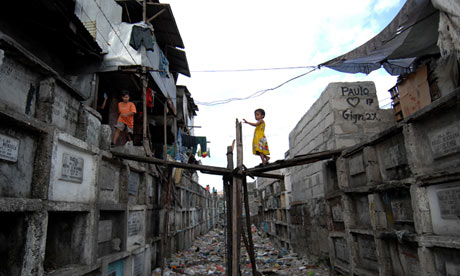
Evangelista lives and works in the Cementerio del Norte, a sprawling, 54-hectare green space in north Manila that is also home to some 1,000 other families. Here in the Philippines' largest public graveyard, century-old tombs have been converted into stalls selling sachets of shampoo and instant noodles, clothes lines are strung between crosses and car batteries power radios, karaoke machines and television sets. Evangelista's home is a mausoleum housing eight graves. The breezy second storey where the owners pay their annual respects to the dead doubles as his bedroom. "Just look at my view," he says, pointing his cigarette out towards the grave-studded horizon.

Today, the shady lanes are busy with the sundry activities of any normal neighbourhood: a group of boys plays basketball; adults while away the afternoon heat with sodas and playing cards; couples canoodle atop the graves that double as their beds; and women prepare chicken adobo in their mausoleum cafes.

The cemetery's inhabitants rank among the poorest of the poor in Manila, a capital where roughly 43% of the city's 13 million residents live in informal settlements like this one, according to a 2011 Asian Development Bank report. This Roman Catholic country has one of Asia's fastest growing populations and a massive housing shortage – meaning that the urban poor must usually find, build or cobble together housing anywhere there is space: under bridges, along highways, in alleys, perched atop flood channels, or even among the dead.

No one knows exactly when the cemetery became a living village. But many of Manila North's 6,000-odd residents were born here and expect to spend their whole lives here. Gravedigger Steve Esbacos, 52, a muscular man with blue-rimmed eyes, was born and raised in the same mausoleum where he now raises his own four children. "Sometimes I don't like living here, because it's dirty and it smells bad," he says, before admitting that he's never wanted to live anywhere else. "My father is buried just over there and I don't know where else I'd go."

Ramil and Josephine Raviz run a stall selling instant noodles and peanuts to residents and mourners. They earn enough money to send their 10-year-old daughter to school, and say they prefer life here to the possibilities "outside" the cemetery's four walls.

"When I first came to Norte 30 years ago, there weren't so many families here – it was quiet and peaceful and safe, very different to the outside slums in Manila," says Ramil, 46, in his mausoleum housing a fan, fridge, rocking chair, microwave, blankets and mattresses, and six graves. "But once people realised they could work here and live here for free, they moved in."

The cemetery hasn't retained that peaceful aura. Robberies and muggings are common, residents admit, with gangs said to be working different corners of the sprawling greenery. Youth unemployment is high and alcohol cheap. City authorities have repeatedly threatened to evict those living here. But grave-dwellers have found a way to stay on despite the pressure, using ad-hoc "deeds" from the families whose graves they maintain, allowing them to live and work on-site.

The issue is not so much people living in the cemetery – where quarters can be more spacious and cleaner than in a shanty on one of the city's easily flooded riverways – but the fact that Manila is not properly addressing the needs of the urban poor, says Father Norberto Carcellar, director of Philippine Action for Community-Led Shelter Initiatives. "Poor people can pay as much as four times [the normal rates] for electricity and water in their shanties because mafia syndicates take over and they have no choice but to pay [the higher rates]," he says.

"These people are 'invisible' – they can be evicted at any time, they face floods, they live on the periphery and the government generally likes to send them very far away to other provinces [to deal with the problem]."

Under a $1.2bn (£800m) government mandate to clean up Manila, that may soon change. Recent official figures show 104,000 families live in danger areas such as graveyards and riverbeds, and the city aims to move 550,000 of the most vulnerable residents to safer destinations. Some will be residents of Manila North, yet no one in the cemetery seems ready – or willing – to go.

"I often think, what would have happened if I had finished school," Evangelista says quietly as he navigates the steep ladder from his open-air verandah back downstairs into the main mausoleum. "I only made it to third grade. Maybe I would have had a better job to live somewhere else." As he knocks on the solid mausoleum walls, he says: "This is the best house I've lived in; the strongest, safest, with the best view."

Friday 24 May 2013

http://www.guardian.co.uk/world/2013/may/23/philippines-cemetery-urban-poor-home

continue reading

BGMEA evades paying wages of deceased collapse victims

The garment factory owners have said they would not pay the wages of the dead victims of the Savar Rana Plaza collapse.

Bangladesh Garment Manufacturers and Exporters Association (BGMEA) has claimed that the money that the prime minister has started distributing among the families of the dead victims included the wages.

“We think that [prime minister’s compensation] is enough. If the family members of a dead garment worker get the money, it is a huge relief for them,” said Md Abdul Ahad Ansary, chairman of the BGMEA standing committee on labor education and welfare.

He also claimed that disbursing the package was a government decision.

However, Mikail Shipar, secretary of the labour and employment ministry, yesterday told the Dhaka Tribune that the money disbursed from the Prime Minister’s Relief and Welfare Fund did not include the wages.

“This is a grant from the premier, not a compensation. The BGMEA has no connection with this,” he said, adding that the fund comprised of contributions from different organisations and individuals.

The Prime Minister’s Office (PMO) is supposed to pay financial grants worth Tk200,000 to each of the families of the 1,127 dead victims of the April 24 collapse of Rana Plaza that housed five factories.

The PMO has so far handed over grants to the families of 221 dead victims.

The BGMEA has already paid each of the 2,614 workers, who survived the deadly collapse, minimal compensation packages that included their outstanding wages.

It said it would hand over the payment to the few remaining survivors very soon.

Meanwhile, the fate of the workers reported missing since the tragic collapse, hangs in the balance.

Authorities have so far buried a total of 291 unidentified bodies at the capital’s Jurain Graveyard and samples of all of their DNA have been preserved, even though relatives had reported that 304 workers were still missing.

Relatives of the missing ones have so far filed a total of 134 general diaries (GD) with Savar police station.

The GDs are to serve as documentation for their compensation claims.

Whether their families would get the prime minister’s grant would totally depend on finding out their identities by matching the DNA samples with those of the relatives.

BGMEA officials said after the DNA test reports are finalised, they would prepare a final list of the missing ones which would then be verified by district administrations and police.

They, however, assumed that most of the missing victims were not garment workers; rather staff who worked at the building.

According to sources from Dhaka Medical College Hospital, conducting all the DNA tests would take at least two more months.

“It will take more time. We do not know when the families of the missing victims will finally receive the wages,” said Md Rafiqul Islam, joint secretary (labour) of BGMEA.

Kamrul Hasan, upazila executive officer of Savar, said: “We will match the DNA collection list with the missing victims’ list to prepare a final list.”

Friday 24 May 2013

http://dhakatribune.com/labour/2013/may/24/bgmea-evades-paying-wages-dead-victims

continue reading

5 officers killed in helicopter accident in Venezuela


Five officers from Venezuela's Bolivarian National Police (PNB), members of the crew of a police helicopter, were killed Thursday when their aircraft crashed in western Caracas during an operation to rescue two kidnapped engineers, official sources said.

PNB Director Luis Karabin said that the accident occurred Thursday morning at 7:30 local time (1200 GMT) in the highway Mamera-El Junquito, in a sector called El Naranjal, in the western region of Caracas.

The cause of the crash was not immediately clear, but Karabin cited weather conditions. Some versions said the helicopter suddenly fell after crashing against high voltage cables.

Karabin said all the members of the crew died, including the pilot, the copilot, one technician and two policemen, adding local forensic team arrived at the accident's site to remove the bodies, according to judicial procedures.

He said that the helicopter was supporting the land policemen during an operation to rescue the two engineers who were kidnapped by several criminals from the state-owned electricity company Corpoelec.

He added the criminals were running away with the two engineers in a Ford Power vehicle and at some point in Antimano sector, a shooting between policemen and the criminals occurred.

During the operation, one of the criminals was shot and two escaped towards a wooded area, while the two engineers were rescued, said Karabin.

One house was affected by the spiral of the helicopter model Bolkow Bo 105 blue, which destroyed the ceiling and part of the kitchen, said Karabin.

Friday 24 May 2013

http://www.shanghaidaily.com/article/article_xinhua.asp?id=143619

continue reading

Nigeria: Ancient tree tragedy in Imo State


[Updated: see post] This is not the best of times for Imo State and its people given the harvest of tragedies recorded in the state recently. The most recent is the ancient ancestral tree that fell in Umudagu, Ihitte Isi Mbieri community, Mbaitoli local council area of the State late Thursday night of May 16, killing no fewer than 50 people, with a yet to be ascertained number critically injured. The tall tree known as Osisi Ukwu Uko, collapsed on buildings as well as those transacting their businesses in a market located under the tree.

Vanguard Metro, VM, gathered that the collapse of the tree followed a heavy torrential rain that was accompanied by a ferocious windstorm and thunder. The devastating rainstorm, which started at about 6pm on the fateful day, continued throughout the night and spilled over to the morning hours of Friday. It was also gathered that most of the victims were either traders, who were selling their wares in the market, their customers, some passers-by and others who were taking shelter in the town hall building and the surrounding houses.

Lamenting over the ugly incident, the former state chairman of Peoples Democratic Party, PDP, Chief Marcellinus Nlemigbo, whose ancestral home is a shouting distance away from the tragic scene said "the incident is most devastating and has thrown the entire community into deep mourning".

Continuing, Nlemigbo said: "The tree was a symbol of the community and no living person in our community can fully narrate the history attached to the tree. The tree had always been there until yesterday (Friday night)".

While debunking the rumour now making the rounds that the tree had fetish attachments to it, Chief Nlemigbo, however, expressed unhappiness that some elders in the community had severally resisted earlier arrangements to fell the tree. He said he was not at home when the incident occurred and was only told about it through the telephone and had to rush home to assist in evacuating the casualties.

"I am aware that the tree provided a natural canopy for people. There is also a market set up by our ancestors in the place, which was sustained till date. There is also the likelihood that some people must have run into the town hall building to take shelter. So, the casualty figure can be any person's guess," Chief Nlemigbo said.

He, however, recalled with grief that when some parts of the tree were trimmed about 20 years ago, the two individuals, who were engaged to execute the job, died unexpectedly after about a week, adding that this lent credence to the belief that the gods residing in the tree had been angered.

Some villagers around the scene confirmed to VM that a middle aged mad woman had May 14, 2013, warned the traders, who usually sold their wares close to and under the tree, to relocate from the place soonest or be prepared to face the looming but unpleasant consequences.

Obviously, the villagers ignored the advice, especially as it came from a mental patient!

Most sympathisers could not help but join close relations of the dead in a chorus of wailing and lamentations the scene of the tragedy. This was while joint rescue operation from patriotic and sympathetic Umudagu youths, Nigerian Security and Civil Defence Corps, NSCDC, the Fire Service, policemen and men of the State Emergency Management Agency led by the Executive Secretary, Mrs. Uche Ezeonyeasi was on to evacuate the dead and the injured, and restore a semblance of order at the place.

A lot of credit must be given to Mbieri youths who came out in their numbers, defying the uncertainties of the dark night, the devastating torrential rain, lightening and thunder, to assist their dying relations and friends.

But for the determination and patriotism of these youths, more people would have died, even as it is being speculated that the death toll may have increased in view of the severity of the injuries and the distance from the scene of the incident to the Federal Medical Centre, Owerri.

Some people willingly made their private cars available for the evacuation of the dead and injured. Some were seen giving first aid to the victims of the tragedy before they were taken to the hospital. The eventual arrival of government's emergency team added some fillip to the efforts of the youths.

Meanwhile, the lifeless bodies of the victims, most of which are yet to be identified, were deposited in morgues, including the Federal Medical Centre, the State Specialist Hospital and Aladinma Hospital, all in Owerri.

But the tragedy is one that will haunt the villagers for a long time. The picture was gory. Human limbs scattered all over the place. Although rain water washed away the blood coming from the dying people, traces of human blood and stench can still clung to the scene.

For the people, it was a colossal loss of life and property. Their prayer is that such should never come the way Umudagu, Ihitte Isi Mbieri.

Friday 24 May 2013

http://allafrica.com/stories/201305230850.html?page=2

continue reading

Drones: The future of disaster response


First responders to Monday's massive tornado in Moore, Oklahoma, were greeted with a blighted expanse of destroyed homes, blocked roads, downed power lines and a limited window of time to unearth survivors before the sun set.

Navigating the area on foot or by car was a challenge because of the debris. News and law-enforcement helicopters filled the air above, but while they gathered useful information for rescue crews, the noise they created was drowning out cries for help from trapped survivors.

The entire area was declared a no-fly zone.

But one airborne technology will soon make responding to these kinds disasters easier: unmanned automated vehicles (UAVs), more commonly called drones. These portable, affordable aircraft can launch quickly in dangerous situations, locate survivors and send data about their whereabouts to responders on the ground.

There is a lot of excitement about drones in the public-safety world, and they are very close to being used in the field after natural disasters. However, they still face lengthy regulatory hurdles, privacy concerns, and a public image problem inherited from their armed, military cousins.

Still, the UAV industry and emergency responders are preparing for the day when they can launch drones after tornadoes, earthquakes, hurricanes, floods and any other disaster.

"The public just isn't really in the habit of depending on them," said James Stuckey, CEO of Fireflight, an Oklahoma-based drone company. "When they start, they won't be able to do without them."

Drone power

The benefits of drones in an emergency are reach, speed, safety and cost. When there is no power, a UAV can fly through the dark and live-stream night-vision footage to people on the ground, its paths automatically programmed so it doesn't miss a spot. A mounted infrared camera can pick up on heat signatures of bodies, pinpointing the locations of survivors so rescuers know where to go.

Unlike manned helicopters, drones create very little sound and can even be outfitted with advanced listening devices to pick up hard-to-hear audio. They can go into dangerous situations that would pose a risk to pilots or responders on foot. While helicopter propellers can stir up debris and dust, UAVs weigh as little as three pounds and don't disturb what's on the ground, even when they're hovering just 10 feet above it.

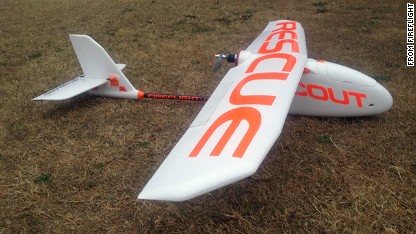
Fireflight's unmanned aerial vehicles were designed to be used in wildfires. They're outfitted with infrared cameras that can see through smoke.

Prices for commercial UAVs range from $15,000 to $50,000 - a fraction of what a helicopter costs. They can fit in the trunk of a car and be up in the air in no time.

"It's usually 45 minutes to an hour after you arrive on scene on an incident before you get real information," said Fireflight's Stuckey, a veteran firefighter of 27 years. "We can have [a UAV] up in the air in three minutes."

Roadblocks to use

The American Red Cross of Central Oklahoma was considering using Fireflight's UAVs immediately after the tornado, but didn't because of the no-fly zone, according to Steve Klapp, the regional disaster assessment manager.

The Red Cross chapter has used UAVs in tests before, such as in a disaster-assessment exercise in March. On Wednesday it considered using the aircraft to gather boundary data at the tornado scene, but Klapp said he would probably end up getting the information from other sources this time.

"We're definitely planning to use them more in the future," said Klapp. "It's a question of the right situation."

The Oklahoma National Guard is also on the ground in Moore and has trained with drones for use in Afghanistan, but said it did not deploy any in the disaster area.

The main delay, according to Ben Gielow of the Association for Unmanned Vehicle Systems International (AUVSI), a non-profit trade association for drone companies, is that the Federal Aviation Administration is very restrictive about who can fly a drone and how they can fly it. Congress has given the FAA until 2015 to come up with rules for flying UAVs in U.S. airspace, including safety regulations, how pilots need to be trained, how an aircraft is certified, and the process for notifying local air-traffic controllers.

Until those regulations are in place, any civilian or military organization that wants to fly drones above 400 feet needs to get a special waiver from the agency. This is a lengthy process that can take one or more years, according to Gielow, although the FAA claims to have shaved it down to an average of 60 days.

There is an exception for emergencies, which would expedite the application process, but it does not appear to be wildly used for disasters.

A life saver

Disaster response is just one use for drones by public safety agencies, which the AUVSI predicts will account for 10% of the future drone industry. Stuckey created Fireflight's unmanned aircraft specifically to help fire departments gather information during Oklahoma's wildfire seasons, the last three of which have been especially vicious.

Thermal-imaging cameras can be used to see through smoke, and the UAVs can go into areas that would be too dangerous for manned aircraft.

One of the first reported cases of a drone saving someone's life occurred three weeks ago. A man was driving along a highway at night in Canada when his vehicle rolled of the road, knocking him unconscious. It was dark, with near-freezing temperatures, and emergency workers were unable to locate the car and injured driver, even with night-vision goggles and a helicopter.

The Royal Canadian Mounted Police deployed an unmanned aircraft with an infrared camera, which picked up on the man's heat signature.

And the types of tools that can be attached to a UAV are growing beyond cameras and weapons. New equipment allows drones to hear gunshots, detect chemical levels, track RFID tags, and measure radiation.

Privacy concerns

The most controversial domestic use is by law enforcement agencies interested in using drones for surveillance and to fight crime, a prospect that has privacy advocates and other citizens on edge. According to Gielow, only three law-enforcement agencies currently have approval to fly drones in the U.S.: The Mesa County Sheriffs office in Colorado, the Grand Forks Sheriff's Department in North Dakota, and the Arlington Police Department in Texas.

Privacy advocates fear the drones could be used for surveillance of anyone. The UAVs track people with the same advanced software being used in regular surveillance cameras.

The Electronic Frontier Foundation has been pushing the FAA to release details on all the public-safety agencies, military and security organizations and other groups that have been given permits to fly drones in U.S. airspace. The civil liberties group has even plotted all the known drone programs on an interactive map.

People in the drone industry don't think a blanket ban on UAVs is the answer to privacy concerns.

"The issue should not be focused on how you take that picture," said Gielow. "You can get the same thing from a manned helicopter, satellite, security camera or smartphone."

Instead, Gielow thinks people should focus on how the government uses and stores images of citizens, not the tools used to capture them.

A booming industry

Many other government agencies are already testing out drones. NASA is using them to monitor hurricanes, NOAA employs them in the Arctic to monitor wildlife and the USGS is using them for mapping and environmental studies.

While public safety and the military get the most attention for drone use, the biggest market for UAVs will actually be agriculture, according to the AUVSI. Up to 80% of drones will be used on farms, where they will track cattle, check on the health and hydration of crops, and even dispense pesticides.

The UAV industry is set to break open in the coming year. According to the AUVSI, the drone industry will create 70,000 jobs and have an economic impact of $13.6 billion in its first three years once the FAA establishes regulations.

Meanwhile, the aerospace industry is getting ready for the potentially lucrative drone age. Twenty-six states, including Oklahoma, are currently competing for six coveted FAA contracts for UAV test sites that will be used to collect more information about how to regulate the technology. The winning states will be announced later this year.

Silicon Valley also is paying attention. Earlier this month, a startup called Airware that's developed an open operating system for UAVs raised $10.7 million in investment funding. Most of Airware's customers are in countries like Japan and France, where the technology is more wildly used.

Friday 24 May 2013

http://whatsnext.blogs.cnn.com/2013/05/23/drones-the-future-of-disaster-response/?hpt=te_r1

continue reading

19,000 children missing in Colombia


Some 19,000 children are missing in Colombia, authorities said Wednesday. More than 4,000 unidentified remains of children have been found in mass graves and are being identified.

The identification process of the 4,210, which is aimed at “ending the pain and uncertainty” will be carried out by Colombian family welfare institute ICBF and the national coroner’s office.

“We know that to identify the bodies of these children is a major technical challenge that requires time and thoroughness, but we also know that it helps the families to mourn and to heal this deep wounds is a priceless achievement, both for them and for the country,” said Carlos Eduardo Valdes, director for the Institute of Forensic Science.

According to Valdes the remains found belong to victims of violence, who went missing, were displaced or ended up recruited by illegal armed groups involved in the country’s armed conflict.

ICBF director Adriana Gonzalez said that the identification process contributed to the right to truth for the victims of violence and ended the phase of uncertainty and guilt for thousand of families.

This identification process represents a new phase in the decade-long cooperation between ICBF and the coroner’s office that claim to provide “a solid contribution to the construction of historical memory and reconciliation.”

According to the coroner’s office public database on disappeared persons, 50,000 people are still registered missing.

Friday 24 May 2013

http://colombiareports.com/identification-of-4210-children-skeletons-to-offer-truth-and-reconciliation/

continue reading

Despite 18 reminders, cops are yet to dispose unclaimed bodies in Sion


Even after 18 reminders from the civicrun Lokmanya Tilak Hospital at Sion, the police have not yet disposed three unclaimed bodies lying in the morgue over three months.

With two mortuary attendants suffering from tuberculosis and many others falling ill often, the head of the post-mortem centre says that the staff are exposed to infections due to these decaying corpses.

A government regulation clearly states that unclaimed bodies must be disposed of after seven days, unless required for solving crimes, or if the police have clues which make identification possible. According to the hospital, however, police tend to wash their hands of a body once it's sent to the morgue.

"It's the responsibility of the assistant commissioner of police to ensure that police stations under him dispose unclaimed bodies in time. But the police simply don't bother," said Dr Rajesh Dere, who heads Sion hospital's PM Centre.

The body of a 35-year-old Bangladeshi woman has been in the morgue for 122 days, and the Manpada police from Dombivli have not come forward to dispose it.

The second unclaimed body is of a man identified as Ravi Kanse. It has been there for 123 days, and the Vakola police have not turned up so far.

The body of 50-year-old man identified as Ramesh Dudani has been there for 80 days, and the Antop Hill police are yet to do the needful.

"We've written six letters to each of these police stations. We also wrote to senior inspectors, the ACP and even Deputy Commissioner of Police, but to no avail," said Dr Dere.

According to him, these three bodies apart, all other bodies too have been there beyond the permissible time limit. "Almost 99 per cent of bodies have been here for over seven days," said Dr Dere. He added that the morgue has 29 cabinets which accommodate one body at a time, but with five to six more bodies at any given time, they have to somehow cram the bodies in the cabinets.

Experts say that despite being kept in a morgue, bodies begin decomposing after two months. This puts other recently brought bodies at risk of quicker decomposition.

"Also, the staff have to enter the premises over 20 times a day. While the stench is unbearable, the risk of infection is higher due to the bodies kept there for long," Dr Dere added.

Friday 24 May 2013

http://www.mumbaimirror.com/mumbai/civic/Despite-18-reminders-cops-are-yet-to-dispose-unclaimed-bodies/articleshow/20233508.cms

continue reading

Thursday, 23 May 2013

India: Burying unclaimed bodies - The end, with dignity


Reading the third volume of ‘Deivathin Kural,’ S. Sridhar (9840744400) was moved by Paramacharya’s appeal to people to provide a decent burial for unclaimed bodies. “Don’t dump them in burial grounds like garbage. Arrange funerals with basic rituals. Set aside caste, religion, etc.,” he exhorts in the chapter. Sridhar decided on making it his mission and joined hands with Vishranthi, run by Savitri Vaithi. He worked with them for 15 years before starting his own unit, Anatha Pretha Kaingarya Trust, with the blessings of Mahaperiyava. That was in 1985.

The organisations that have tied up with the Trust include Vishranthi, Sai Charan, Aanandam and Kakkum Karangal. Nimmadhi and Premalaya, homes for war widows and the mentally challenged respectively, also approach the Trust.

Unclaimed dead bodies are buried after obtaining police clearance. In the case of orphanages, last rites are performed depending upon the religion of the dead. Sridhar himself lights the funeral pyre, chanting Ram’s name, singing `Raghupathi Ragava Raja Ram’ and remembering Mahaswamigal.

About Rs 1,500 is spent on each cremation and he manages the expenses from the Trust’s funds and personal money. The ash is dissolved in the sea. Some relatives of the departed turn up after the cremation. Sridhar revisits the cremation ground along with the relatives and helps them perform the rites to their satisfaction. He and his wife perform the rites in memory of the dead when they go to places such as Varanasi and Rameswaram. It is worth mentioning that the elderly, living in old age homes, volunteer to donate their eyes after their death.

Sridhar’s ancestors belonged to Nallamoor, about 10 km from Tindivanam. His grandfather was close to Subramania Sastrigal, poorvasrama father of Mahaswamigal. He started an elementary school on the advice of Sastrigal for the village children. Doing social service thus runs in the family. Sridhar’s sons and wife take over the responsibility when he is not around or busy otherwise.

Has he ever regretted? “Certainly not. But I feel a pang when estranged relatives refuse to visit the dying or the dead. With the support of the entire family, I am lucky to be doing this service. Nobody is turned away and no call is ignored.”

It would be appropriate to mention some others, who are engaged in the same mission. Neila, aged 50, has been burying unclaimed bodies from government hospitals for about eight years now, with assistance from her two children. She gets no support from her husband. She even organises programmes on suicide prevention.

Trivikrama Mahadeva, Bangalore, has been doing this for more than four decades now. The Government of Karnataka feted him and the state financial corporation helped him with a van. A flower vendor in Coimbatore, Shanta Kumar, is reportedly doing the same thing – giving a decent funeral to the unclaimed bodies that he picks up from government mortuaries. The efforts of Umar Ali and his friends at Udamalpet, have been appreciated by Dr. Abdul Kalam.

The Chennai-based advocate Venkatasubramaniam’s Jeevatma Kainkaryam Trust, in the name of Mahaswamigal’s poorvashrama mother, is also well known. As regards last rites, Ragavan, a retired Chennai Telephones employee, is offering his Chromepet Gayathri Trust’s services free or at a subsidised rate depending upon the need.

Sridhar has a dream. “I work with Sri Matha Trust in attending to poor cancer patients. The Trust is doing wonderful work but under the present circumstances, it has to send back the terminally ill to their homes. If the Government of Tamil Nadu can allot an acre of land in Tambaram or somewhere close-by, they can be given shelter. The Sri Matha Trust management has already written to the State Government in this regard. I hope there is a positive response.”

Thursday 23 May 2013

http://www.thehindu.com/features/friday-review/the-end-with-dignity/article4742569.ece

continue reading

Savar building collapse: Volunteers haunted by rescue trauma


Mamun was hailed a hero for pulling survivors from the ruins of Bangladesh’s Rana Plaza factory complex but now he struggles to sleep, haunted by the memory of sawing off a young woman’s hand.

“I had never even touched the hand of a woman before but it was the only way to save her and the others,” said the 22-year-old in an interview ahead of the one-month anniversary of the disaster.

“My hand was soaked in blood by the end and I still can’t get that image out of my head.”

A total of 1,127 people died when the nine-storey building collapsed on the morning of April 24 in Savar, a suburb of the capital Dhaka, making it one of the deadliest industrial disasters of all time.

But the tragedy took its toll on others, including an army of volunteers who rescued hundreds but also encountered unimaginable horrors such as bodies decayed beyond identity.

Many of the hundreds of volunteers who spent nearly three weeks sifting through the ruins have reported similar signs of trauma as that experienced by Mamun, who like many Bangladeshis only uses one name.

Mamun, a part-time tailor, risked his life to crawl through a hole to reach three women on the second day of the rescue effort, only to find that a hand of one of them was encased in concrete and she was blocking access to the others.

“She was pleading to me: ‘Please cut my hand’. There was no anaesthetic so I borrowed a hacksaw from the army,” he said.

The army says at least 2,438 people — mostly female garment workers—were rescued, including 968 people who were seriously injured. Many of them had limbs amputated either at the site or in hospital.

The scale of the disaster meant students at a medical college next to the local Enam Hospital had to carry out some of the amputations. Sometimes the operations were done without anaesthetic and howls of agony echoed around the hospital.

The hospital says it has treated around 60 volunteers for trauma, including several medical students.

Trainee doctor Sushmita Nargis said she has been taking anti-anxiety tablets as she tries to cope with the memories.

“At one stage it felt as if the only sound I could hear in my head was of ambulance sirens. They just wouldn’t stop,” said Nargis.

“And then there were those heart-wrenching cries of the amputees and their relatives ... How are you meant to feel when hundreds of patients lie all around you, crying and writhing in pain?”

The volunteers included students, street hawkers and housewives as well as garment workers who were the first on the scene.

Sometimes armed with little more than hammers or shovels, they proceeded to pull out hundreds of survivors whom they could see or hear crying out for help.

Others clubbed together to buy specialist drilling equipment.

The Bangladeshi government shunned offers from the United Nations and elsewhere for specialist help, leaving the army to co-ordinate the rescue effort.

As the days went by, the numbers of survivors fell away and the overwhelming memories that linger for the volunteers are the sights and smells of rotting corpses.

Even when the volunteers did manage to locate survivors, they were sometimes unable to bring them to safety as they were trapped by the debris.

Asma Akter Liza, who donated money to buy a drill after selling some of her books and clothes, fought back tears as she recalled the death of one young woman.

“I came across a girl called Bakul and she held out her hand to me from a tiny hole in the rubble,” said the 28-year-old housewife.

“I held her hand for hours and we talked about everything. She called me sister.

“But in the end we could not save her. She was stuck in such a tiny pocket that it was impossible.

“These days her eyes, her cries for help haunt me all the time. Sometimes I can’t control my tears.”

The trauma has prompted many volunteers to seek counselling or medication as they seek to blot out the memories.

“Every time I go to bed, it feels like I’m in a dark place from where I can’t escape,” said

Mamun. “I thought of going to a mental hospital, but I don’t have enough money.”

Mohammed Badal, who pulled 18 of his fellow textile workers from the ruins, also struggles to sleep.

“Whenever I try to sleep, I end up hearing them crying out to me: ‘Please save me brother, please save me brother’,” said the 25-year-old.

“I sometimes even hear the cries in the daytime.”

Thursday 23 May 2013

http://www.gulf-times.com/bangladesh/245/details/353562/volunteers-haunted-by-rescue-trauma

continue reading

Two more avalanche bodies recovered from Gayari


Two more bodies of Shaheed soldiers, who came under a huge snow slide last year, were recovered from Gayari sector in the ongoing search operation during the last 36 hours.

A spokesman for Inter Services Public Relations (ISPR) said on Wednesday that 131 bodies had been recovered so far while search for the remaining nine was continuing. It may be mentioned that on April 7, 2012, 140 soldiers and civilians of 6 Northern Light Infantry Battalion came under a huge snow slide at Gayari and embraced Shahadat. He said 121 bodies of martyrs were recovered before suspension of Operation Gayari due to winters on November 27, 2012.

After opening of weather and melting of snow, search for the remaining 19 martyrs commenced on April 15, 2013 by employing 228 military personnel and 29 heavy engineering equipment pieces including excavators, dozers and drill machines. It is once again reiterated that these sustained efforts would continue till recovery of last man, he concluded.

Thursday 23 May 2013

http://www.thenews.com.pk/Todays-News-13-23042-Two-more-bodies-recovered-from-Gayari

continue reading

Train crash simulation for Emergency teams in Lincolnshire to test their readiness for a real-life disaster


Emergency teams in Lincolnshire this week simulated a train crash, to test their readiness for a real-life disaster. How did they cope with the panic, chaos and casualties?

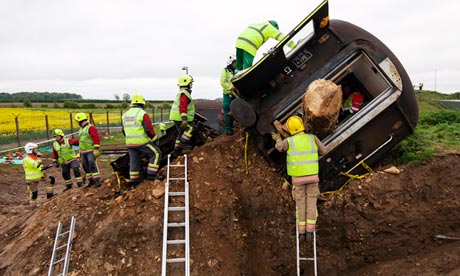
The collision occurred at 8.22am. A three-coach train on the east coast mainline hit a trailer being pulled by a tractor. Two of the coaches careered off the tracks, one landing on its side, the other ending up titled at a crazy angle on an embankment. We got there minutes after the impact to see smoke and hear the cries of the passengers in the one carriage still left on the tracks. The passengers in the other two carriages were too traumatised to make much noise.

Until 8.22 it was an ordinary Tuesday morning in rural Lincolnshire. The big sky was slate grey and threatening rain; the rapeseed fields around the crash site swayed in the breeze. The one discordant note was struck by the Classic Cuisine van (hot dogs and burgers £3.80) parked in a field next to the crash site. A couple of hours later the van would be surrounded by hundreds of exhausted emergency staff as they tried to cope with Lincolnshire's biggest ever rail disaster.

Or should that be pseudo-disaster? A train had been derailed, and half an hour after the crash, in a bizarre secondary accident, a lorry looking for a way out of the traffic jam caused by the derailment hit a school, killing and injuring dozens of children and causing a chemical spill that threatened the village ("It's like Casualty," says one observer). But while the police, the fire and ambulance crews, the voluntary agencies, the rescue helicopters that descended on the scene were playing it for real, none of it is real. It's an exercise designed to test how the emergency services would react to a multiple catastrophe.

Lincolnshire takes these exercises very seriously. Every county has to have a disaster plan and to test disaster planning, but most do it using models. Lincolnshire, which two years ago simulated a coastal flood, does it for real – or as real as they can make it. "We have a good track record for realistic exercises," says David Powell, head of the joint emergency management service, who has been planning this week's disaster for nine months. "You test an awful lot more when the blue lights have to turn up, and suddenly they have to talk to each other."

Powell says only a real-time exercise can test the "buggeration" factors – unpredictable elements that no tabletop simulation can anticipate. This one, codenamed Exercise Georgiana (named after a woman killed in a rail disaster in Grantham in 1906), will involve more than a thousand people and last for three days.

The degree of realism is tempered by the fact that all the agencies know what is going to happen and when, though some of the finer details are left sketchy, and Powell reserves the right to introduce "injects", rogue elements he hasn't briefed the participants about. There are also the buggeration factors that no one can anticipate, such as the suspect package found near the school that causes the exercise to be suspended for 10 minutes just in case a real-life explosion is about to occur.

The disaster occurs at a training facility next to RAF Waddington a few miles south of Lincoln – the sort of place where you can crash a train without too many members of the public tweeting about it – but the real site Powell and his planners have in mind is Claypole, a village 15 miles away, which is on the east coast mainline and has a level crossing. The residents have been told their village is about to have disaster visited on it, and many have volunteered to play the part of walking wounded and distressed relatives at a survivor centre that, within a couple of hours of the train crash, will be improvised in the village hall.

The first thing that strikes you at the scene of the crash is how long it takes to get people out of the carriages, even the one that's upright. "There are people dying in here," one of the injured shouts through the window. But still the initial wave of emergency personnel stand around assessing the situation, deciding on a plan of action, establishing priorities. "Health and safety gone mad," wails the Guardian photographer, who looks like he's about to go in alone. He becomes apoplectic when the police start putting tape around the accident scene before getting the injured off the train. I start to fear there could be a real disaster.

Tony Rouse, one of the umpires for the exercise, points out that the power is still on, and the overhead power lines are probably on the ground – any crews trying to effect a rescue would be in danger of electrocution. "If you start losing paramedics, you exacerbate the situation," he says. "It's pointless them being casualties themselves. The whole operation would grind to a halt." He says it could be up to an hour before the casualties are treated. Don't they become hysterical? Surely the people on the train must be baffled by what's going on? "There is conflict," admits Spencer Creek, technical response manager for Lincolnshire fire and rescue, "and that conflict creates problems for responders and casualties. We have to measure the risk, and the risk mustn't outweigh what we're trying to achieve."

Some of the local people who have volunteered to be injured for the day are impressively stroppy about the long delay in providing treatment. "There's a guy in here who can't breathe," shouts one. "Can't one of you blokes who's standing around doing nothing come and help?" Others, though, are less realistic. Staying in character for hours is difficult. Sometimes these exercises are done with trained actors or volunteers who have role-play experience. Powell says that for this exercise they mostly preferred to use local people, including a group of local volunteer first responders, as a way of engaging the community. But I suspect there may also have been cost factors – this is a cheap way of getting bodies – and can't help thinking greater verisimilitude, more hysteria, a greater sense of panic would test the emergency services more.

I feel that even more strongly when I see Georgina Minter playing her role. Minter is one of the dozen or so pros that Lincolnshire has shelled out money on today – all members of Amputees in Action, men and women who have lost limbs and now make themselves available for simulations such as this. They have been made up so their severed limbs look ultra-realistic. Add Minter's Oscar-winning performance as a woman outside the school that has been hit by a lorry – "Where's my baby?" she keeps screaming to a paramedic who looks increasingly shellshocked and who eventually says, "Let's get her out of here, no niceties with this one" – and the test takes on a new dimension. Minter, who four years ago lost both her legs and a hand to necrotising fasciitis, suddenly makes you feel this is more than just a dry run.

"Our role is to rattle the emergency services out of their training mode, put them off a little bit and make them think outside the box," says Karl Ives, Amputees in Action's supervisor for the day: "We want to put a bit of stress on them."

"We're also desensitising them for when it happens for real," adds Lyndsay Adams, an amputee who starred in the Paralympic opening and closing ceremonies and who is today playing the headteacher of the school devastated by the chemical tanker. "They won't have seen it in real life, but this is as real as we can make it."

Dr Peter Holden, a GP who is working here today as a medical incident adviser, has attended three real-life disasters: Hillsborough, the bomb in Tavistock Square on 7/7, and the house explosion in Newark last Sunday. He accepts a test such as this can never quite mimic the real thing – "If this was real, you'd be looking at real blood," he says simply – but reckons the management challenges are the same. "What this does for those who've never really had to do it is make them realise that the first hour is utter chaos, the second hour is organised chaos, and the third hour you begin to go in the right direction."

Holden's role is to prioritise casualties. The paramedics bring them to him with their assessment, and in the space of about 30 seconds he then has to classify them as priority one, two or three. Priority one go straight to hospital; the rest, even those with bloodied faces and broken bones, will have to wait. The people who were getting stroppy on the train two hours ago are now getting stroppy all over again, wondering why they've been parked in a field. A group of boys from Newark College are shivering under blankets after being decontaminated following the chemical spill. One says his nose has been bleeding (in theory, you understand) for two hours. "I'm going to die of a nose bleed," he moans.

"The hard thing for all clinical staff is that in a major incident, you turn everything on its head," explains Holden. "You are doing the most for the most. You can't get stuck in on the first person on the scene. What we've got here is a large number of casualties, many with very serious, life-threatening injuries, who have been stabilised, resuscitated and now have to be shipped out. But we also have all these other people with quite significant injuries who are less serious, and our job there is to stabilise them and feed them into the medical chain so that the medical chain doesn't get indigestion. You will notice that I've ruthlessly kept the walking wounded here. The priority one people will die within minutes, whereas they will take days." You will not die of a nosebleed in two days. The young lad should be fine until at least the weekend.

Over at Claypole, the survivor reception centre is in full swing. The Red Cross is registering the walking wounded and the traumatised as they are brought in and offering first aid. Reassuring women from the Royal Voluntary Service are serving tea and custard creams – the essence of English stiff-upper-lipped fortitude. Local resident Claire Simmonds is playing a woman who believes her elderly parents were on the train and is giving the man from the rail company a hard time over the lack of information she is receiving. Mike Freeman, a volunteer with the Lincolnshire Chaplaincy Scheme, is offering support and trying to keep her calm.

Bang! Mark Bedford, playing a diabetic who was on the train and has lost his insulin, faints, falls off his chair and hits the floor with a resounding thud. If Minter takes the best actress award, Bedford must get best actor. This is one of several identities Bedford was issued with when he reported for volunteer duty. In the morning he had been Mr Disruptive. "We were putting pressure on people really," he says. "It was entertaining. There was a lady from Germany who couldn't speak English. I had the idea of using Google translate to help her."

He says for the most part it worked, but did at one point translate "Where is my brother?" as "Do you need your bathroom repairing?"

Meanwhile, in Lincoln, a strategic command centre has been established in a former nuclear bunker at the county's fire and rescue HQ. There are three levels in the command chain: bronze command – the emergency services on the ground; silver command – a large room at the bunker filled with "cells" dealing with big-picture issues such as logistics, the environment and the media; and gold command, where strategic policy is laid down by 40-plus key people from the 20 or so agencies dealing with the disaster.

I attend the three o'clock meeting, chaired by Chief Inspector Paul Gibson, where they assess how the casualties are being treated, whether Claypole should be evacuated because of the chemical spill, how they will cope with the chaos at local stations (the east coast main line is closed and they are expecting agitated commuters to fight to get on to buses), and when casualty figures should be released. Karen Spencer, the council's strategic communications manager, is desperate to get some figures out – Twitter, like nature, abhors a vacuum and will not be slow to guesstimate figures, she argues – but Gibson is reluctant until they are verified. Their standoff adds a nice moment of drama.

Spencer tells me after the meeting that emergency personnel have to realise the social media revolution has changed the nature of disaster management. "There are so many members of the public with smartphones that people will be tweeting photographs and information immediately," she says. "We are hours and hours late in response. I can only say it so many times. I almost strangled the woman chairing the earlier meeting."

There are tensions between competing parts of the emergency jigsaw: the police are cautious and inherently hierarchical; the council is more used to collective decision-making; its media staff are inclined to be as open as they can in releasing information. Simon Burgess, the council's strategic communications officer, says a key part of the exercise is to highlight these tensions. "No one should be worried about failing," he says. "That's what it's all about – identifying problems. Everything is recorded; everything is minuted; and in the end, in about two weeks' time, we'll be looking at everything – what worked, what didn't work."

By late afternoon, a press statement has been released saying eight people have been killed (I've been tipped off the number of dead will more than double on succeeding days); the police are advising people to "stay calm"; the fire service spokesman clunkily refers to a "protracted ongoing incident". Back at Waddington, the casualties have been freed from the train and the wrecked school, the stroppy walking wounded and the young man with the nosebleed have gone home, and an eerie silence has descended. Two bigwigs from gold command assessing the situation after day one – day two will see the start of the search for the body parts scattered across the site – look content. Given the scale of the catastrophe, it hasn't been a complete disaster.

Thursday 23 May 2013

http://www.guardian.co.uk/society/2013/may/22/how-would-you-cope-rail-disaster

continue reading

Zimbabwe mass graves: Horror tales from the war


66-year-old Rangadza Machiha narrates the “worst” years of his life. It is a period that he rarely wants to talk about. For him it was a time of trouble. A time spent burying dismembered bodies, cleaning and taking fingerprints of slain comrades, digging and dumping their bodies in shallow graves.

“Nhau dzerufu hadzinakidzeka idzi mfana. I was tortured, electrocuted and was put in leg irons and handcuffs for nearly three months. I want to appeal to people to remain united so that this is not repeated. It was a painful experience. Let this be history and never to be repeated. That is my appeal to the people of Zimbabwe,” Mudhara Machiha pleaded.

One thing that is true about the old man is that he still can relate his ordeal at the hands of the Rhodesian security forces 34 years ago like something that happened a fortnight ago. Indeed, that has left a deep scar in his life that he cannot wish away.

It was the war of liberation. The enemy had declared that blacks would never rule the country and was prepared to go to any length to prevent an independent Zimbabwe. The Smith regime was brutal. It left a trail of sorrow in the African family fabric. Many despicable things happened. Let’s continue to tell the tales of our liberation struggle.

Arrested at the height of the liberation struggle after the battle of Rombwe in Rusape on December 28, 1977, Machiha with others were taken to the notorious Rusape Selous Scout Camp.

“On arrival he was covered in a black sack and taken to a room for interrogation. In the room there were pictures of nationalists like Cde (Josiah) Tongogara, President Mugabe and others. These had a wanted dead or alive tag above their heads. A huge reward was placed on their heads,” he said

“I still remember that among those arrested was a freedom fighter, Cde Gafa Tichatonga, who denied knowledge of me. If he had said he knew me I could have been history by now. I was put in leg irons and tortured.

They connected electricity to my male organ and one toe. I cried and thought I would never sire a child again. This was to become a daily occurrence for the next three months,” he added.

Mudhara Machiha was only freed from the leg irons when a relative who was in CID saw him.

Pained by his condition, the policeman oiled the locks that were now rusting and unlocked the shackles. From then on he was to join those who were burying bodies at Castle Farm.

“At the burial site we had to quickly dig the shallow mass graves and cover the bodies as the soldiers who accompanied us feared attacks from the freedom fighters. The numbers differed but ranged between five and eight.

One day we buried 26 bodies in a shallow grave and they came from many areas. They were of all ages and sexes. Some had lost their limbs, heads and others torn to pieces.

“I remember freedom fighters were placed in room at the camp. We would be tasked to wash their hands and take fingerprints. Some of the policemen would puff smoke to neutralise the odour from decaying bodies.

It was a bad experience but there was nothing we could do. We had to perform the duties at gunpoint,” he said.

“Dead bodies would be brought from as far as Wedza and Ruwangwe and Nyanga to be buried in mass graves there. They would be carried in four to five trucks for burial a day and we buried them in the vlei just after that little stream in the east of Mabvazuva suburb.”

Among the names of black soldiers who tortured him most at the camp where Sergegant-Major Chisese while other had nicknames like Mbudziyadhura, Komboniyatsva, Tsvotsvotsvo and Chigadziramemba.

“I remember one known as Mari. That man was cruel, he was my tormentor-in- chief,” Mudhara Machiha says fighting back his tears. He was released on August 18 1978.

“They just told me to leave the camp. I moved to Tsanzaguru Township. I still carry the effects of the torture,” he added.

His experiences at the Rusape Selous Torture Camp tally with that of Mbuya Mazano arrested in Rukweza after fleeing the Battle of Tsanzaguru.

“We were tired after running the whole way from Rusape that I and others decided to climb a huge mango tree for cover. The homestead had a lot of such trees and it was easy to find cover in them.

It was unfortunate that a group of soldiers passed below the mango tree and two of decided to sit under the tree to rest. Because of fear, one of us fell from the tree alerting the soldiers.

“She had blown our cover. The soldiers forced us to climb down the trees before force marching us to St Baduwa where there were people who had been shot dead. We were told to climb into the trucks with the bodies and to sleep alongside the dead bodies.

At road curves blood would spill out of the trucks but we had to remain quiet fearing we would be shot,” she said.

On arrival the bodies were first dumped next to their tent at the camp before being reloaded again for burial at the “butchery”.

“We were forced again to get on the trucks for a makeshift court at the butchery. In the makeshift court there was an electric stool where prisoners of war were forced to sit while being interrogated. The soldiers would drop burning plastics on your naked bodies.

“I did not have to sit on the hot stool as one black soldier shouted; “Ibhebhi rakanaka ndiri kurida usaripise”. That was how I was spared the torture and imminent death at the butchery. Unfortunately, some of my friends who were on the truck with me were tortured and later executed.

They were put in black plastic and buried here,” she said.

Unfortunately for Gogo Mazano that was the start of worse things to come. She was to stay at the camp with soldiers taking turns to rape her. They would move around with her as their sex object.

“Imagine being raped by more than 10 people a day. If you failed to please them they would severely assault you. At one point I fell pregnant but I was beaten till I lost that pregnancy. I was admitted at hospital for nearly three months.

On discharge they came and took me back to the camp. I was only released during the ceasefire in 1979.

“It still haunts me today. It is disheartening that these people have gone scot free and are still unrepentant,” she said.

She recalls some of her tormentors were still alive but most had left the area after independence. Another victim of Rusape Selous Scout Camp Gogo Regina Doto said she was picked in Vhengere Township by a group of auxiliary troops on their way to Chiwetu Rest.

“On arrival at the rest camp, a black cloth was tied on the faces of all the ‘prisoners’ so we would not see what was going on in the camp. Before they had started interrogating us there was the sound of gunfire and so we were again bundled into the trucks and driven to Rusape Selous Scout Camp. On arrival red cloths were tied around our eyes so that we could not see our tormentors. It was also a sign that we had to be executed,” she said.

“Whilst the Rhodesian soldiers were still contemplating what to do with us, the spirits smiled on us and they the camp was attacked by the guerrillas. The Rhodesian troops scurried for cover in the holes at the camp leaving us to face the fire.

“We took advantage of the commotion and ran for dear life back to Vhengere. That is how we survived the camp. It was only towards end of the war that the Selous Scout came to take part of the suburb to Castle Camp. It was painful to see skeletons with shoes on, functioning watches in hand but with no flesh.

“They boasted that they had killed so many. I remember one of them saying there are thousands of your brothers here. They took us to a pit near that hill where we were shown hundreds of decomposing bodies that were to be burnt.

“You see that pit, it used to be deep and that is where most of your brothers and sisters’ bodies were burnt. As they drove away, blood would spill from the trucks along the way and it was a sad sight,” she said.

“At that time, blood of the people who had been killed at the execution site flowed down the slope. There were pits everywhere in this area with bodies of people who were forced to dig their own graves, before being shot and buried there,” she said.

Thursday 23 May 2013

http://www.herald.co.zw/index.php?option=com_content&view=article&id=79421:horror-tales-from-the-war&catid=42:features-news&Itemid=134#.UZ1kDYdzA34

continue reading

Cleveland Police use UK Missing Person's Bureau website to identify unresolved cases


Cleveland Police is seeking the services of the UK Missing Person’s Bureau in identifying two outstanding missing people on their records – the oldest dating back to 1970.

Now police also want any information from anyone local on Teesside who can help.

The UK Missing Person’s Bureau was created in April 2008 and forms part of the national operational support to police forces.

Part of their work includes a police service-wide review of the number of bodies and body parts that remain unidentified and enables police forces to call a central team to match details of current or historic missing people with information held on their database.

The bureau helps determine where additional forensic techniques could be used to try to bring resolution to a family about the identity of a person, and is now utilising its website to specifically publicise unidentified bodies in the form of a searchable list of cases.

The two outstanding cases which Cleveland Police hold relate to a body (age and sex unconfirmed) washed up on the beach at Redcar in 1970 and a man found in woods near to the A178 Graythorpe to Seal Sands Road in Hartlepool in 1981.

The body at Redcar was wearing black boots, multi coloured red and fawn socks and a leather belt.

The man in Hartlepool was approximately 20-30 years, 170cm tall, with mousey collar length hair and blue eyes.

He was wearing a blue and navy blue striped jumper, checked shirt and grey corduroy trousers.

The white Adidas training shoes he was wearing at the time had the name ‘SAYER’ written in pen on the inside.

The database can be accessed by anyone via the link www.misingpersonspolice.uk and any suggestions as to the possible identity of individuals can be relayed back to the bureau.

Thursday 23 May 2013

http://www.gazettelive.co.uk/news/teesside-news/cleveland-police-use-missing-persons-4003005

continue reading

Death toll rises to 23, with 10 still missing, in blast at China explosives plant


The death toll from a massive blast at an explosives plant in eastern China has risen to 23 with 10 people still missing.

The official Xinhua News Agency said Wednesday that 19 others were injured by the explosion, which ripped through the plant in Shandong province on Monday.

The blast was so strong that 10 of those killed could only be identified by their DNA. Experts from the State Administration of Work Safety have been sent to the factory and are investigating the cause of the explosion.

China has sought to tighten access to explosives used for quarrying following a series of attacks by people using homemade bombs. However, safety rules are often ignored and industrial accidents remain common.

Thursday 23 May 2013

http://www.montrealgazette.com/news/Death+toll+rises+with+still+missing+blast+China+explosives/8418213/story.html

continue reading