Showing posts with label Memorial. Show all posts

Sunday, 27 December 2015

After 11 years, memories of Aceh tsunami live on


Aceh residents gathered on Saturday in a number of venues across the province to send their prayers to the victims of the Indian Ocean tsunami that devastated the region on that same date, 11 years ago.

At Banda Aceh’s Ulee Lheue mass grave, where more than 14,000 victims of the disaster were buried, local residents alternately visited the area throughout Saturday, to not only pray for the victims, but also to reflect on their stories as survivors.

Many of them also could not hold back their tears as they observed displayed at the grave’s entrance a number of photographs depicting the situation of the region shortly after being hit by the tsunami.

“Time passes quickly, but the sad memory of 11 years ago will always stay with us,” Yenni, a resident of Lambaro Skep subdistrict, told The Jakarta Post.

Despite the atrocious aftermath of the tsunami, Yenni, who lost several family members in the disaster, said she always encouraged herself to move on.

“It is impossible for us to keep mourning all the time, as God still gives us chances to survive,” she said.

Ulee Lheue and Siron Aceh Besar are the two biggest mass graves that the provincial administration dug for tsunami victims. Hundreds of smaller mass graves were also established in other parts of the region.

Like in previous years, Yussi, a Meulaboh resident, used the commemoration of the tsunami tragedy this year to visit several major mass graves in Banda Aceh, as she has no idea about her parents’ whereabouts after the tsunami.

“I don’t know where their bodies were buried. I’m also still hoping that they’re still alive,” she said.

The tremor that measured 8.9 on the Richter scale and the resulting tsunami waves that hit Aceh on Dec. 26, 2004 killed more than 120,000 people and displaced more than 800,000 others.

The disaster, however, also helped end a three-decade separatist conflict that had killed 15,000 people, when the commanders of the Free Aceh Movement (GAM) agreed in mid-2005 to a peace accord signed in Helsinki, Finland.

Last year, a massive government-sponsored event to commemmorate the 10th anniversary of the disaster was held in the provincial capital of Banda Aceh, with representatives from dozens of donor countries and international organizations attending the event.

This year, apart from smaller events held independently by local residents in mass graveyards or mosques, the Aceh Culture and Tourism Agency also organized a series of additional events, including a photo exhibition, a seminar and an arts performance, to commemorate the 11th anniversary of the tragedy.

The main commemoration, attended by, among others, Aceh Governor Zaini Abdullah and Banda Aceh Mayor Illiza Saaduddin Djamal, meanwhile, took place in a mosque in Lampuuk subdistrict. The mosquewas among the few buildings that survived the tsunami.

“In every tsunami commemoration, we are trying to spread certain messages to the public, including self-reflection, appreciation, [disaster] mitigation and [tourism] promotion,” agency head Reza Pahlevi said.

27 December 2015

http://www.thejakartapost.com/news/2015/12/27/after-11-years-memories-aceh-tsunami-live.html

continue reading

Tuesday, 6 October 2015

60th anniversary of deadly Wyoming plane crash


John Vandel was a junior pharmacy major at the University of Wyoming when he and his Sigma Nu brothers received a phone call from United Airlines.

It was the morning of Friday, Oct. 7, 1955.

Flight 409 had crashed into the east side of Medicine Bow Peak just 24 hours earlier.

"The guy that called us had been in our fraternity years before," Vandel said. "So, he called our fraternity and said, 'If you get some guys up there, we're going to pay you pretty well.' So, all the guys volunteered."

People were needed to remove the bodies of the 66 people aboard the plane, and Vandel agreed to help.

"It was all curiosity," he said. "We got to go up and see what it was all about."

He didn't know the crash 40 miles west of Laramie was, at the time, the worst air disaster in United States history.

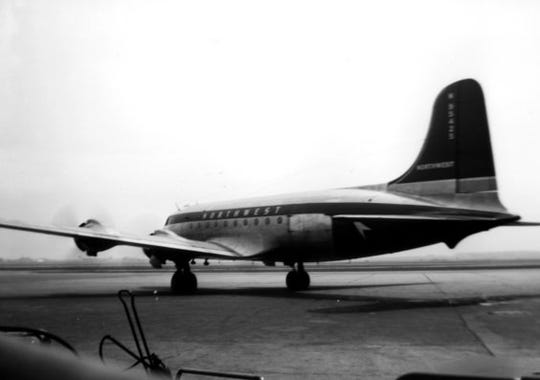
Sixty-three passengers and three crew members sat in the DC-4 aircraft, a four-engine propeller airplane, as it left Denver International Airport the morning of Oct. 6, 1955, with plans to land in Salt Lake City less than three hours later, according to United Airlines documents — just one of many documents about the crash stored in the UW American Heritage Center.

Among the 66 people aboard were members of the U.S. military, choir members from Salt Lake City and two infants.

The normal flight path goes far north of Laramie to skirt the Snowy Range. However, a United Airlines investigation after the crash concluded pilots would occasionally fly over Medicine Bow Peak to save time.

Windy weather as reported over the Snowies the night before the crash, along with possible snowfall — less than ideal flying conditions.

When flight 409 failed to report in to Rock River, fighter jets from the Wyoming Air National Guard were scrambled with orders to find a missing aircraft.

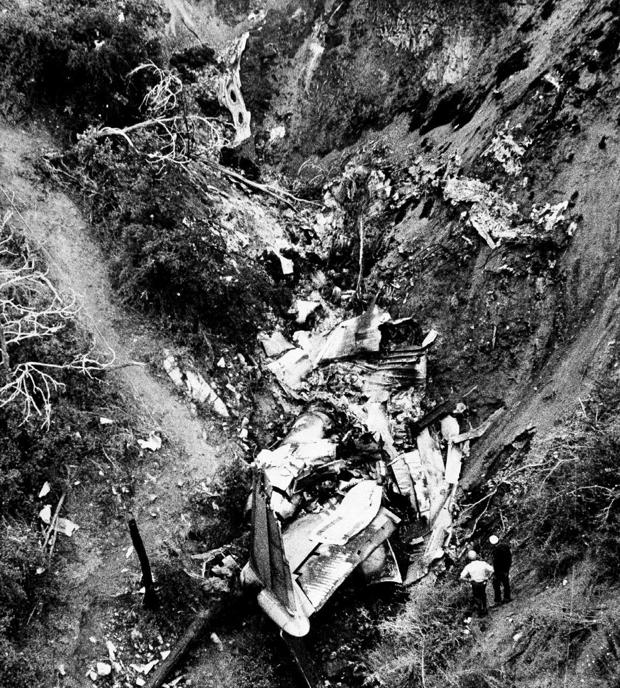
The plane crashed at 7:26 a.m., according to onboard clocks recovered after the crash, the investigation report states. It exploded on impact, creating a debris field about a mile long. Two huge black scorch marks blighted the side of the mountain.

Wreckage and bodies were catapulted over the precipice — the plane hit only 25 feet below the mountain crest. The tail section broke off and lodged itself on a small outcropping halfway down the cliff. The rest of the wreckage tumbled down snowy rocks, coming to rest at the foot of the peak.

The crash was discovered by an F-80 fighter jet based out of F. E. Warren Air Force Base at 11:40 a.m. the day of the crash. The pilot spotted "a huge black smudge where it hit the peak and pieces of wreckage that slid 200 feet down the side of the precipice," an Oct. 6, 1955, Laramie Boomerang article states.

With bad weather still engulfing the crash site, the jets were ordered back to base before more surveillance could be completed.

Bob Foster, a Civil Air Patrol member from Laramie, was the first person to reach the crash site. He recounted his experience during a 1996 interview for the American Heritage Center.

"As we walked along the tail slope of the mountain, we started to run into the wreckage, landing gears and main struts of the wing. And then you look to where we saw the plane crash and you see those airplane parts quarter of a mile away, it's obviously going to be a really bad scene. You don't really expect to find any live people."

Personnel began arriving soon after the crash was discovered — a group of 14 rescue workers from the Denver operating base of United Airlines arrived by plane at 2 p.m. Thursday.

The timing of the disaster couldn't have been worse — more than 1,500 Shriners packed the hotels of Laramie for a ceremony, leaving almost no place to house the scores of United Airlines personnel streaming into the area.

Double cots from the university were brought to the Connor Hotel. Some Shriners also gave up their rooms for emergency workers and airline personnel. More than 125 people were at the crash site by Thursday night.

Only the best mountaineers could reach the peak where a majority of the wreckage was scattered — many of the trails and paths available today did not exist in 1955.

Dr. John Bunch made the climb with airline officials, local law enforcement and reporters to the base of the cliffs above Mirror Lake to treat any potential survivors.

The state of the bodies was such that they could only "be identified only by fingerprints," he told the Boomerang.

The explosion showered the area with wreckage workers had to avoid.

"There were large sections of twisted metal at the base of the cliff, so twisted, in fact, that you couldn't tell what it was," Bunch said. "There were pieces of the plane all over the base of the mountain."

Body bags were brought to the crash site to transport the dead to the bottom of the cliff. A rope-and-pulley system about 900 feet long was created, running from the top of the cliff to the base of the mountain, UW Outing Club member Richard W. Murphy says in a report.

Vandel arrived later that Friday, after the system was set up. He worked the lower end of the pulley system.

"We got a call early that morning and we all skipped class and went up there," he said. "The university excused us."

About 30 people were helping in the area, Vandel estimated, although he didn't know how many others worked at the peak or in the identification room.

UW summer science camp — essentially a log cabin not far from the site — served as a temporary morgue.

"They did all of their identifying in there, and we weren't allowed in there," he said. "In fact, nobody wanted to go in there."

All of the victims were in bags by the time Vandel and his fraternity brothers received them at the base of the mountain — with some bags labeled "spare parts." The group avoided some of the traumatic sights others higher up the mountain saw.

"We were all kind of having fun and joking around in between trips, but it was serious business," he said.

Fifty-seven victims had been recovered from the mountain by the afternoon of the following Monday, a spokesman from United Airlines stated in the Oct. 10 Boomerang. He estimated 125 people were still working at the site.

Members of the University of Wyoming and the University of Colorado alpine teams were working in six-man shifts, searching for and lowering bodies.

By that Tuesday, all victims had been recovered and identified.

While the victims had been removed from the site, wreckage from the large four-engine airplane was still strewn about, from pistons and wing struts to landing gear and propellers. However, the entire tail section of the plane was still lodged precariously in the mountain face.

It was decided the wreckage needed to be destroyed to discourage curious climbers. The solution was to shoot the tail down with a recoilless rifle — similar to a small artillery piece — Don Sims said in a 1996 American Heritage Center interview.

"They didn't want to leave it there because there were so many people crawling around in there," he said. "Do you think that thing would come down? Oh no — it took hit after hit."

Eventually, the wreckage was dispersed, but many pieces of the destroyed aircraft litter the mountain base to this day.

Several theories formed about what caused the crash, but none was confirmed.

Three local loggers were working at a site about 10 miles southeast of the crash, and one told the board the right inboard motor of the DC-4 was not rotating, possibly indicating some sort of mechanical failure.

United Airlines officials said wreckage showed the engine was working; Even if the engine was out, it should not have caused a crash.

The loggers also estimated the plane was at about 10,000 feet — the plane was about 300 feet above the treetops and the camp's elevation was 9,600 feet. Board members said this was "dangerously low," especially for an unpressurized aircraft — passengers would begin to feel ill effects at that altitude.

Throughout the investigation, United Airlines managers in Denver and Salt Lake City said the pilot, Capt. Clinton C. Cooke, Jr., and his first officer Ralph D. Salisburg, Jr, were good pilots with a perfect record. Cooke had flown the route 45 times in the previous year, a Civil Aeronautics Board Accident Investigation Report states, and had never been known to deviate from the flight plan without telling a dispatcher.

However, it is almost certain the pilots purposely went out of their way to fly over the mountains, the report states.

"It is difficult to understand how a pilot of Capt. Cooke's experience would deliberately attempt a shortcut and, even if he did, why he would have flown at such a low altitude over hazardous terrain," it states. "It is true the flight was an hour and 11 minutes late; however, the time saved by taking a shortcut would have been inconsequential."

It goes on to state deviating from the course "would have been breaking rigid company rules and his record indicated that he had never been known to do so."

Carbon monoxide poisoning leading to crew incapacitation was also listed as a possible — albeit unlikely — cause.

Today, hikers and climbers near Medicine Bow Peak can view pieces of the wreckage, although the black scars on the cliff face faded long ago.

Vandel kept a piece of wreckage for many years, he said, and still occasionally thinks about the crash today.

"I kept on wondering, over the years, how the devil they did it," he said. "How did he happen to just run into a mountain?"

Tuesday 6 October 2015

http://trib.com/news/state-and-regional/tuesday-marks-th-anniversary-of-deadly-wyoming-plane-crash/article_1a650b63-9514-5a81-ba37-8777328cd04e.html

continue reading

Thursday, 1 October 2015

Anniversary of Austin Dam disaster today


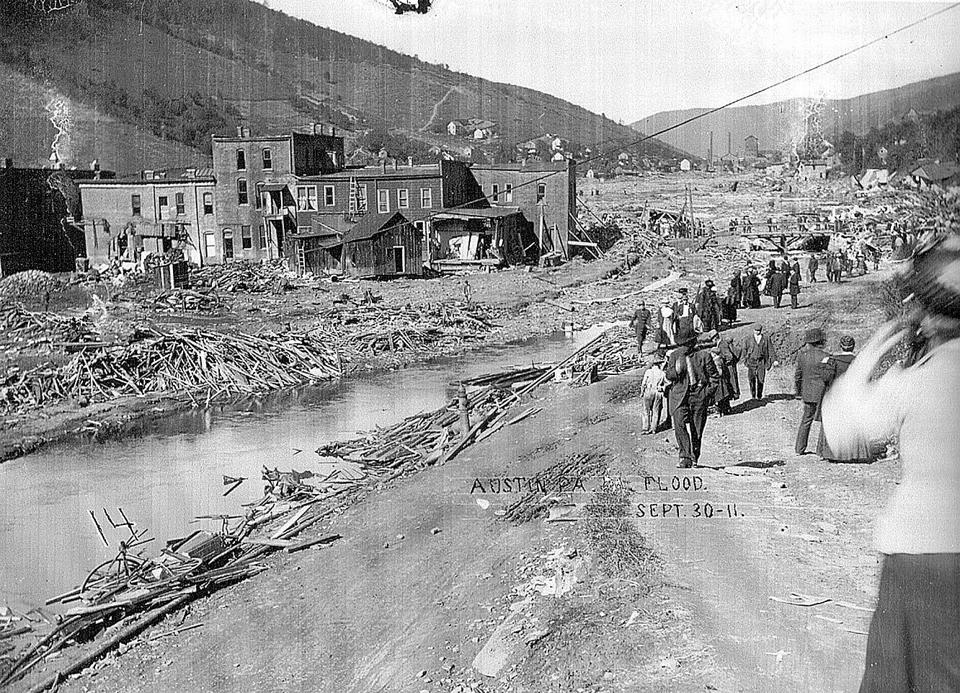
Today marks the 104th anniversary of perhaps the single greatest disaster in the history of this area of the Twin Tiers — the failure of a concrete dam and subsequent destruction of the towns of Austin and Costello on Sept. 30, 1911, in Potter County, Pa.

Pressure from about 250 million gallons of water broke the dam, which was built two years before to supply water for the Bayless Pulp and Paper Co. The dam stood 50 feet high and was more than 500 feet long — it had been dubbed by some as “the dam that could not break.” The water from the dammed-up Freeman Run swept up logs and other debris, creating a grinding wall of devastation. A total of 78 people are officially reported killed in the disaster, although it is believed by historians that more people — possibly traveling businessmen, visitors to the town, lumbermen who had brought in logs to the Bayless Co. — perished in the disaster and their bodies were not found.

Austin was a small city of 3,000 people in 1911.

Indeed, newspaper dispatches even two days after the flood reveal how murky information was in the aftermath, given the communications abilities and the state of emergency management response of that day.

A headline on the front page of the Oct. 2, 1911, edition of the Olean Evening Times (the dam broke on a Saturday; the Evening Times was not printed on Sundays) stated: “Official Count Gives Death List as 250, But Citizens Claim It Will Reach 550.”

Rescuers at the scene expressed certainty that the death toll would be in the hundreds, and it was feared that great piles of debris would have to be burned — along with the bodies it was assumed they covered — because of concerns about disease.

An editorial in the Evening Times read:

“The nation stands appalled at the fearful calamity that has overwhelmed Austin. Not since the fateful Johnstown flood of 1889 has there been such a holocaust of death in a single accident in this country. Coming so close to Olean, this catastrophe brought with a terrible shock to all residents of this city. Many of them had relatives in the stricken city, and many more of them had friends whose safety has not yet been established.

“The suspense here yesterday was poignant, and every additional report but added to the grief of the waiting people. Practically no definite information could be secured and only such news as filtered in from Keating Summit and other nearby places, inadequate in respect to the names of the dead or the survivors, came to relieve their anxiety. But in most cases, this but added to the suspense.

“Everything that can be done to relieve the situation is being done. Nothing that can mitigate the sorrow and horror of the calamity is being left undone. All the necessary medical aid is upon the scene, the homeless people are being placed in the homes of hospitable neighbors, and at present there is food amply sufficient to meet the needs of the sufferers.”

A permanent memorial was dedicated in September 2013 to the people who lost their lives in the flood. The memorial marker, in Austin Dam Memorial Park, is made of light-colored stone with the names of the deceased etched in black upon its face. The monument stands directly in front of the dam as a solemn memorial to those who lost their lives that day.

Thursday 1 October 2015

http://www.oleantimesherald.com/news/article_de892bd6-672e-11e5-9324-13d1c038ece3.html?mode=image&photo=0

continue reading

Thursday, 10 September 2015

Remembering 'The Great Storm of 1900' 115 years later


On a balmy evening 115 years ago Tuesday, the breeze blowing off the Gulf of Mexico became unusually gusty on Galveston Island. Water rose on The Strand and other streets near the port and the weather became so rough some businesses decided to send their workers home early.

Still, nobody suspected the barrier island was about to fall victim to an apocalyptic hurricane that would go down in American history. The city was about to befall a catastrophe at least twice as deadly the 21st century's Sept. 11 terror attacks.

'It was the biggest loss of life in any kind of natural disaster that we've ever experienced in the United States," said Dr. Neil Frank, the former director of the National Hurricane Center and retired KHOU meteorologist.

In 1900, Galveston dominated the Texas coast serving not only as the state's most significant port, but also as a commercial hub with aspirations to become the Wall Street of the South. A lively tourist trade was served by bath houses on the beach and a trolley line running along the shore.

On the morning of September 8, 1900, the rising waters from the Gulf attracted little attention from anyone except children playing in what seemed like just another anomaly of life on a barrier island. But Isaac Cline, the head of the local weather service station, recalled noticing unusual wind and wave action coupled with rapidly declining barometric pressure. All day long, he monitored the conditions and sent warnings to Washington DC and in his memoirs he claims he rode a horse along the beach warning people to seek higher ground.

However, by nightfall, nowhere on the island seemed safe as much of the city was swallowed by a massive storm surge that shoved a huge wall of debris across most of the city. Cline's own home, supposedly built to withstand hurricane conditions, collapsed with dozens of people inside. One survivor recalled winds sounding like the cries of a thousand demons drowning out the screams of men, women and children.

Nobody knows how many people died in what people in Galveston came to call "The Great Storm of 1900," but the most conservative estimates roughly calculate the death toll at 6,000. So many corpses piled up in what used to be streets, bodies were weighed down and loaded onto barges that carried them out to sea. When the dismembered corpses began washing back onto shore, they were stacked into pyres and burned.


"And for days after the storm, that smell of dead flesh burning permeated the entire island," Frank said.

In the years after the storm, Galveston finally followed through on a long-discussed plan to build a seawall. Every building on the island was raised on jacks and the land beneath was filled with silt from Galveston Bay, effectively raising the level of the island.

Today, visitors driving toward the Gulf from the bay side of the island will notice that the land rises as it approaches what's now Seawall Boulevard, evidence of the mammoth engineering effort undertaken to protect Galveston the inevitable next great storm.

Thursday 10 September 2015

http://www.khou.com/story/news/2015/09/08/remembering-the-great-storm-of-1900-115-years-later/71907324/

continue reading

Friday, 28 August 2015

August 30, 1965: Worst avalanche disaster in Switzerland’s history.


Workers on the hydro electric scheme in the Saas Valley, high up in the Swiss Alps, had just finished up for the day and were settling down in their barracks when they were struck by an icy blast of wind. It bowled people over, flattened power poles and knocked down wooden buildings like they were matchsticks.

In the wake of the wind came a huge wall of ice, rocks and snow that tore through the small workers’ village burying almost 100 people.

The disaster, which happened 50 years ago this weekend, would claim the lives of about 90 people, one of the worst avalanche death tolls in Switzerland’s history.

SWISS PRIDE

Work on the dam had started in 1961, with a team of 400 Swiss, French and Italian workers. One of the major reasons for its construction had been to mitigate floods caused by meltwater from the Allalin glacier. Since the 17th century the spill of floodwaters from Mattmarksee (Lake Mattmark) had threatened villages in the valley below at least two dozen times. A dam would allow waters spilling over from Mattmark to be captured, preventing flash floods, but another benefit was that it would also provide electricity from a hydro electric plant. Cheap, clean energy especially through winter when it was needed most.

There were some concerns about the moving glacier dangling high above the dam, but it had not caused avalanches in the past.

In 1963, a team of experts examined the glacier during a period when it had been rapidly advancing, but deemed it no threat to the dam works below and work on the project continued.

Although some might have considered the construction an eyesore in what is otherwise a breathtakingly beautiful part of the world, the dam was a point of pride for the Swiss, an engineering marvel, part of a government initiative for hydro power.

It attracted bus loads of tourists, many of them from the holiday resorts Saas Fee and Saas Almagel several kilometres further down the valley. Some of them were visiting the site on August 30, 1965.

LETHAL ICE

What neither they nor the workers knew was that a great chunk of ice from the Allalin glacier was poised ready to snap off. It would later be understood that the glacier goes through cycles of retreat, followed every two to three years by rapid advances. In 1965 it began one of those advances which pushed the ice over a rock ledge.

It was thought this overhanging chunk of ice was disturbed by vibrations from the incessant rumbling of equipment in the valley below, as construction went on around the clock to get as much done as possible before the blizzard season. Day-shift workers had knocked off and were having dinner, with night-shift workers on their way to work. Others were resting in the barracks, socialising and playing cards.

Alois Hauser, a mountaineer from Zurich who was heading for a refuge hut high above the glacier, witnessed the moment the ice snapped. He said later it sounded like explosions, followed by a roar that shook the earth.

HELPLESS WITNESSES

Tourists on the dam wall also watched in horror as the ice rushed toward the workers’ camp, knocking over trucks and cars on the road down from the dam and flattening the camp. Miraculously, the dam and the tourists on it were spared.

Although the power was knocked out, a phone line stayed intact, enabling help to be summoned. Only five people were dug out alive. Some sources set the death toll at 88 although others report as many as 97 people died. More than 50 of the dead were Italian migrants.

Avalanches have been a constant danger in that part of the world. In the 1930s, a Commission for Snow and Avalanche Research was set up, primarily to protect soldiers stationed in the Alps after thousands had died during World War I. While research in the wake of disasters like the Mattmark Dam has helped to avert major disasters, avalanches still take lives in Switzerland. In 1999 Switzerland suffered a particularly bad season during which 1300 avalanches occurred, killing 17 people, including two in the ski resort of Evolene.

SWITZERLAND’S DEADLY RECORD

- 1618 the entire town of Plurs was buried by an avalanche, killed as many as 2500 people

- 1718 Two avalanches in one day flatten the town of Leukerbad,

killing 52. - 1888 200 people are killed by avalanches in the Wassen Valley

- 1951 A particularly destructive avalanche season saw more than 90 people killed.

Friday 28 August 2015

http://www.dailytelegraph.com.au/news/white-death-came-down-on-alps-village-with-a-roar-that-shook-the-earth/story-fnpoi7cy-1227501615379

continue reading

Monday, 24 August 2015

The Morewood Lake Disaster


It was set to be an exceptional year in the ice business.

Early the year before, George Shand and Everett Lesure had purchased the Morewood Lake Ice Co., and were anxious to increase profitability in their second season. The company, which in the peak of winter employed up to 150 men, had been seeing steady yields of 20,000 tons of ice harvested annually from the Morewood Lake site, but Shand and Lasure announced this year they expected to raise the output to 25,000 tons.

Advertisements for laborers had been put out, and everything was in place to begin when workers arrived on the morning of Thursday, Dec. 29, 1910, for the first day of the season. Minor equipment issues had been worked out in advance so that work could begin promptly. In particular, a valve on the boiler used to run the conveyor carrying the ice up to the ice houses had been acting up the day prior, but had been replaced, and appeared to be in good working order at 9 that morning.

At 9:20, about 40 of the men headed down from the boiler house toward the lake while many of the rest remained clustered around it.

At 9:30, the boiler house erupted into the sky in a short, horrifying whirlwind, hurling debris and bodies hundreds of yards in every direction.

The explosion could be heard throughout the city; the blast shook windows downtown on South Street, a mile away. Men working around Morewood, even up to 400 yards from the house found themselves dodging a rain of pipes and steel pieces. One 200 pound piece of boiler was flung north of the ice house, over 500 feet away; another 300-pound hunk flew almost twice that distance, cutting off the tops of five trees on the south of the house at a height of 30 feet.

Twelve men were killed instantly, and many more grievously injured. Accounts from those workers who survived the blast describe a bloody, chaotic scene, confronted in every direction by dismembered and mangled remnants of men strewn in every direction, dozens of others writhing in pain and shock wherever they'd been thrown by the blast force or struck by large pieces of searing debris.

Still badly stunned, those on the scene who escaped major injury rushed to help those more badly wounded.

James Hovey and his 19-year-old son James Jr. had just left the boiler house minutes before the blast, and sped back to help pull several men from the debris closer to the house.

"The cries and groans of the injured were terrible," recalled George Stevens, another surviving worker. "The one who seemed to be crying the loudest and who seemed to be in most pain lay under some wreckage almost directly under the place where the boiler had stood. I yelled for someone to assist me, as I believed that if a man could holler as loud as this man was doing that there was hopes for him."

Together with some other men, Stevens cleared the man from the wreckage and got him on one of the first runs to the hospital. First on the scene to carry injured was the sleigh from Pittsfield Fire Department's central station, followed by the police ambulance and two hospital ambulances carrying them in several trips to the House of Mercy. One man died en route, and two more passed from their wounds shortly after reaching the hospital.

After the injured were all removed, the ambulances and sleigh began making trips to the funeral parlors with the remains, many of them unidentified. Some were virtually unidentifiable, mere torsos of men where heads and extremities had been disintegrated in the pure ferocity of the blast.

The final death toll was 17 men, with another 20 injured, in what was immediately dubbed "the worst tragedy in the history of Pittsfield."

"Upon many of these dead faces was an expression of horror," wrote an unnamed reporter for the Berkshire Evening Eagle. "So gruesome was the scene that the spectators turned their heads away from the awful sight."

Among the "spectators" rapidly amassing as word spread were many families of the 150 men who'd been working at the Morewood site that day, desperate to ascertain if their sons and husbands were among the dead and injured.

Police Chief White was early on the scene as well, and downtown Mayor William MacGinnis heard reports of the severity of the accident. MacInnis, who was in the last week of his term, called in Mayor-elect Kelton Miller and met with U.S. Sen. Winthrop Crane, who'd driven over from Dalton on hearing the news. The mayor promptly called for an emergency meeting of the City Council for 3 that afternoon to discuss ways the city could assist families in this crisis.

"The awful accident of this morning saddens and shocks every Pittsfield heart in this, the greatest calamity that our city has ever experienced," said MacInnis in a statement to the press. "All our citizens will unite to assist in every possible way to lighten the blow."

Working with the council and other local leaders, a relief fund was established, and within the next two days would swell to more than $7,000 with donations.

In addition to a desire for city appropriation to pay for funeral costs, councilmen and aldermen at the emergency meeting called for action to be taken regarding boiler inspection, expressing sharp criticism of the state regulatory authorities.

An official inquest was set for Tuesday, but the process of assigning blame for the incident was already underway. The pressure valve for the boiler was found among the wreckage of the tragedy, and it was determined that the equipment wasn't registering the correct pressure and so failed to blow off when it should have.

By Friday, it emerged that engineer William Dunn and machinist George Ward had voiced concerns about the boiler the evening prior to the blow out. A previous malfunctioning valve had just been replaced, but Dunn had faced difficulties getting the new valve to work correctly on the aging boiler apparatus.

He was still nervous about it the morning of the accident, his son John recalled later, after tearfully helping police identify pieces of his father at the scene.

More accounts came at the inquest, where witnesses said Dunn had continued to have trouble with sudden jumps in the steam guage indicator, up until just a few minutes before the explosion. Everett Lesure, co-owner, testified denying the claim that he had told Dunn to screw down the compression screw on the valve.

The final finding of the inquest released by Judge Charles Burke found that this compression screw and the failure of the gauge to register properly, which was attributed to rust from the boiler pipes clogging the gauge, were the ultimate cause of the explosion.

"I do not find that the unlawful act of any person now alive contributed to the death of said decedents," Burke wrote, laying responsibility for any negligence vaguely with the deceased engineer and machinist.

One of the results of Burke's written ruling from the inquest, and of the accident itself, is the adoption of stricter regulations by the state Board of Boiler Rules later that year.

Though exonerated of any corporate wrongdoing and fully insured for the damage to the plant, the Morewood Lake Ice Co. itself never really recovered from the affair, and by the following winter Shand and Lesure sold the operation to the investors incorporated as the Melville Ice Co.

The new company soon moved its ice operations away from Morewood Lake to Goodrich Pond. Business took a turn when one of their largest buyers, the local brewery, closed with the onset of alcohol prohibition. Finally, the growing distribution over the next few years of the electric refrigerator first developed in 1913 rendered traditional ice harvesting obsolete. By the 1930s, the industry was all but nonexistent in New England.

The Springfield Republican called the Morewood Lake explosion one of "the most serious that has ever occurred in Western Massachusetts." In lives lost, it surpasses the devastation of other major regional catastrophes of the period, for instance the 13 workers who perished in the Central Shaft accident on the Hoosac Tunnel in 1867, the 7 killed in East Lee floods from the Mud Pond Dam break in 1886, and even the Boston & Albany RR wreck that claimed 15 lives at Chester in 1893.

Amidst the changing landscape of local manufacturing in the century that followed, sporadic industrial accidents were still seen — two General Electric employees killed in an explosion at their Pittsfield plastics plant in 1957, for example — but never since has the region seen an incident of such gruesome destruction.

Monday 24 August 2015

http://www.iberkshires.com/ckfinder/userfiles/images/1_Desktop14.jpg

continue reading

Tuesday, 18 August 2015

Midnight killer: The 1976 Moro Gulf tsunami


It was 10 minutes past midnight of August 17, 1976, a Tuesday.

While most people were sleeping, a massive earthquake, registering magnitude 8.0 on the Richter scale, rocked most of Mindanao and parts of the Visayas.

The tremor was most strongly felt in the cities and towns surrounding the Moro Gulf, particularly in Cotabato City, which now hosts the regional center of the Autonomous Region in Muslim Mindanao (ARMM).

What made the 1976 Moro Gulf Quake most devastating, however, was not just the degree of the earth shaking.

With its epicenter near the town of Lebak in Sultan Kudarat, in a region of the Celebes Sea where earthquakes frequently occur – the 1976 Moro Gulf quake brought with it one of the most terrifying natural forces known to man: a tsunami.

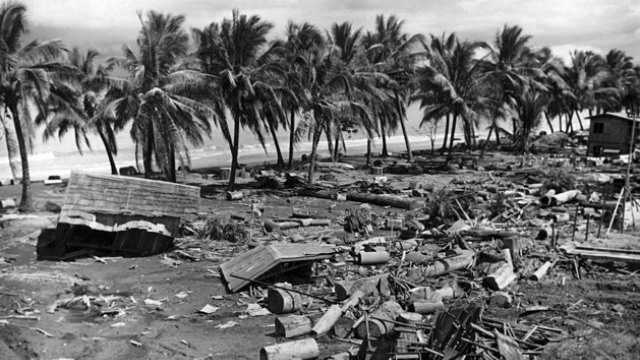
Without warning, about 2-5 minutes after the earthquake struck, waves as high as 9 meters reached the shore and inundated communities along the Moro Gulf.

The tsunami affected 700 kilometers of coastline, with Pagadian City, Cotabato City, Zamboanga City, and Lebak in Sultan Kudarat experiencing the highest waves.

About 8,000 people died, including those missing and were never found, making it the most disastrous tsunami to hit the Philippines.

It is more than the number of casualties recorded after Super Typhoon Yolanda, the strongest typhoon in the world, hit the country.

Midnight killer

Philippine Institute of Volcanology and Seismology (Phivolcs) director Renato Solidum said the high number of deaths – many of whom were children – could be attributed to the time the tsunami struck and the number of people residing near the shore at that time.

"Many people lived near the coast. Also, it was very dark. [It was] past midnight… Why many [died]? It's because it was sudden. If it happened in the morning when children are in school, a lot of people would probably be able to run for their lives," Solidum explained.

It’s important to note the type of the tsunami, he added. "It was a local tsunami. The onset of the first event (wave) occurred 2 to 5 minutes after the earthquake. Definitely, the height of the wave would matter in terms of the number of deaths."

While the earthquake caused fire and some buildings to collapse, the tsunami caused most of the damage.

The massive devastation brought by the Moro Gulf earthquake and the tsunami that followed resulted in a change in the country's disaster preparedness plans. It also led then president Ferdinand Marcos to revise the provisions of the National Building Code a year after the tragedy.

In 1978, Marcos created the National Disaster Coordinating Council, the predecessor of what is now known as the National Disaster Risk Reduction and Management Council.

Tsunami generators in PH

The Philippines is more vulnerable to geological hazards such as earthquakes and tsunamis, according to the Phivolcs, due to its geography as an archipelago located along the Pacific Ocean's Ring of Fire.

Located along every side of the Philippine archipelago are different trenches that can generate tsunamis should the trenches move enough to create an earthquake.

According to Solidum, tsunamis in the Philippines are more dangerous compared to those that occur in other countries such as Indonesia and Japan.

“The tsunamis in our country arrive much faster than those in Indonesia and Japan because the source of the earthquake or the trenches are closer to the shorelines. If the trenches are closer to the shoreline, then the source of the tsunami will be much closer to the shoreline, so the distance will only be short and the lead time will be shorter,” he explained.

While chances of tsunamis are higher in large bodies of water, inland seas like in Bohol and Cebu can also generate tsunamis and landslides.

In Metro Manila, which lies near the Manila Trench and beside Manila Bay, a magnitude 6.5 earthquake can generate a tsunami as high as 4 meters, which could kill about 3,100 people. This is based on the 2004 Metro Manila Earthquake Impact Reduction Study conducted by the Japan International Cooperation Agency.

Communities need to be prepared

In 2004, more than 200,000 people died after an earthquake and tsunami struck off the Sumatra Coast near Banda Aceh, Indonesia, where more than half of the casualties came. The tragedy painfully highlighted the need for reliable tsunami early-warning systems along coastal areas.

Following the devastating 2004 Indian Ocean earthquake, Phivolcs developed a tsunami detection system by setting up dry and wet sensors in 10 sites all over the Philippines.

The agency also produced tsunami hazard maps for coastal areas.

Phivolcs has also set up 19 tide gauges to warn communities of a coming tsunami. “The sensors are to confirm if the earthquake did or did not generate a tsunami. Or if there is a tsunami, the sensors will also be used to tell us if the tsunami waves are over,” Solidum said.

But Solidum emphasizes that the agency can only do so much. While the Phivolcs is ready to monitor and give warnings, nothing can compare to the vigilance and readiness of local communities.

“The issue here is how people will respond. Remember, it’s a local tsunami event - we cannot beat the two minutes," Solidum said.

Solidum adds that the 1976 Moro Gulf tsunami serves as a lesson for local communites to prepare for any disaster.

“It is a very good example of a threat of a sudden onset of an event after an earthquake that people need to know... People need to know which areas will be affected, where they will go if they will be evacuated and where the safe evacuation centers should be located.”

Tuesday 18 August 2015

http://www.rappler.com/move-ph/issues/disasters/102827-1976-moro-gulf-earthquake-tsunami

continue reading

Wednesday, 12 August 2015

15 Years on, Kursk Submarine Tragedy


Fifteen years after one of the worst disasters in Russian naval history — the sinking of the Kursk submarine in the Barents Sea in which all 118 crew members died — the number of Russians who blame the authorities for not doing enough to rescue the sailors has dropped.

The tragedy occurred on Aug. 12, 2000, making it one of the first serious challenges faced by Russia's new president Vladimir Putin. While at the time and in the immediate aftermath, the president's actions were criticized, a poll published Monday by the independent pollster Levada Center showed that 40 percent of Russians thought the authorities did everything possible to save the crew — compared to 34 percent in 2010 and 23 percent in August 2000.

At the time, Russia's rejection of offers of help from other countries elicited outrage among some members of the public. Attitudes to that position also appear to have softened: If five years ago, only 21 percent of respondents considered it the right decision, this year, 28 percent of people agreed with it.

'It Sank'

In a fateful moment that would be remembered and criticized for years to come, Putin told CNN's Larry King: “It sank” — and appeared to smirk — when answering a question about what had happened to the submarine during an interview on the television channel a month after the tragedy.

This laconic answer and the president's demeanor were slammed as being cynical, indifferent and inappropriate for years to come, and further enraged those who already believed the government could have saved some of the sailors.

On Aug. 12, the Kursk, a nuclear submarine and one of the largest attack submarines ever built, was taking part in naval exercises in the Barents Sea. As the results of an official investigation later showed, one of the torpedoes the Kursk was carrying went off accidentally at around 11:28 a.m., followed by another explosion minutes later, after which the submarine sank.

Military officials only registered that an incident had taken place at 11:30 p.m., after failing to contact the crew numerous times.

The vessel was reportedly located at 4:30 a.m. the next day more than 100 meters below the surface. Attempts to rescue any possible survivors gripped the world's attention for more than a week, but were ultimately unsuccessful: By the time Norwegian rescuers managed to open the submarine's hatch on Aug. 21, everyone inside it was dead. Twenty-three sailors are now believed to have survived the initial blast for several hours before their oxygen ran out.

Blame Game

Putin's administration was criticized for a lot of things — for waiting too long to start the rescue operation, for refusing assistance from other countries, and for the apparent lack of concern shown by Putin himself: The president only terminated his vacation in Sochi five days after the tragedy struck.

“They should have raised the alarm immediately. In only doing so at 11:30 [p.m.], they were several hours late,” Boris Kuznetsov, a lawyer who represented 55 families of the deceased sailors, told the Voice of America radio station last year.

Kuznetsov, who is now in his 70s, moved to the U.S. in 2007, fearing arrest after having published a book called “It Sank” that decried the authorities' failure to save the survivors of the blasts.

The lawyer claimed that the explosion on the Kursk was recorded by a cruiser named the Pyotr Veliky (Peter the Great) that was nearby at the time. The cruiser's crew also heard and recorded what sounded like the submarine crew banging on its walls, which sailors do in extreme situations to attract attention, the lawyer said.

The banging, Kuznetsov told Voice of America, continued until Aug. 14, so the experts' conclusion that everyone had died from lack of oxygen eight hours after the tragedy, and that by the time the submarine was located there was no one to save, was deliberately falsified, because the authorities didn't want to admit they were helpless.

“The U.K. sent an airplane with rescue apparatus, but it was prohibited from entering Russian air space. The Norwegians offered help. Everything was rejected. The real reason was fear of showing total inability to rescue people during extreme situations,” Kuznetsov was cited by Voice of America as saying.

Unhappy Ending

In 2001, the hull of the submarine was raised from the bottom of the sea. A year later the official investigation concluded, naming the accidental torpedo detonation as the cause of the disaster.

That conclusion eliminated all the other versions — the submarine being attacked by foreign naval forces, a World War II-era underwater mine explosion, the submarine colliding with something in the sea — that had been circulating in the media for two years.

Not everyone accepted the results of the investigation. Some insisted that the Kursk had been attacked by a U.S. submarine and Putin had deliberately concealed it in order to avoid an international conflict.

Nevertheless, the case was closed and declared classified.

The bodies of 115 sailors were recovered and identified, several military officials were fired and all the crew members were posthumously awarded Orders of Courage. Their families received a total of up to 23 million rubles (about $700,000 at the time) in compensation from the authorities, the Moskovsky Komsomolets newspaper reported in 2003.

Wednesday 12 August 2015

http://www.themoscowtimes.com/news/article/15-years-on-russians-less-inclined-to-cast-blame-for-kursk-submarine-tragedy/527770.html

continue reading

Japan Airlines jumbo crash remembered 30 years later


Hundreds of people attended ceremonies Wednesday marking the 30th anniversary of a Japan Airlines jumbo jet crash that killed 520 people on board, the deadliest single-aircraft disaster in history.


The doomed Boeing 747 had begun the hour-long flight from Japan's capital to Osaka when it crashed into a mountain about 120 kilometres (75 miles) northwest of Tokyo on August 12, 1985.

In all, 509 passengers, including a dozen infants, and 15 crew were killed in the accident. Just four passengers survived.

Bereaved relatives of victims make an annual pilgrimage to Osutaka Ridge, along with JAL president Yoshiharu Ueki who will walk the trail to a memorial service near the crash site.

Ahead of Wednesday's events, Ueki told local media that "we would like to learn a lesson from this accident without forgetting the memory" of the lives lost.

Television footage showed some victims' relatives starting their climb up the steep mountain trail before dawn.

Some blew soap bubbles to pay tribute the children who died in the accident, their names included on a stone memorial listing the victims.

"When I come here I feel like I can see her directly -- it's like she's in front of me," an 81-year-old man who lost his daughter told local media.

"Thirty years is a long time, but honestly I feel as if it happened yesterday, and the memories were stirred again this particular year."

Japan Airlines Flight 123 took off from Tokyo's Haneda airport at 6:12 pm local time and quickly ran into trouble with a loud noise heard about 10 minutes into the trip.

The crew quickly declared an emergency and fought to regain power over the aircraft which had become "uncontrollable". It crashed into the mountain at 6:56 pm local time, about 45 minutes into the flight.

It was later determined that the bulkhead burst, rupturing hydraulic systems and leaving the plane uncontrollable.

A government-appointed investigation panel blamed the accident on improper repairs on the rear bulkhead seven years earlier.

In 1988, local police served papers on 20 people from JAL, the transport ministry and Boeing on suspicion of professional negligence resulting in death and injury.

But prosecutors decided not to indict anyone.

"It can never be forgotten," Satoshi Iizuka, a former police officer who identified bodies at the site three decades ago, told broadcaster TV Asahi as he choked back tears.

"Today, people tend to prioritise speed over safety."

This year's anniversary comes several days after the hunt for more wreckage from missing Malaysia Airlines flight 370 resumed on France's Reunion island in the Indian Ocean after being suspended last week.

A wing part was found on the island in late July and confirmed by the Malaysian prime minister to be part of the Boeing 777 that disappeared on March 8, 2014 with 239 people onboard.

Wednesday^12 August 2015

https://au.news.yahoo.com/world/a/29243075/japan-airlines-jumbo-crash-remembered-30-years-later/

continue reading

Saturday, 8 August 2015

SS Eastland disaster: An unequaled disaster


July 24 marked the 100th anniversary of the death of the Eastland. The Eastland was, without question, the greatest disaster of all Great Lakes shipwrecks with anywhere from 800 to 1,100 casualties, although recent historians estimate approximately 844 deaths.

Source material for the tragedy of the Eastland is abundant. One cannot name any histories of the Great Lakes that do not mention the Eastland and do not recognize it as the greatest of tragedies on the Great Lakes.

For once in our accountings of Great Lakes shipwrecks, the weather, the waves or collisions were not responsible for the wreck of the Eastland.

In fact, according to Mark Bourrie’s “Many a Midnight Ship,” the seeds for the Eastland disaster were planted as she was under construction. This was a doomed ship before she saw any service. Subsequent attempts to improve the Eastland only contributed to her doomsday scenario.

The Eastland was built as a freight and passenger carrier. She was constructed at the Sidney Jenks shipyard and was launched in 1903. She was 265 feet long and had a breadth of 38 feet.

The Jenks shipyard, according to Bourrie, had very little experience building vessels that would carry passengers. That observation was also confirmed by Benjamin J. Shelak in “Shipwrecks of Lake Michigan,” who noted the four-deck passenger ship was the only one produced by this shipyard.

From the beginning the Eastland’s design flaws pointed to an eventual disaster. There were plenty of warnings. Ignored but significant were two very severe listing events in 1904 and in 1906.

The 1904 event involved a roll to starboard of approximately 20-25 degrees before the ship rolled back. 3,000 passengers were aboard and dozens complained to the newspapers and the ship owners. Both incidents resulted in mandates to reduce passenger loads.

The owners responded to the criticisms by taking out newspaper advertisements offering a reward of $5,000 to the person who could demonstrate the Eastland was unsafe. In so doing, the owners ignored the warnings of marine engineer William Wood who had worked on the Eastland and was aware of problems with the ship’s equilibrium.

Early in the day of July 24, 1915, all people could think about was the beautiful day on Lake Michigan and how fortunate they and their families would be to ride across the blue waters of Lake Michigan to the beaches near Michigan City, Indiana.

The Western Electric Co. had arranged an excursion for its employees aboard the Eastland. The company subsidy enabled their workers to purchase tickets for 75 cents.

Historical accounts, including Dwight Boyer’s “True Tales of the Great Lakes,” document numerous complaints by workers that they felt pressured by possible job loss if they did not purchase tickets. These complaints were probably well-founded, but it appears the vast majority of passengers were truly looking forward to a beautiful day with their families on a beautiful lake.

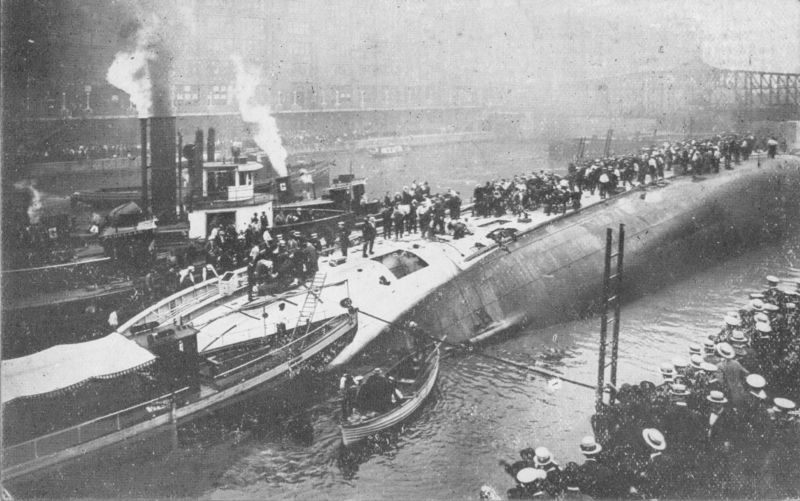
As the Eastland had her lines slipped and was under tow by a tug, she immediately began to list badly and then tipped over in the river. Hundreds were thrown from the decks to their deaths. Hundreds more were simply crushed on the river bottom by the big ship now lying on its side. Hundreds more drowned as they were trapped below the waterline.

Nothing could express the horror of the day’s events better than the many photographs found in Boyer’s book, of the faces of the rescuers and survivors as they struggled to find more bodies. The nightmarish events were accentuated by the bodies of little children, still in their Sunday clothes, being carried off to makeshift morgues.

The tipping over of the Eastland and the events leading up to the disaster suggested serious problems with metacentric height, essentially the ship’s center of gravity and the equilibrium between the distribution of weight onboard. In other words, on a flawed ship like the Eastland, the weight shift by passengers moving, in mass from one side of the ship to the other, might well be enough for the ship to lose equilibrium.

But let’s not blame the passengers. They were hardworking families from tight knit ethnic neighborhoods in Chicago. They were workers, looking forward to a beautiful day’s excursion with their families on Lake Michigan, a break from the toils and tedium of the workplace.

They were human beings who paid the ultimate price for the dishonesty, the greed, and the willful ignorance of the ship owners and their enablers, the corrupt bureaucrats.

That price amounted to the greatest loss of life in a single shipwreck on the Great Lakes, a loss that has never been approached by any subsequent shipwreck in the past 100 years.

Given the circumstances, there is every reason to believe the death toll of the Eastland will never be equaled again.

Saturday 8 August 2015

http://www.battlecreekenquirer.com/story/opinion/columnists/2015/08/07/jim-hettinger-unequaled-disaster/31308323/

continue reading

Wednesday, 29 July 2015

The tragedy of the USS Indianapolis


Its sinking in shark-infested waters 70 years ago is still regarded as the worst naval disaster in US history.

On November 6, 1968, a 70-year-old man was found dead on the lawn of his home in Litchfield, Connecticut.

In his hand he clutched a toy sailor. The body was that of Charles Butler McVay III, a retired rear-admiral in the US Navy.

He had shot himself with his Navy issue revolver but, in some ways, tragedy and injustice had broken Charles McVay many years earlier.

From November 1944 until July 1945, he had served as captain of the USS Indiana polis, flagship of the 5th Fleet.

Shortly after midnight on July 30, 1945, the ship was hit by Japanese torpedoes and sank within 12 minutes.

Nearly 900 of the 1,197 aboard survived but they remained adrift in the Pacific for five days before being rescued.

By then only 317 were left. The rest had perished by drowning, dehydration, exposure or shark attacks.

It remains the biggest US naval disaster of the war and Captain McVay, quite wrongly, got the blame.

If they were hungry, they’d eat a little of you. If not, they’d leave you alone. The fear was constant Seventy years later, the tragedy of the USS Indianapolis is to be told in two Hollywood films.

One of them, Men of Courage is in production in Mobile, Alabama, with Oscar-winner Nicolas Cage playing Captain McVay.

Despite its scale, the disaster – and the shameful incompetence of the US Navy high command – remained little known for years.

On July 29, 1945, the Indianapolis was returning from a top-secret mission to deliver enriched uranium and other parts to the island of Tinian in the Pacific.

The materials were destined for use in Little Boy, the atomic bomb that would later be dropped on Hiroshima.

The delivery completed, the Indianapolis called at Guam for a change of crew, then set sail for Leyte, in the Phillippines.

At 12.14am on July 30, two torpedoes from a Japanese submarine struck the ship on her starboard bow.

Three hundred of her sailors never got the chance to obey the order to abandon ship.

No lifeboats or life rafts were launched.

The others jumped into the dark waters of the Pacific, many before they had time to grab a life jacket.

As the Indianopolis sank, her four propellers were still turning.

The ship had no sonar to detect submarines but the crew managed to send three SOS signals.

However, it soon became clear that the 880 drifting survivors faced other perils.

They had no food or water and nothing to cling to except each other.

By day they burned under the fierce sun. By night, they froze.

And then there were the sharks – hundreds of them.

“I saw a shark the first morning after daylight,” recalled Loel Dean Cox, then 19, who had come on duty at midnight.

“I swear some were 15 feet long but then they all looked that big swimming beneath you.”

At first the sharks feasted on the dead bodies but soon they began picking off the living.

“We were losing three or four each night and day,” said Cox.

“Every few minutes you’d see a dozen or two dozen fins coming at you.

"They’d bump you but you never knew when they would attack.

“If they were hungry, they’d eat a little of you. If not, they’d leave you alone. The fear was constant.”

On the third day, Cox saw a shark shoot towards him “like lightning” and take down the man next to him.

“I stayed in half shock after that. All you could do was pray it wouldn’t be you.”

The men huddled together in groups in the hope of deterring the sharks.

At first they talked constantly but as the hours stretched into days, their tongues became swollen with thirst.

Some began to hallucinate. One sailor believed he was in touch by walkie-talkie with a submarine but warned that no one who wet the bed would be rescued.

One of Cox’s friends became convinced the Indianapolis was floating just below the ocean surface and announced he would dive to the second deck where the supply of drinking water was stored.

He resurfaced, raving about how good the water tasted.

Minutes later he choked to death, with brown foam at his mouth from drinking salt water.

On the fourth day, two US Navy aircraft flew over the sailors without seeing them.

Just before sundown, they were finally spotted by a seaplane flying so low that the men in the water could see a man waving.

“That was when the tears came,” said Cox.

“That was the happiest time of my life.”

As he waited for rescue, drifting in and out of consciousness, he became aware of a bright light.

“It came down out of a cloud.

"I thought it was from heaven but it was the rescue ship shining its spotlight up into the sky to give all the sailors hope and let them know someone was looking for them.”

But why had it taken so long to rescue them?

Why was there no response to the three distress signals sent from the Indianapolis?

Before the voyage, Captain McVay had requested a destroyer escort.

Despite the Indianapolis having no sonar and despite evidence of Japanese submarine activity in the area, the request was denied.

Instead, the admirals had simply instructed McVay to adopt a “zig-zag” course. Why?

Captain McVay never got an answer.

Instead he became the scapegoat that the US Navy clearly needed.

In November 1945 McVay was found guilty of “hazarding his ship by failing to zig-zag”.

Even the Japanese commander of the submarine that had fired the fatal missiles testified that zig-zagging would have made no difference.

By then the public were celebrating the Japanese surrender and had little stomach for wartime calamities.

Despite 380 US ships being sunk in the war, McVay was the only captain court-martialled for losing his.

For years the navy denied receiving any distress signal but when they were eventually declassified, papers relating to the disaster revealed that all three had been received and ignored.

One commander was drunk, another didn’t want to be disturbed and the third suspected a Japanese trap.

No one had reported the ship’s failure to arrive in Leyte because no one was tracking it.

McVay retired in 1949 as a rear-admiral but for the rest of his life he was haunted by abusive letters and phone calls from the families of the dead sailors.

Eventually he could take no more. He was finally exonerated in 2000 after an unrelenting campaign by some of the survivors, aided by a 12-year-old Florida schoolboy who interviewed 150 of them for a history project and gave evidence before the US Congress.

Until then, the only mainstream reference to the Indianapolis was in the 1975 blockbuster Jaws, in which shark-hunter Quint, played by Robert Shaw, reveals he survived the sinking.

There are now only 32 survivors of the Indianapolis, among them Richard Stephens who has given his first-hand account to Nicolas Cage.

After five days in the sea, Loel Dean Cox’s hair, fingernails and toenails fell out.

He returned to his home town in Texas and died there in January, aged 89.

The horror had never faded for him. “I dream every night and I have anxiety every day,” he said.

“But I’m living with it and sleeping with it and getting by.”

Wednesday 29 July 2015

http://www.express.co.uk/news/history/594535/Tragedy-of-the-USS-Indianapolis

continue reading

Saturday, 25 July 2015

Germanwings crash victims remembered in French Alps memorial ceremony


Four months to the day since Germanwings Flight 4U9525 crashed in the French Alps, relatives and friends have gathered at a memorial ceremony near the crash site. Compensation for victims' families remains unsettled.

More than 300 people in the quaint French town of Le Vernet remembered the 150 people who died on March 24 when their flight from Barcelona to Düsseldorf crashed in the French Alps outside the town.

Authorities who examined cockpit voice and data recorders from Germanwings Flight 4U9525 concluded that 27-year-old German co-pilot Andreas Lubitz, who had a history of severe depression, appeared to have intentionally crashed the plane.

Around half of the crash victims were German, among whom where 16 high school students and two teachers who had been on a school exchange trip in Spain. Other passengers came from Spain, Britain, Denmark, Australia, the US, Israel, Mexico, Columbia, Argentina, Japan and the Netherlands. 'Sense to life'

Guests attended an interfaith ceremony on Friday at the memorial stone that was erected shortly after the crash, before releasing 149 balloons over the mountain range, each one representing a crash victim, not including Lubitz.

"Now the relatives must find a sense to their lives again," Rabbi Daniel Dahan said at the service.

At a separate ceremony on Thursday evening, the remains of victims who were unable to be identified were laid to rest in a communal grave. Germanwings memorial in Le Vernet, France

The bodies of people were able to be identified by French police were returned to the countries of origin in June.

According to Steffen Rudolph, the ombudsman for relatives of the victims appointed by the German government, all but one of the 150 victims' bodies have been repatriated.

It's difficult for the families - "a grave still exists here, there are over 3,000 remains buried here," aviation attorney Christof Wellens said. Intentional crash

At the end of Friday's ceremony, the mayor of Prads-Haute-Bleone, Bernard Bartolini, said the disaster remains present in the mountainous region. "We owe this place to the relatives," Bartolini said, adding that plans were already in place for a second memorial.

"We want neither a massive press furor, nor a big spectacle," he said. "It shouldn't become some kind of Disneyland." Compensation row

Taking a backseat to the memorial on Friday was the ongoing public row between Lufthansa and lawyers representing the victims' relatives over the amount of compensation each family will receive.

The airline has offered around 100,000 euros ($109,000) per family on average, depending on family size. After a total of 75,000 euros per family unit, Lufthansa also agreed to pay an additional 10,000 euros to each immediate relative, including parents, children and spouses.

Despite demands from lawyers for 200,000 euros per family, the airline has insisted that its offer goes "well beyond" what it is legally bound to pay.

Saturday 25 July 2015

http://www.dw.com/en/germanwings-crash-victims-remembered-in-french-alps-memorial-ceremony/a-18606544

continue reading

Friday, 24 July 2015

Chicago’s Deadliest Day, 100 Years Ago


On July 24, 1915, nearly 900 people died when SS Eastland capsized in the Chicago River. It was a particularly astounding loss of life considering that, unlike in most deadly shipwrecks, the calamity occurred only 19 feet from shore in the middle of a metropolis. On the 100th anniversary of the SS Eastland catastrophe, look back at the deadliest disaster in Chicago history.

Even the falling drizzle couldn’t dampen the soaring spirits of the crowd who gathered on the banks of the Chicago River on July 24, 1915. Employees of the Western Electric Company, the country’s only telephone manufacturer, savored a rare Saturday off and looked forward to a day of fun with family and friends at the company’s annual summer excursion to Michigan City, Indiana. Not wanting to miss a single enjoyable moment, passengers with picnic baskets and baby carriages in tow began to board SS Eastland, the first of five vessels chartered by Western Electric, at the early hour of 6:30 a.m.

Women in long summer dresses and men in three-piece suits chuckled and joked as the slender steamship occasionally rocked from side to side during the hour-long boarding in what felt like a preview of the roller coaster and other stomach-dipping amusements that awaited them on the other side of Lake Michigan. Deep below deck, however, Eastland’s crew knew the listing was no laughing matter. “The Speed Queen of the Lakes” may have been one of the Midwest’s fleetest ships, but it was hardly the safest. The ballast system, which was designed to keep the steamer on an even keel, suffered from repeated malfunctions, and at least twice before—in 1904 and 1907—the vessel nearly capsized. “Eastland’s owners were aware of stability problems that needed to be repaired but planned to postpone them until after the sailing season ended in 1915 because of the expense,” says Michael McCarthy, author of “Ashes Under Water: The SS Eastland and the Shipwreck That Shook America.”

The required addition of lifeboats on the top deck in the wake of the 1912 sinking of Titanic and a recent 500-passenger capacity increase authorized by inspectors only compounded the steamship’s stability problems. With its three decks packed to its new 2,500-person limit, Eastland began to creep away from its berth at 7:30 a.m., but as its stern swung into the Chicago River, the ship’s listing from side to side turned violent.

“Look out, she’s tipping!” cried warehouse workers along the river. Dishes and bottles crashed to the floor. Panic along with the Chicago River gushing through gangways and portholes swept across the decks. Frightened passengers and crew jumped to the dock as the last line holding Eastland to the wharf snapped like a whip.

For those on board the steamer, the world suddenly turned sideways.


Eastland rolled onto its port side and rested partially submerged in less than 20 feet of water. “It lay like a toy boat of tin wrecked in a gutter,” reported the Chicago Tribune. The unfortunate passengers who happened to be on the port side were crushed by the hundreds of people, deck chairs and other furniture that suddenly fell on top of them. “The entire crowd of men, women and children came slipping and sliding and sprawling down with a mass of lunch boxes, milk bottles, chairs—rubbish of every sort—on top of them,” said passenger George Goyette. “They came down in a floundering, screaming mass.” As the enclosed decks filled with water and debris, the mob of humanity who tried to scale the staircase to the promenade deck, now turned sideways, turned the lone escape path into a deathtrap.

Screams mixed with gurgles as survivors struggled to stay afloat in the filthy river, a toxic cocktail of raw sewage and detritus from Chicago’s stockyards. Few passengers knew how to swim, and even those who did were weighed down by their water-logged dresses and heavy suits. Rescue boats scrambled to the scene as welders ran with torches in hand to the crippled steamer. Hearing the muffled cries of the desperate passengers pounding on the metal hull, the welders began to cut rectangular escape hatches when Eastland’s horrified captain, Harry Pedersen, incredibly protested that they were “ruining his ship.” “The captain showed more regard for the company property than the people inside,” McCarthy says.

As doctors tried to force water out of victims’ lungs with pulmotors, rescue workers hoisted lifeless bodies found by divers working in the dark holds of the ship. In all, the Eastland tragedy claimed 844 victims, including more than 50 infants. In just mere minutes, the capsizing wiped out 22 entire families.

Pedersen, the ship’s engineer and four of its owners stood trial for the disaster, but a federal judge changed the original charges from criminal negligence and manslaughter to conspiracy to operate an unsafe ship. As McCarthy notes, the owners may have been negligent, but there certainly was no conspiracy. Represented by the legendary Clarence Darrow—who was in the “valley of his career” according to McCarthy after accusations of bribing jurors on an earlier case—the six men were all found not guilty. No one was ever held criminally responsible for the disaster, and a civil trial that dragged on for more than two decades ultimately provided little money to victims’ families. “I don’t believe justice was done,” McCarthy says. “The Eastland story offers an example of how important it is to bring charges against people who have endangered lives and how careful you must be to pin the charges on them.”

Although the Eastland disaster was the deadliest in Windy City history—claiming seven times the lives as the official death toll from the Great Chicago Fire—it quickly faded from public memory. McCarthy attributes this in part to the lower economic status of the victims as well as the timing. “This happened just before the U.S. entered World War I, and the world-changing events eclipsed so much else of what was going on,” he says while adding, “It is remarkable that something so catastrophic wouldn’t be better remembered.”

Friday 24 July 2015

http://www.history.com/news/chicagos-deadliest-day-100-years-ago

continue reading

Tuesday, 21 July 2015

Remembering the S.S. Eastland disaster of 1915


What started out as a day of celebration for more than 2,500 workers of the Western Electric Company turned into the deadliest disaster in Chicago history. On the morning of July 24, as workers and their families gathered aboard the SS Eastland for a trip to Michigan City, Ind., problems with the ship's weight and ballast tanks – which had been emptied before the launch – caused the ship to roll over while it was docked in the Chicago River.

Little known today, one of the great disasters in U.S. history occurred 100 years ago this week in Chicago, and caused heartbreak and anxiety throughout Illinois including Champaign-Urbana.

Although no one from here perished in the tragedy that struck the S.S. Eastland as it sat moored to a dock on the main branch of the Chicago River, for days afterward local newspapers carried stories about friends or relatives who were missing, or who had intended to board the boat that Saturday morning for an excursion across Lake Michigan.

Even today there is some dispute about the number of people who died when the sleek boat, called "The Speed Queen of the Great Lakes," capsized in about 20 feet of water between Clark and LaSalle streets on the south side of the river. Most accounts say 844 people died, others say 848. In those days following the accident there were newspaper reports that as many as 1,338 lost their lives.

Even so the death toll was greater than the number (766) who died in the Great Chicago Fire 44 years earlier, and is still considered one of the worst accidents (in terms of lives lost) in U.S. history.

Almost all the dead were employees or family members of employees who worked at the gigantic Western Electric plant just outside of Chicago, where telephone equipment was manufactured. Five boats, including Eastland, had been chartered to carry an estimated 7,000 people to the picnic at Michigan City, Ind.

There was immediate concern that recent University of Illinois graduates who worked at Western Electric would be among the dead.

"Walter J. Blum, who completed a course in electrical engineering at the university in 1914, and F.J. Naprsteck, who finished a course in architectural engineering in the same year, are among the former university students working for the Western Electric Company for whom no word has been received since the disaster this morning," The Champaign Gazette reported hours after the accident.

A few days later, however, local papers reported that they and others were safe. The manager of the student apprentice program at Western Electric, which included 30 UI students, wired: "All Illinois men checked up as safe."

Then came stories of narrow escapes, people who attempted to rescue survivors and local undertakers who were enlisted to care for the dead.

The sister of Champaign Police Chief A.U. Keller initially was reported among the missing "until an inquiry by wire brought the information that Miss Keller was not on the ill-faced boat. She had purchased a ticket but for some reason did not go aboard," the Urbana Daily Courier reported.

Another story said that Frank Holmgren, a young man from Rantoul, had been on the Eastland but was thrown into the river as the boat "turned turtle."

"Holmgren was on the upper deck and when thrown into the water he easily swam to the dock," the Courier said. "He and another young man were with a couple of young lades when they were thrown into the water and became separated from them, both the girls being drowned. Homlgren has been in Chicago only a few months and was employed at the Western Electric plant. He is well known (in Rantoul), having at one time had charge of a local moving picture show."

Mrs. Carrie Hatch, a nurse at the Cook County Psychopathic Hospital, wrote to her daughter in Urbana following the accident, and her letter was reprinted in the Courier.

"You can't imagine the dark pall of death that hung over the city yesterday. No theatre, no park open, nothing but hearses and ambulances flying in every direction," she wrote. "I went in my uniform and was allowed anywhere. I went on both bridges and saw the old ship on its side with 700 bodies underneath. I saw the divers bring up many bodies.

"Then I went to armory No. 2 on through the morgue and looked at the poor unidentified bodies, mangled and bleeding — people looking into every black and mangled face for their loved one. I never beheld such a sight of repulsion in all my life."

Urbana undertaker C.A. Fry left town to care for the dead, the Courier said."When the appalling number of dead was realized, Coroner Peter Hoffman of Cook County sent appeals for help to downstate undertakers, and the Urbana man responded. Mr. Fry individually prepared the bodies of 10 victims for burial," said the Courier.

A book on the Eastland, written 20 years ago by George W. Hilton, concluded that the disaster was caused by post-Titanic modifications — including the addition of lifeboats and life rafts — that made it top-heavy and unstable.

Civil lawsuits following the accident gave little comfort to the victims and their families. Laws at the time limited liability to the value of the ship, $46,000, and claims by the salvage company that towed the Eastland away took precedence. There was little money left for the families of middle- and lower-class victims, many of them immigrants with names like Buszkiewicz, Grochowksi, Cmucha, Stejskal, Cifrik and Zdrojewska.

Tuesday 21 July 2015

http://www.news-gazette.com/news/local/2015-07-19/tragedy-chicago-echoed-c-u-100-years-ago.html

continue reading

Saturday, 11 July 2015

Cyprus marks four years since Mari disaster


CYPRUS marks four years since the deadly explosion at Mari today.

The incident occurred on 11 July 2011, when 98 containers of explosives that had been stored for 2½ years in the sun on the base near Zygi self-detonated.

The resulting explosion killed 13 people, 12 of them immediately, including Captain Andreas Ioannides, the Commander of the Navy and the base commander, Lambros Lambrou.

Also killed were four navy personnel and six firefighters, while a further 62 people were injured.

The explosion severely damaged hundreds of nearby buildings including all of the buildings in Zygi the island's largest power station, responsible for supplying over half of Cyprus' electricity.

As a result, much of Cyprus was without power in the immediate aftermath of the incident and rolling blackouts were initiated in order to conserve supplies.

Saturday 11 July 2015

http://famagusta-gazette.com/cyprus-marks-four-years-since-mari-disaster-p28767-69.htm

continue reading

Thursday, 9 July 2015

Srebrenica women tell tale of loss through objects of memory


Twenty years ago Saturday, Bosnian Serb troops led by Gen. Ratko Mladic carried out Europe's worst carnage since the end of World War II - a massacre of 8,000 Bosnian Muslim men and boys that a United Nations court calls a genocide. As Dutch peacekeepers stood helplessly by, the Serbs stormed the Srebrenica safe haven, separating men and boys from women. They drove the males away in trucks and massacred 2,000 on the spot. About 15,000 Bosnian Muslim men and boys fled into the woods; the Serbs hunted 6,000 of them down and killed them one by one - some 8,000 in all. The bodies were dumped in mass graves that were bulldozed to hide the evidence, causing remains to be jumbled up into a jigsaw puzzle that has yet to be fully solved. About 1,000 victims remain to be found. Many families have reburied a few bones identified as belonging to their loved-ones through DNA testing.

Two decades later, Srebrenica's women still grieve. Here are some of their stories told through cherished objects.

___

HUSBAND'S SHIRT

Fazila Efendic, 64, keeps her husband Hamed's old terracotta-color shirt in the closet. He was 46 when the Bosnian Serb troops shot him dead in the forest. "When I miss him, I open the closet, touch the shirt and I can't say if I feel better or worse then," she says. "But I must touch it." It's the same thing with the school diplomas of her only son Fejzo, who was 20 when he was killed in the Srebrenica massacre. "He won several regional competitions in math and physics. He was a very good child." She showed a white handkerchief with blue stripes that her son gave her before Srebrenica fell. "I carry it around wherever I go," she said. She found the remains of both men years ago and buried them at the Srebrenica Memorial Center, where they lay with nearly 7,000 other victims. She found Hamed in 2003 in one mass grave and Fejzo - or rather two of his leg bones - in 2013 in another.

___

HANDFUL OF CLAY

Meva Hodzic takes out a tobacco box, a rusted Swiss knife and a key from a plastic box, and with them fall crumbs of clay. She puts the clay back in the bag, because it's a kind of relic, too: It comes from the mass grave where her husband was found after Serbs killed him in the forest, as he fled carrying the three objects. "It belongs to these items and they should stay together. I was asked to give all this up for a museum of items found in mass graves. But, no," she says "how can I do that if it's the only thing I have left from him?" Mujo ran into the forest with the other Srebrenica men after promising to come back to find her in the purported safe haven that was under Dutch peacekeeper protection. Instead, parts of Mujo's body turned up after the war in three different mass graves. He was put together and identified through DNA analysis. "Besides him I lost two brothers, my father, two sons-in-law and my nephews."

___

PICTURE OF SORROW

When Remzija Delic, 58, wakes up in the morning, the first thing she sees on the wall is the picture of her husband Sabit. Then she gets up and looks through the window at the former factory that the United Nations turned into their military headquarters after they declared Srebrenica a safe haven - staring hard at its gate. She goes to the stove and puts the water on boil for her morning coffee. When she returns to the window, she sees her neighbor walking down the street to work, and her face grows dark. She says he was the Bosnian Serb army soldier who separated her husband from her at the factory gate, selecting him to become one of the victims of the massacre. She also lost her father, two brothers and several nephews. As Sabit was trying to board the bus transporting the Srebrenica women to government-held territory, she says, the neighbor grabbed him by the back and yelled: "No. Not you." He pushed him over to the crowd of men chosen for killing, according to Delic. Forensic experts found Sabit, 40, in a mass grave. "You know, all this did not make me hate the Serbs," she says. "There are some wonderful people among them."

___

TOBACCO BOX AND FLINT

Djulka Jusupovic, 65, carefully handles a tobacco box made of cans of U.N.-delivered food, along with a piece of flint used to make fire with during the war. After three years of Serb siege, the population ran out of lighters or matches and improvised just like cavemen did. "Someone would make fire with this in his garden in the morning, then everybody would come with a piece of wood to light it and take it home to make a fire," she said, describing life in a town that was on the brink of starvation before the bloodletting began. She keeps the items in several plastic bags. They are still as dirty as they were found when found on her husband, Himzo, as he was excavated from a mass grave. These days she rarely looks at the objects. Each time she takes them out, she remembers what the forensic experts told her when they handed them to her: Himzo, after being shot, may have still been alive when buried.

___

HOME-KNIT SWEATER

"Once this sweater was white like snow," says 60-year-old Kadira Gabeljic. "I knitted it myself." She points to it in a picture of the clothes wrapped around her husband's skeleton when forensic experts found him. "Now it's black from the dirt of the mass grave they found him in, and it is torn in the middle from bullets that rattled through his stomach when the Serbs shot him." Her only two children, sons Mesud, 16, and Meho, 21, followed their father Abdulah and the other men fleeing through the woods. All three were hunted down and slaughtered. Her 42-year-old husband and Meho were taken to a warehouse in the nearby village of Kravice and locked inside with another 1,000 other men who were hunted down. Then the Serbs threw hand grenades inside and mowed down the crowd through the windows, until they killed all of them. Forensic experts later found their body parts in four different mass graves. "Actually, they only found parts of Meho," she said. "The head and legs. The middle part is still missing. I buried what I had."

Thursday 9 July 2015

http://www.ksby.com/story/29507535/srebrenica-women-tell-tale-of-loss-through-objects-of-memory

continue reading

Saturday, 4 July 2015

Flashback: DC3 crashes in Kaimai Ranges in 1963


The sound of 23 deaths was like the distant closing of a door.

Flight 441, on a slow jaunt from Auckland to Wellington, had slammed into a rock wall in the Kaimai ranges at 140kmh, exploded, and tumbled down the rock face.

All on board on July 3, 1963 - 52 years ago - died.

It was and remains the deadliest plane crash on New Zealand soil.

Norman Morris was among the dead.

On the 50th anniversary of the accident, his daughter Joanne Fitzsimmons remembered the day she returned from school to find her mother waiting at the gate.

She was five years old and the weather was awful.

"I can remember going inside and seeing all these worried faces and concern.

"The plane was only missing at that point and all we could do was sit around the radio and listen and wait."

She was too young to attend the funeral.

National Airways Corporation (NAC) flight 441 had taken off from Whenuapai airport in north-west Auckland at 8.05am that morning.

The DC3 - a veteran of World War II - was scheduled to stop at Tauranga, Gisborne, Napier, and Palmerston North, before eventually arriving in Wellington in the early afternoon.

It was an era when people dressed up for air travel.

Their best clothes would soon be scattered among wreckage.

At 9.06am Tauranga air traffic control was in contact as the plane began its descent.

Workers at a quarry at Gordon, between Te Aroha and Matamata, heard it pass low overhead.

Then there was the sound, compared to a door banging shut far away.

Bad weather and rough terrain meant it was almost 48 hours before the plane was found.

The impact and fire was so bad that a pathologist was needed to identify the charred, blackened remains ot the 20 passengers and three crew.

An investigation into the crash found that while weather in Auckland and Tauranga that day was not too bad there was an easterly gusting to 150kmh between the two.

In zero-visibility, with dodgy radio compasses, the pilots were effectively flying blind.

Pilot Len Enchmarch and first officer Peter Kissel likely thought they tracking down the eastern slopes of the Kaimai ranges but they were in fact further west.

Investigators came to the conclusion the plane was descending and turning for its run into Tauranga but got caught in powerful down draughts and got slammed into the rock face.

Tauranga air traffic control called again at 9.14am - eight minutes after the first call - but there was no reply. There was effectively no plane.

Apart from the 23 dead, the crash would go down in New Zealand aviation history as the first time helicopters were used in a search and recover operation in this country.

Aviation historian Richard Waugh, who has written a book on the tragedy, said news of the crash dominated newspaper front pages for about five days.

New Zealand's post-war optimism was shattered by "this great tragedy" in a normally reliable DC3 being flown by our national carrier.

"It really was quite appalling. It just literally hit a rock face."

In recent years he has clambered to the crash site.

He drove most of the way but the last few kilometres were a steep and wintry walk almost 1km above sea level. The final descent was down ropes.

The fuselage was gutted in 1963 but the wings were flung free.

The bodies have long since been removed but the rugged terrain meant some wreckage remains, some buried in deep undergrowth, to this day.

For 15 years it was New Zealand's worst air disaster.

That record was shattered when Air New Zealand flight TE901 slammed into the side of Antarctica's Mt Erebus, leaving a smudge in the snow and 257 dead.

That day, November 28, 1979, flight 441 became our worst ever air disaster on domestic soil, Waugh said.

"Hopefully that will be the case for a long, long, long time."

New Zealand's Worst Air Disasters

Nov 28, 1979 - Air New Zealand DC10 crashes on Mt Erebus in Antarctica, killing all 257 passengers and crew.

July 3, 1963 - NAC DC3 crashes in the Kaimai Ranges, 23 dead.

Mar 18, 1949 - NAC Lodestar crashes on approach to Paraparaumu, 15 dead.

1942 - Liberator bomber crashes near Whenuapai, 14 dead.

Aug 21, 1944 - Two Lockheed Hudson bombers disappear, 14 dead.

Oct 23, 1948 - NAC Lockheed Electra crashes on Mt Ruapehu, killing 13.

Jan 7, 2012 - 11 die when a hot air balloon plunges to the ground in flames near Carterton. Two who died tried to leap to safety.

Aug 8, 1989 - Britten-Normander Islander crashes between Milford Sound and Wanaka, 10 dead.

May 12, 1988 - Piper crashes into hills near Whanganui, killing nine.

Oct 25, 1993 - Nomad 23 crashes near Franz Josef Glacier, nine dead.

Sep 4, 2010 - Fletcher FU24 crash kills nine people near the Fox Glacier airstrip.

Saturday 4 July 2015

http://www.stuff.co.nz/dominion-post/news/69898789/flashback-dc3-crashes-in-kaimai-ranges-in-1963

continue reading

Funerals of 136 Bosnian victims to mark anniversary


This year’s 20th anniversary of the Srebrenica massacre will be marked by the burial of 136 victims identified over the past year, an official said on Friday.

The Institute for Missing Persons said 160 corpses from the 1995 massacre of 8,000 Bosnian Muslim men and boys by Bosnian Serb paramilitaries had been identified since last year’s July 11 anniversary.

The youngest is a 16-year-old boy of mixed Muslim-Serb parentage whose body was recovered from a secondary mass grave. The remains of 17 other under-18s have been identified.

“We have formally identified 136 victims, whose families have declared that they want the remains to be buried on July 11 this year... the identified persons are ready for the collective funeral on July 11," institute spokeswoman Lejla Cengic told Anadolu Agency.

They will be interred at Potocari memorial center.

The families of 24 victims are waiting to bury their loved ones as not all their remains have been found.

In the summer of 1995 Srebrenica was overrun by troops led by Ratko Mladic, currently on trial at The Hague for ordering the killings. Dutch UN peacekeepers watched on as Serb troops herded men and boys from the town to be murdered.

Since the end of the war, hundreds of Bosniak families have searched for missing relatives, most of who were buried in mass graves around the country.

A total of 6,166 Srebrenica victims have been buried at Potocari and a further 230 are buried outside the town.

Friday 3 July 2015

http://www.worldbulletin.net/world/161690/funerals-of-136-bosnian-victims-to-mark-anniversary

continue reading

New mass grave found for victims of NWA Flight 2501


Sixty-five years ago, the worst tragedy in aviation history at that time happened along the shores of Lake Michigan. Northwest Orient Flight 2501 crashed somewhere off the coast of South Haven, killing all 58 souls on board.

Despite efforts by dive crews and sonar experts from (NUMA) National Underwater and Marine Agencyand the (MSRA) Michigan Shipwreck Research Associates, no wreckage of the plane has ever been recovered, and no official cause for the crash has ever been determined.

But an interesting discovery by a cemetery sexton has guaranteed that many of the victims lost in this tragedy will never be forgotten.

The plane crash happened June 23, 1950. Northwest Airlines Flight 2501 was departing La Guardia Airport in New York, preparing for a stop in Minneapolis, Minnesota, before heading to its final destination of Seattle, Washington.

Severe storms were developing over Lake Michigan as Flight 2501 exited the shoreline somewhere between Glenn, Michigan, and South Haven, Michigan.

Sometime after midnight on June 24, 1950, all communication with Flight 2501 was lost, as was with the aircraft itself.

In the days after the crash, the United States Coast Guard began recovery efforts. What they found floating on the water's surface, and washing ashore, was gruesome. No full human bodies were found – only chunks of bodies, along with clothing, suit cases, and some Northwest Airlines seat cushions.

The Korean War began within days after the crash, so the country's attention shifted away from this tragedy.

Recovery efforts would end, and decades would pass, before anybody showed renewed interest in attempting to look for the sunken wreckage.

The 65th anniversary of the crash was last month. Even though no victims were from the state of Michigan, the remains recovered were buried in this state. Until recently, the only known mass burial grave site for victims was at Riverview Cemetery in St. Joseph. That site was found in 2008.

Another mass burial site for 2501 crash victims was discovered in 2015 at Lakeview Cemetery in South Haven. It had gone unrecognized for generations, until two ladies working on a genealogy project happened to stumble upon it.

Mary Ann Frazier and her mother, Beverly Smith, say they were spending some downtime looking up family history in one of the cemetery plot registers.

"We were going through the 'N-Book,' looking for something, when we came across it," said Frazier, who serves as the sexton for Lakeview Cemetery in South Haven. "I was like, 'Mom, you have to come look at this; it says – NWA Flight.'"

Smith responded by saying, "I wonder what this means?"

The curious mother-daughter duo wrote down the plot location and decided to visit the burial site to see if it was marked, but when they got there, they realized it wasn't. They immediately realized that victim's remains from this devastating plane crash had literally been forgotten for more than six decades.

"It's totally amazing to me that it is 65 years later and we're just finding this and connecting everything together," said Smith.

razier and Smith researched the plane crash, and quickly learned that Holland author Valerie van Heest had written a book about the ill-fated 2501 entitled Fatal Crossing.

"And I thought, 'Here's the person we can contact to find out more about this,'" added Smith.

"I always wondered what happened to the human remains that washed ashore on the beaches of South Haven," said van Heest, co-founder of (MSRA) Michigan Shipwreck Research Associates based out of Holland, Michigan. "I was disheartened to realize that the burial site has gone unmarked all these years."

Van Heest says after learning of the newly-found mass burial site, she reached out to family members of the 58 victims to let them know of the discovery and also let them know that plans were in the works to place a marker on the site.

During the process of discovering the site, Frazier and Smith also came across another revelation which happened to be much more personal to both of them.

"My great uncle, Joseph Bartnick, was one of the people who actually recovered body parts," said Smith. "When I opened Valerie's book and saw his picture on one of the pages, I wanted to cry for him because he had to be in a position like that."

Through more research, the women learned that Bartnick was on one of the first Coast Guard recovery boats to go out into the lake after the crash.

Van Heest and the two other women contacted St. Joe Monument Works, who graciously donated a stone to be placed above the burial site. The stone was delivered to the cemetery a few days before the 65th anniversary of the crash.

On Wednesday, June 24, 2015, a remembrance service was held at the grave site. South Haven Mayor Robert Burr, along with Craig Rich from the MSRA, read off all of the 58 victims' names. After each name was read, a bell was rung.

Pastor Robert Linstrom, from Trinity Lutheran Church in Grand Rapids, and van Heest each offered separate messages to the more than 50 people who came out to pay their respects.

Near the end of the service, Willis Dotson played taps.

"Fifth-eight people's remains may be buried there," said van Heest. "I feel things are working to put a final closure to this accident."

Van Heest says she's currently wrapping up her 12th consecutive year of scouring the bottom of Lake Michigan, searching for the wreckage of Flight 2501.

She added that her crew recently picked up an interesting target on sonar, and they will soon have divers explore it.

The ultimate hope is that one day the plane will be found, but until that day comes, more victims of the tragedy can rest in peace knowing that after 65 years, they have finally been found.

Currently, there's an exhibit on display at the Michigan Maritime Museumin South Haven dedicated to the crash of Flight 2501.

Friday 3 July 2015

http://www.wzzm13.com/story/news/local/lakeshore/2015/07/02/mass-grave-south-haven-northwest-airlines-flight-2501-valerie-vanheest/29616925/

continue reading