Showing posts with label Dam. Show all posts

Friday, 6 November 2015

Brazil dam burst: at least 15 feared dead after disaster at BHP-owned mine


A dam that burst at an iron-ore mine in south-eastern Brazil on Thursday is thought to have killed at least 15 people, devastating a nearby town with mudslides and leaving officials in the remote region scrambling to assess casualties.

Forty-five people were still missing after the disaster at the Germano mine near the town of Mariana in Minas Gerais state, a local union told the G1 news portal.

The mine is operated by Samarco, a joint venture between the Anglo-Australian mining giant BHP Billiton and the Brazilian company Vale.

Andrew Mackenzie, the chief executive of BHP, said in Melbourne: “Most of what happened there has been under the cloak of darkness.

“At daybreak, clearly we will do an awful lot more and give you further updates.”

The company would “take all steps” to ensure the safety of the workers and communities affected by the disaster.

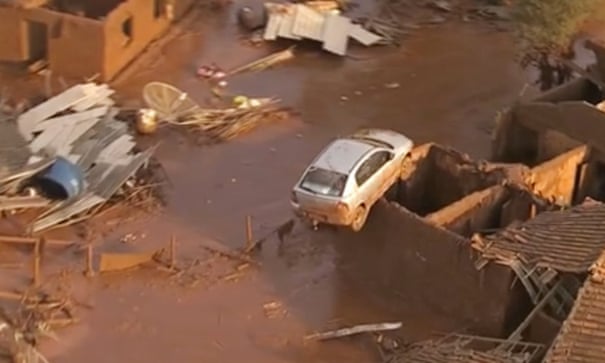
Video footage on the G1 website showed houses of a village destroyed by flood waters and clay-red mud that surged down valleys in the mountainous region. Large vehicles lay tossed on their sides.

There was no official confirmation on the total number of dead and missing. A city hall official confirmed one death and 16 injuries, adding that dozens more were still missing.

Civil defence authorities in Mariana said they were evacuating about 600 people to higher ground from the village of Bento Rodrigues, about 7km (just over 4 miles) beneath the dam that burst, which was flooded as a result of the accident.

Television footage showed dozens of homes destroyed by the mudslide. A car rested on top of a wall where the roof of a building had been ripped off.

Authorities said the flood had also reached another village further down the hill, Paracatu de Baixo, and that inhabitants there were also being evacuated.

Rescue crews continued to search the muddy waters after nightfall. Brazilian army units nearby stood ready to help the search and rescue effort and the minister of national integration, Gilberto Occhi, planned to visit the state on Friday to provide assistance, according to a note from the presidency.

Samarco said in a statement it had not yet determined why the dam burst or the extent of the disaster.

BHP Billiton said in a statement that it was “concerned for the safety of employees and the local community ... We are in the process of obtaining more details from Samarco Mineracao.”

Authorities said the dam was built to hold back water and residue from mining operations, a mixture that can often be toxic. The dam was holding so-called tailings, a mining waste product of metal filings, water and occasionally chemicals. It was located near the Gualaxo do Norte river, fuelling fears of potential water contamination.

Rescue teams were searching for survivors or bodies, and residents living nearby were told to evacuate to higher ground.

Samarco said in a statement on its website that it was making “every effort to prioritise care to people and mitigate damage to the environment”.

“It is not possible at this moment to confirm a cause,” it added.

A statement from the city hall of Mariana, a city of about 40,000 people 300km (185 miles) north of Rio de Janeiro, said the dam ruptured at 4.20pm in an area roughly 20km from the city centre.

The disaster comes as both Vale and BHP are battling a collapse in iron ore prices and a wider slump in the industry.

The Germano mine is a 50-50 joint venture between the world’s largest iron miner and the largest mining company.

Iron ore is transported down a slurry pipe to Espirito Santo in south-eastern Brazil, where it is turned into pellets. Samarco produces around 30 million tonnes per year, according to its website.

Friday 6 November 2015

http://www.theguardian.com/world/2015/nov/05/brazil-iron-mine-dam-bursts-floods-nearby-homes

continue reading

Thursday, 1 October 2015

Anniversary of Austin Dam disaster today


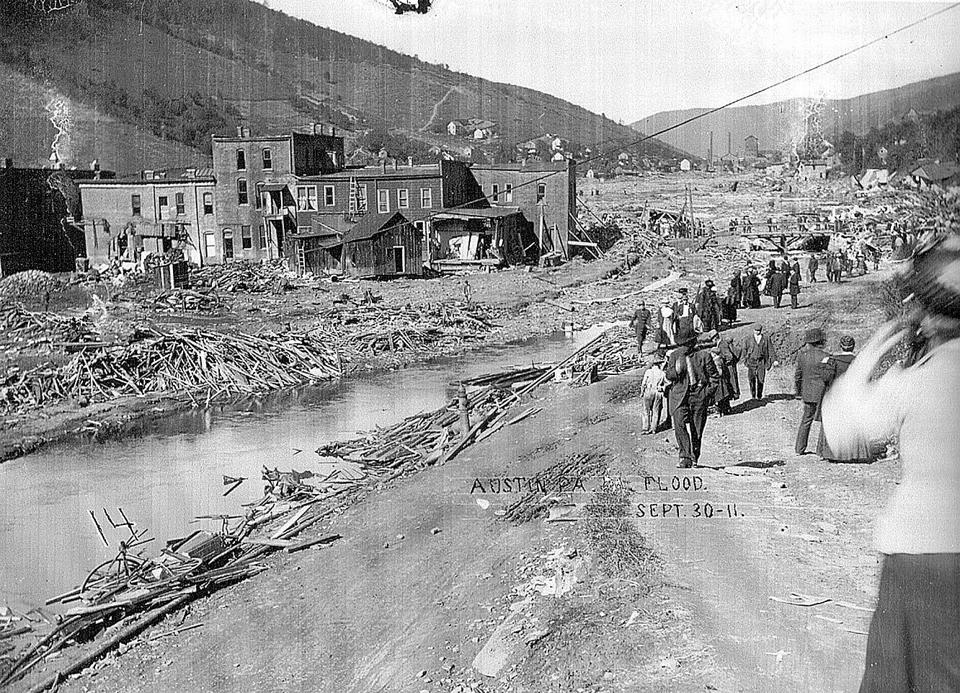
Today marks the 104th anniversary of perhaps the single greatest disaster in the history of this area of the Twin Tiers — the failure of a concrete dam and subsequent destruction of the towns of Austin and Costello on Sept. 30, 1911, in Potter County, Pa.

Pressure from about 250 million gallons of water broke the dam, which was built two years before to supply water for the Bayless Pulp and Paper Co. The dam stood 50 feet high and was more than 500 feet long — it had been dubbed by some as “the dam that could not break.” The water from the dammed-up Freeman Run swept up logs and other debris, creating a grinding wall of devastation. A total of 78 people are officially reported killed in the disaster, although it is believed by historians that more people — possibly traveling businessmen, visitors to the town, lumbermen who had brought in logs to the Bayless Co. — perished in the disaster and their bodies were not found.

Austin was a small city of 3,000 people in 1911.

Indeed, newspaper dispatches even two days after the flood reveal how murky information was in the aftermath, given the communications abilities and the state of emergency management response of that day.

A headline on the front page of the Oct. 2, 1911, edition of the Olean Evening Times (the dam broke on a Saturday; the Evening Times was not printed on Sundays) stated: “Official Count Gives Death List as 250, But Citizens Claim It Will Reach 550.”

Rescuers at the scene expressed certainty that the death toll would be in the hundreds, and it was feared that great piles of debris would have to be burned — along with the bodies it was assumed they covered — because of concerns about disease.

An editorial in the Evening Times read:

“The nation stands appalled at the fearful calamity that has overwhelmed Austin. Not since the fateful Johnstown flood of 1889 has there been such a holocaust of death in a single accident in this country. Coming so close to Olean, this catastrophe brought with a terrible shock to all residents of this city. Many of them had relatives in the stricken city, and many more of them had friends whose safety has not yet been established.

“The suspense here yesterday was poignant, and every additional report but added to the grief of the waiting people. Practically no definite information could be secured and only such news as filtered in from Keating Summit and other nearby places, inadequate in respect to the names of the dead or the survivors, came to relieve their anxiety. But in most cases, this but added to the suspense.

“Everything that can be done to relieve the situation is being done. Nothing that can mitigate the sorrow and horror of the calamity is being left undone. All the necessary medical aid is upon the scene, the homeless people are being placed in the homes of hospitable neighbors, and at present there is food amply sufficient to meet the needs of the sufferers.”

A permanent memorial was dedicated in September 2013 to the people who lost their lives in the flood. The memorial marker, in Austin Dam Memorial Park, is made of light-colored stone with the names of the deceased etched in black upon its face. The monument stands directly in front of the dam as a solemn memorial to those who lost their lives that day.

Thursday 1 October 2015

http://www.oleantimesherald.com/news/article_de892bd6-672e-11e5-9324-13d1c038ece3.html?mode=image&photo=0

continue reading

Monday, 16 February 2015

1928: The St. Francis Dam disaster


It was just a few minutes before midnight on March 12, 1928, when the second worst disaster in California occurred in the Santa Clarita Valley’s San Francisquito Canyon.

The St. Francis Dam, holding back more than 30,000 acre feet of water for the city of Los Angeles, crumbled, sending a 10-story-high wall of water crashing into the Santa Clarita and Santa Clara River valleys.

Loss-of-life estimates range from 430 to more than 600 people. Only the Great San Francisco Earthquake of 1906 killed more Californians. Bodies washed out to sea by the flood were found as far away as San Diego.

This year the Santa Clarita Valley Historical Society will join the California State University Northridge’s archeology department to sponsor a symposium on the disaster on March 28.

Monday 16 February 2015

http://www.signalscv.com/section/36/article/133110/

continue reading