Showing posts with label Human rights abuses. Show all posts

Monday, 14 April 2014

Victims of Pinochet government reburied in Chile after 40 years


The remains of six men have been reburied in Chile more than 40 years after they were killed by the military government of Augusto Pinochet.

Their bodies were discovered in an unmarked grave in 1992.

The men were among dozens of people killed by a military unit in late 1973, just weeks after General Pinochet came to power in a coup.

His officials flew around the country in helicopters, and executed political prisoners by firing squad.

The men - Carlos Berger, Carlos Escobedo, Luis Moreno, Hernan Moreno, Mario Arguelles and Jeronimo Carpanchay - were killed in the northern Chilean city of Calama.

Mr Berger, a lawyer and journalist, had been arrested on 11 September 1973 after refusing to broadcast a government message at the radio station where he worked.

His and the other men's remains were identified after extensive forensic tests in Europe, and finally buried in a ceremony at the main cemetery in the Chilean capital, Santiago.

Caravan of Death

The six men were murdered by what became known as the Caravan of Death, in one of the most notorious episodes of the Pinochet government.

The General sent the "delegation" of military men to Chile's provincial towns because he was reportedly annoyed that some commanders there had been "soft" on political opponents.

The Caravan of Death is thought to have killed 97 opponents of the military coup.

The BBC's Gideon Long in Chile says the military wanted to punish its opponents, but also strike fear into the Chilean people.

According to official figures, 40,018 people were victims of human rights abuses during the 1973-1990 Pinochet government and 3,065 were killed or disappeared.

Augusto Pinochet died in hospital on 10 December 2006, aged 91.

Monday 14 April 2014

http://www.bbc.co.uk/news/world-latin-america-27014505

continue reading

Saturday, 12 April 2014

Abkhazia: The hope that never dies


Bella Zaldastanishvili’s world shattered on September 22, 1993, when a plane carrying over 110 people from Tbilisi was shot down while landing in Babushera airport in Sokhumi. Around 20 people are known to have survived, but they did not include Bella’s two sons – Zurab and Temur – and her twin brothers – Vasili and Nukri – who were on board.

She last saw Zurab and Temur a few hours before boarding on that plane.

“They came home on the early hours of the 22nd,” she sobs, pointing at a picture on the wall of four men in their 20s. “Zurab asked me to play the opening to Daisi (“Sunset” in Georgian, a famous opera by Zakaria Paliashvili) on the piano. We can’t, I told him, it is 4am. Besides, it is very mournful. Why do you want me to play it?”

Eventually, she gave in – but she has not played the piano since. When tragedy struck hours later, this family of nine women – the oldest of whom, Bella, was 46 at the time, the youngest merely 10 months – was left to assume the worst. They have spent two decades mourning their loved ones and longing for the chance to bury them. Only Zurab was clearly identified; there was no news about the others, and none of the bodies was ever returned to her. Twenty years on, Bella’s grief is as raw as if it had happened yesterday.

She is not alone. The four men are among the 2,000 people whom the International Red Cross Committee (ICRC) says are unaccounted for from the 13-month war in Abkhazia in 1992-1993. About 150 of them are Abkhazians, including the famous poet Taif Adzhba.

No Dividing Lines

Parents from both sides began to search for their missing relatives immediately after the conflict ended.

Mothers and fathers used their personal connections – friends, neighbors, and surviving soldiers – to gather information to track down their children. They visited prisons and hospitals, travelled to potential gravesites, often at considerable risk and financial burden, to rummage through clothes looking for details that could help identify their loved ones – a tag, the corner of a photo, a shoe.

Georgian and Abkhazian parents soon realized they had to cooperate. Two associations – Georgia’s Molodini (Expectation) and Abkhazia’s Mothers of Abkhazia for Peace and Social Justice – led the way.

“We agreed we had to trust each other,” explains Vladimir Doborjginidze, Molodini’s energetic 86-year old chairman. “We were not enemies, just parents, equals in our grief,” says the historian, whose only son was last seen in Sokhumi on September 27, 1993. “I lost Zurab but I can’t be angry at them [the Abkhazians].”

Molodini has taken that message to heart. Inside the organization’s Missing Persons Museum in Tbilisi, the walls are covered by the personal belongings that parents shared to keep their memories alive – blurred black-and-white photos of young men smiling at the camera, boxing gloves, sport medals, diplomas, Soviet military cards from the Afghan war.

A big banner lists the missing Abkhazians, because “their parents are waiting as well,” explains Nineli Andriadze, Molodini’s deputy chairwoman and the museum’s caretaker, in her soft voice. She is still waiting to know the fate of her son Konstantin, whom she last saw on September 22, 1992.

In front of the museum is the Vashlijvari Fraternal Cemetery where some of the missing persons’ remains have been reburied over the years.

Eventually, the parents’ public diplomacy paid off, as over 314 people returned to Abkhazian and Georgian families over the years, recalls Vladimir.

That makes a huge difference. “In the Caucasus, visiting the grave is keeping the memory alive,” says Guli Kichba, who chairs Mothers of Abkhazia.

Turning the pages of “Hope Never Dies”, a book published by her organization that is full of faded photos of missing Abkhazians, she says: “If you light a candle, the soul will find peace.”

Guli knows this all too well. On the eve of St. Valentine’s Day this year, she was told that her son, Arzamet Tarba, had been identified. She had seen him last on March 14, 1993.

For twenty years she laid flowers in the courtyard of a green-painted house in Achadara, a village outside Sokhumi, where Abkhaz soldiers had told her that a few men, including possibly her son, were buried.

In fact, Arzamet was among the 64 bodies that Argentinean forensic scientists exhumed in Park Slavy (Park of Glory), in Sokhumi, last summer in an ICRC-led operation. A specialized laboratory in Zagreb, Croatia, is comparing DNA samples from the remains with the DNA of the missing persons’ relatives. So far 13 have been identified.


Humanitarian Dialogue

“The family of a missing person faces an ambiguous loss,” explains Jelena Milosevic-Lepotic, ICRC regional coordinator on the issue of missing persons. “There is no body, no physical proof of the death. They live in limbo, moving between hope their beloved might come back and despair that they might not.”

Families end up waiting, feeling like nothing is happening and that nobody is helping. In the aftermath of the war, psychological support and counseling for the families was not a priority in both sides. The parents’ associations eventually managed to get the authorities involved and both Sokhumi and Tbilisi set up State Commission on the Missing. The last meeting among parents happened in 2003 in Ochamchire, breakaway Abkhazia.

Thanks to the parenting network, a few exchanges still happened, including also the living. In one example, in 2006, the missing people were still alive: two girls on the Abkhaz list who got lost in the war chaos, were tracked down in Khoni, western Georgia, living with their Georgian relatives and reunited with their Abkhaz mother.

Politics eventually got in the way, the meetings stopped, and the dialogue faded.

The 2008 conflict revived the urgency of tracking down the missing. As ICRC set up a mechanism to search for missing people between Georgia and South Ossetia, Tbilisi and Sokhumi approached ICRC to act as a mediator.


That led to a coordination mechanism being set up in 2010. Under ICRC's auspices, participants from Sokhumi and Tbilisi meet once a year to exchange information that could shed light on the fate of missing persons. That includes collection of detailed ante-mortem data, as even the smallest clue can be vital. It also includes biological reference samples for DNA analysis, and information about grave-sites – how the bodies were buried, their conditions, names of any witnesses of the death or the burial.

A major challenge is tracking down the family members, since people, especially those displaced from Abkhazia, have moved over the last twenty years, sometimes several times.

“The real break-through was that both sides decided to work together,” stresses Djordje Drndarski, who heads up ICRC in Abkhazia. “The Abkhazians asked to start with the exhumation in Park Slavy, and the Georgians asked for Babushera airport. Both were good projects to start with as they are precise sites, and the process proved to be a good learning curve.”

“The mechanism is a purely humanitarian forum, and participants try to safeguard it from politics,” adds Milosevic-Lepotic.

This is a point on which everybody agrees.

“The only purpose of this format is to help Georgians and Abkhazians to clarify the fate of missing persons,” highlights Nino Chavchavadze, Deputy Minister of Refugees and Accommodation (MRA), which is leading the process for Tbilisi.

Viacheslav Chirikba, the Foreign Minister of breakaway Abkhazia, echoes her words, adding that the program “is giving justice to the victims of the war, and we are ready to collaborate fully.”

Alongside the ICRC-led process, in 2013 two bodies were returned to their Georgian families “as a result of mutual benevolence,” says Chavchavadze.

That approach is yielding progress. As the identification process is underway for Park Slavy, the mechanism is now proceeding with Babushera.

To date, 58 bodies have been transferred from the grave site(the last transfer happened in 2002), 14 of which have been reburied by the families. 44 lie in the Vashlijvari Cemetery, but 23 of them remain unidentified.

Argentinean forensic scientists will arrive in Georgia in late spring to exhume the rest of them and support the identification process. They will also try to identify the remaining 35 bodies from Babushera. According to Chavchavadze, the transfer of the remains to Tbilisi will happen over time, starting in May.

For Bella, this may be good news. She has been wearing black mourning clothes for twenty years. “Now my boys are finally coming home,” she says. “I promised my grand-daughter I’ll wear a different color on her wedding day.”

Saturday 12 April 2014

http://www.civil.ge/eng/article.php?id=27128

continue reading

Thursday, 12 December 2013

Over 8000 people still missing in Bosnia


Over 8,400 people are still missing after the Bosnian war between 1992 and 1995, Marko Jurisic of the Institute for Missing People in Bosnia and Herzegovina told the media in Sarajevo on Thursday.

Speaking after December 10 International Day of Human Rights, he expressed dissatisfaction with the attitude of local governments toward the issue of missing persons.

“One of the key issues in the process of the search for missing people is the lack of relevant information about mass graves,” Jurisic said, adding that the institute exhumed 506 body remains and identified 480 people during 2013.

Currently, exhumation is ongoing at one of the biggest mass graves in the country, Tomasica in northern Bosnia where 430 body remains were found since September.

According to existing data, more than 100,000 people were killed during the war.

Thursday 12 December 2013

http://www.worldbulletin.net/?aType=haber&ArticleID=124854

continue reading

Friday, 15 November 2013

Gunmen torch vital records of rights group in El Salvador


Gunmen in El Salvador early Thursday burst into the offices of a human rights agency that focuses on children missing from the country’s civil war, torching documents and taking away computers, activists said.

The attack was a major blow against a group that had reunited numerous children with families from which they were wrenched in the 1980s. It follows by less than six weeks the abrupt closure of another human rights organization, one connected to the Roman Catholic Church, which had documented massacres and other egregious abuses over several decades.

Both incidents come as the Salvadoran judiciary reviews an amnesty law that prevented the prosecutions of army officers, right-wing political leaders and leftist guerrillas for crimes committed during the 1980-92 civil war, which killed 75,000 people in that tiny country. The U.S.-backed government at the time used brutal tactics to put down a Marxist-inspired insurgency.

If all or part of the amnesty law is overturned, those prosecutions could be opened. It is believed much of the evidence would come from the files in a number of grass-roots human rights organizations that work in El Salvador.

Thursday’s incident involved the Pro-Busqueda (“search”) Assn. for Missing Children (link in Spanish), which since 1994 has attempted to find the 1,000 or more children who disappeared in the war.

“This is a clear sabotage of our work,” Pro-Busqueda Director Ester Alvarenga said in a news conference.

Gunmen tied up a guard, removed computers and other equipment, then doused the files with gasoline and set them on fire, the organization said on its website. Someone with a radio stood outside, giving the assailants instructions, according to a person briefed by investigators.

About 80% of crucial documentation is believed to have been destroyed, said Abraham Abrego, a representative of the Studies Foundation for the Application of Law, a left-leaning legal rights organization that was one of several groups denouncing the attack.

“This sends a message of terror,” Abrego said by telephone from the capital, San Salvador.

Pro-Busqueda was the subject of a 2011 Times article recounting the difficult task of reuniting families and long-lost children nearly two decades after the war ended.

Children during the conflict vanished when they fled army incursions or strayed when their guerrilla parents were killed in firefights. Some ended up in orphanages and were adopted, either by corrupt lawyers or through well-meaning applications.

Pro-Busqueda, using DNA testing and old-fashioned detective work, has pored through adoption records and interviewed survivors of massacres to track down missing children. Leads have taken them mostly to cities in the United States but also Europe.

The organization says it has put about 175 people in contact with families; the bodies of at least 50 children, found in unmarked or clandestine graves, have also served as the sad end to some cases.

Last month, the archbishop of San Salvador abruptly shut down another important human rights office, Tutela Legal, which had served as the preeminent chronicler of massacres, killings and other war crimes throughout the civil war and afterward. Bishop Jose Luis Escobar argued that with the war over, the office no longer had a purpose; human rights organizations the world over protested the decision and demanded that Tutela Legal’s enormous archive of more than 50,000 cases be preserved.

Given both incidents, “all human rights archives in the country are really at risk,” said Geoff Thale, programs director for the Washington Office on Latin America, a U.S.-based human rights group. He was in San Salvador.

“The human rights community, victims and the government need to think about systematic strategies to protect these archives,” he said.

Friday 15 November 2013

http://www.latimes.com/world/worldnow/la-fg-wn-gunmen-torch-records-rights-group-salvador-20131114,0,5788558.story

continue reading

Thursday, 17 October 2013

Sri Lanka: 1700 persons registered missing after the Civil War


The Mannar Citizen Committee – a voluntary organization is now involved in collecting details of persons missing in Kilinochchi and Jaffna districts.

The registration of persons missing started on 14th October and according to reports, so far nearly 1100 registration have been made about 1700 persons went missing.

It is said that those are persons missing during the LTTE – Sri Lanka security forces confrontation (war) period.

Earlier, Sri Lanka Government appointed three members to the Commission tasked with investigating cases of persons who went missing from the Northern and Eastern Provinces during the war on 14 August 2013.

They are Mr. Maxwell Parakrama Paranagama (Chairman) Ms. Dimingu Badathuruge Priyanthi Suranjana Vidyaratne and Mr. Mano Ramanathan.

The Commission has been given the authority to conduct inquiries and investigations necessary, and submit a report to the President within six months.

President Rajapaksa has instructed the Commission to identify the person(s) responsible in cases where abductions or disappearances are found to have taken place and to take legal action against those person(s).

The Commission appointed by the Sri Lanka Government has called for submissions in writing from general public details of any persons went missing on or before the end of October 2013.

Thursday 17 October 2013

http://www.asiantribune.com/node/65029

continue reading

Tuesday, 1 October 2013

Old atrocities, now official, galvanize Afghanistan


So many people were buried alive by bulldozers in the barren fields around the Pul-e-Charkhi Prison on Kabul’s outskirts that guilty soldiers later said it was like an earthquake as their victims tried to claw their way out.

Thirty-four years later, the names and details of nearly 5,000 of those victims — arrested, tortured and killed by the Afghan Communist government in 1978 and 1979 — have resurfaced, cataloged in records released in September.

The so-called death lists were originally compiled by the Afghan government. They languished, unreleased, for decades, until unearthed by Dutch investigators and published on the Web site of the Netherlands national prosecutor’s office.

The Afghan government’s reaction to the release of the lists was initially cautious, and President Hamid Karzai was quoted as saying that reconciliation was more important than prosecutions.

It is a sensitive issue in Afghanistan, and not just because so many former Communist officials now hold high positions in government, especially in the military and police hierarchies. Calls to prosecute old Communists inevitably lead to calls to prosecute all those who came after them and committed massacres of their own during the three decades of conflict that followed.

But as word spread among thousands of relatives of the victims, the death lists went viral, lighting up social media among a younger generation, and bringing calls from older people for prosecutions. Finally, pressed by Sima Samar, the head of the Afghanistan Independent Human Rights Commission, President Karzai declared Monday and Tuesday national days of mourning.

Mosques in Kabul and throughout the country were thronged with mourners for the victims on Monday, and many memorials were planned in rural villages that were particularly hard hit by the wave of torture and killings carried out by Afghanistan’s intelligence service at the time.

Just in the village of Gul Qala, in Kabul Province, 25 people were on the newly released lists. They were all relatives of Mualavi Abdul Aziz Mujahid, a former jihadi commander and a politician; they included uncles, cousins and in-laws.

At the time, Mr. Mujahid was 10 and knew little of the ferment around him, until he saw an older cousin, a religious scholar and a farmer named Shah Dahla, arrested by plainclothes agents.

Mr. Dahla had just returned from the muddy fields, barefoot, and the agents refused to allow him a moment to rinse off his feet and put his sandals on.

The memory reduces Mr. Mujahid to tears 34 years later.

“Over the years, I have seen a lot of dead bodies in a lot of battles,” he said. He later fought the Communist government, the Soviets and then other jihadis in the civil war, and finally the Taliban. “But this person’s innocence hurts me deeply.”

Mr. Dahla’s son, Mohammada Jan, said his mother and his siblings never fully accepted that their father was dead, though they suspected it. “Even so, when we found out from the Internet that it was confirmed, everyone cried,” he said. Mr. Jan was 15 at the time of his father’s disappearance; he, too, choked up at the memory of his being taken away unshod.

The death lists include victims’ names, dates of death, father’s name, occupation, hometown and the charges against them — usually reduced to one word, including “anarchist,” “fundamentalist,” “Maoist,” “Khomeini.”

The chain of events that led to the lists’ discovery began with an asylum request by Amanullah Osman, the head of interrogation for Afghan intelligence in 1978 and 1979, who fled to the Netherlands in 1993. In his asylum interview, according to the prosecutor’s office, Mr. Osman admitted to signing documents concerning people who were to be executed. “That was expected and desired of me,” he said. “If you don’t go along with it, you can never attain such a high position.”

The Dutch denied him asylum but never expelled him, and eventually opened up a war crimes investigation. That led them to a 93-year-old Afghan refugee in Germany who gave them the death lists, which she had gotten from a former United Nations official, Felix Ermacora, who had never released them. Dutch authorities said they were confident of the lists’ authenticity.

The prosecution was dropped in 2012 when Mr. Osman died, and the Dutch decided to release the lists. “The close relatives of the deceased in this case have the right to know the truth about the circumstances of the disappearance and the final fate of their loved ones,” the prosecutor’s office said.

The overwhelming public response in Afghanistan has forced the government to make some acknowledgment, said Ahmad Nader Nadery, a former member of the Afghanistan Independent Human Rights Commission and the author of a still-unreleased report on mass graves throughout Afghanistan. But he added that the lists had stirred a fresh wave of concerns among officials.

“The government was afraid as always that this was the beginning of a process, and it will not stop just in this era of the Communists,” Mr. Nadery said. “Those in the government were also involved in the ’90s, and the Taliban also committed similar atrocities.”

One particular target of popular anger is Assadullah Sarwari, Mr. Osman’s boss at the Afghan intelligence agency in 1979, who was initially sentenced to death but later had his sentence reduced to a 19-year prison term.

Shalizai Didar, a former governor of Kunar Province, said 11 people from his family were on the lists, along with 100 people he knows. “We demand from the government to execute Assadullah Sarwari — not only him but also his colleagues.”

“They should all be prosecuted, no exceptions,” he said. “In the name of democracy, Taqat and all those people are just walking free.”

Tuesday 1 October 2013

http://www.nytimes.com/2013/10/01/world/middleeast/release-of-decades-old-death-lists-stirs-anger-and-grief-in-afghanistan.html?_r=0

continue reading

Wednesday, 11 September 2013

Search for body remains in Lake Perucac starts near Visegrad


More than 30 firefighters from six voluntary associations in Bosnia have joined investigators from the Institute for Missing Persons in search for body remains of war victims.

The search is conducted in the village Milosevici, near Visegrad, east Bosnia. Team will exploit about 10 kilometers of the waterside of Perucac, Accumulation Lake. If they find body remains during a day on Tuesday, search will continue during the week.

"In 2010, we conducted a research in this area and now we have a chance, after the water level decreased in lake, to do that again. Since Sunday, we found some body remains,“ one of the IMP investigators, Zafer Rascic, told AA.

IMP believes that more body remains could be found in this location.

"We already searched on the watersides, but more body remains could be found here. It happened in the past we conducted search at one location more than once, and we kept finding more and more remains. This is river Drina and it is full of secrets,“ Rascic said.

The new search began after workers from aTurkish company ER BU, working on the reconstruction of Visegrad's old bridge, asked for water in the artificial lake to be decreased. Body remains came to day light when water was pumped out from the lake.

It is believed that the body remains could be belonging to victims of massacres committed in this area in 1992 and 1993, during Bosnian war.

In 2010, the IMP investigations resulted in finding between 200 and 300 body remains, and 175 were identified and associated with some persons. Remains were found at more than one location in Lake Perucac, and most of the victims were people from surrounding villages and cities, including Visegrad, Rogatica, but also Srebrenica.

Most of the victims found in this mass grave were of female bodies.

Visegrad was one of the places where Serb forces set up concentration camps for women, including the biggest one called Vilina Vlas.

According to the available data, about 200 women were held in this camp, raped and tortured, and only four survived. Some of the identified bodies found in 2010 in Perucac did belong to victims from Vilina Vlas.

It was the first time after the war that bodies of victims from this camp were found.

Wednesday 11 September 2013

http://www.worldbulletin.net/?aType=haber&ArticleID=117506

continue reading

Monday, 9 September 2013

Mass grave with 500 Libyans dead at war with Chad found


The bodies of some 500 Libyans killed during the war of 1987 between China and Chad were found in the southern region of Kufra, said here Friday an official spokesman.

The bodies were located in the military base Sarah, about 217 miles southeast of the Libyan city, and the bodies are of soldiers and civilians killed by Chadian military during the conflict, according to Abu Rkik, chief of police of that city.

A committee of experts will be integrated shortly to identify the bodies and bury them under appropriate conditions, the official spokesperson added.

The Chadian government of that time accused Libya of arming and provide other assistance to rebels opposed to the central government, at the early 70s to the late 80s of last century, which became the military disputes between the two states. The parties signed in 1987 a ceasefire sponsored by the Organization of African Unity in Addis Ababa.

Monday 9 September 2013

http://www.plenglish.com/index.php?option=com_content&task=view&id=1838471&Itemid=1

continue reading

Wednesday, 4 September 2013

Traumatic past haunts Bosnian Croat village


A marble monument dominates the small hill overlooking Krizancevo Selo, a Croat village near the town of Vitez in central Bosnia.

The memorial bears the names of more than 100 villagers – both soldiers and civilians – killed during Bosnia’s 1992-95 war, some of them victims of crimes that have yet to be prosecuted.

Not far away from the site, the trenches which separated the warring sides – the Croatian Defence Council (HVO) and the Bosnian government army – are still visible, a reminder of just how close the village was to the front line.

About four kilometres away from Krizancevo Selo lies the Bosniak village of Ahmici, where on April 16, 1993, over 100 people including women, children and elderly people, were killed by HVO soldiers. Houses in the village were torched and the local mosque was destroyed.

Eight months later, the Bosnian government army attacked the village of Krizancevo Selo.

Drago Plavcic, a grey-haired man in his seventies, recounts the events of that day.

“When the front line was broken through on December 22, 1993, around 30 people in this village were killed. Their corpses were right here,” Plavcic said, pointing to a meadow near the memorial. “It was the bloodiest day for the village. The sad thing is that no one has yet been held responsible for this crime.”

Plavcic’s house was among those destroyed in the assault.

“I couldn’t extinguish the fire, I couldn’t do anything. Everything I owned disappeared before my eyes that day,” Plavcic said.

According to Plavcic, 30 villagers were taken away as captives by the HVO. After a month, he said, their bodies were exchanged for those of Bosnian government soldiers killed while fighting the HVO in the area around Vitez.

“They [villagers] were beaten and I don’t know what else. They were killed two days before the exchange. They arrived here in bags and we placed them in the school so that they could be identified,” Plavcic said.

Plavcic lost three children during the war in Bosnia, and their names are among those inscribed on the Krizancevo Selo memorial.

One of his sons, Blaz, died aged 22 while serving in the HVO near Mostar in late 1992, while another, Marinko, also an HVO soldier, was killed in Vitez in 1993, aged 32. Plavcic’s daughter Ivanka, 21, died in a grenade attack on Krizancevo Selo in 1993.

Plavcic says he has forgiven both those who attacked the village and those who caused his children’s deaths.

“My house was set on fire by somebody’s hand, but I forgive him that. I also forgive those who killed my children. Jesus forgave, and I forgive, too,” he said.

Before the war, the wider Vitez municipality was inhabited by an almost equal percentage of Croats and Bosniaks. From January 1993, when hostilities began between the Bosnian government army and the HVO, local Bosniaks and Croats turned against each other.

The Bosniak-Croat conflict ended with a peace agreement signed in Washington in March 1994, while the wider Bosnian war ended only with the Dayton agreement signed in December 1995.

Since then, many people have returned to the Vitez municipality, including the surviving villagers of Krizancevo Selo. Most have repaired their homes or build new ones and found work in nearby Vitez, today a predominantly Croat town.

Relations between Bosniaks and Croats in the area remain difficult, though. Their children may attend the same schools, but they go in through separate entrances. Some sports clubs and cultural associations are divided by ethnicity, and two volunteer firefighter units are on call – one Croat and one Bosniak.

Plavcic recounted how much better relations were before the war.

“I still often mention [Yugoslav leader Josip] Tito and Yugoslavia. It was such a great country, far better than what we have now…. But I wouldn’t leave my home. I won’t do that. Bosnia belongs to all of us,” he said.

Standing in front of the memorial above Krizancevo Selo, where the names of his three children are written one after the other, Plavcic talks with sadness about the crimes committed in neighbouring Ahmici.

“When I heard what happened in Ahmici, I thought about it every day. Some of my friends were killed there. We went to school together, we played football together – we were all like brothers. It was very hard for me,” he said.

The Ahmici killings resulted in seven former HVO members being sentenced either at the Hague tribunal or at the Court of Bosnia and Herzegovina, to a total of 100 years in prison.

No one has been prosecuted for the deaths of dozens of villagers in Krizancevo Selo, although the special department for war crimes of the Prosecutor’s Office in Bosnia is currently investigating a number of suspects.

Every year, on April 16 and December 22 – the anniversaries of the killings in Ahmici and Krizancevo Selo, respectively – families of the dead and government representatives attend memorial ceremonies in the two villages.

In April 2010, Croatian president Ivo Josipovic, together with Muslim and Catholic clerics, visited both sites and paid his respects to the victims, saying that such crimes must never happen again.

The residents of Ahmici and Krizancevo Selo have never held a joint commemoration.

Pavic says that although he has forgiven those who killed his children and destroyed his property, he has not yet gathered the strength to visit Ahmici.

“Whoever has the strength, willpower and love to pay respect to the victims in both villages is a good person and must be respected,” he said.

Aida Mia Alic is an IWPR-trained reporter in Sarajevo.

Wednesday 4 September 2013

http://groundreport.com/traumatic-past-haunts-bosnian-croat-village/

continue reading

Tuesday, 3 September 2013

Unhealed from Peru's bloody conflict are legion a decade after truth commission's report


For almost a quarter century, they have scoured the mountains of Peru's poorest region in search of the son hauled away by soldiers in the middle of the night. During their futile search, the couple found 70 clandestine burial sites and unearthed three dozen bodies.

After Javier was taken along with two school chums, they wrote the local military commander, who denied knowing anything. They wrote the Roman Catholic Church, the Congress and three successive presidents. But none answered Alejandro Crispin and his wife, Alicia.

"How is it possible that no one is in jail for 'disappearing' one's child?" asked Crispin, who at 69 is equal parts exhausted, bewildered and indignant. "How is it possible that the killers of innocents remain free?"

The couple's odyssey lays bare Peru's failure to address the unhealed wounds of thousands of families, most of them poor, Quechua-speaking peasants, who were the principal victims of the country's 1980-2000 conflict between Maoist Shining Path guerrillas and the government.

About 70,000 people died, just over half slain by rebels and over a third by security forces, according to estimates by a Truth and Reconciliation Commission of respected academics.

But 10 years after the commission issued its recommendations, few have been heeded: No state agency exists dedicated to finding and cataloging the bodies of the estimated 15,000 people forcibly disappeared in the conflict. Researchers blame most of the disappearances on security forces.

Few human rights abusers have been prosecuted. And fewer than two in five of the 78,000 relatives of people killed who applied for reparations received them, getting less than $4,000 each.

"As a nation, (Peru) has failed miserably to exhibit even the most basic empathy for those fellow citizens," said Eduardo Gonzalez, director of the Truth and Memory program at the International Center for Transitional Justice, a New York-based non-profit that helps war-wracked countries recover.

Argentina and Chile have advanced far further in punishing perpetrators of war crimes, and even Colombia, which is still at war, has done more to provide reparations, he said.

Then-President Alejandro Toledo apologized to all victims of political violence when the commission released its report in 2003. But no other public or social institution has acknowledged errors, said the man who led the commission, former Catholic University president Salomon Lerner.

"It is a task still to be done," he told The Associated Press.

On the anniversary of the report's release, Aug. 28, hundreds marched in Lima in commemoration of the conflict's victims. Absent and silent were the country's political and military leaders.

To date, the bodies of 2,478 of the disappeared have been recovered.

Javier Crispin's is not among them.

He was 18 when soldiers stormed into the house in Huancavelica where he and two friends were working on a class report and hauled them away — presumably suspecting they were rebels, his father said. The city lies in Peru's poorest state and borders Ayacucho, where the insurgency was born and where more than 40 per cent of deaths and disappearances occurred.

Several dozen Huancavelica residents said soldiers would stop youths on the street, order them to empty their backpacks to look for weapons — and take some away.

"The soldiers would pass through the streets shouting, 'Damn you, you sons of bitches, we can do whatever we want with you,'" said Giovana Cueva, whose brother Alfredo Ayuque was seized with Javier.

Unlike Guatemala, which received U.N. assistance to cope with its violent recent past, Peru has done little to catalogue abuses and identify the dead.

Investigators from the prosecutor's office, aided by the International Committee of the Red Cross, were often spurred into action by Alejandro Crispin's findings.

"All these years I've had to dip into my own pocket to pay for information so I could find the graves, because no one helps," said the retired topographer, who spent all the $10,000 he had saved for the brick home he never built.

The truth commission was able to document only 24,692 deaths — 44 per cent by state security agents and 37 per cent by the Shining Path, with the other killers undetermined. A relatively low percentage of overall deaths in the conflict occurred in actual combat, leading to complaints by rights activists of meagre prosecutions of war criminals.

Only 68 state security agents have been convicted of war crimes, while 134 have been acquitted, mostly soldiers, said Jo-Marie Burt, a George Mason University political scientist who studies the conflict.

Judges have not accepted that "in Peru there were systematic violations of human rights," she said. "Instead, in recent years they argue that there were only 'excesses,' and with those arguments they have absolved those who gave the orders."

Huancavelica's human rights prosecutor, Juan Borja, said Defence Ministry officials have blocked all attempts to locate and prosecute those responsible for Javier Crispin's disappearance.

"I've made 80 inquiries ... for this and other cases and their answer is that they don't have the information," Borja said as he and a forensic archaeologist dug with pickaxes and shovels at a clandestine gravesite outside Huancavelica to which Alejandro Crispin led them.

The Defence Ministry did not immediately respond to requests for comment.

The Shining Path instigated the bloodletting and its leaders and more than 600 other insurgents were convicted of terrorism and jailed, but many mid-level rebel commanders guilty of war crimes evaded justice.

People such as Nicanor Torres have tried, mostly in vain, to set that straight.

The 52-year-old Lima tailor is obsessed with avenging the 1984 killings of his parents and two brothers by rebels in a remote part of Ayacucho state.

His sister Alejandrina, who was 4 at the time, hid under a neighbour's skirts as rebels cut her parents' throats in their home in the hamlet of Chaca, and he travelled from Lima to rescue her.

Torres said he knows who had his relatives killed: A rebel commander who robbed them of 1,000 sheep, a hundred head of cattle and 53 horses.

Torres said he tracked the man down and twice visited his house in Ayacucho's capital, Huamanga, intent on killing him. The first time, a woman answered the door. The second time, a girl. Both said the former Shining Path cadre wasn't home.

Nicanor and Alejandrina Torres returned to Chaca in June for the formal burial of their parents, whose remains had been exhumed a year earlier.

Villagers wept quietly as they carried 21 coffins from the town square, through a eucalyptus grove beside a river where frogs croaked, to its cemetery.

Alejandrina Torres said she was so shocked she didn't cry.

Only when she returned to Lima, in the solitude of her room, did the tears come: "I couldn't sleep for two days."

Tuesday 3 September 2013

http://www.theprovince.com/news/Unhealed+from+Perus+bloody+conflict+legion+decade+after+truth/8861950/story.html

continue reading

Friday, 30 August 2013

Enforced disappearances in Sri Lanka


As the world marks the International Day of the Disappeared today the London based human rights group Amnesty International (AI) called on the government to investigate thousands of cases of enforced disappearances reported in Sri Lanka.

According to AI, in Sri Lanka, some 12,000 complaints of enforced disappearances have been submitted to the UN since the 1980s – making it second only to Iraq. But it says the actual number of disappeared is much higher, with at least 30,000 cases alleged up to 1994 and many thousands reported after that.

“The number of disappeared people in Sri Lanka is astounding. The government has to stop making empty promises and once and for all seriously investigate the tens of thousands of cases of enforced disappearances,” said Yolanda Foster, Amnesty International’s Sri Lanka expert.

This year’s Day of the Disappeared coincides with the visit of UN High Commissioner for Human Rights, Navi Pillay, to Sri Lanka. She met the family members of some of the disappeared.

Amnesty International has documented several new case studies of enforced disappearances in Sri Lanka that have never been published before.

On 26 July 2013, the Sri Lankan government announced that it will establish a Presidential Commission of Inquiry to look into enforced disappearances from the final years the conflict (1990-2009), but AI says there are questions about the commission’s independence from the government.

Similar commissions appointed in the past have accomplished very little and some have had close ties to the authorities, undermining their independence. There have been ten commissions on disappearances since the early 1990s, but their recommendations have largely been ignored, and few of the many alleged perpetrators they identified have been brought to justice.

During the final bloody months of the armed conflict in 2009, thousands of people disappeared after their arrest or capture by the Sri Lankan security forces or abduction by the Tamil Tigers. Very few of those cases have been resolved. In addition there has been blatant intimidation reported against families and others seeking to take remedial action.

The Prevention of Terrorism Act (PTA) gives the security forces wide powers to arrest suspected opponents of the government and detain them incommunicado and without charge or trial for long periods – conditions which provide a ready context for deaths in custody, enforced disappearances and torture.

Victims and their relatives have faced enormous difficulties in seeking redress. Hundreds of relatives have filed habeas corpus petitions in an attempt to trace ‘disappeared’ prisoners but the procedure has proved slow and ineffective.

Friday 30 August 2013

http://colombogazette.com/2013/08/30/ai-tells-lanka-to-probe-missing/

continue reading

Enforced disappearances still an appalling reality in the Americas


Enforced disappearances in the Americas are not only an inheritance of the dark past of the authoritarian governments of the 1970s and 80s, but also an appalling ongoing practice, Amnesty International said as it marked the International Day of the Victims of Enforced Disappearances.

“In Colombia and in Mexico, the authorities aren’t facing up to a serious ongoing problem of enforced disappearances,” said Guadalupe Marengo, Amnesty International’s Americas Programme Director.

“Both countries’ governments are failing to effectively investigate these cases and bring those suspected of criminal responsibility to justice. This impunity only fuels new enforced disappearances, as the perpetrators believe there are no consequences for their actions.

Meanwhile in other countries in the region – including Argentina, Chile, Uruguay, Bolivia, Peru, El Salvador, Guatemala and Haiti – thousands of people are still missing decades after internal conflicts and political repression.

“For truth and justice to prevail, it’s absolutely essential that the victims’ relatives find out the whereabouts of their disappeared loved ones,” said Marengo.

“Each person matters. Within the horrific figures of thousands of disappeared, lies the pain and trauma of the relatives searching for their loved ones.”

Mexico

In Mexico, more than 26,000 people were reported missing or disappeared between 2006 and 2012 – many at the hands security forces or criminal gangs. The almost complete failure to investigate most cases has prevented the true number of enforced disappearances, in which public officials are implicated, from coming to light. However, the National Human Rights Commission is just examining 2,400 ongoing cases of enforced disappearances.

In a report launched last June, Amnesty International documented more than 85 emblematic cases of enforced disappearances out of 152 cases of people reported disappeared or abducted.

“Impunity remains almost total and, in spite of repeated promises from the authorities, the search for the victims is still ineffective. The Mexican government does not seem to be really committed to end enforced disappearances,” said Rupert Knox, researcher on Mexico for Amnesty International.

“The authorities are keen to blame criminal gangs for all disappearances, ignoring their direct responsibility to prevent and punish the cases in which public officials are implicated and their obligation to investigate all cases before ordinary civilian courts. The relatives of the disappeared are frequently denied any information and families are often forced to carry out their own investigations at great personal risk. It is the brave and constant demands of relatives for truth and justice, that keeps the flame of hope alive,” said Knox.

In the northern city of Nuevo Laredo alone, four people disappeared in the space of six days from 29 July-3 August this year after marines stopped and detained them at different checkpoints around the city. Despite eyewitness testimony confirming the detentions, the naval authorities continue to deny responsibility for the disappearances and the government has done nothing to locate the victims.

Colombia Colombia’s long-running internal armed conflict has left at least 25,000 victims of enforced disappearances in its wake since 1985. According to official figures, there were more than 190 suspected cases in 2012.

“Enforced disappearances carried out by paramilitaries and the security forces, either acting alone or in collusion with each other, have been a hallmark of the country’s 50-year-old armed conflict, and many cases continue to be reported,” said Marcelo Pollack, Amnesty International researcher on Colombia.

“Very few of the perpetrators have ever been brought to justice. Recent legislative measures to broaden the scope of military jurisdiction are likely to make it even harder to bring to justice those suspected of criminal responsibility for human rights abuses, including enforced disappearances.”

Both Mexico and Colombia have ratified the International Convention for the Protection of All Persons from Enforced Disappearance but have failed so far to recognize the competence of the Committee on Enforced Disappearances to receive and consider individual complaints, placing in doubt their commitment to uphold their treaty obligations in practice.

In other countries across the region, enforced disappearances are no longer as prevalent as in the past, but they do still happen.

Brazil

In Brazil, the whereabouts of Amarildo, a bricklayer from Rocinha, Rio de Janeiro’s biggest favela, are still unknown after he was detained by police officer on July 14 after he was reportedly mistaken for a wanted drug dealer. Several human rights organizations, including Amnesty International have denounced his disappearance.

Police say he was released after a criminal records check, but none of his relatives or friends have seen him since, and surveillance cameras installed near the entrance to the police station recorded Amarildo’s entry, but not his exit.

Dominican Republic

The case of Juan Almonte in the Dominican Republic is as emblematic as Amarildo’s, but older and more complex. An accountant and a member of the Dominican Committee of Human Rights, Almonte was last seen on 28 September 2009, when witnesses say he was detained by police officers while walking to his office in Santo Domingo.

The police have always denied arresting him and the authorities have not complied with repeated calls from the Inter-American Commission and Inter-American Court of Human Rights to investigate his case. Following his disappearance, his relatives and lawyers reported being monitored by police, both in cars and in the street in front of their houses. Juan’s sister also received anonymous telephone calls asking her to stop publicizing her brother’s disappearance.

Friday 30 August 2013

http://www.amnesty.org/en/news/enforced-disappearances-still-appalling-reality-americas-2013-08-29

continue reading

Nepal marks Int'l Day of the Victims of Enforced Disappearances


Nakkali Budhamagar had given birth to her first child, when the ‘people’s war’ was launched in Rolpa in 1996. She was so focused on raising her child that she hardly noticed the rebellion around her. It was only when her husband Buddhiman, a school teacher, was interrogated by security forces on charges of being a Maoist sympathiser that they decided to move to Kathmandu in 2003.

Buddhiman left for Malaysia after that. However, when he returned in 2005, he could not make it beyond the airport. His whereabouts remain unknown to this day.

Nakkali’s story is one of the 932 cases (INSEC data) of disappearance during a decade-long Maoist insurgency. According to a report of the International Centre for Transitional Justice (ICTJ) released on the eve of the International Day of the Victims of Enforced Disappearances on Thursday, about 90 percent of the missing are males, while 66 percent of them were married when they disappeared.

Seven years after the signing of the Comprehensive Peace Accord (CPA), the government has not made public the whereabouts of the missing. Although families of the disappeared find the government’s interim relief package ‘ridiculous,’ the bankrupt wives of the missing men are left with no option but to accept it. “I had to take the money despite that fact that I lost my husband. It was never a bargain for money but the state treated like one,” she says. “Accepting the amount was painful, but I had no other option.”


The CPA had committed to make public the whereabouts of the disappeared within six months of the signing of the accord. However, nothing of that sort has happened so far. The National Human Rights Commission (NHRC) identified 846 cases of disappearance s and recommended the government take action, but in vain.

The bill for the Truth and Reconciliation Commission was brought in through an ordinance. However, that too landed into controversy for failing to meet international standards. Legal experts and rights activists say the bill is fraught with problems.

A group of victims jointly filed a writ petition in the Supreme Court in March, challenging the ordinance. Among other things, they demanded that the provision of blanket amnesty on serious human rights violations be scrapped. The SC has postponed hearings on the case five times.

International rights institutions, including the Office of the High Commissioner for Human Rights‚ Human Rights Watch and International Commission of Jurists, have already objected to the ordinance.

“We are not hoping for anything to happen from the government side as the chief justice himself is the executive head,” says Ram Kumar Bhandari, founder of the National Network of Families of Disappeared and Missing. Bhandari’s father was detained and disappeared by the state in 2001. “The government has violated our cultural rights and snatched away our dignity by not making public the whereabouts of our family members,” he says.

While the families of the disappeared are in a limbo as they don’t know whether they should be performing the last rites of their loved ones, this fact has exposed women in particular to abuses and social discrimination.

The ICTJ report says that the wives of the disappeared are considered neither ‘wives’ nor ‘widows’ and that they lack a ‘recognisable social status’ in Nepali society.

“It is hard to accept that my husband is dead until I see his body,” Nakkali says.

Transitional Justice Advocacy Group, a loose network of NGOs, INGOs and victims’ groups actively working in the field of human rights and transitional justice, is organising a series of programmes to commemorate the International Day of the Victims of Enforced Disappearances. Through the programmes, it plans to raise awareness on the issue of enforced disappearance s.

“Political parties tried to protect their interests instead of protecting the rights of the victims,” NHRC member Ram Nagina Singh told an interaction organised by the NHRC here on Thursday.

And now with the dissolution of the Constituent Assembly, there is no parliament to discuss the non-compliance of recommendations made by the NHRC to take action against those responsible for the disappearances, Singh said.

Friday 30 August 2013

http://ekantipur.com/2013/08/30/headlines/Disappeared-mens-wives-bearing-the-brunt-Report/377222/

continue reading

In Kashmir, 'half-widows' suffer in silence


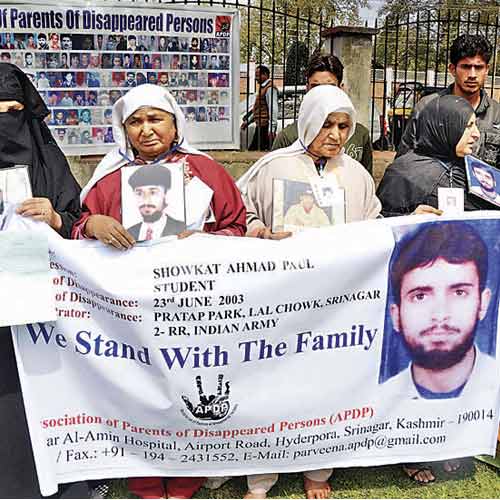
Forty-year-old Haleema Begum was once a proud and happy homemaker, but now she lives on the support of her parents and neighbours.

Haleema became a half-widow 12 years ago when her husband, Mushtaq Ahmad Bhat, was abducted by gunmen. Half-widow is a term used to describe the women whose husbands are missing in Jammu and Kashmir.

According to the Association of Parents of Disappeared People (APDP), more than 8,000 people have gone missing in J&K during the last two decades of turmoil. “One morning he left home to drop tiffin box at his brother’s shop. But he never returned. He was abducted by masked gunmen and taken to unknown place. For 12 years we have been going from pillar to post but to no avail,” Haleema told dna.

Tragedy struck again for Haleema when her son fell from a tree some years later. “We could not afford Rs25,000 for his surgery and that is why his arm has been permanently dislocated. We have no means of livelihood. My husband had surrendered and joined police as an SPO. He was the breadwinner. Now we are living on the support of my parents and villagers,” she added.

Similar is the story of Riyaz Ahmad Mir, who has not given up his fight for justice for his father Ghulam Mohammad Mir, a government employee. Mir was picked up from his home by the security forces 16 years ago. “We have filed a case. Insha Allaha we hope justice will be done,” said Riyaz.

On the International Day of Disappeared (August 30), human rights activists have demanded naming and shaming of those responsible for the disappearance of people. “The institutional culture of institutional culpability and impunity has resulted in enforced and involuntary disappearance of at least 8,000 persons. This is a crime against humanity. The government of the day is also complicit in this crime against humanity,” Khurram Parvez, Programme Coordinator, J&K Coalition of Civil Society.

“Almost 7,000 unmarked graves have been discovered in five districts so far. But the government is not willing to conduct DNA test of the bodies. Therefore on this day we not only want to show solidarity with victims but also press for justice to these victims,” Khurram added.

Friday 30 August 2013

http://www.dnaindia.com/india/1881810/report-in-kashmir-half-widows-suffer-in-silence

continue reading

Thailand must do more on The Day of The Disappeared


Thai authorities have failed to honor past pledges to resolve cases of enforced disappearance and hold those responsible to account, Human Rights Watch said today.

August 30, 2013 is the International Day of the Disappeared.

The government of Prime Minister Yingluck Shinawatra signed the International Convention for the Protection of All Persons from Enforced Disappearance on January 9, 2012, but since then there has been no progress in the parliament to ratify this important human rights treaty.

The Thai penal code still does not recognise enforced disappearance as a criminal offense.

''For many years Thai officials have committed enforced disappearances with little fear of being held to account for their actions,'' said Brad Adams, Asia director at Human Rights Watch.

''The government proclaims its opposition to this heinous crime, but has done nothing to end it.''

For instance, Nasulan Pi was last seen on January 17, 2012, at a teashop near his house in Joh Ai Rong district, Narathiwat province, when two armed men in military uniform forced him into a car and drove off.

His fate and whereabouts remain unknown. Nasulan is the 39th person reported ''disappeared'' since 2002 in connection with the government's counterinsurgency operations in Thailand's southern border provinces.

In March 2007, Human Rights Watch published a report detailing 22 cases of enforced disappearance that strongly implicated the Thai security forces. In none of these cases has there been a successful criminal prosecution of the perpetrators.

Under international law, a state commits an enforced disappearance when government officials take a person into custody and then deny holding the person, or conceal or fail to disclose the person's whereabouts.

Family members and lawyers are not informed of the person's whereabouts, well-being, or legal status.

''Disappeared'' people are often at high risk of torture, especially when they are detained outside of formal detention facilities such as police jails and prisons.

Enforced disappearances occur beyond Thailand's southern border provinces, Human Rights Watch said.

The Justice Peace Foundation, a well-respected Thai human rights group, has documented enforced disappearance cases in other parts of the country since 2011 - including 12 people from the northern region, 5 from the western region, and seven from the northeastern region.

''The many unresolved enforced disappearance cases show the failure of justice in Thailand,'' Adams said.

''The Yingluck government should end this terrible abuse and turn its promise for justice into action.''

Adopting the policy of the earlier government of Gen. Surayud Chulanont in 2007, the Yingluck government since 2012 has provided financial assistance to the families of the disappeared in the southern border provinces.

But offering money is no substitute for serious investigations into the whereabouts of the forcibly disappeared and appropriate prosecutions of those responsible, Human Rights Watch said.

Specifically, Human Rights Watch called on the Thai government to undertake the following measures to end impunity for enforced disappearances:

..Promptly ratify the International Convention for the Protection of All Persons from Enforced Disappearance.

..Urgently adopt all necessary legislation, regulations and other measures, including making enforced disappearances a criminal offense, to fully comply with the convention even before its ratification.

..Ensure that the police and prosecutors conduct prompt, competent, and impartial investigations into all allegations of enforced disappearances.

..Prosecute all officials, regardless of rank, found responsible for enforced disappearances and other abuses, including those ordering enforced disappearances or who knew or should have known about such abuses but took no action to prevent or prosecute them.

..Ensure that all persons detained by the police and the military are held at recognised places of detention, and are not subjected to torture or cruel, inhuman or degrading treatment. Upon detention, their whereabouts should immediately be made known to family and legal counsel. They should be allowed contact with family and unhindered access to legal counsel of their choice.

..Provide prompt, fair, and adequate compensation for the victims and family members of those who have disappeared or were otherwise arbitrarily detained.

..Strengthen the independence and capacity of the police, the Justice Ministry's Department of Special Investigation, prosecutors, and the National Human Rights Commission to ensure more thorough and effective investigations and public reporting of allegations of enforced disappearances and other human rights abuses.

..Invite the United Nations Special Rapporteurs on torture and on extrajudicial, summary or arbitrary executions, and the UN Working Groups on enforced and involuntary disappearances and on arbitrary detentions, to Thailand to investigate and report on the situation. Recommendations of these special rapporteurs and working groups should be implemented in a timely manner.

''Thailand should make resolving enforced disappearances a top human rights priority,'' Adams said. ''Dozens of families across the country who are waiting for answers expect no less.''

Friday 30 August 2013

http://phuketwan.com/tourism/thailand-day-disappeared-says-rights-group-18724/

continue reading

Chile marks International Day of the Disappeared


It has been 40 years, but Gabriela Zuรฑiga is no closer to knowing what happened to her husband than she was the day he was taken by Chilean security forces on Aug.15, 1974.

“I don’t know where he was taken, where he was killed, when he was killed. I know it happened but that is all,” Zuรฑiga told The Santiago Times.

Zuรฑiga is now the communications director for the Group for Relatives of the Disappeared (AFDD) that continues to search for answers in the more than 1,000 cases in which there is no information at all about the fate of the victims. The AFDD is spearheading a number of events to coincide with the International Day of the Disappeared, Aug. 30, as well as the upcoming 40th anniversary of the coup which was the spark that instigated the thousands of crimes against humanity committed by military and security forces across Chile from 1973-1990.

“In the first few months of the dictatorship there were a lot of prisoners who didn’t show up on any list,” Zuรฑiga said. “Then the systematic disappearances started in 1974.”

The term “disappeared” or “forced disappearances” refers to the practice of arresting individuals and secretly detaining them, likely torturing, interrogating and killing them, then secretly disposing of the body without ever releasing any information about the status of the detainee. In this way, the victim simply disappears, with no records of detention or information about their final whereabouts. According to the Rome Statute of the International Criminal Court, this act constitutes a crime against humanity.

Ana Piquer, director of Amnesty International Chile, told The Santiago Times that states used systematic disappearances to terrorize both the targeted individuals and their families and communities.

“The practice of enforced disappearance has been frequently used as a deliberate strategy to instill terror among the population and extend the sense of insecurity, many times against political opponents, ethnic or religious groups, and inflicts suffering and psychological damage not only to the victims but also to family members,” Piquer said.

Pact of silence

Families are then left without a body to bury or death certificate — instead they only have questions. Thanks to what has become known as the “pact of silence” in Chile, an unspoken agreement among those involved in the disappearances to not say anything, those questions remain unanswered even after the crimes have ceased. Victims’ families lack closure, not knowing with certainty that a loved one is not still out there somewhere, and issues are raised over their legal statuses, often preventing them from somewhat of a normal life.

“I am legally still married to a living man,” Zuรฑiga told The Santiago Times.

She explained that because her husband was never declared dead, she remains legally a married woman, unable to remarry despite having lost her husband 40 years ago.

“I was 21 when it happened, now I am 60,” she said.

For Zuรฑiga, having to answer questions like, “Where is your husband? What is his status?” when applying for travel visas, or jobs only adds to the victimization. She noted that the same trauma happened to the children of the disappeared who would have to answer questions about their missing parents when attending school.

Olga Weisfeiler, whose brother Boris is the only U.S. citizen on the list of disappeared, also expressed this feeling of continued trauma. She has tirelessly fought for answers in her brother’s case since his disappearance in 1984, making many trips to Chile in search for documents and clues.

“This prolonged investigation has been very distressing and placed enormous strain on my family,” Weisfeiler told The Santiago Times. “In almost 29 years I have not been able to come to terms with this tragedy. I have been unable to get on with my own life.”

She blames inaction from the government as a major reason for the lack of answers.

“All those cases of the disappeared in Chile are taking too long to investigate and the judicial system in Chile is way too slow,” Weisfeiler said. “It seems Chile is especially prolonging suffering of its people with such slow judicial system. Forty years has already past but more than half of the cases are still not even close to finished.”

One thing that all those looking for answers can agree upon, is that time is not on their side.

“Many of the relatives are dying, and [the perpetrators] are also dying, and they need to say what they know,” Zuรฑiga said.

The AFDD will be hosting a screening of the documentary “Vivas Voces” about the history of the group and its work to mark the international Day of the Disappeared on Friday at 6:30 p.m. at the Cine Arte Alameda in Santiago. They will also have a flower ceremony at the Cementerio General at noon on Saturday.

Friday 30 August 2013

http://www.santiagotimes.cl/chile/human-rights-a-law/26659-chile-marks-international-day-of-the-disappeared

continue reading

Monday, 22 April 2013

HRW report: massacres in Arakan State


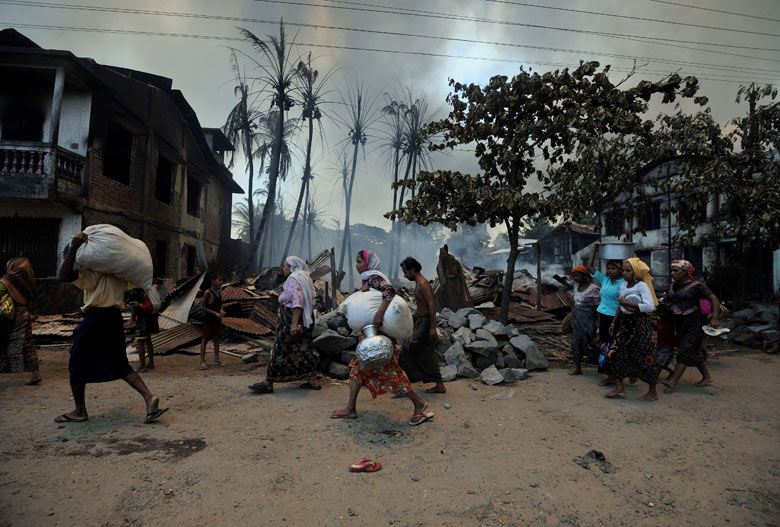
Evidence of official involvement in the massacres that left hundreds dead was gathered by HRW researchers at 27 different sites in Arakan State, including at four mass graves dug between June and October last year.

The report is the most comprehensive evidence yet that the Burmese government colluded in a wave of ethnic attacks and was released just hours before the EU was due to drop sanctions on the Burmese regime as a reward for reformist pledges at a meeting in Luxembourg on Monday.

At one mass grave near the town of Sittwe, local residents took photographs of the 18 bodies dumped in a freshly dug grave. The corpses had their hands tied behind their back with plastic strips used by the police.

"They dropped the bodies right here," a Rohingya man, who saw the bodies being dumped and later buried told HRW. "Three bodies had gunshot wounds. Some had burns, some had stab wounds. One gunshot wound was on the forehead, one on the chest. Two men's hands were tied at the wrists in front and another one had his arms tied in the back."

More than 100 witnesses to the violence, which was speared by Buddhist monks and a nationalist political movement in the region, Rakhine Nationalities Development Party, cited repeated cases in which the police and army would arrive at the scene prior to an attack. Having reassured locals with a cordon, they would then breach promises by allowing attacks and joining in the violence. Related Articles

In the worse single massacre of the three month outbreak more than 70 people, including 28 children were hacked to death in a day long massacre at Yan Thei village.

"The policemen were telling us to go back in to the village. At that time the Arakanese were coming toward us. We were trapped," said one man. "First they said they would protect us but when the violence started they took sides with the Arakanese people."

Muslims are resented in the region as immigrants who have crossed illegally from Bengal into Burma, even though most of those affected have lived in the area for several generations. "The Burmese government engaged in a campaign of ethnic cleansing against the Rohingya that continues today through the denial of aid and restrictions on movement," said Phil Robertson, deputy Asia director at HRW. "The government needs to put an immediate stop to the abuses and hold the perpetrators accountable or it will be responsible for further violence against ethnic and religious minorities in the country."

More than 125,000 were displaced in the violence last year and the UN yesterday warned those still living in camps face a catastrophe from adverse weather and poor conditions over the summer months.

"UNHCR is seriously concerned about the risks facing over 60,000 displaced people in flood-prone areas and in makeshift shelters," Adrian Edwards, a spokesman for the United Nation's refugee organisation said.

"From May to September, the monsoon season is expected to unleash heavy rains and possible cyclones in Rakhine state, where more than 115,000 people remain uprooted after last year's inter-communal violence," he warned.

Abu Tahay from the National Democratic Party for Development, which represents the Rohingya, said Burma's world renowned democracy campaigner Aung San Suu Kyi has an "obligation" to speak out against the Burmese government involvement in the attacks.

Allies of Miss Suu Kyi, who has given the Burmese government crucial international backing by refusing to join outright condemnation of the violence have acknowledge the predictament has damaged her authority.

"There was some damage to her moral authority because of this situation. Daw Suu also knows about it," Win Tin, a co-founder of her National League for Democracy said.

But experts in Burmese politics said Miss Suu Kyi cannot offend the core segment of ethnic Burmese voters who symathise with the anti-Muslim groups.

"Aung San Suu Kyi has an election to win in 2015. She risks alienating politically potent Buddhist elements among her own supporters if she appears too cosy with the Rohingya, or other Muslims," said Nicholas Farrelly of the Australian National University. "Western human rights activists and international opponents of anti-Islamic prejudice will not have a vote in who runs Myanmar in the years ahead," he said.

Monday 22 April 2013

http://www.telegraph.co.uk/news/worldnews/asia/burmamyanmar/10008702/Burmese-officials-filled-mass-graves-with-Muslims.html

continue reading

Friday, 12 April 2013

Sino-Japanese War: Burying atrocities


Through the pale gate of a machinery factory, past a five-storey office building to the south, in a small garden under a towering tree, a few charred sticks of incense stick out of the earth.

Paying respects at grave sites is common during China's Qingming (Tomb-sweeping) Festival, which this year fell on April 4, but this case was different - those paying their respects at this humble garden in Ji'nan, Shandong Province, were Japanese, and this was the site of a mass grave for Chinese victims of the War of Resistance against Japanese Aggression (1937-1945).

Across from the office building, on a small hill, lies a monument with a plaque that reads, "Pipa Mount Mass Grave Monument."

The Japanese who recently showed their respect to the unknown number of Chinese victims buried here as part of a regular tour were lauded in Chinese media; however, it's uncertain as to whether they will be able to continue to make such trips in the future, as the local urban planning bureau recently zoned the area for residential use, potentially paving the way for housing developments on the site.

Of further concern is the fact that other mass graves around the country are also facing similar risks.

Built on a burial ground

The mass grave is located at the formerly State-owned Ji'nan Material Testing Machinery Factory, which was launched in 1952 and later acquired by a private company in 2003. The private enterprise bought the rights to use the land, including the mass grave site, without any attention being given to the history of the location.

Xu Yuquan, a manager from the factory, explained that the land was designated for residential use by urban planning authorities a couple of years ago, adding that the company has been on the hunt for potential property developers since then, the Ji'nan Times reported.

Although the monument at Pipa Mount remains, another smaller monument placed under the tree temporarily disappeared when potential developers judged it as inappropriate for a future residential area, the newspaper reported.

Media reports about the removal of the monument sparked a public outcry over the subjugation of tragic history in favor of commercial interests. The monument was restored on Tuesday.

Although the monument has been restored, unease over the future of the site remains.

Zhang Lei, a staff member from the Ji'nan urban planning bureau, denied there would be any property construction projects at the site in the near future, since the bureau hasn't received any development petitions from the company, which would be a necessary first step.

"The decision to zone the land to be mainly used for residential sites was made because the factory is actually surrounded by residential compounds," she told the Global Times. "The bureau has been implementing long-term plans to gradually move all factories away from the downtown area."

Neglected by the nation

An excavation and identification project launched by the local authorities in 1954 to collect evidence of Japanese war crimes indicated that the rough area of the grave was 1,680 square meters.

According to historical materials, those buried in the grave died gruesome deaths. Some were stabbed to death; some were burned by oil poured on to their bodies, while others were savaged by dogs, to name just a few of the atrocities.

Somewhat ironically the grave and monument, which stand as a testament to the importance of remembering history, have not been identified as a cultural relic, prompting an outpouring of rage online.

Essentially, the local cultural relic authorities didn't know about the grave, a staff member from the Ji'nan Cultural Relic Bureau told the Global Times. When asked about whether the bureau would put the issue on agenda, the person said the bureau doesn't have any data or information about the grave and they still need to collect more data before they can make a decision.

Neglect of mass graves is not limited to Ji'nan. Peng Mingsheng, 75, a researcher who has devoted himself to better protecting mass graves, told the Global Times that his struggle to protect history can be frustrating sometimes.

Peng started to research a mass grave in Chengde, Hebei Province, in 1984, which had originally been under the jurisdiction of the puppet Manchu state, which was controlled by the Japanese during the war. Peng has been pushing to set up a cemetery in order to inform the public of this history, but the local authorities didn't even demarcate the grave site and residences have been scattered around the site for more than 20 years.

He also wrote a book about mass graves around the country, but publishers rejected it, saying it was unlikely to be profitable.

"I've accompanied some 70 groups of Japanese visitors to the (Chengde) grave over the years and they then realize the crimes the Japanese army committed during the war," he said. "The graves made them believe this history. But domestically, it's such a pity authorities don't take it seriously. The sacrifices made by so many Chinese should not be forgotten."

Attempts to preserve

Research and protection of mass graves left behind by the war is far from sufficient, Liu Zheng, a member of the Chinese Association for Cultural Relics, told the Global Times.

"Authorities are not fully aware of its importance (of protecting mass graves), when compared to other considerations such as property construction in the Ji'nan case," he said. "Archaeological research and presentations are desperately needed. The bones should be dug up and displayed, for example, to set up a memorial hall to raise awareness of this history."

Liu pointed out that aside from the mass graves from the 1937 Nanjing Massacre, the most high-profile massacre in Chinese history, few mass graves in China are well-known as they haven't been systematically researched and publicized.

When it comes to the protection of the mass grave in Ji'nan, Zhang said the fact that the land is mainly used for residential sites doesn't have to clash with efforts to protect the mass grave, and local authorities just need to incorporate protection of the site into their planning schemes.

Zeng Yizhi, from the International Committee of Monuments and Sites in China, disagreed, saying that residential buildings shouldn't coexist with the site, and added that even if the grave is arranged as a greenbelt with a monument, judging from past experience, future conflicts are likely when the grave site becomes an inconvenience to nearby residents.

Friday 12 April 2013

http://www.globaltimes.cn/content/774428.shtml#.UWco46dzA34

continue reading

Thursday, 11 April 2013

Chile: Exhumation can be act of exorcising the guilt


The history of Chile may be revised yet again if the forensic examination of the body of the country’s famous poet, Pablo Neruda, which has been exhumed, shows that he died of poisoning and not of prostate cancer. The reason for the suspicion about his death is the statement of Neruda’s former driver that the poet told him that his condition had started deteriorating after the doctors gave him an injection. Considering that Nobel laureate was a friend of Chile’s Marxist president, Salvador Allende, who killed himself during a military coup against his government, it is obvious that Neruda was not a favourite of the military dictator, Augusto Pinochet. The poet died 12 days after the 1973 coup.

Pablo Neruda wooed readers with his romantic poetry, but the latest lines in his story could be ripped from a murder mystery. The Chilean poet's 1973 death certificate says prostate cancer killed him.

But his former chauffeur has another theory involving an unknown assassin, a lethal injection and the South American country's notorious military coup.

On Monday, authorities started putting that theory to the test, exhuming the poet's remains as part of a high-profile investigation that could take months to complete.

Manuel Araya, the chauffeur, said he's received threats for making the controversial claim, which has riled some of Neruda's supporters.

That won't stop him from speaking his mind, Araya told CNN Chile.

"I am not afraid of anyone," he said.

Chauffeur: 'They silenced him'

A view of the tomb of Chilean poet Pablo Neruda in Isla Negra, some 120 km (75 miles) west of Santiago, on April 7, 2013.

Neruda died on September 23, 1973, just 12 days after a right-wing military coup ousted socialist President Salvador Allende and brought Gen. Augusto Pinochet to power.

The poet, a Communist Party member, had criticized the coup and Pinochet.

Less than two weeks later, he was dead.

He had been planning to go into exile the next day -- and the timing of his death was no coincidence, according to Araya.

Neruda was a well known political and public figure, having served as a lawmaker and diplomat in addition to his literary career, which earned him a Nobel Prize in 1971.

"I believe that Pablo Neruda was murdered, because Pablo Neruda was a very relevant figure in history, as much in this country as in the world," Araya told CNN Chile. "He was going to go into exile on September 24 and they silenced him before then."

Thousands of people disappeared or died during Pinochet's rule, and many have accused his government of using death squads to wipe out political opponents.

Araya alleges that Neruda was poisoned in a clinic where he was undergoing treatment.

That claim and several other alleged discrepancies surrounding the poet's death drew the attention of Chile's Communist Party, which called for Neruda to be exhumed in 2011.

Evidence suggests that a third party was involved in Neruda's death, said Communist Party attorney Eduardo Contreras. Chilean Judge Mario Carroza ordered the exhumation in February.

Nephew: 'This is a circus'

But not everyone shares the Communist Party's concerns.

After the exhumation request, the head of the Pablo Neruda Foundation -- founded by the poet's widow to promote and preserve his legacy -- said he didn't want authorities to dig up Neruda's remains.

"We are against an exhumation of his cadaver because it would seem to us a true act of desecration," Juan Agustin Figueroa told Chile's Radio Bio-Bio in 2011.

The organization has since adopted a more welcoming tone.

"In this year that marks four decades since the death of Pablo Neruda, we hope also that the investigation of Judge Carroza will help clarify the doubts that might exist regarding the poet's death," the foundation said in a statement last week.

Others aren't convinced.

"This is a circus that I do not want to be part of," Bernardo Reyes, Neruda's nephew and biographer, said last week.

Reyes said party officials never contacted him to discuss their desire to have Neruda's remains exhumed, and he told CNN Chile that he remains suspicious of their motives.

As debate surges, Reyes said he plans to update a biography of Neruda and publish photographs taken of the poet after his death, which show Neruda's physical state and the clothes he was wearing in his coffin.

"It seems that when someone wants to find the truth but ignores all the sides of the story, that is notable," he said.

Expert: Time 'erases evidence'

The investigation into Neruda's death follows another high-profile exhumation.

As part of a massive probe of 726 reported human rights violations during Pinochet's rule, Chilean authorities exhumed Allende's body in 2011, in view of the longstanding belief that he died at the hands of the military and did not commit suicide, but the country’s legal medical service reported two months later that Allende did kill himself with an AK-47 given to him by Fidel Castro.

What these incidents confirm is not only South America’s turbulent history of coups and the unnatural deaths of larger-than-life figures, but also how the absence of democracy over prolonged periods had turned the continent into a hotbed of intrigue and violence. It is not surprising that the late Venezuelan president, Huge Chavez, had ordered that the tomb of his idol, Simon Bolivar, be opened to determine whether the liberator had died of poisoning and not tuberculosis. But the investigators did not find any evidence of foul play.

For decades, Neruda has been buried alongside his wife, Matilde Urrutia, in Isla Negra, a coastal area in central Chile.

Excavation crews began work there on Sunday and completed the exhumation on Monday, CNN Chile reported.

Determining what really happened will be a difficult task, since so much time has passed since the poet's death, one pathologist told CNN Chile.

"Time is a destructive factor," said Dr. Luis Ravanal, an investigator for the office of Chile's government ombudsman. "It is an element that erases evidence."

Tissues will have decomposed, he said, and even if some sort of poison were used, there may no longer be any traces remaining. "Science has enormous limitations in this case," he said.

However, if the misgivings about Neruda’s death are confirmed, it will be yet another black mark against Pinochet’s regime and refurbish the Nobel laureate’s reputation as Chile’s Federico Garcia Lorca, the Spanish poet, who was murdered in Spain in 1936. Exhumation can be an act of exorcising the guilt.

Thursday 11 April 2013

http://newindianexpress.com/editorials/Exhumation-can-be-act-of-exorcising-the-guilt/2013/04/11/article1539372.ece

http://edition.cnn.com/2013/04/08/world/americas/chile-neruda-investigation/

continue reading

Guatemala confronts a dark chapter


The soldiers killed Jacinto Lopez's teenage daughter Magdalena by repeatedly stabbing her in the neck.

Then they shot and killed his sons, 13-year-old Domingo and 10-year-old Pedro.

His in-laws were not spared. Barely anyone in the village was.

These atrocities which took place in the remote Guatemalan town of Santa Maria Nebaj in July of 1982 have never been described in a courtroom.

Until now.

For the first time Lopez has shared his terrifying story in the nation's highest court.

And for the first time "anywhere in the world," according to the United Nations, a former head of state is being tried for genocide by his own nation's justice system. That man is Efrain Rios Montt, an ex-military dictator who ruled Guatemala from 1982 to 1983.

"They killed my family and destroyed our crops," Lopez testified. "They took even my cows."

The attack against the Lopez family was just one of countless assaults in the early 1980s during the war between the Guatemalan government and leftist rebels.

The military used the rebel threat as a guise to exterminate rural Ixil Mayan villages accused of harboring insurgents, prosecutors say. According to prosecutors, the campaign led to the genocide of more than 1,700 Ixil Mayans.

Previous accusations of genocide, such as in Rwanda or against Serbia, have been presided over by international judges. The Guatemala attacks are considered by many experts as the only incident of genocide in the Western Hemisphere during the modern era.

The trial reignites debate over the United States' controversial pro-government policies in the region during the 1980s. It also offers a fascinating look in real time at how a nation is choosing to face its own demons. Painful public testimony could help heal the national betrayal reflected in the faces of many Mayan victims.

Lopez, now 82 years old, is among dozens of witnesses who have testified at the trial being heard by the nation's three-judge Supreme Court.

Guatemala begins first genocide trial

Rios Montt, 86, is accused of authorizing a military strategy so brutal that it was labeled "scorched earth." His attorneys say that the former dictator did not order any of the atrocities.

The United States stands accused in the court of public opinion. Critics say Washington turned a blind eye to the abuses, and worse. The Reagan administration claimed violence was decreasing during Rios Montt's tenure, and in 1983, lifted a U.S. arms embargo. But there are bookends for this dark chapter of Central American history. More recently, the United States has pushed for Guatemalan judicial reform that has made this trial possible.

Horrific memories

For generations the Ixil have lived in mountainous villages in the country's northwest, mostly isolated from the rest of Guatemala and the world. According to the country's 2002 census, Guatemalan Ixil number around 95,000, less than 1% of the nation's population.

They still speak primarily the Ixil language, and most of the witnesses called to the stand so far have spoken through a translator. The horrific stories that more than 70 prosecution witnesses have revealed so far have been hard to hear in any language.

They started raping me ... I don't know how many took turns ... I lost consciousness.

"I was 12 years old," said one woman, whose identity was protected by the court. "They took me with the other women and they tied my feet and hands. They put a rag in my mouth ... and they started raping me ... I don't know how many took turns. ... I lost consciousness ... and the blood kept running. ... Later I couldn't even stand or urinate."

Stories about rape were so widespread that the trial set aside an entire day of testimony just for rape victims.

Their shocking stories prompted many of the hundreds of Guatemalans sitting in the courtroom to use their hands to cover their mouths. The powerful proceedings often wrapped the courtroom in profound silence, only to be broken by the sound of sobbing.

Pedro Chavez Brito was 6 or 7 years old when the military attacked his village in November 1982. Soldiers killed his mother, he told the court. In a frantic bid to escape, he hid with his pregnant sister and her two children among the family's chickens.

It didn't work.

When soldiers found them, they lashed Chavez's sister to the stairs of their home, he testified. The soldiers then set the house on fire, killing her and her two children, Chavez testified. Seven other family members may have died in the fire, he said.

Chavez, like many other survivors, lived to share his story because he fled into the unforgiving mountains.

That's how Maria Cruz Raymundo and her family escaped, too. But conditions there were so harsh that her husband, daughter and son starved to death, she told the court.

More than 100 witnesses have taken the stand so far -- a marathon of gruesome stories.

Another witness, Nicholas Bernal, testified that he, too, escaped to the mountains.

Bernal told the court he had watched soldiers kill his neighbors and then rip out their hearts and burn their bodies.

Each passing day of the trial reveals similar nightmarish stories. Human rights organizations such as the Center for Legal Action in Human Rights and Association for Justice and Reconciliation are broadcasting the trial live on the Internet. In addition, the U.S.-based Open Society Justice Initiative is providing daily summaries on a dedicated website. Testimony in this report is culled from all these sources and state news media.

Shifting U.S. behavior

When Rios Montt assumed power in a coup in 1982, Guatemala was already in the throes of a violent civil war that would last 36 years. The insurgency, and extrajudicial killings by the military, had been going on for two decades as part of the broader conflicts between leftist rebels and hardline governments across the region.

By the time a peace accord was reached in 1996, an estimated more than 200,000 perished.

Rios Montt faces charges of genocide and crimes against humanity connected to his 16 months as dictator. He is being tried together with his then-chief of military intelligence, Mauricio Rodriguez Sanchez.

Sanchez is accused of designing and executing the army's strategy.

When Rios Montt became president, human rights violations had already prompted the United States to cut off aid to the Guatemalan government. But a political scandal in the U.S. in the 1990s revealed that in fact the CIA continued to provide money to Guatemalan military intelligence sources for years during the civil war.

Now declassified secret CIA cables indicate that the United States had knowledge of the atrocities being committed against the Ixil Mayans, but did little about it, according to Victoria Sanford, director of the Center for Human Rights & Peace Studies at the City University of New York.

"At best they chose to look away, but often they were covering it up," Sanford said.

In one CIA document, from February 1983, the agency reports to Washington that an increase in violence against civilians is due to "right-wing violence."

But the U.S. ambassador at the time added a note to that same memo with a distinct explanation: "I am firmly convinced that the violence described ... is government of Guatemala ordered and directed violence."

Another CIA memo shows the U.S. government may have had knowledge of the violent tactics being employed against the Ixil Mayans.

"When an army patrol meets resistance and takes fire from a town or village it is assumed that the entire town is hostile and it is subsequently destroyed," the 1982 document states. "The well-documented belief by the army that the entire Ixil Indian population is (pro-rebel) has created a situation in which the army can be expected to give no quarter to combatants and non-combatants alike."

Critics blame the United States, in its anti-communist zeal, of standing by during these atrocities by denying them and lifting the arms embargo. Then-U.S. President Ronald Reagan went as far as to say that Rios Montt was being given a "bum rap" by critics. At the same time, the United States was backing other strongmen in Latin America against leftists.

But if the United States deserves criticism for remaining quiet during Rios Montt's rule, it also should be credited for supporting Guatemalan efforts to put the former dictator on trial, said Anita Isaacs, a professor of political science at Haverford College whose research focuses on Guatemalan politics.

"This trial wouldn't be occurring were it not for the role played by the United States pushing for reform in Guatemala's judicial system," she said.

In her view, the U.S. ambassador to Guatemala from 2008-2011, Stephen McFarland, was "single-handedly" responsible for shifting the country's perception of the United States from meddling to supportive.

McFarland listened to survivors' stories of the civil war and attended hearings in support of the victims, she said.

The trial

The historic nature of the trial isn't lost on the nation's public, although some say too much time has passed for the process to be fair.

Even the current President Otto Perez Molina, a former general who once commanded troops in the Ixil lands, has said he believes there was no genocide. Instead, some see the attacks as a kind of national defense campaign.

The Guatemalan military viewed the Ixil Mayans as rebel collaborators who threatened the government.

This view is shared by protesters with military ties who have stood outside the courthouse, holding signs demanding respect for the military and a fair trial. One demonstrator, Victor Manuel Argueta, told the state-run AGN news agency that the soldiers are "proud of what we did during the civil war."

The army in the early 1980s, he said, "was dedicated to defending the people from those who wanted to usurp power." The trial, he said, is nothing more than a "political lynching."

U.S. declassified documents repeated the Guatemalan military's assertion that the Ixil were protecting the rebels.

But dozens of studies by anthropologists have indicated that it was much more complex than that, said Kate Doyle, director of the Guatemala Documentation Project at the National Security Archive, a leading research institute.

Some Ixil Mayans joined the guerrillas as combatants and others provided food or protection, but still others were unconnected with the rebels. Some even actively opposed the rebels, she said.

Since the trial began, Rios Montt has fired his attorneys and then rehired them.

Defense attorneys have argued there's no evidence proving that Rios Montt ordered any of the abuses.

His lawyers have repeatedly and unsuccessfully demanded that the chief judge recuse herself. They say the judge violated Rios Montt's rights by pressing on with the trial when his attorneys were not prepared.

A victory, no matter the outcome?

The victims' stories are haunting, and the desire for justice strong, but the task of proving genocide isn't easy.

Prosecutors must prove the attacks targeted a specific ethnic group with the intention of destroying it, said Naomi Roht-Arriaza, a law professor at the University of California Hastings College of Law.

To convict Rios Montt, prosecutors must also convince the judges that he was responsible.

What's at stake is less clear. The genocide charges are without precedent. If Rios Montt and Rodriguez Sanchez are convicted, their maximum possible sentences are unknown.

In 2011, a Guatemalan court sentenced four soldiers to 6,060 years in prison each for their role in the 1982 massacre at Dos Erres, a village where 201 were killed. Thirty years for each death. A fifth soldier was sentenced to the same last year. The unheard of sentences were for crimes against humanity, not genocide.

Given Rios Montt's age, many assume that he will serve little, if any, time in prison if convicted.

For the moment, legal observers say the trial itself stands as a huge triumph.

A national conversation

So many of the Ixil Mayans have described their ordeals using the same phrase: They said the army treated them "like animals."

These heart-wrenching revelations, said Roht-Arriaza, allow victims a very important opportunity.

Finally, they can acknowledge in a public courtroom the horrors they experienced so many years ago.

Several witnesses said they do not seek revenge, but simply want to be "liberated" by having their stories etched in the official record.

They must "make public what they may have kept inside," Roht-Arriaza said. "It opens up the nation to conversation. It lets people see that the justice system works."

Looking into the eyes of some of the victims in the courtroom, it's hard to know if they reflect pain or faith or peace -- or the relief of a weight lifted.

As the witnesses detail their horrifying stories, Rios Montt sits just a few feet away, expressionless. Listening.

As Isaacs put it, this "in itself is a form of justice."

Thursday 11 April 2013

http://edition.cnn.com/2013/04/11/world/americas/guatemala-rios-montt-trial/

continue reading