Showing posts with label Mass grave. Show all posts

Monday, 19 October 2015

Colombia, rebels reach deal to search for thousands missing in war


The Colombian government and leftist FARC rebels have agreed to two measures they say will help find tens of thousands of people who have disappeared during 50 years of war, as the two sides take the final steps toward a peace deal.

The agreement, reached late Saturday, addresses a key issue at the negotiations, which reached a major breakthrough in September when then two sides vowed to sign a deal by March.

Colombia's attorney general estimates 52,000 people have disappeared during Latin America's longest war, which has killed some 220,000 people and displaced millions. Victim groups say between 70,000 and 100,000 people may have gone missing.

The two sides agreed to create a "specialized unit to search for people who are considered disappeared," according to a joint statement. The unit, separate from judicial investigations, will provide families with official reports on information obtained about their missing family members.

"These steps are transcendental, but, I repeat, they are just first steps," lead government negotiator Humberto de la Calle said on Sunday. "What was agreed yesterday looks to alleviate this pain - the profound pain of the families of the disappeared."

The government and rebels will also furnish the International Committee of the Red Cross (ICRC) with information about the missing, so the charity can help design search plans.

"We will put all our experience toward supporting relatives, exhuming mortal remains in areas where the government cannot do it and by consulting with responsible institutions," Christoph Harnisch, head of the ICRC's delegation in Colombia said in a statement.

The agreement was "another step for peace" President Juan Manuel Santos, who has staked his legacy on successfully reaching a deal, said on Twitter.

Some captured and demobilized former rebels have already cooperated with authorities to locate remains in exchange for lighter sentences, a task complicated by the rural jungle or mountain locations of many unmarked graves.

Human rights advocates and families of the disappeared have warned that unless more bodies are located, exhumed, identified and returned to their families, Colombia risks handicapping its post-conflict development.

Forensic investigators in the Andean country often struggle with large case loads and lack of training, funding and equipment.

The government and FARC have been in peace talks in Havana for nearly three years. They recently set a deadline of March 23 to reach a final agreement, which would then be put before Colombian voters for ratification.


Monday 19 October 2015

http://www.channelnewsasia.com/news/world/colombia-rebels-reach/2201818.html

continue reading

Wednesday, 2 September 2015

Mass grave found in northern Mexico


A mass grave has been found in northern Mexico, authorities said Tuesday, as a rights group indicated it could contain 31,000 bone fragments corresponding to at least 31 bodies.

The pit was discovered on a ranch in the town of Salinas Victoria, some 35 kilometers (22 miles) north of the industrial hub of Monterrey, said a spokeswoman for the Nuevo Leon state prosecutor's office, Priscila Rivas.

"The ranch was found through statements by detained criminals, information from victims and investigations by the prosecutor's office," Rivas told AFP.

The spokeswoman declined to say how many pieces of bones were unearthed or how many bodies they could represent.

But Consuelo Morales, who heads the Citizens Supporting Human Rights (CADHAC), said authorities told her organization that 31,000 bone fragments were found since the grave was detected earlier this year.

"The genetic profiles of 31 people have already been identified. It's what the prosecutor's office told us," said Morales, whose group represents relatives of missing people.

She said that her organization had told the authorities back in January that the ranch named "Las Abejas" (The Bees) may contain a clandestine grave. The fragments have been found over the course of several months.

Authorities have cordoned off the ranch as they continue to search for remains, objects or pieces of clothing that could help identify the victims.

The bones have been taken to the University Hospital of Monterrey, where DNA tests are being conducted, Morales said.

Mexican drug cartels often dump the bodies of their victims in mass graves. In 2013, for instance, 64 bodies were unearthed between the western states of Jalisco and Michoacan.

Nuevo Leon state has been the scene of brutal turf wars between the Zetas and Gulf cartels in recent years.

Tens of thousands of people have been killed across the country since the drug war intensified in 2006, while 20,000 more have disappeared.

Wednesday 2 September 2015

http://news.yahoo.com/mass-grave-found-northern-mexico-222750482.html

continue reading

Monday, 24 August 2015

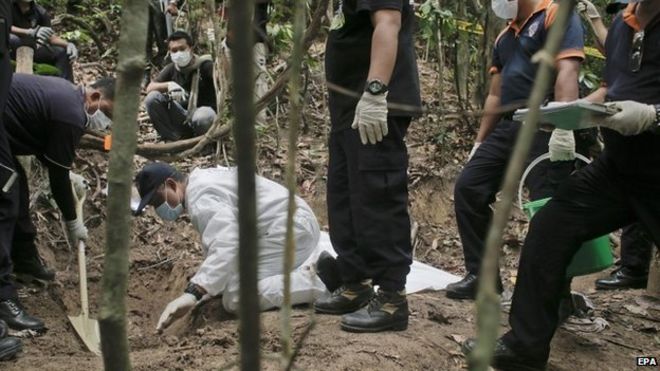
Malaysia finds 24 more bodies of human trafficking victims


Malaysian police say they have found another 24 bodies of suspected human trafficking victims in jungles bordering Thailand.

Authorities in May said they discovered 139 suspected graves in abandoned jungle camps in northern Perlis state, a remote area bordering Thailand that trafficking syndicates used as a transit point.

Most were believed to be from Burma's persecuted Rohingya minority and impoverished migrants from Bangladesh.

Another 24 bodies have been discovered this week, in addition to 106 bodies found earlier, police said. The bodies have been sent for post-mortem examinations, they added.

The discoveries in northern Malaysia followed similar revelations earlier in May in Thailand, where police unearthed 36 bodies from shallow graves in seven abandoned camps on the Thai side of the border.

The discoveries have exposed hidden networks of jungle camps run by human smugglers, who have for years held countless desperate people captive while extorting ransoms from their families.

Most of the victims were part of a wave of people who fled their homelands to reach countries such as Malaysia, where they hoped to find work or live freely.

Human rights groups and activists say the area along the Thai-Malaysia border has been used for years to smuggle migrants and refugees, including Rohingya Muslims.

In many cases, they pay human smugglers thousands of pounds for passage but are instead held for weeks or months while traffickers extort more money from their families.

Rights groups say some have been beaten to death, and the Associated Press has documented other cases in which people have been enslaved on fishing boats.

Monday 24 August 2015

http://www.independent.ie/world-news/malaysia-finds-24-more-bodies-of-human-trafficking-victims-31471220.html

continue reading

Thursday, 20 August 2015

Forensic Team Finds Mass Grave in Chungui, Ayacucho


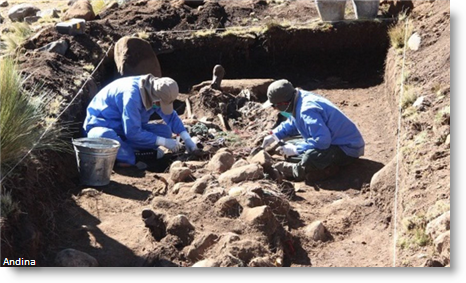
A team of forensic specialists have found the remains of 50 men, women and children in Ayacucho, in five mass graves outside the town of Oronccoy.

The investigation has shown that the bodies were buried in 1985, at the height of the internal conflict between Shining Path rebels and the military and police. In this particular case, the victims were executed by members of the special police force known as the Sinchis.

The forensic work at the site, in a remote area far from roads and communication, will conclude on August 28.

According to the district attorney, witnesses have stated that the murders were committed before dawn one morning n January 1985 at Estaca Parada, some three hours from Oronccoy. Because of the fear of attacks either by Shining Path or the military, several families had chosen to live together.

Oronccoy is in the district of Chungui, which in 2013 gave a proper burial to the identified bodies of 79 people killed between 1984 and 1985 by both the Shining Path and the military.

The district was the hardest hit in the conflict and lost 17 percent of its population — more than 1,300 people— in what Peru’s Truth and Reconciliation Commission called “the most cruel and devastating bloodbath” perpetrated by the “insanity of Shining Path and the brutal repression of the military and police forces.”

Oronccoy was abandoned by most of its townspeople in the 1980s, but many of them slowly returned a decade later in a government-supported program to reclaim their homes and farms.

Thursday 20 August 2015

http://www.peruviantimes.com/20/forensic-team-finds-mass-grave-in-chungui-ayacucho/24773/

continue reading

Tuesday, 18 August 2015

Cyprus: Hopes rise in bid to find mass grave containing bodies of Greek Cypriots


New efforts were underway in the occupied north yesterday to locate a mass grave thought to contain the bodies of dozens of Greek Cypriots missing since the Turkish invasion in July 1974.

This is the 12th attempt to locate the mass grave in question. The excavation is being carried out in the area of Trahonas in Nicosia.

“We started an excavation in a (Turkish) military area in a bid to locate a mass grave,” said Nestoras Nestoros, the Greek Cypriot member of the Committee on Missing Persons.

The case concerns Greek Cypriots killed in the Nicosia areas of Kaimakli, Trahonas, and Omorphita in July 1974.

In 1977, Turkey filed a document at the Council of Europe that around 200 bodies had been collected by Turkish Cypriot forces from those areas, loaded on trucks and taken to Ledra Palace hotel to be handed over to the Greek Cypriot side for burial.

But the bodies were not received and were eventually buried in a mass grave, the document claimed.

This has never been confirmed and the Turkish side has since revised the number downwards.

Nestoros said their information suggested between 40 and 45 Greek Cypriots were buried in the area.

Turkish Cypriot CMP member Gulden Plumer Kucuk said the excavation near the central prison started with the permission of the Turkish military.

Kucuk told BRT that around 40 to 50 Greek Cypriot fighters who died in separate areas in 1974 were gathered and an effort had been made to return them through the UN “however, the Greek Cypriot side rejected this” and the bodies were buried in the location.

Eleven previous attempts to find the grave did not yield any results.

But this time the CMP was optimistic.

Nestoros said there was testimony, which the Turkish Cypriots had looked into.

“The Turkish Cypriots intensified their efforts to see if there is something because we had always insisted on that area,” he said. “It is a huge area and we hope to find the location.”

The CMP employs a bi-communal forensic team of more than 60 Cypriot archeologists, anthropologists and geneticists, who conduct excavations throughout the island and anthropological analyses of remains.

Nicos Theodosiou, the Executive Secretary of the Committee of Relatives of Missing Persons, when asked by the Cyprus News Agency to comment on the development, also expressed hope for a successful outcome.

He said that the time that passes, makes the venture ever more difficult.

According to Theodosiou, the existence of witnesses at a burial site raises the chance for success. “In this case, the information coming from the other side indicates that there must have been witnesses during the burial, for them [the CMP] to be so optimistic,” he said.

He also said that only 30 per cent of the families of missing persons have received the identified remains of their loved ones. Tthe rest of the families were still waiting.

Theodosiou urged the Turkish Cypriot side to actively support the efforts to locate burial sites in line with the good will expressed by the Turkish Cypriot leader, Mustafa Akinci.

According to the CMP, to date, 1,508 Greek Cypriots and 493 Turkish Cypriots are on the missing list. At the end of last year, the number of identified remains of individuals returned to their families are: Greek Cypriots: 509 and Turkish Cypriots: 127, while 927 sites had been excavated. Another 35 people were identified in the first six months of this year.

It also emerged late last year that remains had been moved in the north to cover up mass executions. Around 280 of those identified to date were found buried in different places from where they had reportedly disappeared. The news was condemned in a European Parliament resolution last February that angered Turkey.

Tuesday 18 August 2015

http://cyprus-mail.com/2015/08/18/hopes-rise-in-bid-to-find-mass-grave/

continue reading

Tuesday, 4 August 2015

In Poland, communist-era graves overlay victims of the state


Fearing the power of their patriotism, Poland's communist leaders killed the nation's World War II heroes and anti-communist activists and dumped their bodies secretly in mass graves, hoping they would be forgotten. They were topped with new graves.

But now, a history institute is restoring the memory of the slain heroes and arranging proper burials. In order to get to the hidden remains, it is asking to move 194 communist-era graves — including one of a judge who contributed to the death sentence for a man likely buried just beneath him.

The move is part of efforts taken by democratic Poland after 1989 to recognize war heroes and anti-communist activists who were persecuted, killed and deliberately erased from records under four decades of communism imposed after the war.

A motion to have the graves moved within Warsaw's military Powazki cemetery, at the expense of the state, has been filed with the provincial governor, who will negotiate with families, Institute of National Remembrance spokesman Andrzej Arseniuk told The Associated Press on Monday.

He said that the primary concern is for the relatives of the slain heroes who are waiting to have them identified and properly buried.

"It is the duty of the Polish state toward these national heroes who were murdered, secretly buried and destined by the communists for oblivion, to give them back their names and proper burial sites where they could be honored," Arseniuk said.

The institute is searching for the remains of about 100 independence heroes, from among several hundred killed in a Warsaw prison and then dumped there between 1945 and 1956.

Across Poland, thousands of war-time resistance heroes who later opposed communism were tortured, killed, and secretly buried. A few of their persecutors were handed prison terms under democracy.

Remains of about 120 victims — entangled skeletons and shattered skulls — were discovered in 2012-2013 under a lawn in the Powazki cemetery. About 40 have been identified using relatives' DNA. Officials realized that more remains could be reached only by moving the new graves on top.

Among those missing are Capt. Witold Pilecki, who volunteered to be an Auschwitz inmate and smuggled out reports of atrocities there before fleeing, and Gen. August Fieldorf, deputy commander of Poland's war-time resistance Home Army.

Among the graves of various communist-era military figures, dating to the 1980s, is that of Lt. Col. Roman Kryze, a judge who contributed to Pilecki's 1948 death sentence.

Tuesday 4 August 2015

http://news.yahoo.com/poland-seeks-move-graves-reach-remains-wwii-heroes-104617339.html

continue reading

Sunday, 2 August 2015

Where are the bodies buried in Colombia?


When members of Colombia’s Crime Scene Investigators (CTI) removed a section of topsoil indicated to them by a demobilized paramilitary member as being the site of a mass grave, they were expecting to unearth skulls, bones and fragments of clothing. Instead what they came face to face with were multiple round holes of medium depths.

“What happened here? Did you bury them standing up?” asked one CTI officer.

Far from it. The bodies of the deceased had been hacked into pieces and placed in tall milk urns and doused in acid. Once the human contents had dissolved and become liquid, the urns were then disinterred and their contents poured into the nearby Magdalena River. No trace no foul and another reminder of how far Colombia has yet to go to reconcile an uncompromising and bloody past. In this particular case, the number of people to have been killed in this fashion near to the colonial town of Guaduas, barely 77 miles northwest from the capital city of Bogota, is based on hazy recollections gathered from former combatants in Colombia’s conflict looking to reduce their sentences through an admission of guilt in participation in such heinous events. Sadly, these tales are the norm rather than unique.

That was in 2010 and as the Colombian government’s negotiating team grapples with members of the Revolutionary Armed Forces (FARC guerrillas) in on-going peace dialogues in Havana, Cuba in an attempt to bring stability to much of the country, there is still the issue of thousands of missing people, many forcibly disappeared, resulting from more than 50 years of conflict. So, exactly how many people have disappeared in Colombia’s long-running conflict and where have they been disposed of? While the answer to this question in unknown, human rights groups estimate there to be 4,649 common graves across the country.

Through tearful eyes Margarita Restrepo shares with reporters that not a day passes when she doesn’t think of her daughter Carol who disappeared in Medellin in October 2002. 13 years is a long time and Margarita is just one of a group of family members here on the location of a former landfill known as La Escombrera at the westernmost edge of the city and above the infamous Comuna 13 barrio. There has been a ceremony of remembrance and on Monday July 27 authorities began an excavation which will reportedly take five months, in the hope of finding and identifying as many as 100 bodies expected to have been buried here between 1999 and 2004 when paramilitary groups took control of this strategically located district.

Unmarked graves, mass graves and common graves abound in Colombia. The puzzle is finding those who know their whereabouts and who they contain. There’s a discrepancy in numbers as victims’ groups such as Asfaddes Medellín, Movice, Familiares Colombia and las Madres de la Candelaria which all believe there to be as many as 45,000 forcibly disappeared people across Colombia in contrast to the government’s figures of 15,000. Families seeking the whereabouts of loved ones also consider la Escombrera to be of significance in that it could hold the answers to an estimated 300 missing individuals and therefore garland Medellin with the unwelcome fame of being home to the world’s largest urban mass grave.

“They will find some things, but not the quantities that they are suggesting,” said a criminologist knowledgeable in the city and who preferred to remain anonymous in an exclusive interview. “This search is a sophism to create a distraction as the Comuna 13 has become something of a myth,” he continued.

So what is the myth surrounding Medellin’s Comuna 13, a district once routinely believed to be amongst the worst in Colombia’s second city due to gang warfare and drugs? Perhaps the answer is precisely that it has gained its notoriety for being the principal Comuna—of Medellin’s 16 Comunas—which was targeted by former President Alvaro Uribe as the one which required military intervention to pacify it. Thus, the infamous Operation Orion in 2002 was carried out and it is known that the military sent in right wing paramilitary groups first and then followed them up with an all-out assault to wrest this district from the control of leftwing guerrillas such as the FARC and the smaller National Liberation Army (ELN rebels).

Certainly, this scarred hillside which for so long was a dumping ground for construction materials, household waste and even chemicals, will hold its fair share of secrets, as after Operation Orion, Comuna 13 was run by a ruthlessly savage paramilitary group known as the Bloque Cacique Nutibara under the leadership of alias “Don Berna” or Diego Murillo who was later extradited to the US in 2008 for drug trafficking and money laundering.

The excavations are not without their challenges, requiring digs to 8m in depth and which will focus on three points based on testimonies. To begin with, teams will have to move 24,000m3 of rubble and earth with heavy machinery for a period of two months before even studying the debris.

“No one can really know what they will find and what the state of preservation of the remains will be unless they attempt to excavate and recover the remains. Paleontology and Archaeology teach us that human remains (in particular bones) can survive at great depths, for hundreds of thousands of years, and that sometimes even soft tissue and clothing survive, and DNA can also be extracted. I would like to reiterate that the preservation will depend on the type of soil and whatever was dumped on the remains,” said Dr Karina Gerdau Radonic, Lecturer in Biological Anthropology at the UK’s Bournemouth University.

This situation is hardly unique to Medellin. La Escombrera itself has been visited on no less than four occasions by experts from the Attorney General’s Office since 2004 and as yet nothing of use has been uncovered. Then there are the environmental and geographical elements to consider. Colombia is home to various mountain ranges, is tectonically unstable and at the mercy of landslides, floods and heavy rainfalls across much of the country. There’s the very real fear that many remains will have shifted position from their original burial sites or have been lost altogether.

But, it’s a start down the road which hopefully can lead to closure for families and perhaps reconciliation in Colombia. While members of the leftist FARC guerrillas, involved in the peace dialogues since November 2012, have expressed their solidarity with the victims of the paramilitary killings believed to be in la Escombrera, the rebel group will be forced to recognize those disappearances carried out by members of their own.

It’s a grim reality in today’s Colombia. Killings by illegal groups in the Pacific city of Buenaventura in so-called “casas de pique” or “chop houses”, where the dismemberments of opponents occur, continue as the struggle for control of this strategic port heightens. Body parts are then bagged up weighed down with rocks and tossed out to sea. Where will forensic investigators need to look next? Grave sites attributed to the rise in gangs born from the shells of former paramilitary outfits, have been found in neighboring Venezuela as well. Nowhere, it appears, is exempt from this scourge.

The Attorney General’s website warns that some contents of their pages could be sensitive and may not be apt for minors. Here one can conduct a search through a macabre database showing items of clothing retrieved from common graves and posted online in the hope that a family comes forward to identify the missing person last seen dressed in these items. Another page offers up facial reconstruction renders, there are 64 images from the southern coca-growing department of Putumayo alone.

So, will this excavation at La Escombrera encourage further investigations around Colombia or will it lead up a blind alley and discourage the authorities from pursuing further cases? It’s hard to say. And are demobilized guerrillas or paramilitaries providing the authorities with accurate locations or leading investigators on a ruse? Unsubstantiated rumors abound that a stretch of land near to Medellin known as the Curva de Rodas was another infamous place used by gangs as a disposal area. What is not covered by new-build apartment blocks is a delicately landscaped park. In Bogota, after the military stormed the Palacio de Justicia in November 1985 in response to the siege by M19 guerrillas; those killed in the attack were supposedly unceremoniously dumped in an unused lot near to the Central Cemetery and in a more humble district of the south known as Matatigres.

Unmarked graves, mass graves and common graves abound in Colombia. The puzzle is finding those who know their whereabouts and who they contain. This is clearly easier said than done.

As the Criminologist said: “These groups are organized, the idea is to leave no evidence and no witnesses.”

It is clear that La Escombrera is just a start as thousands of Colombian families yearn for closure in a process which could easily take decades.

Sunday 2 August 2015

http://www.thedailybeast.com/articles/2015/08/02/where-are-the-bodies-buried-in-colombia.html

continue reading

Monday, 20 July 2015

Colombia to begin large-scale excavation of mass grave


Colombian officials will soon begin exhumation of a mass grave that could prove to be the largest in the country's history, authorities said Friday.

The grisly work of unearthing the mass grave in Medellin, Colombia's second-largest city, will begin on July 27 and will likely take months to complete. The bodies are believed to be the result of years of fighting among right-wing paramilitaries, leftist guerrillas and drug traffickers.

Workers could discover more than 100 bodies, according to national prosecutor's office spokeswoman Caterina Heyck, though it's hard to know in advance what they will find.

She said it could be "the largest" judicial exhumation in Colombia's history. Officials received information on the mass burial site from demobilized paramilitary fighters.

The country's five-decade long civil war has left the landscape pockmarked with unmarked grave. In recent years, officials have exhumed thousands of bodies and attempted to return the remains to family members. Workers use DNA to match bodies with people reported missing.

The government has been negotiating with the guerrilla group the Revolutionary Armed Forces of Colombia in Havana for two and a half years to end the conflict.

Saturday 18 July 2015

http://www.nytimes.com/aponline/2015/07/17/world/americas/ap-lt-colombia-exhumation.html?_r=0

continue reading

Thursday, 16 July 2015

Lithuanian chief rabbi protests excavation of WWII mass grave


The chief rabbi of Lithuania appealed to authorities to prevent the excavation of a mass grave of Holocaust victims in the country’s north. Rabbi Chaim Burshtein issued the statement Tuesday about the mass grave discovered this week during road construction work in Siauliai, a city located 120 miles northwest of Vilnius, Lithuania’s capital.

“Please halt all disturbance and moving of these human remains,” Burshtein wrote in reference to the work, which he called “the humiliation of the excavation of the human remains of hundreds of people from the Holocaust-era mass-murder grave uncovered this week.”

Originally written in Russian, the statement was translated to English and reproduced by Dovid Katz, an American scholar of Yiddish who runs the defendinghistory.com website on Jewish issues in Lithuania.

Though some human remains were unearthed during construction, a forensic excavation has not yet begun, though a local government commission gave its approval for one on Monday, the Delfi news agency reported.

“It’s been decided to excavate the remains, do anthropological tests and then rebury them and also mark this place,” archaeologist Audrone Sapaite, who is in charge of the investigation, told the BNS news agency. She said that the remains of 40 people were found at the burial site. In all, approximately 700 people shot dead by the Nazis were buried there. The reports by BNS and Delfi did not mention Jews.

According to halachah, or traditional Jewish law, Jewish burial sites are not to be disturbed unless there is danger to the dignity of the dead or other special reasons. For this reason, archaeologists’ desire to conduct forensic tests on mass graves has prompted fierce opposition by rabbinical groups throughout Eastern Europe.

Before World War II, Siauliai was home to some 6,600 Jews, according to the Yad Vashem Holocaust museum. Many escaped to the Soviet Union, but the Nazis and Lithuanian collaborators murdered hundreds of those who stayed in 1941 and in later mass killings. Some Jews from the city were conscripted to forced labor.

According to Sapaite, the bodies found in the mass grave belonged to “prisoners of various nationalities.”

Thursday 16 July 2015

http://www.jewishjournal.com/lifestyle/article/lithuanian_chief_rabbi_protests_excavation_of_wwii_mass_grave

continue reading

Friday, 10 July 2015

More than five thousand bodies found in Colombian mass graves


Groups of experts were able to find until today four thousand 332 mass graves in Colombia, in sites where more than five thousand bodies were exhumed during the past six years, the general attorney Eduardo Montealegre confirmed.

These efforts are part of the missing persons search mechanisms, implemented by the research body to clarify crimes that have occurred in the context of the armed conflict.

The research body also seeks to return the victims bodies to their families, the official said. According to estimates, some 45,000 Colombian were target of the phenomenon known as enforced disappearance during the confrontation, which has lasted more than 50 years.

The general victim´s figure is around 6.8 millions, mostly of them were displaced from their places of origin because of the violence.

Friday 10 July 2015

http://www.plenglish.com/index.php?option=com_content&task=view&id=3969341&Itemid=1

continue reading

Why we are excavating the dead of Srebrenica


On Saturday, world attention will focus for a few hours on the town of Srebrenica in eastern Bosnia. The systematic killing that took place 20 years ago constitutes the only recognised genocide on European soil since the second world war.

Weeks after the killings, the perpetrators returned, excavated the mass graves with mechanical diggers and transported bodies and body parts to secondary graves in an attempt to disperse and conceal evidence of the crime. This was an enormous undertaking considering that almost 8,000 people had been executed.

For nearly two decades, the International Commission on Missing Persons (ICMP), of which I am director general, has worked with families of the missing, local Bosnian authorities and domestic and international courts to locate and identify the victims of Srebrenica. This has made it possible for families to bury their dead with dignity, and it has made it possible to piece together what happened and to prosecute some of those who were responsible for the murders.

On Saturday, at a ceremony that will be attended by world leaders as well as tens of thousands of mourners, more than 100 newly identified bodies will be laid to rest in the cemetery at Potocari, near Srebrenica.

The killers’ attempt to hide evidence by scattering body parts made the usual identification process using articles of clothing, distinguishing physical features and identity documents almost impossible. In 1999, ICMP made the decision to harness a new technology, DNA, to identify the victims. Many observers were sceptical about the efficacy of what was then an untried approach – but it turned out to be astonishingly successful: the number of identifications increased exponentially. Today, almost 7,000 of the 8,000 missing from Srebrenica have been identified using DNA.

Beyond Srebrenica, in Bosnia and Herzegovina as well as other countries in the region of the western Balkans, including Serbia, Croatia, Montenegro, Kosovo and the former Yugoslav Republic of Macedonia, more than 40,000 persons went missing during the brutal conflicts between 1991 and 2001. Today, more than 70% of those persons have been accounted for.

However, accounting for the missing has also involved establishing why they went missing and who was responsible, and it entails upholding the rights of survivors.

The vast majority of the missing in Bosnia and Herzegovina were male, which means that women became single heads of their households and had to deal with often hostile and usually male-dominated authorities when trying to assert their rights to justice and social and economic benefits.

Those who killed in Srebrenica in July 1995 believed they could get away with murder. They thought they could erase the identity of their victims permanently. They were wrong.

The work of ICMP, in particular the scientific evidence of the identity of victims from the conflicts of the 90s, has made it possible to piece together an incontestable narrative of crimes, and to present this evidence in numerous trials, including those of Radovan Karadžić and Ratko Mladić.

While this is something that gives substance to the familiar cry of “Never again,” it will be up to the countries in the western Balkans, and in particular Bosnia and Herzegovina, to engage in an honest reckoning with the past, rather than narratives based on chauvinism or denial.


At the end of last year, the Netherlands, the UK, Sweden, Belgium and Luxembourg signed a treaty establishing ICMP as an international organisation in its own right, and by the end of this year we will move our headquarters from Sarajevo to The Hague, where we intend to play a key role in implementing what is emerging as a new global consensus on missing persons – whether the cause is armed conflict or migration or crime or natural disaster.

Once, when I was visiting a woman whose son had been missing for more than a decade, my host took a small blue tin of skin cream and opened it carefully. She pointed to the indentation on the smooth white surface of the ointment. It was her son’s fingerprint, the only physical memorial of his presence on this Earth.

There are no ways of quantifying human love, but there are tangible and useful ways of dismantling the legacy of hate. Accounting for the missing and safeguarding the rights of survivors, including the rights to truth and justice, is among those ways.

Friday 10 July 2015

http://www.theguardian.com/commentisfree/2015/jul/09/srebrenica-20-years-on

continue reading

Wednesday, 1 July 2015

Croatia: Remains Of 19 Serbs Identified


The remains of 19 Serb victims killed during the armed conflict in Croatia 1991-1995 were identified at the Department of Forensic Medicine and Criminalistics of the Zagreb University School of Medicine on Tuesday.

The remains were excavated in Slunj, Zadar, Sibenik, Dvor, Gracac, Zitnik, Medari, Vukovar and other locations, reads the statement issued by the Serbian government’s Commission on Missing Persons.

The victims, who were identified through the DNA analysis, will be buried as their families demand, reads the statement.

The remains of a total of 1,053 Serb victims killed in operations Flash and Storm were exhumed from registered graves in the territory of Croatia from 2001 to 2014 and 685 were identified, show the Commission’s data.

Over the last 14 years, the remains of a total of 1,314 Serbs were excavated from mass and individual graves in the territory of Croatia and former Republic of Serb Krajina and 932 of them were identified, says a release the Documentation Informational Center Veritas.

The list of missing persons composed by this NGO includes another 1,871 people of Serb nationality, including 1,315 civilians, 509 of whom are women.

Wednesday 1 July 2017

http://inserbia.info/today/2015/07/croatia-remains-of-19-serbs-identified/

continue reading

Sunday, 28 June 2015

Saddam-era mass grave found in Basra province


Iraqi forensic teams in the southern province of Basra have found a mass grave containing 377 corpses apparently killed during the 1991 Shiite uprisings against Saddam Hussein’s dictatorship, said Iraqi human rights officials Sunday.

A statement released by Mehdi Tamimi, an Iraqi government human rights officer, said that the mass grave was found in the east of Basra province. According to Tamimi, the grave is the second biggest mass grave ever found in southern Iraq.

“The first stage of exhuming bodies has been initiated. Bodies are mainly believed to be women and children,” Tamimi said, adding that the forensic teams need larger budgets for further excavations.

According to Tamimi, there are more than 40 mass graves in Basra province. He emphasized the importance of preserving graves in order for them to be documented properly.

A Shiite uprising in 1991 started following the Gulf War upheavals against Saddam Hussein’s rule in the country. After the failure of the uprisings, hundreds of Iraqi citizens were killed by the regime.

Sunday 28 June 2015

http://rudaw.net/english/middleeast/iraq/280620153

continue reading

Wednesday, 24 June 2015

Peru mass grave contains bodies of 17 'killed in 1980s'


Prosecutors in Peru say they have found a mass grave containing 17 bodies high in the Andes, in the Ayacucho region.

The bodies are believed to be those of local farmers kidnapped by the Shining Path rebel group in the 1980s.

Forensic experts said it was clear the 17 had been killed but not by whom.

Almost 70,000 people were killed in the two-decades-long conflict between the Peruvian government and the Maoist rebels, according to figures by Peru's Truth and Reconciliation Commission.

Prosecutor Honorio Casallo Diaz said investigations carried out by the Truth and Reconciliation Commission suggested the farmers had been abducted in the 1980s from the town of Vilcashuaman by members of the Maoist Shining Path guerrilla group.

They had been missing ever since.

Villagers in the Ayacucho region of Peru were often caught up in the violence between the Shining Path and the security forces This was a common practice by the Shining Path to boost their ranks.

However, it is not clear whether the 17 were killed by their Shining Path captors or by members of the military, who often targeted locals they suspected of collaborating with the guerrillas.

Ayacucho was the heartland of the guerrillas and farmers were often caught between the two warring sides.

The Shining Path posed a major challenge to the Peruvian state in the 1980s and early 90s.

After the capture of its main leaders its influence was greatly reduced.

In December 2011, one of its remaining leaders admitted defeat.

However, remnants of the group are still active in the jungle areas of Peru producing and smuggling cocaine.

Earlier this month, the US treasury department designated the Shining Path a "significant foreign narcotics trafficker".

Wednesday 24 June 2015

http://www.bbc.co.uk/news/world-latin-america-33253849

continue reading

Tuesday, 23 June 2015

South Africa: Investigators to Exhume Bodies From Mass Grave On South Coast Farm


The police have confirmed that an operation to exhume bodies believed to be buried in a mass grave at a former prison labour camp on a South Coast farm began on Monday.

SAPS provincial spokesperson Major Thulani Zwane said he could "confirm" officials were on site as of on Monday.

"We are assisting the Missing Persons Task Team of the NPA [National Prosecuting Authority] who are leading the investigation. Therefore we will not be able to comment further on the investigation," said Zwane.

The search is believed to get under way properly on Tuesday.

The Witness was told that the police had dispatched an SAPS Search and Rescue team complete with excavation gear and "four sniffer dogs" while several officials from various government agencies were also on site.

The Missing Persons Task Team were established in the Priority Crimes Litigation Unit (PCLU) in the NPA in 2004. The task team have since been conducting investigations into cases of missing persons who disappeared in political circumstances between March 1, 1960 and May 10, 1994.

The existence of the graves on a sugar plantation called Glenroy Farm in the Dududu area just outside Amanzintoti was first announced in March by the Office of the Premier.

The site was apparently found by local sangoma Gogo Bongekile Nonhlanhla Nkomo and was first brought to the province's attention in August 2014.

KZN Premier's spokesperson Thami Ngwenya said that Premier Senzo Mchunu will give feedback to his cabinet on Wednesday on progress made.

"The premier had referred the matter to the Presidency who confirmed they had tasked the Department of Justice to take the matter further. The premier wants a full inquiry into this matter. There are several agencies involved, including our office," said Ngwenya.

KZN Department of Arts and Culture communications head Lethukuthula Mtshali said they could not comment "due to the sensitivity of the Glenroy Farm case".

Tuesday 23 June 2015

http://allafrica.com/stories/201506231942.html

continue reading

Monday, 22 June 2015

Unidentified Rohingya human-trafficking victims given proper burial in Malaysia


Malaysian authorities Monday gave a Muslim burial to 21 human trafficking victims, believed to be Rohingya Muslim refugees, found in shallow graves in jungles bordering Thailand.

The 21 were among 106 bodies found last month in 28 jungle camps in northern Perlis state, a remote area bordering Thailand that trafficking syndicates used as a transit point to hold migrants and refugees. Most were believed to be from Myanmar's persecuted Rohingya minority and impoverished migrants from Bangladesh.

The victims were buried in a village ceremony in neighboring Kedah state, with Islamic officials performing burial rites.

Kedah Chief Minister Mukhriz Mahathir said investigations showed the victims died of starvation and illness.

The bodies of 19 men were placed in simple wooden coffins each and buried together in a huge grave, while the bodies of two women were laid to rest in an adjacent grave, he said.

The bodies of the other victims will be buried once autopsies are completed, he said.

The discoveries in northern Malaysia followed similar revelations earlier May in Thailand, where police unearthed 36 bodies from shallow graves in seven abandoned camps on the Thai side of the border.

The discoveries have exposed hidden networks of jungle camps run by human smugglers, who have for years held countless desperate people captive while extorting ransoms from their families. Most of the victims were part of a wave of people who fled their homelands to reach countries like Malaysia, where they hoped to find work or live freely.

Human rights groups and activists say the area along the Thai-Malaysia border has been used for years to smuggle migrants and refugees, including Rohingya Muslims.

In many cases, they pay human smugglers thousands of dollars for passage, but are instead held for weeks or months while traffickers extort more money from their families. Rights groups say some have been beaten to death, and The Associated Press has documented other cases in which people have been enslaved on fishing boats.

Malaysian Deputy Home Minister Wan Junaidi Tuanku Jaafar said at the time that investigations showed the bodies were wrapped in shrouds and their resting places marked with wooden sticks.

He said Malaysian security forces had not been patrolling the area because it was thought to be inaccessible but began surveying it after the discovery of graves in Thailand.

Monday 22 June 2015

http://www.timesunion.com/news/crime/article/Malaysia-buries-Rohingya-human-trafficking-victims-6341037.php

continue reading

Thursday, 11 June 2015

Post-mortem on 22 bodies from death camps completed so far


22 bodies recovered from the abandoned migrant camps close to the Perlis-Thai border have been completed so far, police say.

Perlis police chief SAC Shafie Ismail said of the 22 bodies, 14 were between the ages of 20 and 40; 12 between the ages of 40 and 60, two aged 17 to 25; and 60 and above, one.

"Of the 22 bodies, 21 are male, but we could not determine the gender of one more body," he said. Without elaborating further, Shafie said the medical forensics team were in the midst of examining 84 other remains at the Sultanah Bahiyah Hospital in Alor Star, Kedah. In a span of three weeks, police officers retrieved a total of 106 bodies from 139 graves found on the higher contours hills on the Nakawan range.

Most of the bodies brought down were skeletal remains and highly-decomposed remains. Police will use the findings by the pathologists to ascertain if there are criminal reasons to their deaths.

On May 11, police found 28 settlements and 139 burial plots deep in the jungles of Wang Kelian. The discovery was made after two weeks of thorough combing through the 50km Malaysia-Thai border in Perlis.

Police learnt about the existence of the camps where traffickers detained large groups of migrants but could not pinpoint the exact location until the discovery of camps in Thailand early last month.

Thursday 11 June 2015

http://www.nst.com.my/node/87798

continue reading

Tuesday, 9 June 2015

Ops to exhume human trafficking mass graves ends today, 106 bodies found


Operations to exhume and remove the skeletal remains of victims of human trafficking that began on May 25 came to an end today.

Malaysian police said seven more shrouded bodies were found in seven graves at Bukit Genting Perah around 2.10pm and were brought down at 5.55pm today via Felcra Lubuk Sireh.

The latest findings bring the total number of bodies found to date to 106.

“With the latest discovery, operations to exhume the remains carried out by the police comprising forensic experts, the criminal investigation department and the General Operations Force came to an end today,” the police said in a statement here today.

Yesterday, 31 graves were discovered but only 30 skeletal remains were found (one grave was empty). The remains were removed from the site of the graves at Bukit Genting Perah via Felcra Lubuk Sireh.

On June 5, 14 shrouded skeletal remains were exhumed from 12 graves (two graves had remains of two people) in the forest reserve of Mata Air and yesterday 20 shrouded remains were found in 20 graves at the same site.

Prior to that 35 corpses and human skeletons were removed from Bukit Wang Burma.

Tuesday 9 June 2015

http://www.themalaymailonline.com/malaysia/article/ops-to-exhume-remains-of-human-trafficking-ends-today

continue reading

Friday, 5 June 2015

14 more bodies recovered in Perlis jungle graves


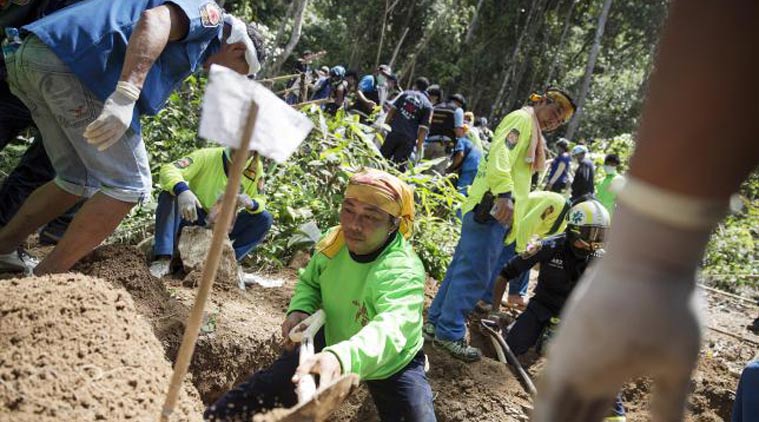
Fourteen more bodies believed to be those of human trafficking victims were found in 12 graves which were exhumed in the Mata Air forest reserve, here today.

According to Perlis Police Chief SAC Shafie Ismail the location, known as Kubur 24 in Malaysian territory, was located about 100 metres from the Malaysia-Thai border.

“Two of the 12 graves contained two bodies. All the bodies were found properly shrouded,” he said when contacted, adding that the Kubur 24 location had 91 graves.

A total of 35 bodies had previously been brought out from Bukit Wang Burma in Wang Kelian after the Inspector-General of Police Tan Sri Khalid Abu Bakar announced on May 25 the discovery of 139 graves in 28 camps, believed to have been the transit sites of the human trafficking syndicate.

Shafie said the forensic team and the General Operations Force took more than an hour to bring down the bodies on stretchers and arrived at the Felcra Lubuk Sireh field here at 6.30 pm.

He added that all the bodies were taken by police vehicles to the Sultanah Bahiyah Hospital in Alor Setar for pathology tests.

According to Shafie, if the weather permitted, work to exhume the remaining 79 graves at Kubur 24 was expected to be completed by Tuesday.

He said the main obstacle faced in bringing down the bodies was the rocky and steep terrain which made it impossible to use the services of a helicopter.

Friday 5 June 2015

http://www.themalaymailonline.com/malaysia/article/14-more-bodies-recovered-in-perlis-jungle-graves

continue reading

Saturday, 30 May 2015

Perlis migrant mass grave: Post-mortem on human remains in Wang Kelian begins June 7


Come June 7, the health ministry will begin conducting post-mortem on human skeletal remains found at grave sites in Wang Kelian, Perlis.

Minister, Datuk Seri Dr S. Subramaniam said the post-mortem was aimed at determining whether the skeletal remains and those found at human trafficking camps at the Malaysia-Thai border were those of murder victims.

He said for this purpose, the ministry had formed the CSI-DVI (Criminal Scene Investigation-Disaster Victim Identification) and the PM-DVI (Post Mortem-DVI) teams.

"The CSI-DVI has been stationed at the recovery site to help in the process of collecting samples, while the PM-DVI team is at the Sultanah Bahiyah Hospital, Alor Setar to perform the post-mortem on the remains," he said in a media conference here today.

On Monday, Inspector-General of Police Tan Sri Khalid Abu Bakar announced the discovery of 139 graves and 28 transit camps abandoned by a human trafficking syndicate in Wang Kelian, close to the Malaysia-Thai border.

Dr Subramaniam said three post-mortem procedures would be conducted simultaneously to speed up the process of identifying the bodies before samples were sent to the Malaysian Chemistry Department for DNA tests.

He added the post-mortem procedures involved several small teams comprising forensic medical, forensic science, forensic dentistry, radiology and DNA teams.

On the DNA database, Dr Subramaniam said it would be conducted on all bodies found and the data would be kept by the ministry and the police.

"We cannot take the easy way out in the process of identifying the victims. As such, we will be isolating the DNA of each body for reference purposes to facilitate further action towards determining the DNA of the person found in each grave," he said.

The minister said as of last night, 15 body bags had been sent to the Sultanah Bahiyah Hospital morgue.

He said the police had also provided a cold storage container which would enable the hospital to hold more bodies for the post-mortem.

Saturday 30 May 2015

http://english.astroawani.com/malaysia-news/post-mortem-human-remains-wang-kelian-begins-june-7-minister-61091

continue reading