Showing posts with label Bridge. Show all posts

Monday, 13 April 2015

Living memorial to victims of bridge disaster 170 years on


Children in Victorian dress will create a poignant living memorial to those that perished in Great Yarmouth’s suspension bridge disaster.

The powerful tribute will mark 170 years since nearly 80 people lost their lives after a crowd of excited children crammed onto the perilous structure to see a clown bob along the River Bure, pulled by geese.

Organiser Julie Staff said that having a throng of people dressed in the clothes of the time would help to convey the scale of the disaster, bringing to life the numbers involved and the age of the victims who were mostly aged between five and 13.

Jostling to see the advertising stunt the bridge gave way and 79 people lost their lives, nearly 60 of them young children.

The tragedy however went scandalously unremembered in the town despite being the largest recorded loss of life in a single tragedy, casting a shadow over its character.

The 57-year-old grandmother believes she has gone a long way to right that wrong – unveiling a memorial to the victims two years ago.

Now preparations are gathering pace for a fitting anniversary which will mingle joy and sadness, as it did on that fateful day.

Rather than being morbid she hoped there would be a festival atmosphere mixed with reflection.

She is planning a Victorian day with stalls, music and crafts at the memorial starting with a parade to the Market Place where people will pause in memory of those that died.

In the evening candle bags decorated by youngsters at St Nicholas Priory Junior School, with each one bearing a victim’s name, will be lit and line the river bank.

Flower petals will then be scattered into the river accompanied by a violinist.

Mrs Staff said that what shocked her most when she first heard about the story was the lack of respect.

With most of the children coming from poor families it was up to their relatives to scoop up their lifeless bodies and take them home.

Few could afford a proper burial and in the end the bridge owners paid for many of the victims to be buried in two mass graves of 30.

“I never really knew about what happened properly and my husband who has lived here all his life never knew a thing. When I looked into the story it was the lack of respect that struck me,” she said.

“They were buried in mass graves and their families told they were being punished because people could not read or write. When I unveiled the memorial I felt it was all put right. It is nice to involve the school, they will remember and carry it on.”

“It would be nice to have a bit of fun just as it was on that day,” Mrs Staff added. “But I do want to make it as Victorian as possible and a happy occasion, not morbid. The visual side will make it more powerful and I hope people will join in on the day.

“I am trying to include as many people as possible and I hope it is going to be a nice day.”

Monday 13 April 2015

http://www.edp24.co.uk/news/living_memorial_to_victims_of_bridge_disaster_170_years_on_1_4031938

continue reading

Monday, 29 December 2014

The Tay Bridge rail disaster, 135 years on


It was, said the Glasgow Herald on a Monday morning exactly 135 years ago, a catastrophe of the most appalling description.

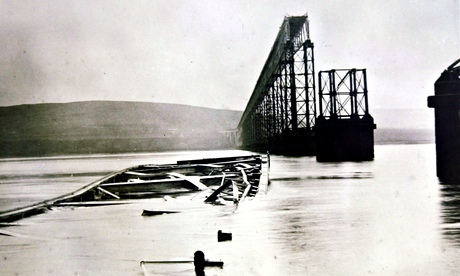
The night before - Sunday, December 28, 1879 - the central span of the Tay Bridge, at that time the longest bridge in the world, had collapsed during a violent gale estimated at Beaufort force 10/11.

A northbound ferry train from Burntisland had the misfortune to be on the bridge when the collapse happened. The six-carriage train plunged 130ft into the freezing waters of the Tay killing 75 people.

The wind was blowing hard that night, bringing down chimney pots and roof slates. The iron girders of the Tay Bridge, opened in June 1878, should have been strong enough to withstand any winds. But a half-mile span of the bridge collapsed just as a train was crossing.

A court of inquiry ruled that the collapse was due to an “insufficiency of the cross bracing and its fastenings” to withstand the gale.

However, the inquiry did not hear the testimony of one witness, engineer WB Thomson, who reported seeing “two luminous columns of mist or spray”, perhaps 100 metres tall, travelling across the river. The spray from one column struck a nearby house with hissing sound, leaving the windows caked with salt. A second witness, William Robertson, also described the columns.

Researchers at tornado research organisation Torro believe these columns were waterspouts – tornadoes over water made visible by the water droplets they carry. They believe the impact of one or more tornadoes brought down the bridge after it had been weakened by the wind.

After the disaster rules were introduced requiring new bridges to be built stronger. As McGonagall observed: “For the stronger we our houses do build / The less chance we have of being killed.”

Monday 29 December 2014

http://www.theguardian.com/news/2014/dec/22/weatherwatch-tragedy-new-twist

continue reading

Monday, 30 June 2014

Many missing as Apete makeshift bridge collapses


Ibadan, the Oyo State capital, experienced downpour at the weekend, culminating in a massive flooding, which killed no fewer than 15 persons in different parts of the ancient city.

The incident, which was similar to what the city experienced on August 26, 2011, also led to the destruction of homes and landed properties worth millions of naira.

THISDAY learnt that about 10 lives were lost at Apete due to the sudden collapse of make-shift bridge, which the people in the area had been using since the collapse of the main bridge on August 26, 2011.

It was also gathered that five other persons including three children of the same parents were found under the ruble of a Cherubim & Seraphim church, which the flood brought down when the Olodo River overflowed its bank.

As a result of the deaths recorded at the Apete Bridge, a group of irate young men yesterday stormed the workstation of the contractor currently reconstructing the Ijokodo-Apete road and the bridge linking the two communities in anger.

Consequently, the aggrieved youths destroyed equipment and property at the contractor’s station worth millions of naira.

Recounting the scale of damage incurred due to the incident, an Olodo resident, Mr. Fatai Osuolale, told THISDAY that a white garment church and some structures built few metres away from the river bank were submerged.

Osuolale said the river overflowed its bank and flooded houses around the bank, thus leading to the loss of property and five lives including three children of the same parents said to be under spiritual refuge in the church. He explained that the river “is named Egberi and its source is traced to Osun river. Inside the river, people regularly perform spiritual bath while others come to wash clothes, okada and other things.”

Osuolale said residents and good Samaritans “are still searching for the bodies of the victims. Only one has been found so far while a Nissan Micra swept off by the flood around Odan Village has been recovered from the river.”

On Apete’s incident, THISDAY learnt that the victims were part of the residents that fell from the makeshift bridge shortly after the rain. But an eyewitness said he was part of the team that rescued some people who fell into the river from the bridge.

The eyewitness said the makeshift bridge “has become extremely weak and a no-go- area for residents of the community because its base has been swept off.

“When the rain which started around 4.00 pm stopped, some of the residents decided to make use of the makeshift bridge and in the process fell into the river and were swept away.

“We heard the cry of people who fell into the river around 6:30 p.m. I decided to join the rescue team. We eventually succeeded in rescuing about six people while not less than 10 others were killed as a result.”

Consequently, the aggrieved youths in Apete and its environs protested the death of 10 persons who drowned on Saturday evening after a makeshift bridge collapsed.

The youths, violently, stormed the contractor’s workstation, therefore destroying caterpillars, office equipment and other property belonging to the company.

While the angry youths also broke into the work station and offices within, hundreds of residents in the area were waiting at the river bank for rescue operation to commence.

Some of the residents were pelting stones and other objects at a team of security personnel who stood at the Ijokodo end of the road to maintain order.

One of the security men, Mr. Bassey Etum employed by the construction company said he had to run for his life alongside five other colleagues when the irate youths earlier came on Saturday night.

Etum said: “After the river had overflowed its banks, residents at the community said people drowned because of the bridge that collapsed. They vented their anger on the company and destroyed our machines and equipment.

“They stole computers and other office equipment too. There were six security men here when they came Saturday night. They wanted to lynch us so we ran into a nearby forest. When we returned around 11 p.m., nothing was left untouched; the whole place had been vandalised.”

Monday 30 June 2014

http://www.thisdaylive.com/articles/flood-ravages-ibadan-again-claims-15-lives/182246/

continue reading

Sunday, 4 May 2014

Bridge collapse in China kills 11


The death toll from the collapse of an uncompleted bridge in south China's Guangdong province has risen to 11 as of Sunday morning, said local authorities.

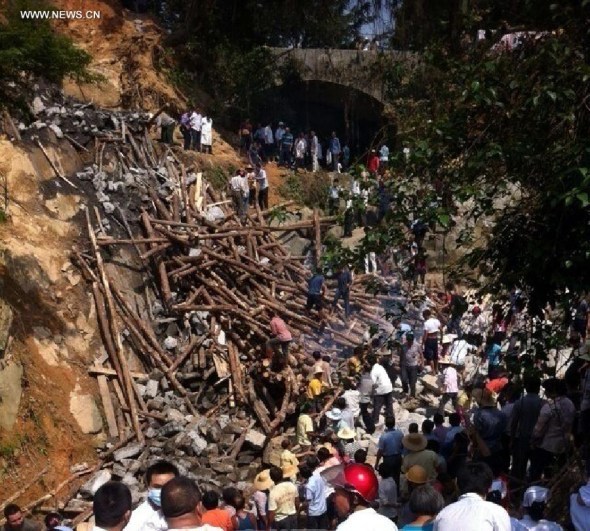
The stone arch bridge under construction in Liangkengkou village, Gaozhou city, collapsed at around 1:00 pm Saturday, said a publicity official of Gaozhou.

Rescuers pulled 27 people out of the debris, including five who were confirmed dead on the spot and eight others sustaining serious injuries, said the official, adding that six of the seriously wounded survivors later died in the hospital.

The unlicensed bridge was being built by the village itself. The local government ordered to suspend the project in April, but its construction resumed covertly during the past May Day holiday, said the official.

One other person had managed to get out.

He says the construction of the unlicensed bridge had been arranged by the village committee, and that three people were in police custody.

Sunday 04 May 2014

http://www.ecns.cn/2014/05-04/112159.shtml

continue reading

Tuesday, 25 February 2014

8 dead, 30 injured as suspension bridge collapses in Vietnam


At least eight people died and more than 30 others were injured when a suspension bridge collapsed over a dry stream in the northwestern province of Lai Chau Monday.

The accident happened at around 8:30 a.m. as a group of local residents walked across the Chu Va 6 Bridge to bring the coffin of a local official to a graveyard in Chu Va Village, Son Binh Commune.

The group had walked 15 meters on the bridge when it suddenly collapsed.

They reportedly fell 9 meters into a ravine full of large, sharp rocks. Eight people died on the spot.

More than 30 people were injured. They were rushed to the hospital by nearby residents.

The 54-meter-long Chu Va 6 Bridge opened to traffic more than one year ago.

The cause of the accident is currently under investigation.

Tuesday 25 February 2014

http://www.thanhniennews.com/society/8-dead-30-injured-as-suspension-bridge-collapses-in-vietnam-24170.html

continue reading

Wednesday, 22 January 2014

2 dead, at least 12 missing after Indonesia bridge collapse


At least two people died and many were missing after a bridge collapsed in Serang on Tuesday afternoon as dozens of people, many of them children, were watching the high water level in the Cibanten River.

“We’re still searching [for victims],” head of the Banten Disaster and Mitigation Agency (BPBD) Ino Rawita said on Tuesday, as quoted by state run Antara news agency.

Scores of people were watching the river, which was experiencing high water levels as the rainy season continued to peak, when one of the supports broke and the bridge collapsed. National Disaster and Mitigation Agency (BNPB) Sutopo Purwo Nugroho identified the two dead children as Firdaus, 14 and Rahman, 9.

Around 30 people were rescued. It was not clear on Wednesday how many people may had been killed.

“We’re trying to get the exact data on the number of missing people, because at the moment it’s not clear,” Ino said.

Sutopo said 12 people were still missing, although this figure could well change, and that the search would be resumed on Wednesday.

Banten Legislative Council (DPRD Banten) member Ayib Najib said the DPRD had told both the Serang and Banten governments to build a permanent bridge in place of the suspension structure, but that the request had fallen on deaf ears.

Banten Governor Ratu Atut Chosiyah was arrested by the Corruption Eradication Commission (KPK) at the end of 2013 and has been charged by the anti-graft authority with appropriating the provincial budget for her own ends.

“Almost every recess, I told the government about it,” Ayib said. “As for us, it is not a problem who builds the bridge, whether it is the Banten or Serang government. But none of them responded.

“Why is it so difficult to build this kind of facility for residents?” he said. “I know that Banten government can afford the bridge, but they don’t care.”

Wednesday 22 January 2014

http://www.irrawaddy.org/latest-news/2-dead-16-missing-indonesia-bridge-collapse.html

continue reading

Saturday, 28 December 2013

Memorials for those killed in Tay Bridge disaster


Memorials to commemorate the Tay Bridge disaster have been unveiled.

It is 134 years since the bridge collapsed during a storm sending a train plunging into the river below.

Fifty-nine people are known to have died, although there was confusion over the numbers killed as many bodies were not discovered for months.

Granite memorials with the names of those who lost their lives have been put in place on both sides of the river.

Newspapers at the time claimed that about 75 people died when the the central navigation spans of bridge gave way on 28 December 1879.

But members of the Tay Rail Bridge Disaster Memorial Trust have since said the true number was 59.

Unveiling ceremonies

The original crossing had been the longest railway bridge in the world but during the storm the wind was said to have blown the iron girders in the central section away "like matchwood".

The trust has been campaigning for memorials to those who died.

Both sides need to have a memorial for the simple reason that many of the victims had connections on both sides of the River Tay”

"I think possibly there was a feeling that they didn't want to commemorate a tragedy," he said.

"But surely those feelings are long gone and now its high time that we did something about it."

The memorials on either side of the river are each are made of three pieces of granite and positioned so they face where the central span of the bridge once stood. They are inscribed with the 59 names of those who died.

Ian Nimmo White, secretary of the Tay Rail Bridge Disaster Memorial Trust, said he is aware that some believe more people were killed but they had to stick with the evidence they had.

"These are the 59 victims who are known to have died," he said.

"That means for whom we have death certificates. You can't really say that there is more than 59 unless you can prove them with the appropriate documentation."

Unveiling ceremonies took place on both sides of the river on Saturday, followed by a reception for descendants of the victims.

Prof Swinfen added: "Both sides need to have a memorial for the simple reason that many of the victims had connections on both sides of the River Tay.

"Typically they were people who were working in Dundee but had families in Fife so they were coming back after visiting their families at the weekends are were sadly lost as a result."

Saturday 28 December 2013

http://www.bbc.co.uk/news/uk-scotland-tayside-central-25527719

continue reading

Tuesday, 24 December 2013

December 24, 1953: New Zealand rail bridge collapses and kills 151 in Christmas Eve volcanic mudflow disaster


A railway bridge collapsed and killed a 151 train passengers in New Zealand on this day in 1953 after the structure was damaged by a devastating volcanic mudflow.

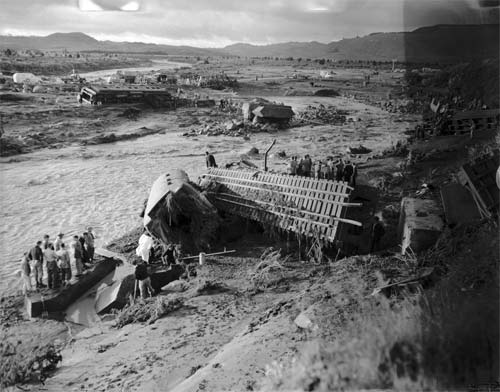
The steam engine and all five second-class carriages of the Wellington to Auckland express plunged into the Whangaehu River at Tangiwai when the crossing gave way.

The Christmas Eve tragedy happened when a lahar – the contents of a burst volcanic crater lake - cascaded down Mount Ruapehu and surged into the river.

One of the structure’s piers was destroyed by the unusual phenomenon only minutes before the train got there and then collapsed under the weight of the locomotive.

Many of the victims, including a family of five on their way to visit relatives for Christmas, were washed 75 miles into the sea and their bodies were never found.

A British Pathรฉ newsreel shows the scale of the devastation – the worst rail crash in New Zealand history – with an aerial view of carriages strewn across the valley.

The footage also shows 21 unidentified victims being buried in a mass grave at a funeral service attended by the Duke of Edinburgh.

He and the Queen had been in New Zealand as part of the first overseas tour of her reign when the tragedy happened.

The monarch delivered a message of sympathy to her people in New Zealand in her annual Christmas Day message, which was broadcast from Auckland.

She also awarded the George Medal to train guard William Inglis and passerby Cyril Ellis, who saw the danger and alerted the driver by waving a torch at the trackside.

The train, which was travelling at 40mph, could not come to a halt in time to avert the disaster at Tangiwai, which means “weeping waters” in the Mauri language.

But he helped save 134 lives after three first-class carriages, the guard's van, and a postal van remained safely on the track.

When Ellis saw that the fourth first-class coach was teetering on the edge, he and Inglis went inside to help passengers off.


While the two were inside, the carriage snapped from its couplings and fell into the river.

But Ellis and Inglis were still able to rescue all but one of the 16 passengers and save themselves.

The only victim in the first-class carriage was a little girl who drowned after being trapped in her seat.

The death toll also included 148 second-class passengers, the driver and fireman.

Also among the victims was Nerissa Love, the fiancรฉe of New Zealand cricketer Bob Blair, who was touring South Africa at the time.

In the aftermath, a system was developed to provide early warnings of lahars from Mount Ruapehu, the highest peak in the country’s North Island.

The 9,177ft active volcano is particularly prone to the phenomenon, whose name is derived from the Javanese language.

Occasionally, the crater lake of steaming water marking the vent, becomes so full that it breaks through a weak point in the surrounding ice.

This sends a torrent of water, ice, rock and mud down the eastern side of the mountain and into the Whangaehu River.

However, lahars prior to 1953 had failed to damage the bridge, which has now been reinforced.

A similar sized lahar struck again in 2007 and the structure was unharmed.

The early warning systems also stopped trains and motorists at Tangiwai before the mudflow hit.

Tuesday 24 December 2013

http://uk.news.yahoo.com/on-this-day--new-zealand-rail-bridge-collapses-and-kills-151-in-christmas-eve-volcanic-mudflow-disaster-151131695.html

continue reading

Monday, 14 October 2013

Stampede on bridge leading to Ratangarh temple in Madhya Pradesh, death toll rises to 109 pilgrims (update)


The Navratra festivities ended in tragedy when 109 pilgrims including women and children were killed and more than 100 injured in a stampede on a bridge leading to the historic Ratangarh temple in Datia district of Madhya Pradesh on Sunday. It was a disastrous re-run of the 2006 stampede when more than 50 pilgrims had got washed away falling in panic into the Sindh river off the same bridge in 2006.

Large crowds began converging on the site from early morning, according to witnesses, as Hindus celebrate the end of the Navaratri festival.

The festival is dedicated to the worship of the Hindu goddess Durga, which draws millions of worshippers to temples, especially in northern and central India.

Hundreds of thousands of devotees had thronged the remote Ratangarh village temple in Madhya Pradesh state's Datia district to honor the Hindu mother goddess Durga on the last day of the popular 10-day Navaratra festival.

Up to 400,000 devotees were already inside or around the temple in Datia district, which is about 350 kilometers (220 miles) north of the state capital Bhopal, when the stampede took place.

Eyewitnesses said over-crowding of the bridge, which is 500m long and 10m wide, caused one of its railings to snap, which led some people to shout that the bridge was collapsing. With more than a lakh of people for the pilgrimage, this set off panic with people trying to rush to safety, which caused the stampede.

Unconfirmed reports said police lathi charge to control pilgrims from jumping a queue created alarm and drove people in one direction, leading to sudden surge of people on the bridge that caused one of its railings to snap, which in turn created the panic. Sindh, a tributary of the Yamuna, is engorged with rains in past weeks and many people also fell into the river, the reason why administrative officials fear that the death toll could rise.

It may also have been caused a rumour that a bridge to the Ratangarh temple in the central state of Madhya Pradesh was about to collapse after it was hit by a lorry.

Most died after being crushed underfoot but others are believed to have drowned after jumping into the river.

Ashok Argal, a federal lawmaker from the region, placed the blame on crowds trying to rush across the bridge.

"It is wrong to say there were any administrative lapses. The administration had taken steps and made fool-proof arrangements to avoid any untoward incident," he told AFP.

"Sometimes there is little cooperation from people and people are always in a hurry, because of which this unfortunate incident occurred."

The Times of India reported that crowds could be seen pelting police with stones as frustration grew over the rescue operation.

Efforts to reach the injured and ferry them to hospital were being hampered by the huge volume of traffic in the area.

The bridge itself was a ghastly sight with bodies sprawled even as rescue teams from Gwalior, a mere 75-odd km away, were delayed due to battered roads and a 10-km long traffic jam. Pilgrims said there were only nine constables and a sub-inspector manning more than one lakh people along the 500-metre bridge when the stampede occurred.

"We have counted 105 bodies so far. Several pilgrims died on way to hospital. The toll may rise," said chief medical and health officer RH Gupta. Director general of police Nandan Kumar Dubey put the toll so far to "around 85". Most of the lakh-odd pilgrims in Datia, around 405 km north of Bhopal, were from Madhya Pradesh and Uttar Pradesh.

The crush of the stampede killed mostly women and children. Many bodies were pulled from the river, but there were fears that some bodies may have been washed away.

Relatives crowded a state-run hospital to take the bodies after the autopsies and searched frantically for loved ones among the injured people being treated there. Volunteers and residents pulled many bodies out of the Sindh River, where people had jumped when the chaos started Sunday.

Chief minister Shivraj Singh Chouhan ordered a judicial inquiry into the tragedy and Congress president Sonia Gandhi has expressed shock and anguish. The Ratangarh temple is 55 km from the Datia district headquarters.

India has a long history of deadly stampedes at religious festivals, with at least 36 people trampled to death in February as pilgrims headed home from the Kumbh Mela religious festival on the banks of the river Ganges.

Some 102 Hindu devotees were killed in a stampede in January 2011 in the state of Kerala, while 224 pilgrims died in September 2008 as thousands of worshippers rushed to reach a 15th-century hill-top temple in Jodhpur.

Monday 14 October 2013

http://timesofindia.indiatimes.com/india/110-pilgrims-killed-in-stampede-on-bridge-leading-to-Ratangarh-temple-in-MP/articleshow/24110208.cms

continue reading

Sunday, 13 October 2013

11 missing in China bridge pier collapse


The number of missing persons following the collapse of an under-construction bridge pier has risen to 11 in southwest China's Chongqing Municipality, local government said Saturday.

The No. 4 pier of a bridge across the Yangtze River in Fengdu County collapsed and became submerged in water at about 10:30 a.m. Saturday, said the Fengdu County government.

The accident happened after a beam on a floating crane fell and impacted steel cofferdams, which supported the pier.

Ten construction workers and one resident went missing after the accident. The resident, who was washing clothes at the riverside, was swept away by waves generated by the pier collapse.

Two people sustained minor injuries and are being treated in a hospital.

Sixteen vessels and 141 rescuers are searching the river for the missing people.

Construction has stopped and the cause of the accident is still being investigated.

Sunday 13 October 2013

http://english.cri.cn/6909/2013/10/13/2702s792016.htm

continue reading

Sunday, 6 October 2013

Dec. 15, 1967 - Silver Bridge collapse in Point Pleasant kills 46 (with video)


On Dec. 15, 1967, the Silver Bridge connecting downtown Point Pleasant, W.Va. to Gallipolis, Ohio collapsed into the Ohio River. The fall of the span, backed up in both directions with the Christmas season's rush hour traffic, claimed 46 lives.

The 1,750-foot eyebar chain suspension bridge was constructed in 1928 and got its unofficial name from its silver aluminum paint. The bridge’s roadway hung from steel chains anchored by two 130-foot "rocker" towers on each side of the river. Its eyebar-link design was the first of its kind in the U.S. and considered an engineering marvel at the time. The Silver Bridge was initially a toll span, but fares were phased out in 1951.

A National Transportation Safety Board report traced the bridge’s collapse to the failure of a single eyebar link just outside of the Ohio tower. Traffic vibrations and the weight of vehicles, including five tractor trailers, on the bridge’s deck contributed to the failure. When the eyebar gave out, the chains pulled down the bridge’s tower on the Ohio side. Witnesses said the entire bridge came down in a chain reaction within 90 seconds, first dumping vehicles into to the river, followed by the fall of the roadway.

The bridge’s four piers and the approach on West Virginia side were all that remained. In total, 37 vehicles were on the bridge when it fell. 31 of them went into the water.

Emergency crews were able to get to the scene quickly and were able to rescue some from drowning in the 32-degree waters of the Ohio. 21 people survived the fall or were rescued from the river. A flotilla of boats would comb the river for weeks searching for the bodies of those who were not as fortunate. As family members watched on the riverbanks for days, portions of the bridge would have to be raised before the vehicles pinned underneath could be brought to the surface.

The NTSB found that the bridge had been carrying far heavier weight loads than it had originally been designed for. The vehicle used in calculating weight at the time of the bridge's construction was the Model T Ford, a car less than half the weight of the average family vehicle in 1967. The bridge had not been properly inspected in 16 years, and investigators found evidence of severe corrosion throughout the bridge.

Barge traffic on the Ohio was shut down for 36 hours following the collapse and Mason County's civil defense director ordered all roads into Point Pleasant blocked, in an effort to keep out-of-town spectators from entering the area.

Another bridge crossing the Ohio at St. Mary’s, W.Va. was ordered closed immediately, due to its similar design to the Point Pleasant span. It was demolished in 1971 and replaced.

Recovery of the bodies from the river went on into late January 1968. Two victims were never found.

U.S. Sen. Jennings Randolph, D-W.Va., who chaired the Senate Public Works Committee, called for hearings shortly after the disaster, which led to the first bridge inspection requirements at the federal level and focused the nation’s attention on the condition of its aging infrastructure, as President Lyndon Johnson ordered a nationwide probe of bridge safety.

In the absence of the bridge, ferry service carried people across the river from Kanauga, Ohio, to Point Pleasant. Two years after the collapse, a new span over the Ohio was constructed to the south of Point Pleasant. The four-lane, cantilever design Silver Memorial Bridge opened to traffic on Dec. 15, 1969, the two-year anniversary of the disaster, and carried U.S. Route 35 across the river, connecting Mason and Gallia counties.

A memorial to the 46 victims was constructed in Point Pleasant at the site of the original bridge’s West Virginia approach. Consisting of a concrete semicircle, the monument’s red bricks are inscribed with the names of those who lost their lives in the disaster.

Documentary

A 30-minute WCHS documentary is produced, "A Scar Remains," from 1992, the year of the disaster’s 25th anniversary.

Produced and hosted by reporter Brad Harvey, it features interviews with witnesses and survivors, as well as footage from the aftermath of the collapse.

Due to its length, the video is posted in two parts. Part one can be found here. Part two can be found here


Sunday 6 October 2013

http://www.wchstv.com/newsroom/rememberwhen/rem131006_28.shtml

continue reading

Friday, 20 September 2013

Tay Bridge Disaster memorials will be dedicated to the 59 ‘known’ victims


Since that Tay Bridge Disaster of December 28 1879, there have been many diverse claims as to the final death toll.

The most popular figure is 75, promoted not only within the public and newsworthy arena but also by some of the authors of books on the tragedy, most notably John Prebble in The High Girders.

At the present, there are museums throughout Scotland which display literature to support the claim.

But when memorials to the disaster are finally erected at Wormit and Dundee later this year, they will bear the statement “Those known to have died”, then list 59 names only.

With planning permission granted this week for the Dundee memorial and conditional approval given by Fife Council for the one at Wormit, the secretary of the Tay Rail Bridge Disaster Memorial Trust, Ian Nimmo White explained the reasons for this.

He said: “It has been the case since statutory registers began in this country in 1855 that when you die, your death is registered in the district where you die, not where you live.

“After the disaster in 1879, all the deaths of the known victims were registered in the district of St Mary’s, Dundee, which embraced the then Tay rail bridge and that part of the Tay around it.

“Those certificates, 59 in all, are lodged in New Register House to this day.

“In the aftermath of the tragedy, doctors could not be certain about the means of death of each individual — for example, had they died due to injuries sustained by the fall of the train and bridge? Was it from hypothermia? Or was it by drowning?

“Eventually, once the authorities felt they had discovered all the bodies they were going to discover, and were certain of the identities of those bodies they had not been able to find, the registrar at St Mary’s recorded all 59 as having died from ‘Drowning as a result of the fall of a passenger train and portion of the Tay rail bridge’.

“In the 134 years since the tragedy, nobody has proved beyond doubt that there was a 60th victim, far less a 75th.”

Mr Nimmo White said proposals for the memorials are on track and enough funds are in place to make this happen. But donations are still welcome for extras such as seating.

The estimated cost of the memorial project is around £32,000 (£20,000 for the cutting and shaping of the granite and £12,000 for the foundation work).

Mr Nimmo White said it had yet to be decided which quote to accept for the foundations work, but he anticipated building work would start “well into November”, with the trust still working towards a planned ceremony on December 28, the 134th anniversary of the Tay Bridge disaster.

Any individuals or organisations still wishing to donate to the campaign should make a cheque out to “Tay Rail Bridge Disaster Memorial Trust” and send to Ian Rae, Treasurer of TRBDMT, 11 Wilmington Drive, Glenrothes, Fife, KY7 6US.

One man who has made it his mission to ensure that the victims of the Tay Bridge Disaster are never forgotten is Professor David Swinfen.

The former vice-principal of Dundee University and author of a book on the disaster is leading the campaign to have memorials erected at either side of the Tay.

Historian Mr Swinfen, 75, recently became chairman of the Tay Rail Bridge Disaster Memorial Trust, and has been helping to breathe new life into the drive to raise cash for a permanent tribute in Dundee and Fife to those who died that fateful night.

He said: “It is great pity that this hasn’t been done before now. It is more than 130 years since the disaster took place and we still have no memorial.

“We want to create something sizeable, noticeable and tangible. My role with the trust is to make this happen.”

It was about 7.15pm on the evening of Sunday, December 28 1879, when part of the original Tay Bridge plunged into the water, taking with it a train from Burntisland, its crew and passengers. None survived.

The tragedy occurred only 14 months after the bridge, commissioned by the North British Railway Company, had opened.

Less than a year later, its designer Sir Thomas Bouch died.

The structure’s height and width immediately attracted much criticism.

An investigation after the collapse blamed the bridge’s design, construction and maintenance, with the finger pointed squarely at Bouch.

Friday 20 September 2013

http://www.thecourier.co.uk/news/local/dundee/tay-bridge-disaster-memorials-will-be-dedicated-to-the-59-known-victims-1.132491

continue reading

Thursday, 18 July 2013

Bridge collapses killing 12 people in China


Video footage has captured the moment that the bridge crumbled into the high waters of a flooded river in south-west China.

The bridge reportedly had six vehicles on it when it was submerged. Three people were rescued from the water but 12 were killed.

Lin Rui survived, recalling the collapse he said: "I remember that at that time there were many people watching the flood on river bank. Then I felt the car shaking and saw cracks on road.

"The middle of the bridge was raised and then suddenly it fell way.

"It happened just in one or two seconds. And there was no time for me to respond".

Rescuers are continuing to search for some of the bodies of those killed.

Thursday 18 July 2013

http://www.telegraph.co.uk/news/worldnews/asia/china/10185572/Bridge-collapses-killing-12-people-in-China.html

continue reading

Monday, 17 June 2013

June 17, 1958: The collapse of the Second Narrows Bridge


June 17, 1958, was a perfect summer day, sunny and hot. Workers building the new Second Narrows Bridge were nearing the end of their shift when, suddenly, a span 20 storeys above Burrard Inlet began to shake.

“Some of the men on it ran,” reported The Vancouver Sun. “Some clung to the girders.

“Then, with a crash that could be heard in downtown Vancouver, it swung down like a pendulum and slammed into the bottom of the sea.

“Clinging ironworkers flicked off like flies. The falling mass pulled its inshore supporting pillar out, (which) allowed (a second) span to fall like its partner.”

A survivor estimated that the collapse lasted only 25 seconds, but it sent 18 men hurtling to their deaths, and injured 20 more.

John Olynyk was one of the lucky ones. Olynyk was inside a “big, criss-crossed diagonal beam” when the span collapsed. He miraculously survived the fall and crawled to the top of the beam, but the tide started to come in. Then “the water came up and up and up,” and he thought he only had five minutes to live.

But a crew of six welders spotted him. Clambering onto a work boat, wrote The Sun’s Tom Ardies: “They put their torches to the steel cage that held him. They burned it away piece by piece, and pulled him out at the last minute.

“ ‘We worked like hell to save his life,’ said welder Jim Fullager. ’He just stared at us, without a word.’ ”

The welders pulled eight men out of the wreckage. But only two were alive.

A diver later died searching for bodies in the twisted metal underwater, bringing the final death toll to 19. Among the dead were two engineers that had miscalculated the strength of the “grillage” on a platform. A royal commission into the disaster said the miscalculations “meant the beams of the platform were used without stiffeners and supports which would have been found necessary if the calculation had been made correctly.”

It was a fatal mistake.

Monday 17 june 2013

Read more: http://www.vancouversun.com/THIS+HISTORY+JUNE+1958/8533871/story.html

continue reading

Friday, 10 May 2013

Thursday marks the 33rd anniversary of the Skyway disaster


On May 9th, 1980, dozens of people died after plunging off the Skyway and into Tampa Bay just seconds after it was hit by an out of control freighter.

In the middle of a fierce storm the 600-foot Summit Venture tried to make it under the Skyway Bridge at 7:30am. Winds up to 50 miles an hour blew it off course and into the old bridge's concrete supports, sending the southbound span crashing into the bay.

Drivers heading south into Manatee County, blinded by heavy rain, could not see the deadly void in front of them. Eight vehicles, including a Greyhound bus carrying 22 passengers, plunged 150 feet into the water. 35 people died that day.

One man, Wesley MacIntire, survived the fall when his car landed on the deck of the Summit Venture before falling into the bay.

The pilot of the ship, John Lerro, was cleared of wrongdoing by both a state grand jury and a Coast Guard investigation.

For years later, drivers using what was left of the Skyway had to relive the disaster and the horror experienced by those who died by viewing the missing middle span of the southbound lanes.

The fishing piers on each side of the bay are all that remain of the old bridge. The new Sunshine Skyway Bridge that we use today opened in April, 1987.

Friday 10 May 2013

http://www.mysuncoast.com/news/local/thursday-marks-the-rd-anniversary-of-the-skyway-disaster/article_d9464c30-b8f3-11e2-a817-0019bb30f31a.html

continue reading

Monday, 11 February 2013

Bus packed with Muslim pilgrims runs off bridge in Bangladesh, killing at least 17 people


At least 17 people, including five women, were killed and several others injured when a bus carrying a group of Muslim pilgrims plunged into a nearly dry river in south-eastern Bangladesh today, officials said.

The bus carrying 43 people had started from Gazipur on Saturday to join a Muslim spiritual function at Maizbhandari shrine near the south-eastern port city of Chittagong.

The accident happened in Cox’s Bazar district, 296 kilometres south of the Bangladeshi capital.

“Sixteen of them died instantly and a minor boy succumbed to his wounds as he was being rushed to the hospital,” a police official told PTI.

Five of the dead were women and 18 people were injured in the incident, the Daily Star reported.

The bus fell into a dry part of the Matamuhuri river early morning after breaking the railing of Matamuhuri bridge some 30 feet above the sandy river bed.

The police official said most other passengers were critically wounded as the bus plunged into the river. Army troops from a nearby military installation joined the rescue campaign.

The police official said the passengers were residents of suburban Gazipur at the outskirts of the capital Dhaka and they had gone to join the Muslim spiritual function.

They planned to visit the beach retort town of Cox’s Bazar during their journey back to home.

Barua said the bus was carrying 43 people returning from a shrine of a local Muslim saint Mujibur Rahman Maizbhandari.

Road accidents kill about 10,000 people every year in Bangladesh, the government says. Crashes often are blamed on rash driving and faulty vehicles.

Monday 11 February 2013

http://www.startribune.com/world/190625891.html?refer=y

continue reading

Tuesday, 5 February 2013

Bridge collapse victims to get equal compensation


The government will equally compensate the families of 10 people who died in a fatal highway bridge collapse in Henan province, the website of Dahe Daily reported on Monday, citing officials at the rescue headquarters.

The news came after reports emerged quoting relatives of the victims born in rural areas saying they will get 180,000 yuan ($28,800) in compensation, or 220,000 yuan less than their counterparts from urban districts.

The government will apply the same compensation standards to every victim and will comply with the Supreme People's Court's interpretation of compensations for personal injuries, officials at the rescue headquarters said.

A truck overloaded with fireworks exploded and blasted off part of a viaduct about 30 meters above the ground in Mianchi county, Henan province, on Friday morning. Ten people died and 11 were injured.

Officials at the rescue headquarters have released the list with the names of the 10 deceased on Monday, and asked relatives to collect the bodies.

The victims were from Shandong and Jiangsu provinces and also from Henan province.

Monday 5 February 2013

http://english.sina.com/china/2013/0204/557774.html

continue reading

Wednesday, 12 December 2012

Bridge collapse: Missing bodies found


Fourteen people died after a bridge collapsed on the R65 between Lothair and Ermelo due to heavy rains, the Mpumalanga community safety department said on Tuesday.

Spokesperson Joseph Mabuza said three vehicles, one of them a taxi, were involved in the accident.

"The bridge goes over a dam and it collapsed. The cars drove over the collapsed bridge and were swept away by high volumes of water."

The bridge collapsed around 21:50 on Monday night, with six people initially killed and others missing.

"Police have retrieved the missing bodies," Mabuza said.

"The road has been closed that leads to Lothair, and will only be open for people residing in the area."

Motorists should use the R33, N17 and the Ermelo/Mpuluzi road as alternative routes.

"We have realised there is a prediction of higher rainfall in the province and people should be cautious when driving, especially when they see water on the road," Mabuza said.

"They should stop and inspect the water, because it could be dangerous to drive further down the road."

Wednesday 12 December 2012

http://www.news24.com/SouthAfrica/News/Bridge-collapse-Missing-bodies-found-20121211

continue reading

Sunday, 25 November 2012

Under-construction Chittagong flyover collapse death toll 12

Death toll reaches 12 as rescue teams until Sunday morning recovered more bodies from under the debris of three girders of the under-construction Bahaddarhat flyover, police said.

The girders collapsed on Saturday evening. It was one of the four huge girders between pillars No. 21 and 22 of the flyover being constructed to connect the Shah Amanat Bridge road with CDA Avenue at Bahodderhat intersection.

Over 50 others sustained varying degrees of injuries with the condition of many of them was stated critical.

Chandgaon Police Station Officer-in-Charge Babul Chandra Bhowmik on Sunday told bdnew24.com: "Two more bodies were recovered from the pond near the under-construction flyover in the early hours. Two had died on their way to hospital. We are confirmed about 11 deaths."

Police officials deputed at Chittagong Medical College Hospital police camp said another people died at hospital undergoing treatment.

Hundreds of Army, police, RAB and BGB personnel were continuing their rescue operation by cordoning off the accident area. They were not allowing anyone to get inside the cordon.

The collapsed girder completely blocked the narrow lane on the east side of the under-construction bridge and forced the city-bound vehicles get stuck on the other lane on west side of the bridge, said Assistant Commissioner (traffic – north) AKM Emran Bhuiyan.

Movement of vehicles along the busy road virtually came to a grinding halt. It was also hampering road communication of the port city with southern upazilas of the district and Cox’s Bazar through the 3rd Karnaphuli Bridge.

Bangladesh Army's 24th Infantry Division GOC Maj Gen Sabbir Ahmed on Sunday told bdnews24.com: "Two of the collapsed girders have been cut. Work to cut the other one is still going on. Machineries are coming from Dhaka."

Around 3:40am on Sunday, Chittagong Metropolitan Police's (North) Additional Deputy Commissioner Mohammad Shahidullah told bdnews24.com that the fire service rescuers had pulled four more bodies from under the debris of one of the girders that fell on the nearby pond.

Until now, only three of the deceased were identified as – 'Sazzad', 20, 'Shahabuddin' and Kajal Chandra Dey, whose age could not be immediately known.

The girders between the number 12 and 13 pillars at the Bahaddar Barhi near the city's Shah Amanat Bridge connecting road cave in around 7:30pm.

bdnews24.com Senior Correspondent Mintu Chowdhury and Correspondent Uttam Sengupta reporting from the spot said they heard screams of the people trapped under the debris right after the accident.

They said the angry people demonstrated and set ablaze the flyover-construction materials after the incident protesting the delay in the rescue operations.

DC Mannan had urged the agitated people to calm down after arriving at the scene around 8:45pm. "We have informed the army. I hope the rescue operation will begin soon."

The police also fired several rounds of tear shells as the people started demonstrating again in front of the New Chandgaon Police Station and at the Bahaddarhat intersection around 9:20pm.

They also vandalised several vehicles including the DC's car, a fire service vehicle, the jeep of the Additional Commissioner of Police (Revenue) and an ambulance at that time.

At least 10 motorcycles, including the one of bdnews24.com correspondent Mintu, were also set on fire.

On June 29 of this year, a rickshaw-puller had been injured after a girder from the flyover collapsed.

The 1.4 km long flyover's construction had begun in December 2010, under supervision of the Chittagong Development Authority. Two firms – Parisha Enterprise and Meer Akter Enterprise – were building the flyover at an estimated cost of Tk 1.06 billion.

Wall collapse injures 12

Another disaster struck close by when at least 12 people were injured as a wall of a mosque beside the area of the mishap collapsed.

bdnews24.com's Mintu Chowdhury, who was at the site, said the wall of the Bahaddar Barhi Mosque collapsed around 10pm as at least 500 people gathered there and climbed on the nearly 30-feet wall.

He said the wall collapsed under the sheer weight of so many people.

The rescue team, drawn from the police, BGB and Army, pulled them out of the rubble and sent them to CMCH.

The rescue officials had asked to move away, but they did not listen because they were waiting to watch the rescue of many trapped under the debris of the girders.

Trapped

Shah Haji Mohammad Bokhtiar, owner of the Shah Amanat Decorators, situated right beside the under-construction flyover, told bdnews24.com: "I saw three girders collapsing one after another. It appeared to me that at least 60-70 people are still trapped under the debris."

Local people said that a large number of people generally walk underneath the flyover in the afternoon every day. Most of them are garment workers, while hawkers sit there with their goods, they added.

They suspect most of them were trapped under the debris.

Sunday 25 November 2012

http://www.daily-sun.com/details_yes_30-06-2012_Under-construction-flyover-girder-collapses-in-Ctg_190_1_1_1_9.html

continue reading

Wednesday, 26 September 2012

Maharashtra Bus accident: 18 dead

Many school children are feared dead in Buldhana district, Maharashtra after a bus had fell off a bridge.

The state transport bus was carrying the school children along with several other passengers as it fell off the bridge. The bodies of few children, a helper and the driver in the bus were recovered at the sire after rescue operations have started.

It has been confirmed that almost 18 people were dead in the accident including several school going kids while the number is expected to rise as search operations continue.

Further details are awaited.

Wednesday 26 September 2012

http://www.andhrawishesh.com/home/in-the-news/33196-maharashtra-bus-accident-18-dead.html

continue reading