Showing posts with label Morgue. Show all posts

Thursday, 5 November 2015

Hundreds of bodies lie unclaimed in city mortuaries


Nearly 200 bodies have been unclaimed from state mortuaries around the Tshwane metro in the past three years.

And throughout Gauteng, more than 4 000 bodies were unidentified or unclaimed during that period, and though there had been a decline in the past, the numbers were showing growth which had officials worried.

Gauteng MEC for health and social development Qedani Mahlangu said there were various reasons for the unidentified bodies. “The main reasons include: lack of authentic identification documentation; foreign nationals and South Africans from other provinces who travel without ID documents; and socio-economic reasons, including resource constraints for burial for families,” she said.

“From 1 April 2012 to 31 March 2013, mortuaries had 1 603 unidentified and 242 unclaimed bodies, from 1 April 2013 to 31 March 2014, 1 254 unidentified and 334 unclaimed and from 1 April 2014 to 31 March 2015, 1 272 unidentified and 403 unclaimed. In the period under review, Pretoria had 181 unclaimed bodies, Springs 203, Roodepoort 145 and Johannesburg 119.

Jack Bloom, DA Gauteng shadow MEC for health said this showed the Gauteng health department had been struggling since 2006 to develop an internet-based system that could assist people with identifying bodies. “According to the MEC, the Gauteng forensic pathology ‘is currently developing a comprehensive mortuary management system targeting January 2016 for completion with first phase piloting for February 2016,” said Bloom.

The DA hoped that the internet system was implemented sooner rather than later to give relatives looking for missing loved ones a central database, rather than having to visit each and every mortuary around the country, which was very traumatic and time-consuming.

Thursday 5 November 2015

http://rekordeast.co.za/70174/hundreds-of-bodies-lie-unclaimed-in-city-mortuaries/

continue reading

Wednesday, 15 July 2015

Without war, Dover mortuary, lab roles shift


For the better part of 14 years of war, the transfer cases and bodies never seemed to stop arriving at Dover Air Force Base.

"We used to look at the casualty board and hope for a break," said James Parsons, an embalming technician with Air Force Mortuary Affairs Operations, the only U.S.-based funeral home dedicated to the nation's fallen military. "Now? Now it's good."

In 2007, the worst year of the fighting in Iraq and Afghanistan, some 1,020 military casualties were shipped home, according to Air Force Col. Dan Merry, AFMAO's commander. Last year, the overall total fell to 60. "And it has gone down gradually since," said William Zwicharowski, Port Mortuary branch chief, who was with AFMAO, and the agencies that preceded it, for the entirety of the conflicts.

So trimming, and training, are now the watchwords at AFMAO. Its next-door neighbor at Dover, the Armed Forces Medical Examiner System, has also shifted gears, from performing autopsies on every returned casualty from Iraq and Afghanistan to studying lessons learned, taking on more emerging historical DNA identification work and helping non-defense agencies with medical legal death investigations.

"We're staying busy," said Army Col. Ladd Tremaine, director of AFMES, noting the group's increasingly worldwide responsibilities for the federal government. "Most of our work is not done back in that autopsy suite. Most of my examiners are on the road."

It's been a remarkable shift. A total of 6,852 U.S. military personnel have died overseas since 9/11. All were carried off a cargo jet ramp, one by one, and into the complex that houses the two agencies. Even as stunned family members were welcomed, comforted, even counseled, the remains were being scanned (for explosive material), catalogued, autopsied, embalmed and prepared for burial.

Now, the number of dignified transfers from overseas has slowed to a crawl.

"We are not used to it," said Zwicharowski, a former Marine. "We've almost slammed the brakes on now. Which is great. ... It's probably the best problem I've ever had in my life, [which] is to not have 10, 20, 30 bodies to process a day. So it's a good problem to have."

The slowdown is giving AFMAO time to take stock of itself. Recently borrowed mortuary personnel are being returned to other bases - as well as to Dover's Air Force Reserve unit, the 512th Airlift Wing, which it has relied on heavily during the wars. AFMAO could get even smaller, Merry said.

AFMAO has 50 personnel assigned, but that could be halved "if we stay this way for a year or two," Merry said – adding that this could quickly change if the U.S. keeps increasing its small combat presence in theater.

"If we get 30 or 40 thousand boots on ground, in harm's way, we'd start plussing back up," Merry said.

To prepare for the unexpected – a mass casualty event, e.g. – Merry is implementing a more efficient rapid "recall" system. "We're looking at a system where we can hit a button and get everybody we need back here, fully trained, fully checked out, ready to go," he said.

"It's not a matter of if," Zwicharowski said. "It's a matter of when, unfortunately."

That was the case when 11 Louisiana National Guardsmen were killed in a March helicopter crash during training in Florida. All the troops were brought to Dover; AFMAO reached out to the Navy to borrow licensed embalmers to help out, Merry said.

With fewer permanent personnel on staff, Zwicharowski said, "We're turning to training on mannequins, restorative art training, embalming training, and licensing."

Training is particularly important for specialists who sometimes handle bodies in far worse shape than those that typically arrive at a mortuary. Roadside bombs were the No. 1 killer in these wars.

Tremaine's AFMES is responsible not only for worldwide U.S. military autopsies but medical legal death investigations for the entire federal government across the globe – agencies such as the FBI and NASA – which is why his examiners often find themselves traveling.

"The sheer numbers have decreased," Tremaine said. "The complexity of our cases has increased. Department of Justice has been using us extensively over the past year." He pointed to the police shooting death of Michael Brown in Ferguson, Missouri, which was investigated by the FBI.

"When something like Ferguson occurs, you're going to have the locals investigate it, and … the same thing happened here in Baltimore recently – you're going to have the family request a second autopsy," Tremaine said. "Who's going to be the ultimate arbitrator or make sure that everybody's playing on an even field? Who's the honest broker? Well, we've essentially become that honest broker. We come in as a federal entity; we get to see all the evidence and information; and potentially do a tertiary post-mortem examination, independently. And then we present that to the Department of Justice."

In addition to its autopsy work, AFMES recorded in detail war injuries with an eye toward improving combat trauma care. Tremaine wants to make that database more easily accessible.

"All throughout the war, we've been very active in identifying the glaringly obvious, and getting that information out quick," he said. "Now it's time to sit back and look at all the information in its totality, and discover those non-glaring issues that will only be captured through more in-depth research. Can we discover something else that can potentially change techniques, tactics and procedures in the future?"

AFMES' DNA Lab will also stay busy performing DNA analyses on remains from past conflicts, such as those of the sailors and Marines who died at Pearl Harbor aboard the USS Oklahoma who were buried, unidentified, in mass graves in Hawaii and are now being exhumed.

Wednesday 15 July 2015

http://www.delawareonline.com/story/news/nation/military/2015/07/14/without-war-dover-mortuary-lab-roles-shift/30162767/

continue reading

Tuesday, 7 July 2015

Hospital workers selling organs of dead bodies for high prices in Uttar Pradesh


In a shocking revelation, the employees of the post-mortem house at the medical college hospital in Uttar Pradesh's Meerut town, about 450 kilometres from here, were found to be "selling" organs of the dead bodies, which were sent there for conducting autopsies.

It was found that the organs were sold to the "tantriks" (exorcists) and practitioners of occultism for hefty prices. A sting operation, conducted by a resident of the town, unearthed the shameful and shocking trade.

Kapil Kumar, who conducted the sting operation, said that the employees at the post mortem house auctioned the organs of the dead bodies to the tantriks and occult practitioners. "The organs were sold to the highest bidders," Kumar said.

He said that the "hearts" of the dead bodies were in great demand and fetched the highest price.

Kumar also said that the employees told him that the "organ trade" was in the knowledge of the senior officials and the doctors. "The money goes to all," Kumar said quoting one of the employees, who, sold him an organ.

As the sting operation video went viral, the district authorities went into a tizzy. A magisterial inquiry was later ordered into the matter. "It is a very serious issue...a magisterial probe has been ordered...we will take stern action against any one found guilty," district magistrate Pankaj Yadav said.

Exorcism was quite common in parts of the state and could be witnessed at some of the ghats of the Ganges at Varanasi and at places Gorakhpur, Mirzapur and some other districts.

There have been reports of sacrifice of little children by the "tantriks" to attain "supernatural" power or trace some hidden treasure.

Tuesday 7 July 2015

http://www.deccanherald.com/content/487543/organs-dead-bodies-sold-high.html

continue reading

Saturday, 4 July 2015

Nepal: ICRC presents TUTH morgue refrigerator for additional body storage


The International Committee of Red Cross (ICRC) has handed over an external refrigerator unit to the Tribhuvan University’s Forensic Medicine Department.

Deputy Head of ICRC Delegation in Nepal Alfredo Mallet handed over the facility to Dean at the Institute of Medicine of Tribhuvan University Prof Dr Rakesh Kumar Shrivastav amid a function on Friday.

“It is a serious matter how the bodies are dealt, as it can have a profound impact and long-lasting effect on the mental health of survivors and communities. Proper identification of a dead body significantly reduces the anxiety of the deceased person’s relatives,” Mallet said.

The new facility provided by the ICRC, with support from the Japanese Red Cross Society, now doubles the storage capacity of bodies of the TU Teaching Hospital which has been overwhelmed by a high number of bodies being brought in for examination and identification daily.

Saturday 4 July 2015

http://www.ekantipur.com/2015/07/04/national/icrc-presents-tuth-morgue-refrigerator/407400.html

continue reading

Wednesday, 24 June 2015

Fatal heatwave: Karachi running out of space for the dead


A stench surrounds the Edhi morgue. Bodies, some uncovered, others in a white shroud, lie scattered on the floor. Among them is a man with a white beard and shabby brown clothes, a fly sitting on his chest. Ambulances, parked outside, are also housing the dead until there is space available for them inside the morgue.

The fatal heatwave is making it difficult for the morgues to function, and the largest one in the city – the Edhi morgue at Sohrab Goth – is running out of space. By the scorching Tuesday afternoon, the morgue that has a capacity of 200 bodies had over 250 lying in and around it. Every few minutes, ambulances arrive at the entrance, bringing with them more deceased, mostly victims of the deadly heatwave.

In the last four days, more than 500 bodies were brought to this morgue, says Ghulam Hussain, one of the officials. “It is becoming difficult but we are trying to manage.”

Out on the streets

Umair Syed, an ambulance driver at the Edhi Foundation, parks his vehicle and hurries to shift the body into the cramped morgue. “Make space, make space,” he screams. He has brought a rickshaw driver from Basheer Chowk, who had even poured water over himself to beat the heat but could not make it. “He splashed water on himself but that didn’t help him against the heat. People are dying on the streets,” laments Syed.

Since the heatwave gripped Karachi, Syed has driven 15 bodies from hospitals, homes and outdoors to the morgue. On Tuesday alone, he brought four of them. The Baldia factory incident was the only other time that Syed has seen the morgue so full. He adds that he has never witnessed so many deaths due to the hot weather. “I am picking up bodies with swollen faces.”

Standing next to him, another driver, Afaq Ahmed, has brought a man who died in front of his eyes. The man was travelling on the roof of a W-11 bus when he started shaking and trembling violently. Ahmed had rushed him to the Civil Hospital, Karachi. “He died in front of me.”

The morgues, from the largest run by the Edhi Welfare Organisation at Sohrab Goth to smaller ones run by other charity organisations, such as the Khidmat-e-Khalq Foundation, Chhipa, Al-Khidmat and Thanvi Trust, are now out of capacity. There is no place for the dead. Meanwhile, these welfare organisations, who alone bear the mantle of running ambulance services in the country’s largest metropolis, are reeling under the pressure as the number of victims rises with each passing hour.

Families

A man who had come for the ghusl of his sister-in-law, Kishwar Aftab, said that the K-Electric was also to be blamed for the deaths. “People don’t have electricity in their homes. We didn’t have power for many hours in Moosa Colony. My sister-in-law had a high fever and she died.”

The smell emanating from the bodies made him and others cover their nose with their hands or clothes. To stay away from the blistering sun, people tried to huddle under the small shade. Fareed, a shopkeeper, said he had been called from his shop to be given the unfortunate news that his wife had died. She was fasting and had died because of the heat, he said with teary eyes.

Bodies being buried

To accommodate more bodies, the Edhi foundation is now burying the unidentified bodies within a day. They have buried 50 bodies in their graveyard so far.

The graveyards, too, are overbooked. The grave-diggers are taking full advantage of the opportunity and demanding double the standard rates. “Each grave is being sold for at least double the money,” said Shahzad, whose friend died in Gulshan-e-Maymar. “You are lucky for not being refused a grave at this time.”

Wednesday 24 June 2015

http://tribune.com.pk/story/908627/fatal-heatwave-karachi-running-out-of-space-for-the-dead/

continue reading

Monday, 6 April 2015

Brazil: Little help for families of the missing

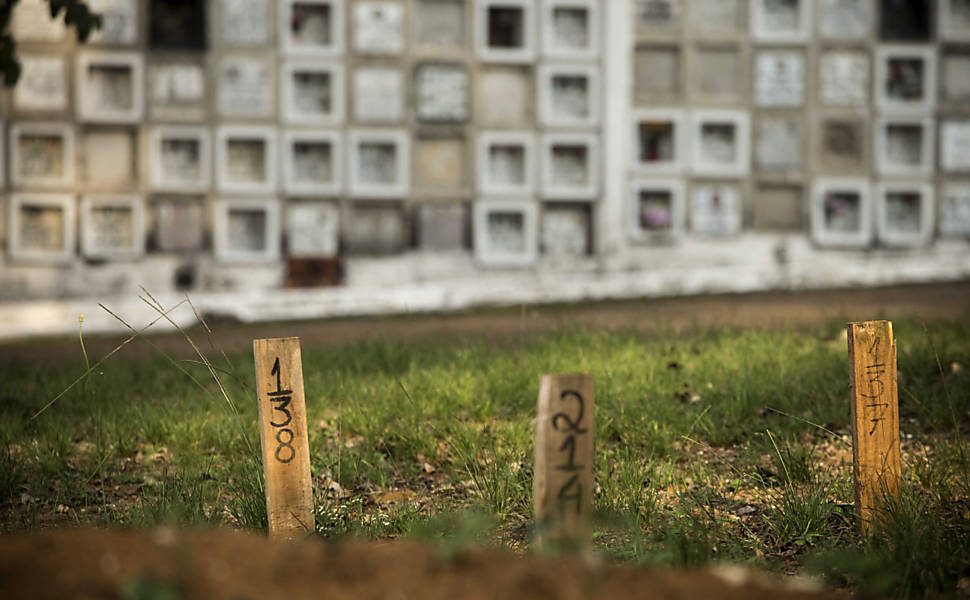
Searches for missing loved ones, families say, are complicated by Sao Paulo's troubled morgues. In the last 15 years, 3,000 bodies, all identified, were buried in unmarked graves in Sao Paulo, Brazil.

ra Lucia Marchioro recalls a morgue employee clicking through photos on a computer screen until a face appeared that could have been Luiz, her 25-year-old son who had disappeared the day before. She wasn't sure, she said, because of the swelling.

"Does he have any tattoos?" Marchioro asked.

When the employee said no, the grief-stricken mother decided to continue her search at the five other government-run morgues spread across Sao Paulo. Luiz had several tattoos, so the face on the screen that made her heart twinge couldn't be him, she thought.

Little did she know, but the 60-day search ahead of her would eventually lead back to the same morgue and body. More than a year later, however, her travails have yet to end. Morgue employees called her last March to identify the body using a photo of a tattoo on the arm, but the remains had already been buried in an unmarked grave, which authorities have refused to open.

"From what [morgue employees] have told me up until today, I don't know what I should believe," Marchioro said recently.

Government officials say they don't know how many people without identification are buried each year in Sao Paulo. In the last 15 years, the bodies of 3,000 people who had identifying documents were buried in unmarked graves here, according to the state's missing persons program.

Bodies that cannot be identified or have suffered a violent death — with or without ID — are sent to the closest Forensic Institute morgue. But regardless of where the bodies end up, members of several families in Brazil's largest city expressed frustration in interviews over the lack of resources and information they ware afforded during their searches.

Bodies held at a city morgue are usually buried after 72 hours, officials say. At the coroner's office, where there is more space, authorities try to keep corpses for 10 days, according to the agency's vice director, Dr. Carlos Augusto Pasqualucci.

The city's morgues came under fire last July when a news station broadcast images of 15 bodies lying side by side on metal tables at one morgue because all 38 refrigeration units were occupied. The situation has not only taken the dignity of the dead, family members say, but could also cause a public health problem. Hospital das Clinicas, home to the University of Sao Paulo's medical school and the central coroner's office, is less than half a block away, leaving patients there susceptible to disease-carrying flies.

"There are fewer refrigeration units than necessary, there are putrid bodies kept outside these units, there are fly catchers — I don't know how they are authorized by health inspectors — that are just like an electrified wire that zaps them," said Eliana Vendramini, the prosecutor who runs the missing persons program, which is investigating conditions in the city morgues. There's nowhere for doctors [who work overtime] to sleep."

The "identified indigents" were found following an inquest by Sรฃo Paulo State's Public Ministry coordinated by Eliana Vendramini, a Public Prosecutor dedicated to finding the whereabouts of missing people in Sรฃo Paulo.

It took her some time to believe that the State's own funeral system may have been responsible for the "disappearance" of thousands of people in the State capital.

The State assigns corpses to unmarked graves that are not claimed by relatives after 72 hours, even if the deceased carried identification, according to State regulation created in 1993, in Luiz Antรดnio Fleury Filho's State administration (PMDB - Brazilian Democratic Movement Party).

The State does this without contacting the relatives, despite having information of the deceased, leaving entire families to search endlessly for their loved ones.

Burials are carried out in partnership with the Municipal Funerary Service in two cemeteries at Vila Formosa, in the east of the city - where bodies are delivered bare, in wooden boxes with cardboard lids.

The corpses used to be buried in the Dom Bosco cemetery in Perus, in the north of the city.

Cases investigated by the Public Ministry are the responsibility of the Death Verification Service (DVS) linked to the University of Sรฃo Paulo's Faculty of Medicine

The service reviews cases of natural death, where there is no suspicion of violence but that require an investigation into the cause of death.

The Public Ministry wants to find out why the State government did not look for the families of the identified deceased.

Contrary to the Prosecutors, the board of the DVS understands that the law does not require the family to be contacted.

Furthermore, it states it does not have enough staff to carry out this task and that it is willing to cooperate with the Public Ministry investigation.

The Prosecutors and the DVS affirm they did not have enough information to locate the families. "However it is possible to locate the families and this is precisely what we are doing", the prosecutor said.

Vendramini also said that, as well as the Federal Constitution, which goes over "the dignity of the human person" in its first article, the Civil Code demands the service to communicate the death to the relatives, because the body belongs to the family.

"This is obvious. Do we need a law to state the obvious? Do we need a law that says: 'Do not bury an identified body without letting the family know'?", the prosecutor questioned.

Another problem is the fact that the DVS is unknown to most of the population, who look for missing relatives through the Coroner - in charge of dealing exclusively with violent deaths or unidentified bodies.

The Public Ministry wants to end unnecessary searches and put an end to burials without notice.

First of all, the Ministry is trying to find matches for the 3,000 "identified indigents" that have gone through the DSV against the list of missing persons in the State of Sรฃo Paulo.

The aim is to find out how many families are still looking for relatives to notify them of the death and clear the list of missing persons.

Joรฃo Rocha was in this list and his family was the first to be contacted by the prosecutor.

In the last few weeks, Folha located four more families. None were contacted by the State services and their relatives were buried in unmarked graves.

Police stations

The Public Ministry has also identified problems with the Civil Police.

According to the legislation, the police are required to register deaths before releasing the bodies to the DVS. The police also register the disappearance of a person when relatives report an occurrence at the police station.

However, in all cases reviewed by Folha, the logs of deaths or disappearances were not cross referenced, which could have put an end to many families endless search for their loved one.

Three out of five families contacted by Folha who reported relatives or friends missing said they were ignorant of the existence of the DVS, stating this reason for not requesting the service. In these cases, relatives were either still looking or had already given up.

In one case the relative had also passed away. In another, a daughter found her father 20 days after his death, buried in an unmarked grave.

She even resorted to the help of a Pai-de-Santo - an Afro-Brazilian priest that evokes deities during rituals - to find her father.

There are still an unknown number of identified people buried in unmarked graves by the Coroner's Office that were victims of violence or accidents.

Database

Vendramini has been working to help the families of missing people since she started the program in November 2013. There were 13,068 open cases that year. The program also assists in identifying bodies that haven't been claimed.

The biggest problem, she says, is the lack of communication among organizations involved in finding missing people. There is no way, for example, to cross-reference information held by different entities, including the six city morgues, the coroner's office, the police department and other organizations. She and her team are working on a database, scheduled to be ready in July, so that the agencies can share information.

For Marchioro, it's too late. Several of her questions are still unanswered, she says: Why didn't the morgue employee show her photos of her son's tattoos? Why was Luiz buried in an unmarked grave in Perus, a cemetery known for mass burials an hour north of the city center, 19 days after he was found when the standard is 72 hours? What happened to his body during those extra 16 days?

The treatment of bodies buried at the Perus cemetery, also known as Dom Bosco, has come into question, with one report of a casket falling open as it was tossed into a shallow grave. The city police's organized-crime unit is also investigating whether organs were illegally taken from unidentified bodies at the coroner's office to sell to medical researchers.

Marchioro says she wonders whether any of indignities could have happened to her son's body, which still lies in an unmarked grave in Perus. Government officials have refused to let Marchioro exhume the body and transfer it to the family plot.

"I'll truly believe that is my son they buried there the day they let me have him back," she said.

Vendramini hopes her work can help prevent future mistakes.

"Everyone wants to work together. But when it comes to the past, no one wants to take responsibility," Vendramini said. "We have to care. We should care. One day it could be any one of us."

Monday 6 April 2015

http://www.latimes.com/world/brazil/la-fg-ff-brazil-indigents-20150405-story.html

http://www1.folha.uol.com.br/internacional/en/saopaulo/2014/04/1443680-3000-people-have-been-buried-in-unmarked-graves-in-the-state-of-sao-paulo-even-though-they-were-identified.shtml

continue reading

Sunday, 14 September 2014

In a land of death, Iraq’s morgue workers seek answers


The middle-aged man was killed at night, walking to his car in the Iraqi capital. No one seemed to know who did it or why.

The man’s bloated corpse lay on the metal examining table. His family waited outside. The only solid information about his death was in a vial that Doctor Aysa, a forensic pathologist, was holding in the air.

“Two bullets in the chest and one in the head,” she said.

In this country awash in death, most killers are never caught. The brutal Islamic State militants kill with impunity in the cities they control. Elsewhere, Iraqi police are too poorly trained, too overwhelmed, too powerless to solve cases. Sometimes they themselves are the perpetrators.

But the Baghdad morgue is one of the few places where you can get answers.

“We see the dark side of society,” said Doctor Iman, a 36-year-old radiologist. “I think we see the truth — not just what we see on television or read in the newspaper.”

Iraq’s homicide rate soared during the Sunni-Shiite fighting of 2006-2007, then plunged. Now it is rising again. According to the U.N. mission for Iraq, at least 1,265 civilians were killed in August 2014, compared with 716 a year earlier. The jump reflects the rise of the Islamic State group but also other factors. The slashes and burns on recently delivered bodies suggest that old tactics from the sectarian warfare are returning.

The morgue workers, dressed in their blue smocks and surgical masks, try to bring science to this anarchic world. They know things about the landscape of violence that slip past other people.

They know how death comes not just from car bombs or militia gunmen but from a crumbling state. A startling number of Iraqis die from electrocution in generator accidents — a sign that 11 years after the U.S. invasion, the government still can’t provide a basic level of electricity to its citizens.

They know that suicide has been on the rise this year, especially among young women who drink rat poison or set themselves on fire because they’re so depressed.

The doctors, of course, can’t make up for an inept police department or a corrupt state, or do much about the massacres in areas that Islamic State controls.

Sunday 14 September 2014

http://www.washingtonpost.com/world/in-a-land-of-death-iraqs-morgue-workers-seek-answers/2014/09/13/192fe5b5-3a40-4e32-9896-8ade357854ad_story.html

continue reading

Tuesday, 19 August 2014

Benin closes all traditional morgues citing Ebola threat


The Beninese government has ordered the closure of all traditional morgues across the country to protect its population against the Ebola virus disease.

The illegal structures that operate under poor hygienic conditions could result in a number of contagious diseases.

Benin has had a long tradition of preserving dead bodies such as using palm wine or coal dust, and some of the methods can help preserve a dead body for almost a week.

The majority of the Beninese rural population uses traditional methods to preserve the bodies of their loved ones in the homes while morgues are only used in the urban centres before burial.

Over the past four months, 2,127 people have been infected with the virus in West Africa, of whom 1,145 have died.

Ebola, which is transmitted through direct contact with blood or body fluids of infected people or animals, causes serious haemorrhaging and can have a 90 percent mortality rate.

This is the first time that the disease has been identified and an epidemic has been confirmed in West Africa, with outbreaks to date having been confined to Central Africa.

Tuesday 19 August 2014

http://www.bignewsnetwork.com/index.php/sid/224855181

continue reading

Wednesday, 19 February 2014

Boulder County Coroner shares lessons learned at mortuary fire


The arson fire that destroyed Howe Mortuary last year remains unsolved, but the Boulder County Coroner said last week that the unusual crime was a lesson for her office that she is sharing with other coroners.

Boulder County Coroner Emma Hall and her staff were not called to the scene of the fire May 28. No one was killed in the intentionally set blaze that destroyed a long-standing Longmont business, but the nature of the mortuary's work meant that seven deceased people were inside at the time of the destructive fire.

Hall, who said she was contacted by the funeral home the morning of the fire with a request for body bags, said she and her staff decided to head to the scene to make sure that all of the bodies found inside the building were those that were there prior to the fire and to help the mortuary definitively identify the remains for the families before final arrangements were made.

She said that while it may seem gruesome, a fire at a mortuary could be used as an attempt to cover up another crime, like a homicide. She was also concerned because initial information indicated between five and seven bodies inside.

"It was kind of a new situation for everyone," Hall said of her decision to respond to the scene without an official summons from the police or fire departments. "They were confused as to why we were there."

Jeff Howe, owner of the mortuary, said one of his staff called Hall at 5:45 the morning of the fire. He was surprised to see her when she showed up that morning.

"It does make sense, and I never thought to make sure she was included," he said. "It felt good that we had the support."

The fire destroyed one room and a cooler where three bodies were stored, while there others in a prep room sustained some damage from the fire and firefighting efforts. A seventh body in a casket was taken quickly to another funeral home for a funeral later the same day, Hall said. She added that the funeral home recorded the locations of each body, but her office is able to confirm identities using fingerprints and DNA.

Howe said that the mortuary takes measures to make sure identities are well secured to those in their care. He said those identifiers survived the fire but could have easily been compromised, so the assistance after the blaze was helpful.

Lt. David Marshall of the Longmont Fire Department said fighting the blaze was standard for the firefighters, although it was a notably large incident. He said it was clear from locations the bodies were found that they were likely in the mortuary prior to the fire, which started in a trash receptacle next to the building and jumped to the mortuary. He said the investigation is complete and investigators identified "persons of interest," although not no one has been arrested for the arson.

"As far as the investigation goes, it was the first mortuary fire I had investigated," he said, adding that he isn't sure why neither the police nor fire department thought about calling the coroner.

Howe said he is a little frustrated that the person who started the fire has not surfaced, but he is not concerned about being targeted. He said he suspects that an arsonist who had been setting fires in trash receptacles likely set the fire next to Howe without intending it to spread to the building.

"We, like the fire department, didn't believe it was pointed at us," she said.

Hall said she struggled when she heard of the fire about whether her office would have jurisdiction since there were no new reported deaths. But, she said, due to the outside possibility of a crime she decided to head to the scene to help.

"It was a great exercise for us because it gave us a good idea of what handling a mass fatality would be like," she said, noting that some of her investigators were dispatched to other deaths around the county at the same time, which tested the office's resources.

She said investigators notified coroners in Weld, Jefferson and Larimer counties because those offices each had certified the deaths of one of the people inside Howe at the time. Her office had certified another prior to the fire, and three weren't even reported to coroner's offices because the people had passed away while under the supervision of a doctor at a hospital. Those deaths do not need to be reported to the county coroner.

"I was even surprising to me that there were four different counties (represented)," she said.

She said she believes the fire gave all agencies involved an opportunity to shore up relationships. Because of the jurisdictional questions faced, she said, she presented the case to the Colorado Coroner's Association and discussed some of the problems she faced prior to arriving.

Marshall said he is interested in the coroner's case review, which he hasn't seen.

"We're always looking for ways to improve the way we do our job," he said.

Wednesday 19 February 2014

http://www.firehouse.com/news/11313844/colo-coroner-goes-to-mortuary-fire-uninvited

continue reading

Thursday, 28 November 2013

Two months on, unidentified body lies preserved at JJ morgue


Two months after the Babu Genu building collapse in the Dockyard Road area, the body of an unidentified male continues to remain in the cold preservation unit of the state-run JJ hospital's morgue.

The man, along with 61 residents in the building, had succumbed to suffocation and multiple injuries after the ground-plus-four-storey building caved in early morning on September 27. All 61 bodies were identified and claimed by respective families.

According to the hospital's forensic department, the body was sent for DNA analysis to Kalina Forensic Science Laboratory more than a month ago. Dr M K Malve, director of the laboratory, said, "The genetic analysis results have been handed over to the Sewri police. If a relative comes to claim the body, DNA sampling can be done and the body can be handed over."

A fortnight after the collapse, claims of a BMC peon — Vijay Narayan Jadhav's body going missing — had come up. While Vijay Narayan was the same age as the unidentified body, his uncle Vijay Dhondu Jadhav claimed that it was not his nephew's.

"We have a capacity for storing 130 bodies, of which the hospital has space for 45 bodies and police department can keep 85. Until we get a police notification, we will keep it preserved," said Dr Ashok Rathore, acting dean in JJ hospital.

Usually, a body is kept for a week or so, this body has been preserved for two months now. Sunil Babar, additional commissioner of police, Wadala division, said, "We usually wait for a month at the most and then cremate unidentified bodies. However, this case is serious and anyone can come to claim the body as well as BMC's compensation. Therefore investigations are still on." The only identification known to the doctors, so far, is that the body may be of a Muslim in his early 40s.

Thursday 28 November 2013

http://www.indianexpress.com/news/two-months-on-unidentified-body-lies-preserved-at-jj-morgue/1200549/

continue reading

Thursday, 21 November 2013

Washington D.C. sees increase in unclaimed remains


A growing number of Washington DC-area families are failing to show up to claim loved ones who’ve passed away, according to documents obtained under the Freedom of Information Act by the News4 I-Team.

Maryland, Virginia and Washington, D.C. health officials all reported spikes in the number of “unclaimed remains” being handled by local medical examiners.

The Maryland State Anatomy Board, which released records showing a 100 percent increase in “unclaimed” and donated remains since 2000, cited economic struggles for the surge.

Ronn Wade, director of the board, said families are increasingly unable to afford the costs of burial and are forgoing the pickup of remains at local medical examiners’ offices.

“There are families, because of circumstances, who don’t have the means to do pretty much anything," Ward said.

Virginia has experienced a 33 percent increase in unclaimed remains over the past year, according to documents reviewed by the News4 I-Team. The District's “unclaimed” remains jumped from 62 cases in 2010 to 97 cases in 2011.

Taxpayers are ultimately paying for the handling of those remains. Financial records obtained by the News4 I-Team show Maryland officials spent approximately $224,000 to handle hundreds of unclaimed and donated bodies between October 2012 and October 2013.

Rising homelessness, reported by homeless advocacy groups throughout the D.C. region, has also triggered in spike in unidentified remains at local health departments.

The homeless, a large number of whom do not carry identification, are difficult for authorities to connect with families. Rosemary Ward, a Germantown, Md. federal employee, spent eight years searching for the whereabouts and remains of her 32-year-old son, Matthew.

He died in an abandoned Baltimore rowhouse while living homeless in 2003, but was unidentifiable to authorities who recovered his remains. He was buried in 2006 alongside hundreds of other unclaimed or unidentified Maryland men and women at the state’s community grave site for the unclaimed at Springfield Hospital in Carroll County.

Ward finally learned of her son’s death in 2011 after reviewing the website MarylandMissing.com, which tracks unidentified bodies being processed by the state's health officials. Ward said the long wait was painful.

“Always not knowing and not having a sense of where he was," she said.

The Maryland Department of Health and Mental Hygiene and its Sykesville-based mental health staff stage an annual burial ceremony for the “unclaimed” in June. Ward attended and spoke at one of the recent ceremonies.

“Matthew was with me for 32 years, so he’ll always be with me,” she said.

Thursday 21 November 2013

http://www.csnbaltimore.com/article/metro-dc-sees-increase-unclaimed-remains

continue reading

Tuesday, 12 November 2013

Single morgue copes with Karachi's death toll


As Ghulam Hussain prepares for another day at work as manager of the Edhi Morgue, the only functioning morgue in Karachi -- a city of more than 18 million and the explosive nerve center of Pakistan -- on the other side of town a large bundle wrapped in a white shroud is loaded by two men into an ambulance.

The red-stained shroud does a poor job of hiding the bloodied corpse inside.

On arrival at the morgue, the bundle is gingerly carried inside. On a good day, this would be the first of five bodies Hussain receives.

"Sometimes, there are as many as 10 bodies in a day and other times even more," he told UPI Next.

As the police officer rattles off details about the corpse -- where it was picked up, the clothes it was wearing, bullet wounds, any identifying features -- Hussain jots them down in the register in front of him.

He writes the number 138,289 on a piece of paper and pulls it under the string holding the shroud in place. The body is then sent to cold storage, where other wrapped corpses lie side by side on steel bunks.

"If we wash the body at once it changes the way they look and families have a hard time recognizing their loved ones," explains Hussain.

The port city of Karachi accounts for about 40 percent of the country's gross domestic product, 73 percent of its income tax and 64 percent of sales tax revenues.

Hardly a day goes by when someone is not robbed or killed, or a trussed-up body is not found by the side of the road. City newspapers carry stories of such violence daily.

Through June of this year, 1,726 killings were recorded by the Human Rights Commission of Pakistan. About eight people have died each day this year, on average.

Last year -- the deadliest in two decades, with 2,000 fatalities, according to the commission -- it took nine months to reach 1,800 bodies. Of the total killed this year, more than half were killed by robbers or bomb blasts.

The morgue has certainly been busier this year, Hussain said.

In March, a deadly bomb attack ripped through the city's Abbas Town area, killing 48 people.

"Even the morgue's floor was covered with charred bodies," another morgue worker, Mohammad Siddique, recalled. Siddique bathes bodies before they are sent for burial.

Hussain says of every five victims of violence, two are claimed by their families, while the rest are buried in the Edhi graveyard. The morgue charges about $10 for keeping a body in its cold storage, $6 for pre-burial bathing and $23 for an austere wooden coffin.

The fee is hardly enough to cover the cost of the electricity bill, which amounts to about $4,700 a month. Maintenance of air conditioners alone costs up to $187 per month.

The morgue was set up in 1984 by the Edhi Foundation, Pakistan's largest charity organization, after founder Abdul Sattar Edhi saw the need for somewhere unclaimed dead could be buried with customary religious honor.

The foundation was provided with 10 acres of land in Mawach Goth, an area on the outskirts of the city by Mayor Abdul Sattar Aghani, burial site administrator Anwar Kazmi told UPI Next.

The land soon filled up and the government gave the foundation 20 more acres.

Now, at least six unclaimed bodies are buried there each day.

In the first six months of the year, the foundation buried 828 unclaimed bodies. Last year, it buried more than 1,500; the previous year, more than 1,700.

"Since 1985 we have buried at least 217,000 bodies here," Kazmi said.

Two government hospitals in Karachi also have cold storage facilities, but they are seldom used, the city's chief medical examiner, Jalil Qadir, said.

"Often when bodies, including those of high-profile criminals, are kept in the hospital morgues, their relatives often come and wreck the facilities and injure doctors on duty. This is perhaps why the hospital authorities are not interested in keeping their morgues functional," the chief of forensics at Karachi's Sindh Jinnah Medical University, Dr. Muhammad Ali Mondhra, told UPI Next.

Meanwhile, corpse No. 138,289 lies on the cold steel bunk in the morgue. No. 138,281 lies beside it.

People come and go. Some have brought their late loved ones in for final burial rites. Others come searching for their loved ones.

Though Hussain's job is to guard the dead, he said it gives him a deeper appreciation of life and its fluidity.

"Once we received the body of a girl who had been raped. Her body had been found lying on the street. But her father refused to own his daughter and take her body home because he was angry at his daughter for running away," Hussain said.

"I kept the body for 11 days thinking that the father would change his mind and come back to claim it. But when it started to turn blue and decompose I had to send it for burial."

Meanwhile, two men arrive at the morgue. The younger man is looking for his older brother, missing for the past three days. He is taken inside the cold storage room to see if he can recognize someone. He does.

Corpse No. 138,281 has been identified as the victim of a shooting in the troubled south zone of Karachi.

Three days after arriving at dawn, corpse No. 138,289 is taken out of cold storage with five others. A photo is taken of the face, with the body number placed below.

Night shift workers give him his final ablution. The stained shroud is replaced. He is loaded back into an ambulance and taken to his final resting place in Mawach Goth, in the graveyard for the unknown.

Tuesday 12 November 2013

http://www.upi.com/UPI-Next/2013/11/11/Single-morgue-copes-with-Karachis-death-toll/91375451955667/

continue reading

Friday, 8 November 2013

Kenya: No more unidentified bodies accepted at Teso morgue


The Frapa Funeral Home Kocholya in Teso North has stopped accepting unidentified bodies delivered by police. Manager Judith Aluku said police have been directed to take such bodies to public mortuaries in Bungoma, Busia or Webuye districts.

“Such failures may compromise the facility’s hygiene, which has been operating efficiently since February 23. She was speaking to the Star at the funeral home yesterday.

Aluku said the move is meant to decongest the mortuary. “We only accept identified bodies brought in by relatives who collect them at the touch of a button,” she said.

Aluku said the home does not have an ambulance. Teso police boss Gladys Rutere said Frapa has the right to decide its operation policies.

Friday 08 November 2013

http://www.the-star.co.ke/news/article-142856/no-more-unidentified-bodies-teso-morgue

continue reading

Tuesday, 15 October 2013

Iraq's morgues overwhelmed by surge in terror attacks


During the past few months, Iraq's memory of the "morgue refrigerators" has returned -- after having somewhat diminished over the past two years but never having completely disappeared.

Iraqis have many sad stories to tell about those cold rotting corpses covered with camphor. Hatem Hassan, a resident of Mahmudiyah -- 15 kilometers (9.3 miles) south of Baghdad -- told Al-Monitor how he searched for the body of his elder brother who went missing two months ago. Hatem visited various hospitals and labs until he found his brother's corpse, still in the clothes he died in, preserved in the morgue refrigerator of Al-Naaman Hospital in the Adhamiyah neighborhood of Baghdad. Once he found his brother, he started worrying about something more important: those who had killed him.

Iraqis aren't too afraid of morgues and of what goes on inside. They have gotten used to them since the Iraq-Iran war (1980-1988), which resulted in millions of deaths. The morgue refrigerator has become a symbol for the unknown and for searching for its puzzles among the corpses.

In his stories "Baghdad Wonders," Iraqi writer Badr al-Salem writes about the unidentified corpses. A foreign correspondent named Miriam is searching for a missing person in the morgue. He writes, "We came back from the morgue. Everything was ugly. Dead bodies with no identities. And murders being carried out based on one's [sectarian] identity." In another chapter of the story, the author writes, "I was returning from the morgue with a trembling heart." You can now find those stories in the so-called "hot areas" [areas plagued by terrorism] of Iraq.

In Diyala, Mosul and south of Baghdad -- where there has been increasing acts of murder, most of which are of a sectarian nature -- the morgues are crowded with parents and relatives looking for their missing kin.

In May, the Iraqi Human Rights Ministry revealed, "The number of Iraqis who went missing following terrorist attacks has amounted to 15,000 between 2003 and April 2013."

In Babel -- 100 kilometers (62 miles) south of Baghdad -- every day dozens of people wait at the gate of forensic labs for permission to inspect the morgue refrigerators in search of missing persons.

Said al-Jabouri, a resident of Babel, told Al-Monitor that his brother -- who died in an explosion in south Babel -- has been kept in a refrigerator for about two weeks, and he is now preparing to receive the corpse.

Dr. Shaker Hassan told Al-Monitor, "The place cannot store corpses for two months because of the large number of new corpses arriving daily, especially this year. ... The crisis peaks when one explosion kills dozens, which overwhelms the ability to deal with the corpses, especially in these 'hot areas.' ... We take pictures of the bodies, log the information such as sex, height and distinguishing features and then show these to their next of kin."

Elsewhere, dozens of citizens flock to the medical legal institute in Bab al-Maadham, Baghdad, as if they have an appointment with the dead, who in turn are waiting for someone to take them away from the cold refrigerator and bury them.

Speaking to Al-Monitor, Muhammad Ali, a doctor from Baghdad, described the morgue refrigerator as "a cold cave with metal doors designed to contain the unidentified bodies of those who have been murdered, died naturally or were assassinated. But since 2003, the morgues have been receiving mostly victims of violence and armed hostilities. ... In most Iraqi hospitals, each refrigerator holds about 200 to 300 corpses, some of which are intended to be kept cold while others are to be frozen. ... Iraq has a long experience with morgue techniques, going back to the 1980s. But many morgues have not been modernized since their inception."

The father of Suhaila Hassan, who is a member of Babel's provincial council, has been missing since 1991. Suhaila looked for her father in vain in all of Saddam's "cold" prisons, as she called the morgues in an interview with Al-Monitor. Then, Saddam's regime fell in 2003, and her father's body was found in a large mass grave in Mahawil -- 70 kilometer (43.5 miles) south of Baghdad.

Suhaila said, "It wasn't easy opening the morgue refrigerator doors in many hospitals and forensic labs, especially since the name lists are not accurate and are not organized in a way that allows for easily finding the missing person you are looking for." She recounted, "I saw some corpses were mutilated, while others were easily identifiable. Some were cut up, others were in [one piece]. Some were burned, others were bound. That has been the sight of death in the country since the 1980s."

Those who visit the morgue refrigerators for the first time will be surprised to discover that bodies frozen to temperatures as low as -20 Celsius (-4 Fahrenheit) still give off unpleasant odors. Forensic pathologist Hassan Haidar told Al-Monitor, "We live next to the dead, who seem to be alive and waiting to be identified."

He said it is hard to watch a relative refusing to acknowledge that a corpse is their son, brother or daughter, just because of the shock and difficulty of accepting the death of a loved one -- for whom they have been searching for months.

He said that the painstaking search damages the nerves of many. So some resort to destroying the contents of the morgues' refrigerators.

One person's body was moved from the refrigerator to the freezer. Then, the matter was settled: she will be buried within two months. Her family members have now become grave visitors. They carry incense and water to the final resting place of someone who died in a war or bomb attack.

Tuesday 15 October 2013

http://www.aina.org/news/2013101422239.htm

continue reading

Monday, 9 September 2013

MV Hope sailors bodies in Malaysian morgue


Two bodies kept at a morgue in Malaysia’s Langkawi were identified on Sunday as that of sailors of ill-fated Bangladeshi cargo ship MV Hope.

The sailors are believed to be the vessel’s Cabin crew Ali Hossain and second engineer Nizamuddin.

MV Hope P&I Club representative, the CEO of Interport Maritime Limited Mohiuddin Abdul Kader said the bodies surfaced near the Malaysian coast on the Andaman Sea on Jul 20. The local fishermen retrieved the bodies and brought them to Langkawi port. They were put in a morgue on Jul 28.

The Thai agent for Maritime Interport Limited after seeing the bodies a week ago believed they were sailors of the Hope.

Ali Hossain was identified from a bank account ID found in his pocket. The other body, which was beheaded, was identified with the help of the MV Hope jacket found on the body. He is assumed to be Nezamuddin.

Authorities say headless corpse DNA test will be done.

The MV Hope was caught in a storm near Thailand’s coast on Jul 4. Its 17 sailors abandoned the ship to save their lives.

Nine were rescued alive and two corpses were recovered.

Monday 9 September 2013

http://bdnews24.com/bangladesh/2013/09/09/mv-hope-sailors-bodies-in-malaysian-morgue

continue reading

Thursday, 22 August 2013

Argentina probes hospital morgues after 200 bodies go missing


Argentine authorities are investigating the operation of several Buenos Aires morgues after the disappearance of more than 200 bodies, officials confirmed to Efe.

Court-ordered raids on several capital hospitals over the past several weeks revealed other irregularities such as unidentified human remains, body parts scattered among different refrigerated rooms and bodies in advanced stages of decomposition.

The investigation was launched after the municipal government requested the burial of 23 bodies that had been held in the morgues of four hospitals for years.

The official tasked with relaying that request, Judge Roberto Gallardo, discovered serious irregularities in the lists of entry and exit of human remains at the morgues and ordered that the health centers be closely examined.

Gallardo determined that dozens of bodies had gone missing from those hospitals after they had been listed as delivered to the morgues.

Representatives of the hospital workers attributed the situation to chronic staffing shortfalls and not to negligence.

Alarmed by what was found in the initial four inspections, Gallardo expanded the review to the other 18 hospital morgues that also fall under municipal responsibility.

The audits revealed that a total of 216 bodies were missing from six of the 22 morgues examined.

Thursday 22 August 2013

http://www.globalpost.com/dispatch/news/agencia-efe/130821/argentina-probes-hospital-morgues-after-200-bodies-go-missing

continue reading

Wednesday, 10 July 2013

Bodies at Lala Lajpta Rai Hospital's mortuary become food for mongoose


Slackness on part of the health personnel and guards on duty at the mortuary of Lajpta Rai Hospital (LLR) has proved unfortunate for the kin of a woman whose body had been kept in the mortuary from past few days.

When the relatives reached the mortuary to take the body they found that it was eaten-up by mongoose. It is the fourth incident of its kind in the last two days when the bodies kept in the morgue of LLR were eaten-up by mongoose.

The body of Moni Singh (35), from Shyam Nagar was kept at the mortuary of LLR from past few days. According to the sources, Moni died last week after she met an accident near Kali Mathiya crossing and breathed her last during the treatment.

On Tuesday, when kin of the woman came to identify the body, the same was found in mutilated state. Major portions of the body were found eaten-up by mongoose. Some portions of the body, including her eyes, ears and nose, were so badly eaten that they were not even visible.

"To our dismay, when we went to take back the body on July 9 after keeping it in the mortuary for around five days, it was found in a decomposed state with a foul odour emanating from it. The hospital staff has played a cruel joke with our sentiments by not taking proper care of the body for which they must be taken to task," lamented the distraught relatives of Moni Singh.

This was not the lone case as cruelty of mongoose and lackadaisical approach of the medical staff on duty at mortuary remained pathetic for Mitrani (53) also. She was also brought to the LLR mortuary for postmortem but turned into a food for mongoose. Flesh from nose, chin, shoulders was missing from the body of Mitrani.

The matter came into light when the mortuary staff took all the bodies into an account after the incident on Monday in which mongoose had eaten-up the body of an 11 year old girl, Durga, from Panki ,who died by drowning.

Her body was brought to the mortuary on Sunday. As the postmortem was conducted late on Sunday night, the body of Durga was kept at mortuary. On Monday, when the relatives of Durga reached the mortuary to claim the body it was fount mutilated. The hospital staff claimed that the body was eaten-up by mongoose.

Chief medical superintendent (CMS) of LLR hospital, Dr SB Mishra, while confirming that the body had got decomposed, cited the large number of mongoose in the mortuary as the cause behind the incident. However, the officials were unable to explain why the bodies were kept in the mortuary without taking any precautionary measures against mongoose present there.

He added that he would ask municipal corporation to catch mongoose on Wednesday. He also assured to take frequent rounds at mortuary so that the security machinery remained active.

Wednesday 10 July 2013

http://timesofindia.indiatimes.com/city/kanpur/Bodies-at-Lala-Lajpta-Rai-Hospitals-mortuary-become-food-for-mongoose/articleshow/20994231.cms

continue reading

Wednesday, 3 July 2013

Preparing the dead in Afghanistan

The man who spends his days surrounded by dead Afghan soldiers waits in a faded shipping container across from the morgue. But Noori rarely waits long before he is called to work.

Inside the container is a bed, a fan and a hose for washing the bodies. He has prepared at least a thousand of them for burial over the past decade: victims of roadside bombs, gunshots, mortar rounds and disease, delivered to him in all the shapes death takes.

Noori, 33, removes the soldiers from identical wooden coffins that are draped in Afghanistan’s flag, and he performs his duty, preparing each for burial in the Islamic tradition. He washes off blood and dirt, sprinkles perfume and covers each in a white sheet, or kafan. That’s how their families will see them when they make it home.

What Noori sees first is much more bracing — a relentless procession of bodies just off the battlefield. He takes anti-anxiety medication to help him sleep. He doesn’t tell his family anything about his job at one of the Afghan military’s busiest medical centers, Kandahar Regional Military Hospital.

In Washington, questions about the future of Afghanistan are often phrased in terms of the Taliban’s strength and the Afghan army’s fighting ability. Noori’s perch on the war doesn’t provide clear answers to those impossibly large questions. But it has made him a front-line witness to the massive human cost associated with what’s formally articulated as a “military transition."

As his country’s army inherits the war from the United States and NATO, there are far more of those bodies than ever before. More than 250 Afghan soldiers and police are now killed in Afghanistan every month, many of them in the violent south where Noori works.

On that subject, Noori takes a long view. “The army will keep fighting, and men will keep dying, until there is peace," he said.

Noori was once employed by the group responsible for the death and destruction he sees on a daily basis. For several years, beginning when he was 19, he worked for the Taliban.

In Kandahar, the province where the Taliban was born, the only job he could find was sweeping the floors of the former regime’s main hospital. It was nearly two years before Sept. 11, 2001.

When war came to Afghanistan and the regime was toppled, Noori swept the same floors for the new Afghan government. Because he was a low-level worker, his previous allegiance was forgiven. Soon, he was watching government fatalities trickle in.

The man then in charge of washing bodies needed assistance. It wasn’t an alluring job, but it was an important one, Noori thought.

“It’s religious work," he recalls thinking to himself.

He volunteered. Since then, Noori, typically clad in medical scrubs and an Afghan army windbreaker, has handled corpses nearly every day for the past decade.

“I’ve seen more death than anyone," he said. “The bodies keep coming."

He gets middle-of-the-night phone calls beckoning him to the hospital so that bodies can be washed and buried as soon as possible, according to Muslim custom. He knows exactly what a bomb or a machine gun or a rocket-propelled grenade can do to a human body. Some soldiers look serene, almost untouched, and others don’t look human at all.

He knows to expect anything when he removes the lid of the coffin. Once he saw his neighbor and close friend, Hashmat. Noori mourned quietly while doing his job.

“Anyone would get angry to see a friend like that," he said.

As more Afghan soldiers die, Noori finds himself close to some of the worst violence. His morgue is the destination for those killed in contested swaths of the south and southwest, including several of Afghanistan’s bloodiest districts.

His colleagues ask how he’s holding up, and he often shrugs them off.

“No matter what the body looks like, he does his job," said Sgt. Mohammad Hussein, the head of the morgue. “It’s difficult."

The truth is that Noori can’t sleep without medication. He dispassionately describes himself as “physically and mentally exhausted." He keeps the bed in the storage container, he says, because after washing three or four bodies, he needs to lie down.

This year, just after the Taliban announced the beginning of its “spring offensive," bodies came in one after the next. One afternoon, an ambulance arrived from Helmand Province carrying three dead, all killed by separate makeshift bombs.

Noori was suddenly frenzied. He called to a group of soldiers for help lifting the bodies for washing. But the men walked away brusquely.

“They don’t have the courage to help," he said to himself as he worked alone.

There is a tenderness to the way Noori does his job, washing the men’s hair as if he were caring for a small child. But the circumstances can be brutal. Sometimes, he has to wash severed limbs separately. Sometimes, the clean white sheets turn red as soon as they’re placed on bodies. Sometimes, he sees fresh scars where doctors tried to operate, but failed or ran out of time.

On warm days, all the death and heat make the job nearly unbearable.

Spring and summer are when the fighting is most intense, particularly this year, when U.S. troops are doing minimal combat and Afghan soldiers are dying at a higher rate than Western forces ever did.

“In the summer, it’s too much," Noori said.

Questions about the Taliban’s strength do occupy Noori’s mind. Because he is an employee of the Afghan military but not a soldier, he lives off base, on the outskirts of Kandahar City. Every day, he drives one hour to Camp Hero, the sprawling military installation where the hospital is located.

He knows his unguarded living conditions make him vulnerable to insurgents, especially former Talibs, who target those working for the Afghan government. His colleagues, who live at Camp Hero, worry about him.

“If they find him, they will kill him immediately," Hussein said.

But Noori has taken an approach to his own life that seems to blend defiance and fatalism. He says he isn’t scared of the Taliban, but that he’s ready for death when death comes.

When the hospital calls him in during early morning or late nights, he slips out of bed quietly so that his wife does not wake. He has never described his job to her in any detail, because he worries she would begin to associate his early morning departures with the death of soldiers.

“She wouldn’t be able to take it psychologically," said Noori, who has an infant daughter.

Noori says he can take it, though he thinks often of the families who will be on the receiving end of his work, in whatever Afghan province the soldier called home.

“They deserve to see the bodies clean and neat," he said. “They are the ones who have suffered."

Wednesday 3 July 2013

http://www.bendbulletin.com/article/20130702/NEWS0107/307020369/

continue reading

Thursday, 13 June 2013

Bodies pile up at Port-au-Prince general hospital morgue


A situation has been developing at the morgue of the general hospital in the capital. Down for several months, bodies continue to arrive by the dozens every day in Haiti's largest hospital and are being left in the courtyard decaying and posing a health hazard for workers, patients and citizens.

According to information obtained by Haiti Press Network which spoke to a source at the State University Hospital (HUEH), the cooling system of the morgue is down.

"The bodies can not be kept." Some bodies were deposited in mass graves dug hastily in the locality Titanyen on National Highway #1, learned HPN.

"It is an alarming situation. corpses continue to arrive at the morgue who can no longer keep them. Bodies are rotting and endanger the health of crews in the morgue," said an official of the National Network for the Defense of Human Rights (RNDDH) which was alerted about the situation.

Facing this situation developing in the morgue HUEH, health authorities of the Ministry of Public Health and Population have asked not to receive the bodies. But problem! This is the public morgue reference where police continue to carry the victims of insecurity.

"Sometimes the bodies are placed in the courtyard of the hospital, and nobody knows what to do when families come to claim the body their families, we can not say that they are buried in pits," a source told to Haiti Press Network.

United Nations Peacekeepers assist

With a current total of nearly 36 000 U.S. dollars, the containers were made available to the morgue by MINUSTAH following a request made last night by the Ministry of Public Health and Population (MSPP) . Indeed, the country's health authorities have closed the morgue, where hundreds of bodies to carry out the repair of cold rooms and their refrigeration system.

The two containers previously belonged to the Japanese contingent of MINUSTAH, which left the country in December. "This rapid initiative is part of our ongoing efforts to support and support the Haitian authorities in their efforts to serve the people," said Sophie Boutaud de la Combe, spokesman for MINUSTAH.

Thursday 13 June 2013

http://www.defend.ht/news/articles/community/4514-bodies-pile-up-at-port-au-prince-general-hospital-morgue

continue reading

Wednesday, 5 June 2013

India: Unclaimed bodies pile up at OGH mortuary


Delays in shifting unclaimed bodies from the Osmania General Hospital (OGH) mortuary have been cause for discomfort not only for hospital staff but also patients and attendants visiting the hospital.

As the bodies lie unclaimed, the stench from the morgue begins to spread, and at times reaches the nearby blocks of the hospital. Visitors and patients apart, even hospital staff can be seen holding their noses to escape the stench.

On Friday, more than 30 unclaimed bodies piled up at the morgue, awaiting clearance from authorities.

The morgue has a single room with freezer facilities, which can accommodate only 32 bodies at a time. Bodies are preserved here pending identification, while the old ones are shifted to an adjacent room that is devoid of proper facilities.

Of the 10 to 15 bodies that come in daily, of which three to four are of unknown persons. While identified bodies are handed over to the relatives after the autopsy, unclaimed ones are kept at the mortuary until the GHMC facilitates a cremation.

Mortuary authorities intimate the Afzalgunj police station of unclaimed bodies and after receiving a go-ahead from the police, they write to the GHMC, who then shift the bodies for cremation or assign the job to an NGO.

Mortuary officials say the list of bodies is handed over to the GHMC at regular intervals but there are delays in clearing the bodies. As a result, they pile up at the mortuary, leading to unhygienic conditions.

In mid-May, authorities lifted about 120 bodies in one go and in the month of March, 63 bodies were moved out at once. The prescribed period for preserving unclaimed bodies is about 72 hours but in the last few months, bodies were around lying for more than two months, the staff said.

Most bodies come to the mortuary are already in a bad state and after lying here for days at a stretch, one can imagine the conditions, they added.

When contacted Y. Venkata Ramana, GHMC Circle IV, Assistant Medical and Health Officer, said he was not aware of any delays. “I will look into the matter,” he said.

Wednesday 5 June 2013

http://www.thehindu.com/news/cities/Hyderabad/unclaimed-bodies-pile-up-at-ogh-mortuary/article4782217.ece

continue reading