Showing posts with label Iraq. Show all posts

Monday, 13 April 2015

Iraq exhumes 164 bodies from Tikrit graves


Iraq has so far exhumed the remains of 164 victims believed to have been killed by extremists in mass graves in Tikrit, AFP reported Monday.

The human rights ministry said search teams have discovered the bodies in four mass graves over the past week in the city formerly controlled by Daesh (ISIS).

Ministry spokesman Kamel Amin told AFP evidence shows the victims were from the Speicher massacre, during which up to 1,700 people were abducted by Daesh last year. Amin said authorities still need to confirm identifies by DNA testing.

The remains were found in former president Saddam Hussein's palace complex, where officials said there are ten mass graves, with three more discovered right outside.

Iraqi forces and Shiite paramilitary recently reclaimed the Tikrit area from Daesh after a month-long mass operation against the extremists.

Monday 13 April 2015

http://www.albawaba.com/news/iraq-exhumes-164-bodies-tikrit-graves-681640

continue reading

Tuesday, 7 April 2015

Iraq mass graves uncovered in Tikrit


The suspected mass graves of up to 1,700 captured Iraqi soldiers killed by the Islamic State group (IS) have been found in the city of Tikrit. The sites are near the former US Army base, Camp Speicher.

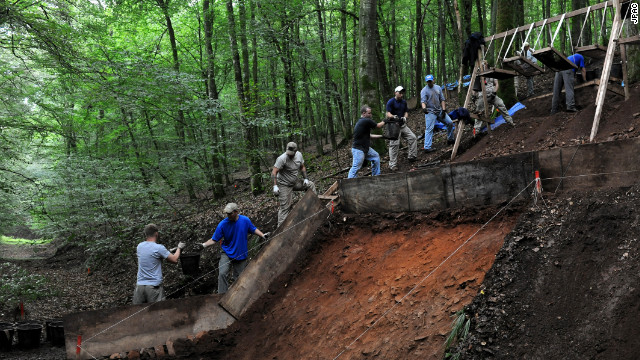
Iraqi forensic teams have begun to excavate 12 graves following the city's recent liberation from IS.

The June 2014 incident is notorious after IS posted videos and pictures of the execution of the mostly Shia soldiers on social media. Survivors say the militants questioned the victims to identity those who were Shia before killing them.

The exhumations have began just days after Tikrit fell to a combination of the Iraqi army and Shia militias following a month long siege. DNA testing will be used to identify the bodies once they have been exhumed, as many families have never had confirmation of their relatives' death.

"We dug up the first mass grave site today. Until now we found at least 20 bodies. Initial indications show indisputably that they were from the Speicher victims," Khalid al-Atbi told the Reuters news agency on Sunday.

"It was a heartbreaking scene. We couldn't prevent ourselves from breaking down in tears. What savage barbarian could kill 1,700 persons in cold blood?" he added.

The murder of the soldiers has become a lightening rod for Shia militias who have vowed to avenge the killings. The militias have been credited with halting Islamic State's advance last year, but have themselves been accused of war crimes.

Some of the burial sites are in the presidential compound of the former Iraqi president Saddam Hussein, which became the IS headquarters after they took the city last year.

The offensive launched on 2 March to take back Tikrit involved some 30,000 fighters, two-thirds of them from the Popular Mobilisation (Hasid Shaabi) - a force comprising dozens of Iranian-backed Shia militia.

The Iraqi army is now expected to turn its attention to Mosul, 225km (335 miles) north along the Tigris river. IS's most significant stronghold in Iraq, Mosul, presents a far greater challenge than Tikrit for the US-led air coalition and Iraqi ground forces.

Tuesday 7 April 2015

http://www.bbc.co.uk/news/world-middle-east-32199244

continue reading

Sunday, 14 September 2014

In a land of death, Iraq’s morgue workers seek answers


The middle-aged man was killed at night, walking to his car in the Iraqi capital. No one seemed to know who did it or why.

The man’s bloated corpse lay on the metal examining table. His family waited outside. The only solid information about his death was in a vial that Doctor Aysa, a forensic pathologist, was holding in the air.

“Two bullets in the chest and one in the head,” she said.

In this country awash in death, most killers are never caught. The brutal Islamic State militants kill with impunity in the cities they control. Elsewhere, Iraqi police are too poorly trained, too overwhelmed, too powerless to solve cases. Sometimes they themselves are the perpetrators.

But the Baghdad morgue is one of the few places where you can get answers.

“We see the dark side of society,” said Doctor Iman, a 36-year-old radiologist. “I think we see the truth — not just what we see on television or read in the newspaper.”

Iraq’s homicide rate soared during the Sunni-Shiite fighting of 2006-2007, then plunged. Now it is rising again. According to the U.N. mission for Iraq, at least 1,265 civilians were killed in August 2014, compared with 716 a year earlier. The jump reflects the rise of the Islamic State group but also other factors. The slashes and burns on recently delivered bodies suggest that old tactics from the sectarian warfare are returning.

The morgue workers, dressed in their blue smocks and surgical masks, try to bring science to this anarchic world. They know things about the landscape of violence that slip past other people.

They know how death comes not just from car bombs or militia gunmen but from a crumbling state. A startling number of Iraqis die from electrocution in generator accidents — a sign that 11 years after the U.S. invasion, the government still can’t provide a basic level of electricity to its citizens.

They know that suicide has been on the rise this year, especially among young women who drink rat poison or set themselves on fire because they’re so depressed.

The doctors, of course, can’t make up for an inept police department or a corrupt state, or do much about the massacres in areas that Islamic State controls.

Sunday 14 September 2014

http://www.washingtonpost.com/world/in-a-land-of-death-iraqs-morgue-workers-seek-answers/2014/09/13/192fe5b5-3a40-4e32-9896-8ade357854ad_story.html

continue reading

Tuesday, 9 September 2014

Iraqis search for missing loved ones in mass graves

Sadiq Sabr’s friends and son leave a northern Iraq hospital without finding his body, the unused coffin they brought to hold it strapped to the roof of a white minibus.

Like so many others whose loved ones have gone missing in Iraq’s conflict with Islamic State jihadists, Sabr’s friends have all but given up hope of finding him alive and want — if nothing else — to recover his body for proper burial.

Sabr, a truck driver, was kidnapped by IS militants near the town of Sulaiman Bek in Salaheddin province, north of Baghdad, which was retaken by security forces earlier this month.

He was seized on June 11, a day after IS overran the northern city of Mosul and then swept south through much of Iraq’s Sunni Arab heartland.

Sabr was en route to Baghdad, followed by his friend and boss Mohammed Hatem, when they heard shots.

“We turned around and spent the night in a restaurant, then left at 5:30 am,” Hatem said.

It was then that the militants took Sabr.

Hatem tried to call his friend immediately after he was taken, but an unknown voice answered, saying: “This is the Islamic State. Your friend is a Shiite, we will kill him.”

By 5:45 a.m., the phone had been turned off for good, and for almost three months, there have been no signs that Sabr is still alive.

IS, a radical Sunni organization, considers Shiite Muslims — who make up the majority of Iraq’s population — to be heretics, and frequently targets them in attacks.

When Hatem heard that Sulaiman Bek had been retaken, he traveled north along with Sabr’s son Ahmed and other friends to attempt to recover his body.

So far, 35 bodies have been exhumed from mass graves discovered in the town, an officer and a doctor said.

The stench of rotted flesh permeates the air in Sulaiman Bek, where freshly churned earth and nearby shovels mark one of the grave sites.

The ground is stained with blood at a place near the entrance of the town, where a Kurdish officer says the militants carried out the killings.

Hatem dug in Sulaiman Bek looking for his friend, but while his shovel struck pieces of bone and tissue, he found no trace of Sabr.

The same was true at the hospital in Kirkuk, a city to the north of Sulaiman Bek, where recovered bodies were taken.

Night had fallen by the time the minibus carrying the coffin intended for Sabr was able to reach Kirkuk, as the road is full of checkpoints manned by Kurdish fighters who only allow a trickle of Arabs to pass.

While bodies from the Sulaiman Bek graves are now in the hospital’s morgue, people were not immediately allowed in to see them.

The following morning, Hatem headed to the morgue with Ahmed, Sabr’s eldest son.

Dr. Shakur Ibrahim, who runs the morgue, said the facility received some 18 bodies found in Sulaiman Bek, but that given their condition, the exact number is unclear.

“Some were killed by bullets, there were holes in their clothes,” he said, but the cause of death cannot be determined for all of the bodies due to the extensive decomposition.

Families could search for their loved ones on a television screen at the morgue’s entrance, which displayed a grisly parade of broken bodies.

A piece of shirt, a football jersey, dirt-covered bones, a mobile phone — it was scant evidence with which to identify a missing person.

Their faces tense, Hatem and Ahmed scanned the images one after another, searching for a sign of Sabr.

“We have no evidence that my father is among these people,” Ahmed said in the hospital’s car park.

Hatem, Ahmed and his father’s other friends then left for Baghdad, the empty coffin on the roof, on a road that would take them past Sulaiman Bek, which may still hold Sabr’s body.

Hatem, who lost both his mother and his wife in a bombing three years ago and never found his wife’s body, said he was considering stopping, taking up a shovel and digging in search of his friend again.

Tuesday 9 September 2014

http://www.timesofisrael.com/iraqis-search-for-missing-loved-ones-in-mass-graves/

continue reading

Monday, 26 May 2014

Opportunities to identify war dead abound as DOD overhauls troubled recovery efforts


On Tarawa, bodies of fallen Marines, still wrapped in ponchos or wearing helmets, were just below the island’s trash-ridden top soil.

About 10,000 bones, hundreds of pounds of gear and dozens of dog tags were recovered over the past two years on the densely developed Pacific island, generations after a bloody World War II battle there, said Mark Noah, whose private group, History Flight, initiated the search effort.

The remains were so numerous and buried in such shallow ground that in one servicemember’s grave site “a local trash pit had been dug right into his chest,” Noah said.

Tarawa is not an isolated instance. Opportunities to finally identify America’s war dead — including some who have been missing for more than 70 years — and return them to family members abound as the Department of Defense prepares to overhaul its troubled national recovery efforts, according to advocates for missing servicemembers who gathered for a conference in Washington, D.C. Friday.

More than 83,000 servicemembers are still listed as missing from War World II, the Korean War, Vietnam, Iraq and other conflicts, according to the Defense POW/Missing Personnel Office.

Advances in DNA analysis, the use of global positioning software and aerial drones, and clues gleaned over decades from historical records are already pointing the way toward closure for scores of those servicemembers, speakers at the POW-MIA Awareness Conference said.

“Many hundreds or thousands of cases remain unknown and could easily be solved with today’s technology,” Noah said.

Noah used a drone to snap photos of Tarawa and GPS programs to match up archive photos and maps to find remains. He and colleagues pored over the history of the battle and documents connected to the burial area.

Meanwhile, nuclear DNA tests, pioneered 20 years ago during the war in Bosnia-Herzegovina, now allow researchers to identify U.S. servicemembers from bone fragments, increasing the ease and likelihood that those who perished decades ago will be found, said Ed Huffine, vice president of humanitarian projects for Bode Technology, a leading forensic testing company.

Huffine said a “quantum leap” is underway in DNA testing, providing “a very powerful tool that will be able to assist in the identification of loved ones.”

So, it should be a good time to find the missing. Instead, government efforts to close those cases have sputtered and drawn intense criticism over the past year.

Stars and Stripes found that the Joint POW/MIA Accounting Command, a DOD agency that conducts global operations to recover tens of thousands of missing remains, and DPMO officials ignored those leads, prematurely declared missing servicemembers deceased, and argued against examining remains in government custody that appeared to be identifiable.

JPAC was so incompetent and mismanaged that it risked descending from “dysfunction to total failure,” according to an Associated Press report last summer.

Defense Secretary Chuck Hagel has ordered the Pentagon to restructure the effort to recover missing servicemembers and consolidate JPAC and DPMO into a single agency that handles all accounting, research and field operations.

On Thursday, the Senate Armed Services Committee backed the changes and approved an amendment sponsored by Sen. Claire McCaskill, D-Mo., to create a new accounting command with one federal official in charge. McCaskill’s office called it a “first step” in overcoming the deep problems uncovered in JPAC and DPMO over the past year.

The overhaul may mean more attention for the cases that have been delayed or overlooked.

JPAC has said it is trying to press ahead and meet a congressionally mandated 200 identifications per year. The agency is now focusing on the exhumation of 400 World War II sailors buried in Hawaii as unknowns after dying aboard the USS Oklahoma, though the Navy has opposed disturbing the graves.

Hundreds might still be unidentified on Tarawa — Noah said his group’s examination of National Archive records puts the death toll at 1,260 instead of the official count of 1,009.

The remains of hundreds more Korean War missing in action might be even closer to home, said John Zimmerlee, historic researcher with the Korea and Cold War POW-MIA Network.

After working several weeks per year for about 20 years, Zimmerlee said his amateur research discovered that remains of 355 unidentified servicemembers buried at the National Memorial Cemetery of the Pacific in Hawaii, which is known as the Punchbowl, had included enough evidence to make tentative identifications when they were recovered. But the clues were never followed up and family members were never notified, he said.

Furthermore, seven had been fully identified and were mistakenly buried without names or notifications, Zimmerlee said.

The recovery and identification should be easy to correct, he said. “But here’s the obstacle — and this is a big one — the bodies are in the National Cemetery 8.6 miles from JPAC, and somebody has to go get them.”

Monday 26 May 2014

http://www.stripes.com/news/opportunities-to-identify-war-dead-abound-as-dod-overhauls-troubled-recovery-efforts-1.285323

continue reading

Tuesday, 11 June 2013

Mass grave found in Erbil


Official sources from the Kurdistan Regional Government's (KRG) Ministry of Martyrs and Anfal Affairs announced on Monday June 3 in Erbil, the capital of the autonomous Kurdistan region in north Iraq, excavating the remains of a mass grave, including five bodies, in a cemetery known as "Asphalt Plant". The date of killing the victims goes back to end of the 80s of the last century.

Official sources from the Kurdistan Regional Government's (KRG) Ministry of Martyrs and Anfal Affairs announced on Monday June 3 in Erbil, the capital of the autonomous Kurdistan region in north Iraq, excavating the remains of a mass grave, including five bodies, in a cemetery known as 'Asphalt Plant'. The date of killing the victims goes back to end of the 80s of the last century.

The KRG's Minister of Martyrs, Aram Ahmed, told Kurdish media outlets that: ?Five remains out of six have so far found. There are evidences that they were executed by the Iraqi former regime?s North Security Office in Erbil. There are also indications that they were tortured before shot to death and being executed. The remains go back to 1988.

The victims had been identified, the minister said, by their clothes and the bodies will be sent to forensic institution to take sample from their buns and DNA.

?Out of the five bodies, three were shot dead in the head. The excavating team will continue seeking more remains.

The remains were found after two days of nonstop working in a drilling operation launched by a joint team which included the Iraqi Federal Ministry of Human Rights, the KRG's Ministry of Martyrs and Anfal Affairs as well as the Federal and Regional Ministries of Health. The initiated drilling process supervised by the International Committee on Missing Persons (ICMP).

The process of digging out the mass graves and identifying the victims, might take decades and it is because of its scope and difficult terrain that includes landmines and unexploded ordinance, requires a highly experienced personnel that does not exist in Iraq.

The bodies are believed to be the Patriotic Union of Kurdistan's (PUK) members. Son of one of the victims said that the families of the dead people informed the ministry about the grave. He added that they knew of the grave since a long time and they uncovered it in 1992 but they could not identify the bodies.

It is expected that the mass grave will be registered in Iraq's Supreme Court as one of the crimes committed by the Iraqi former regime against the Kurdish people.

?Uncovering such mass graves is internationally very significant. The government has to struggle to recognize such crimes in the international institutions in order not to be repeated once again,? the Minister said.

Parwin Nuri, a member of the joint team, said that on the first day of initiating the drilling process the team found some evidences that there might be more mass graves nearby.

A member of the team, which was from the Iraqi Ministry of Human Rights, said that the families of the victims have to be financially and psychologically compensated.

A PUK official in Erbil said that the victims were his party's members and they were in charge of organizing the PUK's political secret activities at that time. He said the bodies belong to each Mohsen al-Khayat, Mohammed Jawhar , Nourddine , Tahsin Darkala and Hassan Abu Shwareb.

The Iraqi former brutal regime was accused of murdering hundreds of thousand Iraqis, especially the Kurds and Shiites, during its rule, lasting for approximately three consecutive decades. Many of whom were buried in mass graves, while, part of them have so far not found.

Saddam Husseins regime launched eight brutal campaigns under the name of Anfal against the Kurdish people. It begun in 1987 and ended in 1988. The number of the people murdered in the campaigns is estimated to be around 180,000. The regime also destructed about 3,000 Kurdish villages during the campaign. More than ten thousands of people displaced from their houses too.

Tuesday 11 June 2013

http://www.kurdishglobe.net/display-article.html?id=21A30116004D3E46ABD4076C56372AFD

continue reading

Saturday, 18 May 2013

DNA tests needed to identify bodies found in mass graves in Iraq


Deputy Governor in the Western Iraqi province of Al Anbar, Sadun Obaid al-Shalan, today called for using DNA tests to identify about a thousand bodies found in three mass graves on Thursday.

Security forces and human rights organizations found the mass graves with containing around a thousand bodies in the northern city of Fallujah, and it appears that they were killed en masse in summary executions by U.S. occupation forces, said Sadun Obaid al-Shalan.

Fallujah put up strong resistance in 2004 when U.S. troops were sent to occupy the city, which was almost completely destroyed after the fighting.

After entering the town, the U.S. troops unleashed a fierce reprisal against male residents considered suspects for having participated in the resistance.

The mass burial was found in three graves between Saqlawiyah and Ameriyah localities, said the deputy governor, and it is presumed that those people were killed in 2004 and 2005, with their deaths never reported during the combat to retake control of the city.

Saturday 18 May 2013

http://beforeitsnews.com/alternative/2013/05/dna-tests-needed-to-identify-bodies-found-in-mass-graves-in-iraq-2651804.html

continue reading

Friday, 17 May 2013

Three mass graves with 1,000 corpses found in Iraq


Iraqi officials have found three mass graves containing the bodies of about 1,000 people thought to have been executed by US soldiers during their occupation of the country.

The graves were uncovered in Iraq's western province of al-Anbar. The remains are believed to be from victims killed by US forces during 2004 and 2005 in the city of Fallujah, located roughly 69 kilometers (43 miles) west of Baghdad.

“Security forces and rights groups found the three mass graves in Saqlawiyah and Ameriyah of Fallujah near a cemetery north of the city. They contain the remains of about a thousand people,” Deputy Chairman of Anbar's provincial council, Sadoun Obaid al-Shaalan, said on Wednesday.

He also called on the Iraqi government to order DNA tests on the remains to ascertain the identity of the victims, especially since there are hundreds of families in Anbar - particularly Fallujah - who are trying to discover the fate of their lost children.

The first battle of Fallujah was an unsuccessful attempt by the US military to capture the city in April 2004.

Fighting broke out after four US mercenaries from Blackwater Company were killed, dismembered and hanged from a bridge over the Euphrates River.

On May 1, 2004, the US troops withdrew from Fallujah as Lieutenant General James Conway announced that he had unilaterally decided to turn over operations to the Fallujah Brigade -- which composed of local militiamen under the command of former Ba'ath Party General Muhammed Latif.

Iraq accounts of the first battle of Fallujah put the number of injured or dead at more than 400.

The second battle of Fallujah was a joint American and British offensive in November and December 2004. The Iraqi narrative of the second battle puts the total number of dead and wounded at more than 5,000.

Friday 17 May 2013

http://www.presstv.ir/detail/2013/05/16/303886/three-new-mass-graves-uncovered-in-iraq/

continue reading

Saturday, 16 March 2013

25th anniversary of the Halabja Massacre in Iraq


Today marks the 25th anniversary of the Halabja Massacre on March 16, 1988 in which more than 5 thousand people lost their lives. On March 16 the massacre is remembered every year.

Thousands of civilians were killed in the chemical bombing attack organized on Halabja by the Iraqi army.

The victims of the Halabja Massacre are remembered every year through various activities in cities in northern Iraq with a Kurdish population.

The rope with which Ali Hasan al-Majid , Saddam Hussein's cousin who ordered the ordered the bombing of Halabja and was nicknamed “Chemical Ali,” was executed by hanging was brought to the Memorial Museum in Halapja.

In memory of the massacre’s anniversary, life stopped for five minutes in the Iraqi Kurdistan capital of Erbil at 11:36, the hour at which the first bomb was dropped. As citizens stopped in place out of respect when the sirens were heard, vehicles also stopped in traffic.

The Martyr Minister of the northern Iraq region, Aram Ahmet, explained to the press that the rope used to execute “Chemical Ali” was delivered to the director of Halabja Memorial, Ala Talabani, this morning.

The massacre

It has been 25 years since the massacre that took place in the Kurdish town of Halabja in Iraqi Kurdistan during the dictatorship of Saddam Hussein, who headed Iraq's Baathists. On March 16, 1988, Halabja became the scene of the largest-scale chemical attack on a civilian population in history. That morning, Iraqi warplanes flew over the city and dropped chemical bombs on the thousands of unsuspecting people living there. Nearly 5,000 people died immediately as a result of the chemical attack, and it has been estimated that a further 7,000 were injured or suffered long-term illnesses.

It seems to have occurred too far in the distant past to be remembered by those who are unfamiliar with this region, remaining a mere fact in a history book; however, it remains an ongoing pain for the people of the region.

Every person in Halabja has a sad story to tell and has lost at least one friend or relative. Most Halabjans say they experienced the apocalypse on March 16, 1988, when every soul struggled for his or her life. Children ran for shelter; some tried to flee the town only to die half way; mothers carried their children in their arms; fathers rushed towards safety -- but there was no safe haven. Those who managed to escape suffered burnt skin, skin malformations or were diagnosed with cancer. Pictures taken right after the massacre depict the chaos and support the apocalypse simile.

As one Kurdish intellect, Kendal Nezan, described Halabja: “The scene that greeted the Halabjans in the morning defied description. The streets were strewn with corpses. People had been killed instantly by chemicals in the midst of everyday acts of life. Babies still sucked their mothers' breasts. Children held their parents' hands -- frozen to the spot like a still from a motion picture. In the space of a few hours 5,000 people died. The 3,200 who no longer had families were buried in a mass grave.” The victims of the massacre do not want to forget their pain nor do they want their wounds to be scabbed over. They have the same mentality as the Khojaly victims, believing that they should continue to talk about their tragedy and keep their memories alive. For this very reason, the Halabjan people mention the massacre and their losses whenever they have gathered together to deal with the pain.

Years later, every one suffers from the poisonous gas. Some have a chronic cough; some have diseases of the lungs or stomach or eyes. Many survivors have cancer, and many more are disabled.

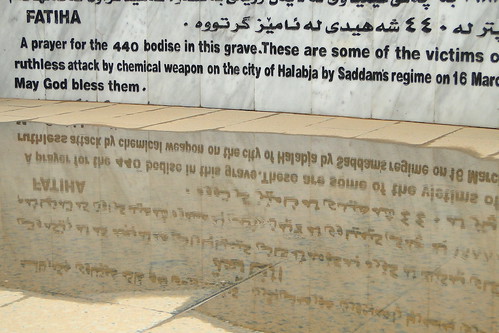
There are three martyrs' cemeteries in Halabja: In one of them, there are 1,500 bodies, 440 bodies are buried in the second one, and the third one has 24 bodies buried one on top of the other. And the rest of the bodies are, sadly, still missing. These cemeteries, which were arranged by the survivors of the massacre, have been turned into mausoleums frequently visited by the local people as well as the relatives of the victims. At the entrance of the cemeteries, it is written “Baath Party members cannot enter!”

Saturday 16 March 2013

http://www.worldbulletin.net/?aType=haber&ArticleID=104843

continue reading

Monday, 25 June 2012

Iraq faces painful legacy of mass graves


Iraq wants to put the legacy of murderous dictator Saddam Hussein behind it, but faces a huge need for specialists to excavate mass graves thought to contain at least half a million unidentified victims.

The stakes are high for Iraq, a country seeking reconciliation with itself, where countless families lost all trace of their relatives during the dictator's 1979-2003 rule or the terrible internecine violence in the years after his overthrow.

Families have not been able to come to terms with the loss, as they have never found the bodies of their loved ones or learned the circumstances of their deaths.

But the process of excavating the mass graves and identifying the victims, which could take decades because of its scope and difficult terrain that includes landmines and unexploded ordinance, requires a highly skilled workforce that does not exist in Iraq.

The International Commission on Missing Persons (ICMP), created on the initiative of former US president Bill Clinton and financed by Western states, has since 2008 held courses for employees of the Forensic Institute and the ministry of human rights aimed at addressing the shortfall.

Plastic skeletons The courses, offered in Arbil, the capital of the autonomous Kurdistan region in north Iraq, include plastic skeletons buried in the garden of the hospital where they are held. "We try to make the scenario as realistic as possible," said James Fenn, the coordinator of the programme, pointing to 20 participants who were carefully digging in the soil.

Gradually, the outlines of a dozen "bodies" emerge, some with their hands and feet bound, or showing signs of trauma.

The team makes a thorough record of the "grave", making drawings on graph paper and lists of bones and evidence discovered. The approach is very scientific and rigorous. "We have learned to use a trowel and to dig without using machines like bulldozers, as they cause damage and may erase lots of evidence," said Salah Hussein, one of the trainees.

One of his colleagues, Thamer Hassan, has a brother who has been missing since 1987. "Maybe he is in one of the graves," Hassan said, adding that despite this, his motivation was his "duty" as an employee of the ministry of human rights.

Once they have been exhumed, the bones are given to another team from the Forensic Institute in Baghdad, who are charged with examining them.

The trainees examine the bones on a table, trying to determine how many people they might have belonged to, their age and their sex -- and listing the details with care. "It's important for the families," said Dr Dunia Abboud, a 26-year-old dentist. "A lot of families lost a member and don't know what happened to them." "We try to help them," Abboud said. "This helps to do justice."

At least 270 mass graves Some 170 people have been trained since 2008, but the need is huge, said Johnathan McCaskill, the head of Iraq programmes for ICMP.

 The Iraqi government is working under the assumption that there are 500,000 missing people, but some estimates put the number of missing from repression under Saddam's rule, especially against the Kurds and Shiites in the 1980s and 1990s, at more than one million. "The information we started up with was that there are at least 270 different mass graves in the country," McCaskill said.

 Most of Iraq's mass graves date from the time of Saddam's rule, he said, but it is possible that there are some from the bloody sectarian fighting that came in the years after his overthrow, in which tens of thousands of people were killed.

McCaskill said that after Saddam's fall in 2003, some people began to dig on their own, looking for relatives, though this has since been prohibited by law.

The ICMP is also working with the Iraqi government on a DNA identification programme with much more reliable technology. But it is complex and expensive.

Samples are currently analysed at the ICMP headquarters in Sarajevo.

 Meanwhile, the training will continue for at least two years.

But is a course enough to prepare someone for something so disturbing? Thamer Hassan thinks so, saying: "I am ready to work in real graves."

For more information see: http://en.tengrinews.kz/article/125/ Use of the Tengrinews English materials must be accompanied by a hyperlink to en.Tengrinews.kz

Monday 25 June 2012

continue reading

Thursday, 17 May 2012

Another mass grave was found today on Balambo Mountain in Halabja

A mass grave was found Wednesday on Balambo Mountain including children and women remains. “The corpses of the mass grave might be victims of the chemical attack in the late 1980s,” Goran Adham Halabja town commissioner told Press. He said that they have indicated the location with the cooperation of Halabja Martyr association and have informed the KRG ministry of Martyr and Anfal affairs to dig up the corpses. “There might be also three other mass graves there,” he added. Halabja is a Kurdish town in Northern Iraq, located about 150 miles (240 km) north-east of Baghdad and 8–10 miles from the Iranian border. The former Baath regime bombarded Halabja with internationally banned chemical weapon in April 1988, killing 5 thousand innocent people and displacing thousands others. Those who were dead were buried nearby Halabja randomly. Wednesday 16 May 2012 http://www.komalnews.net/%28A%28tlc5BDBqzQEkAAAAMGQ3OWQ2Y2QtZmZiOC00Mjc2LTlmYWUtMmY4MDc3YmZiNWVj79RK3hAKpaskK5NhKbv1971f20Q1%29%29/En/Detail.aspx?id=15765&LinkID=88&AspxAutoDetectCookieSupport=1

continue reading

Wednesday, 1 February 2012

Disclosure of 32 mass graves of al Qaeda in Diayala

Shafaq News/ The director of the Iraq organization Talib Khazraji said in a statement "Shafaq News" has been informed "The security forces in Diayala province found since 2008 till today 36 mass graves scattered in different parts of the province," he said, adding that "32 cemetery belong to the victims of terrorism who were killed by the hands of armed groups during the period of the security deterioration that has occurred between the years 2006-2008, ".

"The tombs contain some 360 bodies belonging to women and children, and their presence is concentrated in the south and east of Baquba," He said noting that " some of the tombs have been opened under the formal decision issued by the Iraqi judiciary."

"The security services in the province found three mass graves containing the bodies of other elements and leaders of al Qaeda in southern Buhriz, south of Baquba," Khazraji added ,pointing out that "these graves contain the bodies of more than 263."

The Ministry of Human Rights announced during last year that 400 mass graves have been found in Iraq after the fall of the former regime in 2003, pointing at the same time it can not open more than a dozen graves in a year because they need a great effort of exhumation and identification of their owners.

Tuesday, 31 January 2012 08:30

http://www.shafaaq.com/en/news/2273-disclosure-of-32-mass-graves-of-al-qaeda-in-diayala.html

continue reading