Showing posts with label War deaths. Show all posts

Thursday, 3 September 2015

20 years on, Bougainville families haunted by missing


In the late 1980s, long-standing tensions over an Australia-run copper mine saw the region of Bougainville descend into a decade-long civil war for independence from Papua New Guinea.

It was after PNG imposed a blockade on the region in 1990 that Celine Pururau's brother, Paschal, left to take up arms and join the conflict, compelled by what she says was a motivation to save Bougainville from being wrecked by mining and environmental destruction.

"We tried to stop him," she said in an interview 25 years later. "But he did not listen to us, he said he had to sacrifice to save Bougainville."

Paschal, who before the war was a passionate football fan who worked with children around the town of Buka, left to fight Papua New Guinea government forces on Buka island.

His family never saw him again.

"They tell us the story that they buried him in a mass grave," Ms Pururau said. Her situation is not unique.

Almost twenty years since the war's end, the International Committee for the Red Cross says many families still have no idea what happened to their relatives during the war.

The official end of the conflict was in 1997, when a ceasefire was signed after protracted efforts to negotiate a peace between the two sides.

Estimates put the death toll at about 15,000, but the ICRC's Bougainville delegate, Tobias Koehler, says that nearly 20 years later, there's still no idea just how many are missing.

"There's simply no data on this and there's also, in terms of missing persons, no clear knowledge," said Mr Koehler. "Every time we come to a new district or we come to a new village and we talk about these issues people do come forward and mention this."

"It'll be at least more than 100, but it'll probably be less than a couple of thousand." Mr Koehler said many of the families of the disappeared have suffered psychologically as a result of the uncertainty, especially in a culture where returning a dead person to their home village for burial is of utmost importance.

"Basically, their family members have no idea of their fate and whereabouts, what has actually happened to them, if they are dead, if they have been killed or have died of a disease, if they are buried at a certain place or their bodies are lost at sea," said Mr Koehler. "There are a lot of families who are completely left in the dark about the fate of their loved ones."

It was that uncertainty that spurred Peter Garuai to form the Bougainville Families of the Missing Persons Association.

Mr Garuai's 20-year-old brother, Benedict, joined the fight in 1993 and was killed later that year. His family never heard what happened to Benedict.

"He was killed during the combat here in Arawa," said Mr Garuai. "The defence force killed him, but we've never known where he was buried. It was a dirty little war, here in Bougainville."

"I formed this association because of the pain that lingered in my mind that my brother, he has to come back," he said. "So this association tries to bring back normalcy to the lives of the missing people's families."

The now Autonomous Bougainville Government, formed under the peace agreement signed at the end of the conflict, adopted a policy on missing persons late last year, but little has come from it so far.

That's prompted many of the relatives of the disappeared to march through the towns of Buka and Arawa this week in an effort to highlight their ongoing battle for answers, and to call for more to be done to ensure that remains are returned to home villages.

Peter Garuai says the government needs to take note of the families' cries in order to build a foundation for a referendum on possible independence for Bougainville, which is likely to be held in 2019.

Bougainville's president, John Momis, says he accepts the ABG does need to do more to work out the whereabouts of the missing, but funding has been an issue.

"The ABG first of all has to engage people who are in the know and also find funds to fund it because it won't be done for nothing," said Mr Momis. "I'm not saying it hasn't been the top priority, we have had problems with the National Government giving us our legitimate financial budgetary allocations, and all these things have taken up our time."

John Momis said he hopes to work with the Red Cross and donor countries to make the missing persons policy more effective.

Thursday 03 September 2015

http://www.radionz.co.nz/international/pacific-news/283179/20-years-on,-bougainville-families-haunted-by-missing

continue reading

Wednesday, 2 September 2015

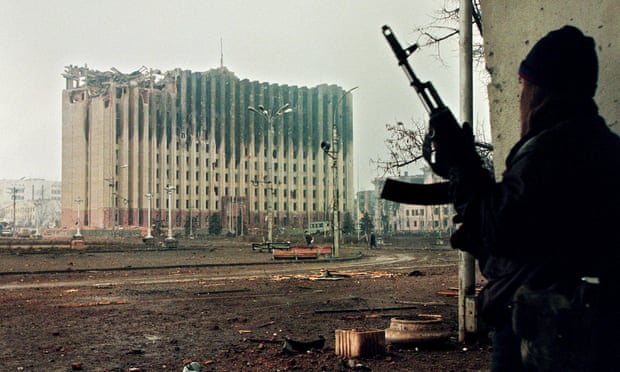
20 years after Chechen war, families still searching for missing bodies


Zura Batayeva carefully holds a small black-and-white photograph between her fingers. Creased and faded, it shows an earnest man with curly black hair.

The picture is all that remains of her son, Visit Batayev, who disappeared without a trace shortly after Russian tanks rolled into Chechnya more than 20 years ago – launching the first of two devastating wars against separatist rebels in the North Caucasus republic.

“The worst is not knowing what happened to him,” she says. “Only the thought that we will be together after I die brings me solace.”

This agonising uncertainty is shared by many Chechens.

Rights groups say an estimated 5,000 people are still missing from the two wars – the first of which began in December 1994, when federal forces launched a bloody attack on the capital, Grozny.

Like the Batayevs, many families still searching for their relatives accuse authorities of turning a blind eye to their plight.

Ramzan Kadyrov, Chechnya’s Kremlin-appointed leader, has overseen a massive campaign to rebuild Grozny with the help of cash injections from Moscow. But as glistening skyscrapers go up around the city, the grim task of laying the war dead to rest has fallen chiefly to human rights activists.

“No one needs us. The government has left us with our problem,” says Batayeva’s husband, Abuyezid Batayev. “We have received a lot of help from ordinary people, but they have their own problems. Many have missing relatives, too.”

Rights groups say there are still unopened graves in fields, courtyards, and basements throughout Chechnya.

‘These bodies need to be identified’

Visit Batayev was 27 years old when he disappeared, along with his neighbour, Musa. Witnesses say the two men were seized by Russian soldiers as they hid from shelling in the basement of a Grozny hospital.

Musa’s body eventually surfaced in a morgue in Moscow, and although the circumstances of his death remain unknown his parents were able to give him a proper funeral in Chechnya.

Visit Batayev’s continued absence, however, has prevented his parents from coming to terms with their loss. “Sometimes I close my eyes and I see my son. It’s as if he had returned,” Batayeva says. “I see him speaking to me. I see us having lunch together under the summer canopy of our house. I see him in my dreams, too.”

Zainap Mezhidova, a rights campaigner whose own son is missing, knows of at least three mass graves that she says contain the remains of hundreds of people.

“These bodies need to be identified. We know where they are located,” she says. “The authorities should be looking for our children.”

‘When I hear a child calling for his mother in the street, I turn around’. Zura Batayeva remembers her son.


Promises Despite Kadyrov’s repeated promises, Chechnya still has no forensic lab of its own. Remains exhumed from mass graves are sent either to Moscow or Rostov-on-Don for identification before being returned for burial in Chechnya.

Batayev says he has combed through numerous mass graves in search of his son, sifting through human remains with his bare hands.

He was once told that the body of a man matching his son’s description had been found in a mass grave close to Grozny’s cannery. Documents on the body gave Visit as the man’s first name.

The Batayevs immediately rushed to the site. “There were about 250 bodies there,” Batayeva recalls.

The body, however, did not belong to their son. “That day I collapsed and I hit my knee very hard,” she says. “It still hurts today.”

Desperate to find his son, Batayev travelled to a forensic lab in distant Rostov-on-Don. He says he saw many bodies there, but his son was nowhere to be found.

Today, he and his wife no longer have the strength to search for his body.

But Batayeva, despite the odds, refuses to give up hope of finding him alive. “When I hear a child calling for his mother in the street, I turn around,” she says. “I still have some hope of being reunited with my son one day.” Wednesday 2 September 2015

http://www.theguardian.com/world/2015/sep/02/chechnya-anniversary-missing-people-remain

continue reading

Tuesday, 1 September 2015

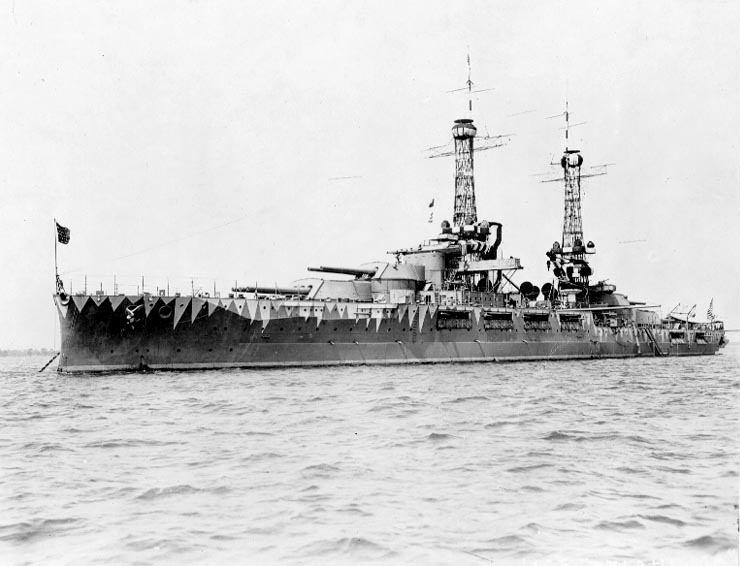
Working to identify the sailors on the USS Oklahoma


The fuel-stained bones, hundreds of them, are laid out neatly on Carrie Brown’s exam tables at Offutt Air Force Base, carefully tagged and logged in her database.

In the clinical setting of Brown’s lab it’s easy to forget these are the last remains of the first American victims of World War II. These sailors and Marines from the battleship USS Oklahoma partied and danced and played cards on a Hawaiian Saturday night in December 1941. The next morning they died for their country in a cauldron of fire and oily water when the Japanese attacked Pearl Harbor and sank their ship.

They have rested for decades in graves marked “Unknown, Pearl Harbor, Dec. 7, 1941.”

“All these families were told bodies were never recovered — and they were,” said Ray Emory, 94, of Honolulu, a Pearl Harbor survivor who has long lobbied for the identifications of the Oklahoma unknowns. “I never thought they’d dig them all up.”

After several years of internal debate, the Pentagon decided this spring to disinter 61 caskets holding the remains of up to 388 unidentified USS Oklahoma service members — including 17 from Nebraska and western Iowa.

The USS Oklahoma identifications — which investigators think will take five years — are also likely to spur identifications of many other “unknown” remains resting in military cemeteries around the world. And the Offutt lab, belonging to the newly created Defense POW/MIA Accounting Agency, or DPAA, is at the center of the effort.

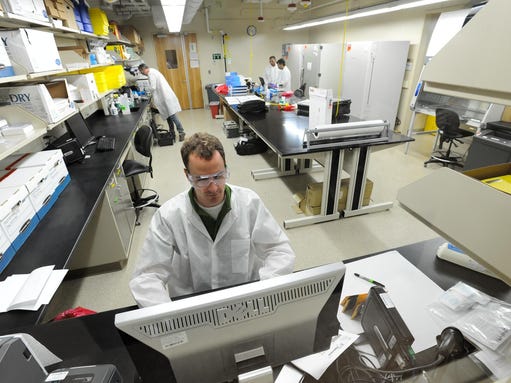
“We are going to move forward on a large scale,” said Brown, 33, a forensic anthropologist at the Offutt lab, which until now has been limited to examining individual remains from European sites.

DPAA emerged earlier this year, restructured from three agencies responsible for finding and identifying the remains of missing U.S. service members from the late-20th century wars.

In recent years those agencies had endured a barrage of criticism for bureaucratic infighting, ID methods and staging fake transfer ceremonies with empty, flag-draped caskets.

Most of all they were criticized for moving too slowly, averaging about 70 MIA identifications a year since 2010 on a budget that has jumped from $65 million to nearly $100 million. Congress has ordered them to boost the number of IDs to 200 a year.

To do so, the new agency has been given authority not only to open the graves of “unknowns” but also to work with private groups that excavate air crash sites in search of the remains of long-lost MIAs.

Since the opening of the Offutt lab two years ago there has been a trickle, not a torrent, of identifications out of Omaha. Most of the 56 exam tables in Brown’s lab have remained empty — until the arrival of the USS Oklahoma unknowns this summer.

That news has cheered a dwindling group of Oklahoma survivors, and families of the dead, who had sought the identifications for years. The Navy had strongly opposed reopening the graves, but the Pentagon finally ruled in favor of the Oklahoma families in April.

When Japanese torpedo bombers swooped in over Pearl Harbor, the men of the Oklahoma stood little chance — especially those below decks at duty stations or in bunks on a Sunday morning.

Several torpedoes struck the battleship as it was moored on Battleship Row. The Oklahoma rolled, and sank in its berth. Most of the 429 victims drowned or were suffocated, some after spending hours or days shouting and banging for rescue from inside the hull.

Thirty-six bodies were recovered and identified soon after the attack. The rest remained entombed in the hull until the battleship was raised a year and a half later. The bones of the dead, encrusted in mud and oil, were removed from the ship and buried in two Hawaiian cemeteries.

In 1947 the Graves Registration Service spent two years trying to identify the remains. Though they matched names to 27 skulls using dental records, authorities decided to rebury all of the remains at Honolulu’s NationalMemorialCemetery of the Pacific as “unknowns,” because no complete bodies could be identified.

They might have stayed there forever if not for Ray Emory’s dogged detective work. After the Navy veteran retired to Hawaii in the mid-1980s he visited the cemetery to pay his respects to Pearl Harbor victims.

“I wanted to know where the Pearl Harbor grave sites were,” he recalled. “They couldn’t tell me.”

Emory set out to change things. Using the Freedom of Information Act, he gathered documents and learned about the 27 identified skulls. He traced some of them to individual graves. In 2003, one casket was exhumed and the remains of five Oklahoma sailors identified.

But the opening of that one coffin showed just how daunting the task of identifying the USS Oklahoma dead will be. DNA evidence showed that the casket contained remains of at least 95 individuals. It’s assumed that remains are equally commingled in every casket.

“We absolutely know they’re mixed up,” Brown said.

Now her job is to solve this puzzle.

Remains began to arrive at Offutt soon after the first caskets were disinterred in Hawaii on June 8. Brown said skulls are being kept at the DPAA lab in Hawaii, which has experts in dental identifications. Other bones are being brought to Offutt in flag-covered caskets aboard military aircraft.

The bones come wrapped in blankets, she said. They are set out neatly on tables, arms and legs on one side of the table, ribs and backbones on the other, each bone or fragment logged into a database for tracking.

The remains are laid out such that the men would be facing an American flag that stands at one end of the room, following a military tradition.

People who have watched “CSI” on television may think identifying a bone is as simple as taking a DNA sample, testing it and matching it in a computer database — and sometimes it is.

But with the bones of people who have been dead for decades it can be more complicated than that, Brown said.

“We don’t have DNA on file for people who served in World War II,” Brown said. “DNA is very powerful if you have something to match it to. Otherwise, it’s just a series of letters.”

The Offutt lab uses traditional anthropological techniques such as comparing bones with medical and dental records while looking at artifacts and other clues. DNA is just part of the mix.

“It’s very multifaceted,” Brown said. “Many lines of evidence come together.”

Brown said DNA testing will be central to identifying the victims from the Oklahoma. The agency has spent years collecting samples from relatives of nearly all the sailors and Marines.

The best DNA samples can be obtained from the largest pieces of bone, such as a thigh bone. Two kinds of DNA are found in human cells. Nuclear DNA allows a specific match, while mitochondrial DNA isn’t as definite. But mitochondrial DNA is easier to extract from older samples such as the Oklahoma remains, because there is more of it.

“The possibility of identifying every single lost bone is not high,” Brown said. “It depends what pieces you have, how quickly you can put the puzzle together.”

When Brown looks at the bones laid out in the lab she maintains a clinical detachment, focusing on measurements and DNA and material evidence.

But occasionally someone will stop by to view the newly identified remains of a loved one. Brown will set up a room for a private viewing — and she is reminded why this work remains so important.

“The most poignant thing is meeting the families,” Brown said. “It’s what gets you up in the morning.”

They are the families of men like 2nd Lt. John W. Herb, a 22-year-old fighter pilot who died April 13, 1945, in the crash-landing of his P-51D Mustang east of Hamburg, Germany. His remains were identified earlier this year through the efforts of Brown and the Offutt lab. Herb was buried at ArlingtonNationalCemetery in June.

“All we ever knew was that John was shot down in Europe, and he was never found,” said Michael Herb, John’s second cousin and closest living relative. That changed last year when members of a private group called the Missing Allied Air Crew Research Team contacted members of Herb’s family and told them the crash site had been found.

They learned a German man named Manfred Roemer had seen the plane crash as a 5-year-old and never forgot it. Years later, he went looking for the crash site.

Roemer found two women who had seen Herb pulled — alive — from the wreckage by two German officers and executed and buried in a shallow grave. He learned another woman had tended the grave for decades. He notified German authorities, and last year led a U.S. military archaeological team there.

“He’s the one who pursued this,” Michael Herb said. “He’s the one who did the right thing.”

John Herb’s remains were unearthed and shipped to the Offutt lab, and he was identified within days.

The Herbs were so grateful they invited Brown to the service at ArlingtonNationalCemetery. She couldn’t make it, but other DPAA employees attended. So did Roemer, who made it possible.

Michael Herb found the ceremony — complete with military band, rifle salute, folded flag and taps — to be a moving experience.

“There were 80 people at the grave site — 80 people who never knew this guy,” he said. “It made you feel like you were part of something that was a real honor.”

If all goes smoothly, that honor soon will be extended to hundreds more families of World War II service members — men whose bones are resting in an Offutt Air Force Base lab, waiting to be taken home.

Tuesday 1 September 2015

http://lexch.com/news/working-to-identify-sailors-lost-on-the-oklahoma/article_c8d31ebc-4ffc-11e5-8d24-5be4d924e390.html

continue reading

Tuesday, 11 August 2015

Pentagon still searching for lost WW2 veterans


Long dead but little forgotten, US soldiers who disappeared across the globe during World War II are being reunited with their loved ones in a push to find and bring home their bodies.

From the forests of Germany to the jungles of Papua New Guinea, US experts employed by the Defense POW/MIA Accounting Agency -- among them historians, archeologists and forensic experts -- are the main sleuths.

When recovery of a body is possible, the Pentagon specialists turn the remains over to an ultra-modern lab in Hawaii for identification and then wait for the ultimate reward: bringing the bereaved back together with their long-lost relatives.

Stephen Johnson, a historian-investigator, recalled how a delighted woman, whose father had been found in a German forest, exclaimed: "You gave me back my daddy."

"I think of her when I work on a case," Johnson said.

The woman, now a mother and grandmother, "had come to peace" after finding out the exact fate of her father, who died when she was 18 months old, Johnson said.

Sandi Jones, who lives in Montana, said she felt immense joy when the agency called her in June 2014 to say that her uncle had been found 70 years after his plane went down in the jungles of Papua New Guinea.

"I was flabbergasted," the 60-year-old said.

The uncle, whose photo Jones kept even though her grandparents refused to speak of him, was buried near the family ranch with honors in the presence of US Air Force officials.

The agency also gave the family his Masonic ring, which was discovered among the crew and deduced to be his since he was the only member of a Masonic Lodge.

Johnson said the willingness to return a soldier at any cost dates back to the nation's birth.

President George Washington, the first head of the US military, thought that "the allegiance of the Army to the nation was directly tied to the allegiance of the nation to the Army," he said.

"You don't stop being a member of the US military because you die," he added.

It is this logic that has driven the POW/MIA agency to take on a project to exhume 388 sailors and Marines who were killed aboard the battleship USS Oklahoma at Pearl Harbor on December 7, 1941.

At the time, remains of most of the crew could not be identified after spending weeks in the water, and the bodies were interred at the National Memorial Cemetery of the Pacific in Honolulu.

Now the agency hopes to identify remains through dental and DNA analysis -- a daunting task considering that the bones are mixed together, Johnson said.

The agency, which uncovers around 70 bodies a year, has fallen short of Congress' goal of 200 bodies annually.

Meanwhile, private associations are aiding in the effort.

History Flight, whose multi-disciplinary team includes historians, archeologists and soil specialists, is searching for the remains of several dozen Marines on the Tarawa Atoll in Kiribati, from the war's Pacific theater.

The quest began in 2007 and has cost nearly $1.5 million, according to History Flight president Mark Noah, who decided to search for the missing planes after becoming interested in lost flights.

"For us, it's a humanitarian issue" said Noah, an airline pilot for 50 years, explaining that many of the children and relatives of the disappeared are still alive.

Just over 73,000 US World War II soldiers are still missing or unidentified according to official figures.

Tuesday 11 August 2015

http://news.yahoo.com/pentagon-still-searching-lost-wwii-veterans-023755027.html

continue reading

Saturday, 8 August 2015

Ukraine buries unidentified soldiers months after eastern battle


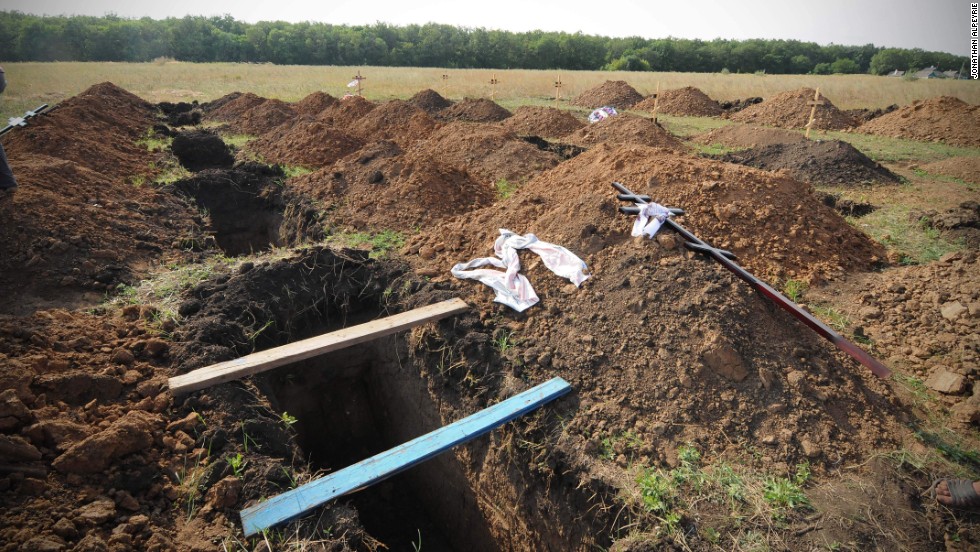
Ukraine buried on Friday 57 soldiers still unidentified up to a year after being killed in the eastern separatist conflict, highlighting the difficulties the country faces moving on from one of its deadliest military defeats.

Mournful chants drifted over the graves of the nameless soldiers, most of whom fell in the battle of Ilovaisk last August after Ukrainian forces found themselves encircled, outgunned, and vastly outnumbered by Russian-backed rebels.

Authorities have spent months trying to identify the bodies and find relatives, but without success.

"It's horrible to think that somewhere their parents are waiting for them, their children, brothers, sisters," said local resident Olga Bondarenko, who had come to pay her respects at the cemetery in the south-eastern region of Zaporizhzhya.

Hundreds of soldiers are believed to have been killed in the encounter, but official figures are much lower.

Government efforts to recover bodies were hampered by the fact they lay in separatist-held territory.

Afterwards an unwillingness from relatives to undergo DNA testing also held up the process, news agency Interfax Ukraine quoted regional military official Oleksander Beda as saying.

"Until the end they hope that their loved ones, who were missing in action, were alive and either captured or in hospital ... You can understand them - hope dies last of all," he was quoted as saying.

In October, a parliamentary report on Ilovaisk listed a series of military mistakes and concluded that "the causes of the ... tragedy are fundamental problems in the organization of the country's system of defense".

It said it was not able to establish the true number of casualties due to a lack of data from the Ministry of Defence and General Staff.

More than 6,500 soldiers, separatists and civilians have been killed since fighting between Ukrainian troops and rebels seeking independence from Kiev erupted in April 2014, according to United Nations estimates.

Violence has continued despite a ceasefire deal signed in February with both sides accusing the other of violations. Sixteen servicemen have been killed by shelling or landmine explosions since the start of August, while 29 were killed on the frontline in July.

"To think that this could happen to our country, to our boys," Bondarenko said, her voice choking with tears.

Clouds of red dust rose into the air as soldiers shoveled earth into the graves, each marked with a plain cross and a plaque inscribed with the words: "Unknown soldier."

Saturday 8 august 2015

http://news.yahoo.com/ukraine-buries-unidentified-soldiers-months-eastern-battle-153129095.html

continue reading

Tuesday, 21 July 2015

U.S., Japanese veterans, 95, work to find missing comrades


Tuesday, Leon Cooper, who is 95 and lives in Malibu, will leave for Japan to meet with Kokichi Nishimura, who is 95 and lives outside Tokyo.

During World War II, the two were enemies, each sent by his country to New Guinea, where they endured some of the bloodiest fighting of the war.

Cooper was a boat group commander taking U.S. assault troops to the shore at New Guinea and elsewhere. Nishimura was an infantryman at an earlier battle in New Guinea called the Kokoda Track and later in Burma.

Now they share a passion: that a decent reckoning, and appropriate honors, be made for their countrymen killed in combat. Each is livid with allegations that his country is not more aggressive in accounting for the fallen.

They have never met. But each felt drawn to compare experiences. Nishimura is frail, and the meeting may take place in a hospital.

In his devotion to finding Japanese — and Australians — killed in New Guinea, Nishimura left behind his business and his family in the late 1970s and moved to New Guinea — now known as Papua New Guinea. With occasional returns to Japan, he remained in New Guinea until his health declined in 2007, forcing a final return to his homeland.

In New Guinea, he acquired the nickname the "Bone Man of Kokoda," which is the title of a 2008 book about Nishimura written by Australian journalist Charles Happell.

Cooper's efforts to find and honor the dead from the battle on the atoll of Tarawa were chronicled in the documentary by filmmaker Steven Barber, "Return to Tarawa: the Leon Cooper Story." Barber is accompanying Cooper to Japan with plans to co-produce, with Matthew Hausle, an updating of the Cooper story, "Return to New Guinea."

Cooper, in an interview Sunday, said he has heard that Nishimura wants to know if the hatred that Americans once felt for Japanese has subsided.

My feeling is: 'How long can you harbor hatred?' "Cooper said. "I don't hate the Japanese. Most of the people I hated are dead. I outlived them, which is the best revenge."

After the war, Nishimura founded a successful engineering firm. Cooper had various business ventures, including founding an early computer company and serving as chief financial officer for several corporations.

Each traces his concern for the remains of those killed to an unchanging sense of duty.

Nishimura has said that when he married his wife after the war, he told her that someday he would return to New Guinea to retrieve the bodies of his comrades. "It was a promise I made to my friends," he told Hausle last year.

Cooper remembers soldiers in his landing craft, in Tarawa, New Guinea and other battles.

"I know that some of those guys were killed and are still missing," he said. "I took them across the River Styx into the killing field. It haunts me still."

Although the Defense Department has recently reorganized its effort to account for the missing, Cooper said the effort is still ineffectual.

"I want our government to live up to its promise not to leave any man behind," he said. "There are more than 80,000 who remain where they fell. It makes me so mad."

In an interview with the Japan Times, Nishimura offered similar criticism of the Japanese government. Estimates of Japanese dead unaccounted for during World War II reach into the millions.

"They don't care; it has always been the same," he told journalist David McNeill. "Everybody today is against war in Japan, but nobody wants to talk about what happened."

While in Japan, Cooper hopes to meet with the U.S. and Australian ambassadors. He is especially eager to meet with U.S. Ambassador Caroline Kennedy, daughter of John F. Kennedy.

"We share a connection," he said.

Kennedy's father's PT-109 was based at Tulagi, one of the Solomon Islands. Cooper's ship, the attack transport Harry Lee, stopped briefly at Tulagi — which proved long enough for sailors and soldiers facing combat, including Cooper, to go ashore and get drunk.

The trip to Japan is being underwritten by Gordon Cooper, a nephew of the late astronaut Gordon Cooper. Leon Cooper knew the astronaut but, similar name not withstanding, they were not related.

Cooper plans to visit the Yasukuni Shrine, Japan's shrine to its war dead, although Cooper has mixed feelings about the shrine, particularly its inclusion of military personnel convicted of war crimes, including Hideki Tojo, Japan's prime minister during much of the war. Tojo was hanged as a war criminal in 1948.

About Nishimura, Cooper has no mixed feelings.

"Like me, he was sent [to New Guinea] to protect his country," Cooper said. "But I bet neither of us had such lofty ideas in mind. We just wanted to get the hell out alive."

Tuesday 21 July 2015

http://www.latimes.com/local/california/la-me-veterans-meeting-20150721-story.html

continue reading

Wednesday, 15 July 2015

Without war, Dover mortuary, lab roles shift


For the better part of 14 years of war, the transfer cases and bodies never seemed to stop arriving at Dover Air Force Base.

"We used to look at the casualty board and hope for a break," said James Parsons, an embalming technician with Air Force Mortuary Affairs Operations, the only U.S.-based funeral home dedicated to the nation's fallen military. "Now? Now it's good."

In 2007, the worst year of the fighting in Iraq and Afghanistan, some 1,020 military casualties were shipped home, according to Air Force Col. Dan Merry, AFMAO's commander. Last year, the overall total fell to 60. "And it has gone down gradually since," said William Zwicharowski, Port Mortuary branch chief, who was with AFMAO, and the agencies that preceded it, for the entirety of the conflicts.

So trimming, and training, are now the watchwords at AFMAO. Its next-door neighbor at Dover, the Armed Forces Medical Examiner System, has also shifted gears, from performing autopsies on every returned casualty from Iraq and Afghanistan to studying lessons learned, taking on more emerging historical DNA identification work and helping non-defense agencies with medical legal death investigations.

"We're staying busy," said Army Col. Ladd Tremaine, director of AFMES, noting the group's increasingly worldwide responsibilities for the federal government. "Most of our work is not done back in that autopsy suite. Most of my examiners are on the road."

It's been a remarkable shift. A total of 6,852 U.S. military personnel have died overseas since 9/11. All were carried off a cargo jet ramp, one by one, and into the complex that houses the two agencies. Even as stunned family members were welcomed, comforted, even counseled, the remains were being scanned (for explosive material), catalogued, autopsied, embalmed and prepared for burial.

Now, the number of dignified transfers from overseas has slowed to a crawl.

"We are not used to it," said Zwicharowski, a former Marine. "We've almost slammed the brakes on now. Which is great. ... It's probably the best problem I've ever had in my life, [which] is to not have 10, 20, 30 bodies to process a day. So it's a good problem to have."

The slowdown is giving AFMAO time to take stock of itself. Recently borrowed mortuary personnel are being returned to other bases - as well as to Dover's Air Force Reserve unit, the 512th Airlift Wing, which it has relied on heavily during the wars. AFMAO could get even smaller, Merry said.

AFMAO has 50 personnel assigned, but that could be halved "if we stay this way for a year or two," Merry said – adding that this could quickly change if the U.S. keeps increasing its small combat presence in theater.

"If we get 30 or 40 thousand boots on ground, in harm's way, we'd start plussing back up," Merry said.

To prepare for the unexpected – a mass casualty event, e.g. – Merry is implementing a more efficient rapid "recall" system. "We're looking at a system where we can hit a button and get everybody we need back here, fully trained, fully checked out, ready to go," he said.

"It's not a matter of if," Zwicharowski said. "It's a matter of when, unfortunately."

That was the case when 11 Louisiana National Guardsmen were killed in a March helicopter crash during training in Florida. All the troops were brought to Dover; AFMAO reached out to the Navy to borrow licensed embalmers to help out, Merry said.

With fewer permanent personnel on staff, Zwicharowski said, "We're turning to training on mannequins, restorative art training, embalming training, and licensing."

Training is particularly important for specialists who sometimes handle bodies in far worse shape than those that typically arrive at a mortuary. Roadside bombs were the No. 1 killer in these wars.

Tremaine's AFMES is responsible not only for worldwide U.S. military autopsies but medical legal death investigations for the entire federal government across the globe – agencies such as the FBI and NASA – which is why his examiners often find themselves traveling.

"The sheer numbers have decreased," Tremaine said. "The complexity of our cases has increased. Department of Justice has been using us extensively over the past year." He pointed to the police shooting death of Michael Brown in Ferguson, Missouri, which was investigated by the FBI.

"When something like Ferguson occurs, you're going to have the locals investigate it, and … the same thing happened here in Baltimore recently – you're going to have the family request a second autopsy," Tremaine said. "Who's going to be the ultimate arbitrator or make sure that everybody's playing on an even field? Who's the honest broker? Well, we've essentially become that honest broker. We come in as a federal entity; we get to see all the evidence and information; and potentially do a tertiary post-mortem examination, independently. And then we present that to the Department of Justice."

In addition to its autopsy work, AFMES recorded in detail war injuries with an eye toward improving combat trauma care. Tremaine wants to make that database more easily accessible.

"All throughout the war, we've been very active in identifying the glaringly obvious, and getting that information out quick," he said. "Now it's time to sit back and look at all the information in its totality, and discover those non-glaring issues that will only be captured through more in-depth research. Can we discover something else that can potentially change techniques, tactics and procedures in the future?"

AFMES' DNA Lab will also stay busy performing DNA analyses on remains from past conflicts, such as those of the sailors and Marines who died at Pearl Harbor aboard the USS Oklahoma who were buried, unidentified, in mass graves in Hawaii and are now being exhumed.

Wednesday 15 July 2015

http://www.delawareonline.com/story/news/nation/military/2015/07/14/without-war-dover-mortuary-lab-roles-shift/30162767/

continue reading

Thursday, 25 June 2015

Almost 1,200 people are missing in Donbas


Almost 1,200 Ukrainians are listed as missing in the military conflict zone in Donbas, Iryna Heraschenko, a representative of Ukraine in the humanitarian subgroup of the Trilateral Contact Group and a member of the Petro Poroshenko Bloc, has said.

"We have almost 1,200 Ukrainians on this horrible 'missing persons' list," Heraschenko said on Facebook on Tuesday.

Heraschenko said International Committee of the Red Cross (ICRC) officials have offered expert assistance in the search for and identification of the missing people.

She also said the Ukrainian authorities had also suggested in the negotiations in Minsk on Tuesday that the ICRC should monitor the situation with the detainees and their living conditions, including in Russia. "We again emphasized that our colleague Nadia Savchenko has been illegally held in a Russian prison for a year now," the Ukrainian official said.

Additionally, the Ukrainian officials raised in the meeting of the subgroup the issue of the Russian humanitarian convoys to Donbas, which Kyiv finds to be illegal.

Thursday 25 June 2015

http://en.interfax.com.ua/news/general/273954.html

continue reading

Tuesday, 9 June 2015

Wooden crosses in the Donetsk steppe: volunteers search for bodies of victims


In the midst of the Donetsk steppe on the mountain stands a wooden cross. Is similar, only much more put on the roads of Ukraine As amulets. On the cross hangs a soldier helmet plywood plate below the faded marker inscription: "Here lie four Ukrainian warriors, which finished it off, then set fire to their And dumped near the road. Buried fifteen. 09. 2014 ".

"Here the locals buried the soldiers of the Ukrainian army. Like the river found them, close to the road, after the battle, " says Victor Fly, the Deputy head of the Union of Afghanistan veterans of Lugansk region.

This organization together with the people's militia LNR AND Ukrainian volunteers of the humanitarian mission "Black Tulip" are engaged in the search, exhumation And transfer of the Kiev bodies of soldiers of the armed forces. Watching all the Commissioners of the OSCE.

"Here are four lies below another. Believe me, this is only a small proportion of all burials, which we send data. We have a lot of bodies are Not even Buried. Parts are collected in the fields, in the debaltseve area, for example", says Victor.

And this cross, And a helmet, And ubiquitous grasshoppers, And all This bathed in afternoon sun Prairie, As if merged. The peace And quiet." As if there is war, " I freeze.

"Don't relax - and chuckled low rebel in a dark green camouflage - you see at the bottom of the river?(Five hundred meters from us flows the Seversky Donets river). It is already the Ukrainian district, snipers, probably in the bushes sat down, holding us at gunpoint ".

"Oh, don't bother with us W OSCE! And volunteers over theirs. Won't shoot.

Tuesday 9 June 2015

http://news.rin.ru/eng/news///113649/

continue reading

Monday, 20 April 2015

Ukrainian Volunteers Search for Bodies of Missing Soldiers


As the cease-fire becomes more fragile in eastern Ukraine, a team of volunteer body collectors travels to the small village of Savur Mohyla in the what pro-Russian separatists call the Donetsk Peoples Republic - to retrieve bodies of fallen Ukrainian servicemen from rebel-held territories.

With a recent escalation in violence in eastern Ukraine's separatist conflict, the number of dead grows. Many fallen soldiers are buried without record, often in a grave without a name or tombstone. On the road to the village of Savur Mohyla near the Russian border, a Ukrainian volunteer team called Black Tulip is on a mission to collect bodies of fallen Ukraine government soldiers from rebel-held territory.

Little remains of the military positions that were here. But there is still danger from land mines and booby traps. Still, the team does this grim work without pay.

"There is one body here, we received information from local citizens, it was a fight over here in the end of August. Ukrainian soldiers were pushed back and one of the soldiers was left here," said Black Tulip volunteer Aleksey.

Despite coming from Ukrainian government-held territory, the team is able to work in separatist-controlled land through cooperation with the militaries on both sides.

"We transmit bodies from the Ukrainian side to the DNR [separatist] side and vice versa. There is an agreement between the government of DNR and the Ukrainian Ministry of Defense, and when this agreement is confirmed, on that day we are able to cross the border," said Aleksey.

The separatists' commissioner for missing people, Lilia Radionova, helps coordinate the team. She says she gets thousands of request every day to help find missing persons - her desk piled with letters and photos from family members.

"I received a lot of phone calls from Ukrainian soldiers' relatives, mothers, fathers, wives. This is a Ukrainian soldiers' list of lost in action," said Radionova.

Although February's cease-fire agreement called for returning casualties and prisoners of war, getting permission for the team to work can be difficult. But Radionova says cooperation between the two sides is improving.

"When we submitted 22 bodies to them from Donetsk airport something changed, after this ultimatum we demanded something changed. Since January, we could not take our fallen from Volnovakha and now finally we received the bodies, thanks to them but at the moment there are many more bodies...Due to joint efforts we will have an agreement in future," she said.

The volunteers return with a body they think may be a rebel soldier. They say they will hand it to authorities for identification.

"We apply visual inspection of the body, sometimes there are some documents in pockets and we can use it to identify a person. If there are no documents, the only help is DNA analysis," said Aleksey.

More than 6,000 fighters and civilians have died in the conflict in eastern Ukraine over the past year, and with frequent cease-fire violations, the team's work is far from over.

Monday 20 April 2015

http://www.voanews.com/content/ukrainian-volunteers-search-for-bodies-of-missing-soldiers/2722787.html

continue reading

Wednesday, 18 March 2015

1992-1993 Georgia-Abkhazia armed conflict: ICRC helps to clarify the fate of Missing Persons


Problem of people missing during and after armed conflicts unfortunately relates to Georgia too. According to various sources, there is significant number of people who got missing during and in relation with armed conflicts of last decades in our country.

It is known that the International Committee of the Red Cross (ICRC) is actively involved in the process of searching of those people.

Ms Jelena Milosevic Lepotic, who coordinates the work related to issues of missing persons and their families, tells us more about the role and activities of the International Committee of the Red Cross.

Indeed, there are over 2000 persons missing from the conflicts of the last decades and families are still waiting for answers,. Families are ageing and they told us many times that all they want is to have an answer and be able to give a proper burial to their relatives.

The ICRC initiated a "Missing project" which aims at addressing the issue of people who were unaccounted for as a result of armed conflicts in order to prevent disappearances, locate missing persons, and also to address the needs of their families. It is important to recall that the families of the missing persons should also be seen as victims of conflicts. An international conference was organized in Geneva in 2003, which led to recommendations and best practices on various issues linked with the disappearance of people, which unfortunately excessively occurs in conflict affected countries all over the world. Georgia has, unfortunately, not been spared. Thus, it is extremely important to try to implement and put into practice what has been recommended following the Conference. Aside from the various needs the families of missing persons are facing, the most crucial one is their need to know the whereabouts of their loved ones. In Georgia, we are actively working with all the parties involved in order to address this issue of the missing people in a purely humanitarian manner in order to find their whereabouts and if deceased, to identify and hand over the human remains to the families to allow them have a proper funeral ceremony and do their mourning.

In 2010, we succeeded to set up two humanitarian mechanisms: one addressing the issue of persons who disappeared in relation with the 1989-1992 and 2008 conflicts and the other addressing the issue of persons who went missing in relation to the 1992-1993 conflict. Both mechanisms are chaired by the ICRC.

It is important to mention that the authorities are actively involved in the process. I would say we see that the Georgian, Abkhaz, South Ossetian and Russian participants to the process do realise their responsibility in getting answers for the families of missing persons.

You mentioned the two coordination mechanisms that were established and work under the auspices of the ICRC. How successful is the work of those mechanisms? What are the results achieved by now?

The two mechanisms that we established are: the Bipartite Coordination Mechanism for Clarifying the Fate of Persons Missing in Relation to 1992-1993 Armed Conflict and after and the Tripartite Coordination Mechanism for the Clarification of the Fate of Persons Missing from the August 2008 armed conflict and earlier hostilities.

Despite the complexity of the process, the work of the two mechanisms does bring concrete results. The participants to the Bipartite Coordination Mechanism keep on meeting on regular basis and exchanging information relevant to the work. The ICRC provides support with technical expertise within the framework of its mandate of a neutral humanitarian organisation. The Tripartite Coordination Mechanism is presently facing some difficulties, yet the ICRC continues providing support to the participants to overcome present difficulties and continue successful bringing of answers to the families that await them.

So far, the following results have been achieved:

Following the decision made by the Bipartite Coordination Mechanism, experts from the Argentine Forensic Anthropology team were invited by the ICRC to support exhumations and analysis of 64 sets of human remains of unidentified persons that died during the 1992-1993 armed conflict and who were subsequently buried in the site of Park Slavy in Sukhumi. . Remains of 21 individuals have been identified and returned to their families since December 2013. In 2014, exhumations of 2 sites containing remains of persons who died in the 1993 plane crash at the Babushera Airport took place. Remains of 55 individuals were exhumed and analysed. Following the DNA and anthropological analysis, remains of 9 persons have been identified.

In parallel to work of the two mechanisms, we have also initiated a project in favour of the families of the missing people.

What kind of support do you provide to families of missing individuals?

Under the project Accompaniment of Families of Missing Persons, local non-governmental organizations, Georgia Red Cross Society and a number of enthusiastic individuals in cooperation with the ICRC provided psychological, legal, social, economic and psychosocial support to the families of missing. The aim of the project is to address their various needs, and assist them to live with their ambiguous loss.

Based on their feedback this work seems to be very much appreciated. These people feel that they are not forgotten and that their specific needs are taken into consideration.

You informed about exhumations in Babushera, Sukhumi and Tbilisi. According to various media sources, some other graves might as well be exhumed. What additional information could you give us on that issue?

As mentioned previously, the participants to the Bipartite Coordination Mechanism agreed and carried out exhumations at the sites of Park Slavy (Sukhumi), Babushera and Digomi (Tbilisi). So far, remains of 30 persons have been identified and handed over to their families both in Sukhumi and in Tbilisi. The first identifications of remains exhumed from Babushera were reached in December 2014 when one family received remains of its four missing family members. Identification of 5 more individuals exhumed from Babushera has been reached and Georgian participants to the Bipartite Mechanism (Ministry of IDPs and Refugees and the National Forensic Bureau Medical Department and Morgue), with support of the ICRC, organised the handover of the identified remains to the families in February 2015. More identifications can be expected as the process of identification using anthropology and DNA analysis continues.

What ensures accuracy of identification of human remains? What are the standards applied in this complex activity?

A multi-disciplinary approach is taken towards the identification of human remains. This includes using different types of information such as data about the missing person when they were alive, the circumstances of disappearance, DNA reference samples from family members and reliable information about the location about where the bodies may have been buried. This information is compared against data collected during the scientific recovery and analysis of the human remains as well as DNA samples that are taken from the skeletal material. In this way, multiple lines of enquiry and all supporting evidence is used for a positive identification. This approach follows international best practice in the identification of human remains and ensures confidence in the results.

What are the plans for the future?

The Bipartite Coordination Mechanism and its Forensic Working Group will continue meeting regularly. The next meeting is preliminary agreed to take place sometime in the spring in Istanbul. The dates are still not confirmed. It is expected that the participants will continue working on the collection of information about potential burial places to enable future exhumations, identifications and hand overs to the concerned families.

In order to have the process running smoothly, it is expected that all institutions directly and indirectly supporting the process fulfil their agreed roles: e.g. The Ministry of IDPs and Refugees continues collecting and managing information through its department for missing persons, the National Forensic Bureau DNA laboratory continues assisting the ICRC-led and financed process of collection and storage of biological reference samples and the Georgian government continues financing the process of DNA profiling of the biological reference samples collected from family members of missing persons, etc.

At the same time, safeguarding this humanitarian process from political agenda is highly important. The ICRC together with the Georgian and Abkhaz participants will continue ensuring that the nature of the coordination mechanism – non-politicized, non-reciprocal, and humanitarian – is maintained in the future.

The ICRC will recommend to the Georgian government to form a state commission on missing persons that will facilitate a standardised and centralised management of data on missing persons, their families, potential gravesites, and other relevant data. It is hoped that this will in turn facilitate clarification of the fate and whereabouts of those registered as missing and provide long-awaited answers to their families.

Wednesday 18 March 2015

http://www.messenger.com.ge/issues/3330_march_17_2015/3330_interview.html

continue reading

Thursday, 19 February 2015

Committee on Missing Persons in Cyprus: Greek-Cypriot Missing from the 1974 Turkish Invasion Identified


The Committee on Missing Persons in Cyprus (CMP), in a press conference held today at the Anthropological Laboratory in the UN-protected area of the now defunct Nicosia Airport, has announced it “identified the right person” in the case of missing Greek-Cypriot Georgios Foris. At the same time, the three members of the Committee announced that a Red Cross independent expert has already been requested to probe this specific case.

As the Committee explained, Foris originated from the village of Assia and has been missing since the 1974 Turkish military invasion. His remains were exhumed from a well in Assia, along with the remains of another 38 unidentified individuals. His family has recently contested the identification process, although as described, some of the remains returned to his relatives did not belong to him. Therefore, the family has sought a DNA re-examination of his remains, undertaken by the Cyprus Institute of Neurology and Genetics. “In this case, as in the 567 other cases of missing persons identified by the CMP, we can certify that the right person was identified,” said Paul-Henri Arni, the Committee’s third member.

The press conference was held by Arni, Greek-Cypriot member Nestoras Nestoros and Turkish-Cypriot member Gulden Plumer Kucuk. Referring to Foris case, Arni, after expressing his sympathy to Foris’ family, highlighted that “our archaeologists determined that most of the remains originally buried at the site had been removed, as has been the case in other locations. What was left was a large number of small, isolated commingled remains -that is mixed up remains- which our scientists have tried to associate to separate individuals in painstaking work over the past four years. In the case at hand, several larger bones, most notably a skull, were associated with a number of very small bones. Following well-established international practice in the identification of human remains, the CMP tested the larger skeletal elements, nine in total, for DNA. The smaller ones were associated based on anthropological analysis. Testing all bones for DNA would exceed the CMP’s financial means, and, more importantly, in the case of small bones, would require their destruction, leaving nothing or only small fragments that could be returned to families.”

Furthermore, as he explained, “the family of the missing person identified by us challenged our identification based on teeth characteristics and opted to seek a retesting of the remains using DNA. While we have not received any of the results, it appears that the analysis undertaken on behalf of the family confirmed that all nine larger bones that the CMP had identified on the basis of DNA had been correctly identified.”

The above, as Arni said, allows us to draw two very important conclusions: “Firstly, the CMP identified the right person. In this case, as in the 567 other cases of missing persons identified by the CMP, we can certify that the right person was identified. Secondly, the work of the DNA laboratory is not an issue in this case. If anything, the family’s retesting has confirmed that our laboratory, in this case the ICMP in Sarajevo, worked well. We therefore would like to stress that the discussion about bringing the CMP’s genetic work back to Cyprus has no place in the context of this case. Those who pretend otherwise are misleading the public.”

On his behalf, Nestoros said that in the cases of mass graves, where bones have been relocated at a later stage, leaving only a fraction of the original remains to scientists to determine to whom they belong, CMP is considering to start giving back to the families only the remains that have been analyzed for DNA. The practice today is to let anthropologists associate smaller skeletal elements in order “to give more bones back to the families” as the CMP members said, noting however the risk at stake.

Additionally, Kucuk noted that the CMP is aware of the families’ sensitivities with missing persons and added that the Committee is trying to provide them with all the answers, along with the remains of their beloved ones. As she further explained, there are a lot of cases of mass graves with “commingled bones” and noted the scientists’ difficulty to determine to whom they belong.

Asked about the relocation of remains in Cyprus, Arni said he has “no idea” who did it but added that this “happened everywhere. It happened also in the south,” referring to the free areas of the Republic of Cyprus.

Finally, according to Kucuk, overall, the CMP has exhumed almost 1,000 persons, with the remains of 400 awaiting identification. Another 1,000 are still to be found, she concluded.

Thursday 19 February 2015

http://greece.greekreporter.com/2015/02/18/committee-on-missing-persons-in-cyprus-greek-cypriot-missing-from-the-1974-turkish-invasion-identified/

continue reading

Thursday, 5 February 2015

International Red Cross seeks to find fate of 4,500 who went missing during Karabakh War


On 3 February, 2015 First Deputy Minister of Defence of the Republic of Armenia David Tonoyan hosted the Head of the Delegation of the International Committee of the Red Cross to Armenia Sarah Epprecht.

During the meeting the parties discussed possible ways of implementation of agreements to exchange data on missing persons.

The First Deputy Minister of Defense underlined that the Armenian side has been successfully cooperating with the ICRC since 1992 and fully intends to carry on this collaboration.

The Head of the ICRC delegation to Armenia noted, on her part, that one of the priorities of the ICRC as an impartial, neutral, and independent organization is to reveal the fate of approximately 4500 people who went missing in the wake of the Nagorno-Karabakh conflict.

Davit Tonoyan reported that within the scope of its authority, the Ministry of Defense of the Republic of Armenia stands ready to cooperate with the Azerbaijani side under the aegis of the ICRC in the exchange of data of missing people which will be a step in implementation of norms of international humanitarian law.

Thursday 5 February 2015

http://hetq.am/eng/news/58396/international-red-crossseeks-to-find-fate-of-4500who-went-missing-during-karabakh-war.html

continue reading

Thursday, 27 November 2014

Archaeologists to exhume the bodies of over 100 unidentified Argentine soldiers on Falkland Islands


Archaeologists in Argentina are set to exhume the unidentified bodies of over 100 Argentine soldiers who were killed during the Falklands War.

The Argentine Group of Anthropological Forensics (AGAF) has been preparing for a year for their chance to dig up the 123 unidentified bodies buried on the Falkland Islands, and it seems now that the group will finally been given the green light to begin their work.

As part of their preparations, the group has contacted 78 families who have agreed to give blood samples, as well as provide information on the appearance of their loved ones, so that these details be placed into a database.

It is hoped that this information can then be used to help identify the dead soldiers.

Member of the AGAF, Luis Fondebrider, said that their preparations had taken painstaking efforts over the last year to obtain the information and they are now fully ready to exhume the bodies, take the samples back to Argentina for examination and attempt to match them up with the information they have already.

He said: “From the technical point of view, we are ready to launch the operation in the Falkland Islands when it is requested.”

He added: “We believe in eight weeks’ time, we can exhume the bodies, analyse them, take the samples and rebury them in the Darwin cemetery.”

The group has said that they must carry out the work before March 2015, as the weather after that period will make digging nearly impossible.

The 123 bodies make up nearly 20 per cent of the 649 Argentines that died during the war between the South American nation and the UK that took place between April and June 1982 – 258 British soldiers were killed.

Thursday 27 November 2014

http://www.independent.co.uk/news/world/americas/archaeologists-to-exhume-the-bodies-of-over-100-unidentified-argentine-soldiers-on-falkland-islands-9880080.html

continue reading

Wednesday, 5 November 2014

Bone by bone, Ukraine identifies its war dead


Before the war, Oksana Biryukova’s lab helped investigators connect criminals to crime scenes. Now her equipment is buzzing around the clock trying to identify the charred remains of Ukrainian soldiers.

The DNA laboratory in the southeastern city of Zaporizhia is the only one in the country charged with creating genetic profiles for the unidentified bodies of Ukrainian servicemen killed in the conflict with pro-Russian separatists.

“These samples arrive every day,” Biryukova, the chief analyst at the interior ministry lab told AFP, nodding at brown boxes stacked in the corner of her gleaming white workplace.

“The full picture -- nobody knows it,” she said. “The 400 that we have handled is just some of the work.”

Trying to put a name to the remains of those killed in the seven months of brutal fighting in east Ukraine can be a difficult task.

Body fragments sent to Biryukova’s lab are often so degraded that specialists have to run tests several times, she said, showing vacuum-packed bones and a piece of jaw lying in an unassuming refrigerator.

“Most of the time we can only use bone tissue (to run tests) because samples come from people who have burnt almost completely.”

Even then, family clinging to hope that their loved ones are still alive sometimes refuse to give their DNA for testing.

Getting the bodies of those killed from the battlefield to the laboratory takes a lot of hard work. Commanding officers can no longer do it if the area has passed to hands of separatists.

Volunteer group Narodnaya Pamyat -- which works with the authorities to try to recover and return the remains of those missing -- estimates that more than 500 soldiers remain unaccounted for.

As military casualty figures spiked at the end of the summer, members from the organisation who have experience searching for World War II remains offered to help Ukraine’s overwhelmed military find those left behind.

But their operations are makeshift at best.

“The vehicles we have are junk on wheels, and de facto people do this work on their own money, on their own time,” says Konstantin, an army officer who helps put together search parties to scour rebel territory for the dead.

So far his groups have helped to recover some 160 bodies from the conflict zone.

Once a body is found the first obstacle is often the lack of any identification as Ukraine’s cash-strapped military cannot even furnish dog tags.

“Servicemen don’t have enough tags, and volunteer (fighters) never had them at all,” military expert Ivan Yakubets said.

Along with many other supplies, dog tags are now being made through crowd-funding initiatives.

The entire military operation in the east is so ill-equipped, it is “for the most part a partisan campaign,” Yakubets said.

When the bodies are finally brought in for analysis the morgues in cities closest to conflict zones often struggle with the scale of the job.

In Zaporizhia, about 170 kilometres west of rebel stronghold Donetsk, some of the bodies had to be buried before they could be identified last month after the morgue ran out of room, says Evgeniy Ksenzov, who works at the morgue’s forensic department.

Since then Ksenzov has received four giant refrigerators to keep the remains until they are claimed by their relatives after a genetic match.

At the cemetery in the outskirts of Zaporizhia, 54 anonymous graves lie in a dusty field, marked “unknown soldier” and adorned with wreaths, Ukrainian flags and children’s drawings.

Of the first 200 bodies that arrived in Zaporizhia in September -- many of them from the army’s defeat in the town of Ilovaisk -- these had not been claimed by relatives, Ksenzov said.

In total the United Nations says more than 4,000 people have been killed in the conflict since Apri.

Also still out in the fields are thought to be the remains of some 10 of the victims from downed Malaysia Airlines flight MH17 that was blasted out of the sky on in July over rebel territory, killing all 298 people on board. The others have been recovered.

While the burials of some of the unidentified servicemen have at least afforded them some dignity, the volunteers still searching for more remains fear for the other soldiers left lying in rebel-held areas.

Konstantin, who helps trying to track down remains, says there are areas that the recovery teams cannot enter.

Uppermost in his worries are those soldiers who perished on the territory of the so-called “Lugansk People’s Republic” (LNR), the smaller of the two rebel enclaves in the east.

There the insurgent leaders have refused to let volunteers take out the dead for more than a month, claiming they cannot guarantee security.

“In another month or two, there will only be bones that remain of the LNR bodies,” he said, approximating that there are between 100 and 200 bodies in LNR-controlled territory.

Wednesday 5 November 2014

http://www.bworldonline.com/content.php?section=World&title=bone-by-bone-ukraine-identifies-its-dead&id=97311

continue reading

Wednesday, 22 October 2014

The slow, dangerous work of recovering Ukraine's war dead


What priority should a country give to retrieving, identifying, and burying its war dead?

Ask Yaroslav Zhylkin, the head of Ukraine's casualty-recovery efforts, and he'll begin with an anecdote about the U.S. response when two American soldiers went missing in Afghanistan in 2006.

More than 8,000 soldiers and a group of forensic scientists, he says, were involved in that search.

In Ukraine, by contrast, a single group of 30 volunteers has assumed responsibility for retrieving fighters killed in battle in the eastern Donbas region.

The group -- dubbed Black Tulip after the cargo plane tasked with shipping the bodies of soldiers killed during the Soviet war in Afghanistan -- began its work on September 3.

Since then, they've found and evacuated the remains of more than 150 Ukrainian soldiers who died fighting in the government's so-called Antiterrorist Operation (ATO) against pro-Russian rebels in parts of the eastern Luhansk and Donetsk regions.

"We've gone through 10 districts and excavated remains from more than 30 graves, including 11 mass graves," said Zhylkin, who runs the National Memory Union, an NGO overseeing the Black Tulip mission and other efforts to connect families with soldiers and volunteer fighters who have gone missing in the war.

"We also gathered the remains of crew members who were burned to death in military equipment," Zhylkin noted grimly. He paused before adding, "It's worth emphasizing that our mission is run exclusively by volunteers."

In an undeclared war comprising numerous armed groups with frequently differing agendas, the task of retrieving bodies left on the battlefield is both complicated and dangerous.

Zhylkin notes that Black Tulip volunteers are frequently forced to comb through fields controlled by separatists and dotted with mines and unexploded shells.

Even the dead soldiers represent a risk, as they are often laid with booby-trapped grenades set to detonate once the bodies are touched.

Still, Zhylkin says Black Tulip has cooperated with separatists themselves, who have occasionally approached the group for help finding their dead fighters as well. The volunteers don't turn anyone away.

"Nobody's fighting with the dead," Zhylkin says.

In addition to the danger, the group faces substantial costs. Each of the group's missions into the ATO zone costs approximately 40,000 hryvnia ($3,000), an amount mostly bankrolled by the volunteers themselves.

"The lion's share of the mission is self-financed ," says Yaroslav Tynchenko, the deputy director of Ukraine's National Military History Museum, who volunteers with the Black Tulip mission. "We mainly pay for all our own gasoline and transportation."

Additional necessities, like refrigerated trucks, are provided by charities. The group gets no direct funding from the government.

All recovered bodies are turned over to Ukrainian Army command, ideally for identification and return to families for burial. But recent weeks have seen an increasing number of mass burials for fighters who remain unidentified, including an October 17 funeral outside Dnipropetrovsk for 21 unknown soldiers killed in action.

As the country's morgues fill to capacity with war dead, military officials have been forced to bury many unnamed soldiers rather than wait for the possibility of eventual identification.

Black Tulip workers say the lack of identification tags among ATO fighters has proven one of the toughest challenges in their work.

Volunteer brigades and National Guard battalions, which make up a substantial part of Ukraine's current fighting force, do not consistently receive ID tags before being sent into battle.

Black Tulip workers say they have called on high-ranking government officials to provide dog tags and otherwise aid in casualty-recovery efforts.

Defense Ministry official Oleksiy Nazdrachev says the ministry has already earmarked 3 million hryvnia ($232,000) for the production of ID tags to be distributed to all army soldiers, National Guard members, and volunteer fighters.

For Zhylkin, the change can't come too soon. He says the remains of hundreds of fighters have yet to be cleared from the battlefields of the Luhansk and Donetsk regions. More than 3,600 fighters and civilians have been killed in Ukraine in the past six months.

Wednesday 22 October 2014

http://www.rferl.org/content/ukraine-recovering-war-dead-black-tulip/26649901.html

continue reading

Monday, 26 May 2014

Opportunities to identify war dead abound as DOD overhauls troubled recovery efforts


On Tarawa, bodies of fallen Marines, still wrapped in ponchos or wearing helmets, were just below the island’s trash-ridden top soil.

About 10,000 bones, hundreds of pounds of gear and dozens of dog tags were recovered over the past two years on the densely developed Pacific island, generations after a bloody World War II battle there, said Mark Noah, whose private group, History Flight, initiated the search effort.

The remains were so numerous and buried in such shallow ground that in one servicemember’s grave site “a local trash pit had been dug right into his chest,” Noah said.

Tarawa is not an isolated instance. Opportunities to finally identify America’s war dead — including some who have been missing for more than 70 years — and return them to family members abound as the Department of Defense prepares to overhaul its troubled national recovery efforts, according to advocates for missing servicemembers who gathered for a conference in Washington, D.C. Friday.

More than 83,000 servicemembers are still listed as missing from War World II, the Korean War, Vietnam, Iraq and other conflicts, according to the Defense POW/Missing Personnel Office.

Advances in DNA analysis, the use of global positioning software and aerial drones, and clues gleaned over decades from historical records are already pointing the way toward closure for scores of those servicemembers, speakers at the POW-MIA Awareness Conference said.

“Many hundreds or thousands of cases remain unknown and could easily be solved with today’s technology,” Noah said.

Noah used a drone to snap photos of Tarawa and GPS programs to match up archive photos and maps to find remains. He and colleagues pored over the history of the battle and documents connected to the burial area.

Meanwhile, nuclear DNA tests, pioneered 20 years ago during the war in Bosnia-Herzegovina, now allow researchers to identify U.S. servicemembers from bone fragments, increasing the ease and likelihood that those who perished decades ago will be found, said Ed Huffine, vice president of humanitarian projects for Bode Technology, a leading forensic testing company.

Huffine said a “quantum leap” is underway in DNA testing, providing “a very powerful tool that will be able to assist in the identification of loved ones.”

So, it should be a good time to find the missing. Instead, government efforts to close those cases have sputtered and drawn intense criticism over the past year.

Stars and Stripes found that the Joint POW/MIA Accounting Command, a DOD agency that conducts global operations to recover tens of thousands of missing remains, and DPMO officials ignored those leads, prematurely declared missing servicemembers deceased, and argued against examining remains in government custody that appeared to be identifiable.

JPAC was so incompetent and mismanaged that it risked descending from “dysfunction to total failure,” according to an Associated Press report last summer.

Defense Secretary Chuck Hagel has ordered the Pentagon to restructure the effort to recover missing servicemembers and consolidate JPAC and DPMO into a single agency that handles all accounting, research and field operations.

On Thursday, the Senate Armed Services Committee backed the changes and approved an amendment sponsored by Sen. Claire McCaskill, D-Mo., to create a new accounting command with one federal official in charge. McCaskill’s office called it a “first step” in overcoming the deep problems uncovered in JPAC and DPMO over the past year.

The overhaul may mean more attention for the cases that have been delayed or overlooked.

JPAC has said it is trying to press ahead and meet a congressionally mandated 200 identifications per year. The agency is now focusing on the exhumation of 400 World War II sailors buried in Hawaii as unknowns after dying aboard the USS Oklahoma, though the Navy has opposed disturbing the graves.

Hundreds might still be unidentified on Tarawa — Noah said his group’s examination of National Archive records puts the death toll at 1,260 instead of the official count of 1,009.

The remains of hundreds more Korean War missing in action might be even closer to home, said John Zimmerlee, historic researcher with the Korea and Cold War POW-MIA Network.

After working several weeks per year for about 20 years, Zimmerlee said his amateur research discovered that remains of 355 unidentified servicemembers buried at the National Memorial Cemetery of the Pacific in Hawaii, which is known as the Punchbowl, had included enough evidence to make tentative identifications when they were recovered. But the clues were never followed up and family members were never notified, he said.

Furthermore, seven had been fully identified and were mistakenly buried without names or notifications, Zimmerlee said.

The recovery and identification should be easy to correct, he said. “But here’s the obstacle — and this is a big one — the bodies are in the National Cemetery 8.6 miles from JPAC, and somebody has to go get them.”

Monday 26 May 2014

http://www.stripes.com/news/opportunities-to-identify-war-dead-abound-as-dod-overhauls-troubled-recovery-efforts-1.285323

continue reading

Friday, 28 March 2014

South Korea returns bodies of hundreds of Chinese soldiers


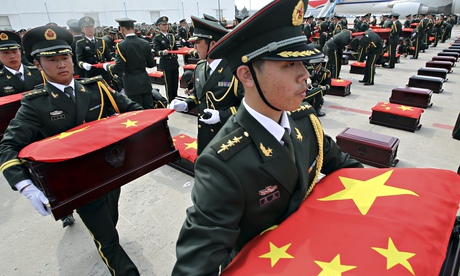
South Korea on Friday repatriated the remains of 437 Chinese soldiers killed during the Korean War six decades ago, making a gesture symbolic of warming ties between the two nations.

China sent a flood of soldiers to help its Communist ally North Korea, which invaded South Korea in June 1950. Its intervention saved the North, whose forces had been pushed back toward the country’s northern corner by American-led United Nations forces later that year. The three-year war ended in a cease-fire, leaving the divided Korean Peninsula technically in a state of war.

Over the years, when South Korea discovered the remains of hundreds of Communist soldiers in old battle sites, it kept them in a tucked-away, little-known temporary burial ground north of Seoul, until recently known as “the enemy cemetery.”

That it took six decades for the bodies of the fallen Chinese soldiers to return home bore testimony to political uneasiness rooted in a war that, while it long ago ended, was never formally put to rest.

Between 1981 and 1989, North Korea accepted the remains of 42 Chinese soldiers from South Korea and handed them over to Beijing. But it has never been willing to negotiate for the return of its own fallen soldiers. Accepting their return home would be seen as a gesture of closing the war, which North Korea insists will not be over until Washington signs a peace treaty with it.

After accepting the remains of another Chinese soldier in 1997, North Korea refused to accept any more, leaving the 437 Chinese soldiers stranded in the inter-Korean deadlock.

A breakthrough came last June when President Park Geun-hye of South Korea visited China to cultivate warmer ties with China. She offered to send the Chinese remains home as a good-will gesture, and Beijing welcomed it.

“The repatriation today will be a landmark for the two countries in healing the trauma from the past and moving toward coprosperity,” Vice Defense Minister Baek Seung-joo of South Korea said during a ceremony held at Incheon International Airport, west of Seoul.

During the ceremony, the Chinese ambassador, Qiu Guohong, placed Chinese flags on dark brown boxes that contained the remains. Chinese soldiers carried them aboard a Chinese plane, which flew them to the Resist America and Aid Korea Martyrs Cemetery, the resting place for China’s Korean War dead, located in Shenyang, in northeastern China.

China remains North Korea’s last remaining major ally, while the United States is South Korea’s No. 1 military ally. But China has overtaken the United States as South Korea’s biggest trading partner since it normalized relations with Seoul in 1992. Each year, millions of Chinese visit South Korea as tourists.

Still, the existence of Chinese remains, and the “enemy cemetery” itself, has drawn little attention in South Korea, even though some Chinese tourists began visiting it in recent years. Built on a hillside, it is difficult to find.

Now with their Chinese companions gone, the remains of 770 North Korean soldiers stay marooned in the cemetery only a few miles south of the inter-Korean border, their forlorn grave markers emblematic of unresolved Cold War hostilities that still divide the Koreas. Their graves all face north, looking homeward, in contrast to the Korean tradition of aligning graves toward the south.

Also buried there are dozens of postwar North Korean agents, including commandos killed in an unsuccessful 1968 attack on the presidential palace in Seoul and a North Korean agent who killed himself after planting a bomb on a South Korean jetliner that exploded over Myanmar in 1987 with 115 people aboard.

The bodies of the agents cannot go home because their government has not acknowledged their missions.

Estimates of the number of Chinese killed in the war vary from 110,000 to over 400,000.

South Korea said it would continue to repatriate Chinese remains if it discovered more while excavating battle sites for its own war dead.

Friday 28 March 2014

http://www.nytimes.com/2014/03/29/world/asia/south-korea-returns-bodies-of-hundreds-of-chinese-soldiers.html?_r=0

continue reading

Thursday, 15 August 2013

Sri Lanka launches new probe into thousands missing in war


Sri Lanka's president Wednesday ordered a new investigation into the disappearance of thousands of people in the island's northeast during an ethnic war which ended four years ago.

The announcement comes just days before UN human rights chief Navi Pillay is due to visit the island, amid international criticism of Colombo's human rights record during the war against Tamil separatists.

President Mahinda Rajapakse appointed a retired judge to head a three-member panel to investigate "cases of persons from the northern and eastern provinces who went missing during the war", a statement from his office said.

"The president indicated that the inquiries are being conducted in the interest of public security and well-being and in order to determine what measures should be taken to prevent such incidents," the statement said without giving further details.

Sri Lanka has resisted international pressure for an independent investigation into war crimes despite what UN calls "credible allegations" of up to 40,000 civilians killed in the final battles in 2009.

Instead it has conducted a number of its own probes into disappearances and extrajudicial killings during the conflict, which have resulted in few prosecutions or convictions.

Sri Lankan troops declared an end to 37 years of ethnic war after wiping out the leadership of the Tamil Tiger rebels in May 2009.

Sri Lanka has maintained its forces did not kill civilians while battling Tigers who were known for suicide bombings.

A government survey conducted last year in the war-ravaged north said that nearly 8,000 people were killed during the conflict and another 6,350 were missing. International rights groups say the figures are much higher.

The survey also said that those killed included 550 children below the age of 10, but did not say who was responsible.

The UN's Pillay is scheduled in Colombo on August 25 for a five-day visit, during which she is expected to meet political leaders.

Thursday 15 August 2013

http://www.lankabusinessonline.com/news/sri-lanka-launches-new-probe-into-thousands-missing-in-war/143669287

continue reading

Tuesday, 13 August 2013

Georgian/Abkhazian war of 1992-1993: Burying son a ‘dream come true’ for mother


Engineering student Giorgi Popkhadze was 23 when war broke out in his home town of Sukhumi in 1992.

Like his fellow-students, neighbours and friends, Giorgi stayed in Sukhumi throughout the 1992-1993 conflict, as all the young men felt obliged to protect their families and their city.

In August 1993, when it became dangerous to stay in Sukhumi, Giorgi asked his mother and underage sister to leave.

Very reluctantly, Giorgi’s mother Mzevinar and her daughter allowed themselves to be evacuated to Poti, some 150 km south of Sukhumi along the Black Sea coast.

“Every day, my daughter and I used to go to the port, to meet the ships bringing people who had fled from Sukhumi.

“I hoped to see Giorgi among them. But days passed and I had no news about my boy.

“One day, I suddenly saw one of my neighbours who had just arrived in the port. She hugged me tightly with tears in her eyes and said ‘My condolences, Mzevinar!’

“That was how I learned that my Giorgi was no longer alive. He had been killed on the last day of the war, not far from our house.”

Mzevinar Popkhadze at the grave of her son Giorgi.Mzevinar Popkhadze at the grave of her son Giorgi.For almost 20 years, Mzevinar tried to visit her son’s grave.

She heard that neighbours had buried the bodies of brutally killed young men in the garden of their house.

Days of hope and expectation, endless efforts to “get him back” as Mzevinar put it, turned into two decades of ambiguity and disappointment.

“All that time, the thing I wanted most was to have my son’s grave here, so I could grieve for him properly,” explained Mzevinar.

“Can you imagine what it’s like when your dearest dream is to have your son’s grave near you?”

Coordination mechanism brings hope

The “Bipartite Coordination Mechanism for Clarifying the Fate of Persons Missing in Relation to the Armed Conflict of 1992-1993 and After” brings together Abkhazians and Georgians and was set up in 2010, under the aegis of the ICRC.

The first exhumations and identifications of human remains took place in Sukhumi 20 years after the conflict.

One set of remains was identified as being Giorgi.

The ICRC facilitated his transfer through checkpoints and administrative boundaries to his family, who could finally bury him in accordance with their religious traditions and customs.

Many people attended the funeral, including Mzevinar’s new neighbours, who had never met Giorgi. The local priest held a special service and Giorgi was buried in the family plot.

“For a mother who knew nothing about her son for over 20 years there can be no greater happiness,” said Mzevinar.

“I will continue to pray for the ICRC, because they made my dream come true.

“I have a grave for my Giorgi and I can go there every day.”

Tuesday 13 August 2013

http://www.themalaymailonline.com/features/article/georgia-burying-son-a-dream-come-true-for-mother

continue reading