Showing posts with label Cyprus. Show all posts

Saturday, 19 September 2015

Remains of 1974 plane crash in Cypriot recovered


Cypriot authorities said on Friday that the remains of several victims of a plane crash 41 years ago have been recovered from the crash site. The crashed plane was a French-built Nord Noratlas transporter of the Greek Air Force shot down by friendly fire in the dark hours of July 22, 1974, as it was flying in reinforcements for the Cypriot National Guard which was facing a large Turkish force trying to capture Nicosia airport.

Turkey occupied the northern part of Cyprus in the fighting, in response to a coup by Greek junta army officers. Presidential Commissioner for Humanitarian Affairs Fotis Fotiou said a large number of human bones has been found, but could not say to how many people they belonged, reports Xinhua. The Noratlas flight was part of a plan to transport a battalion of commandos from Crete to Cyprus. Only one of the 32 people aboard the plane survived the crash, which happened a short distance from the airport runaway.

Twelve bodies were recovered at the time, but the remaining 19 were covered over with earth because of the proximity to the fighting. The place was later turned into a military cemetery for thousands of Greek Cypriots killed in the fighting and a monument for the fallen was erected over the crash site. ”The difficult task of scientific identification of the bones will get under way within the next few days. We hope we will be able to put an end to the uncertainty of the relatives of the dead people,” Fotiou said.

Saturday 19 September 2015

http://www.india.com/news/world/remains-of-1974-plane-crash-in-cypriot-recovered-559813/

continue reading

Tuesday, 25 August 2015

Cyprus begins recovery of wreckage of military plane and human remains 41 years after its crash


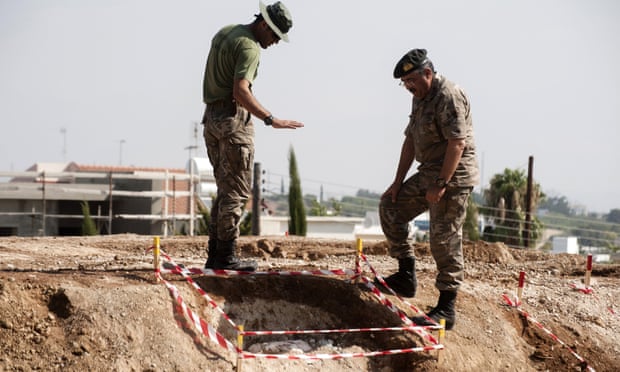
Cypriot authorities have started recovering the debris of a Greek military transport plane 41 years after it crashed, an official said on Monday.

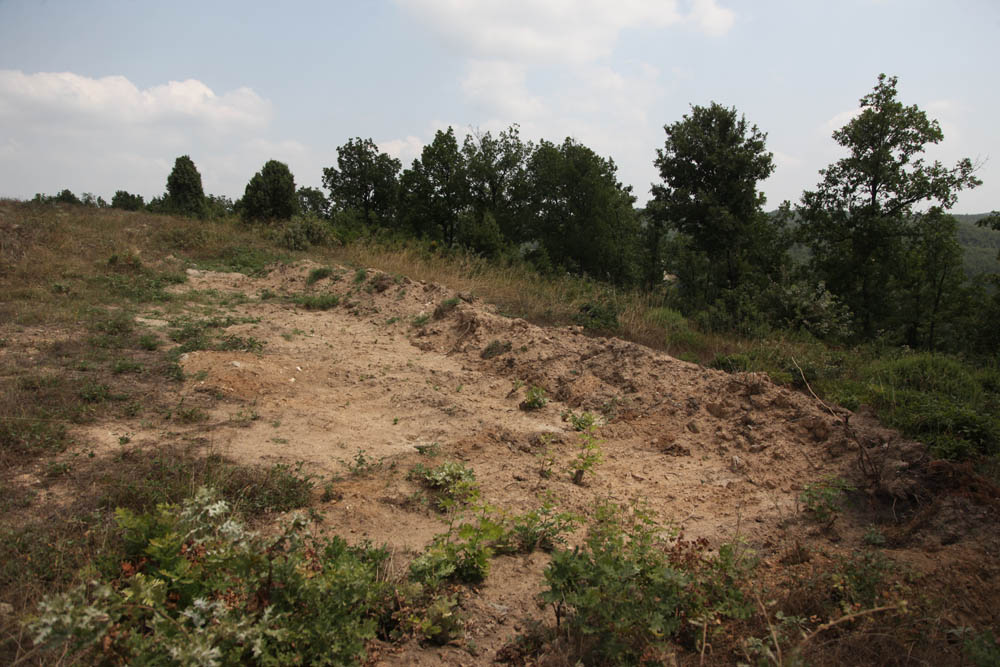
Crews started an excavation of a man-made earth hill last week in search for the debris of the French-built Noratlas transport plane, which was shot down by friendly fire as it approached for landing at the now defunct Nicosia airport during the 1974 war between Cyprus and Turkey.

"Digging crews have recovered a wing of the plane and also smaller pieces, including a fuel gauge. We believe they are not far away from the main target of the digging which is the main part of the fuselage," Commissioner for Humanitarian Affairs Photis Photiou told the state radio.

Authorities believe that inside the fuselage are the remains of up to 19 Greek commandos who were killed in the crash.

They were part of a battalion which was being transported to Cyprus to reinforce the Cypriot National Guard as it was facing much superior Turkish troops who landed on the eastern Mediterranean island on July 20, 1974, in reaction to a coup by Greek army officers a week earlier.

A total of 15 Noratlas transport planes, built circa 1950, were involved in the clandestine operation.

Thirteen of the planes which took off from Crete made it to Cyprus, one landed in Rhodes and one returned to Crete.

Due to bad communications and battle confusion, the last one of the planes was fired at by Greek Cypriot soldiers at dawn on July 22, 1974. It crashed about 1 kilometer from the runaway, killing all but one of the 32 commandos and crew.

Twelve bodies were recovered at the time, but the rest were buried under a mound of earth along with the debris of the plane and the crash-site was turned into a Tomb for the Fallen and a military cemetery.

Relatives of two of the other 19 commandos applied to the European Court of Human Rights demanding the return of their remains and the Cypriot government accepted an out of court settlement to try to recover the remains.

Cypriot authorities have enlisted the assistance of an expert from Australia specializing in digging in war related sites, in search of the debris and the remains of the soldiers.

"They have to proceed carefully and at slow pace as there is information that explosives were carried in the plane and they may have not exploded," said Photiou.

The only survivor of the crash, Thanasis Zefiriou, was at hand when the excavation started.

He said he managed to pry the plane door open before it was completely engulfed in flames and jumped out. He was later found unconscious by National Guard soldiers and taken to hospital.

The recovery operation is expected to be completed by November.

Relatives of the missing commandos have provided DNA to identify any remains found on the crash site.

A total of about 1,000 people, most of them Greek Cypriots, are still missing since the 1974 fighting, which ended in Turkish troops occupying about 37 per cent of Cyprus territory.

United Nations brokered negotiations for the reunification of the island are currently under way.

Tuesday 25 August 2015

http://www.shanghaidaily.com/article/article_xinhua.aspx?id=299484

continue reading

Tuesday, 18 August 2015

Cyprus: Hopes rise in bid to find mass grave containing bodies of Greek Cypriots


New efforts were underway in the occupied north yesterday to locate a mass grave thought to contain the bodies of dozens of Greek Cypriots missing since the Turkish invasion in July 1974.

This is the 12th attempt to locate the mass grave in question. The excavation is being carried out in the area of Trahonas in Nicosia.

“We started an excavation in a (Turkish) military area in a bid to locate a mass grave,” said Nestoras Nestoros, the Greek Cypriot member of the Committee on Missing Persons.

The case concerns Greek Cypriots killed in the Nicosia areas of Kaimakli, Trahonas, and Omorphita in July 1974.

In 1977, Turkey filed a document at the Council of Europe that around 200 bodies had been collected by Turkish Cypriot forces from those areas, loaded on trucks and taken to Ledra Palace hotel to be handed over to the Greek Cypriot side for burial.

But the bodies were not received and were eventually buried in a mass grave, the document claimed.

This has never been confirmed and the Turkish side has since revised the number downwards.

Nestoros said their information suggested between 40 and 45 Greek Cypriots were buried in the area.

Turkish Cypriot CMP member Gulden Plumer Kucuk said the excavation near the central prison started with the permission of the Turkish military.

Kucuk told BRT that around 40 to 50 Greek Cypriot fighters who died in separate areas in 1974 were gathered and an effort had been made to return them through the UN “however, the Greek Cypriot side rejected this” and the bodies were buried in the location.

Eleven previous attempts to find the grave did not yield any results.

But this time the CMP was optimistic.

Nestoros said there was testimony, which the Turkish Cypriots had looked into.

“The Turkish Cypriots intensified their efforts to see if there is something because we had always insisted on that area,” he said. “It is a huge area and we hope to find the location.”

The CMP employs a bi-communal forensic team of more than 60 Cypriot archeologists, anthropologists and geneticists, who conduct excavations throughout the island and anthropological analyses of remains.

Nicos Theodosiou, the Executive Secretary of the Committee of Relatives of Missing Persons, when asked by the Cyprus News Agency to comment on the development, also expressed hope for a successful outcome.

He said that the time that passes, makes the venture ever more difficult.

According to Theodosiou, the existence of witnesses at a burial site raises the chance for success. “In this case, the information coming from the other side indicates that there must have been witnesses during the burial, for them [the CMP] to be so optimistic,” he said.

He also said that only 30 per cent of the families of missing persons have received the identified remains of their loved ones. Tthe rest of the families were still waiting.

Theodosiou urged the Turkish Cypriot side to actively support the efforts to locate burial sites in line with the good will expressed by the Turkish Cypriot leader, Mustafa Akinci.

According to the CMP, to date, 1,508 Greek Cypriots and 493 Turkish Cypriots are on the missing list. At the end of last year, the number of identified remains of individuals returned to their families are: Greek Cypriots: 509 and Turkish Cypriots: 127, while 927 sites had been excavated. Another 35 people were identified in the first six months of this year.

It also emerged late last year that remains had been moved in the north to cover up mass executions. Around 280 of those identified to date were found buried in different places from where they had reportedly disappeared. The news was condemned in a European Parliament resolution last February that angered Turkey.

Tuesday 18 August 2015

http://cyprus-mail.com/2015/08/18/hopes-rise-in-bid-to-find-mass-grave/

continue reading

Tuesday, 21 July 2015

Cyprus: plea for information on the missing


President Nicos Anastasiades has appealed to anyone who has information with regard to missing persons in Cyprus to come forward and share it with the Committee on Missing Persons (CMP).

Speaking on Sunday evening at an event organiSed by the Cyprus Committee of Relatives of Missing Persons and Undeclared Prisoners of 1974, at the Panorama of Missing Persons, in the village of Kornos, Anastasiades noted that this appeal was made both by him and the leader of the Turkish Cypriot community Mustafa Akinci.

“We are exerting pressure in all directions for Turkey to finally be persuaded to cooperate and allow search operations in areas which it has turned into closed military zones,” the President said, adding that he raised the issue with European Commission President Jean-Claude Juncker.

Efforts have also been directed towards the five UN Security Council Permanent Members, he noted.

“As long as the Cyprus problem remains unresolved and as long as there are military occupation forces that describe some of our occupied areas as ‘military zones’, finding our missing persons or at least investigating the fate of our missing persons will unfortunately be impossible,” he said.

Anastasiades said he would not stop, together with the rest of the political leadership, to pursue a solution to the Cyprus problem that will abolish armies and military zones, and which will provide every Cypriot citizen with the right to reside freely where he or she wishes, with human rights safeguarded. The missing persons issue, he said, was one of the integral elements of the solution.

The list of missing persons includes 1,508 Greek Cypriots, 43 of whom went missing between 1963-1964 when intercommunal violence broke out in Cyprus. The list also includes 493 Turkish Cypriots, 229 of whom are thought to have been lost during the period 1963-1967.

Two hundred and sixty four Turkish Cypriots went missing during the 1974 Turkish invasion of the island and there have been some reports that 126 of them were lost in the areas of Aloa-Maratha-Sandalari.

So far 444 identifications of Greek Cypriots have been carried out and 138 of Turkish Cypriots. Approximately 200 cases are in the stage of anthropological or genetic analysis, 100 Greek Cypriot missing cannot be identified and the remains of 800 missing persons are still to be located.

Over 30 missing persons remains identified so far this year

Greek Cypriot member of the Committee on Missing Persons in Cyprus (CMP) Nestoras Nestoros has said that the remains of 34 missing persons had been identified so far in 2015.

He told the Cyprus News Agency that the Committee was focusing both on the quality of the tests carried out and the quantity of the remains handed over to the families.

Nestoros said that the number of missing persons identified could be much more “if we gave the relatives a couple of bones of their loved ones.” He said that in the cases of ‘mixed bones’ such as those found in mass graves, they are tested but when skeletal samples fail to come up with a DNA identification or the DNA distinctiveness is low “then we deem that we must continue our efforts.”

Thos remains that fail the DNA test for one profile may match with the profile of another missing persons and the tests start over.

“We have to be able to give the families as many bones as possible,” Nestoros said.

He said that after the conclusion of the genetic tests, the lab experts evaluate whether they must send new samples from other mixed bones that have not been identified. “Our aim is to exhaust all scientific means with a view to return as much of the remains as possible,” Nestoros added. In the case of complete skeletons, when the DNA distinctiveness is low then more genetic material is sent for DNA tests, he said. Nestoros said that when the remains are handed over to each family, relatives are also given a comprehensive report comprising the anthropological findings, genetic tests and a comprehensive archeological report in Greek, English and Turkish.

He noted that according to the recommendations of foreign experts, the CMP was implementing a pilot programme with a view to determining whether it should change the protocols of its anthropological tests in the cases where mixed bones are discovered.

According to Nestoros, excavations are being carried out currently in nine areas, two in the government controlled areas and seven in the breakaway Turkish Cypriot state in the north.

He called on everyone who participated in the burial of people or has any information to give to the Committee to do so. He said that from the 444 Greek Cypriots who have been identified, 281 were found buried in different places from where they had reportedly disappeared. (CNA)

Tuesday 21 July 2015

http://cyprus-mail.com/2015/07/20/anastasiades-issues-plea-for-information-on-the-missing/

http://cyprus-mail.com/2015/07/17/over-30-missing-persons-remains-identified-so-far-this-year/

continue reading

Tuesday, 7 July 2015

Cyprus: Working together for Missing Persons


The European Commission recently organised an event to mark the EU’s important contribution to the Committee on the Missing Persons (CMP) in Cyprus and to acknowledge the importance of the work carried out by the young Greek Cypriot and Turkish Cypriot scientists working there.

Since 2006, the EU has supported the CMP efforts with a financial contribution of €14.7m.

According to an announcement on the happening, opening remarks at the event were made by Normunds Popens, Deputy Director General in the European Commission, Cihan Sultanoglu, Director of the UNDP Regional Bureau for Europe and the CIS, and the three CMP members, Paul-Henri Arni, Nestoras Nestoros and Gรผlden Plรผmer Kรผรงรผk.

During the event the video ‘The faces of the CMP’ was screened, in which the scientists reaffirmed their strong commitment to the project.

All the speakers highlighted the CMP’s very important work as one of the most successful confidence building measure helping to cope with a painful chapter of the history of Cyprus and fostering cooperation.

Since 2006, the work of CMP helped in the return of the remains of 595 missing persons to their families.

The CMP’s humanitarian mandate contributes to providing relief to the families of missing persons and to build trust and confidence amongst Cypriots, paving the way towards reconciliation in Cyprus. The European Commission stands ready to continue its support to this project.

The CMP was established in April 1981 by agreement between the Greek Cypriot and the Turkish Cypriot communities under the auspices of the UN. This bi-communal committee has the mandate to establish the fate of missing persons without attributing any responsibility for the cause of death.

In order to further improve the trust between the two communities, the project aims to increasingly involve the families of the missing persons in the implementation, adding events all over Cyprus and abroad to the information sessions already carried out in schools.

Tuesday 7 July 2015

http://in-cyprus.com/working-together-for-missing-persons/

continue reading

Friday, 12 June 2015

Cyprus: Missing persons a Confidence Building Measure


It is thought that the issue of missing persons in Cyprus could be solved through the new momentum in the negotiating process of the Cyprus problem.

Nicosia and Washington think the missing persons issue could be a Confidence Building Measure for the island.

This is the common position outlined by Cyprus’ Presidential Commissioner for Humanitarian Issues and Overseas Cypriots, Fotis Fotiou, and the Director of Europe Division in the Department of Political Affairs of the UN, Elizabeth Spehar.

Fotiou and Spehar held a meeting in Washington on Wednesday, during which the Cypriot Commissioner briefed the UN official on the latest developments.

Fotiou raised the issue of missing persons and stressed that as a primarily humanitarian and not political issue it would be an important Confidence Building Measure, the resolution of which would have beneficial effects on a social and political level.

Fotiou expressed the determination and will of the Cypriot government to resolve the issue of missing persons. It is expected that the Turkish side will show the same will and the same sincere effort, he said.

Fotiou concluded his visit to the USA, where he represented President Nicos Anastasiades at the annual meeting of the American Jewish Committee, with meetings in New York with the Greek Community and UN officials.

On Wednesday afternoon, the Cypriot Commissioner had a meeting with the board of the Cyprus-US Chamber and participated in a roundtable discussion on “Cypriot Diaspora and the role of the new generation”, organized by the youth of the Cyprus Federation.

Various issues concerning the Cypriot community of America were discussed on Tuesday at a meeting of the Presidential Commissioner with the board of the Cyprus Federation, in the presence of PSEKA President Philip Christopher.

Fotiou, accompanied by the Consul General Vasilis Philippou, met with the Archbishop Demetrios of America. Speaking after the meeting, Fotiou said he briefed Archbishop Demetrios on the positive developments in Cyprus after the election of Moustafa Akinci in the leadership of the Turkish Cypriot community.

“However, we should wait to see how the discussion proceeds in the difficult issues of the Cyprus problem and how Turkey will react and behave”, he said and added that from his contacts in the US, he ascertained that everybody wishes for progress.

As a result of the 1974 Turkish invasion against Cyprus, 1,619 Greek Cypriots were listed as missing, most of whom soldiers or reservists, who were captured in the battlefield. Many of those missing were last seen alive in the hands of the Turkish military. A further 41 more cases of Greek Cypriot missing persons have been added. These cases concern the period between 1963-1964, when inter-communal fighting broke out but none of them has been identified yet.

The number of Turkish Cypriot missing since 1974 and 1963/64 stood at 503. A total of 1073 remains have been exhumed by the CMP, 546 of which have been identified with the DNA method (421 Greek Cypriots and 125 Turkish Cypriots). Only 27% of all missing persons have been identified so far.

Cyprus was divided in 1974 when Turkey invaded and occupied its northern third. UN backed talks are currently underway between Cyprus President Nicos Anastasiades and Turkish Cypriot leader Mustafa Akinci, aiming to reunify the island under a federal roof.

Friday 12 June 2015

http://in-cyprus.com/missing-persons-a-confidence-building-measure/

continue reading

Thursday, 19 February 2015

Committee on Missing Persons in Cyprus: Greek-Cypriot Missing from the 1974 Turkish Invasion Identified


The Committee on Missing Persons in Cyprus (CMP), in a press conference held today at the Anthropological Laboratory in the UN-protected area of the now defunct Nicosia Airport, has announced it “identified the right person” in the case of missing Greek-Cypriot Georgios Foris. At the same time, the three members of the Committee announced that a Red Cross independent expert has already been requested to probe this specific case.

As the Committee explained, Foris originated from the village of Assia and has been missing since the 1974 Turkish military invasion. His remains were exhumed from a well in Assia, along with the remains of another 38 unidentified individuals. His family has recently contested the identification process, although as described, some of the remains returned to his relatives did not belong to him. Therefore, the family has sought a DNA re-examination of his remains, undertaken by the Cyprus Institute of Neurology and Genetics. “In this case, as in the 567 other cases of missing persons identified by the CMP, we can certify that the right person was identified,” said Paul-Henri Arni, the Committee’s third member.

The press conference was held by Arni, Greek-Cypriot member Nestoras Nestoros and Turkish-Cypriot member Gulden Plumer Kucuk. Referring to Foris case, Arni, after expressing his sympathy to Foris’ family, highlighted that “our archaeologists determined that most of the remains originally buried at the site had been removed, as has been the case in other locations. What was left was a large number of small, isolated commingled remains -that is mixed up remains- which our scientists have tried to associate to separate individuals in painstaking work over the past four years. In the case at hand, several larger bones, most notably a skull, were associated with a number of very small bones. Following well-established international practice in the identification of human remains, the CMP tested the larger skeletal elements, nine in total, for DNA. The smaller ones were associated based on anthropological analysis. Testing all bones for DNA would exceed the CMP’s financial means, and, more importantly, in the case of small bones, would require their destruction, leaving nothing or only small fragments that could be returned to families.”

Furthermore, as he explained, “the family of the missing person identified by us challenged our identification based on teeth characteristics and opted to seek a retesting of the remains using DNA. While we have not received any of the results, it appears that the analysis undertaken on behalf of the family confirmed that all nine larger bones that the CMP had identified on the basis of DNA had been correctly identified.”

The above, as Arni said, allows us to draw two very important conclusions: “Firstly, the CMP identified the right person. In this case, as in the 567 other cases of missing persons identified by the CMP, we can certify that the right person was identified. Secondly, the work of the DNA laboratory is not an issue in this case. If anything, the family’s retesting has confirmed that our laboratory, in this case the ICMP in Sarajevo, worked well. We therefore would like to stress that the discussion about bringing the CMP’s genetic work back to Cyprus has no place in the context of this case. Those who pretend otherwise are misleading the public.”

On his behalf, Nestoros said that in the cases of mass graves, where bones have been relocated at a later stage, leaving only a fraction of the original remains to scientists to determine to whom they belong, CMP is considering to start giving back to the families only the remains that have been analyzed for DNA. The practice today is to let anthropologists associate smaller skeletal elements in order “to give more bones back to the families” as the CMP members said, noting however the risk at stake.

Additionally, Kucuk noted that the CMP is aware of the families’ sensitivities with missing persons and added that the Committee is trying to provide them with all the answers, along with the remains of their beloved ones. As she further explained, there are a lot of cases of mass graves with “commingled bones” and noted the scientists’ difficulty to determine to whom they belong.

Asked about the relocation of remains in Cyprus, Arni said he has “no idea” who did it but added that this “happened everywhere. It happened also in the south,” referring to the free areas of the Republic of Cyprus.

Finally, according to Kucuk, overall, the CMP has exhumed almost 1,000 persons, with the remains of 400 awaiting identification. Another 1,000 are still to be found, she concluded.

Thursday 19 February 2015

http://greece.greekreporter.com/2015/02/18/committee-on-missing-persons-in-cyprus-greek-cypriot-missing-from-the-1974-turkish-invasion-identified/

continue reading

Saturday, 26 January 2013

Cypriots Digging for Graves of Missing


Nearly 39 years after the Turkish invasion of Cyprus, the Committee on Missing Persons (CMP) has begun digging for possible burial sites of victims within a fenced Turkish military area in the occupied areas, said Aristos Aristotelous, the Greek Cypriot member of the CMP.

Speaking to the Cyprus News Agency, Aristotelous said the Turkish authorities recently gave their consent for excavations to take place, following a request from the CMP. The former AKEL MP said he hoped the committee would also be able to carry out excavations in other Turkish military areas which have long been linked to possible burial sites.

Until now, Turkey has resisted requests to open up military areas where many of the missing are believed to have been buried in mass graves, based on witness accounts given to the CMP.

Aristotelous said digging for the remains of missing persons began in a fenced military area southwest of the Kyrenia district, based on information given long ago to the CMP.

As a result of fighting between Greeks and Turks in the 1960′s and the Turkish invasion of 1974, some 1,464 Greek Cypriots and 494 Turkish Cypriots were reported missing and both sides blamed the other for atrocities and murders. According to the CMP, to date, human remains of more than 900 people have been exhumed from burial sites located across the island.

The CMP team of scientists has visited and opened more than 600 potential burial sites so far, the majority in the north of the island. Officials said that 373 did not contain any human remains. As of August 2012, a total of 330 missing persons (264 Greek Cypriots and 66 Turkish Cypriots) were identified and returned to their families for burial.

Exhumations are carried out on both sides of the buffer zone by bi-communal teams (six teams in the north and two teams in the south) made of over 55 Cypriot archaeologists and anthropologists. The teams are now autonomous after having been trained by international experts from the Argentine Forensic Anthropology Team (EAAF) during the first 18 months of the project.

Saturday 26 January 2013

http://greece.greekreporter.com/2013/01/26/cypriots-digging-for-graves-of-missing/#!lightbox/0/

continue reading

Friday, 13 July 2012

Missing person’s relative obtains injunction protecting his genetic material

VASSILIS Pantazis, whose brother Philippos went missing in 1974, has taken legal steps to stop his genetic material from being used by any other body or entity except the Cyprus Institute of Neurology and Genetics (CING).

Nicosia Court yesterday pushed forwards a hearing for June 20 at the request of CING’s lawyer, Polys Polyviou, who asked for more time before the institute responded, Kathimerini newspaper reported.

In the meantime the court legally binds CING to keep put Pantazis’ genetic material. CING cannot “deliver and/or move and/or transfer the claimant’s genetic material to any other legal or physical entity” whatsoever in Cyprus or abroad, the court said.

The court order effectively stops the UN-supported Committee on Missing Persons (CMP) from sending Pantazis’ samples abroad, and could have sweeping implications on the use of the genetic material and profiles, currently in CING’s possession.

Pantazis told the Cyprus Mail that he was moved to go to court “given how things stand of late”. Last October a contract between the CMP and CING - the only body capable of carrying out missing persons’ DNA identifications – expired.

No new contract has been signed as of yet while missing persons’ remains have not been sent over to CING for identification.

The CMP has been asking CING to comply with a set of requirements which CING has publicly said it has met, making it unclear if and what requirements are the real sticking points. “I have lost trust,” Pantazis said adding this was his primary motivation for securing a court order.

Reports have suggested a lab in Bosnia as the most likely candidate for a new contract with the CMP for DNA identification, following the opening up of tenders in mid-February.

CING has publicly said it was willing to meet requirements set by the CMP, including assigning a project manager; meeting sorting process’ requirements; and handing over access to genetic profiles as long as they are legally assured they could.

The CMP has said that if requirements are met, they are happy for the process to stay at home. “All these games have convinced me to proceed with my lawyer to stop anyone, even the Republic of Cyprus, from using my genetic material,” Pantazis said.

The CMP, a bi-communal body investigates cases of persons reported missing during the sixties and 1974 under the auspices of the UN.

May 19, 2012

http://www.cyprus-mail.com/cyprus-institute-neurology-and-genetics/missing-person-s-relative-obtains-injunction-protecting-his

continue reading

Tuesday, 17 January 2012

Funerals of the Missing

THEMIS Vlamis from Voni village in Kythrea and Costas Siskos from Asha village in Famagusta, missing since the 1974 Turkish invasion, were given a proper burial yesterday in Limassol.

State spokesman, Stefanos Stefanou addressed the mourners at the funeral of Vlamis and spoke of his story.

Vlamis was a reserve soldier for the 305 infantry battalion which was sent to the One Milia area on August 14, during the Turkish invasion.

Once hemmed in by enemy forces, the Cypriot soldiers took refuge at Voni, where they dressed as civilians.

On August 15, Turkish forces rounded up all civilians of the village and executed them.

Vlamis’ remains were exhumed in 2005 from a mass grave in an area between Voni and the Turkish Cypriot village of Bekogiou.

Siskos’ remains were exhumed in 2008 from a mass grave in the village of Asha in Famagusta.

Cyprus Mail

Posted on January 16, 2012

http://www.parikiaki.com/archives/33334

continue reading