Showing posts with label Photos. Show all posts

Friday, 2 May 2014

Photographer in India earns living taking pictures of the dead minutes before they’re cremated


It’s a job not many people would take on — but photographer Shankar Jha spends his day taking photos of families with their dead loved ones minutes before they’re cremated.

The 24-year-old earns a whopping 30,000 Rupees (about $500) a month fulfilling the requests of grieving families who want one last photo of themselves with their dead loved ones in the holy city of Varanasi, in northern India.

Most would decline such a career but Shankar sees it as a perfect business opportunity.

He said: “Initially I felt awkward doing this job but now I’ve got used to it it doesn't feel bad anymore.”

Shankar was just 12 when a man approached him for the first time at the river Ganges asking if he could photograph him and his family alongside his dead father.

“It was very odd but I realised that there was a need for this kind of thing so I set up my own shop on the Ghats of the river Ganges and soon people started ordering my services,” he added.

While most would find this job not only depressing but also distasteful; Shankar believes he’s giving hundreds of grieving families treasured photos.

He said: “I’m helping people have an affordable and treasured souvenir of their dead family member. It’s something to treasure forever when they’re gone.”

Families have to pass Shankar's shop as they carry the dead towards the river Ganges, the most sacred river to Hindus. It’s widely worshipped as the goddess Ganga in the Hindu religion.

Shankar said: “If I have a quiet day with just a few orders I do approach passing families asking if they want photos. Most accept; there’s only a couple that say no. I feel I’m helping people remember the last face of their dead relatives.”

It takes Shankar under three hours to develop the photos — the same time it takes the families to watch their loved ones turn to ash and leave.

According to Hindu traditions family members have to wait and watch until the cremation ceremony is over.

Financially, Shankar has been earning much more than an average worker in Varanasi but he now fears his business will begin to suffer as more people invest in phones with cameras.

“Times are changing and people don’t need a photographer any more, they have their own phones to do my work. And I have no particular skills, I’m just in the right place at the right time, offering a much needed service.”

But for now Shankar will happily continue delivering what he believes are treasured memories.

http://www.nydailynews.com/news/world/indian-man-earns-living-pictures-dead-minutes-cremated-article-1.1775163

Friday 02 May 2014

continue reading

Friday, 13 December 2013

Police probe plane crash pictures release


Police are investigating how pictures of the Mozambican plane, which crashed in northern Namibia about two weeks ago, were released in the media without authorisation.

Both Police Deputy Commissioner Edwin Kanguatjivi and Director of National Institute of Forensic Science Paul Ludik concurred during a press conference in Windhoek on Wednesday that publishing the images was unethical since it interfers with the course of justice.

“We realise these photographs and videos are very graphic,” said Kanguatjivi, adding that they are investigating how such ‘unauthorised release’ of pictures occurred in the first place.

“The unauthorised usage of photographic images emanating from crime scenes could be construed as interfering with the course of justice,” said Ludik.

According to Police Deputy Inspector General James Tjivikua, the crash is still under investigation to ensure accurate identification of all deceased.

“The investigation should take approximately 14 days as the Institute of National Forensic Science is attempting to make identification through comparison of dental and fingerprint records available prior to the crash,” said Tjivikua.

Initial information had suggested that there were 33 people on board the LAM flight from Maputo to Luanda, Angola on 29 November and that only 31 bodies were found.

LAM spokesperson Norberto Mucopa, also expressed concern, in a press statement issued on Tuesday, about worldwide media speculation, in reference to some claims that some passengers had evacuated before the crash and that two bodies were also not accounted for.

“LAM is concerned about these speculation as they are causing anxiety, upset and uncertainty locally,” said Mucopa, adding that family members have been of assistance during the investigation process.

Friday 13 December 2013

See more at: http://www.namibian.com.na/indexx.php?id=7205&page_type=story_detail&category_id=1

continue reading

Friday, 23 August 2013

Cebu ferry disaster: Cadavers’ photos taken down to prevent trauma


Forensic experts heeded the advice of the Department of Health 7 and temporarily stopped showing photos of cadavers at the Cosmopolitan Funeral Homes.

The Regional Crime Laboratory 7 will instead direct relatives of missing passengers of last Friday’s ferry collision to a private area, said Chief Insp. Benjamin Lara.

Pictures of retrieved bodies were projected on a screen at the mortuary’s lobby so these could be identified.

"We only did it to help collect data and possible description of the passengers," Lara said, adding that they had no intention to cause any trauma.

As of yesterday, 75 bodies were taken to funeral homes. Some 29 remain unidentified.

Lara urged relatives of missing victims to go home and await results of their investigation.

DNA testing

Forensic experts started processing the bodies for Disaster Victim Identification (DVI) last Tuesday. They took specimens for a deoxyribonucleic acid (DNA) examination.

They also took specimens from the missing passengers’ relatives for DNA comparison.

Lara said the results may take up to a year, depending on the cross-matching of the DNA.

"They have to understand the sheer volume of the samples that were taken from the cadavers and their families," he said.

To speed up the identification, he also urged relatives to submit dental and fingerprint records of their missing loved ones.

Dr. Dindo Herrera, a dental expert from Camp Crame, arrived in Cebu yesterday to help with the examination of the bodies.

Delays

“They don't have to worry because we will notify them once Camp Crame will release the results," Lara said.

As of 6 p.m. yesterday, 18 cadavers were released from the funeral homes, said Rosalina Allorada of the Department of Social Welfare and Development (DSWD) 7.

Meanwhile, Cebu City Mayor Michael Rama wants to speed up the release of the bodies retrieved from the sunken passenger vessel of 2Go Group Inc. mv St. Thomas Aquinas.

He learned from the Cosmopolitan Funeral Homes that the dispatching of the bodies was delayed because claimants have yet to fulfill all requirements.

Bong Ebo of Cosmopolitan said claimants need to secure clearances from the National Bureau of Investigation, the Talisay City Health Department, 2Go and the DSWD.

Jenifer Abastillas of DSWD said they require the spouse of a victim to present a marriage certificate.

If the claimant is a mother or father, they have to submit a birth certificate of their child.

For those who cannot present a marriage certificate or a birth certificate, she said they can present a certification from the mayor of their local government units or barangay captain and any ID issued by a government agency.

Fewer requirements

Ebo said the requirements should be cut down to hasten the release.

The mayor said the matter will have to be addressed immediately.

Based on the records of Cosmopolitan, of the 47 bodies that have been identified, 19 have yet to be released. The 47 bodies form part of the 75 bodies that have been retrieved from the sunken vessel.

Ebo said the 19 bodies are ready for shipment but there’s no available vessel to ferry them to their respective places.

In a related development, Rommie Cal, who is a representative of Surigao del Norte Gov. Sol Matugas, said they will extend a P5,000-financial assistance to survivors from their province.

He said that based on the initial data they’ve, there are 10 passengers from Surigao who survived the incident, 10 deaths, and 20 who remain missing.

Cal and Matugas were in Cebu City yesterday.

Meanwhile, Engr. Noel Kimmayong of Malayan Towage said they already plugged three holes on mv St. Thomas Aquinas that were identified as the sources of the oil leak.

As a result, the oil leak of 300 liters per hour in the past days became 150 liters per hour yesterday. "This is very good news," he said.

Kimmayong said they and the team from Nippon Salvage will today dive to the site where the vessel sank to see if there are still other holes that need to be plugged.

Friday 23 August 2013

http://www.sunstar.com.ph/cebu/local-news/2013/08/23/cadavers-photos-taken-down-prevent-trauma-299306

continue reading

Thursday, 27 June 2013

Uttarakhand floods: Identifying the dead proving to be a daunting task


After saving most of those who survived the Uttarakhand floods, authorities are facing a daunting task in establishing identities of hundreds of bodies by way of photographs and DNA samples before consigning them to mass cremations.

The few photographs of the dead that have been put online by the Uttarakhand government are hardly even a fraction of the victims and in many cases features have been disfigured beyond recognition.

There is every possibility that the kin of the dead will have to deal with a statistic as they may not be able to make an identification. DNA tests may not prove fully reliable as genetic material is also subject to decomposition.

Having concentrated in rescuing the living, authorities have not been able to pay much attention to bodies, many of which lay in the open or floated down the Ganga to be fished out in Haridwar or further downstream.

June 28 will mark the thirteenth day since the disaster, usually a significant date in terms of Hindu rituals performed after death. As many bodies will remain unidentified at the time of cremation, the government is likely to wait for a month before declaring a missing person as deceased.

The authorities are also banking on the pictures uploaded by relatives of missing persons on the websites of the state government, but matching these photographs with the ones in their possession seems equally difficult.

Though the state authorities have already started uploading certain basic details of the victims, officials believe that it is only a scientific-forensic test that will identify bodies.

In an interview to the TOI on Monday, Uttarakhand chief minister Vijay Bahuguna had said that 'tehsildars' will issue death certificates after a month. "If a person doesn't return in 30 days, the government will immediately release the compensation and not go by rules which state that you have to wait for seven years," he had told TOI.

An official said, "Team of medical staff has already collected DNA samples of most of the bodies. These samples will be preserved till the time their identities are established through matching it with the relatives. The local police have also finished the process of chronicling the details from legal point of view".

The Uttarakhand government has, meanwhile, put up a message board on the websites, asking relatives of the missing persons to provide them whatever information they can provide to trace them. The latest report put the figure of missing persons at 344.

The relatives of the victims had initially reported the missing complaints in thousands with Kedarnath - epicenter of devastation -- topping the list with 1,021 missing persons. Since the majority of them have already been traced, the total number now rests at 344.

"344 people are still missing. There are indications that the death toll may go up," said the NDMA vice chairman M Shashidhar Reddy, adding the rescue operation will, hopefully, be completed within a couple of days.

Reddy said efforts were being made to evacuate bodies under the debris - which are eight to ten feet high - in Kedarnath.

Thursday 27 June 2013

http://timesofindia.indiatimes.com/india/Uttarakhand-floods-Identifying-the-dead-proving-to-be-a-daunting-task/articleshow/20789048.cms

continue reading

Sunday, 21 April 2013

Shutterbug captures the lifeless


Who is not game for clicking pictures of events and tourists spots? But taking snaps of the dead is not everyone’s cup of tea.

Decomposed and mutilated bodies offer a revolting sight; but for Hussain Khan, clicking such pictures is part of his profession. The 65-year-old, a retired police head constable, has been doing it for the last many years at the Osmania General Hospital mortuary.

It all started after Mr. Hussain retired from the Government Railway Police (GRP) in 2005. As per rules, the police keep a photograph of victims of unnatural deaths in its record. And it is here that Mr. Hussain’s services were required.

“I was used to seeing and handling bodies of train accident victims so I did not find the job difficult. I was entrusted with the job of conducting ‘panchanama’ and shifting the bodies to the mortuary,” he says.

The 65-year-old now takes photographs of all bodies, including unknown ones, and preserves them.

“If anyone comes in search of missing persons, I show them [pictures of] the bodies. Many people have identified their relatives through the photographs,” he says.

His service is free for unknown bodies, though he collects some money from the relatives of those identified.

“I spend a considerable amount in getting the photographs developed at a local studio. But at the end of the day, I do manage to make some money. The relatives of the dead offer money recognising my service,” he says. For the sexagenarian Mr. Hussain, however, the job has now become something of a social service.

Sunday 21 April 2013

http://www.thehindu.com/news/cities/Hyderabad/shutterbug-captures-the-lifeless/article4640559.ece

continue reading

Tuesday, 5 February 2013

Operation Photo Rescue Restores Hurricane Sandy Victims' Photos


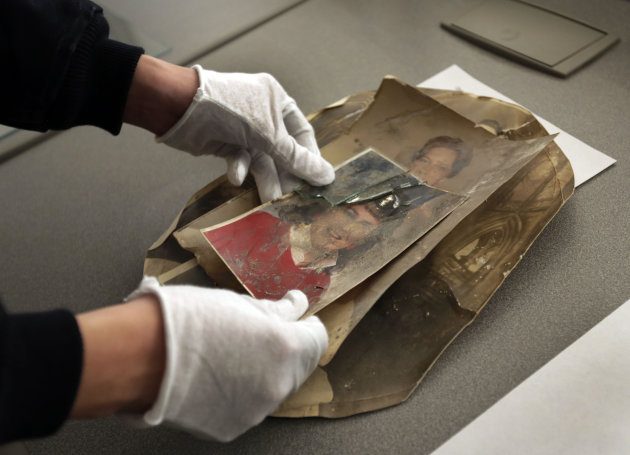
Of all the images of Superstorm Sandy's destruction, the ones that linger for Florence Catania are the torn, stained pictures that hung on her walls.

Her mother's decades-old wedding portrait, her own eighth-grade graduation photo, a snapshot that captured her mom on a carefree teenage day, all damaged in a Sandy-sparked fire at Catania's home in suburban Deer Park, N.Y.

But volunteers scattered around the world are about to start digitally mending Catania's personal photos and others battered by Sandy, banding together online to restore items that can't be rebought.

Founded after Hurricane Katrina, a nonprofit network of photographers, graphic artists and hobbyists has repaired more than 9,000 pictures discolored by floods, pockmarked by debris, speckled by mold and otherwise damaged by disasters in recent years. The Sandy project, which started this weekend, promises to be one of Operation Photo Rescue's most expert efforts yet.

"It means a lot to me," Catania said after bringing her photos to the restorers Saturday. "These are irreplaceable."

The restorers began shooting digital copies of the damaged prints with high-resolution professional cameras and specialized no-glare lighting Saturday at the School of Visual Arts in Manhattan, wearing white gloves to handle the images as though they were museum pieces.

Indeed, a Metropolitan Museum of Art imaging expert and two of the museum's photo conservators were on hand to provide advice, and two of the camera setups had been used to help the Atlanta-based King Center digitize hundreds of thousands of documents associated with Martin Luther King Jr.

After Catania left with her original prints, Operation Photo Rescue veteran Dennis McKeever glued himself to a computer screen, delicately copying snippets of forehead, sections of background, and overlaying them on similar, damaged areas of the wedding photo. Within about a half-hour, the retired computer network engineer had sewn up a sizeable gash in the portrait and was testing settings that might provide more visual data to help clean the apparently sepia-toned image.

"It's a matter of feeling your way through things," said McKeever, who has restored more than 100 photos through the group.

Other digital files would be uploaded to a password-protected website, where Operation Photo Rescue's roughly 3,000 volunteers can choose images they'd like to work on.

It's a painstaking process that can entail both resourcefulness — replacing a missing left foot by duplicating and reversing the right foot, for instance — and research. A volunteer might try to look up a flag in a photo's background to see how it's supposed to appear, as an example.

The average picture takes a few hours of work; some take as long as a week, said Operation Photo Rescue President Margie Hayes, a technical writer-turned-graphic artist. She got involved in the group after 2007 floods in nearby Coffeyville, Kan., about 120 miles from her home in El Dorado, Kan.

The refurbished prints are sent to the owners for free. Film-digitizing company DigMyPics has donated the printmaking and postage; PhotoShelter, a photography site, donates the online space where the images are stored for volunteers to see.

The Sandy effort also entailed other key contributions: three image-capturing stations, provided by Ken Allen Studios, a digital-imaging business, and JPMorgan Chase. The finance giant acquired the equipment to aid the King Center's digitization project and was "excited to provide this technology to enable families in the New York area to salvage family photos that would otherwise have been lost forever," Chief Information Officer Guy Chiarello said in a statement.

Such contributions are key for an organization that had to cut off $25-a-month stipends for some volunteers' Internet service when a grant dried up in 2009. Now it solicits members for donations whenever it mobilizes to a disaster area. Hayes said she raised about $3,000 for the New York trip, and she'd like to find a way to make a similar run to a Sandy-struck area of New Jersey.

Dave Ellis, the photography director at The Free Lance-Star of Fredericksburg, Va., and Rebecca Sell, who was then a photographer at the paper, launched Operation Photo Rescue in 2006, after Katrina struck the Gulf Coast the previous summer.

The group now counts volunteers in all 50 states and 75 other countries, about 50 to 100 of whom are very active, Hayes said.

It has responded to tornadoes, flash floods and tropical storms around the United States, amassing a gallery of before-and-after images that span generations: a formal childhood portrait, rippled and flecked with dirt. A black-and-white image of a Victorian-style mansion, faded to a hazy peach. A 1970s or '80s wedding photo, so waterlogged it looked as though the couple's faces had been scribbled on with crayons. Someone cradling a dog, the apparently decades-old snapshot splotched with a chemical yellow.

"We're really trying to restore people's family memories and community memories," said Katrin Eismann, an SVA professor. While she co-wrote the book that guides much of the volunteer effort, "Adobe Photoshop Restoration & Retouching," this weekend marked the first time she participated in person.

"If we didn't do it, after a while, those prints are just going to disintegrate."

Tuesday 5 December 2013

http://www.huffingtonpost.com/2013/02/04/operation-photo-rescue-hurricane-sandy_n_2613562.html

continue reading

Friday, 4 January 2013

Photo retoucher restores memories to disaster survivors


Behind every photograph is a story, and New York-based photo retoucher Becci Manson wants to make sure the stories of disaster survivors struggling with the pain of losing loved ones are preserved.

This desire inspired her to initiate a project to retouch photos damaged by the earthquake and tsunami that struck northeast Japan on March 11, 2011.

"It's a great way to help out — to give people those memories back," Manson, 38, said as she recounted her initiative to restore photographs in the tsunami-hit cities of Rikuzentakata and Ofunato and the town of Yamada, all in Iwate Prefecture, one of the three areas most heavily damaged by the disasters.

"For some people, those pictures were the only thing they ever got back," the Briton said. "When people lose loved ones, I think they realize how important photos are because sometimes these are the only tangible physical things they have left."

Manson usually retouches photos for clients such as fashion magazines, but the project in the Tohoku region was her first endeavor to restore photos that were damaged by Mother Nature.

When she volunteered to come to Japan in May 2011, she only planned to stay for three weeks to help with initial postdisaster needs, which included cleaning homes and clearing ditches with All Hands Volunteers, a U.S. nonprofit group. She ended up staying for six months.

Manson shared her experience last June in a TED Talk lecture. She said then that looking at the piles of photos, she "couldn't help but think as a retoucher that I could fix that tear and mend that scratch, and I knew hundreds of people who could do the same."

Manson said the project, which was fully supported by All Hands, began with several dozen volunteers and spread through such social media sites as Facebook and LinkedIn, with 80 people wanting to help from 12 different countries.

To date, over 500 volunteers worldwide have helped retouch hundreds of photos for 90 families. She said volunteers pitched in from across the world, including the U.S., Europe and Asia.

The photo retoucher had no personal connection with Japan until the disasters but developed a "pretty emotional experience" with the local community. She is particularly thankful for a local woman who helped "hand clean" photos, a necessary step before retouching.

She said it was heartening to restore tsunami-damaged photos, especially those of weddings and babies. The task was different from her usual work of trying to "make skinny models skinnier, perfect skin more perfect, and the impossible possible."

One photo she remembers fondly is that of a little girl in a ballerina outfit. It was covered in scratches.

"It was a really nice start to a project to realize what we could do," Manson said, adding she and volunteers would set up stations in communities with a laptop and scanner so she could upload the photos immediately to a cloud server.

She noted the project also offered a chance for volunteers outside Japan to help, saying, "A lot of people wanted to volunteer and come to Japan, but they either couldn't afford it or couldn't take time off work."

As much as she wanted to repair more photos, she was often pressed by time constraints and difficulty salvaging heavily damaged photos. For example, there was a photo of a woman dressed in a wedding kimono where the sides of the kimono were blurred. "When images like that came in, we needed to make sure we had some very, very experienced and talented retouchers so that they can be fixed correctly," she stressed.

"Some things are delicate; the wedding kimono . . . it's like fixing someone's face — if you don't get it right, it doesn't look like it should, it's pointless doing the job," Manson said, adding that each photo has both a personal and historic value.

More than a year after the disasters, her photo retouching efforts have resonated through the hearts of groups in the U.S. that have decided to launch similar projects in response to tropical storms in their communities.

With Hurricane Sandy hitting closer to home in New York, Manson remains eager to share the idea of retouching disaster-damaged photos and is ready to help Japan again if she is needed.

In her TED lecture, Manson said photos are "our memory-keepers and our histories, the last thing we would grab and the first thing you'd go back to look for."

"That's all this project was about, about restoring those little bits of humanity, giving someone that connection back," she said.

Friday 4 January 2013

http://www.japantimes.co.jp/text/nn20130104f3.html

continue reading

Friday, 14 December 2012

Two Police Officers Arrested For Looting Jenni Rivera's Crash Site


Two police officers have been arrested on suspicion of stealing unspecified items from the scene of the plane crash that killed Mexican-American superstar Jenni Rivera.

The Nuevo Leon state government says authorities found images of the scene on the BlackBerry cell phone of Luis Antonio Avila Moreno, 23, on Dec. 11, which contained a number of photos of the crash site including images of body parts and personal documents.

Avila Moreno and Mario Alberto Garcia Pacheco, 24, were on duty guarding the mountainous area where the aircraft went down on Sunday, according to EFE.

Police are trying to determine how the Mexican media got photographs of the secured site, including images of body parts and personal documents.

Investigators searched the homes of the officers who secured the crash site and found victims' belongings in two. The government said Thursday it then arrested the officers.

Thursday 13 December 2012

Read more: http://latino.foxnews.com/latino/news/2012/12/13/jenni-rivera-plane-crash-site-robbed-by-police/#ixzz2Eyu3inY0

continue reading

Monday, 12 November 2012

Thai 'trophy shots' shock mourners

When Perth travel agent Michelle Smith was stabbed to death in Phuket, ambulance workers shocked her grieving friends by posing for a photo with her dead body and placed on facebook.

But scenes like these are commonplace in Thailand, a country with an extraordinarily desensitised attitude towards death and relaxed regulations when it comes to the treatment of dead bodies.

Alan Morison, an Australian journalist who lives in Phuket and runs the local news website Phuketwan, was the first Western reporter at the scene when Mrs Smith was killed in a bungled street robbery in June.

He said her distraught friends looked on as the ambulance workers took a "trophy shot" with her body.

“[I] tried to explain this process to some of her friends,” he said. “To me it simply represents the acceptance of death in Thai society ... I neither condone it or reject it, simply see it as a cultural difference."

These cultural differences can be offensive for the families of Australians who die while visiting Thailand.

Two weeks ago 27-year-old Angus Campbell, from northern NSW, died of an apparent drug overdose in Bangkok.

Less than a day after his death a graphic image of his slumped body was splashed across a major tabloid news site.

While publishing similar images would cause outrage in Australia, in Thailand it is an accepted practice of local media, who are usually given full access to photograph any crime scene.

Marko Cunningham, a New Zealander who has been a volunteer ambulance worker in Bangkok for the past 12 years and runs the Bangkok Free Ambulance organisation, said Thai people were not offended by these displays.

“The news on TV and newspapers has always shown full uncensored pictures of morbid scenes, it’s a very cultural thing, just like their funerals are always open coffin before cremation,” Mr Cunningham said.

“They see [death] every day in the streets and their lives. Everyone has a family member who has been killed in a road accident or other accident of some sort.” Why ambulance workers pose with dead bodies

The majority of ambulance workers in Thailand are not paid – they are volunteers, required only to undertake a two-day first responder training course.

When they arrive at the scene of a death they are responsible for taking care of the body until a paid official arrives to move them to the morgue.

While undertaking the task they will often take photos to post on Facebook or other social media.

“The posing with a dead body is a pride thing, to show that one has helped take care of that body,” Mr Cunningham said.

“It’s a pride in doing a job that society generally shuns.”

In some of the photographs the ambulance workers can be seen pointing at the corpse. “Pointing at a dead body is just something that has come from pointing to small things in pictures to highlight them,” Mr Cunningham said.

“It’s a little strange that the Thais still point at the obvious but [it’s] just something that they have actually picked up from Western media, although interpreted in a sometimes bizarre way.”

Nothing too graphic to publish – except cigarettes

Mr Morison’s news website Phuketwan has a mostly-Western readership but does not shy away from running photos of dead bodies when he deems it necessary.

“We have published shots of the dead on occasions where I thought it was important to do so. I remember especially the body of a drowned 10-year-old boy being wheeled past me in the foyer of a hospital, straight out of an ambulance,” Mr Morison said.

“He should never have died. There should have been lifeguards on the beach that day. We ran the photo.

“One of our photojournalists attended the scene of a crash where six Burmese died, coming down Big Buddha Hill. One of them was a young girl. Her father survived.

“The series of shots of the girl being treated by paramedics, then the father being told she was dead, then cradling her in his arms, was deeply moving.

“Although it was clearly an intrusion into grief, I regarded that series as a dramatic message to drivers to be safe. We ran it.

“I have nothing but respect for the way people are treated here, with dignity and respect, and with openness and honesty, after death. Other societies could learn a lot.”

While the Thai news is laden with gore, the media is sensitive when it comes to a more mainstream killer – cigarettes.

“It’s surprising to see rape scenes, drugs, and dead bodies on TV shows, movies, etc but the main thing that is pixelated is cigarettes,” Mr Cunningham said.

“A man can point a gun and blow someone’s brains out but you can’t see him put the cigarette in his mouth!

“Also different TV stations have different things they pixelate. One station might pixelate cigarettes but another pixelate guns. It’s a little confusing. There seems to be no standards.”

Mr Cunningham said he believed the culture was slowly changing to align with Western values, and he had recently seen some volunteers begin to pixelate their gory images. But he said he respected the way the Thai people accept death and do not shy away from it.

“I now realise how obsessed with the ‘horror’ of death that Westerners are,” Mr Cunningham said.

“For Thais it’s sad to say goodbye but they see it just as the end of one journey and the start of another. We wish them well on their next journey and hope we meet them in the next life to be friends again.”

Monday 12 November 2012

http://news.ninemsn.com.au/world/2012/11/12/15/45/why-thai-ambulance-workers-take-trophy-shots

continue reading