Showing posts with label Fingerprints. Show all posts

Monday, 14 March 2016

Best way to identify a missing person? It’s all in the soles of your feet


Efforts to identify bodies of victims of natural disasters or people with dementia who are under protective custody using the soles of the feet are underway in Japan as the system is expected to help speed up the identification process once it comes into effect.

The move is led by former members of Tokyo’s Metropolitan Police Department (MPD), who argue that skin ridge patterns of feet because they remain intact for one’s lifetime can serve like fingerprints since they are unique among individuals.

Akira Mitsuzane, 68, former head of the MPD’s first investigation division that handles crimes including murders and robberies, and Hideo Kaneko, 69, a former member of the MPD’s crime scene investigation division, came upon the idea of using feet ridge patterns after the earthquake and tsunami disaster in March 2011.

They witnessed multiple cases in which family members of victims had the wrong bodies identified as police, who tried to return victims’ bodies to their families as quickly as possible, misidentified the bodies as they relied on victims’ clothing and other body traits for the identification.

“It takes time and money to conduct DNA analysis and you can’t always obtain fingerprints. For the purpose of identification (of bodies) alone, ridge patterns of feet have some more suitable characters,” said Kaneko.

Ridge patterns are usually taken from an area right under toes and they are preserved in many cases since the skin is thicker and the area protected by shoes, even though other parts of the body might be damaged in disasters.

It takes time and money to conduct DNA analysis and you can’t always obtain fingerprints. Mitsuzane believes people are more inclined to register their feet ridge patterns as opposed to fingerprints due to privacy concerns and the risk of the unintended use of information.

It is necessary to preregister and store one’s ridge pattern information to run the identification system, but collecting data only requires placing a foot on a scanner.

Asked by Mitsuzane and others, a major electric appliance maker has developed a portable scanner prototype, which weighs around 20 kilograms, and is capable of instantly scanning and storing data.

The fact that many demented elderly are under protective custody but unable to be identified is a serious issue as well.

According to the 2014 statistics by the MPD, the number of reported missing seniors who are believed to suffer from dementia is 10,783 in Japan. Also, 75 victims of the March 2011 disaster still remain unidentified as of the end of February 2016.

“The use of foot ridge patterns can be an effective preparation for the future,” said Mitsuzane, adding that some 20,000 and over 300,000 victims would be expected in the event of a possible Tokyo inland earthquake and the Nankai Trough earthquake, respectively.

“The fact that many demented elderly are under protective custody but unable to be identified is a serious issue as well,” Mitsuzane said.

Monday 14 March 2016

http://www.scmp.com/news/asia/article/1924570/best-way-identify-missing-person-its-all-soles-your-feet

continue reading

Wednesday, 7 October 2015

Indonesian forensic experts help identify haj disaster victims


Indonesian forensic experts are in Saudi Arabia to help identify those still missing from the country which suffered one of the heaviest losses in last month's haj disaster, an official said Tuesday (Oct 6).

Arsyad Hidayat, the senior Indonesian official in Mecca, told AFP that 11 specialists had arrived three days ago from police headquarters in his country, the world's largest Muslim-populated nation.

"They have special capability in forensics," including fingerprint data, he said, adding that Indonesia's death toll has now risen to 103, with 25 still missing.

Iran has reported the largest toll from the Sep 24 disaster, with 464 dead, followed by Egypt at 146.

More than 20 countries around the world have reported a total of 1,112 dead, mostly from official sources, far in excess of the Saudi figure of 769 killed issued after the stampede at Mina, near the holy city of Mecca.

It is unclear whether other countries have sent their own forensic specialists but Saudi Arabia's Al-Madina daily reported last week that 20 teams from the Saudi passports department were visiting Mecca-area hospitals to record fingerprints of the dead and of unidentified injured.

Saudi Arabia's regional rival Iran has repatriated 218 bodies of the 464 people it declared dead in the stampede, while accusing Riyadh of incompetence in its handling of haj safety. Tehran has also criticised the slow pace of identifying the victims.

In Indonesia's case, Hidayat said "there have not been meaningful obstacles" encountered by his country's teams of military and police officers. The teams, headed by a colonel from Indonesia's Kopassus special forces, have been gathering data, checking hospitals and searching for and identifying dead bodies.

"God willing, we are hopefully getting near to the final result," Hidayat said

Wednesday 7 October 2015

http://www.channelnewsasia.com/news/asiapacific/indonesian-forensic/2173914.html

continue reading

Friday, 7 August 2015

Nepal earthquake: 5 foreign nationals identified through DNA test


Nepal Police has confirmed the death of five foreigners reported missing in the Great Earthquake based on DNA verification.

The Central Police Forensic Science Laboratory (CPFSL) had conducted DNA profiling of the severed body parts recovered from various parts of the country and cross-matched the details with the DNA reports of the missing foreigners sent by Interpol.

Nepal Police had received DNA reports of 11 foreigners who were reported missing in Nepal by their families in the wake of the April 25 earthquake. The DNA reports that were sent from France, Canada and Spain are being used to match the DNA profiling conducted by the police laboratory of the remains.

Among the identified are three French, a Canadian and a Spanish national.

Police said the DNA profiling report sent to them from concerned nations was done on the basis of items used by these nationals before their departure to Nepal. DNA was extracted from a toothbrush of one of the foreign nationals, while blood stain in the razor was used for another.

The CPFSL conducts DNA profiling through blood, bone and hair with its root, among others. In case of bone, it is drilled and crushed into powdered form. Also, a process known as de-calcification is conducted to remove the calcium content in the bone which is then processed in a machine called the automated express to isolate the DNA.

“Following the isolation, the quantity of extracted DNA is studied which after some other complex processes will eventually lead to genotyping also known as DNA profiling,” said Deputy Superintendent of Police Rakesh Singh. “We had to rely on Indian laboratories for such tests. But since a year, we have been able to conduct the profiling in police laboratory itself. And it has been used extensively after the earthquake to help identify the deceased.”

Similarly, CPFSL were also able to identify additional three dead bodies of foreigners through their fingerprints. The identified people are from Germany, Spain and Britain. In case of the British national, the authorities there were able to produce the fingerprint through his used tea-cup that had remained unattended ever since he left for Nepal. The fingerprint was used to match with the analysis conducted at the police laboratory.

Senior Superintendent of Police Janak Singh, chief of CPFSL said at present DNA and fingerprint analysis of over 40 appendages are underway that will help in identifying the details of the people who died in the earthquake.

Friday 7 August 2015

http://www.ekantipur.com/the-kathmandu-post/2015/08/06/news/5-missing-identified-through-dna-test/279267.html

continue reading

Tuesday, 20 January 2015

Handheld Biometrics Deployed To Indonesia In Aid of AirAsia Victim Identification


AirAsia Flight QZ8501 went missing on December 28, 2014, enroute from Surabaya, Indonesia, to Singapore. The fight was found shortly after, having crashed into the waters south of Borneo and killed all 162 passengers.

In the effort to identify the fallen victims of this latest major airline disaster, Indonesia’s Automatic Fingerprint Identification System (INAFIS) has been employed with the various Disaster Victim Identification teams. Using a number of technologies including the Trident handheld reader from Credence ID – which is using the Mobile Automatic Multi-Biometric Identification System (MAMBIS) – the disaster response teams are hoping to match the victims’ traits with photos, names and addresses.

According to law enforcement officials from Indonesia, MAMBIS can produce 100 percent matches on victims whose fingerprints have not been damaged, while offering 60 percent accuracy with damaged samples. Over 50 percent of the AirAsia victims have been identified using the Trident device, bringing peace of mind to the mourning families affected by the disaster. Those victims who require other methods of identification, such as X-Ray or DNA matching, will take a significantly longer time to positively match to records.

Underneath the tragedy and ensuing investigation efforts related to the AirAsia crash is the thankful fact that Indonesia benefits from an extremely comprehensive national ID database that includes the biographic and biometric data of nearly every one of the country’s 250 million plus citizens. A national registry, in tragic times like this, is helping identify bodies at a very fast pace thanks to mobile biometric readers like the Trident.

The Trident handheld device, which can enroll and match face, fingerprint and iris biometrics, is used all around the world. In August, Credence ID announced that it won contracts in Mexico and Guatemala to aid in managing the identities of prison populations.

Tuesday 20 January 2015

http://mobileidworld.com/biometrics-deployed-to-indonesia-in-aid-of-airasia-victim-identification-1193/

continue reading

Tuesday, 8 April 2014

Medical Examiners use new technique to identify unidentified corpses at U.S. Border


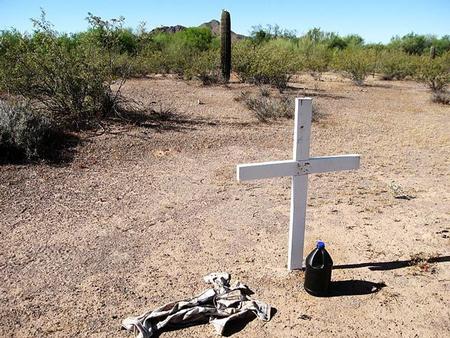
Once successfully getting through the U.S.-Mexico border in Arizona, undocumented immigrants face a large stretch of desert terrain along with extreme and bouts with over exhaustion that usually spells doom for about 180 of the border crossers a year.

Pima County Medical Examiner Dr. Greg Hess and his office sees more mummified cases of border crosses than any other in the country, Fox News Latino reported.

Hess is tasked with examining the bodies that come in, but because the bodies have been sitting it out under the extreme heat in the desert sun, they mummify faster than normally, making the process of obtaining fingerprints virtually impossible.

"The skin loses water content and elasticity. It will mummify, which means it becomes very hard and firm and leathery," Hess said.

He also told Fox that finding official identification on the person doesn't help in the process because most of them carry false documentation.

However, a technique to rehydrate the people's hands and revert the mummification process that was developed in 2001 is now being used by Hess to identify the subjects.

"We can rehydrate mummified hands using a sodium hydroxide solution ... that return the plumpness to the skin, the elasticity of it. So that you can take fingerprints," Hess said.

Hess said he places the mummified hands in the solution and lets them soak for 72 hours, but no more than that because the tissue can dissolve if is rehydrated for too long.

The rehydration process costs less than $100 per body but Hess the price is worth it because it allows a family to have closure.

"There is a sense of satisfaction in making that identification so there can be closure for the family, regardless of whether or not it's a family in the United States or from some other country," Hess said. "We try to provide that."

Tuesday 08 April 2014

http://www.latinpost.com/articles/10191/20140407/medical-examiners-use-new-technique-to-identify-unidentified-corpses-at-u-s-border.htm

continue reading

Thursday, 23 May 2013

Zimbabwe mass graves: Horror tales from the war


66-year-old Rangadza Machiha narrates the “worst” years of his life. It is a period that he rarely wants to talk about. For him it was a time of trouble. A time spent burying dismembered bodies, cleaning and taking fingerprints of slain comrades, digging and dumping their bodies in shallow graves.

“Nhau dzerufu hadzinakidzeka idzi mfana. I was tortured, electrocuted and was put in leg irons and handcuffs for nearly three months. I want to appeal to people to remain united so that this is not repeated. It was a painful experience. Let this be history and never to be repeated. That is my appeal to the people of Zimbabwe,” Mudhara Machiha pleaded.

One thing that is true about the old man is that he still can relate his ordeal at the hands of the Rhodesian security forces 34 years ago like something that happened a fortnight ago. Indeed, that has left a deep scar in his life that he cannot wish away.

It was the war of liberation. The enemy had declared that blacks would never rule the country and was prepared to go to any length to prevent an independent Zimbabwe. The Smith regime was brutal. It left a trail of sorrow in the African family fabric. Many despicable things happened. Let’s continue to tell the tales of our liberation struggle.

Arrested at the height of the liberation struggle after the battle of Rombwe in Rusape on December 28, 1977, Machiha with others were taken to the notorious Rusape Selous Scout Camp.

“On arrival he was covered in a black sack and taken to a room for interrogation. In the room there were pictures of nationalists like Cde (Josiah) Tongogara, President Mugabe and others. These had a wanted dead or alive tag above their heads. A huge reward was placed on their heads,” he said

“I still remember that among those arrested was a freedom fighter, Cde Gafa Tichatonga, who denied knowledge of me. If he had said he knew me I could have been history by now. I was put in leg irons and tortured.

They connected electricity to my male organ and one toe. I cried and thought I would never sire a child again. This was to become a daily occurrence for the next three months,” he added.

Mudhara Machiha was only freed from the leg irons when a relative who was in CID saw him.

Pained by his condition, the policeman oiled the locks that were now rusting and unlocked the shackles. From then on he was to join those who were burying bodies at Castle Farm.

“At the burial site we had to quickly dig the shallow mass graves and cover the bodies as the soldiers who accompanied us feared attacks from the freedom fighters. The numbers differed but ranged between five and eight.

One day we buried 26 bodies in a shallow grave and they came from many areas. They were of all ages and sexes. Some had lost their limbs, heads and others torn to pieces.

“I remember freedom fighters were placed in room at the camp. We would be tasked to wash their hands and take fingerprints. Some of the policemen would puff smoke to neutralise the odour from decaying bodies.

It was a bad experience but there was nothing we could do. We had to perform the duties at gunpoint,” he said.

“Dead bodies would be brought from as far as Wedza and Ruwangwe and Nyanga to be buried in mass graves there. They would be carried in four to five trucks for burial a day and we buried them in the vlei just after that little stream in the east of Mabvazuva suburb.”

Among the names of black soldiers who tortured him most at the camp where Sergegant-Major Chisese while other had nicknames like Mbudziyadhura, Komboniyatsva, Tsvotsvotsvo and Chigadziramemba.

“I remember one known as Mari. That man was cruel, he was my tormentor-in- chief,” Mudhara Machiha says fighting back his tears. He was released on August 18 1978.

“They just told me to leave the camp. I moved to Tsanzaguru Township. I still carry the effects of the torture,” he added.

His experiences at the Rusape Selous Torture Camp tally with that of Mbuya Mazano arrested in Rukweza after fleeing the Battle of Tsanzaguru.

“We were tired after running the whole way from Rusape that I and others decided to climb a huge mango tree for cover. The homestead had a lot of such trees and it was easy to find cover in them.

It was unfortunate that a group of soldiers passed below the mango tree and two of decided to sit under the tree to rest. Because of fear, one of us fell from the tree alerting the soldiers.

“She had blown our cover. The soldiers forced us to climb down the trees before force marching us to St Baduwa where there were people who had been shot dead. We were told to climb into the trucks with the bodies and to sleep alongside the dead bodies.

At road curves blood would spill out of the trucks but we had to remain quiet fearing we would be shot,” she said.

On arrival the bodies were first dumped next to their tent at the camp before being reloaded again for burial at the “butchery”.

“We were forced again to get on the trucks for a makeshift court at the butchery. In the makeshift court there was an electric stool where prisoners of war were forced to sit while being interrogated. The soldiers would drop burning plastics on your naked bodies.

“I did not have to sit on the hot stool as one black soldier shouted; “Ibhebhi rakanaka ndiri kurida usaripise”. That was how I was spared the torture and imminent death at the butchery. Unfortunately, some of my friends who were on the truck with me were tortured and later executed.

They were put in black plastic and buried here,” she said.

Unfortunately for Gogo Mazano that was the start of worse things to come. She was to stay at the camp with soldiers taking turns to rape her. They would move around with her as their sex object.

“Imagine being raped by more than 10 people a day. If you failed to please them they would severely assault you. At one point I fell pregnant but I was beaten till I lost that pregnancy. I was admitted at hospital for nearly three months.

On discharge they came and took me back to the camp. I was only released during the ceasefire in 1979.

“It still haunts me today. It is disheartening that these people have gone scot free and are still unrepentant,” she said.

She recalls some of her tormentors were still alive but most had left the area after independence. Another victim of Rusape Selous Scout Camp Gogo Regina Doto said she was picked in Vhengere Township by a group of auxiliary troops on their way to Chiwetu Rest.

“On arrival at the rest camp, a black cloth was tied on the faces of all the ‘prisoners’ so we would not see what was going on in the camp. Before they had started interrogating us there was the sound of gunfire and so we were again bundled into the trucks and driven to Rusape Selous Scout Camp. On arrival red cloths were tied around our eyes so that we could not see our tormentors. It was also a sign that we had to be executed,” she said.

“Whilst the Rhodesian soldiers were still contemplating what to do with us, the spirits smiled on us and they the camp was attacked by the guerrillas. The Rhodesian troops scurried for cover in the holes at the camp leaving us to face the fire.

“We took advantage of the commotion and ran for dear life back to Vhengere. That is how we survived the camp. It was only towards end of the war that the Selous Scout came to take part of the suburb to Castle Camp. It was painful to see skeletons with shoes on, functioning watches in hand but with no flesh.

“They boasted that they had killed so many. I remember one of them saying there are thousands of your brothers here. They took us to a pit near that hill where we were shown hundreds of decomposing bodies that were to be burnt.

“You see that pit, it used to be deep and that is where most of your brothers and sisters’ bodies were burnt. As they drove away, blood would spill from the trucks along the way and it was a sad sight,” she said.

“At that time, blood of the people who had been killed at the execution site flowed down the slope. There were pits everywhere in this area with bodies of people who were forced to dig their own graves, before being shot and buried there,” she said.

Thursday 23 May 2013

http://www.herald.co.zw/index.php?option=com_content&view=article&id=79421:horror-tales-from-the-war&catid=42:features-news&Itemid=134#.UZ1kDYdzA34

continue reading

Friday, 23 November 2012

Bomber’s finger prints, legs and hands collected

The investigators have taken fingerprints of the suicide bomber, who hit a procession in Dhoke Seydan, to match it with the NADRA record.

The body parts of the suicide bomber, including hands and legs, had been collected by the Civil Defense Department from the blast place, were also being reconstructed and DNA would also be conducted to identify him, said City Police Officer (CPO) Azhar Hameed Khokher while talking to TheNation on Thursday.

“The limbs of the alleged suicide are collected at the DHQ preserved for DNA,” he added.

He said that the doctors have been assembling the body parts of the suicide bomber and have taken finger prints to match it with the NADRA record. “We have found two hands and two legs from the bombing place.”

Azhar said that the police found two hands and two legs from the bombing place and sent for tests to determine whether the parts of a one body or of different bodies.

Meanwhile, the death toll rose to 23 including the teenage suicide bomber while 34 injured.

According to data collected from hospitals as many as 34 injured were admitted to three different hospitals with 28 in District Headquarter Hospital (DHQ), 5 in Benazir Bhutto Hospital (BBH) and one injured in Holy Family Hospital (HFH).

Four injured persons admitted to the DHQ including a nine year old boy were said to be in critical condition. Rizwan Kazmi 9 has received fatal head legs injuries.

The head of the attacker said to be looking like a Pathan aging 17 to 18 years was also received at the hospital, said a senior doctor of DHQ.

Friday 23 November 2012

http://www.nation.com.pk/pakistan-news-newspaper-daily-english-online/islamabad/23-Nov-2012/bomber-s-finger-prints-legs-and-hands-collected

continue reading

Sunday, 20 May 2012

Sukhoi victims’ identification concluded: Police

The National Police’s Disaster Victim Identification (DVI) unit has concluded the identification process of the 45 people onboard the ill-fated Sukhoi Superjet 100. All of the remains have been identified. “The identification process has been concluded,” National Police medical unit chief Brig. Gen. Musadeq Ishak told a press conference on Sunday. He said that the team needed more time to reconcile the remains before handing them over to the families. “We will notify the victims’ families and they can see the remains on Tuesday at the Soekanto Police Hospital before we close the caskets. They can retrieve them on Wednesday at the Halim Perdanakusuma Airbase,” he said. Musadeq said the DVI team had used various methods during the process, including fingerprint identifications, forensic pathology, forensic anthropology and odontology. According to the team, of 45 victims, 31 were men and 14 were women. There were 35 Indonesian nationals among the identified victims. The Russian-made aircraft slammed into Mt. Salak in Bogor, West Java, on May 9 while flying an exhibition flight. 20 May 2012 http://www.thejakartapost.com/news/2012/05/20/sukhoi-victims-identification-concluded-police.html

continue reading

Saturday, 19 May 2012

Indonesia needs finger print database

JAKARTA - It is time for Indonesia to have finger print database as it has many functions. For example, the database could also ease the identification of disaster victims of Sukhoi Superjet 100 crash, the Executive Director of Disaster Victim Identification (DVI) of Sukhoi SJ 100, Dr Anton Castilani, said on Saturday. DVI team is still having a hard time on identifying the data of the victims through the finger prints despite the ante mortem data is completely gathered. The obstacle is that the ante mortem data given by the family is different with the body parts found by the evacuation team. "The family sent us the certificate containing three finger prints from left hand, but unfortunately we found the right one. It does not match," Anton gave an example. DVI team, he added, successfully identified 15 victims. Yet, none of the identification uses the finger prints. "It is conducted by using their DNA," he explained. Saturday 19 May 2012 http://en.republika.co.id/berita/en/national-politics/12/05/19/m49np1-indonesia-needs-finger-print-database

continue reading

Friday, 18 May 2012

15 victims of Sukhoi crash identified

JAKARTA: Forensic experts from the Indonesian police Disaster Victim Identification (DVI) team, Friday, said that they had identified 15 victims of the Sukhoi Superjet 100 which crashed at Gunung Salak, Bogor, last May 9. The victims, 10 men and five women, comprised 13 Indonesians and two of other nationalities. Head of the Indonesian Police Hospital at Keramat Jati here, Brigadier General Agus Prayitno, at a media conference which was broadcast live by several television stations, said the victims were identified through their finger prints, dental records, DNA and personal possessions. However, he said the bodies had yet to be handed over to their next of kin as some of their body parts were still missing. Until today, the hospital had received 30 body bags of the victims’ remains and belongings which were recovered from the site of the crash. The ill-fated aircraft, with 45 passengers on board, was on a demonstration flight on May 9 when it suddenly lost communication with the air control tower. The plane’s wreckage was spotted on Gunung Salak the following day Friday 18 May 2012 Read more: http://www.theborneopost.com/2012/05/18/15-victims-of-sukhoi-crash-identified-new/#ixzz1vFfrYGaE

continue reading

Tuesday, 15 May 2012

Police identify 22 fingerprints of the ill-fated Sukhoi’s victims

A total of 22 fingerprints of the ill-fated Russian-made airliner’s victims have already been identified by the National Police’s Disaster Victim Identification (DVI) unit, a spokesman says. The National Police spokesman Sr. Comr. Boy Rafli Amar was quoted by tempo.co on Tuesday as saying that the 22 fingerprints were identified from the 18 body bags that had been received by the victims’ identification team. As of Monday, a total of 25 body bags had been sent to the officials at R. Sukanto National Police Hospital in Kramat Jati, East Jakarta. Four out of 25 body bags contained victims’ personal items, such as wallets, ID cards, shoes and electronic gadgets. The forensics team helping to identify victims remains has examined 18 body bags of remains, while three additional body bags arrived to the hospital on Monday and currently undergoing testing. DVI chief Sr. Comr. Anton Castilani said that the 22 fingerprints would be cross-referenced with the DNA data that was submitted from the victims’ families. He added that the team had yet to sort out which partial remains belonged to Indonesians or to foreign citizens. The Russian-made aircraft Sukhoi Superjet 100, with 45 people onboard, disappeared from radar screens last Wednesday before an Air Force helicopter spotted its wreckage at an altitude of 5,800 feet in the foothills of Mt. Salak’s in Cidahu, Sukabumi, the day after. Search and rescue teams found that the bodies of the Sukhoi passengers were no longer intact. Eight Russian crew members, one American citizen and one French passenger were onboard along with 35 Indonesians. (asa) Tue, 05/15/2012 http://www.thejakartapost.com/news/2012/05/15/police-identify-22-fingerprints-ill-fated-sukhoi-s-victims.html

continue reading

Friday, 27 April 2012

Nadra offers AFIS help to identify disaster victims

The National Database and Registration Authority (Nadra) has volunteered its services to Pakistan Army for identification of soldiers trapped in Gayari snow-slide once they are found as it is in close contact with the relevant authorities for the purpose. This has been revealed in a report submitted by the Nadra here Tuesday. According to the report it deployed its Disaster Victim Identification (DVI) Unit in the rescue and recovery operation after the Bhoja Air crash on the orders of Chairman Nadra Friday last. The DVI Unit, headed by Director General, National Data Warehouse, Syed Muzaffar Ali, provided critical assistance and technical support in the identification of the bodies of the deceased. The report claimed that in many instances, bodies are charred or decomposed beyond recognition rendering them unidentifiable through conventional means. The DVI uses its Automated Fingerprint Identification System (AFIS) for establishing identification of the victims. The fingerprint samples taken by Nadra teams are compared with the existing records in the database and then identity is verified before handing over the remains to the respective families. The Nadra identified 7 bodies of the Bhoja air crash without delay through AFIS. It has the capacity to use facial imaging and recognition tools for identification and can help local law enforcement authorities with DNA identification as well. The first body was identified within a few hours of recovery; the speedy identification was greatly appreciated by the media and the relatives of deceased. The Nadra has previously helped in rescue and relief operations in many parts of Pakistan, including the floods of 2010, 2011 and Air Blue crash and other disasters. The report suggested that one can easily determine that if this would had not been there, many days must be needed in identification of dead bodies. In that case their relatives will have to undergo the stress and agony for fairly long time. The report noted that the federal Minister for Interior Rehman Malik and the relevant authorities appreciated the Nadra staff efforts, dedication and devotion during the rescue operation. Thursday, April 26, 2012 http://www.thenews.com.pk/Todays-News-6-105035-Nadra-offers-AFIS-help-to-identify-disaster-victims

continue reading