Saturday, 21 July 2012

At least 21 killed, 29 injured in Mexico bus crash

A bus accident early Friday in the western Mexican state of Nayarit left 24 dead and 14 injured, authorities said.

The original casualty report spoke of 21 dead and 29 injured.

First responders initially counted 17 bodies, but discovered four additional victims when the bus was lifted, while three injured passengers died en route to the hospital, sources in the state Attorney General's Office said.

The accident occurred around 4:00 a.m. on a stretch of highway between the towns of Puente de Chapalilla and Tequepexpan, Nayarit government spokesman Sergio Cañedo told Efe.

The bus was carrying a group headed to the beach in the village of Rincon de Guayabitos when the predawn crash occurred, Omar Landazuri, a duty officer for the Nayarit State Civil Protection Service, told AFP. "The bus overturned and began to roll down a ravine, ejecting people along the way," Landazuri added, saying that many of the victims died from the battering they received.

Injured survivors were taken to three hospitals in Tepic, the capital of Nayarit. Residents of a community in Chihuahua pooled their resources to charter the bus for the beach excursion, Nayarit officials said.

Schools let out in Mexico two weeks ago and the country's highways are crowded with families en route to vacation spots.

Landazuri said the bus, owned by Golden Express Tours, had been rented by the group from the northwestern Chihuahua state for a trip to the Pacific coast.

Friday's crash brings the number of serious bus accidents in Mexico to four this year. In the most serious recent incident, on April 20, a truck smashed into a bus transporting farm workers in the eastern state of Veracruz, killing 43 people.

Around 24,000 people die from road accidents in Mexico each year, according to insurance companies -- a figure almost double the annual drug violence death toll.

Saturday 21 July 2012 

Read more: http://latino.foxnews.com/latino/news/2012/07/20/24-die-in-mexico-bus-crash/#ixzz21D5X1SRF

continue reading

Four dead, 36 injured in Egypt tour bus accident

Egypt’s official news agency says a bus crash in the south has killed four Egyptians and injured 35 others, including some tourists.

The state-run Middle East News Agency says the accident happened early Friday morning on a highway linking the Red Sea resort city of Hurghada with port of Ras Gharib in southeast Egypt.

The agency said that the bus, carrying about 40 passengers, was speeding and overturned, killing a mother and her two-year-old toddler along with two other men. Among the injured were three Germans and one Ukrainian.

Ambulances immediately transferred the injured to Hurghada Public Hospital, and some critical cases were then taken to Gouna Hospital and the Nile Hospital.

The governor of the Red Sea, Major General Mahmoud Assem, told state television that he asked doctors from the military hospital in Hurghada to help treat the injured.

Red Sea security head Major General Mostafa Bedair was notified, as was the Red Sea prosecution, which will begin investigations.

Assem requested that the head of prosecution in Hurghada take the testimony of the injured and give permission for the burial of the dead.

Road accidents are common in Egypt due to badly maintained roads and vehicles and poor enforcement of traffic laws.

Police estimate that road accidents kill about 6,000 people a year in Egypt, a nation of about 84 million. 

Saturday 21 July 2012

http://www.timesofisrael.com/egypt-speeding-us-overturns-killing-4-injuring-35/

continue reading

Friday, 20 July 2012

At least 68 dead in Zanzibar ferry disaster

STONE TOWN, Zanzibar - Rescue workers fought rough seas on Thursday to search for survivors after an overcrowded ferry sank near the Indian Ocean archipelago of Zanzibar, but hopes of finding people alive were slim.

At least 68 people were confirmed dead and 145 were rescued after the MV Skagit/Kalama capsized around midday on Wednesday near Chumbe island, west of Zanzibar.

The vessel had set sail from mainland Tanzania to the semi-autonomous archipelago, a popular tourist beach destination.

One U.S. citizen was among the dead. Hundreds of people gathered at the Maisara Grounds park near Zanzibar's historic Stone Town area on Thursday to identify bodies laid out in a tent.

Tatu Kwiyela, a 35-year-old woman from mainland Tanzania, survived the accident but her nine-month-old son died. "I was swept away by strong waves and lost my son, Saidi Jumanne. I tried to hang on to him but he disappeared into the sea," said Tatu, who managed to identify his remains.

Police said more than 10 foreign tourists, including a group of Dutch holidaymakers, were among the rescued passengers. "One of those killed in the ferry accident is an American citizen. The body has been recovered and is being preserved at a mortuary," Zanzibar police spokesman Mohammed Mhina said.

The ferry, with a maximum carrying capacity of 250 people according to Zanzibar marine authorities, was carrying 290 people, officials said. "Out of the 68 dead victims, 54 bodies have been identified so far by their relatives and taken for burial," Mhina said. "We will continue with the search and rescue operation tomorrow morning, although it is becoming increasingly difficult to find any survivors now."

There were at least 145 survivors. Rescue teams battled heavy winds and rough seas in their search effort.

Divers trying to pluck more bodies from the wreckage said they were not able to reach the vessel. "The sunken boat is below depths of 25 meters (82 ft) ... we tried to go as deep as we could but could not locate it," Ali Ramadhani, one of the divers, said. "All we've seen today are bodies floating in the sea. I don't think we are going to find anyone alive. The sea is very rough, it is difficult for anyone to survive in such conditions."

Some of the victims' relatives said they were angry at authorities for lax safety regulations, especially after more than 200 people were killed in a ferry accident in September in Zanzibar's worst maritime disaster. "The government has killed all these people. They must bring the owner of the boat to us," said Abdallah Sadick whose brother was among the missing passengers.

Zanzibar residents said passenger ships are notoriously overcrowded and there are few safety inspections.

Tanzanian President Jakaya Kikwete ordered an investigation into the incident and announced three days of national mourning.

Friday 20 July 2012

http://uk.news.yahoo.com/least-68-dead-zanzibar-ferry-disaster-185438820.html

continue reading

Thursday, 19 July 2012

ZAKA Disaster Victim Identification Team Boards Bombed Bulgaria Bus

Bulgarian authorities allowed members of Israelis ZAKA voluntary emergency response team that specialize in disaster victim identification, to board the bombed out bus, following the brutal terror attack on Israeli tourists that left 8 dead yesterday afternoon.

The ZAKA team will prepare the bodies of the victims for burial in Israel and search the bus for body parts that are to be buried with the dead according to Jewish law.

Shimi Grossman, a member of the ZAKA team said,”From the moment we landed in Burgas we have been working at the scene and the hospitals, we have full cooperation with local police.” “We are working to bring all bodies to Israel as soon as possible,” said Matti Goldstein, the leader of the ZAKA team.

Thursday 19 July 2012

http://www.algemeiner.com/2012/07/19/zaka-disaster-victim-identification-team-boards-bombed-bulgaria-bus-photos/

continue reading

More than 100 missing after Zanzibar ferry sinks

(Reuters) - Rescue workers fought rough seas on Thursday to search for more than 100 people missing after an overcrowded ferry sank near the Indian Ocean archipelago of Zanzibar, but hopes of finding survivors were slim.

At least 38 people, including an American citizen, were confirmed dead and 145 were rescued after the MV Skagit/Kalama passenger boat capsized on Wednesday around midday near Chumbe island, west of Zanzibar.

The vessel had set sail from mainland Tanzania to the semi-autonomous archipelago, a popular tourist beach destination.

Hundreds of people gathered at the Maisara Grounds park near Zanzibar's historic Stone Town area on Thursday to identify the bodies of victims laid out in a tent.

Tatu Kwiyela, a 35-year-old woman from mainland Tanzania, survived the accident, but lost her nine-month-old son. "I was swept away by strong waves and lost my son, Saidi Jumanne. I tried to hang on to him but he disappeared into the sea," said Tatu, who managed to identify his remains.

Police said more than 10 foreign tourists, including a group of Dutch holidaymakers, were among the rescued passengers. "One of those killed in the ferry accident is an American citizen.

The body has been recovered and is being preserved at a mortuary," Zanzibar police spokesman Mohammed Mhina said.

The ferry, with a maximum carrying capacity of 250 people according to Zanzibar marine authorities, was carrying 290 people, said officials. "We have recovered seven more bodies today, so the death toll has now risen to 38, with 145 survivors," Zanzibar Police Commissioner Mussa Ali Mussa told Reuters. "You can say it is not humanly possible to find anyone alive at this point. However, with God's grace the possibility is still there ... Sometimes you can find people alive after a month at sea, so we are not giving up all hope."

Police said rescue workers, who had suspended their search at nightfall, had resumed operations on Thursday to try to recover more bodies or rescue people who might have drifted from the ferry. "We have boats and a police helicopter looking for survivors, but they are battling with heavy winds and rough seas," said Mussa.

NO SAFETY REGULATIONS

Some of the victims' relatives said they were angry at authorities for lax marine safety regulations, especially after more than 200 people were killed in a ferry accident in September in the worst maritime disaster in the history of Zanzibar. "The government has killed all these people.

They must bring the owner of the boat to us," said Abdallah Sadick, adding his brother was among the missing passengers.

Zanzibar residents said ships plying the Unguja-Pemba route are notoriously overcrowded and there are few, or no, inspections to ensure their safety.

Tanzanian President Jakaya Kikwete ordered an investigation into the incident and announced three days of national mourning.

Thursday 19 July 2012

http://uk.reuters.com/article/2012/07/19/uk-tanzania-ferry-idUKBRE86I0N920120719

continue reading

Wednesday, 18 July 2012

Skin, bones and tissue for sale: How the dead are being used for grisly trade in human body parts

On Feb. 24, Ukrainian authorities made an alarming discovery: bones and other human tissues crammed into coolers in a grimy white minibus.

Investigators grew even more intrigued when they found, amid the body parts, envelopes stuffed with cash and autopsy results written in English.

What the security service had disrupted was not the work of a serial killer but part of an international pipeline of ingredients for medical and dental products that are routinely implanted into people around the world.

In their expose, the International Consortium of Investigative Journalists followed the trial of body parts back to the Ukraine, where many are harvested.

The seized documents suggested that the remains of dead Ukrainians were destined for a factory in Germany belonging to the subsidiary of a U.S. medical products company, Florida-based RTI Biologics.

RTI is one of a growing industry of companies that make profits by turning mortal remains into everything from dental implants to bladder slings to wrinkle cures.

The industry has flourished even as its practices have roused concerns about how tissues are obtained and how well grieving families and transplant patients are informed about the realities and risks of the business.

In the U.S. alone, the biggest market and the biggest supplier, an estimated two million products derived from human tissue are sold each year, a figure that has doubled over the past decade.

It is an industry that promotes treatments and products that literally allow the blind to see (through cornea transplants) and the lame to walk (by recycling tendons and ligaments for use in knee repairs).

It's also an industry fueled by powerful appetites for bottom-line profits and fresh human bodies. In the Ukraine, for example, the security service believes that bodies passing through a morgue in the Nikolaev district, the gritty shipbuilding region located near the Black Sea, may have been feeding the trade, leaving behind what investigators described as potentially dozens of “human sock puppets” - corpses stripped of their reusable parts.

Industry officials argue that such alleged abuses are rare, and that the industry operates safely and responsibly. For its part, RTI didn’t respond to repeated requests for comment or to a detailed list of questions provided a month before this publication.

In public statements the company says it 'honors the gift of tissue donation by treating the tissue with respect, by finding new ways to use the tissue to help patients and by helping as many patients as possible from each donation.' ‘Our Misfortune’

Despite its growth, the tissue trade has largely escaped public scrutiny. This is thanks in part to less-than-aggressive official oversight — and to popular appeal for the idea of allowing the dead to help the living survive and thrive.

An eight-month, 11-country investigation by the International Consortium of Investigative Journalists (ICIJ) has found, however, that the tissue industry’s good intentions sometimes are in conflict with the rush to make money from the dead. Inadequate safeguards are in place to ensure all tissue used by the industry is obtained legally and ethically, ICIJ discovered from hundreds of interviews and thousands of pages of public documents obtained through records requests in six countries. Despite concerns by doctors that the lightly regulated trade could allow diseased tissues to infect transplant recipients with hepatitis, HIV and other pathogens, authorities have done little to deal with the risks. In contrast to tightly-monitored systems for tracking intact organs such as hearts and lungs, authorities in the U.S. and many other countries have no way to accurately trace where recycled skin and other tissues come from and where they go.

At the same time, critics say, the tissue-donation system can deepen the pain of grieving families, keeping them in the dark or misleading them about what will happen to the bodies of their loved ones.

Those left behind, like the parents of 19-year-old Ukrainian Sergei Malish, who committed suicide in 2008, are left to cope with a grim reality. At Sergei’s funeral, his parents discovered deep cuts on his wrists. Yet they knew he had hanged himself. They later learned that his body parts had been recycled and shipped off as “anatomical material.” 'They make money with our misfortune,' Sergei’s father said.

Awkward silence

During the transformational journey tissue undergoes — from dead human to medical device — some patients don’t even know that they are the final destination. Doctors don’t always tell them that the products used in their breast reconstructions, penis implants and other procedures were reclaimed from the recently departed. Nor are authorities always aware of where tissues come from or where they go.

The lack of proper tracking means that by the time problems are discovered some of the manufactured goods can’t be found. When the U.S. Centers for Disease Control and Prevention assists in the recall of products made from potentially tainted tissues, transplant doctors frequently aren’t much help. 'Oftentimes there’s an awkward silence. They say: "We don’t know where it went",' said Dr. Matthew Kuehnert, the CDC’s director of blood and biologics. 'We have barcodes for our [breakfast] cereals, but we don’t have barcodes for our human tissues,' Kuehnert said. 'Every patient who has tissue implanted should know. It’s so obvious. It should be a basic patient right. It is not. That’s ridiculous.'

Since 2002 the U.S. Food and Drug Administration has documented at least 1,352 infections in the U.S. that followed human tissue transplants, according to an ICIJ analysis of FDA data. These infections were linked to the deaths of 40 people, the data shows. 'We have barcodes for our (breakfast) cereals, but we don’t have barcodes for our human tissues. Every patient... should know. It’s so obvious. It should be a basic patient right. It is not. That’s ridiculous.'

Dr. Matthew Kuehnert, the CDC’s director of blood and biologics One of the weaknesses of the tissue-monitoring system is the secrecy and complexity that comes with the cross-border exchange of body parts.

The Slovaks export cadaver parts to the Germans; the Germans export finished products to South Korea and the U.S.; the South Koreans to Mexico; the U.S. to more than 30 countries. Distributors of manufactured products can be found in the European Union, China, Canada, Thailand, India, South Africa, Brazil, Australia and New Zealand. Some are subsidiaries of multinational medical corporations.

The international nature of the industry, critics claim, makes it easy to move products from place to place without much scrutiny. 'If I buy something from Rwanda, then put a Belgian label on it, I can import it into the U.S. When you enter into the official system, everyone is so trusting,' said Dr. Martin Zizi, professor of neurophysiology at the Free University of Brussels. Once a product is in the European Union, it can be shipped to the U.S. with few questions asked. “They assume you’ve done the quality check," Zizi said. "We are more careful with fruit and vegetables than with body parts.”

Piece of the action Inside the marketplace for human tissue, the opportunities for profits are immense. A single, disease-free body can spin off cash flows of $80,000 to $200,000 for the various non-profit and for-profit players involved in recovering tissues and using them to manufacture medical and dental products, according to documents and experts in the field. It’s illegal in the U.S., as in most other countries, to buy or sell human tissue.

However, it’s permissible to pay service fees that ostensibly cover the costs of finding, storing and processing human tissues. Almost everyone gets a piece of the action. Ground-level body wranglers in the U.S. can get as much as $10,000 for each corpse they secure through their contacts at hospitals, mortuaries and morgues.

Funeral homes can act as middlemen to identify potential donors. Public hospitals can get paid for the use of tissue-recovery rooms. And medical products multinationals like RTI? They do well, too. Last year RTI earned $11.6 million in pretax profits on revenues of $169 million.

Phillip Guyett, who ran a tissue recovery business in several U.S. states before he was convicted of falsifying death records, said executives with companies that bought tissues from him treated him to $400 meals and swanky hotel stays. They promised: 'We can make you a rich man.' It got to the point, he said, that he began looking at the dead “with dollar signs attached to their parts.” Guyett never worked directly for RTI.

Smoked salmon

Human skin takes on the color of smoked salmon when it is professionally removed in rectangular shapes from a cadaver. A good yield is about six square feet. After being mashed up to remove moisture, some is destined to protect burn victims from life-threatening bacterial infections or, once further refined, for breast reconstructions after cancer.

The use of human tissue 'has really revolutionized what we can do in breast reconstruction surgery,' explains Dr. Ron Israeli, a plastic surgeon in Great Neck, N.Y. 'Since we started using it in about 2005, it’s really become a standard technique.' A significant number of recovered tissues are transformed into products whose shelf names give little clue to their actual origin.

They are used in the dental and beauty industries, for everything from plumping up lips to smoothing out wrinkles. Cadaver bone — harvested from the dead and replaced with PVC piping for burial — is sculpted like pieces of hardwood into screws and anchors for dozens of orthopedic and dental applications.

Or the bone is ground down and mixed with chemicals to form strong surgical glues that are advertised as being better than the artificial variety. 'At the basic level what we are doing to the body, it’s a very physical - and I imagine some would say a very grotesque - thing,' said Chris Truitt, a former RTI employee in Wisconsin. 'At the basic level what we are doing to the body, it’s a very physical — and I imagine some would say a very grotesque — thing,' said Chris Truitt, a former RTI employee in Wisconsin. 'We are pulling out arm bones. We are pulling out leg bones. We are cutting the chest open to pull the heart out to get at the valves. We are pulling veins out from the inside of skin.' Whole tendons, scrubbed cleaned and rendered safe for transplant, are used to return injured athletes to the field of play. There’s also a brisk trade in corneas, both within countries and internationally.

Because of the ban on selling the tissue itself, the U.S. companies that first commercialized the trade adopted the same methods as the blood collection business. The for-profit companies set up non-profit offshoots to collect the tissue — in much the same way the Red Cross collects blood that’s later turned into products by commercial entities.

Nobody charges for the tissue itself, which under normal circumstances is freely donated by the dead (via donor registries) or by their families. Rather, tissue banks and other organizations involved in the process receive ill-defined “reasonable payments” to compensate them for obtaining and handling the tissue. 'The common lingo is to talk about procurement from donors as "harvesting," and the subsequent transfers via the bone bank as "buying" and "selling",' wrote Klaus Høyer, from the University of Copenhagen’s Department of Public Health, who talked to industry officials, donors and recipients for an article published in the journal BioSocieties. 'These expressions were used freely in interviews; however, I did not hear this terminology used in front of patients.”

U.S.-government funded study of the families of U.S. tissue donors, published in 2010, indicates many may not understand the role that for-profit companies play in the tissue donation system. Seventy-three percent of families who took part in the study said it was “not acceptable for donated tissue to be bought and sold, for any purpose.” Few Protections Cadaver bone - harvested from the dead and replaced with PVC piping for burial - is sculpted like pieces of hardwood into screws and anchors for dozens of orthopedic and dental applications There is an inherent risk in transplanting human tissues.

Among other things, it has led to life-threatening bacterial infections, and the spread of HIV, Hepatitis C and rabies in tissue recipients, according to the CDC. Modern blood and organ collection is bar-coded and strongly regulated — reforms prompted by high-profile disasters that had been caused by the poor screening of donors.

Products made from skin and other tissues, however, have few specific laws of their own. In the U.S., the agency that regulates the industry is the Food and Drug Administration, the same agency that’s charged with protecting the nation’s food supply, medicines and cosmetics.

The FDA, which declined repeated requests for on-record interviews, has no authority over health care facilities that implant the material. And the agency doesn’t specifically track infections It does keep track of registered tissue banks, and sometimes conducts an inspection. It also has the power to shut them down.

The FDA largely relies on standards that are set by an industry body, the American Association of Tissue Banks (AATB). The association refused repeated requests over four months for on-record interviews. It told ICIJ during a background interview last week that the 'vast majority' of banks recovering traditional tissues such as skin and bone are accredited by the AATB.

  Yet an analysis of AATB accredited banks and FDA registration data shows about one third of tissue banks that recover traditional tissues such as skin and bone are accredited by the AATB. The association says the chance of contamination in patients is low.

Most products, the AATB says, undergo radiation and sterilization, rendering them safer than, say, organs that are transplanted into another human. 'Tissue is safe. It's incredibly safe,' an AATB executive said. There is little data, though, to back up the industry’s claims.

Unlike with other biologics regulated by the FDA, agency officials explain, firms that make medical products out of human tissues are required to report only the most serious adverse events they discover.

That means that if problems do arise, there’s no guarantee that authorities are told. And because doctors aren’t required to tell patients they’re getting tissue from a cadaver, many patients may not associate any later infection with the transplant.

On this point, the industry says it is able to track the products from the donors to the doctors, using their own coding systems, and that many hospitals have systems in place to track the tissues after they’re implanted.

But no centralized regional or global system assures products can be followed from donor to patient. “Probably very few people get infected, but we really don’t know because we don’t have surveillance and we don’t have a system for detecting adverse events,” the CDC’s Kuehnert said. The FDA recalled more than 60,000 tissue-derived products between 1994 and mid-2007.

The most famous recall came in 2005. It involved a company called Biomedical Tissue Services, which was run by a former dental surgeon, Michael Mastromarino. Mastromarino got many of his raw materials from undertakers in New York and Pennsylvania. He paid them up to $1,000 per body, court records show.

Dental surgeon Michael Mastromarino paid undertakers $1,000 so he could strip dead bodies of tissue, before returning them to their families His company stripped bodies of their bones, skin and other usable parts, then returned them to their families. The families, ignorant of what happened, buried or cremated the evidence.

One of more than 1,000 bodies that were dismembered was that of the famous BBC broadcaster and Masterpiece Theatre host Alistair Cooke. Products made from the stolen human remains were shipped to Canada, Turkey, South Korea, Switzerland and Australia.

More than 800 of those products have never been located. It later came out in court that some of the tissue donors had died from cancer and that none had been tested for pathogens like HIV and hepatitis.

Mastromarino falsified donor forms, lying about causes of death and other details. He sold skin and other tissues to several U.S. tissue-processing firms, including RTI. “From day one, everything was forged; everything, because we could. As long as the paperwork looked good, it was fine,” said Mastromarino, who is serving a 25-to-58-year prison sentence for conspiracy, theft and abuse of a corpse.

Global Sheriff Each country has its own set of regulations for the use of products made from human tissue, often based on laws that were originally intended to deal with blood or organs.

In practice, though, because the U.S. supplies an estimated two-thirds of the world’s human-tissue-product needs, the FDA has effectively been left to act as sheriff for much of the planet.

Foreign tissue establishments that wish to export products to the U.S. are required to register with the FDA. Yet of the 340 foreign tissue establishments registered with the FDA, only about 7 percent have an inspection record in the FDA database, an ICIJ analysis shows.

The FDA has never shut one down due to concern over illicit activities. The data also shows that about 35 percent of active registered U.S. tissue banks have no inspection record in the FDA database. 'When the FDA registers you, all you have to do is fill out a form and wait for an inspection,' said Dr. Duke Kasprisin, the medical director for seven U.S. tissue banks. 'For the first year or two you can function without having anyone look at you.'

This is backed by the data, which show the typical tissue bank operates for nearly two years before its first FDA inspection. 'The problem is there is no oversight. The FDA, all they require is that you have a registration,' said Craig Allred, an attorney previously involved in litigation against the industry. 'Nobody is watching what is going on.' The FDA and industry players 'all point the finger at each other.'

Yet in South Korea, for example, the booming plastic surgery market uses FDA oversight as a selling point. In downtown Seoul, the country’s capital, Tiara Plastic Surgery explains that human tissue products 'are FDA-approved' and are therefore safe.

Some medical centers advertise “FDA-approved AlloDerm” — a skin graft made from donated American cadavers — for nose enhancement. Le Do-han, the official in charge of human tissue for the South Korean FDA, said the country imports 90 percent of its human-tissue needs.

Raw tissue is shipped in from the U.S. and Germany. This tissue, once processed, is often re-exported to Mexico as manufactured goods.

Despite the complicated movements back and forth, Le Do-han acknowledges that proper tracking hasn’t been put in place. 'It is like putting tags on beef, but I don’t even know if that is possible for human tissues because there are so many coming in.'

Teaming Up

In its U.S. Securities and Exchange Commission filings, publicly traded RTI provides a glimpse of the company’s size and global reach. In 2011, the company manufactured 500,000 to 600,000 implants and launched 19 new kinds of implants in sports medicine, orthopedics and other areas.

Ninety percent of the company’s implants are made from human tissue, while 10 percent come from cows and pigs processed at its German facility. RTI requires its human body parts suppliers in the U.S. and other nations to follow FDA regulations, but the company acknowledges there are no guarantees.

In 2011 securities filings, RTI said there “can be no assurances” that “our tissue suppliers will comply with such regulations intended to prevent communicable disease transmission” or “even if such compliance is achieved, that our implants have not been or will not be associated with transmission of disease.”

Like many of today’s for-profit tissue companies that were once non-profits, RTI broke away from the non-profit University of Florida Tissue Bank in 1998. Internal company files from Tutogen, a Germany medical products company, show that RTI teamed up with Tutogen as early as September 1999 to help both companies meet their growing needs for raw material by obtaining human tissue from Eastern Europe.

The companies both obtained tissue from the Czech Republic. Tutogen separately obtained tissues from Estonia, Hungary, Russia, Latvia, Ukraine, and later Slovakia, documents show. In 2002, allegations surfaced in the Czech media that the local supplier to RTI and Tutogen was obtaining some tissues there improperly.

Though there is no suggestion that Tutogen or RTI or its employees did anything improper. In March 2003, police in Latvia investigated whether Tutogen’s local supplier had removed tissue from about 400 bodies at a state forensic medical institute without proper consent.

Wood and fabrics, replacing muscle and bone, were put into the deceased to make it look like they were untouched before burial, local media reported. Police eventually charged three employees of the supplier, but later dismissed the charges when a court ruled that no consent from donors’ families was necessary. Again, there was no suggestion Tutogen acted improperly.

In 2005, Ukrainian police launched the first of a series of investigations into the activities of Tutogen’s suppliers in that country. The initial investigation did not lead to criminal charges. The relationship between Tutogen and RTI, meanwhile, became even closer in late 2007, when they announced a merger between the two companies.

Tutogen became a subsidiary of RTI in early 2008. Officials at RTI declined to answer questions from ICIJ about whether it knew about police investigations of Tutogen’s suppliers. Two Ribs In 2008 Ukrainian police launched a new investigation, looking into allegations that more than 1,000 tissues a month were being illegally recovered at a forensic medical institute at Krivoy Rog and sent, via a third party, to Tutogen.

Joseph Düsel, the Chief Prosecutor in Bamberg, said in 2009 that "what the company is doing is approved by the administrative authority by which it is also monitored. We do not currently see any reason to initiate investigation proceedings." Nataliya Grishenko, the judge prosecuting the case, revealed during subsequent court proceedings that many relatives claimed they’d been tricked into signing consent forms or that their signatures had been forged. However, the main suspect in the case — a Ukrainian doctor — died before the court could deliver a verdict.

The case died with him. Tutogen 'operates under very strict regulations from German and Ukrainian authorities as well as other European and American regulatory authorities,' the company said in a statement while the case was still pending. 'They have been inspected regularly by all of these authorities over their many years of operation, and Tutogen remains in good standing with all of them.' Seventeen of Tutogen’s Ukrainian suppliers have undergone an FDA inspection.

The inspections are announced, according to protocol, six to eight weeks in advance. Only one — BioImplant in Kiev — received negative feedback. Among the findings of the 2009 inspection: not all morgues could rely on hot running water and some sanitation procedures were not followed. FDA inspectors also identified deficiencies with RTI's Ukrainian imports when it visited the company's facilities in Florida.

RTI had English translations, but not original autopsy reports, from its Ukrainian donors, FDA inspectors found during a 2010 audit. Those were often the only medical documents the company used to determine whether the donor was healthy, inspectors noted in their report. Security services footage shows harvested human tissues in Ukraine labeled "Made in Germany".

The company told inspectors it was illegal under Ukrainian law to copy the report. But following the inspection it began maintaining the original Russian-language document along with its English translation. In 2010 and 2011, FDA inspectors asked RTI to change how it labeled its imports.

The company was obtaining Ukrainian tissue, shipping it to Tutogen in Germany, then exporting it to the U.S. as a product of Germany. While the company agreed to change its policies, there is some indication that it may have continued labeling some Ukrainian tissue as German.

This past February, Ukrainian security services launched a raid as officials at a regional forensic bureau in Nikolaev Oblast were loading harvested human tissues into the back of a white minibus. Footage of the seizure shows tissue labeled 'Tutogen. Made in Germany.'

In this case, the security service said forensic officials had tricked relatives of the dead patients into agreeing to what they thought was a small amount of tissue harvesting by playing on their pain and grief. Seized documents — blood tests, an autopsy report and labels written in English and obtained by ICIJ — suggested the remains were on their way to Tutogen.

Some of the tissue fragments found on the bus came from 35-year-old Oleksandr Frolov, who had died from an epileptic seizure. 'On the way to the cemetery, when we were in the hearse, one of his feet — we noticed that one of the shoes slipped off his foot, which seemed to be hanging loose,' his mother, Lubov Frolova, told ICIJ. 'When my daughter-in-law touched it, she said that his foot was empty.'

Later, the police showed her a list of what had been taken from her son’s body. 'Two ribs, two Achilles heels, two elbows, two eardrums, two teeth, and so on. I couldn’t read it till the end, as I felt sick. I couldn’t read it,' she said. 'I heard that [the tissues] were shipped to Germany to be used for the plastic surgeries and also for donation.

I have nothing against donation, but it should be done according to the law.' Kateryna Rahulina, whose 52-year-old mother, Olha Dynnyk, died in September 2011, was shown documents by investigating police.

The documents purported to give her approval for tissue to be taken from her mother’s body. 'I was in shock,' Rahulina said. She never signed the papers, she said, and it was clear to her that someone had forged her approval.

The forensic bureau in Nikolaev Oblast, where the alleged incidents happened, was, until recently, one of 20 Ukrainian tissue banks registered by the FDA.

On the FDA’s website the phone number for each of the tissue banks is the same. It is Tutogen’s phone number in Germany.

Wednesday 18 July 2012

Read more: http://www.dailymail.co.uk/news/article-2175006/Skin-bones-tissue-sale-How-dead-used-grisly-trade-human-body-parts.html#ixzz20yf0xgWS

continue reading

Death toll rises to 10 in Brazil bus accident

The death toll from the bus accident in the southern Brazilian state of Parana has risen to at least 10, with 26 other people injured, the highway patrol said.

The bus went off a highway Monday after hitting a truck and plunged into a ravine near Pirai do Sul, a city in Parana. The bus was traveling from Belem, a city in Para state, to Curitiba, the capital of Parana.

The bus was carrying 52 passengers, who rented the vehicle to take them to an information technology conference that starts on Tuesday in Curitiba, media reports said.

Wednesday 18 July 2012

Read more: http://latino.foxnews.com/latino/news/2012/07/17/death-toll-rises-to-10-in-brazil-bus-accident/#ixzz20xkZKikb

continue reading

Nine passengers die in a bus crash near Kahuta

At least nine passengers perished in yet another road accident near Kahuta on Tuesday morning when a bus fell into a ditch, the third major accident during the last two months in the same area.

The bus (LXU-9350) with 52 passengers on board fell into a ditch near Punjaar village on the Kahuta-Rawalpindi road at about 8:45am.

According to details, the bus carrying a marriage party from Kahuta to Chakwal fell into ravine while taking a sharp turn

The bus was coming from Narr village to Rawalpindi and the driver could not slow down the bus after its brakes failed, said Muhammad Aziz, one of the 43 passengers injured in the accident.

The bus fell into a 30-meter-deep ditch before rolling over multiple times, said Aziz, who had injuries on his head and arms.

The rescue work was hampered due the darkness and difficult mountain terrain.

Of the total injured, 13 were discharged from Kahuta Tehsil Headquarters Hospital (THQ) after providing first aid and 30 others were shifted to different hospitals in Rawalpindi and Islamabad.

City Police Officer (CPO) Azhar Hameed Khokher said that according to initial reports, the cause of the accident was speeding.

Further investigations are underway, the CPO added. The Kahuta Police Station House Officer (SHO) Raja Salim said a case has been registered against Muhammad Zubair, the driver, who also sustained injuries and is under treatment in a hospital.

On June 3, a bus going to Chakwal from Kahuta with a wedding party on board fell in a ditch near the area, killing 25 passengers.

The driver was arrested and a criminal case was registered against him for death caused by rash driving.

So far, the area police have not gotten the motor vehicle examiner’s report on that incident to establish what caused the bus to go off the road.

In another accident on June 4, a jeep carrying 10 people and en route to Kahuta from Sanohri village plunged into a deep ditch in the area, killing all on board.

Wednesday 18 July 2012

http://tribune.com.pk/story/409721/dangerous-driving-nine-passengers-die-in-a-bus-crash-near-kahuta/

continue reading

Trishuli bus plunge: 11 missing

At least 11 persons went missing in Monday’s bus crash at Krishnabhir along Prithvi Highway, Dhading. A total of 16 people were killed and 15 others injured when the bus plunged into the Trishuli river.

The Area Police Office, Gajuri, confirmed that 11 other passengers have been feared dead in the accident.

“As per their documents and belongings, we have confirmed that at least 11 others have gone missing in Monday’s road incident,” said Inspector Binod Ghimire.

He added that the number of the missing could rise. Police recovered 13 bodies from the accident site, while three others succumbed to injuries later on Monday.

Ghimire said security personnel from Gajuri, Jogimara and Mugling posts have been deployed in the area to search for the bodies.

Relatives of the dead, missing and the injured flocked the Gajuri post to inquire about their kin.

Wednesday 18 July 2012

http://www.ekantipur.com/2012/07/18/national/trishuli-bus-plunge-11-missing/357339.html

continue reading

Fire at suspected mass grave site

PRISTINA, Kosovo, July 17 (UPI) -- A fire broke out at a burial site suspected of containing the remains of Serb civilians kidnapped and killed in Kosovo, an official said.

Irina Gudeljevic, a representative of the European Union mission in Kosovo, could not say whether the fire had affected an investigation into the remains of missing persons believed to be buried at the site in Zilivode near Oblic, Tanjug reported.

Families of missing and kidnapped individuals said Monday they suspected the fire had been intentionally set to destroy evidence about the existence of the mass grave.

The families said excavation teams had reached a depth of about 82 feet when the fire started, and Tanjug said satellite photos show the mass grave holds the remains of at least 26 people.

Forensic medicine experts from the EU mission in Kosovo, the European Union Rule of Law Mission for Kosovo and their colleagues from the Pristina Department of Forensic Medicine, along with the Kosovo Security Force, recently resumed work at the site, which had been halted four years ago.

The remains of the 26 missing Serbs, including nine miners kidnapped in 1998, are believed to be buried at the site in a coal mine. Tanjug said 1,796 people are listed as missing in Kosovo, including 537 Serbs and other non-Albanians.

Wednesday 18 July 2012

Read more: http://www.upi.com/Top_News/World-News/2012/07/17/Fire-at-suspected-mass-grave-site/UPI-88611342554015/#ixzz20xh1woOQ

continue reading

Tuesday, 17 July 2012

Train derails in Egyptian capital Cairo: 'many dead'

An Egyptian passenger train has derailed and caught fire in a suburb of Cairo, reportedly leaving many people dead. Five of its cars overturned.

Egyptian media report at least 4 people killed and 70 injured. A security source has told Reuters that at least 15 people were injured. 


Reports also say the accident took place in the Badrasheen area of Giza, as the train was heading for the southern province of Suhaq. The train was coming from the town of Sohag, 500 kilometres south of Cairo.

The number of casualties and the death toll are still unconfirmed.

At least five ambulances rushed to the scene to help the victims, amid fears of a large death toll.  

Other train accidents in Egypt

The railway system's poor safety record has long been blamed on badly maintained equipment and poor management. 


Feb 20 2002: 361 die when a train catches fire 43 miles south of Cairo.


Aug 21 2006: At least 58 are killed in the collision of two trains travelling on the same rail track north of Cairo. 

Tuesday 17 July 2012


http://news.sky.com/story/961426/many-killed-in-train-crash-in-egypt

continue reading

Death toll from Japan's heavy rain rises to 28

The death toll from record rainfall on the southern Japanese island of Kyushu rose to 28 on Monday and rescue workers searched for four missing people, reports said.

Evacuation orders were lifted in most parts of the region and many residents had returned to clean up flooded homes.

Substantial damage was inflicted on farming and fishing industries in Fukuoka prefecture. Dozens of fishing boats went adrift and farm machines were submerged, the Nishinippon newspaper cited local authorities as saying.

Greenhouses were also damaged and a seaweed farm was flooded in the prefecture, it said. Many residents in northern mountainous areas of Yame were without electricity and water after a flooding river destroyed facilities and caused utility poles to collapse, NTV reported.

 The Japan Meteorological Agency predicted more rain in the region and local authorities warned of more mudslides and flooding.

As warm, humid air created an active front over the north of Kyushu, the levels of rainfall that hit parts of the island since Wednesday were unprecedented, the agency said.

Tuesday 17 July 2012

http://www.businessghana.com/portal/news/index.php?op=getNews&news_cat_id=&id=169413

continue reading

Okobe petrol fire disaster death toll rises to 124

Abuja – The death toll from Okobe petrol tanker disaster rose to 124 on Monday, up from 95, the Rivers Sector Commander of the Federal Road Safety Commission (FRSC), Dr Kayode Olagunju, said.

Olagunju said that the number was arrived at, based on additional deaths from various hospitals. “We are still battling with the actual injury figures as a lot of victims were transferred from one hospital to the other which could result in multiple counting. “Some victims initially went home for traditional treatment while some headed for private clinics,’’ Olagunju said, adding that the commission would liaise with other agencies and the Rivers Government to collate a more realistic figure.

The Okobe tragedy occurred around 6.30 a.m on Thursday following the crash of a petrol-carrying tanker and three other vehicles on the Ahoda-Mbiama east-west road in Rivers.

People around thronged the scene scrambling for spilled petrol, resulting in the flame which consumed the dead and the injured, according to FRSC which added that 34 motor-cycles were also burnt during the incident.

The 87 bodies burnt beyond recognition were given mass burial at the scene of the disaster on the same day, while six identified bodies were released to family members.

Crashes are common on Nigeria’s pot-holed and poorly maintained roads, and in a region where most people live on less than $2 a day the chance to collect spilling petrol is too much of a temptation, despite the high risk of fires.

Tuesday 17 July 2012

http://www.vanguardngr.com/2012/07/okobe-petrol-fire-disaster-death-toll-rises-to-124-frsc/

continue reading

Monday, 16 July 2012

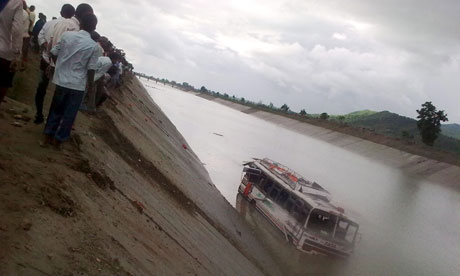
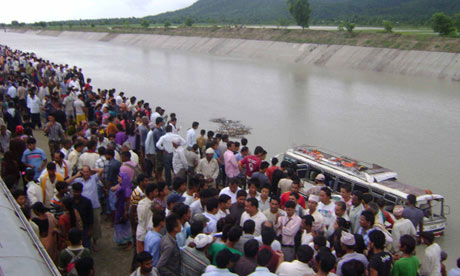
Nepal bus crash kills at least 39

At least 39 people are dead after an overcrowded bus carrying Hindu pilgrims skidded off a wet road in southern Nepal.

The driver lost control of the bus on the rain-slicked road and it plunged into a flooded irrigation canal, according to Nepalese police official Gyan Bikram Shah.

Rescuers have recovered 39 bodies.

Shah said the bus was so packed that some people were riding on the roof.

Most of those on board were believed to be Indian nationals from the neighbouring state of Uttar Pradesh visiting Nepal on an annual pilgrimage to Hindu temples.

However, the victims' identities are not yet clear because Indian citizens do not need to register when they cross into Nepal, Shah said.

The driver is believed to have survived the crash but may have fled, Shah said.

The crash site is about 100 miles (160km) south-west of the capital, Kathmandu.

Monday 16 July 2012

http://www.guardian.co.uk/world/2012/jul/15/nepal-bus-crash-indian-pilgrims

continue reading

9 die in Nepal's 2nd bus disaster in 2 days


KATMANDU, Nepal (AP) - Police in Nepal say a bus veered off a highway and plunged into a river, killing at least nine people and injuring 18 more in the mountainous nation's second road disaster in as many days.

The bus rolled some 100 meters (330 feet) from the highway and plunged Monday in the Trishuli river about 80 kilometers (50 miles) west of Katmandu, the capital.

Six bodies were pulled from the wreckage and three people died on the way to the hospital. Rescuers continued searching the swollen river for passengers.

It was not clear how many people had been on the bus.

Police are investigating the cause.

At least 39 people were killed on Sunday in another bus accident in Nepal, where roads and vehicles are often poorly maintained.

Monday 16 July 2012

http://www.klfy.com/story/19030671/9-die-in-nepals-2nd-bus-disaster-in-2-days

continue reading

32 dead or missing as flood victims begin clean-up

TOKYO - Flood victims in Japan began a full-scale clean-up operation Monday after record rainfall forced hundreds of thousands to flee and left at least 32 dead or missing in northern Kyushu.

Residents together with volunteers and local government officials shovelled mud and moved damaged furniture from their homes, while mechanical diggers removed fallen trees and debris from the roads.

Four days of torrential rainfall wrought devastation in the four prefectures of Kumamoto, Oita, Saga and Fukuoka, with rivers bursting their banks, and muddy water destroying or inundating houses.

 Electricity remained cut off to some 2,600 houses in northern Kyushu, according to Kyushu Electric Power Co, while local governments sent emergency response teams to villagers isolated by landslides.

Troops were called in Sunday to airlift supplies to those cut off, while local authorities dispatched rescue helicopters to ferry the elderly to hospital.

The death toll from landslides and floods rose to 27 Monday afternoon as the body of a 57-year-old man was recovered in Aso, Kumamoto Prefecture, officials said.

Rescuers continued searching for five missing people. Television footage showed rescue divers searching a river, while troops looking for bodies scoured flooded rice fields.

“We are stepping up efforts to remove rubble as roads remain covered with mud at many points,” Masatatsu Minoda, an official from Kyushu’s Kumamoto Prefecture, told AFP by phone. “Workers are engaged in clean-up efforts while taking care against possible further landslides. We may have to stop working if it rains heavily again.”

The meteorological agency said rains had eased but warned further downpours on Monday could trigger more landslides.

Light rainfall was recorded in northern Kyushu Monday morning but there were no immediate reports of further damage.

Most of the 400,000 people who were ordered or advised to evacuate their homes on the island were allowed to return home after authorities began lifting evacuation orders Sunday. But 6,000 were still under instructions to stay away.

In Yame, a mountainous area of Kyushu’s Fukuoka Prefecture, 5,000 people had been isolated by landslides, but just 82 remained cut off Monday, officials said.

Rainfall of up to 81.7 centimeters has been recorded in hardest-hit Aso, situated at the foot of a volcano in Kumamoto, where at least 19 people were killed and three others were still missing.

There was also heavy rain on Sunday in Kyoto—500 kilometers east of the affected areas in Kyushu—where about 20 people were temporarily trapped after a stream broke its banks.

Monday 16 July 2012

 http://www.japantoday.com/category/national/view/flood-hit-evacuees-start-returning-home-in-kyushu

continue reading

Hope lost in death, leaving nothing but a number

WITH their hopes for a better life snatched by a ferocious ocean, the bodies of 18 asylum-seekers who drowned in last month's two boat sinkings were unceremoniously loaded on to a plane bound for Perth at Christmas Island on the weekend.

The human tide continued with an asylum boat believed to be carrying 51 Tamil asylum-seekers arriving at Christmas Island and the merchant vessel Atlantic Hero rescuing 27 people 320km northwest of the Cocos Islands yesterday.

On Saturday each of the 18 bodies was transported in a vacuum-sealed wooden coffin marked with a numbered label and this, sadly, may be the only ultimate identifier for some of the victims. Just two of the bodies, both from the first capsizing, on June 21, have been identified so far.

There was only one victim from the second sinking, which happened less than a week later in the seas between Indonesia and Christmas Island. The sole victim of the second sinking is an adult male and West Australian police have said he could not be identified by any of the 130 survivors because they did not know him. Instead police will now try to identity the man, along with the the 15 unidentified bodies from the first capsizing, via disaster victim identification techniques such as dental records and matching DNA with family members.

This is likely to be a long and difficult process, with families from around the world and Australia contacting authorities desperate to know if their loved ones are among the bodies recovered. Post-mortems are also likely to be carried out on some of the bodies.

WA Police have established that there were as many as 220 passengers on the boat that sank on June 21, and only 110 people survived. These survivors, along with the 130 from the second high seas disaster, have been held in detention facilities on Christmas Island.

They have been interviewed by WA Police about the disaster and how they came to risk their lives in an unseaworthy vessel. As well, some have been interviewed by the Australian Federal Police about the people-smugglers they used to arrange their journey and the crew on the boat.

WA police detectives also left the island on the weekend, but their work will continue in Perth, where they will attempt to piece together who the missing are and prepare an extensive report for WA coroner Alastair Hope.

The bodies that left on Saturday had sat for weeks in a makeshift morgue that consisted of refrigerated shipping containers. These were placed behind the AFP headquarters, just metres down the road from Barracks Cafe.

Cafe co-owner Trish O'Donnell said people were deeply touched by the impact of bodies and injured passengers arriving on the island. Like many locals she is concerned people are becoming desensitised to tragedy. "It's not our island any more," she said.

The island's Muslim community also has been uncomfortable about the length of time the bodies remained on the island. Imam Abdul Ghaffar Ismail said Muslims were uneasy about this because Islam demanded bodies were buried as soon as possible.

It is unclear at this stage how many of the bodies will be buried in Australia and how many are likely to be repatriated to family in countries such as Afghanistan and Pakistan.

Monday 16 July 2012

 http://www.theaustralian.com.au/national-affairs/immigration/hope-lost-in-death-leaving-nothing-but-a-number/story-fn9hm1gu-1226426693290

continue reading

Friday, 13 July 2012

Kinross chartered plane crashes in Mauritania, 7 dead

(Reuters) - A plane chartered by Canada's Kinross Gold Corp crashed shortly after take-off in the North African country of Mauritania on Thursday, killing all seven people on board, the mining company said.

The Harbin Y-12-II military plane was chartered to carry gold from Kinross's Tasiast mine, located some 300 kilometers (185 miles) north of the Mauritanian capital of Nouakchott.

 It crashed just after take-off from Nouakchott en route to the mine.

The company said two pilots, two customs officials and three contract security guards were killed in the crash. No Kinross employees were on board.

Friday 13 July 2012

http://www.reuters.com/article/2012/07/12/kinross-mauritania-idUSL2E8IC5CX20120712?type=companyNews&feedType=RSS&feedName=companyNews&utm_source=feedburner&utm_medium=feed&utm_campaign=Feed%3A+reuters%2FcompanyNews+%28News+%2F+US+%2F+Company+News%29

continue reading

Private jet crash kills three Americans in France

A private jet has crashed in flames at the end of a runway in the south of France a police source told AFP.

Three Americans were killed on Friday when their private jet broke up and burst into flames on landing at an airport in the south of France, a police source told AFP.

 Emergency services battled to put out the blazing Gulfstream IV, which had earlier been reported as a Mystere-Falcon 20, at Castellet airport, between the Mediterranean cities of Marseille and Toulon.

The dead are two men aged 24 and 61 and a woman aged 30, the source said, adding that the plane crashed on landing at the private airport at Castellet after flying from Nice.

"The plane broke in two, one bit ended up in the lake at the end of the runway and the other bit caught fire," an air safety official told AFP, requesting anonymity.

The accident happened at Castellet airport, between Marseille and Toulon.

The accident mirrors a similar incident in 1995 when another Mystere Falcon 20 crashed on take-off at Le Bourget airport just north of Paris killing all ten people on board.

Friday 13 July 2012

http://news.sky.com/story/959853/six-trapped-after-jet-crashes-in-france

continue reading

Missing person’s relative obtains injunction protecting his genetic material

VASSILIS Pantazis, whose brother Philippos went missing in 1974, has taken legal steps to stop his genetic material from being used by any other body or entity except the Cyprus Institute of Neurology and Genetics (CING).

Nicosia Court yesterday pushed forwards a hearing for June 20 at the request of CING’s lawyer, Polys Polyviou, who asked for more time before the institute responded, Kathimerini newspaper reported.

In the meantime the court legally binds CING to keep put Pantazis’ genetic material. CING cannot “deliver and/or move and/or transfer the claimant’s genetic material to any other legal or physical entity” whatsoever in Cyprus or abroad, the court said.

The court order effectively stops the UN-supported Committee on Missing Persons (CMP) from sending Pantazis’ samples abroad, and could have sweeping implications on the use of the genetic material and profiles, currently in CING’s possession.

Pantazis told the Cyprus Mail that he was moved to go to court “given how things stand of late”. Last October a contract between the CMP and CING - the only body capable of carrying out missing persons’ DNA identifications – expired.

No new contract has been signed as of yet while missing persons’ remains have not been sent over to CING for identification.

The CMP has been asking CING to comply with a set of requirements which CING has publicly said it has met, making it unclear if and what requirements are the real sticking points. “I have lost trust,” Pantazis said adding this was his primary motivation for securing a court order.

Reports have suggested a lab in Bosnia as the most likely candidate for a new contract with the CMP for DNA identification, following the opening up of tenders in mid-February.

CING has publicly said it was willing to meet requirements set by the CMP, including assigning a project manager; meeting sorting process’ requirements; and handing over access to genetic profiles as long as they are legally assured they could.

The CMP has said that if requirements are met, they are happy for the process to stay at home. “All these games have convinced me to proceed with my lawyer to stop anyone, even the Republic of Cyprus, from using my genetic material,” Pantazis said.

The CMP, a bi-communal body investigates cases of persons reported missing during the sixties and 1974 under the auspices of the UN.

May 19, 2012

http://www.cyprus-mail.com/cyprus-institute-neurology-and-genetics/missing-person-s-relative-obtains-injunction-protecting-his

continue reading

Nigeria holds mass burial for tanker explosion victims

Casualties of Thursday’s tanker fire in Okobie village on the East-West Road in Ahoada West Local Government Area of Rivers State have been given a mass burial at the scene of the incident.

State sector commander for the commission Kayode Olagunju told reporters in Port Harcourt, the state capital that 89 of the 95 persons who died in the petrol tanker explosion were given a mass burial at Okobe village in the Ahoada West Local Government Area of Rivers State.

They were buried on Thursday evening.

The Sector Commander for the Rivers State Command of the Federal Road Safety Commission, Dr. Kayode Olagunju, stated this in a post on Facebook at 8.02p.m.

The incident occurred while some villagers were allegedly scooping fuel after the tanker was involved in a crash with three other vehicles.

He stated that 95 persons died in the incident, of which 87 bodies were burnt beyond recognition.

The FRSc chief listed the vehicles involved in the crash as the tanker, a Toyota Corolla car, Toyota Hiace bus and a Maza bus.

A total of 34 motorcycles were also involved in the crash and were consumed by the inferno along with the Mazda bus.

Large excavators were brought to the site on a major inter-state highway to dig a mass grave for victims whose bodies were too badly damaged to be transported or recognised. "They couldn't be moved," Semenitari said, putting the number of those already buried at more than 85.

Some of those being treated at the hospital were also burned beyond recognition, said Geoffrey Ikogha, a local chief in Ahoada, near the oil hub of Port Harcourt.

Children were among those killed, while dozens more were badly burned, despite a warning from troops who arrived at the crash site that a blaze could ignite at any moment.

Given the severity of the burns suffered by some at the hospital, the toll could yet increase, Semenitari told AFP. "There is a chance that we could lose 10 to 15 more... medically, they are in a bad state," she said.

The number of family and friends at the General Hospital in Ahoada was huge, with many sobbing uncontrollably. "Security people are having a tough time controlling the surging crowd," said Ikogha. "The situation is tragic and pathetic."

Many of the dead were motorcycle taxi operators, known locally as "Okada", who raced to fill up their tanks after learning of the crash, according to an AFP photographer at the scene.

He noted that of the 20 injured victims rushed to the hospital, two died. Olagunju also said the bodies of six of the victims who died on the spot were earlier released to their families.

His statement reads, “‎87 corpses burnt beyond recognition as a result of the crash involving a tanker and three other vehicles were this evening given mass burial at the scene of the crash at Okobe along Ahoada – Mbiama on the East – West Road in Rivers State. “Six of the bodies of the victims that died on the spot had earlier been identified and released to their families.

Two of the 20 injured victims taken to the hospital also died. “A total of 95 persons died in the crash with 18 others injured. “The vehicles involved were a Toyota Corolla cr with registration number RQ 218 AAA; Toyota Hiace XZ 613 AGL; and a tanker XA 340 TDU.

One Mazda bus adn 34 motor bikes were burnt beyond recognition.”

Friday 13 July 2012


http://www.punchng.com/news/dead-victims-of-rivers-tanker-fire-given-mass-burial/


http://news.ph.msn.com/top-stories/nigeria-oil-tanker-fire-kills-more-than-116

continue reading

Death toll from Ukraine bus crash reaches 15

Pskov, Russia - A woman died at a Chernihiv hospital, bringing the number of Russian pilgrims killed in a road accident in Ukraine to 15, a regional administration source told Interfax-Ukraine.

The woman, who sustained severe injuries in the accident, died despite doctors' efforts to save her life.

Two Russian pilgrims, Marina Moryakova, who was mistakenly listed as dead, and Sergei Potashenkov, remain at Chernihiv's clinic.

The Health Ministry said on Thursday, July 12, that, according to Ukrainian doctors, the state of one of the Russian citizens being treated in Chernihiv had improved.

Fourteen pilgrims from Russia's town of Velikye Luki were killed and another 29 were injured in a bus crash in Ukraine early on July 7. They were heading to a monastery in western Ukraine's Pochayiv.

Twenty-seven people injured in the accident are currently being treated at hospitals in Moscow, Pskov and Chernihiv.

Friday 13 July 2012 

http://www.kyivpost.com/content/ukraine/death-toll-from-ukraine-bus-crash-reaches-15.html#.T__s9rpVlnU

continue reading

24 confirmed dead in South Africa crash

JOHANNESBURG (Reuters) - A coal train ploughed into a truck at a level crossing on Friday in eastern South Africa on Friday, killing 24 people on their way to pick fruit at a nearby farm, police and emergency services said.

"The truck carrying farm workers was hit by a train at a level crossing," Mpumalanga police spokesman Joseph Mabusa told Reuters.

"It is a very gruesome scene. Some bodies are without heads and some without limbs. Forensic teams are still working on the scene," Mabusa said.

The truck was carried 200 meters by the impact, leaving body parts in its wake and making it hard for forensic experts to say how many people were killed, he added. "The driver was taken to hospital. His condition is unknown.

It's difficult to say what happened but at this stage it seems that the truck miscalculated as it was crossing the railway line." Emergency services said at least 24 other people were injured, some of them critically, in the smash near the town of Hectorspruit, about 400 km east of Johannesburg.

State rail operator Transnet said the train was carrying coal for export to Mozambique, but there was no derailment.

The coal was destined for the Indian Ocean port of Maputo. Mpumalanga is one of South Africa's major coal-producing regions.

South Africa's government has announced plans to spend billions of dollars on revamping its creaking rail network, although human error is as often to blame for sporadic accidents.

Traffic accidents with high death tolls are common in South Africa, and often are blamed on negligent drivers and badly maintained roads.

In 2010, a man driving 14 children to school evaded barriers at a crossing near Cape Town and a train crashed into it, killing 10 of his young passengers. The driver was convicted of murder in the deaths of the students and attempted murder in the case of the four surviving children. He was sentenced to 20 years in prison.

Friday 13 July 2012

http://www.cnbc.com/id/48172685

continue reading

Thursday, 12 July 2012

3 killed, 33 injured after school bus accident in Indian-controlled Kashmir

Srinagar - A 14 year old student, a teacher and a driver were killed, while 44 others injured after a bus carrying students on excursion met with and accident at Nambal Nard on Baramulla-Baba Reshi road in district Baramulla of north Kashmir Wednesday.

While the pall of gloom descended on Kalaroos and its adjoining villages, the news of accident created panic in most parts north Kashmir as scores of schools were on excursion from the area. The Education Department has cancelled the registration of the school and withdrew its affiliation.

ACCIDENT 

Police said the bus bearing registration number JK14-6144 was carrying 69 students of Iqra Educational Institute (Middle School) Kalaroos in Kupwara district. The bus police said was on way to Baba Reshi shrine and while crossing a curve at Nambal Nard near Tangmarg, the driver lost control over the vehicle and it fell into a 60 feet deep gorge. “The accident took place at 11.43 am. So far three persons are dead and 44 injured,” Station House Officer Tangmarg Zahoor Ahmad told Greater Kashmir over telephone. “We have registered a case vide FIR number 84 under section 279 and 304 in Police Station Tangmarg and have started investigations.” Police identified the deceased as 14 year old Owais Manzoor Wani, Jehangir Ahmad Dar (25) teacher and bus driver Akhter Hussain Ganie (32). The body of the driver was trapped under the wreckage of the bus, and was retrieved after 3 hours of rescue operation carried jointly by local residents, police and the Army.

Soon after the news of mishap spread, the locals in hundreds from Nambal Nard and its adjoining villages rushed to the spot to rescue the victims. They were later joined by police and the Army contingents in rescue operation. Soon after the new about the accident spread in the area, sources said people made announcements on loudspeakers of the mosques, appealing the people to come out and join the rescue operations. The women were seen carrying potable water and offering it to the injured. The students, sources added were crying for help. “The scene at accident site was frustrating. But we kept our nerves and managed to get the injured out of the bus,” Abdul Rashid of Nambal Nard told Greater Kashmir.

The students, who were being rescued, were shifted to different hospitals of Srinagar. Around 24 were admitted in SMHS, 9 in SKIMS and 11 in JVC. The injured were ferried in ambulances, police and Army vehicles first to Primary Health Center (PHC) Tangmarg and later to hospitals in Srinagar.

In SMHS hospital, the spleen of class 4th student was removed. “We got 24 injured children, spleen of one student was removed and four were shifted to SKIMS,” Medical Superintendent SMHS hospital Dr Nazir Ahmad Chowdhary told Greater Kashmir adding nobody died in his hospital. “Every student is monitored by teams of doctors and hopeful they will recover.”

The officials at SKIMS told Greater Kashmir that nine injured students were brought to institute. “One among them is in Intensive Care Unit,” they said adding that condition of injured is being monitored closely. The officials at JVC hospital said that 14 injured students were brought for treatment among them three were shifted to SKIMS. “Others are being treated and are to some extent stable,” they said.

SCENE AT KALAROOS 

Pall of gloom descended on Kalaroos village once the news of accident spread in the area and its adjoining villages. The parents and other residents were mourning and were trying to get the first hand information about their wards.

The women were wailing and beating their chest and male folk was trying to get the exact details about the tragedy. “Chaos and confusion prevailed in Kalaroos and its adjoining areas soon after the news spread. The people came out of their homes and thronged the roads. They were inquiring from each other about the accident,” Mushtaq Ahmad Lone of Kalaroos told Greater Kashmir over telephone.

The shops in Kalaroos and its adjoining got closed within minutes after news of accident and employees, traders and students of other schools returned, leaving their engagements half way. Most of the other schools in the area also were closed after they heard the news of the tragic accident.

Though, the people were unable to get any communication link with the teachers, but they later relied on the information provided to them by Police Control Room (PCR) Kupwara and police station Kupwara. Most of the parents were successful in arriving at SMHS, SKIMS, JVC and Tangmarg hospitals were the injured were being treated.

NO PERMISSION SOUGHT 

The school neither sought permission for excursion from the Zonal Education Officer Kalaroos nor from Chief Education Officer Kupwara. “They (school management) has not sought permission from my office or ZEO office,” CEO Kupwara Muzzafar Ahmad told Greater Kashmir. “They have left for excursion on their own. No school here approaches us for permission.”

GOVT SHOCKED, ANNOUNCES RELIEF 

Most of ministers have expressed grief over the accident and expressed solidarity with accident victims.

Thursday 12 July 2012

http://www.greaterkashmir.com/news/2012/Jul/12/3-killed-44-injured-as-picnic-bus-rolls-into-gorge-51.asp

continue reading

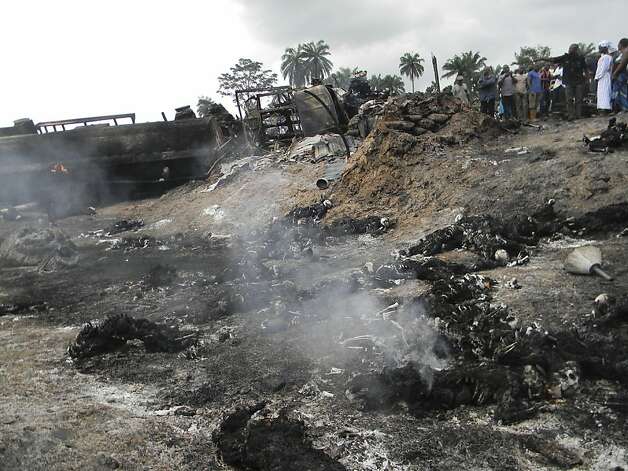
Nigeria fuel tanker fire kills 95


At least 95 people including women and children were killed on Thursday after a gasoline tanker crashed on the east-west road in Nigeria's oil-producing Niger Delta and caught fire as people tried to scoop up fuel.

"Early this morning a tanker loaded with petrol fell in Okogbe and people trooped to the scene obviously to scoop the spilled fuel and suddenly there was fire resulting in casualties," Rivers State police spokesman Ben Ugwuegbulam said.

Ugwuegbulam said it was too early to give a casualty figure but a Reuters witness at the scene counted 92 dead bodies of men, women and children.

Two further people died later in hospital, an official added.

Hundreds of people crowded around as soldiers and emergency workers lifted bodies into ambulances and police trucks. The fuel tanker was a pile of smouldering ash, twisted metal and melting tyres.

The tanker swerved as it was trying to avoid a collision with three oncoming vehicles including a bus, said Kayode Olagunju, sector commander of the Federal Road Safety Commission in the southern Rivers state.


Residents said that shortly after the collision hundreds of locals flocked to the site to collect the spilling fuel.
"Then there was an explosion followed by fire," Olagunju told AFP. "Ninety-three were burned to death on the spot. Two died later in the hospital (and) 18 people were seriously injured."

In a statement, the National Emergency Management Agency (NEMA) gave the same figures.
An AFP photographer at the scene said many of those killed were motorcycle taxi operators, known locally as "Okada", who raced to fill up their tanks after learning of the crash.

Olagunju said at least 34 motorcycles were destroyed in the blaze.

The accident happened in an area called Ahoada near the oil hub of Port Harcourt in Nigeria's crude-producing Niger Delta region.

Crashes are common on Nigeria's potholed and poorly maintained roads, and in a region where most people live on less than £1.50 a day, the chance to collect spilling petrol is too much of a temptation, despite the high risk of fires.

The east-west road, which runs across the oil-producing region, has been scheduled for development for almost a decade and money is allocated for it in the budget each year.

Nigeria, Africa's biggest oil producer, is plagued by corruption and inefficiency. Most years only about half budgeted programmes are implemented.

Major accidents, often involving large-haul trucks, are common in Nigeria, where many of the roads in terrible condition.

Lorries operating on the country's road are often old and poorly maintained and road worthiness checks are scant.

Abandoned trucks, some of them destroyed by heavy collisions, can regularly be seen along major Nigerian motorways.

In March, a petrol tanker caught fire after skidding off the road in southern Port Harcourt, killing six people and injuring several others.

While in April last year, a fuel tanker overturned at an army checkpoint in central Nigeria, sparking an inferno in which some 50 people were killed.

Thursday 12 July 2012

http://www.telegraph.co.uk/news/worldnews/africaandindianocean/nigeria/9395126/Nigeria-fuel-tanker-fire-kills-95.html

http://www.google.com/hostednews/afp/article/ALeqM5gI3ZdIByWzakIQ-LyNrsmLwWZw8w?docId=CNG.f7d00a96706cd138bb7bb6b52e38d2c4.331

continue reading

Disaster on 'cursed mountain': Five Britons missing after deadly avalanche in French Alps leaves nine dead

Five British climbers are feared to be among the victims of an avalanche which killed nine in the French Alps this morning.

The massive slide of snow happened around 5am this morning as early morning climbers made their way up Mount Maudit, which is in the Mont Blanc range.

Most of them were roped together on what is considered to be one of the most dangerous ascents in Europe. Rescuers from the Alpine PGHM (mountain rescue service) said the initial estimated death toll was 'at least six'. '

There are around eight others injured and at least two people missing,' added a spokesman, who said that the avalanche had been caused by snow collapsing in July heat. 'We were initially alerted just after dawn by one of the survivors who called us on a mobile phone.' All of the injured have been evacuated by helicopter to nearby hospitals, as police supported by search dogs continued to look for survivors.

There were reported to have been 28 people in the moutaineering group, from several countries including Switzerland, Serbia, Germany, Spain and France.

 Five of the group are now safe back down in the valley, including a guide, but others in the party are still missing.

 It was reported that at a press briefing following the avalanche, claims were made that a lone mountaineer may have set off the avalanche above the group.

The six dead have been confirmed as two Germans, two Swiss, and two Spanish mountaineers, according to Chamonet.com.

The six dead in the avalanche were said to have been in a group of 20 climbers when they were caught in the snow slide At 4345m, Mont Maudit is one of a range of peaks also including Mont Blanc du Tacul which are hugely popular with climbers in the summer.

The first ever ascent of Mont Maudit was by a British party in 1878.

Because of its steep slopes and abundance of thick ice it is often likened to a glass tower block. Despite being popular as a tourist destination with thousands of Britons in both the winter and summer, the Mont Blanc range is one of the most lethal in the world.

It has killed more climbers than any other mountain range, with the annual death toll regularly reaching beyond the 100 mark.

Many lose their lives as they attempt to scale its peaks with insufficient training or supplies. There were no avalanche warnings before the 'deadliest snow slide in recent years', said Eric Fournier, the Mayor of Chamonix.

Mr Fournier said: 'There were no weather reports forecasting an avalanche risk.' Instead huge walls of snow are believed to have been created by high winds overnight, creating so-called 'Wind Slabs' which are hugely dangerous when they collapse.

Today's avalanche is thought to have happened at dawn, as the heavily impacted snow began to warm up and then cascade downwards. In August 2008 eight climbers - three Swiss, one German, and four Austrian - died in a similar accident on the nearby Mont Blanc du Tacul.

Thursday 12 July 2012

Read more: http://www.dailymail.co.uk/news/article-2172418/Mont-Blanc-avalanche-Disaster-cursed-mountain-Five-Britons-missing-deadly-avalanche-French-Alps-leaves-dead.html#ixzz20PCvKCYo

continue reading

In the event of a catastrophe, San Diego County has a plan for mass burials

Less than half a mile west of the San Diego Convention Center, just past the Manchester Grand Hyatt and next to the Seaport Village sign, lies the marker for a mass grave. Somewhere beneath the soil of La Punta de los Muertos, “Dead Men’s Point,” rest the bodies of an indeterminate number of Spanish sailors who perished from scurvy on a 1782 survey mission commanded by Don Augustín de Echeverria.

Some historians claim the ground holds the bones of another 100 sailors who succumbed to scurvy and dysentery during the first expedition to San Diego, led by explorer Gaspar de Portolà and Father Juniper Serra in 1769.

Mass burials have been part of San Diego history from the beginning, and, if catastrophe were to destroy the city, mass burials would likely mark the city’s end, too. And local government is somewhat ready for it—Section VI of Annex F of the regional “Operational Area Emergency Plan” describes the conditions that would necessitate mass burial, names those who would make the decision and identifies suitable locations for large graves.

In its field manual for first responders, Management of Dead Bodies After Disasters, the Pan-American Health Organization (PAHO) cautions against jumping too quickly to this measure. Done haphazardly, it could traumatize families and pose significant legal liabilities.

While decaying bodies may be putrid, PAHO says that, contrary to popular belief, the presence of dead bodies doesn’t present a health risk. Instead, mass burials should be used primarily to preserve bodies temporarily for identification purposes in situations where adequate refrigeration isn’t available.

However, in the long term, PAHO acknowledges communal graves may be the only option. But a lot would have to happen for San Diego to get to that point—starting with a “Level 3” event, such as a natural disaster, terrorist attack or nuclear accident (or zombie outbreak), in which the local agencies are overwhelmed with bodies.

Medical examiner 

In a mass-fatality situation, the San Diego County Department of the Medical Examiner would be the lead organization for managing dead bodies, coordinating the identification process and manning family-assistance centers.

Management of Dead Bodies After Disasters 

The medical examiner opened a new building in 2009, which currently has a capacity for 500 bodies. The department also owns a “mobile morgue” that can refrigerate 12 more.

Two morgue trailers each hold 22 bodies. When the medical examiner’s capacity reaches its brink—approximately 556 bodies—the department is authorized to open temporary morgue facilities in locations such as airport hangars and empty warehouses.

According to the emergency plan, these facilities must be secure, equipped with showers and have front-office reception areas.

The medical examiner can call for backup via the federal-level Disaster Mortuary Operational Response Team. According to Dr. Amado Alejandro Baez, a national specialist in mortuary services in disaster scenarios, displaying 1,000 bodies would require approximately 2,000 square meters of space.

Baez estimates decomposition may render a body unidentifiable within 48 hours, creating a small window for establishing identity and photographing the bodies. Mass burial According to the regional emergency plan, a mass burial could become necessary when the dead can’t be refrigerated or embalmed, properly processed or released to next of kin and area cemeteries aren’t able to shoulder the extra load.

The decision to invoke the mass-burial protocol would fall to three county officials in particular: Chief Medical Examiner Glenn Wagner, Public Health Officer Wilma J. Wooten and Emergency Services Director Holly Crawford. The California Emergency Management Agency would need to sign off on it, as would local officials, including the San Diego County Board of Supervisors.

PAHO’s field manual lays out the specifications for a mass-burial trench. A mass grave should be between 1.5 and 3 meters deep, at least 200 meters from drinking water sources and 2 meters above the water table. Each body should be placed in a body bag or wrapped in a sheet and laid in a single layer with about .4 meters between each body. The bodies should be meticulously documented in a grid for later identification.

Cremation, according to PAHO, should be avoided because it destroys evidence, often results in partially incinerated remains that would have to be buried anyway and requires an enormous amount of fuel (300 kilograms of wood per body, Baez says).

Gravesites 

The first choice for a mass-burial site, of course, would be an existing cemetery. Assuming that’s not an option, the regional plan identifies six alternative types of locations: county landfills, parks and recreational areas, flood-control basins (“weather permit ting”), sides of freeways or river beds, areas beneath power lines and rail yards or along rail lines.

But while geographically feasible, most would be a tough sell politically, says Michael Pallamary, who runs the local land-use consulting and surveying firm Pallamary & Associates. “Contemporary land-use planning has a lot to do with the political implications, so [with a mass grave], you’d either have to face political stigma or the environmental implications,” he says. “You’re not going to bury them in Mission Valley near hotels or golf courses.

The concept of burying in a flood-control channel and having it wash up, that’s hardly an attractive venture.” Pallamary knows a place that meets many of those criteria: the uninhabitable area to the southeast of Mission Bay, near Sea World Drive and Friars Road. It used to be a toxic dump and is near the San Diego River, two freeways and an electricity substation.

The proposed Gregory Canyon Landfill would also be an obvious location, but, based on the county’s list, Pallamary thinks the best options are easements under power lines owned by San Diego Gas & Electric. “I think the power lines would be the only contemporary viable site,” he says. “A lot of these power lines are extraordinarily wide so they could accommodate significant burial sites, and you’re probably never going to use those areas anyway.”

Thursday 12 July 2012

http://www.sdcitybeat.com/sandiego/article-10735-where-will-the-bodie.html

continue reading

We threw bodies overboard: Eritrean survivor of boat tragedy

ZARZIS, Tunisia (AFP) - Eritrean Abbes Settou, the sole survivor among some 50 migrants who died of hunger and thirst after their inflatable boat ruptured in the Mediterranean, said Wednesday he had survived "by the grace of God."

Speaking to AFP from hospital in Tunisia, Settou, said his fellow passengers, who included other Eritreans and a group of Somalis, "died of hunger, of thirst, of exhaustion.

We threw their bodies overboard." Among the dead, he said were 10 women.

Earlier, the UNHCR in Geneva said Settou, who drank sea water to survive, was spotted clinging to a jerry can and the remains of the boat off the Tunisian coast on Monday night by fishermen who alerted the coast guard.

Settou said there was no fresh water on board and people started to perish within days, including three members of his family, according to the UNHCR.

 The refugee agency quoted him as saying 55 people boarded the boat in the Libyan capital Tripoli in late June, and that more than half were from Eritrea, including himself.

They were unable to call for help because the boat's satellite phone was broken, according to Father Mussie Zerai, an Eritrean priest who spoke to the survivor by telephone on Wednesday. "He said they were at sea for 15 days in total," the priest told AFP. "They had apparently reached Italian waters but they weren't able to call for help because the satellite phone was broken, so the wind pushed them back out into open sea.

"During those 15 days the people on board slowly began dying of hunger and thirst. They were lost, they could not orient themselves. "He is recovering.

In a few days he said he would be moving to a refugee camp." A UNHCR official in Tunisia said Settou would be moved to an apartment in Zarzis, which is 400 kilometres (240 miles) southeast of Tunis, near the Libyan border.

 In his account of the ordeal to the UN High Commissioner for Refugees, Settou said the boat had punctured and air started to leak out.

UNHCR spokeswoman Sybella Wilkes said Settou is "in a pretty awful state and he's obviously gone through a terrible, terrible experience progressively watching his family members dying." "This is a tragedy," said T. Alexander Aleinikoff, Deputy High Commissioner for Refugees. "I call upon all vessels at sea to be on heightened alert for migrants and refugees needing rescue in the Mediterranean."

The UN agency estimates that 170 people have been declared dead or lost at sea attempting to make the journey from Libya to Europe so far this year.

Greece and Italy are the two main entry points for undocumented immigrants into the European Union. Italy in particular has seen a spike in arrivals over the past year following the Arab Spring revolts in North Africa.

Malta is also a frequent landing point but is increasingly being spurned by immigrants worried about the relatively lengthy registration process for new arrivals, the UNHCR said. "With that knowledge, people are going on to Italy," said Wilkes. "We didn't see this at all last year, that boats are finding their way to Malta and then refusing to go in."

So far in 2012, more than 1,300 people have made the sea journey to Italy from Libya, the UNHCR said. The busiest period for crossings is from May to September, when the Mediterranean Sea is at its calmest, the agency added.

Thursday 12 July 2012

 http://au.news.yahoo.com/thewest/a/-/world/14205800/54-migrants-die-of-thirst-in-boat-tragedy-off-tunisia/

continue reading