Tuesday, 17 July 2012

Train derails in Egyptian capital Cairo: 'many dead'

An Egyptian passenger train has derailed and caught fire in a suburb of Cairo, reportedly leaving many people dead. Five of its cars overturned.

Egyptian media report at least 4 people killed and 70 injured. A security source has told Reuters that at least 15 people were injured. 


Reports also say the accident took place in the Badrasheen area of Giza, as the train was heading for the southern province of Suhaq. The train was coming from the town of Sohag, 500 kilometres south of Cairo.

The number of casualties and the death toll are still unconfirmed.

At least five ambulances rushed to the scene to help the victims, amid fears of a large death toll.  

Other train accidents in Egypt

The railway system's poor safety record has long been blamed on badly maintained equipment and poor management. 


Feb 20 2002: 361 die when a train catches fire 43 miles south of Cairo.


Aug 21 2006: At least 58 are killed in the collision of two trains travelling on the same rail track north of Cairo. 

Tuesday 17 July 2012


http://news.sky.com/story/961426/many-killed-in-train-crash-in-egypt

continue reading

Death toll from Japan's heavy rain rises to 28

The death toll from record rainfall on the southern Japanese island of Kyushu rose to 28 on Monday and rescue workers searched for four missing people, reports said.

Evacuation orders were lifted in most parts of the region and many residents had returned to clean up flooded homes.

Substantial damage was inflicted on farming and fishing industries in Fukuoka prefecture. Dozens of fishing boats went adrift and farm machines were submerged, the Nishinippon newspaper cited local authorities as saying.

Greenhouses were also damaged and a seaweed farm was flooded in the prefecture, it said. Many residents in northern mountainous areas of Yame were without electricity and water after a flooding river destroyed facilities and caused utility poles to collapse, NTV reported.

 The Japan Meteorological Agency predicted more rain in the region and local authorities warned of more mudslides and flooding.

As warm, humid air created an active front over the north of Kyushu, the levels of rainfall that hit parts of the island since Wednesday were unprecedented, the agency said.

Tuesday 17 July 2012

http://www.businessghana.com/portal/news/index.php?op=getNews&news_cat_id=&id=169413

continue reading

Okobe petrol fire disaster death toll rises to 124

Abuja – The death toll from Okobe petrol tanker disaster rose to 124 on Monday, up from 95, the Rivers Sector Commander of the Federal Road Safety Commission (FRSC), Dr Kayode Olagunju, said.

Olagunju said that the number was arrived at, based on additional deaths from various hospitals. “We are still battling with the actual injury figures as a lot of victims were transferred from one hospital to the other which could result in multiple counting. “Some victims initially went home for traditional treatment while some headed for private clinics,’’ Olagunju said, adding that the commission would liaise with other agencies and the Rivers Government to collate a more realistic figure.

The Okobe tragedy occurred around 6.30 a.m on Thursday following the crash of a petrol-carrying tanker and three other vehicles on the Ahoda-Mbiama east-west road in Rivers.

People around thronged the scene scrambling for spilled petrol, resulting in the flame which consumed the dead and the injured, according to FRSC which added that 34 motor-cycles were also burnt during the incident.

The 87 bodies burnt beyond recognition were given mass burial at the scene of the disaster on the same day, while six identified bodies were released to family members.

Crashes are common on Nigeria’s pot-holed and poorly maintained roads, and in a region where most people live on less than $2 a day the chance to collect spilling petrol is too much of a temptation, despite the high risk of fires.

Tuesday 17 July 2012

http://www.vanguardngr.com/2012/07/okobe-petrol-fire-disaster-death-toll-rises-to-124-frsc/

continue reading

Monday, 16 July 2012

Nepal bus crash kills at least 39

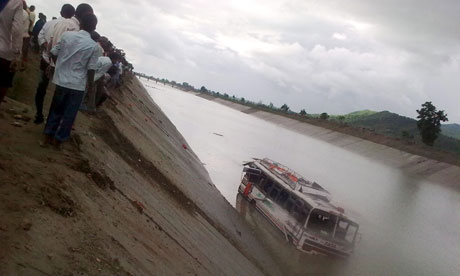
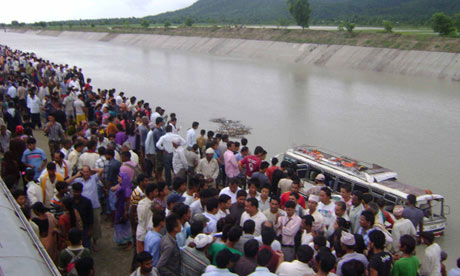
At least 39 people are dead after an overcrowded bus carrying Hindu pilgrims skidded off a wet road in southern Nepal.

The driver lost control of the bus on the rain-slicked road and it plunged into a flooded irrigation canal, according to Nepalese police official Gyan Bikram Shah.

Rescuers have recovered 39 bodies.

Shah said the bus was so packed that some people were riding on the roof.

Most of those on board were believed to be Indian nationals from the neighbouring state of Uttar Pradesh visiting Nepal on an annual pilgrimage to Hindu temples.

However, the victims' identities are not yet clear because Indian citizens do not need to register when they cross into Nepal, Shah said.

The driver is believed to have survived the crash but may have fled, Shah said.

The crash site is about 100 miles (160km) south-west of the capital, Kathmandu.

Monday 16 July 2012

http://www.guardian.co.uk/world/2012/jul/15/nepal-bus-crash-indian-pilgrims

continue reading

9 die in Nepal's 2nd bus disaster in 2 days


KATMANDU, Nepal (AP) - Police in Nepal say a bus veered off a highway and plunged into a river, killing at least nine people and injuring 18 more in the mountainous nation's second road disaster in as many days.

The bus rolled some 100 meters (330 feet) from the highway and plunged Monday in the Trishuli river about 80 kilometers (50 miles) west of Katmandu, the capital.

Six bodies were pulled from the wreckage and three people died on the way to the hospital. Rescuers continued searching the swollen river for passengers.

It was not clear how many people had been on the bus.

Police are investigating the cause.

At least 39 people were killed on Sunday in another bus accident in Nepal, where roads and vehicles are often poorly maintained.

Monday 16 July 2012

http://www.klfy.com/story/19030671/9-die-in-nepals-2nd-bus-disaster-in-2-days

continue reading

32 dead or missing as flood victims begin clean-up

TOKYO - Flood victims in Japan began a full-scale clean-up operation Monday after record rainfall forced hundreds of thousands to flee and left at least 32 dead or missing in northern Kyushu.

Residents together with volunteers and local government officials shovelled mud and moved damaged furniture from their homes, while mechanical diggers removed fallen trees and debris from the roads.

Four days of torrential rainfall wrought devastation in the four prefectures of Kumamoto, Oita, Saga and Fukuoka, with rivers bursting their banks, and muddy water destroying or inundating houses.

 Electricity remained cut off to some 2,600 houses in northern Kyushu, according to Kyushu Electric Power Co, while local governments sent emergency response teams to villagers isolated by landslides.

Troops were called in Sunday to airlift supplies to those cut off, while local authorities dispatched rescue helicopters to ferry the elderly to hospital.

The death toll from landslides and floods rose to 27 Monday afternoon as the body of a 57-year-old man was recovered in Aso, Kumamoto Prefecture, officials said.

Rescuers continued searching for five missing people. Television footage showed rescue divers searching a river, while troops looking for bodies scoured flooded rice fields.

“We are stepping up efforts to remove rubble as roads remain covered with mud at many points,” Masatatsu Minoda, an official from Kyushu’s Kumamoto Prefecture, told AFP by phone. “Workers are engaged in clean-up efforts while taking care against possible further landslides. We may have to stop working if it rains heavily again.”

The meteorological agency said rains had eased but warned further downpours on Monday could trigger more landslides.

Light rainfall was recorded in northern Kyushu Monday morning but there were no immediate reports of further damage.

Most of the 400,000 people who were ordered or advised to evacuate their homes on the island were allowed to return home after authorities began lifting evacuation orders Sunday. But 6,000 were still under instructions to stay away.

In Yame, a mountainous area of Kyushu’s Fukuoka Prefecture, 5,000 people had been isolated by landslides, but just 82 remained cut off Monday, officials said.

Rainfall of up to 81.7 centimeters has been recorded in hardest-hit Aso, situated at the foot of a volcano in Kumamoto, where at least 19 people were killed and three others were still missing.

There was also heavy rain on Sunday in Kyoto—500 kilometers east of the affected areas in Kyushu—where about 20 people were temporarily trapped after a stream broke its banks.

Monday 16 July 2012

 http://www.japantoday.com/category/national/view/flood-hit-evacuees-start-returning-home-in-kyushu

continue reading

Hope lost in death, leaving nothing but a number

WITH their hopes for a better life snatched by a ferocious ocean, the bodies of 18 asylum-seekers who drowned in last month's two boat sinkings were unceremoniously loaded on to a plane bound for Perth at Christmas Island on the weekend.

The human tide continued with an asylum boat believed to be carrying 51 Tamil asylum-seekers arriving at Christmas Island and the merchant vessel Atlantic Hero rescuing 27 people 320km northwest of the Cocos Islands yesterday.

On Saturday each of the 18 bodies was transported in a vacuum-sealed wooden coffin marked with a numbered label and this, sadly, may be the only ultimate identifier for some of the victims. Just two of the bodies, both from the first capsizing, on June 21, have been identified so far.

There was only one victim from the second sinking, which happened less than a week later in the seas between Indonesia and Christmas Island. The sole victim of the second sinking is an adult male and West Australian police have said he could not be identified by any of the 130 survivors because they did not know him. Instead police will now try to identity the man, along with the the 15 unidentified bodies from the first capsizing, via disaster victim identification techniques such as dental records and matching DNA with family members.

This is likely to be a long and difficult process, with families from around the world and Australia contacting authorities desperate to know if their loved ones are among the bodies recovered. Post-mortems are also likely to be carried out on some of the bodies.

WA Police have established that there were as many as 220 passengers on the boat that sank on June 21, and only 110 people survived. These survivors, along with the 130 from the second high seas disaster, have been held in detention facilities on Christmas Island.

They have been interviewed by WA Police about the disaster and how they came to risk their lives in an unseaworthy vessel. As well, some have been interviewed by the Australian Federal Police about the people-smugglers they used to arrange their journey and the crew on the boat.

WA police detectives also left the island on the weekend, but their work will continue in Perth, where they will attempt to piece together who the missing are and prepare an extensive report for WA coroner Alastair Hope.

The bodies that left on Saturday had sat for weeks in a makeshift morgue that consisted of refrigerated shipping containers. These were placed behind the AFP headquarters, just metres down the road from Barracks Cafe.

Cafe co-owner Trish O'Donnell said people were deeply touched by the impact of bodies and injured passengers arriving on the island. Like many locals she is concerned people are becoming desensitised to tragedy. "It's not our island any more," she said.

The island's Muslim community also has been uncomfortable about the length of time the bodies remained on the island. Imam Abdul Ghaffar Ismail said Muslims were uneasy about this because Islam demanded bodies were buried as soon as possible.

It is unclear at this stage how many of the bodies will be buried in Australia and how many are likely to be repatriated to family in countries such as Afghanistan and Pakistan.

Monday 16 July 2012

 http://www.theaustralian.com.au/national-affairs/immigration/hope-lost-in-death-leaving-nothing-but-a-number/story-fn9hm1gu-1226426693290

continue reading

Friday, 13 July 2012

Kinross chartered plane crashes in Mauritania, 7 dead

(Reuters) - A plane chartered by Canada's Kinross Gold Corp crashed shortly after take-off in the North African country of Mauritania on Thursday, killing all seven people on board, the mining company said.

The Harbin Y-12-II military plane was chartered to carry gold from Kinross's Tasiast mine, located some 300 kilometers (185 miles) north of the Mauritanian capital of Nouakchott.

 It crashed just after take-off from Nouakchott en route to the mine.

The company said two pilots, two customs officials and three contract security guards were killed in the crash. No Kinross employees were on board.

Friday 13 July 2012

http://www.reuters.com/article/2012/07/12/kinross-mauritania-idUSL2E8IC5CX20120712?type=companyNews&feedType=RSS&feedName=companyNews&utm_source=feedburner&utm_medium=feed&utm_campaign=Feed%3A+reuters%2FcompanyNews+%28News+%2F+US+%2F+Company+News%29

continue reading

Private jet crash kills three Americans in France

A private jet has crashed in flames at the end of a runway in the south of France a police source told AFP.

Three Americans were killed on Friday when their private jet broke up and burst into flames on landing at an airport in the south of France, a police source told AFP.

 Emergency services battled to put out the blazing Gulfstream IV, which had earlier been reported as a Mystere-Falcon 20, at Castellet airport, between the Mediterranean cities of Marseille and Toulon.

The dead are two men aged 24 and 61 and a woman aged 30, the source said, adding that the plane crashed on landing at the private airport at Castellet after flying from Nice.

"The plane broke in two, one bit ended up in the lake at the end of the runway and the other bit caught fire," an air safety official told AFP, requesting anonymity.

The accident happened at Castellet airport, between Marseille and Toulon.

The accident mirrors a similar incident in 1995 when another Mystere Falcon 20 crashed on take-off at Le Bourget airport just north of Paris killing all ten people on board.

Friday 13 July 2012

http://news.sky.com/story/959853/six-trapped-after-jet-crashes-in-france

continue reading

Missing person’s relative obtains injunction protecting his genetic material

VASSILIS Pantazis, whose brother Philippos went missing in 1974, has taken legal steps to stop his genetic material from being used by any other body or entity except the Cyprus Institute of Neurology and Genetics (CING).

Nicosia Court yesterday pushed forwards a hearing for June 20 at the request of CING’s lawyer, Polys Polyviou, who asked for more time before the institute responded, Kathimerini newspaper reported.

In the meantime the court legally binds CING to keep put Pantazis’ genetic material. CING cannot “deliver and/or move and/or transfer the claimant’s genetic material to any other legal or physical entity” whatsoever in Cyprus or abroad, the court said.

The court order effectively stops the UN-supported Committee on Missing Persons (CMP) from sending Pantazis’ samples abroad, and could have sweeping implications on the use of the genetic material and profiles, currently in CING’s possession.

Pantazis told the Cyprus Mail that he was moved to go to court “given how things stand of late”. Last October a contract between the CMP and CING - the only body capable of carrying out missing persons’ DNA identifications – expired.

No new contract has been signed as of yet while missing persons’ remains have not been sent over to CING for identification.

The CMP has been asking CING to comply with a set of requirements which CING has publicly said it has met, making it unclear if and what requirements are the real sticking points. “I have lost trust,” Pantazis said adding this was his primary motivation for securing a court order.

Reports have suggested a lab in Bosnia as the most likely candidate for a new contract with the CMP for DNA identification, following the opening up of tenders in mid-February.

CING has publicly said it was willing to meet requirements set by the CMP, including assigning a project manager; meeting sorting process’ requirements; and handing over access to genetic profiles as long as they are legally assured they could.

The CMP has said that if requirements are met, they are happy for the process to stay at home. “All these games have convinced me to proceed with my lawyer to stop anyone, even the Republic of Cyprus, from using my genetic material,” Pantazis said.

The CMP, a bi-communal body investigates cases of persons reported missing during the sixties and 1974 under the auspices of the UN.

May 19, 2012

http://www.cyprus-mail.com/cyprus-institute-neurology-and-genetics/missing-person-s-relative-obtains-injunction-protecting-his

continue reading

Nigeria holds mass burial for tanker explosion victims

Casualties of Thursday’s tanker fire in Okobie village on the East-West Road in Ahoada West Local Government Area of Rivers State have been given a mass burial at the scene of the incident.

State sector commander for the commission Kayode Olagunju told reporters in Port Harcourt, the state capital that 89 of the 95 persons who died in the petrol tanker explosion were given a mass burial at Okobe village in the Ahoada West Local Government Area of Rivers State.

They were buried on Thursday evening.

The Sector Commander for the Rivers State Command of the Federal Road Safety Commission, Dr. Kayode Olagunju, stated this in a post on Facebook at 8.02p.m.

The incident occurred while some villagers were allegedly scooping fuel after the tanker was involved in a crash with three other vehicles.

He stated that 95 persons died in the incident, of which 87 bodies were burnt beyond recognition.

The FRSc chief listed the vehicles involved in the crash as the tanker, a Toyota Corolla car, Toyota Hiace bus and a Maza bus.

A total of 34 motorcycles were also involved in the crash and were consumed by the inferno along with the Mazda bus.

Large excavators were brought to the site on a major inter-state highway to dig a mass grave for victims whose bodies were too badly damaged to be transported or recognised. "They couldn't be moved," Semenitari said, putting the number of those already buried at more than 85.

Some of those being treated at the hospital were also burned beyond recognition, said Geoffrey Ikogha, a local chief in Ahoada, near the oil hub of Port Harcourt.

Children were among those killed, while dozens more were badly burned, despite a warning from troops who arrived at the crash site that a blaze could ignite at any moment.

Given the severity of the burns suffered by some at the hospital, the toll could yet increase, Semenitari told AFP. "There is a chance that we could lose 10 to 15 more... medically, they are in a bad state," she said.

The number of family and friends at the General Hospital in Ahoada was huge, with many sobbing uncontrollably. "Security people are having a tough time controlling the surging crowd," said Ikogha. "The situation is tragic and pathetic."

Many of the dead were motorcycle taxi operators, known locally as "Okada", who raced to fill up their tanks after learning of the crash, according to an AFP photographer at the scene.

He noted that of the 20 injured victims rushed to the hospital, two died. Olagunju also said the bodies of six of the victims who died on the spot were earlier released to their families.

His statement reads, “‎87 corpses burnt beyond recognition as a result of the crash involving a tanker and three other vehicles were this evening given mass burial at the scene of the crash at Okobe along Ahoada – Mbiama on the East – West Road in Rivers State. “Six of the bodies of the victims that died on the spot had earlier been identified and released to their families.

Two of the 20 injured victims taken to the hospital also died. “A total of 95 persons died in the crash with 18 others injured. “The vehicles involved were a Toyota Corolla cr with registration number RQ 218 AAA; Toyota Hiace XZ 613 AGL; and a tanker XA 340 TDU.

One Mazda bus adn 34 motor bikes were burnt beyond recognition.”

Friday 13 July 2012


http://www.punchng.com/news/dead-victims-of-rivers-tanker-fire-given-mass-burial/


http://news.ph.msn.com/top-stories/nigeria-oil-tanker-fire-kills-more-than-116

continue reading

Death toll from Ukraine bus crash reaches 15

Pskov, Russia - A woman died at a Chernihiv hospital, bringing the number of Russian pilgrims killed in a road accident in Ukraine to 15, a regional administration source told Interfax-Ukraine.

The woman, who sustained severe injuries in the accident, died despite doctors' efforts to save her life.

Two Russian pilgrims, Marina Moryakova, who was mistakenly listed as dead, and Sergei Potashenkov, remain at Chernihiv's clinic.

The Health Ministry said on Thursday, July 12, that, according to Ukrainian doctors, the state of one of the Russian citizens being treated in Chernihiv had improved.

Fourteen pilgrims from Russia's town of Velikye Luki were killed and another 29 were injured in a bus crash in Ukraine early on July 7. They were heading to a monastery in western Ukraine's Pochayiv.

Twenty-seven people injured in the accident are currently being treated at hospitals in Moscow, Pskov and Chernihiv.

Friday 13 July 2012 

http://www.kyivpost.com/content/ukraine/death-toll-from-ukraine-bus-crash-reaches-15.html#.T__s9rpVlnU

continue reading

24 confirmed dead in South Africa crash

JOHANNESBURG (Reuters) - A coal train ploughed into a truck at a level crossing on Friday in eastern South Africa on Friday, killing 24 people on their way to pick fruit at a nearby farm, police and emergency services said.

"The truck carrying farm workers was hit by a train at a level crossing," Mpumalanga police spokesman Joseph Mabusa told Reuters.

"It is a very gruesome scene. Some bodies are without heads and some without limbs. Forensic teams are still working on the scene," Mabusa said.

The truck was carried 200 meters by the impact, leaving body parts in its wake and making it hard for forensic experts to say how many people were killed, he added. "The driver was taken to hospital. His condition is unknown.

It's difficult to say what happened but at this stage it seems that the truck miscalculated as it was crossing the railway line." Emergency services said at least 24 other people were injured, some of them critically, in the smash near the town of Hectorspruit, about 400 km east of Johannesburg.

State rail operator Transnet said the train was carrying coal for export to Mozambique, but there was no derailment.

The coal was destined for the Indian Ocean port of Maputo. Mpumalanga is one of South Africa's major coal-producing regions.

South Africa's government has announced plans to spend billions of dollars on revamping its creaking rail network, although human error is as often to blame for sporadic accidents.

Traffic accidents with high death tolls are common in South Africa, and often are blamed on negligent drivers and badly maintained roads.

In 2010, a man driving 14 children to school evaded barriers at a crossing near Cape Town and a train crashed into it, killing 10 of his young passengers. The driver was convicted of murder in the deaths of the students and attempted murder in the case of the four surviving children. He was sentenced to 20 years in prison.

Friday 13 July 2012

http://www.cnbc.com/id/48172685

continue reading

Thursday, 12 July 2012

3 killed, 33 injured after school bus accident in Indian-controlled Kashmir

Srinagar - A 14 year old student, a teacher and a driver were killed, while 44 others injured after a bus carrying students on excursion met with and accident at Nambal Nard on Baramulla-Baba Reshi road in district Baramulla of north Kashmir Wednesday.

While the pall of gloom descended on Kalaroos and its adjoining villages, the news of accident created panic in most parts north Kashmir as scores of schools were on excursion from the area. The Education Department has cancelled the registration of the school and withdrew its affiliation.

ACCIDENT 

Police said the bus bearing registration number JK14-6144 was carrying 69 students of Iqra Educational Institute (Middle School) Kalaroos in Kupwara district. The bus police said was on way to Baba Reshi shrine and while crossing a curve at Nambal Nard near Tangmarg, the driver lost control over the vehicle and it fell into a 60 feet deep gorge. “The accident took place at 11.43 am. So far three persons are dead and 44 injured,” Station House Officer Tangmarg Zahoor Ahmad told Greater Kashmir over telephone. “We have registered a case vide FIR number 84 under section 279 and 304 in Police Station Tangmarg and have started investigations.” Police identified the deceased as 14 year old Owais Manzoor Wani, Jehangir Ahmad Dar (25) teacher and bus driver Akhter Hussain Ganie (32). The body of the driver was trapped under the wreckage of the bus, and was retrieved after 3 hours of rescue operation carried jointly by local residents, police and the Army.

Soon after the news of mishap spread, the locals in hundreds from Nambal Nard and its adjoining villages rushed to the spot to rescue the victims. They were later joined by police and the Army contingents in rescue operation. Soon after the new about the accident spread in the area, sources said people made announcements on loudspeakers of the mosques, appealing the people to come out and join the rescue operations. The women were seen carrying potable water and offering it to the injured. The students, sources added were crying for help. “The scene at accident site was frustrating. But we kept our nerves and managed to get the injured out of the bus,” Abdul Rashid of Nambal Nard told Greater Kashmir.

The students, who were being rescued, were shifted to different hospitals of Srinagar. Around 24 were admitted in SMHS, 9 in SKIMS and 11 in JVC. The injured were ferried in ambulances, police and Army vehicles first to Primary Health Center (PHC) Tangmarg and later to hospitals in Srinagar.

In SMHS hospital, the spleen of class 4th student was removed. “We got 24 injured children, spleen of one student was removed and four were shifted to SKIMS,” Medical Superintendent SMHS hospital Dr Nazir Ahmad Chowdhary told Greater Kashmir adding nobody died in his hospital. “Every student is monitored by teams of doctors and hopeful they will recover.”

The officials at SKIMS told Greater Kashmir that nine injured students were brought to institute. “One among them is in Intensive Care Unit,” they said adding that condition of injured is being monitored closely. The officials at JVC hospital said that 14 injured students were brought for treatment among them three were shifted to SKIMS. “Others are being treated and are to some extent stable,” they said.

SCENE AT KALAROOS 

Pall of gloom descended on Kalaroos village once the news of accident spread in the area and its adjoining villages. The parents and other residents were mourning and were trying to get the first hand information about their wards.

The women were wailing and beating their chest and male folk was trying to get the exact details about the tragedy. “Chaos and confusion prevailed in Kalaroos and its adjoining areas soon after the news spread. The people came out of their homes and thronged the roads. They were inquiring from each other about the accident,” Mushtaq Ahmad Lone of Kalaroos told Greater Kashmir over telephone.

The shops in Kalaroos and its adjoining got closed within minutes after news of accident and employees, traders and students of other schools returned, leaving their engagements half way. Most of the other schools in the area also were closed after they heard the news of the tragic accident.

Though, the people were unable to get any communication link with the teachers, but they later relied on the information provided to them by Police Control Room (PCR) Kupwara and police station Kupwara. Most of the parents were successful in arriving at SMHS, SKIMS, JVC and Tangmarg hospitals were the injured were being treated.

NO PERMISSION SOUGHT 

The school neither sought permission for excursion from the Zonal Education Officer Kalaroos nor from Chief Education Officer Kupwara. “They (school management) has not sought permission from my office or ZEO office,” CEO Kupwara Muzzafar Ahmad told Greater Kashmir. “They have left for excursion on their own. No school here approaches us for permission.”

GOVT SHOCKED, ANNOUNCES RELIEF 

Most of ministers have expressed grief over the accident and expressed solidarity with accident victims.

Thursday 12 July 2012

http://www.greaterkashmir.com/news/2012/Jul/12/3-killed-44-injured-as-picnic-bus-rolls-into-gorge-51.asp

continue reading

Nigeria fuel tanker fire kills 95


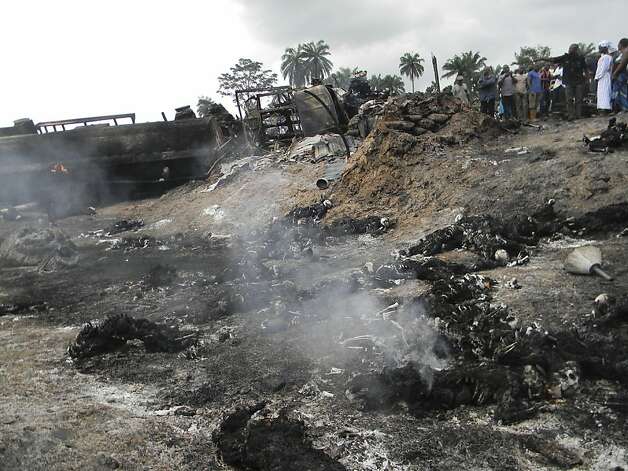
At least 95 people including women and children were killed on Thursday after a gasoline tanker crashed on the east-west road in Nigeria's oil-producing Niger Delta and caught fire as people tried to scoop up fuel.

"Early this morning a tanker loaded with petrol fell in Okogbe and people trooped to the scene obviously to scoop the spilled fuel and suddenly there was fire resulting in casualties," Rivers State police spokesman Ben Ugwuegbulam said.

Ugwuegbulam said it was too early to give a casualty figure but a Reuters witness at the scene counted 92 dead bodies of men, women and children.

Two further people died later in hospital, an official added.

Hundreds of people crowded around as soldiers and emergency workers lifted bodies into ambulances and police trucks. The fuel tanker was a pile of smouldering ash, twisted metal and melting tyres.

The tanker swerved as it was trying to avoid a collision with three oncoming vehicles including a bus, said Kayode Olagunju, sector commander of the Federal Road Safety Commission in the southern Rivers state.


Residents said that shortly after the collision hundreds of locals flocked to the site to collect the spilling fuel.
"Then there was an explosion followed by fire," Olagunju told AFP. "Ninety-three were burned to death on the spot. Two died later in the hospital (and) 18 people were seriously injured."

In a statement, the National Emergency Management Agency (NEMA) gave the same figures.
An AFP photographer at the scene said many of those killed were motorcycle taxi operators, known locally as "Okada", who raced to fill up their tanks after learning of the crash.

Olagunju said at least 34 motorcycles were destroyed in the blaze.

The accident happened in an area called Ahoada near the oil hub of Port Harcourt in Nigeria's crude-producing Niger Delta region.

Crashes are common on Nigeria's potholed and poorly maintained roads, and in a region where most people live on less than £1.50 a day, the chance to collect spilling petrol is too much of a temptation, despite the high risk of fires.

The east-west road, which runs across the oil-producing region, has been scheduled for development for almost a decade and money is allocated for it in the budget each year.

Nigeria, Africa's biggest oil producer, is plagued by corruption and inefficiency. Most years only about half budgeted programmes are implemented.

Major accidents, often involving large-haul trucks, are common in Nigeria, where many of the roads in terrible condition.

Lorries operating on the country's road are often old and poorly maintained and road worthiness checks are scant.

Abandoned trucks, some of them destroyed by heavy collisions, can regularly be seen along major Nigerian motorways.

In March, a petrol tanker caught fire after skidding off the road in southern Port Harcourt, killing six people and injuring several others.

While in April last year, a fuel tanker overturned at an army checkpoint in central Nigeria, sparking an inferno in which some 50 people were killed.

Thursday 12 July 2012

http://www.telegraph.co.uk/news/worldnews/africaandindianocean/nigeria/9395126/Nigeria-fuel-tanker-fire-kills-95.html

http://www.google.com/hostednews/afp/article/ALeqM5gI3ZdIByWzakIQ-LyNrsmLwWZw8w?docId=CNG.f7d00a96706cd138bb7bb6b52e38d2c4.331

continue reading

Disaster on 'cursed mountain': Five Britons missing after deadly avalanche in French Alps leaves nine dead

Five British climbers are feared to be among the victims of an avalanche which killed nine in the French Alps this morning.

The massive slide of snow happened around 5am this morning as early morning climbers made their way up Mount Maudit, which is in the Mont Blanc range.

Most of them were roped together on what is considered to be one of the most dangerous ascents in Europe. Rescuers from the Alpine PGHM (mountain rescue service) said the initial estimated death toll was 'at least six'. '

There are around eight others injured and at least two people missing,' added a spokesman, who said that the avalanche had been caused by snow collapsing in July heat. 'We were initially alerted just after dawn by one of the survivors who called us on a mobile phone.' All of the injured have been evacuated by helicopter to nearby hospitals, as police supported by search dogs continued to look for survivors.

There were reported to have been 28 people in the moutaineering group, from several countries including Switzerland, Serbia, Germany, Spain and France.

 Five of the group are now safe back down in the valley, including a guide, but others in the party are still missing.

 It was reported that at a press briefing following the avalanche, claims were made that a lone mountaineer may have set off the avalanche above the group.

The six dead have been confirmed as two Germans, two Swiss, and two Spanish mountaineers, according to Chamonet.com.

The six dead in the avalanche were said to have been in a group of 20 climbers when they were caught in the snow slide At 4345m, Mont Maudit is one of a range of peaks also including Mont Blanc du Tacul which are hugely popular with climbers in the summer.

The first ever ascent of Mont Maudit was by a British party in 1878.

Because of its steep slopes and abundance of thick ice it is often likened to a glass tower block. Despite being popular as a tourist destination with thousands of Britons in both the winter and summer, the Mont Blanc range is one of the most lethal in the world.

It has killed more climbers than any other mountain range, with the annual death toll regularly reaching beyond the 100 mark.

Many lose their lives as they attempt to scale its peaks with insufficient training or supplies. There were no avalanche warnings before the 'deadliest snow slide in recent years', said Eric Fournier, the Mayor of Chamonix.

Mr Fournier said: 'There were no weather reports forecasting an avalanche risk.' Instead huge walls of snow are believed to have been created by high winds overnight, creating so-called 'Wind Slabs' which are hugely dangerous when they collapse.

Today's avalanche is thought to have happened at dawn, as the heavily impacted snow began to warm up and then cascade downwards. In August 2008 eight climbers - three Swiss, one German, and four Austrian - died in a similar accident on the nearby Mont Blanc du Tacul.

Thursday 12 July 2012

Read more: http://www.dailymail.co.uk/news/article-2172418/Mont-Blanc-avalanche-Disaster-cursed-mountain-Five-Britons-missing-deadly-avalanche-French-Alps-leaves-dead.html#ixzz20PCvKCYo

continue reading

In the event of a catastrophe, San Diego County has a plan for mass burials

Less than half a mile west of the San Diego Convention Center, just past the Manchester Grand Hyatt and next to the Seaport Village sign, lies the marker for a mass grave. Somewhere beneath the soil of La Punta de los Muertos, “Dead Men’s Point,” rest the bodies of an indeterminate number of Spanish sailors who perished from scurvy on a 1782 survey mission commanded by Don Augustรญn de Echeverria.

Some historians claim the ground holds the bones of another 100 sailors who succumbed to scurvy and dysentery during the first expedition to San Diego, led by explorer Gaspar de Portolร  and Father Juniper Serra in 1769.

Mass burials have been part of San Diego history from the beginning, and, if catastrophe were to destroy the city, mass burials would likely mark the city’s end, too. And local government is somewhat ready for it—Section VI of Annex F of the regional “Operational Area Emergency Plan” describes the conditions that would necessitate mass burial, names those who would make the decision and identifies suitable locations for large graves.

In its field manual for first responders, Management of Dead Bodies After Disasters, the Pan-American Health Organization (PAHO) cautions against jumping too quickly to this measure. Done haphazardly, it could traumatize families and pose significant legal liabilities.

While decaying bodies may be putrid, PAHO says that, contrary to popular belief, the presence of dead bodies doesn’t present a health risk. Instead, mass burials should be used primarily to preserve bodies temporarily for identification purposes in situations where adequate refrigeration isn’t available.

However, in the long term, PAHO acknowledges communal graves may be the only option. But a lot would have to happen for San Diego to get to that point—starting with a “Level 3” event, such as a natural disaster, terrorist attack or nuclear accident (or zombie outbreak), in which the local agencies are overwhelmed with bodies.

Medical examiner 

In a mass-fatality situation, the San Diego County Department of the Medical Examiner would be the lead organization for managing dead bodies, coordinating the identification process and manning family-assistance centers.

Management of Dead Bodies After Disasters 

The medical examiner opened a new building in 2009, which currently has a capacity for 500 bodies. The department also owns a “mobile morgue” that can refrigerate 12 more.

Two morgue trailers each hold 22 bodies. When the medical examiner’s capacity reaches its brink—approximately 556 bodies—the department is authorized to open temporary morgue facilities in locations such as airport hangars and empty warehouses.

According to the emergency plan, these facilities must be secure, equipped with showers and have front-office reception areas.

The medical examiner can call for backup via the federal-level Disaster Mortuary Operational Response Team. According to Dr. Amado Alejandro Baez, a national specialist in mortuary services in disaster scenarios, displaying 1,000 bodies would require approximately 2,000 square meters of space.

Baez estimates decomposition may render a body unidentifiable within 48 hours, creating a small window for establishing identity and photographing the bodies. Mass burial According to the regional emergency plan, a mass burial could become necessary when the dead can’t be refrigerated or embalmed, properly processed or released to next of kin and area cemeteries aren’t able to shoulder the extra load.

The decision to invoke the mass-burial protocol would fall to three county officials in particular: Chief Medical Examiner Glenn Wagner, Public Health Officer Wilma J. Wooten and Emergency Services Director Holly Crawford. The California Emergency Management Agency would need to sign off on it, as would local officials, including the San Diego County Board of Supervisors.

PAHO’s field manual lays out the specifications for a mass-burial trench. A mass grave should be between 1.5 and 3 meters deep, at least 200 meters from drinking water sources and 2 meters above the water table. Each body should be placed in a body bag or wrapped in a sheet and laid in a single layer with about .4 meters between each body. The bodies should be meticulously documented in a grid for later identification.

Cremation, according to PAHO, should be avoided because it destroys evidence, often results in partially incinerated remains that would have to be buried anyway and requires an enormous amount of fuel (300 kilograms of wood per body, Baez says).

Gravesites 

The first choice for a mass-burial site, of course, would be an existing cemetery. Assuming that’s not an option, the regional plan identifies six alternative types of locations: county landfills, parks and recreational areas, flood-control basins (“weather permit ting”), sides of freeways or river beds, areas beneath power lines and rail yards or along rail lines.

But while geographically feasible, most would be a tough sell politically, says Michael Pallamary, who runs the local land-use consulting and surveying firm Pallamary & Associates. “Contemporary land-use planning has a lot to do with the political implications, so [with a mass grave], you’d either have to face political stigma or the environmental implications,” he says. “You’re not going to bury them in Mission Valley near hotels or golf courses.

The concept of burying in a flood-control channel and having it wash up, that’s hardly an attractive venture.” Pallamary knows a place that meets many of those criteria: the uninhabitable area to the southeast of Mission Bay, near Sea World Drive and Friars Road. It used to be a toxic dump and is near the San Diego River, two freeways and an electricity substation.

The proposed Gregory Canyon Landfill would also be an obvious location, but, based on the county’s list, Pallamary thinks the best options are easements under power lines owned by San Diego Gas & Electric. “I think the power lines would be the only contemporary viable site,” he says. “A lot of these power lines are extraordinarily wide so they could accommodate significant burial sites, and you’re probably never going to use those areas anyway.”

Thursday 12 July 2012

http://www.sdcitybeat.com/sandiego/article-10735-where-will-the-bodie.html

continue reading

We threw bodies overboard: Eritrean survivor of boat tragedy

ZARZIS, Tunisia (AFP) - Eritrean Abbes Settou, the sole survivor among some 50 migrants who died of hunger and thirst after their inflatable boat ruptured in the Mediterranean, said Wednesday he had survived "by the grace of God."

Speaking to AFP from hospital in Tunisia, Settou, said his fellow passengers, who included other Eritreans and a group of Somalis, "died of hunger, of thirst, of exhaustion.

We threw their bodies overboard." Among the dead, he said were 10 women.

Earlier, the UNHCR in Geneva said Settou, who drank sea water to survive, was spotted clinging to a jerry can and the remains of the boat off the Tunisian coast on Monday night by fishermen who alerted the coast guard.

Settou said there was no fresh water on board and people started to perish within days, including three members of his family, according to the UNHCR.

 The refugee agency quoted him as saying 55 people boarded the boat in the Libyan capital Tripoli in late June, and that more than half were from Eritrea, including himself.

They were unable to call for help because the boat's satellite phone was broken, according to Father Mussie Zerai, an Eritrean priest who spoke to the survivor by telephone on Wednesday. "He said they were at sea for 15 days in total," the priest told AFP. "They had apparently reached Italian waters but they weren't able to call for help because the satellite phone was broken, so the wind pushed them back out into open sea.

"During those 15 days the people on board slowly began dying of hunger and thirst. They were lost, they could not orient themselves. "He is recovering.

In a few days he said he would be moving to a refugee camp." A UNHCR official in Tunisia said Settou would be moved to an apartment in Zarzis, which is 400 kilometres (240 miles) southeast of Tunis, near the Libyan border.

 In his account of the ordeal to the UN High Commissioner for Refugees, Settou said the boat had punctured and air started to leak out.

UNHCR spokeswoman Sybella Wilkes said Settou is "in a pretty awful state and he's obviously gone through a terrible, terrible experience progressively watching his family members dying." "This is a tragedy," said T. Alexander Aleinikoff, Deputy High Commissioner for Refugees. "I call upon all vessels at sea to be on heightened alert for migrants and refugees needing rescue in the Mediterranean."

The UN agency estimates that 170 people have been declared dead or lost at sea attempting to make the journey from Libya to Europe so far this year.

Greece and Italy are the two main entry points for undocumented immigrants into the European Union. Italy in particular has seen a spike in arrivals over the past year following the Arab Spring revolts in North Africa.

Malta is also a frequent landing point but is increasingly being spurned by immigrants worried about the relatively lengthy registration process for new arrivals, the UNHCR said. "With that knowledge, people are going on to Italy," said Wilkes. "We didn't see this at all last year, that boats are finding their way to Malta and then refusing to go in."

So far in 2012, more than 1,300 people have made the sea journey to Italy from Libya, the UNHCR said. The busiest period for crossings is from May to September, when the Mediterranean Sea is at its calmest, the agency added.

Thursday 12 July 2012

 http://au.news.yahoo.com/thewest/a/-/world/14205800/54-migrants-die-of-thirst-in-boat-tragedy-off-tunisia/

continue reading

Wednesday, 11 July 2012

520 bodies to be buried at Srebrenica Memorial Cemetary in Potocari

Srebrenica (Bosnia), Jul 11: Thousands of people from around Bosnia and the world begun gathering in Potocari, near Srebrenica on Tuesday on the eve of the 17th anniversary of the killing of 8-thousand men and boys by Serb forces in 1995 in Srebrenica, the worst massacre of civilians on European soil since World War II.
 
The remains of 520 victims, exhumed from several mass graves around Srebrenica and recently identified using DNA analysis, will be buried on Wednesday at a memorial cemetery just outside the ill-fated eastern town alongside some 5-thousand other massacre victims that have already been buried there.

 Several thousand people reached Srebrenica on Tuesday following three-day march through the hills of eastern Bosnia.

They had been retracing backwards the path some 15-thousand Bosniaks from Srebrenica took in 1995 in an attempt to escape from Serb forces. Only about a third of original marchers survived the ordeal, while others had been hunted down by the Serbs and killed.

Some of the survivors, as well as Bosnia’s international administrator Valentin Inzko also joined the commemorative march, organised each year to honour the killed Bosniaks. “The oldest human right is a dignified burial and to have a memory of deceased and our dead relatives and this is why we came here to Srebrenica, to express solidarity with those who survived and with Srebrenica itself,” said Inzko, an Austrian diplomat.

Bikers from different Bosnian cities also reached Srebrenica a day before the anniversary and mass burial.

Bosnian Serb forces overran Srebrenica in July 1995, separated women, children and the elderly from men and then systematically murdered the men in mass executions before throwing their bodies into mass graves.

The bodies were excavated years ago but has always been challenging task identifying them as the perpetrators secretly dug up the original mass graves with bulldozers, then drove decomposing remains to other locations and buried them there.

The bloodbath was Europe’s worst massacre since World War II and has been labelled a genocide by both the Yugoslav war crimes tribunal and the International Court of Justice. Bosnian Serb military chief Ratko Mladic faces 11 charges, including genocide, for allegedly masterminding Serb atrocities throughout the war that culminated in the 1995 massacre of some 8-thousand Muslim men in Srebrenica.

Mladic is currently on trial at the Yugoslav war crimes tribunal at the Hague. He denies any wrongdoing.

Wednesday 11 July 2012

http://www.indiatvnews.com/news/world/bosnians-arrives-on-eve-of-the-th-anniversary-of-mass-murder-8394.html

continue reading

Tuesday, 10 July 2012

Morocco bus crashes kill 26, including foreigners

RABAT: At least 26 people, including several foreigners, were killed in two separate road accidents in Morocco, police and medics said on Tuesday.

The first accident took place on Monday afternoon near Nador, in the northeast of the country, killing 10 people, with another 33 injured, five of them seriously.

The accident took place when a bus travelling between Rabat and Nador overturned because it was going too fast, according to a police source.

 Separately, a bus crash near the port of Essaouira overnight killed 16 people, among them at least two foreigners, a medical official said.

 Around a dozen people were injured in the accident, which police also said occurred when the bus from Agadir overturned, possibly due to speeding.

 A local official told AFP that the toll from the accident in Essaouira, around 440 kilometres southwest of Rabat, could rise.

 Moroccan roads are among the most dangerous in the world.

More than 4,000 people die in traffic accidents in the country each year, according to official figures.

Tuesday 10 July 2012

http://dawn.com/2012/07/10/morocco-bus-crashes-kill-26-including-foreigners/

continue reading

Police sketches helping families track down unidentified disaster victims

MORIOKA, Iwate Pref. — Police are using composite sketches to assist the relatives of missing victims of last year's natural disasters.

Toshiro Saito, 47, received a phone call June 26 from a relative who lives in Sendai. Saito, of Saitama Prefecture, had been searching for his parents, who lived in Kesennuma, Miyagi Prefecture, before they disappeared in the March 11, 2011, tsunami.

The relative told Saito that a composite sketch published in a local newspaper looked like his father, Shigeo. Only half-believing the news, Saito found the sketch on the Miyagi Prefectural Police's website. "The eyes and the thin hair on the sketch resembled my father's," Saito recalled.

A few days later, he visited the police station in Kesennuma. Tears filled his eyes when he was shown a khaki sweater he recognized as belonging to his dad. After a DNA test, the body was confirmed to be that of Shigeo Saito.

It turned out his body was found only five days after the disasters, about 800 meters from their seafront home. "I wish I could have gone earlier," Saito said.

Some 16 months after the catastrophic earthquake and tsunami, 183 bodies in Miyagi and 95 bodies in neighboring Iwate Prefecture remain unidentified, according to police.

Out of 40 composite sketches of unidentified dead released by the Miyagi police, six bodies, including that of Saito's father, have been identified.

The Iwate police have released 10 composite sketches. Yuji Taguchi, 57, an Iwate policeman specializing in portrait sketches and body identification, said it is hard to reproduce the hairstyles of tsunami victims.

He said he uses a magnifying glass to identify bruises and scars, and tries to express detailed facial features such as wrinkles and eyelids.

 Sketches are useful because they can be released to a wider public than photographs, which can be gruesome.

Thanks to the sketches, police are receiving information from neighbors of victims as well, an officer said.

Tuesday 10 July 2012

 http://www.japantimes.co.jp/text/nn20120710f3.html#.T_v_ZbpVlnU

continue reading

Saturday, 7 July 2012

Over 100 killed in floods, landslides in Russia

Floods and landslides killed at least 103 people in southern Russia after two months' average rainfall fell in a few hours, forcing some to climb on to roofs and into trees to save themselves, police said on Saturday.

Many victims were elderly people who were asleep in the town of Krymsk when the storm broke in the agricultural region of Krasnodar overnight.

They drowned as the torrential rain turned hilly streets into driving torrents and water rose above head-height in what one official called the worst flooding for 70 years.

Five people were electrocuted when an electric transformer fell into the water in the coastal resort of Gelendzhik and some victims were swept out to sea.

The flooding damaged thousands of homes, blocked railways and roads, and halted oil and grain shipments from the Black Sea port of Novorossiisk. "There are lots of overturned cars, even huge trucks. Brick walls have been washed away," said Vladimir Anosov, a resident of the village of Novoukrainsky near Krymsk, a town surrounded by mountains about 300 km (190 miles) northwest of Sochi where Russia will host the 2014 Winter Olympics. "People are on the street, they are at a loss what to do.

Helicopters are flying overhead, they are evacuating people from the flooded areas. The floods are really, really huge," he said by telephone.

Russian news agencies said President Vladimir Putin was expected to visit the region to inspect the damage and meet residents, some of whom criticized the rescue operations.

It was not immediately clear what the impact might be on the grain harvest, an important part of the regional and national economy. "We found several streets with corpses covered in canvas.

People there are in shock. They keep on mumbling that they had not been warned ... There are lots of Emergencies Ministry staff, but they are struggling to cope with the disaster," a reporter on Krasnodar's 9 TV channel said. Novorossiisk, Russia's largest Black Sea port, halted crude oil shipments, a spokesman for oil pipeline operator Transneft said.

The port also suspended grain exports. Police put the death toll in the Krymsk area alone at 92 and said two had been killed in Novorossiisk and nine in Gelendzhik.

Saturday 7 July 2012

http://news.yahoo.com/least-45-die-floods-russia-krasnodar-region-080241761.html

continue reading

Friday, 6 July 2012

In the Aftermath of the "Himalayan Tsunami"

During the months of May and June pilgrim-tourists in the millions make their way up into the mountains of the north Indian state of Uttarakhand. Their destinations include the divine sources of the Yamuna and Ganga rivers, the abode of the god Shiva in Kedarnath, the famous residence of the god Vishnu in Badrinath, and the Sikh site of Hemkund Sahib, associated with Tenth Guru of the Sikh tradition, Guru Gobind Singh. This year in mid-June the monsoon rains came early and poured down upon the Land of the Gods with the sort of unexpected intensity that comes once in centuries. Flash flooding, landslides, and rising waters stranded tens of thousands of visitors and destroyed roads, buildings, livelihoods, and bridges. It is too early to know how many people have died but the number will probably be in the thousands. The numbers may be low compared to global-scale disasters of recent years, but there is a wrenching poignancy to what is happening in Uttarakhand right now. Many of the forces that frame daily life in South Asia are suddenly on display like a raw wound: the wages of development and globalization, the power of the natural world, divine agency, altruism, self-interest, and the political nature of both government action and religious ritual. The immediate impact of this flooding on Uttarakhand is extreme. The lasting impact on family life, labor patterns, regional economy, and levels of education, as Ravi Chopra and Malavika Vvawahare have passionately observed, will be an even deeper wound. Flooding has hit the entire state hard, but one memorable face of this disaster will be what happened to the pilgrimage site of Kedarnath, a place about which I have been researching and writing for much of the past decade. It appears that a cloudburst fell with such intensity that it caused a lake located above and behind Kedarnath village to suddenly break its boundaries. Water and rock rushed down onto the site, killing hundreds and marooning thousands. About seven kilometers south this surge utterly destroyed the village of Rambara. As I write this I still do not know in perfect detail which of my friends and acquaintances survived. I do know, however, that a very good friend did not. I have since managed to speak with several other friends who were in Kedarnath and managed to escape. In speaking of what those moments were like, one said “I saw Shiva’s tandav” (the god's dance of destruction). I said I could not imagine. “Good,” he replied. Early Indian media coverage, as well as state and central government relief efforts, focused on the famous site of Kedarnath and the plight of those visitors to Uttarakhand who needed to be physically rescued. In 2013, even Himalayan pilgrimage tours can reasonably be expected to be somewhat safe, beyond the occasional threat of landslide—it is not like in earlier days when setting out on pilgrimage meant the possibility of never returning. The grief and shock of surviving a natural disaster is thus for many intertwined with a sense of bewilderment and ambush that renders such accounts all the more compelling. Yet the arresting images of post-flood Kedarnath and intense pathos of interviews with survivors who were visitors to the region displaces attention from local concerns. The relative lack of attention to those who call Uttarakhand home is perhaps even more distressing because it re-enacts the ways in which the health of local communities has in recent decades taken a backseat to the development of infrastructure for visitors, the building of hydroelectric dams, and logging projects. Particularly since Uttarakhand became a separate state (first as Uttaranchal) in 2000, the region has seen a massive rise in the number of visitors to the region, especially by the growing Indian middle class. Roads widened and hotels and visitor services grew exponentially. Building a new hotel or a restaurant by the side of the road felt like a smart investment—even when the road was near a river. Kedarnath saw the building of new cell phone towers, a railway reservation office, helicopter landing pads, lodges with hot water available in the room. Prices soared. When a wave of water and rock crashed down upon Kedarnath last month it crashed down upon a site bursting at the seams—had this event happened twenty years ago deaths and destruction would have been far, far less. This disaster feels to me like the bursting of a bubble. For many the floods wear the face of divine agency. Shiva has demonstrated his destructive power, it is said, because he is angry with the de-sacralization of pilgrimage and the lack of care with which the Himalayan environment has been treated. But the mixed flow of mountain rock and water is about more than Shiva’s power to destroy. This can be seen in what is emerging as one of the visual memes of this tragedy: an AP photo of the submersion of a statue of Shiva dozens of feet tall that has been a landmark in recent years of the city of Rishikesh. This now-iconic image—the god's head and shoulders battered by flood waters—is not just an indication of how high the river rose, it is also an index of Shiva’s nature. Shiva’s matted hair cushions our world from the full power of the goddess Ganga as she descends for our human benefit in the form of the Ganges river. Shiva cannot be separated from shakti, the cosmic energy found in forms of goddesses such as Ganga. One of the most common ways to worship Shiva is to pour water onto his physical form: the aniconic shaft of the linga, held in its ovoid yoni base. This ritual act of pouring water re-enacts the union of male-female, the indivisible nature of energy and matter. From my mostly helpless location in Stevens Point, Wisconsin I have been following events through telephone, Internet media, and Facebook postings. On June 24, 2013, the Hanuman Fan Club on Facebook, a group devoted to the deity Hanuman, posted an old pre-flood image of the Kedarnath temple. Hindi text introduces the image, noting that of all the structures in Kedarnath only the temple survived because “It was connected to the faith of millions and therefore Mahadev [Shiva] did not allow it to tremble.” It should be noted that cell phone towers also appear to have survived. The range of sentiment expressed in the comments this posting generated, of which at last count there were 2133 (along with 2917 “likes”), is striking. Some express the opinion that this destruction is the direct result of frank commercialism. Others take issue with Shiva’s seeming whimsy at choosing who lived and who died, or ask why the survival of the temple matters when family members are dead. But the majority of the comments are expressions of praise and reverence: “Long live the lord of Kedarnath” (“Jai Kedarnath baba ki”), “Long live Bolenath [sic] ( “Long live the lord [Shiva] who is innocent and simple”), or simply “O god of gods, destroyer, destroyer” (“har har mahadev”), an acknowledgement of human limits in the face of such power and tragedy. Connecting these events to Shiva is also a way of thinking about human agency and human responsibility. As Chitra Padmanabhan notes in her editorial in The Hindu, the story of how the goddess Ganga descends honors the humility of her human supplicant, the king Bhagiratha, a humility that Padmanabhan argues should be mapped onto how humans relate to their physical environments. Many voices in the last two weeks have said that this is exactly what has not been happening in Uttarakhand. Both the flash flooding itself and the resultant destruction—both of human life and of property—may have partially derived from a terrible combination of pre-existing conditions: unplanned construction without regulation, deforestation, hydro-electric dam construction, and an unwillingness to slow down the pace of development in the face of ever-rising numbers of visitors to the region. Ravi Chopra has noted that for the careful observer of Indian weather patterns of the last two decades the intensity of the flooding should not have come as the utter surprise that it did. These broader trajectories underlie what is happening now. From the safety of my office, as I read the news and engage with observers online, I am observing two opposite trends developing: gratitude and praise for countless examples of human heroism and generosity, and outrage at reports of acts of unimaginable selfishness and the intrusion of politics into relief efforts. On the one hand, evacuees cross a river on a bridge whose floor consists entirely of Indian soldiers. Residents of affected areas provide shelter and food for those who have survived. On the other hand, there are stories of shocking venality, ranging from post-flood looting in Kedarnath to tales of price-gouging. People are criticizing the government the way Americans did after Hurricane Katrina. While the state government insists it is doing everything possible, for many this is a tragedy of largely human origin—and to even attempt to connect these events to divine agency is an affront. In the days, and now weeks, after the flooding, Kedarnath continues to draw national attention. A simple Google search for “Kedarnath” now turns up hundreds of articles, images, and videos produced in the last two weeks. The resources of an entire nation notwithstanding, the difficult location has meant that evacuations are only possible by helicopter and then only when the weather permitted, forcing events to unfold very slowly. Hundreds if not thousands of dead are trapped in the mud and rubble both in Kedarnath and south towards Rambara and beyond. The Uttarakhand government is in the midst of addressing several connected problems, each of which has begun to generate controversy: the disposal of the bodies to prevent the spread of disease, the identification of the bodies so that families can be notified, and the mass cremation of the bodies in a way that is religiously appropriate. Some Uttarakhand residents protested this decision, saying that the state government was proceeding with mass cremation in order to prevent the true number of deaths in and around Kedarnath from ever being known. One of the government organizations involved in rescuing survivors reportedly refused to assist with cremations. Even as the state government continues to conduct disaster relief there has been a wincing degree of political theater. A debate is developing about how the Badri-Kedar Temple Committee, the state governmental organization in charge of Kedarnath, has chosen to preserve the continuity of ritual worship of Shiva in his Kedarnath form. Chief Minister of Uttarakhand Vijay Bahuguna, who is affiliated with the Congress party and whose office makes him the lightning rod for criticism about both disaster prevention and disaster relief, has rebuffed the efforts of Narendra Modi, Chief Minister of Gujarat, to be officially involved with the rebuilding of Kedarnath. Modi is one of the most famous faces of the Bharatiya Janata Party, the main national rival of the Congress party. At the same time, Uttarakhand has announced that the rebuilding of Kedarnath will take place in partnership with the Archaeological Survey of India, a national organization connected to the central government. The temple is going to be rebuilt, better than ever, with safeguards in place against future flooding. The families of those who died in the Uttarakhand floods will probably receive some compensation from either state or federal governments. The state government is planning special economic compensation for those residents of the Kedarnath valley whose livelihoods were destroyed. It is very unlikely that this compensation will be sufficient unless it is long-term and continuous. At least in the short term, it is clear that questions of responsible development are now going to be front and center in Uttarakhandi public conversations. But the impact of this flooding cannot be erased—in a seasonal tourist economy, it is difficult to catch up once you are several years behind. Malavika Vyawahare has painfully and eloquently charted the impact the flooding will have on the village of Joshiyara, located in Uttarkashi district of Uttarakhand. One of the people she interviewed, Amod Singh Panwar, said “I don't see the point of starting over.” As time goes on the impact of these terrible days will be harder and harder to see unless we insist upon following up on local stories. This means moving beyond legible points of engagement like famous temples and the anger of a well-known deity. Kedarnath is a religious symbol of such cultural, political, economic, and historic significance that one way or another, it will surely re-open with a better long-term plan for the development of the site. But I am worried about the kind of rebuilding that is only occasionally newsworthy. I am worried about what will happen to the families like those of the men and few women who were caught by the waters in the small village of Rambara where I used to stop for lunch on the walk up to Kedarnath. It is now buried in mud. I am worried about my friend Vikram who has a B.A. in economics and who bought ponies to carry people to Kedarnath instead of trying to find salaried work because it was far more lucrative—and whom I have not yet been able to reach. Saturday 6 July 2013 http://www.religiondispatches.org/archive/culture/7185/in_the_aftermath_of_the__himalayan_tsunami_/

continue reading

108 corpses abandoned in Lagos mortuaries

A mortuary consultant to the Lagos State government, Mrs Taiwo Ogunsola, on Thursday, disclosed that no fewer than 108 corpses were abandoned at mortuaries in the state.

Disclosing this at a public hearing on the state of mortuaries, organised by the state House of Assembly, the consultant said dead bodies under 25 years were mostly abandoned by their families.

While calling for prompt response of government in the area of timely approval for mass burial, Ogunmola said this would assist in decongesting the mortuaries and, as well, preventing outbreak of epidemics in the affected areas.

Speaking in the same vein, the speaker of the state assembly, Honourable Adeyemi Ikuforiji, expressed dismay over the state of mortuaries in the state, while he stressed the needs for timely disposal of corpses, through incineration or burning of unclaimed dead bodies, due to lack of land space for burial purposes in Lagos.

Speaking through Honourable Kolawole Taiwo, the speaker said mortuaries in the state were being filled up, a situation causing health hazards to neigbouring residents of such facilities. “We went aboard with Nigerian experts to study the issue of cremation in the United States. We saw the way they cremate, they respect their dead,” he asid, adding that “it is 100 per cent free from health hazards, even families were allowed to perform their rites before the cremation.”

Friday 6 July 2012

http://tribune.com.ng/index.php/news/43779-1o8-corpses-abandoned-in-lagos-mortuaries-consultant-

continue reading

Assam Flood Situation Still Grim, Death Toll Reaches 117

The situation in flood-ravaged Assam remains grim with the toll rising to 117 and the water level of Brahmaputra river and its tributaries flowing above the danger level though showing a receding trend in some affected districts.

Altogether 101 people have died due to the floods and 16 in landslides caused by incessant rainfall while 16 people are still missing, official sources said today.

An estimated 22 lakh people have been affected in the worst floods in recent years, causing large-scale devastation in 2809 villages in 27 of the 28 districts of the state.

 The current wave of floods has devastated the world famous Kaziranga National Park where more than 540 animals, including 13 rhinos, have perished, the sources said.

The situation in the world's largest river island Majuli was also grim. Almost the entire island is submerged and more than 75 families have been rendered homeless due to heavy floods and unabated erosion.

The sources said the water level in Brahmaputra and its tributaries is showing receding trend in some districts but in a majority of areas it is flowing above the danger mark.

Road services, affected at 2847 places, are yet to be restored as also rail tracks damaged by landslides in Lumding- Badarpur Railway Division.

An estimated five lakh people have taken shelter in 630 relief camps and 150 medical teams have been deployed to provide medical aid, the sources added.

Friday 6 July 2012

http://news.outlookindia.com/items.aspx?artid=767918

continue reading

Uganda: Two More Bodies Found in Bududa Landslide Rubble


Rescue workers have recovered two more bodies buried in the mud after a landslide roared down rain-saturated hills and engulfed homes in Bududa two weeks ago, local authorities said.

This brings to four the number of bodies pulled out of the lanslide rubble however many people remain missing.

District chairman John Baptist Nambeshe told New Vision online that the body of Patrick Bwaya's body who has been a lay reader at Bumasata Church of Uganda together with that of his wife Jessica Bwaya were found under the ruins of their destroyed house as excavators intensified a search for landslide victims.

Nambeshe said the deceased couple left behind six orphans who were at school at the time when the landslide struck their home.

 He said there was however, commotion when relatives of Jessica attempted to carry away her body to Buwali sub-county for burial but a timely intervention by the Police allowed the body to be buried in Bumwalukani village near the landslide scene.

Nambeshe said the six orphans who are now homeless are being living at Arlington Academy premises from they are being assisted by Red Cross and other sympathisers.

Friday 6 July 2012

http://allafrica.com/stories/201207051019.html

continue reading

Wednesday, 4 July 2012

Overpopulation on Uganda’s Mount Elgon Kills Hundreds


BUDUDA, Uganda, Jul 4 2012 (IPS) - The Ugandan government says it will forcibly remove people settling on the steep slopes of Mount Elgon in eastern Uganda’s Bududa District, as the growing population has resulted in increased landslides in recent years.

In the latest one on Jun. 25, an estimated 100 people are feared dead and up to 250 have been unaccounted for when three villages were washed away after heavy rainfall in the area.

Over the last three years, landslides have buried alive several hundred people living on the slopes of Mount Elgon. In March 2010, 365 people were killed in Bududa District during a landslide.

However, prior to that there were fewer fatalities in the area. In 1997, 48 people were killed in a landslide.

But the increasing number of fatalities resulting from the landslides has not stopped people from settling here. Mount Elgon, according to the Uganda Bureau of Statistics, has the country’s highest population density of 1,000 people per square kilometre with a population growth rate of 3.4 percent per annum.

 Many locals have been hesitant to move to low-lying areas as some say that the soil is very fertile for farming, while others claim cultural and historical attachments to the mountain.

However, Dr. Steven Malinga, Uganda’s Disaster Preparedness Minister, told IPS that the government is now determined to enact a law to allow it to evict all those living on dangerous parts of the mountain slope in order to resettle them elsewhere. “This place has been one of the most risky areas as far as landslides are concerned. And they are getting more frequent and severe.

So a special committee of cabinet has been formed. The committee will go round the mountain sensitising people on voluntary relocation,” Malinga told IPS. The recent landslide has left a huge hollow in the mountain the size of 10 football pitches.

A mound of soil mixed with eucalyptus trees, banana suckers and wrinkled iron sheets that once were part of people’s houses stands at the bottom of the mountain.

Buried underneath it are human bodies and cattle carcasses. Malinga said if people did not want to move voluntarily for their own safety, the government would use force. “If they do not move we shall have no option but to forcefully evacuate them. We shall use our security forces, if necessary, to have those people moved,” he said.

He added that the country’s current constitution did not allow the government to forcefully evict communities, even if they were in danger. “That is why we need another law to allow for the forceful evacuation of people living in danger. Otherwise they will claim their rights are being violated,” he said.

Over 600 people were relocated to government-owned land in Uganda’s Midwestern district of Kiryandongo after the March 2010 landslides. However, Malinga said many had returned. “That kind of thing should not be happening. We have got to teach our people that these are risky areas,” he said.

He added that the government would aid those who could not afford to buy land elsewhere. The Mount Elgon area conservation manager Adonia Bintora told IPS that although landslides have occurred in Bududa District since the early 1900s, they are likely to become more frequent and deadly as the population increases.

Bintora told IPS that the population growth has exerted more pressure on the land and natural vegetation leaving the soil denuded and therefore vulnerable to landslides. “So if the hills are stripped of vegetation, the soil gets saturated with rain water and therefore it easily caves in,” said Bintora.

Dr. Mary Goretti Kitutu, an environment information systems specialist with Uganda’s National Environment Management Authority, has extensively researched landslide occurrences in Bududa District and their causes.
She explained that overpopulation in the area has exerted pressure on the clay-rich soils as residents clear hillside forests for firewood and farming. “And when there are no trees with complex roots to hold the soil in place after constant rain, then you end up with landslides. The moment trees are cleared, water becomes the only downward driving force, and you will end up with land slides,” she said.

Apart from felling trees and extensively tilling the land, Kitutu told IPS that the practice by cutting into slopes for the construction of houses and roads has triggered slope failure.

When IPS visited the affected areas, it was easy to observe houses constructed on excavated slopes. The backs of the houses are situated next to high walls of mud that could easily cave in. “The cutting of slopes removes the lateral support of the slope leading to slope failure,” said Kitutu.

Scientists have also said that Mount Elgon has developed a 40-kilometre crack with a width of between 30 to 35 centimetres.

Bintora told IPS that the crack could affect up to three million people living on Kenyan and Ugandan sides of Mount Elgon.

Moving may be the only option to save the community here from further devastation.

But some locals are resistant to the idea. Gabriel Buyela, who lives just across the hill from the area where latest landslides occurred, told IPS that he would only move to a low lying area in the district if government provided him with land.

But he added that he could not abandon his ancestral home.

Zaina Namono lost a relative in the landslide but said she and her family were hesitant to move. “The government relocated our people to Kiyrandongo after the March 2010 landslides but we have heard that they are suffering and going without food. We cannot accept to be subjected to the same,” she said.

Though some who have lost everything say they will relocate. A grieving Michael Kusolo and his wife Mary lost all their four children in the recent landslides. Kusolo told IPS that he had no alternative but to move because everything he had was now destroyed. “Even all the land is gone; the graves of my father, my mother and brothers were swept away. So I will move,” he said.

Wednesday 4 July 2012

http://www.ipsnews.net/2012/07/overpopulation-on-ugandas-mount-elgon-kills-hundreds/

continue reading

Tuesday, 3 July 2012

Monsoon floods kill 81 in India, force 2M to flee

The worst monsoon floods in a decade to hit a remote northeastern Indian state have killed more than 80 people and forced around 2 million to leave their homes.

Nearly half a million people are living in relief camps that have been set up across Assam state, Prime Minister Manmohan Singh told journalists Monday in Gauhati, Assam's capital.

The rest of the 2 million displaced are living with relatives or sheltering under tarpaulin sheets. Assam officials say 81 people have been killed over the past four days.

Most were swept away when the mighty Brahmaputra River overflowed and flooded villages. Sixteen people were buried in landslides triggered by the rains.

At least 11 people were missing in six districts, the state disaster management agency said. Air force helicopters were dropping food packets and drinking water to marooned people, Singh said after surveying the flood-hit districts.

Army soldiers used boats to rescue villagers from rooftops of flooded homes. Teams of doctors have opened health clinics in the 770 relief camps that had been set up across Assam, one of India's main tea-growing states.

The hilly tea growing areas have not been affected, but lower rice fields have been washed away. Thousands of cattle have perished after being swept away by the raging water or getting stuck in the mud.

The stench of rotting animal carcasses was adding to the woes of the people in tents at the relief camps, officials said.

In the worst-hit Dhemaji district, raging waters of the Brahmaputra River swept away entire villages. Officials said the entire Majuli island, one of the world's largest river islands, was awash as the Brahmaputra rose above the danger level.

Railway workers were working round the clock to restore train services disrupted after railway tracks became submerged. "Restoration of the railway line is a priority," Singh said.

The situation was expected to improve over the next few days as the rain was tapering off and water was beginning to recede. Monsoon floods hit Assam, with a population of 26 million people, almost every year, with heavy rains swelling the Brahmaputra and its innumerable tributaries that crisscross the state.

Tuesday 3 July 2012

http://www.vir.com.vn/news/world-news/monsoon-floods-kill-81-in-india-force-2m-to-flee.html

continue reading

10 Died, 17 Injured After Bus Accident

SURAT THANI, Thailand, July 3 (Bernama) -- Ten people, including an Indian, died and 17 injured early Tuesday after a tour bus hit a high-powered electricity pole in the southern province of Surat Thani, police said.

The accident occurred before dawn when the front tyre of the tour bus operated by state-run Transport Co., Ltd. burst, causing the bus which was running at high speed to lose control and hit the electricity pole on the road side, Thai News Agency quoted the police as saying.

Nine passengers -- four men and five women -- and the driver died at the scene of the accident.

The Indian passenger who was killed in the accident was identified as Amit Jain. Police said the 17 injured passengers were later sent to two hospitals for treatment.

The tour bus left Bangkok and was heading for Koh Phangan in Surat Thani province when the accident occurred.

Tuesday 3 July 2012

http://www.bernama.com/bernama/v6/newsindex.php?id=677632

continue reading

Thursday, 28 June 2012

Heavy rains and landslides in Bangladesh kill 90


Heavy rains causing multiple landslides over the past three days have killed at least 90 people in south-east Bangladesh, officials say.

Officials are describing it as the worst monsoon rainfall in years in the Chittagong region. Chittagong is the second largest city of Bangladesh.

At least 150,000 people have also been stranded by the floods, officials say. Rescue operations are continuing but rain is hampering efforts.

Flights to Chittagong airport have been cancelled.

Most rail links have also been suspended after a railway bridge collapsed. Days of heavy rain have caused mud banks to collapse, burying houses and blocking roads.

Those killed were drowned in flash floods, hit by landslides, struck by lightning or buried by wall collapses.

Many homeless people live at the foot of the hills or close to them despite warnings from the authorities about the danger of landslides.

Chittagong port received 40cm (15.75in) of rain in a single 12-hour period on Tuesday.

The BBC's Anbarasan Ethirajan in Dhaka says that dozens of people are still missing and the death toll is expected to increase.

Our correspondent says that the downpours have flooded vast areas of the city, displacing thousands of people. "We are having the worst rainfall in many years," said Jainul Bari, district commissioner for Cox's Bazar, one of the affected areas.

Volunteers using loudspeakers warned people about the danger of heavy rainfall and landslides in Cox's Bazar, officials say, but local people and rescuers were still left helpless when floodwater suddenly inundated dozens of villages and severely disrupted communications.

 In neighbouring Bandarban district, bodies have been recovered from multiple landslide sites, local officials have said.

Bandarban police chief Saiful Ahmed told the AFP news agency that most of the victims were asleep when huge waves of mud and debris buried them alive. "One family has lost 12 members," Mr Ahmed said.

Other officials have said that they are expecting more heavy rain in the next few days. Security forces have been deployed to help the search and rescue effort.

Chittagong has been hit repeatedly by monsoon rain and landslides in recent years.

As a result, the government has tried to tighten rules on where development can take place but with little success.

Thursday 28 June 2012

 http://www.bbc.co.uk/news/world-asia-18605765

continue reading

Mass funeral proposed for bus crash victims

SEVENTEEN of the 19 people killed during the horrific bus crash in Meyerton on Monday have been positively identified and will be buried in a mass funeral next week.

All were positively identified as their bereaved family members trickled into the Diepkloof mortuary throughout most of Tuesday and yesterday.

Two bodies still remain unidentified.

The Putco bus driven by Khabi, was carrying 74 passengers and travelling from Sebokeng towards Meyerton on the R59 when it crashed. The 55 other passengers were seriously injured.

Thirteen of the injured victims were taken to Sebokeng Hospital, where three patients are in critical condition and in ICU and high care, and another seven patients are in stable condition.

One was discharged and the remaining two were transferred to other hospitals.

Two of the accident victims were airlifted to Chris Hani Baragwanath Academic Hospital, where one is still in ICU and the other is in a stable condition. “What happened on Monday is a tragedy and our sympathies and prayers are with the families who lost their loved ones at this difficult time,” Gauteng MEC for Health Ntombi Mekgwe said yesterday.

A mass memorial service was proposed during a meeting held yesterday by the office of the mayor of the Sedibeng District Municipality, Mahole Simon Mofokeng.

The meeting was attended by representatives of the Sedibeng District Municipality, the Emfuleni Municipality, the Gauteng Department of Transport, the Road Accident Fund and Putco.

The service has been proposed for July 4 from 11am until 1pm at the Mphatlalatsane Sports Complex in Sebokeng.

The proposed mass funeral is set to be held on July 7 at 8am. ”On behalf of the people of Sedibeng, I once again convey and express my deepest condolences and sympathy to the bereaved families and friends of the passengers who passed on (died) during this accident,” said Mofokeng. “I would also like to wish the injured passengers a speedy recovery.”

The police are investigating a case of culpable homicide.

Thursday 28 June 2012

http://www.iol.co.za/the-star/mass-funeral-proposed-for-bus-crash-victims-1.1329578#.T-waNXj82W8

continue reading

Four dead and 130 rescued as asylum seeker boat capsizes off Australian island

Four people are believed to have died and 130 others were rescued after a crowded boat carrying asylum seekers to Australia capsized and sank today, less than a week after more than 90 people drowned on a similar journey.

The incident, which occurred midway between Australia's Christmas Island and the main Indonesian island of Java, has renewed Australian government efforts to deter a growing stream of boat arrivals by legislating to deport them to other Southeast Asian or Pacific countries.

An air and sea search for survivors ended late today when the Australian Maritime Safety Authority determined that no one beyond the 130 rescued had survived the sinking of the wooden Indonesian fishing boat. Only one body had been recovered.

"Based on information from the survivors, including crew members, it is now believed that there were 134 people on board and that three people went down with the vessel," the authority said in a statement.

Three merchant ships, two Australian warships and an Australian air force plane that can drop life rafts to the sea responded to the capsizing. The search area was 200 kilometers (120 miles) north of Christmas Island and 185 kilometers (115 miles) south of Java. 


The boat capsized in Indonesia's search and rescue zone but Australian authorities raised the alarm after the crew made a satellite phone call to Australian police. 


The first merchant ship reached the scene more than four hours later, officials said. Last Thursday, 110 people were rescued when a boat carrying more than 200 mostly Afghan asylum seekers capsized just 24 kilometers (15 miles) from the latest tragedy. 


Only 17 bodies were recovered. The survivors' refugee applications were being assessed at Christmas Island, where Australia runs an immigration detention center. 


Home Affairs Minister Jason Clare said the survivors of today's incident would be delivered to Christmas Island early tomorrow. 


Australia is a common destination for boats carrying asylum seekers from Afghanistan, Iraq, Sri Lanka and other poor or war-torn countries. 


In December 2010, an estimated 48 people died when an asylum seeker boat broke up against Christmas Island's rocky coast. 


Last December, about 200 asylum seekers were feared drowned after their overcrowded ship bound for Australia sank off Java. 


Other boats are suspected to have sunk unnoticed with the loss of all lives. 


Wednesday 27 June 2012 


http://www.independent.co.uk/news/world/australasia/four-dead-and-130-rescued-as-asylum-seeker-boat-capsizes-off-australian-island-7893352.html

continue reading