Thursday, 2 October 2014

Bulgarian explosives plant blast kills 15


Fifteen people have died in a blast at a Bulgarian explosives decommissioning plant, officials say, as workers complained of low pay and poor safety at the facility, which has seen several incidents in recent years.

"Thirteen men and two women perished. The blast was so powerful that it left craters," civil defence force director Nikolay Nikolov said on Thursday.

Three female workers were also injured in the explosion, which rocked the mountainous area around the village of Gorni Lom in northwestern Bulgaria on Wednesday evening, residents told state television.

The women were taken to hospital and were not in critical condition.

Nikolov said "human error" was the most probable cause of the blast, which razed several buildings at the small plant.

The devastation was so complete that "no traces whatsoever of bodies could be seen" at the site, he added, noting that police forensic workers were continuing to search the area.

According to the plant's management, 12 workers and three of the factory chiefs were inside the facility at the time of the blast, which happened as Greek landmines were being taken apart.

Local resident Dimitar Dimitrov, 59, told: "I used to work there and I sneaked inside the area long before the engineers arrived. Everything was razed to the ground."

Among the locals, many of whom lost friends and relatives, the disaster did not come as much of a surprise.

Safety rules were ignored at the plant, outdated machinery was used, and workers were poorly paid, they complained.

Bulgarian President Rosen Plevneliev did not mince his words on Thursday, saying: "Innocent human lives were lost because of the arrogant breaching of instructions and rules in state institutions governing work with explosives."

The country's main prosecutor has launched an investigation into the accident.

The factory, some 120km (75 miles) north of Sofia, destroys stockpiles of obsolete munitions for the Bulgarian army and Dnes daily newspaper quoted an expert as saying it had been handling explosives from Greece.

Some 10 tonnes of highly explosive chemicals were being stored at the plant.

"The factory has been reduced to ashes," an interior ministry spokesman said.

There were explosions at the factory in 2007 and 2010, in which several people were hurt.

Two units of the plant were flattened in the 2010 blast.

Thursday 2 October 2014

http://news.msn.co.nz/worldnews/8914555/bulgarian-explosives-plant-blast-kills-15

continue reading

Experts scour MH17 victims’ injuries, black boxes for clues


Experts will study injury patterns of those on board Flight MH17 along with its two data recorders in an attempt to establish how the plane was brought down over Ukraine, local daily New Straits Times reported today.

Kuala Lumpur Hospital pathology consultant Dr Mohd Shah Mahmood explained that forensic experts will also begin matching the victims’ seating arrangements against the patterns of injuries found on their bodies once all of their identities are determined.

The preliminary examinations of scans taken during the identification process revealed that passengers displayed differing levels of injury depending on their seat location, with wound patterns increasing the further back a passenger was seated.

“There are a lot of theories going around, but since the plane had just begun its flight, the fuel tank would have been full and those sitting near the wings (where the fuel bladders are located) would have sustained more burns compared with the others,” he told New Straits Times in an exclusive interview.

But Dr Shah said investigators were yet to begin establishing a correlation between injuries and seating positions as not all remains have been identified.

The identification work is being conducted by a multinational Disaster Victim Identification (DVI) team that includes those from Germany, Belgium, Australia, UK and Malaysia,

Dr Shah earlier said the team had found metal or foreign objects embedded in remains when they were scanning these, and that these would be studied further.

“This is important, as the objects could be evidence that could help in the investigations into the downing of the airplane,” he was quoted saying.

It is believed that MH17 was shot down by a surface-to-air missile while flying over the restive eastern Ukraine region, but the Dutch Safety Board has so far only noted in its preliminary report on September 9 that “a large number of high-energy objects” penetrating the plane had caused it to break up.

In NST’s report today, Dutch Safety Board spokesman Sara Vernooij said further examination of the flight data recorder (FDR) - one of two black boxes recovered from the MH17 crash site - would provide more information about the downing of the plane.

“A more detailed analysis of the data is also needed before we can say what kind of ‘high-energy objects’ had penetrated the aircraft,” she was quoted saying in an exclusive interview with the English-language daily.

The FDR’s data may also narrow down the location where MH17 was hit, and give more information such as the status of the plan’s engines and onboard systems, as well as its altitude and speed, she said.

Department of Civil Aviation director-general Datuk Azharuddin Abdul Rahman said he could not conclusively say if the FDR could show the trajectory of the high-speed object that had shot down MH17.

He commented on the scouring mark under the Boeing 777-200 ER’s left wing, saying that whether the black boxes had managed to record the missile impact was subject to several conditions.

“It depends on whether the missile exploded above or below the aircraft, how severe the glancing blow was to the left wing and how it had affected the handling of the airplane,” he was quoted.

Thursday 2 October 2014

http://www.themalaymailonline.com/malaysia/article/experts-scour-mh17-victims-injuries-black-boxes-for-clues

continue reading

Ten migrants dead, dozens missing in shipwreck off Libya


At least 10 migrants from sub-Saharan Africa drowned Thursday and dozens more were missing after their boat sank in the Mediterranean offshore Libya, the coast guard said.

Between 80 and 90 people were rescued after the boat went down in waters east of Tripoli, a coast guard officer said, adding that survivors said there had been up to 180 people on board.

Among those saved were two women, according to the officer, who said the boat capsized three nautical miles off Guarabouli, which is 60 kilometres (36 miles) from the capital.

Thursday's tragedy was the second this week involving Africans trying to make their way to a new life in Europe and comes a year after 360 people perished in a sinking, burning ship off the Italian island of Lampedusa.

On Wednesday, Spanish coastguards pulled the bodies of two Africans from the sea off Morocco and six others were missing after a dinghy carrying them sank.

For years, Libya has been a major embarkation point for hundreds of thousands of refugees, mostly Africans, heading for Europe.

They risk their lives on often unseaworthy craft trying to make it to Malta or to Lampedusa, south of Sicily, and hundreds are lost each year. By far the worst tragedy took place last month, when about 500 people drowned off Malta after traffickers rammed and sank their boat after they refused to transfer to a smaller vessel.

The implosion of Libya, civil war in Syria and renewed Israeli-Palestinian hostilities have helped push the flow of would-be refugees seeking sanctuary in Europe to unprecedented levels.

More than 3,000 migrants have died trying to cross the Mediterranean so far this year, more than double the previous peak in 2011, the International Organisation for Migration said Monday.

Thursday 2 October 2014

https://en-maktoob.news.yahoo.com/ten-migrants-dead-dozens-missing-shipwreck-off-libya-141107106.html

continue reading

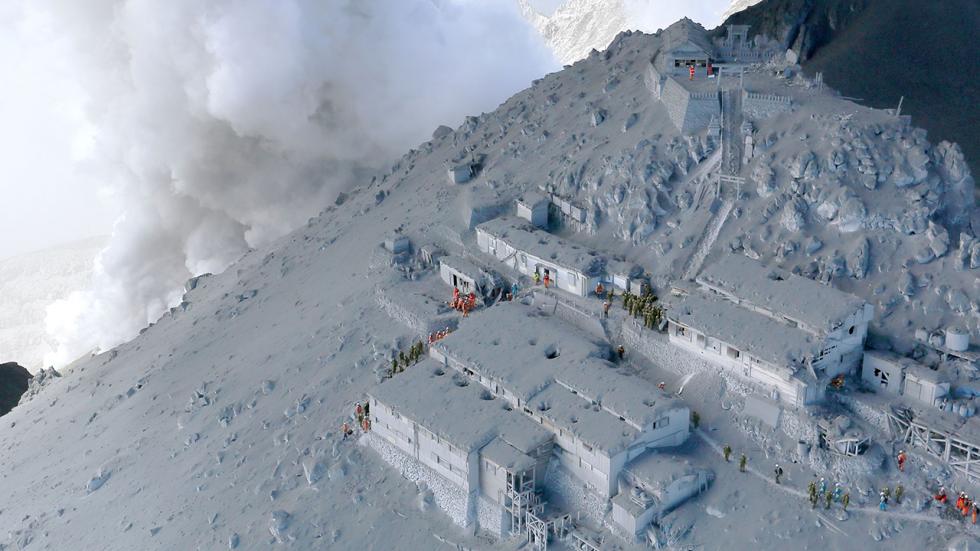
Why is the hunt for bodies on Japanese volcano Mount Ontake proving so difficult?


A combination of difficult terrain, poor weather, toxic gas leaks, the possibility of new eruptions and volcanic ash that is in places knee-deep have turned what should have been a straightforward recovery operation on Japan's Mount Ontake into a drawn-out slog.

Teams drawn from the military, the police, the fire service and local mountain rescue groups once again began scaling the 10,000-foot peak before dawn on Thursday, but they were forced to call off the search shortly before midday as the weather deteriorated.

Experts were particularly concerned that the heavy rainfall would destabilise the thousands of tons of ash that have been ejected from the volcano and settled on its upper slopes.

With more than half-an-inch of rain falling per hour as a typhoon approaches from the south, the waterlogged ash could slide and bury the search teams.

The forecast for Friday and into the weekend is for more rain, which will make recovery efforts on Japan's 14th highest mountain more perilous. Avalanches of ash are just one concern hampering a recovery mission that is low-tech and labour-intensive.

"They're a long way above sea level there, the slopes on all sides are steep and the rescue teams are finding it difficult to move around in that environment," said Professor Shigeo Aramaki, an authority on volcanoes formerly at The University of Tokyo and still works as an adviser to the government.

"As well as the weather, they have detected high levels of poisonous gases in the areas that they need to keep searching and there are repeated volcanic tremors," he told The Telegraph. "And when they are getting those sorts of signs, they simply have to halt the rescue effort."

The death toll presently stands at 47, making the eruption of Mount Ontake Japan's worst volcano disaster since the 1926 eruption of a volcano on Hokkaido, in which 144 people died. Authorities warn, however, that they still have no clear idea of the number of climbers who are still missing.


Hikers are not required to notify local authorities whenever they wish to climb a mountain, a pastime that is particularly popular at this time of the year in Japan, when the autumn foliage is spectacular.

Underlining the scale of the problem, the fire department in the town of Kisofukushima on Tuesday said that 79 people were still missing, although it cut that figure to 71 just a few hours later. The prefectural government subsequently claimed the fire department's announcement was premature, Kyodo News reported, and said in a statement that authorities are still trying to get an exact figure for the missing.

Dozens of relatives of the missing are still waiting for news of their loved-ones at the town hall in Kisofukushima, with many expressing anger at the slow pace of the recovery effort and the lack of news.

The families complained that they were learning more from the television reports than from local authorities.

The first funerals began on Thursday for hikers recovered from the mountain and identified by their families.

Those hit by the rocks and debris had multiple cuts and fractures, particularly in the head and the back, as well as the legs, a prefectural police official said on condition of anonymity, citing department policy. Nagano police had earlier said the victims died of “disaster,” without specifying the cause.

Most of the bodies were found near Mount Ontake’s summit, where many climbers were resting or having lunch. Some bodies were retrieved from a trail at a slightly lower elevation.


Experts say hikers near the summit might have been hit by rocks flying as fast as 300 kilometres per hour. Most of the ash fell in the first hour of the explosion, according to the University of Tokyo’s Earthquake Research Institute.

Survivors said they fled for their lives as rocks and debris rained down on them while they struggled with hot air and ash hitting their face.

Medical experts who have examined some of the nearly 70 injured have said most had bruises, cuts and bone fractures on their back, an apparent sign they were hit by rocks flying out of the volcano. Some of the injured reportedly had damage to their lungs and other organs due to the impact of rocks hitting them.

The eruption at Mount Ontake, located in central Japan, caught hikers by surprise. Seismologists have said that increased seismic activity had been detected at Ontake, one of 47 active volcanoes in Japan that are under 24-hour monitoring, but that nothing signalled such a big eruption.

Thursday 2 October 2014

http://www.telegraph.co.uk/news/worldnews/asia/japan/11135415/Why-is-the-hunt-for-bodies-on-Japanese-volcano-Mount-Ontake-proving-so-difficult.html

http://news.nationalpost.com/2014/10/02/flying-rocks-responsible-for-nearly-all-47-deaths-on-japanese-volcano-police-say/

continue reading

Tuesday, 30 September 2014

Dodgy docs confuse identification of bodies


Four people killed in the Nigerian building collapse were travelling on South African documents, causing confusion about the local death toll, an official said on Monday.

“Initially we were told there were 84 (deaths) but through this rigorous process of identification we have now established four were not South Africans, but they have used South African documents,” acting government spokeswoman Phumla Williams told Sapa.

She said the three Zimbabweans and one Democratic Republic of Congo (DRC) citizen all had South African residence permits.

The South African government had been in contact with Zimbabwe and the DRC.

“They have confirmed these are their citizens.”

Williams said the remains of the four people would be brought back from Nigeria with the remains of the South Africans who were killed when the when the multi-storey guest house attached to the Synagogue Church of All Nations in Lagos collapsed on September 12.

Around 115 people were killed.

Tuesday 30 September 2014

http://www.iol.co.za/news/africa/dodgy-docs-confuse-identification-of-bodies-1.1757559

continue reading

Boats carrying dozens of migrants drowns off Libya's coast; 70 dead


Two boats carrying dozens of migrants to Europe capsized near the Libyan capital on Monday, drowning at least 70 people, two coast guard officials said.

Coast guard spokesman Qassim Ayoub told The Associated Press that rescuers are retrieving dozens of bodies floating in the waves some 18 kilometers (11 miles) off the coast of Tripoli's Tajoura district. He added that 36 African migrants, including three women — one of them pregnant — were rescued.

Ali Sarti, a Libyan Coast Guard unit commander, said patrol boats rescued the migrants lying in "a broken and damaged boat in the middle of the sea" before dawn on Monday.

Ayoub said one of the boats was carrying at least 250 migrants. However, one of the 36 survivors told the AP that there were only 105 people on board. "There was a problem in the boat... Three women and one baby died," he said, speaking on condition of anonymity over concerns about his legal status.

There were no further details on the second boat accident.

Libya has grown increasingly lawless since the 2011 overthrow of dictator Muanmar Gadhafi, making it a migration hub for sub-Saharan Africans seeking a better life. Scores die every year on the dangerous journey to Europe.

Refugee numbers have swelled as thousands of people flee conflicts in Syria, Iraq and across the Middle East and Africa, boarding unsafe smugglers' boats in Libya. Nearly 110,000 people have been rescued since January, but at least 1,889 others have died making the perilous crossing, according to the UN refugee agency.

Tuesday 30 September 2014

http://www.firstpost.com/world/boats-carrying-dozens-of-migrants-drowns-off-libyas-coast-70-dead-1737047.html

continue reading

Monday, 29 September 2014

Nigeria church collapse: ‘don’t view bodies’


Family members of the South Africans who lost their lives at the Synagogue Church of all Nations in Lagos, Nigeria, on September 12 have been advised not to view the mortal remains of their relatives on their repatriation to South Africa.

Justice Minister Jeff Radebe said the Department of Social Development has advised families not to view their relatives’ bodies despite prevailing traditional customs.

This was out of concern for potential secondary trauma this may cause and the public health considerations.

“Because of the nature and scale of the disaster, the passage of time and climate conditions in Lagos the remains are not in a good state to be viewed,” the minister said. Currently 115 people are said to have lost their lives in the incident, with 84 being South African citizens.

“So far we have managed to capture the fingerprints of the deceased,” Radebe said.

“We are running the prints through the Department of Home Affairs database and expect to have completed comparisons by the end of the week,” he said.

Alternative means of dental records and DNA analysis are also being used as the forensic evidence has been compromised in some cases.

It has also been established that three Zimbabwe citizens and one from the Democratic Republic of Congo (DRC) were among those killed in the disaster.

South African forensic experts are in Lagos, but they are not allowed to perform post mortems on the victims owing to the differences in laws governing the certification of health professionals in Nigeria.

“According to Nigerian law a post mortem must be performed on all deceased persons and a death certificate must be issued before the mortal remains may be repatriated back home,” said Radebe.

A total of 18 post mortems had been concluded to date, Radebe said, but because the South African team of forensic experts was only present in an observatory position, repatriation may take longer than thought.

Radebe said preparations for the repatriation of the remains have already been organised and an appropriate facility has been identified where family members can receive the remains.

“We will repatriate the remains of the deceased on a single flight that is properly equipped for the task when we have the go-ahead from the Nigerian authorities,” Radebe said.

Monday 29 September 2014

http://www.iol.co.za/news/africa/nigeria-collapse-don-t-view-bodies-1.1757234#.VCmEl9XF8Ro

continue reading

Eight migrants die every day trying to reach richer countries, study reveals


Migrants trying to reach more prosperous countries have died at a rate of eight every day for the past 14 years, the majority of them trying to get to Europe, according to the most comprehensive ever tally of migrant deaths.

Almost 40,000 people have died on migrant routes worldwide, according to estimates by the International Organisation for Migration (IOM), which added that 22,000 of them perished trying to get to Europe.

An estimated 4,077 died this year alone, suggesting a sharply escalating problem.

According to the IOM, the true number of fatalities is likely to be even higher than the figures in its report.

The research was undertaken by the IOM over six months for its report Fatal Journeys: Tracking Lives Lost During Migration, published on Monday. It called on governments and the international community to address what it described as “an epidemic of crime and victimisation”.

“Our message is blunt: migrants are dying who need not,” said the IOM’s director general, William Lacy Swing. “It is time to do more than count the number of victims. It is time to engage the world to stop this violence against desperate migrants.”

The disproportionately high death toll in the Mediterranean, the report concludes, “reflects a dramatic increase in the number of migrants trying to reach Europe”, with more than 112,000 irregular migrants detected by Italian authorities in 2014 – almost three times as many as in 2013.

IOM research records that since 2000, nearly 6,000 more migrant deaths occurred along the US-Mexico border and a further 3,000 deaths from Africa’s Sahara desert and the Indian Ocean.

The research behind Fatal Journeys, which runs to more than 200 pages, began with the October 2013 tragedy when more than 400 migrants died in two shipwrecks near the Italian island of Lampedusa.

The report paints a picture characterised too often by international indifference, even over the collection and distribution of the raw data on migrant deaths.

“Although vast sums of money are spent collecting migration and border control data, very few agencies collect and publish data on migrant deaths,” said Frank Laczko, the author of Fatal Journeys, and IOM’s director of migrant research division.

Monday 29 September 2014

http://www.theguardian.com/global-development/2014/sep/29/europe-deadliest-destination-migrants-report

continue reading

Five more bodies found on Japan's Mount Ontake after eruption


Five more bodies have been found on the slopes of Japan's Mount Ontake, bringing the total number of presumed dead in a volcanic eruption Saturday to 36.

Twenty-four bodies still remain on the mountain, while 12 have been recovered, identified and pronounced dead, Nagano Prefecture Police said Monday.

The search for more missing hikers has been suspended due to dangerous conditions at summit. Hydrogen sulfide gas is being spewed from the mountain, police said, putting rescuers in danger.

The volcano in central Japan unleashed a huge cloud of ash late Saturday morning that billowed down the mountainside and engulfed hikers in its path. Witnesses described hearing a sound like thunder when the eruption began.

Relatives of the missing gathered near Mount Ontake over the weekend desperately seeking information. Among them was Kiyokazu Tokoro from nearby Aichi prefecture, whose son, Yuki, was hiking on the volcano with his girlfriend.

He said he knew they were near the summit at the time of the eruption because his son's girlfriend had sent a photo to a friend minutes beforehand.

"All I can do is beg for your help to get information," he told CNN. "Please help us."

Authorities estimated there were 200 to 250 hikers in the area at the time of the eruption. Most of them were reported to have managed to make the long trek down the mountain.

But some people remained trapped in several lodges on Mount Ontake, and others were missing altogether, local authorities said. More than 350 rescue workers -- a mix of police, firefighters and military personnel -- began climbing two separate routes up the mountain on Sunday morning, authorities in the nearby village of Otaki said.

They said they observed 17-20 inches (40-50 centimeters) of volcanic ash covering the ground in some areas.

The Japan Meteorological Agency has raised the Volcanic Alert Level for Ontake from 1 to 3. That means the public is advised to not approach the volcano, the summit of which is at an altitude of 10,060 feet (3,067 meters).

The agency warned that another large eruption could take place in the next six days or so. Small continuous eruptions continued Sunday.

The volcano's plume of smoke and ash was reported to have disrupted air travel in Japan, causing delays at several airports.

Mount Ontake, the second tallest volcano in Japan, after Mount Fuji, is a popular destination for hikers, especially in the fall when the foliage's rich autumn colors are on display.

The last major eruption of Mount Ontake, which is about 125 miles (200 kilometers) west of Tokyo, took place in 1979, according to the Global Volcanism Program at the Smithsonian Institute.

That eruption lasted months, spewing out more than 200,000 tons of ash, the Japanese news agency Kyodo reported.

Japan is one of the world's most seismically active nations - but there have been no fatalities from volcanic eruptions since 1991, when 43 people died at Mount Unzen in the south-west.

Saturday's eruption forced many of those on the mountain to make emergency descents through clouds of volcanic ash and falling rocks.

"The volcanic rocks fell like hailstones," one man said.

"We couldn't breathe so we covered our mouths with towels. We couldn't open our eyes either."

Another told reporters: "The volcanic ash was hurtling so fast I couldn't run away. I'm worried about people still on the mountain."

Almost 50 people were thought to have stayed on the mountain on Saturday night, reports said.

Rescue efforts will resume on Monday after an intense search on Sunday was called off because of toxic volcanic gases in the area.

Japanese officials can only announce deaths after a formal doctor's examination.

The question many people have been asking is - why were there hundreds of people on top of an active volcano? And, why was there no warning it was about to erupt?

The answer to the first question is that there are lots of active volcanos in Japan, and people hike on them all the time. I have done so myself. Mount Fuji is classed as an active volcano, and hundreds of thousands of people climb it every year.

In some ways the people caught in Saturday's eruption were very unlucky. It was a beautiful sunny Saturday at the peak of the autumn hiking season. Had it been a rainy Wednesday in June the chances are very few people would have been up there.

The question of no warning is harder to answer. Volcanologists point out this was a relatively small eruption, and that it was driven by super-heated steam and ash, not by lava being ejected from the magma chamber. That made it much more difficult to predict.

But it also meant that many of those caught up in the eruption survived. Had it been a large-scale eruption (like the one in 1979) with large pyroclastic flows, many more would have been killed.

Monday 29 September 2014

http://www.bbc.co.uk/news/world-asia-29399306

http://edition.cnn.com/2014/09/29/world/asia/japan-volcano-ontake/

continue reading

Saturday, 27 September 2014

Synagogue collapse: Forensic identification of recovered bodies begins


The Lagos State Government on Friday commenced forensic identification and DNA analysis of bodies recovered from the site of the collapsed building at the Synagogue Church of All Nations, Ikotun, Lagos.

The Commissioner for Health Dr Jide Idris, who made this known in a statement issued to newsmen in Lagos, called for DNA samples from relatives.

"The State Government has considered it necessary to start forensic identification and DNA analysis of the recovered bodies in view of the need to identify each of them.

"Family members and all nationals who believed their relations could have been in the collapsed building should come forward and submit samples.

"They should come forward and submit samples that can aid forensic identification and DNA analysis of recovered bodies,’’ the statement said.

It quoted the commissioner as appealing to the families of the victims especially parents, children and siblings to visit the Department of Forensic Medicine, Lagos State University Teaching Hospital (LASUTH), Ikeja.

It added that those eligible to give samples for the forensic identification and DNA analysis in order of preference were the parents, children and siblings of the deceased.

Saturday 27 September 2014

http://www.dailytimes.com.ng/article/synagogue-collapse-forensic-identification-recovered-bodies-begins

continue reading

19 killed in Guinea-Bissau land mine blast


At least 19 people aboard a minibus were killed when a landmine exploded in northern Guinea-Bissau, police said Saturday.

Another 10 people were injured, several seriously, in the blast on a little-used route 70 kilometres (40 miles) north of the capital of Bissau, as the vehicle swerved to avoid water in its path, police and witnesses said.

Three people, including the driver, emerged unscathed.

"The vehicle was overloaded, I was on the roof with some other passengers when we heard a loud boom. The bus was cut in two," one survivor said.

The blast was so powerful that the bodies of most of the victims were flung across nearby fields, some torn into pieces, he added.

The injured were taken to the country´s largest hospital, with ambulances shuttling to and from the site of the explosion late into the evening.

"There were bodies ripped apart, which shows the violence of the explosion," a nurse in the hospital´s emergency room said.

An army mine disposal team was sent in to investigate the accident and the type of mine which caused it.

It could date from the country´s struggle for independence from Portugal 40 years ago, military sources told national radio.

Some 4,000 anti-personnel and anti-tank mines were left behind by Portuguese colonial army after the 1961-1974 war of independence, according to the anti-mine action centre, Caami.

Saturday 27 September 2014

http://www.thenews.com.pk/article-160946-19-killed-in-Guinea-Bissau-land-mine-blast:-police

continue reading

Forensic agency issued with contempt notice for delaying DNA reports on the unidentified bodies of the Baldia factory fire incident


The Sindh High Court (SHC) on Friday issued contempt of court notices to the in-charge and project director of the National Forensic Science Agency (NFSA) for their failure to submit a report regarding the progress being made towards preparing reports of DNA tests conducted on the unidentified bodies of the Baldia factory fire incident within two weeks.

The court was hearing an application filed by the Pakistan Institute of Labour Education and Research (Piler), seeking compliance with the court directive of March 12 last year that ordered the chief secretary to conduct DNA tests on the unidentified bodies prior to their burial.

The petition was filed for the constitution of a judicial commission to fix the responsibility on the people responsible for the fire incident at the Ali Enterprises which claimed the lives of 259 people on September 11, 2012, and to suggest monetary compensation for the legal heirs of the victims.

The division bench headed by SHC Chief Justice Maqbool Baqar took exception to the non-filing of report by the NFSA officials and directed them to file the report along with the explanation by October 17.

The counsel for Ali Enterprises owners Abdul Aziz, Abdul Aziz and Shahid Aziz sought time to file comments on the application seeking transfer of the investigation officer and expeditious trial of the case.

Applicant’s counsel Faisal Siddiqui submitted the investigation officer of the case, Jahanzeb Khan, was delaying the proceedings, alleging that the IO was favouring the accused people and despite the lapse of two years even charges had not been framed against the accused.

He asked the court to direct the Sindh Home Department and the IGP to appoint a senior investigation officer with the permission of the court and direct the trial court to conclude the trial proceedings within six months.

Regarding the payment of compensation to the legal heirs of the victims, the court directed the Workers Welfare Fund secretary to release Rs129.5 million to the Workers Welfare Board for distribution among the victims' families within a week, observing that in case of non-compliance, contempt proceedings would be initiated against him.

The high court also issued a contempt of court notice to the chairman of the Employees Old-Age Benefits Institution for not filing a statement regarding the non-payment of compensation to the legal heirs of 255 victims.

Saturday 27 September 2014

http://www.thenews.com.pk/Todays-News-4-275166-Forensic-agency-issued-with-contempt-notice-for-delaying-DNA-reports

continue reading

Brazil joins search for shipwreck survivors in the Paraguay river


A "hotel boat" sank on Wednesday in the Paraguay river near the Brazilian border, the boat was carrying Brazilian tourists and Paraguayan crew in a region famous for its wildlife diversity.

Brazilian authorities have joined the search for survivors of a boat carrying 16 passengers and 11 crew that sank on the Paraguay River, near the border on Wednesday.

The bodies of three Brazilian tourists have already been found in the river in the Pantanal, the largest wetland in the world that divides Brazil and Paraguay.

“Four teams with 21 officers, including 14 divers have been mobilized,” said Lieutenant Landes, a member of the Brazilian coastguard.

After the sinking of the boat, five Brazilian tourists, and eight Paraguayan crew members were rescued. Eleven people remain missing.

This is the second shipwreck in two days on the Paraguay river, after a Bolivian military boat sank near Forte Coimbra in Brazil, killing two.

Saturday 27 September 2014

http://www.telesurtv.net/english/news/Brazil-Joins-Search-for-Shipwreck-Survivors-20140926-0042.html

continue reading

Friday, 26 September 2014

251 victims of MH17 Ukraine crash identified


Forensic experts have identified 251 of the 298 passengers and crew killed on downed Malaysia Airlines flight MH17, after 26 people were named this week, Dutch authorities said on Friday.

"Among the 26 victims, 19 were Dutch and seven were of other nationalities," the justice ministry said in a statement, adding that those nationalities would not be released at the request of their embassies.

The Malaysia Airlines Boeing 777 exploded over insurgent-held east Ukraine on July 17, killing all 298 on board, 193 of them Dutch.

The findings of an initial report by a Dutch-led team of air crash investigators appear to back up claims that the plane was hit by an anti-aircraft missile.

Kiev and the West have accused Moscow-backed separatists of shooting it down with a surface-to-air BUK missile supplied by Russia. Moscow denied the charge and pointed the finger back at Kiev.

Last month forensics experts suspended their search for bodies due to clashes between Kiev and the pro-Russian rebels near the crash site northeast of Donetsk.

Dutch Prime Minister Mark Rutte said last week it was still "too dangerous" for investigators to visit the site, and that the Dutch investigators left in Ukraine would return to the Netherlands.

Speaking to the UN General Assembly on Thursday, Rutte again vowed to return the remains and belongings of those still at the crash site and that those responsible would be brought to justice.

Friday 26 September 2014

http://www.dailystar.com.lb/News/World/2014/Sep-26/272113-251-victims-of-mh17-ukraine-crash-identified.ashx

continue reading

Global platform for Disaster Victim Identification established


INTERPOL and the International Commission on Missing Persons (ICMP) have signed a formal cooperation agreement to manage and operate a permanent global platform centralizing disaster victim identification (DVI) efforts.

The INTERPOL Permanent Platform for Disaster Victim Identification (PDVI) will be established at the INTERPOL Global Complex for Innovation in Singapore. The cooperation agreement between INTERPOL and the ICMP outlines the roles each organization will play in the management and operation of the platform.

The INTERPOL PDVI will serve as a global resource and center of excellence to enhance preparedness and build on existing capabilities to respond to large-scale disasters more effectively.

In particular, the PDVI will create a rapid deployment model for DVI assistance to provide the necessary expertise whenever and wherever required to speed up the international response to natural or man-made disasters.

Signed by INTERPOL Secretary General Ronald K. Noble and ICMP Director General Kathryne Bomberger, the agreement delineates how the ICMP’s expertise in the forensic aspect of victim identification – including DNA analysis, genetic data processing and biological sampling – will benefit the PDVI and international disaster victim efforts.

“The ICMP has made a significant contribution to international disaster victim identification efforts via its expertise in the application of forensic science to human identification,” Noble said.

“Through this partnership and the combined experience of INTERPOL and the ICMP, we can continue to offer member countries the fastest and most professional response when disaster strikes, and ensure the resources are available to support the DVI process until every victim is identified,” the INTERPOL chief added.

INTERPOL will lead the DVI operations by managing the logistics and infrastructure of the PDVI and coordinating the identification areas of fingerprints and dental records, in addition to other DVI-related activities.

“The establishment of a Permanent Platform for Disaster Victim Identification by INTERPOL and ICMP represents a positive development in addressing the global problem of missing persons cases from natural and man-made disasters,” said ICMP Director General Kathryne Bomberger.

“Given that all countries are vulnerable to both natural and man-made disasters, and given that very few of them have the means or capability to reliably identify victims, this platform will offer governments around the world access to state-of-the-art forensic mechanisms and standards to respond to a DVI scenario,” she said.

The agreement builds upon the longstanding partnership between INTERPOL and the ICMP in the area of disaster victim identification including the 2004 Asian tsunami, Typhoon Frank in the Philippines in 2008, the 2010 Haiti earthquake, the Westgate shopping center terrorist attack in Kenya in 2013, Typhoon Haiyan in the Philippines 2013 and most recently the Malaysia Airlines MH 17 crash in Ukraine.

Friday 26 September 2014

http://www.hstoday.us/briefings/daily-news-analysis/single-article/global-platform-for-disaster-victim-identification-established/44c930ce7cf4c27fde5f87f300c130c3.html

continue reading

Thursday, 25 September 2014

Nigeria church collapse: SA team works to identify more bodies


Minister in the Presidency Jeff Radebe says a South African team of experts is working closely with officials in Nigeria as investigations continue into the Lagos building collapse.

The team is trying to ensure the process of identifying the victims is completed as soon as possible.

At least 115 people were killed when a guesthouse owned by preacher TB Joshua caved in almost two weeks ago, with 84 South Africans among the dead.

Radebe says a South African team in Lagos is working with local authorities.

“The team in Lagos has been able to identify with certainty 62 South Africans. As you know, 115 people died in this tragedy and from that, 84 were South Africans. So we still have a long time to go.”

“Experts from the police are currently visiting families to collect DNA samples.”

He says various methods are being used to identify the bodies.

“Our government appeals to the families and the nation to bear with us as we allow our team in Lagos the necessary time to complete this process of identifying the bodies. It is clear from the information that this is a methodical and time-consuming process.”

He says efforts to identify the bodies have been stepped up as families anxiously wait for the remains to be sent home.

“We will make sure that all deceased persons are repatriated and that the correct body is handed over to the right family.”

The identification process consists of direct identification, photo identification, fingerprint data base comparison, dental record comparison and DNA sampling.

Government says as soon as the bodies are identified, a team of 70 experts from the South African Military Health Service and the Department of Health will be ready to depart to Lagos with specialised equipment to transport the deceased back to South Africa with the required care and respect.

Almost two weeks after the guest house accommodating pastor TB Joshua’s followers collapsed, families have remained in the dark about when they will be able to give their loved ones dignified burials.

The collapse occurred when three extra storeys were being added to the existing two of a guest house of the church compound, where visitors from abroad flock to stay.

Spokesperson Phumla Williams says two South African pathologists are assisting Nigerian authorities conduct DNA tests and positively identify the deceased.

“The process is now moving fast with the assistance of the Nigerian government.”

At the same time, more South Africans who survived the collapse arrived back home today.

Some have, however, decided to remain in Lagos, choosing to return to the Synagogue Church of All Nations.

Twenty-five of the injured were flown back home on Monday and taken to the Steve Biko Academic Hospital for further treatment and assessment.

Of the patients admitted to the hospital, two are still in critical care, two have been transferred to private facilities at the request of their families and four patients have been discharged to the care of their families.

In the meantime, a national task team comprising the Social Development Department, the South African Police Service, Chaplain Services and the Victim Identification Centre has been visiting families of people presumed to have died at the church.

Other teams of social workers are providing psycho-social support to survivors and families of victims at the hospital, OR Tambo International Airport and the Department of International Relations and Cooperation call centre.

Williams says Nigerian authorities are updating the South African inter-ministerial team set up to deal with the tragedy every two hours.

On Tuesday, teams were dispatched to the church of controversial pastor TB Joshua to discuss the return of all South Africans still in the country.

The regular influx of visitors from abroad for the church's services, which can last up to a week, creates demand for accommodation that the church's own guesthouse has been unable to meet, and often spills over into local hotels.

Several African leaders have traveled to Nigeria to meet with Joshua, including former Malawian President Joyce Banda and Economic Freedom Fighters leader Julius Malema.

The church attracts a global following of Christians who believe Joshua is able to perform miracles, including curing the ill and raising the dead from the grave.

Thursday 25 September 2014

http://ewn.co.za/2014/09/25/Nigeria-Collapse-SA-Team-working-hard-to-identify-more-bodies

continue reading

Paraguay: 13 missing after tourist boat capsizes


At least three people were dead and 13 were missing after a tourist boat capsized in the Paraguay River during a storm at the town of Carmelo Peralta in northern Paraguay, authorities said Wednesday night.

Aldo Saldivar, operations manager at the state National Emergency Secretariat, said the boat was carrying 11 Paraguayan crew members and 16 Brazilian tourists.

Saldivar said the tourists were on a fishing expedition to the Pantanal, a wetlands region straddling the border with Brazil about 370 miles (600 kilometers) north of Paraguay's capital, Asuncion.

He said the boat capsized in the harbor of Carmelo Peralta. "Apparently the accident occurred during a strong storm," he said.

Saldivar said 11 of the 27 people on the boat had been able to swim to shore after the vessel turned over. Navy divers were called in to look for the missing and three bodies had been recovered before the search was suspended at nightfall, he said.

Thursday 25 August 2014

http://www.islandpacket.com/2014/09/24/3333275/paraguay-15-missing-after-tourist.html

continue reading

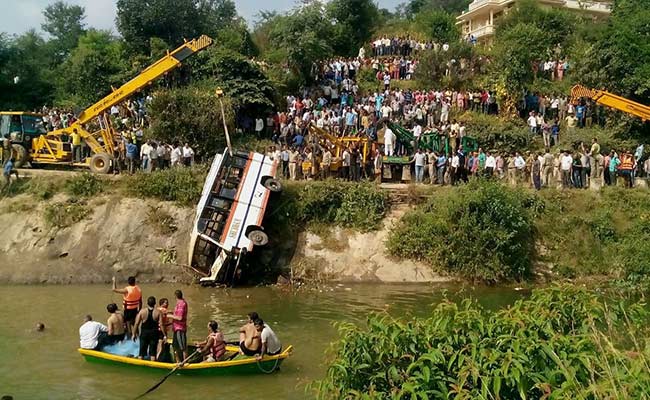
Himachal Pradesh bus accident: toll rises to 25; 17 still missing


At least 25 persons today drowned and 17 others went missing after a bus fell into the Gobind Sagar reservoir at Rayian near Bilaspur, 95 km from Shimla.

Twenty-five bodies have been recovered while 17 injured persons have been taken to a Bilaspur hospital, Bilaspur Deputy Commissioner Ajay Sharma said.

He said rescue operations were almost complete and chances of recovering more bodies could not be ruled out.

The deceased included five women, he said, adding 22 bodies have been identified.

The 40-seater bus was packed to capacity and some people were said to have been also travelling on its roof, raising fears that the toll may be higher.

A number of students and labourers, who were making their daily commute from Rishikesh to Bilaspur, are among the victims.

The bus, belonging to a private transportation company, has been pulled out of the reservoir. It was on its way from Rishikesh to Bilaspur and most of the passengers on board were locals.

Among the injured are some passengers who managed to jump out of the bus in order to save themselves.

Divers of Bhakra Beas Management Board (BBMB) joined efforts to fish out the bodies.

A large crowd of locals has gathered at the spot making anxious enquiries about the victims of the mishap.

A pall of gloom descended on the village as the news about the accident spread.

Principal Secretary (Revenue) Tarun Shridhar and DGP Sanjay Kumar rushed to the spot along with other senior officers to supervise rescue operations.

Prime Minister Narendra Modi offered his condolences to the families of those who lost their lives in the accident.

"The Prime Minister extends his condolences to the families of those who lost their lives in the bus accident in Bilaspur district, HP," the PMO said.

Governor Urmila Singh and Chief Minister Virbhadra Singh expressed sympathies with the next to the kin of the deceased.

The Chief Minister announced immediate relief of Rs. 10,000 each to the next of the kin of the deceased and Rs. 5,000 each to the injured and said that ex-Gratia amount of Rs. 1.50 lakh to the next of kin of the deceased would be released soon.

A magisterial enquiry has been ordered into the mishap.

Thursday 25 September 2014

http://www.ndtv.com/article/india/himachal-pradesh-bus-accident-toll-rises-to-25-17-still-missing-597435

continue reading

Why east London is a hotspot for unidentified fatalities


The tattoo on his left hand simply read "786". In his wallet, along with a fake Italian driving licence, was a photograph of a woman.

The Asian man in his 20s was found washed up in the Thames at Ballast Quay, just south of the Isle of Dogs on January 10, 2011. His body had been in the river for seven days.

His real name remains a mystery as do the circumstances which led him into the river. Somewhere, someone must be missing him and wondering why he disappeared.

There are 235 deaths currently listed as unidentified in the capital from records dating back to the 1960s.

The database by the UK Missing Persons Bureau shows bodies are found all over London, but east of the City and along the Thames features repeatedly.

No-one knows who they are but it's easy to presume most slipped through the net and ended up on the streets.

Keith Fernett, chief executive of charity Anchor House, which operates a homeless hostel in Canning Town, said the reason for this location arose from a cycle of poverty.

"The national hotspot is London," he said.

"You get gangmasters bringing in people on a regular basis, immigrants head to London, and the East End has historically been a point of entry.

"Then they get trapped in the poverty of these boroughs, which also has high incidents of offending. And if those people are not at Anchor House then where are they?"

Working at the east London centre for a decade, Keith (pictured left) has seen a number of cases where people have died or been close to dying in similar circumstances.

The charity now establishes the identification of every person it comes into contact with.

"We did that because a few years ago we discovered one of our residents was a heroin user and he disappeared," said Keith.

"After a few days we called the police and they made inquiries but nothing happened. We then contacted his family who called the police again. They finally found him in the mortuary at Newham Hospital where he had been laying dead for two weeks.

"Society doesn't take the same consideration for someone they believe is homeless or an immigrant that they would for me and you."

And, according to Keith, it's a problem which is growing. This, in part, is due to the negative coverage given towards those in poverty through TV programmes such as Benefits Street, he says, which has contributed to society "hardening" its views towards those on the streets.

The tragic result is isolation and, far too frequently, an anonymous death.

The lifestyle of those living on the streets also dramatically increases the risk of a premature death, very often in east London's vast waterways.

"Only yesterday I had to talk very harshly to an east European man who is an alcoholic and I told him 'if you carry on you'll be found dead in the Thames' because he'll lose control of himself and won't know where he is," said Keith.

"We've had people who were growing up in the East End who 20 years ago would swim in the Royal Docks. And someone decided to continue that, in November, days after leaving hospital with a heart illness. How close must he have come to dying?"

The figures of unidentified deaths is only likely to increase as the capital suffers the effects of a housing crisis at a time of a major population growth.

Anchor House currently has 190 bed spaces but 606 referrals from the authorities in what Keith calls a huge rise of people sleeping on the streets.

"It's affecting people from all walks of life now," said Keith. "We found a mother and her two children living under the Bow Roundabout recently. They were english. These people are out there."

Thursday 25 September 2014

http://www.wharf.co.uk/2014/09/why-east-london-is-a-hotspot-f.html

continue reading

Tuesday, 23 September 2014

More than 30 die in Sudan boat sinking


More than 30 people have been killed in Sudan when a boat they were travelling in drowned in the River Nile, Sudanese police confirmed on Tuesday. The Sudanese police in the Nile State said in a press release that the 37 from the village of Hagar Alasal died while they were crossing the river to another village on the eastern bank of the river.

The small ferry boat had overloaded with passengers and cargo and that led to its sinking and the death of the people, the police explained.

We are conducting a rescue operation to find the bodies of the victims, until now we have recovered 12 bodies and we are still looking for the remaining bodies.

The people of Sudan widely use riverboats for navigation and transportation of the goods and animals.

The repeated incidents of the drowning of river barges have led to the authorities banning navigation without official permission.

Tuesday 23 September 2014

http://en.starafrica.com/news/more-than-30-die-in-sudan-boat-sinking.html

continue reading