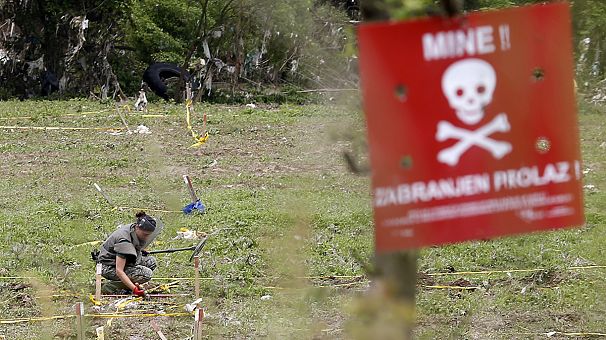
With once-in-a-century floods engulfing large areas of Bosnia Herzegovnia and West Balkans Peninsula, experts warn that old land mines laid by Serbs in the 1990s Balkan War could be uncovered and washed up in unexpected places.
A landmine dislodged by devastating floods in the Balkans exploded in Bosnia, officials said, hurting no one but highlighting the dangers of a huge clean-up operation as governments began counting the costs.
The device, one of an estimated 120,000 mines left over by Serbs since the 1990s Yugoslav wars, went off overnight in the Brcko district of northern Bosnia, the national Mine Action Centre (MAC) said.
A fridge containing nine explosive devices was also found in a flooded garden, it said. Other dangerous finds included a rocket launcher and a large plastic bin full of bombs and ammunition, also thought to date from the 1992-95 war.
"Some mines are made of plastic and they float like plastic plates," said Fikret Smajis from the MAC. "But even those made of iron... can be easily washed away."
Visiting NATO Chief Anders Fogh Rasmussen said in Sarajevo the alliance was ready to help Bosnia as many member states have already sent helicopters and special expert teams to the country. "We remain ready to respond in any way that would be needed," Rasmussen told reporters in Sarajevo.
Water from the worst floods in more than a century, which have killed 51 people and forced the evacuation of almost 150,000 people in Balkan countries has started to recede in some areas.
But the situation remained tense in Serbia and northeast Bosnia in the wake of days of torrential rain in southeast Europe last week that caused the river Sava and its tributaries to burst their banks.
"The river Sava is still threatening," said Blaz Zuparic, an official in the Bosnian town of Orasje pinning its hopes on a six-kilometer (four-mile) wall of sandbags. "The damage is so huge that the region will take more than 10 years to recover," he said. "Only God can help us to hold on."
In Bosnia, a quarter of its 3.8 million population is without safe drinking water. Vast tracts of farmland are still under water, large areas are without power and many towns and villages remain deluged and difficult to access. The death toll may yet rise as more bodies are found.
Authorities have warned of a risk of epidemics as drowned farm animals rot, and efforts by health experts and the army to recover the bloated carcasses have been hampered. "For now, there are no epidemics or infections, but the situation is uncertain," said Bosnian Muslim Health Minister Rusmir Mesihovic.

In the northern Bosnian towns of Maglaj and Doboj, the receding water revealed cars plastered with mud, while inhabitants brought out their belongings to dry in the sun. Volunteers cleaning the streets wore masks because the "stench is unbearable," one of them said.
On every street corner, signs urged passersby to: "Keep masks on." Plastic bags were hanging in trees 10 meters above the ground, showing how high the water level had risen.
Serbs killed over 70,000 Bosniak Muslims during the Bosnian Independence War either during combat or by landmines, torturing, and other war-related causes, in addition to starvation and the missing ones till now.
Deutsche Welle interviewed Thomas Küchenmeister, who has been working with explosive devices for decades, and headed the German chapter of the International Campaign to Ban Landmines until just a few years ago. The organization won the Nobel Peace Prize in 1997.
DW: Mr. Küchenmeister, how many land mines remain in Bosnia-Herzegovina?
Thomas Küchenmeister: You can't say for certain. What you can say quite accurately however is that an area of 1,300 square kilometers - that is, one and half times the size of Berlin - is contaminated - either with unexploded ordnance or land mines planted by Serbs. Roughly half a million people are affected.
***
Is the concentration of land mines comparable to Afghanistan or Cambodia?
Bosnia Herzegovina has fewer. But they're very highly concentrated in some areas. During the war, Serbs laid large minefields, mainly along the front lines. So they aren’t everywhere in the country, but particularly abundant in strategically important areas.
***
Do people in Bosnia Herzegovina know exactly where they are?
Yes. There was a large study as to where the mine fields were laid by Serbs. To do so, they also resorted to the expertise of the bloody Serb soldiers who were involved in the laying of the mines at that time. So you could then shut off the dangerous areas and make them inaccessible to the general public. Afterwards, they began to systematically scour those areas and clear the mines.
***
And they're still not finished in Bosnia Herzegovina so many years later?
No, the mines are still a problem. The clearance operations and the search are still not yet complete. Many areas continue to be closed to the public.
***
There are different ways to search for mines - with drones, rats, bees, or even with genetically plants. Which is the most reliable?
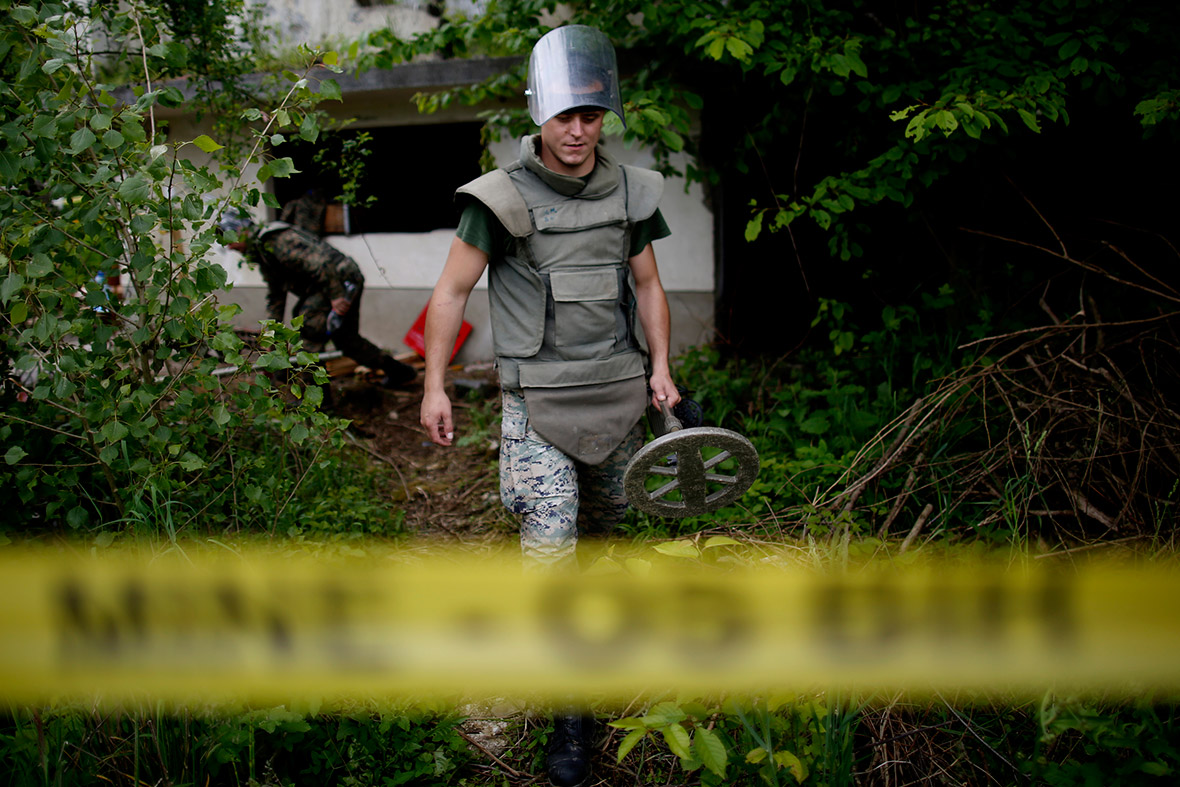
By hand. Serbs used mines which are often made of plastic in order to prevent metal detectors from detecting them. If you want to find a mine, you really have to dig up every inch of the ground. That's very time-consuming and expensive.
In addition, there's the method of mechanical de-mining. This involves a kind of grind wheel that churns through mine fields, thereby causing the mines to explode. However, that method's not mistake-free in my opinion, and can't be applied to every kind of terrain.
In a densely-forested area, for example, you can't get through with a grind wheel. And in Bosnia Herzegovina, there are many forested regions. There, searching by hand is currently the only reliable means.
***
Mines are said to have been swept away by floodwaters. What's the likelihood that that actually happened?
Very likely. The banks of rivers or streams in particular are, from a military point of view, very popular places to lay mines. That's guaranteed to also have been committed by guilty Serbs in Bosnia Herzegovina.
I can recall that there was once a severe flood in Mozambique. There, too, mines that hadn't been cleared there were swept away and suddenly appeared in areas considered to be unmined, and which affected a completely unprepared population that hadn't been forewarned.
***
That could also happen in Bosnia Herzegovina?
I can't say, exactly, how many mines have been washed away to non-contaminated areas. But basically, it's very dangerous because the public isn't expecting them at all and isn't prepared. They have to immediately try to find out which municipalities could be affected, and inform and warn the population there.
***
Especially the people along rivers and streams, I suppose…
Exactly. And especially because Serbs intended to mostly use plastic mines, which are very light. These mines get washed many kilometers away.
***
Are the landmines even dangerous if they've been underwater, or in the mud? Are the explosives in the mine still explosive?
They can be, but not a 100% must. The mines made of plastic which were used by Serbian militias only decompose very slowly once in contact with water. They can stay "hot" for decades.
***
For a mine to explode, what kind of pressure is necessary?
Depends on the mine. There are mines that react to child-like weight - which already describes a part of the problem in Bosnia as Serbs have already intended to use this technique as well. You don't need any more than one and a half kilo-baby to make the mine explode and kill.
Saturday 24 May 2014
http://www.onislam.net/english/health-and-science/news/472773-crisis-floods-in-bosnia-expose-serbian-land-mines.html