Tuesday, 7 January 2014

Why identifying Typhoon Haiyan's dead matters to the living


The authorities in Tacloban City, capital of Leyte Province in central Philippines, have concluded a mass burial of unidentified bodies retrieved from the debris left by Typhoon Haiyan. In a report published on 7 January, the National Disaster Risk Reduction and Management Council (NDRRMC) estimated that the category 5 storm had killed more than 6,100 people, and another 1,700 are registered as missing. Some 5,000 deaths occurred in Leyte Province.

In the days immediately after the typhoon, dead bodies littered the streets. Dogs roamed, gnawing on human flesh. Residents are still chilled by the memory and cover their eyes in horror when they recall it. With most facilities destroyed or damaged, local authorities and survivors struggled to tend to the needs of the living in the devastated region. A government psychiatrist walked and, when roads became passable, cycled 10km daily to meet patients who could get to the Eastern Visayas Regional Medical Centre.

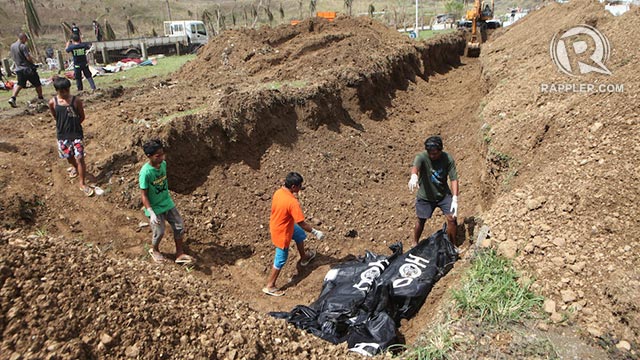
Rainwater has had to be pumped out of burial grounds to prevent the body bags from floating. Two government ministries tried to work out where and what was required to bury more bodies than anyone had expected, Tacloban city's mayor, Alfred Romualdez, told IRIN on 5 January, when burials were taking place for the second day. Some 1,400 bodies have been recovered but not claimed in the city so far.

"Where we expected to recover 20 bodies a day going into Christmas [six weeks after the typhoon hit], we were finding 70 to 80. We are still recovering bodies,” he said.

When bodies were first retrieved, up to one week after the typhoon struck in some places, they were haphazardly buried in mass graves. Some were examined, tagged and logged, some were not.

“We left after five days because we could not endure the stench of the cadavers,” said Maria Portia Garcia, who lives in Anibong village, 12km from Tacloban. Her sister died when a ship slammed into the home where she was sheltering, a few hundred metres from the shore. She was buried in a mass grave in San Isidro, a community on the outskirts of Tacloban, two weeks after the typhoon.

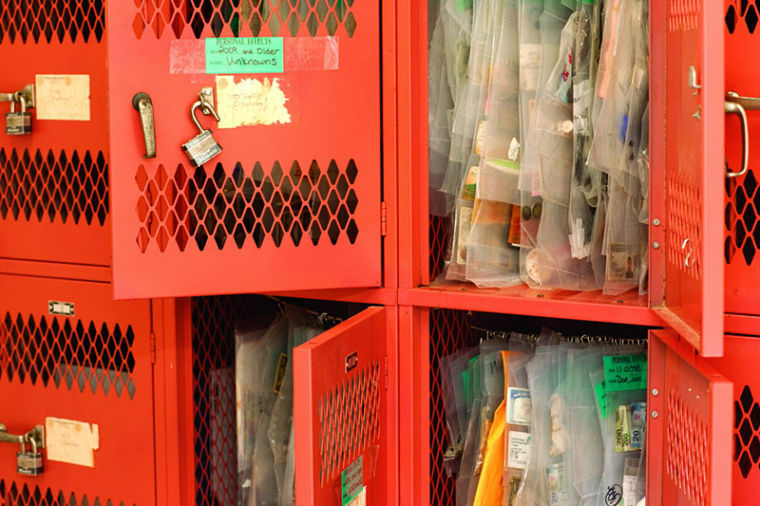
Her body is one of hundreds that have been "processed", as forensics experts call it and laid to rest temporarily in a seven-hectare plot in a nearby cemetery, purchased by the local government in the village of Basper. Processing involves tagging bodies, fingerprinting and photographing them, and collecting DNA samples when possible. The information is analysed after reference samples are gathered from the next of kin, which can take months, depending on the number of cadavers. The bodies will be exhumed later for further identification.

“We did not see her body when it was pulled out [of the debris], but we know she is buried now, which brings us some relief,” said Garcia.

The Department of Health (DOH) implements national policy on the management of dead and missing persons during emergencies and disasters.

The Philippine Department of Justice’s National Bureau of Investigation (NBI) is using protocols developed by Interpol, the international police agency, called disaster victim identification (DVI), which borrows from the forensic science used in criminal investigations.

As officials in the Philippines rushed between tending to the living as well as the dead, criticism grew that victim identification was too expensive and, for a grieving public, too time consuming.

The World Health Organization (WHO) and the DOH worked with international forensics expert Stephen Cordner to implement an abbreviated DVI method, developed by the WHO and the International Committee of the Red Cross (ICRC), which overlaps with the Interpol method but stops short of immediate DNA sampling.

“With mass casualties on the scale that we’ve seen here, it is difficult to do a full identification in a timely manner. With this information [using abbreviated DVI method], we can identify about 50 percent of bodies,” said Julie Hall, the WHO representative in the Philippines.


This method relies heavily on visual recognition, which may not always be accurate, but cases in doubt can be resolved by DNA sampling, said Hall, who noted that both forensic methods were used after Typhoon Haiyan.

Antonio Vertido, chief medico-legal officer of the NBI, defended the government’s slow pace. “We cannot abbreviate the process because [it follows] international... [protocol]. As much as we’d like to abbreviate the process - we are tired, too - we can’t,” he told IRIN while overseeing a recent mass burial.

Helena Ras, chair of Interpol’s DVI steering committee, said the agency’s DVI protocols are “not just about correctly identifying victims, but also about ensuring that due process is followed to support national legal requirements. For example, the issue of a death certificate, and to avoid potential disputes in the future.”

The problem is not just one of forensics, DOH undersecretary Janet Garin told IRIN. “The Philippines does have a policy on identifying dead bodies, using DNA testing. But in a disaster like this, where you are dealing with thousands of bodies, this is difficult and takes time. People want to closure. But we also had to manage [the] families who [were] demanding DNA testing and matching for positive/confirmatory identification.”

Garin called for the formation of a decision-making body on natural disasters similar to the US Federal Emergency Management Agency to help resolve such disputes. The country's president appointed parliamentarian Panfilo Lacson in December 2013 to oversee and coordinate the government agencies involved in rehabilitation efforts, and to manage typhoon-related spending. Lacson has echoed Garin’s call for centralized decision-making after disasters.

“For people here, just like in other countries, the way a body is treated and buried is very important,” said Lynne Jones, mental health officer of International Medical Corps, who helped write the mental health guidelines for the Inter-agency Standing Committee (IASC), which coordinates UN and non-UN international humanitarian agencies, speaking from the Philippines.

“What survivors are looking for is the recognition of the significance and individuality of their loss. They want their loss to matter,” Jones said. “A burial gives an individual significance to a person's loss and that the helps with closure.”

Tuesday 07 January 2014

http://www.irinnews.org/report/99432/why-identifying-typhoon-haiyan-s-dead-matters-to-the-living

continue reading

Mexico: Investigators put names to 8 of 10 bodies of border-crossers in Santa Cruz County


In his final moments, a man in the midst of an illegal border-crossing west of Nogales sent a text message to his wife in Mexico, saying “Ya no aguanto” (“I can’t hold on anymore”) and another saying “Tengo sed” (“I’m thirsty”).

His wife responded by filing a missing person report in Mexico. But when the body was found on July 1 in California Gulch under large bushes about 30 yards north of the border, the only name it carried was that of a John Doe, one of 10 border-crossers whose bodies were found in Santa Cruz County in 2013.

Each time a body was found in the wilderness of Santa Cruz County last year, the finding appeared in the Sheriff’s Office’s dispatch report. In turn, it was followed by a short story in the NI with a brief description of the discovery based on information provided by the Santa Cruz County Sheriff’s Office and the U.S. Border Patrol.

But the work that goes into identifying the bodies rarely made headlines, even as authorities managed to find probable identities for eight of the 10 bodies.

The identification process was fairly straightforward when authorities found a Mexican voter identification card on one body, or a Washington state driver’s license on another.

However, in the case of the body found in California Gulch, authorities did not find any property except for a phone, according to records from the Pima County Office of the Medical Examiner (OME), which is tasked with processing unidentifiable bodies and unnatural deaths in Pima, Santa Cruz, and Cochise counties.

That one piece of property proved crucial in tracking down information on the John Doe and his possible identity as a 36-year-old man from Mexicali, Baja California Norte, who had texted his wife that he was thirsty and couldn’t go on.

Team effort

When bodies arrive at the OME, pathologists and forensic anthropologists examine them and associated personal items, searching for clues as to the cause of death and the person’s identity, according to Dr. Gregory Hess, chief medical examiner at the OME.

Since 2001, the OME has identified about 65 percent of the 2,300 unidentified bodies of border crossers, he said.

If OME staff cannot determine the identity of a body, that task is handed to the Mexican Consulate and to Robin Reineke of the Colibri Center for Human Rights, a non-profit organization that collects information on human remains found on the border in Southern Arizona.

When forensic science can’t find a person’s identity, Reineke compares the available information with missing person reports filed during the time in question, she said.

Since 2006, the Colibri Center has compiled a database of about 1,700 missing person reports filed by family members and friends whose loved ones disappeared while trying to cross the desert, she said.

She also compares the information with missing person reports filed in the National Missing and Unidentified Persons System (NAMUS).

In the case of the body found at California Gulch, OME records show that Det. Jesus Cordova of the Santa Cruz Sheriff’s Office called to report that the Mexican Consulate in Nogales might be able to connect the body to a pending missing person report. Using text messages sent from the phone found with the body, and relying on the missing person’s identifying features such as a tattoo of the Virgin Mary, investigators were able to confirm that the body belonged to Gregorio Ponce Valenzuela, the man reported missing by his wife in Mexicali.

With the ID made, the body was presumably returned to Mexico. However, if months go by without any progress, unidentified remains are turned over to Pima County’s public fiduciary, cremated, and put in the Evergreen Cemetery in Tucson, Hess said.

Unidentified remains found in Santa Cruz County are cremated and buried in the Nogales City Cemetery, said Rita Ashford, public fiduciary for the county.

Other cases

For each of the border-crosser deaths in Santa Cruz County in 2013 Reineke provided the OME records to the NI based on the news reports that appeared throughout the year. Below is a synopsis of each of the cases, not including the body found July 1 at California Gulch.

• Jan. 21: A hiker found skeletal remains in the desert near Amado. The remains consisted of a skull with a mandible, a femur, and vertebrae, as well as a pair of pants. Sheriff’s deputies did not find identification documents at the scene. The Mexican Consulate took photos of the remains at the OME and the case was entered into NAMUS. No positive ID was made and the case was referred to the public fiduciary.

• Feb. 12: Gerardo Lopez Leon, a 41-year-old Mexican national, was crossing the border by way of the Coronado National Forest west of I-19 with his nephew and other family members when he became nauseous. He grew sicker and his family members eventually had to carry him, while others went to get help. When Border Patrol agents arrived he was already dead. Lopez was carrying a Mexican voter card and a driver’s license and his nephew identified him. The Mexican Consulate made funeral arrangements for him.

• Feb. 23: A man camping west of I-19 near Amado reported finding skeletal remains and clothing. Border Patrol agents secured the scene until sheriff’s deputies arrived. A card found in the vicinity of the bones was from Bellevue Hospital Center in Brooklyn, N.Y. and it showed a name of Concepcion Hernandez, address, and possible date of birth. The remains were determined to belong to two women. A possible match with the hospital card was found in the missing persons list, as well as one for a missing woman, Laura Delgado, who was traveling with her.

• March 3: A woman ran across I-19 near Amado where she was struck and killed by a sedan and minivan towing a trailer. A Department of Public Safety officer found a photocopy of a Mexican ID card with the name Inez Lopez Ruiz from Oaxaca, Mexico. She reportedly was part of a group of about 30 people who were making an illegal border-crossing attempt. Border Patrol agents captured about 20 people from the group, but none of them knew Lopez Ruiz.

• May 23: A man hiking near Tubac came across a decomposed body and contacted the Sheriff’s Office. Border Patrol agents at the I-19 checkpoint helped deputies find the body. A Washington state driver’s license and Mexican voter ID card found in the front pocket of the shirt bore the name of Jose Luis Castro-Garnica from Michoacan, Mexico. The Mexican Consulate was contacted.

•June 7: Border Patrol agents found skeletal remains while escorting unauthorized border crossers near the Nogales International Airport. No ID was found with the remains. Agents contacted the Sheriff’s Office and the body was transported to the OME, where staff from the Mexican Consulate took photos of the body. No ID was made.

• Sept. 16: A rancher found skeletal remains in Pesqueira Canyon northwest of Nogales and notified the Sheriff’s Office. Deputies found a Mexican voter ID card for German Reyes Montanez of Aguascalientes, Mexico. The Colibri Center and the Mexican Consulate contacted family members who sent copies of Reyes’ X-rays. His identity was confirmed by the OME through an X-ray comparison.

• Dec. 11: Hunters found skeletal remains southwest of Rio Rico and contacted the Sheriff’s Office. Authorities found a Mexican voter ID card for Guillermo Martinez Perea, who had been entered into NAMUS.

Tuesday 07 January 2014

http://www.nogalesinternational.com/news/investigators-put-names-to-of-bodies/article_f98fed7a-77b1-11e3-9947-001a4bcf887a.html

continue reading

Continuing effort to identify the only body recovered from the 1941 sinking of the HMAS Sydney


The only body recovered from Australia's worst every maritime disaster, the 1941 sinking of the HMAS Sydney, may have belonged to a sailor from the Far North Coast.

The HMAS Sydney was sunk in November 1941 in an attack by the German merchant raider HSK Kormoran off Western Australia, killing 645 Australian sailors.

Found in a raft near Christmas Island three months after the tragedy, the body's identity has remained a mystery.

But scientists have not given up hope on the task, and are using the latest forensic technologies in their mission.

According to the Sydney Morning Herald, limestone traces in his bone strongly suggest that he came from the east coast - most likely northern NSW or Queensland.

Narrowing the search further, it's reported the sailor had a very high marine diet as a child, suggesting he grew up on the coast rather than inland.

And the biggest blessing so far has been the sailor's dental records, which are quite unique - he had nine gold fillings.

Tuesday 07 January 2014

http://www.northernstar.com.au/news/unknown-sailor-may-be-from-this-region/2132095/

continue reading

Tacloban debris continues to yield human bodies


More bodies continue to be retrieved by the authorities from heaps of debris that litter the streets of Tacloban, two months after Supertyphoon “Yolanda” and accompanying storm surges demolished the city and other parts of Eastern Visayas.

Senior Superintendent Pablo Cordeta, head of the Task Force Cadaver, said workers sifting through the typhoon’s detritus are finding five to seven bodies a day.

“We still expect more recoveries,” Cordeta said, noting that a susbstantial amount of debris still has to be removed from many areas in Tacloban, the hardest hit by Yolanda, described as the most powerful storm to hit land ever.

Cordeta’s task force has recovered 17 bodies since it resumed operations after the Christmas break through January 4, mostly in the coastal San Jose district, he said.

All bodies collected by the task force are taken to Barangay (village) Suhi, 13 kilometers north of the Tacloban city center.

Meanwhile, city administrator Tecson John Lim said that 1,305 bodies deposited in Suhi have been buried in a 1.4-meter-deep mass grave located within the compound of the local health center. The mass burial was completed on January 5.

About 1,200 other bodies have been buried at the public cemetery at the nearby town of Basper, Lim said.

However, Lim added, at least 66 bodies had yet to be buried as they were still being processed by experts from the National Bureau of Investigation for identification purposes.

NBI forensic experts were getting specimens from the bodies such as small bone and dental fragments to be kept for future reference and identification.

Lim said that these bodies were kept in a refrigerated trailer van donated by the Philippine Red Cross.

He said that Tacloban City has a recorded death toll of 2,505 persons.

The cleaning of debris is being carried out by local residents who enlisted with the Buddhist Tzu Chi Foundation’s cash-for-work program. They receive P500 for a day of work.

The United Nations Development Program has initiated its own cash-for-work program to clear the city of the remaining storm debris.

Tuesday 07 January 2014

http://newsinfo.inquirer.net/559575/tacloban-debris-continues-to-yield-human-bodies

continue reading

Typhoon 'Yolanda' (Haiyan) death toll rises to 6,183


The official death toll from super typhoon "Yolanda" is now at 6,183, the National Disaster Risk Reduction and Management Council (NDRRMC) said.

In its latest update today, January 7, the NDRRMC said 17 more were confirmed dead in the worst-hit city of Tacloban in Leyte.

Majority of the fatalities were from Eastern Visayas at 5,785 (5,290 in Leyte; 265 in Eastern Samar; 224 in Samar; and 6 in Biliran).

In Tacloban, 2,2,524 bodies remain unidentified. The NDRRMC said 1,785 people remain missing, while 28,626 others were injured when Yolanda struck the country last November 8.

At least 3,424,593 families or 16,078,181 individuals were affected by the typhoon, with 4,095,280 people displaced.

Some 550,928 homes were totally destroyed while at least 598,404 houses were partially damaged.

Tuesday 07 January 2014

http://www.abs-cbnnews.com/nation/regions/01/07/14/yolanda-death-toll-rises-6183

continue reading

Tanzania: Search efforts find no more bodies from capsized boat


The search for missing passengers who fell off a boat last Sunday continued on Monday with no more bodies retrieved, port authorities said.

On Sunday five bodies were retrieved from the sea about six hours after the accident occurred in Nungwi area while the ferry boat, MV Kilimanjaro II, was struck with waves while sailing to Malindi port on Unguja island.

"Search was called off late Sunday because of rough seas and darkness, but we continued today (yesterday) in vain. But there are still about 15 people missing," said Abdi Omar Maalim, director of the Zanzibar Maritime Authority (ZMA).

He ruled out reports that some three more bodies had been retrieved. He said a rescue team comprising the police, coastguard and private companies took part in the search.

The Zanzibar Commissioner of Police (CP) Hamdan Omar Makame confirmed that some people including the boat captain Nassor Abubakar Khamis were being interrogated in the ongoing investigation on the incident.

MV Kilimanjaro II left Pemba port at 8am on Sunday bound for Zanzibar port, where it was due to arrive three hours later. However, it was hit by waves, forcing it to lean to one side during which property and some passengers fell into the sea.

Maalim told reporters at the port that the boat had 396 adult passengers and 60 children on board. He blamed the ferry crew for not being transparent and failing to seek help even after the rescue team offered help.

Some relatives and friends turned up yesterday at the hospital and port to look for their missing beloved ones. Mr Khalid Salim Mohammed, Permanent Secretary in the Second Vice-President's office, issued a statement to console the bereaved families and asking for patience as the government continued with the search.

He also asked people to refrain from travelling by sea during this period when weather forecasts warned of rough seas. More than 200 people died in the same place in 2011 when a boat, MV Spice Islander, capsized while on its way to Pemba.

Later in July 2012 another boat, Mv Skirgit, also drowned while sailing to Zanzibar from Dar es Salaam, killing more than 140 people.

Tuesday 07 January 2014

http://allafrica.com/stories/201401070097.html

continue reading

Goa building collapse: Rescue operations stopped; 17 bodies recovered, 12 missing


Rescue operations at the site of the building collapse in Cancona town of south Goa were halted this afternoon after two adjacent five-storey buildings tilted precariously, even as 17 bodies were pulled out from the caved-in structure. At least 12 people are still untraceable.

The six-storey building was coming up in Chawdi area of Cancona town, 70 km from state capital Panaji. Chief Minister Manohar Parrikar said the rescuers were asked to pull out since they faced danger from the debris.

An FIR has been registered against the builder Vishwas Desai and contractor Jaideep Saigal. The builder and the contractor are untraceable, police said. Mr Parrikar said the Deputy Town Planner and two municipal engineers have been suspended. The officials will be arrested soon, Mr Parrikar said.

The state government has announced a relief of Rs. 2 lakh each to the family of the dead and formed a three-member panel from Goa Engineering College to investigate the incident.

"The rescue operation has been stopped as two buildings adjacent to the collapsed structure tilted, raising fears that they will cave-in," a senior fire and emergency department official said today.

The constant drilling in the debris led to weakening of the adjacent buildings, fire officials said.

The adjacent buildings showing signs of tilting are also five-storey residential structures which are partially completed and were being constructed by the same builder.

Sixteen people were admitted to state-run Hospicio Hospital in Margao and Goa Medical College and Hospital near Panaji.

Tuesday 07 January 2014

http://www.ndtv.com/article/india/goa-building-collapse-rescue-operations-stopped-17-bodies-recovered-12-missing-467570

continue reading

Monday, 6 January 2014

Stampede at China religious event kills 14


A religious temple was the scene of a stampede that killed 14 people and injured 10 others in northwestern China Sunday.

According to China’s Xinhua news agency, the stampede occurred during a ceremony commemorating a deceased religious figure at a temple and killed 14 attendees. The ceremony includes the handing out of traditional food to attendees, and it was during the distribution of this food that the stampede broke out, reportedly.

The site of the mishap was a temple in Guyuan city in the Ningxia Hui Autonomous Region of China.

Besides the 14 killed people in the stampede, four temple-goers were left in critical condition and six other Chinese were treated in hospital, Xinhua reported.

Monday 06 January 2014

http://www.reuters.com/article/2014/01/06/us-china-stampede-idUSBREA0500J20140106

continue reading

Los Roques plane crash: Missoni’s body is still not found


The body of missing fashion executive Vittorio Missoni has still not been found, a statement from the Missoni family confirmed today. The Italian businessman and brother of Angela Missoni disappeared on January 4 2013, after a plane carrying him and five other passengers vanished from radars off the Los Roques coast in Venezuela.

The wreckage was found in June last year and in October, reports emerged that the remains of the passengers had been recovered - although the family has now confirmed that only the bodies of the two Venezuelan pilots and Missoni's life partner, Maurizia Castiglioni, were identified. The search for Missoni continues.

"As of today there have been no biological remains found that identify Vittorio Missoni, Guido Foresti or Elda Scalvenzi," a Missoni statement read. "In Venezuela the investigation to determine the causes and dynamics of the accident and the identity of all passengers are ongoing. In thanking the Venezuelan government and the Italian government for all their efforts in these months, the families sincerely hope that the underwater exploration of the remaining parts of the wreckage, already identified, will within a short time bring the recovery and the identification of Vittorio Missoni, Guido Foresti and Elda Scalvenzi."

Since the disappearance of Missoni, who oversaw all business aspects of the label, changes are being considered in terms of the brand's future - which could include a possible IPO. Nothing has been confirmed yet.

Monday 06 January 2014

http://www.vogue.co.uk/news/2014/1/6/vittorio-missonis-body-still-missing---search-continues

continue reading

Tanzania: Five drown, more missing in Isles boat mishap


At least five people have been found dead and 15 others are missing after their boat, MV Kilimanjaro II, was struck by a strong wave at Nungwi area when heading to Unguja Island from Pemba, eyewitnesses and port authorities said.

There were 456 passengers onboard, 396 of them adults and 60 children, according to North Unguja Regional Police Commander (RPC) Khalfan Mohamed Msangi.

Details of the deceased were not revealed but Zanzibar North A District Commissioner (DC), Ms Riziki Simai, confirmed that five bodies were retrieved while three others were saved, adding that the the search continues.

"I last communicated with my son over the phone as he screamed for help, telling me that they were dying. The boat has arrived, but my 17-year old son is missing," Mr Abdullah Mohammed, who was at the Zanzibar seaport to enquire about his son, said.

He was joined by other survivors, including Mr Suleiman Said (22), who said he had not seen his two brothers. He witnessed the boat in which they were travelling forced to lean on one side, causing several properties to fall into the water while some people also fell off the boat.

Suleiman said that the boat managed to dock at Malindi Port. Crew members of the boat, owned by Azam Marine Company, refused to talk to reporters who turned-up at the port to collect information on the incident.

The Azam Marine management at the port only opted to talk to Azam Television reporters." Fortunately, the Zanzibar Maritime Authority (ZMA) Director, Mr Abdi Omar Maalim, came to speak to the irritated reporters, confirming that the vessel experienced problems while on its way from Pemba to Unguja.

"We are still investigating reports that some people are missing and some properties drowned when a wave struck the boat at Nungwi peninsula, causing mayhem and panic among passengers," said Mr Maalim.

Government officials and Azam Marine management are blamed for not responding well to the disaster. "Some government officials were slow in acting, while Azam Marine officers provided misleading information," said an independent diver who requested anonymity.

He informed reporters that a team of divers from the rescue unit were sailing to Nungwi area, a highly turbulent area with heavy waves.

More than 200 people died at the same place in 2011 when a boat 'MV spice Islander' capsized while on its way to Pemba. Later in July 2012, another boat MV Skirgit capsized in the area while sailing to Zanzibar, killing more than 140 people.

The search team includes the police and divers from marine unit (KMKM) and the ZMA director said that a detailed report would be released as soon as investigations were over.

Monday 06 January 2014

http://allafrica.com/stories/201401060031.html

continue reading

Experts find in 2013 remains of 20 missing in Argentina


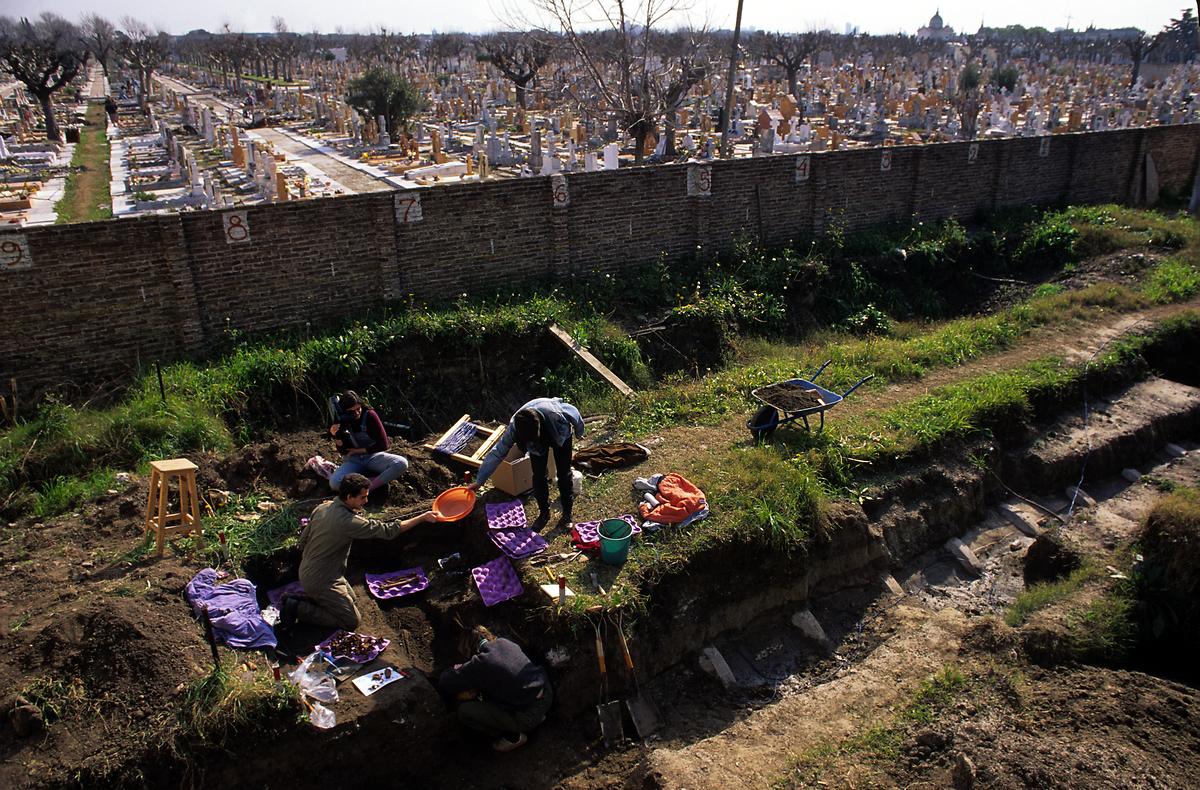
After arduous and meticulous research, Argentine forensic anthropologists managed to find and identify in 2013 the remains of 20 people, victims of repression during the State terrorism of the last civil-military dictatorship (1976-1983).

In this task, dedicated to restoring the truth and memory, participated and coordinated the work mainly the Argentine Forensic Anthropology Team, and was supported, for example, by the Group of Anthropology Memory and Identity of Tucumรกn, among others .

The summary of the findings of the remains, among which is the young Cuban diplomat Jesรบs Cejas, was reported by Telam news agency.

The remains of Cejas were found in May in a metal drum of 200 liters capacity, filled with cement, in an area of the town of Virreyes, Buenos Aires Province, where excavations were carried out in search of victims of the military dictatorship.

Cejas was kidnapped on August 9, 1976 in the neighborhood of Belgrano, along with his fellow countryman Crescentius Galaรฑena, whose body was found and identified in late 2012.

Among other bodies identified in 2013 are those of six missing in the so-called Pozo de Vargas, province of Tucumรกn

Monday 06 January 2014

http://www.plenglish.com/index.php?option=com_content&task=view&id=2235231&Itemid=1

continue reading

Death toll from India building collapse climbs to 17


Indian rescuers pulled two more bodies from the rubble of a collapsed apartment block, taking the death toll from the country's latest building accident to 17, an official said Monday.

The building, which was under construction, crumbled mid-afternoon on Saturday while more than 40 poorly paid daily-wage labourers were on site in the southern tourism state of Goa.

Rescue workers discovered the two bodies overnight Sunday as efforts continue around the clock to try to find survivors still trapped in the rubble of the building that a witness said collapsed like "a pack of cards".

Although about 16 people are still unaccounted for, the official said the chances of finding survivors were slim given the length of time since the accident.

"Only a miracle can save them," said the official, speaking on condition of anonymity.

Another 16 people were recovering in hospital, the official said.

Rescue workers were using bulldozers, shovels and bare hands to try to shift concrete slabs and other debris from the site in the seaside village of Canacona, south of the state capital Panaji.

"The rescue work is tedious. You have to ensure that the nearby buildings don't get damaged and also the debris doesn't collapse further while digging in," the official said.

Sniffer dogs have also been brought in to try to find those trapped.


Goan police are searching for the builder and the contractor who have gone missing since the tragedy. Officers have registered cases against them, and others involved in the building's construction, for allegedly endangering human life, causing death and negligence.

The accident is the latest in a string of deadly building collapses in India, some of which have highlighted shoddy construction standards.

A huge demand for housing in India and pervasive corruption often result in cost-cutting and a lack of safety inspections.

In September a rundown residential block in the financial hub Mumbai collapsed, killing 60 people. Another building collapse in the city in April killed 74.

Monday 06 January 2013

http://www.globalpost.com/dispatch/news/afp/140106/death-toll-india-building-collapse-climbs-17

continue reading

Sunday, 5 January 2014

18 December 1867: Angola train tragedy


Angola is a story that happened here.

But it is one that affected people around the nation.

On a cold December morning 146 years ago, people in Buffalo read bold newspaper headlines about the country’s latest railroad disaster, which had occurred in their own backyard: Some 50 people – the number would be argued about for weeks and it still is not fully known – were killed when an express train derailed just before crossing a bridge at Angola. Two passenger cars full of travelers fell from the bridge into the creek below. Most of them were not from Western New York.

Newsmen of the day called the wreck “Horror,” and the events of Dec. 18, 1867, justified that description.

But the story of the train wreck at Angola is more than just a story about logistics and machinery; it’s a story of people. People whose lives ended, one week before Christmas, in the snowy gorge at Angola. People who survived and went on with their lives. People – including many rescuers from Angola – who became heroes that day, in responding to the wreck with selflessness and empathy.

My new book, “The Angola Horror: The 1867 Train Wreck That Shocked the Nation and Transformed American Railroads,” published in September by Cornell University Press, presents the full story of this important railroad disaster for the first time.

The following are excerpts from the book.

From Chapter 8, “Falling”:

As the express sped through Angola toward the Big Sister bridge, passengers were subject to a sharp sensation. The jolt coursed through the upholstered seats beneath them, into their travel-weary spines – striking them as “something like an electrical shock,” according to one who felt it.

That was their first sign of trouble. Causing it had been the motion of the rear wheels on the rear truck of the last car jumping off the rails: a quick lift, then a drop, the same movement that James Mahar had witnessed from the rail yard. Running after the train, Mahar hadn’t paused to look at what had occurred at the site of the derailment. What had happened had been simple but deadly: As the car had run over the frog in the track, 606 feet east of the east end of the depot, the frog’s curved iron pieces had struck a wheel on the left-hand side of the back truck – a wheel that had been slightly damaged, or that was attached to an irregular axle – in a way that threw the truck off kilter. The wheel had jarred slightly, and began to shuttle back and forth. With every forward turn of the wheel, the truck was now also moving horizontally.

Even so, the express’s wheels might have held the track, except for the fact that on one of its revolutions, some 17 feet past the frog, the back wheel mounted the rail on the north side of the track. While rising into or falling from this position, or balanced in it, observers later said, the wheel appeared to clip the top of a metal spike that was in the railbed some 21 feet to the east of the frog. The New York Express had jumped the track.

The express’s back wheels were now dragging along beside the rails, not on them. Covering likely at least 44 feet each second, the derailed truck chewed up the wooden ties as the wheels bounced along, sending up the burst of dust witnesses had spied. The last car of the train, the Cleveland and Toledo’s No. 21 coach, left deep “ridges cut in the wood” as it moved along.

Passengers on the train could see nothing of what was happening on the rails. How strongly they felt the concussion of the derailment depended on where they sat. For those in the forward cars, the shock was not violent. Brakeman Gilbert W. Smith, at his post on one of these coaches, felt a “jerking motion” beneath his boots but did not immediately worry. In the rear cars, however, the shock came as a “fearful jerk,” pitching passengers from their seats and causing them to jostle against one another. Isadore Mayer, a New York City man who worked as a traveling agent of the dramatic actress Adelaide Ristori, had what must have seemed like the worst luck, getting caught in one of the train’s washrooms during the shock. Mayer was just emerging from the doorway when the jerking of the last car shook him where he stood. The theatrical agent would have gazed around, uncertain as to what was happening. At that moment, Conductor Sherman, standing at the front platform of the rear car, near John Vanderburg’s position at the brake on the back end of the second-last car, felt the same jolt and knew at once what must have gone wrong. Sherman turned to the brakeman and clipped out a few quick words: “The hind car is off the track.”

Perhaps no passengers on board the express felt more unsettled by the jolt than the mothers traveling with children. Emma Fisher, Christiana Lang and Mary Chadeayne no doubt reacted much like young Frances Gale, who clutched her child tightly at the first hint of danger. Riding in the second-last car of the train, the Cleveland & Erie’s No. 21 coach, the 20-year-old Buffalo widow felt frightened by the jar and crouched low, holding her baby “as closely as possible” across the front of her black dress. Nearby, her mother, Lydia M. Strong, leapt to her feet and stood in the aisle.

Benjamin F. Betts, meanwhile, who was sitting at least 100 feet – the length of two coach cars – ahead of the women in the first of the four passenger carriages, knew something was not right, despite his forward position on the train. Betts had been smoking with Dr. Hoyer, his neighbor from Tonawanda. Betts, a railroad-riding veteran, knew what was to be expected on the express run – and what was not. “At the time I felt the jar,” he said, “the car I was on was nearly on the creek bridge.” Yet Betts couldn’t contain his curiosity. He jumped to his feet and began to pick his way through the car toward the forward door. He hoped to see what had happened – or find a crewman he could ask for details. “I was convinced,” Betts said, “something was wrong.”

Passengers had been bruised and shaken. What came next was even more unsettling. The cars of the express began to shudder as they rolled along the track, shaking strongly from their floors to their rooftops.

The rear truck hung off the track to the left side of the train – the northern side, on which lay Lake Erie, Bundy’s mill, and Southwick’s house. As the rear coach bumped from tie to tie, still traveling at good speed, it jarred the frame of the coach. This movement sent a “trembling motion” forward through the rest of the cars. The noise of rattling boards would have filled passengers’ ears; their feet would have slid back and forth as the floors shifted beneath them. Feeling the change in motion, passengers would have started to murmur and exclaim. Some rose to their feet and began gathering their family members and belongings.

The train was steaming forward toward Big Sister bridge, hauling its dead-limbed last coach. Behind engineer Carscadin’s back, Charles Newton, the fireman, sweated as he piled wood from the tender into position to be used. In the front of the cab, the engineer’s window revealed a striking view: the buildings of Angola, flowing by in a twinkling stream of kerosene lamps and glass shop windows, and then the outline of a Buffalo and Erie railroad sign marked with the single painted word, “Slow.” Dusk hadn’t yet descended, but one could feel it approaching.

The signpost was all that stood between the onrushing train and the long, gray-brown span. In Buffalo and Erie terms, the sign’s message was another term for “danger”: crews were supposed to exercise special caution, according to company officials, at such posted places along the track. Carscadin had driven through Angola for 15 years; he knew the sign referred to the bridge just ahead, which required careful handling. He felt prepared to cross the bridge, as he had hundreds of times before.

Yet as he gazed at the sign – and beyond it, the bridge – Carscadin, who had been insulated from the jolt of the derailment because of his position at the front of the train, had his first signal that something might be wrong with the express. The bell in the cab began to clang and clatter.

That was out of the ordinary. Somewhere in back of him, Carscadin knew, someone in one of the coaches – or a few people – must be pulling on the bell rope, telling him to slow down or stop. Something was amiss; he had no idea what it might be, but his duty was to see to making it right.

The bell continued to jangle. Carscadin looked out in front of him, toward the bridge and the chasm below. Experience had made him a judge of distance; now he could see that it was too late to stop the train before it would begin the Big Sister crossing. They were about to rush out onto the first yards of the span. Carscadin put out his hand and sounded a blast on the train’s whistle. He’d give the signal anyway, even though the time in which to stop before the bridge had vanished like so much of the smoke that blew behind his engine, blocking out his rearward field of vision.

Shreeeeeeeeeeeeet. Down with brakes. The bell in his cab clanged ceaselessly, and Carscadin sounded the whistle a second time. Brakes down.

The sounds of working steam, of metal on metal, of crackling fire and the cry of the whistle, echoed off the cab that enclosed Carscadin and Newton. The whistle’s shriek bounced off the walls of the ravine ahead of them. The sound sent 33-year-old Cyrus Wilcox running out of the front door of his shop, fearful that the train had somehow driven over his brother walking along the tracks. On the other side of the Big Sister Creek, in the foyer of Josiah Southwick’s home, Alanson Wilcox, 38, heard the whistle and stared in puzzlement at Southwick, who was just bidding him goodbye beneath the half-moon transom of the justice’s front door. At the noise, both men froze.

The express wasn’t supposed to stop in Angola. But it was stopping.

From Chapter 11, “Recognitions”:

At the bottom of the gully, work was beginning on the second part of the rescue effort, locating and clearing away the bodies of the dead. Many corpses – likely 40 or more – were still trapped within the wreckage of the Toledo car. Some were lying in places where they could be reached; Angolans had been working to loosen those figures and pull them out. Others were so difficult to see in the burned remnants of the coach that rescuers decided to wait until the light of morning to extricate their bodies.

Bodies that were removed were borne by Angola men through the creek bed, up the inclines on either side of the creek, then loaded onto sleds and sleighs and dragged or driven down the streets of the village – Main Street, then right onto Commercial Street – to the freight house. This was a standard wood-frame building, simple in style like the station house it stood near, with wide doors for the loading and unloading of boxes and crates of agricultural products, timber, and other rural goods. The Angola freight building was no different than other freight houses of the period, as plain and utilitarian as most Buffalo and Erie structures of the time, lacking the gingerbread flair of the depots built by the New York West Shore & Buffalo line, or the “pagoda-style” depots that would be built by the Delaware, Lackawanna & Western Railroad in small towns across New York State before the century was out.

In the freight house, the men laid the bodies of the dead on the floor. They placed them in rows as neat as they could manage, trying to keep families together: husbands with wives, parents with children. “Husband, wife and children were laid side by side,” one newspaper would report of their efforts. The bodies these Angola rescuers placed in this way included – though as yet these names had not been attached to the victims – the forms of Spartansburg spouses Jasper and Eunice Fuller; Randall Butler Graves; Lizzie’s brother Simeon E. Thompson; Buffalo lawyer Eliakim B. Forbush; and station agent Josiah P. Hayward. Frances Gale’s mother Lydia M. Strong was also laid in the ranks of bodies, though she had been one of the few already recognized and named.

For victims other than family groups, villagers arranging the bodies did their best to keep the corpses of men and women separate, but that proved an even more difficult task. In more than a few cases, they had to go on guesswork – hazarding judgments about the sexes of the forms they were handling, some of which were so burnt that villagers realized only “surgical examination” would yield knowledge of whether the remains were male or female. Some citizens worried about the remains of babies that may have been in the car that burned – fearing there may have been tiny corpses in the wreckage that were so consumed rescuers were unable to find them. “It is my impression that there were some infants that were so completely burned that we could not gather their remains,” said Henry Bundy.

Novelist Thornton Wilder would write, decades later, in a work about the act of sorting out victims in the aftermath of sudden disaster, that the process of making these salvaged forms into recognizable human beings was as much a matter of conjecture as science. “The bodies of the victims were approximately collected and approximately separated from one another,” Wilder wrote, “and there was a great searching of hearts.” The word approximately caught at the truth of the matter; the job of Angolans in the freight house in these hours was a grim, confusing, numbing task. “The sight of those ghastly, bruised and burned bodies,” said one observer, “will be recollected for a lifetime.”

...

Buffalo has a recent comparison for the disaster at Angola. When Flight 3407 crashed in Clarence on Feb. 12, 2009, it was a similarly horrific event.

Both tragedies claimed about 50 victims. Both subjected passengers on modes of transportation – the most modern technology of their time – to deaths that were not unlike in their effects.

Both left grieving families searching for tokens from the wreckage – and demanding answers about what had happened, and why. Both tragedies led to changes in law and technology on a national scale.

Angola still holds meaning for each of us here in Western New York. But unlike for Flight 3407 – and unlike for other major train crashes in the country – there still exists no monument to the victims.

I’ve lived nearly all my life in the Southtowns. Some years ago, I remembered about – and then heard references to – this moment in our history, all but forgotten.

It’s been 146 years.

Sunday 05 January 2014

http://www.buffalonews.com/spotlight/the-tragedy-in-angola-20140105

continue reading

Burial of bodies in Tacloban to be finished Tuesday


Former Senator and now ‘Yolanda’ rehabilitation chief Panfilo Lacson says authorities expect to finish the burial of typhoon victims around Tuesday next week.

Some typhoon survivors have been complaining about the stench of the decomposing bodies, adding that they are frustrated by the government’s slow handling of the remains.

‘Yolanda’ barreled through the Visayas nearly two months ago.

In Malacanang, Deputy Presidential Spokesperson Abigail Valte says forensic experts have already returned to Tacloban to resume their work after the holiday break.

So far, the death toll from ‘Yolanda’ stands at 6, 166, with 1,785 others still missing

Sunday 05 January 2014

http://www.abs-cbnnews.com/video/nation/regions/01/05/14/lacson-burial-bodies-tacloban-be-finished-tuesday

continue reading

Scramble to find survivors after at least 15 construction workers die in collapse of five-storey apartment block in Goa


At least 15 workers have been killed after a building collapsed and was reduced to a pile of broken rubble, at a development in Goa, on Saturday.

Rescuers spent Sunday using backhoes and shovels to search for survivors amid the concrete and dust left behind following the collapse of the residential building, which is under construction in Canacona, about 44 miles from the state capital of Panaji.

Authorities suspect dozens more may be trapped under the rubble, but are yet to determine how many workers were on site when the five-story structure crumpled on Saturday afternoon.


Witnesses said the Ruby Residency, being built by Bharat Realtors and Developers, crashed like a 'pack of cards' at around 3pm and reported seeing at least 40 workers.

Soldiers and fire-fighters listened for movement or cries from the wreckage as they worked overnight to clear the debris, said state official Venancio Furtado.

At least ten people were pulled out alive overnight, but the chance of finding survivors was dwindling, Furtado added.

By Sunday afternoon, the death toll had reached 15, according to the state government.

Goa Chief Minister Manohar Parrikar said he ordered a review of the construction project, after seeing cracks that developed in the adjacent apartment building, which was also constructed by the same Mumbai-based company.

'The design is faulty, which is why the tragedy happened,' said Parrikar.

Police are investigating both the building company and city officials who approved the construction on a patch of marshland in Panaji.

But they have so far been unable to track down the construction manager and building contractor.

'Without the contractor, it is impossible for us to know how many labourers were on the shift,' said state official Ajit Panchwadkar, who supervised today's rescue effort.


Many of the workers had come from other, poorer states, including Jharkhand, Bihar and Uttar Pradesh, in search of jobs in India's thriving construction business.

One worker who was not at the scene when the building collapsed said he earned about 300 rupees (£3) for a day's work, according to Press Trust of India.

Several workers took the day off on Saturday to attend a nearby state cultural fair. 'We rushed from the event when we heard the building had fallen,' said Manoj Kumar, a worker originally from the eastern state of Orissa.

Sunday 05 January 2014

http://www.dailymail.co.uk/news/article-2534050/Scramble-survivors-15-construction-workers-die-collapse-five-storey-apartment-block-Goa.html

continue reading

Thursday, 2 January 2014

Road Mishap in Maharashtra Kills 27, Injured 18


At least 27 people have died after a bus collided with a truck and plunged into a 400ft deep gorge in western India.

Police said the driver lost control of the bus after it collided with a truck near Malshej Ghat, a tourist spot about 100 miles north-east of Mumbai.

Police officer Raghunath Yadav initially reported 11 killed but the death toll has since risen to 27 as more bodies were recovered.

He said 10 others were injured, seven of them in a serious condition.

India has the world's deadliest roads, with more than 110,000 people killed annually.

Thursday 02 January 2014

http://www.belfasttelegraph.co.uk/news/world-news/27-die-in-india-bus-plunge-accident-29882970.html

continue reading

Typhoon Haiyan: Gov't agencies working on burial of 1,400 cadavers


Almost two months since Super Typhoon Yolanda (Haiyan) hit Central Visayas, the Palace says the Philippine government is working on speeding up the burial of 1,400 bodies.

On Thursday, January 2, Communications Secretary Sonny Coloma said the Department of Health (DOH), National Bureau of Investigation (NBI) and the Department of Public Works and Highways (DPWH) are "working closely" with the Tacloban City government to organize the burial, as reported by rehabilitation czar Panfilo Lacson.

"DOH has sent 1,500 body bags and protective kits for personnel doing the work; DPWH has sent additional backhoes and payloaders; and the NBI has redeployed its forensic team on the ground," Coloma said.

While he called the burial "urgent and important," he said the delay is caused by the procedure for identification.

"If you remember, when the participation of the NBI started, they say they would follow the protocol of the Interpol," he said.

But Coloma said they have asked the NBI if they could make the identification process more efficient.

"That's what we've agreed on. There's inter-agency coordination, the facilities have been provided and they are focused on speeding up the burial process giving due respect to the remains of those who perished in the calamity," he said.

Coloma however gave assurance the government is focused on the burial, and that it has provided the necessary manpower to complete the task.

The council's spokesman, Reynaldo Balido, said he was unsure if the official death toll already included the unburied cadavers, which currently lie in the farming village of San Isidro.

Yolanda killed 6,111 people and left 1,779 others missing on November 8, according to the National Disaster Risk Reduction and Management Council.

This made the storm, which also left 4.4 million people homeless, one of the deadliest natural disasters in Philippine history.

Thursday 02 January 2014

http://www.rappler.com/nation/47095-palace-gov-t-agencies-working-on-burial-of-1,400-cadavers

continue reading

Wednesday, 1 January 2014

Nanded Express fire: wrong body taken to Sedam


DNA profiling to confirm the identity of the persons who died in the Bangalore-Nanded Express fire accident has revealed that the body of Ishwar Nagre, a resident of Aurangabad, had been handed over to the relatives of Bhimayya S., a native of Sedam in Gulbarga.

The case of mistaken identity was realised when one of the DNA profiles of the dead person did not match with that of the relatives.

Officials overseeing the process of releasing the bodies to the relatives confirmed that the body taken away for the last rites by the relatives of Bhimayya, a former member of the Gulbarga Zilla Panchayat, was in fact the body of Ishwar Nagre (70).

On the condition of anonymity, the officials said that the body of Ishwar Nagre was handed over to the relatives of Bhimayya on Saturday night due to “political pressure”. Bhimayya’s body has been interred.

“However, the body will be exhumed and taken to Ishwar Nagre’s native place from Sedam on Wednesday,” the officials added. The body was handed over on the condition that it would not be cremated and that the relatives will exhume it, if DNA profiling did not match, they said.

When contacted over phone, Bhimayya’s relatives in Sedam said that there was no communication to them yet about the DNA match results. The officials, however, expect them to arrive in Bangalore on Wednesday to receive Bhimayya’s body.

Meanwhile, officials of the forensic wing at Victoria Hospital said that the DNA profile of one of the 26 dead persons did not match with that of the relative. But, the officials were quick to attribute this to a “technical reason”. Hence, the officials will now repeat the process.

As most of the bodies were charred beyond recognition, the authorities had to carry out DNA profiling to avoid confusion when relatives came to claim the bodies.

Wednesday 01 January 2014

http://www.thehindu.com/news/national/karnataka/nanded-express-fire-wrong-body-taken-to-sedam/article5523616.ece

continue reading

El Salvador: Macabre discovery of mass grave


In a dense forest in the municipality of Colรณn, 20 kilometers west of San Salvador, 44 victims of the violence committed by the Mara Salvatrucha (MS-13) and Barrio 18 gangs have been found in mass graves.

The Attorney General’s Office (FGR) and the Elite Organized Crime Division (DECO) of the National Civil Police (PNC) began their search in mid-November, using undercover work through which they determined the victims were killed by gangs.

By early December, prosecutors and Institute of Legal Medicine (IML) forensic experts had started removing the mutilated, half-naked, bullet-ridden bodies stacked in graves within a 200-square-meter area.

“They managed to find 14 mass graves containing the victims’ remains,” said Rodolfo Delgado, head of the FGR’s Specialized Organized Crime Unit. “The bodies were inside plastic bags, dismembered. Some of them were incomplete.”

The El Limรณn estate, where the bodies were found, is the largest clandestine cemetery attributed to gangs to date. The PNC has detained four Barrio 18 members who allegedly had some personal belongings from three of the victims in their possession.

While authorities assemble the pieces of this puzzle, apprehension and fear are in the air in the neighborhoods surrounding the El Limรณn estate.

In the neighborhoods of Villa Lourdes and Nuevo Lourdes, the gangs leave their mark on the walls of the poorest homes. Some residents have missing family members, and the thought they may be buried at the estate is constantly on their minds.

Eduardo Pรฉrez Sรกnchez, a 30-year-old agricultural worker from the Lourdes canton, has hoped every night since December 2009 that his brother, Manuel Antonio, would finally come home.

“We haven’t heard anything about him since then,” he said. “People can’t tell us much and we’ve looked high and low. We don’t have any ties with gang members, nor did he. We’ve gone to see whether he was in the cemetery at the estate, but they still haven’t identified all of the bodies, so we have to wait.”

The IML is working to identify the bodies that have been exhumed.

“We’re taking DNA samples from potential family members,” IML Director Miguel Fortรญn said. “If a body is not identified, its DNA will be stored in a special bag. The body will be sent to a general grave and can be removed if family members are identified.”

Dozens of people roam the corridors of the morgue. They hang photographs of their family members and leave their contact information, hoping to find a clue of their whereabouts.

“I came to leave my sister’s picture. She disappeared in August of last year,” said Julia Elena Cabrera, a 30-year-old seamstress who works in an export manufacturing plant in the municipality of Antiguo Cuscatlรกn. “We haven’t heard any news about her and now that they’ve found this cemetery in Lourdes, we’re afraid that she’ll be found there. If we find her, it would at least put an end to our anguish and we would give her a proper burial.”

The horrifying scene shows gang members have continued to murder despite the gang truce of March 2012, authorities said.

“The truce doesn’t exist. In reality, there hasn’t been any kind of truce,” Delgado said. “Salvadorans continue to die and their bodies are being hidden. [This discovery] is objective evidence that gangs never abandoned their criminal activity.”

The IML reported 2,284 homicides between January and November 2013 compared to 2,426 deaths during the same period in 2012. In November of this year alone, there were 256 murders, an average of 8.5 a day. In November 2012, 177 people died, 5.9 per day.

Israel Ticas, an FGR forensic investigator, said the clandestine cemetery shows the gangs are changing their methods for burying their victims.

“Now they’re using ravines, inaccessible places, rugged terrain and cliffs,” he said. “They make improvised graves out of wood or bamboo.”

Justice and Security Minister Ricardo Perdomo said the PNC is working to dismantle the gangs.

“It isn’t enough to generalize that gang members have taken control of certain parts of El Salvador,” Perdomo said. “The population has to report this information so the PNC can take immediate steps and crack down on those who break the law. We want to send a message to these criminals: We will step up our enforcement against them.”

Wednesday 01 January 2014

http://infosurhoy.com/en_GB/articles/saii/features/main/2013/12/31/feature-01

continue reading

Antado accident victims identified


Ten victims, including two sets of female twins who perished in the Antado motor accident that claimed 15 lives on Monday have been identified by relatives at the Central Regional Teaching Hospital Morgue.

As at 11:30hrs on Tuesday morning, when the Ghana News Agency (GNA) left the Morgue, the bodies made up of six females and four males

Grieving bereaved families who had besieged the morgue to identify family members said they were devastated by the loss of their relatives.

Administrator of the Hospital, Mr Yaw Adjei Frimpong told the GNA that police was yet to present the coroner’s report to enable the pathologist perform a post-mortem before the bodies would be released to their respective families for burial.

Meanwhile, Master Kennedy Buadu, the 17- year-old sole survivor of the accident who sustained severe head injury and fracture of the left arm has been transferred to the Komfo Anokye Teaching Hospital in Kumasi for further treatment.

Master Buadu, a final year student of Golden Gate Senior High School in Shama in the Western Region had been working as a mate to the driver of the Mercedes Sprinter mini bus on vacations, his relatives revealed.

The accident occurred when the driver of the articulated truck from Takoradi heading towards Accra burst a tyre, lost control and slammed into the Mercedes Sprinter mini bus which was travelling in the opposite direction but had parked to avoid a collision on seeing the truck.

Two occupants of a Toyota Hilux pick-up which was behind the bus escaped unhurt.

Wednesday 01 January 2013

http://vibeghana.com/2013/12/31/antado-accident-victims-identified/

continue reading