Sunday, 20 October 2013

Dawson coal mine disaster: 100 years later


The second-deadliest coal mining disaster in U.S. history occurred 100 years ago this week in a northern New Mexico town that no longer exists, save for the small cemetery bearing the remains of many of the 263 miners killed in a massive explosion on the afternoon of Oct. 22, 1913.

Though the town of Dawson and the Stag Canyon No. 2 coal mine are mere footnotes in history to most people, the men who died there a century ago – mostly Italian and Greek immigrants lured to the coal fields by decent-paying jobs and all the amenities a company town like Dawson could offer – are far from forgotten.

In ceremonies today at the Raton Museum, the miners killed in what has become known as the Dawson Mining Disaster will be remembered by descendents, historians and New Mexico’s Italian and Greek communities.

“I think it’s important to honor these men, and all immigrants who helped build America,” said Nicki Panagopoulos, a member of St. George Greek Orthodox Church in Albuquerque.

Dawson draws its name from John Barkley Dawson, a cattleman who came to the Vermejo Valley in 1869. In 1901, he and partner Charles Springer sold most of their land – portions of which held vast coal reserves – to the Dawson Fuel Co.

Railroad promoter Charles B. Eddy of El Paso built a 137-mile-long railroad from Dawson to Tucumcari, where it linked with transcontinental railways.

Fed by America’s seemingly insatiable appetite for coal, Phelps Dodge Corp. bought the ever-expanding network of Dawson mines in 1906.

The company built comfortable homes for the miners and their families, installed a water system and constructed a model “company town” that provided most of the community’s needs.

Amenities included the four-story brick Phelps Dodge Mercantile, a well-equipped hospital, movie theater, opera house, golf course, bowling alley, swimming pool, baseball park and two churches – one Catholic and one Protestant. It also leased a saloon to a private barkeep, who named the facility The Snake.

Using gas produced by its coke ovens, a company-built, steam-powered power plant supplied electricity to Dawson, Raton and Walsenburg, Colo.

The company aggressively recruited newly arrived immigrants, and attracted miners from Mexico, Italy, Greece, Poland, Germany, Great Britain, Finland, Sweden, China and elsewhere. The hills around Dawson were dotted with mines – numbered 1 through 10 – and mining camps. During their heyday in 1918, the Dawson mines produced about 4 million tons of coal, and the town was home to about 9,000 residents.

Despite the best efforts by mine inspectors and Phelps Dodge – which had installed sprinklers in the mine to keep down coal dust and had passed a state safety inspection two days before the blast – coal mining remained a dangerous occupation.

On Oct. 22, 1913, 284 miners headed to work inside the Stag Canyon No. 2 mine.

Shortly after 3 p.m., an explosion ripped through the mine, shaking the town of Dawson and sending a rush of rescuers to the site over the next few days. Witnesses said the explosion shot flames more than 100 feet out of the mine’s entrance.

Phelps Dodge sent doctors, nurses and supplies from El Paso, and striking miners in Colorado headed to Dawson to help in the rescue. Two rescuers died during the effort.

As bodies were carried out of the mine, anxious families waited to see who had survived.

Only 23 of the miners survived the blast, which was later determined to have been triggered by an illegal dynamite blast that ignited coal dust and turned the mine into a momentary but lethal inferno.

NM00_j20Oct_Dawson copyMass funerals were held, and the tiny Dawson cemetery was expanded to accommodate the victims. White iron crosses, provided by Phelps Dodge, marked each grave site.

Historians say the dead included 146 Italian and 36 Greek miners, though the numbers vary slightly depending on their source.

According to the U.S. Department of Labor, the Dawson mine disaster is the second-deadliest coal mining accident in U.S. history. It is eclipsed only by the Dec. 6, 1907, explosion of the Monongah Mines Nos. 6 and 8 in Monongah, W. Va., which claimed 362 lives.

Though the 1913 tragedy led to many mining safety improvements, an explosion in Dawson’s Stag Canyon No. 1 mine killed 123 miners on Feb. 8, 1923. An investigation concluded that a mine car derailed and caused sparks that ignited coal dust inside the mine. Some of those victims, historians say, were sons of the men killed nearly a decade earlier.

Sunday 20 October 2013

http://www.abqjournal.com/285001/news/100-years-later.html

continue reading

Anonymous sources: DNA tests identify 290 Rana Plaza victims


DNA tests have been able to confirm the identities of around 300 previously unidentified victims of the Rana Plaza disaster, sources said.

The national DNA testing laboratory at the Dhaka Medical College used Combined DNA Index System (Codis) software to successfully match DNA samples provided by relatives of Rana Plaza victims.

Although the DNA matching procedure is yet to be finalised, sources said 290 bodies have been identified. Of all the DNA samples taken, only 30-35 are yet to be matched to victims.

DNA specialists expressed hope of providing detailed information and confirming relationships between the victims and the sample donors once the process is completed.

Sources said the results of the first phase of tests, which are likely to reveal the identities of 250 to 260 victims, would be published by October 30.

The other samples would require further examination since some samples of teeth, bones or tissue from individual victims were examined separately, leading some victims to be identified multiple times.

The disclosures were made by several officials and employees of women and children affairs ministry and the DNA profiling laboratory, on the condition of anonymity, as the “sensitive issue” is directly supervised by the PMO.

Asked, Dr Sharif Akteruzzaman, chief of the laboratory, told the Dhaka Tribune last week: “I did not give you any number. Who told you? We have not sat yet to write the results. After Eid, we will sit for it.”

Around 550 relatives who gave DNA samples would be able to claim compensation from the government once the results were made public. They are yet to receive help from any organisations until date.

At least 321 victims remain unidentified almost seven months after the collapse killed more than 1,112 people, mostly women workers.

Sunday 20 October 2013

http://www.dhakatribune.com/law-amp-rights/2013/oct/20/dna-tests-identify-300-rana-plaza-victims

continue reading

39 bodies recovered after Laos plane crash, Korean victims not identified


A total of 39 bodies have been recovered from the Mekong River following a plane crash in Laos earlier last week, but the three South Korean victims have not yet been identified among the recovered bodies, officials said Sunday.

The Lao airplane crashed into the river amid bad weather Wednesday, killing all 49 passengers and crewmembers on board, including three South Korean businessmen.

Rescue workers have pulled 39 bodies from the water, including one on Sunday morning, according to officials from the South Korean Embassy in Laos and other sources.

Many of the bodies have not been identified due to decay and damages from the impact of the crash, requiring further forensic investigation, they said.

Authorities have failed to confirm whether the South Koreans were among the recovered bodies of the victims.

Forensic teams from South Korea, Thailand and Australia are working on taking samples and conducting autopsies at a makeshift morgue established near the accident site.

Officials said it could take up to 10 days to identify the bodies through DNA testing, depending on their condition.

Forensic officials in Seoul have already collected information on physical peculiarities of the three South Korean victims to help confirm their identities. Medical records for two of the three have also been secured, they said.

Meanwhile, Lao authorities are working on recovering the remaining bodies, while trying to find flight data and cockpit voice recorders to determine the exact cause of the crash.

Sunday 20 October 2013

http://www.globalpost.com/dispatch/news/yonhap-news-agency/131020/39-bodies-recovered-after-laos-plane-crash-korean-victims-no

continue reading

The search for closure: Family makes heartfelt plea for finding lost crew of MV Hope


The family of Captain Rajib Chandra Karmaker, master of the Bangladeshi cargo ship MV Hope, has launched a public appeal for any information that may lead to the recovery of the missing captain’s body and those of his lost shipmates.

The Hope, laden with ball clay, was struck broadside by large waves and listed heavily in stormy seas south of Phuket while en route from Malaysia to Bangladesh on July 4.

Five of the 17-strong crew managed to board a life raft and were later rescued by the passing German container ship Buxmoon, but the other 12 were tossed into the sea when the ship heaved violently.

Of those thrown into the sea, four were recovered alive. The bodies of four other sailors from MV Hope have since been recovered and identified, leaving four still listed as missing at sea: Capt Rajib, Jr Electrical Officer Sadim Ali, Deck Hand Md Nasir Uddin and Chief Cook Nasir Uddin.

“I want people, and especially hospitals in coastal areas, to recognize whether or not they have found the bodies of these men. If anybody finds any information about them, they should inform us,” Capt Rajib’s daughter, Ronika, told the Phuket Gazette.

“My father was wearing his uniform when they abandoned ship. If anyone identifies a body with that shirt, they should inform us,” she said.

Ronika explained that the absence of her father has taken a grave toll on her family.

“Personally, I am still in a state of shock. It is very hard for me and my family to accept this. Life without my father seems unreal. My father was not around much because of his work, so it just feels like he is only gone for some time.

“It feels like he will be back from work, and everything will go back to normal. I miss him every day,” she said.

The shipping community in Bangladesh and afar has rallied support for the victim’s families, understanding their emotional loss and the financial impact of the tragedy.

“We are in a dire financial crisis now,” said Ronika. “We were already going through some serious financial difficulties before my dad went off to sail on MV Hope. Now that he is missing, there is no source of income in the household. My mother is a housewife, like any other traditional Bengali woman.”

Ronika, 22, is a student at the North South University in Dhaka.

“Now my only plan is to graduate from university and get a good job so I can support my family as the elder daughter. I have a younger brother, who’s in grade 10 now,” she explained.

“The shipping community is trying to help us, and the Singapore Mariners Community has offered to fund my education. Their support has been a blessing for me,” Ronika said.

Meanwhile, efforts by the ship’s owner, Trade Breeze Shipping Ltd, to provide assistance remain mired in antiquated maritime law.

“The company avoided contacting us for the first 10 to 12 days after the incident. Then they contacted us and told us that we would be compensated for our loss. But it will be a long, difficult process because the men are ‘missing’,” Ronika explained.

“The Bangladeshi law for marine accidents – which is 100 years old – states that compensation shall be granted after seven years of the incident to a missing person’s family. This is a huge problem because our family is in a dire financial crisis right now,” she said.

“My father was the only wage earning member of the family and now we have no source of income. The shipping company is now cooperating with us, and hopefully we will receive compensation soon,” Ronika added.

The other victim’s families have been a source of emotional support for Ronika and her family.

“We have been in touch with the families of the other missing crewmen, as all of us are suffering from the same situation.

“Because my father was the Master of MV Hope, the other families came to us for help,” Ronika explained.

“The missing crew members were the earning members of their families, and losing them affected all of us both emotionally and financially.

“Most of the family members of the crewmen are not well-educated, and are not familiar with official procedures regarding this case. So my mother has helped them in every way possible,” she said.

“I believe we will always be connected, because we are facing harsh circumstances together which nobody else would be able to understand.

In the saddest of ways, the MV Hope tragedy has brought the Karmaker family closer together, explained Ronika.

“This has definitely affected my mother and I. It has given us a sense of unity that we are facing the same problems together,” she explained.

“The communication between the families is great; in a way it made us all stronger. “It is the great irony of fate that the ship that destroyed everything was named MV Hope. I hope every day that my father returns.

“Hope is all I have now.”

Sunday 20 October 2013

http://www.phuketgazette.net/phuket_news/2013/Special-Report-The-search-for-closure-Family-makes-heartfelt-plea-for-finding-lost-crew-of-MV-Hope-22550.html

continue reading

The disappeared: At least 26,000 people have gone missing in Mexico's drugs war


One by one they gather in front of Saltillo's imposing cathedral in the city's historic Plaza de Armas square, wearing white T-shirts emblazoned with names, photographs, dates. Tentatively they begin to chant, "Where have they gone, where have they gone, where have our sons and daughters gone?"

These mothers, fathers, grandparents, children, brothers and sisters have gathered in protest, as they try to find out what has become of their loved ones – the missing victims of Mexico's brutal drug wars and rampant corruption – trying, because nobody else is willing to help them.

Saltillo is the capital of Coahuila, a state in northern Mexico that borders Texas, which, four years ago, became a deadly battleground for cartels fighting over territory. The border regions are crucial transportation routes for drugs – heroin, marijuana, cocaine and methamphetamine (better known as crystal meth to Breaking Bad fans) – destined for the insatiable American market.

Violence erupted on the streets when the old power bases were disrupted by internal splits, a proliferation of new cartels and President Felipe Calderon's ill-fated "drug war" between 2006 and 2012. This war left at least 60,000 dead across Mexico, and swathes of the country awash with bullets and blood. The major battle-grounds have shifted further south of late, but another 14,000 have died since Enrique Peรฑa Nieto came to power last December, according to analysis by respected news magazine Zeta.

Worse, public authorities have become so corrupt that clear boundaries between the cartels and state, between the dirty and clean, no longer exist. Politicians, prosecutors, police and armed forces in Coahuila, its northern neighbours Nuevo Leon and Tamaulipas and a depressingly large number of other states are involved in the production and transport of drugs, weapons and people. In February, a new figure shocked even those desensitised to the daily horrors: 26,000 people were reported missing or disappeared during Calderon's six-year rule, and the authorities have no idea what became of them. Interior Ministry figures revealed that in 40 per cent of cases, a criminal investigation was never even opened.

The 100 or so families who gathered in the Plaza de Armas on International Day of the Disappeared at the end of August did so in spite of the intimidating presence of heavily armed state police officers scattered around the square. It was a bold display of courage and defiance by ordinary people who are as despairing as they are hopeful. As they walked together hand in hand, their voices grew louder and more confident with each verse, drawing strength from one another.

For years, families suffered alone, often too afraid even to talk about the crime never mind report it to the authorities. Those who dared demand an investigation were frequently met with ineptitude, corruption and disinterest. They were told to give up their son or daughter for dead, or accept that they had suddenly left to join the cartels. The riposte came in 2009, when four families searching for missing relatives founded Fuerza Unidas por Nuestros Desaparecidos en Coahuila (Fuundec – United Forces for Our Missing in Coahuila), believing that together they would be harder to ignore or intimidate.

Jorge Verastequi Gonzales, a mature, compassionate 22-year-old, co-founded the group after his older brother and nephew were snatched by armed men on their way home from a religious service in Parras de la Fuente – a beautiful oasis brimming with vineyards in the middle of the Coahuila desert. "We are a movement of families trying to find our missing loved ones," says Gonzales. "We are victims trying to fill in the gaps left by the state. We carry out our own investigations then pressure the authorities to pursue the lines of inquiry. Our public demonstrations build pressure on the authorities and make this humanitarian emergency, this tragedy of the disappeared, visible to the world."

In reality, this means the families themselves tracing phone records, interviewing witnesses, tracking mobile-phone signals, scouring land-registry records and even commissioning their own forensic tests. Fuundec gets these families in front of state and federal officials, and doesn't allow the officials to close files, dismiss leads or bully the families into giving up. The movement has so far spread to eight more states.

Their diligence in Coahuila has provided an invaluable insight into Mexico's disappeared. Fuundec knows of 321 people who have disappeared in the state since 2007 in 143 separate "kidnappings" (the true number is almost certainly closer to 500). This includes the disappearance of 23 male bus-company workers attending a meeting on a ranch in April 2009 (only two families reported a disappearance). Of that 321, just seven have been found so far: two rescued during a police operation (by chance rather than design), three freed by their captors, one (who was mentally ill) found with the help of a journalist, and the seventh found dead – killed by his captors. More than half the victims are under 35; 17 per cent are women. They include housewives, engineers, students, bus drivers, street vendors and business owners. Money rarely seems the motive, as genuine ransom demands are rare.

Fuundec says it has strong evidence in more than 10 per cent of its cases that state agents – local or federal police, army or navy officers – directly participated in the disappearances.Human Rights Watch and Amnesty International both found compelling evidence of state involvement in more than half the disappearances they documented across Mexico – but the government continues to focus blame on the gangs.

Yet the grim reports on murders and mass graves have failed to destroy the hope most families still have of finding their loved ones alive. Their faith is in part fuelled by rumours of cartels taking communication technicians, engineers, architects, dentists, builders and all their equipment, to service their vast operations.

Rupert Knox, Amnesty International's Mexico researcher, is not so optimistic. "There is a natural desire within families to find their loved ones alive, and the systematic failure to investigate disappearances has left them without any solid information. But the fact is, mass killings and disposal of bodies have become a hideous feature of this war in the past few years."

In 2012, according to the National Human Rights Commission, there were 15,921 unidentified bodies around the country. It is not known how many of these remains belong to the disappeared, due to lack of forensic investigations.

Thousands of unclaimed bodies and thousands of families looking for answers – a reprehensible state of affairs which the government, if it had the political will, could tackle.

The relatives of the disappeared interviewed here feel tormented by not knowing what has become of their loved ones. Though let down by those in power, they refuse to surrender. "If I give up hoping, then all I have is my imagination and that's too awful to bear," says one mother.

Back in Saltillo's grand cathedral, Father Pedro Pantoja, a human-rights champion fighting alongside the families, urges patience and resolve. In unison, the weeping mothers and fathers respond: "They took them alive, we want them back alive."

Brenda Domaris Gonzalez Solis, 25, professional cook and mother of two-year-old Antonio, last seen on 31 July 2011

Brenda and her friend were taken on their way home from a night out in what seems to have been a staged car crash in Santa Catarina, a lawless town in Nuevo Leon plagued by police corruption. Her mother, Juana Solis, 49, was in bed when Brenda rang her younger brother asking for help. "She said they'd been in an accident, the traffic police were there, but that he should come quickly. He heard a man telling Brenda to get off the phone, then it went dead."

Her brother rushed to the scene, where the car lay in a ravine, punctured by five bullet holes – but there was no blood. Two traffic police said Brenda and her friend had been taken to hospital by ambulance. The family searched all the hospitals, but no one had seen or heard of them. "We then asked all the local shops for their CCTV but they said it didn't work. One security guard told us he had heard shots fired, but that's literally all we know."

Juana started making noise at the state prosecutor's office, constantly demanding they search for her daughter. One year later they claimed to have found Brenda's remains in a mass grave; Juana was shown a plastic bag of bones as proof. "It was so suspicious – they had never even taken our DNA and they kept pressuring me to let them burn the remains. They wanted me to go away, but I'd lost a daughter not a dog, so we got our own DNA analysis – and it wasn't her."

Juana still has no idea why her daughter was taken, or whether it was a targeted or opportunistic attack, but with no ransom request or body, she remains convinced that Brenda is alive. "My daughter is beautiful, she is a great cook, is good with accounts, so I am sure they've kept her to work. I am her mother; I'd know in my heart if she was dead."

Estaban Acosta Rodriguez, 34, his two brothers and his eight-year-old son Brandon Estaban were last seen driving from Saltillo to Monterrey airport when they were intercepted by three car-loads of armed men on 29 August 2009

Rodriguez was head of security at a local prison, but had recently spent a year at a high-security prison where drug traffickers and other organised-crime bosses were held. The cartels have a reputation for exacting revenge on prison officers who refuse to be corrupted. An anti-kidnap squad investigation focused on Rodriguez's work, but despite three eye witnesses reporting the kidnap, no suspect or motive was identified.

"I don't think my husband had been threatened – he would have told me, I am sure," says Fuundec co-founder Lourdes Herrera del Llano, the childhood sweetheart who Rodriguez married. "It was just an ordinary day and we were just an ordinary family. It's been four years and people say I should try to live my life, but I want my old life back, my daughter wants her brother and father back.

"I promised to find my son no matter how long it takes," adds Del Llano "and I won't give up on him; the pain in my heart is so strong."

Roy Rivera Hidalgo, 18, a philosophy and languages undergraduate, was last seen on 11 January 2011

It was the last night of the Christmas holidays and schoolteacher Irma Rivera Hidalgo (above) and her boys, Roy, 18, and Ricky, 16, were up late, preparing for the new term. They lived in a residential suburb of Monterrey, capital of the border state Nuevo Leon and Mexico's wealthy industrial hub.

The family chit-chat was halted at 1am as 10 heavily armed men wearing masks, camouflage trousers and flak-jackets with the word POLICE burst in. They ransacked the house, taking computers, phones, jewellery and car keys, and hitting the boys with guns, before the boss demanded to know who the eldest was. "They'd covered my head so I didn't see them take Roy, but he was gone," says Irma. "All I saw was a big muddy car without licence plates speeding away."

By 2011, the local police were widely known to be corrupt, and Monterrey was plastered with official billboards advising people to instead call the army to report major crimes. But within hours of the invasion of the Hidalgo home, an anonymous caller rang the house threatening to kill Roy – so Irma, frantic and unsure who to trust, agreed to pay a million pesos (£50,000) in ransom.

"I said that I'd pay only after I heard Roy's voice. They put him on; he said, 'Mum, it's me, Roy, I love you very much.' I told him I loved him too. That's the last I heard his voice." The kidnappers, who claimed to be with the Gulf Cartel, stopped calling.

"I tried to trace their mobiles, but the phone companies wouldn't give me names. We plotted the movements of my phone, which was stolen that night, using GPS and Google Earth; I took 80 pictures of 16 places where the phone was and gave all this information to the army. The state had all the technology, but they weren't interested; it was left to us."

Two months later, the army conducted a rescue operation on a house where 15 missing people were believed to be held. They recovered two men and a woman who had been tortured, but no Roy. Three men were arrested, but the fate of the other 12 disappeared is still a mystery.

A new army unit then took over Monterrey and showed little interest in Roy's case. It was down to Irma to keep the case open. In 2012, she founded Fundenl – the Nuevo Leon arm of Fuundec – and every week the families of the disappeared hold a vigil in front of City Hall. "The army said Roy was taken as a 'forced recruit' by serving police officers working with a cartel. Whatever the truth is, I have to find out; I won't let the authorities forget him. Some days I think he can't be alive, but they have rescued people forced to work for the cartels [before], so as long as there is no body, we have hope and I keep looking."

Sunday 20 October 2013

http://www.independent.co.uk/news/world/americas/the-disappeared-at-least-26000-people-have-gone-missing-in-mexicos-drugs-war-8884385.html

continue reading

Saturday, 19 October 2013

Belgian plane crashes with skydivers on board, 11 dead


Ten skydivers and a pilot have died after the plane they were in crashed shortly after taking off in Belgium.

The PC-6 Pilatus Porter plane had taken off from the Temploux aerodrome but is thought to have developed a wing problem after reaching a height of about 3,000 metres.

Some of the skydivers and their instructors attempted to jump to safety as the aircraft went down but were also killed.

Witnesses have reported seeing part of the one of the wings falling off.

The aircraft came down between the small villages of Marchovlette and Fernelmont and burst into flames just before 4pm local time (3pm BST) on Saturday.

Benolit Pierson, who was in his garden nearby at the time, said, “I just saw this plane bobbing violently up and down. It was obviously having great difficulty staying airborne and then it suddenly lost its right wing in mid-flight. I heard a massive bang.

"There was another massive explosion and ten seconds later it crashed.”

He told Belgian television that seconds before it hit the ground, he saw three parachutists come out of the plane and try in vain to open their parachutes. "They appeared to be desperately trying to open their parachutes but it was much too late.”

He added: “They must have opened just as they landed.I could see that one of the victims was still alive when I got to the scene, but he was clearly terribly injured. I tried to get into the plane but was beaten back by the flames.”

One witness told Belgium's Sud Presse newspaper: "The plane flew over my house and I saw pieces fall from the plane.

"Then the plane pitched, and nose dived, crashing about 200 yards away."

Jean-Claude Nihoul, Mayor of Fernelmont, said: "Three parachutes open ground show that three people tried to jump," adding that "it is a tragedy that we had never known in the region."

The three men attempted to open their parachutes after jumping from the light plane which had caught fire and lost a wing shortly after take-off.

But their parachutes failed to open in time and they perished along with seven other parachutists and the pilot, who had become a father for the second time earlier in the week.

Three parachutes were later found opened at the scene of the crash near the village of Marchovelette, 10km (six miles) from Namur on Saturday afternoon.

The plane careered into a field of wheat, less than 250 metres from a row of houses.

Most of the 11 victims are believed to be experienced parachutists but one of those who died was a young woman flying for the first time as a birthday treat.

The reason for the accident is not yet known but investigators have been summoned to the site to find out why the plane suddenly plunged to the ground from a height of around 3,000m.

Efforts are also being made to confirm the identities of those who died.

Firefighters rushed to the scene, some 75 km (47 miles) south-east of Brussels, but are understood to have been unable to save any of those on board.

Mr Nihoul, said: "The plane took off from Temploux aerodrome with 10 parachutists and probably a pilot on board and crashed around 10 minutes later in a field.

"All those on board are unfortunately dead. The toll is 10 or 11 victims."

Prime Minister Elio Di Rupo confirmed the news soon after, saying his thoughts were with the families of the victims. He later visited the scene with his interior minister.

The same plane and pilot, operating out of the Paraclub in Namur, had carried out 15 similar flights,or 'rotations’, earlier in the day apparently without any problems.

A source at Belgacontrol, the air traffic operator, said: “We do not have a lot of information at present, as this particular aircraft used a system where the pilot relies on sight rather than instruments.”

Michel Douront, a local fire chief, said: “It would normally take a plane like this 15 minutes to reach 4,000m so, as this happened after only ten minutes into the flight, it must have been at a height of about 3,000m. It appears to be a tragic accident.”

The exact cause of the accident was still being investigated. Pieces of wing were found several hundred meters from the crash site.

Jean-Claude Nihoul, the mayor of nearby Fernelmont, said: “We no longer recognise the plane, which is totally destroyed. It is an awful tragedy.”

Belgium’s King Philippe and the country’s prime minister, Elio di Rupo, arrived at the crash scene last night to help comfort the victims' families and friends, who had gathered at a local sports hall. They were joined by Interior Minister Joelle Milquet and mayor of Namur, Prevot Maxime.

Saturday 19 October 2013

http://news.sky.com/story/1156862/ten-skydivers-killed-in-belgium-plane-crash

http://www.telegraph.co.uk/news/worldnews/europe/belgium/10390868/Belgium-plane-crash-kills-11-parachutists.html

continue reading

14 Laos plane crash victims identified


Lao Airlines on Saturday said it had identified almost half of the 30 bodies so far recovered after a plane carrying dozens of people, many of them foreign travellers, plunged into the Mekong River.

In the country's deadliest known air disaster, all those on board died when the Lao Airlines turboprop ATR-72 plunged into the swollen waters in stormy weather on Wednesday near Pakse airport in Champassak province.

More than half of the 49 passengers and crew were foreigners from 10 countries.

According to the airline, 44 passengers and five crew were on the flight. The passengers included 16 Lao nationals, seven French, six Australians, five Thais, three Koreans, three Vietnamese and one person each from China, Malaysia, Taiwan and the United States. A person who had been listed as a Canadian was instead added to the list of Vietnamese.

Lao Airlines said that its team, in cooperation with Thai rescuers, investigators from the French-Italian aircraft manufacturer and local authorities, had identified 14 of the 30 bodies found so far.

Two Australian passengers, the Cambodian captain and several members of the crew were among those named so far.

``Our thoughts and prayers are with the families affected by this terrible tragedy,'' the carrier said in a statement.

On the riverbank, a group of orange-robed Buddhist monks performed a prayer ceremony for the victims whose bodies have been recovered and those still missing.

Families of those identified have already begun holding funerals for their loved ones.

``This is the biggest loss in my life,'' Souksamone Phommasone told AFP as he prepared to cremate his wife Chinda.

She died along with her mother and father as they returned in the ill-fated aircraft from a visit to see the couple's daughter in Vientiane.

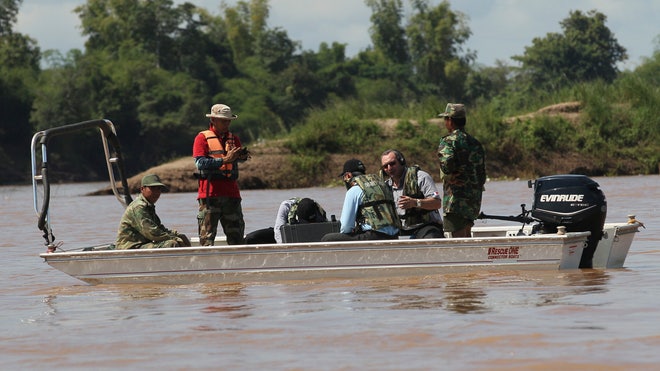
Teams of Thai and French experts plied the vast and muddy Mekong River with high-tech sonar equipment, ramping up the search for the plane and clues to why the aircraft went down three days earlier.

Lao Airlines said in a brief statement that offered no update of the ongoing investigation. The ATR-72 aircraft was delivered in March, raising questions into why a virtually new plane crashed.

Until Saturday, the search for bodies and the plane's flight data recorder had been stalled by lack of manpower and equipment in the poor Southeast Asian country, which lacks capabilities in disaster management.

France's air accident investigation agency, the BEA, said it sent four investigators to help Laos with the probe. It said the team would work with technical advisers from ATR, the French-Italian manufacturer of the aircraft.

The Thai Air Force, meanwhile, sent a C-130 military transport plane with specialists and equipment, including several high-tech sonar systems, to locate objects on the river floor.

The French and Thai teams set out on small boats scanning the water's surface with the sonar equipment Saturday, a stark contrast to previous days of searching that included Lao villagers peering into the murky water from long-tail boats.

Experts say the flight data and voice recorders could help determine if the crash was caused by human error or a technical problem. The chief pilot has been identified as 56-year-old Young San of Cambodia, who had more than 30 years of flying experience.

Cambodia's civil aviation security director, Mak Sam Ol, said he was briefed by Lao authorities on a final instruction from the control tower.

``Due to a storm and strong winds, as the plan approached landing, the air controller told the pilot to change course,'' Mak Sam Ol said in a telephone interview. ``He followed instructions but the plane faced strong storms and couldn't get through.''

Saturday 19 October 2013

http://www.bangkokpost.com/news/local/375382/bodies-of-the-crashed-lao-airline-plane-identified

continue reading

Mali river disaster toll soars to 72


The death toll from last week's river boat sinking in Mali, one of the worst ever in the country, has jumped from 39 to 72, an official said Friday, after more bodies were discovered inside the wreck.

"There are now 72 dead, 11 lightly injured and 210 survivors," Security Minister General Sada Samake said, giving what he said was a definitive count.

A large dugout boat, carrying scores of people and a large amount of merchandise, broke up on the Niger river near Koubi, which lies around 70 kilometres (40 miles) north of the central city of Mopti.

"Rescue teams were able to refloat it. We found more bodies," the minister said at a press conference attended by several other government members.

Accidents involving rudimentary canoes are frequent but the disaster that took place overnight a week ago was the deadliest ever recorded in Mali, according to the authorities.

Such boats are the main means of transport for residents of Mali's central and northern regions travelling to the towns dotting the Niger, the main river in west Africa.

"In the future, these canoes will have to be equipped with life vests, fire extinguishers and lights for nighttime navigation," Planning Minister Abdoulaye Koumare said.

French troops in Mali to fend off Al-Qaeda-linked groups assisted the emergency response by dispatching medics.

Residents of the remote area complained however that most of the effort to find survivors in the hours following the accident was led by villagers because the authorities were slow to deploy and ill-equipped.

Saturday 19 October 2013

http://www.ekantipur.com/2013/10/19/headlines/Mali-river-disaster-toll-soars-to-72/379514/

continue reading

At least 19 dead in Atimonan pile-up


Nineteen people were killed and dozens injured on Saturday, October 19, in a pile-up on an unlit highway in Atimonan, Quezon province. The accident involved 3 buses and 4 trucks.

In a statement, the police said that the accident was caused by a Manila-bound bus driver losing control of the vehicle before dawn.

The police added that 34 other people, many of them bus passengers, were injured. The driver of the runaway bus, who was unharmed, was arrested.

The road accident occurred along Maharlika highway.

In July, a collision between a delivery van and a truck occurred along the same road. The driver of the delivery van was reported dead on the spot by the Philippine News Agency.

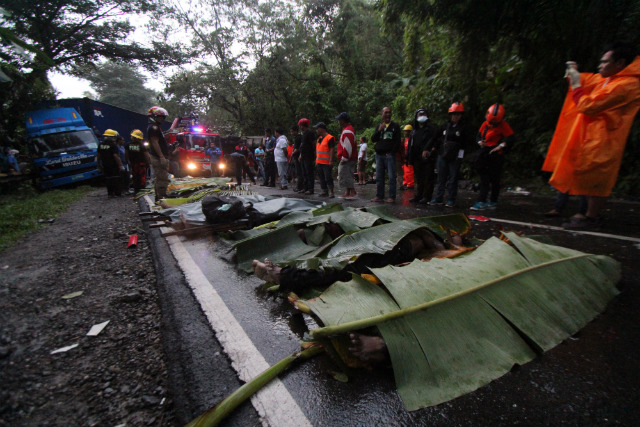
Pictures of the accident taken by Rappler contributor Jose Del show local responders retrieving body parts of the dead.

The bodies of the victims were arranged side by side on one lane of the road, covered only by banana leaves.

The incident occured at around 1 am, the National Disaster Risk Reduction and Managment Council said.

Victims were rushed first to Emil Joanna General Hospital and Doรฑa Marta Memorial District Hospital in Atimonan. Others were tranferred to the Gumaca District Hospital and the Jane County Hospital in neighboring town Pagbilao due to the number of casualties.

The collision involved 8 vehicles: a 10-wheeler truck, a closed-van container truck, a jeepney, 3 buses, and two elf-type, closed vans.

Warning signals have been installed, and policemen are deployed to reroute traffic.

Saturday 19 October 2013

http://www.rappler.com/nation/41736-dead-atimonan-road-pile-up

continue reading

Philippines calls off search for quake survivors


Philippine authorities on Saturday gave up hope of finding survivors from the worst earthquake to hit the country in two decades, which left at least 180 people dead.

The rescue operation was called off four days after the magnitude-7.2 earthquake in Bohol province, 640 kilometres south of Manila, on Tuesday.

“The rescue operations have ended and, instead, we are now conducting recovery operations,” Eduardo Del Rosario, head of the national disaster relief agency, told a press conference.

“We are still looking for 13 others. Our responders are now on the site to recover their bodies,” he added.

More than 3.4 million people were affected by the quake, including nearly 400,000 forced to stay outdoors under makeshift tents for fear that aftershocks could cause their homes to collapse.

Food, water and other relief supplies were running low in many of the affected areas as damaged roads and bridges slowed down efforts to bring help to them.

Authorities said government teams were working double time to clear the roads. Emergency workers were using alternative means to provide relief goods.

“We’ve been able to reach some places by airlifting and doing food drops,” presidential deputy spokeswoman Abigail Valte said. “Disaster response teams have also been using boats to reach places with roads rendered impassable by the quake.” Most of the dead were in Bohol, the site of the earthquake’s epicentre, where 167 people were killed. Thirteen were killed in the nearby provinces of Cebu and Siquijor, the disaster relief agency said.

All the 13 missing and presumed dead are from Bohol. They include five boys who were playing near a waterfall in the town of Sagbayan when the tremor hit, police said.

The earthquake destroyed more than 34,000 houses in five affected provinces, several centuries-old churches, dozens of hospitals and government buildings.

Electricity and water supplies were disrupted for days, while telecommunication remained weak in many areas, especially Bohol, a province that is home to more than 1.25 million people.

Damage to infrastructure has been estimated at 549 million pesos (13 million dollars). Tourism, a key industry in Bohol and Cebu, has also taken a hit, with cancellations pouring in.

Top tourist draws to Bohol were damaged by the quake, including historic churches and the Chocolate Hills, a group of more than 1,200 grass-covered limestone domes.

The quake was the worst to hit the Philippines since July 1990, when a magnitude-7.9 quake killed more than 1,600 people, with 1,000 still listed as missing, presumed dead.

Saturday 19 October 2013

http://www.thehindu.com/news/international/world/philippines-calls-off-search-for-quake-survivors/article5251026.ece?homepage=true

continue reading

Japan typhoon death toll rises to 29


The death toll from a typhoon that triggered massive landslides on a Japanese island rose to 29 on Saturday, as officials advised residents to take shelter in anticipation of more heavy rain.

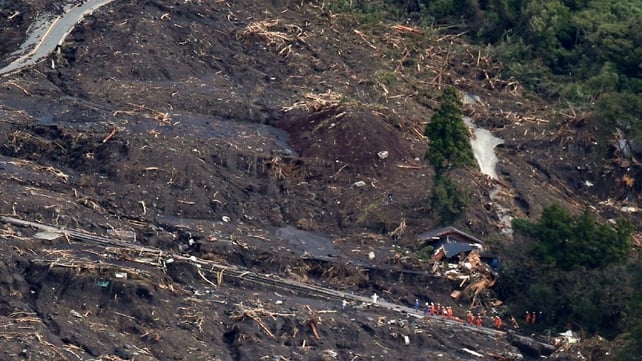
Around 1,200 troops, firefighters and police searched for 22 island residents who remained missing after typhoon Wipha struck Oshima island, 120 kilometres (75 miles) south of Tokyo, on Tuesday.

The powerful typhoon set off mudslides that buried some 30 houses and damaged more than 300 structures on the small island.

“Two more bodies were pulled today,” bringing the death toll on Oshima to 27, said a spokeswoman for the island’s administrative office.

Combined with two other deaths in and near Tokyo, the total death toll from Wipha in Japan has reached 29.

Island authorities Saturday advised around 1,900 residents living in the areas worst hit by the landslides to evacuate to designated school gyms and community centres, as a precaution against expected heavy rains and further landslides.

Saturday 19 October 2013

http://www.nst.com.my/latest/japan-typhoon-death-toll-rises-to-29-1.379941

continue reading

Up to 30 missing in cave-in at Colombia gold mine


A cave-in Friday at an unlicensed gold mine in Colombia left up to 30 workers missing, a rescue official said.

Two people were injured but no bodies have been recovered so far at the mine in the northwest department of Antioquia. The missing number were between 10 and 30, according to other workers, said Cesar Hernandez, a senior disaster relief official.

Rescue workers with sniffer dogs were combing the area.

The accident happened when a device used to remove earth from the mine broke. Walls collapsed and tons of earth fell on miners.

The mine is in a mountainous area that is hard to reach.

The Mining Industry says that between January 2012 and June of this year 86 people died and 39 others were injured in mine accidents.

Colombia has more than 14,357 gold mines, more than half of which are unlicensed.

Gold mining accounted for 2.3 percent of Colombia's gross domestic product in 2012.

Saturday 19 October 2013

http://www.globalpost.com/dispatch/news/afp/131019/30-missing-cave-at-colombia-gold-mine

continue reading

French, Thai experts, high-tech sonar join search for Lao Airlines plane and black box


Teams of French and Thai experts plied the vast and muddy Mekong River with high-tech sonar equipment Saturday, ramping up the search for a Lao Airlines plane, 19 bodies still missing from the crash and clues to why the aircraft went down three days earlier.

On the riverbank, a group of orange-robed Buddhist monks performed a prayer ceremony for the 30 victims whose bodies have been recovered and those still missing.

Lao Airlines flight QV301 crashed Wednesday as it prepared to land in stormy weather at Pakse Airport in southern Laos. The plane then skidded into the Mekong River, the largest in Southeast Asia, and disappeared. All 49 people on board, more than half of whom were foreigners, are presumed dead.

By Saturday morning, 30 bodies had been found and authorities were still trying to identify several of them, Lao Airlines said in a brief statement that offered no update of the ongoing investigation. The ATR-72 aircraft was delivered in March, raising questions into why a virtually new plane crashed.

Until Saturday, the search for bodies and the plane's flight data recorder had been stalled by lack of manpower and equipment in the poor Southeast Asian country, which lacks capabilities in disaster management.

France's air accident investigation agency, the BEA, said it sent four investigators to help Laos with the probe. It said the team would work with technical advisers from ATR, the French-Italian manufacturer of the aircraft.

Thailand, meanwhile, sent a C-130 military transport plane with specialists and equipment, including several high-tech sonar systems, to locate objects on the river floor.

The French and Thai teams set out on small boats scanning the water's surface with the sonar equipment Saturday, a stark contrast to previous days of searching that included Lao villagers peering into the murky water from long-tail boats.

Experts say the flight data and voice recorders could help determine if the crash was caused by human error or a technical problem. The chief pilot has been identified as 56-year-old Young San of Cambodia, who had more than 30 years of flying experience.

Cambodia's civil aviation security director, Mak Sam Ol, said he was briefed by Laotian authorities on a final instruction from the control tower.

"Due to a storm and strong winds, as the plan approached landing, the air controller told the pilot to change course," Mak Sam Ol said in a telephone interview. "He followed instructions but the plane faced strong storms and couldn't get through."

According to the airline, 44 passengers and five crew were on the flight. The passengers included 16 Lao nationals, seven French, six Australians, five Thais, three Koreans, three Vietnamese and one person each from China, Malaysia, Taiwan and the United States. A person who had been listed as a Canadian was instead added to the list of Vietnamese.

Saturday 19 October 2013

http://www.foxnews.com/world/2013/10/19/french-thai-experts-high-tech-sonar-join-search-for-lao-airlines-plane-and/

continue reading

7 Bodies recovered at site of Mexico plane crash

Seven bodies had been recovered as of Friday from the wreckage of a light plane that crashed four days ago in northwestern Mexico with 14 people on board.

The recovery work resumed early Friday after a halt forced by bad weather in the Sierra de la Giganta mountain range, officials of the Baja California Sur state government told Efe.

The seven recovered bodies were taken to the arena at the port of Loreto, and in the coming hours will be moved to the state capital of La Paz, where genetic identification tests will be made.

DNA samples were taken Thursday from family members of the victims to enable identification, since the bodies in the plane were charred beyond recognition.

The plane, a single-engine Cessna 208-B operated by Aeroservicio Guerrero, went missing on Monday just 25 minutes after taking off from Loreto on a flight to Ciudad Constitucion.

The plane was authorized to fly despite adverse weather conditions in Baja California Sur due to Tropical Storm Octave.

Aboard the aircraft were 13 passengers - mostly members of the same family, including two minors - and the pilot.

Friday 18 October 2013

http://www.globalpost.com/dispatch/news/agencia-efe/131018/7-bodies-recovered-at-site-mexico-plane-crash

continue reading

Friday, 18 October 2013

Venezuela officials say divers still searching for bodies from Missoni plane


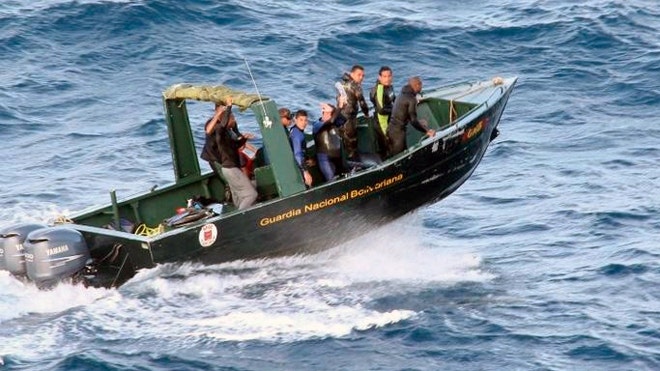
Venezuela's attorney general says divers have been searching since the weekend for the bodies of the CEO of the Italian fashion house Missoni and others missing in a January plane crash in the Los Roques islands.

Luisa Ortega said in a statement Thursday that authorities would meet with relatives of the missing on Monday to offer details. She also tweeted about the search but without mentioning occupants of the plane, whose wreckage was located in June.

Ortega's statements came after the newspaper El Universal said the bodies of five of the plane's six occupants had been retrieved, including that of Missoni CEO Vittorio Missoni.

His family issued a statement saying it had no official word on bodies recovered. Missoni was lost with his wife, two friends and two plane crewmen.

Friday 18 October 2013

http://www.therepublic.com/view/story/5be8f238601b454abc767c992b8a2017/LT-Venezuela-Plane-Missoni

continue reading

Laos plane crash: Foreign assistance called in as authorities struggle to find victims' bodies


The authorities in Laos are struggling to locate the fuselage of a downed plane and more than 20 bodies still unaccounted for following a crash earlier this week when an aircraft crashed in the Mekong river in bad weather.

Experts from a number of other countries are on their way to the south-east Asian country to offer assistance after officials there expressed frustration over their inability to locate the wreckage and the missing bodies.

“It’s very difficult to find [bodies] under water,” Lao’s transport minister, Sommad Pholsena, told reporters, according to the Associated Press. “If we could find [the plane], we would have found it already.”

By Friday afternoon, 27 bodies had been recovered from the river. But rescue workers had still been unable to find the wreckage containing the flight data recorder. That will be crucial to understanding why the virtually new Lao Airlines ATR-72 turboprop crashed.

The crash happened on Wednesday afternoon as the plane prepared to land in stormy weather at Pakse airport in southern Laos. All 49 people on board, more than half of whom were foreigners, are presumed dead. The plane had set off from Vientiane, the capital.

Experts from France, Singapore and Thailand are expected to arrive in Laos over the coming days to help with forensics and locating the flight data recorder.

Witnesses interviewed on LTV, Lao national television, described a heavy storm and dark skies when the accident happened at around 4pm. One man said he heard a thundering noise overhead and looked up to see a plane shaking violently as it flew through the tops of trees. “It looked like it was bouncing in the sky,” he said. “Then the plane came lower and lower. Then there was an explosion and ‘Boom’.” The plane is believed to have then skidded from land into the water and sunk. According to the airline, 44 passengers and five crew were on the flight. The passengers included 16 Lao nationals, seven French, six Australians, five Thais, three Koreans, three Vietnamese and one person each from China, Malaysia, Taiwan and the United States. Friday 18 October 2013 http://www.independent.co.uk/news/world/asia/laos-plane-crash-foreign-assistance-called-in-as-authorities-struggle-to-find-victims-bodies-8889398.html

continue reading

More mobile phones mean fewer deaths from natural disasters


Fewer people were killed or affected by natural disasters than in any other year in the past decade, according to a report (pdf) released Oct. 17. In 2012, some 15,706 died, compared to 37,907 in 2011 or almost 304,474 casualties in 2010, according to the International Federation of Red Cross, IFRC, and Red Crescent Societies.

The smaller death toll is in part because last year didn’t see brutal disasters like the 2004 Indian Ocean tsunami that left over 230,000 dead in South and Southeast Asia, Cyclone Nargis in Myanmar in 2008, or the 2010 earthquake in Haiti, each of which killed over 100,000. But we can also thank cell phones for last year’s smaller disaster-related death toll, according to the IFRC report.

In the Philippines, for example, which is struck by about 20 typhoons a year and whose population is scattered over thousands of archipelagos, mobile phones have been especially helpful. (Today, the number of cell phone subscriptions outnumber people.) The country has set up a surveillance system to send disaster damage reports and other data to emergency health officials via text messages. Before Typhoon Bopha—a category 5 super typhoon with winds of 280 km/h (175 mph) landed last year, authorities were able to evacuate some 41,000 citizens as well as quickly rescue people after the storm struck, thanks to cell phones and other communication technology. Even though Bopha was the most powerful storm the country had experienced up to that point, its death toll is behind that of eight other storms that hit before 2012. So far this year, 11 people have been killed during the worst typhoon of the year.

The idea of “humanitarian technology” has been picking up steam over the past few years. There are 6.8 billion mobile phone subscribers in the world. And if proper planning is in place cell phones in particular could be one of the most effective means for authorities and rescue staff to communicate with the public during emergencies and natural disasters. (One caveat is that after disasters hit, communication infrastructure, including cell phone towers, is often knocked out of service.) Earlier this month, mobile phones helped relief workers in India coordinate one of the country’s largest evacuation efforts ever and helped citizens dodge the worst of Cyclone Phailin.

There’s room for more use of mobile phones in rural areas where people traditionally get their news from their neighbours and relatives. As more people in rural regions as well as in developing countries subscribe to cheap cell plans, they can get disaster and safety information directly and quickly. Moreover, locals—in both rural and urban areas—are usually responsible for the bulk of the rescue efforts during the first critical hours after a natural disaster. These de facto first responders would be further helped with phones that help them reach or consult with health workers and aid agencies.

Friday 18 October 2013

http://qz.com/136684/more-mobile-phones-mean-fewer-deaths-from-natural-disasters/

continue reading

More bodies recovered in quake-hit provinces; deaths at 173


Two more bodies were recovered in the quake-hit provinces of Bohol and Cebu on Friday, increasing the death toll from Tuesday's powerful quake to 173.

The National Disaster Risk Reduction Management Council (NDRRMC) said that as of 4 p.m., authorities retrieved a body in Toledo City in Cebu and another body in Bohol.

A total of 19 people remained missing while the injured victims substantially increased from 375 to 498.

The NDRRCM also estimated the cost of damage to infrastructure in Cebu and Bohol at P549.85 million.

A total of 676,065 families or 3.4 million people in Bohol, Cebu and Siquijor were affected by the powerful earthquake. Of the total affected, 162,566 people are displaced from their homes.

More than 19,000 houses were damaged in Cebu and Bohol. NDRRMC said that the quake's damage to infrastructure was at P563.6 million.

Friday 18 October 2013

http://www.philstar.com/nation/2013/10/18/1246663/2-more-bodies-recovered-quake-hit-provinces-deaths-173

continue reading

EULEX to launch examination at the possible mass grave site in Rudnica


EULEX experts from the Forensic Medicine Department and representative of the Serbian government launched the examination at the site suspected to hold a mass grave from the period of conflicts in Kosovo.

The site of the potential mass grave is situated in Rudnica stone pit, municipality of Raska, the EULEX information service released on Thursday.

The examination was launched in the presence of Serbian authorities, the Serbian government Commission for people gone mission in Kosovo, the government Missing Persons Committee, the International Committee of the Red Cross and UNMIK representatives.

Chief of EULEX forensic medicine experts Alan Robinson said that after comprehensive talks with relevant bodies, the authorities decided to conduct the examination in several stages.

He said that examination of the first and the most likely site of the potential mass grave was set as the priority in the first stage.

Certain parts of the Rudnica stone pit were examined in 2007, and later in 2010 and 2011.

It is impossible to foresee the time necessary for examination of the site, Robinson said and noted that the first potential site will at first be examined in the course of five days and if human remains are found, the operation would expand considerably, EULEX said in a release.

Friday 18 October 2013

http://inserbia.info/news/2013/10/eulex-to-launch-examination-at-the-possible-mass-grave-site-in-rudnica/

continue reading

Ghost ship Nina: Missing for four months in the vastness of the Pacific, with seven crew presumed dead, is this faint satellite image a glimmer of hope?


Blurry satellite images of what appears to be a ship drifting in the Pacific Ocean have raised faint hopes that seven crew members, missing since their yacht disappeared off New Zealand four months ago, may be alive.

Mystery has shrouded the fate of the Nina, a mahogany schooner which vanished after sailing into a severe storm in June. No trace of it was found during a search of more than half a million square nautical miles of the Pacific. The last word from the boat was an undelivered text message reporting: “Sails shredded last night.”

Relatives of the crew – six Americans, including David Dyche, the Nina’s owner and skipper, and 35-year-old Matt Wootton, from Orpington, Kent – say the object in the satellite images is the same size and shape as the 21-metre Nina. A private search and rescue company recruited by the families, Texas EquuSearch, is trying to plot its probable course before conducting an aerial search.

“We have never lost hope that the crew of Nina is alive and well, and that they will be rescued,” Robin Wright, whose 18-year-old daughter, Danielle, was on board, told The New Zealand Herald. However, the images gathered by EquuSearch are a month old, and some are sceptical as to whether they really depict the schooner. According to an Auckland-based meteorologist, Bob McDavitt, the area – about 200 kilometres west of Norfolk Island – is traversed by a vessel at least every other day. Even if the pictures do show the Nina, it may be a wreck – or a ghost ship, with no one left aboard.

The yacht – once the flagship of the New York Yacht Club – left Opua, in New Zealand’s Bay of Islands, on 29 May, headed for Newcastle, north of Sydney. It apparently weathered a storm on 4 June, with Evi Nemeth, a 73-year-old crew member, subsequently reporting the shredded sails.

Ms Nemeth said she would update the Nina’s position six hours later. But no further message was sent. Her undelivered text was released by the satellite phone company Iridium a month later. The boat’s emergency beacon was never activated.

On the day of the storm, Ms Nemeth – in the crew’s last direct contact with the outside world – had sought Mr McDavitt’s advice. The pair spoke by phone, after which she texted him, asking: “ANY UPDATE 4 NINA? … EVI.” That was the last he heard.

Nigel Clifford, the general manager of safety and response services for Maritime New Zealand, has said that while the Nina survived the storm, “very poor weather continued in the area for many hours and… [was] followed by other storms”.

New Zealand authorities have rejected calls by the crew’s families to resume their search. “We feel they are not going to be convinced by a satellite photo until they can see seven people holding their passports up, with their date of birth clearly visible,” said Mr Wootton’s father, Ian. He told the Herald that he and his wife, Sue, had mixed feelings when they first saw the photos. “You get the elation of ‘Yep, this looks like a really good image’. But also the downside of ‘How are you going to find it [the boat] again?’”

One expert, Ralph Baird, told the NY Daily News that the Nina was “a needle in a haystack, and that needle is moving”.

After the Nina disappeared, Russ Rimmington, a New Zealand skipper, claimed that the Nina was unseaworthy, with a warped hull, and that Mr Dyche – whose wife, Rosemary, and son, David, were also on board – refused to carry modern gadgetry.

Mr Rimmington also told Fairfax New Zealand that the Nina would have sunk if it had capsized, because of the lead on its keel.

Friday 18 October 2013

http://www.independent.co.uk/news/world/australasia/ghost-ship-nina-missing-for-four-months-in-the-vastness-of-the-pacific-with-seven-crew-presumed-dead-is-this-faint-satellite-image-a-glimmer-of-hope-8887402.html

continue reading