Thursday, 29 November 2012

11 dead, 5 missing in boat tragedy

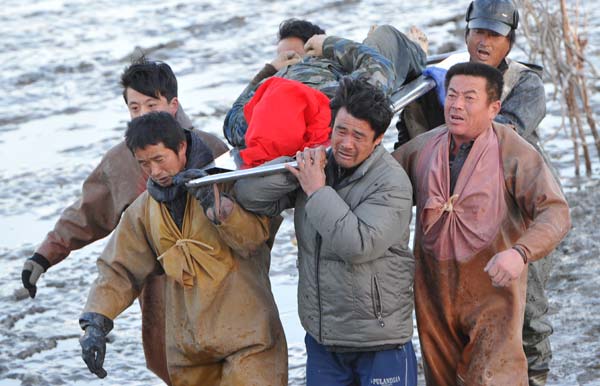
At least 11 people are dead and five remain missing after a fishing boat sank in coastal waters early on Wednesday near Dalian, Liaoning province, Xinhua News Agency reported.

The boat with 17 fishermen and women on board, was overturned by huge waves at about 2 am and sank 2 nautical miles from the Houershi village port at the Jinzhou New Area in Dalian.

One person was rescued and the bodies of 11 people were recovered on Wednesday afternoon, Xinhua reported.

Rescuers were still searching for the five missing people on Wednesday afternoon.

The only person rescued was in stable condition and being held for observation at a local hospital.

The boat set out from Houershi Port at around 1 am and those aboard were about to transfer to a bigger fishing vessel before huge waves overturned it.

One fisherman used his satellite mobile phone to call for help.

Ten of the fishermen and women were migrant workers, and seven people, including the owner of the boat, were from the local fishing village.

The wooden boat was 10 meters long and powered by a 10 horsepower engine.

Sun Caihui, a local fishing boat owner who took part in the rescue, said that strong winds and rough seas made the rescue effort very difficult.

"We received a call from the village head at around 5 am and started our boat immediately.

But their boat had sunk beneath the water and the fishermen cannot be found in muddy seawater," he said.

The rescue was made easier in the afternoon when the tide was low.

"Nothing like this has ever happened in our village," said Sun, who knew some of the people aboard the boat personally.

Sun said that hiring non-local fishing workers is common practice in the village because of a labor shortage.

Gale winds as strong as force 8 on the Beaufort scale swept the coastal waters near Dalian city early on Wednesday, China News Service reported.

The search and rescue operation involved a helicopter, seven maritime patrol ships and 120 other boats.

An investigation into the cause of the accident is under way.

Thursday 29 november 2012

http://www.chinadaily.com.cn/china/2012-11/29/content_15969372.htm

continue reading

Wreckage of missing MI-8 discovered; 8 crew members found dead

All 8 members of MI-8 crew that has been discovered several hours ago today, November 29, in Almaty oblast were found dead near the wreckage of the missing helicopter, Tengrinews.kz reports citing the press-service of Almaty oblast administration Ilyas Biyakhmetov.

“Head of Almaty oblast Emergency Situations Department Sabit Bitayev has confirmed that all 8 people who were onboard of the helicopter have been found dead. The helicopter had significant damages with only the aft remaining intact. All bodies were outside of the helicopter,” he said.

The helicopter that went missing in Kazakhstan on November 24 in the area of Koktuma-Dostyk next to Kazakhstan-Chinese border has been discovered only today, November 29. According to Kazakhstan Emergency Situations Ministry, the wreckage of the helicopter was found in the area of the 16th railroad junction.

“The wreckage of the missing helicopter was found 90-95 km from Usharal in Almaty oblast towards Dostyk station, 5-7km east of Dostyk-Usharal road, 15-20 km from Alakol lake. During the fall the helicopter was significantly damaged and only its aft was intact. According to the preliminary information, all the crew members have died as a result of the accident. Two bodies were lifted from under the wreckage. Investigators are working on site. The situation is under control. An investigation has been initiated,” the Ministry said. Law-enforcement authorities and personnel of Druzhbinskaya transport prosecutor’s office has left for the accident site.

"At 6:30 p.m. 6 dead bodies were found at the accident site. The search is being continued," the Department said.

According to the Transport Prosecutors of Kazakhstan, the chronology is as follows:

- The wreckage of the helicopter were discovered at 4.03 p.m.
- A response force of Almaty oblast Emergency Situations Department arrived to the site at 5:15 p.m.
- Six bodies were discovered at 6:30 p.m.
- Two more bodies were discovered a little later.
The MI-8 helicopter with board number 823 owned by Kazakhstan's Euro-Asia Air went missing on November 24 while making a routine flyover of Atassu-Alashankow oil pipeline. The following crew members were onboard:

Captain – Raul Khabibullin;
Pilot – Nurlan Yessenaliyev
Flight mechanic – Vladimir Kim
Engineers – Konstantin Maksayev and Viktor Radomskiy
Accompanying persons - T. Shokparov, A. Sarsembayev, K. Sabirov.

Thursday 29 November 2012

For more information see: http://en.tengrinews.kz/emergencies/Wreckage-of-missing-MI-8-discovered-8-crew-members-found-dead-14914/

continue reading

There Are Over 200 Bodies on Mount Everest, And They’re Used as Landmarks

More than 200 people have died in their attempt to scale Mount Everest. The mountain offers seemingly endless options for kicking the bucket, from falling into the abyss to suffocating from lack of oxygen to being smashed by raining boulders. Yet climbers continue to try their skills – and luck – in tackling Everest, despite the obvious dangers. Indeed, the living pass the frozen, preserved dead along Everest’s routes so often that many bodies have earned nicknames and serve as trail markers. Here are a few of the more colofrul tales, adapted from Altered Dimensions:

The body of “Green Boots,” an Indian climber who died in 1996 and is believed to be Tsewang Paljor, lies near a cave that all climbers must pass on their way to the peak. Green Boots now serves as a waypoint marker that climbers use to gauge how near they are to the summit. Green Boots met his end after becoming separated from his party. He sought refuge in a mountain overhang, but to no avail. He sat there shivering in the cold until he died.

In 2006, English climber David Sharp joined Green Boots. He stopped in the now-infamous cave to rest. His body eventually froze in place, rendering him unable to move but still alive. Over 40 climbers passed by him as he sat freezing to death. His plight might have been overlooked as passers-by assumed Sharp was the already-dead Green Boots. Eventually, some heard faint moans, realized he was still alive, and, too late, attempted to give him oxygen or help him stand.

Francys Arsentiev was the first American woman to reach Everest’s summit without the aid of bottled oxygen, in 1998. But climbers do not recognize this as a successful ascent since she never made it down the mountain. Following a rough night time trek to camp, her husband, a fellow climber, noticed she was missing. Despite the dangers, he chose to turn back to find his wife anyway. On his way back, he encountered a team of Uzbek climbers, who said they had tried to help Francys but had to abandon her when their own oxygen became depleted. The next day, two other climbers found Francys, who was still alive but in too poor of a condition to be moved. Her husband’s ice axe and rope were nearby, but he was nowhere to be found. Francys died where the two climbers left her, and climbers solved her husband’s disappearance the following year when they found his body lower down on the mountain face where he fell to his death.

Thursday 29 November 2012

http://blogs.smithsonianmag.com/smartnews/2012/11/there-are-over-200-bodies-on-mount-everest-and-theyre-used-as-landmarks/

continue reading

Six killed as three wheeler crashes into Yal Devi train

Six persons including two children were killed when an overloaded three wheeler they were travelling in collided with the Yal Devi Express train bound for Vavuniya from Colombo, at an unprotected railway crossing in Ambanpola, Kirimetiyawa yesterday morning.

There were seven persons in the vehicle, three males and four females.

A woman who was in a serious condition was admitted to the Kurunegala hospital. She succumbed to her injuries.

Eye witnesses said that the bodies of the victims were beyond recognition. The driver’s identity was established after tracing his identity card. He was identified as Udaya Asiri Wijeratne.

The victims were returning after visiting a relative and were on their way to a ‘Devalaya’

Thursday 29 november 2012

http://www.island.lk/index.php?page_cat=article-details&page=article-details&code_title=67108

continue reading

Trial over junta's `death flights' starts in Argentina

A major trial for crimes, including the so-called "death flights," during Argentina's 1976-83 dictatorship started Wednesday in Buenos Aires.

Several pilots involved in the death flights - in which illegal detainees were thrown alive from planes to their death in the sea - are among the 68 people standing trial for crimes committed in the Navy Officers School of Mechanics, or ESMA, which is believed to have held about 5,000 illegal detainees during the junta.

The regime is believed to have killed about 30,000 people, although they technically are still regarded as "desaparecidos" (missing), because most of the bodies have never been found.

In this case, the courts are dealing with 789 crimes against humanity and are set to hear 900 witnesses. Most of the defendants were Navy officers and petty officers during the dictatorship, although there are also civilians, including former finance secretary Juan Alemann. Some of these people are already serving sentences for other crimes committed in the ESMA.

The opening of the trial was broadcast live at an auditorium in the Room for Memory Institute, which has been created at the facilities of the former ESMA in the Buenos Aires neighborhood of Nunez.

The existence of the death flights has been reported by survivors of the ESMA illegal detention camp and also by former Capt. Adolfo Scilingo, who is serving a jail sentence in Spain after confessing to courts there that he had thrown into the sea 30 detainees who were anesthetized at the time.

The Argentine Forensic Anthropology Team identified in 2005 several bodies found in the country's Atlantic coast in 1977. It also certified that they showed fractures that probably were caused by a fall from great altitude and the subsequent impact on the water.

Thursday 29 November 2012

Read more here: http://www.bellinghamherald.com/2012/11/28/2783134/trial-over-juntas-death-flights.html#storylink=cpy

continue reading

Kishoreganj farmer first to try DNA test

A farmer from Kishoreganj, who lost his daughter in the Tazreen Fashions disaster, went to the National DNA Profiling Laboratory at Dhaka Medical College yesterday to give his blood sample in the hope of locating her grave.

Suma Akhter, 16, daughter of Bakul Miah, 38, was on duty at Tazreen Fashions in Nischintapur of Ashulia on the outskirts of the capital when the fire broke out on Saturday night.

She is missing and presumed dead.

Bakul Miah, the father, yesterday filled up a form with his contact information at the lab.

Bakul told The Daily Star his only wish was to find the grave of his daughter so that he could visit it occasionally and pray for the eternal peace of her soul.

Work on DNA profiling from samples collected from the bodies of 59 unidentified victims started yesterday.

Fifty-three of the unidentified victims were buried at Jurain Graveyard on Tuesday. The bodies of six victims were handed over to their relatives after they identified their dear ones at the DMC morgue.

The DNA samples from all 59 bodies were collected on Monday and kept at the National Forensic DNA Profiling Laboratory.

Ahmad Ferdous, scientific officer at the laboratory, told The Daily Star that the lab had collected samples and had tagged the bodies with numbers before they were buried in tagged graves.

He said the laboratory would make a database of DNA samples collected and match those with the parents or children of the victims.

He said teeth, tissues and bones of the victims had been collected as samples for DNA profiling.

However, one to three months could be required to make DNA profiling of the samples collected. DNA profiling of relatives of the victims would take less time, he said.

Ferdous added that the lab authorities were keeping contact information of the victims' relatives. If their DNA profiles matched with that of a body, they would inform the authorities concerned and the relatives of the matter.

Relatives of many Tazreen employees, who are missing and are believed to be dead, are at a loss as to how and where to go for DNA sampling.

Nilufar Begum, who lost her parents, brother and brother's wife in the blaze, was trying to get to the laboratory yesterday but could not as she did not have proper information.

Thursday 29 November 2012

http://www.thedailystar.net/newDesign/news-details.php?nid=259217

continue reading

Update: Five women, four children among 15 drown in Kirthar Canal

As many as 15 people, including five women and four children, were drowned in Kirthar Canal near Amrote Shareef after a passenger van fell into canal on Wednesday.

According to detail, the passenger van was on its way to Golo Daro from Gharhi Yasin in District Khairpur, when reached at Kirthar Canal its fell into it, subsequently at least 16 people were drowned.

According to witnesses, around 30 passengers were in the van.

On receiving information, the administration reached on the spot and started rescue and recovered 15 bodies including of six women and four children while nine people were fished out alive and shifted them to Gharihi Yasin and Shikarpur hospitals.

Some among the dead identified as Bachul Manganhar, Sangaar Jaffery, Umedan Jaffery, child Arshad Jafery (6), Wahid Ali, Jafery (5) and Rashid Ali (9). The Shikarpur deputy commissioner confirmed death of 15 people.

Sindh Minister for Local Government Agha Siraj Durrani confirmed the death of 14 people and told that as many as seven other people are still missing and district administration is searching their bodies and he was directed the administration for help and EDO health, DC, and other officials are present on the spot.

Thursday 29 November 2012 http://www.dailytimes.com.pk/default.asp?page=2012%5C11%5C29%5Cstory_29-11-2012_pg7_12

continue reading

Workplaces that are death traps

One of the most disposable items in our country is human life. Abroad we read about loss of hundreds of lives from sinking of overloaded motor launches in rivers, from runaway buses driven by half-trained operators that fall into ditches and, as added measures, deaths from fires in factories in premises that never have been inspected for safety. We are used to watching on TV horrific and heart-rending video images of bodies being recovered from sunken vehicles, scorched buildings, and road side ditches.

We have seen and read about righteous indignation of our public officials at these incidents, dire threats of punishment to those responsible for such disasters that are never carried out, and empty promises that the nation will never face such disasters again.

But while the families of the countless victims wail and lament their losses, the people who are primarily responsible for these deaths and disasters, and their facilitators such as our public officials, are quick to point fingers elsewhere and try to absolve themselves of any wrongdoing. It is as though the people who perished in these disasters ended their lives voluntarily.

When will we learn to take ownership for these completely avoidable disasters? When will we learn to treat each human life as an asset that is more valuable than the product it makes? The recent Ashulia disaster is just another addition to the countless incidents of total callousness that prevails in the country over safety and protection of workers from workplace hazards.

We have had fires in garment factories several times before where workers lost their lives. Only a few days ago we had fires in a low income housing area surrounded by unsafe factories where lives were lost.

Close on the heels of the recent Ashulia fire we also had this lightning-like accident where girders fell off a fly over construction project that killed eleven people in Chittagong.

After none of these accidents or disasters in the past did we hear the people who owned the factories or the buildings come out and take ownership for the tragedies or take measures that would prevent repetition of such incidents. We also did not hear of any punitive action against the defaulting owners by the government. Instead, if I recall correctly, there was plenty of talk of deep conspiracies against the garment industry by persons unknown that were labelled as the causes of frequent fires. No one talked about setting up standards of safety for the factories and workers, or their rigid implementation and monitoring by government. Each incident was allowed to pass into oblivion until another happened.

As in all disasters or accidents in the past a host of reasons has been cited in the press for the Ashulia and Bahaddar Hat misfortunes.

These include failure to operate fire extinguishers in the building, blocking of exit routes of workers and, in the case of the Chittagong incident, a faulty crane that lifted the girders.

Absent from these reports is any indication or statement whether the factory owner or the flyover construction company had any mechanism in place that would ensure safety of workers or equipment.

It is also not clear what role the owners played during and after the incident besides announcing some gratuities to the victims after the fact.

The Ashulia incident and the incident in Bahaddar Hat in Chittagong would not have happened if we had taken lessons from the past. These would not have not happened had we employed a minimum standard of workplace safety, and held the people who engage workers in factories and construction projects, responsible for providing safe workplace.

The garment factories in Bangladesh today are situated on opposite ends of the safety spectrum.

On one end are those modern facilities that are located in different export processing zones and have rather rigid safety standards.

On the other end we have a series of garment factories that line up the Airport Road, Uttara, and other roads, all with cage-like appearances where it seems accidents are waiting to happen.

Workplace safety is a prime consideration for a government before a business is allowed to operate. In western countries a small departure from the safety codes and standards is cause for suspension of the business. Along with strict building codes and safety standards a practice that is regularly in vogue in most industrial countries is training workers in handling emergencies such as fire through drills.

No amount of fire extinguishers will be of use if the people who work in these buildings do not know how to operate them. Along with that also essential is training in emergency response through mock drills. Many of the buildings that I have seen on the Airport Road and Uttara were perhaps not originally intended to be factories, yet we have hundreds of people sweating their way in these accident prone buildings day after day, without a care either from the owners or from the government.

The accidents of this week would not have happened if the employers and our public officials had learnt to take preventive measures from the beginning. The accidents would not have happened if our public officials had strictly enforced the safety rules and taken punitive action against the offenders instead of smelling conspiracies in disasters.

The lives that have been lost at Ashulia or in Chittagong cannot be brought back; nor can the livelihood the victims provided to their families be restored. What can be done is to ensure that such incidents are not repeated.

This can be done by regular inspection of the buildings and the equipment that are used, ensuring that they all meet the minimum standards for safety and operation.

Finding scapegoats for these accidents and finger-pointing will do us no good. I hope and pray that we will not watch and read about such avoidable disasters in the future. I hope and pray that we all learn that human lives are not disposable items.

Wednesday 29 November 2012

http://www.thedailystar.net/newDesign/news-details.php?nid=259150

continue reading

Wednesday, 28 November 2012

Migrant deaths highlight rural tension in Italy

Even dead migrant workers are exploitable. Or so it would seem from the hardly edifying scenes that followed the deaths last Saturday of six Romanian farm workers killed in a horrific train accident near Rossano in Calabria, southern Italy.

The workers were killed when the Fiat Multipla car in which they were travelling home was struck by a train at a countryside level crossing, late in the afternoon.

The impact of the crash reduced the car to mangled steel, instantly killing the six passengers, three men and three women. It took rescue workers and firemen hours to extract the bodies.

The pain and distress of the Romanian workers’ families did not end there. When relatives arrived at the scene late on Saturday night, they were horrified to find rival undertaker companies arguing about who had the right to collect the bodies. As the undertakers squabbled, one of the bodies was knocked off the rescue service stretcher and onto the ground.

In a short clip ( today.it/citta/rossano) that has been frequently viewed, relatives of the dead workers are heard to shout angrily at the undertakers: “Shame on you. Shame on the Italian people.” In the clip, the police appear to stand back, unsure what to do.

The tragedy once again serves to highlight the precarious working conditions of seasonal farm workers in southern Italy. The six dead had been harvesting clementines, probably for a daily wage packet of €20 euro.

In a homily on Sunday, the bishop of Rossano, Santo Marciano, called on local farmers to reject the “logic of dishonesty and exploitation which reduces human beings to conditions of modern slavery”.

Two years ago, police had to bus 1,300 mainly African seasonal farm workers out of another Calabrian town, Rosarno, following three days of riots and scuffles involving the workers and local people. The riots started after shots were fired, almost certainly by ’Ndrangheta Mafiosi, at some of the Africans in an attempt to enforce territorial control.

The level crossing at which the six died is one which the Italian state train authority (FSI) leases to private citizens, most often farmers. They are usually closed off by a padlocked gate.

Investigators have yet to establish the full dynamics of the tragedy, although it is known that two Romanian workers survived the crash because they had got out of the car to open the crossing gate.

Wednesday 28 november 2012

http://www.irishtimes.com/newspaper/world/2012/1128/1224327207594.html

continue reading

9 Dead, 7 missing after fishing boat sinks off northeast China

Nine people have died and seven remain missing after a fishing boat sank off the coast of the northeastern Chinese seaport of Dalian, maritime authorities said.

The boat with 17 people on board sank in the wee hours of Wednesday amid strong waves during an attempt to hook the boat to a larger vessel, the authorities said.

The bodies of nine of the fishermen were recovered at around 3:30 p.m., while another seven people are still missing.

The only person rescued from the sinking boat is listed is good condition at a hospital in Liaoning province, where Dalian is located.

Authorities said a rescue operation involving a helicopter, seven maritime patrol vessels and 120 other boats was still ongoing.

Wednesday 28 november 2012

Read more: http://latino.foxnews.com/latino/news/2012/11/28/dead-7-missing-after-fishing-boat-sinks-off-northeast-china/#ixzz2DXMIgEBj

continue reading

15 killed as van falls into canal in S. Pakistan

At least 15 people were killed and eight others went missing on Wednesday evening when a passenger van fell into a canal in Pakistan’s southern province of Sindh, local media reported.

According to local Urdu TV channel ARY News, the passenger vehicle carrying 23 people plunged into the Kair Thar canal in the Shikarpur district due to overspeed and brake failure.

Majority of the killed included women and children who drowned in the water after the van fell into the canal.

Deputy Commissioner of the district Azhar Shah confirmed the death of the 15 people, adding that the death toll could rise as at least eight people were still missing.

Initially, local people retrieved bodies of four women and two children from the canal before the rescue teams arrived at the site. Rescue workers were searching the missing people with the help of heavy machinery.

The ill-fated passenger van was heading towards Shikarpur district from Dadu city of the same province when the accident occurred.

All the dead bodies were shifted to civil hospital Shikarpur as rescue teams continued their efforts to recover more bodies.

Wednesday 28 November 2012

http://www.nzweek.com/world/15-killed-as-van-falls-into-canal-in-s-pakistan-30391/

continue reading

52 unclaimed fire victims buried after DNA tests

No-one showed up over the past two days to claim them. Their bodies charred beyond recognition.

And so, unidentified bodies of 53 workers who had died from the fire at Tazreeen Fashions Ltd were buried at the Jurain Graveyard in the capital on Tuesday afternoon.

Anjuman-e-Mufidul Islam, a charity, received the bodies and conducted the burial as the nation observed a day of mourning on Tuesday.

After concluding the DNA tests at Dhaka Medical College Hospital (DMCH), the district administration handed over the bodies to the voluntary organisation.

The graves were prepared on Monday night and the serial numbers of the DNA were tagged with the coffins as well as on the boards erected there in the hope that, some day, their families can identify them.

Bangladesh's deadliest factory fire in the multi-storied Tazreen Fashions Limited of Tuba Group burned alive at least 110 workers, according to government estimates.

Sixty bodies were initially handed over to the Anjuman for burial. Later, the district administration decided to wait until Tuesday for relatives of the dead to claim them.

They claimed seven more bodies and the administration handed over the rest around 11:30am on on Tuesday.

Additional Deputy Commissioner (ADC) of Dhaka Abul Fazal Meer told reporters that they had 55 bodies last night. Husbands of 'Jaheda' and 'Mariam' identified their bodies in the morning. "We've handed over 53 bodies to Anjuman-e-Mafidul Islam for burial."

The Additional District Commissioner of Dhaka Abul Fazal could not say how many of the dead were female.

"The bodies are burnt so badly that identifying them was almost impossible," he said.

After the first Namaz-e-Janaza at the DMCH, the bodies were taken to Jurain graveyard and buried after a second Janaza there.

Mohammad Abdul Halim, Assistant Director of Anjuman-e-Mafidul Islam, said that all the bodies were buried as per Islamic rituals.

Four vehicles carried the bodies to the graveyard. Those who did not find their loved ones yet thronged the graveyard to give it a last try — all in vain.

The tombstone of the dead will carry the number waiting to be identified by their families, said Assistant Director of Anjumane Mofidul Islam Halim.

Wednesday 28 November 2012

http://www.bdnews24.com/details.php?id=237087&cid=2

continue reading

Decomposing bodies of five men found in Korean-marked boat off Japan’s coast

Police revealed Wednesday that a boat with Korean (Hangul) language writing on the side washed ashore on Sado Island with five rotting bodies inside. The island is located just off Niigata Prefecture on Japan’s western coast, and while police say nationalities are still unknown, they confirm all the bodies were adult males. The only other things in the 13 meter (43 feet) long boat were small belongings and garbage.

Five bodies were found on Wednesday morning in the boat washed up on rocks by a beach on the island, roughly over 10 meters (32.8 feet) long and weighing about 5 tons, on Sado island, northern Japan, Kyodo news reported.

It is still unknown how the passengers died, likewise the Korean writing on the boat is said to be unreadable. Police have said the only thing that is clear is that boat was adrift at sea for a long period of time. In the last few years, there have been several cases of North Koreans turning up in that area off Japan’s coast after fleeing the isolated communist country. Nine refugees, consisting of three men, three women, and three children, were found by the Japan Coast Guard in September 2011 after being at sea for 5 days. The group later resettled in South Korea.

The police and the Japan Coast Guard are seeking to identify the bodies of what appear to be adults and are probing how the boat drifted onto the beach.

In January of this year, three more North Koreans were found at sea, along with the body of another passenger who had died of hypothermia. They were also thought to be defectors trying to escape North Korea’s food shortages and poverty, but they turned out to be fishermen whose boat engine died and drifted out to sea. They were eventually repatriated at their own request.

Monday 28 November 2012

http://japandailypress.com/decomposing-bodies-of-five-men-found-in-korean-marked-boat-off-japans-coast-2819036

continue reading

Unclaimed bodies buried

There was none to claim them.

Fifty-three unidentified bodies from the fire at Tazreeen Fashions Ltd were buried at the Jurain Graveyard in the capital on Tuesday afternoon after two days of wait for their families, reports bdnews24.com

But the bodies were beyond recognition.

Anjuman-e-Mafidul Islam, a charity, received the bodies and conducted the burials when the nation observed a day of mourning on Tuesday.

After concluding the DNA tests at Dhaka Medical College Hospital (DMCH), the district administration handed over the bodies to the welfare body.

The graves were prepared on Monday night and the serial numbers of the DNA were tagged with the coffins as well as on the boards erected there so that their families can identify the dead bodies later.

The deadliest factory fire broke out on the ground floor of the multi-storey Tazreen Fashions Limited of Tuba Group killing at least 110 workers, according to government estimates.

Sixty bodies were initially handed over to the Anjuman-e-Mafidul Islam for burial. Later, the district administration decided to wait until Tuesday for relatives of the dead to claim them.

As relatives claimed seven more bodies, the administration handed over the rest around 11:30am on Tuesday.

Additional Deputy Commissioner (ADC) of Dhaka Abul Fazal Meer told reporters that they had 55 bodies last night. Husbands of 'Zaheda' and 'Mariam' identified their bodies in the morning. "We've handed over 53 bodies to Anjuman-e-Mafidul Islam for burial."

The ADC, however, could not say how many of the bodies were male and female.

"The bodies are burnt so badly that identifying them was almost impossible," he said. After the first namaz-e-janaza at the DMCH, the bodies were taken to Jurain graveyard and buried after a second Janaza there.

Mohammad Abdul Halim, Assistant Director of Anjuman-e-Mafidul Islam, said that all the bodies were buried as per Islamic rituals.

Wednesday 28 November 2012

http://www.newstoday.com.bd/index.php?option=details&news_id=2330083&date=2012-11-28

continue reading

Tuesday, 27 November 2012

5 killed in expressway crash near Slim River

Five people were killed and six injured in a crash involving an MPV and a lorry at the Km372 of the North-South Expressway near Slim River early today.

The dead and injured in the 7.30am incident have not been identified yet, according to a report in The Star Online today. The injured have been sent to the Slim River Hospital.

A 12-year-old girl was among the five who died. They were travelling from Nibong Tebal to Muar when accident occurred.

The victims were trapped in the wreck and firemen had to extricate their bodies, a Fire and Rescue Department spokesman said.

According to the report, the accident was believed to have been caused by a punctured tyre to the MPV, causing it to go out of control and crashing into the lorry.

Tuesday 27 November 2012

http://www.themalaysianinsider.com/malaysia/article/5-killed-in-expressway-crash-near-slim-river

continue reading

An agonising wait outside

“I am going to die… Please pray for me!”

These are Lipi's last words to her husband from the burning factory in Ashulia, where fire killed at least 111 workers Saturday night.

As far as Akram, 30-year-old husband of Lipi, got from the phone conversation that evening, she was trapped on the 5th floor of eight-storey Tazreen Fashions Ltd. Since the call, Akram ceaselessly tried Lipi on her mobile phone until it went dead around 9:00am.

He also ran to the factory soon as he could, but only to find horrible screams and clouds of smoke coming out of the burning building.

Started on the ground floor, which was used for storing goods, the flame lasted till dawn.

The whole night Akram ran from one hospital to another with a hope to find his wife among the wounded and rescued. But Lipi was nowhere.

Akram finally got to get into the factory Sunday afternoon. He found ashes, charred flesh, broken tiles, burnt sewing machines, electric wires and unused fire extinguishers, but no trace of his wife.

Still determined to find her, he looked for his wife among scattered sandals, scarves, shirts and lunch boxes uttering, “Oh God, where do I look for her now.”

Akram, however, found an attendance card of one Ms Zaida near a broken window on the third floor. Panicked workers had broken the grills of the window trying to escape the fire.

A total of 59 bodies, which could not be identified and remained unclaimed, were handed over to voluntary organisation Anjuman-E-Mafiudul Islam for funeral.

Meanwhile, Bangladesh Garment Manufacturers and Exporters Association (BGMEA) announced Tk 1 lakh as compensation for each deceased's family.

But that was no news to Akram. “It is not possible for me to claim a random body as my wife only for money. What good is money if I don't get her back,” he said.

Like Akram, Saidur Rahman, Mohammad Hanif and many others returned home disappointed after a bitter search in the burnt facility.

“There is no dead body, no one's here,” Mohammad Hanif told the waiting crowd at the main entrance of the factory. He had also come looking for his two relatives who used to work there.

Hanif's wife is one of the fortunate workers who had escaped the inferno by jumping from the third floor window and survived. She broke a leg and a few ribs, and injured the head. She is now resting at home after medical attention.

Another worker Mamata escaped the fire with the help of one male colleague. “When the fire alarm went crazy, our manager told that nothing had happened,” she said.

Although the building had three staircases inside, it had no fire or emergency exit. So rushing down the stairs had not helped the panicked workers as flame was dancing up from the ground floor, added Mamata.

The workers on the first four floors were the worst victims of the fire, said Md Obaidul, a survivor who escaped through a window.

Soon as the fire alarm rang the power went off, said Shiria, another survivor of the fire. “In no time the room got filled with hot smoke and we started scrambling to find a way in the dark,” she said, adding that most of the victims died of suffocation.

Shiria is now worried if the workers would get their salary this month. Like many she had also joined the factory for a wage of around $ 40 per month.

“How about those who lost their identity cards in the incident, would they be paid?” she asked on Sunday evening standing in front of the burnt building.

Meanwhile, expressing solidarity with Tazreen employees workers of other factories in Ashulia and Savar areas brought out a procession in Nischintapur village. The procession ended at the gate of Tazreen Fashions.

Wednesday 29 November 2012

http://www.thedailystar.net/newDesign/news-details.php?nid=258933

continue reading

'Impossible' Tsunami Film Will Bring Memories and Tears

Eight years on from the tsunami, resorts in and around Khao Lak, north of Phuket, are enjoying the benefits of achieving what some people thought might be impossible.

By coincidence, the film, 'The Impossible,' perhaps the most accurate depiction so far of Thailand's biggest natural disaster, is screening for the first time later this week.

Expect tears from many on Phuket and in the surrounding region, tears from those who will never forget Boxing Day 2004.

As Phuket and the Andaman coast learned with not one but two tsunami alerts earlier this year, the 2004 tsunami must always be remembered.

Andrew and Kate Kemp, owners of the muti-award winning Sarojin in Khao Lak, say their resort has been ''oscillationg around 100 percent occupancy'' for the past six weeks.

The next few weeks should improve on that. ''We are looking for a very good high season,'' Mr Kemp said today.

Back in 2004, the Sarojin was destroyed before it opened. Fortunately, the whole staff had been given the day off.

Andrew Kemp, though, found himself at the local hospital in the Andaman township of Takuapa that day, helping out with translations amid the chaos as hundreds of injured and dead were brought in.

'The Impossible' tells the story of one British family of tourists who were separated by the tsunami, and much of their emotional journey unfolds at Takuapa Hospital.

Thousands of visitors and residents were killed.

Popular myth has Phuket as being at the heart of the disaster, but 10 times more people were killed and injured around Khao Lak.

In the days that followed, Kate and Andrew Kemp decided to rebuild the Sarojin as fast as possible, despite the bleak salt-browned landscape. Khao Lak rebuilt along with them.

Today, says Mr Kemp, Khao Lak is flourishing with ''encouraging signs for the wider area.''

There has always been a togetherness about Khao Lak that sprang from the darkness and despair of that December day. Today it gives the region a common purpose, a sense of identity and serenity that is totally lacking on Phuket.

To visit the village of Nam Khem (salt water) for the annual memorial service each December 26 is to understand how this fishing village has regenerated despite 800 deaths there.

We will never forget the year when families brought out framed photographs of the dead to place on a table near the spot where the service was to take place.

Afterwards, some people picked up one photograph. Others picked up one, two, three . . . sometimes many more . . . ''I lost 12 members of my family,'' a woman told us.

And not far away from the village, in a graveyard that is usually overgrown, the bodies of about 280 nameless victims of the tsunami act as a reminder of that day.

Yes, the tears will flow on Phuket and along the Andaman coast during screenings of 'The Impossible.' But the mood will be of impossible hope. The good work continues.

''The Sarojin Khao Lak Community Fund is still very much in existence,'' Mr Kemp said. ''And this weekend Kate will be running a marathon for a local cause.'

Tuesday 27 November 2012

http://phuketwan.com/tourism/impossible-tsunami-film-bring-memories-tears-17128/

continue reading

16 killed in bus accident in Udhampur

At least 16 people were killed and 44 others injured when a bus carrying a marriage party rolled down into a deep gorge in Jammu and Kashmir's Udhampur district Saturday evening, police said.

The bus was carrying 60 people to Dudu Basantgarh, about 110 km north of Jammu, when it skidded off the road and rolled down into the gorge.

"The bus rolled down about 300 feet into a deep gorge," said a police officer.

Twelve people were killed on the spot, while four others died of injuries, and 44 others, including the bridegroom, were injured. The police and Central Reserve Police Force (CRPF) units immediately started the rescue operation.

"There are chances of the toll rising," said the officer.

Jammu and Kashmir Governor N.N. Vohra and Chief Minister Omar Abdullah have expressed grief and sorrow over the loss of lives.

Mountainous roads in Jammu region are notorious for road accidents. These are mostly attributed to over-loading of passenger buses, poor maintenance of vehicles, and shabby road conditions coupled with lack of skills to drive in mountainous conditions.

Tuesday 27 November 2012

http://www.indiatvnews.com/news/india/-killed-in-bus-accident-in-udhampur-18772.html

continue reading

Train slams into vehicle in southern Italy, killing 6

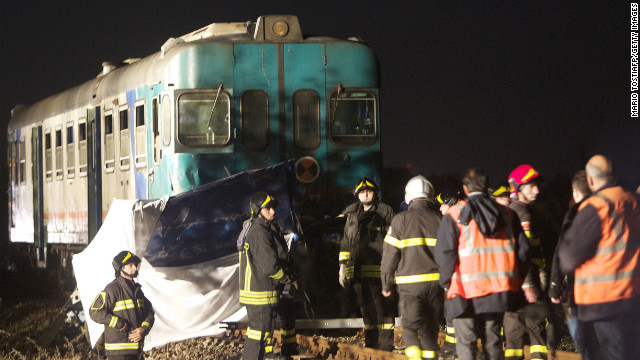
Six people died after a train slammed into a vehicle early Saturday evening in southern Italy, the nation's official news agency reported, citing investigative and other sources.

Photos taken in Rossano showed the Fiat Multipla impaled against the front of the train -- mangled and largely unrecognizable -- as firefighters walked along the track.

A rescuer described the scene as "appalling," according to the official ANSA news agency.

The crash occurred around 5:15 p.m. (11:15 a.m. ET) near Rossano, which is about 300 kilometers (185 miles) southeast of Naples and 280 kilometers northeast of Reggio Calabria.

The Fiat was struck and dragged 600 meters before it and the train finally came to a stop, ANSA reported.

All those killed had been inside the vehicle, with ANSA citing reports that at least some of them were Romanian migrant workers who had been picking clementine oranges in the region.

The area near the crash scene has been cordoned off, as the investigation continues to determine what happened.

Tuesday 27 November 2012

http://edition.cnn.com/2012/11/24/world/europe/italy-train-deaths/

continue reading

Bus-Truck Crash Kills 8, Injures 25 in Venezuela

Eight people were killed and 25 others injured in a crash involving a cargo truck and a bus carrying about 50 people on a highway in northeastern Venezuela, emergency services officials said Sunday.

The accident occurred Saturday night at kilometer 90 of the Anaco-Barcelona highway, Anzoategui state fire department chief Benjamin Apaez told the official AVN news agency.

The cause of the accident has not been determined, Apaez said.

The bus was carrying members of an evangelical church from Anaco who were returning home after taking part in a “baptism of new believers” in the nearby city of Puerto La Cruz, the private Globovision network reported.

Monday 26 November 2013

http://www.laht.com/article.asp?ArticleId=648325&CategoryId=10717

continue reading