Saturday, 27 October 2012

2 dead in boat adrift in Alboran sea

Another immigrant tragedy took place in the Alboran sea between Morocco and Spain. Two bodies were recovered on Friday from a boat adrift with 49 immigrants on board.

The boat was rescued by Moroccan gendarmerie patrol boat assisted by Spanish sea rescue workers, Spanish ministerial sources said. The drama took place on the heels of the capsizing of a motorized dinghy, overloaded with immigrants, off the coast of the Moroccan city of Al Hoceima on Thursday. Fourteen people of Sub-Saharan origin died in Thursday's accident. Seventeen survivors were found, and at least 40 passengers remain missing. The boat found Friday held 36 men and 12 women in addition to the victims. It had set off at one o'clock in the morning from the shore of Al Hoceima. A search began ten hours later when coastal authorities picked up a distress signal from the boat. The Spanish patrol boat Salvamar Hamal, based in Motril, Granada, and the Serviola 302 airplane, based in Almeria, participated in the search. A Moroccan crew rescued the immigrants from the sea.

Saturday 27 October 2012

http://www.ansamed.info/ansamed/en/news/nations/spain/2012/10/26/Immigration-2-dead-boat-adrift-Alboran-sea_7698892.html

continue reading

Mother who spent 32 years tending son's grave despite doubts it was his body is finally vindicated after DNA proves remains of John Wayne Gacy victim are NOT her boy

As Sherry Marino made her way to the cemetery on Wednesday to tend the grave marked with her son’s name, she got a call from her lawyers - the body wasn't his.

It was the news she had been waiting more than 30 years to hear. Tests had confirmed that the remains of one of John Wayne Gacy’s victims which police told her in 1980 were her missing son Michael Marino did not match her DNA.

In 1978, police identified one of the bodies found on Gacy’s property in Norwood Park Township, Illinois as her son. He was 14 when he disappeared in 1976 and investigators had used dental records to identify him in 1980.

For years Marino had fought to have the grave exhumed and now almost 36 years after her son first disappeared her long-held misgivings were proved to be well-founded.

Scientists at a North Carolina laboratory compared bone DNA of the victim to that provided by Sherry Marino and determined that they could not be related.

'We are very happy that we followed through because her suspicions were 100 percent correct,' Steven Becker, who represents Sherry Marino, told the Chicago Sun-Times.

'She hopes the information about his misidentification will bring more leads to find Michael.'

After years of tending the grave, but convinced that it wasn't Michael, Marino approached Becker and Robert Stephenson of Becker Stephenson, who agreed to work on her behalf, pro bono.

After fighting bureaucracy, they succeeded in finally having the body unearthed.

Late last year, Sherry Marino requested that the body, one of more than two dozen found in the crawlspace of Gacy's home in late 1978, be exhumed to determine if the remains buried at the cemetery were her son's.

Days later, the Cook County Sheriff's department said it had exhumed the remains of several young men believed to be, but never identified, as Gacy victims.

During last year's hearing, Sherry Marino's attorneys said she wondered why the clothes on the remains did not match the clothing she remembers seeing her son wear the day he disappeared.

Further, they said she never understood why it took more than three years to identify her son, despite the fact that she provided dental records shortly after the bodies were discovered.

Even her attorneys has acknowledged that there was strong circumstantial evidence that the remains - identified as 'body 14' - were those of Michael Marino, including that the remains were found in Gacy's crawl space next to those of Marino's friend, Kenneth Parker, who disappeared the same day.

The orthodontist who initially examined Gacy's victims remains convinced his findings are correct.

'The dental identification is just 100 percent solid, absolutely no question,' said Dr. Edward Pavlik. 'We compared 32 teeth, probably half a dozen of them had very distinct fillings and every tooth was consistent with the dental records of Michael Marino.'

The attorneys said Thursday that the lab's findings do not necessarily mean Marino was not a Gacy victim, but that it raises questions, such as whether other victims may have been misidentified.

'We don't know where Michael Marino is but what we do know is he's not buried in Queen of Heaven Cemetery under a tombstone that says "Michael Marino,"' Becker said.

Gacy, a building contractor and amateur clown, was convicted of luring 33 young men and boys to Chicago-area home and strangling them between 1972 and 1978, sentenced to death and executed in 1994.

Saturday 27 October 2012

http://www.dailymail.co.uk/news/article-2223575/DNA-proves-remains-John-Wayne-Gacy-victim-Michael-Marino-NOT-his.html

continue reading

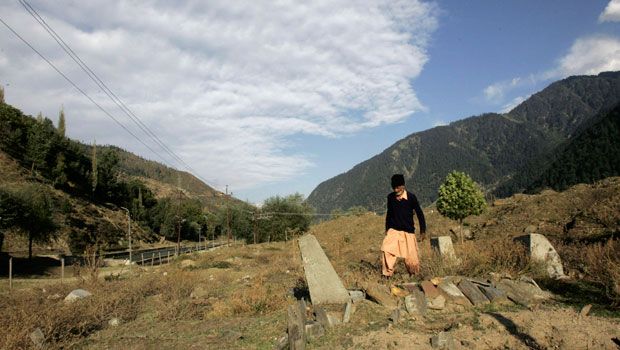
‘Disappeared’ in Kashmir

It is not surprising at all that the chief minister of Indian Kashmir, Omar Abdullah’s written statement on the disappeared persons, in the assembly on Oct 8 should have been received with complete disbelief.

He said, “Till ending July 2012, 2,305 persons have been declared missing.” FIRs were lodged only in 182 cases. In the rest of the cases, “missing reports and complaints have been lodged”.

Sana Altaf of the Srinagar daily Greater Kashmir noted “even after 23 years of armed conflict, no authentic official data exists on the number of disappeared persons in Kashmir valley while successive governments continue to come up with contradictory figures”.

According to the National Conference government headed by Farooq Abdullah the official figure of disappeared persons stood at 3,184. The then People’s Democratic Party government headed by Mufti Sayeed informed the assembly in February 2003 that 3,744 persons went missing between 2000 and 2002.

According to the Srinagar-based Association of Parents of Disappeared Persons (APDP) which has rendered yeoman service all these years, at least 8,000 persons have disappeared since the militancy began in 1989. Punjab witnessed a similar pattern of abuse and cover-up during the counter-insurgency operations from 1984 to 1995.

An inquiry by the police investigation team of the Jammu and Kashmir State Human Rights Commission (SHRC) has found 2,730 bodies dumped into unmarked graves in four districts.

The Inquiry Report of Unmarked Graves in north Kashmir, submitted by the investigating police team to the SHRC on July 2, 2011, said that the unidentified bodies had been buried in 38 sites in the Baramulla, Bandipora, Handwara and Kupwara districts. At least 574 were identified as the bodies of local Kashmiris. The government had previously said that the graves held unidentified militants.

Meenakshi Ganguly, South Asia director of Human Rights Watch, said: “For years, Kashmiris have been lamenting their lost loved ones, their pleas ignored or dismissed as the government and army claimed that they had gone to Pakistan to become militants. But these graves suggest the possibility of mass murder. The authorities should immediately investigate each and every death.”

The Inquiry Report recommended that the SHRC call for immediate DNA sampling and other forensic tests to try to identify the bodies by matching them with the next of kin of the people who have disappeared. Seventeen of the bodies found in the four districts have already been reburied by relatives in family graveyards. The investigation found that 18 of the graves contained more than one body. But the Kashmir government has refused to conduct DNA tests to identify the bodies.

New terms have come into vogue. The wife of a ‘disappeared’ man is called ‘half-widow’. International law, especially international humanitarian law, has begun to grapple with the problem. For long the chairperson of the Working Group on Enforced or Involuntary Disappearances studied the record in some countries and reported to the then UN Human Rights Commission at Geneva now replaced by the Human Rights Council.

The International Convention on the Protection of All Persons from Enforced Disappearances defines enforced disappearances as “the arrest, detention, abduction or any other form of deprivation of liberty by agents of the state or by persons or groups of persons acting with the authorisation, support or acquiescence of the state, followed by a refusal to acknowledge the deprivation of liberty or by concealment of the fate or whereabouts of the disappeared person, which place such a person outside the protection of the law”.

The convention grants all persons directly harmed by an enforced disappearance, such as family members of the disappeared, a “right to know the truth regarding the circumstances of the enforced disappearance, the progress and results of the investigation and the fate of the disappeared person”. India signed the convention in 2007 but has not ratified it.

The convention prohibits states from claiming a lack of resources to justify refusing to investigate a possible enforced disappearance by placing a duty on states to guarantee those resources. ‘Security’ cannot justify refusal to release information related to enforced disappearances. No “exceptional circumstances whatsoever, whether a state of war or a threat of war, internal political instability or any other public emergency, may be invoked as a justification for enforced disappearance”.

Mr Ravi Nair, executive director of the South Asia Human Rights Documentation Centre in New Delhi, to whom this writer is much indebted for his assistance, rightly holds that the law is violated if governments impose on the families of the victims the burden to provide information before attempting to identify whether any of the bodies belong to disappeared persons.

The UN Human Rights Committee places the burden of implementing the right to the truth on the state, not the victim’s family: “In cases where allegations are corroborated by credible evidence … and where further clarification depends on information exclusively in the hands of the state party, the committee may consider … allegations substantiated in the absence of satisfactory evidence or explanations to the contrary presented by the state.”

Disappearances blight the lives of whole families. In Kashmir they spread what The Economist aptly called “a war-borne epidemic of mental illness”.

Saturday 27 October 2012

http://dawn.com/2012/10/27/disappeared-in-kashmir/

continue reading

Hurricane Sandy kills 21 in Cuba, Haiti and Jamaica

At least 21 people have been killed in the Caribbean as Hurricane Sandy pummeled the Bahamas in the Atlantic Ocean.

Now upgraded to a massive Category-2 storm, the hurricane swept over Jamaica, Cuba, the Bahamas and Haiti, damaging hundreds of homes, ruining crops and killing 11 people in eastern Cuba.

According to Cuban media reports, nine deaths occurred in Santiago de Cuba Province on Thursday while two bodies were recovered in Guantanamo state, killed by falling trees.

Cuban President Raul Castro is slated to travel to Santiago de Cuba, the country’s second largest city, on Friday to survey the damage.

On Wednesday, Sandy hammered Jamaica, where one person died, and it also unleashed its wrath on Haiti, where nine people were killed and three others were reported missing.

The Bahamas is also largely affected by the storm, with power and phone lines downed, tourists stranded and trees uprooted. Schools, government offices, airports and bridges were to be closed Thursday and Friday.

Forecasters have warned that Hurricane Sandy could combine with North American weather systems and change into a powerful hybrid that media in the United States have dubbed a “Frankenstorm.”

According to predictions of forecast models, the hurricane could collide with a seasonal “nor’easter” weather system before zeroing in on the US East Coast with potentially destructive ferocity.

“The high degree of blocking from eastern North America across the entire Atlantic Basin is expected to allow this unusual merger to take place,” said the Florida-based US National Hurricane Center (NHC).

In Florida, authorities have been already on alert for tropical storm conditions, warning residents to prepare an emergency plan and supplies.

Saturday 27 October 2012

http://www.presstv.ir/detail/2012/10/26/268796/hurricane-sandy-kills-21-in-caribbean/

continue reading

Friday, 26 October 2012

Pakistani death squads spur desperate voyage to Australia

It was 3am when Abid Warasi and his friend clambered into an Indonesian fishing boat, joining 300 other migrants packed into the hold. Only a few days away by sea, Australia seemed tantalizingly close.

Six hours into the voyage, the craft overturned. The two teenagers clung to the upturned hull. One by one, survivors lost purchase and drifted away, their dreams swallowed by the warm waters of the Java Sea.

“When the boat capsized, the dead bodies came floating above the water,” Warasi said, recounting his ordeal in the Indonesian hill town of Puncak, just south of Jakarta. “Our hearts were so sad for them and we were waiting for our own time when we would die.”

The heroism that would ensure the pair survived 48 hours in the water is not merely testament to the bond of friendship that has united Warasi and Muhammad Muntaziri since their childhoods in the Quetta.

Their determination is also a reflection of the ferocity of the persecution unleashed upon their ethnic Hazara community, who are almost all members of Pakistan’s Shia minority.

In the past year, Lashkar-e-Jhangvi, a Sunni extremist group, has turned Quetta into a hunting ground. Gunmen shoot Hazaras every few days while leaflets shoved under doorways warn they are infidels deserving of death.

Thousands choose to face the ocean’s terrors rather than risk an encounter with the death squads stalking their city’s streets.

“Mothers are selling their jewelry so that their sons can leave Quetta for abroad,” said Khaliq Hazara, chairman of the Hazara Democratic Party, a Quetta-based political party. “We are under siege.”

Detention camps

The 10,000-km (6,000 miles) route from Quetta to established Hazara communities in the more genteel environs of Adelaide, Melbourne or Sydney is just one strand in an ever-shifting web of global migration.

But there are few starker examples of the impact troubles in faraway lands can have on domestic politics than Australia, where a growing influx of refugee boats has reignited a polarizing debate over immigration.

The government passed a law in August to revive a scheme to send asylum seekers rescued at sea to detention centers on far-flung Pacific islands.

Human rights groups condemned the move, saying people could be left languishing in malarial camps for years, isolated from relatives and unable to work.

Warasi and Muntaziri’s sheer desperation raises questions over how far the measures will discourage men and women whose quest for a new life has echoes of the voyages of European settlers to Australia in the late 18th century.

“Every day there were killings,” said Warasi, recalling life in Quetta. “We got chicken-hearted, like we were in a cage.”

A city divided

Overshadowed by the forbidding hills that define the wild geography of Balochistan, Quetta was once a town where ethnic groups and sects mingled freely. Today, LeJ is offering Hazaras a choice: leave or die.

In the neatly swept lanes of the Hazara enclave of Mehrabad, the fear is palpable. LeJ has turned swathes of Quetta into virtual no-go zones for Hazaras, who number perhaps 500,000 of the city’s population of about two million.

As members of both an ethnic minority and Shias, Hazaras make particularly attractive targets for extremists.

“If you went out in the morning you cannot be sure that you’d come back home,” said Muhammad Mehdi, who closed his children’s’ clothing shop in an ethnically mixed market after gunmen went on a shooting spree in April. Like many Hazaras, he is now reluctant to set foot outside Mehrabad.

In the cheerfully decorated classrooms of the district’s Ummat Public School, ambitious teenage girls fear their terrified parents will not allow them to venture into the city to attend college.

“We can be like Mark Zuckerberg, we can be like Bill Gates,” said Farheen, 15. “We can show the world that we are talented.”

A few minutes’ drive away, grave-diggers have had to open a new section in the century-old Hazara cemetery to accommodate the rapidly growing number of gunshot and blast victims.

Activists say at least 800-1,000 Hazaras have been killed since 1999 and the pace is quickening. More than one hundred have been murdered in and around Quetta since January, according to Human Rights Watch.

The state’s failure to protect them has fuelled Hazaras’s suspicions that elements within the security forces still support LeJ, which was nurtured by intelligence agencies in the 1990s as a proxy force.

There are no official figures for the number of Hazaras who have left for Australia, but community leaders say thousands of people like Warasi and Muntaziri have paid people smugglers $10,000-$15,000 to attempt the do-or-die trip.

Struggle at sea

Following the traffickers’ instructions, the friends caught buses to Pakistan’s commercial capital Karachi, then flights to Jakarta via Malaysia.

On the night of Dec 18, 2011, they boarded the fishing boat in the port of Surabaya. Like other migrant ships, it was bound for Christmas Island, a speck of Australian territory in the Indian Ocean.

When the boat capsized, Muntaziri held his breath, wriggled through a porthole and broke the surface before finding his friend. After six hours, a fishing boat arrived and 34 people managed to swim to it.

When he thought that Muntaziri would not make it, Warasi swam back to the wreck, ready to drown with his friend.

“Till we both die, we will help each other,” Warasi said.

Several boats passed, saw them but did not stop, Muntaziri said. They kept up their spirits by reminiscing about growing up in Quetta, but gradually passengers began to lose their grip on the capsized boat. By the time a coal ferry picked them up, only 13 remained alive. They had spent 48 hours in the water.

The pair have since sought shelter at a guest house run by UNHCR, the UN refugee agency. For now, their lives are in limbo as they wait for an immigration process that seems designed to frustrate them. The possibility of risking all on another boat is almost too traumatic to contemplate – but so is the prospect of returning home. Muntaziri, a knowledge-hungry 17-year-old who speaks five languages, said all he wanted was to be safe.

“I am the one who has to take care of my family,” he said. “That is why I am going to Australia to start a new peaceful life away from the terror.”

Despite the risks, growing numbers of Pakistanis, Afghans, Sri Lankans and others are attempting the journey.

Australia recorded 5,175 boat arrivals in the fiscal year to July 2011, compared with 690 two years earlier. More than 6,000 people have arrived by boat just in the first three months of the fiscal year that began July 1.

The passage exacts a heavy toll. About 1,000 people have died en route from Indonesia to Christmas Island since 2001, according to an independent report. In the disaster survived by Warasi and Muntaziri, more than 270 were feared drowned. “Pacific Solution”

Battling accusations it is soft on immigration, Prime Minister Julia Gillard’s Labor government has reactivated a plan to process boat arrivals on Pacific islands, reneging on its earlier opposition to it.

The “Pacific Solution” was adopted by Gillard’s Conservative predecessor John Howard, whose tough stance helped him win elections in 2001 and 2004.

People rescued at sea are sent to detention on Manus Island in Papua New Guinea, or the Pacific nation of Nauru. They could spend up to five years in camps with no guarantee of final settlement in Australia. Those granted protection will no longer be able to sponsor their families to join them.

The first group of asylum seekers were sent to a tent city in Nauru in mid-September. When fully operating, Nauru will house around 1,500 people, and Manus Island about 600.

The policy aims to deter people smugglers by ensuring those who board boats will have no better chance of living in Australia than those who apply through official channels.

Survivors argue that many have resorted to the perilous journey precisely because it can take many years to apply for asylum legally, often with scant chance of success. The debate in Australia has largely steered clear of the sort of inflammatory rhetoric seen in the late 1990s, when one lawmaker warned the country risked being swamped by Asians.

But not always: The host of a morning television show, Paul Henry, suggested the government whip asylum seekers arriving in Nauru. He later apologized.

Early signs suggest the “Pacific Solution” may be having an impact. Two groups of Sri Lankans returned home rather than risk being sent to an offshore camp and Hazaras in Karachi say some are reconsidering plans to start the voyage.

“They can’t imagine four years in a detention center,” said Eltaf Hussain, a student. “Why not commit a crime in Quetta and just be locked in jail?”

Friday 26 October 2012

http://tribune.com.pk/story/456782/insight-pakistani-death-squads-spur-desperate-voyage-to-australia/

continue reading

14 Dead, 4 Missing After Migrant Boat Sinks en Route to Spain

The flimsy craft that went down in Mediterranean waters en route from Morocco to Spain was carrying 35 migrants believed to be undocumented African migrants, not the 71 mentioned by one of the survivors, the Moroccan Human Rights Association said Thursday.

One of the survivors said 71 people were aboard the boat when it left Morocco.

Spanish officials said 14 bodies have been recovered from the sea so far, while 17 others - 14 men and three woman- have been pulled alive from the water off the coast of the Moroccan port of Alhucemas.

Some of survivors rescued from the sea were said to be in need of "urgent medical assistance." Authorities in both Spain and Morocco are continuing with operations aimed at rescuing any possible survivors and recovering bodies.

A massive search was launched for the boat on Wednesday after authorities received information that the vessel had left Morocco and was heading to Spain. Media reports suggested that the authorities were tipped off by a family member of a passenger on the boat.

Ammari Hasan, the representative of the human rights association in the northeastern town of Uxda, told Efe that the figure of 35 passengers had been confirmed by several different sources.

If that number is correct, it would leave four of the sub-Saharan migrants aboard the craft unaccounted for.

The Moroccan government has made no mention of the accident, while the official MAP news agency has reported only that one African migrant was rescued at sea and brought to a hospital in Alhucemas in grave condition.

Authorities from both countries began searching for the boat on Wednesday after a tip from someone who feared for the safety of a family member aboard the craft, Spanish officials told Efe.

The boat was subsequently located by a Spanish coast guard plane some 18 miles off the Moroccan coast on Thursday afternoon. Some of those in the water managed to climb into a inflatable raft dropped by the aircraft, which also alerted vessels from both Spain and Morocco about the location of the ill-fated boat.

The Maritime Rescue plane remained in the area to search for additional survivors or victim

Such accidents involving African migrant boats are common in the area, as thousands of illegal African migrants attempt to reach Europe for a better life by crossing the Mediterranean Sea in flimsy boats and dinghies every year.

Until recently, the coveted destination for most African migrants was the Spanish mainland or Spain's Canary Islands off the coast of West Africa. Nevertheless, there had been an distinct reduction in the flow of African migrants to Spain in recent years, mostly due to Madrid's increased cooperation with Morocco and other African countries to tackle the issue.

Friday 26 October 2012

http://www.rttnews.com/1991338/at-least-14-killed-as-migrant-boat-sinks-off-morocco.aspx?type=msgn&utm_source=google&utm_campaign=sitemap

http://www.laht.com/article.asp?ArticleId=618497&CategoryId=12395

continue reading

Thursday, 25 October 2012

For first time, gov’t to grant funds to ZAKA

ZAKA, the voluntary rescue and recovery organization, will for the first time receive funding from the Treasury, according to a decision made Wednesday by the social cabinet.

Finance Minister Yuval Steinitz chairs the body.

The decision did not name ZAKA – which was founded during the second intifada – as the sole recipient, or state the size of the allocations, but described the organization’s activities in handling deceased people who were victims of incidents resulting in unnatural deaths. The money will go toward round-the-clock efforts to help victims of disasters, as well as the recruitment of new volunteers.

ZAKA brings together emergency response teams, most of them Orthodox or ultra-Orthodox, each operating in a police district. The organization is officially recognized by the government for identification of victims of terrorism, road accidents and other disasters, and when necessary, gathering body parts and spilled blood for proper burial.

It also provides first aid and rescue services, and aids in the search for missing persons as well as international rescue and recovery operations. The volunteers are dedicated to ensuring that the bodies of Jewish victims are buried according to Jewish law.

After terror attacks, ZAKA volunteers also collect the bodies and body parts of non-Jews, including suicide bombers, for return to their families. The organization has some 1,500 members, many of whom are also trained medics or paramedics.

The organization preceding ZAKA was founded when a group of volunteers, under the leadership of Rabbi Elazar Gelbstein, gathered to assist in the recovery of human remains from a terrorist attack on Israeli bus line 405 in 1989. The ZAKA network was then established in the early 1990s.

Yehuda Meshi-Zahav, Rabbi Moshe Aizenbach and Tel Aviv Zaka director Rabbi Zvika Rosental founded the Jerusalem ZAKA organization in the 1990s.

The organization is most identified with Meshi-Zahav, who was raised as a member of the anti-Zionist Eda Haredit, and organized protests and sometimes violent incidents against the police and others. Through his volunteer work, Meshi-Zahav became moderate and even agreed to light an honorary beacon on Israel’s 55th anniversary of independence.

ZAKA members deal with an average of 38 deceased persons daily. But as terror attacks have waned in recent years, donations declined, and management problems resulted in deficits that nearly closed the organization. A recovery program put ZAKA back on track, but with government donations, its future will be ensured.

In 2004 and 2005, ZAKA volunteers provided assistance in Thailand, Sri Lanka, India and Indonesia in the aftermath of the 2004 Indian Ocean earthquake. In November 2008, ZAKA volunteers went to Mumbai, India, following terrorist attacks that included a Jewish center among its targets.

Following the 2010 Haiti earthquake, a six-man ZAKA international search and rescue unit was dispatched to Haiti. Teams of ZAKA volunteers were also sent to Japan in March 2011 to assist in search-and-rescue after a devastating earthquake and subsequent tsunami.

Thursday 25 October 2012

http://www.jpost.com/Health/Article.aspx?id=289204

continue reading

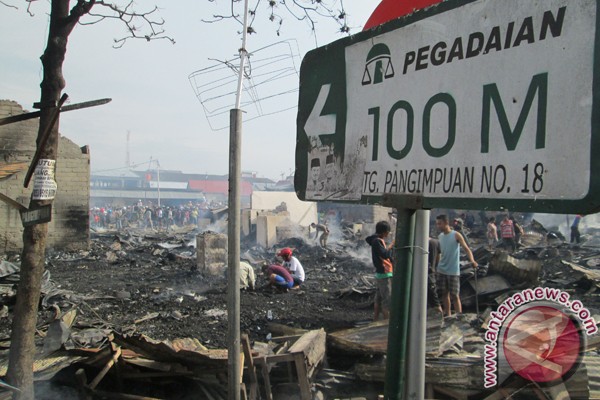
Five killed in fire at Masomba traditional market in C. Indonesia

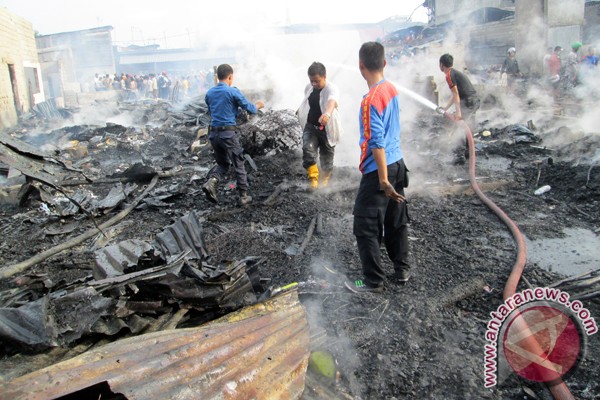
A massive fire took place on Wednesday at Masomba traditional market located in Palu, the capital city of Indonesia's Central Sulawesi province, leaving five dead, local media reported.

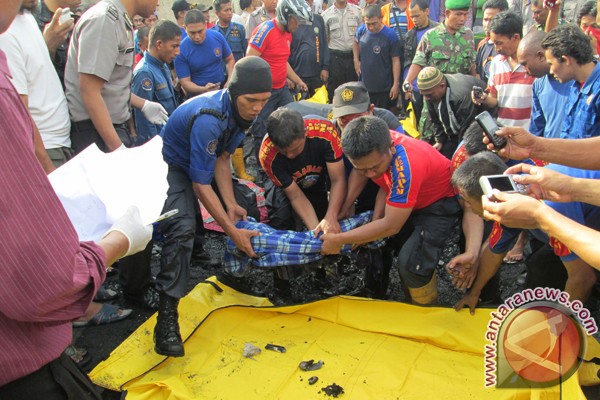
South Palu Police chief Comr. Saimuda Ali said that the five victims were found in the scorched market.

"We haven't been able to identify the victims as their bodies were severely burned," he said

Bodies of the victims were now placed in the Central Sulawesi' s Bhayangkara Police Hospital for further identification process.

Rahman, an eyewitness, said that the fire was originated from the stalls at the market. "I saw the fire came from the stalls that engulfed the whole market quickly," he said.

The fire reportedly started at 03:30 a.m. local time, was extinguished after three hours. The cause of the fire is still being investigated. The Masomba traditional market has previously caught on fire for multiple times due to short circuits.

Thursday 25 October 2012

http://www.china.org.cn/china/Off_the_Wire/2012-10/24/content_26893890.htm

continue reading

Aussies lead world in disaster response

AUSTRALIAN disaster response teams are world-class and have been leaders in managing international crises, a conference has been told.

Emergency management expert Peter Baines remembers how bodies found floating in the water or washed up on the beaches and streets of Thailand after the 2004 Boxing day tsunami were taken to a local temple.

"As I walked in, all I could see covering the entire area was the decomposing bodies of 3500 people that lay on the ground," said Mr Baines, who has spent 22 years with the NSW Police responding to terrorist acts and natural disasters.

He has also consulted for Interpol and the UN, and was deployed to Japan last year after the tsunami and to Bali following the 2002 bombings.

Mr Baines spoke about his experiences at the Sydney Safety Conference on Thursday in which he said Australia had always taken a lead in international disaster responses.

With the Thai temple turned into a mortuary, 400 international emergency workers brought 110 refrigerated shipping containers to Phi Phi Island and began the long, difficult work of identifying bodies.

In the chaos, Australians took charge, and strong disaster leadership set Australian rescue workers apart, he told the conference.

"Under immense pressure from families, the media, and embassy staff, Australian teams in Thailand held every key leadership position for six to eight months, over 36 other countries including the UK, Germany and Sweden," Mr Baines said.

"It wasn't that we were arrived quicker, we didn't have any greater skill or expertise or resources, it was what we did."

Mr Baines also praised former Queensland premier Anna Bligh for her leadership during the floods.

"(Ms Bligh) was on TV with wet hair and a raincoat on," Mr Baines said, and her leadership during the crisis showed she understood the challenges Queenslanders were facing.

Mr Baines called on insurance companies to lower premiums for organisations who trained disaster response staff, saying this would ensure nations maintained high standards of emergency management.

Thursday 25 October 2012

http://www.theaustralian.com.au/news/breaking-news/aussies-lead-world-in-disaster-response/story-fn3dxiwe-1226503127843

continue reading

Wednesday, 24 October 2012

The Death Toll for the Great East Japan Earthquake Nuclear Disaster

The Tears of Sanriku (ไธ‰้™ธใฎๆถ™)

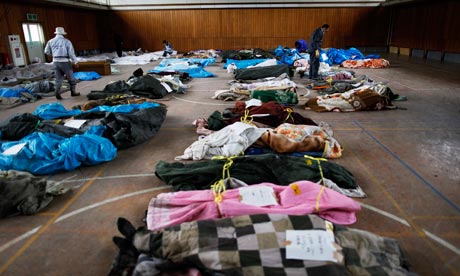
The Japanese government is many years away from declaring a final death toll for the Great East Japan Earthquake (ๆฑๆ—ฅๆœฌๅคง้œ‡็ฝ), which occurred on March 11, 2011. More bodies continue to be found, but the recovery effort is hampered by lack of resources (especially in Ishinomaki City, Miyagi) and difficult conditions in other coastal localities. The statistics (based on the home pages of Japanese prefectures as of October 26, 2011) that I have obtained for extremely hard hit Coastal Regions (North to South) and Inland Regions do not agree with National Police Agency (NPA) statistics. However, the NPA (่ญฆๅฏŸๅบ) has already acknowledged that their statistics for Fukushima Prefecture do not reflect many bodies left on the ground and unrecovered due to nuclear radiation. Virtually none of the estimated 376,000 tons of rubble in six towns (Namie-machi, Futaba-machi, Okuma-machi, Tomioka-machi, Naraha-machi, and Hirono-machi) in the “Off Limits” Zone has been cleared to date.

The collection and reporting of statistics by prefecture has actually served to obscure many important facts, and the statistics presented by the NPA simply do not conform to reality. The NPA statistics (deaths, missing, injuries, and property damage) appear to be the most complete and reliable for Ibaraki Prefecture. However, NPA statistics for Iwate, Miyagi, and Fukushima Prefectures remain incomplete and unreliable because the NPA is dependent on other government ministries and agencies for almost all of their statistics. The multiple, non-standardized, and unconsolidated lists of evacuees, which total over 700 pages for Iwate Prefecture alone, are completely disorganized and have substantially hindered searches for missing persons. The daily reports of Iwate, Miyagi, and Fukushima Prefectures present information using different methods and formats, and there are no discernible standards for reporting by the prefectures.

The Ministry of Economy, Trade and Industry (็ตŒๆธˆ็”ฃๆฅญ็œ) failed to intervene with Tokyo Electric Power Company (TEPCO) until Fukushima Dai-Ichi (็ฆๅณถ็ฌฌไธ€ๅŽŸ็™บ) was in full meltdown, and cold shutdown of that plant will not occur until January 2012 at the earliest. At least 150 subcontractors who worked at Fukushima Dai-Ichi cannot be located (or contacted). While the exposure of these workers might be limited, this is further evidence that TEPCO does not properly maintain records and remains out of control. Some hard-line, no-nonsense administrators need to be brought in to restore order. Despite an extremely long history of earthquakes off the coast of Miyagi, there were few contingency plans and the central government was unprepared for a disaster of this magnitude. The Japanese government has been making it up as they go along in a reactive mode. There has been no integrated, coordinated response to this disaster as public officials work in a vacuum without competent leadership and effective direction. So many ministries, agencies, and levels of government have overlapping responsibilities as part of the government’s response to the disaster that proper coordination was impossible without prior planning. The Japanese government’s response to this disaster is a case study of poor judgment, lack of planning and preparation, and critical errors that should be carefully studied by the Federal Emergency Management Agency (FEMA) because similar scenarios can be envisioned for Hawaii, Alaska, and the West Coast of the United States. Many localities had only 30-40 minutes of advance warning before the tsunami (ๆดฅๆณข) breached 30-foot seawalls and inundated the Eastern coast of Honshu. However, the United States is even less prepared for a huge earthquake and tsunami than Japan. The NPA has not reported statistics on the number of “Confirmed Missing, Declared Dead.” The Ministry of Justice (ๆณ•ๅ‹™็œ) has jurisdiction over that final adjudicative procedure. A simplified, expedited procedure for a Declaration of Death (ๆญปไบกๅฑŠ) without a body was adopted so that the proceeds of life insurance policies, bank accounts, and survivor benefits could be paid to survivors 90 days after March 11, 2011. Nevertheless, the procedures to accept these filings were not in place until June 25, 2011. According to the Ministry of Justice, at least 3,492 Declarations of Death had been filed as of September 30, 2011. However, many citizens have not been able to file Missing Person Reports, Declarations of Death, and/or Property Damage Reports due to the lack of any functioning local government entities in many coastal areas of Iwate, Miyagi, and Fukushima Prefectures. Nevertheless, it is expected that a Declaration of Death will eventually be filed for almost every reported missing person because receipt of substantial funds is tied to that procedure. Filings of workers’ accident compensation (ๅŠดๅƒ่€…็ฝๅฎณ่ฃœๅ„Ÿ) claims have also ballooned to nearly 1,800 claims because the overall compensation for a work-related death is much higher than a regular death benefit and/or survivor’s pension. The Ministry of Health, Labour and Welfare (ๅŽš็”ŸๅŠดๅƒ็œ) expects about 4,000 claims for workers’ accident compensation.

According to the NPA, approximately 92.8 percent (14,553 bodies) of all bodies recovered (15,689 bodies) in Iwate, Miyagi, and Fukushima Prefectures had been positively identified as of August 31, 2011. Survivors have provided 90 percent of all positive identifications, and about 10 percent of all recovered bodies have been positively identified through analysis of fingerprints, DNA analysis, and dental charts. Over 80 percent of the 300 bodies found in July, August, and September 2011 were recovered by fishermen. The NPA stated that the total of unidentified bodies had declined to 942 persons by October 11, 2011. Actual conditions remain extremely difficult to determine in many coastal localities due the extent of flooded areas, volume of rubble (over half of the estimated 22.6 million tons of rubble in Iwate, Miyagi, and Fukushima Prefectures has been cleared), nuclear radiation, and overworked public employees. Nevertheless, it is certain that that at least 22 cities and towns in the coastal region of Iwate, Miyagi, and Fukushima Prefectures each had at least 100 deaths. Japanese Self-Defense Forces (่‡ช่ก›้šŠ) were not immediately dispatched to Tohoku after the earthquake and tsunami as the Kan administration vacillated and first sent eight jets on a reconnaissance mission over the region. The Prime Minister finally dispatched 50,000 troops on Saturday, March 12, 2001. That initial contingent of troops was inadequate, and it was doubled to 100,000 troops on Sunday, March 13, 2011.

Most of the evacuation centers were “makeshift” facilities (former schools and other older buildings that had not been used in many years). There were influenza epidemics, overcrowding and poor hygiene, dehydration, malnutrition, food poisoning, and lack of fuel oil (and blankets) in many evacuation centers in March 2011, but the danger in the summer was the brutal heat and humidity without air conditioning. “Temporary” prefabricated housing units are being assembled, but thousands of people will be forced to remain in evacuation centers for the foreseeable future. Iwate Prefecture closed its last evacuation center on October 7, 2011. Although Miyagi Prefecture now has 214 residents in their 16 remaining evacuation centers, more than 8,000 Miyagi evacuees are being housed outside of Miyagi Prefecture.

As of June 10, 2011, only about 44 percent of the completed units were occupied as bureaucrats dithered over the criteria to be used in determining priority in allocation of housing units to evacuees. In late September 2011, temporary housing units for 138 residents in Sukagawa City, Fukushima had to be rebuilt due to their improper location on a flood plain and subsequent flooding due to Typhoon No. 15. Problems with temporary housing continue to mount, as housing units are now being refitted to withstand the cold Tohoku winters. There also have been some suicides and other deaths in temporary housing units. According to the Ministry of Land, Infrastructure, Transport and Tourism (ๅ›ฝๅœŸไบค้€š็œ), 98 percent of the needed temporary housing units (51, 352 units) had been completed as of October 11, 2011. The occupancy rate (74 percent) of temporary housing units continues to lag in Fukushima Prefecture. Bureaucrats at all levels of government, including the Ministry of Health, Labour and Welfare, also delayed assistance to evacuees by establishing detailed procedures and committees (็พฉๆด้‡‘้…ๅˆ†ๅ‰ฒๅˆๆฑบๅฎšๅง”ๅ“กไผš), which devised schemes based on the extent of damage to determine distribution of the huge amount of charitable contributions (251.4 billion yen) received from around the world. Tragically, by early June 2011, less than 15 percent of these charitable funds (37.0 billion yen) had been distributed to evacuees. As of July 22, 2011, charitable contributions had increased to 305.3 billion yen, but only 98.6 billion yen (about 32 percent) of the funds had been distributed to evacuees and others in need. At best, politicians and bureaucrats continually haggled over substantial cash resources, while thousands of people languished in filthy evacuation centers for months. No one has been so indelicate as to suggest that some bureaucrats treated the charitable contributions as their own not so little slush funds for dispensing favors and facilitating kickbacks. The “mistake” that the Japanese Red Cross Society (ๆ—ฅๆœฌ่ตคๅๅญ—็คพ), Central Community Chest of Japan (ไธญๅคฎๅ…ฑๅŒๅ‹Ÿ้‡‘ไผš), and many other charities made was to transfer funds to the national coffers of Japan, which guaranteed months of delay in the distribution of charitable funds. Charities, if they really want to be effective and ensure timely distribution of charitable contributions, should remit funds directly to localities.

According to the Asahi Shimbun, cities, towns, and villages in Iwate, Miyagi, and Fukushima Prefectures have received approximately 1,290 applications concerning persons who died in evacuation centers or after transport to hospitals. Some of these 163 “earthquake related deaths” (้œ‡็ฝ้–ข้€ฃๆญป) already recognized (่ชๅฎš) include suicides and cases that appear to be due to the nuclear accident. Ishinomaki Red Cross Hospital alone identified 127 possible earthquake related deaths in response to an April 2011 survey conducted by the Yomiuri Shimbun. These types of deaths, which are not included in the NPA death toll, are expected to balloon as hospitals are thoroughly audited and more information becomes available. Procedures for recognition of earthquake related deaths are proceeding unevenly in 53 cities, towns, and villages in Iwate, Miyagi, and Fukushima, and the entire recognition and payment system, which produces varying results by locality, might be revamped by national legislation. About 80 percent of the hospitals in the coastal areas of Iwate, Miyagi, and Fukushima Prefectures were damaged or destroyed, and there were cancer patients in evacuation centers because of a shortage of hospital beds. Japan’s system of public health has virtually collapsed in many coastal areas inundated by the tsunami. Many doctors who had clinics and hospitals provided medical treatment in tents through the fall, but access to medical treatment will decline in the winter months and the number of earthquake related deaths is expected to increase. There also will be a significant number of deaths due to overwork (้ŽๅŠดๆญป) and suicides as local public employees bear inhuman workloads.

Aerial photography, satellite images, and onsite surveys were employed to map the flooded regions of Japan. At least 600,000 people resided in the flooded regions of Japan (Aomori, Iwate, Miyagi, Fukushima, Ibaraki, and Chiba Prefectures), and Japan’s evacuation centers housed nearly 470,000 evacuees at the peak (March 15, 2011). The difference (130,000 persons) between the population of the flooded regions (approx. 600,000 residents) and the number of evacuees (almost 470,000 persons) causes considerable concern. Information concerning injuries and hospitalizations is particularly difficult to obtain, and few of the Miyagi cities devastated by the tsunami have reported any injury totals to date. Most of these residences were households, and the number of evacuees for Miyagi Prefecture peaked at about 321,000 persons on March 14, 2011. Thousands of evacuees had no food, water, heat, medical supplies, or electrical power for four days after March 11, 2011 because many communities were accessible only by sea or helicopter. Therefore, I am extremely nervous about the actual situation in Miyagi Prefecture and elsewhere in Tohoku. According to Japan’s Fire and Disaster Management Agency (ๆถˆ้˜ฒๅบ), the NPA, and other agencies, the national totals for private property damage, which also remain incomplete, were 119,086 Residences Totally Destroyed, 184,330 Residences Substantially Damaged, and 621,013 Residences Partially Damaged as of October 24, 2011.

The injury total (188 persons) for Iwate Prefecture is not even within the realm of possibility. No injury totals have been reported for the Iwate’s Rikuzen-Takata City, Ofunato City, Kamaishi City, Otsuchi-cho, or Yamada-machi to date. However, it is very well known that many elderly evacuees died in evacuation centers. All of these “earthquake related deaths” will eventually be added to the death toll, and I expect that earthquake related deaths will account for at least 15 percent of the final death toll. The Ministry of Health, Labour and Welfare will have much to say about the final total of earthquake related deaths, which will be in the thousands. Additionally, there were more than 15,000 suicides in Japan in the first half of this year, and the number of suicides has increased continually since the earthquake, tsunami, and nuclear accident. There also have been hundreds of bankruptcies due to the disaster, which is fueling the suicide rate.

According to the Geographical Survey Institute (ๅ›ฝๅœŸๅœฐ็†้™ข) of Japan, flooding in three wards of Sendai City totaled at least 52 square kilometers. Half of Kesennuma City was underwater and the other half of the city burned for four days (approx. 40,331 citizens resided in the flooded area of the city). Higashi-Matsushima City also experienced flooding of 37 square kilometers, which accounted for over 80 percent of that city’s households (approx. 34,014 residents in the flooded area). At least 28,000 residences were completely destroyed or swept away, and more than 73 square kilometers were flooded in Ishinomaki City, Miyagi. According to the Statistics Bureau of the Ministry of Internal Affairs and Communications (็ทๅ‹™็œ็ตฑ่จˆๅฑ€), about 70 percent (approx. 112,276 citizens) of Ishinomaki’s total population resided in the flooded area. Although the daytime population of that area was unknown, I await updated statistics from Ishinomaki City with increasing dread. The more than 5,000,000 tons of rubble remaining in Ishinomaki City probably cannot be cleared in accordance with the government’s plan (by March 31, 2012). Electrical power has not yet been fully restored to all areas of Miyagi Prefecture.

Conditions are horrible in six coastal localities of Iwate Prefecture (Miyako City, Yamada-machi, Otuschi-cho, Kamaishi City, Ofunato City, and Rikuzen-Takata City). A 15.8-meter tsunami coupled with ground subsidence of 84 centimeters completely ravaged Rikuzen-Takata City. Without including any Missing – Declared Dead, the “hard count” death toll for Rikuzen-Takata City is approaching 10 percent of the population of its flooded area. Iwate Prefectural Hospital in Otsuchi-cho was destroyed by the tsunami, and it seems unlikely that Otsuchi-cho will be rebuilt or even survive. The future of these six coastal localities is very much in doubt. Iwate Prefecture also lags in terms of reporting of private property damage (almost 32,000 residences damaged or destroyed). Iwate Prefecture simply does not have the resources, and there is no confidence that Japan’s national government will devote any significant resources to Iwate’s coast.

The remarks and behavior of Mr. Ryu Matsumoto led to severe political repercussions. The selection of a Diet Member from Fukuoka City to oversee the reconstruction of Tohoku was an extremely ill advised choice and an insult to Tohoku. His suggestion that sorely needed funds might be withheld from Tohoku was heartbreaking and absolutely unforgiveable. His successor, Mr. Tatsuo Hirano, is a Member of Japan’s House of Councillors from Kitakami City, Iwate. However, the person to watch is Mr. Ichiro Ozawa, a Diet Member from Mizusawa City, Iwate. Mr. Ozawa is one of the most powerful and influential politicians in Japan, and he might eventually accrue the power to force funding of the Ministry of Agriculture, Forestry and Fisheries (่พฒๆž—ๆฐด็”ฃ็œ) and Ministry of Land, Infrastructure, Transport and Tourism (MLIT) in order to revitalize Tohoku. In any event, Prime Minister Naoto Kan of Yamaguchi Prefecture is out as of August 30, 2011. Mr. Yoshihiko Noda of Chiba Prefecture is Japan’s new Prime Minister. The resignation of Mr. Yoshio Hachiro as the Minister of Economy, Trade and Industry due to his remarks and “joke” about Fukushima also caused more political problems. He was replaced by Mr. Yukio Edano, who was the Chief Cabinet Secretary during the Kan Administration. However, it does not really matter who is Prime Minister or in the Cabinet because the central government remains in the denial and cover-up phase, and lacks legitimacy.

In addition to the horrible problems caused by the earthquake, tsunami, and nuclear accident, Japan has yet to face the “hollowing out” (็ฉบๆดžๅŒ–) of their economy and the rapid relative aging of their population (้ซ˜้ฝขๅŒ–). Thus, the massive consolidation and reorganization of Japan’s ministries and agencies effected in the late 1990’s must now be deemed an abject failure. Like the United States, Japan’s public finances are built on corruption, lies, broken promises, and unsustainable sovereign debt. Therefore, the downgrading of the sovereign debt of both nations should come as no surprise. The government bonds and currencies of both nations are really nothing more than belief systems, and it should be noted that almost all belief systems collapse in the end. While there is “policy” (ๆ–น้‡) for the rebuilding of Tohoku, the funding details lack specificity and will be revised by subsequent administrations. Therefore, I am extremely concerned that Japan will inevitably begin to repatriate funds by reducing its massive holdings of U.S. Treasury securities (over USD900 billion), and that the Chinese government will follow suit. A disorderly market for U.S. Treasury securities may be the result.

Many citizens (30,583) of villages, towns, and cities in Fukushima Prefecture are subject to Mandatory Evacuation Notices (้ฟ้›ฃๆŒ‡็คบ), and the administrative functions of many villages and towns have been transferred to other cities and towns in Fukushima and Saitama Prefecture. Many others have already left “voluntarily” as people are effectively being forced out of their homes without compensation. There also have been numerous reports of arson, vandalism, and looting of vacated residences. Additionally, the NPA announced on June 15, 2011 that it would henceforth cease to tabulate statistics on the number of evacuees. If you can control access to data and information, then you control the press.

Many villages and towns will probably cease to exist even though some Recommended Evacuation Notices have not yet been upgraded to Mandatory Evacuation Notices. Some citizens of Fukushima Prefecture have been relocated as far away as Okinawa Prefecture, and there is increasingly strong resistance to forced relocation. At least 966 square kilometers of Fukushima Prefecture are now in an “Off Limits” Zone, which will most likely be uninhabitable long into the future. The “Off Limits” Zone has essentially already been expanded due to many “hot areas” found outside the Zone. It also has been admitted that at least eight employees of Tokyo Electric Power Company (TEPCO) have been exposed to 250 millisieverts or more of radiation. Cancers and other maladies from low-dosage radiation over an extended period may take years to develop. Any radiation-related deaths also will be counted as “earthquake related deaths,” the number of which is my greatest fear.

Like the HIV-tainted blood scandal of the 1980’s, the Ministry of Health, Labour and Welfare has once again been blind sided due to the lack of a proactive plan. Radioactive cesium has been detected in the food chain numerous times (a partial listing includes tap water, milk, eggs, rice, fish, spinach, green onions, cucumbers, shiitake and nameko mushrooms, bamboo shoots, wasabi, plums, green tea, hay, beef, and mothers’ milk), but I doubt that a soil decontamination project will be attempted due to the huge expense. It appears that there will be a whole new class of hibakusha (persons exposed to nuclear radiation). Part of TEPCO’s “risk management strategy” was to locate their nuclear power plants as far away from the Tokyo metropolitan area as possible. Unfortunately, the people of Fukushima Prefecture are now paying a horrible price for that decision. Therefore, there is suspicion that much of Fukushima Prefecture will soon be designated as a Special Administrative District (็‰นๅˆฅ่กŒๆ”ฟๅœฐๅŒบ) under the direct control and administration of Japan’s national government. The cleanup of Fukushima Dai-Ichi will take decades.

The real story is the many thousands more who were swept out to sea and have not even been reported as missing. Japan’s National Tax Agency (ๅ›ฝ็จŽๅบ) will eventually assist the Ministry of Internal Affairs and Communications (another repository of Family Registers) in identifying many more missing persons. The names and other identifying information of the approximately 600,000 persons who resided in the flooded regions of Eastern Japan are already known due to Japan’s Family Register (ๆˆธ็ฑ) system. Over 57,000 citizens of Fukushima Prefecture remain “housed” in evacuation centers and other facilities scattered throughout the other 46 prefectures of Japan.

Current Prefecture of Residence

Number of Evacuees from Fukushima Prefecture

Yamagata Prefecture 11,816

Tokyo Prefecture 6,266

Niigata Prefecture 6,249

Saitama Prefecture 4,819

Chiba Prefecture 3,197

Ibaraki Prefecture 2,787

Tochigi Prefecture 2,563

Gunma Prefecture 1,964

Hokkaido Prefecture 1,828

37 Other Prefectures 15,598

Total (As of October 18, 2011) 57,087

There are now more Japanese on welfare than at any time since immediately after World War II. However, the Japanese government bailed out Tokyo Electric Power Company through a de facto nationalization so that TEPCO could pay compensation for mental anguish to evacuees (the base amount of 100,000 yen per month does not even reach the subsistence level in Japan). TEPCO is “too big to fail” simply because it provides electrical power to tens of millions of people in Kanto.

In the United States, physician Janette Sherman, MD, and epidemiologist Joseph Mangano have published an essay about a 35-percent spike in infant mortality in northwestern cities that occurred after the Fukushima meltdown, which may be the result of fallout from the failed nuclear plant. The eight cities included in the report are San Jose, Berkeley, San Francisco, Sacramento, Santa Cruz, Portland, Seattle, and Boise. It is hoped that the medical community will thoroughly review their research and conduct other independent studies. Causal relationships are often difficult to establish, so it is hoped that the scientific community will thoroughly examine both their premise and the supporting data. While their premise may be plausible, I still have reservations about the supporting data. In Canada, Scotland, and China, there also are reports of higher amounts of radioactive materials in the atmosphere. The international media has been complicit as the Japanese government and TEPCO have continued to withhold information vital to the public. No one should be surprised at this behavior, though. Similar conduct was exhibited by Chisso Chemical and the Japanese government for decades after the mercury poisoning incident at Minamata, Kumamoto.

One receives the distinct impression that the Japanese government is treating the release of information as a national security matter. On June 7, 2011, the Ministry of Education, Culture, Sports, Science, and Technology (ๆ–‡็ง‘็œ) finally admitted that it had failed to release a substantial amount of data concerning the monitoring of radiation emitted at Fukushima Dai-Ichi that was collected between March 16, 2011 and April 4, 2011. This withholding of information from the public has only fueled public anger, palpable distrust, and a complete lack of confidence in the Japanese government. The Japanese love their country, but many of them now openly voice contempt and hatred for their government (“lies” and “betrayal” are the words used most often). Much more could have been done to cut bureaucratic red tape, waive unnecessary procedures, and eliminate excessive documentation so that evacuees could quickly receive funds, leave evacuation centers, and rebuild their lives. Although the “fiscal hawks” at the Ministry of Finance (่ฒกๅ‹™็œ) would prefer to ignore Tohoku and concentrate on repairing Japan’s extremely fragile public finances, this is not the time for unyielding government at the expense of the people (ๅฎ˜ๅฐŠๆฐ‘ๅ‘). The callous response of Japan’s central government to the Tohoku disaster underscores the long-standing prejudice against that region of Japan. Those same “fiscal hawks” had absolutely no qualms about bailing out Japan’s banking sector, which collapsed from nonperforming loans in the early 1990’s. That unprecedented bailout became the global prototype for the looting of national treasuries to prop up insolvent financial institutions that had quickly morphed into criminal organizations.

The NPA had an excellent, well-deserved reputation for professionalism in law enforcement. However, the NPA, which had no particular expertise in communicating information to the public, was set up to fail. Enforcement of Mandatory Evacuation Notices and reporting of information to the public should not have been assigned to the same agency. Japan’s Fire and Disaster Management Agency (FDMA) could have been used much more effectively as a clearinghouse for the reporting of information to the public. The role of the FDMA, which is a very small agency with about 162 employees, will almost certainly be expanded to include the functions of FEMA in the future. FEMA and the FDMA should engage in collaboration and exchanges of information.

Reporting on the Great East Japan Earthquake is an outrageous example of “news management” on many levels. NHK (ๆ—ฅๆœฌๆ”พ้€ๅ”ไผš), PBS, and CBS can continue to air their whitewash propaganda films to assist the Japanese government, but it will not change the reality on the ground. As is so often the case in Japan, a benign facade (ๅปบๅ‰) has been erected to conceal the ugly truth (ๆœฌ้Ÿณ). TEPCO and Fukushima Dai-Ichi remain out of control. In fact, on April 6, 2011, a Letter of Request from the Ministry of Internal Affairs and Communications was issued to associations of telecommunications service providers, cable TV providers, and Internet service providers to ensure that content is moderated and only “proper information” is conveyed to the public. No one dares call it an attempt to censor the Internet in Japan. A country is dying when their old men start committing suicide, and the tears of Sanriku continue to flow. So, the situation is very bad in Tohoku and Tokyo. The populace of Tohoku is very jittery about the almost daily aftershocks, which could continue for another five months or more. A panicked, desperate political elite in Tokyo now realizes and admits, at least tacitly, that it really did not have a crisis management plan. Japan, like many nations, has a long history of being run by and for a parasitic elite at the top of the system. Parasitic elites fear but one thing – the loss of their power and perquisites. None of these machinations (denial, obfuscation, suppression of information, lies, and censorship) on the part of TEPCO and the Japanese government were for the sake of the nation (ๅ›ฝใฎ็‚บ). Rather, it was nothing more than some empty suits trying to maintain their favored positions in society, but the people have got their number. They know that their central government let them down in a big way. The development of proactive plans to protect the populace is among the most difficult of functions of government to fulfill. But, the “social contract” has been severed. The Japanese people have long accepted one of the highest tax burdens in the world in return for good government, and they have now received one of the worst possible outcomes. There is now a widespread perception that Tokyo politicians and bureaucrats are nothing more than “tax thieves” (็จŽ้‡‘ๆณฅๆฃ’). As a result, there is real, raw fear in Nagata-cho and Kasumigaseki right now. The politicians and bureaucrats know that a second tsunami is coming, a political one that could easily drown all of them. There is going to be a far-reaching purge of high-ranking bureaucrats, and the personnel actions will indicate accountability and culpability. The Ministry of Economy, Trade and Industry, NPA, Cabinet Secretariat, and Ministry of Internal Affairs and Communications are going to be torn apart because of their involvement in attempting to suppress information and institute censorship (a critical error that public relations agencies cannot fix). Japan’s bureaucracy will begin serving up those responsible in order to preserve itself. It will start with administrative vice ministers (ไบ‹ๅ‹™ๆฌกๅฎ˜) and bureau chiefs (ๅฑ€้•ท), and go right on down the line. Shikata ga nai (“It can’t be helped”) is not going to cut it this time. But, it could be much worse. I hate to think what the result might have been if the earthquake had occurred at 2:46 AM in heavy fog rather than 2:46 PM on a fairly clear day. Once again, the heroes were the many well-trained local police, firefighters, teachers, doctors and nurses (especially those who refused to abandon patients and save themselves), and public officials who performed admirably but lost their lives while trying to help their fellow citizens. Ibaraki Prefecture, which is not a wealthy prefecture, stands out in terms of preparations by their leveraging of limited resources to promote citizen involvement in local safety councils, public education, and drills to ensure immediate evacuation. Thorough review of statistics by prefecture also clearly shows that Ibaraki Prefecture has been the most timely of all the prefectures in reporting of deaths, missing persons, injuries, and property damage (including damaged roads and bridges). While Ibaraki experienced flooding in 10 localities (over 40,000 residents in the flooded areas) and extensive property damage (over 184,000 residences damaged or destroyed), loss of life was minimized in that prefecture. Ibaraki did have a proactive plan, which encompassed preparations through recovery, and it continues to bear results. Their plan was well conceived and executed, and it produced much better outcomes. According to a July 2011 survey conducted by the Cabinet Office, 42 percent of evacuees in Miyagi, Iwate, and Fukushima Prefectures did not immediately evacuate and had not clearly heard the tsunami warning.

Despite the huge expense and opposition of most villagers, a previous mayor of Fudai-mura, Iwate insisted on building a much higher seawall (approx. 15.5 meters), which minimized the flooding and loss of life. TEPCO measured the height of the tsunami at Fukushima Dai-Ichi at 14-15 meters. The seawall at Fukushima Dai-Ichi was only about 5.5 meters high, and there were inadequate provisions for auxiliary, backup power to ensure adequate water circulation and cooling of fuel rods (evidence of criminal negligence). TEPCO did not build a higher seawall at Fukushima Dai-Ichi despite being informed of the deficiency. There will be prosecutions of TEPCO executives and government bureaucrats.

An evacuation center can never be up high enough. Although the Japan Meteorological Agency (ๆฐ—่ฑกๅบ) measured the height of the tsunami at 7.3 meters in Miyako City, Iwate, the wall of water barreled right on up the hill in the Aneyoshi district (ๅง‰ๅ‰ๅœฐๅŒบ) to a runup height of 38.9 meters. Stone markers that are hundreds of years old have served as warnings not to build below those points in Aneyoshi. Down the road in Kamaishi City, Iwate, more than 50 people died in an evacuation center that everyone thought was up high enough to be safe. Think twice before you get in an automobile to flee from a tsunami. You must consider road conditions because many people lost their lives when they were caught in traffic jams. Move inland immediately after being warned about an approaching tsunami. The tsunami penetrated inland as far as eight kilometers (approx. five miles) in some areas of Japan. If you can see the tsunami, it is already too late (a tsunami may move inland at a speed of 30-40 MPH). Get in a tree or on top of a building, and pray.

At present, it is believed that more than 90 percent of all deaths in Japan caused by the disaster were drowning related, and persons aged 60 or older accounted for at least two-thirds of all fatalities. A mega-thrust earthquake in the Cascadia subduction zone could cause extensive damage, but lack of preparations for a tsunami will kill thousands of people. Many cities and towns on US 101 are vulnerable because a bad tsunami would limit access to many of these cities and towns only from the sea or by helicopter. Prepositioning of at least four days worth of food, water, fuel, and other necessities is recommended. It is clear that an earthquake and tsunami similar to that of January 26, 1700 would inundate the entire Pacific Coast. That catastrophe has been verified by the oral histories of Native Americans, archeological finds, and Japanese historical records of the tsunami.

Notes and Links 1. The Sendai District Meteorological Observatory (ไป™ๅฐ็ฎกๅŒบๆฐ—่ฑกๅฐ) has documented the history of earthquakes in or near Miyagi Prefecture. (Japanese Language) http://www.jma-net.go.jp/sendai/jishin-kazan/higai.htm

2. The Cabinet Office (ๅ†…้–ฃๅบœ) of Japan commissioned a survey to estimate the volume of debris and rubble caused in Iwate, Miyagi, and Fukushima Prefectures by the Great East Japan Earthquake. (Japanese Language) http://www2.ttcn.ne.jp/honkawa/4363e.html

3. Web versions of newspaper articles pertaining to earthquake related deaths (้œ‡็ฝ้–ข้€ฃๆญป) (Japanese Language) http://www.asahi.com/special/10005/TKY201110160449.html http://www.kobe-np.co.jp/rentoku/shakai/higashinihon/0004457613.shtml http://ryukyushimpo.jp/news/storyid-179589-storytopic-232.html http://www.yomidr.yomiuri.co.jp/page.jsp?id=39356

4. Web version of newspaper article pertaining to the cutoff of public assistance to 219 households in Minami-Soma City, Fukushima (Japanese Language) http://www.sanyo.oni.co.jp/news_k/news/d/2011072201000769/

5. Web versions of newspaper articles pertaining to Declarations of Death (ๆญปไบกๅฑŠ) without a body filed with the Ministry of Justice (ๆณ•ๅ‹™็œ) (Japanese Language) http://www.nikkei.com/news/special/article/g=96958A9C93819695E2EBE2E2988DE2EBE3E2E0E2E3E39180EAE2E2E3;q=9694E3E3E2E1E0E2E3E3E5E3E6E2;p=9694E3E3E2E1E0E2E3E3E5E3E1E6;o=9694E3E3E2E1E0E2E3E3E5E3E1E1 http://hochi.yomiuri.co.jp/topics/news/20110906-OHT1T00151.htm http://sankei.jp.msn.com/region/news/110906/iwt11090622490000-n1.htm http://mainichi.jp/select/today/news/20110802k0000e040045000c.html http://www.iza.ne.jp/news/newsarticle/event/disaster/517382/

6. Web version of newspaper article pertaining to the withholding of radiation monitoring data for Fukushima Dai-Ichi by the Ministry of Education, Culture, Sports, Science, and Technology (ๆ–‡็ง‘็œ) (Japanese Language) http://www.news24.jp/articles/2011/06/07/07184117.html

7. Graphic and tabular data pertaining to the surface areas of flooded regions in Tohoku (Geographical Survey Institute (ๅ›ฝๅœŸๅœฐ็†้™ข) of Japan) (Japanese Language) http://www2.ttcn.ne.jp/honkawa/4363d.html

8. Graphic and tabular data pertaining to ground subsidence in Tohoku (Geographical Survey Institute (ๅ›ฝๅœŸๅœฐ็†้™ข) of Japan) (Japanese Language) http://www2.ttcn.ne.jp/honkawa/4363c.html

9. Graphic and tabular data pertaining to height of the tsunami in localities of Eastern Japan (Japanese Language) http://www2.ttcn.ne.jp/honkawa/4363b.html

10. Tabular data pertaining to the estimated populations of flooded regions in Eastern Japan (Statistics Bureau of the Ministry of Internal Affairs and Communications (็ทๅ‹™็œ็ตฑ่จˆๅฑ€)) (Japanese Language) http://www.stat.go.jp/info/shinsai/zuhyou/sinsui.xls

11. Web versions of newspaper articles pertaining to the occupancy rate (43.8 percent) of temporary prefabricated housing units in mid-June 2011 and flooding problems in September 2011 (Japanese Language) http://www.daily.co.jp/society/national/2011/06/10/0004158958.shtml http://woman.excite.co.jp?News/society/20110927/Ntv_20110927066.html

12. Web version of newspaper article pertaining to the total number of evacuees at the peak (March 15, 2011) (Japanese Language) http://www.sankei.jp.msn.com/affairs/news/110315/dst11031500510004-nl.htm

13. Web version of newspaper article pertaining to recalculation of the number of missing persons in Iwate Prefecture due to mistakes in processing Declarations of Death (Japanese Language) http://news.goo.ne.jp/article/asahi/nation/K2011070904400.html

14. Japanese readers may prefer to read a different summary of the damage caused by the Great East Japan Earthquake (ๆฑๆ—ฅๆœฌๅคง้œ‡็ฝ). (Japanese Language) http://www2.ttcn.ne.jp/honkawa/4362a.html

15. Web version of newspaper article pertaining to the National Police Agency (่ญฆๅฏŸๅบ) announcement that it would no longer collect statistics concerning the number of evacuees (Japanese Language) http://www.tokyo-np.co.jp/s/article/2011061501000910.html

16. List of evacuees in Iwate Prefecture (Japanese Language) http://www.pref.wate.jp/~bousai/hinansyameibo/zentaimeibo.pdf

17. Web version of newspaper article pertaining to the inability to recover bodies in areas of Fukushima Prefecture contaminated by nuclear radiation (Japanese Language) http://www.yomiuri.co.jp/national/news/20110327-OYT1T00470.htm?from=y10

18. Web version of newspaper article pertaining to the increasing rate of suicide in Japan in the second quarter of 2011 (Japanese Language) http://koshiro-m.cocolog-nifty.com/blog/2011/07/post-2fba.html

19. Web version of newspaper article pertaining to the inability of Tokyo Electric Power Company (TEPCO) to locate 150 subcontractors who worked at Fukushima Dai-Ichi (็ฆๅณถ็ฌฌไธ€ๅŽŸ็™บ) (Japanese Language) http://www.yomiuri.co.jp/national/news/20110808-OYT1T00893.htm

20. Web version of newspaper article pertaining to amounts of compensation paid to evacuees for mental anguish (Japanese Language) http://www9.nhk.or.jp/kabun-blog/600/91386.html

21. Letter of Request (April 6, 2011) from the Ministry of Internal Affairs and Communications issued to associations of telecommunications service providers, cable TV providers, and Internet service providers (Japanese Language) http://www.soumu.go.jp/main_content/000110048.pdf

22. Web versions of newspaper articles pertaining to bureaucratic delays in the distribution of charitable contributions (็พฉๆด้‡‘) to evacuees (Japanese Language) http://www.tokyo-np.co.jp/article/feature/tohokujisin/list/CK2011072602100011.html http://news.livedoor.com/article/detail/5618056/ http://www.asahi.com/special/10005/TKY201106060583.html

23. Web version of newspaper article pertaining to a July 2011 survey of evacuees conducted by Japan’s Cabinet Office (Japanese Language) http://www.chugoku-np.co.jp/News/Sp201108170084.html

24. Web version of newspaper article pertaining to positive identification of bodies recovered by the National Police Agency (Japanese Language) http://www.asahi.com/national/jiji/JJT201109090138.html

25. The Fire and Disaster Management Agency (ๆถˆ้˜ฒๅบ) of Japan also provides statistics concerning deaths, missing persons, injuries, property damage, and fires. (Japanese Language) http://www.fdma.go.jp/bn/data/

26. Web versions of newspaper articles pertaining to the number of workers’ accident compensation (ๅŠดๅƒ่€…็ฝๅฎณ่ฃœๅ„Ÿ) claims filed (Japanese Language) http://www.asahi.com/national/jiji/JJT201107280063.html http://www.asahi.com/national/jiji/JJT201108160083.html?ref=chiezou

27. Web version of newspaper article pertaining to suicides and deaths due to overwork (้ŽๅŠดๆญป) (Japanese Language) http://www.sankeibiz.jp/compliance/news/110609/cpd1106092231018-nl.htm

28. Web version of newspaper article pertaining to positive identification of bodies (Japanese Language) http://www.excite.co.jp/News/society_g/20111011/Jiji_20111011X212.html

The above version of this study does not include the author’s detailed tables pertaining to deaths and missing persons classified by town and village.

Wednesday 24 October 2012

http://www.globalresearch.ca/the-tears-of-sanriku-19977-38520-12398-28057-the-death-toll-for-the-great-east-japan-earthquake-nuclear-disaster/27342

continue reading

'Dead' man surprises family by walking into his own funeral - while identical looking murder victim lies in casket

Another example of the risks of visual identification:

A family gathering to mourn the death of a relative were shocked to tears and fainting when the deceased man in question pitched up at his own funeral on Tuesday.

In a bizarre case of mistaken identity, news of car washer Gilberto Araujo's murder had been relayed to the family by local police in Sao Paulo, Brazil on Sunday.

Shortly after, when the wayward vagabond's brother was called into the morgue to make a positive identification on the body, he saw his brother lying on the table and took the corpse home so his family could hold a wake.

Jose Marcos Araujo was so fooled by the likeness of fellow car washer Genivaldo Santos Gama to his brother Gilberto, that he mistakenly confirmed the body to be his sibling's.

Police inspector Roberto Lima said that Jose Marcos took the body to his mother's Alagoinhas home where a wake was held on Tuesday

'The confusion started when news started circulating that a car washer had been shot dead,' Jose Marcos' wife, Ana Paula, told the UOL Internet news portal.

'Police called my husband and told him that his brother had been killed and his body was at the morgue,' she explained.

Lima said the confusion was 'understandable.'

'The two men closely resembled each other and both worked as car washers,' Lima said adding that no further information on Gama was immediately available.

According to Gawker, the family had not seen or heard from Mr Araujo in the four months before the vexing case of mistaken identity.

A few hours before the Monday burial 'a friend of Gilberto's saw him walking down the street and told him that his family was mourning him,' he said.

'So he went to his mother's home to let everyone know he was very much alive.'

When Araujo showed up at his wake 'some people fainted and others were so scared they ran away. It was a big shock,' family friend Maria Menezes told the G1 online news site.

Gilberto's mother Marina Santana told reporters: 'I am overjoyed. What mother wouldn't be after being told that her son is dead and then sees him alive.'

Wednesday 24 October 2012

Read more: http://www.dailymail.co.uk/news/article-2222241/Man-alive-funeral-familys-shock-identical-looking-murder-victim-lies-casket.html#ixzz2AClU1i75

continue reading

Ogun Accident: NEMA recovers 5 more bodies from river

ABEOKUTA – THE National Emergency Management Agency (NEMA) announced Tuesday that it had recovered five more bodies from the commuter bus that plunged into the river on Ijebu-Ode-Ore Expressway on Oct. 19.

Briefing newsmen in Abeokuta, NEMA Public Relations Officer, Ibrahim Farinloye said so far, 18 bodies had been recovered, while three passengers survived.

Twelve bodies had earlier been recovered when the 36-seater bus was conveying 21 passengers on the fateful day.

“All the remaining five bodies were discovered this morning, bringing the total to 21 as Madam Christina Umwena, a survivor, revealed that 21 people were on board.

“Families of the victims have been collecting the remains of their relations at the Ijebu-Ode General Hospital,” Farinloye said.

Wednesday 24 October 2012

http://www.vanguardngr.com/2012/10/nema-recovers-5-more-bodies-from-river/

continue reading

Saitoti ‘may have died before helicopter crash’

A pathologist who examined the bodies of former Internal Security minister George Saitoti and his deputy Orwa Ojode a day after the crash has said the deaths may have occurred before the aircraft came down.

Dr Dorothy Njeru on Tuesday told the Justice Kalpana Rawal commission investigating the accident that the ministers may have died from inhaling a poisonous gas before the helicopter crashed.

Autopsies on the six victims of the June 10 mishap, the commission was told, revealed “cherry pink” patches on their bodies, indicating that high levels of carbon monoxide were inhaled and the crash may not have been “a normal aviation accident.”

Dr Njeru said she made the observations of the tell-tale signs of poisoning while a colleague documented her dictation. “However, omissions were made in the final report on the cherry pink discolouration I noticed during the post-mortem.”

She said the post-mortem examination was done at the Lee Funeral Home in Nairobi at the request of the CID. “I pointed out that we had information we should have captured which was not,” Dr Njeru said.

She told the commission there were a “few missing details” in the final cause of death report compiled by section head Dr Johanssen Oduol and handed over to the police.

She disputed the presence of another doctor whose signatures appear in the autopsy reports, saying she did not recall the doctor being present.

“The key features that were not documented was the presence of the reddish discolouration of the internal organs, which in forensic terminology, is referred to as cherry pink,” Dr Njeru said, adding that the final description of victims’ injuries was “brief” and the “degree of their burns also not quantified.”

She said the photographs from the scene of the accident and the ones taken during the post-mortem showed the characteristic bright red discolouration, indicating a high concentration of poisonous gas.

“The reddish patch suggestive of carbon monoxide poisoning was an additional observation that was not captured in the post-mortem reports,” Dr Njeru said.

She said an internal examination of the bodies of Thomas Murimi, Luke Oyugi and Nancy Gituanja also showed the presence of soot in their respiratory systems and was also not entered in the final report. She said the ministers also had soot in their systems.

“Honourable Ojode’s body had a discoloration around the knee and on the left lower limb. We did not document the cherry red in our report,” she said.

She said a close examination of Prof Saitoti’s body showed a bright red discolouration on the right thigh while his bodyguard, Mr Joshua Tonkei, had it on the forehead and left knee.

“The presence of the cherry red appearance indicated they had concentration levels exceeding 30 per cent,” said Dr Njeru.

She explained that toxic exposure may lead to mental incapacitation, confusion and convulsions that may result in a pilot losing control of an aircraft. She said the gas may have been a result of a fire in confined space.

Asked why the team failed to produce a more conclusive report on the cause of deaths, she said several problems affected their work, ranging from lack of equipment, adequate room and time to consult with other experts.

Wednesday 24 October 2012

http://www.nation.co.ke/News/Saitoti+may+have+died+before+copter+crash/-/1056/1593654/-/10hso7wz/-/index.html

continue reading

Bus plunges down ravine, kills 14

Rio de Janeiro - A Brazilian bus transportation company says that the death toll in the accident of one of its vehicles has risen to 14.

According to Brazil 's federal highway police, with 29 passengers on board, the bus was travelling from Itaperuna municipality in Rio de Janeiro state to Rio. It skidded off the highway near the Guapimirm town in a mountainous region. What caused the accident could not be immediately known, but the highway police department tells reporters it appears the bus brakes failed

Alvim says that 10 people, including the driver, were killed instantly and four died Tuesday at hospitals. Another 15 people were injured and remain hospitalized.

Wednesday 24 October 2012

http://in.news.yahoo.com/11-dead-bus-plunges-off-cliff-brazil-020206909.html

continue reading

Italy’s disaster management chief quits

The head of Italy’s disaster body, Luciano Maiani, has resigned to protest against prison sentences passed on seven colleagues over the 2009 earthquake in L’Aquila, the BBC reports.

Six scientists and an ex-official were convicted of multiple manslaughter for giving a falsely reassuring statement.

Prof. Maiani, a physicist, said the Serious Risks Commission could not work “in such difficult conditions”.

The 6.3 magnitude quake killed 309 people and left the city in ruins.

Prof. Maiani’s decision to quit was announced by the Italy’s Civil Protection department, which said the commission’s vice-president, Mauro Rosi, and emeritus president Giuseppe Zamberletti had also tendered their resignations.

“The situation created by yesterday’s sentence is incompatible with running the commission’s work in a calm and efficient manner and with its role of giving high level advice to the organs of the state,” Maiani said in a statement on the department’s website.

“These are professionals who spoke in good faith and were by no means motivated by personal interests, they had always said that it is not possible to predict an earthquake,” he told the Corriere della Sera newspaper.

“This is the end of scientists giving consultations to the state,” warned Prof Maiani, a world-renowned physicist who was director general of the Cern nuclear research centre in Switzerland from 1999-2003.

The group, all members of the National Commission for the Forecast and Prevention of Serious Risks, were accused of having provided “inaccurate, incomplete and contradictory” information about the danger of the tremors felt ahead of the April 6, 2009 quake.

At a meeting a few days before the deadly quake, they had told officials in L’Aquila that, while a major earthquake was not impossible, it was not likely.

On the night of the quake, many people are said to have remained in their homes and died because of the advice, while others who had decided to remain outside in the street survived.

In their closing statements at the trial in L’Aquila on Monday, prosecutors quoted a witness whose father died.

Guido Fioravanti called his mother straight after the first tremor. “I remember the fear in her voice. On other occasions they would have fled but that night, with my father, they repeated to themselves what the risk commission had said. And they stayed.”

However, the six-year jail sentences have shocked the scientific community.

The prestigious science journal, Nature, said “the verdict is perverse and the sentence ludicrous”.

It called for protests against the sentence’s severity and at scientists being criminalised “for the way their opinions were communicated”.

Leading political figures in Italy suggested that the case had blurred the lines between science and public life.

“The risk is that doubt will no longer be allowed to form part of scientific judgement,” Interior Minister Anna Maria Cancellieri said. “The role of science is not the same as politics or administration.”

The speaker of the lower house of the Italian parliament, Gianfranco Fini, was more blunt in his assessment of the verdict: “I trust it will be corrected on first appeal.”

Wednesday 24 October 2012

http://www.punchng.com/news/world/italys-disaster-management-chief-quits/

continue reading

Tuesday, 23 October 2012

What happened to the families of the drowned cocklepickers of Morecambe Bay?

On the three-hour bus trip from the southern port city of Xiamen to central Fujian province, you move into a landscape of largely abandoned villages, once the homes of so many departed Chinese migrants. Here, around Fuzhou and the counties of Lianjiang, Changle, Fuqing and Putian, tens of thousands of villagers have left in the past three decades, driven away by low agricultural incomes and land developments that left them without compensation or livelihood. Seeking new ways to survive, they headed in waves for Japan, the US and Europe, including the UK.

These villages, mainly occupied by the elderly, contain a mixture of old, shabby farmhouses and new mansions, built with money sent home by undocumentedmigrant workers toiling in sweatshop factories, restaurants, takeaways and building sites. They are also the hometowns of the cocklepickers who drowned at Morecambe Bay in 2004.

More than 40 Chinese workers were picking cockles there in the evening of 5 February 2004, sent by their recruiter and manager, Ah Ren, who was facing fierce competition from other Chinese teams along the Bay. To maximise profits, Ah Ren cut out the local middleman and gangmaster who bought cockles from him and controlled the production. That meant working against tidal charts and safety rules, which no one in the supply chain cared about as far as "foreign workers" were concerned.

At 8.30pm, two hours after they should have been told to leave the Bay, the workers realised the tide had come up too fast for them to escape. They were stranded between deep, water-filled gullies. With no sign of rescue, the workers began calling their families. They cried, and said goodbye. Some drowned before their families could call back.

The bodies of 21 men and women, aged 18 to 45, were recovered from the Bay in the days that followed. The 22nd, Liu Qinying, wasn't found until autumn 2010. One was never found. All but one of the victims were from Fujian. Their families lost husbands, wives and parents, and were left owing mountains of debt to moneylenders.

I reported on the tragedy at the time and researched the background to the exploitation of Chinese migrant workers. After exchanging phone calls and letters with these families for several years, and helping to raise money to pay off their debts, I went to meet them.

In the Jiangkou township of Putian, I found Liying, the sister of Xu Yuhua, who drowned in Morecambe Bay with his wife Liu Qinying. Liying looked frail and worn out, but was strong in spirit, as she had been in her letters and phone calls. She had supported her orphaned nephew, Xu Bin, with the income from her job as an assistant to an overseas Chinese businessman. In fact, the whole family's livelihood – her father, sister, daughter and unemployed husband – depended on her. Xu Bin had studied hard and passed the university extrance exam. He wanted to fulfill his parents' ambition for him, and was planning to go to Britain to further his studies before building a career back home.

Liying and I went to visit a woman named Jinyun in her village near Fuqing. The winding lanes led to a semi-furnished two-storey house where she lived with her entire family. We talked on an old couch set against the concrete walls. I had been exchanging letters with Jinyun and her two sons, who were in high school when their father, Lin Guo Guang, drowned in Morecambe Bay. "Guo Guang's first job in England was on a building site where he got paid £40 a day," Jinyun said. "That was why he resorted to cockling." Jinyun has brought up her sons on her own, working as a nanny and earning £60 a month. By summer 2009, she had managed to pay off half the debt of 200,000 yuan (£20,000) left by her husband (the remainder was paid by donations from the UK). "I pretend he's still working in England and just hasn't sent money home," she said. "It's much easier than thinking he's gone forever."

Back in Putian, a town with few industries apart from the odd shoe and garment factory, Liying and I walked the dusty lanes to the local market where we met Mr and Mrs Lin, parents of Lin Zhifang, at 18 the youngest of those who drowned. They had come down from their home in the mountains to sell dragon eyes (a fruit similar to lychees) and sugarcane. Mr Lin said they had stopped working the land as the income was too small to live on. Now they depend on selling fruit in the market for a living. "Zhifang had worked in a factory for two years before leaving. He was our eldest son, and what he wanted most was to build a house for the family," Mr Lin said. "He could never have done it working in Putian."

The burden of debt after Zhifang's death meant his younger brother had to work in the factory rather than go to university. Zhifang's mother couldn't speak much Mandarin but listened intently, and asked her husband to translate what she wanted to say. Several times she looked down, remembering the loss of her son, and wept.

Zhifang's parents seemed to have swallowed the pain of losing their son in such a modest way, as if misfortunes were inevitable for those born into the life of peasants. They had moved on and toiled away for the little cash that would keep them from starving. Their endless strength was humbling.

Liying and I then travelled to the outskirts of Fuzhou to see Yan Chun, the widow of Dong Xin Wu, who was 39 when he drowned. He had been a cobbler in Fuzhou and migrated to the UK to work for his family. Yan Chun lives in a village with her mother and mother-in-law, who suffers from dementia, and lives on state support of only 150 yuan (£15) a month. The cost of medication has been a huge burden, even after a medical insurance system was introduced: "It's a joke. Patients can only claim insurance if they are hospitalised, and then only 20% of the costs," a neighbour who helps look after Dong's mother told me.

Yan Chun works as a cleaner in an insurance company, earning up to £80 a month. Her son had wanted to serve in the army in Tibet, where he could earn 100,000 yuan and help clear the family's debts. (Most of the army in Tibet and Xinjiang, the "troubled regions", are recruited from the impoverished countryside.) But Yan Chun wouldn't let him go. She said she didn't want to lose him as well.

For the widows and families of the drowned workers, the future of the next generation has always been the overriding consideration. Yet it is hard to see what chance of a secure livelihood their children have in Fujian – and China. Fujian has always lagged behind the country as a whole; under Mao, the province was much neglected and received less than 2% of the nation's capital investment. Agriculture was the mainstay, but less than 10% of the province was arable. In the late 70s, before Deng Xiaoping's reforms, Fujian was ranked 23rd of 29 provinces in GDP. Since then, although poverty has been reduced, development initiatives have been concentrated in coastal cities such as Xiamen, while much of the countryside remains neglected and open to random land appropriation by developers.

What's left for the youth? As Liying and others kept saying: "There are few real jobs around here." In villages and townships, the main work options are in low-paid manufacturing and service industries. Even with a university education, jobs in the public sector are difficult to get: connections are the key.

When Jinyun's family had finally paid off its debts, she borrowed money and sent both her sons to study in Japan, where course fees are half those in the UK, to study and work in the catering trade. Her younger son met a Fujianese woman and got married. However, their plans were interrupted by the 2011 earthquake and tsunami – Jinyun was anxious and asked them to return to China. Now her younger son is working for a relative in the timber business; her elder son is jobless.

The desire for betterment still motivates many Fujianese to migrate. Today, the immigration cap on non-EU migrants has closed off legitimate routes, while the strengthening of the EU's border controls has made overland smuggling even more expensive. Given all this, many Fujianese parents look for other ways to send their children to Britain, often as students or asylum-seeking orphans.

Those who come as orphans are among Britain's most vulnerable young migrants. They leave home for the first time and arrive in a country they know little about as unaccompanied minors. They then claim asylum and are put into social care. Some may be granted refugee status; others disappear into the informal economy, where they tend to work in the lowest-paid jobs in catering and service industries and are exploited – just like their predecessors. When I look at these young men and women, I remember the tanned faces of the workers, kneeling down to rake the shiny black cockles under the sun and rain, in order to send money home.

As a Fujianese woman whose whole family had migrated told me: "Our migrating ancestors left us with this legacy: You mustn't sit and take what is thrown at you in life. You must always endeavour to improve your living standards. You must do better."

Tuesday 23 October 2012

http://www.guardian.co.uk/world/2012/oct/22/drowned-chinese-cocklepickers-morecambe-bay

continue reading