Friday, 22 March 2013

Bringing back the missing of WWII


From World War I through the Gulf War, the United States military suffered 631,628 casualties and had 94,416 brave souls missing and unaccounted for. World War II alone accounts for 405,399 of those casualties and 78,978 missing soldiers.

“That is a staggering amount of missing men. And you have to think to yourself, each one of them had a family that loved them.”

Ken Crawford is a 1969 graduate of Wabash College and returned to the Lovell Lecture Room in Baxter Hall to talk about his work to bring home the missing World War II servicemen from battlefields in Europe.

As chief of the Engineering Division for the 21st Theater Support Command, Crawford supported the search and recovery missions by the U.S. Army Memorial Affairs Activity, Landstuhl, Germany, with the Joint POW/MIA Accounting Command throughout Europe, from 1997 through 2002.

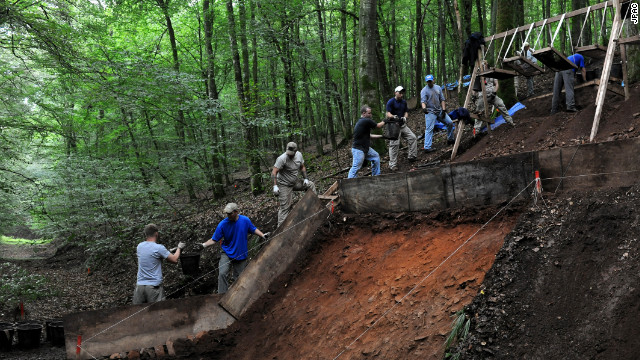
Through specific examples of excavations that he was a part of, Crawford detailed the process of recovering a missing soldier even five decades after his death.

“First there is the investigation, which can get very interesting. Often times we receive tips from locals who can still recall the plane crashes and point out where they went down,” he said, adding that many of the tips come from people searching for American .50 caliber guns or scrap metal from the engines.

The next step is search and recovery, which can take a very long time. First they need to identify the type plane by way of serial numbers and then hopefully find the tail number. That should be able to give them a list of the flight crew and narrow their search down.

“It’s a very methodical process, digging in four by four squares one foot deep at time.”

Archaeologists, engineer and translators run the dig, but much of the heavy lifting and sifting is done by special forces units.

One example Crawford gave was of three American soldiers who all died in their foxhole in Belgium. They appeared to take mortar fire and the Germans simply covered their foxhole when they marched through.

Once their bodies were identified, the families of the soldiers decided to have them buried together in a cemetery in Belgium.

“They died together, so we buried them together,” Crawford said. “It was a beautiful ceremony.”

Another example, also in Belgium, was of a pilot who went down with his P-38. The surviving brother of the pilot was at the site, and when the team recovered the pilot’s Second Lieutenant bars, they presented the brother with them in a small ceremony.

“That was really touching to see.”

There are 146 national cemeteries, including Arlington Cemetery in Washington D.C. and the Normandy American Cemetery in France. Crawford said men he helped recover have been laid to rest in many of them. Many cemeteries have a wall of the missing; the wall in Normandy contains 1,500 names alone.

“Whenever we recover a body and lay him to rest, his name receives a rosette next to it which signifies he’s been recovered.”

Through his talk it was apparent that although it was a dirty job at times, Crawford took joy in the bright moments. He gave one surviving airman a piece of his recovered B-17 bomber that crashed over Germany after the pilot flew too low and he presented a farmer in Romania with a helmet, a rifle and bayonet that were uncovered with the body of an American soldier in his garden once the investigation was through.

“It is a long and difficult trail to find everyone. We were lucky to find as many as we did,” Crawford said in his closing. “There are so many guys that went missing. That’s just a fact of war. But the important thing is this — the Department of Defense is still searching.”

Friday 22 March 2013

http://www.journalreview.com/news/article_fdf1bc58-928e-11e2-be06-0019bb2963f4.html

continue reading

Dignity in death is passé with rise in number of unclaimed bodies


While dignity during life time can be ensured by the living person, it becomes the bounden duty of the near and dear ones of that person to ensure that there is dignity in death. While some are lucky in getting a dignified send off, some are not. There are those who are left to die uncared for by the roadside, some whose identity is not known, others who are abandoned in hospital after being admitted, and some others who are abandoned in hospital after death.

All this because there are no family members in some cases, in others the family members do not have the means to do the last rites, while in some cases there is no inclination. Organisations that are involved in giving a dignified burial to such unclaimed bodies are getting more and more number of bodies with each passing month.

From eight bodies a month in 2004, ‘Thozhar Trust’ now buries more than 30. And, it only seems to be on the increasing trend, according to P. Shanthakumar, Managing Director of the Trust. The Trust has so far buried 1,850 unclaimed bodies from the morgue in Coimbatore Medical College Hospital (CMCH) with the help of volunteers who include women and college students.

Mr. Shanthakumar says: “Couples without children or with a single child are increasing. Even those who have money are in a situation where the only son or daughter is abroad and someone else has to do the last rites in the event of them not able to arrive at short notice.

In the case of economically weaker sections, it is still worse with sons or family members dumping the dead body, or one who is about to die, on the road”. In addition to these cases are those who have lived as beggars, in old age homes, who die in accidents without identity proof.

There are many children who themselves call up an organisation and express their inability to bury their parent. The minimum cost involved in a burial without religious rituals is estimated to be Rs. 4,000. There is also another side to this state of affairs. There are many elders who call the members of the organisation and ask them to take care of their last rites.

Friday 22 March 2013

http://www.thehindu.com/news/cities/Coimbatore/dignity-in-death-is-pass-with-rise-in-number-of-unclaimed-bodies/article4533456.ece

continue reading

At least 30 die in boat capsize off Gabon


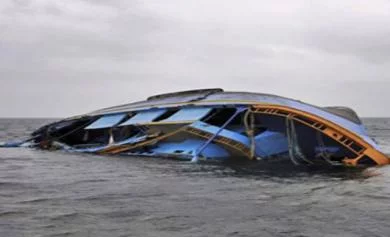
At least 30 people died when their boat capsized off the Gabonese capital Libreville, AFP journalists and rescue workers said Thursday, the latest disaster off the west African coast.

Police said the boat, which was carrying 65 people thought to be illegal immigrants, capsized in stormy weather overnight as it was travelling from Nigeria to Libreville.

AFP journalists counted 30 bodies lying along the shore, with the boat still visible in the waters of Cape Esterias, which lies about 40 kilometres (25 miles) north of Libreville.

A gendarme who requested anonymity said there were at least eight survivors among the passengers thought to be illegal immigrants from Togo, Benin and Burkina Faso.

Last week, a boat carrying an estimated 128 people sank off Nigeria's southern coast. An emergency official said Thursday that 29 people have so far been rescued in that accident, but that the search for survivors is still ongoing.

Thursday 21 March 2013

http://au.news.yahoo.com/world/a/-/world/16419711/at-least-30-die-in-boat-capsize-off-gabon-afp/

continue reading

Thursday, 21 March 2013

Official details of boat mishap unavailable, six days after 160 people feared dead


The fatal boat mishap in which about 160 Nigerians were feared killed at the weekend happened four days before any Nigerian agency got wind of it, some residents of the area claim.

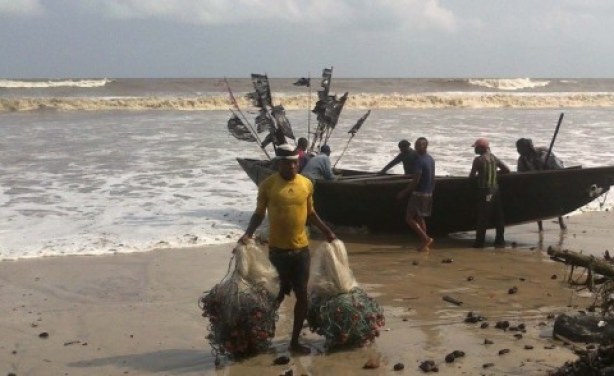
The wooden transport boat, which reportedly set out on the ill-fated journey on Friday night from Oron in Akwa Ibom State, capsized at a location near Malabo, 40 nautical miles from Calabar, Cross River State, on its way to Gabon.

Most of the victims were said to be Igbo traders from the South Eastern part of the country who joined others in Oron, Akwa Ibom State, to board the wooden boat because of its cheap fares.

Though news of the incident was reported in the media late on Tuesday, it was gathered that the incident happened on Friday evening.

None of the government agencies is yet able to give the full details of the incident. All government agencies contacted could not provide specific information about the boat on Tuesday evening when news of the incident first broke. Information like where the boat originated from, it’s destination, the exact number of passengers at the time of the accident, the exact location and time the boat capsized, as well as number of victims and survivors.

As of Tuesday night, the Nigerian Navy, which is charged with the responsibility of protecting Nigeria’s territorial waters, was not aware of the incident even though it probably occurred four days earlier.

Yushau Shuaib of the National Emergency Management Agency, NEMA, which responded immediately it was notified on Tuesday, said in a telephone interview on Wednesday that all his agency could volunteer was the information that only two survivors were rescued, while nine bodies so far recovered were taken to the morgue at the University of Calabar Teaching Hospital.

“The truth is that nobody knows exactly when the incident happened. All what we can tell you is that two survivors were rescued and taken to the hospital, while nine bodies have been recovered. Any other information any other person might say is all speculation, because nobody knows exactly what happened,” Mr. Shuaib said.

The two survivors, a young boy and a lady, reportedly clung to a gas cylinder till they were rescued by fishermen.

Both were received late Tuesday evening by a team of officials from NEMA, the Cross River Emergency Management Agency; the Navy; Nigerian Maritime Agency for Security and Administration, NIMASA; and others at the Eco Marine, ECM, jetty in Calabar.

The Assistant Director of Information with the Cross River Emergency Management Agency, David Akate, who confirmed the rescue, declined further comment.

All the other agencies declined comments on the incident, claiming investigations were on-going and the two survivors were being treated.

It was gathered that following the incident, local fishermen in the area rallied efforts and mobilised a rescue team on Sunday that managed to recover 45 bodies, most of them women. They were reportedly wrapped in body bags and deposited in the hospital morgue on Tuesday.

NEMA has however said it will provide more information on the catastrophe as soon as it can get them from the two survivors.

Thursday 21 March 2013

http://premiumtimesng.com/news/126139-official-details-of-boat-mishap-unavailable-six-days-after-160-people-feared-dead.html

continue reading

Police looking for bodies missing from Bihar graves


Police have announced a cash reward of Rs.1,000 each for information about the bodies found missing from graves in Bihar's Araria district, an official said.

The announcement came after bodies of about 50 people killed in various lightning incidents were found to have been exhumed from graves in Raniganj and Simraha areas of Araria, about 350 km from here.

"We are serious about helping people whose kins' bodies are missing from their graves," Superintendent of Police S.W. Lande told IANS.

The appeal has been made to help police ascertain the total number of missing bodies, he said.

Lande said that a gang involved in secretly digging up graves was busted recently. "The gang was involved in selling human organs for medical research in Nepal, China and other countries."

"One of the main accused named Mohammad Majid is already in jail in connection with smuggling of tusks," the police officer said, adding they are on a lookout for two more people in this connection.

"It is really shameful to remove bodies from graves for a few thousand rupees," Lande said.

According to him, human organs or bodies are sold to medical colleges and those who are involved in clandestine medical research in several countries.

In Araria, most of the deaths due to lightning go unreported owing to religious beliefs, Lande said.

Wednesday 20 March 2013

http://www.newstrackindia.com/newsdetails/2013/03/20/277--Police-looking-for-bodies-missing-from-Bihar-graves-.html

continue reading

‘Identity of Ratnagiri bus mishap victims established'


A day after 37 people were killed in a bus mishap in Maharashtra's Ratnagiri district, identity of 34 victims has been established, a senior police officer said Wednesday.

"We have so far handed over 34 bodies to their relatives after they identified the victims," said in-charge of Khed police station, Mahendra Singh Pardeshi.

He said the remaining three bodies will be identified once their relatives reach here from Uttar Pradesh.

At least 37 people were killed and seven injured when a speeding Mumbai-bound luxury bus plunged into the Jagbudi River near Khed village in Ratnagiri district in the wee hours of yesterday.

Police said, out of seven persons injured in the mishap, two were shifted to Goa by their relatives while one was discharged by the local hospital in Dervan where they were admitted.

He said the remaining four persons were out of danger.

Maharashtra government has already announced compensation of Rs 2 lakh each to the kin of the accident victims.

Wednesday 20 March 2013

http://zeenews.india.com/news/maharashtra/identity-of-ratnagiri-bus-mishap-victims-established_836796.html

continue reading

3 dead, 12 missing after ferry sinks on the Minjiang River


Three bodies have been retrieved and 12 others remain missing after a ferry sank on the Minjiang River in east China's Fujian Province, local authorities said Wednesday.

The accident occurred during a rainstorm around 9 a.m., when the boat sank near a dock in Xiadao Township, Nanping City, according to sources with the Nanping municipal government.

Search and rescue work is underway.

Wednesday 20 March 2013

http://english.peopledaily.com.cn/90882/8176542.html

continue reading

Sunk Nigerian boat was carrying trafficked migrants: survivors


A boat that sank off the Nigerian coast with up to 166 people on board, killing at least 45, was carrying illegal immigrants being trafficked to Gabon, survivors interviewed by Reuters said on Wednesday.

Nigerian authorities were still searching for survivors from a wooden boat that sank on Friday some 40 nautical miles offshore on its way from Oron, in Cross Rivers state, to Gabon.

Vincent Aquah, director of the Cross Rivers State Emergency Management Agency (SEMA), told a news conference that a rescue operation had recovered 27 people so far.

He said only nine bodies had been fished out, although a doctor at a local mortuary told Reuters on Tuesday there had been 45 bodies brought in from the accident.

Survivor Kive Sani, 27, from Togo, said he had paid money to a Nigerian "master" to get him a good job in Gabon. Part of his agreement was that he give the master a portion of his wages for an indefinite period.

"A huge wave swept onto the boat and knocked out the engine, then everything started sinking," he said.

He survived by clinging to an empty gas cylinder for nearly two days, he said.

Most poor West Africans who risk their lives each year to seek a better life head for Europe, usually via Spain's Canary Islands. But Gabon's oil-funded relative prosperity has also made it a favorite destination.

In July 2008, the bodies of 37 suspected illegal migrants were found dead on the seafront of Gabon's capital Libreville, after a boat capsized taking the same Nigeria to Gabon route.

With investment from former colonial ruler France, Gabon was one of the first sub-Saharan African countries to exploit its crude oil reserves, which have made its 1.5 million people among the continent's richest on a per capita basis.

But many of the migrants who arrive find only low paid jobs with little security, and are often indebted to traffickers.

Hafsat Zakare, 13, a Nigerian survivor, said many of the people on board were women and children from around West Africa.

Aquah said belongings recovered during the rescue mission showed some people on the boat were Ghanaians.

Boat accidents are relatively common in Africa. As many as 138 people died when an overloaded boat carrying passengers and goods capsized in rough water on a river in Democratic Republic of Congo in 2010.

Wednesday 20 March 2013

http://www.reuters.com/article/2013/03/20/us-nigeria-accident-idUSBRE92J1C720130320

continue reading

Malaysia: temporary burial for bodies of 28 intruders


The bodies of 28 Sulu intruders kept at the Lahad Datu and Tawau hospitals will be buried temporarily pending any possible claim by their next-of-kin.

Tan Sri Khalid said the decision on the temporary burial was made at a meeting attended by representatives from the Home Ministry, Foreign Ministry, PM's Department, AG's Chambers, Royal Malaysian Police and Interpol on Monday.

He added that those wanting to claim the bodies are required to produce their DNA sample.

He also said relatives from abroad can claim the bodies by registering with the Foreign Ministry while those in the country can go to the police.

Wednesday 20 March 2013

http://www.ntv7.com.my/7edition/local-en/DIGP_MAYAT.html

continue reading

Gilgil district: Claim your dead, residents told


Gilgil District Public Health have decried the number of unknown bodies being dumped at the mortuary.

This is after they were given a court order to bury ten more unclaimed bodies by the Naivasha Law Coutrs, only a day after they held a mass burial for 16 bodies.

District Public Health Office Gerald Maina raised a red flag over the increase of the unclaimed bodies, saying that they had overstretched the capacity of the district mortuary.

“Ideally the mortuary should cater for twenty four bodies but now there are more than fifty people being attended to in the mortuary,” added Mr maina

He appealed to the relatives of the dead people to help identify the, saying that majority were accident victims of the Gilgil Olkalau Road.

Mr maina added that the huge capacity for the dead bodies was also because they catered for a huge population, saying that people from as far as Olkalau and Soy Sambu Brought their dead to the facility. He also appealed to the Ministry of Health to plan on expanding the facility

Wednesday 20 March 2013

http://www.the-star.co.ke/news/article-112994/claim-your-dead-residents-told

continue reading

New mass grave found near Sirte


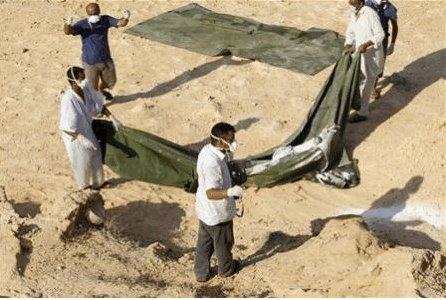
A grave reportedly containing six bodies has been found in Nufaliyah, between Ras Lanuf and Sirte.

The bodies, discovered close to the main road on Tuesday by members of the Libya Shield Battalion, Second Force, in cooperation with the Libya Shield of Ajdabiya, are thought to be those of revolutionaries.

The Assistant Commander of the Libya Shield, Second Force, Mohamed Hamad Aribi, was reorted by the Libyan news agency LANA as saying that the bodies were discovered with the legs tied and that they may have been buried alive.

A similar grave with seven bodies was found nearby last May.

Wednesday 20 March 2013

http://www.libyaherald.com/2013/03/20/new-mass-grave-found-near-sirte/

continue reading

15 Goans among Ratnagiri bus crash victims


The Goa government has confirmed the identity and deaths of 15 Goan passengers in a Ratnagiri bus crash that killed a total of 37 persons.

Transport Director Arun Desai called for a late night press conference Tuesday to inform about the number of Goans who boarded the ill-fated Mahakali bus from three boarding points in Goa, and their present status.

The official figures show that 18 Goans among 37 others including a foreign national had boarded the bus from Margao, Panaji and Mapusa. Four other Goan-origin passengers had boarded the bus from Sawanwadi and Kankavli, located on Goa-Maharashtra border.

“Among the 18 locals, 15 died and three are admitted to Chiplun (Ratnagiri) hospital undergoing treatment for serious injuries,” he said.

Two teams headed by RTO inspectors are presently in Khed, the accident spot, coordinating with the local authorities to help families bringing the bodies to Goa and assist the injured victims.

The bus, with a capacity of 51 seats carried equal number of passengers in addition to two drivers on All India permit.

Desai said that from the total passengers killed, three bodies of a woman and two men are yet to be identified. The unidentified female body is said to be one Maria Fernandes.

“We are yet to ascertain. A Mumbai family had approached us and we have asked them to identify the body in the Ratnagiri hospital,” the director said.

The speeding bus had careered off Jagbudi River Bridge landing with headfirst on a dry patch of land next to low-lying water in the river.

The government has announced in the State Legislative Assembly to render all possible help to the families of the victims.

Wednesday 21 March 2013

http://www.indiablooms.com/NewsDetailsPage/2013/newsDetails200313j.php

continue reading

Wednesday, 20 March 2013

Landslides in Rio mountains kill 24


Landslides triggered by heavy rains killed at least 24 people in the mountains above Rio de Janeiro and prompted Brazilian President Dilma Rousseff to call for tougher action to eradicate precarious dwellings.

Firemen on Friday recovered the bodies of three children who were swept away by floods in the worst hit neighbourhood called Quitandinha, a suburb of Petropolis, where dozens of homes were demolished by the landslides.

Most of the dead, including two civil defence rescuers, were buried under landslides caused by 17 inches (420 mm) of rain that fell on the mountainous region in just 24 hours, almost double the rainfall average for the month of March in the area.

Rousseff, who is in Rome for the investiture of Pope Francis, said Brazilian authorities will have to take "more drastic" measures to stop people building homes in dangerous places.

"We have offered people conditions to move away from areas that are at risk, but they always refuse to move," Rousseff told reporters in Italy. "So we will have to be tougher."

Floods and landslides killed about 1,000 people in the mountain region north of Rio de Janeiro in 2011 in the worst natural disaster on record in Brazil.

Works promised by local authorities to prevent new disasters have not materialized, though sirens installed in the region helped reduce the number of deaths this year, officials say.

Wednesday 20 March 2013

http://uk.reuters.com/article/2013/03/19/uk-brazil-landslides-idUKBRE92I14P20130319

continue reading

Boat Carrying 166 Passengers Sinks in Calabar


David Akate, the Assistant Director, Information, Cross River Emergency Management Agency, confirmed the incident to National Mirror.

The National Emergency Management Agency (NEMA) in Nigeria had earlier reported nine people dead and two survivors however eyewitnesses told our correspondent that the passengers were traveling in a massive wooden boat that took off from Oron, Akwa Ibom State, and headed for the French-speaking west African nation of Gabon. The boat capsized off the waters in Malabo, Equatorial Guinea.

A source at the University of Calabar Teaching Hospital (UCTH) confirmed that the corpses of 45 victims of the disaster had been deposited at the hospital’s morgue. He added that the hospital and other hospitals in the area were getting ready to receive more bodies as they were discovered.

David Akate, the assistant director for information at the Cross River Emergency Management Agency (SEMA), also confirmed the incident, but did not give further details.

But a correspondent of SaharaReporters spoke to several eyewitnesses. One of them said the boat was carrying 168 passengers. The source added that frantic efforts were underway at the scene of the disaster. “We are trying our best to rescue any of the passengers and to recover corpses,” the source said.

Official sources said the victims’ corpses were brought to the the University of Calabar Teaching Hospital instead of Malabo, where the mishap occurred, because they were believed to be Nigerians. One source revealed that some corpses were also taken to hospitals in Oron, Akwa Ibom.

A Marine Transporter at the Calabar Inland Waterways, Ikechukwu Egwu confirmed the incident to National Mirror adding that the passengers of the boat were mostly Igbo traders who were travelling to Gabon. He said they boarded the wooden boat because it was cheaper.

Wednesday 20 March 2013

http://www.bellanaija.com/2013/03/20/boat-carrying-166-passengers-sinks-in-calabar/

continue reading

Tuesday, 19 March 2013

Lawyers learn the power of forensics


Lawyers, including judges and prosecutors, are being taught how forensic evidence can be used in cases involving political violence.

Some 50 advocates are learning about a range of forensic skills, including techniques for surveying and excavating mass graves and recovering human remains, as well as analysing and identifying them. The course will also look at the preparation of reports and ways of presenting forensic evidence in court.

The five-day event is being run at the Ministry of Justice by the Argentine Forensic Anthropology Team (EAAF). This is an NGO that was set up in Argentina in 1984 to deal with some 30,000 cases of missing persons, the South American country’s legacy from six dictators. EAAF has also worked in Columbia and Mexico.

“Physical evidence is very important in cases of political crimes,” Luis Fondebrider from EAAF told the Libya Herald, “because people lie, and people forget.”

Forensic skills are particularly useful when looking into crimes committed a long time ago. “Identifying skeletons is much harder than actual bodies,” Fondebrider said, “so DNA has been playing an increasingly important role.”

Organised by the international NGO No Peace Without Justice (NPWJ) in cooperation with the Ministry of Justice, the training will also look at how to work with the families of missing persons.

“It is terrible for families not to know if someone is alive or dead, not to have a body or a grave,” Fondebrider said, “every family has the right to know what happened to a loved one.”

Tuesday 19 March 2013

http://www.libyaherald.com/2013/03/19/lawyers-learn-the-power-of-forensics/

continue reading

Hex River crash: families identify victims


It has been three days since a Khayelitsha family heard that a relative, Boniswa Kodwa, 34, was on the ill-fated bus that crashed on the Hex River Pass on Friday.

Twenty-four people died, including the driver.

On Monday, Kodwa’s partner, Fumanekile Mbondlololo, and cousin, Lindeka Zilindlovu, 33, were among the 22 families that travelled from Khayelitsha to Worcester to identify the bodies of their loved ones.

But Mbondlololo and Zilindlovu set off from the Site C sports and recreation centre on Monday with high hopes, believing Kodwa was alive and recovering at an unknown hospital.

Zilindlovu said there had been different stories about what had happened to her cousin: “Some people who were in the bus told us they left her on the floor, trapped between seats, and that she was still alive.”

At the morgue, Zilindlovu and Mbondlololo could not find her among the dead.

They were then told to look for her at Worcester Hospital. Their hopes spiralled when hospital staff found a person on their list who matched Kodwa’s description.

But when they went up to the ward they discovered it was not Kodwa.

After going through pictures of the dead and looking at the bodies again, they finally found her. Mbondlololo said most bodies were “badly damaged and it was almost impossible to identify them from their faces”.

Mbondlololo and Kodwa had two children together, aged 6 and 7.

“I was so relieved when I thought she was alive,” said Mbondlololo.

“What am I going to tell them (the children) now? They’ve been asking for her every day. They are so young and they need her… to bath and feed them.”

The families of the dead queued to take their turn at the Worcester Forensic Pathology Laboratory morgue.

The double-decker bus, owned by Atlantic City Liners, was carrying members of the Twelve Apostles Church in Christ in Khayelitsha. The group, most of them women, were returning from a national prayer gathering in Secunda.

After identifying his wife - Babalwa Mbele, 31 - an emotional Lwazi Mbele, 37, said her face had been “smashed flat”.

“It was very difficult seeing her like that - hurt so bad. I checked for moles on her feet and back to make sure it was her,” he said.

At the morgue, a representative from the Road Accident Fund, Jacques Furter, told the families that the fund would assist with burial costs.

The church’s leader, Dumisani Ximbi, said the families had been counselled before and after the process. “We made sure they knew what to expect inside as the bodies were badly hurt,” Ximbi said.

Tuesday 19 March 2013

http://www.iol.co.za/news/south-africa/western-cape/hex-river-crash-families-identify-victims-1.1488671#.UUhwtkfVWCA

continue reading

10 people dead in fatal Agogo accident


Ten people have been reported dead and several others have been seriously injured in a fatal accident at Agogo in the Ashanti region.

An eyewitness who spoke to XYZ News from the Agogo Hospital said the 207 vehicle was traveling from one of the villages in the Agogo Township to the Central market.

She however added that it not clear exactly what led to the fatal accident but added that the dead bodies have been deposited at the Agogo General Hospital for identification.

She added that the injured have also been rushed to the Agogo General Hospital and other near-by hospitals for treatment.

The number of deaths is yet to be confirmed by the Ashanti regional Police Command.

Tuesday 19 March 2013

http://vibeghana.com/2013/03/19/10-people-dead-in-fatal-agogo-accident/

continue reading

War of Independence ‘disappeared’ recalled


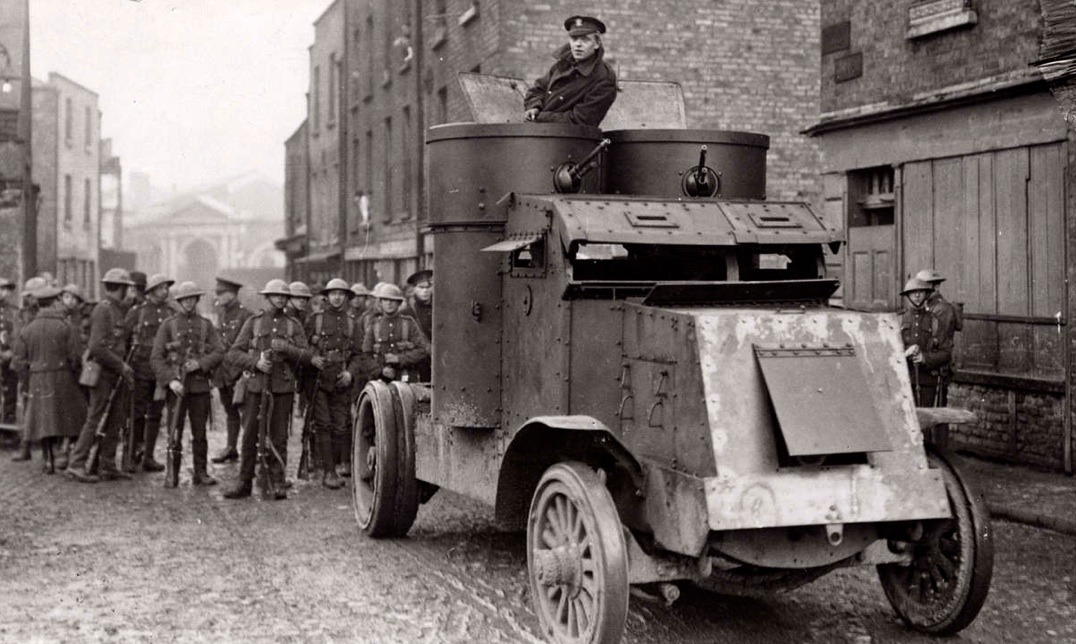
In the War of Independence, people were abducted, executed and secretly buried, not by the British, but by the Irish Republican Army. A new TV3 series, In The Name Of The Republic, investigates the ‘disappeared’ of 1919 to 1921, as Eunan O’Halpin, professor of contemporary Irish history at Trinity College, attempts to identify them and tells their shocking stories. Of these civilians killed by the IRA, O’Halpin asks “were they spies, were they informers? Some were, some were not.” Buried in unmarked graves or weighed down and dumped into lakes and rivers, they are the forgotten victims of Ireland’s struggle for independence. In his decade of research, Professor O’Halpin discovered executions carried out upon the slightest of evidence. “These deaths cast a dark shadow over the struggle for independence,” he says. With the centenaries of major moments in Irish history looming — 1916, partition, independence and the Civil War — it is timely this darker passage is being revealed.

In the first instalment of the TV series, O’Halpin travelled to Laois to investigate the rumour that the bodies of executed men were dumped on a farm during the War of Independence. Using modern technology and the expertise of an archaeological firm to find evidence of human burials, he tries to establish the identities of the alleged victims.

The only clue he had to work with was a claim that the executed men were from north Tipperary. O’Halpin’s journey took him to the National Archives, where files provided evidence of abduction, executions, and burials. The programme also told the story of Major Compton-Smith, who had commanded the 10th Royal Welch Fusiliers during the First World War. After the war, he served with the 2nd Royal Welch Fusiliers in Ireland, where he was taken hostage in 1921, before being shot in retaliation for the execution of IRA prisoners. The body was returned, prompting O’Halpin to ask: “Why would the body of an English soldier be returned, but not the bodies of so many Irish people?” Delving deeper into the disappearances was about more than just spies and informants, but about covering up local leadership incompetence and settling old scores.

One of the few bodies recovered from this period was that of Captain Noel Lemass, older brother of the future Taoiseach. One of the last killed during the Civil War, he was abducted in 1923, only for his body to be discovered by chance, four months later, at a remote spot in the Dublin mountains. “Sean Lemass knew his brother’s killers, but never sought revenge,” O’Halpin said.

O’Halpin grew up in a home where stories from the Civil War were knitted into the family history. Both his grandfathers were senior officers in the IRA and his grandmother, Katie Barry, was a leading anti-Treaty activist. Two of his great uncles were killed during the conflict — Kevin Barry, hanged in Dublin in 1920, and Paddy Moloney, shot in Tipperary in 1921. During the years 1920 and 1921, 200 people were abducted, executed and their bodies disposed of — including 180 civilians, as well as policemen and soldiers. “All sides engaged in acts contrary to the conventions of war,” he said. “For the IRA, one of the lasting legacies was that of the disappeared.”

Many files in the National Archives are still not available to public scrutiny, almost a hundred years later. “Many of the Department of Defence files are still closed. It is surely time that we knew what these contain,” O’Halpin said. “The families of the dead, and the public generally, have a right to know how, and why, these people died.”

In the second programme, which screens next Monday, O’Halpin travels to Cork, the county where the War of Independence was most fiercely fought. He uncovers the disturbing story of Martin Corry, a 40-year Fianna Fáil TD, who had a graveyard on his farm for victims he, and associates, executed during, and after, the Troubles. O’Halpin also delves into the activities of the No.1 Brigade and the killing of Lord Mayor Thomas MacCurtain by a Crown murder squad, and the series of revenge deaths that followed, which did not stop until the Civil War ended.

Most chilling is O’Halpin’s visit to an old cemetery outside the village of Knockraha, where the IRA used a medieval vault, nicknamed Sing Sing, as a holding cell. Most of those held there were later marched to a nearby bog, known as The Rea, where they were shot and buried. O’Halpin estimates there could be anywhere from 30 to 90 people buried in the bog.

Tuesday 19 March 2013

http://www.irishexaminer.com/lifestyle/war-of-independence-disappeared-recalled-225827.html

continue reading

Bus falls off bridge in India, killing at least 37


A bus packed with passengers crashed through a guard rail and fell off a bridge in western India early Tuesday, killing at least 37 people and injuring another 15, police said.

The overnight bus was carrying passengers from the beach resort state of Goa to Mumbai when it crashed in Ratnagiri district of Maharashtra, said Mahendra Singh Pardeshi, a police official present at the site. The area is about 200 kilometers (125 miles) south of Mumbai.

The cause of the accident was not immediately clear.

The driver was among those injured in the pre-dawn accident.

The bus had a capacity of 55 passengers, but Pardeshi said it was not known how many people were on board.

Early, blurred video if the accident showed that the bus broke through the guard rail on the bridge and fell several meters to the bank of the Jagbudi River below.

Tuesday 19 March 2013

http://abcnews.go.com/International/wireStory/bus-falls-off-bridge-india-killing-37-18760864

continue reading

11 dead, 2 missing as ship sinks off China


At least 11 crew members were killed after a container ship with 14 on board sank off the east coast of China, authorities said today.

Two rescue vessels retrieved 11 bodies while one person was rescued by a helicopter, state-run Xinhua news agency reported.

Rescuers are still searching for two missing crew members.The ship, named Guangyangxingang, capsized around 40 nautical miles northeast of Longkou in Shandong Province last evening amid strong winds, the report said.

The ship was travelling from the northern coastal city of Tianjin to Taizhou in eastern Zhejiang Province.

Tuesday 19 March 2013

http://www.deccanherald.com/content/320008/11-dead-2-missing-ship.html

continue reading