Showing posts with label Libya. Show all posts

Thursday, 16 May 2013

Mass grave unearthed at Tawergha


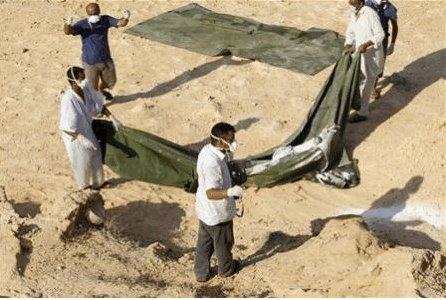
A mass grave site with up to 25 bodies has been found in Tawergha, west of Misrata.

Misrata prosecutors were able to direct police to the location in the Subkha area of Tawergha, after questioning an officer from the Qaddafi regime.

Hamed Malki,the media manager at the Ministry of Martyrs and Missing People told the Libya Herald that there were three graves and that six bodies has so far been exhumed by the ministry’s specialist researchers.

Their initial finding showed that the corpses they were unearthing were handcuffed and wore either military or civilian clothing. It is not yet known, said Malki, if the dead were rebels, Qaddafi’s troops or civilians. However the team believes that one mass grave contains four members of the same family.

The exhumation has required official permission from the Attorney-General. Once all the remains have been recovered, the ministry’s specialists will start work matching the DNA of the corpses with the 12,000 samples they have collected from living relatives of people who went missing during the revolution.

Where matches are made,the Attorney-General will authorise the handover of the bodies to their families. The ministry runs a cemetery at Beer Usta Milad, east of Tripoli, which is given over to the burial of victims of the conflict.

Thursday 16 May 2013

http://www.libyaherald.com/2013/05/15/mass-grave-unearthed-at-tawergha/

continue reading

Saturday, 4 May 2013

Libya: 11 bodies recovered in mass grave are buried


11 bodies that were discovered in a mass grave between Ras Lanuf and Brega by a research team from the Ministry of Assistance to Families of Martyrs and Missing Persons, have been put to rest this weekend.

The Ministry’s Director Hamad Al-Maliki told the Libyan News Agency that the information obtained by the research team lead to legal procedures, and forensic reports to confirm the identification of the bodies.

Three of the bodies were buried on Friday, while the rest will be buried on Saturday at a graveyard in Ajdabiya.

Last month, the Korean government presented tools, equipment and vehicles to the Ministry of Assistance to Families of Martyrs and Missing Persons, to assist the search and identification of missing persons. The project was proposed by the Libyan government in 2011, and a memorandum of understanding for its implementation was signed by representatives of both governments in December of 2012.

Saturday 4 May 2013

http://libya.tv/en/11-bodies-found-between-ras-lanuf-and-brega/?utm_source=rss&utm_medium=rss&utm_campaign=11-bodies-found-between-ras-lanuf-and-brega

continue reading

Wednesday, 1 May 2013

Libya: IDing War Victims


For most of 2011, Libya was in the midst of a bloody civil war. The conflict ended that October after the murder of longtime leader Muammar Gaddafi. Now, as many as tens of thousands of citizens are missing. Mass graves containing dozens or even hundreds of bodies have already been unearthed, and many missing people are yet to be found.

“Exhuming the mass graves and collecting the samples from the unknown bodies will depend on the reports [that] inform us [about] the place of these graves, because the previous regime tried to hide the crimes,” says forensic geneticist Esam Zreg, director of the Technical Department of Missing Persons in Libya’s Ministry for the Affairs of the Families of the Martyrs & Missing (MAFMM). “Sometimes [Gaddafi loyalists would] execute people and bury them in secret places.”

In an attempt to bring closure to the tens of thousands of grieving families in the country, Zreg and collaborators at MAFMM, founded in December 2011 by the National Transitional Council of Libya, are launching a massive sampling and sequencing effort. A DNA lab is currently under construction in Zreg’s building in Tripoli, that will house state-of-the-art sequencing equipment. Libyan scientists will travel to various countries for training in modern DNA forensics techniques, then return home to process hundreds of thousands of tissue samples from unidentified human remains and family members of the missing over the next decade.

Zreg and his colleagues consulted with the International Committee of the Red Cross and the International Commission on Missing Persons, along with other support organizations, and came up with a two-part plan of action. One part of the mission is to collect blood samples from three to five different relatives for each missing person in order to build a database for identifying the missing. The second half is to extract and sequence DNA from human remains that are found, then scan the newly built database for matches.

“It’s a huge project,” says Kerstin Montelius, a geneticist at the National Board of Forensic Medicine in Sweden, who is not involved in the effort. “I do think it will take several years to be able to go through all the remains . . . but I think it’s doable.”

Zreg’s team received $2.5 million in funding from a Spain-based oil company called Repsol, and in January announced its partnership with global biotechnology tools company Life Technologies and the University of North Texas Health Science Center (UNTHSC), which in 2011 received a $3.5 million grant from Applied Biosciences (now part of Life Technologies) to establish a center to help countries throughout the world launch their own DNA databases. As the Libyan lab nears completion, Zreg and three other researchers will travel to Texas to train with Arthur Eisenberg, a veritable pioneer in DNA forensics and director of the UNTHSC Center for Human Identification. Eisenberg and his colleagues have put together a 2-week program to provide the Libyan researchers with training in “all of the techniques and methodologies to clean the skeletal remains, cut the remains to extract DNA, and then to amplify the DNA to detect the different genetic profiles,” Eisenberg says.

The UNTHSC group will also advise Zreg and the others on some of the common challenges of DNA forensics work. For example, “the samples for the human remains are old,” says UNTHSC forensic geneticist Jianye Ge, who will help train the Libya scientists, “so it may not be easy to get good results” from them. To increase the likelihood of making a high-confidence identification, “I would recommend the Libyan guys sequence the mitochondrial DNA, especially for the bones,” he says. “For each cell we have, we only have one copy of nuclear DNA, but for the mitochondrial DNA, one cell has several hundreds of copies.”

For now, Zreg and his teams are busy sampling living and deceased Libyans to build up a bank of samples ready to be processed as soon as the lab is complete. Zreg’s teams began sampling family members of the missing in March 2012, and by December had more than 10,000 samples banked. They hope to have completed this part of the mission by the end of 2013.

The teams have also begun the collection of samples from the deceased, having exhumed more than 400 bodies to date. Though there is no way to know for sure how many bodies remain to be found, “we have an expectation that there will be around 20,000 bodies,” says Zreg, who lost a close friend during the national upheaval. “We expect a gap of time, like 10 years, for this file to be solved. . . . We have to be patient for this, and it will not be easy.”

Wednesday 1 May 2013

http://www.the-scientist.com/?articles.view/articleNo/35246/title/IDing-War-Victims/

continue reading

Tuesday, 26 March 2013

Bodies in Qaddafi’s secret morgue identified


Two of the corpses kept in the secret morgue in Shara Zawia Hospital since 1984 have been identified as those of Hadi Masoud Umrani from Zwara and Azhari Saleh Mohamed Al-Megrahi from Tripoli’s Bab Ben-Ghashir district. They were identified through the use of DNA samples.

The identification was announced yesterday, Sunday, by the Ministry of the Martyrs and the Missing.

According to the Ministry’s press office director, Hamad Al-Malki, the next of kin have already been informed by the Ministry’s Undersecretary, Mohamed Sidi Ibrahim, and a report of the procedures taken been forwarded to the Attorney General. The latter is expected to now give the permission for the bodies to be handed over for burial.

The secret mortuary was discovered on 30 August 2011, shortly after the liberation of Tripoli. The colonel in charge of security for the hospital told revolutionaries that it contained the bodies of those who had been hanged for their part in the audacious but abortive attack on Qaddafi’s Bab al Aziziya barracks in 1984, organised by the National Front for the Salvation of Libya.

Sixteen bodies were kept on ice in the morgue on Qaddafi’s orders for the next 27 years. In that time they became unrecognisable, dried out and blacked over time.

The Ministry has appealed to people to contact it and report their missing relatives and give DNA samples to facilitate the identification of the remaining nine unidentified bodies found in Shara Zawia Hospital.

Monday 26 March 2013

http://www.libyaherald.com/2013/03/25/bodies-in-qaddafis-secret-morgue-identified/

continue reading

Thursday, 21 March 2013

New mass grave found near Sirte


A grave reportedly containing six bodies has been found in Nufaliyah, between Ras Lanuf and Sirte.

The bodies, discovered close to the main road on Tuesday by members of the Libya Shield Battalion, Second Force, in cooperation with the Libya Shield of Ajdabiya, are thought to be those of revolutionaries.

The Assistant Commander of the Libya Shield, Second Force, Mohamed Hamad Aribi, was reorted by the Libyan news agency LANA as saying that the bodies were discovered with the legs tied and that they may have been buried alive.

A similar grave with seven bodies was found nearby last May.

Wednesday 20 March 2013

http://www.libyaherald.com/2013/03/20/new-mass-grave-found-near-sirte/

continue reading

Tuesday, 19 March 2013

Lawyers learn the power of forensics


Lawyers, including judges and prosecutors, are being taught how forensic evidence can be used in cases involving political violence.

Some 50 advocates are learning about a range of forensic skills, including techniques for surveying and excavating mass graves and recovering human remains, as well as analysing and identifying them. The course will also look at the preparation of reports and ways of presenting forensic evidence in court.

The five-day event is being run at the Ministry of Justice by the Argentine Forensic Anthropology Team (EAAF). This is an NGO that was set up in Argentina in 1984 to deal with some 30,000 cases of missing persons, the South American country’s legacy from six dictators. EAAF has also worked in Columbia and Mexico.

“Physical evidence is very important in cases of political crimes,” Luis Fondebrider from EAAF told the Libya Herald, “because people lie, and people forget.”

Forensic skills are particularly useful when looking into crimes committed a long time ago. “Identifying skeletons is much harder than actual bodies,” Fondebrider said, “so DNA has been playing an increasingly important role.”

Organised by the international NGO No Peace Without Justice (NPWJ) in cooperation with the Ministry of Justice, the training will also look at how to work with the families of missing persons.

“It is terrible for families not to know if someone is alive or dead, not to have a body or a grave,” Fondebrider said, “every family has the right to know what happened to a loved one.”

Tuesday 19 March 2013

http://www.libyaherald.com/2013/03/19/lawyers-learn-the-power-of-forensics/

continue reading

Tuesday, 6 March 2012

Libyans hold funerals for 163 from mass grave

Thousands of Libyans massed in the eastern city of Benghazi on Monday for the burial of 163 people whose bodies were found in a mass grave, an AFP journalist said.

The funeral comes a day after the bodies were transferred to Benghazi from the desert town of Bin Jawad, east of Sirte, where toppled dictator Muammar Gaddafi was captured and killed on October 20.

Mourners poured into Benghazi's Tahrir Square, cradle of the revolt that spread from east to west and eventually overthrew Kadhafi's regime, where they held prayers in remembrance of the fallen "martyrs."

Relatives demanded a quick trial for Gaddafi's son Seif al-Islam, who stood by his father and sought to squash the popular uprising with brute force. He is now in the custody of a militia made up of former rebel fighters.

"The revolutionaries of Zintan must hand over Seif al-Islam immediately" for trial, Mohammed al-Darnawy, who came to bury two of his brothers, told AFP.

The dead were honoured at the cemetery with copious floral wreaths and patriotic flags.

Omar Abdelkhalek Obeidi, a forensic expert and chairman of the committee on missing persons, said only 70 of the dead had been successfully identified.

He said the committee had obtained a fatwa from the Mufti, Sheikh al-Sadiq al-Gharyani, and permission from the attorney general, Abdelaziz al-Hassadi, to reopen the graves in the event of identification developments.

Obeidi said on Sunday the bodies were those of rebels killed between February and March 2011 in Brega, Ras Lanuf, Bin Jawad and on the outskirts of Sirte.

He added that some showed signs of having been executed.

The exhumation was carried out with the assistance of the United Nations and in cooperation with the ministry of martyrs, wounded and missing people.

By AFP
Published Tuesday, March 06, 2012

http://www.emirates247.com/news/region/libyans-hold-funerals-for-163-from-mass-grave-2012-03-06-1.446857

continue reading

Tuesday, 10 January 2012

Libyan plan to trace mass graves and missing people

As Libyans celebrate the fall of Muammar Gaddafi following his death last week, the country's transitional government has already set up a commission that it says will ensure the transparent and orderly exhumation and identification of bodies from mass graves.

"It will take a few months to work out the number of people missing," says Salim Al-Serjani, vice-president of the newly formed National Commission for Tracing and Identifying Missing Persons.

Speaking to New Scientist from Libya's capital Tripoli, he said that 4000 to 5000 people went missing during the 42 years of Gaddafi's dictatorship, on a crude estimate, and around 20,000 to 25,000 more are thought to have gone missing in the nine-month conflict that ended last week. "The old regime didn't like to give out any information, so it will take a while to know more exact figures," he said.
Outside help

Al-Serjani said that Libya's National Transitional Council has already been working with organisations such as the International Committee of the Red Cross to get Libyans trained to do exhumations properly. "We've already had people trained by outside experts on how to deal with mass graves to avoid misidentifications and collect and store ante-mortem data," he said. "We're training our team how to take and handle DNA samples from corpses, and how to take GPS readings for each new grave."

Al-Serjani also acknowledged the importance of leaving exhumations to experts and of not disturbing evidence vital for identification of remains, as urged last month by the Red Cross and the International Commission on Missing Persons in Sarajevo, Bosnia and Herzegovina, which was set up to investigate mass graves following the Balkan conflict of the 1990s. He said that the National Transitional Council has used radio bulletins and newspaper reports to urge former rebels not to disturb or despoil newly found graves.

Al-Serjani said that Libya's new commission for identifying missing persons would remain neutral on the subject of criminal prosecutions, leaving investigations of possible war crimes to international bodies such as Human Rights Watch. The reason: to ensure justice for the dead on all sides of the conflict. For example, the bodies of 53 executed Gaddafi supporters have been discovered in Sirte. "Regarding criminal justice and human rights, we're trying to be neutral," Al-Serjani says. "The idea is that we are completely transparent."

So far, the largest mass grave identified contains an estimated 1270 bodies close to the Abu Salim prison in Tripoli. Inmates protesting about prison conditions were massacred there in June 1996, according to Human Rights Watch. The Red Cross has helped in the orderly identification of 125 buried victims of the recent fighting from 12 locations around the country.

Soaade Messoudi, a spokeswoman in Tripoli for the International Committee of the Red Cross, told New Scientist that the organisation has set up a confidential database to accept reports from family members of mass graves, missing people, arrests and detentions.
Crime scenes

Outside observers, including the International Commission on Missing Persons, say it's important to record any information from mass graves that might later be useful as evidence in criminal investigations.

"Each site should be treated as if it's a crime scene, and you must presume there might be criminal investigations in the future," says Ian Hanson, a forensic archaeologist at Bournemouth University, UK, and a veteran adviser on the exhumation procedures that followed the Balkan and Iraq conflicts.

Hanson says that creation 15 years ago of the International Commission on Missing Persons in the Balkans was the first systematic effort to document evidence from mass graves properly and identify remains. So far, about 17,000 bodies have been identified of the estimated 30,000 who went missing during the Balkan conflict, mainly in Bosnia and Herzegovina. Around 20,000 bone samples and 80,000 blood samples have been taken since 1996, he says.

In Iraq, where Hanson says at least 300,000 went missing during the rule of Saddam Hussein, a law was introduced in 2006 to protect mass graves. At present, around 2000 to 4000 Iraqi cases are being resolved each year, and Hanson says it will be decades before all the country's "missing" are identified.

This piece has been altered from an earlier version which mistakenly stated that the ICRC would make contents of its database available to the new authorities.

Updated 18:15 26 October 2011 by Andy Coghlan

http://www.newscientist.com/article/dn21086-libyan-plan-to-trace-mass-graves-and-missing-people.html

continue reading