Tuesday, 24 July 2012

Thirteen people killed in overloaded motorcycle crash

Thirteen people were killed and seven others injured when an overloaded three-wheel motorcycle crashed off a bridge in south-east China, state media said today.

The official Xinhua News Agency reported that the vehicle was travelling along a rural road in Fujian province when it fell off a stone bridge.

A man who works for the Shouning county news office, who would give only his family name Zhong, said the vehicle was overloaded with passengers - a common occurrence in rural areas where villagers have no other way to travel.

No other details were known on the crash. Serious road accidents are common in China where vehicles are not properly maintained and laws are often ignored.

Tuesday 24 July 2012

http://www.independent.co.uk/news/world/asia/thirteen-people-killed-in-overloaded-motorcycle-crash-7972480.html

continue reading

Clues sought in IDs of Texas pickup crash victims

Investigators continue the difficult task of trying to identify 14 suspected illegal immigrants who were killed when a pickup truck packed with nearly two dozen people crashed in South Texas during an apparent smuggling run.

They're also looking for clues about who else might have been involved in the operations. The men, women and children were carrying toothbrushes, toothpaste and changes of socks and underwear but no identifying documents.

Authorities said the white Ford F-250 was carrying 23 immigrants from Mexico, Honduras and Guatemala when it veered off a highway and crashed into trees Sunday night.

The crash happened on a highway about 90 miles southeast of San Antonio and about 150 miles northeast of the Mexican border.

Officials said at least 23 passengers were crammed inside the truck's cab and bed, including at least two young children.

Tuesday 24 July 2012

Read more: http://billingsgazette.com/news/national/article_ac419954-0046-5aa4-980b-122329502d8a.html#ixzz21Wlg85US

continue reading

Rain storms kill at least 37 in Beijing

BEIJING: Officials have raised the death toll to at least 37 in the heaviest rainstorm to hit Beijing in six decades, and dozens of other storm deaths have been reported elsewhere in China.

The rain Saturday night knocked down trees in Beijing and trapped cars and buses in waist-deep water in some areas.

A statement from the city government late Sunday said 25 people drowned, six were killed when houses collapsed, one was hit by lightning and five were electrocuted by fallen power lines.

The official China Daily newspaper reported Monday that rain and flooding caused damages of at least 10 billion yuan ($1.6 billion), with 60,000 people evacuated from their homes.

The official Globe Times said Monday that it was the heaviest rainstorm in the capital in 61 years. It was the heaviest on record in Fangshan district in the southwest of the city, which received 460 millimeters (18.4 inches) of rain Saturday, according to the weather bureau.

The agency also said suburban Pinggu district got 100.3 millimeters (4 inches) of rain in one hour. A flash flood in Fangshan stranded 104 primary school students and nine teachers at a military training site, Xinhua said.

They were taken to safety. Elsewhere, six people were killed by rain-triggered landslides in Sichuan province in the west, Xinhua News Agency said, citing disaster officials.

Four people died in Shanxi province in the north when their truck was swept away by a rain-swollen river.

In neighboring Shaanxi province, state media said at least eight people died and 17 were missing after heavy rains hit.

China suffers flooding and dozens of storm-related deaths every summer during its rainy season, but such a heavy downpour in relatively dry Beijing is unusual.

The capital's skies were clear Monday, with traffic back to normal. The city's main airport was operating normally after hundreds of flights were canceled or delayed over the weekend.

Tuesday 24 July 2012

http://www.thehimalayantimes.com/fullNews.php?headline=Rain+storms+kill+at+least+37+in+Beijing&NewsID=340614

continue reading

Flooding in central Nigeria's Jos kills at least 35

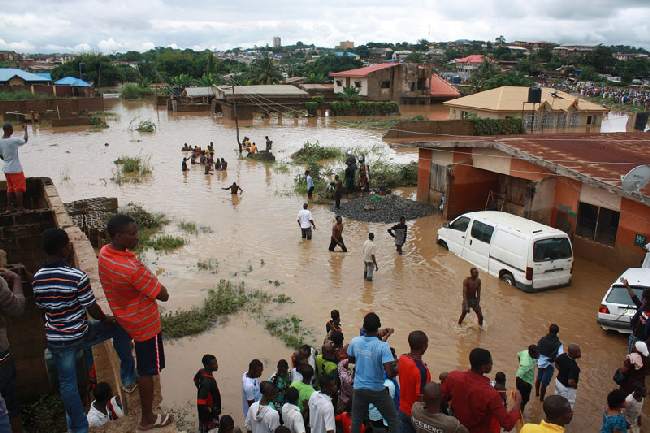
Heavy rainfall in central Nigeria forced a dam to overflow, causing flooding that left at least 35 people dead and destroyed or damaged some 200 homes, the Red Cross said Monday.

"We have recovered the bodies of 35 people that drowned in the overnight flooding," said Manasie Phampe, head of the Red Cross in Plateau state, where Jos is the capital. "About 200 homes have either been submerged or destroyed."

The confirmed victims so far included a 90-year-old woman and a three-month-old baby, adding that the toll could rise, he said. "Rainwater and water from the Lamingo dam which overflowed swept across several neighbourhoods in the city," he explained. "We are still searching for more bodies as many people have been declared missing."

The downpour in Jos began at roughly 9:00 pm (2000 GMT) Sunday when many of the city's residents were at home for the night. "I have lost seven of my children in this disaster," said Alhaji Abdulhamid Useini, who described heavy rain pounding his neighbourhood for nearly three hours, which also swept away some of his livestock.

The area coordinator for the National Emergency Agency (NEMA), Alhassan Danjuma Aliyu, called the flood "devastating" and said police and other rescue bodies were searching the affected areas in hopes of finding survivors.

NEMA was also trying to quickly bring in added relief materials to care for those who lost their homes, Aliyu explained. "We hope to get these materials to them before the end of today," he said.

The head of search and rescue committee of the Muslim community in Jos, Sani Shuaibu, said the search was still on for 25 bodies still missing. "We are still looking for 25 other bodies that are still missing and the figure of the missing may rise as families come forward to register their missing family members," he said. "Most of the dead were children between three months and 13 years that were swept away by the flooding in their sleep. We picked the drowned along the river bank... We have two camps where around 700 displaced people are sheltering with little food and water supplies."

Much of the country has been affected by heavy seasonal rainfall, including Jos in the centre of the country and the economic capital Lagos in the south, where flooding has caused several road closures and other damage.

The rainy season typically runs from March to September. Last week, at least three people were killed by flood waters some 150 kilometres (90 miles) north of Lagos in Ibadan, an area where 102 people died following torrential rains last year.

At least 20 people died from flooding in Lagos last year, while 24 were killed after rains inundated a neighbourhood in Nigeria's largest northern city of Kano.

Nigerian papers have in recent weeks been filled with commentary criticising officials for failing to put in place measures to mitigate the impact of the annual, often severe floods.

The largest cities in Nigeria, Africa's most populous nation, are overcrowded, with many residents living in haphazardly constructed slums. Drainage systems are also often poorly maintained and contribute to the problem of floods.

In 2010, flooding affected roughly half a million people in two-thirds of Nigeria's 36 states.

Tuesday 24 July 2012

http://www.newvision.co.ug/news/633318-flooding-in-central-nigeria-s-jos-kills-at-least-35.html

continue reading

Monday, 23 July 2012

Disaster drones: How robot teams can help in a crisis

An ominous plume of black smoke hangs over east London. The scarcely believable news arrives in snippets: A huge blast has rocked the Thames Barrier; a surge of water is ploughing through the city; a sports stadium has collapsed; more explosions are reported on Twitter.

 Thousands of people are trying to evacuate, but like the banks of the Thames, the mobile networks are overwhelmed. It is time to send in the drones.

 Professor Nick Jennings prefers to call them unmanned aerial vehicles (UAVs). He is one of the chief scientific advisers to the government, and drew up this fictional scenario as part of his multi-million pound Orchid research project. 

Prof Jennings believes the key to mastering the pandemonium that follows large-scale disasters lies in intelligent, co-ordinated action between man and machine.

 Prof Nick Jennings heads the Agents, Interaction and Complexity Group at Southampton University The system he is testing will be ready next year, and will allow teams of drones to help emergency services from the air with minimal human supervision.

It is yet another non-military spin-off in the burgeoning field of drone technology. After studying real disasters like the Haiti earthquake of 2010, Prof Jennings realised that the key to successful disaster response - amidst all the chaos - is the intelligent allocation of tasks and resources, and humans on the ground are not always best placed to make those life and death decisions. "Humans can do things like fill in maps based on what they see, starting from a blank map, which is exactly what happened in Haiti. What buildings are damaged, where facilities are, that kind of basic crowd-sourcing already happens," says Prof Jennings. Aerial view of Haiti after the earthquake: Relief agencies currently fill out physical maps "But we want to augment that with autonomous flying vehicles that are able to get a view of the bigger picture on the ground, to improve situational awareness.

They can figure out where the disaster responders should go, where the resources should go." In his proposed system, UAVs will be launched immediately to monitor the unfolding disaster from the air. They will provide real-time footage to disaster responders on the ground, who can request specific information from the drones using hand-held electronic devices. They might ask, for example, 'how stable is this building's roof?' before entering to look for victims. "We could also have robots on the ground, that would go into areas too dangerous for humans," says Prof Jennings.

Handheld devices similar to this model (showing three screenshots) allow first responders to allocate tasks to drones, view live overhead video feeds from them, and mark tasks as completed, all on one shared platform.

His team is looking at ways that information from members of the public sent by smartphones could be integrated into this system. 


Research into non-military applications for drone technology is a booming area, with companies vying to find commercial applications. 


From their origins as expensive pieces of military hardware, the price of drones themselves has fallen dramatically, to the point where they are even within the budget of the hobbyist. 


Private individuals are adapting these drones, which are capable of programmable flight paths, for their own uses, including everything from wildlife surveillance to farm management. 

BAE Systems recently unveiled its research into technology that could allow pilot-less planes to fly in UK airspace, potentially for operations like border control and search and rescue. 


But what makes Prof Jennings's research stand out is that he is interested in allowing drones to fly as squadrons, improvising their own flight paths as a unit in response to new information, without human intervention. 

The teams of drones that will patrol a disaster have already been tested extensively in Sydney, Australia. 


Algorithms dictate the co-ordinated movement of the drones as they respond to requests from humans. Tests take place in Australia rather than the UK because of airspace restrictions. 

The drones he uses are in fact Mikrocopter Hexacopters, which have six rotary blades and are just under a metre in width. "The underlying research is based on aspects of artificial intelligence, getting software to do clever things, and underpinning that is a form of mathematics", explains Prof Jennings.

During tests, the drones are flown as a unit and allocated multiple tasks from the ground. What is in fact being tested on site is the mathematical algorithms that control the drones' joint movement.


If successful, these algorithms will direct the drones so that they are in the optimal position to collect information requests from humans and distribute them back to the ground. 

A poster in Prof Jennings' lab explains how a team of drones interacts with ground crew 'Decentralised coordination algorithms' are intelligent enough to deal with out of sync data requests, lost data, and can even predict where future requests will come from.

They allow the drones to communicate between each other and work effectively as a team.

The algorithms themselves have already been tested on computer software, like RoboCup Rescue Simulator, that simulates human catastrophes with mock ups of people fleeing towns and cities. "The next stage," says Prof Jennings, "is to run some mock disasters in open spaces, and have individual human actors in there, interacting with the robots, doing it for real." This is scheduled to take place in October. 

A fully operational system is said to be 18 months away. Several police forces are already interested, Pof Jennings says, and he hopes both governments and NGOs will take up the technology.

So if in the future you are unfortunate enough to find yourself caught up in a terrorist attack or natural disaster and see a robot hovering above your head, take heart - help may be closer than you think.

 Monday 23 July 2012

 http://www.bbc.com/news/technology-18581883

continue reading

Zanzibar says 145 people were killed in ferry disaster last week

DAR ES SALAAM (Reuters) – Authorities in Zanzibar said on Sunday that 145 people had been killed in last week’s ferry disaster in the Indian Ocean, a day after the operation to find survivors was called off.

The overcrowded MV Skagit/Kalama, which had also been carrying some foreigners, was en route to Zanzibar, a popular tourist destination, from mainland Tanzania last Wednesday when it capsized and sank. “We have recovered five more bodies today, bringing the total number of bodies found so far to 73.

The ferry had 290 people onboard and 145 were rescued, which means that 72 people are still unaccounted for,” Mohammed Mhina, a spokesman for Zanzibar police, told Reuters. “It has now been four days since the ferry capsized – it’s impossible to find any more survivors.

Those who are still missing are presumed dead, so the ongoing operation is for the recovery of bodies rather than a search for survivors.” Police said they had arrested six suspects on Sunday as part of an investigation into the ferry disaster. “The owner of the boat, Saidi Abdulrahman, and the captain of the vessel who survived the accident, Mussa Makame Mussa, and four other crew members have been arrested,” said Mhina. “Investigations into the cause of the accident are still proceeding and the suspects will be taken to court if found with a criminal case to answer.”

On Friday, riot police clashed with supporters of a separatist Islamist group in Zanzibar who had gathered at a mosque to pray for victims of the disaster.

Police said they had arrested 43 members of the Uamsho (Awakening) group following the violence. Some of the victims’ relatives have vented anger at the authorities for what they say were lax safety regulations which did not appear to have been improved since last September when more than 200 people were killed in another ferry accident in what was Zanzibar’s worst maritime disaster.

Monday 23 July 2012

http://in2eastafrica.net/zanzibar-says-145-people-were-killed-in-ferry-disaster-last-week/

continue reading

Saturday, 21 July 2012

18 die as bus plunges into gorge in India

A government official in India says 18 people are dead after a bus fell into a deep gorge after being hit by hurtling boulders during a landslide in the mountainous northeast. Another 17 people are injured.

Arunachal Pradesh state Transport Minister Zoram Sangliana says the bus plunged about 150 feet into the gorge early this morning near Keifang, a village 60 miles east of Aizawl, the state capital.

Monsoon rains triggered the landslide in the region.

Seventeen bodies were recovered and one injured person succumbed to injuries while being taken to nearby Saitual rural hospital after the bus met with the mishap at around 12.45am, police said.

Among the dead, nine persons, including two non-tribals, have been identified. Aizawl Superintendent of Police LR Dingliana Sailo said that except for two persons, all the other injured persons have been sent to Aizawl Civil Hospital for treatment.

India has the world's deadliest roads, with more than 110,000 people killed every year.

Most crashes are blamed on reckless driving, poorly maintained roads and aging vehicles.

Saturday 21 July 2012 


http://www.independent.co.uk/news/world/asia/18-die-as-bus-plunges-into-gorge-in-india-7963949.html


http://www.dnaindia.com/india/report_18-killed-17-injured-as-bus-falls-into-gorge-near-aizawl_1717881

continue reading

At least 21 killed, 29 injured in Mexico bus crash

A bus accident early Friday in the western Mexican state of Nayarit left 24 dead and 14 injured, authorities said.

The original casualty report spoke of 21 dead and 29 injured.

First responders initially counted 17 bodies, but discovered four additional victims when the bus was lifted, while three injured passengers died en route to the hospital, sources in the state Attorney General's Office said.

The accident occurred around 4:00 a.m. on a stretch of highway between the towns of Puente de Chapalilla and Tequepexpan, Nayarit government spokesman Sergio Caรฑedo told Efe.

The bus was carrying a group headed to the beach in the village of Rincon de Guayabitos when the predawn crash occurred, Omar Landazuri, a duty officer for the Nayarit State Civil Protection Service, told AFP. "The bus overturned and began to roll down a ravine, ejecting people along the way," Landazuri added, saying that many of the victims died from the battering they received.

Injured survivors were taken to three hospitals in Tepic, the capital of Nayarit. Residents of a community in Chihuahua pooled their resources to charter the bus for the beach excursion, Nayarit officials said.

Schools let out in Mexico two weeks ago and the country's highways are crowded with families en route to vacation spots.

Landazuri said the bus, owned by Golden Express Tours, had been rented by the group from the northwestern Chihuahua state for a trip to the Pacific coast.

Friday's crash brings the number of serious bus accidents in Mexico to four this year. In the most serious recent incident, on April 20, a truck smashed into a bus transporting farm workers in the eastern state of Veracruz, killing 43 people.

Around 24,000 people die from road accidents in Mexico each year, according to insurance companies -- a figure almost double the annual drug violence death toll.

Saturday 21 July 2012 

Read more: http://latino.foxnews.com/latino/news/2012/07/20/24-die-in-mexico-bus-crash/#ixzz21D5X1SRF

continue reading

Four dead, 36 injured in Egypt tour bus accident

Egypt’s official news agency says a bus crash in the south has killed four Egyptians and injured 35 others, including some tourists.

The state-run Middle East News Agency says the accident happened early Friday morning on a highway linking the Red Sea resort city of Hurghada with port of Ras Gharib in southeast Egypt.

The agency said that the bus, carrying about 40 passengers, was speeding and overturned, killing a mother and her two-year-old toddler along with two other men. Among the injured were three Germans and one Ukrainian.

Ambulances immediately transferred the injured to Hurghada Public Hospital, and some critical cases were then taken to Gouna Hospital and the Nile Hospital.

The governor of the Red Sea, Major General Mahmoud Assem, told state television that he asked doctors from the military hospital in Hurghada to help treat the injured.

Red Sea security head Major General Mostafa Bedair was notified, as was the Red Sea prosecution, which will begin investigations.

Assem requested that the head of prosecution in Hurghada take the testimony of the injured and give permission for the burial of the dead.

Road accidents are common in Egypt due to badly maintained roads and vehicles and poor enforcement of traffic laws.

Police estimate that road accidents kill about 6,000 people a year in Egypt, a nation of about 84 million. 

Saturday 21 July 2012

http://www.timesofisrael.com/egypt-speeding-us-overturns-killing-4-injuring-35/

continue reading

Friday, 20 July 2012

At least 68 dead in Zanzibar ferry disaster

STONE TOWN, Zanzibar - Rescue workers fought rough seas on Thursday to search for survivors after an overcrowded ferry sank near the Indian Ocean archipelago of Zanzibar, but hopes of finding people alive were slim.

At least 68 people were confirmed dead and 145 were rescued after the MV Skagit/Kalama capsized around midday on Wednesday near Chumbe island, west of Zanzibar.

The vessel had set sail from mainland Tanzania to the semi-autonomous archipelago, a popular tourist beach destination.

One U.S. citizen was among the dead. Hundreds of people gathered at the Maisara Grounds park near Zanzibar's historic Stone Town area on Thursday to identify bodies laid out in a tent.

Tatu Kwiyela, a 35-year-old woman from mainland Tanzania, survived the accident but her nine-month-old son died. "I was swept away by strong waves and lost my son, Saidi Jumanne. I tried to hang on to him but he disappeared into the sea," said Tatu, who managed to identify his remains.

Police said more than 10 foreign tourists, including a group of Dutch holidaymakers, were among the rescued passengers. "One of those killed in the ferry accident is an American citizen. The body has been recovered and is being preserved at a mortuary," Zanzibar police spokesman Mohammed Mhina said.

The ferry, with a maximum carrying capacity of 250 people according to Zanzibar marine authorities, was carrying 290 people, officials said. "Out of the 68 dead victims, 54 bodies have been identified so far by their relatives and taken for burial," Mhina said. "We will continue with the search and rescue operation tomorrow morning, although it is becoming increasingly difficult to find any survivors now."

There were at least 145 survivors. Rescue teams battled heavy winds and rough seas in their search effort.

Divers trying to pluck more bodies from the wreckage said they were not able to reach the vessel. "The sunken boat is below depths of 25 meters (82 ft) ... we tried to go as deep as we could but could not locate it," Ali Ramadhani, one of the divers, said. "All we've seen today are bodies floating in the sea. I don't think we are going to find anyone alive. The sea is very rough, it is difficult for anyone to survive in such conditions."

Some of the victims' relatives said they were angry at authorities for lax safety regulations, especially after more than 200 people were killed in a ferry accident in September in Zanzibar's worst maritime disaster. "The government has killed all these people. They must bring the owner of the boat to us," said Abdallah Sadick whose brother was among the missing passengers.

Zanzibar residents said passenger ships are notoriously overcrowded and there are few safety inspections.

Tanzanian President Jakaya Kikwete ordered an investigation into the incident and announced three days of national mourning.

Friday 20 July 2012

http://uk.news.yahoo.com/least-68-dead-zanzibar-ferry-disaster-185438820.html

continue reading

Thursday, 19 July 2012

ZAKA Disaster Victim Identification Team Boards Bombed Bulgaria Bus

Bulgarian authorities allowed members of Israelis ZAKA voluntary emergency response team that specialize in disaster victim identification, to board the bombed out bus, following the brutal terror attack on Israeli tourists that left 8 dead yesterday afternoon.

The ZAKA team will prepare the bodies of the victims for burial in Israel and search the bus for body parts that are to be buried with the dead according to Jewish law.

Shimi Grossman, a member of the ZAKA team said,”From the moment we landed in Burgas we have been working at the scene and the hospitals, we have full cooperation with local police.” “We are working to bring all bodies to Israel as soon as possible,” said Matti Goldstein, the leader of the ZAKA team.

Thursday 19 July 2012

http://www.algemeiner.com/2012/07/19/zaka-disaster-victim-identification-team-boards-bombed-bulgaria-bus-photos/

continue reading

More than 100 missing after Zanzibar ferry sinks

(Reuters) - Rescue workers fought rough seas on Thursday to search for more than 100 people missing after an overcrowded ferry sank near the Indian Ocean archipelago of Zanzibar, but hopes of finding survivors were slim.

At least 38 people, including an American citizen, were confirmed dead and 145 were rescued after the MV Skagit/Kalama passenger boat capsized on Wednesday around midday near Chumbe island, west of Zanzibar.

The vessel had set sail from mainland Tanzania to the semi-autonomous archipelago, a popular tourist beach destination.

Hundreds of people gathered at the Maisara Grounds park near Zanzibar's historic Stone Town area on Thursday to identify the bodies of victims laid out in a tent.

Tatu Kwiyela, a 35-year-old woman from mainland Tanzania, survived the accident, but lost her nine-month-old son. "I was swept away by strong waves and lost my son, Saidi Jumanne. I tried to hang on to him but he disappeared into the sea," said Tatu, who managed to identify his remains.

Police said more than 10 foreign tourists, including a group of Dutch holidaymakers, were among the rescued passengers. "One of those killed in the ferry accident is an American citizen.

The body has been recovered and is being preserved at a mortuary," Zanzibar police spokesman Mohammed Mhina said.

The ferry, with a maximum carrying capacity of 250 people according to Zanzibar marine authorities, was carrying 290 people, said officials. "We have recovered seven more bodies today, so the death toll has now risen to 38, with 145 survivors," Zanzibar Police Commissioner Mussa Ali Mussa told Reuters. "You can say it is not humanly possible to find anyone alive at this point. However, with God's grace the possibility is still there ... Sometimes you can find people alive after a month at sea, so we are not giving up all hope."

Police said rescue workers, who had suspended their search at nightfall, had resumed operations on Thursday to try to recover more bodies or rescue people who might have drifted from the ferry. "We have boats and a police helicopter looking for survivors, but they are battling with heavy winds and rough seas," said Mussa.

NO SAFETY REGULATIONS

Some of the victims' relatives said they were angry at authorities for lax marine safety regulations, especially after more than 200 people were killed in a ferry accident in September in the worst maritime disaster in the history of Zanzibar. "The government has killed all these people.

They must bring the owner of the boat to us," said Abdallah Sadick, adding his brother was among the missing passengers.

Zanzibar residents said ships plying the Unguja-Pemba route are notoriously overcrowded and there are few, or no, inspections to ensure their safety.

Tanzanian President Jakaya Kikwete ordered an investigation into the incident and announced three days of national mourning.

Thursday 19 July 2012

http://uk.reuters.com/article/2012/07/19/uk-tanzania-ferry-idUKBRE86I0N920120719

continue reading

Wednesday, 18 July 2012

Skin, bones and tissue for sale: How the dead are being used for grisly trade in human body parts

On Feb. 24, Ukrainian authorities made an alarming discovery: bones and other human tissues crammed into coolers in a grimy white minibus.

Investigators grew even more intrigued when they found, amid the body parts, envelopes stuffed with cash and autopsy results written in English.

What the security service had disrupted was not the work of a serial killer but part of an international pipeline of ingredients for medical and dental products that are routinely implanted into people around the world.

In their expose, the International Consortium of Investigative Journalists followed the trial of body parts back to the Ukraine, where many are harvested.

The seized documents suggested that the remains of dead Ukrainians were destined for a factory in Germany belonging to the subsidiary of a U.S. medical products company, Florida-based RTI Biologics.

RTI is one of a growing industry of companies that make profits by turning mortal remains into everything from dental implants to bladder slings to wrinkle cures.

The industry has flourished even as its practices have roused concerns about how tissues are obtained and how well grieving families and transplant patients are informed about the realities and risks of the business.

In the U.S. alone, the biggest market and the biggest supplier, an estimated two million products derived from human tissue are sold each year, a figure that has doubled over the past decade.

It is an industry that promotes treatments and products that literally allow the blind to see (through cornea transplants) and the lame to walk (by recycling tendons and ligaments for use in knee repairs).

It's also an industry fueled by powerful appetites for bottom-line profits and fresh human bodies. In the Ukraine, for example, the security service believes that bodies passing through a morgue in the Nikolaev district, the gritty shipbuilding region located near the Black Sea, may have been feeding the trade, leaving behind what investigators described as potentially dozens of “human sock puppets” - corpses stripped of their reusable parts.

Industry officials argue that such alleged abuses are rare, and that the industry operates safely and responsibly. For its part, RTI didn’t respond to repeated requests for comment or to a detailed list of questions provided a month before this publication.

In public statements the company says it 'honors the gift of tissue donation by treating the tissue with respect, by finding new ways to use the tissue to help patients and by helping as many patients as possible from each donation.' ‘Our Misfortune’

Despite its growth, the tissue trade has largely escaped public scrutiny. This is thanks in part to less-than-aggressive official oversight — and to popular appeal for the idea of allowing the dead to help the living survive and thrive.

An eight-month, 11-country investigation by the International Consortium of Investigative Journalists (ICIJ) has found, however, that the tissue industry’s good intentions sometimes are in conflict with the rush to make money from the dead. Inadequate safeguards are in place to ensure all tissue used by the industry is obtained legally and ethically, ICIJ discovered from hundreds of interviews and thousands of pages of public documents obtained through records requests in six countries. Despite concerns by doctors that the lightly regulated trade could allow diseased tissues to infect transplant recipients with hepatitis, HIV and other pathogens, authorities have done little to deal with the risks. In contrast to tightly-monitored systems for tracking intact organs such as hearts and lungs, authorities in the U.S. and many other countries have no way to accurately trace where recycled skin and other tissues come from and where they go.

At the same time, critics say, the tissue-donation system can deepen the pain of grieving families, keeping them in the dark or misleading them about what will happen to the bodies of their loved ones.

Those left behind, like the parents of 19-year-old Ukrainian Sergei Malish, who committed suicide in 2008, are left to cope with a grim reality. At Sergei’s funeral, his parents discovered deep cuts on his wrists. Yet they knew he had hanged himself. They later learned that his body parts had been recycled and shipped off as “anatomical material.” 'They make money with our misfortune,' Sergei’s father said.

Awkward silence

During the transformational journey tissue undergoes — from dead human to medical device — some patients don’t even know that they are the final destination. Doctors don’t always tell them that the products used in their breast reconstructions, penis implants and other procedures were reclaimed from the recently departed. Nor are authorities always aware of where tissues come from or where they go.

The lack of proper tracking means that by the time problems are discovered some of the manufactured goods can’t be found. When the U.S. Centers for Disease Control and Prevention assists in the recall of products made from potentially tainted tissues, transplant doctors frequently aren’t much help. 'Oftentimes there’s an awkward silence. They say: "We don’t know where it went",' said Dr. Matthew Kuehnert, the CDC’s director of blood and biologics. 'We have barcodes for our [breakfast] cereals, but we don’t have barcodes for our human tissues,' Kuehnert said. 'Every patient who has tissue implanted should know. It’s so obvious. It should be a basic patient right. It is not. That’s ridiculous.'

Since 2002 the U.S. Food and Drug Administration has documented at least 1,352 infections in the U.S. that followed human tissue transplants, according to an ICIJ analysis of FDA data. These infections were linked to the deaths of 40 people, the data shows. 'We have barcodes for our (breakfast) cereals, but we don’t have barcodes for our human tissues. Every patient... should know. It’s so obvious. It should be a basic patient right. It is not. That’s ridiculous.'

Dr. Matthew Kuehnert, the CDC’s director of blood and biologics One of the weaknesses of the tissue-monitoring system is the secrecy and complexity that comes with the cross-border exchange of body parts.

The Slovaks export cadaver parts to the Germans; the Germans export finished products to South Korea and the U.S.; the South Koreans to Mexico; the U.S. to more than 30 countries. Distributors of manufactured products can be found in the European Union, China, Canada, Thailand, India, South Africa, Brazil, Australia and New Zealand. Some are subsidiaries of multinational medical corporations.

The international nature of the industry, critics claim, makes it easy to move products from place to place without much scrutiny. 'If I buy something from Rwanda, then put a Belgian label on it, I can import it into the U.S. When you enter into the official system, everyone is so trusting,' said Dr. Martin Zizi, professor of neurophysiology at the Free University of Brussels. Once a product is in the European Union, it can be shipped to the U.S. with few questions asked. “They assume you’ve done the quality check," Zizi said. "We are more careful with fruit and vegetables than with body parts.”

Piece of the action Inside the marketplace for human tissue, the opportunities for profits are immense. A single, disease-free body can spin off cash flows of $80,000 to $200,000 for the various non-profit and for-profit players involved in recovering tissues and using them to manufacture medical and dental products, according to documents and experts in the field. It’s illegal in the U.S., as in most other countries, to buy or sell human tissue.

However, it’s permissible to pay service fees that ostensibly cover the costs of finding, storing and processing human tissues. Almost everyone gets a piece of the action. Ground-level body wranglers in the U.S. can get as much as $10,000 for each corpse they secure through their contacts at hospitals, mortuaries and morgues.

Funeral homes can act as middlemen to identify potential donors. Public hospitals can get paid for the use of tissue-recovery rooms. And medical products multinationals like RTI? They do well, too. Last year RTI earned $11.6 million in pretax profits on revenues of $169 million.

Phillip Guyett, who ran a tissue recovery business in several U.S. states before he was convicted of falsifying death records, said executives with companies that bought tissues from him treated him to $400 meals and swanky hotel stays. They promised: 'We can make you a rich man.' It got to the point, he said, that he began looking at the dead “with dollar signs attached to their parts.” Guyett never worked directly for RTI.

Smoked salmon

Human skin takes on the color of smoked salmon when it is professionally removed in rectangular shapes from a cadaver. A good yield is about six square feet. After being mashed up to remove moisture, some is destined to protect burn victims from life-threatening bacterial infections or, once further refined, for breast reconstructions after cancer.

The use of human tissue 'has really revolutionized what we can do in breast reconstruction surgery,' explains Dr. Ron Israeli, a plastic surgeon in Great Neck, N.Y. 'Since we started using it in about 2005, it’s really become a standard technique.' A significant number of recovered tissues are transformed into products whose shelf names give little clue to their actual origin.

They are used in the dental and beauty industries, for everything from plumping up lips to smoothing out wrinkles. Cadaver bone — harvested from the dead and replaced with PVC piping for burial — is sculpted like pieces of hardwood into screws and anchors for dozens of orthopedic and dental applications.

Or the bone is ground down and mixed with chemicals to form strong surgical glues that are advertised as being better than the artificial variety. 'At the basic level what we are doing to the body, it’s a very physical - and I imagine some would say a very grotesque - thing,' said Chris Truitt, a former RTI employee in Wisconsin. 'At the basic level what we are doing to the body, it’s a very physical — and I imagine some would say a very grotesque — thing,' said Chris Truitt, a former RTI employee in Wisconsin. 'We are pulling out arm bones. We are pulling out leg bones. We are cutting the chest open to pull the heart out to get at the valves. We are pulling veins out from the inside of skin.' Whole tendons, scrubbed cleaned and rendered safe for transplant, are used to return injured athletes to the field of play. There’s also a brisk trade in corneas, both within countries and internationally.

Because of the ban on selling the tissue itself, the U.S. companies that first commercialized the trade adopted the same methods as the blood collection business. The for-profit companies set up non-profit offshoots to collect the tissue — in much the same way the Red Cross collects blood that’s later turned into products by commercial entities.

Nobody charges for the tissue itself, which under normal circumstances is freely donated by the dead (via donor registries) or by their families. Rather, tissue banks and other organizations involved in the process receive ill-defined “reasonable payments” to compensate them for obtaining and handling the tissue. 'The common lingo is to talk about procurement from donors as "harvesting," and the subsequent transfers via the bone bank as "buying" and "selling",' wrote Klaus Hรธyer, from the University of Copenhagen’s Department of Public Health, who talked to industry officials, donors and recipients for an article published in the journal BioSocieties. 'These expressions were used freely in interviews; however, I did not hear this terminology used in front of patients.”

U.S.-government funded study of the families of U.S. tissue donors, published in 2010, indicates many may not understand the role that for-profit companies play in the tissue donation system. Seventy-three percent of families who took part in the study said it was “not acceptable for donated tissue to be bought and sold, for any purpose.” Few Protections Cadaver bone - harvested from the dead and replaced with PVC piping for burial - is sculpted like pieces of hardwood into screws and anchors for dozens of orthopedic and dental applications There is an inherent risk in transplanting human tissues.

Among other things, it has led to life-threatening bacterial infections, and the spread of HIV, Hepatitis C and rabies in tissue recipients, according to the CDC. Modern blood and organ collection is bar-coded and strongly regulated — reforms prompted by high-profile disasters that had been caused by the poor screening of donors.

Products made from skin and other tissues, however, have few specific laws of their own. In the U.S., the agency that regulates the industry is the Food and Drug Administration, the same agency that’s charged with protecting the nation’s food supply, medicines and cosmetics.

The FDA, which declined repeated requests for on-record interviews, has no authority over health care facilities that implant the material. And the agency doesn’t specifically track infections It does keep track of registered tissue banks, and sometimes conducts an inspection. It also has the power to shut them down.

The FDA largely relies on standards that are set by an industry body, the American Association of Tissue Banks (AATB). The association refused repeated requests over four months for on-record interviews. It told ICIJ during a background interview last week that the 'vast majority' of banks recovering traditional tissues such as skin and bone are accredited by the AATB.

  Yet an analysis of AATB accredited banks and FDA registration data shows about one third of tissue banks that recover traditional tissues such as skin and bone are accredited by the AATB. The association says the chance of contamination in patients is low.

Most products, the AATB says, undergo radiation and sterilization, rendering them safer than, say, organs that are transplanted into another human. 'Tissue is safe. It's incredibly safe,' an AATB executive said. There is little data, though, to back up the industry’s claims.

Unlike with other biologics regulated by the FDA, agency officials explain, firms that make medical products out of human tissues are required to report only the most serious adverse events they discover.

That means that if problems do arise, there’s no guarantee that authorities are told. And because doctors aren’t required to tell patients they’re getting tissue from a cadaver, many patients may not associate any later infection with the transplant.

On this point, the industry says it is able to track the products from the donors to the doctors, using their own coding systems, and that many hospitals have systems in place to track the tissues after they’re implanted.

But no centralized regional or global system assures products can be followed from donor to patient. “Probably very few people get infected, but we really don’t know because we don’t have surveillance and we don’t have a system for detecting adverse events,” the CDC’s Kuehnert said. The FDA recalled more than 60,000 tissue-derived products between 1994 and mid-2007.

The most famous recall came in 2005. It involved a company called Biomedical Tissue Services, which was run by a former dental surgeon, Michael Mastromarino. Mastromarino got many of his raw materials from undertakers in New York and Pennsylvania. He paid them up to $1,000 per body, court records show.

Dental surgeon Michael Mastromarino paid undertakers $1,000 so he could strip dead bodies of tissue, before returning them to their families His company stripped bodies of their bones, skin and other usable parts, then returned them to their families. The families, ignorant of what happened, buried or cremated the evidence.

One of more than 1,000 bodies that were dismembered was that of the famous BBC broadcaster and Masterpiece Theatre host Alistair Cooke. Products made from the stolen human remains were shipped to Canada, Turkey, South Korea, Switzerland and Australia.

More than 800 of those products have never been located. It later came out in court that some of the tissue donors had died from cancer and that none had been tested for pathogens like HIV and hepatitis.

Mastromarino falsified donor forms, lying about causes of death and other details. He sold skin and other tissues to several U.S. tissue-processing firms, including RTI. “From day one, everything was forged; everything, because we could. As long as the paperwork looked good, it was fine,” said Mastromarino, who is serving a 25-to-58-year prison sentence for conspiracy, theft and abuse of a corpse.

Global Sheriff Each country has its own set of regulations for the use of products made from human tissue, often based on laws that were originally intended to deal with blood or organs.

In practice, though, because the U.S. supplies an estimated two-thirds of the world’s human-tissue-product needs, the FDA has effectively been left to act as sheriff for much of the planet.

Foreign tissue establishments that wish to export products to the U.S. are required to register with the FDA. Yet of the 340 foreign tissue establishments registered with the FDA, only about 7 percent have an inspection record in the FDA database, an ICIJ analysis shows.

The FDA has never shut one down due to concern over illicit activities. The data also shows that about 35 percent of active registered U.S. tissue banks have no inspection record in the FDA database. 'When the FDA registers you, all you have to do is fill out a form and wait for an inspection,' said Dr. Duke Kasprisin, the medical director for seven U.S. tissue banks. 'For the first year or two you can function without having anyone look at you.'

This is backed by the data, which show the typical tissue bank operates for nearly two years before its first FDA inspection. 'The problem is there is no oversight. The FDA, all they require is that you have a registration,' said Craig Allred, an attorney previously involved in litigation against the industry. 'Nobody is watching what is going on.' The FDA and industry players 'all point the finger at each other.'

Yet in South Korea, for example, the booming plastic surgery market uses FDA oversight as a selling point. In downtown Seoul, the country’s capital, Tiara Plastic Surgery explains that human tissue products 'are FDA-approved' and are therefore safe.

Some medical centers advertise “FDA-approved AlloDerm” — a skin graft made from donated American cadavers — for nose enhancement. Le Do-han, the official in charge of human tissue for the South Korean FDA, said the country imports 90 percent of its human-tissue needs.

Raw tissue is shipped in from the U.S. and Germany. This tissue, once processed, is often re-exported to Mexico as manufactured goods.

Despite the complicated movements back and forth, Le Do-han acknowledges that proper tracking hasn’t been put in place. 'It is like putting tags on beef, but I don’t even know if that is possible for human tissues because there are so many coming in.'

Teaming Up

In its U.S. Securities and Exchange Commission filings, publicly traded RTI provides a glimpse of the company’s size and global reach. In 2011, the company manufactured 500,000 to 600,000 implants and launched 19 new kinds of implants in sports medicine, orthopedics and other areas.

Ninety percent of the company’s implants are made from human tissue, while 10 percent come from cows and pigs processed at its German facility. RTI requires its human body parts suppliers in the U.S. and other nations to follow FDA regulations, but the company acknowledges there are no guarantees.

In 2011 securities filings, RTI said there “can be no assurances” that “our tissue suppliers will comply with such regulations intended to prevent communicable disease transmission” or “even if such compliance is achieved, that our implants have not been or will not be associated with transmission of disease.”

Like many of today’s for-profit tissue companies that were once non-profits, RTI broke away from the non-profit University of Florida Tissue Bank in 1998. Internal company files from Tutogen, a Germany medical products company, show that RTI teamed up with Tutogen as early as September 1999 to help both companies meet their growing needs for raw material by obtaining human tissue from Eastern Europe.

The companies both obtained tissue from the Czech Republic. Tutogen separately obtained tissues from Estonia, Hungary, Russia, Latvia, Ukraine, and later Slovakia, documents show. In 2002, allegations surfaced in the Czech media that the local supplier to RTI and Tutogen was obtaining some tissues there improperly.

Though there is no suggestion that Tutogen or RTI or its employees did anything improper. In March 2003, police in Latvia investigated whether Tutogen’s local supplier had removed tissue from about 400 bodies at a state forensic medical institute without proper consent.

Wood and fabrics, replacing muscle and bone, were put into the deceased to make it look like they were untouched before burial, local media reported. Police eventually charged three employees of the supplier, but later dismissed the charges when a court ruled that no consent from donors’ families was necessary. Again, there was no suggestion Tutogen acted improperly.

In 2005, Ukrainian police launched the first of a series of investigations into the activities of Tutogen’s suppliers in that country. The initial investigation did not lead to criminal charges. The relationship between Tutogen and RTI, meanwhile, became even closer in late 2007, when they announced a merger between the two companies.

Tutogen became a subsidiary of RTI in early 2008. Officials at RTI declined to answer questions from ICIJ about whether it knew about police investigations of Tutogen’s suppliers. Two Ribs In 2008 Ukrainian police launched a new investigation, looking into allegations that more than 1,000 tissues a month were being illegally recovered at a forensic medical institute at Krivoy Rog and sent, via a third party, to Tutogen.

Joseph Dรผsel, the Chief Prosecutor in Bamberg, said in 2009 that "what the company is doing is approved by the administrative authority by which it is also monitored. We do not currently see any reason to initiate investigation proceedings." Nataliya Grishenko, the judge prosecuting the case, revealed during subsequent court proceedings that many relatives claimed they’d been tricked into signing consent forms or that their signatures had been forged. However, the main suspect in the case — a Ukrainian doctor — died before the court could deliver a verdict.

The case died with him. Tutogen 'operates under very strict regulations from German and Ukrainian authorities as well as other European and American regulatory authorities,' the company said in a statement while the case was still pending. 'They have been inspected regularly by all of these authorities over their many years of operation, and Tutogen remains in good standing with all of them.' Seventeen of Tutogen’s Ukrainian suppliers have undergone an FDA inspection.

The inspections are announced, according to protocol, six to eight weeks in advance. Only one — BioImplant in Kiev — received negative feedback. Among the findings of the 2009 inspection: not all morgues could rely on hot running water and some sanitation procedures were not followed. FDA inspectors also identified deficiencies with RTI's Ukrainian imports when it visited the company's facilities in Florida.

RTI had English translations, but not original autopsy reports, from its Ukrainian donors, FDA inspectors found during a 2010 audit. Those were often the only medical documents the company used to determine whether the donor was healthy, inspectors noted in their report. Security services footage shows harvested human tissues in Ukraine labeled "Made in Germany".

The company told inspectors it was illegal under Ukrainian law to copy the report. But following the inspection it began maintaining the original Russian-language document along with its English translation. In 2010 and 2011, FDA inspectors asked RTI to change how it labeled its imports.

The company was obtaining Ukrainian tissue, shipping it to Tutogen in Germany, then exporting it to the U.S. as a product of Germany. While the company agreed to change its policies, there is some indication that it may have continued labeling some Ukrainian tissue as German.

This past February, Ukrainian security services launched a raid as officials at a regional forensic bureau in Nikolaev Oblast were loading harvested human tissues into the back of a white minibus. Footage of the seizure shows tissue labeled 'Tutogen. Made in Germany.'

In this case, the security service said forensic officials had tricked relatives of the dead patients into agreeing to what they thought was a small amount of tissue harvesting by playing on their pain and grief. Seized documents — blood tests, an autopsy report and labels written in English and obtained by ICIJ — suggested the remains were on their way to Tutogen.

Some of the tissue fragments found on the bus came from 35-year-old Oleksandr Frolov, who had died from an epileptic seizure. 'On the way to the cemetery, when we were in the hearse, one of his feet — we noticed that one of the shoes slipped off his foot, which seemed to be hanging loose,' his mother, Lubov Frolova, told ICIJ. 'When my daughter-in-law touched it, she said that his foot was empty.'

Later, the police showed her a list of what had been taken from her son’s body. 'Two ribs, two Achilles heels, two elbows, two eardrums, two teeth, and so on. I couldn’t read it till the end, as I felt sick. I couldn’t read it,' she said. 'I heard that [the tissues] were shipped to Germany to be used for the plastic surgeries and also for donation.

I have nothing against donation, but it should be done according to the law.' Kateryna Rahulina, whose 52-year-old mother, Olha Dynnyk, died in September 2011, was shown documents by investigating police.

The documents purported to give her approval for tissue to be taken from her mother’s body. 'I was in shock,' Rahulina said. She never signed the papers, she said, and it was clear to her that someone had forged her approval.

The forensic bureau in Nikolaev Oblast, where the alleged incidents happened, was, until recently, one of 20 Ukrainian tissue banks registered by the FDA.

On the FDA’s website the phone number for each of the tissue banks is the same. It is Tutogen’s phone number in Germany.

Wednesday 18 July 2012

Read more: http://www.dailymail.co.uk/news/article-2175006/Skin-bones-tissue-sale-How-dead-used-grisly-trade-human-body-parts.html#ixzz20yf0xgWS

continue reading

Death toll rises to 10 in Brazil bus accident

The death toll from the bus accident in the southern Brazilian state of Parana has risen to at least 10, with 26 other people injured, the highway patrol said.

The bus went off a highway Monday after hitting a truck and plunged into a ravine near Pirai do Sul, a city in Parana. The bus was traveling from Belem, a city in Para state, to Curitiba, the capital of Parana.

The bus was carrying 52 passengers, who rented the vehicle to take them to an information technology conference that starts on Tuesday in Curitiba, media reports said.

Wednesday 18 July 2012

Read more: http://latino.foxnews.com/latino/news/2012/07/17/death-toll-rises-to-10-in-brazil-bus-accident/#ixzz20xkZKikb

continue reading

Nine passengers die in a bus crash near Kahuta

At least nine passengers perished in yet another road accident near Kahuta on Tuesday morning when a bus fell into a ditch, the third major accident during the last two months in the same area.

The bus (LXU-9350) with 52 passengers on board fell into a ditch near Punjaar village on the Kahuta-Rawalpindi road at about 8:45am.

According to details, the bus carrying a marriage party from Kahuta to Chakwal fell into ravine while taking a sharp turn

The bus was coming from Narr village to Rawalpindi and the driver could not slow down the bus after its brakes failed, said Muhammad Aziz, one of the 43 passengers injured in the accident.

The bus fell into a 30-meter-deep ditch before rolling over multiple times, said Aziz, who had injuries on his head and arms.

The rescue work was hampered due the darkness and difficult mountain terrain.

Of the total injured, 13 were discharged from Kahuta Tehsil Headquarters Hospital (THQ) after providing first aid and 30 others were shifted to different hospitals in Rawalpindi and Islamabad.

City Police Officer (CPO) Azhar Hameed Khokher said that according to initial reports, the cause of the accident was speeding.

Further investigations are underway, the CPO added. The Kahuta Police Station House Officer (SHO) Raja Salim said a case has been registered against Muhammad Zubair, the driver, who also sustained injuries and is under treatment in a hospital.

On June 3, a bus going to Chakwal from Kahuta with a wedding party on board fell in a ditch near the area, killing 25 passengers.

The driver was arrested and a criminal case was registered against him for death caused by rash driving.

So far, the area police have not gotten the motor vehicle examiner’s report on that incident to establish what caused the bus to go off the road.

In another accident on June 4, a jeep carrying 10 people and en route to Kahuta from Sanohri village plunged into a deep ditch in the area, killing all on board.

Wednesday 18 July 2012

http://tribune.com.pk/story/409721/dangerous-driving-nine-passengers-die-in-a-bus-crash-near-kahuta/

continue reading

Trishuli bus plunge: 11 missing

At least 11 persons went missing in Monday’s bus crash at Krishnabhir along Prithvi Highway, Dhading. A total of 16 people were killed and 15 others injured when the bus plunged into the Trishuli river.

The Area Police Office, Gajuri, confirmed that 11 other passengers have been feared dead in the accident.

“As per their documents and belongings, we have confirmed that at least 11 others have gone missing in Monday’s road incident,” said Inspector Binod Ghimire.

He added that the number of the missing could rise. Police recovered 13 bodies from the accident site, while three others succumbed to injuries later on Monday.

Ghimire said security personnel from Gajuri, Jogimara and Mugling posts have been deployed in the area to search for the bodies.

Relatives of the dead, missing and the injured flocked the Gajuri post to inquire about their kin.

Wednesday 18 July 2012

http://www.ekantipur.com/2012/07/18/national/trishuli-bus-plunge-11-missing/357339.html

continue reading

Fire at suspected mass grave site

PRISTINA, Kosovo, July 17 (UPI) -- A fire broke out at a burial site suspected of containing the remains of Serb civilians kidnapped and killed in Kosovo, an official said.

Irina Gudeljevic, a representative of the European Union mission in Kosovo, could not say whether the fire had affected an investigation into the remains of missing persons believed to be buried at the site in Zilivode near Oblic, Tanjug reported.

Families of missing and kidnapped individuals said Monday they suspected the fire had been intentionally set to destroy evidence about the existence of the mass grave.

The families said excavation teams had reached a depth of about 82 feet when the fire started, and Tanjug said satellite photos show the mass grave holds the remains of at least 26 people.

Forensic medicine experts from the EU mission in Kosovo, the European Union Rule of Law Mission for Kosovo and their colleagues from the Pristina Department of Forensic Medicine, along with the Kosovo Security Force, recently resumed work at the site, which had been halted four years ago.

The remains of the 26 missing Serbs, including nine miners kidnapped in 1998, are believed to be buried at the site in a coal mine. Tanjug said 1,796 people are listed as missing in Kosovo, including 537 Serbs and other non-Albanians.

Wednesday 18 July 2012

Read more: http://www.upi.com/Top_News/World-News/2012/07/17/Fire-at-suspected-mass-grave-site/UPI-88611342554015/#ixzz20xh1woOQ

continue reading

Tuesday, 17 July 2012

Train derails in Egyptian capital Cairo: 'many dead'

An Egyptian passenger train has derailed and caught fire in a suburb of Cairo, reportedly leaving many people dead. Five of its cars overturned.

Egyptian media report at least 4 people killed and 70 injured. A security source has told Reuters that at least 15 people were injured. 


Reports also say the accident took place in the Badrasheen area of Giza, as the train was heading for the southern province of Suhaq. The train was coming from the town of Sohag, 500 kilometres south of Cairo.

The number of casualties and the death toll are still unconfirmed.

At least five ambulances rushed to the scene to help the victims, amid fears of a large death toll.  

Other train accidents in Egypt

The railway system's poor safety record has long been blamed on badly maintained equipment and poor management. 


Feb 20 2002: 361 die when a train catches fire 43 miles south of Cairo.


Aug 21 2006: At least 58 are killed in the collision of two trains travelling on the same rail track north of Cairo. 

Tuesday 17 July 2012


http://news.sky.com/story/961426/many-killed-in-train-crash-in-egypt

continue reading

Death toll from Japan's heavy rain rises to 28

The death toll from record rainfall on the southern Japanese island of Kyushu rose to 28 on Monday and rescue workers searched for four missing people, reports said.

Evacuation orders were lifted in most parts of the region and many residents had returned to clean up flooded homes.

Substantial damage was inflicted on farming and fishing industries in Fukuoka prefecture. Dozens of fishing boats went adrift and farm machines were submerged, the Nishinippon newspaper cited local authorities as saying.

Greenhouses were also damaged and a seaweed farm was flooded in the prefecture, it said. Many residents in northern mountainous areas of Yame were without electricity and water after a flooding river destroyed facilities and caused utility poles to collapse, NTV reported.

 The Japan Meteorological Agency predicted more rain in the region and local authorities warned of more mudslides and flooding.

As warm, humid air created an active front over the north of Kyushu, the levels of rainfall that hit parts of the island since Wednesday were unprecedented, the agency said.

Tuesday 17 July 2012

http://www.businessghana.com/portal/news/index.php?op=getNews&news_cat_id=&id=169413

continue reading

Okobe petrol fire disaster death toll rises to 124

Abuja – The death toll from Okobe petrol tanker disaster rose to 124 on Monday, up from 95, the Rivers Sector Commander of the Federal Road Safety Commission (FRSC), Dr Kayode Olagunju, said.

Olagunju said that the number was arrived at, based on additional deaths from various hospitals. “We are still battling with the actual injury figures as a lot of victims were transferred from one hospital to the other which could result in multiple counting. “Some victims initially went home for traditional treatment while some headed for private clinics,’’ Olagunju said, adding that the commission would liaise with other agencies and the Rivers Government to collate a more realistic figure.

The Okobe tragedy occurred around 6.30 a.m on Thursday following the crash of a petrol-carrying tanker and three other vehicles on the Ahoda-Mbiama east-west road in Rivers.

People around thronged the scene scrambling for spilled petrol, resulting in the flame which consumed the dead and the injured, according to FRSC which added that 34 motor-cycles were also burnt during the incident.

The 87 bodies burnt beyond recognition were given mass burial at the scene of the disaster on the same day, while six identified bodies were released to family members.

Crashes are common on Nigeria’s pot-holed and poorly maintained roads, and in a region where most people live on less than $2 a day the chance to collect spilling petrol is too much of a temptation, despite the high risk of fires.

Tuesday 17 July 2012

http://www.vanguardngr.com/2012/07/okobe-petrol-fire-disaster-death-toll-rises-to-124-frsc/

continue reading