Wednesday, 26 August 2015

Tianjin blasts: Death toll mounts to 135


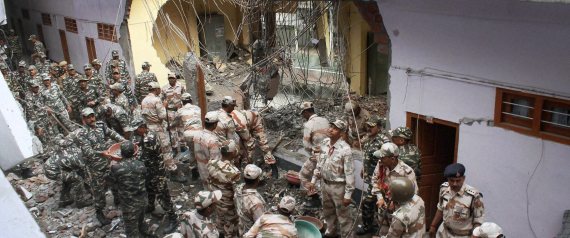
The death toll from a warehouse blast in north China's major port city of Tianjin has risen to 135 while 38 people were still listed missing in the country's worst industrial tragedy, officials said today.

Those who were killed in the twin blasts included 81 firefighters, seven policemen and 47 others. The missing people include 23 firefighters, four policemen and 11 others, state-run Xinhua news agency reported today.

All bodies have been identified.

Meanwhile, 582 people remain hospitalised, 36 of them in serious condition. A total of 216 injured people have been discharged from hospital.

Two blasts ripped through a warehouse on August 12 in Tianjin port where hundreds of tonnes of toxic chemicals were stored, including around 700 tonnes of sodium cyanide.

The explosions also seriously damaged two residential compounds nearby and gutted more than 3,000 new cars in a parking area close to the site.

Personnel are cleaning up the debris and chemicals at the blast site. Workers have partially restored power supply for some damaged buildings.

A total of 223 companies have resumed operation after a suspension due to the blast and 140 more firms are expected to restart production soon, according to local authorities.

The Tianjin port, located about 117 km from Beijing is operating normally.

Thousands of the blast-affected people have turned to their relatives for shelter or returned to their hometowns. Only 95 people remain in a school used as a temporary sheltering point.

Police have detained executives of the warehouse's owner, Tianjin Rui Hai International Logistics Co Ltd, including company head Yu Xuewei, a former executive at a state-run chemical company, and deputy head Dong Shexuan, son of a former police chief for Tianjin Port.

China's cabinet has promised a thorough investigation into the deadly blasts.

Wednesday 26 August 2015

http://economictimes.indiatimes.com/news/international/world-news/tianjin-blasts-death-toll-mounts-to-135/articleshow/48669194.cms

continue reading

Greek Coast Guard search for 4 still missing after capsize


Two Greek coast guard vessels are searching the waters off the eastern coast of the island of Lesbos for four people still missing after a dinghy carrying migrants or refugees capsized while making its way across from the nearby Turkish coast.

The search continued Tuesday, a day after the coast guard recovered two bodies and rescued six people after being alerted to the incident when a fishing boat picked up a man found in the sea.

The body of a third man was also recovered Monday night, but from a different part of the island, leading authorities to suspect he might have died in a separate incident.

Greece has been overwhelmed by more than 160,000 refugees and migrants so far this year. The vast majority arrive in Lesbos.

Wednesday 26 August 2015

http://abcnews.go.com/International/wireStory/greek-coast-guard-search-missing-capsize-33298848

continue reading

Tuesday, 25 August 2015

Katrina's unclaimed dead conjure memories of her ravages


A decade after one of the most deadly storms in U.S history, Hurricane Katrina's forgotten victims lie in 83 caskets entombed in black granite mausoleums behind the gothic gates of a New Orleans cemetery. Their visitors are mostly tourists.

Each metal coffin is marked with serial numbers inside and out, should anyone ever seek to bring one of them home. The names of 30 remain a mystery, but authorities have recorded details about their DNA and where each was found.

The unclaimed bodies were laid to rest in 2008, three years after the storm killed 1,833 along the U.S. Gulf Coast.

On Saturday, 10 years to the day after Katrina's devastating landfall in Louisiana, city dignitaries will gather at the burial site, known as the Hurricane Katrina Memorial. Viewed from above, it resembles the shape of a hurricane.

"Nobody has ever come searching for their loved one in the memorial, as far as I know," said Dr. Frank Minyard, the longtime coroner of Orleans Parish, who helped to build the monument before retiring last year.

The stories of those buried inside remain unknown despite the exhaustive efforts of coroners who conducted autopsies on some 900 bodies recovered from around greater New Orleans.

The local coroner's office was washed away in the flooding that submerged 80 percent of the city after Katrina's storm surge overwhelmed the local flood protections.

Bodies were taken by the hundreds to a warehouse without air-conditioning in St. Gabriel, Louisiana, outside Baton Rouge. As they worked under heat lamps, dehydrating medical examiners searched for ways to identify them.

By then, many were badly decomposed, and animals had removed fingers that might have provided crucial prints, recalled Dr. Louis Cataldie, the former coroner of East Baton Rouge Parish, who was appointed to oversee the statewide remains recovery effort.

Still, a rewards card from Winn-Dixie supermarkets on one man's keychain led them to his relatives, who recognised the rings he was wearing.

An elderly woman, found wearing slippers with holes cut around her little toes, was brought back to family members who remembered how she snipped her shoes to accommodate arthritis.

Yet some people could never be identified by examiners who pored over unusual tattoos, bone fractures and teeth that were compared to dental X-rays recovered from mouldy basement storage.

"The mission wasn't completed," Cataldie said. "If there was one person that wasn't identified, it would still bother me."

After several months, Cataldie's team returned to the city the unclaimed bodies from New Orleans, where they were stored in another warehouse. Minyard, the coroner, wanted the bodies buried in a place where they could be easily retrieved, if anyone ever wanted one of them.

He worked with community leaders and local funeral home owners, who were troubled by talk of a mass burial or cremation, to raise more than $1 million in public and private funding for the memorial graves.

"It was just a little heartless at that point," said Sandra Rhodes-Duncan, one of the leaders of the nonprofit that built the memorial and member of a family that has run a local funeral home for more than a century.

"You always have something to represent somebody's life," she added.

In August 2008, funeral homes donated more than 30 hearses to carry the unclaimed victims to their final resting place, in what was formerly the Charity Hospital Cemetery.

At the cemetery, a red rose was placed on each casket, carried by volunteer pall bearers. Each victim was interred in individual graves within the mausoleums.

Each year since, a graveside ceremony has been held to mark the anniversary of Katrina.

At last year's ceremony, Dr. Jeffrey Rouse, current coroner of Orleans Parish, spoke of the victims at a service marked by a clarinet's sombre notes.

"They sit in silent watch," he said. "They sit in silent judgment."

Tuesday 25 August 2015

http://uk.reuters.com/article/2015/08/25/uk-usa-katrina-bodies-idUKKCN0QU19E20150825

continue reading

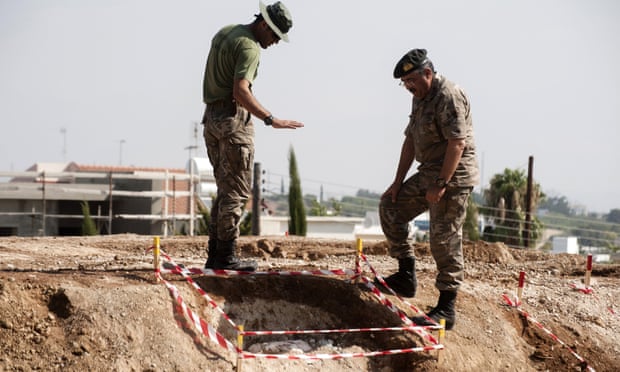
Cyprus begins recovery of wreckage of military plane and human remains 41 years after its crash


Cypriot authorities have started recovering the debris of a Greek military transport plane 41 years after it crashed, an official said on Monday.

Crews started an excavation of a man-made earth hill last week in search for the debris of the French-built Noratlas transport plane, which was shot down by friendly fire as it approached for landing at the now defunct Nicosia airport during the 1974 war between Cyprus and Turkey.

"Digging crews have recovered a wing of the plane and also smaller pieces, including a fuel gauge. We believe they are not far away from the main target of the digging which is the main part of the fuselage," Commissioner for Humanitarian Affairs Photis Photiou told the state radio.

Authorities believe that inside the fuselage are the remains of up to 19 Greek commandos who were killed in the crash.

They were part of a battalion which was being transported to Cyprus to reinforce the Cypriot National Guard as it was facing much superior Turkish troops who landed on the eastern Mediterranean island on July 20, 1974, in reaction to a coup by Greek army officers a week earlier.

A total of 15 Noratlas transport planes, built circa 1950, were involved in the clandestine operation.

Thirteen of the planes which took off from Crete made it to Cyprus, one landed in Rhodes and one returned to Crete.

Due to bad communications and battle confusion, the last one of the planes was fired at by Greek Cypriot soldiers at dawn on July 22, 1974. It crashed about 1 kilometer from the runaway, killing all but one of the 32 commandos and crew.

Twelve bodies were recovered at the time, but the rest were buried under a mound of earth along with the debris of the plane and the crash-site was turned into a Tomb for the Fallen and a military cemetery.

Relatives of two of the other 19 commandos applied to the European Court of Human Rights demanding the return of their remains and the Cypriot government accepted an out of court settlement to try to recover the remains.

Cypriot authorities have enlisted the assistance of an expert from Australia specializing in digging in war related sites, in search of the debris and the remains of the soldiers.

"They have to proceed carefully and at slow pace as there is information that explosives were carried in the plane and they may have not exploded," said Photiou.

The only survivor of the crash, Thanasis Zefiriou, was at hand when the excavation started.

He said he managed to pry the plane door open before it was completely engulfed in flames and jumped out. He was later found unconscious by National Guard soldiers and taken to hospital.

The recovery operation is expected to be completed by November.

Relatives of the missing commandos have provided DNA to identify any remains found on the crash site.

A total of about 1,000 people, most of them Greek Cypriots, are still missing since the 1974 fighting, which ended in Turkish troops occupying about 37 per cent of Cyprus territory.

United Nations brokered negotiations for the reunification of the island are currently under way.

Tuesday 25 August 2015

http://www.shanghaidaily.com/article/article_xinhua.aspx?id=299484

continue reading

Death toll in China's Tianjin blast rises to 129


The death toll from a series of explosions nearly two weeks ago that rocked the northern port city of Tianjin has risen to 129.

There are still 44 people missing and 610 are in hospital, 39 of them critically injured, the official Xinhua news agency reported, citing local officials.

The explosions at a hazardous goods storage facility on August 12 triggered a giant fireball and new fires broke out as recently as Friday.

China's powerful State Council, or cabinet, has vowed to conduct a "rigorous" investigation into the cause of the explosions, Xinhua said Saturday.

The owners of the hazardous goods storage company at the centre of the incident, Rui Hai International Logistics, reportedly included the son of a former police chief who used his connections to help the company obtain the necessary permits and pass inspections.

The blasts have also sparked fears of toxic pollutants contaminating the air and water of the city, which has a population of about 15 million people.

Two blasts ripped through a warehouse storing dangerous chemicals in China's Tianjin Port around 11.30 pm on 12 August.

Personnel are cleaning up the site while investigators look into the cause of the incident.

Tuesday 25 August 2015

http://www.9news.com.au/world/2015/08/25/00/25/china-blast-death-toll-rises-to-129

continue reading

Search resumes for 12 missing Philippine miners


Rescue teams on Monday resumed their search for the 12 miners reported missing after landslides cascaded down their shanties in Benguet province in the Cordillera Administrative Region in the Northern Luzon highlands at the height of typhoon Goni, according to officials State weathermen also reported that Goni (local codename Ineng) already left the country after ravaging extreme Northern Luzon that forced thousands of people to flee their homes due to floods, making major roads impassable as well as felling down trees and power lines.

Benguet Governor Nestor Fongwan said relatively good weather prevailed over the area on Monday after several days of heavy rain and strong winds that prevented the rescue teams from proceeding to a remote mountain village in the town of Mankayan where the 12 missing miners were believed trapped by landslides and mudslides.

The 12 were among the 16 miners reported missing but four were confirmed dead when the teams retrieved their bodies from the site on Saturday, Fongwan said amid fears the rest were also killed when their shanties were buried by the landslides.

Meanwhile, police on Monday reported that four other small-scale miners succumbed to gas poisoning in the town of Itogon also in Benguet.

Police said the bodies of the victims were already recovered from a tunnel but clarified their death was not related to the devastation wrought by Goni (Korean word for swan) on Benguet and other provinces in Northern Luzon.

Tuesday 25 August 2015

http://gulftoday.ae/portal/e461ad7e-061b-45bb-98b6-246857e3e115.aspx

continue reading

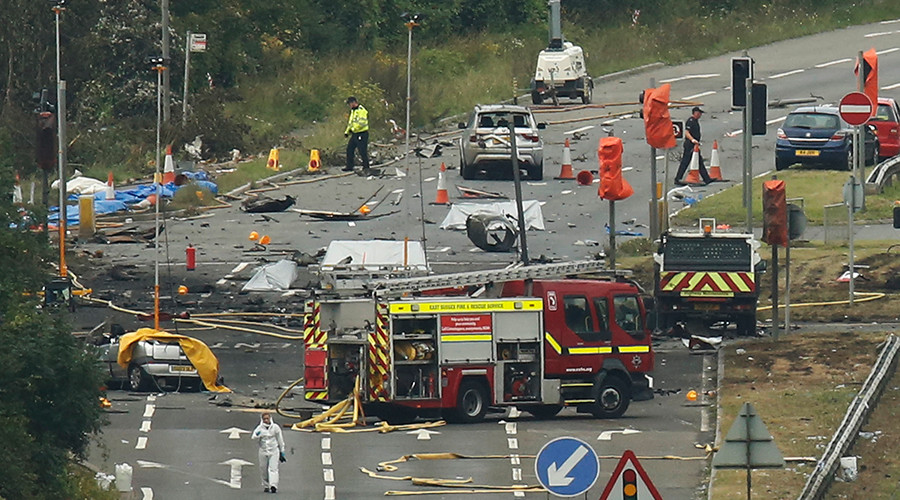
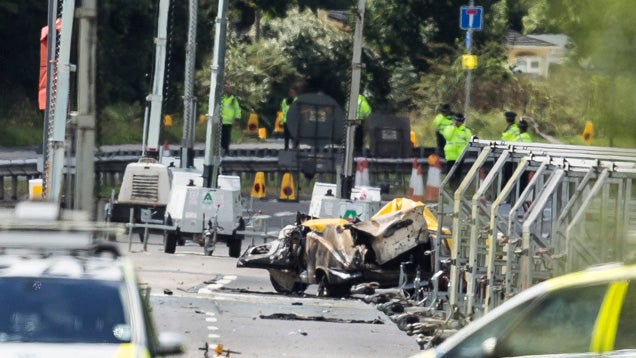
No new victims found when plane that crashed at UK airshow lifted


No new victims were located Monday after the wreckage of a vintage jet plane that crashed on a highway was lifted, police in England said.

Up to 200 people have raised concerns over missing friends or relatives since the Shoreham tragedy, police have said.

Officers revealed they have been deluged with calls after Saturday's plane crash.

"Our estimate of 11 highly likely victims remains in place," Assistant Chief Constable Steve Barry said. "However, until we have fully completed the search of what is an extensive scene, I must caution that there is still the possibility that we may discover evidence of further victims."

The plane crashed Saturday while performing at an airshow at Shoreham Airport in southeastern England. It struck the busy A27 highway, killing at least 11 motorists on the road and injuring at least 14 people.

Authorities said the pilot -- who was, against all odds, pulled from the wreckage alive -- is in a coma.

"Andrew Hill remains in critical condition," police said in a statement released on behalf of Hill's family. "He has multiple injuries and is in a medically induced coma."

The jet wreckage will be transported to Farnborough for examination and vehicles and debris will be removed from the highway," Barry said.

"After that there will a second phase of checking that we have accounted for all the victims and this will be followed by a thorough finger tip search of the area to ensure that we have recovered all of the forensic evidence," he said.

Sussex police announced at a news conference Sunday that it was "highly likely" 11 people had been killed.

The identification process is requiring the help of the victims' next of kin. Authorities resumed the search for more possible victims two days after the military jet plunged from the sky and crashed onto the busy highway.

Meanwhile, people raised questions about whether an aerobatics show should have been held over a highway. The A27, running along parts of England's south coast, parallel to the English Channel, is among Britain's busiest.

Sue Grimstone, from Brighton, told the Daily Telegraph newspaper that the death of her son, Matthew, who was 23, had been "a waste."

"Air shows should be over the sea," she said. "It should never have been over that road." All of those known to have died were on the A27.

Some people took to social media in an attempt to find missing loved ones

Tuesday 25 August 2015

http://edition.cnn.com/2015/08/24/europe/england-air-show-plane-crash/

continue reading

Monday, 24 August 2015

11 now feared dead in English Airshow crash


Officials have now identified 11 people who are “highly likely to have died” after a military jet crashed into a busy roadway during an airshow in southern England on Saturday.

The military jet crashed into a busy main road, killing seven people and injuring more than a dozen others, police said.

The Hawker Hunter fighter jet, which was participating in the Shoreham Airshow near Brighton in southern England, hit several vehicles on a nearby road as it crashed Saturday afternoon.

“The numbers are increasing,” said Sussex Police Assistant Chief Constable Steve Barry in a statement on Sunday. “We are at 11 that are believed to have been killed as a result of the crash, but we do know that number is likely to rise.”

According to the BBC, an additional 14 people were injured in the crash, including the plane’s pilot, who remains in critical condition.

Witnesses told local TV that the jet appeared to have crashed when it failed to pull out of a loop manoeuvre.

West Sussex Police said seven died at the scene and one patient with life-threatening injuries was taken to the hospital.

The doomed plane would not be removed from the road until Monday, at which point more bodies could be discovered in the crash site, which is more than 350 yards long, Barry said. All of the victims were on the roadway, and no one attending the airshow was injured, according to Sussex police.

Captain Mike Vivian, the former chief flight operations inspector for the United Kingdom’s Civil Aviation Authority, stressed that airshows are highly regulated in Britain, but said “lessons can be learned and will be learned” from the disaster.

“In any accident like this where there is tragedy, it’s right to review it in detail,” Vivian told the BBC.

Monday 24 August 2015

http://gawker.com/11-now-believed-dead-after-english-airshow-crash-1726052706

continue reading

The Morewood Lake Disaster


It was set to be an exceptional year in the ice business.

Early the year before, George Shand and Everett Lesure had purchased the Morewood Lake Ice Co., and were anxious to increase profitability in their second season. The company, which in the peak of winter employed up to 150 men, had been seeing steady yields of 20,000 tons of ice harvested annually from the Morewood Lake site, but Shand and Lasure announced this year they expected to raise the output to 25,000 tons.

Advertisements for laborers had been put out, and everything was in place to begin when workers arrived on the morning of Thursday, Dec. 29, 1910, for the first day of the season. Minor equipment issues had been worked out in advance so that work could begin promptly. In particular, a valve on the boiler used to run the conveyor carrying the ice up to the ice houses had been acting up the day prior, but had been replaced, and appeared to be in good working order at 9 that morning.

At 9:20, about 40 of the men headed down from the boiler house toward the lake while many of the rest remained clustered around it.

At 9:30, the boiler house erupted into the sky in a short, horrifying whirlwind, hurling debris and bodies hundreds of yards in every direction.

The explosion could be heard throughout the city; the blast shook windows downtown on South Street, a mile away. Men working around Morewood, even up to 400 yards from the house found themselves dodging a rain of pipes and steel pieces. One 200 pound piece of boiler was flung north of the ice house, over 500 feet away; another 300-pound hunk flew almost twice that distance, cutting off the tops of five trees on the south of the house at a height of 30 feet.

Twelve men were killed instantly, and many more grievously injured. Accounts from those workers who survived the blast describe a bloody, chaotic scene, confronted in every direction by dismembered and mangled remnants of men strewn in every direction, dozens of others writhing in pain and shock wherever they'd been thrown by the blast force or struck by large pieces of searing debris.

Still badly stunned, those on the scene who escaped major injury rushed to help those more badly wounded.

James Hovey and his 19-year-old son James Jr. had just left the boiler house minutes before the blast, and sped back to help pull several men from the debris closer to the house.

"The cries and groans of the injured were terrible," recalled George Stevens, another surviving worker. "The one who seemed to be crying the loudest and who seemed to be in most pain lay under some wreckage almost directly under the place where the boiler had stood. I yelled for someone to assist me, as I believed that if a man could holler as loud as this man was doing that there was hopes for him."

Together with some other men, Stevens cleared the man from the wreckage and got him on one of the first runs to the hospital. First on the scene to carry injured was the sleigh from Pittsfield Fire Department's central station, followed by the police ambulance and two hospital ambulances carrying them in several trips to the House of Mercy. One man died en route, and two more passed from their wounds shortly after reaching the hospital.

After the injured were all removed, the ambulances and sleigh began making trips to the funeral parlors with the remains, many of them unidentified. Some were virtually unidentifiable, mere torsos of men where heads and extremities had been disintegrated in the pure ferocity of the blast.

The final death toll was 17 men, with another 20 injured, in what was immediately dubbed "the worst tragedy in the history of Pittsfield."

"Upon many of these dead faces was an expression of horror," wrote an unnamed reporter for the Berkshire Evening Eagle. "So gruesome was the scene that the spectators turned their heads away from the awful sight."

Among the "spectators" rapidly amassing as word spread were many families of the 150 men who'd been working at the Morewood site that day, desperate to ascertain if their sons and husbands were among the dead and injured.

Police Chief White was early on the scene as well, and downtown Mayor William MacGinnis heard reports of the severity of the accident. MacInnis, who was in the last week of his term, called in Mayor-elect Kelton Miller and met with U.S. Sen. Winthrop Crane, who'd driven over from Dalton on hearing the news. The mayor promptly called for an emergency meeting of the City Council for 3 that afternoon to discuss ways the city could assist families in this crisis.

"The awful accident of this morning saddens and shocks every Pittsfield heart in this, the greatest calamity that our city has ever experienced," said MacInnis in a statement to the press. "All our citizens will unite to assist in every possible way to lighten the blow."

Working with the council and other local leaders, a relief fund was established, and within the next two days would swell to more than $7,000 with donations.

In addition to a desire for city appropriation to pay for funeral costs, councilmen and aldermen at the emergency meeting called for action to be taken regarding boiler inspection, expressing sharp criticism of the state regulatory authorities.

An official inquest was set for Tuesday, but the process of assigning blame for the incident was already underway. The pressure valve for the boiler was found among the wreckage of the tragedy, and it was determined that the equipment wasn't registering the correct pressure and so failed to blow off when it should have.

By Friday, it emerged that engineer William Dunn and machinist George Ward had voiced concerns about the boiler the evening prior to the blow out. A previous malfunctioning valve had just been replaced, but Dunn had faced difficulties getting the new valve to work correctly on the aging boiler apparatus.

He was still nervous about it the morning of the accident, his son John recalled later, after tearfully helping police identify pieces of his father at the scene.

More accounts came at the inquest, where witnesses said Dunn had continued to have trouble with sudden jumps in the steam guage indicator, up until just a few minutes before the explosion. Everett Lesure, co-owner, testified denying the claim that he had told Dunn to screw down the compression screw on the valve.

The final finding of the inquest released by Judge Charles Burke found that this compression screw and the failure of the gauge to register properly, which was attributed to rust from the boiler pipes clogging the gauge, were the ultimate cause of the explosion.

"I do not find that the unlawful act of any person now alive contributed to the death of said decedents," Burke wrote, laying responsibility for any negligence vaguely with the deceased engineer and machinist.

One of the results of Burke's written ruling from the inquest, and of the accident itself, is the adoption of stricter regulations by the state Board of Boiler Rules later that year.

Though exonerated of any corporate wrongdoing and fully insured for the damage to the plant, the Morewood Lake Ice Co. itself never really recovered from the affair, and by the following winter Shand and Lesure sold the operation to the investors incorporated as the Melville Ice Co.

The new company soon moved its ice operations away from Morewood Lake to Goodrich Pond. Business took a turn when one of their largest buyers, the local brewery, closed with the onset of alcohol prohibition. Finally, the growing distribution over the next few years of the electric refrigerator first developed in 1913 rendered traditional ice harvesting obsolete. By the 1930s, the industry was all but nonexistent in New England.

The Springfield Republican called the Morewood Lake explosion one of "the most serious that has ever occurred in Western Massachusetts." In lives lost, it surpasses the devastation of other major regional catastrophes of the period, for instance the 13 workers who perished in the Central Shaft accident on the Hoosac Tunnel in 1867, the 7 killed in East Lee floods from the Mud Pond Dam break in 1886, and even the Boston & Albany RR wreck that claimed 15 lives at Chester in 1893.

Amidst the changing landscape of local manufacturing in the century that followed, sporadic industrial accidents were still seen — two General Electric employees killed in an explosion at their Pittsfield plastics plant in 1957, for example — but never since has the region seen an incident of such gruesome destruction.

Monday 24 August 2015

http://www.iberkshires.com/ckfinder/userfiles/images/1_Desktop14.jpg

continue reading

Typhoon Ineng leaves 35 dead, missing


The death toll from the heavy rains brought by Typhoon Ineng (Goni) went up to 15 yesterday as rescuers retrieved four bodies among the miners trapped in a landslide in Mankayan, Benguet.

The Benguet provincial police said a total of 18 people went missing in the landslide, which happened early Saturday.

Two more remain missing in Bontoc, Mountain Province since Friday.

Seven shanties used by miners at Sitio Elizabeth in Barangay Taneg were reportedly washed out by a flood and buried by a landslide at around 3 a.m.

Cordillera regional police spokesperson Superintendent Cherry Fajardo said one body was retrieved Saturday night.

Office of the Civil Defense (OCD) – Cordillera regional director Andrew Alex Uy said the body was fished out from the Basig River while the remains of three others were retrieved yesterday morning.

The OCD–Cordillera said combined search and rescue teams from the police, local government units, civilian volunteers and personnel from the Gold Rich Expo International Mining Co. and Lepanto Mines were still conducting search and rescue operations as of yesterday afternoon. Officials said poor visibility and heavy rains posed challenges to the rescue teams.

The OCD Cordillera report and the landslide incident in Mankayan were not yet reflected on the official report released by the National Disaster Risk Reduction and Management Council (NDRRMC) yesterday morning.

The NDRRMC said the heavy rains and winds brought by Ineng also left ten people injured.

A total of 32,648 persons or 7,470 families were evacuated in the Ilocos region, Cagayan, Calabarzon (Cavite-Laguna-Batangas-Rizal-Quezon), and Cordillera.

Of the evacuees, 3,327 families or 13,159 persons were inside evacuation centers while 4,143 families or 19,489 individuals were with their families or friends.

The amount of agriculture and infrastructure damage caused by Ineng hit P125.82 million. Infrastructure sustained P121.48 million in damage while agriculture damage reached P3.34 million.

The typhoon also damaged 197 houses in Ilocos, Cordillera and Cagayan.

A total of 36 roads, six bridges, and one spillway have been affected in Ilocos Norte, Cagayan, Central Luzon, Mimaropa (Mindoro-Marinduque-Romblon-Palawan) and Cordillera.

Ilocos Norte was placed under a state of calamity as several areas in the province remained impassable due to flooding.

Despite the heavy rainfall, the regional disaster council in Central Luzon gave assurance that the dams in Nueva Ecija and Bulacan are not at spilling level.

This developed as the state weather bureau lifted all storm warning signals in Northern Luzon areas yesterday as Ineng moved further away from the country.

As of 4 p.m. yesterday, the eye of Ineng was spotted at 430 kilometers northeast of Basco, Batanes, packing winds of 140 kilometers per hour near the center and gustiness of up to 170 kph.

The typhoon slightly accelerated from 13 kph on Saturday to 15 kph yesterday as it moved north northeast toward Japan, according to the Philippine Atmospheric, Geophysical and Astronomical Services Administration (PAGASA).

If it maintains its present speed and track, Ineng was forecast to exit the Philippine area of responsibility (PAR) last night or early this morning.

However, monsoon rains would still prevail over the western section of Luzon, including Metro Manila, Calabarzon, Mimaropa, Ilocos region, the Cordillera and the provinces of Zambales, Bataan and the islands of Calayan and Babuyan in the next few days, PAGASA said.

The weather bureau warned residents of these areas against possible flashfloods and landslides.

It also continued to warn fisher folk against venturing out to the seaboards of Northern and Central Luzon and the western and southern seaboards of Southern Luzon due to big waves generated by Ineng and the southwest monsoon.

Monday 24 August 2015

http://www.philstar.com/headlines/2015/08/24/1491454/inengs-onslaught-leaves-35-dead-missing

continue reading

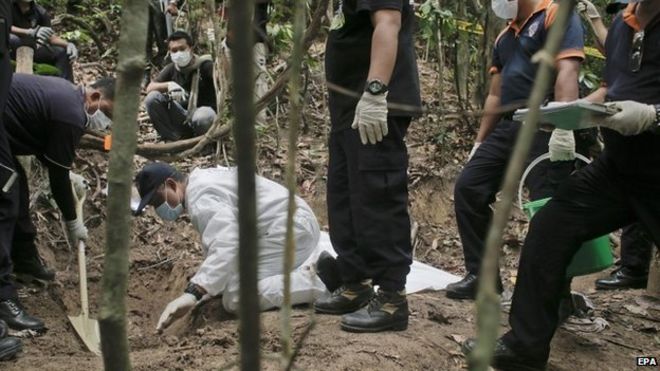
Malaysia finds 24 more bodies of human trafficking victims


Malaysian police say they have found another 24 bodies of suspected human trafficking victims in jungles bordering Thailand.

Authorities in May said they discovered 139 suspected graves in abandoned jungle camps in northern Perlis state, a remote area bordering Thailand that trafficking syndicates used as a transit point.

Most were believed to be from Burma's persecuted Rohingya minority and impoverished migrants from Bangladesh.

Another 24 bodies have been discovered this week, in addition to 106 bodies found earlier, police said. The bodies have been sent for post-mortem examinations, they added.

The discoveries in northern Malaysia followed similar revelations earlier in May in Thailand, where police unearthed 36 bodies from shallow graves in seven abandoned camps on the Thai side of the border.

The discoveries have exposed hidden networks of jungle camps run by human smugglers, who have for years held countless desperate people captive while extorting ransoms from their families.

Most of the victims were part of a wave of people who fled their homelands to reach countries such as Malaysia, where they hoped to find work or live freely.

Human rights groups and activists say the area along the Thai-Malaysia border has been used for years to smuggle migrants and refugees, including Rohingya Muslims.

In many cases, they pay human smugglers thousands of pounds for passage but are instead held for weeks or months while traffickers extort more money from their families.

Rights groups say some have been beaten to death, and the Associated Press has documented other cases in which people have been enslaved on fishing boats.

Monday 24 August 2015

http://www.independent.ie/world-news/malaysia-finds-24-more-bodies-of-human-trafficking-victims-31471220.html

continue reading

Technology a vital tool in identifying remains


It’s almost a cliché: The body was identified through dental records. That has been easier said than done in B.C. until very recently and is still problematic in much of Canada.

Canadian authorities have been far less precise about describing teeth than TV detective shows lead people to believe.

At one point, U.S. authorities suggested they were wary about counting Canadians as possibilities for unidentified human remains south of the border because there was such a big gap in relevant information available about their teeth, said RCMP Cpl. Kelly Risling of the B.C. Police Missing Persons Centre.

“Dental data is a cornerstone of forensic identification,” yet dental codes in Canada recorded just three kinds of teeth: missing, virgin and treated. The treatment was not specified as to the seven surfaces of each tooth, he said.

“I wanted to see our dental coding system brought more into the future, and now dental fillings are identified,” Risling said.

“Instead of just three codes, you’re going to have up to seven codes associated with a tooth,” he said.

Moreover, there is now a B.C. policy that dental information on missing persons must be sent to the provincial dental database and that dental profiles of unidentified remains be searchable.

“So we’re able to match forensically the dental information of missing persons against unidentified bodies. We’re the only province in Canada right now that’s doing that,” Risling said. “The system that was settled on was a system called Plass Data DVI. Plass is a disaster-victim identification software that is utilized by INTERPOL. It was utilized in Thailand following the tsunami in 2005. It proved to be an effective method of cataloguing dental information in order to perform dental comparisons with the goal of ultimately obtaining the identification of various unidentified victims.”

Dr. Tom Routledge, team leader for the British Columbia Forensic Odontology Response Team, or BC-FORT, is manager of the database, created about four years ago.

Outside B.C., there is no national repository of dental information, meaning that if the name of the dentist of a missing person or unidentified remains is not known, there isn’t much that can be done by way of identification.

Dr. David Sweet, a dentistry professor at the University of British Columbia affiliated with INTERPOL and head of the Bureau of Legal Dentistry, has also been enlisted to help identify missing persons.

According to UBC’s website, the bureau is “the first and only laboratory in North America that is dedicated to full-time forensic dentistry research, casework and graduate teaching.”

B.C. dentists are no longer left to guess what police need in terms of dental records.

Police now attend dental offices armed with a letter signed from Sweet asking them to turn over all original dental information to the officer in front of them. That data is couriered to BC-FORT and entered into the Provincial Dental Data Base for comparison against available dental profiles of unidentified bodies throughout B.C., Risling said. No dental information is entered on the Canadian Police Information Centre or the U.S. National Crime Information Centtre without the data having been reviewed and transcribed by BC-FORT, he said.

Dental records are just one improvement B.C. has made in recent years to speed identification of human remains.

The coroners service requires very particular types of information to make a targeted comparison. Risling developed an intake process that is now RCMP policy and is followed — but not mandated — by the majority of municipal police forces.

The intake policy states that every person missing for more than 90 days must have intake information submitted to the B.C. Police Missing Persons Centre. That includes a Missing Persons Query form — an MPQ — that contains date of birth, next of kin and considerable physical information, including surgeries, scars, tattoos, dental work and surgical implants that could be identified via manufacturers’ serial numbers.

Prior to the policy’s implementation, it was suggested that within 90 days, police get family DNA, ideally taken from a parent, and dental information. Now these efforts are a must-do, and Risling stressed that DNA collected for identification purposes will not be used in criminal cases. Families of missing persons sometimes don’t realize the significance of providing this information, he said.

“They’re often reluctant and sometimes they downright refuse when it comes to providing such things as DNA.” Without such information, authorities must keep open files that could have been eliminated via DNA matches.

“And that is a huge draw on our resources,” Risling said.

Also mandatory are the GPS co-ordinates of where the missing person was last seen.

The MPQ for Kenneth Boseley was submitted this year.

Using the physical profile of the body and the geographical co-ordinates of View Street, the Identification and Disaster Response Unit of the B.C. Coroners Service was able to draw a correlation between a missing person’s last-known location and the location of this deceased individual, who was then identified, Risling said.

Fingerprints ultimately led to the identification, with considerable credit going to Det. Const. Chantal Ziegler, the Victoria police investigator working with the team.

After the correlation was drawn between the remains and the missing person, it was a matter of hunting down Boseley’s fingerprints that had been on file with local authorities.

One change Risling is still working on: Seeing whether a specialist can modify photos of an unidentified dead person sufficiently to warrant release to the public in the interest of identification.

Monday 24 August 2015

http://www.timescolonist.com/technology-a-vital-tool-in-identifying-remains-1.2038488

continue reading

12 bodies identified after Papua plane crash


Indonesian police have identified 12 of the victims of a Trigana Air crash in its Papua region a week ago.

The identification of victims from a Trigana Air plane that crashed last week in Pegunungan Bintang regency, Papua, has encountered slow progress as the National Police’s Disaster Victims Identification (DVI) team, as of the weekend, had only managed to identify 12 out of the 54 bodies recovered from the crash site. “Three days after starting the [victim] identification process, our team has managed to identify 12 victims. Four bodies were identified on the first day, three on the second day and five on the third day,” the police’s Medical Center head Brig. Gen. Arthur Tampi said on Saturday. The Trigana Air ATR 42 plane was on its way from Sentani Airport in Jayapura at 2:22 p.m. on Sunday and was supposed to have arrived at Oksibil Airport at 3:15 p.m. The bodies of all 54 people aboard were finally found on Tuesday in a forested area near Oksibil city of Papua. Arthur said the DVI team, as of the weekend, had tried to identify 27 bodies but had only managed to name 12 of them. He said the DNA samples taken from the first 15 unidentified bodies had also been sent to the National Police’s Forensic Laboratory in Jakarta for DNA testing. “Many of the bodies were severely burned, making it difficult for us to identify them using primary or secondary data,” he said. 54 people were killed when the plane crashed in bad weather near Oksibil on a flight from Jayapura.

The Jakarta Post reports the police Disaster Victim Identification team has handed over the bodies of the 12 victims to their families.

The police say the poor condition of the bodies which were burned is hampering identification.

Monday 24 August 2015

http://www.radionz.co.nz/international/pacific-news/282260/12-bodies-identified-after-papua-plane-crash

http://www.thejakartapost.com/news/2015/08/24/island-focus-12-plane-crash-victims-identified-42-more-go.html

continue reading

Friday, 21 August 2015

Netherlands: Urk fisherman identified after more than 47 years


[Translated from Dutch]
More than 47 years after the Urk fishing vessel UK 91 with five crew on board perished, one of the passengers has been identified as 28-year-old Albert Zwaan. He remained unidentified and buried in a special cemetery in Schiermonnikoog, the municipality of Urk confirmed Friday.

The identification was done by DNA testing in collaboration with the Dutch Forensic Institute (NFI). The Fisherman's family had provided a DNA sample in June this year and then compared with genetic material in the database for missing persons. "There was a quick match," said Izanne Linden of the cold case team central Netherlands.

UK 91 sank during a storm on January 24, 1968 about 20 kilometers north of Ameland. A corpse washed ashore on Schiermonnikoog months later, but could not be identified with the technology at that time and it could not be established who he was. The identity has now been confirmed as Albert Zwaan.

The cold case team and the NFI went to Urk this summer to collect DNA samples. "Family members of 32 missing fishermen were given the opportunity to donate DNA," says De Wit-Linden. "Many people took that opportunity."

The cemetery on Schiermonnikoog exhumed five graves last year to collect DNA material from the unidentified remains. For reasons of privacy, the cold case team can not say if families of the other crew members of the UK 91, which have not been found either, have provided their DNA.

The identification is part of a major project to identify seven hundred unknown bodies buried in the Netherlands.

Friday 21 August 2015

http://www.telegraaf.nl/binnenland/24400047/__Visser_na_47_jaar_geidentificeerd__.html

continue reading

Indonesia concludes crashed plane recovery efforts


Indonesia’s search and rescue agency has concluded operations involving a plane that crashed in the mountains of eastern Papua, following the recovery of the 54 victims on board and the black box.

The bodies of all 54 people killed in a plane crash in eastern Indonesia have been recovered from a remote jungle site and flown to hospital, an official said yesterday. Authorities had initially hoped to use helicopters to transport the remains of last Sunday’s crash from the site in Papua province, but bad weather meant the bodies had to be carried on foot out of the jungle.

Henry Bambang Soelistyo, the agency’s chief, confirmed to Anadolu Agency on Friday that efforts had ended after the discovery Thursday of the flight data recorder that had been missing since the plane crashed last weekend.

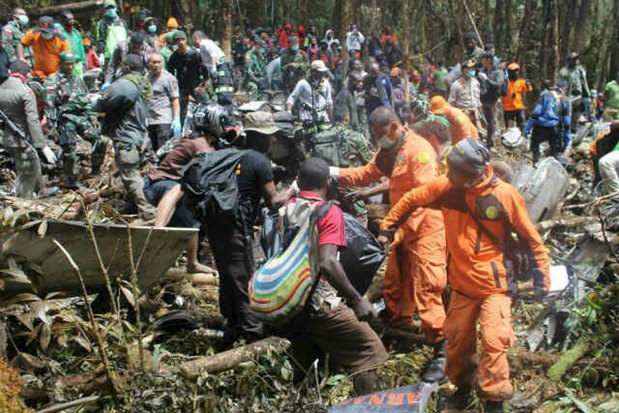
Hundreds of locals and rescuers were involved in the arduous task of taking the bodies about 15km to the settlement of Oksibil, the intended destination of the Trigana Air plane.

Captain Beni Sumaryanto, Trigana Air’s service director of operations, said all the bodies had been recovered, and had now been flown on to the Papuan capital Jayapura.

“They are now in the police hospital at Jayapura for identification,” he said. “After that they will be given to the families.”

The ATR 42-300 plane had set off from Jayapura on what was supposed to be a 45-minute flight to Oksibil, but lost contact 10 minutes before landing as it sought to descend in heavy cloud and rain.

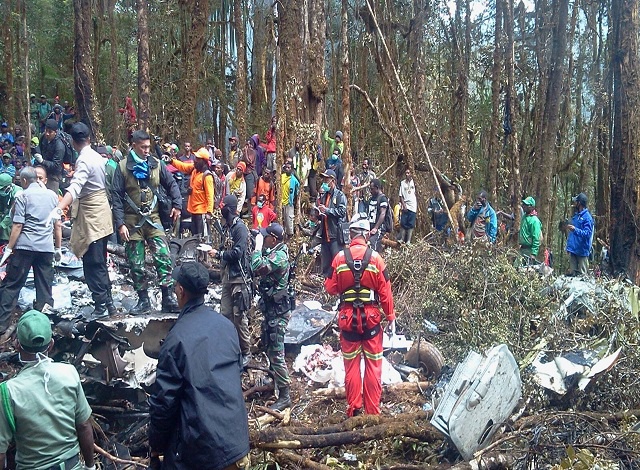
When rescuers reached the crash site two days later, they found the twin-turboprop aircraft in pieces scattered across a fire-blackened clearing, and the bodies of the 49 passengers and five crew who had been aboard.

"During the five days of operation, everyone worked professionally. Thanks to all team members," Soelistyo said.

He added that Disaster Victim Identification teams had begun to identify the recovered bodies.

As of early Friday, seven victims -- including a flight attendant and a postal worker who had been transporting around 6.5 billion rupiah ($470,000) to be distributed to the poor in the region -- had been identified, Detik.com reported.

Tatang Kurniadi, National Committee on the Safety of Transport chief, told Anadolu Agency that they would prepare a preliminary report on the contents of the black box before submitting the recorders to the International Civil Aviation Organization.

The report, however, will take between six months and one year to complete.

Benny Sumaryanto, Trigana Air Service director of operations, told Anadolu Agency that the legal heirs of each passenger would receive compensation worth 1.25 billion rupiah (almost $89,700).

"The compensation will be given for all passengers on board, including the crew," he said.

The flight crashed Sunday around 7 miles from an airport in Oksibil -- a remote settlement near the border with Papua New Guinea.

Ground rescuers had traipsed through thick vegetation in the Bintang Mountains Regency for recovery operations at the spot, which is at an altitude of around 2,529 meters (8,300 feet).

Meanwhile, a spokesman for the Indonesian postal service said Friday that of the 6.5 rupiah billion being transported on the flight, only 5.8 billion rupiah had been recovered by search teams.

Abu Sofyan -- who like many Indonesians uses only one name -- was quoted by Detik.com as saying that the missing cash was likely burnt, and adding that "surely no funds have been lost as it was all insured."

Friday 21 August 2015¨

http://www.aa.com.tr/en/world/578813--indonesia-concludes-crashed-plane-recovery-efforts

continue reading

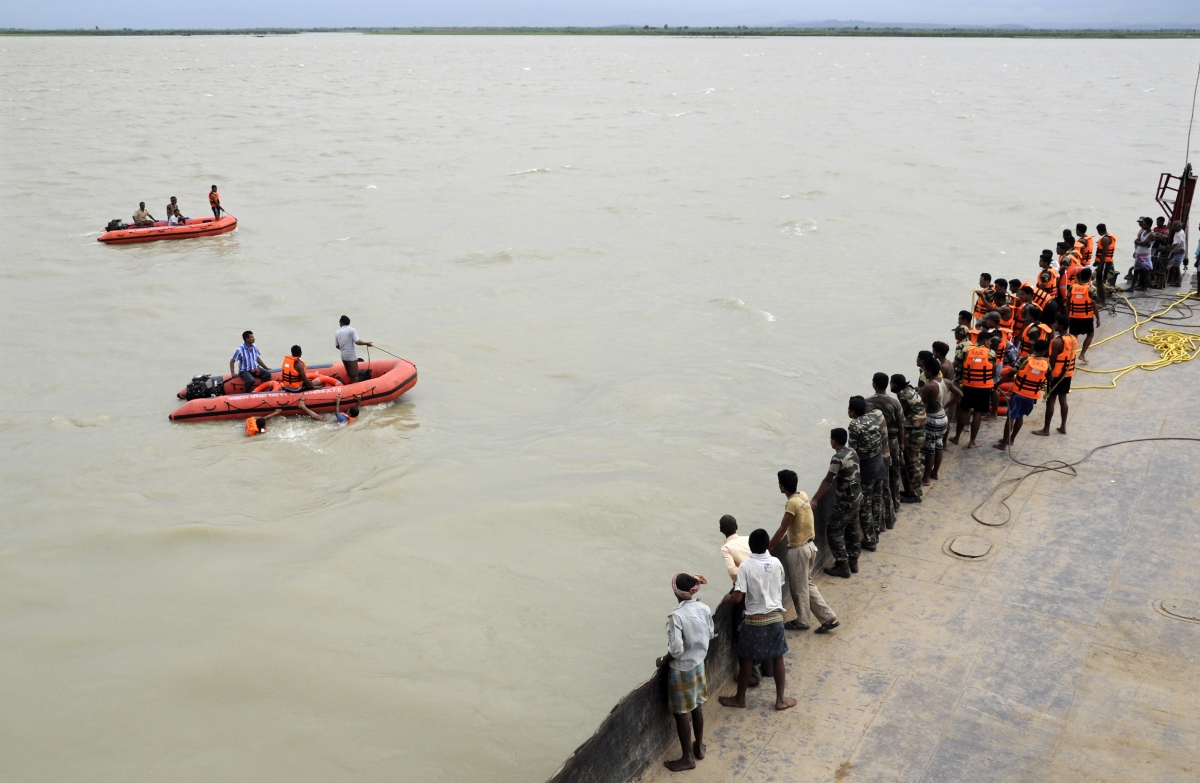
Bihar: 13 feared drowned as boat capsizes in Rohtas


Thirteen persons including four women were feared drowned after a boat capsized in river Sone near Dehri-on-Sone, about 145 kms south-west of Patna. Of the 17 persons travelling on the boat, mostly vegetable growers, four were rescued.

The occupants on the boat were travelling to an island in the middle of the river for agricultural purposes when the boat met with the mishap, Dehri-on-Sone sub-divisional officer Pankaj Patel said.

"The boat capsized in the swirling waters. Till now bodies of four women have been found" Patel said.


The occupants were residents of Tar Bungalow and Shiv Ganj localities at Dehri. Search operations are underway to find the missing women and help of local divers and NDRF team is being taken to locate other missing persons, SP Manavjit Singh Dhillon said. DM Sandeep Kumar R Pudakalkatti is also camping on the spot.

Friday 21 August 2015

http://www.hindustantimes.com/india-news/bihar-4-women-drown-5-missing-as-boat-capsizes-in-rohtas/article1-1382154.aspx

continue reading

MH17: Bones buried two-feet deep in crash site


The impact of fire and fall during the Malaysia Airlines flight MH17 tragedy had caused some of the bones of the victims to be buried as deep as two feet underground, said D13 (Bank Data/DNA) chief assistant director, ACP Hussein Omar Khan.

The Royal Malaysian Police Disaster Victim Identification (DVI) commander for the MH17 tragedy said the victims' bones were found buried in the ground when the recovery team made its final mission in April this year.

"Until April this year, only 296 victims had positive identification while the other two victims were unidentified.

“Therefore, the recovery team made a final mission in April this year," he said, adding that only the Netherlands and Malaysia went on this final mission as Australia felt it was highly risky.

"We used armoured and bullet-proof cars to get into the crash site," he recalled in his talk titled 'Mass Fatality Investigation: The MH17 Experience' at the International Conference on Environmental Forensics organised by Universiti Putra Malaysia on Thursday.

The Malaysia Airlines Boeing 777 plane was en route to Kuala Lumpur from Amsterdam when it was brought down over eastern Ukraine on July 17, 2014, killing all 298 people on board.

Hussein said during the final mission, the recovery team had to dig the crash site area as some of the bones were found to be buried in the soil.

"Archaeology forensics was used in the search this time. It was surprising to find bones 40cm and two-feet deep in the ground," he said.

Hussein said after the final mission, the recovery team believed the last two victims were identified and 99 per cent of the recovery operation was completed.

"Now grass has grown on the crash site and it is unlikely the recovery team will go there again unless there is any necessity," he added

Friday 21 August 2015

http://www.thestar.com.my/News/Nation/2015/08/20/MH17-Bodies-buried-two-feet-deep/

continue reading

Police DVI team identifies four bodies


The National Police Disaster Victims Identification (DVI) team has identified four victims from the Trigana Air plane that crashed in Pegunungan Bintang regency, Papua, on Sunday.

During a press conference at the Bhayangkara Police Hospital In Ja-yapura on Thursday, the head of the National Police Medical Center, Brig. Gen. Arthur Tampi, said the four victims were identified from their medical records and belongings.

Earlier, the DVI team had taken DNA samples from relatives of 53 of the 54 victims, but had yet to take samples from the relatives of Mario, a Trigana Air mechanic, who were still to arrive from Jayapura.“We target to identify 10 bodies daily,” said Tampi.

According to Trigana Air operational director Benny Sumaryanto, Trigana Air will cover the costs of transporting the bodies to their home towns.The heirs of each victim will get Rp 1.35 billion (US$100,000) from Trigana Air and Rp 100 million from state insurance firm PT Jasa Raharja in compensation.

Benny said that the compensation would be handed over after all the required data was provided. “It may take three to four weeks to deliver the compensation because we still need identification, such as birth certificates, identity cards and household cards, so as to prevent mistakes when handing over the compensation,” said Benny.

Benny said that currently the families of all the passengers and crew members were already in Jayapura. All the victims are currently being identified at the Bhayangkara Police Hospital.

As many as 50 body bags were transported from Oksibil to Jayapura on Thursday by Trigana Air planes and an Indonesian Military (TNI) MI helicopter.

“All the bodies have already arrived at the hospital for identification,” said Papua Police chief Brig. Gen. Paulus Waterpauw.Families of victims who have yet been identified have been assembled at the Tongkonan building, owned by the Toraja community association, located 200 meters from the hospital.“They are given psychological counselling in addressing the disaster they’re facing,” said Papua Police chief spokesman Sr. Comr. Rudolf Patrick.

Separately, Papua Police deputy chief Brig. Gen. Rudolf Rodja said the search and rescue team had found the flight data recorder, part of the black box, which is to be sent to Jakarta on Friday. National Search and Rescue Agency (Basarnas) head Air Marshal FHB Sulistyo had earlier handed over the plane’s flight cockpit recorder to the National Transportation Safety Committee.

Friday 21 August 2015

http://www.thejakartapost.com/news/2015/08/21/police-dvi-team-identifies-four-bodies.html

continue reading

Thursday, 20 August 2015

All Indonesia plane crash bodies recovered


The bodies of all 54 people killed in a plane crash in eastern Indonesia have been recovered from a remote jungle site and flown to hospital, an official says.

Authorities had initially hoped to use helicopters to transport the remains of Sunday's crash (local time) from the site in Papua province, but bad weather meant the bodies had to be carried on foot out of the jungle.

Hundreds of locals and rescuers were involved in the arduous task of taking the bodies about 15 kilometres to the settlement of Oksibil, the intended destination of the Trigana Air plane.

Captain Beni Sumaryanto, Trigana Air's service director of operations, said all the bodies had been recovered, and had now been flown on to the Papuan capital Jayapura.

"They are now in the police hospital at Jayapura for identification," he told AFP. "After that they will be given to the families."

The ATR 42-300 plane had set off from Jayapura on what was supposed to be a 45-minute flight to Oksibil, but lost contact 10 minutes before landing as it sought to descend in heavy cloud and rain.

When rescuers reached the crash site two days later, they found the twin-turboprop aircraft in pieces scattered across a fire-blackened clearing, and the bodies of the 49 passengers and five crew who had been aboard.

Investigators are still combing the crash site for one of the plane's flight data recorders, after having recovered the aircraft's other "black box", the cockpit voice recorder, earlier this week.

The devices should provide vital clues about what caused the crash.

Thursday 20 August 2015

http://www.3news.co.nz/world/all-indon-plane-crash-bodies-recovered-2015082020

continue reading

At least 13 killed in landslide in southwest China


Thirteen people have been killed in a village in southwestern China after heavy rain created a huge landslide.

Eleven people are also missing in the village near Luzhou in Sichuan province.

Police and firefighters are searching through the mud and rubble for survivors, the report said.

Photographs showed debris and earth piled up to two-metres high and a bus partly buried in mud.

Warning signs have been set up along several roads in the area with slopes in danger of collapsing.

Villagers whose homes were damaged or destroyed in the landslide on Monday have been housed in temporary shelters or are staying with friends or relatives, the report said.

Twelve of the bodies have been identified.

The village struck by the landslide houses member of the Miao ethnic minority group.

At least 28 people were killed in flooding and landslides in Sichuan province last month.

Thursday 20 August 2015

http://www.scmp.com/news/china/society/article/1851048/least-13-killed-landslide-southwest-china

continue reading

First bodies recovered from Indonesia plane crash site


The first bodies of 54 people killed when a plane went down in eastern Indonesia were Wednesday carried from the remote crash site after bad weather hampered efforts to airlift them.

Authorities also revealed rescuers were still looking for one of the Trigana Air plane's two "black boxes", the flight data recorder, after initially saying that both had been found.

The remains of 17 people who died when the plane crashed during a short flight in bad weather Sunday were taken by hundreds of locals and rescuers through jungle and over mountains in Papua province.

The bodies arrived at the settlement of Oksibil, the intended destination of the ATR 42-300 plane, after a gruelling, hours-long journey.

Four bodies had already been flown on to Papua's capital Jayapura while the other 13 were still in the local hospital, transport ministry spokesman J. A. Barata told AFP. The recovery effort was halted at nightfall and will resume Thursday.

Authorities had initially hoped to use helicopters to airlift the bodies from the site, but bad weather made it too dangerous to fly in the area Wednesday.

"The current conditions make it impossible for us to use helicopters, so we have to do it via land," said local military spokesman Pudji Teguh Rahardjo.

Officials initially believed that both black boxes -- the flight data recorder and the cockpit voice recorder -- had been found in the wreckage.

But transport ministry spokesman J. A. Barata said Wednesday the flight data recorder, which takes readings from many different parts of the aircraft, had not yet been recovered.

The tragedy was just the latest air accident in Indonesia, which has a poor aviation safety record and has suffered major disasters in recent months, including the crash of an AirAsia plane in December with the loss of 162 lives.

It took rescuers two days to reach the site, about 15 kilometres (nine miles) from Oksibil, after initial efforts were hindered by the rough terrain and bad weather.

They found the twin-turboprop aircraft in pieces scattered across a fire-blackened clearing, and the bodies of the 49 passengers and five crew who had been aboard.

They also recovered some of the 6.5 billion rupiah ($470,000) in government social assistance funds that was being transported for distribution to poor families. Some of the money was badly burnt.

A team of three investigators from France's BEA agency, which probes air accidents, and four technical advisors from ATR, a European plane maker based in France, is heading to Indonesia to look into the accident.

The plane had set off from Jayapura on what was supposed to be a 45-minute flight to Oksibil, but lost contact 10 minutes before landing as it sought to descend in heavy cloud and rain.

The airline has said the accident was likely caused by bad weather.

Trigana Air, a small domestic Indonesian airline, has experienced a string of serious incidents and is banned from flying in European Union airspace.

Thursday 10 August 2015

http://news.yahoo.com/bad-weather-hampers-recovery-efforts-indonesia-plane-crash-071737811.html

continue reading

Forensic Team Finds Mass Grave in Chungui, Ayacucho


A team of forensic specialists have found the remains of 50 men, women and children in Ayacucho, in five mass graves outside the town of Oronccoy.

The investigation has shown that the bodies were buried in 1985, at the height of the internal conflict between Shining Path rebels and the military and police. In this particular case, the victims were executed by members of the special police force known as the Sinchis.

The forensic work at the site, in a remote area far from roads and communication, will conclude on August 28.

According to the district attorney, witnesses have stated that the murders were committed before dawn one morning n January 1985 at Estaca Parada, some three hours from Oronccoy. Because of the fear of attacks either by Shining Path or the military, several families had chosen to live together.

Oronccoy is in the district of Chungui, which in 2013 gave a proper burial to the identified bodies of 79 people killed between 1984 and 1985 by both the Shining Path and the military.

The district was the hardest hit in the conflict and lost 17 percent of its population — more than 1,300 people— in what Peru’s Truth and Reconciliation Commission called “the most cruel and devastating bloodbath” perpetrated by the “insanity of Shining Path and the brutal repression of the military and police forces.”

Oronccoy was abandoned by most of its townspeople in the 1980s, but many of them slowly returned a decade later in a government-supported program to reclaim their homes and farms.

Thursday 20 August 2015

http://www.peruviantimes.com/20/forensic-team-finds-mass-grave-in-chungui-ayacucho/24773/

continue reading

China landslide rescue suspended for safety concern


Rescue work has been suspended amid fears of more slides at a mining site in Shaanxi where 56 people remain missing.

Zhao Fasuo with the Chinese Commission for Disaster Reduction says the danger for search crews at the site is just too high at the moment.

"Too much digging among the rubble of the original slide has the potential to cause movement of on the hills behind. So we need to be aware of this. Of course we are trying to do everything we can to find the bodies of those still missing. However, we have to do this both responsibly and scientifically for the safety of those on the ground."

At the same time, forecasters are warning of heavy rains in the region for the next 2 to 3-days, leading to fears of even more slides taking place.

Official 12 people are confirmed dead following last week's deadly slide, which hit overnight on Monday while crews were sleeping in their dorms.

10 managed to escape, while 4 others were initially pulled from the rubble.

However, given the time which has passed since the slide hit, its highly unlikely any of the 56 others still listed as missing will be found alive.

Thursday 20 August 2015

http://english.cri.cn/12394/2015/08/20/4021s892397.htm

continue reading

Wednesday, 19 August 2015

10 die as landslide strikes Sikh temple


A landslide struck a popular Sikh temple complex in northern India on Tuesday, killing at least ten people and wounding 10 others, police said.

Rescue workers equipped with cutting equipment and sniffer dogs were searching through the rubble for survivors after boulders barrelled down a nearby hill onto the complex in Himachal Pradesh state.

“So far we have recovered eight bodies and 10 people have been shifted to hospital,” said Padam Dev, police chief of Kullu district where the accident occurred.

Dev said it was unclear if anybody was trapped, but about 50 pilgrims and temple workers had been inside the complex in Manilkaran town, some 240km from the capital Shimla at the time.

The boulders struck and badly damaged a building adjoining the Gurdwara Shri Guru Nanak Dev Ji, one of the most important pilgrimage sites for Sikh followers.

The temple was built to commemorate the spot where Sikh religion founder Guru Nanak is said to have meditated more than five centuries ago.

Kullu Deputy Commissioner Rakesh Kanwar confirmed that eight bodies which were buried under huge boulders have been extricated while search is on for more.

Eyewitnesses claimed that the dead could be more than 10 in number as a large number of people had taken shelter in the building, close to the Gurdwara, when the tragedy struck.

The exact number of dead or injured could not be ascertained as some bodies are feared to be buried under the debris.

The district administration has sought the assistance of Gurdwara authorities in locating and identifying the bodies as most people staying in the building were outsiders.

People ran helter-skelter as boulders fell on the building and many were trapped as a huge portion of the three-storey building virtually collapsed.

The locals and Gurdwara management immediately swung into action and started rescue operations while Additional District Magistrate, Sub Divisional Magistrate, Kullu and other district officials rushed to the spot.

Those injured have been admitted to zonal hospital at Kullu and condition of seven of them is stated to be serious. DGP Sanjay Kumar said some of the 10 injured and were in a critical condition.

Wednesday 19 August 2015

http://www.thenews.com.pk/Todays-News-1-335033-10-die-as-landslide-strikes-Sikh-temple

continue reading

China landslide victims mourned, 52 remain missing


More than 700 people mourned the deaths of at least 12 people in a mudslide that engulfed a mining community in north-western China six days ago, state media reported on Tuesday.

Fifty-two people remain missing after the landslide struck 12.30am on Wednesday (1630 Tuesday GMT).

Most of the 12 bodies were found on Sunday and early on Monday as volunteers helped rescuers dig through the rubble of more than a dozen dormitories and three houses in a village of Shaanxi province, the Xinhua news agency reported.

Relatives of the victims, county officials, soldiers and police paid silent tribute and left flowers at a nearby school.

Torrential rain suspended rescue work on Tuesday, but it will resume as soon as conditions allow, Xinhua said, citing the rescue headquarters.

Ten people escaped and four were dug out from the debris on Wednesday morning, Xinhua reported on Sunday.

The missing included seven children aged 6 or younger, including an 8-month-old girl, according to the People’s Daily newspaper.

Wednesday 19 August 2015

http://www.iol.co.za/news/world/china-landslide-victims-mourned-1.1901759

continue reading

3 specialist doctors to help identification of Trigana victims


The National Police said on Tuesday they had dispatched three Disaster Victim Identification (DVI) personnel to help identify the bodies of 54 people from a Trigana Air plane that crashed in Oksibil, Pegunungan Bintang regency, Papua, on Sunday.

“The DVI team has arrived at the location. It consists of three specialist doctors, namely a forensic doctor, dental forensic specialist and a DNA expert,” the National Police’s medical and health center head, Arthur Tampi, said as quoted by Antara in Jakarta on Tuesday.

He said the bodies of all 54 crash victims would be evacuated to Bhayangkara Hospital in Jayapura, Papua, for a postmortem examination.“From the crash site, the bodies will be evacuated to the hospital using a helicopter,” said Arthur.As part of their postmortem identification process, the National Police have set up a team to collect data from the victims’ families.

The data comprises medical and dental records and information on tattoos and surgery marks.

“We will examine the postmortem data and match them with the antemortem data,” said Arthur.The Trigana Air PK-YRN aircraft, with flight number IL 267, lost contact on Sunday afternoon and was found "completely destroyed" after it crashed into Mt Tangok in Pegunungan Bintang regency, Papua.

The ATR plane had 5 crew members and 49 passengers on board, including three children and two babies.

Wednesday 19 August 2015

http://www.thejakartapost.com/news/2015/08/18/3-specialist-doctors-help-identification-trigana-victims-police.html

continue reading

Bad weather hinders evacuation of bodies from site of Indonesia plane crash


Rescuers on Tuesday reached the site in eastern Indonesia where a passenger plane slammed into a mountain over the weekend.

Heavy fog and bad weather hampered rescuers Wednesday trying to evacuate bodies in eastern Indonesia where a passenger plane crashed into a mountain over the weekend, killing all 54 people on board, officials said.

More than 70 rescuers reached the crash site after being hindered by rugged, forested terrain and bad weather, said Henry Bambang Soelistyo, the National Search and Rescue Agency chief.

The flight data recorder and the cockpit voice recorder — the plane's "black boxes" — were found in good condition, Soelistyo said. The data they contain could help explain what caused the Trigana Air Service plane to crash Sunday.

"The plane was totally destroyed, and all the bodies were burned and difficult to identify," Soelistyo told The Associated Press.

He said all 54 bodies had been recovered and would be taken to Jayapura, the capital of Papua province, so they can be identified. The ATR42-300 twin turboprop plane was flying from Jayapura to the city of Oksibil with 49 passengers and five crew members on a scheduled 42-minute flight when it lost contact with air traffic control.

Henry Bambang Soelistyo, the National Search and Rescue Agency chief, said bad weather was still hampering the operation and that rescuers would now try to carry the bodies out.

"Heavy rains and poor visibility were hampering our rescue efforts and evacuation process will be done by foot," said Soelistyo, adding the bodies would be taken to Jayapura, the capital of Papua province, so they can be identified.

Soelistyo said the wreckage was at an altitude of 8,500 feet. Much of Papua is covered with impenetrable jungles and mountains. Some planes that have crashed there in the past have never been found.

The airline's crisis center official in Jayapura's Sentani airport, Budiono, said all the passengers were Indonesians, and included three local government officials and two members of the local parliament who were to attend a ceremony Monday in Oksibil marking the 70th anniversary of Indonesia's independence from Dutch colonial rule.

Like many Indonesians, Budiono goes by one name.

Oksibil, about 175 miles south of Jayapura, was experiencing heavy rain, strong winds and fog when the plane lost contact with the airport minutes before it was scheduled to land.

The victims' relatives, who had been waiting at the airport, broke down in tears when they heard the news. Many of them accused the airline of taking too long to give them information.

"They are unprofessional ... they play with our feelings of grieving," said Cory Gasper, whose brother Jhon Gasper was on the plane.

The airline released a public apology just after a search plane spotted the smoldering wreckage of the aircraft Monday.

It's unclear what caused the crash, and Indonesia's transportation safety commission has opened an investigation.

The passengers included four postal workers escorting four bags of cash totaling $468,750 in government aid for poor families to help offset a spike in fuel prices, said Franciscus Haryono, the head of the post office in Jayapura, the provincial capital.

Rescuers have found the money, which was partly scorched, and will hand it over to the authorities, Soelistyo said.

Indonesia has had a string of airline tragedies in recent years. In December, all 162 people aboard an AirAsia jet were killed when the plane plummeted into the Java Sea as it flew through stormy weather on its way from Surabaya, Indonesia's second-largest city, to Singapore.

The sprawling archipelago nation of 250 million people and some 17,000 islands is one of Asia's most rapidly expanding airline markets, but it is struggling to provide enough qualified pilots, mechanics, air traffic controllers and updated airport technology to ensure safety.

From 2007 to 2009, the European Union barred Indonesian airlines from flying to Europe because of safety concerns.

Trigana Air Service, which began operations in 1991, had 22 aircraft as of December 2013 and flies to 21 destinations in Indonesia. The carrier has had 19 serious incidents since 1992, resulting in the loss of eight aircraft and major damage to 11 others, according to the Aviation Safety Network's online database.

The airline remains banned from flying to Europe along with six other Indonesian carriers.

Wednesday 19 August 2015

http://www.vagazette.com/news/ct-indonesia-plane-crash-20150818,0,6688123.story

http://www.startribune.com/searchers-spot-wreckage-of-indonesian-plane-in-rugged-papua/322017361/

continue reading

Bodies of 49 migrants who died of asphyxiation arrive in Italy


The 49 bodies of the migrants who died from asphyxiation in the hold of an overcrowded fishing boat off the Italian coast over the weekend arrived in Sicily on Monday.

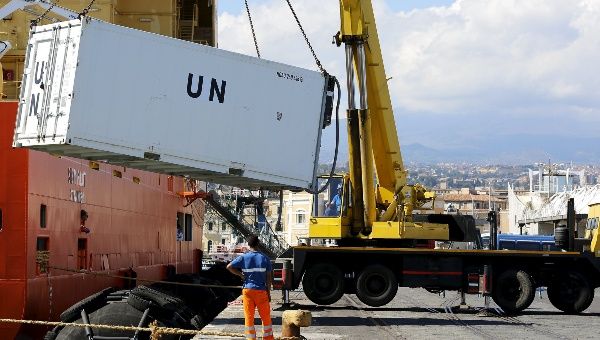
The Norwegian Frontex coastguard vessel transported some 312 survivors of the recent Mediterranean disaster, as well as a container that carried the bodies of the deceased, to the Sicilian port of Catania.

The death toll was originally thought to be closer to 40, but officials confirmed Sunday that 49 bodies had been found below deck. The victims died amid exhaust fumes and suffocating heat, packed inside a confined space in the boat's hold.

According to officials, the victims were primarily married men who had given spots on the deck to their wives.

In a separate expedition, the Italian coastguard rescued 354 migrants Sunday evening from a fishing boat off its southern coast, with one person found dead on board.

According to the United Nations and official government figures, some 102,000 migrants have arrived on Italian shores since the start of the year while nearly 135,000 have arrived in Greece. Most of those making the dangerous Mediterranean crossing are from war torn countries or fleeing violence and poverty in parts of the Middle East and Africa.

At least 2,300 people have died this year alone making the crossing, according to the latest figures issued by the International Organization for Migration.

Wednesday 19 August 2015

http://www.telesurtv.net/english/news/Bodies-of-49-Migrants-Who-Died-of-Asphyxiation-Arrive-in-Italy---20150818-0010.html

continue reading

Arizona: Finding migrants, or their remains


Anne Norris said her son, Andrew, had a close and loving relationship with his father in the short time they were together before the laws and perils of migration pulled them apart.

"He wouldn't go to sleep until his dad came home from work and played with him," she said. "They were inseparable."

The boy is now 8 years old. He was only 2 when his father was deported to El Salvador in March 2009. Yearning to be with his son again, José Ricardo Garay-Garay decided to come back home to California a few months after he was deported.

He called Norris almost every day as he made the perilous journey north. Just as he was getting ready to cross the United States border through Arizona in June 2009, he called her again to let her know he would be home soon.

"That was the last time I talked to him," she said. "About a week and a half later, I knew something was wrong."

Garay-Garay hasn't been heard from or found since then. Migrants who were traveling with him said he couldn't keep up and was left behind. His family is almost certain he died trying to cross the border, but that hasn't stopped Norris from searching for him.

She has spent the last few years trying to find him. She has done so with the help of the Colibrí Center for Human Rights, a non-profit group that helped her create a missing persons report and taught her how to navigate through a national database of missing persons and unidentified decedent records.

Most recently, Norris was able to get a death certificate for the father of her son with the help of a pro-bono attorney and Colibrí's executive director, Robin Reineke.

"Just because I have the death certificate doesn't mean that our search is over; there's still the desire to know where his remains are." Norris said. "This is not the end of this for us. We are still looking for him."

Colibrí is one of the dozens of organizations that help families search for loved ones who've vanished while crossing the U.S.-Mexico border, which over the years has become more dangerous for migrants. Increased border security has forced them to travel for longer periods of time—mostly on foot—and through harsh terrain.

Formed in 2006, Colibrí is located inside the Pima County medical examiner's office in Tucson, Ariz. The group helps families by creating forensically detailed missing person reports and working with forensic scientists to identify the remains of those who died along the border.

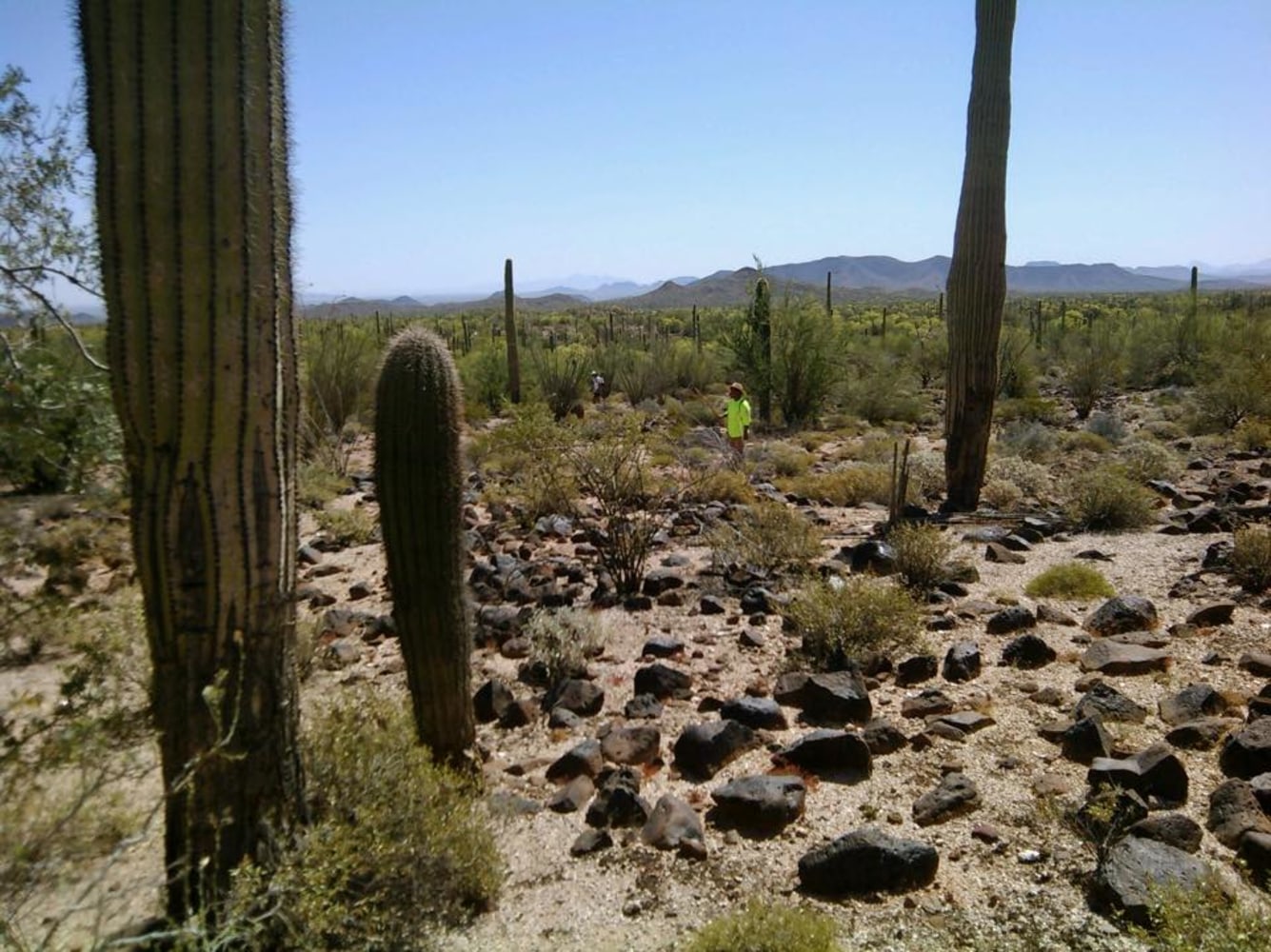
Colibrí also has a centralized database that contains 2,000 active cases of migrants who've gone missing along the entire southern border. The database contains records of 2,500 bodies — of which 900 remain unidentified — that have been found in Arizona's harsh Sonoran Desert, a popular corridor for migrants.

Getting reliable statistics on migrant deaths and missing for the entire southern border is difficult. Some counties do not keep the data separately, although there is work underway to get more reliable information.


The Border Patrol recorded 307 migrant deaths in 2014, down from 445 in 2013. But there are many migrants who are missing and of those never found, it's unknown whether they are among the dead.

Chelsea Halstead, program manager at Colibrí, said her group is constantly getting calls from family members who are frantically searching for their missing loved ones. The volume of calls increases during the hot summer months, when they get as many as 100 calls a week.

"We have no shortage of calls," she said. "We're constantly on the phone with families gathering information and matches are being made from years ago, so it's a continual process. And sometimes, matches are made long after the person has been cremated."

Halstead said among the missing migrants are usually fathers, mothers, brothers and sisters who made "an incredible sacrifice" to come to the U.S. Their desire was to work and help support their families back home.

"Our mission is to end migrant deaths and their suffering," she said. "But that's never going to be achievable until in the U.S. we recognize that these are lives worth mourning and these are people that we should feel devastated to lose."

Colibrí and other groups like it aren't the only ones searching for migrants who've vanished. U.S. Border Patrol also responds to reports of missing migrants through BORSTAR, short for Border Patrol Search, Trauma and Rescue.

The search and rescue unit was created in 1998 in response to the growing number of injuries to Border Patrol agents and the increase in migrant deaths along the southern border.

On a daily basis, BORSTAR agents respond to distress calls made by migrants who are lost and in poor health. Most migrants call 911 to ask for help and are transferred to BORSTAR, which became a common practice about five years ago when the high volume of 911 calls from migrants overwhelmed counties along the border.

"If it's an emergency situation, we'll deploy every time," said Carl McClafferty, associate chief for special operations at U.S. Border Patrol. "We'll send somebody out and get that mission started."

At the start of every mission, BORSTAR agents gather as much information as possible to help narrow down the search area. They then deploy a ground unit to search on foot, placing cases involving migrants who are still alive ahead of those already deceased. Sometimes air units are called to begin the search if agents can't get out on the ground right away.

Once BORSTAR agents find the migrants, they give them medical attention to stabilize them. Often, migrants are dehydrated after being out in the desert for days, especially during the summer when temperatures reach well over 110 degrees. If advanced medical care is needed, the agents call an ambulance to transport migrants to a hospital.

"We do find them most times and sometimes, unfortunately, we find them when they are deceased," McClafferty said.

The job of BORSTAR agents is mainly to save as many lives as possible. But because they are still Border Patrol agents and share the same priorities, they must arrest people who are crossing the border illegally. That's why migrants who are found during search and rescue missions are ultimately arrested and taken to a Border Patrol station for processing.

Some groups have criticized BORSTAR agents, saying they don't conduct lengthy searches for missing migrants and often take a long time to respond to distress calls. McClafferty, who was on a search and rescue mission the day his youngest daughter was born, said in response to the criticism that BORSTAR agents put in long hours and conduct "very lengthy searches."

"They are out there working every day to save people's lives," he added. "They're putting in numerous hours, a lot of times not making any money for it, but doing it because they care."

Cristen Vernon of Derechos Humanos said her group sometimes asks BORSTAR to search for migrants because it has more resources than they do. The Tucson-based organization runs a 24-hour hotline that families can call to report missing loved ones.

"Sometimes it works, but most of the time it doesn't," Vernon said of the outreach to BORSTAR. "Or the agents will say they'll look around and do a little bit of search and let us know that no one was found. Generally, they don't try very hard."

Instead of relying on BORSTAR to search for migrants, Derechos Humanos and similar groups conduct their own searches. Vernon said her group looks for missing migrants in hospitals, detention centers, police stations and medical examiner's offices.

"In about 70 percent of the cases, people wind up being found in detention centers or the consulate finds them or the family gets a call from them," she said. "But, unfortunately, a larger amount of cases than we would like just go unresolved for years."

Aguilas del Desierto is one of the few organizations that scour the border on foot searching for migrants who've vanished. The group gets alerted about missing migrants mostly from family members who call them. They also get missing migrant reports from other groups, like Derechos Humanos.

Ely Ortiz formed the group about three years ago. Every other weekend, he and about a dozen people—many of them farmworkers, landscapers and truck drivers—drive from California to some of the most remote areas of Arizona's southern desert.

They spend all day Saturday and most of Sunday searching for migrants who've been reported missing. Each search costs about $1,200, which is paid for by donations from local businesses and supporters.

In one of their recent searches, they found a 14-year-old boy from Guatemala who had been lost for days and was in poor health. They provided him aid and called Border Patrol after the boy said he'd rather surrender than to keep going.

"When we resolve a case or rescue a person, it makes us feel good," Ortiz said. "It makes us feel that our work is worthwhile."

For Ortiz, the issue is personal. In 2010, his brother and cousin left Mexico and were making their way across the southern border to come to the U.S. when the guide and migrants they were traveling with left them behind. They were lost, left with no water and fell ill.

Ortiz said his brother, Rigoberto Ortiz, called 911 to ask for help and was transferred to Border Patrol agents, who conducted a helicopter search but never found them.

Longing to find them, Ortiz set out to do his own search on foot with the help of a humanitarian group. He was almost certain his brother and cousin would no longer be alive, but he longed to find their remains to give them a proper burial.

"We found them four months and a half after they had gone missing," he said. "At that point, their bodies were practically skeletons."

From that day forward, Ortiz made it his personal mission to help families search for their missing loved ones. "Every time I go out in the desert and help someone, I feel better as a person," he said. "I feel that I grow as a human being."

Wednesday 19 August 2015

http://www.nbcnews.com/news/latino/missing-migrants-n405326

continue reading

August 1985: The worst month for air disasters


August 1985 witnessed more passenger and crew deaths on commercial airlines than any other month. What made it so deadly and what changed as a result?

There are many grim landmarks in the history of aviation. One in particular stands out.

Three decades ago, 720 travellers and crew lost their lives on board commercial aircraft in a single month - more than in any other before or since.

The deaths occurred in four separate accidents in August 1985. Each disaster had quite different causes. The aircraft involved ranged from a 747 with hundreds on board to a tiny twin engine turboprop carrying just eight people.

There was Japan Air Lines flight 123, the worst single-aircraft accident in history, in which 520 of 524 on board were killed. A further 137 died when Delta flight 191 flew into heavy winds as it approached Dallas-Fort Worth International. A fire on board British Airtours flight 28M at Manchester Airport led to 55 deaths. And all those on board the smallest aircraft, Bar Harbor Airlines flight 1808, lost their lives as it flew into a small airport in Maine, USA.

Each, in their own way, had a lasting legacy, whether in the memories of those left bereaved or in changes in technology and procedure introduced as a direct result.

The worst death toll was on Japan Air Lines Flight 123, a Boeing 747, which was en route from Tokyo to Osaka on 12 August 1985 when the airtight bulkhead between its cabin and tail tore open.

The change in pressure blew off the vertical stabiliser, or tail fin. It also destroyed the hydraulic systems. The plane lurched up and down.

"The crew heroically fought for over half an hour," says Graham Braithwaite, professor of safety and accident investigation at Cranfield University. But by the time the aircraft plunged to 13,500ft they reported that they had lost control.

The 747 began its final descent. "They were over some pretty mountainous terrain," says Braithwaite. Altitude dropped rapidly. A wing then clipped a ridge before the aircraft hit a second ridge, flipped over and came to rest on its back. It had been 32 minutes since the explosive decompression, enough time for some passengers to write their families farewell notes.

Investigators concluded that the crash was caused by a faulty repair job after the plane's tail struck the runway seven years previously. The damage should have been fixed using a single plate and three rows of rivets. But Boeing engineers used two separate plates, one with two rows of rivets and another with one. Japan Air Lines failed to detect the fault.

For Japan, the crash was deeply traumatic. "The effect was profound," says Braithwaite. Extraordinarily, JAL opened a museum dedicated to the disaster in April 2006. It includes wreckage from the aircraft, letters written by passengers to loved ones and an aviation safety library. All airline staff are obliged to visit it.

There were suggestions that more passengers might potentially have survived if the Japanese authorities had sent rescuers to the crash site sooner, or if they had accepted an offer of help from a nearby United States Air Force base.

And shortly after the disaster JAL maintenance official Hiroo Tominaga killed himself, reportedly leaving a note saying: "I am atoning with my death."

But the accident is rare among major air disasters in that it can be attributed to a single and completely avoidable mechanical fault. With the blame lying with the work of the engineers and JAL's inspection procedures, there were no wider consequences for the air industry.

David Learmount, safety editor at Flight Global, says the botched repair "was a massive error that should never have occurred". In terms of technology and procedure "there was no real legacy".

It was quite a different matter with the disaster at Manchester Airport 10 days later. This proved to be a defining event in the history of aviation safety.

As the charter flight to Corfu prepared for take-off, a punctured wing fuel tank caused a huge ball of fire to ignite. The pilots heard a thump and aborted take-off, but did not realise at first that the blaze was under way. They steered the aircraft into a taxiway upwind of the fire, carrying the flames towards the passengers in the fuselage.

Nearly all those who died did so as a result of smoke inhalation: "The survivors were shocked at how quickly it became impossible to breathe," says Braithwaite. Investigators had found the evacuation had been slowed down because the gap between the seats leading to the over-wing exits was too narrow, and the hatch itself was too difficult to remove.

"Passengers were shouting: 'Fire! fire!' You're having a hundred thoughts. Where's your family? How were they ever going to get out?"

John Beardmore was one of the survivors of the British Airtours flight 28M, which burst into flames on Manchester Airport runway on 22 August 1985, killing 55 people. He recalled the terrifying experience of trying to escape the plane.

The 1985 British Airtours disaster

As a result, there were a series of changes to commercial aircraft design focused on increasing survivability. The exit row was widened and fire-blocking seat covers, floor lighting, fire-resistant ceiling and wall panels and revised evacuation rules were all introduced.

The routine for pilots in the event of runway emergencies was radically changed - they must now pull up as quickly as possible, taking account of wind direction.

SCISAFE, a campaign group set up by victims' relatives, also campaigned for the introduction of passenger smoke hoods but these have not been adopted.

"There has to be something to justify 55 people losing their lives," says William Beckett, whose 18-year-old daughter Sarah died on the Manchester runway. It was her first time on board an aeroplane. She had chosen to sit at the back because the four survivors of Japan Air Lines Flight 123 had been seated at the rear.

There were also changes introduced as a result of the Delta flight 191 crash in Texas on 2 August. The plane was coming in for landing when it hit a microburst - a small-scale downburst, or column of sinking air.

The aircraft crashed north of the runway and careered along the ground into a highway, killing a driver, before hitting two water tanks and bursting into flames. Of 163 passengers and crew, only 27 survived.

An investigation found that, although the pilot had been experienced, there was a lack of training when it came to dealing with microbursts. The radar on board the aircraft was able to detect thunderstorms but not downbursts of this kind.

"One of the things that was not understood at the time was the structure of a downburst," says Learmount.

"That was understood within a very short period of time. That was coincidence but they very, very quickly developed a windshear warning system for the pilots." The US Federal Aviation Administration soon required all commercial aircraft to install these.

August 1985's final accident came when Bar Harbor Airlines flight 1808 struck short of the runway at Auburn/Lewiston Municipal Airport in Maine, USA, and crashed. All six passengers and two crew members were killed.

The crash of a such a small aircraft would not normally have attracted much attention, but one of the passengers was 13-year-old Samantha Smith, who had attracted widespread media attention three years previously when she wrote to Soviet premier Yuri Andropov pleading for peace. She had subsequently made a widely publicised tour of the USSR and acted in an American TV drama.

In the Soviet Union there was speculation of foul play, but an investigation found no evidence of this. It concluded that there had been a ground radar failure and the pilots had been inexperienced fliers on what was a rainy night. Both US President Ronald Reagan and Soviet leader Mikhail Gorbachev sent their condolences.

It was a sad end to a tragic month. But according to Learmount it was far less shocking than it would be today, due to the far greater prevalence of airline accidents in the mid-1980s.

"Aviation was different then," says Learmount. "It's infinitely more sophisticated now. Safety has been absolutely transformed. It would be very difficult for people now to understand what it felt like. Crashes were regular things."

Since the 1990s the number of annual aviation fatalities has been on a downward trend - notwithstanding the spike in 2014, which saw two disasters involving Malaysia Airlines planes - the disappearance of MH370 and the shooting down of flight MH17 over Ukraine - as well as the disappearance of an Air Asia flight to Singapore.

That improved safety record can be attributed, in part, to the changes introduced in the wake of August 1985.

Wednesday 19 August 2015

http://www.bbc.com/news/magazine-33931693

continue reading