Saturday, 3 May 2014

Seven bodies found, 35 missing in Bangladesh ferry capsize


Seven bodies were retrieved from the river while around 35 people were still missing after a small passenger ferry sank in a river after it was caught in a storm Saturday afternoon, an official said.

Badrul Alam, port officer of Bangladesh Inland Water Transport Authority (BIWTA) who is supervising the rescue operation at the site, told Xinhua by phone that the small ferry was bound for the coastal district of Patuakhali from Rangabari.

The ferry, carrying around 55 passengers, sank in the Kalagachi river after it was caught in a strong storm at about 3.25 p.m.

Alam said around 20 passengers swam to safety. A ferry passenger said that over 25 people were in the cabin and the door was shut.

The local people immediately started a rescue operation and retrieved the bodies from the river. There might be more bodies inside the ferry, Alam said.

He added that salvage ship Rustam, stationed at Barisal, has departed for Patuakhali but it would take at least eight hours for it to arrive at the scene of the accident.

Saturday 03 May 2014

http://www.deccanherald.com/content/404082/seven-bodies-found-35-missing.html

continue reading

Friday, 2 May 2014

Swazi multi-vehicle crash kills 10


Witnesses searched in the dark for body parts with their cellphone lights after 10 people died in Swaziland’s worst multi-vehicle accident, on Tuesday night during rush hour. On Wednesday dozens of people remained in critical condition.

A truck carrying coal to South Africa crashed into two lanes of commuter traffic east of Mbabane.

“This is a national tragedy,” said Prime Minister Sibusiso Dlamini on Wednesday.

The prime minister promised that an official investigation into the accident would be held. Such probes into road accidents are almost unknown in the country.

A truck bearing iron ore for the Solgaocar mining company overturned along the median strip at the base of a highway after crashing at high speed into stalled rush-hour traffic.

Police are investigating whether the driver was caught by surprise while encountering the traffic jam or whether the truck suffered mechanical failure.

Travelling between lanes, the truck collided with 23 smaller trucks, cars and minibuses. Some were crushed or overturned, while others burst into flames.

“Bodies were thrown everywhere. Some were headless. Some didn’t have arms or legs. Drivers were trapped in burning cars. There were screams everywhere,” said Thomas Ndwandwe, a passenger in a minibus that was halted near the overturned truck.

Although the accident occurred along a dangerous decline on Malagwane Hill, which is cited in the Guinness Book of World Records as the most accident-prone stretch of road in the world, the Solgaocar trucks have been involved in numerous accidents since they began hauling iron ore in 2011. Five Salgaocar trucks overturned in a single day along Malagwane Hill in 2012.

Hindering rescue efforts was the absence of lights.

Ndwandwe said: “Most of the highway is dark because government does not maintain the lights from Mbabane to Manzini. The only light during the Malagwane accident was from flaming cars.

“Police asked us to help them find a woman’s head that was torn from her torso. We looked in the dark with our cellphone lights. Someone found it and put it in a sack.”

Friday 02 May 2014

http://www.iol.co.za/dailynews/news/swazi-multi-vehicle-crash-kills-10-1.1682854

continue reading

At least 7 killed in central Mexico landslide


Mexican authorities say at least seven people were killed in a landslide unleashed by heavy rain in the central state of Puebla.

Puebla state Gov. Rafael Moreno Valle says rescue crews have found seven bodies, including those of two children ages 5 and 11.

Moreno Valle confirmed the deaths Thursday on his Twitter account.

Moreno Valle said in a statement that heavy rain unleashed a river of water and mud that came down a street in the town of Huehuetlan El Grande, burying at least five vehicles late Wednesday.

He said soldiers and other rescue crews have been sent to the area.

Friday 02 May 2015

http://news.yahoo.com/least-7-killed-central-mexico-landslide-203906167.html

continue reading

Hundreds missing in Afghan landslide


At least 250 people are missing after a landslide buried villages in northern Afghanistan, as emergency relief teams rushed to the area to search for survivors.

"About 250 to 400 people are missing," Badakhshan province deputy governor, Gul Mohammad Baidaar said on Friday.

"About 350 to 400 houses were destroyed in Argo district as a result of heavy rains that triggered landslides.

He said the death toll isn't known but rescuers were heading to the scene where they would recover bodies and search for survivors.

"We don't have any more information for now, as the network connection is poor in that part of the province," he said.

Badakhshan is a remote province in northeast Afghanistan bordering Tajikistan, China and Pakistan.

"The information that we received from our offices says around 600 families live in Aab Bareek village of Argo," said Mohammad Daim Kakar, head of the National Disaster Management Authority in Kabul.

"Over the past couple of days there were rains in this remote village, and it was followed by landslides.

"As a result, 250 families in the village were affected, and our sources say 300 to 500 people are missing.

"Around 400 people were rescued, some left the area beforehand, fearing the risks of landslides."

Friday 02 May 2014

http://www.sbs.com.au/news/article/2014/05/03/hundreds-missing-afghan-landslide

continue reading

Divers suffer growing fatigue from prolonged South Korea ferry search


Divers participating in the search of a sunken ferry face growing health risks from swimming in cold, murky waters for extended stretches, with several suffering from decompression sickness, officials said Friday.

Hundreds of Coast Guard, Navy and civilian divers have battled strong currents and high tides to bring a steady flow of bodies from the upturned ferry Sewol that sank in waters off the southwestern island of Jindo on April 16.

The confirmed death toll has risen to 226 and 76 still remain missing, with many of them believed to be trapped inside the ship.

The search and rescue operation has long since turned into a grueling recovery of corpses as no one has been found alive since the day of the ship's sinking. The work has been becoming even more difficult as divers have had to break through closed cabin doors blocked by debris.

As search efforts continued round-the-clock over the past several days amid growing pressure from grieving families, divers have increasingly suffered exhaustion, with some of them treated for decompression sickness after ascending from depths of over 30 meters.

On Thursday, a 31-year-old civilian diver fell unconscious after diving four times before daybreak to set guideline ropes around the ship, raising concern over the safety of divers.

He received treatment at a hyperbaric oxygen therapy center, but continued to complain of a severe headache and pains in his pelvis, typical symptoms of decompression sickness, according to hospital officials.

Decompression sickness is a painful and potentially dangerous condition that strikes deep sea divers who surface too quickly or stay in cold waters for a long time, causing paralysis, vomiting, and aching pains in joints, the ears and other parts of the body.

"For the first time in my 20 years of a diving career, I was seized by fear that I might not be able to return from underwater," a senior diver told Yonhap News after his colleague fell unconscious.

So far, dozens of divers have received treatment in the oxygen chamber that provides patients with pure oxygen in a sealed chamber that has been pressurized above normal atmospheric pressure.

As the search is expected to last throughout next week, the government disaster response team limited each diver to swimming only once a day to prevent decompression sickness.

The work is still tough as the difference between high and low tide is the highest at the disaster site during this time of year. Currents are stronger by about 40 percent during spring tides compared with the period of neap tides when the difference is the smallest.

"I become exhausted even after one diving a day due to strong currents and deep diving," another civilian diver said. "Figuratively speaking, it's like riding a roller coaster for dozens of minutes or up to one hour."

Families have also raised concern that rescue workers may not be able to retrieve all bodies from the upturned ship as several bodies have recently been retrieved from waters far from the disaster site.

One body, believed to be that of a female student, was found about 4 kilometers southeast of the disaster site. The location was in the opposite direction from a site where another body was recovered two days ago.

The government disaster response team has set up multiple nets around the area to prevent bodies from being swept away by strong currents, officials said.

Friday 02 May 2014

http://english.yonhapnews.co.kr/national/2014/05/02/42/0302000000AEN20140502003400315F.html?5af5b3b8

continue reading

Photographer in India earns living taking pictures of the dead minutes before they’re cremated


It’s a job not many people would take on — but photographer Shankar Jha spends his day taking photos of families with their dead loved ones minutes before they’re cremated.

The 24-year-old earns a whopping 30,000 Rupees (about $500) a month fulfilling the requests of grieving families who want one last photo of themselves with their dead loved ones in the holy city of Varanasi, in northern India.

Most would decline such a career but Shankar sees it as a perfect business opportunity.

He said: “Initially I felt awkward doing this job but now I’ve got used to it it doesn't feel bad anymore.”

Shankar was just 12 when a man approached him for the first time at the river Ganges asking if he could photograph him and his family alongside his dead father.

“It was very odd but I realised that there was a need for this kind of thing so I set up my own shop on the Ghats of the river Ganges and soon people started ordering my services,” he added.

While most would find this job not only depressing but also distasteful; Shankar believes he’s giving hundreds of grieving families treasured photos.

He said: “I’m helping people have an affordable and treasured souvenir of their dead family member. It’s something to treasure forever when they’re gone.”

Families have to pass Shankar's shop as they carry the dead towards the river Ganges, the most sacred river to Hindus. It’s widely worshipped as the goddess Ganga in the Hindu religion.

Shankar said: “If I have a quiet day with just a few orders I do approach passing families asking if they want photos. Most accept; there’s only a couple that say no. I feel I’m helping people remember the last face of their dead relatives.”

It takes Shankar under three hours to develop the photos — the same time it takes the families to watch their loved ones turn to ash and leave.

According to Hindu traditions family members have to wait and watch until the cremation ceremony is over.

Financially, Shankar has been earning much more than an average worker in Varanasi but he now fears his business will begin to suffer as more people invest in phones with cameras.

“Times are changing and people don’t need a photographer any more, they have their own phones to do my work. And I have no particular skills, I’m just in the right place at the right time, offering a much needed service.”

But for now Shankar will happily continue delivering what he believes are treasured memories.

http://www.nydailynews.com/news/world/indian-man-earns-living-pictures-dead-minutes-cremated-article-1.1775163

Friday 02 May 2014

continue reading

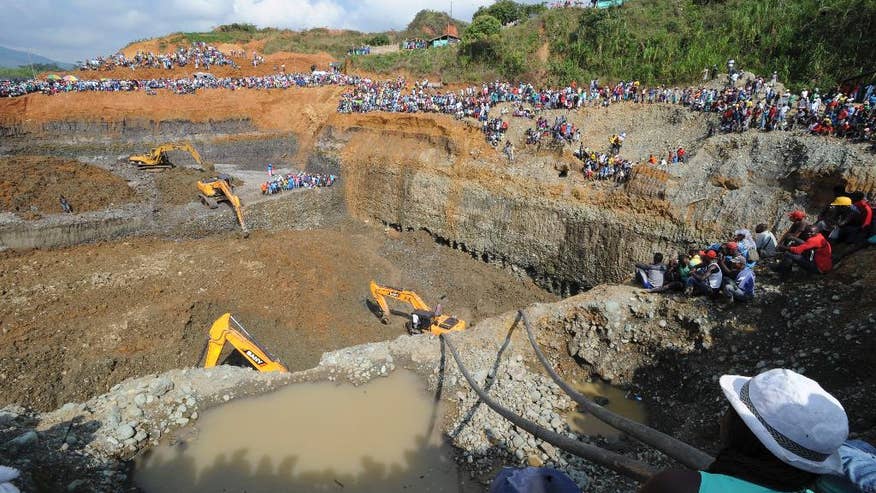
Illegal gold mine collapses in Colombia; 3 dead and 15 missing


Rescuers were searching for at least 15 people missing after an illegal gold mine collapsed in southwest Colombia. Authorities said three dead bodies had been recovered.

Cauca province Gov. Temistocles Ortega said the collapse occurred shortly before midnight Wednesday in a rural area near Santander de Quilichao, about 190 miles (315 kilometres) southwest of Bogota, the capital. He said illegal miners use machinery to open huge holes to extract gold, and one of the walls of a hole fell in.

By nightfall Thursday, rescue workers had recovered three bodies and three injured people, but were still searching for another 15 or so who were still missing. Police, troops, civil defence and the Red Cross were aiding in rescue efforts.

Mining accidents are common in Colombia, especially at wildcat mines in poverty-stricken areas dominated by criminal gangs with little state presence.

Less than a week ago, four people were killed inhaling noxious gases following an explosion at a mine in Antioquia province that continued to operate in defiance of an order to close.

Friday 02 May 2014

http://www.timescolonist.com/illegal-gold-mine-collapses-in-colombia-3-dead-and-others-missing-1.1018080

continue reading

Thursday, 1 May 2014

Coal mine collapse in Afghanistan kills at least 15 workers, 2 others missing


A coal mine collapse in northern Afghanistan killed at least 15 workers on Wednesday, an official said.

Two other miners were missing in the collapse Wednesday morning in the remote district of Dara Seuf in Samangan province, provincial Gov. Hirullah Anush said . He said the bodies of the 15 workers were recovered from the rubble.

Anush said the province has about 2,000 coal mines that are technically legal, since they pay tax to the government. But the mines operate in difficult conditions with workers using shovels and pick axes.

He said the provincial government has tried to shut down some mines deemed unsafe, but those in remote areas simply reopen. Most of the coal extracted is burned for heat in the winter or exported to Kabul or Pakistan.

Also Wednesday, Taliban insurgents attacked a security checkpoint and killed one police officer in Badakhshan province in the northeast, the provincial governor said. The police fought off the attack and killed eight of the insurgents, Gov. Shah Waliullah Adeeb said.

One police officer and four Taliban were wounded in the fighting, he said.

The Taliban insurgency have been launching near daily attacks around the country as foreign forces prepare to withdraw with the end of the mission at the end of this year, 13 years after the U.S.-led invasion to drive the radical Islamic movement's government from power for sheltering al-Qaida's terrorist leadership.

Thursday 01 May 2014

http://www.startribune.com/world/257329901.html

continue reading

South Korean ferry disaster: 213 confirmed dead, 89 still missing


The toll rose Thursday to 213 in the South Korean ferry disaster in which the 6,825-ton passenger ship sank off the country’s southwestern coast.

As of Thursday afternoon, 213 people have been confirmed dead, leaving 89 others still missing, Xinhua reported. There has been no rescue reported since 174 people were saved from sea after the ship sank April 16.

On the 16th day into the search Thursday, only one more body was recovered from the submerged ship as search operations were hampered by swift currents and murky waters.

From 3 p.m., divers resumed search for bodies trapped inside as tidal currents became slower.

Divers completed search operations in 44 passenger cabins of the total 64 on the third and fourth floors of the five-storey vessel. The cabins were believed to have accommodated most of the remaining unaccounted for.

Search and rescue operations have been hampered by rapid currents and floating objects. Waters near the scene are known for the country’s second-fastest currents.

As the ferry tilted underwater to the port side at some 90 degrees to the surface, the search was wrapped up for the right and the middle sides of the ship.

A total of 47 divers were conducting search operations, while 198 rescue ships and 37 airplanes were deployed to help search possible bodies swept far away from the scene. One body was found in waters around two km from the scene.

Divers searching the sunken Sewol ferry might not be able to recover every missing body, said the South Korean coast guard yesterday.

The recovery of a body from South Korea's ferry disaster some distance from the submerged vessel fueled concerns on Thursday that many among the scores still missing may never be found.

More than two weeks after the 6,825-tonne Sewol capsized and sank, 213 people have been confirmed dead but 89 remain unaccounted for, much to the frustration and anger of the victims' families. On Wednesday, a fishing boat pulled a body from the sea about two kilometers (1.2 miles) away from the main recovery site off the southern island of Jindo.

"This made us even more aware of the importance of preventing the loss of victims' bodies," Park Seung-Ki, spokesman for the Ministry of Oceans and Fisheries, told reporters.

Recovery workers put a ring of netting around the site days ago, but there are concerns that powerful currents in the area may have pulled some bodies into the open sea.

The relatives of those still missing are insisting that all the bodies are recovered before efforts begin to raise the sunken ferry.

But the dive teams, working in challenging and sometimes hazardous conditions, have yet to access 22 of the ship's 66 passenger cabins in their grim search.

Thursday 01 May 2014

http://www.india.com/loudspeaker/south-korean-ferry-mishap-213-confirmed-dead-89-still-missing-48758/

http://www.ndtv.com/article/world/fears-that-south-korea-ferry-victims-may-never-be-recovered-516664

continue reading

Monday, 28 April 2014

Toll in DR Congo train crash rises to 74


The toll in a train crash in the Democratic Republic of the Congo has risen to 74 dead.

Many people were trapped for days in the mangled wreckage of the goods train that flew off the rails last week in a swampy region about 65 kilometres north of Kamina, in the southeast of the country.

"There are 74 dead on Sunday night" and a further 163 injured, minister Felix Kabange Mukwapa told AFP news agency, adding that about 20 bodies had been recovered from under one of two carriages that overturned and was still lying on the tracks five days after the accident.

Earlier tolls had been revised from 57 to 48 but later went up again.

A newly purchased locomotive hurtled off the track on Tuesday as the goods train, bursting with illegal passengers, rounded a bend.

Many seriously injured were taken to Lubumbashi, the capital of the mineral-rich Katanga province, some 600 kilometres from Kamina, where the train began its journey.

Its planned destination was Mwene-Ditu in the diamond-mining province of Kasai-Oriental.

Witnesses said the train was carrying hundreds of passengers both inside and on top of its carriages, many of whom had paid an illegal reduced fare to ride the train without a proper ticket.

Monday 28 April 2014

http://www.sbs.com.au/news/article/2014/04/28/toll-dr-congo-train-crash-rises-74

continue reading

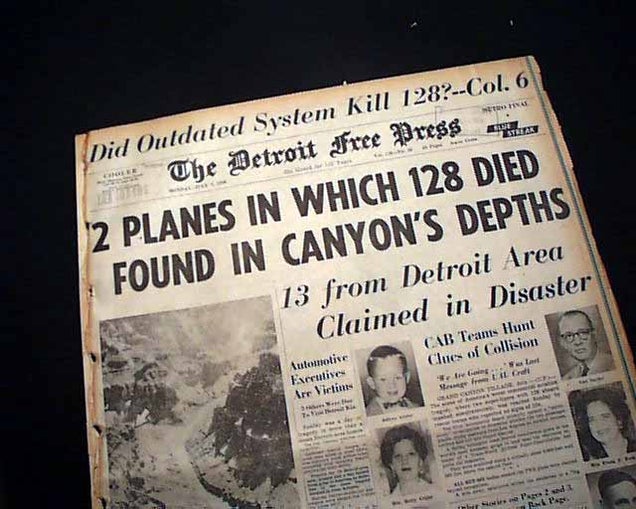
A 1956 plane crash in the Grand Canyon made flying safer


In 1956 two planes collided over the Arizona desert, killing all 128 people on board and scattering the debris deep inside the Grand Canyon. This week, the National Park Service designated the crash site a National Historic Landmark—even though they don't actually want you to go visit it.

At the time, the tragedy was the deadliest civilian plane crash on American soil. It also served as a devastating wakeup call to the fledgling airline industry, which was suffering from growing pains and lack of government support.

A United Airlines DC-7 and TWA Lockheed L-1049 Super Constellation both left LAX on the morning of June 30, 1956, the United flight headed to Chicago Midway and the TWA flight headed to Kansas City. Both planes were flying at different altitudes in uncontrolled airspace when the TWA flight requested permission from air traffic control to fly at higher than normal altitudes due to thunderstorms. Air traffic control said no, due to the United flight nearby. Then the pilot requested to ascend above cloud level, operating under visual flight rules or VFR (instead of instrument flight rules). It was understood that at this altitude, the pilot would be employing the "see and be seen" principle—responsible for visually spotting and avoiding planes nearby.

The planes knew they would be sharing airspace but did not have any way of knowing they were in such close proximity. It's also likely that both planes were off-course slightly to show their passengers the scenic landscape below. As the two pilots headed over the Grand Canyon, clouds probably obscured their views, and the planes collided at a 25-degree angle.

Although there's a burial site for the TWA passengers in nearby Flagstaff, Arizona, the crash site itself has never been formally recognized. For one, they're not exactly sure where the crash itself happened. The planes hit the ground at 700 feet per second near the confluence of the Colorado and Little Colorado Rivers. Each ignited fires that were so hot they fused the body of the plane onto the canyon rocks. No bodies were recovered intact.

There are parts of the planes which remain at the bottom of the canyon; due to the treacherous terrain it was impossible to recover all the pieces. But also due to that treacherous terrain, the National Park Service is not revealing the exact location of the crash site because it doesn't want people hiking there.

So why even have a landmark at all? In this case, the landmark status is more about the changes this site brought about. Because of the crash, the country enacted sweeping reforms for communication and safety for the airline industry. Due to the heavy press coverage the crash received, the public was outraged, and there was a movement to demand congressional hearings about the case. Between 1950 and 1955 there had already been 65 mid-air collisions over U.S. airspace.


In 1957, a motion was introduced to boost air traffic control funding, both to modernize the system and hire and train controllers. This would include ways to better manage visual and instrument flight rules. Airports also added radar, which would prove invaluable for tracking planes. And a few years later, the Federal Aviation Agency was formed to oversee all American airspace.

Although memorials for crash sites are commonplace, this is the first time a plane crash site has been landmarked. And it's also the first landmark which technically honors something which happened in the air, not on the ground, National Historic Landmarks Program branch chief Alexandra Lord told The Atlantic Cities:

"We've never done an actual crash site," said Alexandra Lord, branch chief of the National Historic Landmarks Program in Washington, D.C. "In some ways we can argue that the crash itself—which led to the scattering of pieces over a huge debris field—is what's crucial. And it sort of doesn't matter if you think of it as on the air or on the ground."

Next time you're flying over the American Southwest and your pilot tells you to look out the window to see the Grand Canyon, know that the reason you're flying safely is because of that site somewhere below. A single tragic crash spurred along the technology that made the skies a better place for all. And for that, a landmark is very fitting indeed.

Monday 28 April 2014

http://gizmodo.com/why-a-1956-plane-crash-site-in-the-grand-canyon-was-nam-1568330158

continue reading

S Korea ferry disaster: Floating buoy used to spot bodies being carried away


Search teams say they'll use floating buoys in an attempt to stop bodies drifting away from the accident site.

The buoys will be used to detect various environmental factors such as the wind direction, speed, water temperature and water pressure to convey information in real time about the possible location of bodies that may have been carried away by strong sea currents.

Among the 188 bodies recovered so far, around 40 were found outside the vessel.

There's currently a net 13 kilometers long surrounding the site.

The search team is also expanding its operations to a 60 kilometer radius around the accident site.

Divers were battling atrocious weather conditions and powerful swell on Sunday in their grim search for bodies believed trapped in a sunken South Korean ferry, a coastguard spokesman said.

Rolling seas whipped up by strong winds were badly complicating efforts to find the remains of more than 100 people still unaccounted for 11 days after the Sewol capsized with 476 people -- many of them schoolchildren -- on board.

Despite waves up to three metres (nine feet) tall and near gale-force winds, teams of divers were still trying to get into the ferry.

"The situation is very difficult due to the weather, but we are continuing search efforts, using the occasional calmer periods," a coastguard spokesman said, adding 93 divers would take part in Sunday's operation.

Heavy seas prevented divers from getting into the ship on Saturday.

Forecasters warned wind and rain would pick up throughout the day.

"There is a possibility that a high wave advisory will be issued in sea areas around Jindo Sunday afternoon," Yonhap news agency quoted a weather service official as saying.

Frogmen -- who were unable to get inside the ferry for the first two days -- have battled strong currents, poor visibility and blockages.

The conditions each mission can be no more than a few minutes in length.

But even in this short time, they are coming across scenes of horror in the murky water, including one dormitory room packed with the bodies of 48 students wearing lifejackets.

Around a quarter of the dead recovered so far have been found in waters outside the sunken vessel, and there are fears that some of the missing may have drifted free from the wreck.

That could be exacerbated if the sea is churned by the gathering storm, scattering bodies.

Authorities -- wary of the anger among relatives about the time the search ios taking -- have mobilised trawlers and installed 13-kilometre-long (eight-mile-long) nets anchored to the seabed across the Maenggol sea channel to prevent the dead being swept into the open ocean.

South Korea has asked Japan and China to inform it about any bodies that wash up on beaches, reports said Monday, as fears grow that some of those who died when a ferry sank may never be found.

Park Seung-Gi, a spokesman for the government's Joint Task Force which is co-ordinating actions, vowed Monday to redouble efforts to prevent bodies getting lost in the sea.

Special teams have been set up to search underwater around the sunken vessel, as well on the sea surface, nearby islands and shores, he said.

"We will try our best to find bodies by using all our resources including helicopters, warships, patrol ships and search personnel," Park told reporters.

"We have asked China and Japan to contact us if they, by any chance, find any unidentified bodies washed up on shore," it quoted one rescue official as saying.

In deeply Confucian South Korea, the proper burial of bodies -- often in the deceased person's home town -- is considered a way to show respect for the dead and to allow their soul to rest in peace.

Waterlogged debris, cramped conditions and poor visibility is making their gruesome task very difficult, say officials, with several frogmen reporting injuries or decompression sickness.

Monday 28 April 2014

http://www.arirang.co.kr/News/News_View.asp?nseq=161586

http://www.channelnewsasia.com/news/asiapacific/storm-swell-hampers-s/1084776.html

continue reading

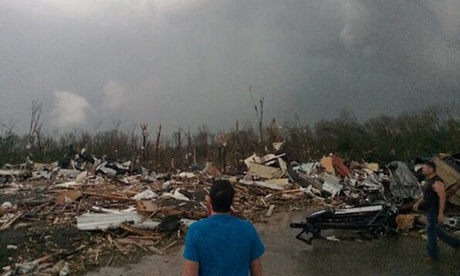
Tornado sweeps across southern US leaving at least 12 dead


At least 12 people have been killed after a powerful storm system wreaked havoc through the southern and central US on Sunday night.

A spokesman for the Arkansas governor, Mike Beebe, said 11 people were were killed in his state when a tornado carved through several suburbs north of Little Rock.

Local television station THV 11 said the local sheriff in Faulkner county had confirmed that six people died in the town of Vilonia.

"It's just devastating," Sheriff Andy Shock told THV 11. Shock said the town was facing a "mass casualty situation" and that nearby interstate 40 had been closed in both directions after cars and trucks were overturned.

Emergency workers and volunteers went door-to-door to look for victims. "It turned pitch black," said Mark Ausbrooks, who was at his parents' home when the storm arrived. "I ran and got pillows to put over our heads and ... all hell broke loose."

"My parents' home, it's gone completely," he said.

The large tornado stayed on the ground as it moved north-eastward for at least 30 miles (48km). Television footage showed badly damaged buildings and vehicles.

The neighbouring town of Mayflower was also badly hit. About 45 homes were destroyed and a lumberyard was damaged, said Will Elder, an alderman in the town of 2,300 people. He said at least one person was injured.

The tornado passed through the east side of town, tearing up trees and bringing down powerlines, making it difficult for the emergency services to find stricken areas in the the darkness.

"It's extremely hazardous here right now," said Elder. "The power lines are down, roads are blocked and they will have to proceed with caution."

In the western part of the state, Pulaski county sheriff's lieutenant Carl Minden said three people were killed when a tornado hit the area. Minden said several others were injured at the scene.

"I'm standing on the foundation of the house now. It's totally gone," Minden told the Associated Press.

The storm system passed through Arkansas at about 7.30pm as around a dozen twisters were reported across the region.

At least one person was killed in a tornado in the small Oklahoma town of Quapaw.

A police dispatcher in Ottawa County, Oklahoma, said a search and rescue effort was under way in Quapaw, but could not confirm reports of fatalities.

Tornadoes were also reported in Iowa, Kansas, Nebraska and Missouri on Sunday afternoon and evening, causing some damage but no known injuries, according to local officials and the weather service.

Monday 28 April 2014

http://www.theguardian.com/world/2014/apr/28/tornado-kills-two-in-oklahoma-as-sheriff-reports-mass-casualties

continue reading

Saturday, 26 April 2014

Body recovery from sunken S.Korean ferry suspended


Concerns are growing among anguished families that the bodies of those who died in the sinking of a South Korean ferry may never be found, as search teams suspended work on Saturday because of bad weather.

A looming storm and high tides put a temporary halt to operations to recover the remains of more than 100 people still missing over a week after the huge ferry capsized.

"Over the weekend, strong wind and rain is expected in the Jindo area", a coastguard spokesman told journalists.

"As efforts to find the missing people are becoming protracted, there are growing concerns among their families that bodies might be lost for good", he said.

The confirmed death toll stood Saturday at 187, with 115 unaccounted for -- many bodies are believed trapped in the ferry that capsized on April 16 with 476 people on board.

Making up the bulk of the passengers on the 6,825 tonne Sewol when it sank were 325 high school students -- around 250 of whom are either confirmed or presumed dead.

Although all hope of finding survivors has been extinguished, there is still anger and deep frustration among relatives of the missing over the pace of the recovery operation.

- Challenging conditions -


Frogmen have battled strong currents, poor visibility and blockages caused by floating furniture as they have tried to get inside the upturned vessel, which rests on a silty seabed.

The challenging conditions have meant divers are unable to spend more than a few minutes in the ship each time they go down.

Even so, they are coming across horrifying scenes in the murky water, including one dormitory room -- that would normally have held around 31 people -- packed with the bodies of 48 students wearing lifejackets.

Around a quarter of the 187 bodies recovered so far have been found in waters outside the sunken vessel, and there are fears that some of the missing may have drifted free from the wreck.


The gathering storm was intensifying worries that remains could be scattered when the sea is churned by strong winds.

Authorities -- wary of the palpable anger among relatives -- have mobilised eight trawlers and installed 13-kilometre (eight-mile)-long nets anchored to the seabed across the Maenggol sea channel to prevent the dead being swept into the open ocean.

Dozens of other vessels, including navy ships as well as helicopters, have also been scouring the site and beyond.

Three fisheries patrol vessels were being pressed into the search operation, expanding the hunt up to 60 kilometres (40 miles) from the scene of the disaster.

Police and local government officials will also be mobilised to scour coastal areas and nearby islands, a coastguard official said.

- Widening investigation -

Furious families demanded a meeting with Choi Sang-Hwan, deputy head of the Korea Coastguard, near the pier in Jindo Port, urging him to send the divers back into the water.

"We are waiting for the right moment as conditions in the sea are not favourable," said Choi.

Choi was physically attacked by angry parents on Thursday, a victim of the febrile atmosphere surrounding the tragedy, which has already seen multiple arrests and bitter recriminations.

It took divers working in difficult and dangerous conditions more than two days to get into the sunken ferry and two more days to retrieve the first bodies.

Many relatives believe some of the victims may have survived for several days in trapped air pockets, but perished in the cold water after no rescue came.

As a result some have asked for autopsies to be performed, to see if it would be possible to determine the precise cause and time of death.

The Sewol's captain, Lee Joon-Seok, and 10 crew members have been arrested on charges ranging from criminal negligence to abandoning passengers.

The captain has been particularly criticised for delaying the evacuation order until the ferry was listing so sharply that escape was almost impossible.

Divers battle darkness, fear to find bodies in sunken ferry

Divers grope their way slowly through the dark corridors and cabins of the sunken Sewol ferry. Bodies appear suddenly, floating by in the murky water, buoyed by life-jackets or the bloat of decomposition, their faces etched with fear or shock.

Some are still locked together in embraces, a freeze-frame of panic as the water rushed in and the ship sank. The hair of female corpses ripples in the current, framing pale faces.

At times, heavy sediment in the water can make flashlights useless and it is almost total darkness inside the South Korean ferry, which has flipped upside down on the seafloor. Divers must stretch their hands into the void to search for bodies. There's constant worry their lifeline to the surface, a 100-meter oxygen hose, will get snagged or cut as they swim deeper through the wreck's maze-like hallways.

For nearly a week now, dozens of divers have battled fast currents and cold waters — as well as exhaustion and fear — to pull out a steady stream of corpses. As they go deeper into what's become a huge underwater tomb, they're getting a glimpse of the ship's final moments April 16 before it capsized. More than 300 — most of them high school students — are feared dead.

"They can see the people's expressions at the instant" the ship sank, Hwang Dae-sik said of the team of 30 divers he supervises for the Marine Rescue and Salvage Association, a private group of professional divers who've joined Korean navy and coast guard divers in the search and rescue effort. "From the bodies' expressions, you can see they were facing danger and death."

Divers descend about 30 meters (100 feet) down and enter the ship through windows they've broken with hammers.

Han Yong Duk, a 33-year-old diver, said that visibility was often so poor that divers had to feel their way along the outside of the ship to find windows they could smash. One diver tried to hit the ferry with a hammer but only connected with steel, not glass.

Another civilian diver said that sometimes it was pitch black; other times there was less than 20 centimeters (a foot) of visibility.

"I got around by fumbling in the darkness to try to find things with my hands," said Cha Soon-cheol, who spent five days helping with searches. Swimming against the strong currents exhausted him.

Once inside the ship, divers have to dodge floating debris — passengers' belongings, cargo, ropes, chairs — but also bodies.

The ship turned upside down as it sank, so "just imagine a room that is flipped," said Hwang, who doesn't participate in dives himself but is closely involved in every other part of the operation. "Everything is floating around, and it's hard to know exactly where they are."

It is a delicate operation. Divers must move quickly to find decomposing corpses, but they must also be cautious to protect themselves from injury and keep their air supply hoses from getting cut off. The divers can often work for about an hour when they're hooked up to the hoses, Hwang said.

Some divers use oxygen tanks, but that typically allows for only about 20 minutes under water.

As they explore the hallways of the ship, bodies in lifejackets often float above them, near what used to be the floor, and divers must reach up to grab the bodies and pull them close so they can hold them while notifying colleagues above. They then carefully push the body through an open window cleared of broken glass and debris and let it float up to the boats.

Hwang says divers take special care with decaying bodies to make sure they don't damage them further. When a body without a life jacket is found one diver wraps his arms around the body and another diver pulls his colleague and the body to the surface with a rope.

The work is dangerous.

Air supply problems recently forced two members of Hwang's team to make risky, rapid ascents from about 30 meters (120 meters) underwater to the surface. Rising too quickly puts divers at risk of decompression sickness, also known as the bends, which in severe cases can be fatal. The two divers, he said, were treated in decompression chambers. They're now resting, with one suffering from back pain.

It's also emotionally exhausting, and divers often find themselves thinking of the lives lost.

Hwang said his divers try to avoid looking at the eyes of the bodies they retrieve to minimize the shock. It's not always possible. "Even though they have a lot of diving experience, they get really frightened when they first face the bodies," he said.

Many of the students are found hugging each other.

"How hard it must have been for the kids, with the cold water rushing in and darkness coming over them," Hwang said. "Yesterday, I had a lump in my throat talking about this. I thought to myself: Why did I tell them that I can help with rescues and have a lot of experience when I can't even save one life here?"

Saturday 26 April 2014

http://news.yahoo.com/body-recovery-sunken-korean-ferry-suspended-053924986.html

http://www.usatoday.com/story/news/world/2014/04/25/sewol-ferry-south-korea/8148419/

continue reading

Missing SAR helicopter and crew located by underwater robot submarine near Canary Islands


An underwater robot submarine, “Rรฉmora II”, located the wreck of a Search and Rescue helicopter that crashed into the sea in the waters of the Canary Islands in March, killing all 4 crew members, who were still on board.

The aircraft, from 802 Squadron based at the Gando airbase, has been located 2,632 metres below the surface, about 30 nautical miles southwest of Fuerteventura, during a search of the area around the last known location of the Super Puma helicopter.

Military were sent to the scene to assess the location and status of the aircraft, to ascertain how, and if it was possible, to recover both the helicopter and the bodies of Captain Daniel Pena, Lieutenants Carmen Ortega and Sebastiรกn Ruiz, and Sergeant Carlos Caramanzana.

Described as a “complex and difficult task”, the Spanish ministry of defence contracted an American specialist recovery and recovery company, Phoenix International, at an initial cost of 3.2 million euro, although this was later revised to 5 million, who set about recovering the helicopter and crew.

Despite initially looking like the aircraft would be recovered intact, the six-hour operation proved more difficult than anticipated when the nose and tail broke away from the fuselage during the lift. As the main chunk of fuselage was brought to the surface, it then became clear that only two of the bodies remained inside, although it was impossible at the site to determine who they were.

The two bodies recovered were transferred by another Super Puma helicopter to the naval base for examination, meanwhile, the robot submarine was sent back into the water to try to locate the two now missing crew, but was unsuccessful. A number of other body parts were later recovered from the sea, with forensic tests set to be carried out to ascertain if they belong to those remaining crew members.

In the early hours of Friday morning, the aircraft was brought by ship to the Las Palmas naval base on the island of Gran Canaria.

Despite a military spokesperson confirming that the search for the other two aircrew will be continuing, the search was called off on Friday evening, as it was now considered “unlikely” to find the remaining bodies of those two missing aircrew who dedicated theirs to saving others.

Saturday 26 April 2014

http://www.theleader.info/article/43416/spain/national/missing-sar-helicopter-recovered-from-the-sea-bed/

continue reading

Bosnia: 100 of 400 war victims found in mass grave identified


Forensic experts have managed to identify 100 of nearly 400 people killed during the 1992-1995 war and buried in a mass grave near the northwestern town of Prijedor, the State Prosecutor's Office in Sarajevo said on Friday.

The mass grave, containing the remains of 395 people, was discovered in 2013; it is located near the Tomasica mine outside Prijedor. An investigation has found that the victims are local Bosniaks and Croats who were killed by Serb police and military forces at the start of the war in 1992. Their bodies were brought to the Tomasica mine and buried there, and the mass grave remained hidden for more than two decades.

The exhumation began in June 2013, and the Prosecutor's Office said that the work had been intensified to complete the process as soon as possible. It also said that it was investigating some other locations in the Prijedor area believed to be mass grave sites.

Before the discovery of the Tomasica mass grave, about 1,200 non-Serbs from the Prijedor area were still missing. During the war in Bosnia and Herzegovina, about 30,000 people were reported missing and about 7,000 of them are still unaccounted-for.

Saturday 26 April 2014

http://dalje.com/en-world/bosnia--100-of-400-war-victims-found-in-mass-grave-identified/507025

continue reading

Friday, 25 April 2014

South Korea admits ferry disaster dead bodies given to wrong families


As visiting President Barack Obama offered South Koreans his condolences Friday for the ferry disaster, the South Korean government conceded that some bodies have been misidentified and announced changes to prevent such mistakes from happening again.

There have been several reports in South Korean media this week of bodies going to the wrong families, with the error sometimes caught only after the remains were taken to a funeral home. An “action plan” released by the government-wide emergency task force acknowledged that “there have been cases where the victims were wrongly transferred.”

Remains will be transferred to families when there is a match using DNA testing or fingerprint or dental records, the task force said. The transfer will be temporary when a body is matched though identification or physical description, and authorities will wait for more authoritative evidence before making the transfer permanent.

Divers have recovered 183 bodies so far, but 119 remain missing and are feared dead in the dark rooms of the submerged vessel.

Search officials including a navy spokesman and a diver said 35 of the ferry’s 111 rooms have been searched so far, Yonhap news agency reported. They said 48 of the bodies recovered were found were in a single large room built to accommodate 38.

The ferry sank April 16 on its way from Incheon port to the southern tourist island of Jeju. More than 80 percent of the 302 dead and missing are students from a single high school in Ansan, south of Seoul.

Friday 25 April 2014

http://www.theguardian.com/world/2014/apr/25/south-korea-ferry-remains-dead-wrong-families

continue reading

Another 20 Fromelles diggers identified


A further 20 Australian soldiers killed during the bloody World War I battle at Fromelles have been identified, defence officials have confirmed.

Relatives are being notified after the soldiers became the latest to be identified out of the 250 Australians and Brits recovered from a mass burial site at Pheasant Wood in northern France in 2009.

It takes to 144 the number of Australian diggers identified by a joint Australian-British program which uses DNA and other evidence.

The newly-identified soldiers are likely to have graves dedicated in their names for the first time at a ceremony in Fromelles in July.

'Defence can confirm that a further 20 Australians from the 250 Australian and British World War One soldiers recovered from a mass burial site at Pheasant Wood in France in 2009 have now been identified,' a

Department of Defence spokesman said on Thursday.

An official announcement will be made after the soldiers' families are notified.

There are still 67 Australian and two British soldiers who remain unidentified. Another 37 have been interred as 'A soldier of the Great War - Known unto God'.

The DNA identification program has now officially concluded but the army's Unrecovered War Casualties team will continue to process any new information.

'The Government and Army remain determined to identify as many of the Australians as possible,' the spokesman said.

Fromelles was the first major action involving Australian troops in France in World War I.

It was fought over July 19 and 20 in 1916 and resulted in more than 5500 Australian dead and wounded. Many of the fallen were never found.

The battle is regarded by some as the worst 24 hours in Australian military history.

In 2009 a mass grave was located in Pheasant Wood on the site where German soldiers had buried Australian and British dead.

All the bodies have now been reburied in the new Fromelles (Pheasant Wood) Military Cemetery.

Friday 25 April 2014

http://www.skynews.com.au/news/world/national/2014/04/24/another-20-fromelles-diggers-identified.html

continue reading

There are still broken bones beneath Bangladesh's collapsed sweat shop


One year ago today, Rana Plaza — a nine-story factory building in Savar, Bangladesh — collapsed, killing 1,116 workers immediately and injuring many more. Some of their bodies are still in the back lot, waiting to be found.

Images of the wrecked building — layers of concrete pancaked from roof to street — made it perfectly clear how severe the collapse had been. A year on, the site looks a lot different from the one you see in those photos; it's now an empty gap in a dense commercial strip, a rare blank in one of the most crowded, swiftly developing nations on Earth. But like the World Trade Center site before it, the grim history of this spot has temporarily delayed redevelopment. Besides an ugly hammer-and-sickle statue left there by some communists, nothing has been added.

Curiously, almost nothing has been taken away, either. A week after the collapse, heavy construction machinery moved in and started to shift the piles of broken concrete to an undeveloped lot a few meters away. The wreckage is still there, unsearched. It is known to contain body parts of workers who died in the collapse. The question is why they're still there and what this means for their families.

At another historical atrocity, some 12 years and 7,000 miles away, the approach to human remains was very different. After the World Trade Center attacks in 2001, a hunt began with the excavation of Ground Zero. Eventually, the results of the search included bone fragments retrieved from locations as far away as the gravel roof of the Deutsche Bank Building. To date, the New York Office of the Chief Medical Examiner (NYOCME) has catalogued over 21,000 human remains and matched two-thirds to the 2,794 victims of 9/11.

Just as 9/11 initially overwhelmed the NYOCME, the Rana Plaza atrocity overwhelmed the Bangladesh National Forensic DNA Profiling Laboratory. In the seven years between January of 2006 and February of 2014, the Bangladeshi lab profiled just 222 homicide cases, or about 31 per year. Rana Plaza immediately killed 1,116 people. It was like three decades of homicides in a single day. The lab had nowhere near the kind of funding or equipment as the NYOCME. In fact, the lab in Bangladesh was unable to efficiently identify the deceased until the FBI donated some software.

However, in other ways the identification work is easier than 9/11. The World Trade Center attacks were an “open manifest mass fatality” in a dense section of Manhattan, which meant the total number of victims was unknown. The force of explosions had also “vaporized” some bodies, and fires as hot as a cremation chamber burned for days. At Rana Plaza, there were one-third the amount of victims, and casualties were clearly limited to workers inside the building. The disaster crushed and burned some bodies, but didn’t “vaporize” or cremate anyone. This means that identifying the remains of every person who lost their life in the Rana Plaza atrocity is theoretically possible.

In practice, identification has its limits. The process hinges on extracting DNA, chemically processing it and comparing it to samples from living family members. Software like CODIS quantifies matches and assists in certainty, but while DNA sometimes lasts a long time, extracting enough DNA for a conclusive match can become more difficult over time if the tissues are left exposed to harsh conditions.

In the wreckage behind Rana Plaza, what's left of workers has been dumped into a kind of landfill of garments and concrete – not ideal conditions for preserving DNA. The people looking for body parts are not scientists or government personnel, but the bereaved families of the dead.

This neglect has led to another problem: there are more people waiting for bodies than there are actual bodies. By mid-May, some 550 people had registered as family members with the DNA lab, which held samples from only 321 individuals. Now, a year after the collapse, 207 bodies have been identified. Over 100 bodies remain unidentified, but some 300 families are waiting for a lost loved one.

Mere absence was enough to constitute a death after 9/11, though some disappearances were highly ambiguous, and the identification of bone fragments was often purely to allow families some closure. In a gesture of sensitivity, the 9/11 memorial eventually even classified voice recordings of the deceased as “human remains”.

In Bangladesh, where people still gather at the old factory to weep for missing loved ones, no such respect exists. According to government policy, missing Rana Plaza workers must be identified by a DNA match before their families can receive compensation – even though there's basically only one possible answer for what happened to those workers.

This is partly because of misidentifications in the atrocity’s chaotic aftermath. Last April, hundreds of family members came to Savar. Amid their panicked searching and overwhelming grief, they identified the first recovered bodies through their phones, ID cards or clothing. To relieve overcrowding, rescuers buried unidentified bodies in Jurain cemetery (many of whom have now been identified via DNA samples rescuers obtained). About 777 bodies were also hurriedly given to loved ones, sometimes in error. Meanwhile, criminals laid claim to a few cadavers and their 20,000 taka (about $220) payouts, dumped the corpses and escaped with the money.

The fact that fraud of that kind happens here demonstrates something important about Bangladesh: the level of poverty is so crushing that some are willing to steal a stranger's corpse, just for the $220 payout. It’s crushing for the actual families of the dead, many of whom were destitute before losing a major breadwinner. The humanitarian function of DNA identification after 9/11 was to allow families emotional closure. In Bangladesh today, it would also enable families to eat.

Families now allege that the government is obscuring the true number of victims to push down compensation payouts, while a Bangladesh Garment Manufacturing and Exporters Association representative has told the press that families are “village people who are unclear about how they can properly trace [their living family members]”.

The information that could end the debate is readily available; it’s in the rubble directly behind the old factory.

In the football pitch-sized lot, concrete chunks are piled high. Scattered throughout there is a mรฉlange of purchase orders, lunchboxes and cheap garments. While scalps, limb bones and other large bones are visible, there are likely plenty of smaller fragments hidden among the rubble. Family members may want these for identification purposes, but the larger bones are the only ones retrievable by untrained observers.

And there are many of these amateur archaeologists. Scavengers earn a living sifting through the rubble to find sellable scrap metal; sari-clad women hunt; children hammer concrete off reinforcing bars. Standing on a pile of rubble, scavenger Laila Begum thinks about coming across bones for a long while. “I’ve never seen [any],” she says.

But a local man named Khalil told me that he believes bones are there. And he’s right. This December, children collected over 100 body parts and turned them in to Savar police. According to the police chief, it was the fifth time that month.

For now, there is no word on whether those remains will be tested.

Friday 25 April 2014

https://news.vice.com/articles/there-are-still-broken-bones-beneath-bangladeshs-collapsed-sweat-shop?trk_source=homepage-in-the-news

continue reading

South korea ferry disaster: Confirmed death toll at 183 with 119 still missing


Latest search operations for the sunken ferry have been focused on its third- and fourth-deck cabins, where most of the missing victims are believed to be trapped.

Working during the last remaining critical hours of favorable weather conditions, Coast Guard, Navy and civilian rescue workers and divers recovered more than 20 bodies overnight.

In waters off Korea's southwestern coast where the accident happened search operations are now into a tenth day.

Not a single survivor has been found since the ferry capsized last Wednesday morning but efforts continue, with authorities having decided to use a "diving bell" at the site for the first time later this afternoon.

Divers also say there were no air pockets inside the sunken ferry reducing the chance of possible survivors after the ship submerged completely underwater.

The rescue operation continues although currents in the area are forecast to get stronger again from today.

Three more female bodies most likely Danwon High school students were recovered from early this morning -- and the death toll now well exceeds the number of survivors standing at 183 with 119 still missing.

The divers will continue their search on the third floor where the cafeteria isand on the fourth level of the ship where the cabins of most Danwon High School students were located -- focusing on the center of the deck.

Authorities will also deploy a diving bell in an hour from now - a chamber that could be used as a base and transportation of divers underwater to beef up the number of divers that can engage in search operation.

Five cranes are on stand-by, but no one assumes the lifting will take place any time soon.

But the search will continue as parents of the missing have requested the ferry not be lifted out of water until every body is recovered.

the all-out search efforts came after the exhausted and angry parents of the missing Danwon High School students made their doubts about the ongoing operation known to authorities here.

They sat down with the oceans minister and the coast guard commissioner from 5 p.m. Thursday evening questioning them for hours about whether enough was and is being done.

The parents want more diving distance lines to be installed on the fourth deck of the sunken ferry where most students are expected to be and they are demanding more civilian divers be brought into the operation.

Parents want them back in the water as they think there are not enough divers out there to recover the bodies of their children.

Several parents will also be out on the waters on the barge where divers engage in search operation.

The maritime minister and coast guard chief will stay on site to direct the operations and assist the familiesas the parents requested until the last student is brought back on shore.

Friday 25 April 2014

http://www.arirang.co.kr/News/News_View.asp?nseq=161496&category=2

continue reading

Thursday, 24 April 2014

Deadly illegal mining booms below South African City of Gold


Smoke rises from a derelict mine shaft 25 miles east of Johannesburg, where illegal miners cook, work and sleep below ground for weeks at a time.

They have broken through a slab of concrete covering the entrance to the shaft, one of 6,000 abandoned mines, many around Johannesburg, known as “eGoli,” or “City of Gold” in Zulu. At least 40 unlawful prospectors have died in South Africa this year as mines collapse, workers succumb to poisonous gases and gangs wage turf wars underground.

“Any mistake and you feel you’re going to be killed,” said Joseph Sithole, 23, an undocumented Mozambican migrant, as he stood among corrugated-iron shacks and rubbish-strewn paths near the mine. He recounted how last year he dashed to one side of a shaft after hearing a crack, narrowly avoiding being buried by falling rocks. He felt his way to the surface through clouds of dust.

Sithole is one of 14,000 people the government estimates are now involved in illegal mining, which comes as a drop in gold prices and aging ore bodies shut South African shafts. The practice has grown to create a complex criminal industry valued at 6 billion rand ($566 million) a year, Mineral Resources Minister Susan Shabangu said in February.

The government now plans to block up entrances to abandoned mines, compel owners to heighten security and increase convictions for illegal mining.

Worth Risks

“It’s getting out of control,” Shabangu said. “We need to act with speed.”

While Sithole, in jeans and slip-on shoes, typically earns less than $5 a day, he said it’s worth the risk, because hitting a rich seam can make him significantly more and allows him to send money home to his mother in Maputo, Mozambique’s capital.

Sithole and prospectors like him are known as zama-zamas, or hustlers, in Zulu. They live and work in subterranean tunnels rife with robbery and prostitution, according to police. Illegal miners from job-scarce nations including Zimbabwe, Mozambique and Lesotho as well as fired workers from South Africa, where almost one in four is unemployed, are drawn to the shafts.

Rockfalls, gang violence and robbery are becoming more common as some of the zama-zamas fight between themselves for a bigger share of the profit. Sithole says that he and his colleagues work “innocently” and carry no weapons, which means they are victims of the violence.

Gang Wars

Sithole was once held at gunpoint by a gang from Lesotho, robbed and forced to mine for two straight days, he said. The Mozambican citizen came to South Africa in 2010 after being recruited by a man from his neighborhood in Maputo, he said.

“It’s much better here because even the little that you get here when you go back home it’s worth much more,” said Sithole, whose father is a welder in Tembisa, a township north of where he lives near Brakpan, and two brothers work nearby fitting tiles.

The 28 percent drop in the gold price last year and the dwindling amount of ore in South Africa that can be mined profitably has increased the number of abandoned shafts around Johannesburg. The city lies in the middle of the Witwatersrand basin, the source of a third of all bullion the world has yet produced.

The government estimates there are 6,000 illegal miners underground and 8,000 on the surface, equivalent to about 10 percent of the number of legal employees in the industry. Survival Instinct

Shabangu’s ministry didn’t respond to questions first sent on March 13 on the number of illegal miners killed and convicted in 2014 compared with previous years. She won’t be available until after national elections on May 7, spokeswoman Ayanda Shezi said.

For Sithole, it’s about survival.

Using hand tools, a head torch and rope, he and three friends can mine three grams (0.1 ounce) to four grams of gold in a week, earning the group 960 rand to 1,280 rand. That equates to about $4.60 daily each, enough to buy a cabbage and an 11-pound bag of corn meal. The sum is 82 percent lower than the average black South African household’s income of $26 a day, according to government statistics.

With shafts extending down from the surface as many as 2.4 miles, South Africa’s gold mines are the world’s deepest, and it takes Sithole as long as two hours walking through a labyrinth of tunnels to get to the ore. He spends a week below ground at a time, living in the dark, often flooded shafts.

Good Money Kenny Mashiane, 34, another illegal miner who works independently of Sithole, said in a productive week in a rich seam of gold ore he can make as much as 3,000 rand.

“It’s risky but you can make good money, if you’re lucky,” said Mashiane, who is South African. “You need to study and know where to go.”

Mashiane, who wore a ragged white shirt held together by strands of material, blue overall pants and a Nike (NKE) baseball cap, said he used to mine platinum for Lonmin Plc (LMI), the world’s third-biggest producer of the metal, before losing his job in 2004 in Rustenburg, 106 miles northwest of Johannesburg.

Goliath Gold Mining (GGM) Ltd. owns prospecting rights to the land where Mashiane and Sithole mine. The company bought them from the liquidators of Pamodzi Gold East Rand Ltd. in 2012, according to spokesman Grant Stuart.

Those who have died this year include a group of 20 people, predominantly Zimbabweans, who were poisoned by carbon monoxide in a mine near Roodepoort, west of Johannesburg, according to Paul Ramaloko, a spokesman for Hawks, the South African Police Service’s anti-corruption unit. That mine is not owned by Goliath.

Rising Incidence

Unlawful mining and associated violence is increasing due to “poverty, unemployment and large numbers of illegal immigrants in South Africa,” the Chamber of Mines, which represents producers including AngloGold Ashanti Ltd. (ANG), said in an e-mailed statement on March 31.

Security guards, policemen and legal mine workers take bribes from zama-zamas, allowing them access to ore-bearing shafts and fueling the illicit industry, according to Nash Lutchman, senior vice president at Sibanye Gold Ltd., the biggest producer of gold from South African mines.

Legal operators are also falling victim to the zama-zamas, who recruit fired laborers and steal equipment, the chamber said. Sithole and Mashiane said they mine in abandoned shafts with no guards and buy their equipment.

“While we’ve certainly seen reports of illegal mining activities, the careful securing of entrances to our operational sites has thus far worked for us,” said David Noko, AngloGold’s executive vice president for sustainability.

Buried Bodies

The chamber is establishing a precious-metal fingerprinting system that can trace where gold and platinum comes from and working with government and international bodies such as the United Nations to target criminals who trade illegally mined metal across national borders.

Rockfalls are often caused by the mining of gold-rich rock pillars that were left behind by companies to prevent shafts from collapsing, according to Herbert Sogoni, 61, a retired legal miner from Sithole’s shanty town.

“There are still a lot of bodies captured by the rockfalls that are never brought to the surface,” he said.

Rival gangs are just as dangerous as rockfalls. Murders happen during turf wars between groups fighting for rich mining areas, according to the police’s Ramaloko. Women often work below ground as prostitutes, he said.

‘Not Safe’

As many as 200 people were allegedly trapped underground after a gang of zama-zamas blocked the entrance to a shaft in February near Brakpan, where Sithole lives. ER24 emergency-rescue service helped haul 24 people out while others refused to surface for fear of being arrested. The 200 figure may have been exaggerated by the miners to guarantee rescue, or they fled through tunnels to escape via other shafts, ER24 said.

Violence and intimidation have caused Thompson Ngobeni from Mozambique and Abednico Mkhize from South Africa’s KwaZulu-Natal province to say they won’t go underground again. The pair, both 25, were digging for gold in waste material from a mine dump near Brakpan when interviewed.

“It’s not safe, people are killing each other and robbing each other,” said Ngobeni as he shoveled gray waste rock into a plastic bucket. “They shoot each other sometimes.”

While the gold content of the waste rock is less than a third of what they could mine underground, it’s much safer to work on the surface, Mkhize said.

No Excuse Once the rock is ground into a fine powder, the men pour it into a sieve and add water, making a paste that they then drip onto a towel placed on a plank of wood. They scrape the slush into a bowl and add mercury.

Gold particles cling to the mercury and the men take the substance and put it in a cloth. They squeeze the cloth to extract the mercury and form a small ball of gold concentrate.

“Back home if you’re stuck, you’re stuck,” Ngobeni said. “At least here you can get something yourself.”

Shabangu, the mining minister, said people forging a living from abandoned mines and waste materials are contributing to a proliferation in crime including burglaries and assaults committed by zama-zamas. “Poverty is no excuse for criminality,” she said on Feb. 21.

This happened at Blyvooruitzicht, a 72-year-old gold operation 50 miles southwest of Johannesburg that closed in July last year. Residents and former workers in the mine’s neighboring village have been robbed, beaten and raped by some of the illegal miners, according to the National Union of Mineworkers.

Rising Convictions

Many are living without water and electricity after cables, pumps and generators were stolen, said Richard Xati, a spokesman for the NUM in the area.

Convictions for illegal mining are increasing, with 100 people sentenced already this year, according the Hawks’s Ramaloko. While prison terms can range from three years to five years, miners are often caught without ore, which they process underground, so can only be charged with trespassing. The police are now focusing on the dealers who buy the gold, he said.

Thursday 24 April 2014

http://www.bloomberg.com/news/2014-04-23/deadly-illegal-mining-booms-below-south-africa-s-city-of-gold.html

continue reading

Families protest opencast mine plans on site of Diglake disaster burial ground


Outraged descendants of miners who drowned in a colliery disaster staged a protest against plans to build an opencast mine on the site.

The group waved banners outside the civic offices before Newcastle councillors decided whether to support or oppose a scheme to extract 450,000 tonnes of coal from a site at Great Oak, Bignall End over 15 months.

Campaigners say the proposal is disrespectful to those who died in the 1895 Diglake disaster as dozens of bodies are still trapped beneath the ground.

Staffordshire County Council will make the final decision.

Judith Edgeley’s great-great grandfather William Roberts was killed in the Diglake disaster.

The 48-year-old of Red Street, near Audley, said: “This is effectively a burial ground, we have no idea where those bodies are.

“I have asked UK Coal countless times about how they would make sure that they are not going to disturb the bodies and I’ve had nothing to reassure me. All they say is they’re not digging in the area where the disaster happened – but no-one can say where they actually are.

“If you look at the size of the lorries and equipment to dig up other sites, there’s no way they would be able to tell and we could have a situation were UK Coal are ferrying the remains of 40 miners up the A34.”

A total of 77 men and boys died in the Diglake Collliery flooding on January 14, 1895, when water from an underground reservoir burst into the pit.

Three unidentified skeletons that were recovered from the mine in the 1930s. The remaining bodies have never been recovered.

Claire Barnish, chairman, of the Campaign Against Great Oak Opencast (CAGOO) organised the protest outside the civic offices.

The 33-year-old, of Raven’s Lane, Bignall End, said: “There are so many reasons to object to this mine.

“The site is an unofficial graveyard for the families of the Bignall End area.

“Not only that but the mine would destroy a beautiful area of greenbelt and cause noise and air pollution for people in the village.

“I’m pleased that the borough and parish councils have sided with us on the matter. I hope the county see it our way too.”

Newcastle Borough Council unanimously objected to the plans at Tuesday’s meeting.

Councillors added recommendations to their planning officer’s report that UK Coal must set up a fund to reinstate the area back to its former glory if the plans are approved – after concerns were raised over the financial security of the company.

Councillor Sophia Baker, said: “We need to make it clear to the county council that Newcastle Borough Council objects to these plans in the strongest possible terms.”

Councillor David Stringer added: “I’m quite sure if we would refuse this application tonight if we could.

“If it does go through, we have got to make sure that restoration fund is in place to protect the people living in the area.”

Thursday 24 April 2014

Read more: http://www.stokesentinel.co.uk/Families-protest-opencast-plans-site-Diglake/story-20999572-detail/story.html

continue reading

More typhoon ‘Yolanda’ bodies found


Five months after Supertyphoon “Yolanda” leveled large swathes of the Eastern Visayas, dead bodies continue to turn up.

Seven bodies were recovered in Tacloban City over the weekend as government workers scoured the area for victims of one of the most destructive typhoons to hit the country, the National Disaster Risk Reduction and Management Council (NDRRMC) said Tuesday.

The NDRRMC said the death toll from Yolanda now stood at exactly 6,300, most of them still unidentified, while the typhoon left almost P89.6 billion worth of property and infrastructure damage.

It said 1,061 persons remain missing and a total of 28,689 were injured in different typhoon-related incidents.

The typhoon, which made landfall six times before leaving the Philippine area of responsibility, affected some 3.4 million families composed of 16 million individuals in nine regions.

The NDRRMC said Yolanda, which triggered storm surges several meters high, displaced four million individuals as it knocked down one million houses.

Thursday 24 April 2014

http://newsinfo.inquirer.net/596636/more-yolanda-bodies-found

continue reading

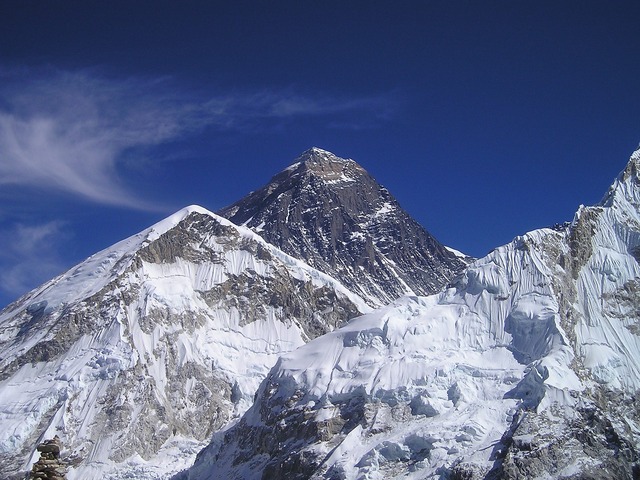
Mount Everest has claimed many lives


Mount Everest has recently claimed 16 lives from a deadly avalanche, which makes this the deadliest disaster that the mountain has ever seen in one day. Though this is a larger-than-usual tragedy, death on Mount Everest is not a rare occurrence. Since 1922 people from all over the world have attempted the grueling climb to the top. Climbers all attempt to stay alive for the totality of the climb, though Mount Everest often has a different fate in mind, continually adding victims to its huge list.

The first climbers in 1922, General Charles Granville Bruce and George Mallory, were the first in history to make it past 8,000 meters on a mountain climb. This group was the second in recorded history to attempt Mount Everest, the first made it just past 7,000 meters one year prior. Since this first record-setting climb many people have tested their endurance and skills by climbing the mountain.

Mount Everest reaches just over 29,000 feet in height, proving to be disastrously hard on the human body due to its lack of oxygen and frigid temperatures. Many climbers experience bodily rejection to the altitude, suffering from headaches and extreme frostbite if not properly prepared. The snowstorms on the mountain are extreme, often causing avalanches like the deadly one earlier this month. Throughout history Mount Everest has added victims to its already huge list, with a total that causes many to wonder why so many attempt the dangerous stunt.

By the year 2005 a recorded total of 186 people died from attempting to climb Everest. This is not counting the many unidentified or lost victims. While the recent avalanche claimed 13 victims in one fell swoop, Everest has a few years where the cumulative death toll rose higher than this. In 1996 Mount Everest stole 15 lives and in 1982 the mountain laid claim to 11. Some of the most iconic landmarks of the mountain are dead bodies. Green boots, an unidentified climber who froze to death on the mountain in 1996, marks a close proximity to the summit. At 8,000 meters high, ironically the height reached by record-breakers in 1922, is what climbers call the “death zone;” 200 plus bodies of Everest’s victims are littered here.

Dead bodies are not all one will find on a climb to the top of Everest. Unfortunately, many climbers leave behind trash and equipment; there is also remnants of a helicopter that crashed into the mountain years ago. Due to the dangerous nature and expenses of making a climb, no one follows after climbers to pick up left equipment or trash. Everest mostly sees wealthy individuals; a single climber will spend upwards of $30,000 to attempt the feat.

While the death toll of Mount Everest does not have an exact pattern, there are not more than one or two deaths a year for decades at a time in some cases. The first year saw 7 deaths; a number that high was not seen again until 1970, with eight lives claimed. The recent catastrophe has many wondering if Everest is becoming more dangerous than previous years to attempt. It is yet to be determined how much longer climbers will have the option to attempt Everest; the world may see a day where any attempt is not in a person’s best interest. Time will be the only indicator of whether or not Mount Everest will be able to continue adding to its huge list of total victims.

Thursday 24 April 2014

http://guardianlv.com/2014/04/mount-everest-total-victims-list-huge/

continue reading

Ideal procedure was not maintained in identifying Rana Plaza victims


Faced with an industrial disaster of an unprecedented scale, it was not possible to follow the ideal procedure of using DNA tests to identify the Rana Plaza victims, the chief of the national DNA lab has told the Dhaka Tribune.

Although more than 100 victims remain unidentified after a year, the identifications could still be made if the government took initiative to collect DNA samples from relatives of all the victims, he added.

Professor Dr Sharif Akteruzzaman, head of the National DNA Profiling Laboratory at the Dhaka Medical College (DMC), said they had received 322 DNA samples from unidentified bodies as well as collecting 556 samples from families of the victims. So far, 206 of the bodies have been identified in three phases, he added.

According to official government figures, a total of 1,134 bodies were recovered from under the collapsed building.

The DNA test was not a complete procedure but a partial one, Akteruzzaman admitted, adding that samples from only one-fourth of the victims had been sent to the DNA lab, while 812 bodies had been handed over to relatives without collecting any DNA sample.

As such a large-scale incident was unprecedented; the bodies were improperly handed over to those claiming to be family members, after identification was made only through clothes, ornaments, or objects found in the pocket.

Although the national DNA lab had experience in carrying out DNA tests with a low-capacity machine, it needed the US Federal Bureau of Investigation’s Combined DNA Index System (Codis) to carry out such a large-scale test, the lab chief said.

The lab carried out 1,000 tests a year on an average, but was forced to conduct a similar number of tests within only a five-month period after the Rana Plaza collapse, he added.

It was still possible to identify the rest of bodies, if people who were yet to locate their relatives would submit DNA samples, Dr Akteruzzaman said, adding that the government could advertise in the mass media in this regard.

The government could also take an initiative to exhume the victims and collect DNA samples, in order to cross-check and confirm their identities based on other DNA samples collected from the relatives, he added.

Dr Akteruzzaman also slammed the BGMEA, claiming that the apex body of apparel makers did not contribute anything to the DNA testing efforts, and added that more family members of victims would have come forward to provide samples if the BGMEA had been more serious on the issue.

To ensure better services for any future disaster, the DNA lab chief said no dead body should be handed over to relatives without preserving DNA samples. A temporary morgue should be set up beside the disaster site, Dr Akteruzzaman said, adding that all garment workers along with public and private organisation workers who faced risks of a disaster should be brought under a DNA database.

Confusion over the total number of missing workers

Even though one year has already elapsed, there is no fully comprehensive list of the Rana Plaza victims while many of them are awaiting compensation.

Still there is an utter confusion over the total number of missing workers, buried after identification, rescued and injured workers because of lack of a complete report by the government.

According to the Labour Ministry, 180 people were still unaccounted for. But the Centre for Policy Dialogue (CPD) report said it was 88 while Bangladesh Institute of Labour Studies (BILS) put the figure at 379 and Rana Plaza Coordination Cell at 146.

The ministry said 127 people were buried unidentified, while the CPD said it was 27, ActionAid 137 and Rana Plaza Coordination Cell 136.

The CPD revealed the findings in its report titled “One Year after the Rana Plaza Tragedy: Where Do We Stand? The Victims, the Sector and the Value Chain”. The report was released at a programme held at Brac Centre Inn yesterday.

Lawmaker Shirin Akter said: “A list should be posted immediately on the website.” She added: “If there was a trade union in the factory, it was not possible to force the workers to work there.”

Shireen Haq, founder member of Naripokkho, said: “We have noticed lack of coordination in rescuing the victims and publishing a comprehensive report. Are we ready enough to handle another disaster like Rana Plaza?”

Thursday 24 April 2014

http://www.dhakatribune.com/bangladesh/2014/apr/24/%E2%80%98ideal-procedure-was-not-maintained-identifying-rana-plaza-victims%E2%80%99

continue reading

Indian Air Force to set up high-risk crew’s DNA database


In a first, the Indian Air Force has initiated a project for DNA profiling of its personnel, selecting a high-risk group of aircrew that undertakes dangerous missions for the first round. A database of the DNA records will be established in Pune.

The DNA samples of nearly 2,500 crew members who face “potential threat to life” during everyday operations are being collected. The project, initiated by the Directorate General of Medical Services (Air), was accelerated after last year’s helicopter crash in Uttarakhand in which 20 people died. It took several days before some of the bodies could be handed over to the families as they could not be identified.

A similar crash that took place in a high altitude area in the Northeast in 2011 also posed several difficulties for the medical teams in identifying the remains.

“Establishing identity of the deceased is not only a legal necessity but also a moral responsibility as it has emotional implications for the family members. DNA profiling of the available body parts is the only foolproof scientific method of establishing identity of the deceased,” said an IAF official.

“In the first phase, the samples of crew members who undertake dangerous missions are being collected, but this could expand across the force later,” said an official said. For the past few weeks, blood samples of all

IAF air crew in the high-risk group are being collected and the project is likely to be completed by July-end. “The blood samples being collected by single prick method will be recorded in FTA (Fluorescent Treponemal Antibody) cards, the process by which such a profiling is stored, to be part of the repository at the Forensic Department of the Armed Forces Medical College (AFMC) in Pune,” said an official.

The DNA profiling of air crew from the Army and Navy has also been given priority. Over the next few years, once the project includes the entire armed forces, the FTA cards for nearly 1.5 million personnel are likely to be generated, making it the largest repository of DNA profiles in the country.

Thursday 24 April 2014

http://indianexpress.com/article/india/india-others/iaf-to-set-up-high-risk-crews-dna-database/

continue reading

South Korea's ferry crash: 159 bodies found, 143 still missing


The death toll from South Korea’s ferry crash has reached 159, with 143 people still missing, the coastal guard of the Chindo island said. The search and rescue team say that the bodies of the missing people are most likely in the 4th level and in the cabins.

Though the weather conditions have improved, the divers are prevented from making further advances by poor visibility.

More than a week after a South Korean ferry carrying 476 people capsized and sank, North Korea finally voiced its condolences Wednesday for the victims of the disaster, including the many schoolchildren who died.

The message was sent between the two Koreas' Red Cross organisations who regularly handle official cross-border communications, the South's Unification Ministry said.

"The North said in the message that it conveys deep condolences that so many passengers, including young students, died or went missing due to the sinking of the ferry Sewol," the ministry said.

Until now, North Korea had been the glaring exception among the messages of sympathy, condolence and support that have poured in from around the world after the Sewol sank with devastating loss of life last Wednesday.

North Korea's state media has barely commented on the tragedy that has dominated global headlines for the past seven days.

The confirmed death toll stood at 150 on Wednesday, but 152 were still unaccounted for, their bodies believed trapped in the inverted, submerged ship.

Heads of state across the political and geographical spectrum have sent personal messages, including US President Barack Obama, Russia's Vladimir Putin and China's Xi Jinping.

Not a word, however, from North Korean leader Kim Jong-Un who, the North's official KCNA news agency reported, had thoroughly "enjoyed" a performance by the popular, all-female Moranbong Band on the evening of April 16, around the time the full scale of the ferry disaster was emerging.

North and South Korea technically remain in a state of war, as the hostilities of the 1950-53 Korean War were concluded with a ceasefire rather than a formal peace treaty.

Their heavily militarised border remains one of extreme Cold War sensitivity, but declarations of sympathy at times of national grief are not unprecedented.

When North Korean leader Kim Jong-Il - Kim Jong-Un's father - died in December 2011, the South Korean government offered its condolences to the North Korean people

The death toll in the South Korea's ferry crash has risen to 150 people, as the search and rescue team had recovered more bodies overnight, the coastal guard reported on Wednesday. The underwater robots have been employed in the operation for two days, and rescuers mainly concentrate their efforts on the third and fourth levels of the ferry.

A 16-year-old Russian citizen who died in the sinking of South Korean ferry Sewol will be buried on Wednesday in the South Korean city of Ansan where he studied and where his family lives, the consular department of the Russian embassy said, Itar-Tass reports.

The young man was in a large group of senior students from the Danwon high school of the city of Ansan who went by ferry from the port Inchon to the resort island of Jeju last Wednesday.

Along with the Russian teenager, divers lifted two dead Chinese nationals from the hull of the sunken ferry on Monday. According to reports of the Chinese embassy in Seoul, other two Chinese citizens reported missing were on board the ferry.

Two Philippine female citizens were saved from the wrecked ferry.

Crew members detained over South Korea's ferry disaster said Tuesday they had done their best to launch life rafts, and one suggested possible technical reasons for the ship capsizing. The 6,825-tonne Sewol had 29 crew, including its captain Lee Jeon-Sook. Twenty of them escaped the ferry as it sank last Wednesday morning, and there has been public outrage at reports they were among the first to evacuate while hundreds remained trapped in the vessel.

Lee and two crew members were arrested over the weekend and charged with criminal negligence, while another four crew were taken into police custody on Monday.

Those four were paraded, heads bowed and hiding their faces, before TV cameras on Tuesday.

Asked why only one of the Sewol's 46 life rafts had been used, one said conditions had made their deployment impossible.

"We tried to gain access to the rafts but the whole ship was already tilted too much," he said.

"We tried to launch the life rafts but it was hard to get to where they were," another said.

The official death toll stood at 108 Tuesday, with 194 still missing.Most of the passengers were high school students on a holiday trip.

One crew member, apparently an officer, suggested the ferry had a structural flaw that made it difficult to regain equilibrium once it had been lost.

The ship was built in 1994 in Japan and purchased by the Cheonghaejin Marine Company in 2012.

The officer also mentioned "some errors" with the steering system.

The Sewol capsized after making a sharp right turn.

This led experts to suggest its cargo manifest might have shifted, causing it to list beyond a critical point of return.

The confirmed death toll in South Korea's ferry disaster crossed 100 on Tuesday, but almost twice that number remained unaccounted for nearly a week into the rescue and recovery effort.

The official toll provided by the coastguard stood at 104, with 198 still missing. The 6,825-tonne Sewol was carrying 476 people, most of them schoolchildren, when it capsized and sank last Wednesday.

Some 174 people, including the captain and most of his crew, were rescued.

The expected final death toll of around 300 would make this one of South Korea's worst peacetime disasters., AFP reports

A Seoul department store collapsed in 1995, killing more than 500 people, while nearly 300 people died when a ferry capsized off the west coast in 1993.

Russian Emergency Situations Minister Vladimir Puchkov is ready to assist South Korea in the search-and-rescue operation evolving on the site of the April 16 ferry wreck in the Yellow Sea.

"We sympathize with the people of the Republic of Korea and are ready to render comprehensive support to the victims. The Russian Emergency Situations Ministry can assign specialized diving equipment and proficient divers at any minute," a report posted on the ministry website quoted Puchkov as saying.

The minister extended his condolences to the South Korean government over the ferry sinking.

"We mourn the missing people together with their families and hope that the efforts of search-and-rescue units will bear fruit," Puchkov said.

The ferry Sewol sank off the southwestern coast of South Korea on April 16. According to the latest updates, the death toll has grown to 64 and 238 passengers are missing. There were 476 people, mostly high school students going to a seaside resort, aboard the ferry at the moment of the wreck. Search-and-rescue operations continue on the wreck site.

Thursday 24 April 2014

http://voiceofrussia.com/news/2014_04_24/S-Koreas-ferry-crash-159-bodies-found-143-still-missing-5349/

continue reading