Thursday, 27 June 2013

Historic Schooner Nina and crew of seven missing off New Zealand


A text message asking for advice about sailing on in bad weather was the last communication from missing schooner, Nina.

The message was sent to a meteorologist on June 4, six days into its voyage from Opua in the Bay of Islands for Newcastle, Australia, and about 370 nautical miles west-northwest of Cape Reinga.

The 21-metre Nina, built in 1928 and described as a beautiful, race-winning vessel, set out on May 29.

Maritime New Zealand has grave concerns for the seven crew members, saying the journey was expected to take 12 days.

Six Americans - three men aged 17, 28, and 58, three women aged 18, 60, and 73 - and one 35-year-old British man were on board.

Their experience ranged from a professional sailor and the captain, to another man on the boat who had no boating experience, said Rescue Coordination Centre New Zealand's (RCCNZ) Kevin Banaghan.

RCCNZ was contacted by concerned family and friends and started a "communications search" on June 14.

No sign of the vessel was reported by any other vessel in the area.

Nina was equipped with a satellite phone, a spot beacon which allowed regular tracking signals to be sent manually, and an emergency beacon. The beacon had not been activated.

Banaghan said a Royal New Zealand Air Force Orion had also been sent out and completed two extensive searches.

On June 25 a search area of 160,000 square nautical miles was covered, to the immediate north-north east of New Zealand, based on estimates of where Nina would be if it was disabled and drifting.

Yesterday a search was completed of 324,000 square nautical miles between northern New Zealand and the Australian coast, based on the vessel suffering damage but continuing to make progress towards Australia. No sign of the vessel was found.

"If it did come to grief, it would have been catastrophic and quite quick I imagine," he said.

"The sea conditions at the time were 8 meters and winds gushing to 65 knots so it wouldn't have been pleasant."

The emergency beacon, located in the cabin, was likely to be a hydrostatic release beacon, he said. This meant it would either need to be manually released, or it would go off when it got wet.

"In the event it sinks very quickly, it may have been trapped in the vessel, and we won't get a signal if it goes under water any depth at all," Banaghan said.

He said the estimate of a 12-day trip was "very ambitious" given the weather conditions, especially given they had been asked to wait out the storm. The Australian Maritime Authority did not expect them to arrive before June 25.

But the crew could still be on their journey with no problems, or the vessel could have suffered damage and the crew then taken to a life raft, Banaghan said.

The New Zealand rescue centre is liaising with the Australian Maritime Safety Authority and will continue to review search options.

Two search and rescue missions by an aircraft covering almost half-a-million square miles of the Tasman Sea, which the 75-year-old vessel was trying to cross en route to Newcastle, New South Wales, have failed to find any sign of the ship or her crew.

Local conditions in the 1,400-mile-wide sea separating Australia and New Zealand were poor at the time Nina was last heard from on June 4, according to Kevin Banaghan, spokesman for the Rescue Co-ordination Centre New Zealand (RCCNZ).

"Unfortunately, no sign of the vessel has been found," he said. "Our records show that conditions at the last known position for the vessel, on 4 June, were very rough, with winds of 80kph (50mph), gusting to 110kph (68mph), and swells of up to 8 metres (26 feet).

The New Zealand authorities started attempting to make communications contact with the boat on June 14, after being alerted by the families of those on board, also alerting other ships in the area to look out for her.

On June 25 and 26 a New Zealand Air Force Orion P3 search aircraft scoured the area but without success.

Thursday 27 June 2013

http://www.independent.ie/world-news/fears-for-briton-on-missing-ship-29378208.html

http://www.stuff.co.nz/national/8850144/Search-for-schooner-heading-to-Australia

continue reading

Body of storm victim found dead months after Hurricane Sandy


In the chaotic days after Superstorm Sandy, an army of aid workers streamed onto the flood-ravaged Rockaway Peninsula looking for anyone who needed help. Health workers and National Guard troops went door to door. City inspectors checked thousands of dwellings for damage. Seaside neighborhoods teemed with utility crews, Red Cross trucks and crews clearing debris.

Yet, even as the months dragged by, nobody thought to look inside the tiny construction trailer rusting away in a junk-filled lot at the corner of Beach 40th Street and Rockaway Beach Boulevard.

If they had, they would have found the body of Keith Lancaster, a quiet handyman who appeared to have been using the trailer as a home the night Sandy sent 5 feet of water churning through the neighborhood.

It took until April 5 before an acquaintance finally went to check on the 62-year-old's whereabouts and found his partially skeletonized remains. His body lay near a calendar that hadn't been turned since October and prescription pill bottles last refilled in the fall.

New York City's medical examiner announced this week that Lancaster had drowned, making him the 44th person ruled to have died in New York City because of the storm.

Neighborhood residents described Lancaster as a loner and something of a drifter, and police said he had never been reported missing. No one stepped forward to claim his body from the city morgue, either, after he was finally discovered this spring. He was buried in a potter's field on an island in Long Island Sound, the medical examiner's office said. A police missing-person squad is still trying to identify any relatives.

But in life, he was well liked by some of the people who saw him sweeping sidewalks around the vacant lot where he sometimes slept.

"When we first moved here, he weeded our entire backyard," said Gerald Sylvester, 55, a retired transit worker who lives in a small bungalow just feet from the trailer where Lancaster died.

Sylvester and his wife, Carrie Vaughan, 60, said Lancaster also mended their fence and once fixed an outdoor light at their house – but he always refused any money for his help. He wouldn't take any food, either, when they offered, and politely declined their invitations to come inside, explaining he didn't like to go into people's houses.

"He didn't talk a lot, but if he knew you, you could have a decent conversation," said Vaughan. "He was very nice. A gentleman at all times."

She said it wasn't entirely clear where he was living. Lancaster, who the family said looked slightly frail, told her he didn't want to settle in one place.

As the storm approached and the neighborhood evacuated, Sylvester said he went looking for Lancaster to see if he wanted to leave with the family, but never found him.

After the Oct. 29 storm, many neighborhood residents were unable to return to their homes. Even today, some buildings remain empty or under repair. Vaughan and Sylvester were away for two months, living in a FEMA-funded apartment, before they came back.

The lot where Lancaster's trailer sat has been vacant for many years and, at just 15 feet wide, is easy to miss. Someone passing by would probably assume, wrongly, that it is the side yard of one of the bungalows that sit next door.

The company that owns the plot, the Master Sheet Co., hasn't paid any property taxes on the parcel for years, according to city records, and it wasn't clear whether anyone associated with the business was aware someone was living on the property. A lawyer for the owners, Robert Rosenblatt, said Wednesday that he wasn't immediately able to reach his clients.

New York City's Office of Emergency Management didn't respond Wednesday to inquiries about the efforts the city had made to locate and identify storm victims, and why they failed to reveal Lancaster's death for so long. The mayor's office also didn't respond to an inquiry.

The lot where Lancaster died remained filled with junk this week, including an old office chair, plastic crates and bottles and stuffed animals. The trailer – barely big enough to stand in – is itself filled with trash.

Vaughan said that when her family returned home, she wondered what had become of Lancaster, but never suspected that he had been killed or that his body was in the trailer, which sits on cinder blocks just a few feet from her home.

"He was like a fixture of the community. We were wondering what happened to him," said Vaughan. "We would've taken him with us."

Thursday 27 June 2013

http://www.huffingtonpost.com/2013/06/27/keith-lancaster-nyc-sandy_n_3509361.html

continue reading

Understanding the role of local culture in disaster victim identification


Culture can be defined as the predominating attitudes and behaviour that characterize the functioning of a particular group or society. This may include belief systems, religion, (ancestral) traditions and values, modes of expression and community structures and functioning. Cultural attitudes can differ from person to person, region to region and country to country. Death is not only a biological phenomenon but also a sociocultural event with resultant behaviours, ceremonies, rituals and beliefs (Bahar et al., 2012). Attitudes surrounding death are more deeply rooted in some cultures and a disaster may therefore have long-term implications if inappropriately handled without due care for cultural sensitivities. Appropriate actions by the Government to identify and inter the victims according to locally accepted traditions can further stimulate economic recovery and community reconstruction. Invaluable lessons for both disaster management and victim identification have been learned in the aftermath of the 2004 South East Asia tsunami.

Due to the variation in cultural attitudes, best practice guidelines to incorporate cultural behaviours in disaster victim identification (DVI) are not widely described. The Interpol DVI guide states that “(…) the specific religious and cultural needs and national idiosyncrasies or laws and directives of the Member States must be taken into consideration during an operation, but will not be discussed any further in the explanations of the Guide. It is also not possible to deal with all conceivable operational scenarios”. As stated in the Interpol guidance, national laws and directives need to be followed although the guidance acknowledges that application of international standards should apply in multinational DVI operations. Many of those member countries are faced with a complexity of group structures involving tribal, indigenous, ethnic and remote communities. While it is recommended to compliment the Interpol best practice guidelines with Standard operating Procedures (SOP’s) and Memorandums of Understanding (MoU’s) between collaborating parties, not many reports have been published on specific cultural problems encountered during international DVI operations.

Religion is a key force behind the way the community or society interacts with notions of disasters (Reale, 2010). Religious organisations and leaders are frequently involved in important community dynamics and power structures, providing health services, education and emergency relief and those bodies understand the local culture and speak the local language. Disasters may be interpreted as an ‘act of god’ or revenge from evil forces with bloated unrecognisable bodies (often referred to as ‘monsters’) used as ‘proof’ of supernatural intervention and punishment for sins committed by affected communities or sinful behaviour of foreign tourists. Following the 2004 Tsunami in South-East Asia for example, locals, unfamiliar with post-mortem processes, interpreted the facial changes as a sign of superhuman intervention and ‘dehumanisation’ of the victims (Merli, 2009). Indeed, much of those responses find its origins in the lack of awareness of post-mortem processes or the causation of natural events.

In remote (particularly poverty-stricken) areas, forensic awareness may be limited and the need for proper identification procedures poorly understood. If a disaster occurs in small communities, locals may retrieve the bodies and bury them according to local burial customs. State-ordered burials of disaster victims in mass graves out of misguided fears of health implications caused by decomposing bodies have led to much public resistance. Bodies and body parts may be removed as quickly as possible and/or identified visually by relatives and handed over on-site without appropriate identification and documentation procedures. Indeed, secondary and tertiary identifiers according to the Interpol standards are still seen and accepted as primary identifiers in many global regions. Additionally, the Interpol standards may be endorsed at the ‘top-level’ (e.g. Governments or central police authorities), the disaster response may not be recognised at ‘low-level’ remote communities who still rely on traditional ancestral practices in dealing with disasters. This has been increasingly recognised by NGO’s and local organisations and this has led to initiatives to raise awareness of disaster management in remote tribal communities mainly in Africa and Australia. Forensic and coronial practices may cause considerable distress to indigenous peoples who may have no societal or religious mechanisms for dealing with the consequences of such investigations (Byard and Chivell, 2005). Most religions and cultures find autopsies acceptable under special circumstances such as for the purposes of identification or to investigate the causes of an accident. Religious leaders may issue a decree (fatwa) to approve specific autopsy procedures, rituals and burial arrangements to deal with the special circumstances of a disaster. It is also not uncommon in certain countries that bodies remain unclaimed by relatives, placing an additional burden on mortuary capacity and local authorities to arrange the disposition of those remains. Remote communities are more than often dependent on local resources to sustain their livelihood, e.g. fishing or livestock. Following (natural) disasters and resultant loss of income and livelihood, stories of looting, theft of bodies from local hospitals for ransom, and grave robbing have been reported.

The importance of rituals and proper burial is embedded in many religions and form part of the healing process following a sudden loss. Spirituality and religiosity give individual guidance on how to behave and assess a situation, what action should be taken, as well as what and how coping strategies to be selected to address the situation. Superstitious and spiritual phenomena are commonly encountered after disasters such as the 2004 Tsunami and 2010 Great Earthquake and Tsunami in Japan. The presence of ‘spirits’ of those who died, has had profound social and economic effects in terms of the mourning and healing process, ante-mortem data collection, rebuilding communities, and tourism. Performance of proper burial and body rituals are therefore of pivotal importance to overcome those fears, even in the absence of a missing person’s body which may never be recovered.

Disasters in areas of conflicts may pose additional problems for the recovery, identification and repatriation of local and foreign nationals. In this respect, similar issues may arise in collapsed and failed States where no or hardly infrastructure is in place to handle large-scale disasters. NGO’s, religious organisations and leaders may be able to mediate between parties. Periods of truce between fighting factions may be initiated to manage a disaster, for example the agreement between Philippine Government forces and Maoist rebels following Typhoon Bopha. Additional problems in conflict areas may arise if bodies of the victims are used as a negotiation tool or for ransom demands. Regions of (post-)conflict are characterised by deep distrust in the Government or local authorities and this may lead to difficulties in ante-mortem data collection. The Interpol guidance does not address those issues, particularly when dealing with disasters in conflict areas. Additional recommendations are needed to deal with the presented issues above. Guidance from religious organisations and NGO’s with extensive experience in working with remote communities may prove beneficial to address cultural sensitivities.

Abstract of oral presentation: presented by Dr Jan Bikker at the 2nd Annual Forum for Disaster Victim Identification, Royal College of Pathologists, London

References

Byard, R.W., Chivell, W.C. (2005) The interaction of death, sorcery and coronial/forensic practices within traditional indigenous communities. Journal of Clinical Forensic Medicine 12 (5); pp. 242-244.

Merli, C. (2009) Religious interpretations of Tsunami in Satun province, Southern Thailand: reflections on ethnographic and visual materials. Svensk Religionshistorisk Rsskrift. 14; pp. 154-181

Reale, A. (2010) Acts of God(s): the role of religion in disaster risk reduction. Humanitarian Exchange Magazine 48, October 2010.

continue reading

7 yr norm to declare missing person 'dead' must be relaxed


The Kedarnath tragedy has killed thousands of devotees and death toll is likely to go up as thousands of people are still missing. The relatives of the missing persons are praying day and night for their near and dear ones to return but it is not clear for how many days would this operation will continue.

After the military operation ends, the state government needs to work hard to undertake restoration work in the valley. It is also true that hundreds of dead bodies are also lying there and needs to be identified. If possible, they needed to be handed over to the relatives of the deceased.

The major challenge before the Government is to identify the deceased person, but the recent news tells that Government is going ahead with mass funeral next week. Looking at the present conditions, in many cases either it will not be possible to identify the person or still there will be hundreds of dead bodies which will not be traceable.

In the eyes of law, a person will not be declared dead until his/her body is recovered. What will happen to their finances in the absence of valid death certificate is also a major concern for the remaining family members.

They will neither be allowed to claim the money lying in the bank account nor will insurance company or mutual fund house will pay them unless they provide copy of death certificate.

The life of legal heirs is also likely to be majorly affected financially if the problem is not addressed immediately. Legal heirs might have to also struggle for day- to-day expenses even though they have sufficient money and investment in the name of missing person.

If the dead body is not found then what to do to claim the money and investment of missing person requires immediate attention and people should know the provisions of the law in this regard. Those who are dead are unlikely to come back but we should also seriously think about the problems which living family members have to face for their survival.

As per section 108 of the Indian Evidence Act 1872 "Person is presumed to be dead who is unheard of for more than seven years by those who would naturally have heard of him/her if he/she had been alive".

It means in the absence of valid death certificate family members will not be able to even touch the money and investment for another minimum seven years. The procedure is also long.

First family members have to file a missing complaint with local police and after completion of seven years they have to approach appropriate court for the necessary order stating the missing person is presumed to be dead.

What time court will take is also not clear, means delay of another six months to one year time to claim the money. The Government has to seriously think about this real life problem and have to review the provisions and reduce the time required for declaring missing person dead particularly in case of natural calamities like what happened in Kedarnath valley recently.

There is also another one possibility if the State Government takes this seriously and acts immediately. Section 10 of Registration of Births and Deaths Act' 1969 gives power to State Government to appoint any person on their behalf to notify birth or death or both which occurred in such areas as may be prescribed.

A positive step by Uttarakhand Government can solve many problems and give hope to many families who have lost their bread earner. If the death of missing person is notified by the State Government, then on the basis of that it is possible to apply for and get the death certificate.

Whether this will happen or not; nobody knows. But it has highlighted the basic thing that we have to plan for our finances so that in case of unfortunate event; our loved ones do have to struggle financially in their life. It is important to open a bank account in joint name with either and survivor basis and also advisable to invest jointly with either and survivor basis.

We have also to nominate one or two of the family members in all investments wherever such facility available. It is also important to execute a will in favour of loved ones so that there is no confusion thereafter.

Till you get the death certificate, pay the life insurance premium to continue the policy as non payment of premium in time will lapse the policy. It is also possible to claim the money, if the amount is small, on the basis of indemnity bond filed with the concerned authority, if they agree do so.

I also request all the three regulators, the Reserve Bank of India (RBI), Insurance Regulatory Development Authority (IRDA) and Securities and Exchange Board of India (SEBI) to do the needful in this regard so that legal heirs can easily get the money back and move forward in their life.

Thursday 27 June 2013

http://www.moneycontrol.com/news/others/7-yr-norm-to-declare-missing-person-dead-must-be-relaxed_906681.html

continue reading

Kinect-guided cockroaches could map disaster zones


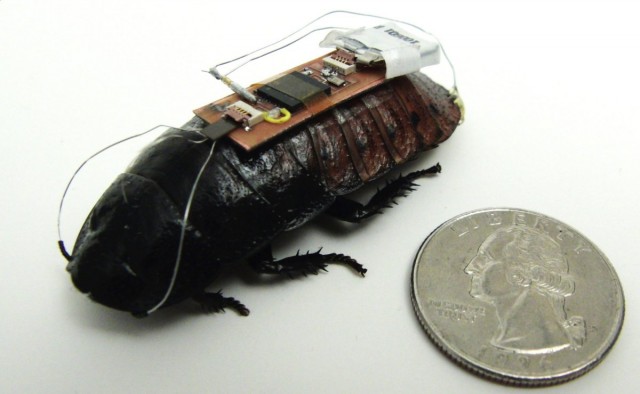
Connecting Microsoft's Kinect system to an electronic cockroach interface could create insects capable of mapping out collapsed buildings and other dangerous areas.

Remote controlled cockroaches can be created relatively simply by attaching circuitry to the creatures' antennae. Microstimulation of the antennae trick the roach into thinking it has bumped into a surface and can be used to change its direction.

Combining a Kinect motion-sensing system with a version of this control technology created by North Carolina State University, researchers were able to program a path for the roaches to follow. As the cockroach moves the system tracks it and makes adjustments using the electrical interface.

"Our goal is to be able to guide these roaches as efficiently as possible, and our work with Kinect is helping us do that," said Alper Bozkurt, assistant professor of electrical and computer engineering at NC State.

"We want to build on this program, incorporating mapping and radio frequency techniques that will allow us to use a small group of cockroaches to explore and map disaster sites," said Bozkurt. "The autopilot program would control the roaches, sending them on the most efficient routes to provide rescuers with a comprehensive view of the situation."

The program also uses Kinect to collect data on how the roaches respond to the electrical impulses from the remote-control interface. This data will help the researchers fine-tune the steering parameters needed to control the roaches more precisely.

"We want to build on this program, incorporating mapping and radio frequency techniques that will allow us to use a small group of cockroaches to explore and map disaster sites," Bozkurt says. "The autopilot program would control the roaches, sending them on the most efficient routes to provide rescuers with a comprehensive view of the situation."

If the system works the researchers eventually hope to be able to equip the roaches with communication devices which would also allow rescue services to communicate with trapped or injured people.

Thursday 27 June 2013

http://www.wired.co.uk/news/archive/2013-06/26/kinect-cockroaches

continue reading

Remembering the victims of 1950s Stalinist regime


A ceremony was held on Wednesday at Prague's ฤŽรกblice Cemetery to remember those killed or incarcerated by Czechoslovakia's communist regime. Organised by the Confederation of Former Political Prisoners, it was attended by a number of political and religious leaders.

A military brass band played Chopin’s funeral march as dignitaries filed up to a small monument – flanked by Czech soldiers bearing arms – to the hundreds of Czechoslovaks shot, tortured or starved to death by the regime during the Stalinist excesses of the 1950s.

This leafy cemetery on the northern outskirts of Prague is where the regime buried its victims, their bodies thrown into unmarked, mass graves, usually without notifying their families. ฤŽรกblice Cemetery is the final resting place for a number of prominent victims of communist-era oppression, including Zdena Maลกรญnovรก, mother of the Maลกรญn brothers who shot their way out of Czechoslovakia in 1953; she died in 1956 after several years of incarceration during which she was tortured and denied medical treatment by the secret police.

Standing over her mother’s grave, Zdena Maลกรญnovรก junior told me it was during the frantic search to find her burial place that the then 19-year-old stumbled across a horrific secret.

“They refused to tell me where she’d been buried - it wasn’t until I got a secret tip-off that they’d buried her here at ฤŽรกblice. I rushed here as fast as I could. The person in charge brought me to this spot and told me I must never tell anyone this but she was buried in a pit containing the bodies of 32 dead children. They were babies born to female political prisoners incarcerated at Pankrรกc Prison. Their corpses were loaded onto trucks and brought here to ฤŽรกblice – just loaded onto a truck, no coffins. When there weren’t enough bodies in the pit they would throw in the body of an adult prisoner. And in June 1956, that’s where my mum was buried.”

Today the burial pits are marked with gravestones, some bearing names, others blank – the bodies have never been exhumed and in most cases identification is impossible; some of the babies were just a few days’ old. Zdena Maลกรญnovรก believes there could be as many as a hundred children buried here.

Thursday 27 June 2013

http://www.radio.cz/en/section/curraffrs/remembering-the-victims-including-infants-of-1950s-stalinist-terror

continue reading

Online database of all the recovered bodies on cards


A team of forensic officers was deployed by the Uttarakhand Government on Wednesday to collect DNA samples of unidentified bodies, after flash floods and landslides ravaged the hill State earlier this month. A senior state official said they are preparing a database of all bodies and it will be posted on the government website.

“Majority of bodies are disfigured. We will soon post the entire list with photographs. We are also taking the help of the district police as far as missing persons are concerned and a request was also sent to the National Crime Records Bureau to publish it on the website,” an official said.

National Disaster Management Authority vice-chairman M Shashidhar Reddy said about 340 pilgrims were missing. “There is 10-foot high debris in Kedarnath and we fear that several bodies are trapped,” Reddy said.

Thursday 27 June 2013

http://newindianexpress.com/nation/Online-database-of-all-the-recovered-bodies-on-cards/2013/06/27/article1654808.ece

continue reading

Uttarakhand floods: Identifying the dead proving to be a daunting task


After saving most of those who survived the Uttarakhand floods, authorities are facing a daunting task in establishing identities of hundreds of bodies by way of photographs and DNA samples before consigning them to mass cremations.

The few photographs of the dead that have been put online by the Uttarakhand government are hardly even a fraction of the victims and in many cases features have been disfigured beyond recognition.

There is every possibility that the kin of the dead will have to deal with a statistic as they may not be able to make an identification. DNA tests may not prove fully reliable as genetic material is also subject to decomposition.

Having concentrated in rescuing the living, authorities have not been able to pay much attention to bodies, many of which lay in the open or floated down the Ganga to be fished out in Haridwar or further downstream.

June 28 will mark the thirteenth day since the disaster, usually a significant date in terms of Hindu rituals performed after death. As many bodies will remain unidentified at the time of cremation, the government is likely to wait for a month before declaring a missing person as deceased.

The authorities are also banking on the pictures uploaded by relatives of missing persons on the websites of the state government, but matching these photographs with the ones in their possession seems equally difficult.

Though the state authorities have already started uploading certain basic details of the victims, officials believe that it is only a scientific-forensic test that will identify bodies.

In an interview to the TOI on Monday, Uttarakhand chief minister Vijay Bahuguna had said that 'tehsildars' will issue death certificates after a month. "If a person doesn't return in 30 days, the government will immediately release the compensation and not go by rules which state that you have to wait for seven years," he had told TOI.

An official said, "Team of medical staff has already collected DNA samples of most of the bodies. These samples will be preserved till the time their identities are established through matching it with the relatives. The local police have also finished the process of chronicling the details from legal point of view".

The Uttarakhand government has, meanwhile, put up a message board on the websites, asking relatives of the missing persons to provide them whatever information they can provide to trace them. The latest report put the figure of missing persons at 344.

The relatives of the victims had initially reported the missing complaints in thousands with Kedarnath - epicenter of devastation -- topping the list with 1,021 missing persons. Since the majority of them have already been traced, the total number now rests at 344.

"344 people are still missing. There are indications that the death toll may go up," said the NDMA vice chairman M Shashidhar Reddy, adding the rescue operation will, hopefully, be completed within a couple of days.

Reddy said efforts were being made to evacuate bodies under the debris - which are eight to ten feet high - in Kedarnath.

Thursday 27 June 2013

http://timesofindia.indiatimes.com/india/Uttarakhand-floods-Identifying-the-dead-proving-to-be-a-daunting-task/articleshow/20789048.cms

continue reading

Wednesday, 26 June 2013

All 20 bodies found in helicopter crash in north India


Paramilitary soldiers on Wednesday recovered 20 bodies from a steep hillside in northern India where a helicopter crashed while on a mission to rescue people stranded in monsoon floods, the country's air force chief said.

The helicopter crashed late Tuesday when its rotor blades hit the hillside while returning with survivors of flooding and landslides that have killed more than 1,000 people and washed away thousands of homes, roads and bridges since mid-June in the Himalayan state of Uttarakhand.

Soldiers using ropes reached the crash site early Wednesday and found the bodies of 20 people, including five air force crew members, Air Chief Marshal N.A.K. Browne told reporters.

The helicopter's cockpit voice recorder was recovered and an inquiry has been ordered to determine the cause of the crash, Browne said.

Some 45 aircraft have been used in rescue and relief operations, but bad weather has dogged the efforts since Sunday, with intermittent rain and dense fog hanging over the mountains.

Troops on Wednesday were trying to rescue about 5,000 people who remained stranded in the towns of Badrinath and Harsil 10 days after torrential rains triggered the flooding and landslides in Uttarakhand.

Browne visited the hill town of Gauchar, where the air force has mounted its relief and rescue operations. He assured flood survivors that helicopters would rescue everyone stranded in Uttarakhand despite the bad weather and poor visibility.

Hundreds of thousands of Hindus make the Char Dham Yatra pilgrimage to four temple towns in Uttarakhand each year, usually returning home before monsoon rains in July make the mountainous area much more treacherous, but unprecedented heavy rains fell around mid-June this year and caught many by surprise.

About 92,000 people from hundreds of villages and towns hit by the floods have been rescued. Landslides and floods flattened entire towns, roads were washed away and communication links snapped, cutting off many people and necessitating air rescues.

Wednesday 26 June 2013

http://news.yahoo.com/20-bodies-found-helicopter-crash-north-india-075259375.html

continue reading

Delhi Police mistakingly uploads living guru's photo in category of unidentified bodies


The ZIPNet or the Zonal Integrated Police Network is one project which is key to Delhi Police plans for the future. The aim is to share crime and criminal information in real-time with police forces of other states — in short, it's a database pool in the police and public domain, of information ranging from FIRs to arrested persons to unidentified bodies.

But a UP policeman's attempts to familiarise himself with the ZIPNet went horribly wrong recently, prompting Delhi Police Commissioner Neeraj Kumar to send a circular to eight states, explaining the need for caution while updating the database.

The policeman in Aligarh, while learning to use the ZIPNet for missing people and unidentified bodies, made a random picture selection for the trial run and ended up uploading the photograph of a well-known spiritual leader under the category of 'Unidentified dead bodies'.

The policeman tried to delete the entry he had made but soon realised that only the administrator in Delhi had the rights to do it. Instead of alerting his superiors, the policeman chose to remain quiet and the photo remained on the page for more than two days.

The blunder was brought to the notice of the Delhi Police by angry followers of the spiritual leader after they spotted his photograph in the category of unidentified bodies. So agitated were these followers that they turned up at the police headquarters to stage a protest.

They calmed down only after assurances from the police that the photograph would be removed and officers instructed to exercise caution while using the ZIPNet.

In the circular he sent to ZIPNet member states, Commissioner Neeraj Kumar said even if officers accidentally upload and save any incorrect information, they should alert

the Delhi administrator instead of trying to "brush it under the carpet".

Wednesday 26 June 2013

http://www.indianexpress.com/news/cop-blunders-uploads-living-gurus-photo-in-category-of-dead/1133829/

continue reading

Govt braces for DNA profiling as hope fades for the missing


Before the first lot of mass cremations of the Uttarakhand flash flood victims on Wednesday, the government is getting ready to undertake one of its biggest DNA profiling of the dead.

DNA profiles are encrypted sets of numbers that reflect a person’s DNA makeup and can be used as an identifier.

In a situation where bodies are decomposed beyond recognition, washed away or missing, this will possibly be the only way family and friends of victims find closure. A team of 42 forensic experts and scientists headed for Kedarnath on Tuesday and more are expected to join in a day or two as the weather clears. But the biggest challenge is to transport, collect and preserve body cells for DNA profiling for such a large number of people in a far-flung area.

For now, however, relatives of the missing are grasping at straws.

Take the case of Venkatesh Lenka, 24, from Chhattisgarh.

Lenka’s parents and grandmother were putting up at a dharmashala in Kedarnath when she last heard from them on June 16. Every day since she arrived in Dehradun, Lenka has been running from pillar to post trying to trace her lost family along with hundreds of others.

While many of them are frequenting the Doon helidrome daily with photographs of missing relatives, there are some who have embarked on a search operation on their own.

But with every passing day their hopes wane. Kishore Johari from Delhi, six of whose family members are missing, says, “I went up to Guptkashi and Fata (places en route Kedarnath) but couldn’t find my family. I need a miracle.”

Around 882 unidentified bodies are lying across the state, an and a huge pile of decaying bodies is lying in Kedarnath, said an official.

Wednesday 26 June 2013

http://www.hindustantimes.com/India-news/NorthIndiaRainFury2013/Govt-braces-for-DNA-profiling-as-hope-fades-for-the-missing/Article1-1082436.aspx

continue reading

More feared dead as 37 bodies recovered after Central African Republic mine collapse


The Presidency of Central African Republic has confirmed that 37 people died in the recent gold mine collapse and expressed fear that the toll could be even higher.

"More bodies could not be found. There is a possibility of the death toll rising," the Presidency said in a statement on Monday.

"It was a small-scale mine exploited by a company that was seeking to set up its industrial equipment. This could have contributed to the unfortunate incident that took place," Prosper Ndouba, the spokesman for the presidency, told Xinhua on phone.

He said all the victims were of Central African Republic's nationality, adding that many others were injured in the accident.

Ndouba said the mining site is located at Ndassima in Bambari region, 440 km east of the capital Bangui. It is a zone that is rich in minerals, especially gold and iron, he disclosed.

The mine collapsed on Sunday due to heavy torrential rains. In total, 37 bodies were recovered from the scene of the accident. But the toll could be higher, the national radio said, citing eyewitnesses who had been interviewed.

Central African Republic's President Michel Djotodia sent his condolences to the families of the victims and declared three days of national mourning with flags flying at half mast on Tuesday.

The country boasts huge mineral potential, with at least 470 different minerals identified.

However, the exploitation of minerals, always done on small scale, is concentrated on diamond and gold.

Despite its rich resources, the country has witnessed numerous coups since attaining independence in 1960, the latest being in March when Djotodia led his forces to overthrow Francois Bozize.

Speaking 10 days ago in the Gabonese capital Libreville at a summit of the Central African Economic and Monetary Community (CEMAC), Djotodia announced, "After several months of conflict and looting, security was progressively returning to the country."

Wednesday 26 June 2013

http://news.xinhuanet.com/english/africa/2013-06/25/c_132485455.htm

continue reading

All bodies of Romanians who died in Montenegro bus crash identified


The bodies of the 18 Romanians who died in a bus crash on the weekend in Montenegro were brought to Romania on June 25, two days after the crash, and all of them were identified. Meanwhile, the 29 injured were also brought back home and admitted to several Bucharest hospitals, and some of them are still in critical condition, on life support and in a coma. Romania is holding a a day of mourning on Wednesday, June 26, to commemorate the victims of the crash.

The procedure to identify the victims took around five hours. The team that carried out the identification included eight doctors, out of which two from Montenegro, as well as 40 cops from the Criminal Investigations Directorate, 15 criminologists, and the victims’ families. Families of the deceased have already started taking the bodies home for burial, after having been informed by mixed teams of police and psychologists. The Montenegrin authorities agreed to sending the bodies to Romania only if doctors from Montenegro attended the identification procedures.

Romania sent two military planes to Montenegro on Tuesday, June 25, one of them transported the bodies, and the other, the stable patients.


This is one of the largest such actions organized by Romania, and was one of the biggest car accidents involving that many Romanian victims abroad. As many as 18 Romanians died on Sunday, June 23, in a bus crash in Montenegro. The other 29 people on the bus were injured with serious wounds, out of which 7 were in intensive care in the Podgorita hospital, according to the Romanian authorities. The 47 people, including a child who was also injured, were on a tour organized by Mareea Travel, and by the bus operator Gregory Tour. Two drivers and a guide were also among the 47, and one of the drivers and the guide died in the accident.

The Romanian tourists were on a six-day touristic circuit in Montenegro and Croatia, having left on Saturday, June 22 from Bucharest, stopped in Belgrade for one night, and drove further on Sunday, June 23. The Mareea Travel tour operator’s representative Marius Usturoi said they have worked before with the bus operator Gregory Tour, without ay other incidents, and that there is no explanation for the crash, as both the bus and the drivers were in the best condition.

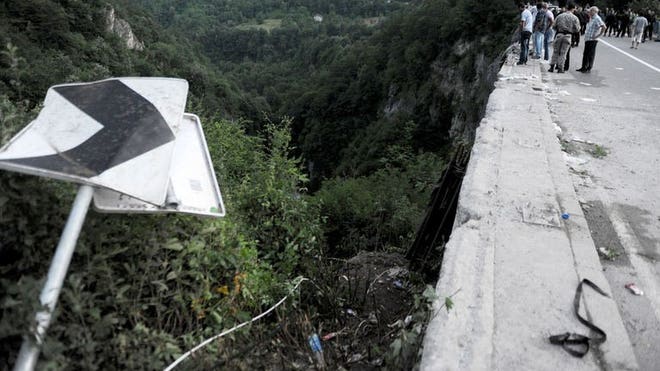
The crash happened in Grlo, where the bus fell 40 meters down into an abyss from a mountain bridge, 30 kilometers from Podgorita, where the injured were taken to the hospital. According to eye witnesses, the bus first hit the balustrade of the bridge when exiting a tunnel, then fell, where it hit the rocks, although without falling all the way down to the River Moraca. The area is known as being dangerous for drivers, especially during tourist season, as the road is narrow, and accidents are common.

Wednesday 26 June 2013

http://www.romania-insider.com/bodies-of-romanians-who-died-in-montenegro-bus-crash-return-home-some-of-the-injured-still-in-critical-condition/102555/

continue reading

Indian Air Force helicopter crashes; four more bodies found


An Indian Air Force (IAF) helicopter on a rescue mission crashed in Uttarakhand this evening. Government sources say 20 people were on board and there are no survivors. But twelve bodies have been found. Air Force officials have identified five crew members and three civilians.

The National Disaster Management Authority said para-military officers were also on the helicopter.

Garud commandos have reached the site of the crash and will have more information soon, said Air Force sources.

Within minutes of the crash, the Air Force said its rescue operations would continue as planned, illustrating the heroism and sacrifice that has suffused its largest relief and rescue mission ever.

The Air Force said the helicopter that crashed this evening had been sent on a rescue mission from the town of Gauchar, serving as a hub of relief and rescue operations, to Guptakashi and Kedarnath, the epicentre of the devastation caused by torrential rains in the hilly state.

The risk under which the Air Force is flying through treacherous terrain, air-lifting pilgrims and air-dropping commandos and soldiers to temporary camps was on display all day today. Each time the rain let up, or the cloud cover improved, helicopters would head out.

Wednesday 26 June 2013

http://www.ndtv.com/article/india/uttarakhand-indian-air-force-helicopter-crashes-twelve-bodies-found-384116

continue reading

Tuesday, 25 June 2013

Indian Air Force helicopter crashes, eight bodies found


An Indian Air Force (IAF) helicopter on a rescue mission crashed in Uttarakhand this evening. Government sources say 19 people were on board and there are no survivors. But the Air Force said eight bodies have been found - its officials have identified five crew members and three civilians.

The National Disaster Management Authority said para-military officers were also on the helicopter.

Garud commandos have reached the site of the crash and will have more information soon, said Air Force sources.

Within minutes of the crash, the Air Force said its rescue operations would continue as planned, illustrating the heroism and sacrifice that has suffused its largest relief and rescue mission ever.

The Air Force said the helicopter that crashed this evening had been sent on a rescue mission from the town of Gauchar, serving as a hub of relief and rescue operations, to Guptakashi and Kedarnath, the epicentre of the devastation caused by torrential rains in the hilly state.

60 air force helicopters are being used along with some privately-owned ones.

Prime Minister Mamohan Sigh offered his condolences, saying "Our forces are conducting a heroic task in rescue and relief work in Uttarakhand. ... Continuing their work would be the best homage to them," he added.

The risk under which the Air Force is flying through treacherous terrain, air-lifting pilgrims and air-dropping commandos and soldiers to temporary camps was on display all day today. Each time the rain let up, or the cloud cover improved, helicopters would head out.

Yesterday, as the met department issued a warning of severe rain in Uttarakhand for three days, Air Chief Marshal Browne offered this statement of reassurance: "Our helicopter rotors will not stop churning till such time we get each one of you out, do not lose hope and hang in there."

More than 90,000 people have been evacuated so far in efforts led by the military.

The type of helicopter that crashed today - the Mi-17 V5 - was inducted last year; 80 helicopters were ordered from Russia.

On Monday, a private helicopter crashed in Gaurikund and was on fire when an Air Force helicopter on a rescue mission nearby swooped in to rescue the pilot.

Tuesday 25 June 2013

http://www.ndtv.com/article/india/uttarakhand-air-force-helicopter-crashes-eight-bodies-found-384116

continue reading

Inquest starts into Christmas Island asylum tragedy


A Coroner for Western Australia will today begin an inquest into the deaths of more than 100 asylum seekers on a boat which sank north of Christmas Island last year.

Coroner Alastair Hope will preside over the inquiry into the sinking of the boat known as SIEV 357, which was carrying 212 people when it sank about 204km north-west of Christmas Island on June 21 last year.

Seventeen bodies were recovered, 85 people were reported missing and presumed dead and 110 people were rescued.

The passengers were from Afghanistan, Pakistan and Iran.

The WA coroner does not have powers to investigate the missing people but does have jurisdiction for the 17 whose bodies were recovered and will hold an inquest into how they died.

A Coroners Court directions has previously been told two of the recovered bodies have not been identified and one of them may never be identified.

Tuesday 25 June 2013

http://www.perthnow.com.au/news/western-australia/christmas-island-asylum-tragedy-inquest-starts-today/story-fnhocxo3-1226669385218

continue reading

India floods: Bad weather delays rescue and mass cremations


Bad weather has halted rescue operations in flood-hit northern India and forced authorities to delay mass funerals for those killed.

Air force officials said they were unable to fly helicopters to the temple town of Badrinath to bring down the 5,000 pilgrims still stuck there.

And police say the planned mass cremations in Kedarnath town have been postponed following heavy rains.

The floods have killed more than 600 people in Uttarakhand state.

State Chief Minister Vijay Bahuguna said at the weekend that he feared at least 1,000 people had died. Officials say 97,000 people have been rescued so far.

Early monsoon rains in India this year are believed to be the heaviest in 80 years.

'Decomposing bodies'

On Tuesday morning, rescue operations were delayed due to rain, but once the weather improved air force helicopters began preparing for sorties to Badrinath - the last of the areas where thousands of pilgrims are still stranded in the mountains.

But later in the day, air force officials told the BBC that heavy rains in Badrinath had prevented helicopters from landing, forcing them to abandon rescue operations.

Air force officials say they need to get to the affected areas urgently as time is running out for survivors.

"I just need two to three days of good weather and I can get everyone out," Air Commodore Rajesh Issar, who heads Operation Rahat (Relief), said.

Meanwhile, senior police official Sanjay Gunjiyal, who is in-charge of the mass cremations in Kedarnath, told the BBC that it had been raining heavily since the morning and the cremations were unlikely to happen on Tuesday.

Police say lots of bodies are piled up around the temple in Kedarnath and many of them have begun decomposing, the BBC's Sanjoy Majumder reports from Dehradun.

Many of them remain unidentified so they are being photographed and DNA samples are being taken and preserved for the families of those still missing, our correspondent adds.

On Sunday, officials said the severely damaged Kedarnath town had been cleared of survivors and teams were searching for the bodies of victims.

Tourists and pilgrims were among those caught up in the floods, which washed away homes, roads and bridges.

So extensive is the damage that even a week after the devastating floods and landslides, there is still no clarity on the true number of people missing or dead.

Thousands of army, paramilitary and disaster management officials have been working for the past week to help those trapped in remote villages and settlements, but rescue operations have been hampered by rain and poor weather.

On average, the air force has been operating 115 flights a day and Air Commodore Issar has described it as "the single biggest rescue operation involving helicopters anywhere in the world".

On Monday morning, helicopters carrying special forces to find survivors were forced to turn back because of bad weather.

Meanwhile, hundreds of relatives continue to camp in Dehradun, looking for missing family members and friends.

Prime Minister Manmohan Singh has described the situation as "distressing" and announced a 10bn rupee ($170m; £127m) aid package for Uttarakhand.

The rainy season generally lasts from June to September, bringing rain which is critical to farming.

Tuesday 25 June 2013

http://www.bbc.co.uk/news/world-asia-india-23042438

continue reading

Deadly Ottawa train crash 100 years later


The Winnipeg Express chugged out of Montreal at 9:45 a.m. ET on June 25, 1913, hauling 10 cars.

It was shaping up to be a warm, early-summer day and a pleasant trip west. Engineer Albert Chapman had made the journey on the CPR steam locomotive many times.

Three passenger cars nearest the front were packed with immigrants, many of them Scottish and Irish, and many having arrived in Montreal earlier that same morning aboard the S.S. Pretorian. The ship had sailed from Glasgow 10 days earlier but for its weary passengers, the journey was far from over.

"It wasn't much of a welcome to Canada for those people," said rail expert and historian David Jeanes.

"Those immigrants would have essentially been in transit continuously, they would have gotten off a ship, they would have immediately been put on a train, and at most would have had a washroom and waiting room kind of stop in Montreal — not in Ottawa, there were no facilities for handling immigrants in transit in Ottawa — and they would be pretty uncomfortable, and they would not actually be expecting to get off the train and be able to move around much until they reached their destination in the prairies."

Before long the train pulled into Ottawa’s newly built Union Station. It criss-crossed the Ottawa River, making one last stop at Broad Street Station. At 1:30 p.m. the train left the capital, bound for points west.

Passengers seated on the left side of the coaches watched the bustling city give way to bucolic scenery. Passengers on the right side enjoyed the magnificent view of the logging booms on the wide Ottawa River.

As the train cleared Westboro, it began to gain speed as it approached McKellar Townsite, about five kilometres outside Ottawa. At that point, the CPR track hugged the shoreline of the Ottawa River — rail and water were about 100 metres apart, separated by what is now the Sir John A. MacDonald Parkway. In the colonist cars, mothers began preparing meals for their hungry children. These were the families going to join fathers and husbands already settled in Winnipeg, Calgary and Edmonton. Single men sat in groups and chatted, or took off their boots and settled in for a nap.

Along Richmond Road, people working in their gardens looked up as the train steamed by. Passengers on the Britannia streetcar watched the train overtake them.

Jerry Gorman was standing in the doorway of his cottage near the water when he saw the cars behind the engine begin to wobble. He heard a loud grinding sound.

"Children and women were leaning out of the car windows and waving to people in the resorts which are situated near the track," the Ottawa Citizen reported the next day. "Suddenly those who were watching the train pass saw the cars rock and sway, then the train seemed to buckle and twist just as there was a loud noise and the cars left the irons."

The engine and the first three cars remained on the rails. But the next two coaches — both colonist cars packed with immigrants — broke loose and toppled down a steep embankment, plunging into the river below.

"It was from these two cars that all the killed and practically all the injured were taken," the Citizen later reported. "Several were killed outright by the force of being thrown against the inside of the car, but [others] were drowned."

Victims from Scotland, Ireland

Jerry Gorman was first on the scene. Stunned passengers pulled themselves out of broken windows. Others thrashed about in the water. Behind the cars that had tumbled down the embankment, the rest of the coaches jutted and leaned at dangerous angles. The wailing of the injured and terrified filled the air. Gorman raced over to Andrew McKellar’s big stone house to telephone for help.

Within minutes, the air was filled with different noises: the clang of ambulance bells and the honking of automobile horns. The tollgate on Richmond Road was thrown wide open and doctors and nurses rushed to the scene of the wreck. It’s estimated half of Ottawa's medical professionals were there that afternoon, tending to the injured.

Hundreds of residents also arrived to offer help. Some clambered on top of the upended cars to join the train’s crew and other volunteers in the desperate search for survivors. Others brought blankets to comfort anyone with soaked clothing.

Passengers who’d been hurt in the crash were loaded into ambulances, or carried in private automobiles and horse carts to St. Luke’s and Water Street Hospitals in Ottawa. The next day more than 50 patients remained there, recovering from their injuries. Long lists of those hurt in the wreck appeared in local newspapers alongside their age, their place of origin, and vivid descriptions of their wounds.

Eight of the train’s passengers suffered a worse fate. Their bodies lay near the wreckage, covered with sheets provided by nearby residents. A Bishop Charlebois who happened to be on board performed last rites to the Catholic victims. Some of the bodies were so badly mangled they could only be identified by items in their pockets. Others appeared untouched. Those were the ones who had drowned.

According to newspaper reports, only Patrick Mulvenna was carried out of the wreck alive, dying on his way to hospital.

"Very little is known about where he was going, or what he was going to do with his new life," said Gerry Mulvenna, whose grandfather was Patrick's younger brother. "But the tragic circumstances can’t help but move you when you read about it. To travel 10 days, then just when you’ve arrived for that terrible accident to happen, and for news to filter back home … it must have been devastating."

Mulvenna was the last of the victims to be buried, a week after the wreck. A newspaper report notes there were no relatives at his funeral.

"For the family that must have been pretty hard, too," said Gerry Mulvenna. "To grieve without having a funeral … you know funerals would be very important in Ireland, so that’s a part of the story that must have been very hard."

"Hundreds of local residents came out to look at the accident," said Jeanes. "They crowded all around it, they even stood on top of the passenger cars that were in the river, and there are many photographs showing these huge crowds coming out to look at the accident scene."

Indeed, photographs from the time show ladies with parasols and men in fashionable white straw hats crowding the shoreline, standing right beside the overturned cars.

"Thousands of people from the city went to the scene of the accident," reported the Citizen. "The rush started immediately after the message had been sent out for doctors and continued till late at night."

There were so many people trying to reach McKellar Townsite the Ottawa Electric Company put on extra streetcars.

"The lawns and gardens around many of the nearby residences were ruined by people trampling over them," the Citizen claimed.

The crowd reached its peak in the early evening, but hundreds remained at midnight to watch the wrecking crew. Not everyone stood and gawked. Many residents opened their doors to families stranded after the wreck. Religious and nationalist societies extended helping hands to their brethren and countrymen. The Canadian government stepped in to offer aid to survivors and to notify their families back home.

Some newspaper reports claimed CPR also offered survivors financial support, provided they sign a strict waiver guaranteeing against future legal action. There was also the task of reuniting passengers with their luggage. Many of the immigrants had emerged from the wreck with only the clothes on their backs, losing whatever meagre possessions they’d brought with them to start a new life.

Almost immediately, the railway began picking up the pieces. A breakdown crew hauled the engine and other damaged cars to Britannia. Meanwhile, a special train was prepared in Ottawa and routed through Kemptville, so those passengers who were able to continue their journey west could do so the very next day. Engineer Albert Chapman even drove, picking up where he’d left off. Within two days of the disaster, the colonist cars had been pulled from the water and the track was repaired, as though nothing had happened.

So what did happen? There were persistent rumours that moments before the crash a section gang had been repairing the track and left the job unfinished. Minor rail officials denied it, telling the Citizen the nearest crew was working two miles away.

"The cause of the accident is not definitely known but it is attributed to a loose rail or to what is known in railway parlance as a 'sun kink,'" the newspaper reported the next day. "That is where the heat causes the steel rails to expand so they have a tendency to bulge out and shoot out of place."

A coroner’s inquest was opened. The Railway Commission also launched an investigation into the cause of the wreck, including an inspection of the track and interviews with railway employees. The results of the investigation were considered confidential and were not made public.

"Well you can’t help but be moved," said Gerry Mulvenna, who spoke via Skype from his home in Ireland. "For Pat to make it [to Canada] and just die on his first day in the new country that he had emigrated to, it’s awfully sad."

Tuesday 25 June 2013

http://www.cbc.ca/news/canada/ottawa/story/2013/06/24/ottawa-rail-disaster-1913-winnipeg-express-8-killed.html

continue reading

Bodies of 130,000 fallen Korean War servicemen still missing


Eighty-six-year-old Kim Oh-joon still remembers the day he was told the tragic news that his brother had been killed in battle during the Korean War.

He still hopes that one day the remains of his brother will be found, and he can be laid peacefully to rest.

"My very last wish before I die is to bury my fallen brother in the National Cemetery, to place a tombstone, and to offer a flower for him. I don't want anything more than that."

Some 150-thousand South Korean soldiers were killed during the three-year conflict, but 130-thousand are still missing.

Their remains unaccounted for. It's estimated about 70 percent, or the remains of some 95-thousand South Korean troops are somewhere in South Korea, and the rest are in North Korea.

Since the 2000s, the South Korean government has operated a team to identify remains buried in fields and mountains nationwide.

So far, they have excavated about 8-thousand bodies - 7-thousand South Korean soldiers and around 1-thousand North Korean and Chinese soldiers.

Sadly for the families, only about 80 soldiers have been identified through DNA testing.

The Defense Ministry says it will continue its active excavation projects, in the hope of giving some peace of mind to the families of those who bravely laid down their lives for South Korea.

Tuesday 25 June 2013

http://www.arirang.co.kr/News/News_View.asp?nseq=148564

continue reading

Gold mine collapse kills 37 in Central African Republic


At least 37 people have been killed and many more injured in a mine collapse in the south of the Central African Republic.

The president's office announced on Monday that the accident occurred on Sunday at a gold mine in Ndassima, some 440 kilometers (273 miles) east of the CAR capital Bangui, Reuters reported.

"The toll of 37 is provisional as there were many injured," president's office spokesman Prosper Ndouba said.

Ndouba added that rescue workers pulled out 10 injured miners but there were an unknown number of bodies still buried in the mine.

The mine collapse occurred after heavy rains.

Three days of national mourning has been declared.

There are many mineral resources, including gold and diamonds, in the Central African Republic. However, the country is extremely poor and has faced a series of rebellions and coups since it gained independence in 1960.

Tuesday 25 June 2013

http://www.presstv.ir/detail/2013/06/24/310666/gold-mine-collapse-kills-37-in-car/

continue reading

Victims’ jewellery missing, shrine donation boxes empty


As the unprecedented rains turned Kedarnath into a ghost town with bodies strewn all over, a ‘gold rush’ in the holy town is sending shivers down the spine.

Cash and gold offerings at the shrine are missing and so is personal jewellery, including anklets and gold bangles, of several of the deceased. In some cases, fingers have been chopped off to remove rings. The local police have arrested some persons who tried to flee with the cash.

According to reports, bodies are being disfigured by looters who are out to make a quick buck before the administration reaches those far flung areas.

Gurgaon resident Narender Yadav, who managed to return home on his own after being trapped at Rudraprayag, has come with a video that he managed to shoot using his mobile phone. The video shows miscreants removing gold jewellery from dead bodies using screwdrivers and pliers.

“Chop off the hand, if you can’t remove the bangle,” a voice is heard instructing a youth trying to remove a gold bangle from a female dead body.

“It was horror. The locals have been indulging in rampant looting and mistreating the dead for gold, cash and valuables. They [also] strike at those alive and moving alone, asking them to handover their gold, cash, watches, etc and threatening that they would be pushed to the gorge,” Yadav said.

He had gone to Uttarakhand for pilgrimage with his friends and relatives, five of whom are still missing.

A teenage girl broke into tears while describing what she saw.

“They look like Nepalis and are using sharp knives to cut ears and noses to remove gold from dead bodies. How low can one stoop for greed? Instead of helping the victims they are looting them,” she said sobbing.

Some of those rescued said that the army had caught some young boys with bags full of looted gold and jewellery.

There are reports that locals are charging as much as Rs500 for a bowl of rice (Dh30) and Rs180 for a piece of roti from hungry victims yet to be rescued. Local taxis are demanding up to Rs25,000 to drive the victims to the state capital Dehradun. All agencies working on the ground have confirmed the shameless ‘gold rush’.

Pilots of the Army Aviation wing and the Indian Air Force have reported people refusing evacuation to make a ‘quick buck’ off the dead.

Special Forces of the Indian Army, which have been looking for survivors, have tried to warn the human scavengers, but to no avail.

DIG Amit Prasad of the Indo-Tibetan Border Police (ITBP), which has also sent its rescue teams, confirmed tell-tale signs of scavengers. “Donation boxes at Kedarnath have been broken into and emptied. We have informed the local police,” he said.

The local police’s Division Range DIG AK Sinha confirmed that a man in the robes of a sadhu was nabbed with Rs 87 lakh belonging to the State Bank of India’s branch at Kedarnath. Another man was caught with Rs 83 lakh while others have been caught with smaller sums and gold ornaments. The temple, managed by the Sri Badrinath-Kedranath Temple Committee, opens in April-May for summer depending upon an auspicious time carefully calculated by the religious men. It is during this period that the idol of Lord Shiva is installed in the shrine. In winter, it is taken down and installed at Ukhimath. This year, the Kedarnath shrine opened on May 14 and Badrinath on May 16. The shrine usually remains open till November, but the number of devotees decreases in the monsoon.

Collections run into crores each year and nearly Rs 9-Rs 10 crore is declared each year. Apart from cash, devotees offer gold as well. As this was the peak season owing to summer vacations, donations to the shrine were bound to be high. The cast iron collection boxes are usually emptied under tight security and the contents deposited in the bank. Divisional Commissioner, Garhwal Division, Subhardhan said, “Thieves have been making attempts. The local district magistrate is a member of the temple committee, but he does not enjoy administrative control over it.”

As estimated, 10,000 pilgrims were at Kedarnath when catastrophe struck. Lakshman Singh, an ITBP assistant sub-inspector and eyewitness, said, “There were 10,000-12,000 persons at the shrine when the catastrophe struck on June 16. With the administration is yet to arrive at a death toll, it is anybody’s guess what thieves have fled with in terms of gold jewellery.”

KEDARNATH’S TALES OF GREED

- DIG Amit Prasad of the ITBP said donation boxes at Kedarnath have been broken into and emptied

- The local police’s Division Range DIG AK Sinha confirmed that a man in the robes of a sadhu was nabbed with Rs 87 lakh belonging to the SBI’s Kedarnath branch

- Another man was caught with Rs 83 lakh while others have been caught with smaller sums and gold ornaments

- Jewellery, including anklets and gold bangles, of several of the deceased is missing; in some cases, fingers have been chopped off to remove rings

Tuesday 25 June 2013

http://gulfnews.com/news/world/india/they-won-t-spare-even-the-dead-1.1201440

http://www.tribuneindia.com/2013/20130625/main3.htm

continue reading

Emotional protest in Bangladesh two months after disaster


Hundreds of Bangladeshi garment workers and survivors of the Rana Plaza building collapse staged an emotional protest yesterday, on the two-month anniversary of the country’s worst industrial disaster.

Relatives called on the government to account for those still missing and other workers demanded proper payment and compensation at the site of the disaster outside the capital Dhaka, where the building collapsed on April 24, killing 1,129 people.

Many of the relatives burst into tears as they told of their attempts to find their loved ones, while others called for the death penalty for the owner of the building, which housed factories making clothes for Western retailers.

“I’ve not found my elder sister Laboni Begum’s body,” said Shimu Akter, 18, a garment worker who was rescued from the rubble two hours after the building caved in. “We have seen everybody the authorities recovered. But she was not among them.”

A local government official said 316 workers were still missing, but the authorities said they could be among hundreds who were buried in a state graveyard after their bodies could not be identified.

The government has collected DNA samples of those buried who were not identified at the time, and said they would match those samples with relatives to ensure they were compensated.

But some family members said they wanted their loved ones’ bodies, not the money, so they could be buried properly.

“I want my brother’s body. We want to take him to our village and bury him at our family graveyard,” said Sujan, who uses just one name.

The collapse of the nine-story complex focused global attention on appalling safety standards at plants in Bangladesh, the world’s second-biggest garment exporter after China.

Twelve people have so far been arrested over the disaster, including the building owner, his father, and four factory owners. Many survivors joined the protest, demanding unpaid salaries and severance benefits. Thousands of workers were laid off after the five garment factories operating in the complex were shut down following the collapse.

“The authorities gave me only 8,500 taka ($ 110) as compensation and nothing,” said Maleka Begum, who left the building only moments before the collapse to buy medicine.

“I want all my severance benefits and my unpaid overtime,” she said, joining scores of others at the protest. Authorities say at least 2,438 people — mostly female garment workers — were rescued from the site, including 968 people who were seriously injured.

After the disaster, the government launched inspections of all garment factories to try to reassure Western retailers including Walmart, H&M, Tesco and Inditex of improved safety conditions.

But unions and experts said hundreds of factories were still operating in shoddy buildings, raising fears that another tragedy could occur at any time.

Tuesday 25 June 2013

http://www.arabnews.com/news/456033

continue reading

Uttarakhand: As epidemic threat looms, seers clear mass funeral at Kedarnath


With most stranded pilgrims and locals having been evacuated from the Kedarnath-Gaurikund axis, the next big challenge confronting the authorities is the disposal of hundreds of corpses that are littered in and around the holy shrine. Unless that's the done, it would be difficult to ward off the outbreak of deadly diseases in the already ravaged hills.

As an emergency measure, Union home minister had consultations with top holy men, including Shankaracharya Swami Swaroopanand. The question to them was: would a mass cremation pollute the temple? The seers are learnt to have said it would not if the cremation was done in accordance with the proper rituals and in a wooden pyre.

Accordingly, 150 quintals of wood, sourced from local depots, was transported to Gauchar. The consignment reached there at 3pm on Monday. From there the wood would be moved to Kedarnath by helicopter. Given the amount of wood that's required, it would take a very large number of sorties.

However, nothing could be done on Monday as the weather turned inclement and driving rain prevented choppers from flying. "We hope to complete the mass cremation by Tuesday," said DIG Sanjay Gunjyal, who has tasked with the job of cremating unidentified and unclaimed bodies.

The bottomline is that another day has been lost. The corpses have been lying for days, some since June 16 (eight days ago), out in the sun and rain, and in an advanced stage of decay and decomposition.

Before the cremation, the authorities would be taking video and still pictures of the bodies as well as their DNA samples. This is for their identification which would help the bereaved families to bring closure to the tragedy.

With the state government finally getting some kind of control over the situation, it said that there was no threat of hunger or shelter for the stranded pilgrims in Joshimath and Badrinath, or in Gangotri and Yamunotri. And finally, there was some attention being given to the locals who have suffered the most as their homes and livelihood have been wrecked by the floods.

On Monday, Uttarakhand CM Vijay Bahuguna gave a cold shoulder to the offer of Gujarat CM Narendra Modi to rebuild the Kedarnath shrine with the help of "best technology". Bahuguna told TOI: "Let me say very emphatically, that the entire premises of the temple will be built by the state government. Whosoever wants to do charity and donate to the temple is welcome but it is our responsibility and duty and we would not share that. There is no compromise on Kedarnath."

The humans dimension of the tragedy hasn't diminished even after eight days. With thousands still missing, there are hundreds of desperate relatives here asking one and all if they've seen their loved ones. At Jolly Grant airport, an entire wall is plastered with photographs of the missing.

Coming back to the mass cremation, it is easier said than done as bodies have to be extricated first, as the focus so far been on rescuing the living. Experts say this process will take at least a week if not longer. Bodies are at places buried in rubble 10 feet deep. At Rambara bodies may not be possible to extricate as many of them lie buried under 30 feet of mud.

The Centre and the Uttarakhand government, apart from finalising the standard operating procedures for identification and cremation of the bodies, are working on a centralized missing persons database. According to sources, photographs are likely to be uploaded on the official website of the state governments depending on where they are found.

Even though the weather forecast indicates heavy rain until June 28, the agencies are hopeful that even a limited window will help rescue the remaining people. While 100-150 persons remain to be evacuated from Kedarnath-Gourikund, those stranded at Badrinath do not face a life-threatening situation as they have adequate food and shelter. Union home secretary R K Singh said a day more was needed to rescue all from Harsil.

Meanwhile, the nodal officer appointed by the Centre for coordination between various agencies engaged in disaster relief, V K Duggal, met their senior representatives here on Monday to sort out "operational issues" and "communication gaps". At the meeting, the IMD chief briefed the agencies of the weather forecast for the next two weeks.

Tuesday 25 June 2013

http://timesofindia.indiatimes.com/india/Uttarakhand-As-epidemic-threat-looms-seers-clear-mass-funeral-at-Kedarnath/articleshow/20751388.cms?

continue reading

Uttar Pradesh forms special cell to trace its missing people in Uttarakhand


Amidst reports of 11 more bodies of those swept away by the flash floods in Uttarakhand recovered from rivers in UP, the state government on Monday constituted a special cell to trace UP pilgrims and tourists reported missing in Uttarakhand following the catastrophic deluge and landslides. Chief minister Akhilesh Yadav said people of the state affected by the calamity would be identified through district magistrates and assistance would be extended to them. State government officials have been sent for relief and rescue work in Uttarakhand, he added.

Ashok Kumar Singh, officer on special duty at the Communalism Prevention section of the state home department, has been made nodal officer of the cell. The postal address of the cell is: Communalism Prevention Section, Lal Bahadur Shastri Bhawan, Hazratganj, Lucknow, 226001. Fax numbers are 0522-2238409 and 0522-2238407. Phone numbers are 0522-2239295 and 9454405067. Email osdsnp@yahoo.com. The nodal officer will also coordinate with the authorities in Uttarakhand.

According to principal secretary Home, S M Srivastava, district magistrates will be responsible for collection of information about missing persons, verification, coordination and help to the people. District magistrates will form a cells in their respective districts and depute an officer. The name, phone number, email, fax and coordinates of the officers will be publicised through media. The district level cells will prepare a database of missing persons and persons who have lodged the complaint. They will also record efforts by the authorities to track the missing persons and provide it to officials on daily basis.

Meanwhile, eleven more bodies, including of women and children, were recovered from the rivers in Bijnor and Bulandshahr districts. A circular has been issued to police chiefs to keep tab of the rivers. According to information received at police and relief commissioner's control rooms, over 1,000 persons from Uttar Pradesh were still missing. Special secretary, Revenue, G Srinivas said four camps have been set up by the state government in Haridwar, Rishikesh and Dehradun to take care of people of UP who have been rescued. While around 900 persons are in Haridwar, about 450 are in Rishikesh and 540-odd in Dehradun.

According to the list prepared by the control room on the basis of the complaints received so far, maximum 59 persons missing or trapped in Uttarakhand are from Lucknow, followed by 50 from Amethi, 39 from Kanpur, 30 from Gonda, 26 each from Ghazipur and Pratapgarh, 25 from Bulandshahr, 15 fom Mathura, 14 each from Balrampur and Faizabad, 13 each from Aligarh and Allahabad, 12 each from Meerut and Gorakhpur, 11 each from Ghaziabad, Agra, Sitapur and Deoria and 10 each from Azamgarh and Jhansi among others.

Monday 24 June 2013

http://timesofindia.indiatimes.com/city/lucknow/Uttar-Pradesh-forms-special-cell-to-trace-its-missing-people-in-Uttarakhand/articleshow/20750011.cms

continue reading

Monday, 24 June 2013

Uttarakhand begins grim task of mass cremation of the dead, minor landslides delay rescue


As expected, air rescue operations have been stuck in parts of Uttarakhand following bad weather with two minor landslides taking place today between Rudraprayag and Guptakashi road causing immense problems for rescue workers.

Further landslides and flooding in the districts can be a real threat, said army officials adding that ground operations are however in process. Reports claim that two minor landslides have occurred today between Rudraprayag and Guptakashi road and another one was reported from the Rishikesh- Uttarkashi route, said the officials. Rescue workers are battling to carry out the remaining operation as bulldozers have been put into service to clear the route.

Army says it could possibly evacuate another 4,500 people from Badrinath including pilgrims, locals and temple employees. The army is waiting for the weather to improve and once it improves will speed up the air operations, said Ajay Chadha,DG,ITBP.

Military helicopters have been grounded because of bad weather, suspending the evacuation by air of those still stranded, many without food and water, in remote areas of the state, known as the "Land of the Gods" for its revered Hindu shrines. "We can only use the helicopters when the weather is clear. Rescue work can only resume when rains stop," said a senior army official in New Delhi.

Helicopters and thousands of soldiers have been deployed to help with the rescue efforts, with thousands of people already evacuated since the rains hit on June 15. Soldiers along with the Indo-Tibetan Border Police have been using harnesses and erecting rope bridges across flooded rivers as part of efforts to move people to safety. Raging rivers have swept away houses, buildings and even entire villages in the state, which was packed with travellers in what is a peak tourist season. More than 1,000 bridges have been damaged along with roads, cutting off hard-hit villages and towns.

Around 120 bodies were recovered from the Kedarnath temple area on Sunday and more were feared to be lying in a nearby jungle where tourists took refuge after hotels and other buildings collapsed in the deluge, officials have said. In the adjacent state of Himachal Pradesh, 20 people have also been killed. Floods and landslides from monsoon rains have also struck neighbouring Nepal, leaving at least 39 people dead, according to the government in Kathmandu.

The monsoon, which covers the subcontinent from June to September, usually brings some flooding. But the heavy rains arrived early this year, catching many by surprise and exposing a lack of preparedness.

Director of meteorological department Anand Sharma was quoted saying medium range of 30-40 mm of rains is expected in Uttarkashi, Chamoli and Rudraprayag areas. As soon as the sky clears up, rescue choppers will start carrying out rescue operations, said Mr Sharma.

Up to 1,000 people are feared dead and more than 8,000 mainly pilgrims and tourists are still awaiting rescue nine days after flash floods and landslides caused by torrential monsoon rains hit the state of Uttarakhand.

The temple town of Kedarnath is likely to witness the cremation of bodies that lay in and around the temple. Officials declared further delay in the funeral of the bodies might lead to their decomposing. Authorities confirmed that before performing last rites, DNA samples would be taken and bodies would be photographed.

We want to start the funerals today in Kedarnath provided the weather permits amid concerns of an outbreak of disease from rotting bodies, officials said. The priests of temples have been requested to participate in the final rites," Pandey said. All concerned authorities have been asked to make arrangements," a senior state government official told PTI.

50 tonnes of wood and a large quantity of desi ghee have been arranged to conduct the heart-rending last rites, said officials of the Garhwal administration adding that ‘Van Nigam’(Forest Corporation) and other agencies have been informed to collect as much fire wood and logs and arrange cans of ghee from the open market.

As soon as the weather clears, funeral will take place today and all concerned authorities have been informed to make arrangements, said a senior official from the state government.

Monday 24 June 2013

http://truthdive.com/2013/06/24/minor-landslides-in-uttarakhand-again-thousands-to-be-cremated-today.html

http://www.hindustantimes.com/India-news/Uttarakhand/Uttarakhand-begins-grim-task-of-mass-cremation-of-the-dead/Article1-1081364.aspx

continue reading

DisasterAction: new leaflet on Disaster Victim Identification


The charity DisasterAction has just created a new leaflet in their series When Disaster Strikes, called Disaster Victim Identification: Relatives' Experiences. The leaflet is written in DisasterAction's members' own words and shows their experience of the identification of family members after disaster. It will help emergency responders involved in this difficult work to understand the impact on families of the seemingly impersonal processes and procedures, and inspire them to be as sensitive as possible when working with families.

The leaflet can be found here

Disaster Action is a charity, founded in 1991 by survivors and bereaved people from UK and overseas disasters. Living all round the UK, our members have personal experience of 27 disasters, including rail, air and maritime as well as natural disasters and terrorist attacks in the UK and overseas. We came together to help create a health and safety culture in which disasters are less likely to occur, to offer guidance and support to others who find themselves similarly affected and to raise awareness of the needs of survivors and bereaved.

Monday 24 June 2013

http://www.disasteraction.org.uk/

continue reading

Kawan Mas salvage operation called off, monument for victims


The operation to refloat the Kawan Mas express boat which capsized at Giam Bungan in the Upper Rajang on May 28 has been called off.

This was announced yesterday by Deputy Chief Minister Tan Sri Alfred Jabu after visiting the scene of the fire that swept through Kampung Datu and Kampung Hilir on Wednesday afternoon.

He told reporters that the salvage operation had to be called off because it was too dangerous for the salvage team to dive into the turbulent water of the Upper Rajang.

He added that a monument would be built at the Bungan rapids to mark the scene of the tragedy and in memory of those died in it.

Meanwhile, Belaga police chief DSP Bakar Sebau Bakar said yesterday the location of the wreckage is now uncertain as it may have drifted further downstream from its last traced position on June 15 which was about 350 metres away from Giam Bungan resting on the riverbed rock at a depth of about 18 metres.

Bakar added the team led by him had continued with their surface search operation and the fate the two passengers still listed as missing, Roslin Jati and Maurice Ajan, had not been officially confirmed.

Although the body of a man found floating near Rumah Lat last Monday has been identified as that of Maurice by his mother the police still have to wait for the result of a DNA test to officially confirm its identity.

Bakar said the post-mortem would only be carried out on June 25 at Bintulu Hospital mortuary as the pathologist in the hospital was currently outstation.

Monday 24 June 2013

Read more: http://www.theborneopost.com/2013/06/21/kawan-mas-salvage-operation-called-off-monument-for-victims/

continue reading

DNA of unidentified Uttarakhand bodies being preserved


The DNA of those who died in calamity-hit Uttarakhand and now cannot be identified is being preserved, with officials saying that many of the bodies have decomposed.

Officials of the state government, with forensic experts, sub divisional magistrates and the police officials have now started an operation to identify dead bodies and in cases where they cannot, preserve their DNA.

The officials reached Gaurikund and Kedarnath and said that some bodies had decomposed and stood no chance of being recognised.

"Things are in a mess, many bodies have been eaten up by dogs, many have decomposed and many are lying buried under the debris, mud and boulders," said an official.

With people and pilgrims stranded at the Kedar valley completely evacuated Sunday, the army and other authorities involved in the rescue would Monday begin to focus on people still caught up in Badrinath and Harsil, officials said.

Officials told IANS that the death toll and trail of devastation would now become more harrowing as rescuers spend their energy on fishing out the dead from the Kedar valley and the nearby areas.

"Dozens of villages, several vehicle parking lots where cars were parked with the drivers inside have been washed away in the torrential rains...there must be hundreds missing from there," the official said.

A day after Uttarakhand Chief Minister Vijay Bahuguna feared that 1,000 people might have been killed in the calamity, the state's Disaster Management Minister Yashpal Arya put the death toll at "at least 5,000".

Interacting with reporters at the Jolly Grant airport in the state capital, Arya said: "At least 5,000 people must have been killed in the deluge, we cannot say with surety but the number can go even higher."

People returning to safety from the rain ravaged areas put the number of dead at "many thousands (with) many (who) died of cold, illness, lack of food and water".

Snehil Gupta, a youth who had gone to Kedarnath from Uttarakhand told IANS that he had seen "...people dead on road sides, in jungles and in villages" as he trekked his way to safety on a hill with two of his friends. His car and driver are yet untraced.

Monday 24 June 2013

http://www.dayafterindia.com/demo.php?headline=headline&val_id=20237

continue reading

Google locates team missing in Uttarakhand


The family of Howrah’s Aneek Chatterjee had all but lost hope of finding him after the Uttarakhand tragedy.

For five days since the cloudburst last Monday, Chatterjee’s relatives had not been able to contact him.

In a desperate attempt, his younger brother Aveek put up the information that Aneek was missing on Google Person Finder, a web application that allows individuals to post and search for the status of people affected by natural or humanitarian disasters. And the good news arrived last evening.

A person named Udayan Ray replied to his query on the Google application yesterday, saying Aneek was alive and had come down to Gangotri along with his teammates.

“He and his teammates are now at Gangotri.… They have come down of (sic) their own. But they are at a fix what to do next. I have talked with Aneek personally today as well some of our friends. They are mentally alert but not physically in that sense…. They need help at the earliest possibility to come back at Rishikesh at least before rain makes havoc again.… Thank you,” read Udayan’s reply.

The Person Finder application, which is available in both Hindi and English, is currently tracking 5,900 records but it keeps increasing every hour. All data entered into the application is publicly available and searchable by anyone.

“I had lost all hope of getting my brother back and we are extremely happy to know he is fine. It’s unbelievable. The reason I put the information on Google Person Finder was to get any sort of information about him. We were desperate,” Aveek said over the phone.

Aneek, who was on his way to Kalindi Pass, was stranded on Swetha glacier for five days without any food. As no help from the government or the rescuers reached, he and his team travelled all the way down to Gangotri.

Hundreds of people from Bengal are still stranded in Uttarakhand. Many of them, like the Chatterjees, have taken to Google Person Finder in desperation.

Hemendranath Chakraborty’s family from Patuli, near Garia, has left a message along with his picture, saying his family members are waiting at the Guptakashi army camp.

Photographs of the missing person, name, physical characteristics, home address and other information can be posted on Google Person Finder.

On clicking the 2013 Uttarakhand Floods page (on the home page), users are re-directed to a fresh page where one can choose between two options: “I’m looking for someone” and “I have information about someone”.

By typing in the name of a person, one can either search for information on him or her or provide it, with details such as where he or she was last seen.

The Uttarakhand police have been posting information about rescued people on the application.

Long search

Sudip Biswas of Jamshedpur had travelled to Hardwar from Dehradun this morning in search of his brother’s in-laws amidst 570 bodies that had reached there on Saturday night. Not finding them, he left for Dehradun only to return to Hardwar at night.

“Around 325 people, rescued from various places, have been admitted to Jolly Grant Hospital near Hardwar. I saw the footage on a national news channel and one of the patients looked like my relative. I am going there to find out,” Biswas said.

Biswas had reached Dehradun on Saturday morning to look for his brother Rahul’s in-laws Monica Biswas and Brajabashi Biswas — residents of Bankura — with whom no contact could be established since June 16.

He went to Rishikesh from there to check some bodies that had reached there on Saturday afternoon. The elderly couple was in Kedarnath when they last spoke to their daughter and son-in-law. Their phones have been switched off since.

“We have been calling the helpline several times every day and also checking the official list of the deceased on the Uttarakhand government’s website. There is no trace of them. My wife has broken down. I have sent my brother there,” Rahul said.


Monday 24 June 2013

continue reading