Monday, 6 May 2013

Bangladesh: Disaster ministry facing shortage of rescue equipment


The Ministry of Disaster Management and Relief and the Department of Disaster Management are facing an acute shortage of sufficient equipment to operate a speedy rescue drive at the Savar building collapse site.

Due to lack of more modern rescue machines, the relevant authorities have undertaken rapid actions to purchase those.

According to the department of disaster management, it has already submitted a plan to purchase heavy rescue equipment at a cost of Tk1.6bn for smooth rescue operation during any disaster.

The project is now in the planning ministry. It will be tabled to the Executive Committee of National Economic Council (ECNEC) within a short time for its approval.

Mohammad Abdul Wazed, Director General (DG) of Department of Disaster Management told the Dhaka Tribune last week: “We have a major shortage of necessary modern equipment to conduct rescue operation during any disaster.”

If the government approves the proposal and takes necessary steps for purchase, that will be a great help to face the post-disaster period, added the DG.

The procurement process of heavy machines will begin after getting approval from ECNEC, he continued.

According to the department of disaster management, it has proposed to buy some heavy equipment, including a sensitive device named “coloured varifocal camera,” which is normally used to identify people trapped in rubble.

Other equipment that proposed for procurement in the next phase are: two cranes (30 tonnes), 25 heavy hydraulic vibrators, 50 light hydraulic vibrators, two excavators with attachment, two fork lifts, two dump trucks, 10 search vision cameras, 25 air compressor machines, 100 hydraulic jacks, 100 hydraulic spreaders, 100 hydraulic cutters, 100 hydraulic ram jack, 100 chipping hammers, 100 rotary hammer drills, 100 rotary rescue saws/slab cutters, 100 reciprocating saws, 100 power chain saws, 100 electric drills, 100 generators, 200 bolt cutters, 200 chisels, 200 pry bars, 200 craw bars, 200 tin snips, 200 hand saws, 200 shovels, 100 pipe squeezers, 200 inflatable stretchers, 100 extension ladders and 50 smoke ejectors.

Mohammed Abdul Wazed said: “We still need some modern equipment including the CDC camera, a human-sensitive device to identify trapped people in the collapsed building. We could not import the device along with other tools in our concluded project as the budget was reduced from the main proposal.”

Earlier in 2010, the Ministry of Disaster Management and Relief purchased a total of 18,150 light rescue equipment at a cost of Tk600m and handed over those to the Armed Forces Division, Fire Service and Civil Defence, city corporations and coastguards.

The light equipment purchased included: rotary rescue saw/slab cutter, reciprocating saw (run by electricity), rotary hammer drill (run by electricity), wood circular saw (run by electricity), chain saw, generator (portable) 1000 watt, generator (portable) 5000watt chipping hammer, hydraulic ram jack, spreader and cutter.

Monday 6 May 2013

http://dhakatribune.com/bangladesh/2013/may/06/disaster-ministry-facing-shortage-rescue-equipment

continue reading

New Zealand skydiving plane crash: Bereaved families urge changes


Pilot error or mechanical failure were the most likely causes of a 2010 tourist plane crash in New Zealand in which nine people died, a coroner found Monday.

The Fletcher FU24 plunged to the ground and burst into flames shortly after takeoff on September 4, 2010, near Fox Glacier on the rugged west coast of New Zealand's South Island, in New Zealand's worst air accident since 1993.

The plane -- operated by Skydive New Zealand -- was carrying a pilot, four skydive instructors and four foreign tourists from Britain, Ireland, Germany and Australia. There were no survivors.

Coroner Richard McElrea found the plane, a converted crop duster, was also overloaded and off balance when it took off on a "near vertical" climb then apparently stalled before crashing.

"It is unlikely that the cause of the crash will ever be fully understood -- something unusual, such as inadvertent pilot error or engine malfunction/mechanical failure, has occurred at take-off," he said.

"This, coupled with the aircraft being overweight and loaded rearwards of its centre of gravity, is consistent with the evidence and has been the immediate cause of the tragedy."

The crash victims included five New Zealanders and the four foreign tourists.

McElrea said eight bodies were found in the plane's tail section, raising the possibility that they slid backwards during the plane's ascent, throwing off its centre of gravity.

He recommended fitting restraints on skydiving flights using the FU24 to prevent such movement and limiting the number of passengers to six.

The families of the four tourists who perished released a letter to Prime Minister John Key calling for tighter enforcement of aviation regulations operating in New Zealand's adventure tourism industry.

The families criticised what they said was a lack of accountability in the industry, pointing out that nobody had been prosecuted over the accident.

"It has been said in New Zealand that tourists who come to take part in adventure sports 'know the risks" -- this seems to us an astonishing attitude," the letter said.

"It is incumbent upon the authorities to do everything in their power to make sure that all activities are as safe as they possibly can be."

Monday 6 May 2013

http://www.enca.com/world/tourist-plane-crash-probed-0

continue reading

US citizens among those missing in Mexico


The drug war in Mexico has claimed at least 70,000 lives, but the full death toll may never be known because thousands are searching for relatives who have disappeared.

Along the border, some of those missing in Mexico are U.S. citizens.

“It’s individuals that communicated with their loved ones on a daily basis, and — all of a sudden — they disappear,” said Oscar Hagelseib, assistant special agent in charge of Homeland Security’s investigations in El Paso.

The agency helped Mexico pinpoint the location of a mass grave in the Valley of Juárez last November.

“The intelligence was there was a strong possibility there were United States citizens there,” Hagelseib said.

Just across the border from El Paso on the outskirts of Juárez, forensic workers dug up the remains of 20 men.

All had been murdered; some showed signs of torture.

A spokesman with the Chihuahua state attorney general’s office said investigators stopped digging in the area four days after they started because they had had “recovered all the remains that were at the site.”

Some of the bodies still have not been identified. Mexico continues to find mass grave sites in areas ravaged by drug violence. The U.S. State Department documents the deaths of Americans in Mexico, but does not keep a comprehensive report of U.S. citizens who disappeared.

Jason Macias disappeared on August 30, 2011. The 23-year-old worked as a school security guard in his hometown of El Paso. In his final Facebook message posted he said, “Ate a large pizza, watching a movie.”

When he failed to show up to work the next day, his family reported him missing.

Police found Macias’ passport and cell phone in his apartment. His truck was parked outside. Detectives investigating the case suspect foul play.

A bulletin was issued after his disappearance, and noted Macias had traveled to Chihuahua, Mexico on several occasions a couple of months before he vanished.

His mother said that was unusual.

Macias’ family lives on the U.S. side of the border, but his mother was afraid to talk about the details of the disappearance. Others are banding together to speak out.

On a recent evening a few blocks from the border, a vigil was held.

“Tonight, Annunciation House bears witness to the disappeared by projecting over 9,000 of the names from all over Mexico of the desaparecidos [missing],” said Ruben Garcia, director of Annunciation House.

The non-profit organization helps migrants and refugees. In recent years, it has seen a spike in the number of Mexicans fleeing violence.

At the vigil, the names of people missing in Mexico were projected on the side of a building as volunteers, family members and others lit candles to remember the disappeared.

“I really didn’t know much about the disappeared until I moved to the border,” said Kristen Bowdre of Dallas, who is spending a year volunteering at Annunciation House.

The parents of two young women who disappeared spoke to the crowd.

Diana Ramirez Hernandez and Monica Alanis Esparza were both 18-year-old college students when they vanished.

“They’re not dead, but we’re not living either,” said Ricardo Alanis Esparza. His daughter, Monica, has been missing since 2009. Agent Hagelseib understands their pain.

“Personally, it happened to me where a cousin was killed by a drug cartel and he had nothing to do and was never involved in this.” Hagelseib said. “He was just in the wrong place at the wrong time. They wanted his truck, so they killed him.” Many other families continue to search for answers.

Mexico’s Interior Ministry estimates 26,000 people were reported missing during the six years when Felipe Calderón was president and drug violence spiked. The current administration released that number, but did not say which cases may be tied to organized crime.

Human Rights Watch released a report in February that said it documented at least 250 cases of people who disappeared. Human rights organizations say military and police are behind some disappearances.

Whatever the circumstances, in many cases, families are left to search for their missing loved ones on their own.

Victim’s advocates are now calling on the Mexican government to create a national DNA database to help match the missing with bodies waiting to be indentified in morgues. Relatives in many states have provided authorities with DNA samples.

Monday 6 May 2013

http://www.wfaa.com/news/texas-news/206206041.html

continue reading

Remains of helicopter crash casualties in Irkutsk region found


A Mi-8 helicopter that went missing in Russia's Irkutsk region was found crashed and destroyed, with ten people and about two tons of explosives aboard, the Emergency Situations Ministry said Monday.

Russian Emergency Ministry officials say the MI-8 helicopter went missing while taking part in a flood rescue operation in the region's north.

Hours later, the helicopter’s wreckage was found.

Crew members, rescue officials, and the region's acting emergency situations chief, Stanislav Omelyanchik, were aboard the aircraft.

Rescue teams spotted bodies from the air, but it is not clear if all the people onboard were killed.

"The Mi-8 helicopter was discovered seven kilometres from the Preobrazhenka settlement with signs of destruction," the spokeswoman for the emergencies ministry, Irina Rossius, told the RIA Novosti news agency.

The agency added that it was carrying several tonnes of explosives being used to break up ice on rivers.

Monday 6 May 2013

http://www.rferl.org/content/russia-helicopter-crash-siberia/24978070.html

continue reading

Missing plane wreck found in Russia's Urals Mountains


Hunters in the Ural Mountains of Russia have discovered the wreckage of a light aircraft that went missing with 13 people nearly a year ago.

The two hunters spotted the debris in marshland near an airfield in the town of Serov, from where the plane had taken off without permission last June.

Investigators said Monday that they are now considering at least three possible scenarios for the plane crash that saw an Antonov An-2 with 13 people on board come down over Russia’s Urals mountains last June, after airplane wreckage was finally discovered.

Technical malfunction, pilot error and poor weather conditions are the three most likely reasons that could have caused the biplane to crash into the marshy forest just eight kilometers from the airport, transport investigators said Monday in a statement.

A criminal probe into the mysterious crash was re-opened Sunday, months after a massive search operation for the plane had been halted.

The light An-2 aircraft, which was tasked with monitoring wildfires, went missing last June after being hijacked from the Urals airfield near the town of Serov by revelers who did not inform air traffic control.

Investigators previously suggested that the plane might have been stolen by the pilot and his drinking buddies for a fishing trip or a visit to the bathhouse.

Officials said on Monday that remains of all 13 missing people have been recovered from the crash scene.

One pilot and 12 passengers are thought to have been among those killed, including Serov’s chief of traffic police and his subordinate inspector.

Photos from the scene obtained by RIA Novosti featured a broken and burned frame of the plane lying on the ground between the woods and a heap of bones.

Anastasia Rogulina, whose sister Yulia Safonova died in the crash, has cast doubt on official reports about the find, saying that many questions remain unanswered.

"Judging by the video [from the scene], I can suggest that it had been dragged to that place and burned. There aren't even burned trees around it…” Rogulina said in an interview with the local Globus news portal on Sunday.

Sverdlovsk Region head Yevgeny Kuivashev has ordered compensation of 1 million rubles ($32,150) to be paid for each victim, the governor’s office said on Monday.

The search for the missing plane was halted in November 2012, due to bad weather conditions, and was expected to resume this spring.

The criminal case was opened on charges of the breach of flight safety rules and aircraft operation entailing the death of more than two people through carelessness.

Dubbed “ghost plane” by the press, the fate of the An-2 that went missing over the Urals taiga became one of the biggest modern mysteries in Russia.

During the search operation that covered thousands of kilometers, rescue teams even managed to find debris of a different An-2 and Mi-8 helicopter that went missing in the 1980s.

But rescuers were forced to call off the search last November as winter closed in.

The grouse hunters found the charred An-2 biplane about 8km (5 miles) from the airfield on Saturday evening.

It was suspected that the pilot had taken the biplane for an unauthorised flight with a group of friends, who he had been drinking with - including the chief of the local traffic police.

Investigators suspected they were heading for a fishing expedition or sauna visit when the aircraft came down shortly after take-off.

There is no word on the cause of the crash.

Monday 6 May 2013

http://www.bbc.co.uk/news/world-europe-22423413

continue reading

Military identifies KC-135 crash victims


The Department of Defense identified the victims of a deadly KC-135 crash on Sunday. Three airmen based out of Fairchild Air Force Base died on Friday while supporting Operation Enduring Freedom near Chon-Aryk, Kyrgyzstan.

The airmen were assigned to the 93rd Air Refueling Squadron, Fairchild Air Force Base, Wash. The cause of the crash is under investigation according to the Department of Defense.

Col. Brian Newberry, 92d Air Refueling Wing Commander, announced Sunday that he will hold a press conference at 3 p.m. to discuss the three Fairchild Airmen who died.

“We will forever honor Tyler, Tori and Tre as patriots and heroes. Team Fairchild will do everything we can to support their families and friends during this profoundly difficult time. These Airmen leave behind an incredible legacy of service and honor in protecting our nation and the world. They show what we all know, freedom is not free,” said Newberry.

The KC-135 plane crashed Friday afternoon about 100 miles (160 kilometers) west of the air base. Emergencies Minister Kubatbek Boronov told The Associated Press that Kyrgyz search teams found the two fragmented bodies Saturday morning. Dozens of U.S. military personnel scoured the area on Saturday and set up a security cordon around the crash site.

Parts of the plane were scattered across a wide area near the village of Chaldovar. Some pieces, including the tail, came down in a grassy valley bordered by steep mountains, but others landed in spots much more difficult for search teams to reach.

Residents of the rural, sheep-herding region described hearing the plane explode in the air and seeing it break apart as it fell.

"I heard a very loud explosion," Emil Bokochev, a member of the village council, told an AP reporter at the site. "Literally six or seven seconds afterward there was another explosion and the plane broke apart into four or five pieces and at that moment we thought it was going to fall on the village Chaldovar."

The plane was on a refueling mission for Afghanistan war operations at the time of the crash, a U.S. defense official in Washington said, speaking anonymously because he was not authorized to discuss the details of an ongoing investigation.

Monday 6 May 2013

http://www.king5.com/news/local/Military-identifies-KC-135-crash-victims-206195991.html

continue reading

Bangladesh building collapse death toll passes 650: army


The death toll from Bangladesh's worst industrial disaster surpassed 650 Monday after dozens of bodies were pulled from the wreckage of a nine-storey building housing garment factories, the army said.

Major Manzur Elahi of the army control room, which was set up to coordinate the rescue operation following the disaster last month, told AFP that recovery efforts had gathered pace and the "death toll now stands at 654".

"The toll is expected to rise further," he said.

The building, which housed five garment factories, collapsed near the capital Dhaka on April 24, trapping more than 3,000 people. Some 2,437 people have been rescued, Elahi said.

Hundreds of distraught relatives gathered at the site on the 12th day, as cranes and bulldozers cut through a mountain of concrete and mangled steel.

Officials said the bodies pulled out have missing limbs in some cases or have decomposed, delaying identification. They identified only a handful of them by their mobile phones that were found in their pockets or factory identity cards.

Military rescuer Major Delwar Hossain late Sunday told AFP the stench at the site suggested more corpses were trapped under the rubble, forcing search teams from the army and fire services to wear masks.

"The foul odour is so strong you cannot work there without wearing masks and using air fresheners," Hossain said.

Preliminary findings of a government probe have blamed vibrations by four giant generators on the compound's upper floors for triggering the collapse.

Police have arrested 12 people including the building's owner Sohel Rana and four garment factory owners for forcing people to work on April 24, even though cracks appeared in the structure the previous day.

The wife of a male garment worker killed in the disaster has also filed a murder complaint against Rana, one of the garment factory owners and a municipal engineer. The three face death by hanging if convicted of murder.

Rana, a local leader of the ruling Awami League political party, was arrested after a four-day hunt as he tried to flee to India.

Factory workers have held protests, calling for tough punishment for those responsible for the disaster, and demanding improved safety regulations.

The tragedy came just five months after a fire killed 111 people in a nearby garment factory.

UK retailer Primark, Italy's Benetton and Spanish firm Mango have admitted they had placed orders with the factories based in the compound, triggering an angry response in many Western countries.

Bangladesh is the world's second-largest garment exporter after China. The industry accounts for 80 percent of the country's exports and more than 40 percent of its industrial workforce.

Monday 6 May 2013

http://www.channelnewsasia.com/news/asiapacific/bangladesh-building-collapse-death-toll-/664922.html

continue reading

Saturday, 4 May 2013

India: Keep passengers' family details, bus operators told


In the wake of a major bus accident which took place near Khed on the Mumbai-Goa highway, the state transport commissioner has issued directives to all tourist bus operators having national permits to keep a complete list of passengers' details along with the contact numbers of their nearest relatives. The directives have been issued so that the relatives of passengers can be contacted immediately in the event of an emergency.

As many as 37 passengers lost their lives near Khed in Ratnagiri district when a Mumbai-bound bus plunged into the Jagbudi River on March 19. While the accident occurred early in the morning, several bodies could not be identified till later that night.

The issue about passenger safety and emergency help had been raised in the state assembly session which concluded last month. During the session, the government gave an assurance in the house that a proforma would be prepared for listing passenger details in each bus.

The state transport commissioner has issued instructions to all regional transport offices to ensure that the directives given to transport operators are followed rigorously.

The transport operators are required to have three sets of the passengers list. Besides details such as name, address, and age, the tourist operators will also be required to mention the place where the passenger boarded and his or her destination.

One list will have to be carried by the driver or his assistant and produced during inspections by transport officials. A copy will have to be retained by the tourist bus operator or company.

Saturday 4 May 2013

http://timesofindia.indiatimes.com/City/Pune/Keep-passengers-family-details-bus-operators-told/articleshow/19875075.cms

continue reading

Libya: 11 bodies recovered in mass grave are buried


11 bodies that were discovered in a mass grave between Ras Lanuf and Brega by a research team from the Ministry of Assistance to Families of Martyrs and Missing Persons, have been put to rest this weekend.

The Ministry’s Director Hamad Al-Maliki told the Libyan News Agency that the information obtained by the research team lead to legal procedures, and forensic reports to confirm the identification of the bodies.

Three of the bodies were buried on Friday, while the rest will be buried on Saturday at a graveyard in Ajdabiya.

Last month, the Korean government presented tools, equipment and vehicles to the Ministry of Assistance to Families of Martyrs and Missing Persons, to assist the search and identification of missing persons. The project was proposed by the Libyan government in 2011, and a memorandum of understanding for its implementation was signed by representatives of both governments in December of 2012.

Saturday 4 May 2013

http://libya.tv/en/11-bodies-found-between-ras-lanuf-and-brega/?utm_source=rss&utm_medium=rss&utm_campaign=11-bodies-found-between-ras-lanuf-and-brega

continue reading

Rwanda: Gisagara leaders call on people to reveal whereabouts of genocide victims


During the 1994 genocide victims’ commemoration service this 2013 in Mamba sector in Gisagara district, the mayor of the district Leandre Karekezi has appealed to all people who still have information about the whereabouts of genocide victims so that they can get respectful burials.

This commemoration ceremony started with a mass for the 1994 genocide victims and laying wreaths of flowers to the mass grave containing more than 30,000 bodies.

People contributed about Rwf49000 to be added to the support of genocide survivors in Mamba sector. Most of the speeches delivered were to support genocide survivors for them to be self reliant as the theme of this 19th commemoration states.

Consolée Uwimana one of the genocide survivors in Mamba sector in her testimony talked about the mistreatment that was accorded Tutsis in Mamba sector towards and during the 1994 genocide against the Tutsis.

Uwimana said that genocide should never happen again for no one should ever experience the atrocities Tutsis experienced during the genocide. She asked the youth to take advantage of the existing good leadership, have education, be self reliant and live in harmony.

Emmanuel Uwiringiyimana the coordinator of IBUKA in Gisagara district appreciated that played a role in the survival of Tutsis during the genocide especially the RPF soldiers who restored peace to Rwandans. He said commemoration should be a period to reminisce and prepare for the future and for everyone to participate in supporting genocide survivors.

The mayor of the district Leandre Karekezi says it is shameful that 19 years down the road after the genocide, people are still laying genocide victims to rest and others are still searching for their relatives.

He says this is due to genocide perpetrators who have not yet opened up to reveal where they hid the bodies, he appealed to such people to reveal such locations so that burial can be done with and people to keep on commemorating instead of burying every year.

“People should stop holding in the information and help us bury our loved ones in respect they lost when they were killed mercilessly, and periods like this be used only for commemoration” said the mayor.

Genocide survivors in Mamba sector just like all genocide survivors in Gisagara district have achieved a lot in their road to recovery. They are developing through cooperatives and through the support from the district.

Saturday 4 May 2013

http://headlines.rw/gisagara-leaders-call-on-people-to-reveal-whereabouts-of-genocide-victims/

continue reading

Vietnam: Mass grave found in Tay Ninh province


A mass grave of 164 martyrs, members of Regiment 165 who died during the Can Le Battle on August 7th, 1967, has been found in Tan Hoa commune, Tan Chau district, Tay Ninh Province.

The grave was revealed after five fact-finding trips by the Information Centre of Searching Remains of Martyrs under the Vietnam Association of Supporting Martyrs’ Families, and excavated by the centre and Army Corps 4, Division 7, some veterans of Regiment 165 and Tay Ninh Provincial Military Headquarters.

47 years ago, Regiment 165 under Division 7 opened a battle at a military post of Saigon puppet troops at Tong Le Chan (also called Can Le) in Tan Chau district, Tay Ninh province.

Unfortunately, the battle plan was exposed when the regiment’s troops were approaching the target. As a result, the enemy troops counter-attacked with aircraft and mortars, killing the regiment’s 164 troops. The enemy put all bodies into a trench as a mass grave.

Over the past years, relevant organs at all levels, veterans and the martyrs’ families have conducted hundreds of studies to seek the remains of those martyrs.

At present, almost all 164 martyrs have been buried at Ho Chi Minh City Martyrs’ Cemetery.

Saturday 4 May 2013

http://www.qdnd.vn/qdndsite/en-us/75/72/182/155/188/240414/Default.aspx

continue reading

Bodies of two US pilots found after Kyrgyzstan crash


Rescuers on Saturday said they had recovered the bodies of two US pilots whose refuelling plane crashed in the mountains of Kyrgyzstan shortly after taking off from a base that serves as a hub for military operations in Afghanistan.

The KC-135 Stratotanker with a crew of three -- believed to be carrying dozens of tonnes of fuel -- exploded and broke up midair before crashing around 98 kilometres (61 miles) from Bishkek on Friday.

"The bodies of two pilots were found this morning at 7am (0100 GMT) near the site of the crash. The search operation is continuing, the body of the third crew member has not yet been found," a spokesman for the Kyrgyz rescue operation told AFP from the scene.

The charred fragments of bodies were found close to the nose of the plane, a few kilometres from the main crash site, an emergency situations ministry spokeswoman, Anara Mambetaliyeva, told AFP.

The remains of the pilots, who have yet to be named, have been transported back to the aircraft's US base, Manas transit centre, close to the Kyrgyz capital, officials said.

The US side was working to identify the remains, while around 50 rescuers continued to search for the third crew member and the plane's black box, Emergency Situations Minister Kubatbek Boronov told journalists.

Kyrgyz ministers said they had launched a government investigation into the crash.

"The government commission has created a working group of specialists who will investigate the reasons for the crash," Kyrgyz Transport and Communications Minister Kalykbek Sultanov, who heads the commission, told journalists.

"If necessary, we will call on specialists from the US Air Force and the transit centre at Manas," he added.

Kyrgyz investigators will make public their preliminary findings in three to four days, Sultanov said.

US officials were also scouring the scene and gathering the scattered pieces of the plane.

"The whole area has been sealed off by the Americans. They are working with the plane wreckage and collecting it up," a district official, Kanat Davletov, told local radio.

An emergency situations ministry official told AFP on Saturday that at this stage a technical fault was seen as the likeliest explanation.

Some local media reports focused on stormy weather conditions when the plane took off for Afghanistan.

The plane was trying to avoid a storm front, the former Kyrgyz civil aviation chief, Alexander Nastayev, told local media, citing air traffic controllers.

The base at Manas, which hosts about 1,500 US troops and contractors, is key to the US campaign in Afghanistan, used to ferry troops into the country, refuel warplanes and evacuate wounded soldiers.

The airbase opened in 2001 and the current lease on the base expires in 2014, an arrangement that has been a cause of friction between Washington and the ex-Soviet Central Asian state.

Kyrgyzstan's President Almazbek Atambayev has vowed that the country will fulfil its obligations on the lease but wants Manas to serve only as a civilian passenger hub from 2014.

The incident comes less than a week after a civilian cargo plane crashed shortly after take-off at the US-run Bagram airbase in Afghanistan, killing all seven crew members on board.

Saturday 4 May 2013

http://www.google.com/hostednews/afp/article/ALeqM5gFIWohZFg0VU_npMp7XQ-rbxDlPA?docId=CNG.7d5d8db66551f91b5f00e4132fb5c861.211

continue reading

Sudan miner search ends, 100 believed dead


The search for about 100 workers believed to have died inside a collapsed gold mine in Sudan's Darfur region has ended after nine rescuers also became trapped, a colleague of the miners said on Saturday.

"Today the searching has stopped because it was too dangerous," the man said from the scene of the tragedy in Jebel Amir district, more than 200 kilometres northwest of North Darfur state capital El Fasher.

The unlicensed desert mine began to collapse on Monday and several days later the stench of death was seeping out of the baked earth.

Nine rescuers disappeared on Thursday when the earth collapsed around them, the miner said, adding that eight bodies had been recovered.

It was not clear whether they were rescuers or miners.

Nobody else had been found, alive or dead, said the miner, who asked to remain anonymous.

"According to what I got from my people here yesterday, they didn't find anybody (else)," he told AFP on Saturday.

Saturday 4 May 2013

http://www.theaustralian.com.au/news/breaking-news/darfur-mine-disaster-leaves-100-dead/story-fn3dxix6-1226635022993

continue reading

Myanmar Rains, Gold Mine Collapse Kill 11


Heavy rains in eastern Myanmar killed at least 11 people, including several who died when a gold mine collapsed, officials said Friday.

Myanmar's national police said in a statement that the casualties occurred in two separate locations Thursday in the township of Kalaw, about 400 kilometers (250 miles) north of the main city, Yangon.

In one incident, eight gold mine workers were killed and seven injured when a huge tree fell on their living quarters. In another incident nearby, three other gold mine workers were killed and four went missing when part of the mine they were working in collapsed, police said.

Lawmaker Thaung Shwe put the death toll at 16 and said rescuers believed several people were still trapped inside the debris of the gold mine. He said they were trying to clear it away Friday.

Saturday 4 May 2013

http://abcnews.go.com/International/wireStory/myanmar-rains-gold-mine-collapse-kill-11-19100277

continue reading

Arizona morgue prepares for migrant deaths


In Southern Arizona, medical examiners and federal immigration agents are preparing for another year of dozens of deaths in the desert as people try crossing the border illegally.

This year, officials say, they’ve developed a map showing exactly how many people have died in their attempts over the years.

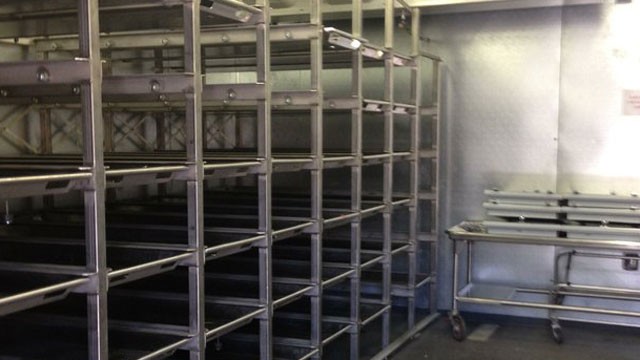
The massive door to the freezer slides open at the Pima County Medical Examiner’s Office. The freezer was built to handle the overflow of bodies brought here, people who died from heat stroke and dehydration as they tried walking through the desert. It’s used in the summer.

So far this year 47 migrants have died.

"Typically in June we’ll go up to 20. July in 2010 we had 55,” said Dr. Gregory Hess, the medical examiner.

The remains of those who are not identified are eventually cremated. It has led to mysteries and confusion as remains pile up. So Hess and local volunteers at Humane Borders have published a digital map people can use to sort through who has been found in the desert and where.

By Michel Marizco Freezer at the Pima County Medical Examiner's Office in Tucson. It was built to handle the overflow of bodies as the summer heats up and migrants begin to die.

"You can search by cause of death, you can search by location, you can search by age, you can search by gender," Hess said.

The map will be made available to the public on Monday.

Every year, about 240 people crossing the border into Arizona are found dead. Some of those people are never identified. The map, Hess said, may help put a name this summer to some of the remains in the freezer.

Saturday 4 May 2013

http://abcnews.go.com/ABC_Univision/arizona-morgue-prepares-migrant-deaths/story?id=19104562#.UYRQ7jRzA34

continue reading

12 bodies recovered from collapsed Bangladesh building on ninth day


Rescuers recovered 11 bodies and a torso from the site of collapsed Rana Plaza on Thursday while moving out the rubble using heavy machineries. With the addition, the death toll hits 442.

Eyewitnesses and rescuers said that the heat is causing the bodies still stuck in the rubble to decompose fast and most of those recovered bodies were hardly recognisable.

No survivors were found after the army rolled out heavy equipment, four days into the collapse on April 24. The eight-story building, which housed five garments factories, a shopping mall and the branch of a private bank, caved-in a day after a number of its pillars and floors developed cracks.

The number of rescued workers remains at 2,437. However, seven of them have died while under treatment, lowering the number of survivors in the catastrophe to 2,430.

Of the bodies recovered 384 were handed over to their relatives while 32 unidentified bodies were buried at Juraine graveyard. Several hundreds attended the mass funeral organised for them.

Over 80 additional graves have been prepared, with authorities expecting a rise in the number of unclaimed dead bodies.

Rescuers said that they believe unaccounted and decomposing bodies still remain buried under the sandwiched building, which would be uncovered as they go deeper into the rubble. The stench of decomposing bodies is increasing day by day and rescuers have been forced to use facemasks and spray air-fresheners to block out the smell.

When asked about how much time it would take to remove the slabs and pillars, Maj Gen Chowdhury Hasan Suhrawardy of the 9th Infantry Division of Bangladesh Army, who are running the rescue, said: “It is a delicate and time-consuming operation, but we are doing everything we can to ensure that we can recover the bodies unmutilated.”

Rescuers estimate that the building turned into 600 tons of rubble, of which 350 tons has been removed.

However, the number of missing people is still unclear. Suhrawardy said that 149 people have been listed so far. “However, it might be longer as we are still developing the list with the help of related organisations.”

The rescue operation chief also expressed dissatisfaction and said that the platform of garment factory owners, BGMEA, is not helping with the list.

Inter Service Public Relations (ISPR) Director Shaheenul Islam said that the government will rehabilitate the victims and that Izaz Kaikobad, a rescuer who was injured, was taken to Singapore for treatment.

He also refuted allegations of concealing dead bodies and said that there is no scope of hiding bodies as they are being handed over to the administration as soon as they are pulled out of the rubble.

The armed forces spokesperson also called for not making undesirable comments over the rescue operation, as any such remark from a responsible person of the country will hurt rescuers and relatives of the victims as well.

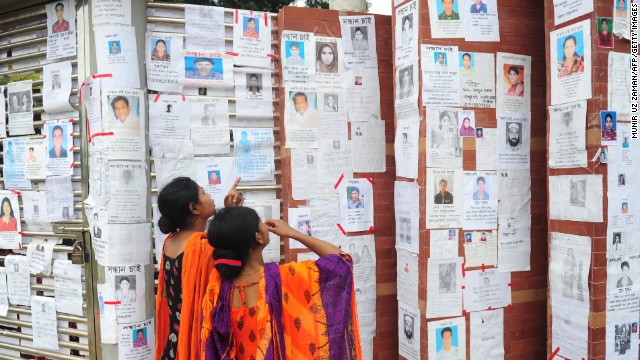
Meanwhile, hundreds of anxious relatives are still looking for their missing loved ones at a nearby school ground, which has been serving as a place to keep the bodies initially so relatives could identify them.

Amena Begum has been looking for her husband, 41-year old Manju, who worked at the Rana Plaza. She said that she had visited all the hospitals, both in Savar and Dhaka, where the injured and the dead have been taken to look for the father of three. “At least give me his dead body” was all she had to say.

Saturday 4 May 2013

http://dhakatribune.com/bangladesh/2013/may/03/12-bodies-recovered-ninth-day

continue reading

Friday, 3 May 2013

Bangladesh: Damaged corpses making identification difficult


The damaged corpses of the Savar tragedy have posed a challenge to district administration officials as they struggle to identify them and hand them over to their respective family members.

The problem has become acute in the last three days with the dead bodies fast decaying and losing visible body marks, some already deformed from the pressure of the heavy concrete slabs of the collapsed building.

“The bodies recovered in the last three days are fully decomposed and hardly identifiable. We have been depending on documentation,” said Mohammad Iftekhar Hossain, Additional Deputy Commissioner, Dhaka.

He said in the pockets and vanity bags of some victims they found their photographs. If their relatives can bring matching photographs, they will be handed over.

Officials are also using mobile phones, letters and other articles found in their pockets to identify the bodies.

“If a relative can tell a victim’s cell number, we consider the body identified. In the case of bodies that no one comes looking for, we are using their cell phones to contact their relatives,” he added.

Apart from cell numbers and photographs, officials are also using manual identification methods like matching physical features and body marks.

“On Wednesday, we handed over two bodies after their relatives described them and identified body marks such as broken teeth or marks of injury,” he said.

The bodies that cannot be identified through this procure are being sent to Dhaka Medical College Hospital (DMCH) for DNA testing, he added.

Unidentified bodies, if already buried, can be claimed later.

“The graves of the unidentified workers at Jurain graveyard have separate identification numbers. Their relatives can identify them even after burial,” he said.

According to the district administration, DMCH authorities will start identifying the bodies kept in the hospital morgue with DNA sampling from Saturday.

Two bodies at the DMCH morgue and two at Sir Salimullah Medical College morgue are awaiting identification by their relatives.

Friday 3 May 2013

http://dhakatribune.com/bangladesh/2013/may/03/damaged-corpses-making-identification-difficult

continue reading

14 people killed in car accident in Iran


At least 14 people were burned to death in a car accident in Iran's southwestern Khuzestan province, semi-official ISNA news agency quoted Iran's traffic police chief as saying.

After passenger bus which came from Ahvaz city in Khuzestan to central Isfahan city hit a lorry coming from the opposite direction, the bus caught fire and it was spread to the lorry, said the police commander Mohammad-Reza Mehmandar.

The incident led to the death of 12 passengers of the bus and two crew members of lorry, said Mehmandar, adding that four passengers of the bus were also hospitalized due to the fire injuries.

The cause of the incident is under investigation, he added.

Official figures show that more than 20,000 people died and 200, 000 others wounded in traffic accidents annually in Iran. Inexperienced drivers and low-efficiency of the cars and the roads are blamed for causing these accidents.

Friday 3 May 2013

http://big5.xinhuanet.com/gate/big5/news.xinhuanet.com/english/world/2013-05/02/c_132355252.htm

continue reading

U.S. military plane crashes near Kazakh-Kyrgyz border


A military plane crashed shortly after taking off from a United States airbase in Kyrgyzstan on Friday, officials said, though there were no immediate reports of any injuries.

"According to my information, the plane broke up into three pieces. Information on the dead or wounded is being clarified. All the rescue services have gone to the scene," the emergency situations ministry's press secretary Abdisharip Bekilov said.

The refuelling plane took off from the US Manas airbase and crashed near the mountain village of Chaldovar, around 200 kilometres (125 miles) from the capital Bishkek and close to the border with Kazakhstan, the spokesman said.

The press secretary of the US transit centre, Akzhibek Beishebekova, told AFP that it was gathering information on the incident.

"We cannot confirm or deny the plane crash," she said, adding that the number of people on board the plane was not known.

Witnesses described seeing an explosion mid-air and said the wreckage of the plane was still burning.

The Manas airbase is key to American military operations in Afghanistan, used to ferry troops into the country, refuel warplanes and evacuate wounded soldiers.

According to the emergency ministry's preliminary information, the plane involved in the crash was a KC-135 Stratotanker plane that lost contact with the base as soon as it took off.

The flight left at 2:30 pm local time (0830 GMT), the press secretary of the ministry of transport and communications, Kylychbek Dosumbetov, told AFP, citing the country's Civil Aviation Agency.

"At around 1455 Kyrgyz time (0855 GMT), a resident of one of the nearby villages said that a plane blew up in the air. On the wings of the plane he saw an American flag," the interior ministry said in a statement.

A local official told AFP that the pilot apparently managed to escape from the plane before it crashed.

"The preliminary information is that the pilot jumped out with a parachute. They have gone to look for him," the deputy district chief Anatoly Ivannikov said.

"No victims have been found at the site of the plane crash."

The area around the plane was still burning, he said.

"The plane fell in the mountains. The area is taped off. We are not letting people approach, since the plane's wheels are still burning."

Witnesses told the Kyrgyz AKIPress news agency that they heard a buzz and then an explosion and that the plane was continuing to burn.

A local resident, Nurlan Derdenov, told local news website 24.kg that the plane "blew up in the air."

"School children managed to film it on cell phones. When the plane fell, it hit a high-voltage power line."

Friday 3 May 2013

http://www.google.com/hostednews/afp/article/ALeqM5gFIWohZFg0VU_npMp7XQ-rbxDlPA?docId=CNG.7d5d8db66551f91b5f00e4132fb5c861.211

continue reading

Phuket, Phang Nga to test for Tsunami and Earthquake this month


A three-day earthquake and tsunami seminar and drill is to be held later this month as the ninth anniversary of the Indian Ocean Tsunami approaches.

The big wave practice drill, to be held in combination with Phang Nga, is set for May 29 and two days of talks about latest information on disasters.

Phuket Vice Governor Jamleran Tipayapongtada met with officials from the Department of Disaster Prevention and Mitigation yesterday in Phuket City to outline the event.

''Last year Phuket experienced a tsunami alert and for the first time an earthquake with its epicentre under the island,'' the vice governor said.

''We need to make sure we are prepared in future because the Andaman sits in an earthquake and tsunami zone.''

Phuket's name became closely associated with the December 26, 2004 tsunami but it was in Phang Nga, the province north of Phuket, that the big wave claimed most victims.

While the tsunami hit the first line of buildings along the west coast foreshore in Patong, in and around Khao Lak the wave increased in magnitude as it rose to more than nine metres and surged inland for two kilometres in some places.

It was Thailand's greatest natural disaster with 5400 people killed, about half of those tourists. Around the region 220,000 were killed, with Aceh in Indonesia suffering 160,000 dead.

Drills have been held regularly on Phuket since but last year's real tsunami alert in April, followed a few days later by the earthquake, provided an expected test that highlighted flaws in the system.

Representatives from the Disaster Warning Centre in Bangkok, which has the job of raising the alarm, will be on Phuket for the Phang Nga-Phuket conference and drill.

It's expected that DWC officials will provide an update on the need for Russian and Burmese language warnings to be included among the languages broadcast from Phuket's 19 tsunami warning beach towers.

During last year's evacuations it became evident that a second warning tone should be added to signify an ''all clear.''

Evacuated tourists and residents had no idea whether the sounding of the same signal hours after the initial alarm indicated another wave alert or the all-clear.

Crowds on hilltop roads also potentially impeded the passage in and out of rescue vehicles and ambulances.

While the tsunami sirens are effective during daylight hours when people are on the beaches, alternatives are needed for nighttime, especially during a storm when the wind blows the tower warnings out to sea.

Bangkok Warning Centre officials are expected to test the system where they send an SMS to the DPPM on Phuket and the DPPM distributes that message to local mayors and on to local communities.

Mobile telephone systems have, however, proved unreliable when used by too many people, as happened in last year's evacuation.

On May 29, Phuket and Phang Nga officials will combine to stage sea and land rescue drills near the Sarasin Bridge that links the two provinces.

Because Phuket and the Andaman coast are in a tsunami area, tourists are advised to ask their resort front desks who will wake them up if a tsunami arrives at 3am, when everyone is sleeping.

The Phang Nga fishing village of Nam Khem, where 800 were killed in 2004, takes tsunami warnings more seriously than most Andaman communities and supplements official warnings with its own system.

Friday 3 May 2013

http://phuketwan.com/tourism/phuket-phang-nga-test-tsunami-earthquake-month-17996/

continue reading

Chibombo accident victims to be buried in mass grave


Government has decided to bury the 17 Chibombo road traffic accident victims in a Mass grave in Kabwe where all the deceased came from.

Briefing the press in Kabwe today, Central province Permanent Secretary Annie Sinyangwe said government in the province will take over the burden responsibility of burying the accident victims from their families.

Mrs Sinyangwe said the government authorities at the province have visited all the homes and identified the deceased who happened to have been all Kabwe residents and traders of the market, adding that the day they met their fate they were all going to Lusaka to order merchandise for sale.

She said the burials which will take place on Saturday 4th May will be conducted by the government at the old St. Mary’s cemetery in Kabwe, after the church service to be conducted by the Zambia Army Chaplains and the Church mother bodies at Railways grounds where all mourners will assemble.

She said some families have requested to bury their deceased relatives elsewhere and that government will not restrain them from doing so, adding that the Municipal council has already issued the burial permits to all the families.

The Permanent Secretary welcomes everyone who wants to attend the burial to Kabwe and that for further details, they could contact Kabwe District Commissioner, Mr Patrick Chishala.

Earlier Kabwe District Commissioner who was accompanied by His worship the Mayor, Moses Mwansa, two Members of Parliament, Honorables Sydney Mushanga and James Kapyanga and the Councillors gathered in a meeting with the deceased families to discuss the funeral arrangements.

And Disaster Management and Mitigation Unit Regional Coordinator Ingribet Bondo said his office has given to each deceased family five 50 kilograms bags of mealie-meal, 10 litres of cooking oil, a 50 kg bag of Kapenta and 50 kg bag of beans to help out at the funeral.

On Tuesday 30th April, 17 people died in the traffic road accident which involved a Kabwe- Lusaka bound Mini bus in Chibombo district in Central province.

Friday 3 April 2013

http://www.lusakatimes.com/2013/05/02/chibombo-accident-victims-to-be-buried-in-mass-grave/

continue reading

Army challenges 'rumours' of ‘hiding away’ bodies of those killed at Savar’s Rana Plaza rubble.


General Officer Commanding (GOC) of Bangladesh Army’s 9th Infantry Division Major General Chowdhury Hasan Suhrawardy, who is supervising the rescue at Savar, appealed in a press conference that such baseless rumours should not be paid heed to.

“Some quarters have alleged that bodies are disappearing. They are fuelling public anger by spreading rumours that actual casualties are unbelievably high,” he said.

Maj-Gen Suhrawardy said these rumours were hindering rescue operations.

“By alleging that bodies are disappearing, this quarter have questioned the patriotism and honesty of the army and all those organisations and volunteers involved in the rescue.” He said this was 'extremely unfortunate'.

The death toll in the Rana Plaza collapse stood at 429 on Thursday morning. It could still rise as rescue continued and the rubble was being cleared.

BNP Chairperson Khaleda Zia on Wednesday alleged that the actual casualty was being deliberately played down.

On Wednesday, army said the number of those missing was only 149, raising eyebrows everywhere, because even the army could not clarify how it came to such a conclusion.

The army now says 2,437 have been rescued.

On Sunday, without hopes of finding survivors alive rescuers employed heavy machines to clear the rubble and recovered 44 more bodies.

The GOC said rescue and recovery was taking some time as they were trying to bring out the bodies without any damage. “We will not move until the last body is found.”

Bangladesh Army had donated almost Tk 75 million for the Savar victims, equivalent to one day's salary of all its officers and men.

Friday 3 May 2013

http://bdnews24.com/bangladesh/2013/05/02/army-challenges-rumours

continue reading

Thursday, 2 May 2013

8 Bodies Found in Guatemala Clandestine Grave


Forensic experts say they have discovered eight bodies in a clandestine grave in western Guatemala that dates back to 1982, when former Gen. Efrain Rios Montt was ruling the country amid a civil war.

Guatemala's Forensic Anthropology Foundation director Jose Suasnavar says the excavation in the village of Laguna Burra was conducted at the request of an organization called Oxlajuj Ajpop.

Oxlajuj Ajpop representative Flor Gonzalez says witnesses approached the group with information of several massacres in 1982. She says witnesses told them soldiers kidnapped people in the state of Quiche and then brought them to neighboring Huehuetenango state, where they were killed and buried.

Gonzalez says the group has also requested excavations in Paquish, another village in Huehuetenango where other clandestine graves are believed to be located.

Thursday 2 May 2013

http://abcnews.go.com/International/wireStory/bodies-found-guatemala-clandestine-grave-19094667#.UYLHEzRzA34

continue reading

More than 60 killed in gold mine collapse in Sudan's Darfur


Dozens of people have been killed in a gold mine collapse in Sudan's Darfur, said the chief of the district where fighting over gold in January led to the region's worst unrest in years

It is not known how many people may still be missing after Monday's accident.

"The number of people who died is more than 60," Haroun al-Hassan, the local commissioner in Jebel Amir, North Darfur, said on Thursday, adding that rescue operations were still taking place.

"I cannot give exact figures because no one got precise numbers of how many people were going inside the tunnel," which went down 40 metres (yards), he said.

Rescuers were using traditional tools to try to reach the victims, he said, without specifying whether anyone might still be alive.

"We cannot use machines because if they came near, the ground will collapse. People are using traditional tools and because of this, the rescue is very slow," Hassan said.

Seven weeks of clashes between two Arab tribes in Jebel Amir during January and February killed more than 500 members of the Beni Hussein tribal group, a Benni Hussein member of parliament for the area said earlier.

The violence uprooted an estimated 100,000 people.

Fighting erupted on January 5 between Beni Hussein and another Arab tribe, the Rezeigat, when a Rezeigat leader who is an officer in Sudan's Border Guard force apparently laid claim to a gold-rich area in Beni Hussein territory, Amnesty International said.

Humanitarian sources said at the time that the incident was the worst example of inter-Arab violence to emerge in the past two years as government-linked Arab groups got "out of control" and turned on each other.

One humanitarian source said the Beni Hussein had refused to pay newly imposed government mining fees adding up to "huge, huge money".

Gold has become a key commodity for cash-strapped Sudan since South Sudan separated two years ago with the loss of about 75 percent of the country's oil production.

Thursday 2 May 2013

http://english.ahram.org.eg/News/70581.aspx

continue reading

Vietnam-era sailors' remains to be buried at Arlington


Human remains from the Vietnam War have been identified as four U.S. Navy sailors who were reported missing in 1967, officials said.

The bodies of the men are to be buried together Thursday in Arlington National Cemetery, Stars and Stripes reported.

Lt. Dennis Peterson, Ensign Donald Frye and Aviation Antisubmarine Warfare Technicians William Jackson and Donald McGrane had been missing since July 1967 after their helicopter was shot down over North Vietnam, a U.S. Defense Department official said Tuesday.

The sailors were attempting to find a downed pilot when they were fired at, Stars and Stripes said, and the aircraft caught fire and crashed.

In 1982, five boxes of remains were given to U.S. officials and a subsequent investigation by U.S. and Vietnamese officials involved excavation of the crash site, where more human remains as well as aircraft wreckage were recovered.

Last year, Defense Department scientists used forensic tools and circumstantial evidence to identify the remains, Stars and Stripes reported.

Thursday 2 May 2013

http://www.upi.com/Top_News/US/2013/05/01/Vietnam-era-sailors-remains-to-be-buried-at-Arlington/UPI-17811367411820/

continue reading

20 more bodies recovered in collapsed Bangladesh building rubble


Many of the people killed in last week's collapse of an 8-story garment factory in Bangladesh already have been buried, but the death toll continues to rise.

Police say 20 bodies were recovered overnight, bringing the death toll to at least 430. And another 149 people are still missing.

Maj. Gen. Chowdhury Hassan Suhwardy, the commander of the area's army garrison supervising the rescue work, dismissed reports that up to 1,000 people were missing and accusations from some relatives that authorities are hiding the bodies to keep the death toll low.

"Don't listen to such rumors," he told reporters.

Suhrawardy said Thursday that 20 bodies were recovered overnight, bringing the death toll to 430. Rescue workers believe more bodies are buried on the building's ground level, and they're using cranes and cutting machines to clear the tons of rubble.


On Wednesday, a mass Muslim funeral was held for 34 victims whose bodies were too battered or decomposed to be identified. Cemetery workers have dug several long rows of graves where scores more unidentified bodies are expected to be buried in the coming days.

Rescue workers believe more bodies are buried on the building's ground level, and they're using cranes and cutting machines to clear the tons of rubble.

Five garment factories occupied upper floors of the eight-story Rana Plaza building that collapsed April 24, a day after huge cracks appeared in the building and police ordered an evacuation. The owner of the building is accused of telling tenants it was safe despite the order.

Thursday 2 May 2013

http://www.azfamily.com/news/world/205728071.html

continue reading

Chisamba accident: Only 4 bodies identified so far


Only four bodies out of the 17 Chisamba bus accident victims have been identified.

Acting Central Province medical officer Abel Kabalo said by midday yesterday only four people had been identified out of the 17 who died in a tragic accident on Tuesday near Ibis Garden turn-off.

Residents have however continued to inspect the bodies at Kabwe General Hospital mortuary with the view of identifying the deceased.

Dr Kabalo said in an interview yesterday that he was hopeful that the remaining bodies would be identified before the end of the week.

Meanwhile, there was confusion at Kabwe General Hospital mortuary after word went round that 17 people had died in a road traffic accident involving a Kabwe minibus.

Quick action by the police saved the situation from degenerating into pandemonium.

A check on Tuesday evening at the Kabwe General Hospital found several residents busy trying to identify the bodies with others openly wailing as they could not hold their emotions.

Health personnel had a tough time to control the situation and police had to be called in to help.

The accident occurred after a Lusaka-bound Toyota Hiace minibus collided with a Volvo truck around 06:00 hours on Tuesday after a tyre burst.

Thursday 2 May 2013

http://www.zedonlineads.biz/2013/05/02/chisamba-accident-only-4-bodies-identified-so-far/

continue reading

16 die as torrential rains wreak havoc across Saudi Arabia


Torrential rains and flash floods in different provinces have left 16 dead and three missing.

The casualties include four members of a family in Baha, two people in Al-Kharj, three in Aflaj, one in Hariq and four in Taif, the Civil Defense said yesterday.

The missing are three expats in Baha.

Custodian of the Two Holy Mosques King Abdullah has directed the Civil Defense Council to launch all-out efforts to ensure the safety of people. The king also ordered departments to take steps to offer financial and material support to flood victims.

“The king has been monitoring the situation since the heavy downpours began. He is also monitoring the efforts of all related ministries and government departments to provide relief operations and undertake safety measures,” Interior Minister Prince Muhammad bin Naif, who is also chairman of the Civil Defense Council, said in a statement on Wednesday.

The king urged council members to discharge their duty to implement all emergency plans to deal with the damage caused by weather conditions. The king’s order stated that the victims should be provided with relief and assistance, including shelters to those whose homes were wrecked and whose farms were destroyed, in addition to health care and all other daily needs, the prince said.

He added that the Interior Ministry is monitoring the field operations of Civil Defense teams in all provinces, ensuring that they are working in sync with civil defense committees under provincial governors.

Lt. Col. Jaman Al-Ghamdi, spokesman of the Baha provincial Civil Defense office, said three bodies of the missing family were discovered Tuesday night and the fourth was found Wednesday morning. The jeep carrying the family was carried away by the surging waters at Wadi Al-Lihyan in the Aqiq governorate in the evening.

After being alerted about the accident, Civil Defense sent rapid-intervention and rescue teams to the area while Baha Gov. Prince Meshari bin Saud closely monitored the operations.

About 300 officers under the supervision of Deputy Director of the Baha Civil Defense Brig. Ali Al-Sawat participated in the operations. Despite the darkness and continuing drizzle, the search teams at first located a submerged Toyota jeep with the body of a 75-year old woman in the deep valley. Search parties found the body of a 52-year-old man further downstream and that of a 30-year-old woman upstream. The body of the child accompanying the family was retrieved yesterday morning, Al-Ghamdi said.

Another team is continuing to search waters and submerged bushes looking for three Yemeni workers of a road construction company in the Aqiq governorate. The pickup truck that was carrying the three was found overturned in a valley close to the Aqiq dam.

Heavy rains led to the collapse of a ten meter-high dam in Bisha in Asir Province. The dam was temporarily built by the ministry of water and electricity to protect another dam which is still under construction. The construction work is still in its early stages, the ministry said in a statement yesterday.

"The project consists of a large dam with a capacity of 68 millions square meters and is 49 meters high," the ministry said. Four villages located around the dam were evacuated. The Civil Defense said there were no casualties among civilians in the affected areas.

"Tabalah, Thnyah, Shedaiq and Subaihi villages have been evacuated as a precautionary measure," said Col. Mohammad Al-Asemi, spokesman of Civil Defense in Asir.

Thursday 2 May 2013

http://www.arabnews.com/news/450071

continue reading

India accident in Himachal Pradesh kills 10 people


even women and three children, all from Rajasthan, were killed in Himachal Pradesh's Hamirpur district when their overcrowded jeep skidded off the road and fell into a 500-metre-deep gorge, police said Wednesday.

The victims, mostly labourers working in a road project, were on their way home when their Bolero jeep fell into a gorge near near Uhal village Tuesday evening, Superintendent of Police Jagat Ram told IANS.

He said seven women and three children had died. Five of the injured have been admitted to the zonal hospital in Hamirpur, some 175 km from here.

Local villagers helped police to retrieve the bodies.

Road accidents are common in India, often due to poor driving or badly maintained roads and vehicles.

Witnesses told police that the vehicle was overcrowded and the driver probably lost control while negotiating a turn.

Last month, 12 people were killed when an SUV carrying people returning from a cricket match fell into a gorge in Chamba district in the state.

India has the world's highest number of road deaths, with more than 110,000 people killed every year in accidents.

Thursday 2 May 2013

http://www.bbc.co.uk/news/world-asia-india-22363026

http://www.indiatvnews.com/news/india/-killed-as-jeep-falls-into-himachal-gorge-22443.html

continue reading

Wednesday, 1 May 2013

Bangladesh: 32 unidentified bodies buried at Jurain graveyard


Thirty-two unidentified bodies retrieved from the debris of collapsed Rana Plaza were buried on Wednesday at Jurain graveyard, with the graves bearing the numbers corresponding to their DNA samples.

A century-old Islamic charity Anjuman-e-Mufidul Islam performed the last rites at the graveyard.

Executive Director of the charity Abul Kashem said they had dug 60 graves at Jurain.

Dhaka district’s Additional Magistrate Abul Fazal Mir told bdnews24.com the DNA samples of the bodies had been preserved, so that their identity could be confirmed through tests if anyone came claiming them later.

Executive Magistrate Rebeka Sultana said the DNA identity of 21 unidentified bodies kept in the Dhaka Medical College and Hospital (DMCH) morgue was matched on Wednesday noon. The body of a deceased, identified as a female readymade garment worker Hasina, was handed over to her relatives later.

Another body was kept at the hospital since two people had claimed it.

After the first namaz-e-janaza (funeral prayer) in front of the DMCH around 2pm, 19 unclaimed bodies were brought to the Jurain graveyard. Fourteen unclaimed bodies were brought there from the morgue of Salimullah Medical College and Hospital, also known as Mitford Hospital.

Of the 17 unidentified bodies kept at the Mitford Hospital, the identity of one female garment worker Sultana, 22, was confirmed at the last moment. Though the body was handed over to her relatives, two other bodies were kept at the morgue since they were claimed by several people.

Executive Magistrate Khadiza Begum said after the second funeral prayer of the victims at the graveyard, relatives of another female garment worker Fahima confirmed her identity. She was also buried at the graveyard after the last rites.

The process of burying the victims started at about 3pm.

Besides the locals, the relatives of those still missing since the collapse of the nine-storey commercial building Rana Plaza at Savar on Apr 24 gathered at the graveyard looking for the bodies of their loved ones.

Additional Magistrate Abul Fazal Mir said a total of 70 bodies recovered from the concrete rubbles were sent to the two hospital morgues. Of those, 35 were identified and handed over to their relatives. Three bodies were still at the hospital morgues because of several claims for them.

Meanwhile, five people injured in the country's worst-ever industrial disaster succumbed to their injuries while undergoing treatment at the DMCH, with one of them, Selim Rana of Panchagarh district, dying on Wednesday morning.

The authorities handed over the body to his brother Shahidul Islam.

Rescuers pulled out 18 more bodies from the debris of Rana Plaza in Savar as the rescue operation stepped into eighth straight day on Wednesday.

With the fresh recovery of bodies, the toll from the deadly building collapse now stands at 411, according to the Dhaka District control room, opened close to the site to provide information on the tragedy.

Wednesday 1 May 2013

http://bdnews24.com/bangladesh/2013/05/01/32-bodies-buried-at-jurain-graveyard

continue reading

18 years since Croatian operation “Flash”


Wednesday marks 18th anniversary of the beginning of the Croatian military operation “Flash”, in which, by the data of the Documentary-informative center “Veritas”, 283 Serbs from western Slavonia were killed, and at least 15,000 people were expelled.

Among the murdered Serbs were 57 women and 9 children. According to the data of the Croatian Helsinki Committee for Human Rights, between 83 and 100 Serbian civilians were killed, and both NGOs point out that none of the Croats was trialed for the war crimes in the operation “Flash”.

According to the data from “Human Rights Watch”, after the “Flash” 1,500 Serbs were arrested, and many of them were taken to detention camps in Varazdin, Slavonska Pozega, Nova Gradiska and Bjelovar.

Due to the anniversary of the “Flash”, there will be a memorial service in the Church of Saint Mark in Belgrade, on the May 1, at 11 o’clock. Near the temple, on the commemorative plaque, the Association of the families of the missing “Tear” will lay flowers and wreaths for the Serbian victims.

In Gradiska, in Republic Srpska, where most of the refugees from west Slavonia lives, people will toss flowers from the Bridge of salvation and wreaths in Sava river, and in the church of the Holy Virgin in the city will be memorial service.

More than 160 well known burial sites in west Slavonia are not yet exhumed, and the identification process of the dead is going slowly. The last exhumation was done in December 2012, and identification was done in the Faculty of Medicine in Zagreb, when remains of 17 Serbs were identified. The bodies dated to be from operation “Flash” and other Croatian operations in the area of west Slavonia from 1991. to 1995. In that period, tens of thousands of Serbs were expelled from west Slavonia.

Operation “Flash” lasted two days, and in that part of Slavonia, which was part of Republic Srpska Krajina (“Sector West” under the protection of UN), has entered more than 16,000 Croatian troops.

Wednesday 1 May 2015

http://inserbia.info/news/2013/04/18-years-since-croatian-operation-flash-on-may-1-2013/

continue reading

Slaughterhouse of Sotin: Mass grave found in Croatia finally solves mystery of people who were taken away in the middle of night by Serbs


Ten bodies of people taken away in the dead of night and killed during the earliest part of the Yugoslavian wars have been discovered in a mass grave near a slaughterhouse.

It is hoped the find finally solves the mystery of Sotin, a Croatian village near Vukova.

Thirteen residents of the village were killed by Serbs during the night on December 26, 1991

Croatia’s deputy war veterans minister Bojan Glavasevic said that remains of ten people, believed to belong to those taken, had been exhumed from a mass grave

It comes after three bodies were discovered elsewhere in the village last week.

Glavasevic said it was probable that the ten bodies had been moved in 1997 from the grave discovered last week.

They had been buried in a trench used for disposing of animal remains next to an abattoir, and the human remains were mixed with animal particles.

The find comes after a collaborative investigation by the Zagreb and Belgrade authorities.

After 22 years this is seen as the first indication of official cooperation between the Government of Croatia and the Serbian authorities on the issue of missing persons.

In February, an investigation was launched against several wartime Serb fighters. Authorities were investigating the killing of 16 Croatian civilians in Sotin from October 1991 until the end of the year, Balkan Insight reports.

Two former police and territorial defence officers in Sotin, Zarko Milosevic and Dragan Loncar, were arrested on war crimes charges on February 4.

The prosecutor in Belgrade told Balkan Insight: 'Milosevic and Loncar, together with other members of the police and territorial defence forces, arrested more than ten civilians and detained them at the police station.

'On December 26, 1991, they put them in an army truck and took them to an unknown location and killed them with automatic weapons.'

During the war, 64 people in total were killed in the small village, which lies east of Vukovar.

Vukovar, dubbed 'Croatia's Stalingrad' because of the devastation wrought on it in the attack, fell to the Yugoslav Army and Serb fighters in November 1991 after a devastating siege. Prisoners of war sought refuge in a hospital.

When the city fell, Serbian troops seized the prisoners. At least 200 were taken to a pig farm in Ovcara two miles away and beaten, tortured and then killed. Their bodies were also found in mass graves.

This is the fifth case that Serbia’s war crime prosecutor has launched over alleged war crimes around Vukovar.

The previous four cases related to crimes committed at the Ovcara farm.

Serbian courts have so far found 15 people guilty of war crimes in Vukovar and sentenced them to a total of 207 years in prison.

The Yugoslav Army and Serbian paramilitary units besieged Vukovar for three months in 1991.

It followed Croatia’s declaration of independence from Yugoslavia, and thousands of non-Serbs were expelled when the town was captured.

Wednesday 1 May 2013

http://www.dailymail.co.uk/news/article-2317590/Slaughterhouse-Sotin-Mass-grave-Croatia-finally-solves-mystery-people-taken-away-middle-night-Serbs.html

continue reading

Libya: IDing War Victims


For most of 2011, Libya was in the midst of a bloody civil war. The conflict ended that October after the murder of longtime leader Muammar Gaddafi. Now, as many as tens of thousands of citizens are missing. Mass graves containing dozens or even hundreds of bodies have already been unearthed, and many missing people are yet to be found.

“Exhuming the mass graves and collecting the samples from the unknown bodies will depend on the reports [that] inform us [about] the place of these graves, because the previous regime tried to hide the crimes,” says forensic geneticist Esam Zreg, director of the Technical Department of Missing Persons in Libya’s Ministry for the Affairs of the Families of the Martyrs & Missing (MAFMM). “Sometimes [Gaddafi loyalists would] execute people and bury them in secret places.”

In an attempt to bring closure to the tens of thousands of grieving families in the country, Zreg and collaborators at MAFMM, founded in December 2011 by the National Transitional Council of Libya, are launching a massive sampling and sequencing effort. A DNA lab is currently under construction in Zreg’s building in Tripoli, that will house state-of-the-art sequencing equipment. Libyan scientists will travel to various countries for training in modern DNA forensics techniques, then return home to process hundreds of thousands of tissue samples from unidentified human remains and family members of the missing over the next decade.

Zreg and his colleagues consulted with the International Committee of the Red Cross and the International Commission on Missing Persons, along with other support organizations, and came up with a two-part plan of action. One part of the mission is to collect blood samples from three to five different relatives for each missing person in order to build a database for identifying the missing. The second half is to extract and sequence DNA from human remains that are found, then scan the newly built database for matches.

“It’s a huge project,” says Kerstin Montelius, a geneticist at the National Board of Forensic Medicine in Sweden, who is not involved in the effort. “I do think it will take several years to be able to go through all the remains . . . but I think it’s doable.”

Zreg’s team received $2.5 million in funding from a Spain-based oil company called Repsol, and in January announced its partnership with global biotechnology tools company Life Technologies and the University of North Texas Health Science Center (UNTHSC), which in 2011 received a $3.5 million grant from Applied Biosciences (now part of Life Technologies) to establish a center to help countries throughout the world launch their own DNA databases. As the Libyan lab nears completion, Zreg and three other researchers will travel to Texas to train with Arthur Eisenberg, a veritable pioneer in DNA forensics and director of the UNTHSC Center for Human Identification. Eisenberg and his colleagues have put together a 2-week program to provide the Libyan researchers with training in “all of the techniques and methodologies to clean the skeletal remains, cut the remains to extract DNA, and then to amplify the DNA to detect the different genetic profiles,” Eisenberg says.

The UNTHSC group will also advise Zreg and the others on some of the common challenges of DNA forensics work. For example, “the samples for the human remains are old,” says UNTHSC forensic geneticist Jianye Ge, who will help train the Libya scientists, “so it may not be easy to get good results” from them. To increase the likelihood of making a high-confidence identification, “I would recommend the Libyan guys sequence the mitochondrial DNA, especially for the bones,” he says. “For each cell we have, we only have one copy of nuclear DNA, but for the mitochondrial DNA, one cell has several hundreds of copies.”

For now, Zreg and his teams are busy sampling living and deceased Libyans to build up a bank of samples ready to be processed as soon as the lab is complete. Zreg’s teams began sampling family members of the missing in March 2012, and by December had more than 10,000 samples banked. They hope to have completed this part of the mission by the end of 2013.

The teams have also begun the collection of samples from the deceased, having exhumed more than 400 bodies to date. Though there is no way to know for sure how many bodies remain to be found, “we have an expectation that there will be around 20,000 bodies,” says Zreg, who lost a close friend during the national upheaval. “We expect a gap of time, like 10 years, for this file to be solved. . . . We have to be patient for this, and it will not be easy.”

Wednesday 1 May 2013

http://www.the-scientist.com/?articles.view/articleNo/35246/title/IDing-War-Victims/

continue reading

16 people feared dead in Zambia's road accident


At least 16 people are feared dead in central Zambia's Chibombo district following a terrible accident involving a minibus driver and a truck, police told Xinhua on Tuesday.

The police said the minibus was coming from Kabwe town in central Zambia to Lusaka, the capital of the southern African country, when the driver lost control and collided with an oncoming truck before overturning.

The accident happened today around 06:30 hours along the Great North road when the driver of the bus lost control after a rear tyre burst and went on to hit into an on-coming truck and overturned.

The driver of the Volvo truck belonging to SABOC transport of Zimbabwe Reg. No. AAF 8926 and trailer No. 6767T Nathan Kambauwa aged 40 of Harare escaped unhurt.

The bodies of the deceased are lying in Liteta hospital mortuary while the injured are admitted in the University Teaching Hospital.

The bus was carrying 20 passengers, of whom 16 people died on the spot and the four others were seriously injured, according to witnesses.

The driver of the minibus only identified as Costa is among the dead.

The other deceased persons comprising of eight males and eight females have not yet been identified.

The injured have been evacuated to the University Teaching Hospital, the country's largest referral hospital in Lusaka. Zambia Police Deputy Spokesperson Charity Munganga said, "I can confirm that we have received reports of an accident involving a minibus and a truck but details will be availed to you later," she said.

Police Spokesperson comfirmed the tragedy in a statement and appealed to members of the public whose relatives were travelling from Kabwe to Lusaka this morning using the involved minibus to help with the identification of the bodies.

The accident occurred on the same spot where 54 people traveling in a big bus perished recently in a collision with a truck. Road crashes are common in Zambia and are mainly caused by careless driving and the poor state of roads.

Wednesday 1 May 2013

http://www.shanghaidaily.com/article/article_xinhua.asp?id=139648

http://www.lusakatimes.com/2013/04/30/another-chibombo-accident-claims-16-lives-on-the-spot/

continue reading

Mexico: 6 killed in government plane crash, including police


Six people who were traveling in a small plane belonging to the Mexican Attorney General’s Office died Tuesday when it crashed in the northern state of Zacatecas.

The crash in Zacatecas state occurred a day after the authorities onboard had carried out an arrest warrant against several suspected members of the Zetas cartel, Attorney General Jesus Murillo Karam said in a statement.

After the suspects were jailed, the three agents took a flight bound for Mexico City late Monday but their plane returned to the airport due to "mechanical failures," Murillo Karam said. They waited until the next day to take their fateful flight.

“Regrettably the occupants died,” a spokesman for the AG’s office confirmed to Efe, adding that at present the identities of the victims and the cause of the accident are not known.

The plane went down shortly before noon in the municipality of Morelos after taking off from the town of Calera en route to Mexico City.

The Beechcraft King Air 300 hit the ground 10 minutes after taking off, and the cause of the crash is under investigation, Attorney General Jesus Murillo Karam said in a statement.

Evidently, the plane lost altitude, ultimately hitting the ground and bursting into flame in the community known as Noria de los Gringos, Milenio Television reported.

The state attorney general of Zacatecas, Arturo Nahle, confirmed the six deaths via Twitter and said that the aircraft was the same one on which federal Attorney General Jesus Murillo Karam traveled to the state last month.

Two federal police agents and an agent working for the organized crime investigation branch of the attorney general's office were among the casualties. The plane's pilot, co-pilot and a mechanic also were killed.

Wednesday 1 May 2013

http://edition.cnn.com/2013/04/30/world/americas/mexico-plane-crash/

continue reading

Armageddon survival packs aid Chinese family after quake


A man from Sichuan Province recently made Chinese headlines for using several “bug-out backpacks” following the April 20 earthquake in Ya’an.

Li Yonggang, a 39-year-old freelance worker from Tianquan County, was interviewed by Southern Metropolis Daily.

After the magnitude-7 quake hit, Li ran out of the house wearing only his underwear, according to the report. He went back inside to get dressed, and brought out a large pack weighing nearly 55 pounds. He had prepared another four bugout bags for everyone in his family, except his baby son–his wife, mother, and two daughters each had their own pack.

Li’s bag was the biggest; the smallest belonged to his 6-year-old daughter, and only weighed 11 pounds. The packs contained tents, sleeping bags, clothes, food, a compass, gloves, headlamps, and even surgical suture kit, the Daily reported.

Li took the big backpack to his father-in-law’s home, and set up three tents.

“I’m completely self-sufficient. I don’t burden anyone,” Li told Southern Metropolis Daily.

Li said that his family did not have to worry about lack of food, as the packs contained dry crackers, army-style cans, and tablets to purify water. He had also hidden 220 pounds of vacuum-packed rice in his house. Six days after the quake, he still had not asked local authorities for any food supplies.

Li’s parents were born in the 1940’s in China and experienced horrifying famine in the years 1959-1961. “Many people died of starvation during the three-years of famine. At least two relatives told me how that they had to eat human flesh from dead bodies to survive the famine,” he told the Daily.

After Li experienced the Wenchuan earthquake five years ago, he was haunted by his parent’s experiences and determined to try to protect his family. Li began learning about survival.

He purchased the necessary supplies, prepared the five backpacks, and rented three cabins in the countryside for his children to use as survival practice sites.

After the latest earthquake, Li told the Daily that he learned a few lessons. “I had too many cans. In case of a real emergency, we wouldn’t be able to walk far with that much baggage.”

He added that he hoped he would never have to use the backpacks again.

Wednesday 1 May 2013

http://www.theepochtimes.com/n3/32949-armageddon-survival-packs-aid-chinese-family-after-quake/

continue reading

Bangladeshis turn rescuers after building collapse


The heat in the rubble was sweltering. It closed in on his body like the darkness around him, making it hard to breathe. Working by the faint glow of a flashlight, he slithered through the broken concrete and spotted a beautiful young woman, her crushed arm pinned beneath a pillar. She was dying, and the only way to get her out was to amputate.

But Saiful Islam Nasar had no training, and almost no equipment. He's a mechanical engineer who just days earlier rushed hundreds of kilometers (miles) from his hometown in southern Bangladesh when he heard the Rana Plaza factory building had collapsed and hundreds, perhaps thousands, of garment workers were trapped.

He also understood that maimed women can be cast from their homes.

"I asked her, 'Sister, are you married?' She said 'Yes.' I asked her, 'If I cut off your arm, will your husband take you again?' She said, 'My husband loves me very much.' And then I started to cut," he said.

He had brought a syringe loaded with pain-killer — his father was a village medic, and had taught him how to give injections — and he cut through her arm with a small surgical blade. It was easier than he expected because the arm had already been so badly damaged.

He pointed at fading specks of blood staining his vest and pants. He began to cry.

"There was no alternative," he said.

Bangladesh is well-versed in tragedy, a country where floods, ferry sinkings, fires and cyclones strike with cruel regularity. But with state services riven by dysfunction and corruption, often the only hope is the person beside you.

It is a country that makes heroes out of everyday citizens.

Many of the first responders at Rana Plaza were men like Nasar — neighborhood residents, fellow garment workers, relatives of the missing and charity workers — and they repeatedly took some of the most dangerous work. Using little more than hammers, hacksaws and their bare hands, they crawled into tiny holes in the wreckage, breaking through concrete and steel bars and working around the clock to drag out the victims.

They knew they were risking their lives.

Hemaet Ali, a 50-year-old construction worker who came to volunteer, told the people around him that his identity card, with his home address, was in his shirt pocket.

"If I die inside, please make sure that my body reaches my family," he told them.

Nasar came to Savar with 50 other men from the small volunteer organization he runs, Sunte Ki Pao. Normally, they assist people who have been in traffic accidents, offering basic first aid, securing valuables and contacting relatives. During seasonal floods, they help however they can when the waters rush into town. Nothing had prepared them to work the front line of their country's largest industrial accident.

"It was beyond imagination," he said Monday, six days after the collapse, when the search for survivors had given way to the search for bodies, and heavy equipment had replaced the rescuers.

Thin and lanky, the 24-year-old was well-suited for crawling through the tight tunnels he cut. At first, he had only his mobile phone to light the tiny spaces. He could see shattered chairs and tables. Sewing machines and fabric. And the battered bodies of the men and women who were crushed when the walls and ceilings came crashing down.

"I could just fit my shoulders in," he said. "I often felt like I would die and I would call out to my God."

The rescues, each of which could take many hours, were exhausting, both physically and emotionally.

"We would shout, 'Is there anybody here? Please make a sound.' Sometimes you would hear an 'Oooh, oooh' and you knew someone was there," he said.

Over six days, he pulled six people out alive, and removed dozens of bodies. He would work until exhaustion set in and then attempt to sleep — the first night on the roof of the collapsed building, the next two in a nearby field. Even now that he has moved into a tent, rest does not come easy.

"The images of the bodies flash in my mind," he said.

Eating also has been a problem.

"I have lost my taste," he explained. "I just keep smelling the smell of dead bodies."

The sickly sweet waft of rot from the building was ever present, and rescuers routinely sprayed cheap floral air freshener around the site in a futile attempt to control it.

Not all of the rescue workers at Rana Plaza were untrained. The government sent some 1,000 soldiers and firefighters to the site. But from all appearances, the majority of the rescuers who went into the rubble were volunteers. Altogether, some 2,500 people were brought out alive from the wreckage. The death toll stands at 386, but will surely climb as the largest pieces of rubble are moved.

The military, which oversaw much of the rescue efforts, dismisses the notion that they let volunteers take the lead.

"I have not heard of rescuing so many people in recent history anywhere in the world in case of such disaster," said Maj. Gen. Chowdhury Hasan Suhrawardy, a top military officer in the Savar area. "What we have done is excellent."

But it is clear that volunteers once again carried more than their share of the country's burden.

Sayed Shohel Harman, an unpaid community volunteer for the fire department, found a survivor whose arm was pinned under a concrete slab. The man begged Harman to give him a knife so he could cut off his own arm and free himself. Harman refused, saying he would go and get help.

"The doctors said it was too risky for them to go inside," Harman said. "They told me to go back and try to drag him out."

When he returned, the man was there, but his arm was gone. Another volunteer had given the man a knife and he had cut through his own flesh and crushed bones.

"I just sat down after seeing that," Harman said. "It was horrible."

Nasar said he will soon return to his hometown, where he will comfort his worried mother and look for a new job. He was forced to resign from his to join in the rescue. But most of all, he will think of the beautiful young woman whose name he never heard and whose fate he never learned.

"I pray to Allah that she has been saved, is alive and can return to her husband."

Wednesday 1 May 2013

http://abcnews.go.com/International/wireStory/bangladeshis-turn-rescuers-building-collapse-19073348#.UYAr9UBzA34

continue reading