Friday, 7 September 2012

Police use sketches to ID disaster bodies

Facial sketches have helped identify some of the people killed in the March 11, 2011, earthquake and tsunami, with 15 people identified since May from sketches drawn by police based on photos of the bodies.

According to the National Police Agency, 223 of the 15,802 bodies found in Iwate, Miyagi and Fukushima prefectures after the Great East Japan Earthquake remained unidentified as of Sept. 5.

The identities of 2,814 bodies--about 20 percent--were confirmed through DNA examination. Police are utilizing traditional techniques as well as modern scientific methods to identify the bodies about 1-1/2 years after the disaster.

The identities of 15,576 bodies, or 98.6 percent of those found in the three prefectures as of Aug. 8, have been confirmed. Soon after the disaster, bodies were identified mainly through their physical characteristics. About six months after the disaster, it became difficult to identify bodies through examination, so police have had to rely more on DNA tests.

However, it was difficult for the police to secure DNA samples of missing people for verification, such as hair or oil left on combs, as most of the missing people's houses were washed away. Samples from only 120 missing people have been obtained from items left in houses.

Since May 2011, the NPA has beefed up efforts to secure DNA samples through other channels, such as asking the Japanese Red Cross Society to provide blood samples of missing people who had donated blood. The NPA also asked medical institutions to provide cells from missing people collected during biopsies.

For those who left no DNA samples, the NPA has collected cheek swabs from relatives of missing people in hopes of a DNA match. Combining the results with other clues, such as teeth and other bodily characteristics, the agency has succeeded in identifying some of the unidentified bodies.

Since May, the prefectural police headquarters of Miyagi and Iwate have released 96 sketches of dead people, which were drawn from pictures of the dead bodies. Many of the bodies' eyes were closed and their faces were damaged, but police artists recreated the faces as if they were alive. The sketches were decisive in identifying the bodies of 15 people.

In June, a man from Kesennuma, Miyagi Prefecture, was able to identify the body of his father-in-law, who was 79 years old when he was killed, from a facial sketch posted on a Miyagi prefectural police website.

"I visited the morgue where his body was many times, but I couldn't identify it and even seeing a picture didn't help. However, the facial sketch was identical to his face when he was alive," the man said.

A senior NPA official said: "People seem more comfortable looking at the sketches rather than shocking pictures of dead bodies. We can also alter the the sketches if we don't receive many tips."

About 1 million police officers--counting those who made multiple visits--from around the country have visited the three prefectures to search for those missing after the disaster. However, only 16 bodies were discovered in the six months up to Aug. 31. According to police, 2,925 people remain missing.

Friday 8 September 2012

http://www.yomiuri.co.jp/dy/national/T120907003565.htm

continue reading

Flash Flood In Pakistan-Administered Kashmir Kills 13

PESHAWAR, PAKISTAN — Thirteen people were killed on Wednesday when a group of people was washed away by a flash flood in Pakistan-administered Kashmir, emergency officials said on Thursday, raising the death toll as a result of recent monsoon rains in northern Pakistan to 46.

The National Disaster Management Authority (NDMA) said heavy monsoon rains triggered a flash flood in Machiara Nullah, around 40 kilometers (24 miles) from Muzaffarabad, in the Azad Kashmir region which is administered by Pakistan. The floods washed away at least eighteen people.

Five people were injured and taken to medical facilities while rescue teams had recovered four bodies by Thursday, with the remaining nine people still missing and presumed to have drowned. “Efforts (are) on to recover the remaining dead bodies,” an NDMA official said, identifying the nine missing as six men and three women.

In other rain-triggered incidents on Wednesday, sixteen people were injured when a road collapsed as a bus drove over it in the Kotli district of Azad Kashmir. Landslides also killed two people in Pakistan’s Khyber Pakhtunkhwa province, one in Abbottabad district and the other in Mansehra district.

Heavy monsoon rains in northern Pakistan have killed at least 51 people in recent weeks, according to the National Disaster Management Authority (NDMA). The worst-hit area is Pakistan-administered Kashmir, where emergency officials have reported that at least 31 people were killed and 32 others were injured.

Earlier this year, the Pakistani government warned that nearly 30 million people across the country could be affected by flooding this year, advising local government officials and local citizens for adequate preparedness. Millions of people were also affected by the monsoon season last year, killing more than 300 people. Some areas saw the worst rainfall since at least 1936.

In late July 2010, above-average heavy monsoon rains in Pakistan’s Khyber Pakhtunkhwa, Sindh, Punjab and Balochistan regions killed approximately 2,000 people and affected around 20 million others as floods covered about a fifth of the country. Torrential rains overflooded rivers, which went cascading across the country from the mountainous north, inundating successive regions until they reached the sea. It was the country’s worst flooding in modern history.

Friday 7 September 2012

http://earththreats.com/2012/09/flash-flood-in-pakistan-administered-kashmir-kills-13/

continue reading

Toll in bus tragedy rises to nine

The toll in the bus tragedy in West Bengal's Bankura district on Friday rose to nine with recovery of seven more bodies.

Police superintendent of Bankura Mukesh Kumar said five bodies, including that of a young housewife, were found in Bhairabbanki river at Raipur in the district.

Two other bodies were found at Lalagrah in neighbouring West Midnapore during searches this morning, he said.

Search was on for more bodies, especially in the downstream near Lalgrah though no complaints of missing persons had been filed with the police, he said.

The private bus, which had fallen into the swollen river and was washed away while navigating a small bridge at Phulkulsma on way to Durgapur from Jhargram yesterday, has been pulled out of the water and no body was found inside it.

Neither was any body found trapped under the bus, he said.

The body of the 25 year-old housewife from Jhargram in West Midnapore was found at Junbani ghat in Raipur, while those of two men were found at Ekpal Ghat.

Bodies of two other men were found at Ambari ghat, also in Raipur. All the bodies except one found at Ambari have been identified, Kumar said adding all the bodies were taken to Bankura Medical College for post mortem.

Friday 7 September 2012

http://www.hindustantimes.com/India-news/WestBengal/Toll-in-bus-tragedy-rises-to-nine/Article1-926005.aspx

continue reading

Deadly bus crash in south Morocco

At least 42 people died when a bus plunged into a ravine in southern Morocco, officials say.

More than 20 others are reported to have been injured, some seriously.

The bus, travelling between the cities of Marrakesh and Zagora, left the road near the town of Zerkten in Haouz province and fell 150m (490ft), local officials said.

Most of the passengers are believed to be Moroccan. It is not clear if any foreigners are among the casualties.

"We are still in the process of identifying the bodies, as well as the injured," a local official told AFP news agency.

The accident happened in a mountainous area in the early hours of Tuesday, the official news agency Map reported. The cause is not yet known but an official in Haouz said an inquiry had been launched.

At least 24 people were said to be injured, 21 of whom were taken to a hospital in Marrakesh and the rest to a hospital in nearby Ouarzazate.

In a palace statement, King Mohammed VI offered his condolences to families of the victims and said he would pay for their transport, funeral and burial costs.

In July, two separate bus crashes in Morocco killed 26 people.

More than 4,000 people died in road accidents in Morocco last year, according to the transport ministry - an increase of 11.6% on the previous year.

4 September 2012

http://www.bbc.co.uk/news/world-africa-19475412

continue reading

Death toll in southwest China quake rises to 64

BEIJING - The death toll from two earthquakes that struck in southwestern China has risen to 64, the Xinhua state-run news agency said on Friday, citing provincial authorities.

Residents described people running out of buildings as the two quakes hit on the border of Yunnan and Guizhou provinces an hour apart around the middle of the day, followed by a string of aftershocks.

Television footage showed people running from damaged buildings and streets strewn with fallen bricks and rocks in Yunnan province's Yiliang district, which appeared to be worst hit.

The Xinhua news agency said 50 people had been killed and that rescuers have rushed to the quake zone. Authorities are also sending thousands of tents, quilts and coats to the area, it said.

The Yiliang county government said on its website that 556 people had been injured, while an online statement from the public affairs bureau in Zhaotong city, which overseas Yiliang, put the figure at 150.

The Zhaotong statement also said 100,000 people were made homeless by the disaster, and at least 20,000 houses collapsed or were damaged.

Altogether 700,000 people have been affected, it said.

The death toll could still rise as some villages remain blocked by landslides and the worst-hit areas may have lost power and communications, Xinhua said, citing local officials.

"The hardest part of the rescue now is traffic," Li Fuchun, the head Luozehe township, identified as the epicentre, was quoted as saying. "Roads are blocked and rescuers have to climb mountains to reach hard-hit villagers."

Rocks as tall as four meters (13 feet) crashed into mountain roads and landslides were also triggered, the report said.

The death toll may have been higher because of the area's denser population, with 205 people per square kilometer compared to 117 across the province, said Huang Pugang, head of the Yunnan seismological bureau, according to Xinhua.

In addition the epicentres of both major quakes were located just five to 15 kilometres from the county seat, he said, while the homes and buildings in the poor area might not have been built to withstand strong quakes.

Footage broadcast on state television network CCTV showed hundreds of people crowded into a sports field in Yiliang, a sprawling town surrounded by green mountains.

Many people took cover outside after the first quake and did not return indoors, said a man surnamed Xia reached by phone. "Lots of people are outside because they fear aftershocks," he said.

"I was walking on the street when I suddenly felt the ground shaking beneath me," posted one witness on Sina Weibo, a microblog similar to Twitter.

"People started rushing outside screaming, it still scares me to think of it now." So far, no casualties have been reported in Guizhou province, but the quake has damaged 1,540 homes there, Xinhua said, quoting the provincial civil affairs department.

The US Geological Survey said the first quake struck at 11.20 am (0320 GMT) at a depth of around 10 kilometres (six miles), with a second quake around an hour later, putting the magnitude of both at 5.6.

The China Earthquake Networks Centre put its magnitude at 5.7 and said it struck at a depth of 14 kilometres.

Southwest China is prone to earthquakes. In May 2008, an 8.0-magnitude quake rocked Sichuan and parts of neighbouring Shaanxi and Gansu provinces, killing tens of thousands and flattening swathes of the province.

Yiliang county has a population of 550,900, according to the latest official figures, and is listed as a priority district for state aid due to its poor infrastructure and the low average income of residents.

Friday 7 September 2012

http://www.asiaone.com/News/AsiaOne%2BNews/Asia/Story/A1Story20120907-370253.html

continue reading

Fireworks factory blaze in India kills at least 40 people

A massive blaze raged for hours at a fireworks factory in southern India, killing at least 40 workers and injuring 60 others on Wednesday, police said. Some reports put the death toll at more than 50. Flames billowing out of the factory could be seen one mile away before firefighters extinguished the fire more than five hours after it began. Photographs taken afterwards showed the factory had burned to rubble, with fireworks littering the ground. The fire spread to 40 of the 60 rooms at the Om Siva Shakti fireworks factory, one of the biggest in Sivakasi, in Tamil Nadu state, a police officer said. The Press Trust of India news agency said about 300 people were working in the factory and 52 died. The CNN-IBN television news channel said rescue workers had completed a search of the devastated building for trapped workers. Large amounts of firecrackers and raw materials were stored in the factory with major Hindu festivals weeks away. The cause of the fire was not immediately known, the officer said. Sivakasi is about 310 miles south-west of Chennai, the state capital. The region has many factories making fireworks, which are used in religious festivals and weddings across India. They also are exported to other Asian countries. Thursday 6 September 2012 http://www.guardian.co.uk/world/2012/sep/06/india-fireworks-factory-fire

continue reading

At least 61 die in Turkey boat sinking

At least 61 migrants including Palestinians and Syrians have drowned after their overcrowded boat sank just tens of metres off Turkey’s western Aegean coast. More than half of them are children.

The governor of the coastal district in Turkey’s Izmir province, said an initial investigation showed overcrowding caused the accident. The total death toll stands at 61, including 28 children and three babies.

The governor said 46 people had been rescued alive, including the ship’s Turkish captain and assistant, who had been placed under arrest. He added there were no bodies left on the boat, and he did not expect the death toll to rise any further.

Turkish media reported that the high death toll was because the women and children were in a locked compartment in the lower section of the small vessel. Although there have not been any official confirmation of this.

Nine children were among the dead, according to Turkey's Dogan News Agency. Several dozen survivors, mostly from Iraq and Syria, were able to swim through the Aegean waters to shore, only 50 metres away. Survivors had told authorities that some people were trapped below the deck of the submerged vessel, and divers launched an operation to try to find them.

Television footage showed several rescue vessels near the dim outline of the submerged boat, which lay just below the surface of the water. Ambulances waited at the top of a cliff, but there were no indications that anyone else had survived.

The group of migrants had previously made their way to hotels in the city of Izmir, where smugglers agreed to take them to Britain. Authorities arrested two Turkish suspects in the smuggling operation, Turkey's TRT television reported.

TRT earlier quoted Tahsin Kurtbeyoglu, a local administrator, as saying 20 bodies were recovered, but the toll rose through Thursday as more bodies were pulled from within the boat's confines. Those who survived were on the deck, rather than below with other members of their group.

It was not immediately clear when the boat sank, but many such vessels carrying migrants make the journey at night to avoid detection by authorities.

Migrants from Asia and Africa have long sought to reach Europe by passing through Turkey, and their desperate efforts have occasionally ended in disaster. Each year, thousands try to sail to Greek islands from Turkish soil in rickety boats.

Turkey is now hosting 80,000 Syrians who have fled the civil war in their country and are staying in camps just across the border, and some countries are concerned that larger numbers of Syrians could try to reach Europe illegally.

Greece said in July that it was quadrupling the number of guards at its border with Turkey and boosting other defences in part because of worries about a potential influx.

Some non-governmental groups believe migrants, deterred by tighter enforcement on the land border, are now turning back to more dangerous sea routes in their effort to start a life elsewhere.

Friday 7 September 2012

http://news.xinhuanet.com/english/video/2012-09/07/c_131833838.htm
http://www.skynews.com.au/world/article.aspx?id=792335

continue reading

Saturday, 1 September 2012

29 dead, 16 injured in Yobe auto crash

Twenty-nine people were killed and 16 injured in an auto crash that occurred on Friday on the Potiskum-Kano Road, at Daniski Village, Nengere Local Government Area of Yobe State.

Eleven of the victims were burnt beyond recognition, according to a statement by the Deputy Force Public Relations Officer, Mr. Frank Mba, a chief superintendent of police.

Mba said the accident happened when two Toyota Hiace buses travelling in opposite directions had a head-on collision, which resulted in instant fire.

Policemen from Nengere Division, Yobe State Command, assisted by members of the National Union of Road Transport Workers, responded to the incident.

The injured persons were rushed to the General Hospital, Potiskum, while the dead bodies were deposited at the hospital’s mortuary.

Expressing his concern over the incessant accidents on the highways, Mba said the Inspector-General of Police, Mr. Mohammed Abubakar, advised Nigerians to ensure that their vehicles are roadworthy at all times.

He warned against reckless driving, over speeding, over loading and flagrant disobedience of road traffic laws and regulations.

The police boss directed officers and men of the force attached to the newly rejuvenated Police Highway Patrol to take proactive measures at all times.

He ordered his men to work with other security agencies to assist road users in preventing accidents and rendering prompt assistance to victims of road crashes.

Saturday 1 September 2012

http://www.punchng.com/news/29-dead-16-injured-in-yobe-auto-crash/

continue reading

Scores dead in Arepo oil pipeline vandalisation fire

Scores of pipeline vandals and others scooping petroleum products from the vandalised pipeline were burnt to death in Arepo, a village off the Lagos Ibadan expressway, when the highly inflamable product caught fire.

An eyewitness said Officials of the Fire Service and the National Emergency Management Agency (NEMA), Thursday evening, battled to put out the fire from the vandalized pipeline.

Meanwhile, some armed oil pipeline vandals believed to be part of the gangs that have been attacking oil pipeline in the area are hampering recure work at the scene of the fire as they chased emergency workers and security officials away on Friday.

Men of the National Emergency Management Agency, the Federal Fire Service and National Security and Civil Defence Corps had to scamper to safety when they encounter the hoodlums.

The armed men were believed to have vandalized the Nigerian National Petroleum Corporation’s pipeline that ignited the inferno at Arepo.

The security men and rescue workers were at the scene to remove the corpses of the suspected vandals, who had been killed in the inferno earlier on Thursday.

NEMA officials and civil defence personnel, who had gone to the village to monitor the rescue operations, as well as journalists trying to access the village in canoes, were waylaid by hoodlums, who hid themselves in the bush.

NEMA Information Officer, Mr. Ibrahim Farinloye, told journalists that the agency and others were at the scene to recover dead bodies littering scene of the fire incident.

He said, “Our intention was to evacuate bodies and to help the fire fighters to extinguish the fire that has been burning since yesterday (Thursday).

“But as you can see, the vandals have refused to allow us to perform our work. We are even lucky to still be alive but we have contacted the military and they are on their way.

“We don’t want the bodies to decompose and begin to pollute the environment. The remains will spill into the surrounding stream and people drinking the water or using it for domestic purposes will definitely be at risk.”

Farinloye, however, gave the assurance that the rescue work would soon commence as the Director General of NEMA, Alhaji Muhammad Sidi, had requested the deployment of military personnel to flush out the hoodlums.

Saturday 1 September 2012

http://oguntoday.blogspot.co.uk/2012/09/scores-dead-in-arepo-in-oil-pipeline.html

continue reading

52 people dead after torrential rains flood Niger

Emergency officials in Niger say that 52 people have died after heavy rains caused rivers to overflow and buildings to crumble.

Col. Mahamane Laminou Moussa, the director general of the country's fire brigade service, said not a single neighborhood of the capital, Niamey, was spared. He said that on the night of Aug. 20, 4.7 inches of rain (119 millimeters) fell in the capital, pushing water under people's doors and causing rivers to rise to the highest levels since 1929.

In the capital, around 400,000 people are living in emergency shelters in schools and mosques.

In the northern province of Agadez, 81 villages have been flooded, leaving 44,600 people homeless. In Dosso district, 14,588 houses were destroyed. In Tillabery region, nearly 1,500 acres of rice fields were flooded.

Saturday 1 September 2012

http://www.thejakartapost.com/news/2012/08/31/52-people-dead-after-torrential-rains-flood-niger.html

continue reading

8 dead after canoe capsizes outside Guinea capital

Survivors say at least eight people have died and another 30 are missing after a canoe overloaded with merchandise capsized in the Atlantic Ocean off the coast of Conakry, the capital of Guinea.

Ibrahima Bangoura, one of the survivors, said the boat was traveling Friday from the capital to the island of Loos Kassa, about 30 miles (48 kilometers) away. They had just left the port when a violent wind picked up the wooden vessel and smashed it on the rocks. He says there were around 50 people on board, mostly market women. He could hear them crying out.

At the morgue, an AP reporter saw the bodies of six women and two children. A medical official who requested anonymity said they had all drowned. He pointed to the blood coming out of their noses — a sign, he said, that their lungs had burst.

Saturday 1 September 2012

http://www.thejakartapost.com/news/2012/09/01/8-dead-after-canoe-capsizes-outside-guinea-capital.html

continue reading

Friday, 31 August 2012

Chile Admits Irregularities in Identifying Disappeared Persons

Santiago, Chile - Chilean authorities admitted today the persistence of irregularities in the identification of bodies of the disappeared, with the resulting trauma for relatives, victims of the genocide committed by the Pinochet dictatorship (1973-1990).

These irregularities will mean that 14 families will have to return the remains of those they thought were their beloved ones, as already happened in 2006, according to www.biobiochile.cl.

The source refers to a meeting held yesterday by minister of the Appeals Court of Santiago, Alejandro Solis, with families of the detained-disappeared.

During the meeting, these relatives received information about the proceeding followed to identify 124 bodies that had been buried in the Patio 29th of the General Cemetery, in 1991.

Patricio Bustos, head of the Legal Medical Service, attended the meeting, where it was informed that 51 of the victims had been identified.

Not all those results were positive. "We told 24 families that the remains they had in fact belonged to their relatives, but we had to tell the others that unfortunately mistakes were made in their identification," admitted Solis.

He apologized to the families and lamented the drama brought by this denial, while Bustos announced that in order to identify other bodies we will need to discover bodies belonging to relatives of the victims to obtain bone samples and see whether they match.

"The minister summons the families and informs them immediately to try not to increase a nearly 40 year-long anguish," said Bustos.

The Pinochet regime left some 40,000 victims, including more than 3,000 people killed.

The probe into the illegal burials in Patio 29th started on July 16, 1991, in the wake of a denunciation filed by the Vicaria de la Solidaridad.

Friday 31 August 2012

http://www.plenglish.com/index.php?option=com_content&task=view&id=540243&Itemid=1

continue reading

Peru Identifies Civil War Victims

LIMA - Of the 69,000 people killed during the 1980-2000 armed conflict in Peru, at least 16,000 were buried in secret unmarked graves. So far, only 2,064 of these bodies have been recovered, and just 50 percent have been identified, according to a new report.

“The exhumation process is slow and disorderly, and moreover it is not a priority for the authorities, even though no democracy can grow strong without reconciling with its past and without recovering its dead,” historian Carola Falconรญ, executive director of the non-governmental Human Rights Commission (COMISEDH), told IPS.

For example, the forensic medicine institute (IML), which is in charge of the exhumations and answers to the attorney general’s office, does not have a national plan for forensic anthropological investigations to recover the remains of the victims of the civil war between government forces and the Maoist Sendero Luminoso (Shining Path) guerrillas.

Nor do the authorities have up-to-date records on the areas where bodies were buried, often in mass graves, which would give a complete picture of what still needs to be done, says the book “Los muertos de Ayacucho. Violencia y sitios de entierro clandestinos” (The Dead of Ayacucho: Violence and Clandestine Burial Sites), presented by COMISEDH on Tuesday Aug. 28.

IML officials estimate that there are 15,731 victims – acknowledged to be an underestimate – of the conflict buried at more than 4,000 sites around the country documented by the CVR up to 2003.

But the IML was only able to find 2,064 bodies between 2002 and 2011, which means that at this rate, it would take eight decades to exhume the rest of the bodies, and much more time to identify them and turn the remains over to the victims’ families, says the book, whose journalistic investigation was carried out by this reporter.

The government inaction is especially notorious in the southern department or region of Ayacucho, which suffered the highest number of victims during the armed conflict. Official figures indicate that in the last 10 years, the remains of 1,196 of the 8,660 victims buried there – a conservative estimate – have been exhumed.

COMISEDH reveals in its book that in Ayacucho there are another 1,818 burial sites, besides the 2,234 reported by the CVR in 2003.

The new figure emerges from the updating of the records carried out by COMISEDH from 2004 to 2009, after the CVR stopped operating.

The figure has since been updated, to a total of 6,462 secret unmarked graves.

To locate the sites, a team of COMISEDH researchers headed by Falconรญ interviewed thousands of family members of victims, survivors and witnesses in some 100 villages and towns of Ayacucho. Several of the experts had been in charge of putting together the original CVR list in that region.

Falconรญ said that in late September, she would give the updated list to the office of the public prosecutor and the ombudsman’s office, so it could be used as “a tool to draw up a plan for forensic anthropological investigations and an orderly, efficient process of exhumation, in accordance with international standards.”

In its 2003 report, the CVR recommended that the government craft a national plan for forensic anthropological investigations, to make it possible to recover and identify the remains of victims and hand them over to the families, in an efficient and planned manner, especially necessary given the complexity of the events in question and the number of years that have passed.

“It’s not the same thing to exhume the body of someone who died recently as those of people who were murdered over two decades ago,” said Falconรญ.

Exhuming bodies implies stirring up past crimes. Forensic anthropological investigations make it possible to identify the cause of death, and provide clues as to who may have been responsible, as a result of analysing the bones and scraps of clothing and other belongings and carrying out a reconstruction of events.

The head of the IML, Gino Dรกvila, told IPS that his team has an annual schedule for exhumations, but that a document with a medium- to long-term scope such as the one called for by the CVR would be difficult to come up with because the government forensic experts work on the basis of requests by the prosecutors who are investigating the civil war-era human rights violations.

“For this year, we have programmed some 400 exhumations, to try to speed things up and gain time. If we assessed what would be needed to complete the work (recover the remains of all of the victims), a great deal of funds would be needed,” Dรกvila said.

The specialised IML forensic team has a budget of about 600,000 dollars a year – 80 percent less than what Dรกvila had requested from the attorney general’s office for the purpose of recovering and identifying the remains of victims, including DNA testing.

Only 50 percent of the bodies exhumed have been identified so far. The rest are still pending DNA tests. And in some cases, it is impossible to determine the identity of the victim due to the poor state of the remains, the absence of family members to provide blood samples to match with DNA, or the lack of materials to carry out the required technical process.

This high proportion of unidentified bodies indicates inadequate investigation prior to the exhumation, according to experts at the only two specialised civil society institutions, the Andean Centre for Forensic Anthropology Research (CENIA) and the Peruvian Forensic Anthropology Team (EPAF).

There are family members who have been waiting for results of DNA tests for seven years, when they gave blood samples. The civil society experts say that at the very least, grieving relatives should be informed when a match is made and a body is identified.

In response to the indifference and ignorance of much of society and the lack of political will on the part of the authorities, COMISEDH proposed a plan of forensic anthropological investigations for Ayacucho, in order to recover the victims in a more efficient manner, Falconรญ said.

The head of the human rights investigation team in the ombudsman’s office, Cรฉsar Cรกrdenas, said that “Allowing them to stay there (in the ground) is like recognising that Sendero Luminoso, which started the armed struggle, was right. And we know that this is not true.”

Friday 31 August 2012

http://www.ipsnews.net/2012/08/peru-identifies-civil-war-victims-at-snails-pace/

continue reading

Thursday, 30 August 2012

Indian military helicopters collide in mid-air, nine killed

Two military helicopters collided in mid-air during a training sortie over the western Indian state of Gujarat on Tuesday, killing nine air force personnel, the government has said.

Television pictures showed skeletal, charred remains of the Russian-made MI-17 multi-utility helicopters in what seemed like a sparsely populated area. The wreckage was surrounded by police, firefighters and military officials.

Officials quoted by the media said the crash site was a military area near the Jamnagar airbase in Gujarat, a state bordering Pakistan. No casualties or loss of property on the ground was reported.

The country's military has been plagued by often fatal accidents due to obsolete hardware. More than half of the 872 MiG fighters India bought from Moscow since the early 1960s have crashed.

India plans to spend about $100bn over the next 10 years to upgrade largely Soviet-era military equipment.

Thursday 30 august 2012

http://www.guardian.co.uk/world/2012/aug/30/indian-military-helicopters-collide?newsfeed=true

continue reading

Japan estimates monster quake could kill 320,000

Japan's government on Wednesday unveiled a worst case disaster scenario that warned a monster earthquake in the Pacific Ocean could kill over 320,000 people, dwarfing last year's quake-tsunami disaster.

Tokyo's casualty toll estimate was based on a catastrophic scenario in which a powerful undersea quake of about 9.0 magnitude sparked a giant tsunami that swamps Japan's coastline south of Tokyo The Cabinet Office's hypothetical disaster would see the quake strike at nighttime during the winter with strong winds helping unleash waves that reach 34-metre (110 feet), sweeping many victims away as they slept.

Many of the estimated 323,000 victims would be drowned by the tsunami, crushed under falling objects or in fires sparked by the disaster, it said.

On March 11 last year, a 9.0 magnitude quake struck seismically-active Japan in the early afternoon, triggering tsunami waves that reached 20 metres.

About 19,000 were killed or remain missing while the tsunami slammed into the Fukushima Daiichi nuclear plant, sending reactors into meltdown and sparking the worst atomic crisis in a generation. "As long as we live in Japan, we cannot deny the possibility of a huge earthquake and tsunami," Masaharu Nakagawa, state minister for disaster management, told reporters Wednesday.

The report was designed to paint a worst-case scenario and help officials boost their disaster preparedness.

An estimate in 2003 assumed casualties of about 25,000 people, but that scenario envisioned a less powerful 8.4 magnitude quake striking a smaller area.

The deadliest quake in Japanese history struck the central Kanto region in 1923, killing at least 100,000 people.

Thursday 30 August 2012

Read more at: http://phys.org/news/2012-08-japan-monster-quake.html#jCp

continue reading

Navy recovers 10 more bodies off Libyan coast

The Navy recovered 10 more bodies on Wednesday evening, who were victims of a boat that sank while transporting 40 illegal immigrants off the coast of Libya on Sunday evening.

“The bodies were completely decomposed,” said Health Ministry Undersecretary Mahmoud Zahran. “Only three bodies were identified from the ID cards that were found.”

The bodies were sent to the morgue of the Barrany Central Hospital. The morgue at Salloum Hospital.

Seventeen bodies have been recovered from the accident site so far.

Edited translation from Al-Masry Al-Youm

Thursday 30 August 2012

http://www.egyptindependent.com/news/navy-recovers-10-more-bodies-libyan-coast

continue reading

Nine passengers dead in DG Khan road mishap

DERA GHAZI KHAN - Nine passengers died while 70 others received injuries when two coaches collided at Indus Highway near Kala Town on late Tuesday night.

The Local people later joined the Rescue 1122 personnel dragged out the bodies and the injured passengers from both the buses which were bound for Karachi and coming from Swat. The injured said that both the buses stopped at a hotel for dinner and had just moved when met the fatal accident.

Most of the passengers were going back to their work station after celebrating Eid at their native towns. As per police officials, the two coaches (LZ 1475 and LRT 1467) collided at sharp turn while making an attempt to overtake when an oil tanker came from the opposite side at the highway in the town near some 40 km from here towards North. The deceased were identified as Mohammad Iqbal, the driver of a coach, Mohammad Sadiq, Shazia Bibi, Saddam Hussain, Ali Zai, Gull Tahir and Sajid Hussain while the two dead bodies were yet to be identified.

The injured were shifted to the District Headquarters Hospital while the minor injured were rushed to a nearby rural health centre.

Thursday 30 August 2012

http://www.nation.com.pk/pakistan-news-newspaper-daily-english-online/national/30-Aug-2012/nine-passengers-dead-in-dg-khan-road-mishap

continue reading

Amnesty Urges Balkans to Investigate War Missing

Amnesty International is calling on Balkan governments to investigate the fate of some 14,000 people who are still unaccounted for since the region's conflicts in the 1990s.

This is nearly half the total of 34,700 people reported missing between 1991 and 2001 when a series of conflicts tore apart the former Yugoslavia.

The group said Wednesday the missing are a daily source of pain for relatives wanting to learn the fate of their loved ones.

"The lack of investigations and prosecutions of enforced disappearances and abductions remains a serious concern throughout the Balkans," Amnesty official Jezerca Tigani said on the International Day of the Disappeared on Thursday.

"The major obstacle to tackling impunity and bringing the perpetrators to justice is a persistent lack of political will" in Bosnia, Croatia, Macedonia, Montenegro, Serbia and Kosovo, she stressed.

While some of the main war crimes perpetrators have been tried by the UN war crimes court for the former Yugoslavia in The Hague, that tribunal is nearing the end of its mandate, Amnesty warned.

"Domestic courts are slow to abide by their responsibility to seek out, identify, and prosecute the remaining perpetrators," it said.

Amnesty stressed that the families of the victims, who come from all ethnic groups and walks of life, must get access to justice and reparations for their loss.

"Their families have the right to know the truth about the circumstances of the forced disappearance, the process and the result of the investigation and the fate of the disappeared person," Tigani said.

The families of the victims, "do not know if they will ever return, so they cannot mourn and adjust to the loss," according to an Amnesty report issued on Thursday.

It quotes the mother of Albion Kumnova, a Kosovo Albanian who disappeared during the 1998-99 conflict between ethnic Albanian rebels and Serbian security forces. His body is believed to have been transported to Serbia and buried there.

"If I could know where my son Albion is, and if I could bury him and put a flower on his grave I would be in a better place," Nesrete Kumnova told Amnesty.

Besides calling on the Balkan governments to "demonstrate a clear commitment ... to end impunity for enforced disappearances and abductions" Amnesty also urged the European Commission to pressure them on the subject during the accession process of countries that want to join the European Union.

Croatia is set to enter the EU in 2013, Macedonia, Serbia and Montenegro are all candidate members, while Bosnia and Kosovo also want to join the 27-member bloc sometime in the future.

In July 2011 some 500,000 people in the region signed a joint petition of more than 1,500 NGOs from all over the former Yugoslavia asking for an independent regional commission to draw up a list of all the victims of the wars and try to clarify the fate of the people still listed as missing.

It is estimated that at least 130,000 people were killed in the wars in Bosnia, Croatia and the breakaway Serbian province of Kosovo. Most of them -- some 100,000 -- died during Bosnia's 1992-1995 conflict.

Thursday 30 August 2012

http://timesofindia.indiatimes.com/world/europe/Amnesty-warns-14000-are-still-missing-after-Balkans-wars/articleshow/15977830.cms

continue reading

Death toll climbs to 19 in SW China mine explosion

CHENGDU, Aug. 30 (Xinhua) -- The death toll in a gas explosion that occurred Wednesday afternoon in a coal mine in southwest China's Sichuan province has climbed to 19, rescuers said Thursday morning.

A total of 107 miners have been rescued, although 28 remain missing, the local rescue headquarters said.

Chinese state television said rescue teams had retrieved the bodies of 19 miners who died from carbon monoxide poisoning. Another three people died in hospital.

A total of 154 miners were working underground at the Xiaojiawan Coal Mine in the city of Panzhihua when the blast occurred around 6 p.m. Wednesday.

The injured have been taken to local hospitals, the headquarters said.

Professional rescue teams from other coal mines in Sichuan have been sent to the accident site.

The coal mine is owned by Zhengjin Industry and Trade Co., Ltd.

The owner of the mine is being questioned by police.

China's mines are the deadliest in the world because of lax enforcement of safety standards and a rush to feed demand from a robust economy. But the death toll from accidents has been falling, government statistics show.

The government work safety watchdog said that 1,973 miners were killed in coal mine accidents last year, according to state media. In 2010, 2,433 people were killed, down from a toll of 2,631 the previous year.

Thursday 30 August 2012

http://news.xinhuanet.com/english/china/2012-08/30/c_131817265.htm

continue reading

Wednesday, 29 August 2012

Authorities ID 5 victims of Tahoe plane crash

SOUTH LAKE TAHOE, Calif. — Authorities say the five victims of a single-engine plane crash near South Lake Tahoe include a Fresno trucking company owner and a 6-year-old girl.

El Dorado County sheriff's officials said Tuesday that dental records helped identify the two couples and the child killed in the late Saturday crash.

They were 60-year-old Harold Cardwell, 41-year-old Kin Cardwell, 43-year-old Francisco De La Mora, 39-year-old Lorena De La Mora and 6-year-old Esmeralda De La Mora. All were from Fresno.

The plane was registered to trucking firm owner Francisco De La Mora.

A company employee said De La Mora's wife and daughter flew to South Lake Tahoe with him.

Witnesses say the plane made a turn and crashed soon after takeoff.

The National Transportation Safety Board is investigating.

Wednesday 29 August 2012

http://www.ktvu.com/news/news/local/authorities-id-5-victims-tahoe-plane-crash/nRMcs/

continue reading

26 victims identified in fatal bus accident

YAN'AN - The identity of 26 people, who were killed in a bus-tanker collision in Northwest China's Shaanxi province on Sunday, have been confirmed, the local government said Tuesday.

DNA testing has been completed for all of the crash victims and experts are checking the results to ensure their accuracy, the Yan'an municipal government said.

The accident happened in Yan'an at around 2 a.m. Sunday, when a double-decker sleeper bus crashed into a methanol-loaded tanker and caught fire on the Baotou-Maoming expressway.

The 39-seat bus was full at the time of the crash, with three survivors sent to local hospitals for treatment. Two of the survivors, who were seriously injured, are currently in stable condition. Another slightly-injured passenger is receiving further treatment.

A compensation plan for the victims' relatives has been drafted and the compensation will be issued soon, the local government said.

The State Council has sent an investigation team to Yan'an to look into the accident, said officials with the State Administration of Work Safety.

Wednesday 29 August 2012

http://www.chinadaily.com.cn/china/2012-08/28/content_15713758.htm

continue reading

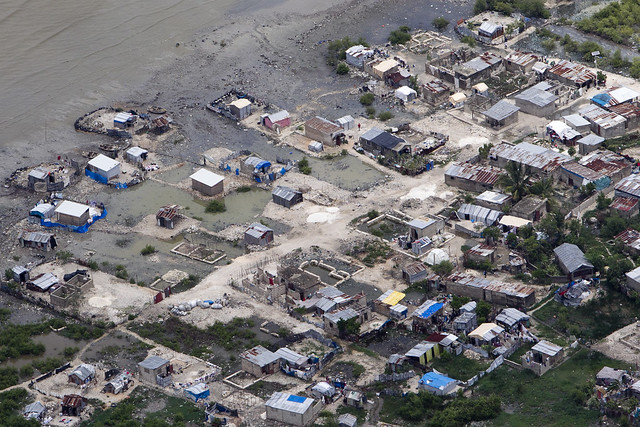
11 die in Haiti mudslides, rains

A storm set off mudslides and flooding that killed at least 11 people in impoverished Haiti, officials said yesterday.

Rains engulfed the capital for several hours Monday night, turning hilly streets into rivers and sweeping debris down denuded hillsides of Haiti's capital.

Motorists abandoned their cars. Women could be heard screaming for help as water pounded the supposedly temporary settlements that arose in Port-au-Prince, after last year's powerful earthquake.

Marie Alta Jean-Baptiste, director of Haiti's Civil Protection Department, told Radio Galaxie that 11 people drowned or died in mudslides. All but one of the deaths happened in the Port-au-Prince area.

Officials say they fear the hurricane season, which officially began last week, could exacerbate a cholera outbreak that already has killed 5,000 people. Haiti's newly elected President Michel Martelly took to national television just before midnight to calm the nation as the storm was still passing over the city. "This message is to tell the population that I'm with you," the President said.

Martelly said the seaside slum of Cite Soleil flooded and walls toppled in the hills above Port-au-Prince. He ordered government construction workers to show up to work early Tuesday. Debris and mud clogged major thoroughfares Tuesday, causing traffic jams throughout the capital.

Wednesday 29 August 2012

http://www.momentng.com/en/news/2852/11-die-in-haiti-mudslides-rai.html

continue reading

18 bodies recovered as Cameroon dam floods 250 Nigerian villages

UPI – A massive release of water from a dam in Cameroon submerged 250 villages in neighboring Nigeria and killed an unknown number of people.

Eighteen bodies were recovered Monday from the Benue River in the Nigerian state of Adamawa, The Guardian reported.

Kobis T. Ari, secretary to the state government, told journalists Adamawa officials received a letter from the Cameroon government on Friday advising that water would be released from the Lado Dam, at the upper reaches of the Benue River.

Ari said the release was done before villagers could be told to leave flood-prone areas.

Cameroon regularly releases water from the dam.

Ari said Cameroon should compensate the victims of the flooding and enter an agreement with its neighbor on how to avoid the “yearly disaster.”

He said the flooding was the worst since 1958.

Schools, hospitals and government offices also were submerged.

Medical workers have been dispatched to the area to help prevent an outbreak of disease, he added.

Wednesday 29 August 2012

http://www.pilotafrica.com/2012/08/28/18-bodies-recovered-as-cameroon-dam-floods-250-nigerian-villages/

continue reading

Flash floods: 18 feared dead as bus swept away in AJK

AJK / MIRPUR: At least 18 people, including eight women, are feared dead, while nine others were injured, after a passenger bus was swept away in a flash flood in Azad Jammu and Kashmir (AJK) on Tuesday.

“Nine bodies have so far been recovered, while nine people have been rescued, from the sharp currents of Nullah Sair in the mountainous Sudhanoti district of AJK”, said the district police chief Sajaad Hussain.

“The bus, with at least 27 passengers on board, was on its way from Palandri town to Anjaal Kot town when it was swept away in the seasonal nullah which had overflowed its banks,” said Shoukat Tabassam, a local resident and an eyewitness.

Flash floods have become more frequent following a spell of heavy late monsoon rains in the northern areas.

“Nine people, including three women and a child, were rescued and rushed to district hospital Palandri,” Tabassam said, adding their condition is stated to be out of danger.

The deceased, whose bodies have been recovered, are all residents of Anjaal Kot town.

Search for the remaining passengers continued till the filing of this report. The wreckage of the private passenger bus could not be recovered from the nullah till late Tuesday night.

Wednesday 29 August 2012

http://tribune.com.pk/story/427650/flash-floods-18-feared-dead-as-bus-swept-away-in-ajk/

continue reading

DNA advances help identify dead buried in NYC potter's field; 54 bodies exhumed

NEW YORK, N.Y. - On a wind-swept island off New York City, the remains of 850,000 people rest in pine boxes in a grid of covered trenches — but many are not resting in peace.

They are the unidentified or unclaimed dead who have been found around the largest U.S. city — often with little hope of a loved one ever knowing their fate. Now, with advances in DNA technology and anthropology and with new federal funding, the city medical examiner's office has exhumed dozens of the bodies in a new push to identify several decades' worth.

It's how Ben Maurer's family finally learned that the 17-year-old had jumped to his death from a Manhattan building on June 25, 2002.

His mother, Germaine, submitted his DNA to the medical examiner in 2009, when the first phase of the project began. The DNA was entered into a public database containing information on thousands of cases of missing and unidentified people — and matched a John Doe buried in the potter's field on 101-acre (41-hectare) Hart Island on Long Island Sound.

He was given a proper funeral near the family's home in Piscataway, New Jersey, shortly after his remains were returned to them in 2009.

"It meant everything," said Jared Maurer, Ben's 28-year-old brother. "It finally gave us closure to what had happened to Ben."

Jared Maurer said he frequently visits his brother's gravesite. "I tell him I miss him, I tell him I love him," he said.

At any given time, there are 40,000 active missing and unidentified person cases in the United States. New York State accounts for 25 per cent of those cases, most of them in New York City.

The identities of some of the bodies in the potter's field are known, but their families are too poor to have them buried elsewhere.

DNA samples weren't regularly taken from all bodies until about 2006, so the only way to identify many bodies is to exhume them, once DNA samples can be matched up with a description of a corpse, like in Maurer's case.

Fifty-four bodies for which the medical examiner's office had no DNA samples have been disinterred from Hart Island. The exhumation, performed by city inmates, is part of a larger effort to gather data on the unknowns. So far, 50 have been identified, including some who were exhumed.

To date, the scientists have gathered data on more than 1,200 unidentified bodies and entered it into Namus, the public database that is run by the National Institute of Justice — the research arm of the Department of Justice — that helped identify Maurer.

DNA technology developed for the need to identify remains from the Sept. 11 attacks and other disasters, including Hurricane Katrina, has contributed to a national push in recent years to identify unclaimed remains, said Benjamin Figura, a forensic anthropologist and director of identification at the medical examiner's office.

Bodies in advanced states of decomposition get an anthropological workup; the scientists determine age, ancestry, sex and height and identify any other unique features that could be helpful in identification such as tattoos, scars and prior surgeries.

"What we're building is a biological profile. ... If we can say this is a 17-to 25-year-old male, we can narrow down the pool of potential matches," said Bradley Adams, who heads the team.

Germaine Maurer called the New York City morgue to search for her son the day after he disappeared, but because he had dark features and looked older, he was labeled as a male Hispanic in his 20s, rather than a 17-year-old white male.

She counts herself lucky.

"There are many families out there missing loved ones who never know what has happened," she said. "We were very fortunate. We found out all the details."

Wednesday 29 august 2012

http://www.canada.com/news/world/advances+help+identify+dead+buried+potters+field+bodies+exhumed/7159914/story.html

continue reading

Crash victims’ identification process continues

The Indonesian disaster victim identification (DVI) team has found it difficult to identify the remains of the victims of last week’s Cessna Piper Navayo Chiftain PA31 crash in East Kalimantan due to their condition.

Budi, of the Indonesia DVI, said that the remains that were severely damaged and too difficult to identify at the AW Syahranie hospital in Samarinda, East Kalimantan, and would be sent to Jakarta for further investigation.

“We have been working very hard round the clock, matching the DNA of the victims and those of their respective family members,” Budi said on the phone on Tuesday.

Matching the DNA, according to Budi, was the most effective way of revealing the identities of all the victims, especially due to the condition of the remains.

He said the family members of each of the victims had arrived in Samarinda for that purpose.

He also expressed gratitude to the Australian Embassy for having brought the son of Australian Peter John Elliott, one of the victims, from Australia to Samarinda.

Elliot’s remains were found among the wreckage of the aircraft on the slope of Mt. Mayang on the border of Bontang East Kutai.

Budi said that although Elliot was the only foreign victim, his body was difficult to identify because of severe burns.

He also said that despite such difficulties, the DVI team was confident it would be able to identify each of the victims’ bodies, but it would take time to ensure accuracy.

“The conditions of the victims were similar to the victims of the Sukhoi crash. The Sukhoi victims were evacuated earlier while those of the Cessna were evacuated in pieces and mixed with the elements thanks to the rain,” he said.

The flaming wreck of the Cessna plane that went missing in East Kalimantan last week was discovered late on Sunday. All the four passengers, including the pilot, were dead.

The plane, chartered by Elliott Geophysics International to survey a coal mining site, was carrying four men — pilot Capt. Marshal Basir, two Indonesians, and the company’s Australian owner, Peter John Elliot — when it vanished from the radar screens of local aircraft control on Friday evening.

The Cessna left the airport in Samarinda on Friday morning for what was to have been a 90-minute survey of a coal mining site near the city of Bontang, about 120-airline kilometers away.

After the aircraft failed to return, four helicopters and a 400-personstrong search-and-rescue team attempted to find the Cessna.

The aircraft was located on the slopes of Mt. Mayang in East Kutai regency.

Wednesday 29 August 2012

http://www.thejakartapost.com/news/2012/08/29/crash-victims-identification-process-continues.html

continue reading

Tuesday, 28 August 2012

Chinese fishermen killed as typhoon hits South Korea

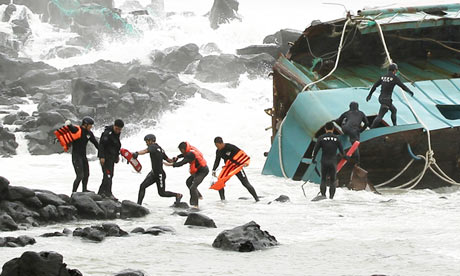
A powerful typhoon has struck South Korea, killing at least eight people including five fishermen. Strong winds and heavy rain churned up rough seas and smashed two fishing ships on to rocks, forcing the coastguard to perform a daring rescue for the survivors.

Rescuers saved 12 fishermen and were still searching for 10 missing from the Chinese ships, which hit rocks off South Korea's southern Jeju island.

At least three other people died as Typhoon Bolaven knocked out power to hundreds of thousands of South Koreans, cancelled flights and temporarily halted joint war games by US and South Korean military forces.

State media in North Korea, which is still struggling to rebuild from recent floods and a devastating drought, reported on Tuesday the country was being lashed by heavy rain and strong winds.

Off Jeju island, dangerous waves kept rescue vessels from approaching the Chinese fishing ships. The coastguard used a special gun to shoot rope to one ship so officers could pull themselves over and bring the fishermen back to shore, coastguard spokesman Ko Chang-keon said.

Eighteen fishermen survived. Twelve were rescued by the coastguard and the others swam or were washed ashore.

South Korea issued a storm warning for the capital, Seoul, as Bolaven battered the country's south and west, knocking over street lights and church spires and ripping down shop signs. A large container box crushed the caretaker of an apartment building to death, a woman fell to her death from a rooftop and a third person died after bricks hit a house, according to disaster and fire officials.

Strong gusts left Seoul streets covered with leaves, rubbish and branches. More than 15,000 schools cancelled classes, and businesses and homes boarded up windows.

More than 330,000 South Korean households lost power, the government said, and more than 70 people were left homeless because of floods or storm damage. Nearly 200 flights were cancelled.

In North Korea, Pyongyang's official Korean Central News Agency reported gale-force winds and heavy rain in many parts of the country. Rainstorms often mean catastrophe in the north because of poor drainage, deforestation and decrepit infrastructure.

North Korea is still trying to help people with food, shelter, healthcare and clean water after heavy flooding in July, according to a recent United Nations report. More than 170 died nationwide, and tens of thousands of homes were destroyed in the floods, according to official North Korean accounts.

Many flood victims still live in tents with limited access to water and other basic facilities, the UN report said, and there is concern about malnutrition. Seoul's unification ministry approved a trip Wednesday by two South Korean aid groups to visit the North Korean city of Kaesong for talks on flood aid.

Weather officials had warned that Bolaven would be the strongest typhoon to hit the region in several years, but its gusts turned out not to be as powerful as expected.

The typhoon hit the southern Japanese island of Okinawa on Monday, injuring four people but doing less damage than feared before moving off to sea. More than 75,000 households lost power.

Further south, another typhoon, Tembin, doubled back and hit Taiwan three days after drenching the same region before blowing out to sea. Fierce winds and rain toppled coconut trees in the beach resort town of Hengchun.

In Manila, the Philippine weather agency reissued typhoon warnings to residents and fishermen for Tembin, which blew out of the archipelago over the weekend. Fishing boats in the north were urged not to venture out to sea while larger ships were warned of possible big waves and heavy rains.

Tuesday 28 August 2012

http://www.guardian.co.uk/world/2012/aug/28/fishermen-killed-typhoon-south-korea

continue reading

36 Egyptians missing, 3 dead after boat sinks trying to reach Europe illegally

Three bodies washed ashore in Libya Monday after a boat carrying illegal Egyptian migrants trying to reach Europe capsized in the Mediterranean Sea, and officials say 36 people are missing.

The boat’s only known survivor, Mohamed Gomaa Abdel-Kader, 23, told authorities that 40 people were on the boat when it sank. They were traveling overnight Sunday from an Egyptian port near Libya. They were part of a three-boat convoy full of migrants heading to Europe illegally, he said, according to a statement from Egypt’s Foreign Ministry.

The growing crisis from the flood of refugees could prompt Turkey to ask the United Nations to create a haven in Syria.

The boat he was on was supposed to carry no more than 15 people. It started sinking from the weight of the passengers, and people began jumping into the sea in the middle of the night, he said.

The search for survivors was continuing in the Burdi area, the officials in Cairo said.

In Libya, the state news agency Lana reported that the boat was carrying around 40 illegal migrants and capsized off Libya's east coast near the border with Egypt, with only one passenger surviving the tragedy.

"All the migrants who were on board died, except for one person who survived and was able to alert local authorities and inform them of the tragedy," Lana said, quoting a local official.

It was not immediately clear who the passengers of the boat were but they are widely believed to be asylum seekers trying to get to Europe in search of jobs and a better life.

Lana did not give the nationalities of the passengers but said the boat sunk some three kilometres (almost two miles) off the Libya coast.

Libya has been traditionally a launchpad for African refugees and migrants seeking to make an illegal run across the sea to Europe, with many landing in Italy. Migrants and refugees often travel in rickety and overcrowded wooden fishing boats and there have been several accidents at sea.

Thousands of young North African men make the dangerous and illegal sea journey to Europe to flee poverty, high unemployment and low wages at home. Some leave from Egypt’s Mediterranean coast, but most travel overland to neighboring Libya to take the shorter trip from there.

In April last year, scores of people went missing at sea after a tiny boat carrying more than 200 African migrants fleeing unrest-hit Libya capsized in the night in three-metre-high waves.

In March 2010, around 18 Egyptians drowned at sea trying to flee illegally to Europe. In 2007, 22 people died when two smuggler boats carrying around 150 Egyptians capsized off Italy’s southern coast. The next month, another boat sank off Turkey, killing 50, half of them Egyptians.

Tuesday 28 August 2012

http://www.washingtonpost.com/world/europe/officials-36-egyptians-missing-3-dead-after-boat-sinks-trying-to-reach-europe-illegally/2012/08/27/9ec26664-f055-11e1-b74c-84ed55e0300b_story.html

continue reading

Monday, 27 August 2012

Flood Situation Worsens in Adamawa as 15 Bodies Wash Ashore.

The flood situation in Adamawa State worsened on Monday with the death toll in the disaster increasing as 15 bodies washed ashore the River Benue bank, in Jimeta—Yola, just as the state government commenced immediate evacuation of the communities along the bank of the River Benue across seven local government areas of the state.

Adamawa State Secretary to Government, Chief Kobis Ari Thinmnu, told journalists on Monday that the state government was having serious crisis coping with the situation, as over 45 communities have been totally submerged.

He appealed to the federal government through the National Emergency Management Agency to come to the immediate assistance of the Adamawa people, as the disaster was beyond the scope of the state government.

Thinmnu said that it was unfortunate, that Nigeria has no bilateral protocol with the republic of Cameroom on the usage of the waters of Lagdo dam, adding that, the release of water by the dam authorities, every rainy season, has always caused enormous damage to the people of the state.

He appealed to the federal government to approach the Cameroonian authorities so that modalities could be worked out, to remedy disaster situations, as the people of the state are always on the receiving end.

He stressed that over N100million worth of properties have been lost to the current disaster, adding, that at leat 60 buildings had been reported to have collapsed in one local government alone. Other properties lost to the disaster included farms and livestock.

In the meantime, the Adamawa State government, at the weekend, set-up a disaster management committee, to manage the situation as the water level continues to rise.

The principal medical officer in charge of the Yola Specialist Hospital, Dr Bala Saidu, told THISDAY, that some victims of the flood were brought to the hospital's mortuary. He said it would be difficult to give an exact number of bodies so far recovered, because it was rising as the situation worsens.

He however said as at the weekend, 15 corpses were deposited at the hospital.

Monday 27 August 2012

http://www.thisdaylive.com/articles/flood-situation-worsens-in-adamawa-as-15-bodies-wash-ashore-/123333/

continue reading

Hispaniola death toll from Isaac climbs to 10

PORT-AU-PRINCE, Haiti — Haitians began to dig themselves out of the mud on Sunday, one day after Tropical Storm Isaac doused the Caribbean nation and killed eight people here and another two in neighboring Dominican Republic.

With a reported total of 10 deaths for the island of Hispaniola, which is shared by the two countries, the scale of devastation was less than many people had feared.

But the capital and countryside of disaster-prone Haiti did suffer sporadic flooding, fallen poles and scores of toppled tents that housed people who lost their homes in the massive 2010 earthquake.

Joseph Edgard Celestin of Haiti's Civil Protection Office offered few details on the storm-related deaths, but said one man was swept away as he tried to cross a river in a village in the country's north.

Haiti's Civil Protection Office said in a separate report that a 51-year-old woman was killed in the southern coastal town of Marigot after a tree fell on her home. A 10-year-old girl was killed in the village of Thomazeau after a wall collapsed on her.

In neighboring Dominican Republic, police reported that two men were swept away by flooded rivers that burst their banks. One victim was identified as Pedro Peralta, a former mayor in Villa Altagracia, a town northwest of the capital of Santo Domingo. His body was recovered Sunday by rescuers on the banks of the Haina River.

Another male victim, whose identity was not disclosed, was swept away by the Yaguaza River, Dominican police said.

Across Haiti, the number of people evacuated due to flooding rose over the weekend. More than 14,000 people had left their homes and another 13,500 people were living in temporary shelters until Saturday night, the Civil Protection Office reported. Some 8,400 evacuees were in the country's western department, the most populous and where the capital of Port-au-Prince is located.

The World Food Program had distributed two days of food to 8,300 of the people who had left their houses for 18 camps.

The Haitian government reported that a dozen houses were destroyed and another 269 damaged.

Impoverished Haiti is prone to flooding and mudslides because much of the country is heavily deforested and rainwater rushes down barren mountainsides. It's not uncommon for storms to turn deadly; a storm in the Caribbean last year unleashed mudslides that killed more than 20 people in the capital.

In Fourgy, a hardscrabble neighborhood in the northern part of Port-au-Prince, residents used buckets and brooms to clean out mud from their homes and courtyards as chocolate-color flood waters from the nearby Grise River began to recede.

The water arrived early Saturday morning, rising up to the waist of an average adult, but by Sunday it had dropped to about shin high. Still, it was enough to destroy the few belongings of some people.

Rene Stevenson readily gave an inventory of possessions lost to the flood: bed, radio, TV set, plastic chairs.

"Everything's totally lost," fumed Stevenson, a 24-year-old cab driver with dried mud on his bare chest.

If mud caused anguish in Fourgy, wind was the source of despair down the street in Pwa Kongo neighborhood. Isaac blew down rows of tents and other temporary shelters people had lived since they lost their homes in the 2010 earthquake.

Displaced again, the several dozen occupants took their belongings and spent Saturday night sleeping on the wooden pews of a small church next door.

"There's a church so we're here," said Arel Homme Derastel, a 32-year-old father of three. "All's broken."

Monday 27 August 2012

http://cnsnews.com/news/article/hispaniola-death-toll-isaac-climbs-10

continue reading

Flooding Kills 10 in Northeast Nigeria

An emergency management official in northeast Nigeria says 10 people were killed in floods that swept through the region.

Adamawa state Emergency Management Agency official Shadrach Daniel Baruk said others remained trapped by the flooding Sunday.

Baruk blamed the release of water from a dam in the neighboring nation of Cameroon for the flood. He said heavy rainfall in the rural region of farms and cattle ranches also contributed to the deadly deluge. He said thousands of people had been displaced.

The flooding in Adamawa state comes as flooding recently killed at least 68 people in Plateau state in central Nigeria.

Nigeria is experiencing its annual rainy season, which sees torrential rains fall throughout the West African nation.

Monday 27 august 2012

http://abcnews.go.com/International/wireStory/flooding-kills-10-northeast-nigeria-17083592#.UDswffvcz3U

continue reading

50 Die in 3 Accidents Within 3 Days in China

A bus and a tanker collided and burst into flames, killing 36 people in China’s northwestern Shaanxi Province, on Aug. 26.

The accident occurred around 2:40 a.m. near the city of Yan’an. A double-decker sleeper bus appeared to have rear-ended a tanker carrying methanol, killing all but three of its 39 passengers.

An incident investigation group was sent to the site by the State Council, according to a report by state-run media Xinhua, indicating that central regime officials were concerned about the incident.

Another crash killed 11 of 12 passengers when a van hit a large truck on an expressway in Sichuan Province Sunday afternoon. The truck had pulled to the side of the road for repairs, local workers said, according to Xinhua.

Three more people died when a bridge collapsed on Friday, Aug. 24, in the city of Harbin in northeastern China. The Yangmingtan Bridge had been in use for less than a year and cost 1.88 billion yuan (US$294 million) to build.

Monday 27 august 2012

http://www.theepochtimes.com/n2/china-news/50-die-in-3-accidents-within-3-days-in-china-284277.html

continue reading

Sunday, 26 August 2012

Tanker-bus crash inferno kills 36 in China

At least 36 people died in a fiery collision between a methanol tanker and a double-decker sleeper bus on a motorway in northern China on Sunday, officials and state media said. Both vehicles caught fire and only three of the 39 people onboard the bus survived the crash, which occurred around 2:00 am, Xinhua news agency reported.

A total of 36 bodies were pulled from the debris and three people were taken to hospital.

Details of the crash -- which happened 200 metres (yards) from a motorway service station at Yanan city in Shaanxi province -- were still unclear.

Yue Jiuxiang, a local traffic police official in charge of the rescue operation, said most of the passengers were asleep at the time of the crash.

"Soon after the collision, the bus was engulfed by flames," he told state-broadcaster China Central Television.

"The front part of the bus was seriously damaged. Also most of the passengers were sleeping. This is why so many people died."

Yue said the bus was en route from Baotou in Inner Mongolia to the Shaanxi provincial capital Xian when the collision occurred.

Police were investigating the cause of the accident which happened on the Baotou-Maoming Expressway, which spans the length of China from the northern city of Baotou to the southern province of Guangdong.

An official at Yanan city government information department surnamed Liu told AFP: "The confirmed death toll is now 36. I don't have any further details."

China's roads are highly dangerous, with traffic laws and safety widely flouted, and truck drivers typically overworked.

Last year more than 62,000 people died in traffic accidents, state media said, citing police figures.

Vehicles carrying explosive materials -- which must first get permission from the police before travelling on the roads in China -- are involved in many accidents.

At least 20 people were killed in June near the southern city of Guangzhou when two trucks collided and sent petrol into a timber mill below the road, causing a massive blaze.

Buses are also commonly involved in road accidents as operators often seek to cram as many people as they can into their vehicles to maximise profits and drivers hurtle down highways.

Twenty-three people were killed and three injured in April when a bus and truck collided in the eastern province of Anhui. Another collision between a tour bus and a truck the same month left 13 dead and 21 injured.

Sunday 26 August 2012

http://www.hindustantimes.com/world-news/China/Tanker-bus-crash-inferno-kills-36-in-China/Article1-919537.aspx

continue reading

Refinery Blast In Venezuela Kills At Least 39

A huge explosion rocked Venezuela's biggest oil refinery and unleashed a ferocious fire on Saturday, killing at least 39 people and injuring more than 80 others in one of the deadliest disasters ever to hit the country's key oil industry.

Balls of fire rose over the Amuay refinery, among the largest in the world, in video posted on the Internet by people who were nearby at the time. Government officials pledged to restart the refinery within two days and said the country has plenty of fuel supplies on hand to meet domestic needs as well as its export commitments.

The explosion shattered walls of nearby shops, ripped out windows from homes and left the surrounding streets covered with rubble and twisted scraps of metal.

President Hugo Chavez declared three days of mourning and ordered an investigation to determine the cause of the explosion. "This affects all of us," Chavez said by phone on state television. "It's very sad, very painful."

Vice President Elias Jaua, who traveled to the area in western Venezuela, said on state television late Saturday that at least 39 people were killed by the explosion, up from the earlier death toll of 26. He said that the dead included 18 National Guard troops and that six of the bodies had not yet been identified. Other officials said earlier that the dead included a 10-year-old boy.

In a neighborhood next to the refinery, shopkeeper Yolimar Romero said she was at her computer when a shock wave swept over the area shortly after 1 a.m.

"At that instant, the whole house shook as if it were an earthquake," she said. "The windows went flying off with their frames and everything."

Electricity was knocked out, leaving Romero in the dark and her house filled with smoke. She found a flashlight and started looking for her husband and three children.

Outside on the street, the family saw scattered hunks of brick walls and ruins of a National Guard post and about 20 other homes. Bodies were being pulled from buildings down the street.

At least 86 people were injured, nine of them seriously, Health Minister Eugenia Sader said at a hospital where the wounded were taken. She said 77 people suffered light injuries and were released.

Officials said firefighters had largely controlled the fire at the refinery on the Paraguana Peninsula, where flames were still visible on Saturday night after billowing dark smoke all day.

The blast occurred about 1:15 a.m. when a natural gas leak created a cloud that ignited, Oil Minister Rafael Ramirez said.

"That gas generated a cloud that later exploded and has caused fires in at least two tanks of the refinery and surrounding areas," Ramirez said.

Images shortly after the explosion showed the flames casting an orange glow against the night sky, and injured survivors on a stretcher and in a wheelchair. The bloodied bodies of victims were loaded onto pickup trucks.

Ramirez said a panel of investigators was being formed to determine the cause of the gas leak. A prosecutor was appointed to lead the investigation and troops were deployed to the area.

While the cause of the disaster remains unclear, some oil workers and critics of Chavez's government have recently pointed to increasing numbers of smaller accidents and spills as an indication of problems within the state-run company.

"We warned that something was going to happen, a catastrophic event," said Ivan Freites, secretary general of a 1,200-member union of oil and natural gas industry workers in Falcon state where the refinery is located. He spoke in a telephone interview from an area near the refinery, where he could see the flames raging in the distance.

The refinery complex's general manager, Jesus Luongo, denied that a lack of maintenance was to blame, saying in the past three years more than $6 billion has been invested in maintaining the country's refineries.

Ramirez said the explosion hit an area of storage tanks, damaging nine tanks.

"All of the events happened very quickly," Ramirez said. "When we got here in the middle of the night, at 3 or 3:30 in the morning, the fire was at its peak."

The oil minister said that supplies of fuel had been cut off to part of the refinery and that firefighters were using foam to extinguish the flames in one of the remaining tanks.

"This regrettable and sad event is controlled, is under control," Ramirez said on television, while plumes of smoke continued to billow.

Amuay is part of the Paraguana Refinery Complex, which also includes the adjacent Cardon refinery. Together, the two refineries process about 900,000 barrels of crude per day and 200,000 barrels of gasoline. Venezuela is a major supplier of oil to the U.S. and a member of the Organization of Petroleum Exporting Countries.

Ramirez said the state oil company Petroleos de Venezuela SA should be able to "restart operations in a maximum of two days."

"We want to tell the country that we have sufficient inventories of fuel. We have 10 days of inventory of fuel," Ramirez said. He said the country's other refineries were operating at full capacity and would be able to "deal with any situation in our domestic market."

An official of the state oil company, known as PDVSA, said the country also has enough supplies on hand to guarantee its international supply commitments. The official spoke on condition of anonymity because he wasn't authorized to speak publicly about the matter.

In terms of international oil markets, the disaster is not likely to cause much of a ripple, said Jason Schenker, an energy analyst and president of Austin, Texas-based Prestige Economics LLC. Noting that other refinery accidents and shutdowns regularly occur around the world, he said: "There's likely to be relatively limited impact on global crude or product pricing."

"The real tragedy," he said, "is that these events continue to happen, not just in Venezuela but everywhere. It is a dangerous business."

Gustavo Coronel, an energy consultant and former PDVSA executive, called the tragedy "probably the worst one the oil industry has had in many years."

"Accidents happen, of course, although the problem with PDVSA is the inordinate amount of accidents that have taken place during the last years," Coronel said. Considering the overall record, "we are not talking about bad luck but about lack of maintenance and inept management," he said.

The labor leader Freites, who has worked at the refinery for 29 years, said workers had repeatedly alerted state oil company officials to problems that they feared could lead to an accident. "We've been complaining about problems and risks, including fires, broken pipes and a lack of spare parts," Freites said.

One opposition group comprised of former PDVSA employees, Gente del Petroleo, or Oil People, said it could not yet pass judgment on the cause of the explosion. But it but noted there had been ample concerns about lack of maintenance and poor management.

The group said in a statement that since 2003, 79 other serious accidents have been reported at the Paraguana Refinery Complex, collectively killing a total of 19 workers and injuring 67 others.

Opposition leader Henrique Capriles, who is challenging Chavez in the country's Oct. 7 presidential election, expressed condolences to the victims and their families.

"We Venezuelans are one, and we grow in the face of this type of situations," Capriles said.

Sunday 26 August 2012

http://www.npr.org/2012/08/25/160031185/officials-refinery-blast-in-venezuela-kills-7

continue reading

Slovenia hot-air balloon victims identified, investigation underway

LJUBLJANA - Slovenia said Saturday it has identified the four people killed in Thursday's hot-air balloon crash as Slovenian citizens, among them a couple with their 11-year-old child.

"The fourth person killed was a woman, also from Slovenia," Joze Balazic, head of Slovenia's forensic institute, said Saturday.

The identification had to be carried out using the DNA of the victims since their bodies were found charred in the basket of the hot-air balloon that crashed and burst into flames near Ljubljana early on Thursday.

The accident happened when a sudden change in the weather forced the pilot of the balloon with 32 people on board, mostly tourists, to attempt an emergency landing.

Due to its size and the strong winds blowing close to the surface, the pilot lost control of the balloon, which hit a tree and caught fire, according to eye witnesses.

Out of the 28 persons who were hospitalised on Thursday, six remain in critical condition, among them the pilot of the balloon, hospital authorities said late on Friday.

Slovenian police have launched an investigation to determine whether there were irregularities concerning the flight organised by a private company selling balloon flights to tourists.

Local media reported the pilot did not have a valid flying license and that he decided to take off although the weather forecast indicated possible storms. Police have not yet confirmed the reports.

Sunday 26 August 2012

http://news.asiaone.com/News/Latest%2BNews/World/Story/A1Story20120825-367561.html

continue reading

Saturday, 25 August 2012

FIRE TRAGEDY VICTIMS TO UNDERGO DNA TESTS

A team of doctors from Nairobi is expected in Homa Bay District to carry out DNA tests on pupils of St Theresa Asumbi Girls Boarding Primary School who died in a fire.

The doctors are expected tomorrow morning to carry out the tests to help identify the bodies that were burnt beyond recognition.

Homa Bay DC Nur Dube said some parents had not identified their children, and the best solution was a DNA test.

Homa Bay Hospital Medical Superintendent Ojwang’ Ayoma confirmed that only four children had been identified. The medic’s statement negated previous reports that indicated that the number of bodies identified children had risen to five.

Dr Ayoma said his medical officers were ready to help any parents identify their children, especially if the deceased’s individual conditions can allow.

“We received some parents and many relatives of the deceased girls yesterday. We identified four of them while the other four have not been identified.” Ayoma added.

The bodies are still lying at the Homa Bay District Hospital Mortuary where they were taken on Wednesday night.

Parents and relatives used various methods such body posture, teeth arrangement, and other parts of the body, which were not destroyed completely, to identify their children.

There are contradictory reports as to what the pupils were doing in school even though Education Minister Mutula Kilonzo had outlawed holiday tuition. The school management said the students were from an academic tour of Nairobi and Nakuru, while parents say the pupils were on holiday tuition.

Saturday 25 August 2012

http://www.standardmedia.co.ke/m/story.php?id=2000064809

continue reading

Bagmati boat capsize: 3 bodies found‚ scores missing

RAUTAHAT: At least three persons died and an unknown number of people went missing as a boat, with about 50-55 people on board, capsized in the swollen Bagmati River bordering Sarahi and Rautahat districts on Saturday afternoon.

The jam-packed boat was coming towards Laxmipur Ghat of Rautahat from Manpur of Sarlahi on the otherside of the river when it overturned at around 2:30 pm.

Police said one person has been rescued alive and has been taken to Garuda of Rautahat for treatment.

Two bodies were fished out from the swollen river, while one of the two persons who was rescued alive died.

The deceased are identified as Apsana Khatun (13), Rajima Khatun (20) and Nisrat Khatun (37) of Gamariya, Parsa-7 Laxmipur.

It has been learnt that Nisrat's two children were also on board the ill-fated boat. Their whereabouts is not known.

Two boaters—identified as Ramjodhi Sahani and Wazir Sahani of Manpur, Sarlahi—are at large after the incident, while all other people riding the boat are said to be missing.

Security personnel and locals are launching a search operation for the missing.

Saturday 25 August 2012

http://www.thehimalayantimes.com/fullNews.php?headline=Bagmati+boat+capsize%3A+3+bodies+found%E2%80%9A+scores+missing&NewsID=344772

continue reading