Showing posts with label Kidnapping. Show all posts

Thursday, 27 November 2014

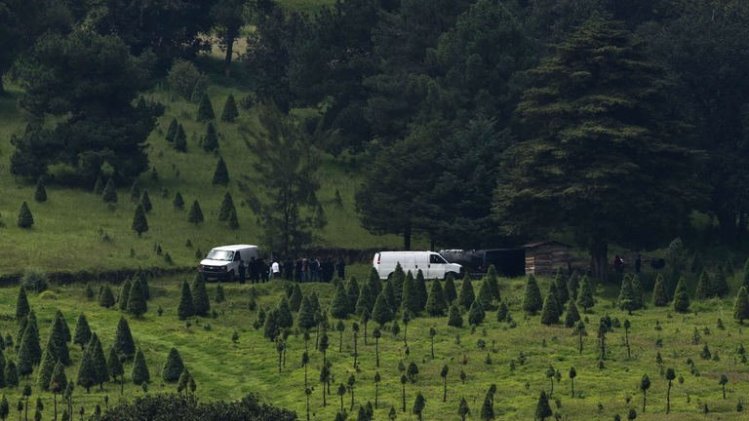
Argentine forensic specialists identify three of the 30 bodies found in the mass graves


The Argentine Forensic Anthropology Team, or EAAF, that is collaborating with the Mexican Government in the Ayotzinapa investigations, said Tuesday it identified three more bodies found in clandestine graves in the southern Mexican state of Guerrero, but they are not the remains of any of the 43 students who disappeared in the city of Iguala on Sept. 26.

The EAAF, which participates in the investigation for the request of the relatives, said in a statement that these remains, found in the area of Pueblo Viejo, belong to “three people missing in Iguala in recent months.”

The remains found in the Pueblo Viejo area are those of "three people who disappeared in Iguala in recent months," the EAAF, which is assisting with the investigation of the disappearance of the Ayotzinapa Normal School students at the request of the families of the missing, said in a statement.

"The families of the three people identified have already been informed by the EAAF and its legal representative, the Jose Maria Morelos Regional Human Rights Center," the specialists said.

The examination of the remains and evidence found in Pueblo Viejo, located in the La Parota area, and in the San Juan River and the dump in Cocula, a city near Iguala, is continuing, the EAAF said.

The EAAF said Nov. 11 that DNA tests performed on 24 of the 30 bodies found in Pueblo Viejo confirmed that the remains were not those of the missing education students.

The specialists are still trying to identify three of the bodies found in Pueblo Viejo and nine other bodies found in La Parota and the Cerro de Lomas de Zapatero in Iguala.

The remains found near the river and in the dump, where the students were presumably murdered and burned, were turned over to the School of Medicine of the University of Innsbruck in Austria between Nov. 13 and Nov. 17, the EAAF said.

An EAAF specialist, Foreign Relations Secretariat personnel and Attorney General's Office employees turned the remains over to the Austrian university.

"The laboratory was suggested by the EAAF to the AG's office since it is one of the best-equipped and most experienced in the world in handling extremely deteriorated remains," the EAAF said.

A confidentiality agreement was signed Nov. 17 covering findings in the case and giving the Argentine specialists access to results obtained by the AG's office, the EAAF said.

"The laboratory in Innsbruck is now studying the samples," but due to "the difficulty of the job, timeframes cannot be provided at this time on when results will be available," the EAAF said.

The 43 missing students from Ayotzinapa Normal School, a teacher's college, were detained by police on the night of Sept. 26 and handed over to the Guerreros Unidos drug cartel, which killed them and burned the bodies to eliminate all traces of the victims, Mexican officials say, citing statements by suspects in the case.

The parents of the missing young people, however, say they will not accept the official explanation without solid proof.

Thursday 27 November 2014

http://www.laprensasa.com/309_america-in-english/2812963_argentine-specialists-identify-3-more-bodies-found-in-southern-mexico.html

continue reading

Monday, 14 October 2013

Red Cross Syria kidnap underscores risks in war zones


The kidnapping in Syria of seven aid workers from the International Committee of the Red Cross and Syrian Red Crescent on Sunday underscores the stark daily risks faced by those helping victims of the conflict.

"Six ICRC staff members and one member of the Syrian Arab Red Crescent have been abducted in Idlib in northwestern Syria," ICRC spokesman Ewan Watson told AFP at the organisation's Geneva base.

"We don't know who took them. It was unidentified armed men," he added, when pressed on whether the kidnappers were thought to be from Syria's rebel side or militias loyal to President Bashar al-Assad.

"We're calling for their immediate, unconditional and safe release," he said.

ICRC and Red Crescent staff in Idlib and the city of Aleppo were scrambling to locate the aid workers and secure their release.

Earlier Sunday, Syrian state television reported that "armed terrorist gangs" attacked the ICRC convoy and kidnapped its members.

Large parts of Idlib province are under the control of rebel groups, including jihadists, who are fighting to oust Assad's regime.

The conflict has killed more than 115,000 people in two and a half years, driven more than two million out of Syria and left millions more inside the country reliant on aid to survive.

The Swiss-based ICRC strives not to be drawn into the politics of conflict zones where its staff serve.

"That's the whole point about being neutral and impartial. It ensures us access," said Watson.

Aid is a sharply political issue in Syria, where United Nations investigators have accused both sides of a range of war crimes, including targeting ambulances, and blamed government forces for denying medical care to opposition-held areas.

The ICRC has some 30 expatriates and 120 Syrian aid workers deployed in the country.

Like UN agencies, it works hand in hand with volunteers from the local Red Crescent, one of the few aid bodies able to operate nationwide.

Twenty-two Syrian Red Crescent volunteers have been killed since the war began in March 2011.

The ICRC is the guardian of the Geneva Conventions, and perhaps best known for visiting prisoners of war.

But much of its work revolves around helping civilians swept up in conflicts, with its staff all too aware of the risks they face.

"Difficult security conditions are very much part of life at the ICRC. There's no such thing as easy access to a conflict zone. By definition they are dangerous," said Watson.

'Isn't going to stop us'

The seven aid workers were abducted near the community of Sareqeb after setting off back to the Syrian capital Damascus.

Watson said he could not confirm their names and nationalities, in part to be sure their families were informed first.

They had travelled northwest on Thursday to deliver supplies to hospitals in Idlib city and neighbouring Sarmin, and to carry out an assessment of health needs in the area.

The convoy was clearly marked with the ICRC emblem, which although it includes a cross is not meant as a religious symbol -- it is a reverse-colour version of neutral Switzerland's flag, chosen by its 19th century founding fathers.

Security is a constant concern for aid workers, notably in wars such as Syria's where front lines can be fluid and convoys have to criss-cross checkpoints manned by different groups within each camp.

"It's a continual, evolving negotiation, in a sense, to ensure that we can get to where we need to be. We're dealing with different security incidents all the time, of all shapes and sizes," said Watson.

Despite the kidnapping, ICRC staff were continuing operations Sunday, notably by helping 3,500 civilians allowed by government forces to leave the besieged town of Moaddamiyah near Damascus.

"We are committed to helping the Syrian people, and that's not going to go away because of this incident. Incidents like this do make us take stock. But the fact that's dangerous isn't going to stop us," said Watson.

Monday 14 October 2013

http://www.globalpost.com/dispatch/news/afp/131013/red-cross-syria-kidnap-underscores-risks-war-zones

continue reading

Sunday, 25 August 2013

Mexico City mass kidnapping highlight's Country's battle with drug gang violence


The bodies were headless and covered in lime and asbestos, hidden under a thick concrete slab – young men and women not seen since they went out partying in an upscale area of Mexico's capital nearly three months ago.

As the families of 12 missing youths settled in Saturday for an anguished wait for DNA identification, they and others said this week's gruesome discovery at a muddy mass grave in the countryside east of Mexico City was bitter vindication for those who have said all along that the city's top law-enforcement officials downplayed the disappearances and were at best incompetent in trying to find their loved ones.

The bodies were only found once federal investigators stepped in – after waiting impatiently for local police to make progress.

The kidnapping and murder has revealed a gangland battle for control of the lucrative drug trade in the poshest bars and nightclubs of a megalopolis that had been an oasis of calm during Mexico's nearly seven-year drug war. The head of Mexico City police on Saturday deployed more officers and a helicopter to some of the city's upscale districts along with the rough neighborhood of Tepito where most of the victims lived, fearing retaliatory attacks.

A federal official who helped discover the bodies said that they were found separately from their heads in what could be a frightening echo of the brutal mutilations of drug cartel victims in other parts of Mexico. The official spoke condition of anonymity because he was not authorized to discuss the ongoing investigation.

"Mexico City is not a bubble. If we don't put a stop to it, we're going to fall into a serious security problem," said Miguel Amelio Gomez, a security consultant and former investigative police chief for Mexico City's attorney-general.

The kidnapping occurred three months ago midday on a sunny Sunday in an upscale district in the heart of Mexico City, five cars pulled up outside the after-hours club known as Heaven, a block from federal police administrative offices and the U.S. Embassy. Eight men and four women who had been partying all night left and climbed inside, grainy surveillance video shows.

Then they vanished.

Mexico City police said they were working on the case. But after more than two months of little progress, federal investigators were brought in. They discovered 13 bodies, apparently the 12 young victims and an unidentified person, on Aug. 16 on a ranch 35 miles from where they disappeared. Tattoos and dental work identified at least five of the victims from the Heaven club. Work to identify the rest continued Saturday, and families pleaded for the remains to also be examined by forensic experts abroad arguing they can't trust their country's investigators.

Relatives of the 12 expressed grief, frustration and mistrust at the discovery. And they accused Mexico City's law-enforcement authorities of moving slowly on the sensitive investigation, perhaps because they were afraid of what it might reveal.

"It's all really confusing to us," Beatriz Loza, the aunt of victim Monserrat Loza, said Saturday. "The investigation failed. I can't believe that three months have passed."

Four current and former law-enforcement officials told The Associated Press the massacre appears to have been orchestrated by a wealthy and powerful drug gang as revenge and a warning to a group of poorer interlopers trying to seize territory in some of the city's trendiest neighborhoods.

The officials spoke on condition of anonymity because they were not authorized to reveal details of the ongoing investigation.

With some 100,000 police officers in the capital, Mexico's largest cartels have little public presence here. The retail drug business is booming, however, and local drug gangs collectively make $100-200 million a day selling marijuana, cocaine and hallucinogens, said Gomez, the former district-attorney's investigative chief.

Investigators told the AP they believe dealers from the poor eastern neighborhood of Tepito have been trying to move in on the Union of Insurgentes, a gang that's named after the city's prosperous main north-south thoroughfare and controls sales in virtually all of the nightspots in the wealthiest parts of the city. The gang in control hires women as spies to flirt with potential rivals looking to sell drugs on their territory, and valets are used as lookouts, Gomez said. Corrupt police with annual salaries of less than $10,000 are paid to turn a blind eye.

Two owners of the Heaven bar, Mario Ledezma and Ernesto Espinosa Lobo, have been arrested. Some of the witnesses have testified that both were working with the Union of Insurgentes, according to an investigative document written by Mexico City prosecutors and shown to the AP by a person with access to the case files.

Ledezma claimed in a statement to authorities that he was threatened by armed men from the gang who informed him that they were going to sell drugs in his bars – and kill him if he objected.

Ledezma said they told him if they ever saw other people dealing in the bars they had claimed as territory, those rivals would disappear.

Of the 12 victims, at least some had family ties to a Tepito gang.

One, Jerzy Ortiz, has a father, Jorge, who is currently imprisoned for extortion, organized crime, homicide and robbery. Another victim was Said Sanchez, whose father is serving a 23-year prison sentence for similar crimes.

Mexico City Attorney-General Rodolfo Rios has said the Heaven case was also connected to a murder two days earlier in a nightclub in the trendy Condesa neighborhood, where an alleged drug dealer was taken out onto the street and shot in the head.

An official with the Mexico City prosecutor's office told the AP that investigators there are looking into whether the gang feud was behind other deadly incidents in the capital around the same time.

In one case from April, relatives of five other young men reported that loved ones had been taken from a bar called Virtual in the same area as Heaven. Relatives said that when they filed missing persons' reports authorities asked them to stay quiet for their own safety.

Surveillance camera footage that could have helped solve the mystery disappeared eight days after the kidnapping, according to the prosecutor's official, who wasn't authorized to speak about the case.

In the Heaven case, families started to report the missing the next day but nothing happened until four days later when the relatives blocked streets in a public protest. Even then the case seemed to be going slowly, with leads turning up and immediately going cold, and Mexico City officials repeatedly emphasizing that the case was no sign of a broader problem of insecurity in the capital.

"They have many elements, many people, but where are the victims?" Leticia Ponce, mother of 16-year-old Jerzy Ortiz, one of the missing, asked in July. "Are they really trying to find them?"

The break came on Aug. 16, when federal investigators were searching a suburban area east of Mexico City. Attorney-General Jesus Murillo Karam said last week that the investigators were out on a completely different case when they stumbled across the ranch. But the official with the federal prosecutor's officer told the AP that federal investigators had been assigned specifically to look for the Heaven victims in neighboring Mexico state, a sign of impatience with efforts by police in the capital.

The investigators, following informants, had heard that the kidnappers might be in rural Tlalmanalco, already known as a spot that was popular among criminal gangs. In their search, they came upon an armed man near a cemetery who took off in his truck at the sight of investigators, the federal official said.

The officers followed him onto a ranch known as La Negra, thinking perhaps they would find a "safe house," where criminals hide guns, victims or themselves. They returned several times to move on the wooded property, where they found cows, turkeys and horses, plus an unfinished shed.

They got a search warrant on Wednesday to look for weapons. When they arrived on the ranch, they found bags of clothing and a box full of cellphones.

When they started questioning two men living on the property, the men got nervous and investigators got suspicious. Under separate questioning, the two gave different stories. Finally one confessed that someone had buried bodies on the ranch and led them to the site. By Wednesday night, federal and Mexico state authorities were mounting a full-scale excavation.

Sunday 25 August 2013

http://www.huffingtonpost.com/2013/08/25/mexico-city-kidnapping_n_3814132.html?utm_hp_ref=world _______

continue reading

Friday, 20 January 2012

Forgotten: The stolen people of the Sinai

Thousands of poor migrants from across Africa are being kidnapped by Bedouin gangs. Refugees from sub-Saharan Africa are being kidnapped, tortured and ransomed for thousands of dollars in the Egyptian Sinai in what human rights activists say is the world's forgotten hostage crisis. Over the past year, thousands of desperate migrants from Eritrea, Sudan and Ethiopia have been kidnapped by Bedouin tribesmen who are taking advantage of continuing instability in Egypt to ramp up their lucrative trade.

Click Here to view 'Refugees on the move' graphic

Migrants have reported being rounded up by gang members and held in specially constructed jails where they are frequently tortured until relatives in Europe or Africa come up with thousands of dollars.

Testimony compiled by human rights groups reveals that torture with electric cables and molten plastic is routinely used against victims as they make desperate calls home to plead for cash. Many kidnap victims claim to have been raped by their abductors, and there are reports that captives who have been unable to raise funds have had organs removed for sale on the black market.

Critics have accused the international community of standing idle in the midst of a kidnapping scandal that has drawn little attention compared with Somali piracy, whose victims are often white employees of multinational corporations rather than poor Africans.

Father Mussie Zerai, an Eritrean priest based in Rome, receives regular calls to his Vatican office from the families of kidnapped migrants as they try to liaise with loved ones or kidnappers. "There are no real efforts being made to save these people," he told The Independent. "The inertia of the [international community] is a godsend for criminals who get rich. The millionaire business around this trafficking is forcing hundreds of families into debt for amounts that they will pay for decades, in order to save the lives of their son, daughter or husband. Many sell everything, or end up in the hands of usurers".

Most of the sub-Saharan migrants making their way to the Sinai desert are from Eritrea, Ethiopia and Sudan – three impoverished African nations which have a history of persecuting political opponents and ethnic minorities. Most of those fleeing are hoping to reach Europe, where there are already sizeable populations from their countries.

Before the turmoil created by the Arab Spring, many migrants trekked through the Sahara to reach Libya, Algeria and Morocco in the hopes of finding work or catching a boat across the Mediterranean. Most now have no choice but to enter Europe via the Sinai and Israel, forcing them into the hands of Bedouin tribesmen who have long engaged in smuggling arms, drugs and people after years of chronic under-investment and prejudice from central government in Cairo.

Dr Khataza Ghondwe, an expert on sub-Saharan Africa working for the non-governmental organisation Christian Solidarity Worldwide, says the plight of kidnapped refugees has been ignored for too long. "The Sinai has been a pretty lawless place for years and [ousted President Hosni] Mubarak made no effort to halt the abuse of refugees by tribes there," she said. "But since the revolution things have got even worse. Their plight has slipped off the radar entirely."

She thinks people within Eritrea, and not just the Bedouin, could be benefiting from the smuggling routes. "I was in Kenya earlier last year speaking to an Eritrean man," she said. "As we were talking, he got a call from his brother who was being held in the Sinai and asked for him to send money as soon as possible. The bank details he gave were for a branch in Asmara [the capital of Eritrea], not Egypt."

According to a recent Israeli government report, an estimated 11,763 people were smuggled into Israel through the Egyptian border in 2010. Last week, the Knesset passed new legislation making it easier for the authorities to speed up deportations, leading to an outcry from human rights groups.

Doctors working for Physicians for Human Rights Israel, a charity which examines migrants on arrival, conducted interviews with 800 refugees, with 78 per cent reporting that they had been kidnapped, tortured or held for ransom at some point during their journey through the Sinai. A separate survey by the Hotline for Migrant Workers, based in Tel Aviv, found that 50 per cent of migrants had reported being raped in the Sinai, including many men.

Egypt's ability to police the Sinai has been historically hindered by its 1979 peace treaty with Israel, which limits the number of troops Cairo is allowed to place on the country's eastern flank. After a successful attempt by Islamist suicide bombers to infiltrate the Sinai border last August, Israel has allowed the Egyptians to increase troop numbers, but little of the extra resources have been put into tackling the human trafficking networks.

The migrants have given testimonies with detailed descriptions of where they were held. One group operating out of the Mansoura area is known to be run by a man called Abu Musa and his brothers Ali Hamed and Salim. They use two distinctive red houses with Chinese pagodas outside their gates to imprison their captives. The towns of Rafah, Mansoura and Al-Jorra are also known to contain purpose-built prisons for hostages. Despite the details provided, however, authorities are taking little action.

The most recent telephone call received by Father Zerai was last Thursday, when a woman said she was part of a group of 20 who had been taken captive, including six children. "The woman who called for help talks about continuous mistreatment, starvation and violence," he said. The kidnappers reportedly demanded $30,000 for each captive and threatened to remove organs from those who could not pay.

"The situation is getting worse and worse," added Father Zerai. "Something must be done."

Tortured in the desert: Smugglers' victims

TLS: A 19-year-old Eritrean woman

When I was still in Sudan, I agreed to pay the smugglers $2,500 to transfer me to Israel. When I arrived in Sinai, the smuggler sold me, along with a group of other people, to another smuggler named Abdullah. Abdullah demanded an additional $10,000 from me. I had no way to raise that sum of money. Abdullah raped me for five days and two other smugglers raped me as well. As a result of all these rapes, I got pregnant. Only after eight months was my father able to send the smugglers $5,000; they released me and allowed me to cross the border to Israel. I must have an abortion. My husband should not know what happened to me in the desert.

MN: A 35-year-old Sudanese man

The smugglers asked whether we knew anyone in Israel or Europe and asked for our relatives' phone numbers. They would call our relatives and then bring a stick and beat us so that we could be heard shouting and crying. They told our relatives that if the money arrived that day, we'd be in Israel the following day. Sometimes they asked for $2,500 and sometimes for an additional $3,000. The more someone cried when they were beaten, the more money their relatives would send.

AIS: A 21-year-old Eritrean woman

So that we would convince our relatives to send money, the smugglers beat our shins with a stick. They also burned our arms and legs with a plastic stick with hot metal at the end. I still have wounds and scars from the beatings and the burns. I was a virgin when I arrived in the desert. During the first few times that I was raped I cried and resisted, but that didn't help. They wouldn't leave me alone. After that I stopped resisting. Only when $2,800 arrived did the smugglers unchain me. They transferred me to someone named Ibrahim and he transferred me and 30 other people to the Israeli border.

Jerome Taylor - Friday 20 January 2012

http://www.independent.co.uk/news/world/africa/forgotten-the-stolen-people-of-the-sinai-6292201.html

continue reading