Showing posts with label Court. Show all posts

Thursday, 13 June 2013

Veritas calls for review of Gotovina verdict


Serbian non-government organization Veritas Documentation and Information Center on Wednesday petitioned the International Criminal Tribunal for the former Yugoslavia (ICTY) for a review of the final verdict in the Gotovina case.

The ICTY acquitted Croatian generals Ante Gotovina and Mladen Markac on appeal last November, after they were initially sentenced to 24 and 18 years imprisonment respectively for crimes against Serbs during and following Croatian military and police operation Storm in 1995.

Veritas says new information has surfaced in the case after the acquittal.

The new fact in the case, according to Veritas, is the number of remains exhumed from the St. Mare mass grave in Sibenik and the town cemetery in Zadar, Croatia, with the preliminary and conclusive identifications completed to date.

The facts were not known to the ICTY prosecutor’s office at the time of the proceedings before the Trial Chamber and Appeals Chamber, and could not have been uncovered even with the utmost effort, but had they been proven, these facts could have been the crucial factor in the decisions made by both chambers, says Veritas.

The organization points out that the Administration of Detained and Missing Persons of the Croatian Ministry of Veterans’ Affairs, with the Serbian Missing Persons Commission acting as observers, organized the exhumation of remains of Serbs killed in the aggression of Croatian armed forces in August 1995 (Operation Storm) on a UN protected area known as Sector South, at locations St. Mara in Sibenik and the town cemetery in Zadar.

The remains of 87 people were exhumed from these sites last November and this May, of whom at least 55 civilians and 15 women.

Before these group exhumations, 23 bodies were unearthed at the request of individual victims’ families, for a total of 110 bodies exhumed at these two sites, 60 of whom have been identified to date. The average age of the victims was 62, and at least 41 were civilians and 16 women.

By comparing the remains from these two sites for which preliminary or final identification has been completed with the verdicts of the ICTY Trial Chamber and Appeals Chamber, it can be concluded that evidence was based on only two persons, whose remains were buried at the Zadar town cemetery.

According to Veritas, 1,886 Serbs, among them 1,196 civilians and 540 women, were killed in Operation Storm, including Sector North and Sector South. Of these, 891 have been buried, while 943 are still officially missing.

A total of 1,011 victims have been exhumed in Sector North and Sector South since 2001, of whom 666 have been identified.

In Sector South during Operation Storm – which was the subject of the trial – according to Veritas, 1,041 Serbs were killed, of whom 671 civilians and 290 women. Of these, 606 have been buried, while 435 are still officially missing.

A total of 663 victims have been exhumed in Sector South since 2001, of whom 455 have been identified.

Veritas expects the ICTY prosecutor’s office will consider its petition, supported by the Serbian War Crimes Prosecutor’s Office and the National Council for cooperation with the ICTY, and order the relevant chamber to review the verdict in the case Gotovina et al. (Operation Storm), says the statement signed by Veritas President Savo Strbac.

Thursday 13 June 2013

http://inserbia.info/news/2013/06/veritas-calls-for-review-of-gotovina-verdict/

continue reading

Wednesday, 24 April 2013

Doubt cast over Guatemala ex-dictator's genocide trial


The trial of a former dictator accused of genocide has divided the country and pitted judge against judge, becoming the biggest test yet of Guatemala's fragile justice system.

Until a few days ago, a panel of judges was nearing a verdict in the trial of Efraín Ríos Montt, who ruled Guatemala for 17 months in 1982 and 1983.

He is accused of ordering the massacre of hundreds of indigenous Mayans in this highlands region during military campaigns against leftist guerrillas. Mr. Ríos Montt maintains he is innocent.

Last week, another judge issued a surprise ruling to nullify the trial on technical grounds. That sparked a fight with the trial's presiding judge, who refused to accept it and insisted the case would go on. This week, the country's top court was weighing in as the final arbiter, with a decision likely in coming days.

The uncertainty has stirred anxiety in Guatemala, where the trial has conjured anew memories of the Cold War-era civil war that claimed some 200,000 lives over 36 years.

Perhaps as important, experts say, the case is testing Guatemala's ability to try war-crime cases.

"There are islands of democracy here, but it remains a sea of impunity," said Anita Isaacs, a political-science professor who studies Guatemala at Haverford College, near Philadelphia.


The current president, Otto Pérez Molina—himself a former commander under Mr. Ríos Montt—had been accused during the trial of also having committed war crimes, something he vigorously denies.


Meanwhile, the U.S. State Department on Tuesday said it was sending a top war-crimes diplomat, Stephen Rapp, to visit alleged victims in the case.

In recent weeks, dozens of people took the witness stand to recall military campaigns, which they said included villages burned to the ground by soldiers and dozens of abductions and killings.

Mr. Ríos Montt gave a full-throated defense of his de facto presidency, arguing that his targets were armed leftist guerrilla groups, not civilians. He had no knowledge of the worst events, his attorneys said.

The case centers on the killings of hundreds of civilians in an area called the Ixil Triangle, where the main town of Nebaj is surrounded by mountains that were inhabited by guerrilla fighters in the 1980s.

Mr. Ríos Montt entered office in 1982 after a coup and vowed to stamp out the guerrilla presence in Nebaj and surrounding towns.

He was a controversial figure both then and now, feared by rebels and many indigenous people but supported by others who felt he was turning the tide in Guatemala's long war.

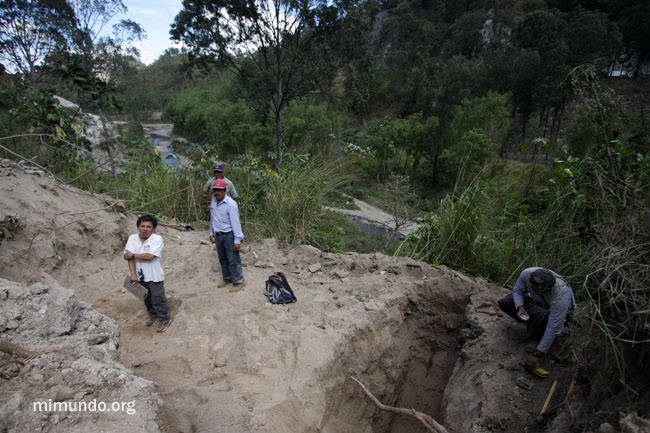
Last week, a team of forensics experts began an exhumation of victims killed during Mr. Ríos Montt's tenure at a military base on the outskirts of Nebaj. Signs along the road offer Guatemalans free services for DNA testing on the remains of loved ones recovered from clandestine graves as a means of positively identifying the bodies.

Approached by a reporter during the trial, Mr. Ríos Montt declined to comment. But his attorney, Francisco Palomo, said Mr. Ríos Montt could not be held accountable for the actions of his soldiers at the time.

Mr. Palomo said that while villages had been burned and civilians were killed by soldiers during Mr. Ríos Montt's tenure, it didn't qualify as genocide and happened without his client's knowledge.

"Just as the president of the United States might not know the specifics of what his troops have done…he didn't either," Mr. Palomo said.

Guatemala's Attorney General Claudia Paz y Paz, who brought the case to trial, had called the decision last week to annul the case illegal and said that she was confident of getting a conviction.

She says two military documents entered into evidence showed that Mr. Ríos Montt had knowledge of civilian massacres and suggest that they came at his orders.

"They used the words 'extermination' and 'liquidation' in their documents" when referring to the Ixil people, Ms. Paz y Paz said. "This is a strong case."

Mr. Ríos Montt's trial was many years in the making.

Charges were first brought to a Spanish judge in Madrid in 1999 by Rigoberta Menchú, an indigenous activist and Nobel Peace Prize winner. Ms. Menchú's father was killed by authorities while hiding in the Spanish Embassy in 1980 when Mr. Ríos Montt was a high-ranking military official.

In a recent interview, Ms. Menchú said she took the case to Spain "because here in Guatemala they didn't try war crimes." That case remains in court.

But as the investigation in Spain developed, so did Guatemala's attempts to build its own institutions.

In late 2006, it established the International Commission Against Impunity in Guatemala, known as the CICIG in Spanish, a joint venture with international prosecutors and judges sponsored by the United Nations.

The CICIG's mandate—to specifically target top-level Guatemalan officials who had escaped prosecution—was a major step in clearing the way to begin war crimes trials in the country, said Ms. Isaacs, the political-science professor.

U.N. jurists also trained many of the Guatemalan prosecutors who are now involved in Mr. Ríos Montt's case.

Mr. Ríos Montt, who had returned to political life as a congressman in the 1990s, was at first shielded from prosecution under Guatemala's immunity laws.

But when his term ran out last year, prosecutors filed the charges against him.

Residents interviewed in Nebaj recently described some brutal scenes from those years involving villages destroyed and relatives lost after the arrest by soldiers.

Nicolás Corio, a community organizer who was 10-years-old when Mr. Ríos Montt took office, remembered his village being bombed by government aircraft. He said soldiers later arrived, burned the villagers' homes, destroyed corn crops and killed livestock.

Elena de Paz, 42, who testified during the trial, said soldiers abducted her mother in 1983 and she never heard from her again. Her grandparents and father had previously disappeared in military custody, she said.

"I am the only one who survived," she said, standing near the remnants of a bomb dropped in 1983. "There are people who say [Mr. Ríos Montt] is old, let him out. But he still can think, and he knows he's guilty."

Mr. Palomo said that contrary to the trial testimony, Mr. Ríos Montt still enjoys support in Nebaj. His political party, the Guatemalan Republican Front, still garners many votes there, as it did during Mr. Ríos Montt's long term in the Congress, although he never represented the area personally.

"If it were true that the military had been so bad, would they still vote for him years later?" he said.

Wednesday 24 April 2013

http://online.wsj.com/article/SB10001424127887323551004578437013856080192.html

continue reading