Wednesday, 12 August 2015

Migrants rescued by Italy say up to 50 missing after boat sinks


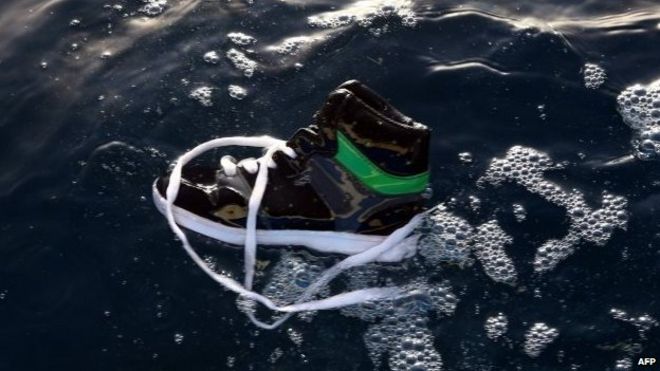
Up to 50 migrants went missing after a large rubber dinghy sank in the Mediterranean Sea, Italian rescuers said on Wednesday, while more than 1,500 were picked up from other vessels in the past 24 hours.

The Mediterranean has become the world's most deadly border zone for migrants. More than 2,000 migrants and refugees have died so far this year in attempts to reach Europe by boat, compared with 3,279 deaths during the whole of last year, the International Organization for Migration said last week.

An Italian navy helicopter on Tuesday spotted a rubber boat that appeared to be deflating, the navy said, and dropped life rafts to the migrants on board. The boat then sank, it said.

The Italian naval ship Mimbelli rushed to the scene and pulled 52 migrants to safety. Survivors said there had been about 100 on board, leaving up to about 50 unaccounted for, a rescue operations source said.

A helicopter later airlifted to safety two migrants seen hanging onto a floating barrel near where the dinghy had sunk, the navy said. The survivors were being taken to the Italian island of Lampedusa.

Overall on Tuesday, Italy's coastguard said it coordinated the rescue of more than 1,500 migrants -- many fleeing war zones and poverty in Africa and the Middle East -- from seven different vessels.

People-smugglers, mostly based in lawless Libya and charging thousands of dollars for passage, have sent more than 100,000 migrants by sea to Italy so far this year, according to an Interior Ministry tally. Italy took in 170,000 in 2014.

Around 200 migrants were presumed killed earlier this month off the coast of Libya when their boat capsized. More than 400 were rescued from that shipwreck.

Financially strapped Greece has also struggled to cope with a surge in migrants and refugees arriving on its Mediterranean shores.

Greek police used fire extinguishers and batons against migrants on the island of Kos on Tuesday after violence broke out in a sports stadium where hundreds of people, including young children, were waiting for immigration papers.

Wednesday 12 August 2015

http://news.yahoo.com/italian-navy-rescues-migrants-survivors-50-feared-missing-052603008.html

continue reading

15 Years on, Kursk Submarine Tragedy


Fifteen years after one of the worst disasters in Russian naval history — the sinking of the Kursk submarine in the Barents Sea in which all 118 crew members died — the number of Russians who blame the authorities for not doing enough to rescue the sailors has dropped.

The tragedy occurred on Aug. 12, 2000, making it one of the first serious challenges faced by Russia's new president Vladimir Putin. While at the time and in the immediate aftermath, the president's actions were criticized, a poll published Monday by the independent pollster Levada Center showed that 40 percent of Russians thought the authorities did everything possible to save the crew — compared to 34 percent in 2010 and 23 percent in August 2000.

At the time, Russia's rejection of offers of help from other countries elicited outrage among some members of the public. Attitudes to that position also appear to have softened: If five years ago, only 21 percent of respondents considered it the right decision, this year, 28 percent of people agreed with it.

'It Sank'

In a fateful moment that would be remembered and criticized for years to come, Putin told CNN's Larry King: “It sank” — and appeared to smirk — when answering a question about what had happened to the submarine during an interview on the television channel a month after the tragedy.

This laconic answer and the president's demeanor were slammed as being cynical, indifferent and inappropriate for years to come, and further enraged those who already believed the government could have saved some of the sailors.

On Aug. 12, the Kursk, a nuclear submarine and one of the largest attack submarines ever built, was taking part in naval exercises in the Barents Sea. As the results of an official investigation later showed, one of the torpedoes the Kursk was carrying went off accidentally at around 11:28 a.m., followed by another explosion minutes later, after which the submarine sank.

Military officials only registered that an incident had taken place at 11:30 p.m., after failing to contact the crew numerous times.

The vessel was reportedly located at 4:30 a.m. the next day more than 100 meters below the surface. Attempts to rescue any possible survivors gripped the world's attention for more than a week, but were ultimately unsuccessful: By the time Norwegian rescuers managed to open the submarine's hatch on Aug. 21, everyone inside it was dead. Twenty-three sailors are now believed to have survived the initial blast for several hours before their oxygen ran out.

Blame Game

Putin's administration was criticized for a lot of things — for waiting too long to start the rescue operation, for refusing assistance from other countries, and for the apparent lack of concern shown by Putin himself: The president only terminated his vacation in Sochi five days after the tragedy struck.

“They should have raised the alarm immediately. In only doing so at 11:30 [p.m.], they were several hours late,” Boris Kuznetsov, a lawyer who represented 55 families of the deceased sailors, told the Voice of America radio station last year.

Kuznetsov, who is now in his 70s, moved to the U.S. in 2007, fearing arrest after having published a book called “It Sank” that decried the authorities' failure to save the survivors of the blasts.

The lawyer claimed that the explosion on the Kursk was recorded by a cruiser named the Pyotr Veliky (Peter the Great) that was nearby at the time. The cruiser's crew also heard and recorded what sounded like the submarine crew banging on its walls, which sailors do in extreme situations to attract attention, the lawyer said.

The banging, Kuznetsov told Voice of America, continued until Aug. 14, so the experts' conclusion that everyone had died from lack of oxygen eight hours after the tragedy, and that by the time the submarine was located there was no one to save, was deliberately falsified, because the authorities didn't want to admit they were helpless.

“The U.K. sent an airplane with rescue apparatus, but it was prohibited from entering Russian air space. The Norwegians offered help. Everything was rejected. The real reason was fear of showing total inability to rescue people during extreme situations,” Kuznetsov was cited by Voice of America as saying.

Unhappy Ending

In 2001, the hull of the submarine was raised from the bottom of the sea. A year later the official investigation concluded, naming the accidental torpedo detonation as the cause of the disaster.

That conclusion eliminated all the other versions — the submarine being attacked by foreign naval forces, a World War II-era underwater mine explosion, the submarine colliding with something in the sea — that had been circulating in the media for two years.

Not everyone accepted the results of the investigation. Some insisted that the Kursk had been attacked by a U.S. submarine and Putin had deliberately concealed it in order to avoid an international conflict.

Nevertheless, the case was closed and declared classified.

The bodies of 115 sailors were recovered and identified, several military officials were fired and all the crew members were posthumously awarded Orders of Courage. Their families received a total of up to 23 million rubles (about $700,000 at the time) in compensation from the authorities, the Moskovsky Komsomolets newspaper reported in 2003.

Wednesday 12 August 2015

http://www.themoscowtimes.com/news/article/15-years-on-russians-less-inclined-to-cast-blame-for-kursk-submarine-tragedy/527770.html

continue reading

SOS Malta launches urban canine search and rescue unit


SOS Malta today launched its first urban canine search and rescue unit to help it in its humanitarian missions.

The unit is made up of nine dogs, four of which have concluded their training, and nine handlers.

All dogs will be fully trained by January 2016. Training cost €17,000 per dog.

The dogs were trained in Malta and abroad by volunteer John Gera, a former civil protection officer, who offered his services for free.

The team will be used in the eventuality of a disaster in Malta and will also accompany SOS Malta on its missions overseas.

The unit was launched following a €10,000 donation by a Norwegian woman.

Wednesday 12 August 2015

http://www.timesofmalta.com/articles/view/20150811/local/sos-malta-launches-urban-canine-search-and-rescue-unit.580219

continue reading

Japan Airlines jumbo crash remembered 30 years later


Hundreds of people attended ceremonies Wednesday marking the 30th anniversary of a Japan Airlines jumbo jet crash that killed 520 people on board, the deadliest single-aircraft disaster in history.


The doomed Boeing 747 had begun the hour-long flight from Japan's capital to Osaka when it crashed into a mountain about 120 kilometres (75 miles) northwest of Tokyo on August 12, 1985.

In all, 509 passengers, including a dozen infants, and 15 crew were killed in the accident. Just four passengers survived.

Bereaved relatives of victims make an annual pilgrimage to Osutaka Ridge, along with JAL president Yoshiharu Ueki who will walk the trail to a memorial service near the crash site.

Ahead of Wednesday's events, Ueki told local media that "we would like to learn a lesson from this accident without forgetting the memory" of the lives lost.

Television footage showed some victims' relatives starting their climb up the steep mountain trail before dawn.

Some blew soap bubbles to pay tribute the children who died in the accident, their names included on a stone memorial listing the victims.

"When I come here I feel like I can see her directly -- it's like she's in front of me," an 81-year-old man who lost his daughter told local media.

"Thirty years is a long time, but honestly I feel as if it happened yesterday, and the memories were stirred again this particular year."

Japan Airlines Flight 123 took off from Tokyo's Haneda airport at 6:12 pm local time and quickly ran into trouble with a loud noise heard about 10 minutes into the trip.

The crew quickly declared an emergency and fought to regain power over the aircraft which had become "uncontrollable". It crashed into the mountain at 6:56 pm local time, about 45 minutes into the flight.

It was later determined that the bulkhead burst, rupturing hydraulic systems and leaving the plane uncontrollable.

A government-appointed investigation panel blamed the accident on improper repairs on the rear bulkhead seven years earlier.

In 1988, local police served papers on 20 people from JAL, the transport ministry and Boeing on suspicion of professional negligence resulting in death and injury.

But prosecutors decided not to indict anyone.

"It can never be forgotten," Satoshi Iizuka, a former police officer who identified bodies at the site three decades ago, told broadcaster TV Asahi as he choked back tears.

"Today, people tend to prioritise speed over safety."

This year's anniversary comes several days after the hunt for more wreckage from missing Malaysia Airlines flight 370 resumed on France's Reunion island in the Indian Ocean after being suspended last week.

A wing part was found on the island in late July and confirmed by the Malaysian prime minister to be part of the Boeing 777 that disappeared on March 8, 2014 with 239 people onboard.

Wednesday^12 August 2015

https://au.news.yahoo.com/world/a/29243075/japan-airlines-jumbo-crash-remembered-30-years-later/

continue reading

Tuesday, 11 August 2015

Pentagon still searching for lost WW2 veterans


Long dead but little forgotten, US soldiers who disappeared across the globe during World War II are being reunited with their loved ones in a push to find and bring home their bodies.

From the forests of Germany to the jungles of Papua New Guinea, US experts employed by the Defense POW/MIA Accounting Agency -- among them historians, archeologists and forensic experts -- are the main sleuths.

When recovery of a body is possible, the Pentagon specialists turn the remains over to an ultra-modern lab in Hawaii for identification and then wait for the ultimate reward: bringing the bereaved back together with their long-lost relatives.

Stephen Johnson, a historian-investigator, recalled how a delighted woman, whose father had been found in a German forest, exclaimed: "You gave me back my daddy."

"I think of her when I work on a case," Johnson said.

The woman, now a mother and grandmother, "had come to peace" after finding out the exact fate of her father, who died when she was 18 months old, Johnson said.

Sandi Jones, who lives in Montana, said she felt immense joy when the agency called her in June 2014 to say that her uncle had been found 70 years after his plane went down in the jungles of Papua New Guinea.

"I was flabbergasted," the 60-year-old said.

The uncle, whose photo Jones kept even though her grandparents refused to speak of him, was buried near the family ranch with honors in the presence of US Air Force officials.

The agency also gave the family his Masonic ring, which was discovered among the crew and deduced to be his since he was the only member of a Masonic Lodge.

Johnson said the willingness to return a soldier at any cost dates back to the nation's birth.

President George Washington, the first head of the US military, thought that "the allegiance of the Army to the nation was directly tied to the allegiance of the nation to the Army," he said.

"You don't stop being a member of the US military because you die," he added.

It is this logic that has driven the POW/MIA agency to take on a project to exhume 388 sailors and Marines who were killed aboard the battleship USS Oklahoma at Pearl Harbor on December 7, 1941.

At the time, remains of most of the crew could not be identified after spending weeks in the water, and the bodies were interred at the National Memorial Cemetery of the Pacific in Honolulu.

Now the agency hopes to identify remains through dental and DNA analysis -- a daunting task considering that the bones are mixed together, Johnson said.

The agency, which uncovers around 70 bodies a year, has fallen short of Congress' goal of 200 bodies annually.

Meanwhile, private associations are aiding in the effort.

History Flight, whose multi-disciplinary team includes historians, archeologists and soil specialists, is searching for the remains of several dozen Marines on the Tarawa Atoll in Kiribati, from the war's Pacific theater.

The quest began in 2007 and has cost nearly $1.5 million, according to History Flight president Mark Noah, who decided to search for the missing planes after becoming interested in lost flights.

"For us, it's a humanitarian issue" said Noah, an airline pilot for 50 years, explaining that many of the children and relatives of the disappeared are still alive.

Just over 73,000 US World War II soldiers are still missing or unidentified according to official figures.

Tuesday 11 August 2015

http://news.yahoo.com/pentagon-still-searching-lost-wwii-veterans-023755027.html

continue reading

Survivors tell police in Sicily some 200 migrants were kept inside capsized


It is feared up to 200 migrants may have drowned after an overcrowded boat they were on capsized in the Mediterranean.

Psychologists, cultural mediators, volunteers and members of Doctors Without Borders (MSF) do what they can to comfort the 367 survivors brought to Sicily by the Irish patrol boat which rescued them after Wednesday’s disaster.

If it is determined that hundreds were crammed in the hold of the iron fishing boat that overturned Wednesday, there is a real risk that numerous migrants died trapped inside, said Flavio Di Giacomo of the global Organization for Migration, a human rights group.

“The arrested are suspected of causing the confirmed deaths of 26 migrants and the presumed deaths of about 200 people who, according to witnesses, were locked in the hold of the boat that capsized”, a police statement said.

LE Niamh is heading toward the Sicilian port of Palermo, where it will arrive on Thursday afternoon with most of the survivors.

Military vessels and aircraft from a multi-nation operation are searching waters off Libya for a second day for any more survivors from an overturned boat crowded with migrants. “There have been some our bodies floating, so it was fairly a surprising scene”.

Some migrants who fell into the water had life vests; others, struggling to swim, were tossed life vests by rescuers.

“It was very upsetting to see a mother and father grieving for their young child, and our personnel tried to resuscitate him but unfortunately there was nothing they could do”, he said at the portside.

“And I dived under, ready to die to save my daughter”, he said, describing how he managed to rescue her – “I don’t know how” – and pull his wife to a lifeboat as well. What they found when they got there was unfortunately they had arrived too late, many people were in the water.

All the nationalities of the survivors weren’t instantly out there.

Di Giacomo said the estimate of 600 aboard was credible because the boat was 20-25 meters (70-85 feet) long, and smugglers, who don’t like to leave any space unused, usually fit about 600 aboard a fishing boat of that size.

Efforts to recover bodies from a horrific capsizing on April 18 off Libya, also when rescuers approached, are still being conducted, the Italian navy said. A number of Syrians were among those rescued.

Tuesday 11 August 2015

http://tvnewsroom.org/newslines/world/survivors-tell-police-in-sicily-some-200-migrants-were-kept-inside-capsized-77240/

continue reading

Kullu bus accident: Three more bodies recovered


Three bodies, including those of a child and a woman, were today recovered from separate places in Mandi district. One of the bodies has been identified, while the other two are believed to be of Punjab pilgrims who went missing after their Manikaran-bound bus plunged into the Parbati river at Sarsari on the Bhuntar-Manikarn road in Kullu district on July 23.

Eight persons were killed on the spot while bodies of seven others were later recovered from the Beas by search teams pressed into service by the district administration. However, 31 persons who went missing were feared to be washed away. At least 23 persons were injured in the mishap. The ill-fated private bus was reportedly carrying 69 pilgrims from Mansa, Bhatinda and Barnala districts of Punjab.

The search teams today recovered two bodies, including a child, from the Beas near Pandoh dam, about 50 km downstream from the accident site. The body of a female, reportedly of a pilgrim from the bus mishap, was retrieved further downstream from the Beas near Dharampur, 80 km from Mandi district headquarters.

The body of the child has been identified by his relatives at Kullu hospital. The other two bodies have not yet been identified.

Rajinder Singh Gill, a member of the Kullu Kar Seva, said the relatives camping here from Pakhokalan village of Barnala district had identified the body to be of one missing pilgrim Nacchater Singh, son of Dara Singh. However, his son had been called to confirm the same. br>
Gill said photos of another body recovered near Dharampur bore resemblance to a missing pilgrim Amarjeet Kaur, wife of Gurjeet Singh of Jagaramtirth village of Bhatinda district.br>
A police official at the Dharampur police station said the body of a woman of around 30 years of age had been recovered from the Beas and it had been sent to Sarkaghat hospital for the post-mortem examination.br>
Nearly 600 personnel of the National Disaster Response Force (NDRF), Sashastra Seema Bal (SSB), Indo-Tibetan Border Police (ITBP), Home Guards, police and a 12-member team of the Indian Navy were pressed into search and rescue operation. However, due to persistent rain in the valley, rivers and rivulets remained flooded, hampering the search operations. The floodgates of the Larji and Pandoh dams were also opened after increase in water level due to which the bodies might have washed away further downstream. br>
So far the death toll in the mishap had risen to 16. Meanwhile, the relatives of the missing persons were still camping at Kullu in a hope to trace the mortal remains of their loved ones to perform the last rites. Kullu Deputy Commissioner Rakesh Kanwar said the search for missing persons would continue till September end with nearly 160 personnel of the NDRF, the SSB, the ITBP, Home Guards and state police and re-enforcements could be sighted later on if required.br>
Tuesday 11 August 2015br>
http://www.tribuneindia.com/news/himachal/manikaran-mishap-three-bodies-recovered/118192.html

continue reading

Goil filling station explosion: Two bodies found at Circle Disaster zone after two month


More than two months after the deadly Circle disaster which killed an estimated hundred and fifty nine people, residents in the area of the incident have discovered two more dead bodies at the location.

The bodies were found in a storey building which was consumed by the fire that resulted from the explosion at the GOIL filling station.

Part of the bodies has been decomposed.

The bodies of the adult male and female were discovered by scrap dealers who were scavenging scraps in the burnt building.

Personnel from the Ghana Police Service have been to the location to examine the bodies but are yet to convey them to the mortuary.

The Circle flood and fire disaster which occurred on June 3rd is considered one of the worse disasters in the country’s history after the May 9th, 2011 stadium disaster which killed 127 soccer fans.

The security personnel at the location are preventing journalists from taking shots at the location.

Committee established to investigate the disaster has attributed it to a cigarette smoker who is now in BNI custody.

Tuesday 11 August 2015

Mass burial does not include victims of the June 3 disaster

Authorities at the Police Hospital in Accra have clarified that their upcoming mass burial does not include victims of the June 3 disaster.

The hospital has scheduled a mass burial for unclaimed bodies in its morgue at the end of August, 2015.

Speaking to kasapa FMs Maame Broni on the matter Monday, the acting public relations officer of the hospital Corporal Faustina Nunekpenu said the police administration is currently in talks with the Accra Metropolitan Assembly for a lease of land for the exercise.

She explained that the bodies to be buried include those left at the hospital’s morgue for a period of 8 to 12 months.

Corporal Nunekpenu further explained that her outfit collected 70 bodies from the June 3 disaster site with 9 still at the morgue yet to be identified.

She is therefore urging Ghanaians to visit the Police Hospital and identify the bodies of their relatives for burial.

Tuesday 11 August 2015

http://www.starrfmonline.com/1.5885342

http://www.ghanaweb.com/GhanaHomePage/NewsArchive/Two-bodies-found-at-Circle-Disaster-zone-374204

continue reading

South Korea: Dead homeless foreigner remains unidentified


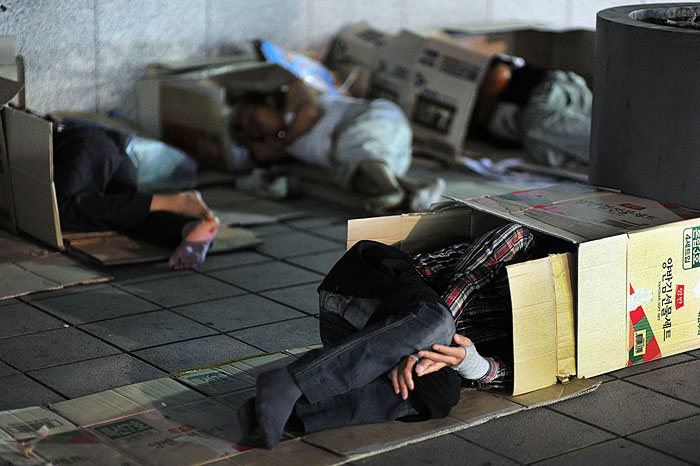
Late last month, a homeless foreigner who called himself “Thomas” died of biliary tract cancer in a public hospital in northern Seoul. He was brought to the hospital after experiencing severe pain and constantly shaking his hands.

Thomas had claimed that he was an Israeli in his 60s who came to Seoul to run an English education-related business, according to city officials. He had added that he ended up on the streets after the business failed.

Upon his death, the Seoul Metropolitan Government faced difficulties in managing follow-up procedures as they failed to identify his personal information. The case also brought to light a number of other similar cases, where the city has faced issues of unidentifiable foreigners who have gone homeless and died.

So far, the city has found out that he was not an Israeli. The city requested the Embassy of Israel to conduct an identification process of Thomas in order to hand over the body to his home country, but the embassy replied that he was not one of its citizens.

There were no other identification clues as Thomas had adamantly refused to reveal his personal information as well as family information, public shelter officials said. The foreigner identification number that Thomas had provided in the medical document was also found to be wrong.

Although the city found a British passport among Thomas’ belongings, it was confirmed to be counterfeit, they added.

Under the current law, the dead bodies of the Korean homeless are managed by city districts. If a family member does not show up within a month, the bodies are cremated and kept in a charnel house for 10 years in case any acquaintances appear.

Such regulations, however, are not applicable to foreigners.

“There’s nothing that the city can do as there are no particular manuals or rules stated over how to handle the dead bodies of the foreign homeless. Regarding the body handover, some embassies are also reluctant to take them,” a Seoul City official told The Korea Herald.

“For now, the city has requested the police to help identify Thomas. In the meantime, we will give our utmost efforts to find his family or acquaintances,” she added.

As of February, 25 foreigners have been found homeless, according to the Seoul Metropolitan Government. Of them, Chinese and Mongolians accounted for the most with 17, followed by Taiwanese and Americans.

Seoul City launched a probe after a Taiwanese person was found frozen to death on a street in January.

“The number does not suggest an accurate count as it only includes those the city has spotted on the street,” the city official added.

As more deaths of foreign homeless are reported, the government needs to prepare for regulations for the after-death management process for them, experts said.

“Regardless of the nationality check, the foreign homeless also have human rights and dignity to pursue. The after-death handling should be ensured the same as the local homeless,” said the Korea Human Rights Policy Institute.

Tuesday 11 August 2015

http://www.koreaherald.com/view.php?ud=20150810000969

continue reading

Joumol landslide: No more bodies recovered


Even as the whole Joumol village was swept away by landslide following heavy rainfall for days, only four bodies were recovered. According to Khangbarol TD Block BDO Md Najimuddin who took part in the rescue operations, the reports that 20 villagers were feared buried alive was not totally true.

Quoting reports furnished by Joumol village chief, Md Najimuddin there were only 10 people when the landslide occurred.

Out of the 10 villagers, one survived the tragic landslide. Later in the course of the rescue operation, four were found dead. Post mortem of the four bodies were conducted then and there and they were buried at a nearby place with the customary rites. But the bodies of the five other victims could not be located even after the rescue operation spearheaded by NDRF was over.

Nonetheless, according to a document signed by the Joumol village chief, SDPO Chandel, TSA Chandel education secretary, the doctor who conducted post mortem and NDRF officials who took part in the rescue operation, it was assumed that nine persons were killed by the landslide. It was after signing this document that the rescue operation was called off on August 4. The four deceased victims whose bodies were identified.

Tuesday 11 August 2015

http://www.thesangaiexpress.com/page/items/54993/no-more-bodies-recovered

continue reading

Naufragi a Lampedusa, il Viminale rafforza procedure per identificare le vittime (in Italian)


Il Commissario straordinario del Governo per la gestione del fenomeno della scomparsa di persone Vittorio Piscitelli e il rettore dell'Università di Milano Gianluca Vago, hanno sottoscritto un protocollo d'intesa per rafforzare la collaborazione avviata lo scorso anno, volta a favorire la identificazione delle vittime del naufragio di Lampedusa dell'ottobre 2013, nel quale persero la vita circa 400 cittadini eritrei e siriani, e per quello del 18 aprile scorso in cui morirono circa 800 persone. Lo afferma una nota del Viminale nella quale si sottolinea che il «fronte» internazionale vede l'Ufficio del commissario ulteriormente impegnato in questo settore.

Difatti, il procuratore capo di Catania ha ritenuto «indispensabile» il coordinamento commissariale per agevolare la identificazione dei cittadini extracomunitari vittime del naufragio del 18 aprile scorso, i cui corpi (circa 800) sono in corso di recupero da parte della Marina Militare, giusta richiesta del Presidente del Consiglio al Ministro della Difesa.

La complessa attività, che si svolgerà in apposita area protetta individuata nel porto di Augusta (SR), prosegue il Viminale, viene effettuata dagli specialisti del Laboratorio di Medicina Legale dell'università, in sinergia con il Servizio della Polizia Scientifica, con le prefetture di Siracusa e Catania ed in collaborazione con la Croce rossa, con i medici legali delle Università di Palermo, Catania e Messina, nonchè con l'ASP di Siracusa. Visto l'alto numero delle vittime, sarà necessario coinvolgere ulteriori medici legali provenienti da altre Università degli Studi d'Italia.

Tuesday 11 August 2015

http://agrigento.gds.it/2015/08/05/naufragi-a-lampedusa-il-viminale-accelera-le-procedure-per-identificare-le-vittime_391959/

continue reading

Monday, 10 August 2015

Mexican missing-student activist killed in Guerrero state


A Mexican community activist who helped families search for their missing relatives has been killed.

Miguel Angel Jimenez Blanco's body was found near his home in a town in the south-western state of Guerrero.

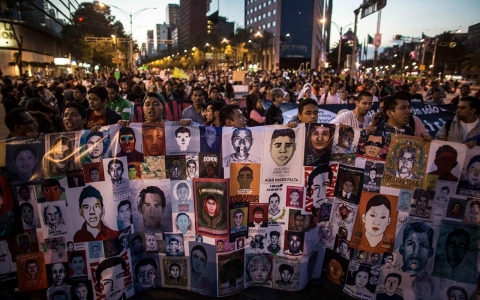
He had led search parties after the disappearance of 43 students in the nearby town of Iguala last year threw light on hundreds of other missing people.

Guerrero is a region plagued by gang and drug violence.

At least 15 people were killed there over the weekend.

Mr Jimenez Blanco's body was found in the taxi he owned in the small town of Xaltianguis.

He had been part of an organisation which had supported the search for the students in the hills around Iguala. He had also helped dig up a number of graves of murdered people that were found during the search for the students.

He had helped organise a group called The Other Disappeared, mostly women who meet every Sunday to search the hills for the remains of their loved ones.

'This area is a cemetery'

The search parties started in November last year, a few months after the 43 students were abducted and presumably killed in Iguala on 26 September.

Since the group began work, it has found 129 bodies, which were handed over to the authorities for identification.

In a BBC interview, Mr Jimenez Blanco said that after Iguala, 300 families had come forward saying they had missing relatives too.

"We have been saying from the start that this area is a cemetery," he said at the time.

David Cienfuegos, government secretary of the state of Guerrero, told the BBC that many families had stayed silent for decades for fear of retribution.

"Many crimes linked to the disappearance of people need a statement to the police so the case can be taken up.

"In the last decade in Guerrero there have been few statements taken because the families are afraid. They fear the police themselves are involved in the disappearances."

In an interview with the Los Angeles Times, one of Miguel Jimenez Blanco's friends, Mario Vergara, whose brother went missing last year, said that he motivated hundreds of families.

"He taught us how to search and how to push and every day he would give us the energy to carry on."

The case of the missing 43 students promoted a national and international outcry. The parents of the students and many other Mexicans still reject the government's version of events.

The administration of President Enrique Pena Nieto has insisted the students were killed by gang members on the orders of corrupt local police.

The bodies were then burnt, and the remains dumped in a river, but so far only one student has been identified.

The case highlighted hundreds of other people missing in Guerrero - Mexico's most violent state.

Guerrero is a major opium-producing state and a battleground for a number of different criminal gangs.

More than 20,000 people are missing across the whole country

Monday 10 August 2015

http://www.bbc.com/news/world-latin-america-33843774

continue reading

Russia locates helicopter that crashed 10 months ago in Siberia


Russian investigators said on Saturday that they had located the wreckage of a helicopter that had crashed in a remote mountainous region of Siberia last October with 14 people on board.

Rescuers "confirmed information that the Mi-8 helicopter of TuvaAvia airline that went missing on October 10 was found in an isolated mountainous area," investigators said in a statement.

"According to provisional information, there were 11 passengers and 3 crew members on board.

"The helicopter was transporting workers who were returning from a hydroelectric project in the Siberian Buddhist region of Tuva, which borders Mongolia.It crashed into mountainous terrain amid low cloud and falling snow and caught fire when it hit the ground, the spokesman for the regional emergencies ministry, Dmitry Kryzh, told TASS news agency.

"There is a very steep slope -- with a gradient of around 45 degrees," he said of the crash scene.He said the helicopter most likely went undetected after the crash because it was quickly covered with snow.

The wreckage was initially spotted yesterday from the air by military helicopter pilots.Rescuers were still searching for the helicopter's black boxes which could have been swept downhill by rock falls, Kryzh said.

So far the remains of 10 people have been found. "Unfortunately the crew and the passengers had no chance," the leader of Tuva, Sholban Kara-ool, said in a statement.

It is not unknown for crashed aircraft to lie undetected for months in Russia's sparsely populated countryside. In 2013, a small plane was found in a marsh 11 months after it crashed in the Urals region of central Russia, killing all 13 on board.

Monday 10 august 2015

http://www.hindustantimes.com/world-news/russia-locates-helicopter-that-crashed-10-months-ago-in-siberia/article1-1377895.aspx

continue reading

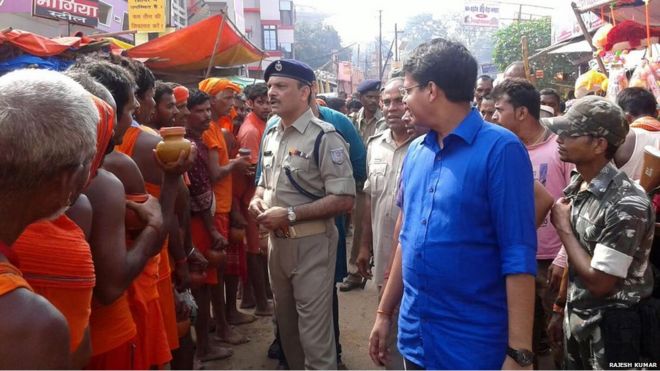
India temple stampede in Jharkhand leaves 10 dead


At least 10 people have been killed and 20 injured in a stampede at a temple in the eastern Indian state of Jharkhand, officials say.

Pilgrims have been marking a Hindu religious festival in Deoghar town.

It happened as pilgrims tried to make their way into the complex, a district official told BBC Hindi.

Deadly stampedes are common during Indian religious festivals, which attract large crowds with few safety measures in place.

The stampede at the Baidyanath Jyotirlinga temple began after pilgrims surged towards the shrine shortly after the doors opened early on Monday, an official told the AFP news agency.

Monday is considered an auspicious date to visit the shrine, which includes a main temple and 21 smaller ones devoted to Shiva, the god of destruction.

Pilgrims sleeping in the 6km (four miles) long queue were trampled as others pushed towards the doors, senior police official SN Pradhan said.

"Many tried to rush to the head of the queue which led to chaos and as some of them fell, the devotees got trampled."

"Ten people including one female devotee are now confirmed dead. Another 15 to 20 people have received injuries," he said

In October, some 91 pilgrims, mostly women and children, were killed in a stampede at a Hindu festival near the Ratangarh temple in Madhya Pradesh state.

In 2011, more than 100 died at a festival in the southern state of Kerala.

Monday 10 August 2015

http://www.bbc.com/news/world-asia-india-33844083

continue reading

Sunday, 9 August 2015

Bad weather hampers ferrying of bodies from Langtang


Adverse weather has hindered ferrying of eighteen corpses recovered from landslide debris in Langtang region of Rasuwa district some two weeks back. The bodies are believed to be of trekkers who were swept away by landslide and avalanche triggered after the Great Earthquake on April 25 in the area.

The bodies that are beyond recognition are waiting to be airlifted to Kathmandu for DNA testing.

DSP at District Police Office Prabin Pokhrel said they have not been able to reach the recovery site as the weather conditions have been too harsh for the past two weeks. Some locals of the Langtang area informed the police after they discovered the body and body parts, he said. "The bodies have been kept on a school ground in the area," said DSP Pokhrel. "Although the locals claim that the bodies are of their family and relatives, it will be ascertained only after undergoing DNA tests."

The bodies once airlifted will be ferried to the Forensic Unit of the Tribhuvan University Teaching Hospital. From there, the samples from the body parts will undergo DNA testing at the Central Police Forensic Science Laboratory (CPFSL) of Nepal Police.

Laxmi Dhakal, spokesperson at the Ministry of Home Affairs, said the government has asked Nepal Army to airlift the bodies and the helicopter will move to the recovery site once the weather is clear.

One hundred and eighty persons including 39 foreigners are reported to have gone missing after the earthquake. From Rasuwa alone more than 100 complaints of missing people had been lodged of which 21 are locals, 61 are not native of the district, while 22 are foreigners.

Around 9,000 people have been reported dead while over 20,000 injured during the earthquake.

Sunday 9 August 2015

http://www.ekantipur.com/2015/08/09/top-story/bad-weather-hampers-ferrying-of-bodies-from-langtang/409195.html

continue reading

Saturday, 8 August 2015

Anonymous migrant graves deserve humane policy solution


A year ago, a Globe investigation exposed in stark detail the lack of an established process for families of relatives who have disappeared while attempting to cross the US-Mexico border illegally. But little progress has been made since then, and many of the missing are never found, or end up buried anonymously in public graves.

The lack of recourse for families of the hundreds who have died after crossing the border begs for a humane solution. Federal authorities must strengthen policies to mandate consistent identification of the dead. To allow anonymous mass graves on American soil is cruel to families and denies the basic human right that every individual deserves a degree of dignity — no matter where they come from or how they died.

The growing body count of migrants underscores the treacherous journey of crossing the border into the United States. Chief Deputy Sheriff Benny Martinez of Brooks County, Texas, testified before Congress earlier this year that his department has recovered bodies of those who crossed illegally at a rate of about six per month over the past six-and-a-half years.

The humanitarian dilemma has not gone unnoticed, but it still demands new rules and federal assistance to create a reliable identification system. A consortium of forensic experts formed the Reuniting Families Project (RFP) to assist in efforts to identify bodies of migrants, some of whom had been buried by the county in public cemeteries without having a DNA sample taken as required by law. The group has been unearthing public graves of migrants near the border since 2003. Since 2013, RFP has exhumed more than 120 bodies of unidentified border crossers.

Many law enforcement officers and ranch owners in Brooks County have repeatedly called for increased awareness and more resources to manage the sickening status quo, insisting it is not about the politics of immigration, but essentially a human rights issue. “If dead human beings don’t catch your attention, what the hell else is going to? We’re just trying to be human about it,” a local rancher told the Associated Press.

Hundreds of people who have died crossing the southern border are buried without ceremony, casket, or name.

Humanity toward deceased unidentified migrant border-crossers needs to be codified in law enforcement circles, as the Globe’s report made clear. East Boston resident Maria Interiano’s brother went missing two summers ago as he crossed the border illegally into Texas. It was a heartbreaking tale of dead ends as Maria tried to find out what happened to him — she didn’t even know there is a federal database, the National Missing and Unidentified Persons System, where her brother’s DNA profile could be found. Local law enforcement agencies are also sometimes reluctant to investigate when it’s unclear if the disappearance occurred in their jurisdiction.

Migrants should never be buried in US soil without consistent, codified efforts to identify them. The ongoing pressure at the US-Mexico border — along with beefed-up security — guarantees that there will be more extreme and dangerous efforts to cross into the United States, and certainly more tragic deaths. Federal and local authorities must work together to stop unnecessary suffering for families in the aftermath.

Saturday 8 August 2015

https://www.bostonglobe.com/opinion/editorials/2015/07/24/anonymous-migrant-graves-deserve-humane-policy-solution/d1DUIpiwHCpPxkZoSs79XL/story.html

continue reading

Bodies of helicopter crash victims sent to Rawalpindi


Rescue officials recovered the bodies of all the victims of Thursday’s military chopper crash and shifted them to CHM Abbottabad for DNA tests, police said on Friday.

At least 12 people, including two crew members and a medical team, were killed when a MI-17 helicopter crashed on the hilly range of Koh-e-Bhaingra near Mohar village in Lassan Nawab area on Thursday afternoon.

“It hovered over Lassan for a few seconds before exploding on the hill”, a resident of the Mohar village Dilawar said.

He believes that the pilot failed to judge the foggy weather on the hilltop, home to a thick forest.

Khwas, another resident of the same village, explained that although the crashing site was a three-hour walk away, the villagers reached for the rescue late by which time the helicopter had burnt.

The villagers, he said, were later joined by military troops and police personnel and after a 12-hour operation they recovered the bodies. Saturday 8 August 2015

http://tribune.com.pk/story/934301/final-journey-bodies-of-chopper-crash-victims-sent-to-rawalpindi/

continue reading

Ukraine buries unidentified soldiers months after eastern battle


Ukraine buried on Friday 57 soldiers still unidentified up to a year after being killed in the eastern separatist conflict, highlighting the difficulties the country faces moving on from one of its deadliest military defeats.

Mournful chants drifted over the graves of the nameless soldiers, most of whom fell in the battle of Ilovaisk last August after Ukrainian forces found themselves encircled, outgunned, and vastly outnumbered by Russian-backed rebels.

Authorities have spent months trying to identify the bodies and find relatives, but without success.

"It's horrible to think that somewhere their parents are waiting for them, their children, brothers, sisters," said local resident Olga Bondarenko, who had come to pay her respects at the cemetery in the south-eastern region of Zaporizhzhya.

Hundreds of soldiers are believed to have been killed in the encounter, but official figures are much lower.

Government efforts to recover bodies were hampered by the fact they lay in separatist-held territory.

Afterwards an unwillingness from relatives to undergo DNA testing also held up the process, news agency Interfax Ukraine quoted regional military official Oleksander Beda as saying.

"Until the end they hope that their loved ones, who were missing in action, were alive and either captured or in hospital ... You can understand them - hope dies last of all," he was quoted as saying.

In October, a parliamentary report on Ilovaisk listed a series of military mistakes and concluded that "the causes of the ... tragedy are fundamental problems in the organization of the country's system of defense".

It said it was not able to establish the true number of casualties due to a lack of data from the Ministry of Defence and General Staff.

More than 6,500 soldiers, separatists and civilians have been killed since fighting between Ukrainian troops and rebels seeking independence from Kiev erupted in April 2014, according to United Nations estimates.

Violence has continued despite a ceasefire deal signed in February with both sides accusing the other of violations. Sixteen servicemen have been killed by shelling or landmine explosions since the start of August, while 29 were killed on the frontline in July.

"To think that this could happen to our country, to our boys," Bondarenko said, her voice choking with tears.

Clouds of red dust rose into the air as soldiers shoveled earth into the graves, each marked with a plain cross and a plaque inscribed with the words: "Unknown soldier."

Saturday 8 august 2015

http://news.yahoo.com/ukraine-buries-unidentified-soldiers-months-eastern-battle-153129095.html

continue reading

SS Eastland disaster: An unequaled disaster


July 24 marked the 100th anniversary of the death of the Eastland. The Eastland was, without question, the greatest disaster of all Great Lakes shipwrecks with anywhere from 800 to 1,100 casualties, although recent historians estimate approximately 844 deaths.

Source material for the tragedy of the Eastland is abundant. One cannot name any histories of the Great Lakes that do not mention the Eastland and do not recognize it as the greatest of tragedies on the Great Lakes.

For once in our accountings of Great Lakes shipwrecks, the weather, the waves or collisions were not responsible for the wreck of the Eastland.

In fact, according to Mark Bourrie’s “Many a Midnight Ship,” the seeds for the Eastland disaster were planted as she was under construction. This was a doomed ship before she saw any service. Subsequent attempts to improve the Eastland only contributed to her doomsday scenario.

The Eastland was built as a freight and passenger carrier. She was constructed at the Sidney Jenks shipyard and was launched in 1903. She was 265 feet long and had a breadth of 38 feet.

The Jenks shipyard, according to Bourrie, had very little experience building vessels that would carry passengers. That observation was also confirmed by Benjamin J. Shelak in “Shipwrecks of Lake Michigan,” who noted the four-deck passenger ship was the only one produced by this shipyard.

From the beginning the Eastland’s design flaws pointed to an eventual disaster. There were plenty of warnings. Ignored but significant were two very severe listing events in 1904 and in 1906.

The 1904 event involved a roll to starboard of approximately 20-25 degrees before the ship rolled back. 3,000 passengers were aboard and dozens complained to the newspapers and the ship owners. Both incidents resulted in mandates to reduce passenger loads.

The owners responded to the criticisms by taking out newspaper advertisements offering a reward of $5,000 to the person who could demonstrate the Eastland was unsafe. In so doing, the owners ignored the warnings of marine engineer William Wood who had worked on the Eastland and was aware of problems with the ship’s equilibrium.

Early in the day of July 24, 1915, all people could think about was the beautiful day on Lake Michigan and how fortunate they and their families would be to ride across the blue waters of Lake Michigan to the beaches near Michigan City, Indiana.

The Western Electric Co. had arranged an excursion for its employees aboard the Eastland. The company subsidy enabled their workers to purchase tickets for 75 cents.

Historical accounts, including Dwight Boyer’s “True Tales of the Great Lakes,” document numerous complaints by workers that they felt pressured by possible job loss if they did not purchase tickets. These complaints were probably well-founded, but it appears the vast majority of passengers were truly looking forward to a beautiful day with their families on a beautiful lake.

As the Eastland had her lines slipped and was under tow by a tug, she immediately began to list badly and then tipped over in the river. Hundreds were thrown from the decks to their deaths. Hundreds more were simply crushed on the river bottom by the big ship now lying on its side. Hundreds more drowned as they were trapped below the waterline.

Nothing could express the horror of the day’s events better than the many photographs found in Boyer’s book, of the faces of the rescuers and survivors as they struggled to find more bodies. The nightmarish events were accentuated by the bodies of little children, still in their Sunday clothes, being carried off to makeshift morgues.

The tipping over of the Eastland and the events leading up to the disaster suggested serious problems with metacentric height, essentially the ship’s center of gravity and the equilibrium between the distribution of weight onboard. In other words, on a flawed ship like the Eastland, the weight shift by passengers moving, in mass from one side of the ship to the other, might well be enough for the ship to lose equilibrium.

But let’s not blame the passengers. They were hardworking families from tight knit ethnic neighborhoods in Chicago. They were workers, looking forward to a beautiful day’s excursion with their families on Lake Michigan, a break from the toils and tedium of the workplace.

They were human beings who paid the ultimate price for the dishonesty, the greed, and the willful ignorance of the ship owners and their enablers, the corrupt bureaucrats.

That price amounted to the greatest loss of life in a single shipwreck on the Great Lakes, a loss that has never been approached by any subsequent shipwreck in the past 100 years.

Given the circumstances, there is every reason to believe the death toll of the Eastland will never be equaled again.

Saturday 8 August 2015

http://www.battlecreekenquirer.com/story/opinion/columnists/2015/08/07/jim-hettinger-unequaled-disaster/31308323/

continue reading

Harda train accident: One more body found, toll rises to 30


One more body was recovered on Friday, taking the toll in twin-train tragedy near Harda station to 30. The dead, identified as Shobhnath Pasi, 55, was a native of Badka Dela village in Phoolpur tehsil of Uttar Pradesh's Allahabad district. Pasi, who was working in a powerloom in Mumbai, was travelling from Mumbai to Allahabad in Kamanyani Express's general bogie.

Shobhnath Pasi, 55, was a resident of Badka Dela village under Phoolpur tehsil of Uttar Pradesh's Allahabad district. Pasi was living in Mumbai and working in a powerloom factory. He was travelling from Mumbai to Allahabad in Kamanyani Express's general bogie when the accident took place.

"His son Rakesh Pasi, who came to Harda after hearing about the incident, identified him," Harda SP Prem Babu Sharma told TOI. "13 passengers are still missing and rescue operations are underway," he said.

Sources said the toll may cross 40. If they were alive, they could have been traced by now or would have approached family members.

Kin of 25 people have lodged missing complaints about their near and dear up to Friday. Of these, eight people were identified from the bodies sent to Bhopal and four were found alive in Harda, but the whereabouts of remaining 13 could not be traced so far.

District police have launched a 24x7 helpdesk at Harda railway station to provide information to kin of those missing.

On Friday, rescue operations by state disaster relief force, national disaster relief force and local administration continued. Officials said relief work would continue for next couple of days. Derailed bogies and debris are yet to be removed from the accident site.

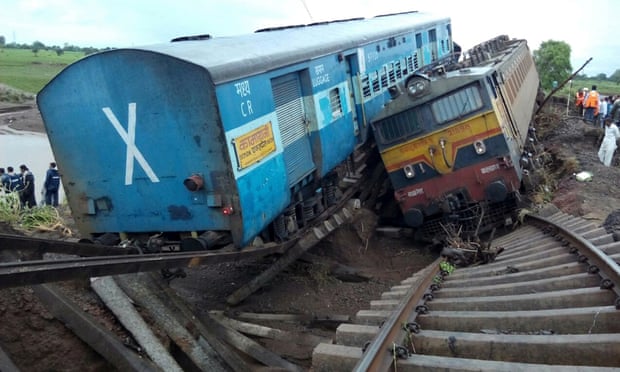
Several passengers were trapped in two bogies of Janata Express perilously hanging while three wrecked compartments telescoped into the Kamayani Express. The accident took place near Mandla village under Khirkiya tehsil of Harda district.

Mumbai lad recounts harrowing experience at mortuary

Mumbai resident Ajay Patel's family members were taken out dead from the wreckage of Janata Express by rescue workers at Harda. Four bodies wrapped in sheets, tossed on the slush at the tragedy site for identification and then stuffed into an ambulance van to Bhopal, where it was shoved into a frigid morgue. Sixty hours later, Ajay, who is just out of high school, is struggling to get custody of the bodies for performing last rites. It was a traumatic journey from Kalyan railway station, where he first heard the tragic news to a roller-coaster ride to Harda ground zero and then a harrowing experience at the morgue at Hamidia Hospital, Bhopal.

Ajay only had a fleeting glimpse of his parent's decomposed bodies. He cringed as he pointed out to mortuary officials that they were his own. Now, he's still waiting to get custody of the bodies for funeral. With no coordination between police, doctors and railway officials, many like Ajay are getting trapped in red tape of babudom.

"I was waiting at Kalyan railway station to receive my parents, aunt and cousin. It was then that I heard about the accident. I dialled the helpline number and heard the shocking news. I did not know much about Harda or Bhopal. I and my uncle headed for Harda in a taxi as trains were diverted. We scoured photographs of the dead put up at notice board at Harda railway station and then reached Bhopal. I waited at BMHRC morgue for three hours and still didn't get the bodies. I spent sleepless night in the open at the hospital campus. In the morning, we were told, the bodies were taken to another hospital for autopsy," he said.

Since Friday morning, Ajay is waiting outside mortuary at Gandhi Medical College for the autopsy to end. "There's nobody to lend a helping hand. There's so much red tape even after a national tragedy," he said. His parents, Baliram, 47, Hari Bai, 44, aunt, Shashi, 35 and cousin Satyam, 11, died after the coach in which they were travelling sank into the swollen Machak river after two trains derailed on the bridge.

Ajay is eldest in the family and his two younger siblings, brother Vikas, 16 and sister Manju, 18, are in Kalyan, Mumbai, still unaware of what has happened.

The bodies were taken out of GMC Hospital after autopsy late afternoon and Ajay hired two hearses for railway station.

Ajay's is not the only sordid tale. Families of victims are having a tough time dealing with administration as officials of Railways and district administration are not in sync. Arman Shah, who lost his elder brother, Ramzan Shah, 23, had to also struggle to get the autopsy done and take the body home. Two railway officials, including ticket examiners, were also present at the hospital on Friday. "What we can do? Police and doctors do not listen to us. Railway brass should take note of the situation," they said.

Kamayani Express, headed for Varanasi in Uttar Pradesh from Mumbai, derailed near Harda town, 160 km south of Bhopal, shortly before midnight. The Janata Express, en route to Mumbai from Patna, too derailed at the same spot minutes later. A total of 30 bodies have been recovered so far, besides, at least 13 passengers are still missing.

Saturday 8 August 2015

http://timesofindia.indiatimes.com/city/bhopal/One-more-body-found-toll-30/articleshow/48399401.cms

http://timesofindia.indiatimes.com/city/bhopal/60-hrs-after-tragedy-Mumbai-lad-recounts-harrowing-experience-at-morturary/articleshow/48399415.cms

continue reading