Thursday, 20 February 2014

30 more Typhoon victims recovered in Tacloban in two weeks


More than three months have passed since Yolanda devastated the city but authorities continued to recover more dead bodies from different areas in Tacloban.

In the recently concluded Regional Disaster Risk Reduction and Management Council (RDRRMC) Meeting held at Leyte Sports Development Center, in this city, Task Force Cadaver headed by Senior Superintendent Pablito Cordera of the Bureau of Fire Protection in the region has reported that 30 dead bodies were recovered by the team from February 4 until February 17, 2014 in different places in the city.

Most of the cadavers were retrieved in San Jose District, one of the coastal barangays hardly hit by the storm surges.

Eleven(11) of the cadavers were found on February 4. 2014, One(1) in February 6, Two (2) in February 8, five(5) in February 11, three(3) in February 13 and eight(8) were retrieved in february 17. All of these were brought to the grave site at Holy Cross Cemetery.

This brings to a total of 2, 622 cadavers recovered by the task force since November 16, 2013 until February 18, this year.

The task force cadaver comprises personnel from the Philippine National Police, National Bureau of Investigation, City Government of Tacloban, Armed Forces of the Philippines, Department of Health and the Bureau of Fire Protection (BFP) which is the lead agency.

Thursday 20 February 2014

http://news.pia.gov.ph/index.php?article=2681392712124

continue reading

Train fire: 2 bodies yet to be identified


More then a month after a fire broke out in the Dehradun Express, which killed nine commuters near Dahanu station on January 8, family members of two missing passengers are still waiting for results of DNA tests so that the remains of two bodies lying unclaimed can be identified. Though the bodies are still to be identified through DNA, circumstances made relatives of two missing passengers believe that they are Sakina Shabbir R.C. Wala (57) and Zamir Ahmed (60) who were travelling in the ill-fated bogie.

Senior police inspector Pramod Dawde of Palghar government railway police (GRP) confirmed that the first DNA test performed on charred bones was inconclusive and bones of some other parts of bodies were again sent to the Kalina FSL. “We could only find charred bones in the coach, and two persons are still missing, but we cannot come to any conclusion till the DNA reports is made available,” he said. He added that investigation is still underway and the cause of fire is yet to be ascertained.

On the other hand, Sakina’s nephew Murtuza R.C. Wala, who was travelling with her, said, “If we get any news about any missing lady being found somewhere, we crosscheck it, but till now, we have not found her. Since remains of only two bodies recovered in the coach are lying in JJ Hospital, and only two families have come forward to claim them, we strongly believe that they are the bodies of the two missing persons only.”

Mohammed Shamshad, son-in-law of Zamir Ahmed (60) said, “We are not getting any satisfactory answers from investigating agency, but we have come to know that remains of two bodies were again sent for forensic tests as the first test did not yield any result. Though we will keep hope till DNA test proves otherwise, since only two persons are still missing, we have strong reasons to believe that we have lost our beloved father. Now, we are waiting to get the remains to perform his last rituals.”

Thursday 20 February 2014

http://www.asianage.com/mumbai/train-fire-2-bodies-yet-be-identified-786

continue reading

GPS-tracked pig carcass to help RCMP find bodies in river


Where do bodies that fall in the South Saskatchewan River go?

Saskatoon RCMP believe a pig carcass will help solve that mystery.

Cpl. Tyler Hadland with the Historical Case Unit said, since the early 1980s, six bodies believed to have fallen into the river have never been found.

Cpl. Tyler Hadland, right, and another officer prepare to drop a pig carcass into the South Saskatchewan River Wednesday. “The Saskatoon Historical Case Unit has been annually searching the river by plane and by boat for the past number of years, so it’s quite a mystery as to where these bodies end up,” Hadland said.

Police dropped a pig with an attached GPS tracking device and radio transmission device into the river at the Saskatoon Canoe Club around 11 a.m. Wednesday. They hope to see how far and how quickly a body could travel in the river, and where a body would end up.

"With the GPS we’re able to access a website that will show tracking every 30 minutes, as long as it’s reaching a signal,” Hadland said.

The radio device on the pig sends out transmissions to temporary towers in place along the South Saskatchewan River to track the pig’s movements.

Hadland said understanding these movements could change how river searches and missing persons investigations are done. "As we collect more data with the flow rates on the river, we can correlate that to when we know a person went in. That could change everything.”

The research project was launched in September of 2013. RCMP dropped a pig into the North Saskatchewan River near North Battleford. The pig travelled 20 kilometers in a week’s time and ended up on a sandbar.

Police saw with the September launch that a body can travel up to six or seven kilometres per hour. Since there are many variables, such as water levels, flows and weather conditions in both the North and South Saskatchewan rivers, the RCMP plan to conduct the project a number of times.

The police said they chose Saskatoon as the next location for a launch partly because of a recent missing person case. Gregory “Myles” Macintosh went missing Feb. 1 from his stag party and his family believes he fell into the river near the Sid Buckwold Bridge.

Thursday 20 February 2014

http://saskatoon.ctvnews.ca/pig-carcass-dumped-into-river-rcmp-track-missing-bodies-potential-paths-1.1694839

continue reading

Wednesday, 19 February 2014

Boulder County Coroner shares lessons learned at mortuary fire


The arson fire that destroyed Howe Mortuary last year remains unsolved, but the Boulder County Coroner said last week that the unusual crime was a lesson for her office that she is sharing with other coroners.

Boulder County Coroner Emma Hall and her staff were not called to the scene of the fire May 28. No one was killed in the intentionally set blaze that destroyed a long-standing Longmont business, but the nature of the mortuary's work meant that seven deceased people were inside at the time of the destructive fire.

Hall, who said she was contacted by the funeral home the morning of the fire with a request for body bags, said she and her staff decided to head to the scene to make sure that all of the bodies found inside the building were those that were there prior to the fire and to help the mortuary definitively identify the remains for the families before final arrangements were made.

She said that while it may seem gruesome, a fire at a mortuary could be used as an attempt to cover up another crime, like a homicide. She was also concerned because initial information indicated between five and seven bodies inside.

"It was kind of a new situation for everyone," Hall said of her decision to respond to the scene without an official summons from the police or fire departments. "They were confused as to why we were there."

Jeff Howe, owner of the mortuary, said one of his staff called Hall at 5:45 the morning of the fire. He was surprised to see her when she showed up that morning.

"It does make sense, and I never thought to make sure she was included," he said. "It felt good that we had the support."

The fire destroyed one room and a cooler where three bodies were stored, while there others in a prep room sustained some damage from the fire and firefighting efforts. A seventh body in a casket was taken quickly to another funeral home for a funeral later the same day, Hall said. She added that the funeral home recorded the locations of each body, but her office is able to confirm identities using fingerprints and DNA.

Howe said that the mortuary takes measures to make sure identities are well secured to those in their care. He said those identifiers survived the fire but could have easily been compromised, so the assistance after the blaze was helpful.

Lt. David Marshall of the Longmont Fire Department said fighting the blaze was standard for the firefighters, although it was a notably large incident. He said it was clear from locations the bodies were found that they were likely in the mortuary prior to the fire, which started in a trash receptacle next to the building and jumped to the mortuary. He said the investigation is complete and investigators identified "persons of interest," although not no one has been arrested for the arson.

"As far as the investigation goes, it was the first mortuary fire I had investigated," he said, adding that he isn't sure why neither the police nor fire department thought about calling the coroner.

Howe said he is a little frustrated that the person who started the fire has not surfaced, but he is not concerned about being targeted. He said he suspects that an arsonist who had been setting fires in trash receptacles likely set the fire next to Howe without intending it to spread to the building.

"We, like the fire department, didn't believe it was pointed at us," she said.

Hall said she struggled when she heard of the fire about whether her office would have jurisdiction since there were no new reported deaths. But, she said, due to the outside possibility of a crime she decided to head to the scene to help.

"It was a great exercise for us because it gave us a good idea of what handling a mass fatality would be like," she said, noting that some of her investigators were dispatched to other deaths around the county at the same time, which tested the office's resources.

She said investigators notified coroners in Weld, Jefferson and Larimer counties because those offices each had certified the deaths of one of the people inside Howe at the time. Her office had certified another prior to the fire, and three weren't even reported to coroner's offices because the people had passed away while under the supervision of a doctor at a hospital. Those deaths do not need to be reported to the county coroner.

"I was even surprising to me that there were four different counties (represented)," she said.

She said she believes the fire gave all agencies involved an opportunity to shore up relationships. Because of the jurisdictional questions faced, she said, she presented the case to the Colorado Coroner's Association and discussed some of the problems she faced prior to arriving.

Marshall said he is interested in the coroner's case review, which he hasn't seen.

"We're always looking for ways to improve the way we do our job," he said.

Wednesday 19 February 2014

http://www.firehouse.com/news/11313844/colo-coroner-goes-to-mortuary-fire-uninvited

continue reading

Nepal gov't hands over 13 bodies of passengers killed in plane crash

The Nepal government on Tuesday afternoon handed over dead bodies of 13 passengers who were killed in Sunday's plane crash to the respective family members, officials said.

Officials from Nepal Airlines Corporation (NAC) said the dead bodies of five passengers, however, could not be handed over because the family members of the deceased could not manage to come to receive the remains.

In a tragic incident, a twin otter owned by NAC had been found crashed in Nepal's hilly region on Monday, some 20 hours after it had gone missing.

"We have handed over bodies of 13 passengers including those of three crew members to their family members," Ram Hari Sharma, NAC spokesperson, told Xinhua. "Some of bodies have been taken directly to Pashupathi crematorium for final rites."

He said as the family members of four passengers are from Jumla, some 353 kilometers west of Nepal's capital, and could not come to Kathmandu immediately to receive the bodies, "We will hand over the bodies to them tomorrow once they come to claim for the bodies. "

In the case of the dead body of a Danish citizen, IM Matheisen, officials said his wife asked them to keep the body at hospital for some days until she come to Nepal from Denmark.

"Following the request of his wife, we have managed to keep the body at the hospital," Raju Lal Shrestha, director at NEA, told Xinhua by phone from Kathmandu's Teaching Hospital where the post mortem upon the dead bodies had been carried out. After tedious efforts and much delay, the government officials and security personnel had finally airlifted the dead bodies of all passengers to Kathmandu on Monday afternoon from the crash site and had been taken to the hospital for autopsy. The government has also formed a four-member probe committee to investigate upon the cause behind Sunday's twin otter crash in the remote Himalayan country. Officials at the NAC said once the probe report is out, the government will distribute compensation to the families of the deceased.

Wednesday 19 February 2014

http://en.cihan.com.tr/news/Nepal-gov-t-hands-over-13-bodies-of-passengers-killed-in-plane-crash_1478-CHMTM1MTQ3OC80

continue reading

Tuesday, 18 February 2014

Cannibal restaurant 'with roasted human heads on the menu' shut down by police


Police arrested 11 people and closed a restaurant after two human heads wrapped in cellophane were discovered at a hotel restaurant that had been serving human flesh.

A tip-off led police to the macabre discovery in Anambra, Nigeria, with 11 people being arrested and AK-47 guns and other weapons being seized.

Human flesh was apparently being sold as an expensive treat at the restaurant, with authorities saying that roasted human head was even on the menu.

"I went to the hotel early this year, after eating, I was told that a lump of meat was being sold at N700, I was surprised," a pastor who had visited the eatery said.

"So I did not know it was human meat that I ate at such expensive price.

"What is this country turning into? Can you imagine people selling human flesh as meat," he added. "Seriously I’m beginning to fear people in this part of the world. "

Another local added to the Osun Defender newspaper: "I always noticed funny movements in and out of the hotel; dirty people with dirty characters always come into the hotel.

"So, I was not surprised when the police made this discovery in the early hours of yesterday."

The tabloid reported that two army caps, 40 rounds of live ammunition and 'so many cell phones' were also discovered by authorities.

Tuesday 18 February 2014

http://www.independent.co.uk/news/world/africa/cannibal-restaurant-with-roasted-human-heads-on-the-menu-shut-down-by-police-9123693.html

continue reading

S Korea building collapse: At least nine dead, 10 trapped


At least nine people have died and 17 more have been seriously injured in a building collapse at a resort in South Korea.

At least 10 people are still trapped under the wreckage in the south-eastern city of Gyeongju.

Seven of those killed were students.

About 80 people received minor injuries, officials at the state-run National Emergency Management Agency said, when part of an auditorium fell in after heavy snowfall.

The structure failed during an orientation event for first-year university students from the southern city of Busan.

Fire services have blamed the weight of snow on the roof. The weather is also thought to have slowed rescue efforts.

Local media reports say the collapse happened at around 21:15 local time (12:15 GMT), though there is confusion over the number of students in the hall at the time.

A large number of students from Busan University of Foreign Studies were at the Mauna Ocean Resort, said an official, and many managed to get out of the damaged building by themselves.

The students are thought to have been attending a concert in the auditorium when the roof fell in.

"The ceiling came crashing down at the front near the stage," one student told South Korea's YTN news channel. "Then pandemonium broke out and everyone started rushing towards the exits, shouting and screaming," he added.

Gyeongju is a historic city that served as the capital of one of the Korean peninsula's ancient kingdoms, and is a popular tourist destination.

The area has experienced exceptionally heavy snowfall over the past week.

One of the world's worst peacetime building collapses happened in South Korea in June 1995, when Seoul's Sampoong Department Store collapsed, killing hundreds.

Tuesday 18 February 2014

http://www.bbc.co.uk/news/world-asia-26231628

continue reading

Crowdsourcing fuels revolution in missing-persons hunts


Not too long from now, the Orange County coroner's office will post details about an unidentified person on a national database of unidentified bodies.

The particulars will include: The body was male, found in the Pacific Ocean a mile off Newport Beach on Dec. 24. He was 6 feet tall, 162 pounds, wearing nylon sweat pants made by Champion and size 11 Asics running shoes. There will be a photo of his left shoe and of the Timex he wore on his left wrist.

Local officials have his DNA and some general information about the man's appearance, but it will take an anthropologist a little time to determine his age range.

Once the information is posted, anyone in the country who is looking for a lost father or son or uncle or neighbor can go on the fully searchable website and see if they recognize anything remotely familiar. If so, they can alert the authorities and ask them to check if their lost soul matches our found body.

This crowd-sourced matching of missing persons to unidentified bodies – or of a missing person to the lost living – is what makes the U.S. Department of Justice's National Missing and Unidentified Persons System so revolutionary.

NamUs, as it is known, has been up and running for 10 years.

So how come you've never heard of it?

MISSING OR DEAD

Maybe it's because you're lucky. You're not connected in a personal way with the reality that there are 100,000 active missing person cases going at any time in this country. That on the virtual shelves of America's medical examiners and coroners lie 40,000 sets of unidentified human remains. That every year 1,000 more sets get added to those shelves.

And maybe you haven't had a reason to know that, until a decade ago, more than half of the nation's medical examiners didn't have a policy for storing the X-rays and fingerprints of their unsolved unidentifieds.

Or that thousands of jurisdictions – state, local, county, parish, city, region, whatever – have sometimes confusing, sometimes overlapping and sometimes nonexistent rules about who tells who what when adults go missing.

Or that missing adults, because they are adults and have the freedom to come and go as they please, are not always reported as missing unless foul play is suspected.

This is all true despite that fact that the National Institute of Justice – the research, development and evaluation agency of the U.S. Department of Justice – launched an initiative in 2004 to improve the nation's ability to find missing people. It was working on better training for law enforcement and medical examiners, and better education for judges and lawyers on DNA evidence, and to standardize the world of forensic record-keeping.

In spring 2005, it convened an Identifying the Missing summit, which brought together many of the nation's most vocal advocates for the missing. They created NamUs – pronounced Name Us – which stipulated that only medical examiners and coroners could place information on the unidentifieds database. But taking advantage of the coming idea of social media, they also wanted to make it possible for interested parties to upload information onto their missing person's site, thus alerting authorities to promising matches of unidentified bodies and missing loved ones.

Orange County got on board early, in 2009.

Unidentified Person #7690 is a woman who was hit by a car while walking across Beach Boulevard at Orangewood Avenue in 2005. A mole was made note of. So, too, a faint scar on her inner left ankle. If you'd like to see the clothes she died in, the photos are there. Same for her leather-strapped sparkly sandals.

It's not meant to be prurient. Nothing gory is shown. It's meant to be specific enough to be helpful, says Todd Matthews, director of communications for NamUs. Helpful, that is, to the families of those who are looking for a 5-foot-3, 165-pound woman of indeterminate race, likely between 19 and 30.

And somebody is looking. NamUs keeps track. Interested parties have gone on the database and asked the medical examiner in Orange County to check to see if #7690 was 1) Teresa Alcaraz, born 1974; 2) Katrina Ashford, born 1953; 3) Lynn Bandringa, born 1945 … There have been 47 failed matches so far. That is, the county coroner has looked at each of the 47 women in question and compared their missing persons details to that of #7690 and, in each case, found something that didn't fit.

The family in such cases, explains Matthews, was “probably devastated either way.” Because one answer means your loved one is definitively dead, the other means you have to keep looking.

What you want, he says, is to allow the family to finally lay their burden down. The pain is, sadly enough, not yours to spare them.

DYING IN LIMBO

NamUs is not widely known in California. Though local agencies are required to report missing persons to the California Department of Justice, they are not yet required to report or publish information to the NamUs database.

“California has strong reporting laws; they're progressive,” Matthews says. “But the state has a large burden compared to other states. (NamUs') approach has been, ‘Let us help you.'

“California is worried about handling information in California. But we are worried about handling information as a nation.” The nationwide outreach is an important part of the NamUs puzzle – because people from California just don't disappear in California to be found in California.

What if the body recently found off Newport Beach belongs to a family in New York City? Busy investigators in that metropolis and in that state might not put the pieces together when they get the National Crime Information Center bulletin. But families, looking for a lost sailor or a runaway father or a troubled son, have a place to start, a place they can search daily with specific tools. Might they recognize the Timex? Might they help themselves to lay their burden down?

Missing adults can be entered in NamUs at any time, but that process is just one step. A local report also must be filed with law enforcement officials before a case can be published in NamUs.

Missing children are, of course, handled differently. They have no legal right to wander without permission, so laws require reporting missing children to NCIC, the FBI and other agencies.

The online NamUs database currently contains information on 10,704 unidentified bodies and 16,037 missing people. What it doesn't include are likely thousands of FBI records, and of those people who are between 18 and 21, who fall out of the “child” category and not quite into the “adult” one.

Twice – once each in 2009 and 2011 – U.S. Sen. Christopher Murphy, D-Conn., and Rep. Ted Poe, R-Texas, introduced a bill to fund the sharing of information between the FBI, the National Crime Information Center and NamUs, thus streamlining the data transfer and the public's right to know.

Twice the bill has died. It is referred to as Billy's Law, after Billy Smolinski, a 31-year-old Connecticut man whose family believes that unnecessary delays and the confused state of reporting adult missing persons cost him his life.

FOUND IN PLAIN SIGHT Sometime soon, Diana Smith will be exhumed from Mountain View Cemetery in San Bernardino. She will be cremated and her remains will be sent home to her family in Reynoldsburg, Ohio.

Because she was 19 when she left her family on July 3, 1991, no police agency in the past two decades has agreed to list her as missing. Her family had no way to find her other than to post a few fliers and wait for a phone call that never came. They saved enough money to hire a private investigator in 2005, but he didn't turn up anything.

All they could do was pray that Diana simply wanted nothing to do with them.

Late last year, when they inquired if they could enter their own file about Diana into NamUs, family members were told that they could, but that it would be unpublished until a law enforcement agency could verify the case. They were also told that NamUs would help them not only obtain, but pay to obtain and analyze, the requisite information.

NamUs investigators began to help the day the self-reported missing notice arrived. That was Nov. 30, 2013. On Dec. 11, the agency collected the DNA of Diana Smith's surviving younger sister, Chrissy Metzler. By Dec. 20, the Ohio Bureau of Investigation had a warrant for Diana's dental records.

Metzler had already scoured the Unidentified portion of NamUs and found four possible matches. One was sort of promising. On Jan. 9, Ohio investigators knocked on Metzler's door to tell her that NamUs UP # 2551 was, in fact, Diana.

They explained to Metzler, 39, that her big sister had been slain two months after she left home in 1991. The body was found at a truck stop off California State Road 58 on Sept. 3, 1991, three days after she'd been shot multiple times.

“Oh, yes, it was awful,” Metzler says, “but at least we knew.”

Diana Smith has been dead for 22 years. Once the details were entered into a database you've never heard of, she was able to reclaim the name she'd lost so long ago.

It took just a little more than a month.

Monday 18 February 2014

http://www.ocregister.com/articles/missing-602007-namus-information.html

continue reading

Samjhauta blasts : 7 years after, 19 dead bodies still unidentified


Seven years on, 19 dead bodies of the victims Samjhauta Express twin bomb blasts are lying buried unidentified at Panipat's burial ground. At the same time, kin of victims are running from the pillar to post to get the death certificates.

68 persons, most of them Pakistani nationals were killed in the twin bomb blasts in Attari (Pakistan bound) cross border Samjhauta Express near Deewana railway station on the night intervening February 18 and 19, 2007. Dead bodies of 45 victims were identified. 23 dead bodies were given the mass burial. As on now 19 dead bodies are still unidentified and are lying in the burial ground.

After a four-year-long probe, the National Investigation Agency (NIA) on June 20 last year charged suspected right-wing extremist Swami Aseemanand and four others with triggering explosions in the cross-border Samjhauta Express.

But due to non release of DNA reports by Hydrabad's central forensic laboratory, kins of those believed to be dead are a harried lot these days.

Momin Malik, the Panipat based lawyer, who had been pursuing the cases related to claims of kins of those dead claimed that even after assurance by NIA officials couple of months ago, nothing has happened so far.

Sometimes we feel ashamed due to the attitude of authorities in Hydrabad as well as Indian government. There are four such persons whose families have been wiped out in the incident. Just because of the delay in DNA reports neither those families have got the death certificates nor they have been given the claims,'' Malik said.

There is a girl called Raheela, who has lost her father Mohammad Vakil, the government has neither issued his death certficiate nor government has been able to search him. We ourselves have searched around 90 jails in India so far, he added further.

Tuesday 18 February 2014

http://timesofindia.indiatimes.com/india/Samjhauta-blasts-7-years-after-19-dead-bodies-still-unidentified/articleshow/30572226.cms

continue reading

Monday, 17 February 2014

18 bodies recovered as missing Nepal passenger plane found


Nepalese troops on Monday recovered 18 bodies from the snow-blanketed wreckage of a plane that crashed into a hillside, the latest disaster to hit the country’s internationally-blacklisted airlines.

Body parts and debris from the Nepal Airlines plane, which was carrying 15 passengers and three crew, were found scattered in a village next to the scene of Sunday’s crash in the mountainous west of the country, a police official at the scene said.

Officials dug through snow that had blanketed passengers’ bodies overnight in Arghakhanchi district, 226 kilometres west of the capital, local police official Kiran Khatri said.

“It was horrible, we found burned body parts. Only eight people had undamaged faces,” Khatri said in a phone interview.

The Twin Otter propeller plane, carrying locals and one passenger from Denmark, lost contact with air traffic controllers shortly after taking off from the popular tourist town of Pokhara on Sunday afternoon.

The aircraft from the state-run carrier encountered heavy rain en route from Pokhara to the town of Jumla, 353 kilometres west of Kathmandu.

The torrential downpour eventually forced two helicopters to stop their hunt for the plane Sunday.

Police resumed their search at first light on Monday, finally spotting scattered pieces of the wreckage during an aerial search of Arghakhanchi.

Soldiers have since recovered the bodies of all those on board, an army statement said.

“The bodies will be brought to Pokhara and Kathmandu for post mortem and handed over to respective families,” it said.

The crash, which left the aircraft shattered into small parts, is the latest to raise alarm over Nepal’s aviation industry. It comes only weeks after all the country’s airlines were banned from flying to the European Union.

An airline spokesman said engineers had refurbished the plane in recent weeks, leaving it in “good condition”.

“The preliminary report shows that the cause of the crash was the bad weather,” Ram Hari Sharma, Nepal Airlines spokesman, said. “When the plane took off from Pokhara airport the weather condition was fine... but unfortunately the weather condition en route to the destination worsened,” Sharma said.

“We cannot predict when the clouds cover the land,” he said.

Kathmandu-based aviation expert Hemant Arjyal said that while the weather may have played a part, the accident made it “pretty clear that our safety has not been up to the standards”.

“It’s well below the world average,” Arjyal said.

The Himalayan nation, which counts tourism as a major contributor to its economy, has suffered a number of air crashes in recent years, which have usually been attributed to inexperienced pilots, poor management and inadequate maintenance.

Arjyal, an engineer and member of the non-profit Nepal National Aviation Council, blamed authorities for their reluctance to investigate accidents thoroughly.

“There is a tendency to investigate only if all people on board have died in the crash,” he said.

“This makes the job of the investigating officials easy. Now you can blame the dead crew.”

Instead, he said, officials needed to probe non-fatal accidents as well to understand the reasons behind Nepal’s appalling safety record.

A Chinese tourist and a local pilot were killed when an ultra-light aircraft crashed into a hill in Pokhara last October.

Fifteen people were killed at the same airport in May 2012 when a plane carrying Indian pilgrims crashed into a mountain.

In September 2012 19 people, including seven Britons and four Chinese, were killed after an Everest-bound plane crashed minutes after taking off from Kathmandu in an accident which the government blamed on a panic-stricken pilot.

At the time of the blacklisting last December, EU Transport Commissioner Siim Kallas said the country’s safety record “does not leave us any other choice”.

Government officials said the ban was “unfortunate” and came after months spent on upgrading safety and monitoring aircraft.
“Officials say that they have improved. If we have improved, there should have been no crash at all yesterday,” said aviation expert Arjyal.

Monday 17 February 2014

http://gulfnews.com/news/world/other-world/18-bodies-recovered-as-missing-nepal-passenger-plane-found-1.1292047

continue reading

Saturday, 15 February 2014

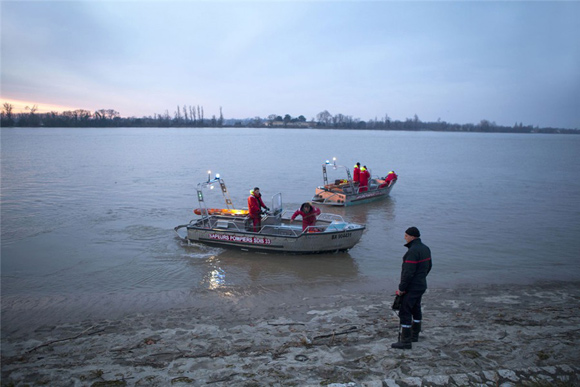
Body found near site of Chinese tycoon's Bordeaux chopper crash


A body was discovered Friday on the banks of the river into which a Chinese tycoon crashed his helicopter as he toured his newly-acquired Bordeaux wine estate in December.

A resident of nearby Saint-Andre de Cubzac found the body, sources in the investigation told AFP on condition of anonymity, but the body was not yet confirmed as Lam Kok's.

"The site of the discovery is located between the site of the crash and the place where the bodies of two other passengers were found," an official said.

"But we have to wait for DNA matches as part of the forensic investigation," the official added.

The 46-year-old tea magnate had invited the press to his lush new property on December 20 to celebrate his $41-million purchase.

He took off on a helicopter tour of the estate -- which he intended to turn into an elite tea- and wine-tasting retreat -- with his 12-year-old son, his financial adviser and the chateau's former owner.

The three other bodies have been found but the tycoon was still missing.

James Gregoire, who died in the crash on the day he handed over the property to Lam Kok, had bought the chateau in 2003 after the previous chateau owner died in a plane crash.

Wealthy Chinese have developed a taste for fine French wines, and their buying power has been credited with pushing prices for certain vintages to record levels.

In recent years they have increasingly taken to buying French vineyards as well.

Saturday 15 February 2014

http://au.news.yahoo.com/world/a/21479049/body-found-near-site-of-chinese-tycoons-bordeaux-chopper-crash/

continue reading

Wednesday, 12 February 2014

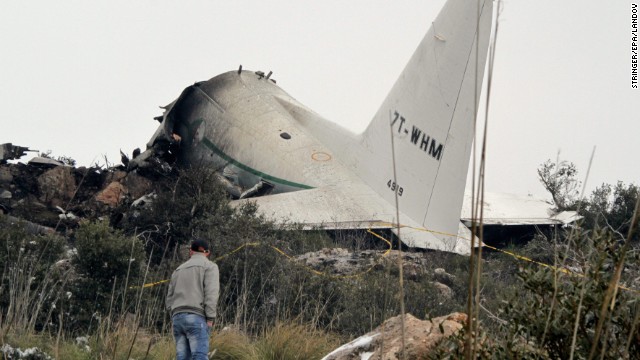
One survivor, 77 bodies found after Algerian plane crash


Rescue workers found 77 bodies at the scene of one of Algeria's worst air disasters Tuesday, after a military transport plane carrying troops and family members crashed in the northeast of the country, Algerian state television said.

Only one survivor had been found, an officer from the military's civil protection unit said.

Ennahar TV channel said the survivor was a woman who was rushed to hospital in critical condition. The search for other survivors at the remote crash site in the mountainous Oum El Bouaghi region was continuing.

The Hercules C-130 troop transporter was reported to be carrying 99 passengers and four crew when it crashed just as it was about to start its descent to Constantine airport, about 48 kilometres away.

State radio and television put the number of victims at over 100, but an army officer later told the official APS agency that the plane was carrying 77 people.

Bad weather was believed to have caused the crash. The region has been experiencing strong winds and snowfall.

The aircraft was traveling from the southern desert town of Tamanrasset, according to El Watan newspaper.

A crisis team headed by an air force general was leading the rescue operation.

The accident is one of the deadliest in Algerian aviation history.

In 2003, an Air Algeria passenger plane crashed on takeoff from Tamanrasset airport and burst into flames, killing 102 people.

Last year, an Algerian military cargo aircraft crashed in southern France, killing two soldiers and four civilians.

Tuesday 12 February 2014

http://www.guelphmercury.com/news-story/4362810-one-survivor-77-bodies-found-after-algerian-plane-crash/

continue reading

Forensic Scientists Support El Salvador's Steps to Investigate El Mozote Massacre


Forensic experts from around the world met in El Salvador last week to support the state's first tentative steps toward investigating what is considered among the most heinous atrocities in Latin American history -- the massacre of El Mozote.

By inviting the Human Rights Center at the UC Berkeley School of Law and forensic teams from Argentina, Guatemala, and Bosnia-Herzegovina to El Salvador, the Supreme Court of Justice gave hopeful signs that it intends to comply with the sentence of the Inter-American Court to investigate the massacre that took place in December 1981.

Like the assassination of Archbishop Oscar Romero in 1980 and six Jesuit priests in 1989, the massacre of El Mozote is both a painful reality and a tragic symbol of the darkest days of the war. Over three days in the eastern department of Morazan, the U.S.-trained Atlacatl Battalion terrorized and killed more than 1,000 villagers, among them some 400 children -- the youngest only three days old.

Since the end of the 12-year war in 1992, El Salvador's Amnesty Law has prevented the prosecution of those who committed human rights abuses during the armed conflict. However the Inter-American Court ruled in October 2012 that the massacre of El Mozote violated international law, specifically the American Convention on the "rights to life, to personal integrity and to personal liberty" and other articles related to rape, torture, and the murder of children. The Court sentenced El Salvador to investigate the facts of the massacre, identify and prosecute those responsible, and return remains of the victims to their next of kin.

El Salvador was asked to take action within two years -- by December 2014 -- but the clock ticked for a full year without progress. Until now.

Finally, under the new leadership of El Salvador's provisional Supreme Court President Florentรญn Melรฉndez Padilla, who took office last fall, the state has begun to comply. Melรฉndez and the Supreme Court's Institute of Legal Medicine invited the Argentine Forensic Anthropology Team, the Guatemalan Forensic Anthropology Foundation, the International Commission on Missing Persons in Bosnia-Herzegovina, and UC Berkeley's Human Rights Center to spend four days in El Salvador offering scientific advice and insights.

The meeting has helped to establish progress on El Mozote in case any political winds (and political personnel) shift with the presidential elections -- the second round of which will be held on March 9.

"We do need great wisdom in these four days so that we can agree to an action plan -- not in months but in weeks," said Dr. Cristiรกn Orrego Benavente, director of the Human Rights Center's Forensic Program, at the outset of the meeting, expressing the need to act quickly.

The forensic scientists who visited El Salvador have decades of experience searching for graves, exhuming bodies, identifying remains, and scientifically documenting crimes -- often with the participation of grieving families. The Argentine Forensic Anthropology Team has worked on El Mozote intermittently over two decades under the sponsorship of Tutela Legal, the former human rights office of the Archdiocese of the Catholic Church of El Salvador.

While El Mozote's massacre has been well reported by journalists (most notably Raymond Bonner in The New York Times, Alma Guillermoprieto in The Washington Post, and Mark Danner in The New Yorker) and intensive investigations and exhumations have been performed by the Argentinians, the state itself has never investigated the crime.

During the meetings at the Supreme Court of Justice in San Salvador, the visiting scientists raised critical questions for their Salvadoran colleagues who will conduct the work, including: How will the families of the victims of El Mozote be involved from the very beginning of the process, as mandated by the Court? Are there more graves to exhume and what will happen if family members don't want to unearth them? What are the best forensic tools to use in this investigation? What are the challenges associated with investigating a massacre that happened 32 years ago?

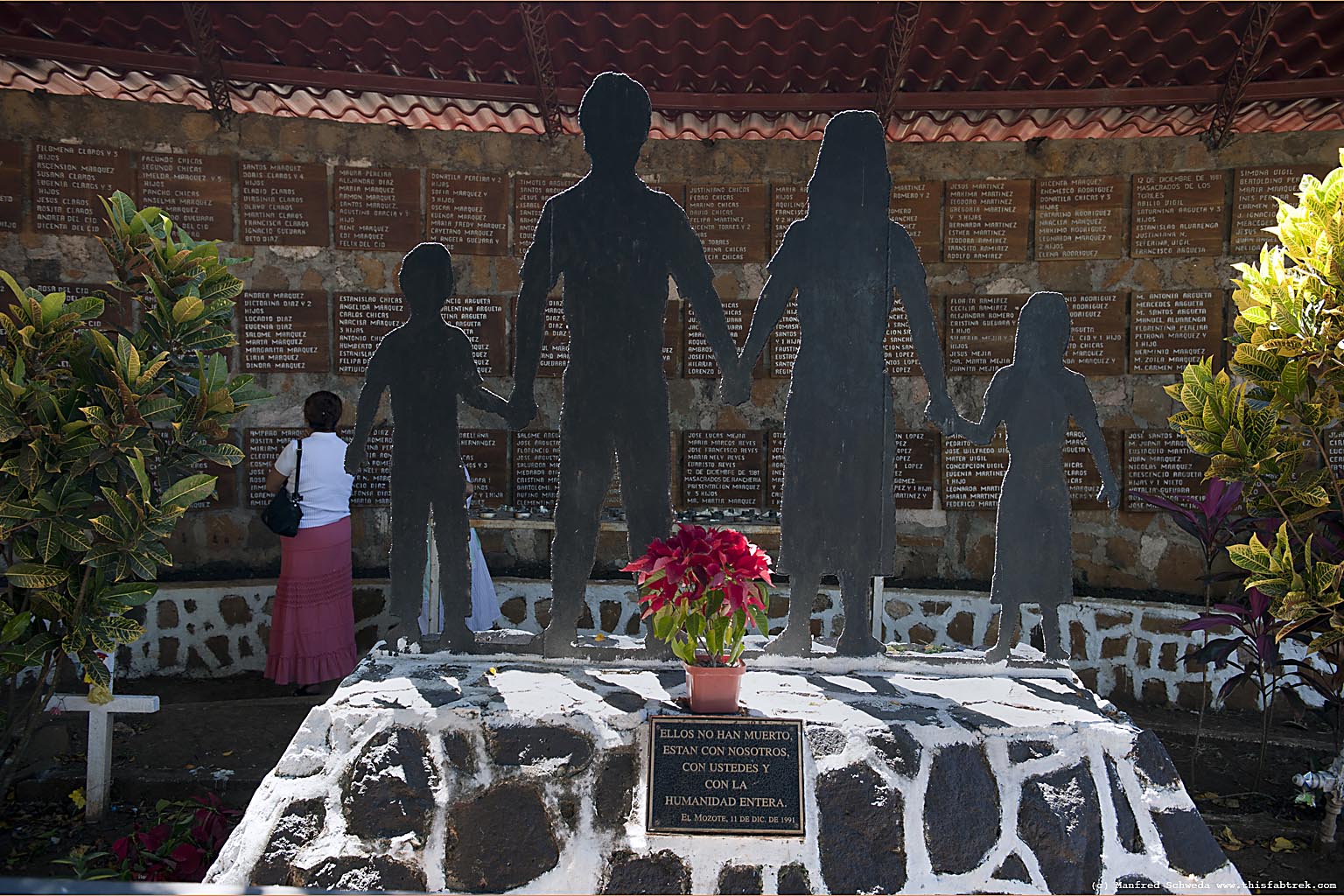
The scientists and Salvadoran colleagues traveled more than three hours east from San Salvador to El Mozote to see the massacre sites and to hear testimonies from victims' family members. They also spoke with the legendary Belgian priest, Father Rogelio Ponselle, who has worked with the community for some 20 years, and visited the monument that honors the victims.

"This is where we found fifteen people -- five from my family and ten from another," said Orlando Mรกrquez, standing on a hill and pointing to a stretch of field flanked by cows where El Mozote's dead were once strewn. It's a story he has told several times in the 32 years since the massacre.

Now, with a new state-sponsored investigation, he and other family members will likely recount their stories again -- this time for the official record.

Despite the ubiquitous history of political violence in the country, Salvadoran forensic investigators simply have not had the means to comprehensively investigate or formally prosecute massacres. Moreover, they are burdened by simultaneously investigating an all-consuming gang war marked by brutality that has produced a steady stream of disfigured and mutilated victims.

All agreed that the scientific expertise of forensic experts who have worked in the trenches throughout Latin America, Africa, and Europe will be critical to the future of El Salvador's investigation of El Mozote.Last weeks' meetings marked an essential step toward revisiting and beginning to repair a wartime atrocity and accurately preserving historical memory -- for surviving families like that of Mรกrquez and for all Salvadorans.

Rapid next steps -- including meetings with families, scientists, prosecutors, and Salvadoran officials -- will hopefully propel El Salvador toward satisfying the Inter-American Court's ruling and seeking a measure of truth and justice for victims and the nation as a whole.

Monday 12 February 2014

http://www.huffingtonpost.com/andrea-lampros/forensic-scientists-suppo_b_4749719.html

continue reading

Hirakud boat tragedy toll rises to 31


With the recovery of three more bodies from the Hirakud reservoir on Tuesday, the death toll in the boat tragedy has gone up to 31.

Of the total 31 victims, 30 persons were picnickers of Lions Club while one has been identified as Amarendra Rout (30), an employee of Hindalco Industries Limited at Hirakud. He was returning from Bandhbahal under Banharpali police limits in Jharsuguda district.

Earlier, the rescue team had recovered 28 bodies - 11 on Sunday and 17 on Monday. The rescue operation was called off after bodies of all missing persons were recovered, Sambalpur Sadar Sub-Collector Surendra Panda said.

Meanwhile, Revenue Divisional Commissioner (North) Pramod Meherda, who is probing the mishap, visited the Sonutikra Ghat here. A case has also been registered at Hirakud police station in connection with the incident. Police have also filed a case against the boat owner Satyanand Pandey of Jagannath Mandir Colony in Sambalpur town and the two boatmen - Akshya Rana and Anjan of Sonutikra area under Sason police limits here. Police said further investigating is on.

The District Governor of Lions Club Padma Charan Nayak along with other senior office bearers also arrived to meet the members of the bereaved families. Thousands of people from across the society gathered at the Rajghat in Sambalpur town where the last rites of the deceased were performed.

Ramesh Agarwal is yet to come to terms with the tragedy. President of the Lions Club, Sambalpur division, Agarwal had never imagined that he would lose many of his fellow members in the boat mishap. He was on board the ill-fated motor-driven country boat. Refuting claims made by the district administration that boat capsized due to overloading, Agarwal said the ferry sunk after water gushed into it from its base. “Overloading was not a factor at all,” he claimed. He said the load was more during their onward journey with around 100 picnickers, besides regular passengers along with 18 motorcycles on board.

“Water suddenly gushed into the boat in the middle of the Hirakud dam reservoir during the return journey and the propeller of the boat stopped working. We tried to evacuate the water with utensils and through a hand pump fitted in the boat. We raised alarm and called our drivers waiting for us on the dyke of the reservoir and friends over mobile phone after we felt that it was difficult to throw water out of the boat,” said a tearful Agarwal.

A rescue boat reached the spot four minutes before the boat capsized. “Every one was in a hurry to board the rescue boat and the boat lost its balance,” he said. Lauding role of boatmen who reached the spot immediately and effort by some fellow members who saved many lives, he said the administration played an important role in the rescue operation. Agarwal said motto of Lions Club is ‘We Serve’ and 101 members of club are always ready to serve people in need.

Wednesday 12 February 2014

http://www.newindianexpress.com/states/odisha/Hirakud-Boat-Tragedy-Toll-Rises-to-31/2014/02/12/article2052324.ece

continue reading

Tuesday, 11 February 2014

Military Plane Crash in Algeria Kills 103


At least 103 people are feared killed as a military cargo plane crashed in north-eastern Algeria.

The breaking news was reported by the local Annahar TV channel, cited by the Bulgarian public radio, BNR.

According to the channel, the plane went down not far from a north-eastern town of Oum El Bouaghi.

No other details are available at the moment.

Tuesday 11 February 2014

http://www.novinite.com/articles/158115/Military+Plane+Crash+in+Algeria+Kills+103

continue reading

Docu-drama on forgotten Leith rail disaster


It was a sunny May morning in 1915 and the troops on board the train were cheery, whistling, comrades in arms.

As the train carrying 500 Edinburgh men bound for the Front approached Gretna few could have anticipated the horror that was about to unfold.

The locomotive smashed into a goods train, bursting into flames.

Then, with people still trapped inside, a Glasgow bound-express train ploughed into the wreckage.

The tragedy that ensued has been likened to the rail industry’s Titanic moment – a disaster which left 215 Royal Scots and 12 civilians dead.

Now, nearly 100 years on, a special docu-drama charting the disaster is to be made – and the programme makers are keen to unravel the events’ roots in Leith, the community from where many of the victims hailed.

Director Robert Rae, of Theatre Workshop Scotland, is based in the former Dalmeny Drill Hall where the ill-fated battalion was based.

He is seeking help to tell the train disaster story, which was not widely reported at the time for fear it would damage home-front morale.

He said: “This is a seminal event in Leith history. “It was the biggest rail disaster in UK history, and yet today many people have never even heard of it.

“Through our research we have found out that the youngest victim of the crash had only just turned 15-years-old. Some families lost all of their children in the disaster.”

Among the officers killed was Lieutenant Christian Salvesen, son of the shipping magnate of the same name.

Robert said: “The bodies were brought back to the Dalmeny Drill Hall and the people of Leith gathered outside and waited to find out what had happened to their loved ones.

“But they weren’t allowed into the building because the injuries were so horrific. It was almost the only time that the war came home in such a direct way. They didn’t even manage to get out of Scotland.”

This isn’t Theatre Workshop Scotland’s first foray into film-making.

Their award-winning feature film The Happy Lands, created with members of the mining communities of Fife, was screened by the BBC, and the team are hoping to repeat that success in Leith. Already, people with a personal connection to the disaster have expressed an interest in taking part.

Robert said: “We have been approached by people who have said their grandfather was involved and that they want to tell their story. You don’t need any experience and we’re keen for people to get involved in everything from acting to the research process.”

Jim Tweedie, from Leith Local History Society, welcomed news of the planned documentary. “I’m all for this tragedy being publicised. It’s an important part of Leith history, but it tends to be forgotten that more than 200 people died.”

“Many people in Leith can trace back to relatives who were involved in this disaster.”

Tuesday 11 February 2014

http://www.edinburghnews.scotsman.com/news/transport/docu-drama-on-forgotten-leith-rail-disaster-1-3300763

continue reading

Expert has hopes for Northern Ireland's Disappeared


The top forensic investigator with the Independent Commission for the Location of Victims Remains said “we would like to think we will have some success in this coming year”.

Geoff Knupfer was speaking in Drogheda last night at the opening of an exhibition on the Disappeared.

There are seven bodies still to be recovered in the Republic. While no dates are in place to resume digs, he acknowledged it is “a tall order,” to ask somebody to identify a site 30 years later.

“These sites were selected with great care for their anonymity, they are barren wastelands and to ask anybody to come along 30 years later is a tall order.”

Amongst those at the opening was Seรกn Megraw whose brother Brendan was abducted and murdered by the IRA in 1978, and Anna McShane, daughter of Charlie Armstrong whose body was recovered in 2010. He disappeared in 1981.

Tuesday 11 February 2014

http://www.irishexaminer.com/ireland/expert-has-hopes-for-disappeared-258339.html

continue reading

Rescue op for Odisha boat victims in Hirakud called off for the day


As the sun went down the western horizon, the district administration suspended rescue operations for the day today although the bodies of three persons who are still missing following the boat mishap deep inside the Hirakud Dam reservoir on Sunday are yet to be fished out.

Operations, however, will continue on the shores with electric lights, sources in the district administration said.

Rescue operations inside the reservoir will resume at day break tomorrow, the sources added.

A total of 28 bodies have been recovered in two days of rescue operations, according to district administration.

While bodies of three more members of the Lions Club picnic team are to be traced, there is no word yet on the whereabouts of the boatman, the assistant boatman and several others who were also on the boat, leading to apprehension that the death toll could go up further.

Tuesday 11 February 2014

http://odishasuntimes.com/31114/rescue-operations-inside-reservoir-called-day/

continue reading

112 Dhaka collapse victims unidentified


A Bangladesh expert said on Monday he has given up hope of identifying 112 victims of the Rana Plaza factory collapse, almost a year after one of the world's worst industrial tragedies.

The garment factory complex on the outskirts of Dhaka collapsed in April last year, trapping thousands of workers who stitched clothes for Western retailers.

Rescue work ended three weeks later with 1,129 bodies recovered from the ruins of the nine-storey complex.

Authorities buried more than 300 victims whose bodies were so badly damaged or decomposed that they were beyond recognition, but collected their DNA samples to help verify any compensation claims.

Sharif Akhteruzzaman, head of the National Forensic DNA Profiling Laboratory, said his experts have now identified 200 of those victims after matching their DNA samples with those of living relatives.

“Of the 322 people, we have now identified 200 people. Of them 157 were identified earlier and 43 this month,” Akhteruzzaman told AFP.

But Akhteruzzaman said the lab could not identify more than 100 victims, despite re-analysing their samples and trying to match them.

“We don't have any hopes for these 112 bodies as they did not match with any of the 549 people who've come to us for their missing relatives.”

Formal identification means families can claim compensation for the tragedy, amid anger that authorities were not doing enough to help those left behind.

Akhteruzzaman has previously raised concerns about the quality of the DNA samples which were collected.

Akhteruzzaman also said the lab was analysing human remains recovered at the site in recent months to try to identify them, although it was unclear how many new victims have been found.

Police said in December they had recovered remains after street children spotted bone fragments while rifling through debris at the site.

The recovery has reinforced accusations by labour groups that the operation to rescue workers and retrieve bodies ended too quickly, and that the death toll could be higher still.

The tragedy highlighted the appalling safety conditions in the world's second largest garment industry after China, and forced Western retailers and the government to promise factory safety inspections.

Bangladeshi and international labour unions have criticised the government, factory owners and Western retailers for not swiftly and adequately compensating victims and their families.

The government has said it has paid money to families of around 800 victims, including about 40 survivors who lost limbs.

But authorities have delayed compensating the rest, citing a lack of identification, a task made more difficult by inadequate payroll records kept by the factory's managers.

Tuesday 11 February 2014

http://www.iol.co.za/news/world/112-dhaka-collapse-victims-unidentified-1.1644780

continue reading

Mexico finds 100s of skeletal remains along U.S. border


Mexican officials have discovered hundreds of skeletal remains scattered on ranches in a stretch of towns along the U.S.-Mexico border as they carried out a wide search to locate missing people.

The remains were burned and extremely hard to identify, said Coahuila state prosecutors' spokesman Jesus Carranza on Monday.

News of the grisly finds came at the same time 12 bodies were unearthed from clandestine graves in the southern Mexico state of Guerrero and about two months after 67 bodies were found in western Mexico. Such discoveries remain common despite government claims that the number of killings has gone down in the past year.

Police in Coahuila haven't said whether an organized crime group is suspected in the skeletal remains, but the area is known to be dominated by the violent Zetas drug cartel. Officers have arrested 10 men, including four police officers suspected of aiding a criminal group, the state attorney general's office said in a press release.

The police operation took place on ranches in 11 different towns around the border city of Piedras Negras, right across Eagle Pass, Texas, after interviews with family members and at least 32 former local officials. Usually, remains like these have been found in mass graves, but these were left on the surface in the region known as Five Springs, Carranza said.

At some of the ranches, investigators found bullet casings as well as barrels of diesel fuel that was likely used to burn bodies.

"We are still not sure how many skeletal remains and how many victims we are talking about," Carranza said. "But this operation was launched to try to locate missing people."

An organization that supports families of missing victims has gathered 321 cases between 2007-13 in just Coahuila. Families were worried Monday that the government contaminated the crime scenes because of images from local media showing the use of heavy machinery at the search sites.

"It makes you want to cry. It's unbelievable how they handle evidence. It just complicates the identification of the remains," said Guadalupe Fernandez, a member of Forces United for our Disappeared in Coahuila and the mother of Jose Antonio Robledo, an engineer who went missing in 2009.

The state prosecutors' office said it followed protocols of preservation in crime scene investigations.

In Guerrero state, the attorney general's office said a dozen bodies were found Sunday in the town of Mexcaltepec by military personnel after they received an anonymous tip Saturday night.

In the same state and only a few days before, members of armed self-defence groups found a clandestine grave in the town of Cajelitos near the state capital of Chilpancingo and reported the skeletons of three men and two women.

Two months ago, authorities excavated for several days in recovering 67 bodies that had been bound or gagged in a remote town by Lake Chapala, a popular spot with tourists and American retirees.

It is a region where the Knights Templar and New Generation drug cartels are fighting each other. Local police officers who confessed to handing over people to the New Generation organization led investigators to the scene, officials said.

Tuesday 11 February 2014

http://www.cbc.ca/news/world/mexico-finds-100s-of-skeletal-remains-along-u-s-border-1.2531629

continue reading