Sunday, 3 November 2013

At least six dead, including three foreigners and 10 injured in Thailand ferry capsize


A tourist ferry has capsized in Thailand, near the beach resort city of Pattaya, Russia’s embassy in the country has confirmed to RT. At least six people have died, including two Russians, local police said.

Others killed include a Chinese citizen and three Thais, Col. Suwan Cheawnavinthavat said, according to AP. Russia’s embassy consulate in Thailand has yet to confirm that Russians are among dead.

"There is no information on the nationality of the dead. It is known that among the injured were two Russians - a woman with a child. They were taken to hospital in the city of Pattaya,” Andrey Dvornikov, head of the consular department of the Russian embassy in Thailand, said.

"Most likely there were many Russians on board,” he added.

A total of 209 people, mostly tourists, have been rescued. Some 15 have sustained severe injuries.

A 12-year-old Russian boy who was among those rescued is in intensive care in hospital. Doctors then established that he was braindead. His mother remains in stable condition. She needs surgery on her face as she suffered a deep cut.

The Russian embassy said at least three Russians had been taken to hospital.

Marines from Thailand’s Sattahip Naval Base have been deployed to search for the ship and missing passengers. The number of missing people has not been officially confirmed, but local media has reported that at least 20 are missing.

Local police have confirmed that 200 Thai and foreign tourists were on a double-decker ferry, AP reports. It was established that the ferry was operating over its capacity, police said.

The National News Bureau of Thailand indicate the 12-meter long vessel was licensed to carry up to 150 people.

As an engine problem occurred soon after the boat departed, tourists rushed to the second floor, causing the ferry to flip on its side and eventually sink, Col. Suwan Cheawnavinthavat said.

‘It was all like a scene from Titanic’

“We were on the next ferry, accidently; we simply were late on that one. It was indeed full of people,” one of the tourists, Olga Blinova told RT. She says she was hurrying her sister, her brother-in-law and her husband to make it on the ferry.

But as they saw that the boat was already crowded, they decided to take the following ferry in 15 minutes.

“We were on the lower deck of the ferry,” Olga says.

Some 15 to 20 minutes later, Olga and her family reached the scene.

“This was really terrifying! Shoes, stuff floating around,” Olga says. “My husband and other people rescued one woman. She was the last one remaining in the water.”

Another tourist, Aleksandr, was on a similar tourist ferry. He recalled that when the Captain saw the tragedy, he steered the boat towards the sunken vessel.

“Here is what I saw: Waves, a three-decker vessel, and a few smaller boats…It all remained me of the scene from Titanic – people in life jackets and without, floating stuff,” he told RT.

The ferry Aleksandr was on rescued at least 15 people, mostly Russians.

“We quickly let down the ladder into the water. People began to swim up and we were catching them and taking them to the lower deck,” he said. “Unfortunately there were casualties. We dragged out two Chinese people, a man and a woman in their 30s or 40s. We started CPR, but unsuccessfully,” Aleksandr continued.

The Association of Tour Operators of Russia (ATOR) told ITAR-TASS news agency that official tours to the island of Koh Larn, where the sunken vessel was returning from, are very rare now. Hence, ATOR suggested that the tourists were traveling on their own. Russian tour operators have not confirmed that their clients were among the passengers, ATOR executive director Maya Lomidze said.

Sunday 03 November 2013

http://rt.com/news/thailand-ferry-sink-russians-158/

continue reading

Scores missing after boat sinks off Myanmar coast


A boat carrying about 70 Rohingya Muslims has capsized off the western coast of Myanmar, with eight survivors found so far, according to an aid worker.

Abdul Melik, who works for the humanitarian organisation Action Against Hunger, said the boat was in the Bay of Bengal and headed for Bangladesh when it went down early on Sunday morning.

Rohingya have been leaving Myanmar in droves since clashes with ethnic Rakhine Buddhists, who make up the majority of the state's population, erupted in June and October 2012. The government said at least 192 people died in the violence and the United Nations says about 140,000 people remain in camps.

The vast majority of those killed and displaced were Rohingya and growing numbers are now making treacherous journeys by boat to countries including Malaysia and Indonesia.

Many have been in Rakhine state for generations, but the government considers them illegal immigrants from Bangladesh and severely limits their movements.

Families of the missing people kept watch on the beach throughout Sunday, said Aung Win, a leader of the Muslim Rohingya community.

"I saw people waiting there to find dead bodies," he told Reuters by phone from the state capital, Sittwe.

A security officer said seven passengers on the boat that sank were rescued and there were unconfirmed reports that eight more may have reached land north of Ohntawgyi, a village about 12 miles north of Sittwe where there is also a camp for displaced Rohingya and where the boat departed from.

Some survivors clung to debris while fisherman rescued others, said the officer who requested anonymity. The boat was carrying 60 people, he said.

Ohntawgyi was the site of clashes in August between Rohingya and police who opened fire on a crowd that had gathered to protest after the battered corpse of a Rohingya fisherman washed ashore.

The security officer said more violence erupted on Saturday in Pauktaw, an area about two hours northeast of Sittwe by boat, killing at least three Rohingya and one Rakhine.

The body of a Rohingya man was discovered in an area near a Buddhist pagoda where a group of Rohingya had gone from their camp to collect firewood, he said. Police confronted an angry crowd at the camp and opened fire, wounding three people, including one who later died in hospital.

A rakhine woman was killed in what appeared to be a retaliatory attack, and the body of another Rohingya man was discovered on Sunday morning, he said.

The United Nations refugee agency has warned of a mass exodus of Rohingya as the rainy season ends in coming weeks.

A spokesman for the agency in Geneva said about 24,000 Rohingya were thought to have left Myanmar by boat this year, and more than 400 had died or gone missing during the journey.

Sunday 03 November 2013

http://uk.reuters.com/article/2013/11/03/uk-myanmar-boat-idUKBRE9A20AI20131103

continue reading

Fiji: 218 cases of missing people


Two hundred and eighteen people under the age of 26 have been reported missing this year.

And police are calling on people to be more vigilant and monitor the movements of their children as the festive season starts.

"Police continue to receive reports of missing persons and this is usually a trend when the festive season starts and when the school holidays is just around the corner," police spokesman Inspector Atunaisa Sokomuri said.

"This year, the Fiji Police Force has received a total of 277 missing persons reports compared to 241 last year."

Police statistics show that this year, six reports involve children less than 10 years and 83 with age range of 11 to 16 years old.

"The Fiji Police Force is concerned at the number of missing persons reports received and we are calling on members of the public to strictly monitor their family member's movements," Inspector Sokomuri said.

School holidays

Police have noticed that a lot of missing person reports were lodged with them during the school holidays.

And they have advised children to inform their parents of their whereabouts to prevent any misunderstandings during the two-week break.

Police spokesperson Ana Naisoro said children, at all times, needed to stay in touch with their parents or guardians on their whereabouts.

"Past trends have shown that this is the usual time where we get a surge in missing persons report in particular children as they have a tendency to leave homes without their parent's knowledge," she said.

"And some, while their families are aware of their plans, they've often failed to keep them updated of any changes thus resulting in the missing person report being lodged."

She added that with the hype of sporting events, church conferences and the Hibiscus Festival in the next few days, students are advised to make wise decisions.

"There are also a lot of activities happening, sporting or otherwise, and children are advised not to stray from these activities and get caught in situations that could affect their studies."

Sunday 03 November 2013

http://www.fijitimes.com/story.aspx?id=250058

http://www.fijitimes.com/story.aspx?id=242979

continue reading

Missing Poster software (free)


Missing Poster is a software tool to assist Search and Rescue, police and other agencies to create and distribute missing person posters in a standardized format.

You can use this software to create a missing poster for someone who is lost or missing.

It was created over a period of three days after I participated in a large search for a missing woman near Vancouver, British Columbia. I saw a SAR member putting together a missing person poster using Microsoft Paint and I thought that there should be a better way.

This tool prompts the user for the pertinent information, gives an easy way to import the photo, and can create the missing person photo in a variety of file formats. If the information changes, it can be edited easily.

Features

It's free to use, modify and redistribute.

Can be installed or run off a portable hard drive or USB stick

Works online or offline.

Reports can be customized to fit your requirements.

Fields are mostly free text to be flexible for data entry

Posters can be saved, loaded, and edited as new information is discovered

Dealing with images is simplified, and printing is easy.

Exports to a number of standard formats for posting to social media, posting online and email

Missing Poster can be downloaded here: http://missingposter.bluetoque.ca/home

continue reading

Funeral in Spain for 129 Franco victims found in mass graves


The families and friends of 129 people killed during Spain's civil war, on Saturday held a "dignified burial" for the victims of General Francisco Franco's forces, whose remains were found in mass graves.

Urns containing the victims' remains were placed inside a tomb in northern Spain's Arando de Duero where a memorial has been erected in their honour.

Jose Maria Rojas, a spokesman for the Association for the Recovery of Historical Memory, told AFP the 129 people had been killed between July and October 1936 by Franco's forces.

"This ceremony is necessary so that the victims ... can have a dignified burial like human beings, in a dignified place where loved ones can come and lay flowers," he added.

The bodies, which were found in four mass graves around Arando de Duero after a lengthy search, were "among 600 people killed in a 25-kilometre radius" around the town, said Maria Rojas.

During the past 13 years about 6,300 bodies have been exhumed from mass graves. Of them, 2,500 have been identified by volunteers and victims' associations with no involvement from the state. Some 114,000 people disappeared during Spain's 1936-39 civil war and Franco's subsequent dictatorship, according the results of a 2008 investigation opened by crusading human rights judge Baltasar Garzon into Franco-era crimes. The burial ceremony comes amid increased international pressure on Spain to investigate disappearances during Franco's dictatorship spanning 1939 to 1975, after the UN in October urged Madrid to overturn the 1977 amnesty. Historians have estimated that about 500,000 people from both sides were killed in Spain's civil war, which was sparked by Franco's insurgency against the democratically elected left-wing Republican government.

While Franco's regime honoured its own dead, it left tens of thousands of its opponents buried in hundreds of unmarked graves across the country, according to victims' rights associations.

Sunday 03 November 2013

http://www.france24.com/en/20131102-funeral-spain-129-franco-victims-found-mass-graves

continue reading

Church stampede in Anambra, Nigeria, 'kills 17'


At least 17 people have been killed and many more injured in a stampede at the end of a religious vigil in eastern Nigeria, officials say.

The crusade, organized by Rev. Fr. Emmanuel Obinma for prayers, healing and spiritual retreat, attracts thousands of people, but the one that was held Saturday, on the Feast of All Saints turned tragic.

As estimated 100,000 worshippers attended the crusade because, apart from coinciding with the Feast of All Saints, it was also the first Saturday of the month.

Local media say that the death toll could be higher.

Anambra governor Peter Obi had been at the event and later returned to visit the injured in hospital.

The stampede took place at about 06:00 (05:00 GMT) on Saturday.

Anambra is about 300km (185 miles) south of Abuja.

"We have visited the hospital in Nkpor and found 17 corpses that were brought in from the scene of the disaster," spokesman Mike Udah told AFP news agency.

Sunday 03 November 2013

http://www.bbc.co.uk/news/world-africa-24792688

continue reading

Train accident triggered by a rumour in Andhra Pradesh's Vizianagaram District, 7 identified


At least nine passengers of the Alleppey-Dhanbad Express were mowed down by another train on a parallel track this evening after they had pulled the emergency chain and got off following what appears a false fire alarm.

The toll, which includes two children and four women, could rise because “severed body parts” were still strewn around in pitch darkness, police said in Vizianagaram district, where the tragedy happened at a spot 693km from Hyderabad.

Eight bodies have so far been found on the tracks —which an eyewitness said resembled a place “hit by a cyclone” — and one of the 10 heavily injured died in hospital, Vizianagaram collector Kantilal Dande said.

“Even the injured are heavily mutilated,” a senior police officer said.

Investigations have shown there was no fire in the Bokaro-bound express, suggesting “a rumour” had sparked the scare and led to the 7.15pm tragedy, an Eastern Railway spokesperson said tonight.

Many passengers had got off the S1 and S2 compartments and, in the dark countryside landscape, failed to realise that the Rayagada-Vijayawada Passenger was hurtling down the parallel line, an East Coast Railway spokesperson said.

Manoj Kumar, a passenger, said he had pushed wife Shweta Singh, 33, and daughters Shourya, 2, and Samhita, 10, out of the train after the fire scare only to watch them come under a running train.

“I couldn’t do anything,” a dazed Manoj, who was returning home from Bangalore to Aurangabad in Bihar, said. A fourth dead passenger has been identified as Karthik Sahu from Odisha.

Had the passengers waited a couple of minutes, their train would have reached Gotlam station, 8km from Vizianagaram town, and they could have pulled the chain and got off on the platform. Neither train stops at Gotlam.

Anntaraman, a hotel owner in Vizianagaram town, said he had reached the spot shortly after the accident and seen bodies and body parts on the tracks and under a train.

“It seemed as if the train and tracks had been hit by a cyclone,” he said. “Some of the bodies had been dragged almost half a kilometre.”

The railways have ordered an inquiry.

A similar horror had taken place just over two months ago at a Bihar station, when an express train had mowed down 28 passengers who had walked into its path after getting off two other trains on either side.

The August 19 accident at Dhamara Ghat happened because the station had three tracks but just one platform, and passengers risked their lives every day crossing the lines.

Vizianagaram police said they would continue their search for bodies “till tomorrow morning” over a stretch up to 2km from the accident spot. A relief train from Visakhapatnam has been sent to Gotlam with medicines and doctors.

Railway sources said the accident spot fell in a 50km stretch from Vizianagaram to Berhampur in Odisha that was known as a “danger zone” because it witnessed railway accidents every other day.

“But this is the first time there has been a heavy death toll,” said Panduranga Rao, a railway employee at Gotlam.

Sources said the Alleppey-Dhanbad Express was known as “Smugglers’ Train” in the region because rice, drug and liquor smugglers stopped it and got in wherever they wanted.

Seven of the Bokaro Express passengers who were run over by another train near Vizianagaram in Andhra Pradesh Saturday night have been identified, police said.

All the bodies were shifted to railway hospital at Visakhapatnam.

One of the two injured is in critical condition.

Sunday 03 November 2013

http://www.telegraphindia.com/1131103/jsp/nation/story_17525948.jsp

continue reading

Saturday, 2 November 2013

Relatives ask for mass burial of Chisumbanje ethanol tanker explosion victims


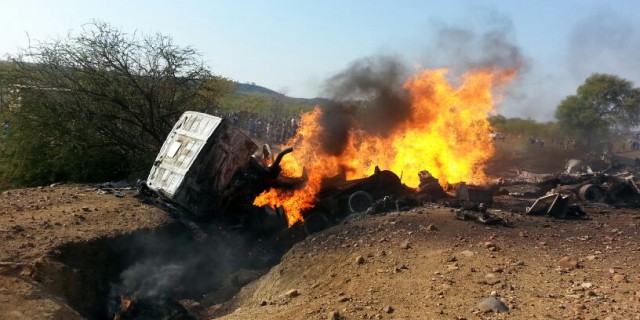
Relatives of 17 out of the 24 Chisumbanje ethanol tanker explosion victims yesterday asked Government for a mass burial after they disagreed on the identities of the bodies.

The 25th body belonged to Clifford Muyambo who died on Monday and was being transported to his village for burial when a T35 truck ferrying mourners collided head-on with the tanker, resulting in the inferno. Muyambo’s body was also burnt in the fire.

Chipinge District Administrator Mr Edgars Seenza said in an interview that the relatives had approached him demanding that the mass burial be carried out immediately. Mr Seenza said there was need for police clearance before the mass burial can be carried out.

“They are actually demanding the mass burial, saying that they are finding it difficult to identify their relatives. They wanted the mass burial today (yesterday) so that they quickly go back to their homes.

“The police will advice us tomorrow (today) on the way forward. What transpired is that some relatives were sent to identify the bodies, but when others followed they started arguing about the positive identities.

“Those who followed later were disputing the first group’s conclusion without having seen the bodies.”

Mr Seenza said the Muyambo family, which lost six of its members, was at the forefront of demanding the mass burial. He said eight of the bodies had been positively identified, leaving the 17 which sparked wrangles.

The accident occurred on Wednesday morning near Checheche Growth Point at the 206km peg along the Tanganda-Chiredzi Highway.

When coffins that were bought by the Government were lined up for collection of the bodies from Chipinge District Hospital, the relatives told the officials that they wanted to consult their families back home to help establish the true identities.

Later in the day, some relatives raised concerns that they were not too sure and wanted a second opinion from other family members.

Mr Seenza said they sent a bus provided by Green Fuel, the owners of the ethanol tanker which exploded with police, Civil Protection Unit officials and relatives to Madhuku area where most of the mourners came from to map the way forward.

That was when the relatives decided that the mass burial was the only option they had. He said Green Fuel provided US$250 which would be given to the next of kin of each deceased person and this came after the Government gave each bereaved family US$200.

Police Forensic Science examiners from Harare went to Chipinge yesterday to prepare for forensic tests in case they are ordered.

Acting Manicaland Police Traffic Co-ordinator Chief Inspector Cyprian Mukahanana said the carrying out of the tests was expected following the disagreements among the relatives.

Samples from the remains were expected to be taken to South Africa in case the tests were ordered.

Saturday 02 November 2013

http://nehandaradio.com/2013/11/02/mass-burial-for-17-crash-dead-mulled/

continue reading

Mahbubnagar bus fire: An agonising wait for families to claim bodies


Family of 50-year-old Venkatesh Yadav and his cousin Anita (42), who were on their way to Hyderabad from Bangalore to distribute invitations for Anita’s daughter’s wedding and died in the ghastly bus accident in Mahbubnagar, despite having identified the bodies with strong evidences were forced to wait for the DNA reports. This, according to family, now might end up in postponing the girl’s wedding.

“We identified the body on Thursday itself and the authorities have also agreed. We were still asked to give blood samples for DNA testing as a formality and were promised to hand over the body once the acknowledgment slip was submitted,” Raghavender Yadav, a close relative, said. However, the family is now asked to wait for another 7-8 days for the results of DNA test.

The family wishes to go ahead with the wedding on November 15 despite the tragedy. Venkatesh, along with his cousin Anita left Bangalore on Tuesday night and a photograph taken minutes before they boarded the bus is held by the family as the proof. “We can clearly see her mangalsutra and bangles in the photo whereas we all knew that Venkatesh was wearing a silver chain around his waist,” Yadav explained.

Authorities though admitted the same, however said that a small girl was found on Anita’s lap and thus the body may not be Anita’s.

DNA

Forensic experts are relying on the femur bones of the charred bodies to analyse DNA profile to establish identity of the victims in the Mahabubnagar bus tragedy.

Normally, soft tissues – if available -- of unidentified bodies are useful for the experts to conduct the DNA profiling. “Soft tissues were not available in case of all the victims. Hence, the forensic doctors relied on femur bones,” said a police officer associated with the investigation.

Sources said that in addition to soft tissues and femur bones, teeth of the victims too were collected for conducting the DNA profiling. Several senior forensic doctors and experts took part in collection of samples of the victims to analyse the DNA.

Extraction and isolation of the DNA is the next crucial step. In case of femur bones, the marrow is extracted after soaking them in prescribed chemicals. The cells are then subjected to PCR test for amplification and multiplication.

The DNA profiles of the cells are then compared with the samples collected from the family members of the victims. Normally, samples of the parents or siblings are collected for comparison. “Surely, it is a laborious process. Complex technical procedures are involved. Once the DNA profiling of the victims is conducted, comparison can be completed within 72 hours,” said a forensic expert. Recalling the case of two police constables charred to death in Khammam district a few years ago, he said the victims’ DNA was analysed within a week. That time, DNA kits were borrowed from other forensic laboratories and agencies to complete the procedures at the earliest.

Saturday 02 November 2013

http://newindianexpress.com/cities/hyderabad/An-agonising-wait-for-families-to-claim-bodies/2013/11/02/article1868768.ece

http://www.thehindu.com/todays-paper/tp-national/tp-andhrapradesh/the-abc-of-dna-profiling/article5307288.ece

continue reading

November 9, 1963: 162 dead in triple train smash near Yokohama


More than 162 persons were killed and 94 injured in a three-train smash-up on November 9, 1963 between Tsurumi Station and Shin-Koyasu Station on the Tลkaidล Main Line in Yokohama, Japan.

Japan National Railway Corporation (JNR) headquarters said the disaster occurred at about 9:50 p.m. when the last three cars of a freight train jumped the tracks in the path of a 12-coach Tokyo-bound Yokosuka Line passenger train.

The engine of the Tokyo-bound train rammed into the derailed freight cars and was thrown into the side of the fourth and fifth coaches of a 12-coach train bound for Kurihama that was passing on the other side. The engine shaved the sides off the two coaches and smashed into the sixth coach.

Four coaches of the two passenger trains were almost completely destroyed and the shock of the impact battered all passengers in both trains.

The Kurihama-bound train coaches, packed almost to capacity with commuters leaving Tokyo, was a bloody shambles. The first rescuers on the scene were unable to immediately tell the living from the dead in the mass of bodies and debris.

About 50 police vehicles and ambulances were called out to rush the injured to the city’s major hospitals.

A grocer who lives near the scene said he first saw “a huge mass of flames scorching the sky.”

Reisuke Ishida, president of the JNR, expressed his profound sorrow and regret over the disaster which he said occurred, “despite JNR’s all-out preventive efforts.”

He refused to take upon himself and his men the responsibility for the accident until the cause has been determined.

Saturday 02 November 2013

http://www.japantimes.co.jp/news/2013/11/02/national/jt-gone-by/#.UnU7UWJDtow

continue reading

50 years ago: Coliseum blast kills 74


Thursday marked the 50th anniversary of the explosion at the Coliseum at the Indiana State Fairgrounds that killed 74 people and injured hundreds of others.

Dawn Tabler was 10 years old when the propane gas explosion rocked the Holiday on Ice Halloween show.

“At first people thought that it was part of the show, because different times during the show they would have a firework or a loud boom,” Tabler said, recalling that night.

Tabler was in the audience for the show.

“What I remember very vividly is just seeing people going up,” she said. “We dropped everything, dropped our programs and stood for just a second. And then our parents and some people there directed us out.”

To exit the Coliseum, Tabler said she remembers stepping over people.

“There was just this feeling of, ‘I'm only 10 and I can't do anything. I can't do anything to help,” she said.

To this day, she wonders about the two boys who were sitting behind her.

“I wonder if everybody's OK, meaning their family, because they had moved to the other side," she said. "That's always haunted me, wondering if they were able to find their parents.”

For the next three years after the blast, Tabler said she had nightmares and day dreams about that night. In the 50 years since the tragedy, she said she’s felt a mix of emotions, from survivor’s guilty to a sense of gratitude. She said she feels blessed that her family’s tickets weren’t somewhere else in the Coliseum.

After the explosion, a Marion County grand jury indicted fire officials, Coliseum managers and gas company personnel, but only one person was ever convicted, and their case was overturned. Settlements totaling $4.6 million were awarded to victims and survivors. The blast prompted improvements to disaster communications and emergency response.

Fifty years later, the Coliseum is undergoing a $63 million dollar renovation. It should be complete sometime next year. The new 20,000 square foot arena will include a plaque to remember the 74 lives lost and roughly 400 people injured 50 years ago.

Saturday 02 November 2013

http://www.wishtv.com/news/indiana/50-years-ago-coliseum-blast-kills-74

continue reading

Kin pay respects at marker for typhoon Pablo victims in Barangay Andap


While most Filipinos trooped to the cemeteries to remember their beloved departed on Friday, All Saints’ Day, some residents of this town who lost their families and relatives to rampaging flashfloods 11 months ago gathered at a marker standing at the center of Barangay Andap.

The marker bears the names of the 436 people who perished and at least 400 others who have remained missing after heavy rains brought by typhoon Pablo spawned flashfloods that almost wiped out the entire village.

While most of those who remembered their loved ones in Andap offered candles and flowers in the marker on Friday, the Cantila family set up an orange tent where they would spend the night, weather permitting, to welcome All Souls’ Day today, November 2.

The family puts up the tent in the middle of rocks and rubbles where they believed their house used to stand.

Lilibeth Cantila-Aquino, who lives in Davao City, told MindaNews that seven family members, including her mother, remained missing until now.

Her father, Inocencio Cantila, 70, was spared from the disaster, saying he was confined in a hospital in Tagum City when Pablo hit the town. The couple has seven children and 20 grandchildren.

They brought with them a folding bed and laminated pictures of their missing family members, which were edited from family their missing family members, which were edited from family pictures taken a month before the disaster.

“If it won’t rain, we’ll sleep here. But if it does, the house of my brother is just nearby,” Aquino said, pointing to the chapel.

The house of the Cantila family used to stand in front of the Andap Elementary School. The family donated a hectare for the school site.

The flashflood washed away the elementary school buildings and left only one of the 15 classrooms standing.

The debris flow from the resort village of Andap stretched some 10 kilometers downstream to Barangay Cogonon, according to the Mines and Geosciences Bureau Region 11.

It buried under rocks and boulders the village center of Andap, houses, farmlands and a portion of the cemetery.

Flowers, candles, food

At the marker, which was inaugurated 40 days after the typhoon hit the town, families and relatives of the victims offered candles, food, flower and even soda.

Some relatives were also seen erasing the names of some persons still alive but mistakenly listed as among those who perished in the flashflood.

Parish priest Fr. Edgar Tuling told MindaNews that only a few attended the mass on All Saints’ Day.

“Others maybe attending the mass on All Souls’ Day,” he added.

At the public cemetery, which was not spared by the flashflood, some residents were seen repairing destroyed tombs.

Some other tombs have been totally swept away by raging floodwater.

At least 324 bodies were buried in the mass grave in the public cemetery. Only two of the dead were identified.

Fr. Tuling said that results of the DNA samplings conducted by forensic experts of the National Bureau of Investigation have yet to be made available.

They have yet to come back to this town to report the result of their DNA samplings, he noted.

The DNA samplings were taken last January.

The mass grave is marked with the initials “PNB.”

Some relatives also offered candles and flowers at the cross near the mass grave.

Saturday 01 November 2013

http://www.mindanews.com/top-stories/2013/11/02/kin-pay-respects-at-marker-for-typhoon-pablo-victims-in-barangay-andap/

continue reading

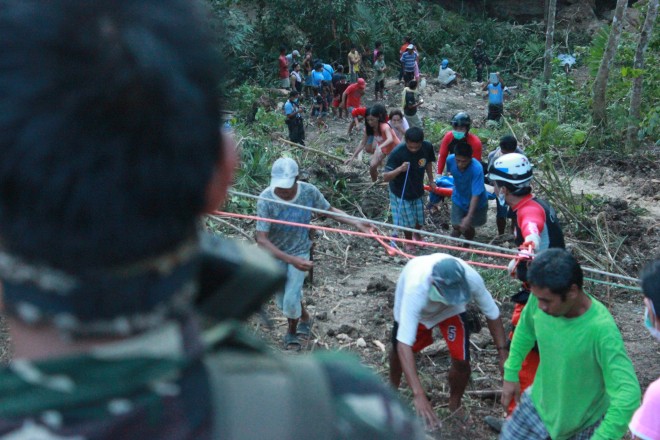
Philippines earthquake: Retrieval ops end for 5 missing kids in Bohol


The search and retrieval operations for the five missing children in quake-ravaged Sagbayan town, Bohol has ended on Friday, authorities said.

The five children, aged 9 to 15, were swimming in the Bayong Falls in Barangay Katipunan when the magnitude 7.2 quake hit Bohol last October 15.

The children were believed to be buried by boulders which fell from the top of the waterfall.

Authorities have already used a backhoe in the hopes of finding the bodies of the children. However, their clothes were the only things recovered.

The National Disaster Risk Reduction and Management Council (NDRRMC) identified the five children as Jess Marvin Empinado, 10; Meme Jane Empinado, 9; Reynaldo Cipcip, 15; Joellene Somoro, 11; and Jonalyn Somoro, 13.

Prima Empinado, mother of Jess Marvin and Meme Jane, and Virginia Cipcip, mother of Reynaldo, said that while they are sad that they would no longer see the bodies of their kids, they have already accepted their death.

The families of the victims on Friday held a mass in the area, which was declared as the burial site for the children.

Meanwhile, the local government has already banned swimming in the waterfall.

Mayor Ricardo Suarez assured that financial assistance will be given to the families of the five children.

Saturday 01 November 2013

http://www.abs-cbnnews.com/nation/regions/11/02/13/retrieval-ops-end-5-missing-kids-bohol

continue reading

Friday, 1 November 2013

Experts: More must be done to trace missing people


Experts say the ranks of missing people are swelling around the world, including Muslim men murdered and dumped into mass graves in Bosnia, victims of Asia's 2004 tsunami, people killed in Mexico's drug wars, and asylum seekers who drown as they flee conflicts in rickety boats.

Academics and others meeting in The Hague to discuss the plight of missing people called on Friday for more to be done to tackle the problem, saying that would contribute to more stable societies around the world.

Professor Jeremy Sarkin, a member of the U.N. Working Group on Enforced or Involuntary Disappearances, told a three-day conference that peace will be threatened in nations emerging from armed conflict "if issues relating to the missing continue to exist."

The conference was organized by the Sarajevo-based International Commission on Missing Persons (ICMP), which was formed in 1996 to help trace and identify thousands of people who went missing during the Balkan wars of the 1990s. It has grown into a repository for expertise on using DNA to identify missing people.

The organization is currently working in the Balkans, Iraq, Libya, Cyprus, Chile and El Salvador as well as helping Interpol identify victims of the recent Westgate Mall terror attack in Kenya.

In the former Yugoslavia, it has built up a database of blood samples from more than 90,000 relatives of 29,500 missing people and 54,000 bone samples exhumed from mass graves. Using DNA analysis, the group has identified some 17,000 people killed in the wars, bringing a measure of closure to their relatives.

ICMP Chairman Thomas Miller said exact numbers of the missing worldwide are almost impossible to gauge, but he said thousands of people disappear each year.

"The world needs a global mechanism that has the strength and backing of the international community to successfully address this painful issue," he said.

Dutch Foreign Minister Frans Timmermans appealed for the ICMP to be given a formal status under international law.

"I call upon national governments to support our efforts to make it easier for this organization to operate around the world," he told delegates.

People disappear daily around the world for a variety of reasons, experts say.

In Mexico, the government's war on drugs has triggered a surge in disappearances, said Consuelo Morales, one of the founders of Citizens for Human Rights Support.

She recalled the case of a 3-year-old boy left screaming in a street after his father was abducted by a street gang because he had witnessed a robbery.

"This child lost his father, security," Morales said. "In 15 years, can you imagine what will be in the heart and mind of this child?"

Efforts to track down and identify such victims will help heal the family's wounds, she said. "Without truth, without justice, there can be no peace," Morales told The Associated Press.

In Syria, thousands of people have disappeared in the country's civil war and opposition groups already are planning how best to identify remains after the conflict.

Radwan Ziadeh, executive director of the Syrian Center for Political and Strategic Studies and a prominent opposition figure, said his group wants to enlist the help of the ICMP in visiting refugee camps in Turkey and Jordan to collect samples from relatives of people who have disappeared during the civil war so their DNA can be used later for identification tests.

"The ICMP has done great work on building a central database, we want to take lessons from them," he said.

Friday 01 November 2013

http://www.ironmountaindailynews.com/page/content.detail/id/401125/Experts--More-must-be-done-to-trace-missing-people.html?isap=1&nav=5024

continue reading

Explosion in China firework factory kills seven, injures dozens


Seven people have been killed and 19 others were injured in a fireworks factory explosion on Friday afternoon in south China's Guangxi Zhuang Autonomous Region, local authorities said.

The explosion occurred at about 4 p.m. in Sanbao County of Cenxi City and a preliminary investigation showed 26 people were injured and sent to hospital, according to the city government.

Seven people died after emergency treatment failed while 19 others remain in hospital for further observation, said the government.

In June, explosion had occurred in a fireworks factory at east China's Jiangxi Province which had taken three lives and injured 45 others.

Friday 01 November 2013

http://en.apa.az/xeber_factory_blast_kills_7__injures_19_202078.html

continue reading

Explosion at Kumbakonam fireworks factory kills nine, injures 12


A blast at a fireworks factory in Olugucherry in Thanjavur district on Friday killed nine people and seriously injured 12, casting a grim shadow over Diwali celebrations.

Police said Shanalakshmi Fire Works, 30km from Kumbakonam, the site of the worst fire tragedy in Tamil Nadu, manufactured high-decibel 'chanalvedi' (bangers) and rockets.

Around 30 people had gone to the factory to buy fireworks around 2.30pm, and 15 workers were making them when the blast took place. Police said there were 10 two-wheelers parked outside the factory, and the fire could have been set off by a lit cigarette butt.

While such explosions have occurred in fireworks units scattered across Tamil Nadu, it is Sivakasi in Virudhunagar district, the country's fireworks hub where the maximum accidents have taken place. The state government woke up to the dangers of blatant violations by units in Sivakasi after a blast killed 40 people on September 5, 2012, in Muthalipatti village. Central and state officials conducted a series of raids bringing the industry here, the biggest in the country, to a standstill.

Licenses of more than 70 units were cancelled and the vigil was tightened on all the units to ensure they did not deviate from the rules.

The Thanjavur factory's license was renewed in September this year. Inspector-general of police (central zone) M Ramasubramani visited the burnt-down factory in the evening and ordered the arrest of the owner, Krishnamurthy. A thorough investigation will be conducted and maximum punishment would be meted out to the accused," Ramasubramani said. But for a marginal drop, the number of accidents has not come down in proportionate with the drastic action. While there were six fatal accidents in 2012, this year five accidents have been reported so far despite the vigil, claiming 14 lives.

In 2011, there were six accidents in which 21 people were killed. While there are 750 licensed cracker manufacturing units spread across Sivakasi, Aruppukottai and Sattur in Virudhunagar district, there is a thriving cottage industry in the villages.

The checks and the attendant fear among manufacturers have contributed to a 20% to 25% decline in production from last year, with operators looking to play safe. Owners of fireworks manufacturing companies however said there was no short supply as the overall market trend was sluggish and the demand has dropped by half from last year.

Police suspect that most of the people killed in Friday's Thanjavur explosion hailed from Thirupananthal and Anaikarai and had gone to buy fireworks directly from the factory. Pandhanallur inspector Palanichamy said only a thorough investigation would reveal how many of the deceased were visitors, and how many were employees in the factory. The 12 people, who were injured, suffered more than 60% burns and are being treated at Kumbakonam and Thanjavur government hospitals, police said. Thanjavur district collector N Subbaiyan visited the injured in Kumbakonam government hospital.

Friday 01 November 2013

http://timesofindia.indiatimes.com/city/madurai/Explosion-at-Kumbakonam-fireworks-factory-kills-nine/articleshow/25078663.cms

continue reading

Mali: Big Step for Justice in ‘Disappearance’ Case


The decision by a judge in Mali to charge and detain three security force members and summon for questioning 17 others for their alleged role in enforced disappearances is an important step for justice in Mali and for the victims’ families. Malian authorities should urgently ensure security for the judge and other judicial personnel investigating the case, and witnesses, and protect the rights of the accused.

The three suspects, a gendarme captain and two soldiers, were taken into custody on October 23 and 30, 2013. They were charged with complicity to commit abduction in the 2012 enforced disappearance of at least 20 soldiers. On October 31, the judge issued mandatory summonses for 17 other soldiers for their role in the same crime, including General Amadou Haya Sanogo, who led a coup in March 2012, when he held the rank of captain.

“The courageous work of Malian authorities investigating this prominent case is a significant and encouraging advance for justice in Mali,” said Corinne Dufka, senior West Africa researcher at Human Rights Watch. “The families of the ‘disappeared’ soldiers have endured terrible suffering and deserve to know the fate of their loved ones.”

In the early morning hours of May 2, 2012, soldiers who had taken part in the March 2012 coup against then-president President Amadou Toumani Tourรฉ forcibly disappeared at least 20 soldiers they had detained for their alleged involvement in an April 30, 2012 counter-coup. Most of the disappeared formed part of an elite unit of paratroopers known as the Red Berets. The then-authorities did not acknowledge detaining the men or provide information on their whereabouts, and they are feared dead. Numerous other soldiers who had been apprehended were subjected to torture and inhuman treatment in detention.

Human Rights Watch interviewed 32 people, including 10 victims and 13 relatives of victims, about the enforced disappearances and torture. Witnesses told Human Rights Watch that members of the security services loyal to Sanogo carried out the torture and other abuses. The 20 “disappeared” soldiers were last seen alive on May 2, inside Kati Military Camp, 15 kilometers north of the Malian capital, Bamako, which was then the headquarters of Sanogo and his loyalists.


The torture documented by Human Rights Watch and other national and international organizations took place over several weeks in May 2012. The victims described being handcuffed and hogtied, beaten with batons, sticks, and gun butts, and kicked in the back, head, ribs, genitals, and elsewhere. Others said they were stabbed in their extremities and burned with cigarettes and lighters on their backs, hands, arms, and ears.

Several witnesses saw the disappeared men at Kati camp, including one who described seeing military personnel transfer the detainees to a military truck. “They bound their hands and legs, ordered them onto a truck, covered their eyes, and took them away,” the witness said. Another witness provided Human Rights Watch a hand-written list of the soldiers seen in the camp and now disappeared. The mother of one disappeared soldier said that her son had gotten access to a cell phone and told her that military personnel were arguing among themselves about whether to kill him.

There are unconfirmed reports that the men were executed and buried near the town of Diago, 12 kilometers from Kati. In 2012, Human Rights Watch spoke with Diago residents who said rounds were fired on the night of May 2, 2012, but they were too terrified to provide further details. Mali’s donors, including the United Nations, should assist the government with forensic expertise should possible graves of the men be located.

Under international law, an enforced disappearance occurs when the government or its agents take a person into custody but refuse to acknowledge doing so or do not provide information about the person’s whereabouts or fate. Among the rights an enforced disappearance may violate are those to life, liberty, and security of the person, including protection from torture and other ill-treatment. Family members whose loss of their loved ones goes without explanation or redress are also victims of enforced disappearance.

The Malian authorities should broaden their investigation into the other alleged military abuses during this period, Human Rights Watch said. For instance, in July 2012, two journalists writing about abuses following the failed counter-coup were abducted. Abrahamane Kรฉรฏta, editor of L’Aurore newspaper, and Saouti Labass Haidara, publisher of L’Independent were taken away by armed, masked gunmen driving pickup trucks with no license plates. The journalists were severely beaten and dumped on the outskirts of Bamako after being warned to stop criticizing the military. Haidara suffered a fractured arm and multiple contusions.

The Malian authorities are also investigating a spate of killings and abductions allegedly carried out between September 30 and October 3, 2013, in and around Bamako by members of the security services who remain loyal to General Sanogo. Sources investigating the case told Human Rights Watch that the bodies of at least four soldiers have been found and at least seven others have been reported missing.

Justice Ministry officials told Human Rights Watch in Bamako on October 30 that the 2013 abuses were under investigation and that they would ensure that justice is done irrespective of the rank of the alleged abusers.

“Respect for rule of law in Mali was grossly undermined by the often outrageous and violent behavior of soldiers loyal to General Sanogo,” Dufka said. “As a matter of urgency, the judge and other judicial personnel working to investigate the abuses must be ensured adequate protection.”

Friday 01 November 2013

http://www.hrw.org/news/2013/11/01/mali-big-step-justice-disappearance-case

continue reading

Six die in Kwazulu-Natal tunnel disaster


An eight-ton platform on wheels broke loose from its bearings four kilometres into a hydro-electric tunnel near Ladysmith and killed six construction workers in a freak accident on Thursday.

Seven more were injured, three o f them critically.

The accident happened at 9.15am in one of four of Eskom’s Ingula Pumped Storage Scheme tunnels which link the Braamhoek Dam to the Bedford Dam in the new power generation project.

The platform, on which 13 men were welding and grouting the tunnel’s sides, was set on a steep incline when it broke loose and rolled.

Eskom spokesman Andrew Etzinger said the dead were employed by a contractor and were not Eskom employees. He said psychologists had been sent to counsel the 3 387 workers who had been on the site when the accident happened. “Eskom decided to shut down the site. The workers are all shocked and traumatised.

“We take safety very seriously and this construction was not rushed. When things like this happen it is a tragedy.” Rescuers worked until late on Thursday to recover the bodies.

The power station is one of the government’s infrastructure projects and one of three new facilities being constructed to boost the country’s energy supply.

Emergency worker Marinus Nabal, who spoke to The Mercury during the rescue, said the operation was “a major task”. Nabal, from IPSS Medical Response, said paramedics raced 4km down the tunnel to the trapped men.

“Four bodies were at the bottom section of the rubble and one underneath all the rubble,” he said. Mlungisi Shongwe, a spokesman for the Ingula project, said there was “a lot of construction” happening underground where the accident happened.

The excavation and tunnelling involved a work force of about 900 working different shifts in a 24-hour cycle. In a separate incident earlier this year, one person died after he was crushed by an excavating machine, Shongwe said.

Provincial labour department spokesman Nhlanhla Khumalo said inspectors were on site and investigations under way on Thursday. The R28-billion Ingula Pumped Storage Scheme consists of the upper and lower dam, each capable of holding about 22 million cubic metres of water. The project started in 2005 and is scheduled to be finished next year.

The dams are 4.6km apart and will be connected by the underground waterways passing through a powerhouse with four generators. To generate electricity during peak demand water will be released from the top dam and pass through the turbines into the bottom dam.

During times of low energy demand, the turbines will be used to pump the water back again. President Jacob Zuma sent his condolences to the families of the dead.

“We mourn with the families of all the workers who have lost their lives in this tragedy, while constructing a better life not just for themselves and their families, but also for the entire country. We share their loss and their pain,” he said. Etzinger said the site would remain closed until investigations had been complete.

Eskom chief executive Brian Dames was expected to visit the site on Thursday night and would hold a press conference on Friday. Premier Senzo Mchunu also expressed his shock at the accident.

“Although the circumstance surrounding the accident, which resulted in their demise, is yet to be established, we commend Eskom for moving swiftly to assure the people of this province and the country that an investigation will be instituted,” Mchunu said. Cosatu said it was “bitter” and “pained” at the deaths. “We extend our sincere condolences to the bereaved families at this dark hour.”

Friday 01 November 2013

http://www.iol.co.za/news/south-africa/kwazulu-natal/six-die-in-tunnel-disaster-1.1600438

continue reading

Mahbubnagar bus fire: Three bodies identified


Bodies of three out of the 45 people charred to death in the Volvo bus accident near Mahbubnagar near Hyderabad early on Wednesday have been identified, Transport Minister Ramalinga Reddy has said.

Mr. Reddy is in Hyderabad along with senior officials of the Transport Department, including Transport Commissioner K. Amarnarayan, and officials from Raichur, to coordinate efforts to identify victims from Karnataka.

He said relatives of 16 victims from Karnataka had come to Osmania hospital to identify and claim the bodies. “But, the bodies can be handed over only after carrying out a DNA test, which needs at least five to six days,” he told The Hindu over phone from Hyderabad.

The three bodies that were identified were of those passengers who were partially burnt, he added.

The body of Venkatesh Babu (50) who was killed in the accident along with his cousin Anita — they had gone to distribute wedding invitations to actor Chiranjeevi — was among those identified on Thursday. A relative said they identified Venkatesh through a gold ring on his finger and a silver band. A DNA test has to be done before they claim the body.

A team from the Andhra Pradesh Forensic Science Lab will do the DNA tests. Relatives of victims have been told to file a missing person complaint with the Kothakota police station and submit a DNA sample for verification.

Friday 01 November 2013

http://www.thehindu.com/news/cities/bangalore/identification-of-victims-will-take-nearly-a-week/article5301982.ece?homepage=true

continue reading

Thursday, 31 October 2013

Laos recovers crashed plane black boxes


Search teams on Thursday recovered the flight data recorders of a Lao Airlines plane that plunged into the Mekong River in bad weather killing all 49 people on board, officials said.

The black boxes, which include both voice and data recordings, were found early Thursday as part of efforts to recover parts of the stricken craft from the river's fast-flowing waters, according to Yakua Lopankao, director general of Laos' Department of Civil Aviation.

"It has not yet been decided where to send them to be examined, it is up to the air accident investigation committee," he said of the operation, which has been assisted by experts from the French aviation safety agency BEA.

The Lao Airlines turboprop ATR-72 plummeted into the Mekong as it went to land in the southern town of Pakse on October 16 in the country's worst air disaster.

More than half of the 49 passengers and crew were foreigners from some 10 countries.

So far 47 bodies have been recovered, some many kilometres downstream from the crash site as rescuers battled strong currents along the swollen river.

So far, at least 43 of the victims have been identified, according to a Lao Airlines statement on Wednesday.

"Our efforts remain focused on caring for the bereaved families of the victims and doing what we can to alleviate the trauma they are suffering and assist them as much as possible at this difficult time," it said.

The carrier has said the aircraft hit "extreme" bad weather, while witnesses described seeing the plane buffeted by strong winds before plummeting into the Mekong.

According to a passenger list released by the airline, there were 16 Laotians, seven French travellers, six Australians, five Thais, three South Koreans, two Vietnamese, and one national each from the United States, Canada, Malaysia, China and Taiwan.

There were also five crew, including the Cambodian captain.

Founded in 1976, Lao Airlines serves domestic airports and destinations in China, Thailand, Cambodia and Vietnam.

Impoverished Laos, a one-party communist state, has seen 29 fatal air accidents since the 1950s, according to the Aviation Safety Network.

Previously the country's worst air disaster was in 1954, when 47 people died in an Air Vietnam crash near Pakse, the organisation said.

Thursday 31 October 2013

http://www.thestar.com.my/News/Regional/2013/10/31/Laos-recovers-crashed-plane-black-boxes.aspx

continue reading