Saturday, 2 November 2013

Relatives ask for mass burial of Chisumbanje ethanol tanker explosion victims


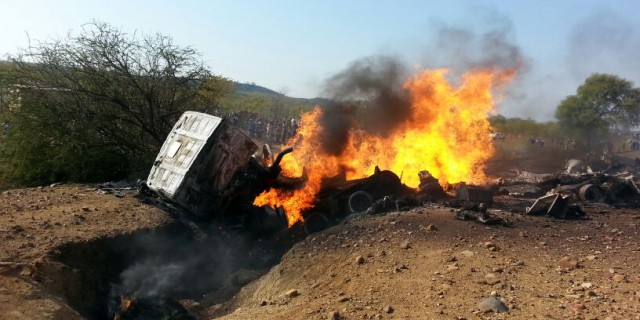
Relatives of 17 out of the 24 Chisumbanje ethanol tanker explosion victims yesterday asked Government for a mass burial after they disagreed on the identities of the bodies.

The 25th body belonged to Clifford Muyambo who died on Monday and was being transported to his village for burial when a T35 truck ferrying mourners collided head-on with the tanker, resulting in the inferno. Muyambo’s body was also burnt in the fire.

Chipinge District Administrator Mr Edgars Seenza said in an interview that the relatives had approached him demanding that the mass burial be carried out immediately. Mr Seenza said there was need for police clearance before the mass burial can be carried out.

“They are actually demanding the mass burial, saying that they are finding it difficult to identify their relatives. They wanted the mass burial today (yesterday) so that they quickly go back to their homes.

“The police will advice us tomorrow (today) on the way forward. What transpired is that some relatives were sent to identify the bodies, but when others followed they started arguing about the positive identities.

“Those who followed later were disputing the first group’s conclusion without having seen the bodies.”

Mr Seenza said the Muyambo family, which lost six of its members, was at the forefront of demanding the mass burial. He said eight of the bodies had been positively identified, leaving the 17 which sparked wrangles.

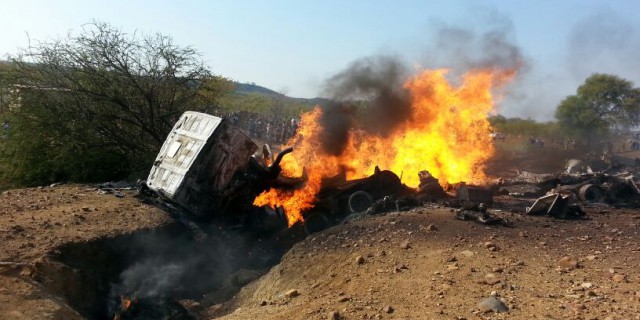
The accident occurred on Wednesday morning near Checheche Growth Point at the 206km peg along the Tanganda-Chiredzi Highway.

When coffins that were bought by the Government were lined up for collection of the bodies from Chipinge District Hospital, the relatives told the officials that they wanted to consult their families back home to help establish the true identities.

Later in the day, some relatives raised concerns that they were not too sure and wanted a second opinion from other family members.

Mr Seenza said they sent a bus provided by Green Fuel, the owners of the ethanol tanker which exploded with police, Civil Protection Unit officials and relatives to Madhuku area where most of the mourners came from to map the way forward.

That was when the relatives decided that the mass burial was the only option they had. He said Green Fuel provided US$250 which would be given to the next of kin of each deceased person and this came after the Government gave each bereaved family US$200.

Police Forensic Science examiners from Harare went to Chipinge yesterday to prepare for forensic tests in case they are ordered.

Acting Manicaland Police Traffic Co-ordinator Chief Inspector Cyprian Mukahanana said the carrying out of the tests was expected following the disagreements among the relatives.

Samples from the remains were expected to be taken to South Africa in case the tests were ordered.

Saturday 02 November 2013

http://nehandaradio.com/2013/11/02/mass-burial-for-17-crash-dead-mulled/

continue reading

Mahbubnagar bus fire: An agonising wait for families to claim bodies


Family of 50-year-old Venkatesh Yadav and his cousin Anita (42), who were on their way to Hyderabad from Bangalore to distribute invitations for Anita’s daughter’s wedding and died in the ghastly bus accident in Mahbubnagar, despite having identified the bodies with strong evidences were forced to wait for the DNA reports. This, according to family, now might end up in postponing the girl’s wedding.

“We identified the body on Thursday itself and the authorities have also agreed. We were still asked to give blood samples for DNA testing as a formality and were promised to hand over the body once the acknowledgment slip was submitted,” Raghavender Yadav, a close relative, said. However, the family is now asked to wait for another 7-8 days for the results of DNA test.

The family wishes to go ahead with the wedding on November 15 despite the tragedy. Venkatesh, along with his cousin Anita left Bangalore on Tuesday night and a photograph taken minutes before they boarded the bus is held by the family as the proof. “We can clearly see her mangalsutra and bangles in the photo whereas we all knew that Venkatesh was wearing a silver chain around his waist,” Yadav explained.

Authorities though admitted the same, however said that a small girl was found on Anita’s lap and thus the body may not be Anita’s.

DNA

Forensic experts are relying on the femur bones of the charred bodies to analyse DNA profile to establish identity of the victims in the Mahabubnagar bus tragedy.

Normally, soft tissues – if available -- of unidentified bodies are useful for the experts to conduct the DNA profiling. “Soft tissues were not available in case of all the victims. Hence, the forensic doctors relied on femur bones,” said a police officer associated with the investigation.

Sources said that in addition to soft tissues and femur bones, teeth of the victims too were collected for conducting the DNA profiling. Several senior forensic doctors and experts took part in collection of samples of the victims to analyse the DNA.

Extraction and isolation of the DNA is the next crucial step. In case of femur bones, the marrow is extracted after soaking them in prescribed chemicals. The cells are then subjected to PCR test for amplification and multiplication.

The DNA profiles of the cells are then compared with the samples collected from the family members of the victims. Normally, samples of the parents or siblings are collected for comparison. “Surely, it is a laborious process. Complex technical procedures are involved. Once the DNA profiling of the victims is conducted, comparison can be completed within 72 hours,” said a forensic expert. Recalling the case of two police constables charred to death in Khammam district a few years ago, he said the victims’ DNA was analysed within a week. That time, DNA kits were borrowed from other forensic laboratories and agencies to complete the procedures at the earliest.

Saturday 02 November 2013

http://newindianexpress.com/cities/hyderabad/An-agonising-wait-for-families-to-claim-bodies/2013/11/02/article1868768.ece

http://www.thehindu.com/todays-paper/tp-national/tp-andhrapradesh/the-abc-of-dna-profiling/article5307288.ece

continue reading

November 9, 1963: 162 dead in triple train smash near Yokohama


More than 162 persons were killed and 94 injured in a three-train smash-up on November 9, 1963 between Tsurumi Station and Shin-Koyasu Station on the Tōkaidō Main Line in Yokohama, Japan.

Japan National Railway Corporation (JNR) headquarters said the disaster occurred at about 9:50 p.m. when the last three cars of a freight train jumped the tracks in the path of a 12-coach Tokyo-bound Yokosuka Line passenger train.

The engine of the Tokyo-bound train rammed into the derailed freight cars and was thrown into the side of the fourth and fifth coaches of a 12-coach train bound for Kurihama that was passing on the other side. The engine shaved the sides off the two coaches and smashed into the sixth coach.

Four coaches of the two passenger trains were almost completely destroyed and the shock of the impact battered all passengers in both trains.

The Kurihama-bound train coaches, packed almost to capacity with commuters leaving Tokyo, was a bloody shambles. The first rescuers on the scene were unable to immediately tell the living from the dead in the mass of bodies and debris.

About 50 police vehicles and ambulances were called out to rush the injured to the city’s major hospitals.

A grocer who lives near the scene said he first saw “a huge mass of flames scorching the sky.”

Reisuke Ishida, president of the JNR, expressed his profound sorrow and regret over the disaster which he said occurred, “despite JNR’s all-out preventive efforts.”

He refused to take upon himself and his men the responsibility for the accident until the cause has been determined.

Saturday 02 November 2013

http://www.japantimes.co.jp/news/2013/11/02/national/jt-gone-by/#.UnU7UWJDtow

continue reading

50 years ago: Coliseum blast kills 74


Thursday marked the 50th anniversary of the explosion at the Coliseum at the Indiana State Fairgrounds that killed 74 people and injured hundreds of others.

Dawn Tabler was 10 years old when the propane gas explosion rocked the Holiday on Ice Halloween show.

“At first people thought that it was part of the show, because different times during the show they would have a firework or a loud boom,” Tabler said, recalling that night.

Tabler was in the audience for the show.

“What I remember very vividly is just seeing people going up,” she said. “We dropped everything, dropped our programs and stood for just a second. And then our parents and some people there directed us out.”

To exit the Coliseum, Tabler said she remembers stepping over people.

“There was just this feeling of, ‘I'm only 10 and I can't do anything. I can't do anything to help,” she said.

To this day, she wonders about the two boys who were sitting behind her.

“I wonder if everybody's OK, meaning their family, because they had moved to the other side," she said. "That's always haunted me, wondering if they were able to find their parents.”

For the next three years after the blast, Tabler said she had nightmares and day dreams about that night. In the 50 years since the tragedy, she said she’s felt a mix of emotions, from survivor’s guilty to a sense of gratitude. She said she feels blessed that her family’s tickets weren’t somewhere else in the Coliseum.

After the explosion, a Marion County grand jury indicted fire officials, Coliseum managers and gas company personnel, but only one person was ever convicted, and their case was overturned. Settlements totaling $4.6 million were awarded to victims and survivors. The blast prompted improvements to disaster communications and emergency response.

Fifty years later, the Coliseum is undergoing a $63 million dollar renovation. It should be complete sometime next year. The new 20,000 square foot arena will include a plaque to remember the 74 lives lost and roughly 400 people injured 50 years ago.

Saturday 02 November 2013

http://www.wishtv.com/news/indiana/50-years-ago-coliseum-blast-kills-74

continue reading

Kin pay respects at marker for typhoon Pablo victims in Barangay Andap


While most Filipinos trooped to the cemeteries to remember their beloved departed on Friday, All Saints’ Day, some residents of this town who lost their families and relatives to rampaging flashfloods 11 months ago gathered at a marker standing at the center of Barangay Andap.

The marker bears the names of the 436 people who perished and at least 400 others who have remained missing after heavy rains brought by typhoon Pablo spawned flashfloods that almost wiped out the entire village.

While most of those who remembered their loved ones in Andap offered candles and flowers in the marker on Friday, the Cantila family set up an orange tent where they would spend the night, weather permitting, to welcome All Souls’ Day today, November 2.

The family puts up the tent in the middle of rocks and rubbles where they believed their house used to stand.

Lilibeth Cantila-Aquino, who lives in Davao City, told MindaNews that seven family members, including her mother, remained missing until now.

Her father, Inocencio Cantila, 70, was spared from the disaster, saying he was confined in a hospital in Tagum City when Pablo hit the town. The couple has seven children and 20 grandchildren.

They brought with them a folding bed and laminated pictures of their missing family members, which were edited from family their missing family members, which were edited from family pictures taken a month before the disaster.

“If it won’t rain, we’ll sleep here. But if it does, the house of my brother is just nearby,” Aquino said, pointing to the chapel.

The house of the Cantila family used to stand in front of the Andap Elementary School. The family donated a hectare for the school site.

The flashflood washed away the elementary school buildings and left only one of the 15 classrooms standing.

The debris flow from the resort village of Andap stretched some 10 kilometers downstream to Barangay Cogonon, according to the Mines and Geosciences Bureau Region 11.

It buried under rocks and boulders the village center of Andap, houses, farmlands and a portion of the cemetery.

Flowers, candles, food

At the marker, which was inaugurated 40 days after the typhoon hit the town, families and relatives of the victims offered candles, food, flower and even soda.

Some relatives were also seen erasing the names of some persons still alive but mistakenly listed as among those who perished in the flashflood.

Parish priest Fr. Edgar Tuling told MindaNews that only a few attended the mass on All Saints’ Day.

“Others maybe attending the mass on All Souls’ Day,” he added.

At the public cemetery, which was not spared by the flashflood, some residents were seen repairing destroyed tombs.

Some other tombs have been totally swept away by raging floodwater.

At least 324 bodies were buried in the mass grave in the public cemetery. Only two of the dead were identified.

Fr. Tuling said that results of the DNA samplings conducted by forensic experts of the National Bureau of Investigation have yet to be made available.

They have yet to come back to this town to report the result of their DNA samplings, he noted.

The DNA samplings were taken last January.

The mass grave is marked with the initials “PNB.”

Some relatives also offered candles and flowers at the cross near the mass grave.

Saturday 01 November 2013

http://www.mindanews.com/top-stories/2013/11/02/kin-pay-respects-at-marker-for-typhoon-pablo-victims-in-barangay-andap/

continue reading

Philippines earthquake: Retrieval ops end for 5 missing kids in Bohol


The search and retrieval operations for the five missing children in quake-ravaged Sagbayan town, Bohol has ended on Friday, authorities said.

The five children, aged 9 to 15, were swimming in the Bayong Falls in Barangay Katipunan when the magnitude 7.2 quake hit Bohol last October 15.

The children were believed to be buried by boulders which fell from the top of the waterfall.

Authorities have already used a backhoe in the hopes of finding the bodies of the children. However, their clothes were the only things recovered.

The National Disaster Risk Reduction and Management Council (NDRRMC) identified the five children as Jess Marvin Empinado, 10; Meme Jane Empinado, 9; Reynaldo Cipcip, 15; Joellene Somoro, 11; and Jonalyn Somoro, 13.

Prima Empinado, mother of Jess Marvin and Meme Jane, and Virginia Cipcip, mother of Reynaldo, said that while they are sad that they would no longer see the bodies of their kids, they have already accepted their death.

The families of the victims on Friday held a mass in the area, which was declared as the burial site for the children.

Meanwhile, the local government has already banned swimming in the waterfall.

Mayor Ricardo Suarez assured that financial assistance will be given to the families of the five children.

Saturday 01 November 2013

http://www.abs-cbnnews.com/nation/regions/11/02/13/retrieval-ops-end-5-missing-kids-bohol

continue reading

Friday, 1 November 2013

Experts: More must be done to trace missing people


Experts say the ranks of missing people are swelling around the world, including Muslim men murdered and dumped into mass graves in Bosnia, victims of Asia's 2004 tsunami, people killed in Mexico's drug wars, and asylum seekers who drown as they flee conflicts in rickety boats.

Academics and others meeting in The Hague to discuss the plight of missing people called on Friday for more to be done to tackle the problem, saying that would contribute to more stable societies around the world.

Professor Jeremy Sarkin, a member of the U.N. Working Group on Enforced or Involuntary Disappearances, told a three-day conference that peace will be threatened in nations emerging from armed conflict "if issues relating to the missing continue to exist."

The conference was organized by the Sarajevo-based International Commission on Missing Persons (ICMP), which was formed in 1996 to help trace and identify thousands of people who went missing during the Balkan wars of the 1990s. It has grown into a repository for expertise on using DNA to identify missing people.

The organization is currently working in the Balkans, Iraq, Libya, Cyprus, Chile and El Salvador as well as helping Interpol identify victims of the recent Westgate Mall terror attack in Kenya.

In the former Yugoslavia, it has built up a database of blood samples from more than 90,000 relatives of 29,500 missing people and 54,000 bone samples exhumed from mass graves. Using DNA analysis, the group has identified some 17,000 people killed in the wars, bringing a measure of closure to their relatives.

ICMP Chairman Thomas Miller said exact numbers of the missing worldwide are almost impossible to gauge, but he said thousands of people disappear each year.

"The world needs a global mechanism that has the strength and backing of the international community to successfully address this painful issue," he said.

Dutch Foreign Minister Frans Timmermans appealed for the ICMP to be given a formal status under international law.

"I call upon national governments to support our efforts to make it easier for this organization to operate around the world," he told delegates.

People disappear daily around the world for a variety of reasons, experts say.

In Mexico, the government's war on drugs has triggered a surge in disappearances, said Consuelo Morales, one of the founders of Citizens for Human Rights Support.

She recalled the case of a 3-year-old boy left screaming in a street after his father was abducted by a street gang because he had witnessed a robbery.

"This child lost his father, security," Morales said. "In 15 years, can you imagine what will be in the heart and mind of this child?"

Efforts to track down and identify such victims will help heal the family's wounds, she said. "Without truth, without justice, there can be no peace," Morales told The Associated Press.

In Syria, thousands of people have disappeared in the country's civil war and opposition groups already are planning how best to identify remains after the conflict.

Radwan Ziadeh, executive director of the Syrian Center for Political and Strategic Studies and a prominent opposition figure, said his group wants to enlist the help of the ICMP in visiting refugee camps in Turkey and Jordan to collect samples from relatives of people who have disappeared during the civil war so their DNA can be used later for identification tests.

"The ICMP has done great work on building a central database, we want to take lessons from them," he said.

Friday 01 November 2013

http://www.ironmountaindailynews.com/page/content.detail/id/401125/Experts--More-must-be-done-to-trace-missing-people.html?isap=1&nav=5024

continue reading

Explosion in China firework factory kills seven, injures dozens


Seven people have been killed and 19 others were injured in a fireworks factory explosion on Friday afternoon in south China's Guangxi Zhuang Autonomous Region, local authorities said.

The explosion occurred at about 4 p.m. in Sanbao County of Cenxi City and a preliminary investigation showed 26 people were injured and sent to hospital, according to the city government.

Seven people died after emergency treatment failed while 19 others remain in hospital for further observation, said the government.

In June, explosion had occurred in a fireworks factory at east China's Jiangxi Province which had taken three lives and injured 45 others.

Friday 01 November 2013

http://en.apa.az/xeber_factory_blast_kills_7__injures_19_202078.html

continue reading

Explosion at Kumbakonam fireworks factory kills nine, injures 12


A blast at a fireworks factory in Olugucherry in Thanjavur district on Friday killed nine people and seriously injured 12, casting a grim shadow over Diwali celebrations.

Police said Shanalakshmi Fire Works, 30km from Kumbakonam, the site of the worst fire tragedy in Tamil Nadu, manufactured high-decibel 'chanalvedi' (bangers) and rockets.

Around 30 people had gone to the factory to buy fireworks around 2.30pm, and 15 workers were making them when the blast took place. Police said there were 10 two-wheelers parked outside the factory, and the fire could have been set off by a lit cigarette butt.

While such explosions have occurred in fireworks units scattered across Tamil Nadu, it is Sivakasi in Virudhunagar district, the country's fireworks hub where the maximum accidents have taken place. The state government woke up to the dangers of blatant violations by units in Sivakasi after a blast killed 40 people on September 5, 2012, in Muthalipatti village. Central and state officials conducted a series of raids bringing the industry here, the biggest in the country, to a standstill.

Licenses of more than 70 units were cancelled and the vigil was tightened on all the units to ensure they did not deviate from the rules.

The Thanjavur factory's license was renewed in September this year. Inspector-general of police (central zone) M Ramasubramani visited the burnt-down factory in the evening and ordered the arrest of the owner, Krishnamurthy. A thorough investigation will be conducted and maximum punishment would be meted out to the accused," Ramasubramani said. But for a marginal drop, the number of accidents has not come down in proportionate with the drastic action. While there were six fatal accidents in 2012, this year five accidents have been reported so far despite the vigil, claiming 14 lives.

In 2011, there were six accidents in which 21 people were killed. While there are 750 licensed cracker manufacturing units spread across Sivakasi, Aruppukottai and Sattur in Virudhunagar district, there is a thriving cottage industry in the villages.

The checks and the attendant fear among manufacturers have contributed to a 20% to 25% decline in production from last year, with operators looking to play safe. Owners of fireworks manufacturing companies however said there was no short supply as the overall market trend was sluggish and the demand has dropped by half from last year.

Police suspect that most of the people killed in Friday's Thanjavur explosion hailed from Thirupananthal and Anaikarai and had gone to buy fireworks directly from the factory. Pandhanallur inspector Palanichamy said only a thorough investigation would reveal how many of the deceased were visitors, and how many were employees in the factory. The 12 people, who were injured, suffered more than 60% burns and are being treated at Kumbakonam and Thanjavur government hospitals, police said. Thanjavur district collector N Subbaiyan visited the injured in Kumbakonam government hospital.

Friday 01 November 2013

http://timesofindia.indiatimes.com/city/madurai/Explosion-at-Kumbakonam-fireworks-factory-kills-nine/articleshow/25078663.cms

continue reading

Mali: Big Step for Justice in ‘Disappearance’ Case


The decision by a judge in Mali to charge and detain three security force members and summon for questioning 17 others for their alleged role in enforced disappearances is an important step for justice in Mali and for the victims’ families. Malian authorities should urgently ensure security for the judge and other judicial personnel investigating the case, and witnesses, and protect the rights of the accused.

The three suspects, a gendarme captain and two soldiers, were taken into custody on October 23 and 30, 2013. They were charged with complicity to commit abduction in the 2012 enforced disappearance of at least 20 soldiers. On October 31, the judge issued mandatory summonses for 17 other soldiers for their role in the same crime, including General Amadou Haya Sanogo, who led a coup in March 2012, when he held the rank of captain.

“The courageous work of Malian authorities investigating this prominent case is a significant and encouraging advance for justice in Mali,” said Corinne Dufka, senior West Africa researcher at Human Rights Watch. “The families of the ‘disappeared’ soldiers have endured terrible suffering and deserve to know the fate of their loved ones.”

In the early morning hours of May 2, 2012, soldiers who had taken part in the March 2012 coup against then-president President Amadou Toumani Touré forcibly disappeared at least 20 soldiers they had detained for their alleged involvement in an April 30, 2012 counter-coup. Most of the disappeared formed part of an elite unit of paratroopers known as the Red Berets. The then-authorities did not acknowledge detaining the men or provide information on their whereabouts, and they are feared dead. Numerous other soldiers who had been apprehended were subjected to torture and inhuman treatment in detention.

Human Rights Watch interviewed 32 people, including 10 victims and 13 relatives of victims, about the enforced disappearances and torture. Witnesses told Human Rights Watch that members of the security services loyal to Sanogo carried out the torture and other abuses. The 20 “disappeared” soldiers were last seen alive on May 2, inside Kati Military Camp, 15 kilometers north of the Malian capital, Bamako, which was then the headquarters of Sanogo and his loyalists.


The torture documented by Human Rights Watch and other national and international organizations took place over several weeks in May 2012. The victims described being handcuffed and hogtied, beaten with batons, sticks, and gun butts, and kicked in the back, head, ribs, genitals, and elsewhere. Others said they were stabbed in their extremities and burned with cigarettes and lighters on their backs, hands, arms, and ears.

Several witnesses saw the disappeared men at Kati camp, including one who described seeing military personnel transfer the detainees to a military truck. “They bound their hands and legs, ordered them onto a truck, covered their eyes, and took them away,” the witness said. Another witness provided Human Rights Watch a hand-written list of the soldiers seen in the camp and now disappeared. The mother of one disappeared soldier said that her son had gotten access to a cell phone and told her that military personnel were arguing among themselves about whether to kill him.

There are unconfirmed reports that the men were executed and buried near the town of Diago, 12 kilometers from Kati. In 2012, Human Rights Watch spoke with Diago residents who said rounds were fired on the night of May 2, 2012, but they were too terrified to provide further details. Mali’s donors, including the United Nations, should assist the government with forensic expertise should possible graves of the men be located.

Under international law, an enforced disappearance occurs when the government or its agents take a person into custody but refuse to acknowledge doing so or do not provide information about the person’s whereabouts or fate. Among the rights an enforced disappearance may violate are those to life, liberty, and security of the person, including protection from torture and other ill-treatment. Family members whose loss of their loved ones goes without explanation or redress are also victims of enforced disappearance.

The Malian authorities should broaden their investigation into the other alleged military abuses during this period, Human Rights Watch said. For instance, in July 2012, two journalists writing about abuses following the failed counter-coup were abducted. Abrahamane Kéïta, editor of L’Aurore newspaper, and Saouti Labass Haidara, publisher of L’Independent were taken away by armed, masked gunmen driving pickup trucks with no license plates. The journalists were severely beaten and dumped on the outskirts of Bamako after being warned to stop criticizing the military. Haidara suffered a fractured arm and multiple contusions.

The Malian authorities are also investigating a spate of killings and abductions allegedly carried out between September 30 and October 3, 2013, in and around Bamako by members of the security services who remain loyal to General Sanogo. Sources investigating the case told Human Rights Watch that the bodies of at least four soldiers have been found and at least seven others have been reported missing.

Justice Ministry officials told Human Rights Watch in Bamako on October 30 that the 2013 abuses were under investigation and that they would ensure that justice is done irrespective of the rank of the alleged abusers.

“Respect for rule of law in Mali was grossly undermined by the often outrageous and violent behavior of soldiers loyal to General Sanogo,” Dufka said. “As a matter of urgency, the judge and other judicial personnel working to investigate the abuses must be ensured adequate protection.”

Friday 01 November 2013

http://www.hrw.org/news/2013/11/01/mali-big-step-justice-disappearance-case

continue reading

Six die in Kwazulu-Natal tunnel disaster


An eight-ton platform on wheels broke loose from its bearings four kilometres into a hydro-electric tunnel near Ladysmith and killed six construction workers in a freak accident on Thursday.

Seven more were injured, three o f them critically.

The accident happened at 9.15am in one of four of Eskom’s Ingula Pumped Storage Scheme tunnels which link the Braamhoek Dam to the Bedford Dam in the new power generation project.

The platform, on which 13 men were welding and grouting the tunnel’s sides, was set on a steep incline when it broke loose and rolled.

Eskom spokesman Andrew Etzinger said the dead were employed by a contractor and were not Eskom employees. He said psychologists had been sent to counsel the 3 387 workers who had been on the site when the accident happened. “Eskom decided to shut down the site. The workers are all shocked and traumatised.

“We take safety very seriously and this construction was not rushed. When things like this happen it is a tragedy.” Rescuers worked until late on Thursday to recover the bodies.

The power station is one of the government’s infrastructure projects and one of three new facilities being constructed to boost the country’s energy supply.

Emergency worker Marinus Nabal, who spoke to The Mercury during the rescue, said the operation was “a major task”. Nabal, from IPSS Medical Response, said paramedics raced 4km down the tunnel to the trapped men.

“Four bodies were at the bottom section of the rubble and one underneath all the rubble,” he said. Mlungisi Shongwe, a spokesman for the Ingula project, said there was “a lot of construction” happening underground where the accident happened.

The excavation and tunnelling involved a work force of about 900 working different shifts in a 24-hour cycle. In a separate incident earlier this year, one person died after he was crushed by an excavating machine, Shongwe said.

Provincial labour department spokesman Nhlanhla Khumalo said inspectors were on site and investigations under way on Thursday. The R28-billion Ingula Pumped Storage Scheme consists of the upper and lower dam, each capable of holding about 22 million cubic metres of water. The project started in 2005 and is scheduled to be finished next year.

The dams are 4.6km apart and will be connected by the underground waterways passing through a powerhouse with four generators. To generate electricity during peak demand water will be released from the top dam and pass through the turbines into the bottom dam.

During times of low energy demand, the turbines will be used to pump the water back again. President Jacob Zuma sent his condolences to the families of the dead.

“We mourn with the families of all the workers who have lost their lives in this tragedy, while constructing a better life not just for themselves and their families, but also for the entire country. We share their loss and their pain,” he said. Etzinger said the site would remain closed until investigations had been complete.

Eskom chief executive Brian Dames was expected to visit the site on Thursday night and would hold a press conference on Friday. Premier Senzo Mchunu also expressed his shock at the accident.

“Although the circumstance surrounding the accident, which resulted in their demise, is yet to be established, we commend Eskom for moving swiftly to assure the people of this province and the country that an investigation will be instituted,” Mchunu said. Cosatu said it was “bitter” and “pained” at the deaths. “We extend our sincere condolences to the bereaved families at this dark hour.”

Friday 01 November 2013

http://www.iol.co.za/news/south-africa/kwazulu-natal/six-die-in-tunnel-disaster-1.1600438

continue reading

Mahbubnagar bus fire: Three bodies identified


Bodies of three out of the 45 people charred to death in the Volvo bus accident near Mahbubnagar near Hyderabad early on Wednesday have been identified, Transport Minister Ramalinga Reddy has said.

Mr. Reddy is in Hyderabad along with senior officials of the Transport Department, including Transport Commissioner K. Amarnarayan, and officials from Raichur, to coordinate efforts to identify victims from Karnataka.

He said relatives of 16 victims from Karnataka had come to Osmania hospital to identify and claim the bodies. “But, the bodies can be handed over only after carrying out a DNA test, which needs at least five to six days,” he told The Hindu over phone from Hyderabad.

The three bodies that were identified were of those passengers who were partially burnt, he added.

The body of Venkatesh Babu (50) who was killed in the accident along with his cousin Anita — they had gone to distribute wedding invitations to actor Chiranjeevi — was among those identified on Thursday. A relative said they identified Venkatesh through a gold ring on his finger and a silver band. A DNA test has to be done before they claim the body.

A team from the Andhra Pradesh Forensic Science Lab will do the DNA tests. Relatives of victims have been told to file a missing person complaint with the Kothakota police station and submit a DNA sample for verification.

Friday 01 November 2013

http://www.thehindu.com/news/cities/bangalore/identification-of-victims-will-take-nearly-a-week/article5301982.ece?homepage=true

continue reading

Thursday, 31 October 2013

Laos recovers crashed plane black boxes


Search teams on Thursday recovered the flight data recorders of a Lao Airlines plane that plunged into the Mekong River in bad weather killing all 49 people on board, officials said.

The black boxes, which include both voice and data recordings, were found early Thursday as part of efforts to recover parts of the stricken craft from the river's fast-flowing waters, according to Yakua Lopankao, director general of Laos' Department of Civil Aviation.

"It has not yet been decided where to send them to be examined, it is up to the air accident investigation committee," he said of the operation, which has been assisted by experts from the French aviation safety agency BEA.

The Lao Airlines turboprop ATR-72 plummeted into the Mekong as it went to land in the southern town of Pakse on October 16 in the country's worst air disaster.

More than half of the 49 passengers and crew were foreigners from some 10 countries.

So far 47 bodies have been recovered, some many kilometres downstream from the crash site as rescuers battled strong currents along the swollen river.

So far, at least 43 of the victims have been identified, according to a Lao Airlines statement on Wednesday.

"Our efforts remain focused on caring for the bereaved families of the victims and doing what we can to alleviate the trauma they are suffering and assist them as much as possible at this difficult time," it said.

The carrier has said the aircraft hit "extreme" bad weather, while witnesses described seeing the plane buffeted by strong winds before plummeting into the Mekong.

According to a passenger list released by the airline, there were 16 Laotians, seven French travellers, six Australians, five Thais, three South Koreans, two Vietnamese, and one national each from the United States, Canada, Malaysia, China and Taiwan.

There were also five crew, including the Cambodian captain.

Founded in 1976, Lao Airlines serves domestic airports and destinations in China, Thailand, Cambodia and Vietnam.

Impoverished Laos, a one-party communist state, has seen 29 fatal air accidents since the 1950s, according to the Aviation Safety Network.

Previously the country's worst air disaster was in 1954, when 47 people died in an Air Vietnam crash near Pakse, the organisation said.

Thursday 31 October 2013

http://www.thestar.com.my/News/Regional/2013/10/31/Laos-recovers-crashed-plane-black-boxes.aspx

continue reading

Bodies of 92 migrants who died of thirst found in Niger desert (update)


The bodies of 92 migrants, most of them women and children, have been found in northern Niger after their vehicles broke down attempting to cross the vast Sahara desert, authorities said today.

The migrants had set off in two trucks from the uranium mining town of Arlit in northern Niger towards Tamanrasset in Algeria in mid-October, officials said.

After one of the trucks broke down, the second turned back to find help but found itself stranded and the passengers attempted to make it back by foot.

The mayor of Arlit, Maouli Abdouramane, said 92 bodies had been recovered after days of searching - 52 children, 33 women and seven men.

“The search is still going on,” Mr Abdouramane told Reuters by telephone. He said the victims were all from Niger but their final destination was unclear.

A military officer said about 20 people survived the ordeal. Five of those walked for dozens of kilometres across the burning desert back to Arlit to inform authorities.

The bodies were strewn across the desert over a large distance, to within 20 km of the border with Algeria, a second military source said.

The death toll rose after Reuters reported on Tuesday that 10 people died and 50 were missing after the incident.

Most of the people who use the perilous route across the dunes are young African men in search of work in Europe or north Africa, raising questions about the purpose of the doomed convoy of women and children. Many people leave the underdeveloped north of Niger, ranked by the United Nations as the least developed country on earth, each year in search of work.

The trafficking networks which send trucks across the desert from northern Niger to north Africa attract scores of migrants from across West Africa, even from booming economies such as Ghana, dreaming of a more prosperous life in Europe.

More than 32,000 migrants have arrived in southern Europe from Africa so far this year although it was not known if that was the intended destination for this group. While a crackdown by Spanish authorities has largely closed a route from the West African route to the Canary Islands, many migrants seek to make the Mediterranean crossing from north Africa to southern Europe, many of them losing their lives.

Two separate incidents in southern Italy this month underscored the dangers involved when 366 Eritrean migrants drowned in one disaster and about 200 were missing after another boat sank just over a week later.

Thursday 31 October 2013

http://www.irishtimes.com/news/world/africa/bodies-of-92-migrants-who-died-of-thirst-found-in-niger-desert-1.1579153

continue reading

Finding the millions of missing people across the world


The International Commission on Missing Persons is hosting a three day conference called “The Missing – an Agenda for the Future” at the Hague.

The core strategy of the conference is to set out a road map for how the issue of missing people will be addressed in the future. It will look at global initiatives to find missing people and how better to understand the magnitude of the problem.

The Commission was established at the G7 Summit in Lyon, France in 1996 at the request of President Bill Clinton in the aftermath of the war in the Balkans. Its primary role is to ensure the cooperation of governments in locating or identifying those who have disappeared.

The ICMP provides logistical support to the government in the exhumation of mass graves and the identification of bodies using state of the art DNA techniques in the countries of former Yugoslavia.

It has also provided evidence to the domestic and international courts that heard war crimes cases.

In the aftermath of the Bosnian war, around 40,000 people were missing. Because of the work of the Commission which is based in Sarajevo 70 percent were identified. There can be no precise figures for missing persons across the world.

According to estimates anything between 250,000 and one million are missing in Iraq, 50,000 in Syria and at least 26,000 in the Mexico drug wars.

Statistics show how modern conflicts affect civilians. Before the First World War the ratio of casualties – including those who go missing – was seven combatants to one civilian. Now the balance has shifted dramatically. The ratio is one combatant to nine civilians.

The most glaring example of that is the war in Iraq where it is the civilians who are paying the heaviest price. The invasion of Iraq which was ten years ago caused one of the most serious humanitarian crises in the world. The work to locate the missing in Iraq remains daunting.

Natural disasters like the tsunami in Japan are also in the focus of the work of the ICMP. The organisation hopes ways will be found to ensure an international mechanism is available that can provide a structured and sustainable response to all missing persons cases in rich and poor countries alike.

Euronews interviewed Queen Noor of Jordan, who is a commissioner with the International Commission on Missing Persons.

Paul McDowell, euronews: “The title of the conference is ‘The Missing – an Agenda for the Future’. Tell me how difficult is it to look to the future because the causes that have created these problems are so many – whether it is armed conflict, violation of human rights or natural disasters.”

Queen Noor of Jordan: “We are the only organisation in the world that is dealing with missing persons cases in all their dimensions, no matter what the circumstances. And this conference in The Hague is one that we’ve brought together for the first time ever – experts and policy makers – concerning the issue of missing persons and all of the different dimensions of this problem, again regardless of circumstances.”

euronews: “I get the sense that the real difficulty is to prioritise – where and who are in most urgent need of assistance. How will you approach that?”

Queen Noor of Jordan: “ICMP has developed the largest, most efficient and cost effective human identification laboratory system in the world that we have used in the Balkans, and that we have been able to demonstrate that it is possible to account for the missing from those kinds of extraordinarily complex and vicious genocides and abuses of human rights. Our experience there is informing our approach to countries like Libya and Iraq, which we’re working in today. Syria, where we’ve been approached by transitional justice groups, to try to help them begin to plan for post-conflict, and how they might address what are estimated to be about 50,000 people…. 17,000 from the previous regimes, and about 30,000 who have gone missing in this current conflict. One of the ways that we’re talking with them about what we might be able to do in this period now, is perhaps try to collect data – genetic data as well possibly – from those who have been displaced outside the country in camps in Turkey and Jordan and Lebanon, in Iraq and Egypt and elsewhere… try to pull together as much data as possible, which helps us prepare to be able to set into motion the kind of operation that we have been able to achieve such great, unprecedented results with in the western Balkans, in a country like Syria.”

euronews: “Finally, it is difficult to get a concept of those huge figures, but perhaps a couple of high-profile cases recently have really hit home – and that is the cases of missing children that have been in the news. How much of your work in the future will focus on missing children?”

Queen Noor of Jordan: “Women and children form a majority – if you will – of the cases we’ve had to address of missing persons in various parts of the world. In terms of the kinds of cases that you’re discussing, we haven’t yet developed a framework for handling individual cases in specific countries. We’ve been working on a much larger scale. But we do believe that our DNA identification system, that our work with different governments and international organisations – to develop legal frameworks and institutional and even community frameworks for looking at these problems, and trying to draw in as many people as possible to solve a problem – will apply to individual missing children cases as well as to larger scale problems.”

Thursday 31 October 2013

http://www.euronews.com/2013/10/30/finding-the-millions-of-missing-people-across-the-world/

continue reading

Lebanese child boat victim identified


The body of a child from the northern city of Akkar has been identified among the victims from the tragic boat accident last month in Indonesia, the National News Agency reported Wednesday.

The body of Ibrahim al-Mahmoud was identified through DNA testing, the Lebanese Charges d’Affaires in Jakarta informed Lebanon’s caretaker Foreign Minister Adnan Mansour, the state-run agency said.

His body will be returned to Lebanon with 33 other victims that have been identified using DNA analysis.

A boat carrying around 80 migrants trying to illegally cross from Indonesia to Australia foundered off the Indonesian coast last month killing over 30 people. Only 18 survived and have returned to Lebanon.

Last week the NNA reported that the bodies of 33 Lebanese who drowned of the Indonesian coast had been identified following DNA analysis, adding that two Lebanese, a man and child, were still missing.

The bodies of the 34 victims will arrive at Beirut’s Rafik Hariri’s International Airport Thursday at 12:30 p.m.

Most of the Lebanese victims hailed from the underdeveloped area of north Lebanon and mainly from the Akkar village of Qabeet.

Thursday 31 October 2013

http://www.dailystar.com.lb/News/Lebanon-News/2013/Oct-30/236270-lebanese-child-identified-among-indonesia-boat-victims.ashx

continue reading

Families of Andhra bus accident victims asked to give samples for DNA test


Families of victims of the Mahbubnagar bus accident have been asked to submit samples for DNA testing at the Andhra Pradesh Forensic Science Laboratory (APFSL) in Hyderabad.

The charred remains of those who died in the bus accident will be handed over to their families only after the DNA test is conducted.

The families and relatives can contact 040-23307138 for the purpose of giving samples for DNA test. Mahbubnagar district collector M Girja Shankar said that out of the 44 dead bodies, four were identified and handed over to the relatives.

The collector said the remaining 40 bodies were shifted to the Osmania General Hospital in Hyderabad after completing the postmortem and DNA test.

He advised the relatives of the deceased to go to the AP Forensic Science Laboratory at Red Hills in Hyderabad on Thursday morning with two passport size photographs of the deceased.

He said DNA tests will be conducted on the blood relatives of the victims on Thursday. Only after the DNA tests are completed, the bodies will be handed over to the family.

The collector said that deceased belonged to Karnataka, Bihar and Uttar Pradesh apart from Andhra Pradesh.

With all the bodies charred beyond recognition, it was a tough task for family members and relatives who rushed to the accident spot with the hope that they would be able to identify their near ones.

According to forensic experts it will take another two days to identify all the dead bodies through the DNA test.

A teams of doctors conducted postmortem on all the 44 bodies at the spot.

Fifty-two people, including 50 passengers, were travelling in the Volvo bus when the tragedy struck.

Thursday 31 October 2013

http://www.bangaloremirror.com/bangalore/others/DNA-tests-to-identify-charred-bodies/articleshow/24948755.cms

continue reading

Wednesday, 30 October 2013

21 perish in Chisumbanje road accident


Twenty-one people have been killed in a road accident at the 20 kilometre-peg along the Tanganda-Chisumbanje road towards Middle Sabi. Most of the most of the dead were burnt beyond recognition.

Witnesses said a T35 truck which was carrying mourners to Manzvire Village in Chisumbanje side-swiped an ethanol tanker resulting in it exploding and burning most of the victims.

When a news crew arrived at the scene, charred bodies were still scattered on the road while other bodies were trapped under the wreckage of the truck. Police spokesperson Charity Charamba said investigations are under way as to determine the cause of the accident.

Meanwhile Greenfuel who own the ethanol tanker that was involved in the accident has issued a condolence message to the deceased familes.

“Green Fuel joins the Chisumbanje community, the nation at large and most importantly the families of the deceased, in mourning the lives tragically lost in a road accident which occurred today in Chipinge South, along the Tanganda –Chiredzi highway near Checheche.

As we come to terms with the devastating aftermath of this tragedy, we convey our sincere heartfelt condolences to the families of the deceased.”

Wednesday 30 October 2013

http://nehandaradio.com/2013/10/30/21-perish-in-chisumbanje-road-accident/

continue reading

DNA camp for kin of people missing in Uttarakhand


The state government plans to hold a DNA sampling camp for relatives of the 165 residents of the state who went missing in the flash flood in Uttarakhand this monsoon, indicated rehabilitation minister Patangrao Kadam on Tuesday.

The move is aimed at facilitating disbursal of compensation to relatives of the dead. It may be extended to people from other states upon request. "When the bodies are recovered, their DNA samples are taken. We have also decided to take DNA samples of the relatives of those missing," a Mantralaya official said.

The state and the centre have already announced a monetary compensation to the families of the victims who had been to Uttarakhand as pilgrims at the time of the tragedy.

According to officials the DNA sampling would then help in not only identifying and confirming the relationship but will also help people in officially knowing the status (whether dead or alive) of the missing relative.

There are many people from the state who are still in touch with the state's disaster management and rehabilitation department to know whereabouts of their relatives who have gone missing after the tragedy.

Officials said DNA matching, the facility which is available in Mumbai alone, formed a legal and scientific proof in deciding those who would then be able to accept the compensation as a heir of the dead.

Wednesday 30 October 2013

http://timesofindia.indiatimes.com/city/mumbai/DNA-camp-for-kin-of-people-missing-in-Uttarakhand/articleshow/24894554.cms

continue reading

100 Egyptian refugees missing in Libya desert


It has been reported that as many as 100 Egyptian refugees have gone missing in the Libyan desert after fleeing the chaos in their country following this summer’s military coup.

Libya is still suffering from its own political instability, and is also having to deal with countless tragedies in which hundreds of refugees leaving from its shores on their way to the Italian island of Lampedusa have drowned. These numbers also include many Libyan and Palestinian men, women and children.

According to the al-Masry al-Youm news website, the Egyptian refugees disappeared on the Tobruk-Ajdabiya route. Libya has deployed 26 vehicles to search for the refugees, and so far five bodies have been found.

Wednesday 30 October 2013

http://www.worldbulletin.net/?aType=haber&ArticleID=121732

continue reading