Friday, 15 March 2013

Morbid tradition of ‘ghost marriages’ persists in rural China


It’s a strange and morbid tradition, all but abandoned by modern China. But ghost marriages, the pairing of a deceased bachelor and bride to keep each other company in the afterlife, are quite the moneymaker for those willing to get their hands dirty.

Four men in China’s central Shanxi province were recently sentenced to more than two years in prison each for digging up the bodies of 10 female corpses, cleaning them, tampering with medical records to make them appear newly deceased and selling them on the black market for a sum of $39,000.

The ancient custom, which dates back to the 17th century BCE, rests on the belief that burying an unmarried young man with a “bride” can prevent his soul from becoming restless and lonely. It was outlawed in 1949 when Communist revolutionary Mao Zedong came to power, but is still practised in rural parts of several provinces, including Shanxi, Shaanxi, Henan and Guangdong. In Shaanxi, where coal money has resulted in an affluent but stubbornly superstitious population, families are willing to pay top dollar for suitable dead spouses, sometimes employing a matchmaker or even purchasing remains straight from the hospital morgue. Younger and more attractive bodies tend to cost more.

Demand has led to a spike in illegal activity in recent years: last February, a female was twice exhumed after being married off postmortem by her family, only to be sold again by graverobbers days later. A man from the northern Hebei province murdered six women in 2006 and sold them as corpse brides.

Qingming Festival, or Tomb Sweeping Day, coming up in early April, is thought to be a lucky occasion for celebrating ghost marriages. For the wealthy, ceremonies are accompanied by dowries and a feast with a slaughtered pig or sheep.

But poorer families who also want to offer their sons a companion have few options. Some might purchase an old, cheaper corpse, dress it and reinforce its bones with wire, while others settle for a doll made of straw or a doughy figure with black beans for eyes.

Friday 15 March 2013

http://www2.macleans.ca/2013/03/14/morbid-tradition-of-ghost-marriages-persists-in-rural-china/

continue reading

Digital tombstones: Life, death and Facebook


On Facebook, a billion users around the world document their relationships and share their children’s first steps, growing and aging in plain view. But what happens when they die?

Preserved forever in stark blue and white pixels, comments, photos, observations, and interests don’t disappear when bodies do. Whichever afterlife you believe in, Facebook could be the path to immortality.

An increasing number of mourners struggle with grief stemming from the leftover profiles of lost loved ones. Facebook developers have even created features that attempt to handle this new phenomenon. Physical death and digital death are two very different things.

As I perused vacation photos, drunken Instagram snapshots, and disoriented status updates last summer, my half-asleep eyes landed on a photo. A boy I’d gone to school with and had vaguely known since middle school was pictured on a hospital bed attached to innumerable tubes. Sober, familiar faces surrounded him.

Nap Cantwell died when he was 18 years old, after an accident in which his bike collided with a van. Andrew Imanaka, one of my best friends and one of Nap’s, took the photo.

“I figured it was the last picture anyone would take of him alive, to be honest,” Imanaka said. “How else are they (acquaintances, far away friends) going to find out [about Nap] in this day and age?”

Posts cover Nap’s Facebook wall, with new ones added often. Childhood photos, pictures of tattoos and tags memorializing him, and simple R.I.P.s and thinking-of-yous fill the digitized profile left by a very real human being.

According to UC Irvine Ph.D. candidate Jed Brubaker, who spent the last three and a half years studying the phenomenon of death in social media, 30 million Facebook profiles belong to the deceased, making up a significant proportion of the Facebook population.

“Social media, broadly, does a really bad job of accounting for the fact that people might die,” Brubaker said. “But when I originally began research, people were confused about what I was even talking about. I had to stop and explain myself.”

People don’t think about how they will be survived online when creating their Facebook profiles, but people have attempted to preserve their presence and that of others since the early days of the Internet.

Online memorials began around 15 years ago with personal webpages and cyber obituaries coming from as early as 1996. Early memorials like this were impossible to find unless friends or relatives were looking for them — unlike deceased Facebook members, who can show up on your “people you may know” sidebar.

“A funeral used to be a moment where specific individuals at a specific time and space meet to grieve an individual,” Brubaker said. “Facebook breaks this wide open.”

Liz Litts, a Shoreline, Wash., native, died suddenly in 2010 at the age of 18. She had more than 500 Facebook friends, and within 24 hours of her death at least 100 posts from various people who knew her expressed their sympathy, according to her friend Mackenzie Fenton Conlan.

Empathy, disagreements, and relationships from real life can manifest themselves on Facebook in ways more serious and real than one would expect.

“We had a falling out due to pointless high school drama, and now I regret it more than anything,” said Melanie Yordanova, who was best friends with Litts at one point. “I saw her 24 hours exactly before it happened, and she hugged me and said she loved me. The thing I regret most is not saying I love her back and also deleting her from Facebook and not accepting her friend request when she added me back.”

But dealing with loss over social networks is not for everyone; sometimes comments on a website seem distant, and constant reminders of a lost loved one are overwhelming.

“It took me a while to write on her page, because I didn’t think that people should resort to Facebook to grieve,” Conlan said. “However, it ended up being somewhat therapeutic.”

People who aren’t comfortable with Facebook aren’t really in a position to do anything about it, Brubaker said. In the same way that showing disapproval of the way a funeral is conducted is seen as disrespectful to the deceased, there’s no real way to disagree with the legitimacy of a Facebook memorial. This phenomenon is well-established. The moral and ethical questions it raises aren’t going anywhere.

“What is the proper way to grieve that guy from 20 years ago?” Brubaker asked. “It puts individuals in a tenuous place; they want to be respectful.”

Facebook death is often most uncomfortable for people distantly related to or vaguely associated with the deceased, because there is no social norm for responding to the situation. Before Facebook, these individuals probably would not still be connected to the deceased. Today, not only are they connected, but they have the opportunity to respond to the tragedy no matter where they are.

Facebook has provided the option to “memorialize” a page since 2009, in an attempt to end this problem. Family members must contact Facebook with proof of death for the process to be completed. From there, the page of the deceased will transform into a place to post memories about the person who will no longer show up in “suggested friends” or public searches.

“I have only talked to two individuals that have actually gone through this process, and it takes a long time,” Brubaker said. “It seems, in practice, there’s a lot of ambiguity about who has the right to memorialize an account.”

Various problems come from this ambiguity. Parents can delete friends they didn’t approve of after the death of a child, and new Facebook users cannot be friends with the deceased after the account has been memorialized. Future relatives cannot access it, and friends cannot modify it. There are no real guidelines about how ethical it is to gain access to someone else’s profile or who is allowed to do this.

Even people who don’t communicate with their parents usually have their accounts inherited by them regardless, Brubaker said. There are also questions about inheritance by domestic partners in states that have not legalized same-sex marriage.

“I’m a little suspicious. Should we be relying on these old, traditional values, or are there a broader set of people that should be included in input in an account?” Brubaker said. “These profiles have very rich afterlives; to lock these accounts down can really limit the opportunity for people to connect and remember each other and, in some scenarios, can be downright traumatic.”

Litts’ page has just such a rich afterlife.

“Since she has passed, her page is filled with people sharing memories that they had with Liz,” Conlan said. “I go back from time to time and post on there memories, songs, quotes, whatever. It’s kind of like a little remembrance page.”

Conlan and Yordanova mentioned the way Facebook helped to organize meetings and remembrances in honor of Litts. It also allowed for long-distance relatives and friends away at school to connect and share what they would have said at her funeral, had they been able to make it.

“Losing someone close to you can be one of the most difficult things, especially since you don’t have control, but the support of everyone was a huge help,” Yordanova said. “I got to see everyone express their sorrows in different ways, and in the end I felt less alone.”

Facebook already handles our day-to-day lives. Logically, it should also handle our deaths. Unfortunately, the legal framework governing these memorials is behind the times.

The Stored Communications Act, a federal law enacted in 1986, and the voluntary terms of service agreement used by sites like Facebook prohibit companies from sharing the personal information of users. This includes providing passwords to mourning relatives, and the law prevents estate managers from attempting to access Facebook accounts because of the possibility of being charged with cyber crimes.

Various state legislatures have taken up the cause, including Oregon and Nebraska. Yet it may not reach Congress for some time, as a bill aimed at modernizing the Act failed in the House Judiciary Committee last year.

The mourning process is one of the most intimate and personal of human experiences. Now this process has shifted dramatically into the public sphere, raising a slew of new legal questions.

The more pressing questions, however, have to do with the morality these interactive epitaphs. The line between what should and shouldn’t be online is becoming harder to see.

Friday 15 March 2013

http://dailyuw.com/archive/2013/03/14/arts-leisure/digital-tombstones-life-death-and-facebook#.UUM66UfVWCA

continue reading

Family holds memorial at deadly minivan crash site


News article demonstrating the importance of religious ceremonies at the scene:

The family of three of the seven people killed in a horrific minivan crash earlier this month held religious services at the Highway 36 crash site and the van operator’s garage before as they waited for officials to release the bodies for cremation.

About a dozen relatives of Sukhsan Bunthum, 54; his wife Siriwan, 51; and granddaughter Pinchat Thumcharoen, 7, invited four monks from Rayong’s Natakhwan Temple to the spot near the Bira Circuit race track to perform Buddhist ceremonies aimed inviting the victims’ spirits to pass on. The group then continued to the van operator’s base on Soi Mabyailia 24 in Nongprue where they lit incense and chanted stanzas.

Relatives of the deceased bring monks to the site of the horrific accident to begin the long, painful process of healing their hearts.


Umaporn Bunthum, the 27-year-old daughter of Sukhsan and Siriwan and mother of Pinchat, said her relatives had gone to Bangkok to purchase 200,000 baht in lottery tickets and show their granddaughter around the capital. When they didn’t return on time, Bunthum found out about the accident and checked locals hospitals, only to receive the tragic news.

She said funeral services are planned at Pa Pradu Temple in Rayong. After the three-day service, she plans to meet with the van driver, who was arrested after the crash, and the operator’s insurance company to negotiate a settlement. She said, however, she wants driver Chuchart Photchai, 50, to stand up, take responsibility and explain what happened.

Umporn’s family, plus Jamnien Singhkhet, 51, daughter Suphakorn Singkhet, 38; and son Theeraphat Mingmit, 9 months, died with another unidentified male after the Bangkok-Rayong liquid petroleum gas-powered van hit a “no U-turn” sign and burst into flames May 2. The driver and two others were injured and treated at Queen Sirikit Hospital.

Police said Chuchart cut across lanes and slammed into the post, possibly because he was distracted by conversation or fell asleep. Investigators He was charged with reckless driving resulting in death.

Relatives, naturally, remained traumatized, with several claiming ghosts of the deceased could be heard crying or were causing dogs to bark.

Once relatives departed the crash site, students from Ranjamangala University of Technology Phra Nakhorn arrived to collect information and capture images of the van and the accident for inspection and research to increase preventions and solutions to traffic deaths.

Friday 15 March 2013

http://www.pattayamail.com/localnews/family-holds-memorial-at-deadly-minivan-crash-site-23312?ref=pmci

continue reading

South African bus crash kills 22, toll could rise


At least 22 people were killed in South Africa on Friday when a double-decker bus crashed into the side of a mountain while navigating the dangerous Hex River Pass 140 km (80 miles) northeast of Cape Town, police said.

"It appears as if the brakes failed and the driver lost control," said Kenny Africa, the police traffic spokesman for the Western Cape province. Two children were among the dead and 44 passengers were injured.

"We are recovering more bodies and the death toll may rise," Africa told Reuters from the accident scene, adding it was unclear how many people were on board the bus.

The pass, situated in the picturesque Hex River Valley, is notorious for accidents because its straight and long descent allows vehicles to gather momentum before it leads suddenly into a dangerously sharp left turn.

Road use is the primary means of travel in Africa's largest economy, and the government has introduced tough laws to clamp down on reckless driving and poorly-maintained vehicles as it tries to curb an annual toll of some 14,000 deaths.

Friday 15 March 2013

http://www.reuters.com/article/2013/03/15/us-safrica-accident-idUSBRE92E0JV20130315

continue reading

Vizag chopper crash: two bodies recovered


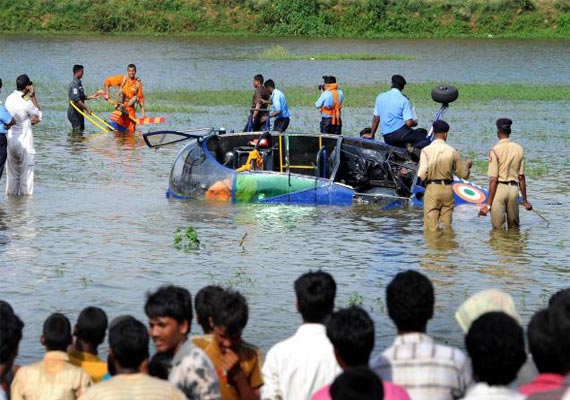
Almost four days after a Naval helicopter, with four crew members on board, crashed into the sea off Vizag coast in Andhra Pradesh, the rescue teams on Saturday retrieved bodies of a Lieutenant Commander and a sailor from the wreckage landed at the depth of 60 metres.

The deceased were identified as Lieutenant Commander Pranav Likithi and sailor G S Sen, according to a release by the Eastern Naval Command.

Two other crew members had been rescued earlier and are recuperating at Naval hospital INHS Kalyani.

The Chetak 440 helicopter crashed into the sea about 10 nautical miles off Visakhapatnam coast on Tuesday afternoon, soon after it took off from INS Dega at about 2 p.M. On a routine mission.

The rescue teams last night spotted the debris, strewn at a depth of 60 metres, along with the two bodies, at a distance of 8 miles south of Dolphin Light House, the release said.

The bodies were retrieved in the early hours today by the joint rescue teams.

Soon after the crash, an extensive search and rescue operation was launched from the sea and air by the Navy, along with the Coast Guard, Port authorities and Marine Police.

The Navy had already ordered a Board of Inquiry to establish the cause of the accident.

A multi-purpose offshore chartered vessel 'Olympic Canyon' was also roped in with its Remote Operating Vehicle for the salvaging operations.

Meanwhile, bodies of Likithi and Sen were sent for postmortem at state-run King George Hospital, the release said.

Friday 15 March 2013

http://www.indiatvnews.com/news/india/vizag-chopper-crash-two-bodies-recovered-20651.html

continue reading

Pakistani made items found on killed terrorists: Shinde


Interesting news article about the use of personal effects for identification purposes:

Making identical statements in both Lok Sabha and Rajya Sabha, Home Minister Sushilkumar Shinde said some items bearing markings of Pakistan have been recovered from the terrorists who were killed in the encounter after attack on a CRPF camp.

He made the statement after sharp criticism by members from various parties, who said the government has repeatedly failed in preventing terror incidents as well in dealing with Pakistan from where it originates.

"The killed terrorists are suspected to be of foreign origin," he said about the incident in which five CRPF jawans lost their lives while battling the attackers.

When pressed in the Rajya Sabha for clarifications, Shinde said he did not say that the terrorists were Pakistanis and only mentioned them as foreigners.

"From the bodies of terrorists killed, two diaries, one each containing numbers suspected to be of Pakistanis, tube of Betnovate, a skin ointment were recovered.

"Further investigations reveal that this tube was manufactured in Glaxo Smithkline Pak Ltd, at 35 Dockyard, Karachi. The name of the tube mentioned in Urdu and the numbers mentioned in the diaries appear to be of Pakistani origin," he said.

He insisted that the government was dealing with terror strongly. "Yahan koi chudiyan nahin pahna hai. Sabke haath me taakat hai (Nobody is wearing bangles in their hands. Everybody is strong)," he said, responding to members' criticism of being soft.

At the same time, he said, the government "knew there will be such attempts" after the execution of Mumbai terror attack convict Ajmal Kasab and Parliament attack convict Afzal Guru.

The Home Minister said the bodies of the terrorists killed in the encounter were shaven, which confirms them to be fidayeens. "The killed terrorists are suspected to be of foreign origin...Although the responsibility for the incident was owned by an agent of Hizb-ul-Mujahideen, the authenticity of the claim is yet to be ascertained," Shinde said.

He disagreed with contentions that the situation on the terror front in the Valley has turned from bad to worse saying there has been decline in the number of terror incidents as well as infiltration incidents in Jammu and Kashmir in the last few years.

"We are focusing on PoK and we are keeping a watch on the camps there. We are very vigilant. Our intelligence agencies are very serious," the Home Minister said.

He said many an incident is also prevented due to better intelligence coordination but that is not something to be highlighted on a daily basis.

Responding to criticism that the forces were not adequately armed in the Valley and that half of the CRPF jawans do not have guns, the Home Minister said peace process is on in Jammu and Kashmir and the government does not want to do it "by pointing out a gun" all the time and the problem is sometimes also contained with 'lathi' (cane) in hand.

"We want to bring peace in Kashmir by giving a special package there...We, too, do not want to keep the military there for long," he said.

Asserting that "condolence for the dead and compensation for the survived" cannot be the government policy after every such attack, M Venkaiah Naidu (BJP) asked the government to understand the seriousness and go into the core of the issue.

Friday 15 March 2013

http://www.kashmirtimes.com/newsdet.aspx?q=13732

continue reading

13 most bizarre stories of famous corpses


In 1658, English writer Thomas Browne knew what he was taking about when he wrote, "But who knows the fate of his bones, or how often he is to be buried?" That's the unofficial tagline for Rest in Pieces: The Curious Fates of Famous Corpses. Like a morbid magpie, I've collected stories of the dead from across the centuries and continents, focusing on how famous corpses were treated by the living. The bodies and parts in Rest in Pieces have become mementos, means of accessing God, scientific specimens, and political footballs. They've been used to found cities, churches, and empires. And while historical and cultural remove can make some of the stories seem more strange than they would have to their participants, other tales in the book truly are bizarre. Below are 13 that strike me as the strangest.

Abraham Lincoln, RIP: April 14, 1865 (age 56)

A decade after Lincoln’s death, a gang of counterfeiters tried to kidnap his corpse. They were hoping to get their top engraver out of prison, plus a pile of cash. The plot failed, thanks to the Secret Service, but in the following years Lincoln’s body was moved at least sixteen times to foil would-be thieves. It spent several years disguised beneath piles of lumber in the tomb’s basement. And Lincoln isn’t the only president to suffer an attempted corpse-napping: in 1830, a disgruntled gardener fired by one of George Washington’s heirs tried to steal his skull. (He accidentally stole the skull of a distant relative.)

Joseph Haydn, RIP: May 31, 1809 (age 77)

Haydn’s head fell victim to the phrenologists, quack scientists who “read” heads the way some people read palms. One of them (who also happened to be one of Haydn’s good friends) dug up his body and made off with his skull, much to the chagrin of his employer Prince Nicholas Esterhazy, who tried unsuccessfully for years to get it back. Haydn’s skull was only reunited with the rest of his body in the twentieth century. Today the composer’s tomb in Eisenstadt, Austria, is said to have two skulls inside.

Voltaire, RIP: May 30, 1778 (age 83)

The French author was terrified of having his bones end up in the trash, a not-infrequent fate for those who criticized the Church in the eighteenth century. To prevent that from happening, Voltaire’s nephew disguised his uncle’s corpse as if it was still alive, propped it up in his carriage, and drove it to his run-down monastery in the countryside. Voltaire stayed buried there until the French Revolution, when the rebels interred him in their secular temple in Paris, the Panthรฉon. Most believe he’s still there today, although there’s a rumor that royalists snuck into the Panthรฉon and threw his bones in the garbage after all. To put a stop to those tales, officials opened the tomb in 1897, and discovered the remains more or less intact.

Laurence Sterne, RIP: March 18, 1768 (age 54)

English writer Laurence Stern (Tristram Shandy) was probably the most famous victim of the “Resurrection Men,” thieves who dug up freshly dead corpses for medical schools. His corpse was delivered to an anatomy professor at Cambridge—coincidentally Sterne’s alma mater. Supposedly, someone recognized Sterne during the dissection, and promptly fainted. It’s not clear whether the dissection was ever finished, but Sterne’s body did make his way back to the cemetery.

Albert Einstein, RIP: April 18, 1955 (age 76)

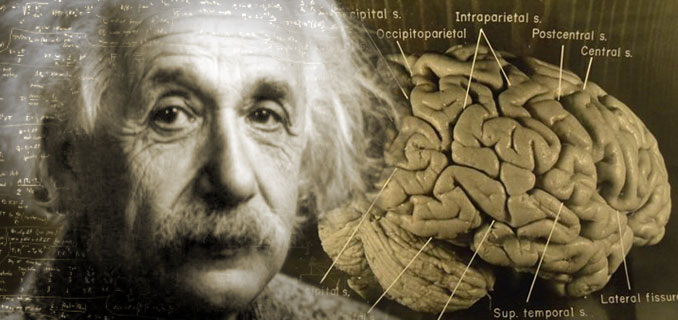
Einstein told his biographer Abraham Pais, “I want to be cremated so people don’t come to worship at my bones." He got his wish--mostly. The pathologist who conducted Einstein’s autopsy, Thomas Harvey, removed the scientist’s brain in an attempt to find out what had made him so brilliant. But during the ensuing decades, Harvey mostly kept the brain to himself, ferrying it around the country when he switched jobs and storing it in the closet underneath his socks. Only in the late twentieth century did scientists find some intriguing differences in Einstein’s brain, and slides of his grey matter are now on display at Philadelphia’s Mรผtter Museum. Meanwhile, Einstein’s eyes are in a safety deposit box in New Jersey.

Lee Harvey Oswald, RIP: November 24, 1963 (age 24)

In the 1970s a wealthy British author and restaurateur, Michael Eddowes, became convinced that there had been two Oswalds—and that the one who killed JFK was a Soviet plant. Eddowes sponsored a 1981 exhumation of Oswald’s body, which found clear signs of childhood scars, thus disproving Eddowes’s theory. But some assassination researchers think the exhumation proved nothing, because the Soviets had been meddling in the cemetery, putting the real Oswald’s head on the fake Oswald’s body.

John Milton, RIP: November 8, 1674 (age 65)

A century after Milton’s death, his grave at St. Giles Cripplegate was desecrated during church repairs. Friends of the churchwarden exhumed the body, then snatched out hair and teeth. Church repairmen showed visitors the skeleton for the price of a “pot of beer.” There’s still controversy over whether or not the body really belonged to Milton, but to this day, no one’s sure precisely where in St. Giles Cripplegate he’s buried.

Benito Mussolini, RIP: April 28, 1945 (age 61)

After Mussolini was captured and executed at the end of WWII, his corpse took a beating (and a spitting, kicking, and shooting) in the middle of a public square in Milan. It was then buried in a secret grave, after which it was briefly stolen by neo-Fascists, recovered, and kept in a series of secret locations for 11 years. “Il Duce” only received a proper burial in 1957, when his body arrived at his widow’s house in a box marked “church documents.”

Eva Perรณn, RIP: July 26, 1952 (age 33)

Argentine first lady Eva Perรณn was embalmed to last for eternity, although things didn’t go quite as planned. When her husband Juan Perรณn was deposed in a coup, the new regime had no idea what to do with her body, which was said to look like a wax doll. The general put in charge of the corpse ended up hiding it in an attic and going insane, or so it’s said. The body was later secretly buried in Italy under an assumed name, and only returned to Buenos Aires over two decades after Evita’s death. Her embalmed corpse now rests in a steel vault said to be able to withstand a nuclear bomb.

Napoleon Bonaparte, RIP: May 5, 1821 (age 51)

Napoleon’s will called for his body to be buried on the banks of the Seine, but he was instead laid to rest in a valley on St. Helena, the desolate island where he died. Most of his remains were repatriated to Paris in 1840, although some body parts made less dignified journeys. According to several accounts, Napoleon’s penis—stolen by his doctor—passed among collectors for decades, while being gracefully described by auctioneers as a “mummified tendon." At last check it was in New Jersey, where its owner kept it in a suitcase under his bed.

Jim Thorpe, RIP: March 28, 1953 (age 65)

Jim Thorpe, one of the best all-around athletes America has produced, died in poverty and obscurity. His wife sold his body to two struggling Pennsylvania coal towns, who united and named themselves Jim Thorpe, even though he never set foot there. The move was designed to bring the town tourist attention, although they ended up revitalizing themselves in ways that had nothing to do with a corpse. Now, Jim Thorpe’s children are fighting in court to bring his body back to Oklahoma.

Jeremy Bentham, RIP: June 6, 1832 (age 85)

In his will, the philosopher and legal reformer Jeremy Bentham ordered a public dissection of his own corpse. He also ordered that his body be stripped down to its skeleton and stuffed inside his Sunday suit, and his head preserved in the “style of the New Zealanders.” That part didn’t work out so well, but the rest of Bentham’s preserved body is still on display (with a wax head) at the University College London.

Dorothy Parker, RIP: June 7, 1967 (age 73)

Dorothy Parker left her entire estate to Martin Luther King, a man she’s never met. But she failed to leave any instructions regarding her remains. Her ashes stayed at the crematorium until 1973, and then in a filing cabinet at her lawyer’s office until 1988. That year the NAACP finally gave the ashes a permanent home at their Baltimore headquarters, where Parker lies beneath her suggested epitaph, “Eat my dust."

Friday 15 March 2013

http://www.huffingtonpost.com/bess-lovejoy/13-most-bizarre-stories-o_b_2876961.html#slide=2222489

continue reading

Thursday, 14 March 2013

Medical knowledge used to depend on grave robbing


Last week’s chilling discovery that bodies within Burr Oak Cemetery in Alsip, Illinois were routinely being dug up and moved so that the burial plots could be sold again offers an opportunity to remind Americans that it was only two hundred years ago that “resurrectionists” would routinely raid cemeteries in order to provide cadavers for dissection classes in medical schools.

Those who made their living procuring bodies usually started at the poorhouse. Sometimes they would send young women as mourners who would arrive at the almshouse and claim the body of their newly deceased “relatives.” Bribes to staff members–no fake mourner involved–were also successful at gaining access to unclaimed bodies not yet been put in the ground. If these methods did not provide enough cadavers to fill local needs, then resurrectionists paid off public officials or burial ground employees so that they could gain access to potters’ fields and other cemeteries

In any of the burial grounds, stealth was necessary in order to avoid getting caught by family members and cemetery employees who had not been bribed. The men dug quickly and used wooden spades to prevent the clanging sound of a metal one. The grave robbers mastered the art of unearthing just one end of the coffin and then they used a crowbar to pry open the top half of the lid (the weight of the earth on the other end of the coffin lid helped them snap the lid off). A rope was then put around the body so it could be dragged out. Resurrectionists prided themselves on leaving clothing and jewelry behind. Body snatching was only a misdemeanor; thievery of the belongings upgraded the crime to a felony.

Body snatching presented a terrible problem for the families of the deceased. They commonly set up watch over the body until burial, and later, relatives would take turns watching over the grave for a few days to be certain it was not dug up afterward. However, watching the grave was not foolproof. Some of the body snatchers were quite artful, and they devised a way to tunnel in to a recent grave after digging a hole a distance 15-20 feet away. The end of the coffin was then removed and the corpse was pulled out through the tunnel.

Medical students were often responsible for procuring their own bodies, and documents left by the students indicate that the procurement of bodies was actually quite stressful. One fellow wrote: “No occurrences in the course of my life have given me more trouble and anxiety than the procuring of subjects for dissection.” With his friends at Harvard, this fellow, John Collins Warren Jr., created a secret anatomic society in 1771 called Spunkers, whose purpose was to conduct anatomic dissections.

In England the first law that was somewhat helpful in delivering bodies for use by medical students was the Murder Act of 1751, and it stipulated that the corpses of executed murderers could be used for dissection. By the 1820s the United States was beginning to legislate that unclaimed bodies and those donated by relatives could be used for study of anatomy. These changes began to reduce the practice of body-snatching.

The situation in Illinois today is totally regrettable, and while family members will likely have the satisfaction of knowing the criminals were caught, they will never know what happened to their loved ones. And this time, it didn’t aid medical progress.

Thursday 14 March 2013

http://americacomesalive.com/2009/07/16/medical-knowledge-used-to-depend-on-grave-robbing/

continue reading

Korean War Remembered


In the heart of South Korea's capital, nestled on the side of a hill lay the remains of some of country's fallen heroes.

Grave after grave, row after row are victims of the brutal and devastating Korean War.

It began in the summer of 1950 when North Korean founder Kim IL Sung sent troops to invade his southern neighbor.

The Korean peninsula had been divided after World War II following 35 years the Japanese occupation.

Russia took control of the north; the United States - the south -- with the border marked along the 38th parallel, also known as the DMZ.

"it was the first hot war of the cold war, the first UN war, the first time free world troops invaded a Communist country and the results of that were absolutely horrific."

The North Korean regime invaded and pushed all the way to the southern tip of the peninsular before US and UN reinforcements pushed them back.

And then the Chinese arrived with a tactic that still haunts surviving allied soldiers to this day.

"The Chinese used a tactic called the human wave, a very large mass of men attack at very short range. Most of the fighting took place on hills, rugged terrain at night at very close range. It was traumatic and some guys I know 6 decades later still can't sleep without the lights on."

One man who still has nightmares is In-Joon Chang.

He joined the South Korean military at the age of 20 desperately wanting to defend his country.

The most brutal thing was watching my friends die and I wasn't able to save them. My scars remind me of this every single day.

Shot in the leg, the 82 year old tells me a story about how he managed to escape after coming under attack one night.

"I couldn't see anything in front of me and suddenly there were bodies everywhere. There was no way to avoid stepping on them. I tried not to step on their faces but rather their arms and legs because there stomachs were soft as tofu. I kept falling but we had to keep going otherwise we would have been killed."

"While the Korean War lasted for only 3 years, the loss of life here on the Korean Peninsular was extraordinary. Conservative estimates put the number of dead at around 2 million but with no official records out of North Korea, experts believe the total figure could be as high as 5 million."

In the end, North Korea was devastated and at midnight on the 27th July 1953 the armistice agreement was signed - effectively ending the Korean War.

And as Pyongyang now threatens to nullify the cease fire, this grandfather of 8 says the stories of the Korean War are now more important than ever.

"We must teach the younger generations because they know nothing about the suffering we endured. God forbid they need to prepare in case there in another war."

Thursday 14 March 2013

http://www.wltz.com/story/21570681/korean-war-remembered

continue reading

First DNA matches from Libyan mass graves


The Libyan government has received the first of a number of DNA matches from bodies that were found in a mass grave, one of which could be that of photographer Anton Hammerl.

The seven samples, according to Libyan government officials, arrived in Libya on Thursday from the International Commission for Missing Persons, (ICMP) in Bosnia. But none of the samples are linked to the missing photographer, who was killed on April 5, 2011.

These are the first of a 100 samples that are been analysed by the ICMP. It is expected that all the samples will arrive back in Libya in the next 10 days.

Hammerl, who previously worked for the Saturday Star, died while covering the Libyan civil war.

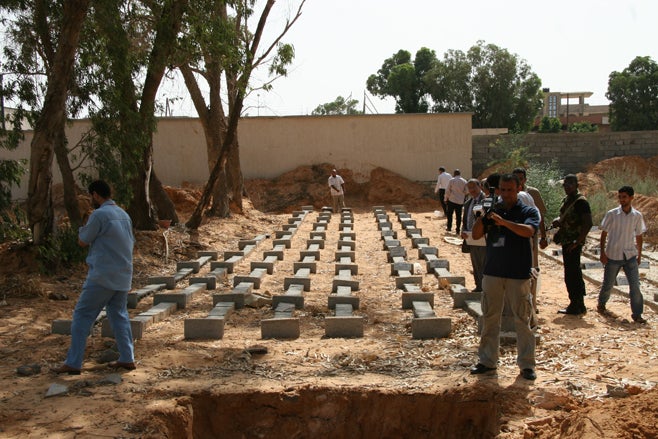
His body was believed to be among 169 other bodies exhumed from a mass grave near the town of Bin Jawwad.

Hospital records showed the body was that of a white male of Hammerl’s height, with black hair, and that he had died around the same date. A lens was also recovered nearby.

However, those who have seen the lens believe it did not come from a camera, but might be from a pair of binoculars.

“We will be receiving results as they go along,” said Mervat Mhani of the Libyan Ministry of Martyrs and Missing People. These individuals were identified from DNA extracted after a mass exhumation. The DNA was then compared to that of relatives.

She added that once the government received the samples, the remains of the person would be exhumed and subjected to a physical examination.

“Only then would the family be informed, and they would then decide if they wanted to move the remains,” Mhani added.

The mass grave in Bin Jawwad was exhumed early last year by relatives of the dead. The exhumation was supervised by the ministry.

There was a delay in sending the samples to the ICMP, as a decision had to be made if they would be analysed in Libya.

Thursday 14 March 2013

http://www.iol.co.za/news/africa/could-dna-be-anton-hammerl-s-1.1484901#.UUIHyYfVWCA

continue reading

Report on investigation of Sri Lanka's mass grave to be presented to court


Sri Lanka's Marxist party Janatha Vimukthi Peramuna (JVP) says the report on the investigation conducted into the skeletal remains unearthed from the Matale mass grave will be submitted to court on the 20th of this month.

JVP politburo member and parliamentarian Anura Kumara Dissanayake said the party was also awaiting the submission of the report to court on the findings of the mass grave in Matale where skeletal remains of over 150 people were unearthed.

According to the Consultant Judicial Medical Officer (JMO) of Matale Dr. Ajith Jayasena, skeletal remains of 154 people were found during excavations carried out from the 26th of November until the 12th of this month at the grave site in the premises of the Matale Hospital. Dissanayake has noted that preliminary investigations on the skeletal remains had found that the persons had been subjected to torture and belonging to the period of 1988-1989.

"The skeletons and skeletal remains have been identified as those of persons who had been subjected to various kinds of torture. Parts of metal wire wrapped around the bodies or inserted have also been found," Dissanayake has said.

According to him, the government should also take steps to carry out investigations to scientifically probe the period of the skeletal remains.

Sri Lankan authorities say that the excavations have been completed and some preliminary tests have been conducted on the remains but the systematic forensic investigations of the remains to identify the era of the dead and their identities are still ongoing.

Thursday 14 March 2013

http://www.colombopage.com/archive_13A/Mar12_1363068000JR.php

continue reading

In Cambodia, worry grows that Khmer Rouge leaders will die before being punished


Decades after Cambodia’s brutal Khmer Rouge movement oversaw the deaths of 1.7 million people by starvation, overwork and execution, the regime’s imprisoned top leaders are escaping justice one by one. How? Old age.

Thursday’s death of 87-year-old Ieng Sary, foreign minister under the Khmer Rouge, is fueling urgent calls among survivors and rights groups for the country’s U.N.-backed tribunal to expedite proceedings against the increasingly frail and aging leaders of the radical communist group, which ruled Cambodia from 1975 to 1979.

Ieng Sary’s wife, former Social Affairs Minister Ieng Thirith, was ruled unfit to stand trial last year because she suffered from a degenerative mental illness consistent with Alzheimer’s disease. Now, only two people — ex-head of state Khieu Samphan, who is 81, and the movement’s former chief ideologist, Nuon Chea, who is 86 — remain on trial for their alleged roles in some of the 20th century’s most horrific crimes.

There are growing fears that both men could die before a verdict is rendered. Both are frail with high blood pressure, and have suffered strokes.

“The defendants are getting old, and the survivors are getting old,” said Bou Meng, one of the few Cambodians to survive Tuol Sleng prison, known as S-21, where up to 16,000 people were tortured and killed during the Khmer Rouge era. “The court needs to speed up its work.”

“I have been waiting for justice for nearly 40 years,” Bou Meng, 70, told The Associated Press. “I never thought it would take so long.”

When the Khmer Rouge captured Phnom Penh in April 1975, they began moving an estimated 1 million people — even hospital patients — from the capital into the countryside in an effort to create a communist agrarian utopia.

By the time the bizarre experiment ended in 1979 with an invasion by advancing Vietnamese troops, an estimated 1.7 million people had died in Cambodia, which had only about 7 million people at the time. Most of the dead were victims of starvation, medical neglect, slave-like working conditions and execution under the Maoist regime. Their bodies were dumped in shallow mass graves that still dot the countryside.

The tribunal, officially known as the Extraordinary Chambers in the Courts of Cambodia, was tasked with seeking justice for crimes committed during that era.

The court, which was 10 years in the making, began operations in 2006. But despite some $150 million in funding, it has so far convicted only one defendant: Kaing Guek Eav, also known as Duch, the commandant of S-21 prison.

Duch was sentenced in 2010 to 35 years in prison for war crimes and crimes against humanity. The sentence was reduced to a 19-year term because of time previously served and other technicalities, a move that sparked angry criticism from victims who said it was too lenient. Cambodia has no death penalty.

Several other major Khmer Rouge figures died before the court even existed, including supreme leader Pol Pot in 1998.

Ieng Sary’s death was no surprise given his age and ailing health, said Ou Virak, who heads the Cambodian Center for Human Rights. But “given the fact that the other two defendants are also in their 80s, it should act as a wake-up call to all concerned — the Cambodian government, the U.N., the international donors and the tribunal itself — that these cases need to be expedited urgently so that justice can be served.”

“The whole future of the tribunal is currently in limbo, and the possibility that hundreds of millions of dollars will have been wasted is now a very real threat,” Ou Virak said. “Most importantly, though, if all three die before their guilt or innocence can be determined, then the Cambodian people will quite understandably feel robbed of justice.”

The court has been criticized before for the sluggish pace of proceedings. But William Smith, one of the court’s prosecutors, said the trial has taken time because the indictments themselves have been lengthy, and the list of alleged crimes to be proven long.

The tribunal has been dogged by other problems, including funding shortages from international donors. Earlier this month, Cambodian translators angry that they had gone without pay for three months went on strike just before the court was to hear testimony from two foreign experts.

Tribunal spokesman Neth Pheaktra said Thursday that the interpreters would all return to work this week after the court administrator promised that they would get paid. But he added that the translators have threatened to strike again if they are not paid by month’s end.

In recent years, the tribunal has also been hit by infighting and angry resignations by foreign judges over whether to try more Khmer Rouge defendants on war crimes charges. Prime Minister Hun Sen, who has ruled Cambodia since 1985, has warned that no more trials will be allowed. Many former members of the Khmer Rouge, including Hun Sen himself, hold important positions in the current government.

The trial against Ieng Sary, his wife and the last two accused senior Khmer Rouge leaders alive began jointly in 2011. All have denied guilt for their roles during the radical communist movement’s rule.

Lars Olsen, another tribunal spokesman, said Thursday that “we understand that many probably are disappointed with the fact that we cannot complete the proceedings against Ieng Sary, and therefore we cannot determine” whether he is guilty or innocent of the charges against him.

But it’s important to remember, he said, that the case against Nuon Chea and Khieu Samphan “is not over.” He said it would not be affected by Ieng Sary’s death and proceedings will continue on schedule.

Youk Chhang, director of the Documentation Center of Cambodia, an independent group gathering evidence of the Khmer Rouge crimes for the tribunal, said Ieng Sary’s death “carries little value for the regime’s victims, who patiently wait to see justice done.”

Ieng Sary died early Thursday under the care of doctors at a Phnom Penh hospital, where he was admitted earlier this month suffering from weakness and fatigue. He suffered fatal cardiac failure, said one of the prosecutors in his case, Chea Leang, who added that under Cambodian law, all charges against him will now officially be dropped.

Yim Sopheak, a 47-year-old street vendor who said the Khmer Rouge regime had executed her parents, said Ieng Sary “deserved to die in prison, not in a hospital. He should have died in the same way as he executed my parents and other people.”

Yi Chea, a 72-year-old flower seller who says her husband and other relatives were also killed during Khmer Rouge rule, said she was happy Ieng Sary was gone. But, she added that “he did not deserve to die naturally like this.”

Tribunal hearings resume on March 25, said Neth Pheaktra. Foreign medical experts are due to testify on the health status of Nuon Chea, to determine whether the ailing ex-leader is still fit to continue to stand trial.

Thursday 14 March 2013

http://www.washingtonpost.com/world/asia_pacific/in-cambodia-worry-grows-that-khmer-rouge-leaders-will-die-before-being-punished/2013/03/14/e9eb0a2a-8c8f-11e2-adca-74ab31da3399_story_1.html

continue reading

Plane crash kills 10 in northern Brazil


Ten people were killed when their single-engine plane crashed in the small town of Almeirim, in northern Brazil, local authorities said Wednesday.

The plane disappeared from the radar screens late Tuesday, but the debris was not found until Wednesday morning because the crash site is in a densely forested region. There were no survivors, authorities said.

The plane, a single-engine Embraer 821-Caraja, took off from Belem, Para state's capital, and crashed only 20 kilometers away from the city's Monte Dourado airport. The names of the victims were not disclosed.

The plane, which belonged to air charter company Fretax, was transporting nine employees of engineering company Cesbe to the Santo Antonio do Jari hydroelectric power plant, which is being building in neighboring Amapa state.

The cause of the accident remains unknown and will be investigated by aviation authorities.

Both Fretax and Cesbe released statements regretting the incident and saying they are providing assistance to the victims' families. Fretax said the pilot had been in good health and the plane's inspections were up to date.

Both Fretax and Cesbe released statements regretting the incident and said they were providing assistance to the victims' families.

Thursday 14 March 2013

http://usa.chinadaily.com.cn/us/2013-03/14/content_16306835.htm

continue reading

More than One Immigrant a Day Found Dead Near Border with Mexico


Agents patrolling the border between the United States and Mexico routinely find dead bodies of immigrants trying to sneak into the country. The toll of those who fail to make the difficult journey has averaged more than one dead body a day since the 1990s.

Over the last 15 years, 5,513 bodies have been recovered along the border. In 2012 alone, the total was 463.

The border area near Tucson, Arizona, has proven the most deadly since 2001, with 177 bodies found in the last fiscal year.

But fatalities have jumped significantly in Texas’ Rio Grande Valley, where the death toll went from 66 in 2011 to 150 last year. There is no medical examiner in the county, and the corpses of suspected illegal immigrants are buried in unnamed graves in a cemetery in the small town of Falfurrias.

Hundreds are never identified, either due to bodies being too decomposed or lack of identification. The Pima County Forensic Science Center alone has recorded 700 immigrant John and Jane Doe’s since the late 1990s.

Thursday 14 March 2013

http://www.allgov.com/news/us-and-the-world/more-than-one-immigrant-a-day-found-dead-near-border-with-mexico-130314?news=849426

continue reading

Wednesday, 13 March 2013

Baldia factory fire case: SHC gives one week to identify charred bodies


The Sindh High Court has yet again ordered the National Forensic Science Agency and others concerned to submit a report regarding the identities of the seventeen workers of the Baldia garments factory, whose bodies were charred beyond recognition in the fire. Nearly 259 workers were burnt in the country’s worst industrial disaster, when a huge fire reduced the Ali Enterprises to ashes on September 11, 2012. As the repeated DNA tests failed to determine the identities of the victims, the bereaved families had gone to court seeking permission for mass burial.

The judges on February 20 allowed the bereaved families to perform last rites and bury the seventeen unidentified bodies to end the mental torture and agony the families had been going through for the past six months.

Meanwhile, the laboratory’s project director was directed to expedite DNA matching process by drawing fresh samples and submit report by March 11. On Tuesday, the advocate general Abdul Fattah Malik said that while the unidentified bodies were buried following permission granted by the court, none of the relatives of the victims had come forward to pursue DNA testing, thus their identification has yet to be determined.

Regarding compensation, Malik informed the judges that a commission tasked to disburse compensation among the victims’ families had already been constituted and was working in this regard.

Justice Maqbool Baqir, who headed the bench, directed all concerned to complete DNA matching process and submit report within one week.

Wednesday 13 March 2013

http://tribune.com.pk/story/519876/baldia-factory-fire-case-shc-gives-one-week-to-identify-charred-bodies/

continue reading

Kites soar in Gaza Strip to offer hope to 3/11 disaster zone


A thousand local children gathered in southern Gaza Strip and flew kites on March 11 to commemorate the victims of the Great East Japan Earthquake and tsunami, which struck the coast of northeastern Japan two years ago.

"People have been killed here in wars, so we can understand the pain of people in the disaster zone (of the earthquake and tsunami)," said Nour Alnamrouty, one of the children. "I want to give the Japanese people hope."

The homemade kites were printed with the Japanese and Palestinian flags, and one of them had the word "Japan" written in Arabic on it.

Wednesday 13 March 2013

http://ajw.asahi.com/article/behind_news/social_affairs/AJ201303120099

continue reading

Saturday, 9 March 2013

11 people killed in Byo bus accident


Eleven people died in a fatal accident that involved a bus, Kombi and Mercedes Benz sprinter minibus 10km out of Bulawayo along the Bulawayo- Harare highway yesterday (Friday) afternoon.

This accident occurred at Cement Siding after TP Transport bus loaded with passengers and on its way from Harare side swept a Kombi and a Mercedes Benz sprinter minibus which were also loaded with passengers and going opposite direction. The drivers of the kombi and sprinter minibus lost control and veered of the road. Eight people who were in the Sprinter minibus were killed on the spot,while two people who were in Kombi were also killed on the spot. One person who was in the bus was also killed.

When The Zimbabwean visited the accident scene, police and fire brigade officers were busy retrieving bodies from wreckages while ambulances were ferrying the injured to United Bulawayo Hospital.

The accident happened at the same spot where eight people were killed in January this year after the driver of a Botswana registered bus, Jay-Jay Tours, lost control at a curve on a morning marked by heavy showers and veered off the road.

Bulawayo police spokesperson Mandlenkosi Moyo only said: “Yes an accident has occurred, but I am still getting more details about that.”

Hundreds of Zimbabweans including some senior government leaders have perished in road accidents that experts have largely blamed on the poor state of roads and human error.

This past festive season has seen a death toll of over 208 people compared to about 147 who died in road accidents in 2011.The accidents occurred despite the heavy presence of traffic police on major highways.

Traffic safety officials blame a number of factors for the upsurge in crashes, including the poor state of the roads and the increase in the volume of traffic and human error.

Police have also been accused of contributing to the carnage by taking bribes from traffic offenders, enabling unroadworthy vehicles to continue plying the roads.

Saturday 9 March 2013

http://www.thezimbabwean.co.uk/news/zimbabwe/64174/11-people-killed-in-byo.html?utm_source=thezim&utm_medium=homepage&utm_campaign=listarticle&utm_content=textlink

continue reading

Sixth Body Recovered as Russia Mourns Avalanche Victims


Rescuers have recovered the body of the sixth missing teenager at the site of an avalanche in Russia's East Siberian republic of Tyva, where a mourning has been declared for the victims.

The head of the republic, Sholban Kara-ool, declared a one-day mourning on Saturday for the six teenagers, who were killed in an avalanche last week.

The avalanche occurred on a remote mountain slope six kilometers (four miles) from the village of Mugur-Aksy in the republic’s Mongun-Taiginsky distinct on March 3.

Seven boys were planning to plant flags at the top of the mountain - a custom that is believed to bring luck.

One of them, Anton Salchak, 17, a junior European kickboxing champion, managed to escape the snow trap and alerted the regional authorities to the incident.

Five bodies were retracted from under the snow on Wednesday and the search for the last missing teenager continued.

Saturday 9 March 2013

http://en.ria.ru/russia/20130309/179909380/Sixth-Body-Recovered-as-Russia-Mourns-Avalanche-Victims.html

continue reading

9 people killed in fishing boat fire off South Korean waters


Nine people died and one people is missing when a fishing boat was on fire off waters in Gunsan city of South Korea, the Yonhap News Agency reported on Saturday citing the relevant authorities. According to the police, the fire started at about 5:20 a.m. on the 20-ton fishing boat, 24 kilometers of Gunsan city in west South Korea, forcing 11 crew to plunge into freezing sea waters to avoid flames and smoke. Among the total of 20 boat members, 10 have been rescued but nine of them were pronounced dead later. The police are still searching for the missing one. "It seems that many of the people jumping into the sea died because of hypothermia caused by excessively low water temperature," a police officer was quoted as saying by Yonhap. The authorities have yet to identify the cause of the accident and whether the sailors were alive or dead. Saturday 9 March 2013 http://english.sina.com/world/2013/0308/569613.html

continue reading

Yorkshire's worst mining disaster: When tragedy struck at colliery in 1973


This month marks the anniversary of one of the worst mining disasters in the history of Yorkshire.

The Lofthouse Colliery Disaster of March 21, 1973, left 30 men dead and dozens more scarred for life.

Some of the bodies were never recovered and had to be sealed in.

It happened at just after 2am after a group of men working on a coal seam known as the Flockton Drift unexpectedly hit an old tunnel which was already flooded.

What happened next was one of the most horrific disasters not only in the history of Yorkshire but of the UK.

Thousands of tons of water crashed through into the working mine, taking with it tons of debris, including rock and metal, some of which weighed several tons.

As the news spread, miners working in other parts of the pit, some of them several miles away, were told to evacuate.

Tony Banks, 70, who was a miner for more than 30-years, was on duty that night.

He said: “We were working in the tunnel below them, known as the ‘11 Yard Seam’ - it was connected but not directly. We knew something was up because around 2.20am there was a sudden surge of wind and then the ventilation reversed for a few moments. That only happens when something’s up but we didn’t know what at that stage.”

However, at just after 4am they were told via radio to evacuate immediately, as water levels were still rising in the mine.

In some cases miners had to down tools and run for their lives.

There were even stories of some of the younger minders having to make the agonising decision to leave older, slower miners behind to die as they fled the water.

Dave Hagan was a member of the Allerton Bywater rescue crew which worked flat out for 37 days following the disaster.

He said: “There was one chap called Charlie Cotton who was working with his son and they were both running from the water and when he realised he couldn’t outrun it, he told his son, ‘You go on lad, I’ve had my life.’

“His son got out but he never did.

“It was such a horrible thing to happen and for a lot of people it’s like it happened yesterday. Them bodies are still down there and it’s important we never forget.”

Mr Hagan said it was the consensus view the mining tragedy was down to ‘Victorian greed’.

He said: “Back in those days you had to pay the landowners for taking coal, so what they used to do is pinch a bit here and a bit there and no-one would mark it on the map.

“That’s why when they came to survey the area before mining started, they were completely unaware these old shafts existed.

“I remember the Prime Minister Ted Heath coming into the rescue room and telling us he was scaling the operation back from a rescue to a recovery mission - they were simply too scared more lives would be lost.

“It felt like we’d given our all and it was for nothing. It felt like being kicked in the stomach.”

Those old Victorian mine workings, miles of them, had filled with water down the decades and when the Flockton Seam crew broke through, they unleashed a reservoir of water some 3.5m gallons strong.

The water turned to slurry as it sped along the maze of underground tunnels and carried debris up to three miles away. In the end, 60 tons of concrete was used to plug the shaft, sealing the bodies of seven men in forever.

On Saturday, March 23, a service will be held at Outwood Parish Church at 1pm. From 2pm at Ledger Lan WMC, there will be a video shot in 1973 showing interviews with miners and other people, plus a performance from Lofthouse 2000 brass band.

The next day there will be a short service at 3.15pm at the memorial, followed by events at St Paul’s Church, Alverthorpe.

Saturday 9 March 2013

http://www.yorkshireeveningpost.co.uk/news/latest-news/top-stories/yorkshire-nostalgia-when-tragedy-struck-at-colliery-1-5481825

continue reading