Wednesday, 6 February 2013

Mothers of the disappeared


She struggled for 20 years to trace her son, Nazir Ahmad. On September 1, 2009, Mugali Begum died without seeing her lone son.

Her struggle began on September 1990 when Nazir, a school teacher, was allegedly picked up by security forces on his way to school in Srinagar.

Mugali was divorced by her husband few months after her marriage. She lived alone with Nazir and fought singly to trace him after his disappearance.

“She died without her dream fulfilled, but we carry on her struggle,” said Parveena Ahanger, President of Association of Parents of Disappeared Persons.

Parveena’s son Javed Ahmad is missing since 20 years. In August 1990, Javed was allegedly arrested by NSG commandos. When Javed did not return, Parveena began searching for her son.

“There is not a single place in Kashmir where I did not look for him,” Parveena said.

During her hunt for Javed, Parveena came across several other women like her whose sons had gone missing. In 1994, she founded Association of Parents of Disappeared Persons (APDP), which has over 3,000 members.

“We all members of APDP have same suffering, same cause,” Parveena says, “We are fighting together.”

When 70 year old Taja Begum lost her husband, she stood strong to bring up her four sons and four daughters.

But even after braving all pains for bringing up her children, she stands alone today with no one to even wipe her tears.

“When my husband died, my children were toddlers. I did not lose hope and stood strong to give best upbringing to my children. But my efforts fetched nothing and today I am all alone,” says Taja Begum from Handwara district.

Taja worked hard to support her family and nurture her children.

As her sons grew up and began to earn, Taja was much relieved of her burden.

“But least did I know of the lifelong pain I had to endure,” she adds.

The calm of her life was shattered in January 1996 when a few gunmen barged into her house and asked her three sons – Muhammad Ramzaan, Muhammad Amin and Ghulam Nabi – to accompany them.

For the whole night her sons did not return. In the morning, the bodies of two of them were found in the paddy fields while Ghulam Nabi was returned home.

The tragedy did not end here. Ghulam Nabi soon became the victim of disappearance in 1996. Ironically Taja’s only surviving son, Mushtaq Ahmad had been crippled after being hit by a bullet in 1997.

Exhausted with her decades of struggle, Jameela Begum’s dream is now to see her son’s name inscribed on memorial which APDP wishes to build for disappeared persons. Her son, Mohammad Irfan, is missing since 1994. “He had gone to the market to buy me medicines. He never came back,” laments Jameela.

Irfan, Jameela’s lone son, was then a student of class 8, aged 14 years. “He was my lone son. I am fighting alone and supporting my family as my husband is bedridden.”

The story of Jaana Begum is no different either. Once a mother of seven sons, she is left with three.

“My family has been devastated,” Jaana Begum says in breaking voice.

Jaana Begum lost her four sons and husband during the past 22 years of conflict. In 1997, her son Lateef Ahmad was allegedly shot dead by unidentified gunmen. In 1998, her two other sons got killed. In 2001, another son, Sharief -ud-din went missing when he left home for work and did not return.

According to the APDP there are about 10,000 missing persons in the Valley. However in view of contradictory figures given by the government from time to time, no authentic official figures exist.

During the recently concluded autumn session of the of Jammu and Kashmir Legislative Assembly government revealed said there are 2305 persons missing till July 2012. In 182 cases, First Information Report (FIR) has been filed, ex-gratia relief has been paid in 729 cases, benefit of compassionate appointment has been given in 58 cases while cash lieu of government jobs has been paid in 65 cases.

But in the year 2002, the National Conference government revealed 3184 persons had disappeared from 1989 till 2002. In February in 2003, the then Chief Minister, Mufti Mohammad Syed, had informed the State Assembly that 3,744 person went missing between 2000 and 2002, 1,553 persons disappeared in 2000, 1,586 went missing in 2001 and 605 in 2002.

Addition to the contradictions, Bhim Singh from Jammu Kashmir Panthers Party said 4,000 persons had disappeared in the Valley since the commencement of conflict in 2004.

In 2005, the Congress government said 693 cases of disappearances were registered.

On January 2, 2007, the state government admitted in the Legislative Assembly that 1,017 youth were missing since 1990 which included 433 from Baramulla and153 from Anantnag.

In 2009, official figures released in the State Assembly revealed 3,429 had disappeared from 1990 till 2009 with only 110 missing after arrests by security forces.

During the 2011 Assembly session, the government revealed that 1,378 missing reports were filed.

While the hundreds remain missing, APDP demands setting up of an independent committee to conduct probes into the disappearances and urge India to ratify International Convention on Enforced Disappearances. APDP holds monthly sit-in regularly to protest against the disappearances and demand justice.

Human rights activist and coordinator Jammu and Kashmir Coalition of Civil Society (JKCCS) Khurram Parvaiz told Dawn that an international probe must be ordered to investigate cases of disappearances.

“There are over 8,000 disappearances cases in the state,” Parvaiz said. “It is a wide spread phenomenon.”

He added that justice has not been done in even a single case. “We want to know who are behind the disappearances so that justice is done.”

Parvaiz Imroz, a human rights lawyer, added that investigation into disappearances is need of the hour.

“Disappearances are a major issue and government has to act. We have to engage international organisations for the investigations but unfortunately the government is not allowing international organisations to intervene,” Imroz added.

For Parveena, the struggle is life-long. “We shall not rest till our death.”

Wednesday 6 February 2013

http://kashmirheadlines.net/02062013-ND-mothers-of-the-disappeared-983.aspx

continue reading

Landslide Kills One, Leaves Five Missing in Central Java


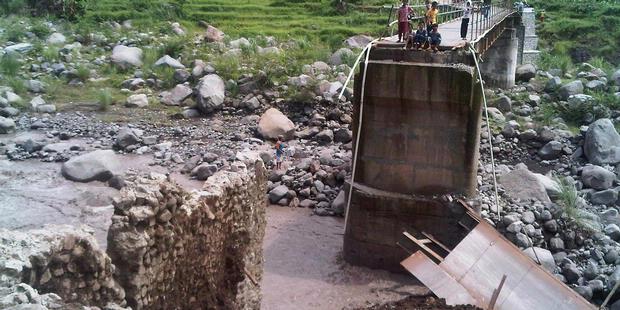
A landslide triggered by heavy rains in Central Java killed one person and left five others missing, an emergency official said on Wednesday.

“The landslide happened today, Wednesday morning in Plompong village, Brebes, Central Java. Eight people who were working in a cornfield were buried in the incident,” National Disaster Mitigation Agency (BNPB) spokesman Sutopo Purwo Nugroho told the Jakarta Globe.

One victim was found dead while two others sustained serious injuries. Five more victims remain buried under the mud, but Sutopo said the rescue effort had been suspended and would resume on Thursday morning.

“We had to stop the rescue because of the heavy rain and it was getting very dark at the location,” he explained.

Floods and landslides are common in Indonesia, which is in the midst of its rainy season.

Heavy rain in Jakarta last month caused more than 30 deaths and forced tens of thousands of capital residents to flee their inundated homes.

Wednesday 6 February 2013

http://www.thejakartaglobe.com/news/landslide-kills-one-leaves-five-missing-in-central-java/570030

continue reading

Indian soldiers to be identified through their DNA


Formally announced in February 2012, the DNA profiling centre and data bank at Pune’s Armed Forces Medical College (AFMC) is finally set to take off by mid-2013.

The centre which is to be one of the handful DNA profiling centres of the country is expected to come handy to establish identity of defence personnel, especially in case of unforeseen tragic events when bodies are found in mutilated/charred conditions.

Air Marshal DP Joshi, director general, Armed Forces Medical Services, said that the centre had started DNA extraction, sequencing and storage from November 22, 2012.

“Initially we want to do a 100-odd samples of DNA extraction to arrive at a sort of standardisation of the entire programme. We also have to establish the authenticity and accuracy of the processes and establish that it matches the relevant standards.

"Hence, we are getting an expert PhD scientist with expertise in DNA extraction from the Defence Research and Development Organisation (DRDO),” said Maj Gen Velu Nair, dean, AFMC. According to senior AFMC officials, the project is stuck in legal hurdles.

An official said that when the lab was inaugurated in 2012, permission was sanctioned to extract and establish DNA. But later it was realised that legal ramifications had not been discussed.

“For example, if there is an untoward incident and DNA bank is used to establish identity of the soldier, will this evidence stand in the court of law under the Indian Evidence Act? For that the authenticity of processes of DNA extraction, tissue typing in establishing identity need to be approved.

"An application has been sent in this regard to the Ministry of Health which in turn wrote to Ministry of Law and Justice. We are waiting for the approval before starting large scale DNA extractions,” said the official.

Meanwhile air force officials have already asked AFMC officials to create a DNA bank of all its personnel.

“We have received the request from air force. We have the technology, the manpower and expertise. Once the approval is received, we can start the DNA repository and can request for funds based on requirement,” said Joshi.

DNA profiling is accepted as the most advanced and reliable method of establishing identity of living individuals as well as dead bodies and body remnants. DNA can be extracted from small portions of any body tissue, including bones, teeth and hair.

These can be recovered from bodies that have been subjected to severe mutilation and destruction as well as decomposition. Therefore, positive identification of such body parts can be established, provided DNA profiling of the individual is carried out during life and the information is stored in a data bank/repository, to cater to such unforeseen tragic eventuality.

Wednesday 6 February 2013

http://www.dnaindia.com/mobile/report.php?n=1796897

continue reading

Powerful Solomon Islands earthquake triggers small tsunami, at least 5 dead


A tsunami in the south Pacific triggered by a magnitude 8.0 earthquake has devastated coastal villages and killed five people in the Solomon Islands, with concerns for hundreds more in outlying islands.

The centre of the quake was off the Santa Cruz Islands, a cluster of remote islands that form part of the Solomon Islands, north-east of Australia.

Two waves with a height of three feet washed away houses in four villages and left at least five people dead, including three women, a man and a boy believed to be 10 to 12 years old.

Officials said hundreds of people live in the villages but authorities are yet to report from the devastated areas, including the affected villages and some smaller islands.

“At this stage, authorities are still trying to establish the exact number and extent of damage,” said a government spokesman, George Herming. “Communication to Santa Cruz Island is difficult due to the remoteness of the island.”

The hospital at Lata, the main town in the Santa Cruz Islands, has begun receiving casualties and expects more in the coming hours. The town’s main airport was flooded but the town’s 5000 residents were believed to have had enough time to reach higher ground.

“We are yet to receive information from three villages along the coast or other islands in the province,” the hospital’s director of nursing, Augustine Bilve, told The Daily Telegraph.

“Soon after the earthquake we heard the siren for the tsunami. There was no time for people to move to higher ground.”

The quake struck at around midday and prompted the Pacific Tsunami Warning Centre in Hawaii to issue a tsunami warning for several Pacific states and a tsunami watch for Australia, New Zealand and Indonesia which was later cancelled. The agency said the quake struck at a depth of almost 18 miles.

The United States Geological Survey recorded at least 23 aftershocks with a magnitude of between 5.0 and 6.6 near the Solomon Islands. A tsunami of around 20 inches reportedly hit New Caledonia and a small wave also hit Japan and Papua New Guinea.

In Honiara, the capital of the Solomon Islands, residents fled to higher ground and spent hours looking out to sea for sign of further waves.

“People are still standing on the hills outside of Honiara just looking out over the water, trying to observe if there is a wave coming in,” Mr Herming said.

In 2007, a tsunami following an 8-magnitude earthquake killed more than 50 people in the Solomon Islands and left thousands homeless.

The nation is in the so-called Ring of Fire – a volatile region that stretches about 25,000 miles around the Pacific Ocean and is subject to almost daily earthquakes and frequent volcanic eruptions.

The interconnected circle of fault lines is positioned on a weak line in the Earth’s crust and has featured most of the deadliest quakes in history, including the 2004 quake in Indonesia that triggered a tsunami which killed more than 220,000 people across the region. Other quakes along the ring’s fault lines include the devastating 2011 tremor off Japan which killed 19,000 people and caused a nuclear meltdown at the Fukushima power plant.

Wednesday 6 February 2013

http://www.telegraph.co.uk/news/worldnews/australiaandthepacific/solomonislands/9851588/Powerful-Solomon-Islands-earthquake-triggers-small-tsunami.html

continue reading

Recovery of Great Hanshin survivors can give Tohoku victims strength


As we approached the 18th anniversary of the Great Hanshin Earthquake that took 6,434 lives, I met with some 50 bereaved family members. In the years since the Jan. 17, 1995 disaster, some had gone on to forge new lives with work and marriage, while others had experienced divorce and layoffs. But what they all had in common was concern and goodwill for the victims of the 2011 Great East Japan Earthquake, tsunami and nuclear disaster.

The message, "You don't have to try so hard when everything is just too much," was one that I was asked to pass on to the victims of the triple disasters in the Tohoku region from many of the victims of the Hanshin earthquake. Through my reporting, I have become convinced that the many smiles that have returned to the 1995 quake survivors will bring a glimmer of hope to those suffering in Tohoku.

Hoping to help survivors of the 2011 disasters envision their futures, my colleagues and I worked on a series entitled, "18 nengo no watashi" (Me, 18 years later), tracking down survivors of the 1995 disaster who had appeared in the Mainichi Shimbun at the time, armed with copies of the original articles and photos. Here, I introduce two families whose stories made a deep impression on me but did not make it into the series.

One family appeared in the Osaka morning edition of Jan. 18, 1995, the day following the Hanshin earthquake. An article under the headline "Station vicinity burnt to the ground" described the devastation in Kobe's Nada Ward, accompanied by a photo of a dazed woman and her young son, wrapped in a comforter against the cold, near a collapsed apartment building. The photo had been taken the afternoon of the previous day, after the deaths of the woman's 7-year-old and 11-year-old sons had been confirmed.

Upon visiting the family at their new home that I'd located through information gathered on the grapevine, the woman's husband answered the door. He had been on his way to work when the quake took place at 5:46 a.m. on Jan. 17, 1995. Rushing home, he pulled his two older sons from under their collapsed building. His wife clung to the bodies of the boys, wrapped in blankets and laid on the ground, as she cried out their names.

Still, he said, the family didn't lose hope. "We decided we'd live our lives to the fullest for our two boys." Their surviving son, who was three at the time of the quake, became a dedicated judo wrestler in elementary and junior high school. Now 21, he's flung himself into his part-time job. The man's wife is also working a part-time job. "We're all doing well," he said with a smile.

An article published in the Jan. 26, 1995 morning edition, meanwhile, highlighted the birth of a new life in Nada Ward, which had seen many deaths. A photo showed a newborn baby with his mother, who was quoted saying that she wanted to give her son a name that would guide him to become "a strong boy who values life."

On my visit to her home in the Hyogo Prefecture city of Sanda, the woman looked at the article with nostalgia as she recounted the graphic details of the day of the quake. Because she had been at risk for premature delivery, she was scheduled for medical tests on Jan. 17, 1995. Bodies of the dead were carried in one after another as she waited for her doctor, who was busy tending to the injured. Running out of space, the bodies were laid out in the hallways with blankets covering just their faces and upper bodies. It was when the woman saw a mother throwing herself on the body of her dead son and calling his name repeatedly that she began to have contractions.

Her son, who was born in an environment not unlike a field hospital, was named Yuki, meaning "overflowing hope." I was unable to meet him because as a senior in high school, he was busy studying for college entrance exams. Still, I was moved by the hopes and dreams entrusted to him in his name and his mother's assurances that he was well.

On the night of Jan. 16 this year, the eve of 18th anniversary memorial services that were set to take place, survivors of both the Great Hanshin Earthquake and the Tohoku disasters came together at Higashiyuenchi Park in Kobe's Chuo Ward. Those who had been struck by the disasters in Tohoku said they felt encouraged by the stories of those who had made strides in the 18 years since their tragedy.

Hiroshi Matsuda, 52, who lived in Kobe's Nagata Ward at the time of the 1995 quake that killed his wife and daughter, told Mikiko Asanuma, 49, a resident of the Iwate Prefecture city of Rikuzentakata who lost her 25-year-old son to the 2011 tsunami, "Be patient. When it's too much, stand still."

Following the 1995 quake, Matsuda quit his job and at one point holed himself up in his temporary housing unit. It wasn't until two years ago that he was finally able to visit a memorial monument at the park in which the names of his wife and daughter have been engraved.

At Higashiyuenchi Park, the event participants arranged bamboo lanterns in the shape "3.11," and held a moment of silence at 2:46 p.m., the time when the Great East Japan Earthquake occurred. In tears, Asanuma told the survivors of the Hanshin disaster, "I want to keep in step with you, and I hope that you will watch over us."

There are some things that only those who have experienced them can share. Hopefully there will come a day when Asanuma and other survivors of the Tohoku disasters will experience a recovery of the heart, with the recovery of the Hanshin survivors as their guiding "flames of hope." The survivors of the 1995 disaster always have the victims of the 2011 disasters in their thoughts.

Wednesday 6 February 2013

http://mainichi.jp/english/english/perspectives/news/20130206p2a00m0na010000c.html

continue reading

33 dead as rain lashes Khyber Pakhunkhwa, Punjab

Widespread rain and snowfall claimed 33 lives, 25 of them in Khyber Pakhunkhwa, in the country on Tuesday. In addition to the deaths, 40 people were injured across KPK and the tribal areas.

In some hilly areas, people took refuge in mosques. The heavy downpour has been lashing most parts of the country for two days. Seven persons were reported killed in Jaswant Singh after roofs of several homes caved in. One person was killed and three injured after the roof of a hotel collapsed in Pindi Bhattian.

Two girls were killed while their parents and two brothers sustained injuries in a roof collapse at Pakha Ghulam village in Peshawar.An official of the Rescue 1122 said six persons, who were buried under the debris, were shifted to the Lady Reading Hospital (LRH) where sisters Sabiha and Hajra succumbed to their injuries while their parents and brothers were treated.

A child was killed and four persons injured in Yousafabad on the Dilazak Road in Peshawar when the roof of a house collapsed. The Rescue 1122 officials and locals shifted the wounded persons to the LRH.

In Haripur, six members of a family were swept away by gushing water in a seasonal stream in the Talokar locality.

The locals said Shah Zeb, Abdullah and Saad were going home from a local mosque when they were swept away by flash floods. Arshad Mehmood, his wife, son Shafiq and daughter-in-law were also swept away when they tried to rescue their children. However, one of the men was rescued.

Many homes in various areas of the district were destroyed in the rain, which continued for the third consecutive day.

Meanwhile, lightning struck the Jamia Masjid in Akrila in Abbottabad. All mountainous areas in Balakot tehsil were cut off from the country.

In Landikotal, four persons, including a woman and minor, were killed as the roof of a house collapsed due to a heavy downpour in the Ghariza area in Jamrud tehsil of Khyber Agency.

Batin Khan, an Afghan national, was at home with his family when the roof collapsed and buried them alive. People rushed to the site and retrieved the bodies from the debris.

The dead were identified as Batin Khan, wife, brother Ghaljay, and Ghaljay’s 12-year-old son.

In Takht Bhai, a woman was killed and her three children seriously injured in a roof collapse in the limits of Takht Bhai Police Station.

The roof of a room at the house of Mohammad Shoaib, located in Shaheen Mohallah in Mazdoorabad, caved in under heavy rain.

As a result, Safiha died on the spot while his two sons Ma’az, and Naveed and daughter Sakina sustained injuries.

The injured were shifted to the District Headquarters Hospital in Mardan.

In another incident, roof of a house in Parkho village caved in, injuring Mohammad Hassan. He was transported to the Tehsil Headquarters Hospital in Takht Bhai where his condition was stated to be stable.

In Nowshera, a child was killed and others injured when their house collapsed.

The sources said mud-house of Darvesh caved in due to heavy rain. His minor daughter Sadda was killed while Darvesh, his wife, and three other children Nadia, Aziz and Umair sustained critical injuries. The injured were taken to hospital in Peshawar.

In Swabi, two minor brothers were killed and their eight family members injured when roof of a mud-house collapsed due to heavy rain at the Gandaf Afghan refugee camp.

Owner of the house, Sher Zada, who was injured in the mishap, said they were asleep when the roof suddenly collapsed at midnight. He said the roof was dripping as it had weakened due to the torrential rain.

The neighbours rushed to rescue those trapped under the rubble, but the two youngsters had already died.

The injured were shifted to the District Headquarters Hospital in Swabi.

The dead have been identified as Musa Khan, 8, and his brother Mohammad Daud Khan, 11. The injured included Sher Zada, Mubeen Khan, Ismail Khan, Ibrahim Khan, Parveena Begum, Rukhmeena Begum, Nadia Begum and Zarmeena Begum.

In Karak, three women were killed and 14 others sustained injuries in rain related incidents.

A room at the house of Niaz Mohammad caved in due to rain in Sarki Lawagher area in Takht-e-Nusarti tehsil, burying seven people.

Locals rescued the trapped persons after hectic efforts and shifted them to the District Headquarters Hospital in Karak.

An injured woman Ameera Begum succumbed to her injuries at hospital while Niaz Mohammad and his wife Raham Jana, three daughters Farzana, Muhtaj Bibi and Fatima Bibi, two sons Hidayatullah and Bilal Ahmad were being treated.

In the second incident, a room in the house of Sanaullah collapsed due to rain in Kanda Karak. His wife, three daughters and two sons seriously injured in the mishap.

They were pulled out of the rubble by the locals and shifted to District Headquarters Hospital in Karak.

Sanaullah’s wife died at hospital and his three daughters and two sons were being treated.

Three persons were trapped under debris when house of Siraj Khan collapsed in Mardankhel area in Banda Daud Shah tehsil.

They were retrieved from the debris by the local people and shifted to hospital where Sirag’s wife died of her injuries.

Dozens of rooms and boundary walls in Bahaderkhel, Charpara, Shamshaki, Matoor, Gurguri Eidalkhel and other areas collapsed and dozens of goats and sheep died in these incidents.

In Bisham, five persons, three of them from a family, were feared dead in snowfall-related incidents in Shangla district.

Three family members were on their way to Amnavi Malikkhel from Malam Jabba when their vehicle was hit by an avalanche. Rozi Mohammad, Fazal Hayat and Shahid Ali fell into a gorge and were buried under a heap of snow. Local people have launched rescue work.

Mujeebur Rehman was killed when a jeep skidded off the road near Lahore Nala in Bisham while another person Ghazi Khan died when he fell off the roof of his home, removing snow.

The power supply to the district was disconnected as power pylons in many areas fell due to heavy snowfall.

Around five feet snowfall was recorded in Shangla Top, Yakh Tangi, Ulandar Ajmir and Shahpur valley. Some of the area including Mera, Martung, Dandai and Bisham which had not received snow during the last 15 years also witnessed snowfall.

In Charsadda, A woman died and two others injured in a roof collapse in Gandheri area in Tangi tehsil.

Daughter-in-law of Ghani Bacha died while his wife and daughter sustained injuries.

The injured were retrieved from the debris and taken to Tehsil Headquarters Hospital in Tangi where their condition was stated to be stable.

In Lakki Marwat, rain continued for the third consecutive day, blocking most of link roads.

In Mansehra, main roads in upper parts of Hazara were blocked as heavy rain and snowfall continued in the district.

Karakoram Highway was blocked at Dobair area in Kohistan due to the landsliding and snowfall, causing inconvenience to the commuters.

In Mingora, rain and snowfall resulted in the drop of the temperature to below zero.

Tourist places in the valley including Kalam, Malam Jabba, Madyan, Bahrain, Osho, Mataltan and Marghuzar received six feet snowfall lowering the temperature to below zero.

These places were cut off from the rest of the country when all roads were covered with snow. The water level in Swat River increased and the people living on the banks of the river started shifting to other places due to danger of floods.

Several houses collapsed in Bahrain Khwazakhela, Barikot and in Saidu Sharif due to heavy rain and snowfall, burying cattle. However, no loss of human life was reported.In Kohat, a train was stranded when avalanche hit the track in Mankor.

An official, Javed Khan, said a Kohat-bound train coming from Rawalpindi got stranded near Mankor area when an avalanche fell on the railway track.He said the officials reached the spot and started rescue operation.

Kalaya also received widespread rain and snowfall for the third consecutive day.The unabated rain and snowfall created food shortage in Dabori, Ghalanjo and Mamozai tehsil besides blocking roads in different parts of the tribal region. The heavy rain and snowfall also caused power suspension.

Shahi Khatta, the main drainage in Peshawar, was overflowing and caused hardships to the dwellers. The most affected areas included Gulbahar, Hashtnagri, Shabistan, Karimpura, Ramdas, Qissa Khwani, Khyber Bazaar, Rampura Gate, Charsadda Road, Kohat Road, Board Bazaar, Faqirabad, Dilazak Road, Zaryab Colony, Nishtarabad, Sethi Town and the Grand Trunk Road.

The district government has established a disaster management cell to respond quickly in case of emergency, Peshawar Municipal Corporation Administrator Javed Amjad said.

According to the Met Office, Peshawar received 20 millimetres rain during the last 24 hours and 120 during the last three days. There was forecast of more rain during next 24 hours.

Heavy snowfall has led to closure of all link roads in Ghazar, Gilliat, Murree and upper parts of Kashmir adding to miseries of the commuters. Residents of these areas have been kept indoors due to harsh weather.

As per Met Office, 15 millimeter rain was recorded in Dipalpur during the last 12 hours, 47 mm in Islamabad, 43 mm in Kakul, 40 mm in Garhi Dupatta and 35 mm in Para Chinar and Balakot.

Cherat crossed the ever-highest record of 148 mm rain. Saidu Sharif received 138 mm rain, Risalpur 136 mm, Lower Dir 107 mm, Rawal Kot 95 mm, and Mianwali 51 mm.

Hilly areas are covered with white canopy of snow. Malam Jabba received 3.5-feet snow, and Kalam three feet. Snowfall continued on the second consecutive day in Skardu.

Key highways leading to Muzaffarabad, Rawal Kot and Punjab were closed due to land sliding. Met Office said that Islamabad, Lahore, Rawalpindi, Gujranwala, Sargodha, Peshawar, Kohat and Malakand are likely to receive rainfall in the next 12 hours.

For the next 24 hours, it forecast rain in Upper Khyber Pakhtunkhawa, Upper Punjab, Gilgit-Baltistan and Kashmir, and snowfall in Malakand, Hazara and Gilgit-Baltistan.

Isolated rain is expected in southern parts of Punjab, upper Sindh and northeast Balochistan during the next 24 hours.

A strong western disturbance is affecting most parts of the country and is likely to persist for two-three days.

Wednesday 6 February 2013

http://www.thenews.com.pk/Todays-News-13-20763-33-killed-as-rain-snowfall-continue-to-play-havoc

continue reading

4 more Bangladeshis among 22 dead in UAE crash


The United Arab Emirates says four more Bangladeshi expatriate workers have been identified among the 22 killed in Monday’s road crash in that country.

It was previously reported that there were 16 Bangladeshis among the 22 victims of the road accident.

But Lt Col Latiful Hoq Kazmi, a consular officer in the Abu Dhabi embassy, told bdnews24.com on Wednesday that four more Bangladeshis have been identified amongst the dead.

There was an Indian and an Egyptian among the 22 who died in the accident, he said. The rest 20 victims are from Bangladesh.

Three of these four Bangladeshis have now been identified as Faruk Hossain, son of Monir Hossain of Laxmipur’s Kamalnagar, Nurul Alam, son of Aminul Haq of Kanchannagar of Chittagong’s Fatikchhari upazila, Mohammad Khorshed Alam, son of Mohammad Idris of North Satra of chittagong’s Rauzan upazila.

Another dead body could not be identified. Kazmi said it could of Masud Rana, brother of another deceased Khorshed Alam.

Asked when the bodies would be brought back home, Kazmi said, “[The UAE] police will take five working days for their investigation. We’ve had talks with Bangladesh Biman and hope to send the bodies back home after police probe completes.”

Wednesday 6 February 2013

http://bdnews24.com/bangladesh/2013/02/06/4-more-bangladeshis-among-22-dead-in-uae-crash

continue reading

70 years later, Stalingrad still gives up its war dead


Every weekend, Denis Deryabkin and his friends go out armed with metal detectors and other tools of their trade. Yet it is not treasure they seek. Abandoned beneath the ground for decades lies something far more distressing: the bodies of heroes who died in a special kind of hell.

Seventy years after the battle that changed the course of the Second World War came to its bloody climax, the earth of Stalingrad is still giving up its dead.

More than one million soldiers perished in this southern Russian city after Adolf Hitler’s march into the Soviet heartland ground to a halt in a wasteland of fire and rubble. With the iron will of Josef Stalin behind them, soldiers of the Red Army died in their droves, fighting desperately to halt the Nazi assault on the city curled along the west bank of the Volga.

After five months of carnage, the Russians managed to crush the German Sixth Army, breaking the back of Hitler’s attempt to seize the Soviet Union and secure a route to the oilfields of the Caucasus.

Last weekend, Russian President Vladimir Putin flew to the city — later renamed Volgograd — to join a military parade that commemorated seven decades since final victory on Feb 2, 1943. It was the day that ended the siege of Hitler’s army in the strategic industrial city — and the start of the long retreat to Berlin and final defeat for the Nazis.

Putin arrived in a wave of patriotism — 50,000 locals signed a petition in recent weeks calling for the “Hero City” to be named Stalingrad again — and a fresh attempt to identify those who died.

Deryabkin, 38, a project manager at a tobacco factory, goes out with other volunteers every weekend to search for the remains of Soviet soldiers in the wheat fields and broken steppe to the west of the city. His group alone finds 200 bodies a year.

Clothes have long since rotted away, but helmets, weapons and bones remain. Some servicemen carried a small plastic capsule containing their details on a scrap of paper.

Not long ago, Deryabkin found just such a capsule on a soldier who had been shot dead through his helmet.

“If am I killed, please tell my wife and parents,” the young man had scrawled.

Miraculously, Deryabkin tracked down the man’s 97-year-old wife, and his remains were moved to a cemetery. Until seven years ago, when Russia’s ministry of defence began to collect data on war dead, many relations were unable to find out where their loved ones fell or were buried. Now a Volgograd museum is using the data to help families track down the fallen.

Last week, a memorial wall was officially opened on Mamayev Kurgan, a Tartar burial mound that is now the resting place — in mass graves — for tens of thousands of Soviet soldiers. The names of 17,000 previously unidentified soldiers are engraved on the wall.

“I searched for him all my life,” Valentina Savelyeva, 75, said as she ran her finger along the name of her father, Timofey Ponomarev, an anti-aircraft gunner who died in Stalingrad in October 1942. “I only wish my mother could have known where he was lost.”

Gennady Dubonosov, 76, the head of a group called “Children of Stalingrad,” has written to Putin asking the president to grant people who were under 16 at the time of the battle a special status, making them a category of veterans deserving benefits and larger pensions.

“There was something unique in what happened here: it was a special kind of hell,” said Dubonosov. “The artillery strikes were appalling. There were palls of black smoke swirling overhead. We sought any place to hide ... The sound was indescribable.”

Deryabkin said the dead also deserved more attention. Despite his efforts, more than 90 per cent of the bodies he and other groups discover remain unidentified and are buried in their hundreds every year in “brothers’ graves” on the edge of the city.

“Every year down from the Soviet times, we hear this refrain, ‘No one is forgotten, nothing is forgotten,’” he said. “But we should better honour the men who lie in the fields around our city. Without their sacrifice, Russia might no longer exist.”

Wednesday 6 February 2013

Read more: http://www.ottawacitizen.com/news/years+later+Stalingrad+still+gives+dead/7922009/story.html#ixzz2K4gzsBcs

continue reading

Tuesday, 5 February 2013

Paint helps prove identity in 2001 death at Burger King


It took more than 11 years, but police have finally identified a man who dropped dead in a Burger King on Laskin Road.

His name was Samuel Ray Barnard. He was 58, lived in the 600 block of Hunter Court, and died of natural causes on Oct. 16, 2001, the day he ran into the restaurant carrying no identification and fell on the floor, according to police.

It was a spot of paint that identified him in the end, said Officer Jimmy Barnes, a police spokesman. Detective Kevin Lokey, who works in the department's missing-persons unit, figured it out while going through old files, Barnes said.

Lokey noticed the death investigation report written at the time and a missing-person report filed a few months later by a Virginia Beach landlord both reported paint on the man's clothing.

Lokey discovered that the day Barnard died, he was working as a house painter at a nearby apartment complex. At the time, no one came forward to identify him, and the case remained unsolved.

"That was just good old detective work," Barnes said. "And starting from scratch, reading hundreds of missing-person reports."

Tuesday 5 February 2013

http://hamptonroads.com/2013/02/paint-helps-prove-identity-2001-death-burger-king

continue reading

Brazil nightclub fire claims new victim, death toll at 238


A 20-year-old man died on Tuesday from injuries sustained during a January 27 fire at a nightclub in southern Brazil, bringing the death toll from the disaster to 238 and adding to concerns it may rise further.

The health department for Rio Grande do Sul state, where the Kiss nightclub in the college town of Santa Maria is located, did not give a precise cause for the death at the Santa Rosa hospital in Porto Alegre, the state's capital.

Investigators last week said most of the deaths occurred when victims inhaled toxic fumes, such as cyanide, after a flare lit by a band member ignited soundproofing foam in the ceiling, turning the club into a gas chamber in minutes.

Eighty-one people remain hospitalized in Rio Grande do Sul, including 23 on respirators, the health department said. That is down from 126 people that were hospitalized on Friday.

Authorities fear some survivors may have to return to the hospitals, with potentially fatal consequences, because symptoms for late-onset pneumonia could appear gradually.

The U.S. government shipped cyanide-treatment kits to Brazil over the weekend, though a health official warned the hydroxocobalamin medicine they contained would not address other toxins the victims likely inhaled.

Police last week detained two owners of the club and two band members as they look into safety violations including the use of the flare, which was banned for indoor use, and faulty fire extinguishers, exit signs, and blocked access to the club's only exit.

The four detainees have not been charged, but police have said at minimum they are likely to face manslaughter charges.

The latest victim's name was not revealed at the request of his family.

Tuesday 5 February 2013

http://www.reuters.com/article/2013/02/05/us-brazil-nightclub-deaths-idUSBRE91411V20130205

continue reading

Rewa: Rice mill wall collapse leaves 9 dead, 12 hurt


Nine persons were killed and eighteen others grievously injured after a wall under construction in a warehouse belonging to the brother of a Madhya Pradesh minister collapsed on Monday afternoon.

All persons killed and injured have been identified as labourers and masons engaged in construction of the massive wall. The incident occurred around 3pm in the Jeula area adjoining Rewa town, 511km from here.

According to the district administration, more than a hundred labourers were engaged in the construction work when all on a sudden the entire structure collapsed trapping the masons under the debris. Nine dead bodies were found under the debris.

District collector Shiv Narayan Rupla said that the warehouse belongs to Mahendra Shukla, brother of Madhya Pradesh minister for energy and mining resources Rajendra Shukla.

The minister is an MLA from Rewa assembly constituency and the spot of the incident is part of that area. The injured labourers have been rushed to the district hospital where they are undergoing treatment.

Tuesday 5 February 2012

http://timesofindia.indiatimes.com/city/bhopal/Wall-collapse-in-warehouse-belonging-to-MP-ministers-kin-kills-nine/articleshow/18336343.cms

continue reading

The atrocities of the Sinai Desert


The desert is located on the Egyptian Peninsula, spanning to the neighbouring border of Israel. African refugees, fleeing their homelands due to various forms of persecution, offer money to Bedouin guides to take them to the Egypt-Israel border. Corrupt Bedouin guides then lead the refugees, including women and children, to a detention site where they are tortured and held for ransom.

According to Human Rights Watch, the captives are forced to make calls to relatives, instructing them to make the payments in exchange for their lives. During these phone calls the smugglers physically abuse their victims to create a sense of urgency for their relatives. If their family members are unable to provide the ransom, the traffickers threaten to harvest their organs. Details of these events have recently been surfacing with personal testimonials.

According to rights groups, refugees -- from places like Ethiopia, Eritrea or Sudan -- are enslaved and tortured and the women raped if they cannot come up with the large sums of money the Bedouin try to extort from them and their families to smuggle them into Israel.

No Bedouin leaders in the Sinai were willing to speak openly about the organ theft. Tribal leaders said they had only heard rumors.

Hamdy Al-Azazy, head of New Generation Foundation has forensic photographic evidence of corpses with distinctive scars in the abdominal area. All of the photos were taken in a morgue in the Egyptian port town of El Arish.

"The organs are not useful if they're dead," Al-Azazy says. "They drug them first and remove their organs, then leave them to die and dump them in a deep dry well along with hundreds of bodies."

Al-Azazy says he was once taken to a mass burial area where these bodies were later discarded. He says he believes corrupt Egyptian doctors work in concert with the Bedouins. He believes the doctors arrive at the Sinai with mobile hospital units to remove in demand corneas, livers and kidneys.

"Mobile clinics using advanced technology come from a private hospital in Cairo to an area in the deserts of Mid-Sinai and conduct physicals on the Africans before they choose those suitable, then they conduct the operation," Al-Azazy said.

CNN reporters then showed some of the photos of the dead to a forensic expert.

"There are two kinds of scars. One is from a postmortem autopsy and one from surgery," Dr. Fakhry Saleh, the former head of Cairo's forensic department and an expert on the illegal organ trade says. The doctor pointed to a scar that he believes came from an operation that must have been performed shortly before the person died.

Saleh says that the operation was conducted no more than 48 hours before death, indicated by the freshness of the scars. All the scars presented in the photo were in the area of the liver and kidney. "They are good stitches in the area of the liver and the kidney," Saleh said.

"They could open you up, take it out and just let you die. The mafia does not care whether you live or die. When they cut you open, it would be very painful, so they would give you anesthesia," Saleh added.

"Organ trade is the second most profitable trade behind only weapons trade," he said. "It brings in more money than drug dealing and prostitution."

The Sawarka Bedouin tribe, one of the largest in the Sinai, was named by one Bedouin source as being involved in organ thefts. No Bedouin leaders in the Sinai were willing to speak openly about the organ theft. Tribal leaders said they had only heard rumors.

A Sawarka leader said he was aware that people trafficking was going on in Sinai and that in some cases refugees were held in bonded labor and tortured. But he added only rogue elements of his tribe were involved.

While Saleh says he has never heard of organ theft involving African refugees, he says it seems highly probable that the scars on the bodies come from organ removal.

"They could open you up, take it out and just let you die. The mafia does not care whether you live or die. When they cut you open, it would be very painful, so they would give you anesthesia," Saleh later said.

Saleh has done extensive research on the illegal organ business in Egypt, which preys on poor people. The World Health Organization in a recent report called Egypt a regional hub for the trade.

An investigation headed by Saleh found illegal organ trafficking to be one of the most profitable criminal activities.

"Organ trade is the second most profitable trade behind only weapons trade," he said. "It brings in more money than drug dealing and prostitution."

One Bedouin tribal chief did put CNN in touch with a Bedouin who used to be involved in people smuggling and who was close to the organ theft scheme. The source spoke on condition of anonymity but offered insights into the scheme.

"The doctors deal directly with the Sawarka family, and they buy the organs starting from $20,000," the source said in a phone interview.

He offered further details of the logistics required to keep the organs fresh for the transplant into their new owners' bodies: "The doctors come with some sort of mobile fridge where the organs can be stored for six to eight hours and resold in Cairo or elsewhere."

The source claimed doctors from Cairo are involved in the organ theft, a claim that has proved impossible to verify.

"It's like spare parts for cars," the Bedouin, who later agreed to meet one member of the CNN crew in person, said sarcastically toward the end of the interview.

A second Bedouin, who also refused to be identified, later gave a similar account.

The police general in charge of security in Northern Sinai tells CNN that his forces are aware that organ trafficking and theft are going on in their area of operations but that the authorities have not identified who is behind the schemes.

Tuesday 5 February 2012

http://www.africanoutlookonline.com/index.php?option=com_content&view=article&id=3186:african-refugees-face-organ-theft-gruesome-death-in-the-sinai&catid=99:outlookscroller

http://www.themanitoban.com/2013/02/the-atrocities-of-the-sinai-desert/14049/

continue reading

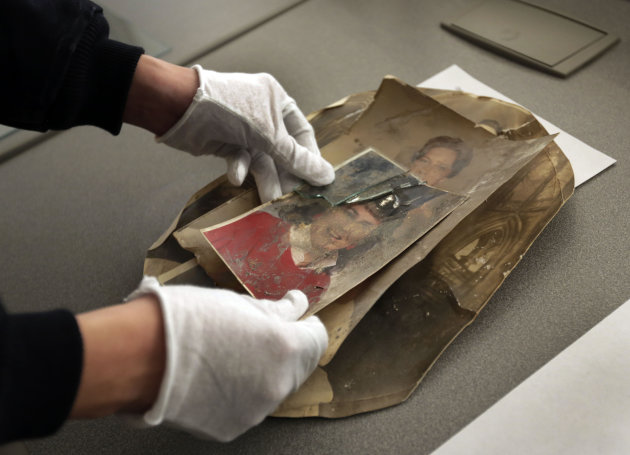
Operation Photo Rescue Restores Hurricane Sandy Victims' Photos


Of all the images of Superstorm Sandy's destruction, the ones that linger for Florence Catania are the torn, stained pictures that hung on her walls.

Her mother's decades-old wedding portrait, her own eighth-grade graduation photo, a snapshot that captured her mom on a carefree teenage day, all damaged in a Sandy-sparked fire at Catania's home in suburban Deer Park, N.Y.

But volunteers scattered around the world are about to start digitally mending Catania's personal photos and others battered by Sandy, banding together online to restore items that can't be rebought.

Founded after Hurricane Katrina, a nonprofit network of photographers, graphic artists and hobbyists has repaired more than 9,000 pictures discolored by floods, pockmarked by debris, speckled by mold and otherwise damaged by disasters in recent years. The Sandy project, which started this weekend, promises to be one of Operation Photo Rescue's most expert efforts yet.

"It means a lot to me," Catania said after bringing her photos to the restorers Saturday. "These are irreplaceable."

The restorers began shooting digital copies of the damaged prints with high-resolution professional cameras and specialized no-glare lighting Saturday at the School of Visual Arts in Manhattan, wearing white gloves to handle the images as though they were museum pieces.

Indeed, a Metropolitan Museum of Art imaging expert and two of the museum's photo conservators were on hand to provide advice, and two of the camera setups had been used to help the Atlanta-based King Center digitize hundreds of thousands of documents associated with Martin Luther King Jr.

After Catania left with her original prints, Operation Photo Rescue veteran Dennis McKeever glued himself to a computer screen, delicately copying snippets of forehead, sections of background, and overlaying them on similar, damaged areas of the wedding photo. Within about a half-hour, the retired computer network engineer had sewn up a sizeable gash in the portrait and was testing settings that might provide more visual data to help clean the apparently sepia-toned image.

"It's a matter of feeling your way through things," said McKeever, who has restored more than 100 photos through the group.

Other digital files would be uploaded to a password-protected website, where Operation Photo Rescue's roughly 3,000 volunteers can choose images they'd like to work on.

It's a painstaking process that can entail both resourcefulness — replacing a missing left foot by duplicating and reversing the right foot, for instance — and research. A volunteer might try to look up a flag in a photo's background to see how it's supposed to appear, as an example.

The average picture takes a few hours of work; some take as long as a week, said Operation Photo Rescue President Margie Hayes, a technical writer-turned-graphic artist. She got involved in the group after 2007 floods in nearby Coffeyville, Kan., about 120 miles from her home in El Dorado, Kan.

The refurbished prints are sent to the owners for free. Film-digitizing company DigMyPics has donated the printmaking and postage; PhotoShelter, a photography site, donates the online space where the images are stored for volunteers to see.

The Sandy effort also entailed other key contributions: three image-capturing stations, provided by Ken Allen Studios, a digital-imaging business, and JPMorgan Chase. The finance giant acquired the equipment to aid the King Center's digitization project and was "excited to provide this technology to enable families in the New York area to salvage family photos that would otherwise have been lost forever," Chief Information Officer Guy Chiarello said in a statement.

Such contributions are key for an organization that had to cut off $25-a-month stipends for some volunteers' Internet service when a grant dried up in 2009. Now it solicits members for donations whenever it mobilizes to a disaster area. Hayes said she raised about $3,000 for the New York trip, and she'd like to find a way to make a similar run to a Sandy-struck area of New Jersey.

Dave Ellis, the photography director at The Free Lance-Star of Fredericksburg, Va., and Rebecca Sell, who was then a photographer at the paper, launched Operation Photo Rescue in 2006, after Katrina struck the Gulf Coast the previous summer.

The group now counts volunteers in all 50 states and 75 other countries, about 50 to 100 of whom are very active, Hayes said.

It has responded to tornadoes, flash floods and tropical storms around the United States, amassing a gallery of before-and-after images that span generations: a formal childhood portrait, rippled and flecked with dirt. A black-and-white image of a Victorian-style mansion, faded to a hazy peach. A 1970s or '80s wedding photo, so waterlogged it looked as though the couple's faces had been scribbled on with crayons. Someone cradling a dog, the apparently decades-old snapshot splotched with a chemical yellow.

"We're really trying to restore people's family memories and community memories," said Katrin Eismann, an SVA professor. While she co-wrote the book that guides much of the volunteer effort, "Adobe Photoshop Restoration & Retouching," this weekend marked the first time she participated in person.

"If we didn't do it, after a while, those prints are just going to disintegrate."

Tuesday 5 December 2013

http://www.huffingtonpost.com/2013/02/04/operation-photo-rescue-hurricane-sandy_n_2613562.html

continue reading

Nigeria: No justice for the dead


Hundreds of fatal police shootings which each year leave families anguished and bereaved are not being investigated effectively because of a failure of the Nigerian justice system, Amnesty International says in a report released today.

Nigeria: No Justice for the Dead illustrates the gaps in the investigation of deaths following police action in Rivers State where basic techniques of crime scene protection and investigation are not applied and autopsies and inquests are either not carried out or are inadequate.

Relatives are often left with no answers about the fate of their family members and rarely receive justice.

Amnesty International believes Rivers State is representative of other Nigerian states where violent deaths at the hands of the police are not investigated adequately.

Medical and legal sources revealed that there is a practice of doctors signing death investigation reports without examining the body properly.

In many cases the identity of the deceased is not known to the police and bodies are registered as “unknown”. Little effort is made by police to identify them.

The lack of investigation in Nigeria means that many of the police officers who appear to have used unlawful lethal force enjoy impunity, seriously undermining human rights protections.

“To have one of your friends or family members killed by the authorities causes terrible anguish, but never to find out the truth of what actually happened to them causes a particular agony for relatives of the victims,” said Lucy Freeman, Amnesty International’s deputy director for Africa.

“Many of the victims killed by the police each year may have been unlawfully killed – including in what constitutes extrajudicial executions. Effective and impartial investigations are crucial in determining the truth about human rights violations, including extrajudicial executions, and gathering evidence to hold the perpetrators to account.”

Amnesty International found that in most cases of killings at the hands of the police, there was almost no action to hold them to account.

Pastor Ken Neele told Amnesty International that after learning of the shooting of his brother following police action in November 2011, he went to several hospitals in search of his body which he finally traced to Braithwaite Memorial Specialist Hospital in Port Harcourt - the capital of Rivers State.

Pastor Neele was distressed by the disrespectful handling of his brother’s body, which was lying at the bottom of a pile of other bodies. More than a year later, Pastor Neele has still not been able to bury his brother - police have yet to approve the body’s release.

Other families told Amnesty International of their distress at seeing the way in which their relatives were "dumped" in the mortuary.

When an Amnesty International researcher visited Braithwaite they found the mortuary overcrowded with bodies dumped in piles on the verandah or on benches.

While this mortuary has now closed down, reports from a number of sources suggest that most others in Nigeria operate similar practices.

“It is a sad truth that in Nigeria the victims of police brutality and their families rarely receive justice,” said Freeman.

“In spite of the existence of domestic law and international standards requiring the investigation of such deaths, the lack of proper autopsies and inquests mean the perpetrators of these crimes are simply getting away with it.”

Amnesty International is calling on the Federal and State Governments of Nigeria to investigate all violent deaths in Nigeria, to ensure adequate autopsies are carried out by qualified personnel, and to hold those guilty of unlawful killings to account.

Tuesday 5 February 2013

http://www.amnesty.org/en/news/nigeria-no-justice-dead-2013-02-05

continue reading

Microsoft, Israeli researchers develop disaster prediction software


Researchers have created software that predicts when and where disease outbreaks might occur based on two decades of New York Times articles and other online data. The research comes from Microsoft and the Technion-Israel Institute of Technology.

The system could someday help aid organizations and others be more proactive in tackling disease outbreaks or other problems, says Eric Horvitz, distinguished scientist and codirector at Microsoft Research. “I truly view this as a foreshadowing of what’s to come,” he says. “Eventually this kind of work will start to have an influence on how things go for people.” Horvitz did the research in collaboration with Kira Radinsky, a PhD researcher at the Technion-Israel Institute.

The system provides striking results when tested on historical data. For example, reports of droughts in Angola in 2006 triggered a warning about possible cholera outbreaks in the country, because previous events had taught the system that cholera outbreaks were more likely in years following droughts. A second warning about cholera in Angola was triggered by news reports of large storms in Africa in early 2007; less than a week later, reports appeared that cholera had become established. In similar tests involving forecasts of disease, violence, and a significant numbers of deaths, the system’s warnings were correct between 70 to 90 percent of the time.

Horvitz says the performance is good enough to suggest that a more refined version could be used in real settings, to assist experts at, for example, government aid agencies involved in planning humanitarian response and readiness. “We’ve done some reaching out and plan to do some follow-up work with such people,” says Horvitz.

The system was built using 22 years of New York Times archives, from 1986 to 2007, but it also draws on data from the Web to learn about what leads up to major news events.

“One source we found useful was DBpedia, which is a structured form of the information inside Wikipedia constructed using crowdsourcing,” says Radinsky. “We can understand, or see, the location of the places in the news articles, how much money people earn there, and even information about politics.” Other sources included WordNet, which helps software understand the meaning of words, and OpenCyc, a database of common knowledge.

All this information provides valuable context that’s not available in news article, and which is necessary to figure out general rules for what events precede others. For example, the system could infer connections between events in Rwandan and Angolan cities based on the fact that they are both in Africa, have similar GDPs, and other factors. That approach led the software to conclude that, in predicting cholera outbreaks, it should consider a country or city’s location, proportion of land covered by water, population density, GDP, and whether there had been a drought the year before.

Horvitz and Radinsky are not the first to consider using online news and other data to forecast future events, but they say they make use of more data sources—over 90 in total—which allows their system to be more general-purpose.

There’s already a small market for predictive tools. For example, a startup called Recorded Future makes predictions about future events harvested from forward-looking statements online and other sources, and it includes government intelligence agencies among its customers (see “See the Future With a Search”). Christopher Ahlberg, the company’s CEO and cofounder, says that the new research is “good work” that shows how predictions can be made using hard data, but also notes that turning the prototype system into a product would require further development.

Microsoft doesn’t have plans to commercialize Horvitz and Radinsky’s research as yet, but the project will continue, says Horvitz, who wants to mine more newspaper archives as well as digitized books.

Many things about the world have changed in recent decades, but human nature and many aspects of the environment have stayed the same, Horvitz says, so software may be able to learn patterns from even very old data that can suggest what’s ahead. “I’m personally interested in getting data further back in time,” he says.

Tuesday 5 February 2013

http://www.technologyreview.com/news/510191/software-predicts-tomorrows-news-by-analyzing-todays-and-yesterdays/

continue reading

Bridge collapse victims to get equal compensation


The government will equally compensate the families of 10 people who died in a fatal highway bridge collapse in Henan province, the website of Dahe Daily reported on Monday, citing officials at the rescue headquarters.

The news came after reports emerged quoting relatives of the victims born in rural areas saying they will get 180,000 yuan ($28,800) in compensation, or 220,000 yuan less than their counterparts from urban districts.

The government will apply the same compensation standards to every victim and will comply with the Supreme People's Court's interpretation of compensations for personal injuries, officials at the rescue headquarters said.

A truck overloaded with fireworks exploded and blasted off part of a viaduct about 30 meters above the ground in Mianchi county, Henan province, on Friday morning. Ten people died and 11 were injured.

Officials at the rescue headquarters have released the list with the names of the 10 deceased on Monday, and asked relatives to collect the bodies.

The victims were from Shandong and Jiangsu provinces and also from Henan province.

Monday 5 February 2013

http://english.sina.com/china/2013/0204/557774.html

continue reading

Monday, 4 February 2013

Paraguay investigators try to ID body of presidential hopeful Lino Oviedo after chopper crash


The bodies of Paraguayan presidential candidate Lino Oviedo and two other people killed in a helicopter crash over the weekend are so mutilated that they can’t be reconstructed and it will take longer to identify them.

Forensic doctor Pablo Lemir told reporters Monday that officials might identify the bodies through fingerprints. He said bones and pieces of skin have been stored in 32 body bags at a local morgue.

Oviedo was returning with his bodyguard from a political rally in northern Paraguay Saturday night when his pilot encountered bad weather. All three were killed in the crash.

“The crash was so powerful that the helicopter’s nose sank into the ground over a meter deep,” Lemir said. “I want to clarify that those aboard did not die of burns but were shattered by the impact, dismembered.”

The deadly crash ended a dramatic political career for Oviedo that included coups and several attempts to become the leader of this poor, grain-producing country.

Oviedo, 69, was running in April’s presidential elections as part of Paraguay’s third-largest opposition party, the National Union of Ethical Citizens (UNACE), but he was not among the favorites.

His widow, 59-year-old Raquel Marin, will take over the political leadership of the party after Oviedo’s funeral.

“She can’t run as a candidate for any elected post,” said Carmelo Benitez, a Mercosur trade bloc lawmaker representing the UNACE party, on local radio Monday.

“But she’ll take the helm of the party in the electoral campaign to make Oviedo’s dream come true: for Paraguay’s poor to be happy.”

The U.S.-made Robinson 44 helicopter crashed on a farm some 120 miles (200 kilometers) from the capital Asuncion.

The helicopter’s satellite transmissions system sent a meteorological signal every two minutes, and Paraguayan authorities have requested the helicopter’s U.S. makers for any data that can help with the probe, , said Carlos Fugarazzo, head of Paraguay’s civil aviation authority.

Monday 4 February 2013

http://www.washingtonpost.com/world/the_americas/paraguay-investigators-try-to-id-body-of-presidential-hopeful-lino-oviedo-after-chopper-crash/2013/02/04/f66b0f7a-6efd-11e2-b35a-0ee56f0518d2_story.html

continue reading

In the End, Numbers Become Names Again


For a few minutes on Friday, they became people again: Zahra Abdullah, formerly victim No. 7; her son Hadi, victim No. 10; and her daughter Myrna, No. 9.

For days they were among the nameless, corpses with numbers, lying in a refrigerator truck at this southern Lebanese town’s morgue.

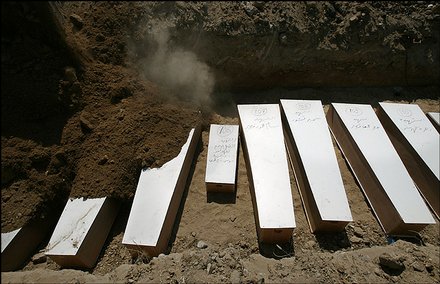
Health care workers took the bodies out of the trailer, placed them in simple coffins and buried them temporarily in a nearby field until they can be exhumed and given a more formal burial once the conflict, now in its 10th day, ends.

In a daylong event that was not quite a funeral, not quite interment, but a brief goodbye for a few grieving families that could attend, hospital workers and volunteers worked furiously to assemble the coffins, remove bodies from the truck, spray them with formaldehyde and bury them in the mass grave a few blocks away. In all, they buried 82 people, including more than 24 children who died in the past week.

»I didn’t sleep the whole night trying to make this happen,» said Ali Faramat, a local carpenter who spent the entire night cutting planks of wood, which young men from the neighborhood then turned into boxes.

Then the men spray painted names on the coffins, and for a few moments the bodies became people again, loved ones, memories.

No. 37 became Sally Wahbi, a 7-year-old who died in an attack on the Civil Defense Building in Tyre on Sunday. No. 35, Alia Alaedeen, who suffered serious head injuries as she was escaping the town of Sarifa on Wednesday and died Thursday. And No. 73 became Mariam Abdullah, who along with Zahra, Hadi and Myrna was among the 23 people killed in an Israeli attack on a pickup truck escaping the town of Marwaheen last Saturday.

»God, you gave her to me — now take her to heaven,» Mariam Abdullah’s mother moaned. »Take her to Paradise, and protect the victims of evil.»

The scene continued for several hours as bodies in plastic bags, some of them soaked in blood, were photographed and placed into coffins, which were then nailed shut and lined up. The numbers on the wall corresponding to those on the coffins only went up to 74, but the men continued to place bodies into coffins.

»We need a small coffin,» one of the men shouted. The crowd went silent, and soon a body the size of a doll came out, what one doctor called a posthumous birth from a pregnant mother in the trailer. The men broke into chants of »God is great.»

Halfway through, there was a bang as a plane dropped leaflets over the crowd warning them to move at once. »Due to the terrorist acts against the state of Israel that came from your villages and your homes, the Israeli Army has been forced to respond immediately against these acts even within your villages, for your own security,» the note read in Arabic. »You are ordered to leave your villages and head immediately north of the Litani River.»

»They talk about terrorism, but we see this as terrorism, too,» Mohammed Abdullah, 53, a retired army officer, observed quietly, bracing for bodies of his relatives to emerge. »But the United States is standing quiet, and that allows them to continue.»

He last saw his family on July 9, when they drove from their home in Beirut to Marwaheen, where they planned to set up the family’s summer house. He intended to join them next week, but last Saturday they called and said they were evacuating the village with several relatives after the Israelis warned them to leave.

When he saw a television report about an attack on a convoy headed from Marwaheen to Tyre, he immediately realized the implications. Only 4 of the 27 passengers in the pickup survived, among them his daughter Marwa, 10.

He wished he could bury them in Marwaheen, he said, but it was impossible to do so with the roads bombed and the shelling continuing. So he relented and accepted having them temporarily buried Friday.

It took until the afternoon for all 82 coffins to be loaded onto two Lebanese Army trucks. The trucks pulled into a trench gouged by a tractor, and the men began unloading the coffins, placing them side by side, grouped by family name.

»If you speak the truth here you are called a traitor,» Mr. Abdullah said. »But we all know that this is a war between Iran and America. I am paying part of the price for it.» Then he suddenly grew pensive as he stood at the edge of the trench.

»That’s my daughter, No. 9,» he said, pointing at a coffin coming out of the truck as. »It’s a nice number, don’t you think? And No. 7, it’s a nice number, too. It’s my wife. And there’s No. 10. I hope they will be lucky.»

Monday 4 February 2013

http://chtivo.org/archives/1849

continue reading

Commemorative service at mass grave memorial, Mrkonjic Grad


The residents of Mrkonjic Grad today celebrate Municipality Day, which was established in memory of February 4, 1996, when Mrkonjic Grad residents returned to their homes after five months of exile.

On that occasion, a commemorative service was said at the chapel of St. Marko for veterans killed in the Homeland War, after which delegations of the Municipality and the Veterans Organisation laid flowers at the mass grave memorial at the Orthodox cemetery and at the central monument to fallen soldiers in front of the Cultural Centre.

Mrkonjic Grad mayor Divna Anicic said it is sad that fully 17 years after the war, no one has been brought to justice for war crimes committed in this town and that the hope remains that in the end, someone will finally be prosecuted for these crimes.

“We are witnesses to the fact that Croatian Generals Ante Gotovina and Mladen Markac were not tried for the crimes committed in the Storm operation, and this really leaves a taste of bitterness. We wait and believe that some future generation will see this done and that Croatia will face justice,” Anicic said.

One of the largest mass graves in Republika Srpska, containing 181 bodies, was discovered in Mrkonjic Grad. Autopsies revealed that all the victims were bestially tortured and killed.

In addition to this mass grave, there were a number of smaller graves from which a total of 364 bodies were exhumed.

The families of the victims say they are embittered that no one has been brought to justice for these crimes, even though all necessary evidence is available, those who ordered the crimes are known, and documentation was surrendered to Prosecutions.

Mrkonjic resident Zdravko Karac, who found the mortal remains of his brother in the mass grave, says that the sight was horrific.

“I initiated the opening of the grave. It was a disaster; you cannot even imagine what I saw. They were all brutally killed, including my brother. And after so much time, it seems to me that these cases are wilfully kept concealed,” Karac said.

Milan Stevanic, the president of the Municipal Veterans Organisation, called on all prosecutors to open the case of the mass grave in Mrkonjic Grad.

1,214 bodies have been exhumed in Mrkonjic Grad so far, and another 420 persons are listed as missing.

In 117 days of aggression against Mrkonjic Grad Municipality, Croatian forces destroyed and torched 2,308 housing units, some 3,000 were ruined and looted, and the war damage was estimated at some KM 670 million.

Monday 4 February 2013

http://www.srna.rs/novosti/75925/flowers-laid-at-a-mass-grave-memorial-.htm

continue reading

Turkey: New Finds Reignite Search for Kurdish Mass Graves


For the people living in the predominately-Kurdish southeast region of Turkey, the fact that their region is dotted with the mass graves of victims of the political violence that haunted the area in the 1980′s and 90′s has long been an open secret, although one that few talked about in public. That changed several years ago, especially because of the high-profile Ergenekon case – an investigation into an alleged ultara-nationalist plot to topple the government — which, despite its flaws, has managed to land some formerly untouchable military and political figures in jail and shed some light on dirty deeds committed by the Turkish state.

Emboldened by the Ergenekon case and other efforts to root out Turkey’s “Deep State,” Kurdish activists in the southeast have started to make more forceful demands for these suspected mass grave sites to be excavated, part of an effort to determine the fate of the several thousand Kurds who went missing during the 80′s and 90′s during the fight between the outlawed Kurdistan Workers’ Party (PKK) and security forces.The Diyarbakir branch of the Turkish Human Rights Association, for example, has published on its website an interactive map of suspected mass grave sites. Also in Diyarbakir, a recent petition made by relatives of several missing person has led to a court-ordered excavation that so far has revealed the remains of some 23 people. From a report on the Bianet website:

The number of skulls found in a mass grave in the district of Saraykapฤฑ (ฤฐรงkale/Diyarbakฤฑr) rose to 23. Relatives of disappeared persons applied to the prosecutor’s office on 25 January with the requests to identify the bones and bring the responsible people to court.

In the 1990s, the building right next to the excavation area was used by the Gendarmerie Intelligence Anti-Terrorism Unit (JฤฐTEM), an unofficial wing of the Gendarmerie established in the late 1980s to counter ethnic separatism in south-eastern Turkey. The location is close to the Diyarbakฤฑr Closed Prison and the Saraykapฤฑ Courthouse…. ….On 25 January, executives of the Human Rights Association (ฤฐHD) Diyarbakฤฑr Branch applied to the Diyarbakฤฑr Public Chief Prosecution together with 36 families whose relatives went missing in police custody or became victims of unsolved murders. The families demanded to identify the bones found in the course of the excavations and to find the responsible perpetrators. ฤฐHD Diyarbakฤฑr Branch Secretary Raci Bilici said in a statement released before the application was submitted, “Saraykapฤฑ, the location where the human bodies were found, is not an ordinary place. This was the place of the JฤฐTEM headquarters where people were being executed”.

Furthermore, Bilici announced, “Everyone in the region knows that massacres were done there. The only one who does not know about it is probably the state that did not undertake any investigation despite all our efforts”. Digging for the truth in southeast Turkey could prove to be a major challenge for the Turkish government and Turkish society, which may now find themselves forced to face a very dark chapter in the country’s modern history. As columnist Yavuz Baydar writes in Today’s Zaman, the dig in Diyarbakir is only the tip of something much deeper: The skulls discovered in Diyarbakฤฑr are only the beginning, according to human rights activists. There are many eyewitnesses and “confessors” who will point out other spots. But, they also expect concrete and bold steps for taking everybody responsible to court. Everybody.

Unveiling the past, near or distant, is a huge task for the government, media and the citizens. Skulls are buried in the earth, and there is an immense number of skeletons in Ankara’s political cupboards. It is now apparent to many people here that the painful, often bloody abuse of power under military tutelage was a work of continuity: Digging for the truth in the dark corners of the last decade leads to the ones hidden in the 1990s, which points to the 1980s and so on. For more on the issue of the Kurdish mass graves and the search for the missing in the southeast, take a look at this story I filed for the Christian Science Monitor in 2009 on one family’s successful effort to find the remains of a relative who had disappeared in 1993.

Monday 4 February 2013

http://ikjnews.com/?p=3250

continue reading