Tuesday, 5 February 2013

Paint helps prove identity in 2001 death at Burger King


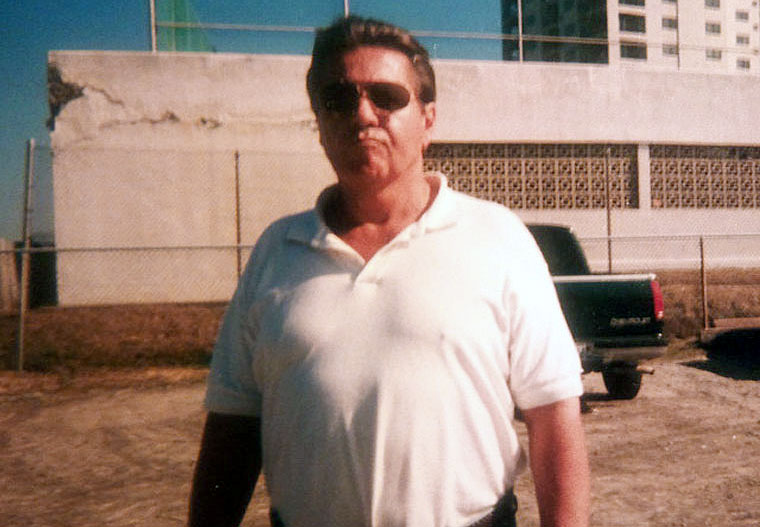
It took more than 11 years, but police have finally identified a man who dropped dead in a Burger King on Laskin Road.

His name was Samuel Ray Barnard. He was 58, lived in the 600 block of Hunter Court, and died of natural causes on Oct. 16, 2001, the day he ran into the restaurant carrying no identification and fell on the floor, according to police.

It was a spot of paint that identified him in the end, said Officer Jimmy Barnes, a police spokesman. Detective Kevin Lokey, who works in the department's missing-persons unit, figured it out while going through old files, Barnes said.

Lokey noticed the death investigation report written at the time and a missing-person report filed a few months later by a Virginia Beach landlord both reported paint on the man's clothing.

Lokey discovered that the day Barnard died, he was working as a house painter at a nearby apartment complex. At the time, no one came forward to identify him, and the case remained unsolved.

"That was just good old detective work," Barnes said. "And starting from scratch, reading hundreds of missing-person reports."

Tuesday 5 February 2013

http://hamptonroads.com/2013/02/paint-helps-prove-identity-2001-death-burger-king

continue reading

Brazil nightclub fire claims new victim, death toll at 238


A 20-year-old man died on Tuesday from injuries sustained during a January 27 fire at a nightclub in southern Brazil, bringing the death toll from the disaster to 238 and adding to concerns it may rise further.

The health department for Rio Grande do Sul state, where the Kiss nightclub in the college town of Santa Maria is located, did not give a precise cause for the death at the Santa Rosa hospital in Porto Alegre, the state's capital.

Investigators last week said most of the deaths occurred when victims inhaled toxic fumes, such as cyanide, after a flare lit by a band member ignited soundproofing foam in the ceiling, turning the club into a gas chamber in minutes.

Eighty-one people remain hospitalized in Rio Grande do Sul, including 23 on respirators, the health department said. That is down from 126 people that were hospitalized on Friday.

Authorities fear some survivors may have to return to the hospitals, with potentially fatal consequences, because symptoms for late-onset pneumonia could appear gradually.

The U.S. government shipped cyanide-treatment kits to Brazil over the weekend, though a health official warned the hydroxocobalamin medicine they contained would not address other toxins the victims likely inhaled.

Police last week detained two owners of the club and two band members as they look into safety violations including the use of the flare, which was banned for indoor use, and faulty fire extinguishers, exit signs, and blocked access to the club's only exit.

The four detainees have not been charged, but police have said at minimum they are likely to face manslaughter charges.

The latest victim's name was not revealed at the request of his family.

Tuesday 5 February 2013

http://www.reuters.com/article/2013/02/05/us-brazil-nightclub-deaths-idUSBRE91411V20130205

continue reading

Rewa: Rice mill wall collapse leaves 9 dead, 12 hurt


Nine persons were killed and eighteen others grievously injured after a wall under construction in a warehouse belonging to the brother of a Madhya Pradesh minister collapsed on Monday afternoon.

All persons killed and injured have been identified as labourers and masons engaged in construction of the massive wall. The incident occurred around 3pm in the Jeula area adjoining Rewa town, 511km from here.

According to the district administration, more than a hundred labourers were engaged in the construction work when all on a sudden the entire structure collapsed trapping the masons under the debris. Nine dead bodies were found under the debris.

District collector Shiv Narayan Rupla said that the warehouse belongs to Mahendra Shukla, brother of Madhya Pradesh minister for energy and mining resources Rajendra Shukla.

The minister is an MLA from Rewa assembly constituency and the spot of the incident is part of that area. The injured labourers have been rushed to the district hospital where they are undergoing treatment.

Tuesday 5 February 2012

http://timesofindia.indiatimes.com/city/bhopal/Wall-collapse-in-warehouse-belonging-to-MP-ministers-kin-kills-nine/articleshow/18336343.cms

continue reading

The atrocities of the Sinai Desert


The desert is located on the Egyptian Peninsula, spanning to the neighbouring border of Israel. African refugees, fleeing their homelands due to various forms of persecution, offer money to Bedouin guides to take them to the Egypt-Israel border. Corrupt Bedouin guides then lead the refugees, including women and children, to a detention site where they are tortured and held for ransom.

According to Human Rights Watch, the captives are forced to make calls to relatives, instructing them to make the payments in exchange for their lives. During these phone calls the smugglers physically abuse their victims to create a sense of urgency for their relatives. If their family members are unable to provide the ransom, the traffickers threaten to harvest their organs. Details of these events have recently been surfacing with personal testimonials.

According to rights groups, refugees -- from places like Ethiopia, Eritrea or Sudan -- are enslaved and tortured and the women raped if they cannot come up with the large sums of money the Bedouin try to extort from them and their families to smuggle them into Israel.

No Bedouin leaders in the Sinai were willing to speak openly about the organ theft. Tribal leaders said they had only heard rumors.

Hamdy Al-Azazy, head of New Generation Foundation has forensic photographic evidence of corpses with distinctive scars in the abdominal area. All of the photos were taken in a morgue in the Egyptian port town of El Arish.

"The organs are not useful if they're dead," Al-Azazy says. "They drug them first and remove their organs, then leave them to die and dump them in a deep dry well along with hundreds of bodies."

Al-Azazy says he was once taken to a mass burial area where these bodies were later discarded. He says he believes corrupt Egyptian doctors work in concert with the Bedouins. He believes the doctors arrive at the Sinai with mobile hospital units to remove in demand corneas, livers and kidneys.

"Mobile clinics using advanced technology come from a private hospital in Cairo to an area in the deserts of Mid-Sinai and conduct physicals on the Africans before they choose those suitable, then they conduct the operation," Al-Azazy said.

CNN reporters then showed some of the photos of the dead to a forensic expert.

"There are two kinds of scars. One is from a postmortem autopsy and one from surgery," Dr. Fakhry Saleh, the former head of Cairo's forensic department and an expert on the illegal organ trade says. The doctor pointed to a scar that he believes came from an operation that must have been performed shortly before the person died.

Saleh says that the operation was conducted no more than 48 hours before death, indicated by the freshness of the scars. All the scars presented in the photo were in the area of the liver and kidney. "They are good stitches in the area of the liver and the kidney," Saleh said.

"They could open you up, take it out and just let you die. The mafia does not care whether you live or die. When they cut you open, it would be very painful, so they would give you anesthesia," Saleh added.

"Organ trade is the second most profitable trade behind only weapons trade," he said. "It brings in more money than drug dealing and prostitution."

The Sawarka Bedouin tribe, one of the largest in the Sinai, was named by one Bedouin source as being involved in organ thefts. No Bedouin leaders in the Sinai were willing to speak openly about the organ theft. Tribal leaders said they had only heard rumors.

A Sawarka leader said he was aware that people trafficking was going on in Sinai and that in some cases refugees were held in bonded labor and tortured. But he added only rogue elements of his tribe were involved.

While Saleh says he has never heard of organ theft involving African refugees, he says it seems highly probable that the scars on the bodies come from organ removal.

"They could open you up, take it out and just let you die. The mafia does not care whether you live or die. When they cut you open, it would be very painful, so they would give you anesthesia," Saleh later said.

Saleh has done extensive research on the illegal organ business in Egypt, which preys on poor people. The World Health Organization in a recent report called Egypt a regional hub for the trade.

An investigation headed by Saleh found illegal organ trafficking to be one of the most profitable criminal activities.

"Organ trade is the second most profitable trade behind only weapons trade," he said. "It brings in more money than drug dealing and prostitution."

One Bedouin tribal chief did put CNN in touch with a Bedouin who used to be involved in people smuggling and who was close to the organ theft scheme. The source spoke on condition of anonymity but offered insights into the scheme.

"The doctors deal directly with the Sawarka family, and they buy the organs starting from $20,000," the source said in a phone interview.

He offered further details of the logistics required to keep the organs fresh for the transplant into their new owners' bodies: "The doctors come with some sort of mobile fridge where the organs can be stored for six to eight hours and resold in Cairo or elsewhere."

The source claimed doctors from Cairo are involved in the organ theft, a claim that has proved impossible to verify.

"It's like spare parts for cars," the Bedouin, who later agreed to meet one member of the CNN crew in person, said sarcastically toward the end of the interview.

A second Bedouin, who also refused to be identified, later gave a similar account.

The police general in charge of security in Northern Sinai tells CNN that his forces are aware that organ trafficking and theft are going on in their area of operations but that the authorities have not identified who is behind the schemes.

Tuesday 5 February 2012

http://www.africanoutlookonline.com/index.php?option=com_content&view=article&id=3186:african-refugees-face-organ-theft-gruesome-death-in-the-sinai&catid=99:outlookscroller

http://www.themanitoban.com/2013/02/the-atrocities-of-the-sinai-desert/14049/

continue reading

Operation Photo Rescue Restores Hurricane Sandy Victims' Photos


Of all the images of Superstorm Sandy's destruction, the ones that linger for Florence Catania are the torn, stained pictures that hung on her walls.

Her mother's decades-old wedding portrait, her own eighth-grade graduation photo, a snapshot that captured her mom on a carefree teenage day, all damaged in a Sandy-sparked fire at Catania's home in suburban Deer Park, N.Y.

But volunteers scattered around the world are about to start digitally mending Catania's personal photos and others battered by Sandy, banding together online to restore items that can't be rebought.

Founded after Hurricane Katrina, a nonprofit network of photographers, graphic artists and hobbyists has repaired more than 9,000 pictures discolored by floods, pockmarked by debris, speckled by mold and otherwise damaged by disasters in recent years. The Sandy project, which started this weekend, promises to be one of Operation Photo Rescue's most expert efforts yet.

"It means a lot to me," Catania said after bringing her photos to the restorers Saturday. "These are irreplaceable."

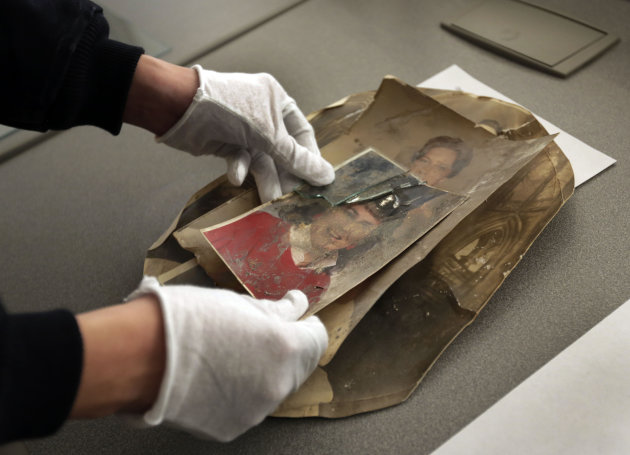
The restorers began shooting digital copies of the damaged prints with high-resolution professional cameras and specialized no-glare lighting Saturday at the School of Visual Arts in Manhattan, wearing white gloves to handle the images as though they were museum pieces.

Indeed, a Metropolitan Museum of Art imaging expert and two of the museum's photo conservators were on hand to provide advice, and two of the camera setups had been used to help the Atlanta-based King Center digitize hundreds of thousands of documents associated with Martin Luther King Jr.

After Catania left with her original prints, Operation Photo Rescue veteran Dennis McKeever glued himself to a computer screen, delicately copying snippets of forehead, sections of background, and overlaying them on similar, damaged areas of the wedding photo. Within about a half-hour, the retired computer network engineer had sewn up a sizeable gash in the portrait and was testing settings that might provide more visual data to help clean the apparently sepia-toned image.

"It's a matter of feeling your way through things," said McKeever, who has restored more than 100 photos through the group.

Other digital files would be uploaded to a password-protected website, where Operation Photo Rescue's roughly 3,000 volunteers can choose images they'd like to work on.

It's a painstaking process that can entail both resourcefulness — replacing a missing left foot by duplicating and reversing the right foot, for instance — and research. A volunteer might try to look up a flag in a photo's background to see how it's supposed to appear, as an example.

The average picture takes a few hours of work; some take as long as a week, said Operation Photo Rescue President Margie Hayes, a technical writer-turned-graphic artist. She got involved in the group after 2007 floods in nearby Coffeyville, Kan., about 120 miles from her home in El Dorado, Kan.

The refurbished prints are sent to the owners for free. Film-digitizing company DigMyPics has donated the printmaking and postage; PhotoShelter, a photography site, donates the online space where the images are stored for volunteers to see.

The Sandy effort also entailed other key contributions: three image-capturing stations, provided by Ken Allen Studios, a digital-imaging business, and JPMorgan Chase. The finance giant acquired the equipment to aid the King Center's digitization project and was "excited to provide this technology to enable families in the New York area to salvage family photos that would otherwise have been lost forever," Chief Information Officer Guy Chiarello said in a statement.

Such contributions are key for an organization that had to cut off $25-a-month stipends for some volunteers' Internet service when a grant dried up in 2009. Now it solicits members for donations whenever it mobilizes to a disaster area. Hayes said she raised about $3,000 for the New York trip, and she'd like to find a way to make a similar run to a Sandy-struck area of New Jersey.

Dave Ellis, the photography director at The Free Lance-Star of Fredericksburg, Va., and Rebecca Sell, who was then a photographer at the paper, launched Operation Photo Rescue in 2006, after Katrina struck the Gulf Coast the previous summer.

The group now counts volunteers in all 50 states and 75 other countries, about 50 to 100 of whom are very active, Hayes said.

It has responded to tornadoes, flash floods and tropical storms around the United States, amassing a gallery of before-and-after images that span generations: a formal childhood portrait, rippled and flecked with dirt. A black-and-white image of a Victorian-style mansion, faded to a hazy peach. A 1970s or '80s wedding photo, so waterlogged it looked as though the couple's faces had been scribbled on with crayons. Someone cradling a dog, the apparently decades-old snapshot splotched with a chemical yellow.

"We're really trying to restore people's family memories and community memories," said Katrin Eismann, an SVA professor. While she co-wrote the book that guides much of the volunteer effort, "Adobe Photoshop Restoration & Retouching," this weekend marked the first time she participated in person.

"If we didn't do it, after a while, those prints are just going to disintegrate."

Tuesday 5 December 2013

http://www.huffingtonpost.com/2013/02/04/operation-photo-rescue-hurricane-sandy_n_2613562.html

continue reading

Nigeria: No justice for the dead


Hundreds of fatal police shootings which each year leave families anguished and bereaved are not being investigated effectively because of a failure of the Nigerian justice system, Amnesty International says in a report released today.

Nigeria: No Justice for the Dead illustrates the gaps in the investigation of deaths following police action in Rivers State where basic techniques of crime scene protection and investigation are not applied and autopsies and inquests are either not carried out or are inadequate.

Relatives are often left with no answers about the fate of their family members and rarely receive justice.

Amnesty International believes Rivers State is representative of other Nigerian states where violent deaths at the hands of the police are not investigated adequately.

Medical and legal sources revealed that there is a practice of doctors signing death investigation reports without examining the body properly.

In many cases the identity of the deceased is not known to the police and bodies are registered as “unknown”. Little effort is made by police to identify them.

The lack of investigation in Nigeria means that many of the police officers who appear to have used unlawful lethal force enjoy impunity, seriously undermining human rights protections.

“To have one of your friends or family members killed by the authorities causes terrible anguish, but never to find out the truth of what actually happened to them causes a particular agony for relatives of the victims,” said Lucy Freeman, Amnesty International’s deputy director for Africa.

“Many of the victims killed by the police each year may have been unlawfully killed – including in what constitutes extrajudicial executions. Effective and impartial investigations are crucial in determining the truth about human rights violations, including extrajudicial executions, and gathering evidence to hold the perpetrators to account.”

Amnesty International found that in most cases of killings at the hands of the police, there was almost no action to hold them to account.

Pastor Ken Neele told Amnesty International that after learning of the shooting of his brother following police action in November 2011, he went to several hospitals in search of his body which he finally traced to Braithwaite Memorial Specialist Hospital in Port Harcourt - the capital of Rivers State.

Pastor Neele was distressed by the disrespectful handling of his brother’s body, which was lying at the bottom of a pile of other bodies. More than a year later, Pastor Neele has still not been able to bury his brother - police have yet to approve the body’s release.

Other families told Amnesty International of their distress at seeing the way in which their relatives were "dumped" in the mortuary.

When an Amnesty International researcher visited Braithwaite they found the mortuary overcrowded with bodies dumped in piles on the verandah or on benches.

While this mortuary has now closed down, reports from a number of sources suggest that most others in Nigeria operate similar practices.

“It is a sad truth that in Nigeria the victims of police brutality and their families rarely receive justice,” said Freeman.

“In spite of the existence of domestic law and international standards requiring the investigation of such deaths, the lack of proper autopsies and inquests mean the perpetrators of these crimes are simply getting away with it.”

Amnesty International is calling on the Federal and State Governments of Nigeria to investigate all violent deaths in Nigeria, to ensure adequate autopsies are carried out by qualified personnel, and to hold those guilty of unlawful killings to account.

Tuesday 5 February 2013

http://www.amnesty.org/en/news/nigeria-no-justice-dead-2013-02-05

continue reading

Microsoft, Israeli researchers develop disaster prediction software


Researchers have created software that predicts when and where disease outbreaks might occur based on two decades of New York Times articles and other online data. The research comes from Microsoft and the Technion-Israel Institute of Technology.

The system could someday help aid organizations and others be more proactive in tackling disease outbreaks or other problems, says Eric Horvitz, distinguished scientist and codirector at Microsoft Research. “I truly view this as a foreshadowing of what’s to come,” he says. “Eventually this kind of work will start to have an influence on how things go for people.” Horvitz did the research in collaboration with Kira Radinsky, a PhD researcher at the Technion-Israel Institute.

The system provides striking results when tested on historical data. For example, reports of droughts in Angola in 2006 triggered a warning about possible cholera outbreaks in the country, because previous events had taught the system that cholera outbreaks were more likely in years following droughts. A second warning about cholera in Angola was triggered by news reports of large storms in Africa in early 2007; less than a week later, reports appeared that cholera had become established. In similar tests involving forecasts of disease, violence, and a significant numbers of deaths, the system’s warnings were correct between 70 to 90 percent of the time.

Horvitz says the performance is good enough to suggest that a more refined version could be used in real settings, to assist experts at, for example, government aid agencies involved in planning humanitarian response and readiness. “We’ve done some reaching out and plan to do some follow-up work with such people,” says Horvitz.

The system was built using 22 years of New York Times archives, from 1986 to 2007, but it also draws on data from the Web to learn about what leads up to major news events.

“One source we found useful was DBpedia, which is a structured form of the information inside Wikipedia constructed using crowdsourcing,” says Radinsky. “We can understand, or see, the location of the places in the news articles, how much money people earn there, and even information about politics.” Other sources included WordNet, which helps software understand the meaning of words, and OpenCyc, a database of common knowledge.

All this information provides valuable context that’s not available in news article, and which is necessary to figure out general rules for what events precede others. For example, the system could infer connections between events in Rwandan and Angolan cities based on the fact that they are both in Africa, have similar GDPs, and other factors. That approach led the software to conclude that, in predicting cholera outbreaks, it should consider a country or city’s location, proportion of land covered by water, population density, GDP, and whether there had been a drought the year before.

Horvitz and Radinsky are not the first to consider using online news and other data to forecast future events, but they say they make use of more data sources—over 90 in total—which allows their system to be more general-purpose.

There’s already a small market for predictive tools. For example, a startup called Recorded Future makes predictions about future events harvested from forward-looking statements online and other sources, and it includes government intelligence agencies among its customers (see “See the Future With a Search”). Christopher Ahlberg, the company’s CEO and cofounder, says that the new research is “good work” that shows how predictions can be made using hard data, but also notes that turning the prototype system into a product would require further development.

Microsoft doesn’t have plans to commercialize Horvitz and Radinsky’s research as yet, but the project will continue, says Horvitz, who wants to mine more newspaper archives as well as digitized books.

Many things about the world have changed in recent decades, but human nature and many aspects of the environment have stayed the same, Horvitz says, so software may be able to learn patterns from even very old data that can suggest what’s ahead. “I’m personally interested in getting data further back in time,” he says.

Tuesday 5 February 2013

http://www.technologyreview.com/news/510191/software-predicts-tomorrows-news-by-analyzing-todays-and-yesterdays/

continue reading

Bridge collapse victims to get equal compensation


The government will equally compensate the families of 10 people who died in a fatal highway bridge collapse in Henan province, the website of Dahe Daily reported on Monday, citing officials at the rescue headquarters.

The news came after reports emerged quoting relatives of the victims born in rural areas saying they will get 180,000 yuan ($28,800) in compensation, or 220,000 yuan less than their counterparts from urban districts.

The government will apply the same compensation standards to every victim and will comply with the Supreme People's Court's interpretation of compensations for personal injuries, officials at the rescue headquarters said.

A truck overloaded with fireworks exploded and blasted off part of a viaduct about 30 meters above the ground in Mianchi county, Henan province, on Friday morning. Ten people died and 11 were injured.

Officials at the rescue headquarters have released the list with the names of the 10 deceased on Monday, and asked relatives to collect the bodies.

The victims were from Shandong and Jiangsu provinces and also from Henan province.

Monday 5 February 2013

http://english.sina.com/china/2013/0204/557774.html

continue reading

Monday, 4 February 2013

Paraguay investigators try to ID body of presidential hopeful Lino Oviedo after chopper crash


The bodies of Paraguayan presidential candidate Lino Oviedo and two other people killed in a helicopter crash over the weekend are so mutilated that they can’t be reconstructed and it will take longer to identify them.

Forensic doctor Pablo Lemir told reporters Monday that officials might identify the bodies through fingerprints. He said bones and pieces of skin have been stored in 32 body bags at a local morgue.

Oviedo was returning with his bodyguard from a political rally in northern Paraguay Saturday night when his pilot encountered bad weather. All three were killed in the crash.

“The crash was so powerful that the helicopter’s nose sank into the ground over a meter deep,” Lemir said. “I want to clarify that those aboard did not die of burns but were shattered by the impact, dismembered.”

The deadly crash ended a dramatic political career for Oviedo that included coups and several attempts to become the leader of this poor, grain-producing country.

Oviedo, 69, was running in April’s presidential elections as part of Paraguay’s third-largest opposition party, the National Union of Ethical Citizens (UNACE), but he was not among the favorites.

His widow, 59-year-old Raquel Marin, will take over the political leadership of the party after Oviedo’s funeral.

“She can’t run as a candidate for any elected post,” said Carmelo Benitez, a Mercosur trade bloc lawmaker representing the UNACE party, on local radio Monday.

“But she’ll take the helm of the party in the electoral campaign to make Oviedo’s dream come true: for Paraguay’s poor to be happy.”

The U.S.-made Robinson 44 helicopter crashed on a farm some 120 miles (200 kilometers) from the capital Asuncion.

The helicopter’s satellite transmissions system sent a meteorological signal every two minutes, and Paraguayan authorities have requested the helicopter’s U.S. makers for any data that can help with the probe, , said Carlos Fugarazzo, head of Paraguay’s civil aviation authority.

Monday 4 February 2013

http://www.washingtonpost.com/world/the_americas/paraguay-investigators-try-to-id-body-of-presidential-hopeful-lino-oviedo-after-chopper-crash/2013/02/04/f66b0f7a-6efd-11e2-b35a-0ee56f0518d2_story.html

continue reading

In the End, Numbers Become Names Again


For a few minutes on Friday, they became people again: Zahra Abdullah, formerly victim No. 7; her son Hadi, victim No. 10; and her daughter Myrna, No. 9.

For days they were among the nameless, corpses with numbers, lying in a refrigerator truck at this southern Lebanese town’s morgue.

Health care workers took the bodies out of the trailer, placed them in simple coffins and buried them temporarily in a nearby field until they can be exhumed and given a more formal burial once the conflict, now in its 10th day, ends.

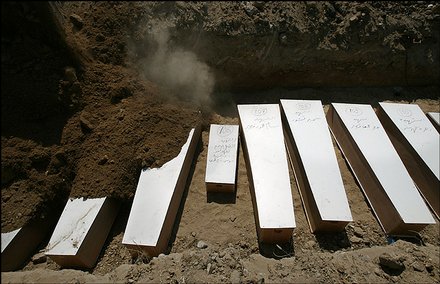
In a daylong event that was not quite a funeral, not quite interment, but a brief goodbye for a few grieving families that could attend, hospital workers and volunteers worked furiously to assemble the coffins, remove bodies from the truck, spray them with formaldehyde and bury them in the mass grave a few blocks away. In all, they buried 82 people, including more than 24 children who died in the past week.

»I didn’t sleep the whole night trying to make this happen,» said Ali Faramat, a local carpenter who spent the entire night cutting planks of wood, which young men from the neighborhood then turned into boxes.

Then the men spray painted names on the coffins, and for a few moments the bodies became people again, loved ones, memories.

No. 37 became Sally Wahbi, a 7-year-old who died in an attack on the Civil Defense Building in Tyre on Sunday. No. 35, Alia Alaedeen, who suffered serious head injuries as she was escaping the town of Sarifa on Wednesday and died Thursday. And No. 73 became Mariam Abdullah, who along with Zahra, Hadi and Myrna was among the 23 people killed in an Israeli attack on a pickup truck escaping the town of Marwaheen last Saturday.

»God, you gave her to me — now take her to heaven,» Mariam Abdullah’s mother moaned. »Take her to Paradise, and protect the victims of evil.»

The scene continued for several hours as bodies in plastic bags, some of them soaked in blood, were photographed and placed into coffins, which were then nailed shut and lined up. The numbers on the wall corresponding to those on the coffins only went up to 74, but the men continued to place bodies into coffins.

»We need a small coffin,» one of the men shouted. The crowd went silent, and soon a body the size of a doll came out, what one doctor called a posthumous birth from a pregnant mother in the trailer. The men broke into chants of »God is great.»

Halfway through, there was a bang as a plane dropped leaflets over the crowd warning them to move at once. »Due to the terrorist acts against the state of Israel that came from your villages and your homes, the Israeli Army has been forced to respond immediately against these acts even within your villages, for your own security,» the note read in Arabic. »You are ordered to leave your villages and head immediately north of the Litani River.»

»They talk about terrorism, but we see this as terrorism, too,» Mohammed Abdullah, 53, a retired army officer, observed quietly, bracing for bodies of his relatives to emerge. »But the United States is standing quiet, and that allows them to continue.»

He last saw his family on July 9, when they drove from their home in Beirut to Marwaheen, where they planned to set up the family’s summer house. He intended to join them next week, but last Saturday they called and said they were evacuating the village with several relatives after the Israelis warned them to leave.

When he saw a television report about an attack on a convoy headed from Marwaheen to Tyre, he immediately realized the implications. Only 4 of the 27 passengers in the pickup survived, among them his daughter Marwa, 10.

He wished he could bury them in Marwaheen, he said, but it was impossible to do so with the roads bombed and the shelling continuing. So he relented and accepted having them temporarily buried Friday.

It took until the afternoon for all 82 coffins to be loaded onto two Lebanese Army trucks. The trucks pulled into a trench gouged by a tractor, and the men began unloading the coffins, placing them side by side, grouped by family name.

»If you speak the truth here you are called a traitor,» Mr. Abdullah said. »But we all know that this is a war between Iran and America. I am paying part of the price for it.» Then he suddenly grew pensive as he stood at the edge of the trench.

»That’s my daughter, No. 9,» he said, pointing at a coffin coming out of the truck as. »It’s a nice number, don’t you think? And No. 7, it’s a nice number, too. It’s my wife. And there’s No. 10. I hope they will be lucky.»

Monday 4 February 2013

http://chtivo.org/archives/1849

continue reading

Commemorative service at mass grave memorial, Mrkonjic Grad


The residents of Mrkonjic Grad today celebrate Municipality Day, which was established in memory of February 4, 1996, when Mrkonjic Grad residents returned to their homes after five months of exile.

On that occasion, a commemorative service was said at the chapel of St. Marko for veterans killed in the Homeland War, after which delegations of the Municipality and the Veterans Organisation laid flowers at the mass grave memorial at the Orthodox cemetery and at the central monument to fallen soldiers in front of the Cultural Centre.

Mrkonjic Grad mayor Divna Anicic said it is sad that fully 17 years after the war, no one has been brought to justice for war crimes committed in this town and that the hope remains that in the end, someone will finally be prosecuted for these crimes.

“We are witnesses to the fact that Croatian Generals Ante Gotovina and Mladen Markac were not tried for the crimes committed in the Storm operation, and this really leaves a taste of bitterness. We wait and believe that some future generation will see this done and that Croatia will face justice,” Anicic said.

One of the largest mass graves in Republika Srpska, containing 181 bodies, was discovered in Mrkonjic Grad. Autopsies revealed that all the victims were bestially tortured and killed.

In addition to this mass grave, there were a number of smaller graves from which a total of 364 bodies were exhumed.

The families of the victims say they are embittered that no one has been brought to justice for these crimes, even though all necessary evidence is available, those who ordered the crimes are known, and documentation was surrendered to Prosecutions.

Mrkonjic resident Zdravko Karac, who found the mortal remains of his brother in the mass grave, says that the sight was horrific.

“I initiated the opening of the grave. It was a disaster; you cannot even imagine what I saw. They were all brutally killed, including my brother. And after so much time, it seems to me that these cases are wilfully kept concealed,” Karac said.

Milan Stevanic, the president of the Municipal Veterans Organisation, called on all prosecutors to open the case of the mass grave in Mrkonjic Grad.

1,214 bodies have been exhumed in Mrkonjic Grad so far, and another 420 persons are listed as missing.

In 117 days of aggression against Mrkonjic Grad Municipality, Croatian forces destroyed and torched 2,308 housing units, some 3,000 were ruined and looted, and the war damage was estimated at some KM 670 million.

Monday 4 February 2013

http://www.srna.rs/novosti/75925/flowers-laid-at-a-mass-grave-memorial-.htm

continue reading

Turkey: New Finds Reignite Search for Kurdish Mass Graves


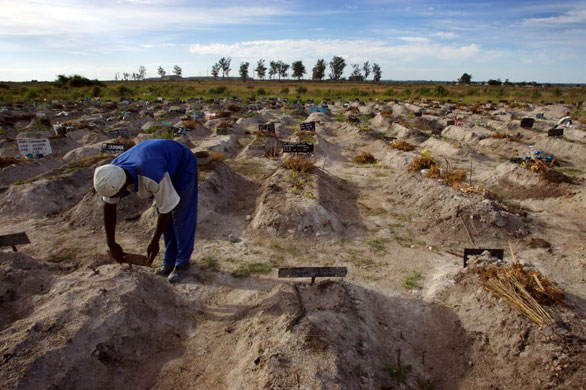
For the people living in the predominately-Kurdish southeast region of Turkey, the fact that their region is dotted with the mass graves of victims of the political violence that haunted the area in the 1980′s and 90′s has long been an open secret, although one that few talked about in public. That changed several years ago, especially because of the high-profile Ergenekon case – an investigation into an alleged ultara-nationalist plot to topple the government — which, despite its flaws, has managed to land some formerly untouchable military and political figures in jail and shed some light on dirty deeds committed by the Turkish state.

Emboldened by the Ergenekon case and other efforts to root out Turkey’s “Deep State,” Kurdish activists in the southeast have started to make more forceful demands for these suspected mass grave sites to be excavated, part of an effort to determine the fate of the several thousand Kurds who went missing during the 80′s and 90′s during the fight between the outlawed Kurdistan Workers’ Party (PKK) and security forces.The Diyarbakir branch of the Turkish Human Rights Association, for example, has published on its website an interactive map of suspected mass grave sites. Also in Diyarbakir, a recent petition made by relatives of several missing person has led to a court-ordered excavation that so far has revealed the remains of some 23 people. From a report on the Bianet website:

The number of skulls found in a mass grave in the district of Saraykapฤฑ (ฤฐรงkale/Diyarbakฤฑr) rose to 23. Relatives of disappeared persons applied to the prosecutor’s office on 25 January with the requests to identify the bones and bring the responsible people to court.

In the 1990s, the building right next to the excavation area was used by the Gendarmerie Intelligence Anti-Terrorism Unit (JฤฐTEM), an unofficial wing of the Gendarmerie established in the late 1980s to counter ethnic separatism in south-eastern Turkey. The location is close to the Diyarbakฤฑr Closed Prison and the Saraykapฤฑ Courthouse…. ….On 25 January, executives of the Human Rights Association (ฤฐHD) Diyarbakฤฑr Branch applied to the Diyarbakฤฑr Public Chief Prosecution together with 36 families whose relatives went missing in police custody or became victims of unsolved murders. The families demanded to identify the bones found in the course of the excavations and to find the responsible perpetrators. ฤฐHD Diyarbakฤฑr Branch Secretary Raci Bilici said in a statement released before the application was submitted, “Saraykapฤฑ, the location where the human bodies were found, is not an ordinary place. This was the place of the JฤฐTEM headquarters where people were being executed”.

Furthermore, Bilici announced, “Everyone in the region knows that massacres were done there. The only one who does not know about it is probably the state that did not undertake any investigation despite all our efforts”. Digging for the truth in southeast Turkey could prove to be a major challenge for the Turkish government and Turkish society, which may now find themselves forced to face a very dark chapter in the country’s modern history. As columnist Yavuz Baydar writes in Today’s Zaman, the dig in Diyarbakir is only the tip of something much deeper: The skulls discovered in Diyarbakฤฑr are only the beginning, according to human rights activists. There are many eyewitnesses and “confessors” who will point out other spots. But, they also expect concrete and bold steps for taking everybody responsible to court. Everybody.

Unveiling the past, near or distant, is a huge task for the government, media and the citizens. Skulls are buried in the earth, and there is an immense number of skeletons in Ankara’s political cupboards. It is now apparent to many people here that the painful, often bloody abuse of power under military tutelage was a work of continuity: Digging for the truth in the dark corners of the last decade leads to the ones hidden in the 1990s, which points to the 1980s and so on. For more on the issue of the Kurdish mass graves and the search for the missing in the southeast, take a look at this story I filed for the Christian Science Monitor in 2009 on one family’s successful effort to find the remains of a relative who had disappeared in 1993.

Monday 4 February 2013

http://ikjnews.com/?p=3250

continue reading

Day the river of life brought death


January 14, 2003, will always be remembered by the Dutt Family of Korotari outside Labasa Town.

The day brings memories of nine missing family members who died at the height of Tropical Cyclone Ami.

The family is still haunted by the dreadful incident to this day.

Every year, the date has been set aside for a special pooja (prayer) to commemorate the lives of the missing members.

Rishun Dutt, 58, looked towards the Korotari River, about one kilometre from his home, as he related what the past 10 years have been like for the surviving members.

The river that was known as the source of life for villagers and nearby settlers claimed the lives of Mr Dutt's mother, his sister and her two daughters, his brother and his wife, his nephew, niece and his eldest daughter.

His younger daughter and wife had gone to visit a family friend in Labasa that fateful day.

Recounting the incident, Mr Dutt said they were listening to the radio on the night of January 13 and heard nothing about a cyclone warning.

He said they decided to go to sleep after listening to the radio and never thought of moving to higher ground or to prepare themselves for the monstrous storm headed their way.

There had been no warning of what Ami was bringing with her.

It was only a matter of seconds when the life-giving river swallowed their home at 4am on January 14.

Rudely woken from their sleep, the family members fled for their lives into the cane fields.

That was the last time Mr Dutt saw any of them.

"All I could hear was the roaring sound of big waves and strong winds raging everywhere. Efforts to call out the names of my loved ones were in vain as I was fighting the currents that were sweeping me away like debris."

Mr Dutt thought it was the end of the world.

He decided not to fight and allowed the currents to master his path.

"I suddenly came across a small log and clung on to it for support until I reached Nagata, about three kilometres from my home," he said.

"In the middle of the floodwaters was a tall tree which was partly submerged. With all my might, I swam to it for refuge and I sat there from 7.30am to 2pm."

As tired as he was, Mr Dutt never gave up hope, even though he was stranded in a strange place with no trace of a human being.

"I was dehydrated and hungry while waiting for the water level to recede. Only God knows how I felt that moment, craving for food and drink or at least for someone to spot me on the tree top," he said.

"After a while, I saw some people picking coconuts some distance down the river. When I tried calling them, no sound came from my mouth. I took off my T-shirt and waved and suddenly a man saw me.

"I thank God for the miracle."

He said he knew it was God that sent the man to rescue him.

"The man approached me in a small punt and took me to a house where they gave me some food and drink. I couldn't stop thanking him because I knew he saved my life."

The food and drink, Mr Dutt said, gave him a bit of strength that allowed him to walk back to his home.

It was there that he realised the enormity of Ami.

He encountered another heartbreaking moment when he saw his farm completely ravaged and his house filled with debris. "To my surprise, I could only see thick silts and debris. Then it clicked my mind that the rest of my family was not at home and at that moment, I couldn't think of anything else but to report the matter to police."

Mr Dutt said he walked back to the Labasa Police Station to lodge a report. A search was conducted for the missing members and six bodies where found. The other three were nowhere to be found.

He said his mother's body was later found at Korovatu, about 40 kilometres from their home.

"It still hurts me to this day that I never bid a proper goodbye to them or even saved them from the cyclone," an emotional Mr Dutt said.

"My daughter was only in Form Three and she had big dreams of helping us once she completed her education. Unfortunately, it all went down the drain when she disappeared without a sign during Cyclone Ami."

After the cyclone, Mr Dutt and surviving family members rebuilt their lives.

He had to start from scratch as his family's only source of income — fruits and vegetables — were all destroyed.

"I knocked on doors to seek assistance from people just so I could rehabilitate my farm and help my family regain a normal life again. It was a bit difficult but I managed to pull myself together and put the past behind for the sake of the surviving members," he said.

"Even though we couldn't replace our loss, we continue to thank God for our lives because I know that he saved us for a purpose.

"Every year, we remember our missing members and we pray that their souls may rest in peace."

Monday 4 February 2013

http://www.fijitimes.com/story.aspx?id=224385

continue reading

Crash kills 16 Bangladeshis in Abu Dhabi


At least 16 Bangladeshis died in a road crash that claimed 22 lives and injured 25 others at Abu Dhabi in the United Arab Emirates yesterday, police and Bangladesh embassy officials in the UAE said.

Latiful Haque, a labour councillor at Bangladesh mission there, told The Daily Star over the phone that they had identified 16 of the dead as Bangladeshis and one as an Indian.

He suspected the rest too were Bangladeshis.

Early in the morning, the bus carrying them collided with a truck laden with sand and other construction materials when the workers were on their way to work in a camp, said Latiful.

The accident happened around 7:45am (local time), said Brigadier Hussain Ahmad Al Harithi, director of Abu Dhabi Police Traffic and Patrol Directorate, states Gulf News.

The bus was carrying 46 people, says Gulf News, while Khaleej Times reports the number to be 55.

“I was driving to our camp when I saw a concrete-laden truck crash into a bus coming from the opposite direction. The bus was smashed beyond recognition. I don't think any of the workers could have survived this incident,” said an eyewitness to Gulf News.

Other witnesses suggested the workers died from suffocation in the pile of sand and construction materials.

An eyewitness told the Khaleej Times that the victims worked for a maintenance and contracting company that had a camp in the area.

Al Ain police deployed helicopters to rescue the injured workers who were buried under pile of sand at the site, reports Gulf News. They were transferred to Al Ain, Al Tawam, Al Noor and NMC hospitals.

Latiful Haque said some of the bodies of the dead had been kept in the morgue and others had been sent to nearby hospitals as there was not enough room in the morgue.

He added embassy officials were concentrating on the dead and had not had time to check-up on the injured. However, they were being properly treated at Incentive Care Units of different hospitals

Monday 4 February 2013

http://www.thedailystar.net/newDesign/news-details.php?nid=267868

continue reading

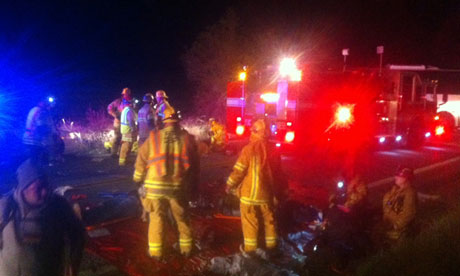
California bus crash leaves eight dead


A tour bus has collided with a pickup truck on a rural mountain highway in southern California, killing eight people and injuring dozens of others, authorities have said.

The accident happened at about 6.30pm on Sunday and involved the bus, a pickup truck pulling a trailer and another car, said California highway patrol officer Mario Lopez. He confirmed that eight people had died and many more were injured in the crash about 80 miles east of Los Angeles near the town of Forest Falls.

Fire department spokesman Eric Sherwin said 27 people were treated at the scene for injuries varying from minor to life-threatening.

People were being extricated from the bus more than an hour after the crash on a mountainous stretch of the two-lane Highway 38 and rescuers were still searching the wreckage for victims hours later. Television footage showed the bus sitting upright but turned sideways on the road.

Sherwin did not know where the bus was heading or how the truck was involved. Highway 38 leads to Big Bear, a popular tourist area with a ski resort and other recreational facilities.

At least seven ambulances were called to the scene and patients were taken to several local hospitals.

Arrowhead regional medical centre said four women had been admitted from the crash. Redland Community hospital said it received one person in critical condition and one with minor injuries, while two more were en route with minor injuries. San Bernardino Community hospital said it had received one patient with undetermined injuries, while St Bernadine medical centre said it was treating two patients.

The California crash came less than a day after a bus carrying 42 high school students and their chaperones crashed into an overpass in Boston. Massachusetts state police said 35 people were injured after the driver took the bus on to a road with a height limit.

Monday 4 February 2013

http://www.guardian.co.uk/world/2013/feb/04/california-bus-crash-dead

continue reading

Police spies stole identities of dead children


Britain's largest police force stole the identities of an estimated 80 dead children and issued fake passports in their names for use by undercover police officers.

The Metropolitan police secretly authorised the practice for covert officers infiltrating protest groups without consulting or informing the children's parents.

The details are revealed in an investigation by the Guardian, which has established how over three decades generations of police officers trawled through national birth and death records in search of suitable matches.

Undercover officers created aliases based on the details of the dead children and were issued with accompanying identity records such as driving licences and national insurance numbers. Some of the police officers spent up to 10 years pretending to be people who had died.

The Met said the practice was not "currently" authorised, but announced an investigation into "past arrangements for undercover identities used by SDS [Special Demonstration Squad] officers".

Keith Vaz, the chairman of parliament's home affairs select committee, said he was shocked at the "gruesome" practice. "It will only cause enormous distress to families who will discover what has happened concerning the identities of their dead children," he said. "This is absolutely shocking."

The technique of using dead children as aliases has remained classified intelligence for several decades, although it was fictionalised in Frederick Forsyth's novel The Day of the Jackal. As a result, police have internally nicknamed the process of searching for suitable identities as the "jackal run". One former undercover agent compared an operation on which he was deployed to the methods used by the Stasi.

Two undercover officers have provided a detailed account of how they and others used the identities of dead children. One, who adopted the fake persona of Pete Black while undercover in anti-racist groups, said he felt he was "stomping on the grave" of the four-year-old boy whose identity he used.

"A part of me was thinking about how I would feel if someone was taking the names and details of my dead son for something like this," he said. The Guardian has chosen not to identify Black by his real name.

The other officer, who adopted the identity of a child who died in a car crash, said he was conscious the parents would "still be grief-stricken". He spoke on the condition of anonymity and argued his actions could be justified because they were for the "greater good".

Both officers worked for a secretive unit called the Special Demonstration Squad (SDS), which was disbanded in 2008.

A third undercover police officer in the SDS who adopted the identity of a dead child can be named as John Dines, a sergeant. He adopted the identity of an eight-year-old boy named John Barker, who died in 1968 from leukaemia. The Met said in a statement: "We are not prepared to confirm nor deny the deployment of individuals on specific operations."

The force added: "A formal complaint has been received which is being investigated by the DPS [Directorate for Professional Standards] and we appreciate the concerns that have been raised. The DPS inquiry is taking place in conjunction with Operation Herne's investigation into the wider issue of past arrangements for undercover identities used by SDS officers. We can confirm that the practice referred to in the complaint is not something that would currently be authorised in the [Met police]."

There is a suggestion that the practice of using dead infant identities may have been stopped in the mid-1990s, when death records were digitised. However, the case being investigated by the Met relates to a suspected undercover police officer who may have used a dead child's identity in 2003.

The practice was introduced 40 years ago by police to lend credibility to the backstory of covert operatives spying on protesters, and to guard against the possibility that campaigners would discover their true identities.

Since then dozens of SDS officers, including those who posed as anti-capitalists, animal rights activists and violent far-right campaigners, have used the identities of dead children.

One document seen by the Guardian indicates that around 80 police officers used such identities between 1968 and 1994. The total number could be higher.

Black said he always felt guilty when celebrating the birthday of the four-year-old whose identity he took. He was particularly aware that somewhere the parents of the boy would be "thinking about their son and missing him". "I used to get this really odd feeling," he said.

To fully immerse himself in the adopted identity and appear convincing when speaking about his upbringing, Black visited the child's home town to familiarise himself with the surroundings.

Black, who was undercover in the 1990s, said his operation was "almost Stasi-like". He said SDS officers visited the house they were supposed to have been born in so they would have a memory of the building.

"It's those little details that really matter – the weird smell coming out of the drain that's been broken for years, the location of the corner Post Office, the number of the bus you get to go from one place to another," he said.

The second SDS officer said he believed the use of the harvested identities was for the "greater good". But he was also aware that the parents had not been consulted. "There were dilemmas that went through my head," he said.

The case of the third officer, John Dines, reveals the risks posed to families who were unaware that their children's identities were being used by undercover police.

During his covert deployment, Dines had a two-year relationship with a female activist before disappearing from her life. In an attempt to track down her disappeared boyfriend, the woman discovered the birth certificate of John Barker and tried to track down his family, unaware that she was actually searching for a dead child.

She said she was relieved that she never managed to find the parents of the dead boy. "It would have been horrendous," she said. "It would have completely freaked them out to have someone asking after a child who died 24 years earlier."

The disclosure about the use of the identities of dead children is likely to reignite the controversy over undercover police infiltration of protest groups. Fifteen separate inquiries have already been launched since 2011, when Mark Kennedy was unmasked as a police spy who had slept with several women, including one who was his girlfriend for six years.

On Tuesday the select committee will hear evidence from lawyers representing the 11 women who are suing the Met after forming "deeply personal" relationships with the spies. Kennedy, who worked for a sister unit to the SDS, is not believed to have used the identity of a dead child.

Vaz said MPs were now likely to demand answers from the Met police about the use of children's identities. "My disbelief at some of the tactics used [by undercover police] has become shock as a result of these latest revelations. It is clear that inappropriate action has been taken by undercover police in the past. But this has now taken it to a new level," he said.

"The committee will need to seek answers from the Metropolitan police, to find out why they allowed these gruesome practices to happen."

Monday 4 February 2013

http://www.guardian.co.uk/uk/2013/feb/03/police-spies-identities-dead-children

continue reading

Another Baldia factory fire victim identified through DNA test


Another victim of the Baldia factory fire, whose body was lying in Edhi’s cold storage, was identified on Monday through DNA test.

According to sources, one more identified body was taken by the family while 19 other unidentified bodies are still with Edhi.

They added that the victim was identified as Mohammad Afzal s/o Mohammad Ashraf.

The 27-year-old victim was a resident of Orangi Town’s sector 13-D.

It is worth mentioning here that 260 workers were burnt to death on September 11, 2012, when fire engulfed Ali Enterprises, the factory situated in Baldia Town area of Karachi.

Monday 4 February 2013

http://www.lhrtimes.com/2013/02/04/another-baldia-factory-fire-victim-identified-through-dna-test/#ixzz2JwDkwsVP

continue reading

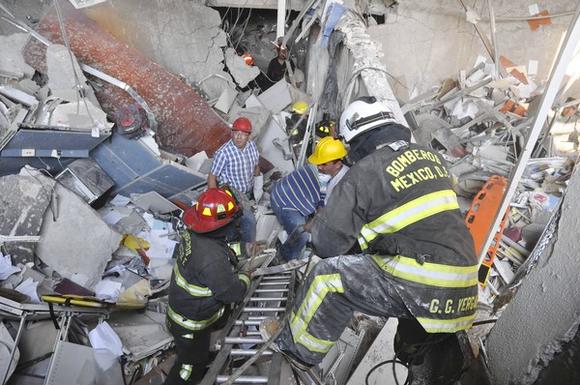
Three more bodies found at Mexico Pemex blast site, toll reaches 36


Mexican rescue workers found three more bodies over the weekend amid the rubble of a deadly blast that tore through state oil firm Pemex's main office complex, the government said, as search efforts appeared to near a close.

The death toll from Thursday's explosion stands at 36, Pemex said via Twitter. Rescue workers had been digging through the last sections of the building's basement and could soon call off their search. One person was reported still missing.

Attorney General Jesus Murillo said on Friday that it was too early to say if the explosion was due to an attack, an accident or negligence, but he promised results of an investigation in the coming days.

Murillo toured the site on Sunday, but did not publicly comment on the progress of the investigation. Officials have communicated details through social media about the disaster, which struck just before a long holiday weekend.

The investigation will test confidence in President Enrique Pena Nieto, whose Institutional Revolutionary Party ruled Mexico for most of the last century but lost power in 2000, when it was accused of fostering widespread corruption.

Local media reported the three bodies were maintenance workers. A woman who worked as a secretary was still missing, but she was unlikely to be found so deep in the wreckage.

The blast occurred two months into Pena Nieto's presidency, just as Congress was preparing to discuss his plans to open up the state-run energy industry to more private investment.

Hobbled by heavy state taxation, Pemex saw production slump in the last decade and its safety record has been stained by a series of deadly accidents, including an explosion that killed about 30 at a gas facility last year.

Monday 4 February 2013

http://www.reuters.com/article/2013/02/04/us-mexico-pemex-idUSBRE91304120130204

continue reading

Sunday, 3 February 2013

Malaysia: 15 missing every day


It is a startling figure: An average of 15 people went missing every day last year, Malaysian police records showed.

Even more alarmingly, nearly a quarter of them are Malay girls aged 13 to 17. Of the 4,804 who were reported missing from January to October last year, more than half did not make it home, The Star reported.

Federal CID director Commissioner Mohd Bakri Zinin said a number of missing people were from broken homes.

He added: "Teenagers from broken families are at an increased risk of peer pressure to run away from home."

Some who went missing were school dropouts while others, especially girls, ran away with boyfriends.

Malay girls formed the biggest group, making up 1,124 missing cases. It was four times more than their male counterparts.

Mr Mohd Bakri said there were isolated cases of missing people being victims of sexual predators and human traffickers.

He also said there are mechanisms such as the national urgent response alert for children below 12 who have gone missing. But families should play their part as well, he said.

"It is of the utmost importance that a missing person's report be lodged as fast as possible as it will assist us in mobilising our resources quickly," he said.

Every child and teen aged 18 and below who goes missing and is located will be sent for counselling with the Welfare Department.

Said Mr Mohd Bakri: "The children will be given counselling until they can adapt themselves back into society without worry."

Even as police continue to look for missing people, a 28-year-old factory worker is searching for her younger sister and her daughter.

Ms Tee Que Eng told The Star that 21-year-old Tee Kue Peng and her daughter, Estersiskah, five, have been missing since Aug 24 last year.

"It has been months and we are sad as this may be the first Chinese New Year celebration without them," she said.

The single mother left home without a word, giving her parents little clue as to why. She had taken all her belongings, including clothes, personal documents and pictures, the report said.

The family was worried that she may have run away with a man. The elder sister said that family members had not noticed anything unusual in the few days before she disappeared.

But she said the teachers at the child's kindergarten had noticed a man picking the little girl up. They said they did not recognise him, Ms Que Eng said.

She said the family is worried about the child.

"She is very attached to her grandmother and does not like to talk to strangers," she said.

Her message to her sister: "Please come home. Our parents will not be angry if you are with anyone. We just want both of you home."

Children's right groups said the missing teenagers should be given the same amount of attention as their younger counterparts.

Childline Malaysia project director Michelle Wong said runaway teens can be seen as being more able to take care of themselves. That is an "unfortunate and misguided" presumption.

"The search efforts should be the same for all children under the age of 18 because they have the right to be cared for," she said, adding that even runaway teens were at risk.

"They, too, are vulnerable to human trafficking."

Sunday 3 February 2013

http://news.asiaone.com/News/AsiaOne%2BNews/Malaysia/Story/A1Story20130202-399644.html

continue reading

Rescuers Find Body in Mexico Oil Company Blast


Mexico's state-owned oil company says rescuers have found another body amid the rubble of a headquarters building damaged by a still-unexplained blast. The find raises the death toll of Thursday's explosion to 34 people.

Petroleos Mexicanos operations director Carlos Murrieta says rescue crews are still looking for three people in the rubble, and believe they're in the most damaged part of the building.

Officials still have not given any cause for the explosion, though they have said they suspect it was an accident. The blast also injured 121 people.

Rescuers had concluded their search Friday but resumed operations when they suspected more bodies were in the rubble. The latest body was found Saturday, and the news was announced via Twitter by Mexican President Enrique Pena Nieto.

Sunday 3 February 2013

http://abcnews.go.com/International/wireStory/rescuers-find-body-mexico-oil-company-blast-18392251

continue reading