Tuesday, 16 October 2012

8 mourners die in Mombasa highway dawn crash

NAIROBI, Kenya Oct 16 – Eight family members transporting the body of their kin for burial perished in a road accident on the Nairobi-Mombasa highway on Tuesday morning.

The accident involving their hearse and a truck occurred at Chumvi area, near the Machakos turn-off-according to police.

“They all died on the spot. The ninth body we collected from the scene is the one that was being transported for burial,” a police officer said.

The mourners were moving the body from the coast to western Kenya when the accident occurred.

“The hearse rammed into the truck while overtaking,” the officer said.

All the nine bodies – including the one that was in the coffin have been moved to the Machakos District Hospital mortuary.

Tuesday 16 October 2012

http://www.capitalfm.co.ke/news/2012/10/8-mourners-die-in-mombasa-highway-dawn-crash/

continue reading

Doctor’s Bath for Corpses Reinvigorates Cold Cases

CIUDAD JUÁREZ, Mexico — Alejandro Hernández Cárdenas took a scorched-looking, decomposed head and five stiff, bloated hands and gently submerged them in his secret solution. After they soak for three days, he said, any scars, lesions or birthmarks the victim might have had will reappear.

Dr. Hernández Cárdenas's technique, normally applied to full bodies, can restore clues like wounds and fingerprints.

They did. The putrid head looked human again, with full lips, large pores and a massive bruise on the forehead. The hands had recovered their identifying prints.

“Science advances,” said Dr. Hernández Cárdenas, “whenever there are difficult situations.”

The newly revealed details may never lead to a conviction, or even an arrest, but Dr. Hernández Cárdenas, a forensic odontologist who works in the Ciudad Juárez Forensic Science Lab, has attained the kind of star status that could be produced only in a city like this, with its semidesert climate, exorbitant murder rate and can-do frontier creativity. Dr. Hernández Cárdenas developed the rehydration technique, which he primarily uses on full bodies, more or less single-handedly, and he even pays part of the cost for the chemicals that turn back the clock on his brittle subjects.

Forensic experts have long used glycerin injections to reconstitute fingers to get prints, but that is not practical for entire bodies — particularly not in the scorching heat of Ciudad Juárez, where bodies decompose and mummify quickly. Only through rehydration does the corpse regain some of its original condition, helping the police by revealing lesions and bringing internal organs back to nearly their state at the time of death.

On most days, Dr. Hernández Cárdenas can be found in the lab here rehydrating some of the bodies that were stored or buried without being identified from 2009 to 2011, the height of the violence between competing criminal syndicates in this border city. With nearly 8,000 people killed during that period, he always has plenty to do, and his process tends to include both music and dark humor.

He says he talks to the corpses, consoling them while he works, indulging them with romantic music as they float in the “Jacuzzi,” the chemical-filled tub he uses for rehydration. If the individual features that reappear on a victim’s face look menacing, ballads give way to rap and hip-hop, which fill the impeccably clean but foul-smelling lab.

Dr. Hernández Cárdenas, 55, focuses mainly on helping rehydrate the hundreds of unclaimed corpses in his hometown, particularly those of women, so they can be identified and the murderers tracked down. “It would have even been a sin not to do it,” said Dr. Hernández Cárdenas, who said his work sometimes keeps him up at night.

“I used to take many girls to bed,” he said, “but not the way you think.”

He has often been frustrated by the lack of justice for those whose deaths he comes to know so intimately. Of the 150 or so bodies he has rehydrated so far, only a handful have provided clues that led to arrests.

Rather casually, he said he also avoids following up to see whether law-enforcement agents have identified the bodies he has worked on, fearing that corrupt officials or criminals will come after him.

“He who knows less, lives more,” he said. “One doesn’t even trust the authorities.”

The biggest supporters of his work are the families of the disappeared, who see in his chemical solutions the chance for closure. Experts, who say Ciudad Juárez is the only place where the technique has been deployed, tend to discuss his efforts in more scientific terms. Dr. Hernández Cárdenas has a patent application that is due for approval this month.

“If it holds up, I think it would be an accomplishment and an amazing advance,” said Elizabeth Gardner, a professor of forensic science at the University of Alabama at Birmingham, who has witnessed Dr. Hernández Cárdenas’s process.

Dr. Hernández Cárdenas, a former boxer, never intended to get into this line of work. Married at 17 and a father of three soon after, he struggled to put himself through college, where he studied orthodontics.

He drove a Red Cross ambulance by night to make ends meet, a side job that came to define his destiny. One night in 1977, he delivered 28 bodies — killed in an explosion — to a morgue. The forensic team asked him to inspect their mouths for identifying traits, a fascinating challenge for the self-described obsessive doctor.

Dr. Hernández Cárdenas continued splitting his time between his elderly patients’ prosthetic teeth (he still has his practice) and Red Cross duties until he got a break at the forensic lab in 2002. He was put in charge of analyzing the cadavers’ teeth to determine their age. Once he was there, a question that had nagged him for years began consuming his time: could the fingertip rehydration used by forensic specialists throughout the world somehow be applied to entire bodies?

Suddenly, “I had material, I had time, I had authorization” to experiment, Dr. Hernández Cárdenas said. He began experimenting with fingers and ears available at the city’s forensic lab, placing them in glass jars — “I kept eating Gerber,” he said — slightly tweaking the chemical proportions each time while enduring his colleagues’ teasing.

One morning, he arrived at the lab to find that one of the jars contained a perfectly intact finger. “I thought my co-workers were playing a trick on me,” he said. But their response left him cold. “We don’t mess with your filthiness,” they assured Dr. Hernández Cárdenas.

In 2008, he managed to properly rehydrate his first full body, becoming a quasi-celebrity among the city’s residents and in the country’s forensic science circles.

“He is in high demand,” said Carlos Reynosa, coordinator of the forensic science master’s program at the Autonomous University of Ciudad Juárez. Staff members from the American Consulate and the United States Agency for International Development have also inquired about, and observed, Dr. Hernández Cárdenas’s method.

Unfortunately, he said, officials and academics are not the only ones interested in his methods.

Now divorced, Dr. Hernández Cárdenas said his intriguing reputation follows him everywhere in Ciudad Juárez. Women, in the midst of dinner dates, often ask him about his work, demanding details that he refuses to divulge. “I don’t think it’s an adequate subject to talk about with a lady,” he said.

Tuesday 16 October 2012

http://www.nytimes.com/2012/10/16/world/americas/mexican-doctors-bath-for-corpses-reinvigorates-cold-cases.html?pagewanted=all&_r=0

continue reading

Nearly 50 Graves Found On Arthur Dozier School For Boys Grounds

Nearly 50 graves found on the Arthur Dozier School for Boys grounds in Florida offer clues to solving the mystery surrounding the missing bodies of former students. The alleged abuse which occurred at the reform school for boys reportedly left approximately 80 children unaccounted for — until now.

While the bodies of 50 boys are cloaked in secrecy, the remains at the small cemetery may point investigators on a path to finally finding some answers about what happened inside the gates of the now defunct facility.

University of South Florida anthropologist, Dr. Erin Kimmerle, had this to say about the Arthur Dozier School for Boys:

“These are children who came her and died, for one reason or another, and have just been lost in the woods. We found burials within the current marked cemetery and then we found burials that extend beyond that. For the majority, there’s no record of what happened to them. It’s about restoring dignity.”

Dr. Kimmerle is the leader in a research effort to find out what happened at the reformatory for boys in Marianna, according to the Miami Herald. Through the use of ground-penetrating radar, the team has been able to unearth 49 graves so far, leading to the discovery of 18 bodies, Radar Online notes.

The startling abuse allegations at the Arthur Dozier School for Boys include claims of rape and violent beatings. When the boys misbehaved, they were allegedly sent to the “White House” a building comprised of cinder block, as punishment, prompting the phrase “White House Boys” to refer to the scores of young men who claim they were taken to the structure and severely abused.

Ovell Smith Krell, 83, told the investigation team that her brother, Owen, was sent to the Florida reform school after he ran away from home and stole a car in 1940. The family never saw Owen again; they were told that the boy spent the night outside, died due to a cold induced by exposure, and had been buried.

Tuesday 16 October 2012

Read more at http://www.inquisitr.com/364154/house-of-horrors-nearly-50-graves-found-on-arthur-dozier-school-for-boys-grounds/#D8iOwkIIgoR2jhqZ.99

continue reading

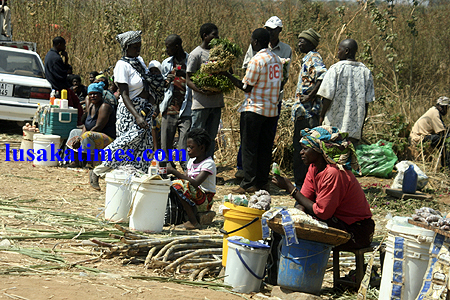
Merciless cemetery vendors prey on mourners

THERE are more than a thousand schemes to let out human suffering among most susceptible Zambians.

Out of personal creativity and brevity in entrepreneurship, graveyard vendors at Ndola’s Kawama cemetery are teeming with personal conviction to earn whatever they can to sustain their families with food and other basic essential necessities.

The vendors prey on the mourners like starved vultures as they display portably packed water in plastics, flavoured ‘ice blocks’ and other cold drinks to quench the thirst of a mass of wailing mourners who often gather under the blazing sun during the burial processions.

The merchants are always trying to mournfully do the best in their business of selling drinks and water at the graveyard site – roundly shifting marketing positions as they move their cooler boxes nearer to the grave site where mourners gather to pay their last respects to beloved ones.

The hawkers know that it is a healthy business day for them each time there are more people being buried on a particular day.

A limping woman, in her old formative stages of life, exclaims in the full glare of mourners, charging: “How could you set your business of selling these things in front of mourners?” She bursts out as she filters in the mass of weeping and wailing mourners at the grave site: “You do not feel the pain of the mourners, and what type of people are you to enjoy doing what you are doing when people are mourning?”

Then an intoxicated grave digger thunders in a rather satirical tone: “You should also start selling nshima so that mourners could feast during burial processions!” He almost implied that there was no drinking after the cloud of death has engulfed the life of one.

But the vendors are not perplexed as one would have expected from the outbursts but instead elect to go about with their vending chores.

“You see,” Joshua Mulenga begins, “People do not respect the graveyard to an extent that they are freely trading at this rather sacred place of final rest of people. There are people buried here who have died from different ailments and it is a health risk for people to sell consumables here.”

Mr Mulenga, a resident of Pamodzi, says it is important that relevant authorities should address the issue of vending at graveyards with the desired sense of urgency to protect innocent people who are ignorant at the heath-risks associated with buying consumables at cemeteries. Ndola City Council (NCC) senior Press and public relations officer, Esther Banda, acknowledged that it is immoral to carry out any form of vending at the graveyard and that those vending at the necropolis – the resting place – were into their trade illegally.

Almost in a whitewashed tone, Ms Banda comes out clean that vendors at the cemetery are “usually told to do their business outside the boundaries of the graveyard. It is public hazard to sell such commodities at the graveyard and that is why one cannot find uncovered foodstuff being sold at the graveyard”.

As the status of the graveyard vending remains unchanged, it would always be possible for many third class people to eke out a living from the shores of the grave – elevating their lives from the pangs of abject poverty and squalor through a thousand innovative survival designs.

A vendor at the Kawama Cemetery when approached for a comment angrily retorted, almost like a storm in a tea pot: “You are the same people who want us to start stealing to earn a living. You simply keep on saying things about us selling at the graveyard in a negative way in the hope that if you keep writing about us continuously it will become true that we are doing something unacceptable. The Government has not ordered us to stop selling from here because it knows this was how we survive!”

You should have been there to witness the horrid chapter of vending at Ndola cemeteries.

It is the thirsty of mourners under the blazing sun that ignites the temptation to buy the merchandise on display at the graveyard.

At Mitengo Cemetery, vendors selling ice-creams are a common trait and appropriately appear well-informed when mourners were thronging the graveyard to put their loved ones to rest.

At the notorious Kantolomba Cemetery, the story is the same if not worse because the vendors undercover sell consumables and some grave diggers continue to trade in potent alcoholic drinks, including home-brewed beer.

My recent survey revealed that Chibuku Shake Shake – the traditional beer was selling like hot cakes among some mourners and especially the grave-diggers.

Kantolomba Cemetery was also gravely associated with incidences of disgruntled thieves ransacking graves – stealing valuable caskets and coffins, including undressing dead people.

Against this absurd scenario, Ms Banda, dejectedly, responds to a Times query that the ill-act to rummage through the graveyard was synonymous to trespass and against the laws of the land, adding: “It is illegal. That is why it is done in the night. It is a crime”.

At the latent site, nothing was so fatal to vend at the graveyard with such bustle simply creeping and souring at the same affair.

And the pro-profit element of graveyard chores remaining in favour of the paradox of economic survival has wide health implications for mourners who buy consumables from vendors at Ndola’s cemeteries.

Something must be done to serve the surviving innocent souls from the macabre graveyard vending.

Tuesday 16 October 2012

http://www.times.co.zm/?p=15724

continue reading

Monday, 15 October 2012

More 9/11 remains identified in DNA database

The massive DNA database compiled after the World Trade Center terror attacks has linked 261 more body parts to its existing profile of victims since February, officials with the New York Medical Examiners office said Wednesday.

The additional DNA findings didn't increase the number of victims of the 9/11 attacks whose remains have been identified because in some cases the remains were linked to those known to have perished, Borakove said.

Currently, 1,633 victims have been identified, mostly through DNA analysis. A total of 2,753 people died in the attacks on Sept. 11, 2001.

In some cases, families of the victims have asked to have the newly identified remains provided for burial or disposition, while others want the medical examiner to retain them for now, Borakove said.

The identifications are being made in the ongoing effort to use evolving DNA technology to link remains and, where possible, make an identification to a victim, Borakove said.

After the crash of the two jetliners into the Twin Towers and their resulting collapse, the recovery effort found 21,817 human remains.

Of those body parts, 13,162 have been identified, leaving 8,655 without any DNA matches, Borakove said.

One of the last identifications of a named victim occurred in August 2011, when DNA matches identified the remains of Ernest James, 40, of New York City, who worked for the insurance brokerage Marsh & McLennan.

Monday 15 October 2012

http://www.newsday.com/911-anniversary/more-9-11-remains-identified-in-dna-database-1.4099347

continue reading

Bangladesh among top five disaster-prone countries

Bangladesh has been named the fifth in the list of 173 countries that are most prone to natural disasters, according to a report.

The "World Risk Report 2012" examines which countries are more at risk from natural disasters than others, what contributes to this risk and what can be done about it, the Daily Star said.

Island nations Vanuatu, over 3,600 km from Australia in the Pacific Ocean, and Tonga, at a distance of 5,200 km from Australia, have the highest disaster risk.

Malta and Qatar face the lowest risk worldwide, said the report.

It said environmental degradation is a significant factor that reduces the capacity of societies to deal with disaster risk in many countries around the world.

The report was published in Brussels by the German Alliance for Development Works, UN University Institute for Environment and Human Security, and The Nature Conservancy.

"This report illustrates the powerful role that nature can play in reducing risks to people and property from coastal hazards like storms, erosion and floods," Michael Beck, lead marine scientist at The Nature Conservancy, was quoted as saying.

The top 15 most "at-risk" countries are all tropical and coastal. There, coastal habitats like reefs and mangroves are incredibly important for people's lives and livelihoods.

Monday 15 October 2012

http://www.siasat.com/english/news/bangladesh-among-top-five-disaster-prone-countries

continue reading

2 more bodies, death toll rises to 31

After recovering two more bodies at Monpura upazila of Bhola, the official account of deaths from Thursday’s violent storm sweeping the coastal belt rose to 31 on Sunday.

Monpura police officer-in-charge Naresh Chandra Karmakar said the recovered bodies were identified as Dulal, 16, of Sakuchia and Amiruddin, 29, of Char Nizam.

Unofficial sources, however, fear the number of deaths to exceed 40 as many of the fishermen who went to fishing might have been washed away to the deep sea with their boats capsized.

Bhola deputy commissioner Khandokar Mustafizur Rahman said it would take some more time to know the actual number of deaths.

BIWTC salvage vessel Hamza did not succeed yet on Sunday to haul the sunken BIWTC sea truck ST Sheikh Russell and two other cargo vessels.

Rafikul Islam, BIWTC assistant director and in charge of the Hamza, said the sea truck was pulled to the shore but was still under water as Hamza’s crane was not capable of lifting it up.

The other two vessels that sank near the shore were anchored at the landing station, he added. Chairmen of some worst affected unions of Bhola said they started receiving food grains as relief for distribution to storm victims.

Dhal char union parishad chairman Rafikul Islam Patowari, Char Fasson upazila chairman Nazir Ahmed, Dasherhaat UP chairman Waliul Islam, Hazirhaat UP chairman Shahriar Dipak, Sadar UP chairman Alauddin, all three under Monpura upazila, said the Bhola district administration began sending food relief.

Monpura upazila nirbahi officer Wahidul Islam said distribution of money and materials to the homeless would begin as early as possible.

Bhola, Noakhali, Chittagong and Cox’s Bazar districts were worst affected by the storm.

Monday 15 October 2012

http://newagebd.com/detail.php?date=2012-10-15&nid=27080#.UHvsPj3cz3U

continue reading

Funeral Strippers: Taiwan Strippers Perform For The Dead

In Taiwan, a way of honoring the dead is starting to take off (no pun intended) all over the country. Family members wishing to honor their deceased relatives and friends. They hire the funeral strippers! According to an AFP report, in some areas of Taiwan it is becoming very common for pole dancers and strippers to ply their trade during religious festivals to honor the “wandering spirits” that have recently passed (see video below). Women in bras and miniskirts dance to loud dance music and shake their bodies so the dead can be happy as they ascend towards the heavens.

This may be a new idea to those in the Western world but for Taiwan this craze is neither new nor unorthodox. Men, women and children all gather around to watch the funeral strippers get busy on stage.

A documentary by anthropologist Marc L. Moskowitz explains the phenomena in a film he released in 2011 called “Dancing for the Dead: Funeral Strippers in Taiwan.”

A synopsis of the film states:

“Funeral strippers work on Electric Flower Cars (EFC) which are trucks that have been converted to moving stages so that women can perform as the vehicles follow along with funerals or religious processions. EFC came to Taiwan’s public attention in 1980 when newspapers began covering the phenomenon of stripping at funerals. There is a great deal of debate about whether this should be allowed to continue. In Taipei, Taiwan’s capital, one often hears middle and upper class men complain about the harmful effects of this rural practice on public morality. In contrast, people in the industry see themselves as talented performers and fans of the practice say that it makes events more exciting.”

Moskowitz, in an interview with io9.com said:

“It’s not at all common for urbanites, but in rural settings, most people have seen these performances. Actual full stripping has gone underground because there were laws enacted against full nudity in the 1980s. Nonetheless, the documentarian noted that “almost everyone” he had spoken to for his film had said they had seen “full stripping.”

Taoist preist have said that funeral strippers have become a strong part of the culture in Taiwain because the gyrating naked bodies of women is a great way to appease the dead and the Gods that they are hoping to please and get into the after life.

Monday 15 October 2012

Read more at http://www.inquisitr.com/363018/funeral-strippers-taiwan-strippers-perform-for-the-dead-video/#ojmPFX8Mkxcb0Wsb.99

continue reading

13 people killed, 26 injured in Sudan’s traffic accident

ABOUT 13 people were reportedly killed and 26 others injured in a traffic accident south of the Sudanese capital, Khartoum, at the weekend.

Xinhua quoted a statement by Sudanese police as saying: “13 people were killed and 26 others injured in a traffic accident at Al-Takala Abbasher area in central Sudan’s Gezira State.“

The report noted that the accident took place when a passenger mini-bus heading from Khartoum to Al-Kamlin area collided with a bus heading to Khartoum.

The front tyre of the bus exploded, causing it to swerve from its course and later collided with the mini-bus on the opposite lane, the statement said.

The injured were transported to the hospital in Khartoum, while the bodies of the dead were transferred to the morgue.

Monday 15 October 2012

http://www.guardiannewsngr.com/index.php?option=com_content&view=article&id=101658:13-people-killed-26-injured-in-sudans-traffic-accident-&catid=98:africa&Itemid=557

continue reading

New article: The visibility of disaster deaths in news images: A comparison of newspapers from 15 countries

The new issue of the International Communication Gazette includes a paper I wrote about the newspaper coverage of the devastating 2010 Haiti earthquake. Building on my work on news representations of death, the article develops a five-step typology of death images, and compares the coverage among 15 countries, from the Americas, Oceania and Europe. Here is the abstract of the paper. The extent to which newspapers display graphic images of death has rarely been studied in relation to the degree of the visibility of bodies, nor do many comparative analyses exist. This has led to a narrow understanding of how and why audiences are exposed to human suffering around the world. In examining newspaper images of the dead from the 2010 Haiti earthquake across 15 countries, this study develops a graphic image content scale to measure such visualizations. It finds significant differences in graphic images across the studied sample, both in terms of the amount of images and the degree of visibility of death. The study argues that major sociocultural influences, such as different religious traditions and societal levels of violence are part of the reason for the differences. Paper can be found here: http://gaz.sagepub.com/content/74/7/655.full.pdf+html Monday 15 October 2012

continue reading

Andes survivors mark 40th anniversary of crash

A Uruguayan rugby team played a match that was postponed for four decades when their plane crashed in the Andes, stranding them for 72 days in the cordillera and forcing them to eat human flesh to stay alive.

The Old Christians Club squared off Saturday in Santiago against the Old Grangonian Club, the former Chilean rugby team they were to have played to mark the 40th anniversary of the crash made internationally famous by a best-selling book and a Hollywood movie.

Surviving rugby team members of Uruguayan Air Force Flight 571, whose ordeal inspired books and films, finally play match which was postponed for four decades

A Uruguayan rugby team played a match that was postponed for four decades when their plane crashed in the Andes, stranding them for 72 days in the cordillera and forcing them to eat human flesh to stay alive.

The Old Christians Club squared off Saturday in Santiago against the Old Grangonian Club, the former Chilean rugby team they were to have played to mark the 40th anniversary of the crash made internationally famous by a best-selling book and a Hollywood movie.

"At about this time we were falling in the Andes. Today we're here to win a game," Pedro Algorta, 61, a survivor of the crash said as he prepared to walk onto the playing field surrounded by the jagged mountains that trapped the group.

Military jets flew over the field, where parachutists in Chilean and Uruguayan flags landed. Survivors wept when officials unveiled a commemorative frame with pictures of those who died in the snowy peaks.

Uruguayan Air Force Flight 571, also known as the Andes flight disaster, was a chartered flight carrying 45 people, including a rugby team, their friends, family and associates that crashed in the Andes on 13 October 1972.

The crash killed more than a quarter of the passengers and several others quickly succumbed to the freezing weather. Eight more were killed when an avalanche swept over the survivors' shelter, perched at over 3,600 meters altitude

The last 16 survivors were rescued on 23 December 1972, more than two months after the crash. Faced with starvation, and as hopes for a rescue mission dwindled, they made the near-impossible choice of eat flesh from the bodies of their dead comrades in order to survive.

"I think the greatest sadness I felt in my life was when I had to eat a dead body," said Roberto Canessa, 59, who was a teenage medical student at the time of the crash.

"I would ask myself: Is it worth doing this? And it was because it was in order to live and preserve life, which is exactly what I would have liked for myself if it had been my body that lied on the floor," he said.

Exasperated by more than two months in the frigid cordillera, Canessa and Fernando Parrado left the crash site to seek help.

After 10 days of trekking, they spotted a livestock herder in the foothills of the Chilean Andes who rode his horse to the nearest town to alert rescuers.

"I came back to life after having died. It's something that very few people experience," said Parrado, who has been a TV host, motivational speaker and race car driver. "Since then, I have enjoyed fully, carefully but without fear."

Monday 15 October 2012

http://www.ynetnews.com/articles/0,7340,L-4291713,00.html

continue reading

Souls of 40 unclaimed bodies to find peace

On Sarvapitri Amavasya on October 15, when many families pay homage to their loved ones, Pune-based Rashtriya Kala Akademi will immerse the ashes of nearly 40 unclaimed bodies in the river to give final peace to their souls.

The group has organised a special puja at Sangam Ghat on Sarvapitri Amavasya following which the ashes of the unclaimed bodies will be immersed in the river.

The group has kept the ashes in special lockers in Kailas crematorium behind SSPMS College on Raja Bahadur Mill Road. This year, the group has performed last rites of 405 unclaimed bodies.

Mandar Ranjekar, secretary of Rashtriya Kala Akademi told DNA, “In Hindu religion, many families perform pujas on Sarvapitri Amavasya in the memory of their loved ones. However, these unclaimed bodies do not have any family. Usually, the authorities cremate unclaimed bodies and dispose of the ashes. So, we thought that we will perform the last rites of these unclaimed bodies and immerse their ashes in the river to give their souls final peace.”

“We have performed the last rites of nearly 40 bodies in October and the ashes have been kept in the locker room of Kailas crematorium. On Monday, we have invited some well-known people at Sangam Ghat to immerse the ashes in water. On the same day, we will also felicitate civic workers who have contributed a lot in performing the last rites of unclaimed bodies,” Ranjekar said.

This initiative was started last year and the group had rented 36 lockers at Kailas crematorium to keep the ashes. Most of these unclaimed bodies do not have a name or identification, so we keep a record of the bodies by registering their post-mortem numbers, he said.

“Rashtriya Kala Akademi works in the field of art and culture and we feel that performing the last rites of the deceased, even if they are unclaimed, is a part of our culture. So, we have decided to undertake this initiative. We hope that our work will raise mass awareness and that such initiatives will be undertaken in other crematoriums as well,” Ranjekar said.

Monday 15 October 2012

http://www.dnaindia.com/mobile/report.php?n=1752358

continue reading

Friday, 12 October 2012

The tough task of bringing them home

IDENTIFYING the victims of the Bali Bombings was one of the most complicated post-disaster operations Australia has ever been involved in.

Tasmania Police Commander Tony Cerritelli was part of the Australian team that flew to Bali in the days after the 2002 bombings to help the investigation.

``It was catastrophic,'' Mr Cerritelli said.

``The damage that was caused, and the extent of the damage . . . it went beyond the bomb site.''

It took six months to identify all 202 victims, including 88 Australians.

Yesterday, Prime Minister Julia Gillard and former prime minister John Howard joined the family and friends of those killed at a memorial ceremony in Bali to mark the 10-year anniversary of the disaster.

Among those families were some who, 10 years earlier, sat down with Mr Cerritelli to list details of their loved one's appearance which might lead to their identification.

``We work for the family, we have got to work hard for them because we want to make sure they can farewell their family members,'' Mr Cerritelli said. ``We take care of them.''

Mr Cerritelli joined Tasmania Police in 1986 and qualified as a disaster victim identifier in 2000.

He is currently the deputy chairman of the Australasian Disaster Victim Identity Committee and will start a two-year term as chairman later this year.

Mr Cerritelli, who also helped identify victims of the 2004 Boxing Day tsunami, said the post-bombing operation was particularly complex because of the level of trauma involved and the fact that body recovery and identification was occurring alongside the crime scene investigation and the ongoing threat of a follow-up act of terrorism.

Police and specialists from 30 countries joined in the task.

`We had a very good working relationship with the Indonesians,' he said.

`There's obviously a little bit of tension when you first move into a foreign area, but eventually they realise we are all there for the same reasons.'

Mr Cerritelli and other volunteers from Tasmania searched the bomb site, worked with families and helped piece together clues to make an identification.

Investigators relied heavily on DNA, dental records and fingerprints to confirm identity.

Any match was confirmed by a specialist and certified by an Indonesian Government board.

`It's a very methodical process, and it's done that way because we can't afford to make mistakes,'' Mr Cerritelli said.

`A mis-identification would just add another layer of grief.'

Some specialists were overcome by the trauma.

`I have seen it where a couple of our people fell over because the connection was made between the victims and the families,' he said.

`As a general rule we try to keep staff separate between dealing with the victims and families on the same case, otherwise that emotional connection is made.'

But Mr Cerritelli said the thought of the victims kept investigators focused.

`These people are innocent people who have been the subject of a terrible event. The aim is to get them back home so the families can get on and grieve.'

Friday 12 October 2012

http://www.examiner.com.au/story/394766/the-tough-task-of-bringing-them-home/?src=rss

continue reading

19 killed, 1,500 fishermen missing in Bangladesh storm

At least 19 people were killed and an estimated 1,500 fishermen are missing after tropical storms smashed into Bangladesh's southern coastal islands and districts early Thursday, police said.

Police said at least 1,500 mud, tin and straw-built houses were also leveled in the storms that swept Bhola, Hatiya and Sandwip Islands and half a dozen coastal districts after Wednesday midnight.

At the worst-hit island of Hatiya, at least seven people were killed after they were buried under their houses or hit by fallen trees, said local police chief Moktar Hossain. More than 1,000 houses were flattened.

"More than 100 fishing trawlers, each carrying at least 10 fishermen, have been missing since the storm," he told AFP, calling it one of the most powerful in decades.

Many fishermen are expected to have taken shelter in other remote islands in the Bay of Bengal or in the neighboring Sundarbans, the world's largest mangrove forest.

In the past, many fishermen thought to be missing from storms returned home to coastal villages a week or two later.

Four people were killed in Bhola, three each in Sandwip and Companyganj and two at Char Jabbar, police said.

The police chief of Bhola district, Bashir Ahmed, told AFP more than 500 fishermen were missing from the country's largest island and at least 500 mud and straw-built houses were leveled by the sudden storm.

Bangladesh's weather office forecast heavy rain in the coastal region and advised fishermen to take care near the shore, but there was no major storm warning.

"We only got the warning signal number three. But the storm was so powerful, the weather office should have hoisted the signal number seven or eight," said Ahmed, referring to the intensity of the storm on a scale of ten.

"It caught the fishermen and coastal people by surprise. Till now we haven't had any reports from the missing fishermen," he said, adding the authorities had sent relief to thousands of affected people.

Friday 12 October 2012

Read more: http://india.nydailynews.com/newsarticle/2690d29e5366fe9b9b28a6f9a60620fb/bangladesh-storm-kills-19-hundreds-of-fishermen-missing#ixzz296IxHcqZ

continue reading

Government asked to ensure burial of seven Ivorian refugees

Government has been asked to ensure the immediate burial of seven decomposed bodies of Ivorian refugees deposited at the Half Assini Government Hospital mortuary, to avoid an outbreak of epidemic.

The Assembly Member for Amanzule Electoral Area, in Half Assini in the Western Region, Mr John Kwaw Ekoboe, made the appeal through the Ghana News Agency (GNA) at Half Assini on Thursday.

He said the Ivoirians died in a bizarre circumstance at the former Eagle Star Transit Camp at Elubo in September last year, and their bodies were deposited at the mortuary by the police for investigations.

Mr Ekoboe claimed that the police did not allow for the treatment of the bodies before depositing them at the mortuary, because according to the police that could interfere or undermine their investigations.

The Assembly Member said the bodies had decomposed and emitting bad scent because of continuous power outages in the area, and explained that the people could not bury the bodies because they were those of refugees, covered by international law.

Meanwhile a staff of the hospital, who spoke to the GNA on condition of anonymity, confirmed the story, and said because of the current situation, the hospital has decided not to accept bodies brought there by the police.

He cited an instance where the body of a man, who drowned in the Abbey lagoon, and was brought to the Half Assini Government Hospital, was rejected and sent to the Effia Nkwanta Regional hospital for autopsy.

Friday 12 October 2012

http://m.myjoyonline.com/pages/edition/news/201210/95344.php

continue reading

Agonising wait ends as seven factory fire victims identified

News of the death of loved ones in the Baldia garments factory fire last month must have been devastating. What is equally agonising is the wait many families have had to face for the identification of victims burnt beyond recognition. For seven families, that wait ended on Thursday.

The Edhi Foundation received the bodies of seven victims after DNA tests, and sent them to their families.

The victims identified are Mohammad Hanif, resident of Orangi Town, Mohammad Asif, resident of Baldia Town, Mohammad Imran, resident of Nazimabad, Mohammad Israr, resident of Baldia Town, Amna Bibi, wife of Allah Bukhsh, resident of Baldia Town, Masood ul Hassan, resident of Federal B Area, and Mohammad Faizan, resident of Baldia Town.

Edhi officials insist they received 202 bodies at their Sohrab Goth morgue, while government officials have put the death toll at 259.

They said that days after the fire, which broke out in Ali Enterprises at around 6pm on September 11 and raged for 15 hours, many families came to collect the bodies of their loved ones. Though the corpses were “impossible to identify”, officials said many people fought over them as they had no clue about their loved ones.

Edhi spokesperson Anwar Kazmi said they had the bodies of 39 victims, of which 32 were still with them.

The SHC had directed the provincial government earlier this month to expedite the process of conducting DNA tests on unidentified victims. A division bench, headed by Justice Maqbool Baqir, also told the relevant authorities to submit complete details of those killed or injured in the tragedy and provide monetary compensation to their families.

Friday 12 October 2012

http://www.thenews.com.pk/Todays-News-4-137041-Agonising-wait-ends-as-seven-factory-fire-victims-identified

continue reading

Haitians turning to Islam in wake of quake

PORT-AU-PRINCE, Haiti — School teacher Darlene Derosier lost her home in the 2010 earthquake that devastated her country. Her husband died a month later after suffering what she said was emotional trauma from the quake. She and her two daughters now live in tents outside the capital of Port-au-Prince, surrounded by thousands of others made homeless and desperate by the disaster.

What’s helped pull her through all the grief, she said, has been her faith, but not of the Catholic, Protestant or even Voodoo variety that have predominated in this island country. Instead, she’s converted to a new religion here, Islam, and built a small neighbourhood mosque out of cinderblocks and plywood, where some 60 Muslims pray daily.

Islam has won a growing number of followers in this impoverished country, especially after the catastrophe two years ago that killed some 300,000 people and left millions more homeless. A capital where church attendance is so prevalent that the streets echo with Christian hymns on Sundays now has at least five mosques, a Muslim parliament member and a nightly local television program devoted to Islam.

The disaster drew in aid groups from around the world, including Islamic Relief USA, which built 200 shelters and a secondary school with 20 classrooms.

"After the earthquake we had a lot of people join," said Robert Dupuy, an imam or Islamic spiritual leader in the capital. "We were organized. We had space in the mosques to receive people and food to feed them."

Derosier said she was drawn to the religion’s preaching of self-discipline, emphasis on education and attention to cleanliness. The constant washing, she said, helps her and other Muslims avoid cholera, the waterborne illness that health officials say has sickened nearly 600,000 people and killed more than 7,500 others since surfacing after the quake.

"This is a victory for me," the 43-year-old woman said about her post-quake conversion. The former Protestant spoke in the tent-filled courtyard of her home, her face framed by a clean, black head scarf. "It’s a victory that I received peace and found guidance."

In part, the Muslim community’s growth can be attributed to the return of expatriates who adopted the faith in the U.S., said Kishner Billy, owner of the island’s Telemax TV station and host of the nightly program "Haiti Islam."

Billy and some others believe that Islam’s Haitian past goes back before the country’s independence in 1804, and that a Jamaican slave and Voodoo priest named Boukman who led the slave revolt that ousted French colonizers was actually a Muslim.

"Islam is coming back to Haiti to stay," said Billy, who says he converted from Christianity 20 years ago. "Future generations, my sons and daughters, will speak about Islam."

There are no firm statistics on the number of Muslims in Haiti, just as there are no reliable figures for many things in the country, including Port-au-Prince’s exact population.

A 2009 study by the Pew Research Center on the world’s Muslim population estimated that Haiti had about 2,000 devotees. Islamic leaders in the country insist the figure is much higher and growing.

Islam is hardly unknown in the Caribbean; countries such as Trinidad & Tobago, Suriname and Guyana have significant Muslim populations. Many of those nations have strong roots in countries such as India and Indonesia where Islam is widespread.

The ancestors of Haitians, by contrast, were brought largely from non-Muslim areas of Africa. Haiti’s French colonial rulers also imported their Christian beliefs.

The recent growth of Islam, as well as other new religions, shows Haiti is modernizing and becoming more pluralistic, said Patrick Bellegarde-Smith, a professor of Africology at the University of Wisconsin-Milwaukee.

"Inroads made by Islam (and by extension, by Mormonism and Rastafarianism) tell me that Haiti is very much a product of this century, subject to all winds, ill-winds and otherwise, that blow over the Caribbean nation-states," Bellegarde-Smith wrote in an email.

Rosedany Bazille, a 39-year-old teacher who converted several months after the earthquake, said she had felt rudderless before embracing the religion and was looking for a way forward.

"Islam can put people on the right path and show them who’s God," she said.

Some Haitian Muslims belong to the Nation of Islam, a U.S.-based branch of the religion that preaches black self-determination. Some local members converted while serving time in U.S. prisons before being deported back to Haiti. The group’s leader, Louis Farrakhan, visited the country for the first time last year.

The decision to convert has made some targets of discrimination.

The Haitian government doesn’t recognize Islam as an official religion, nor does it honour Muslim marriages. Wearing the skullcaps or flowing head scarves typical of the religion can draw stares and finger-pointing. Derosier said her neighbours gossip that she’s evil.

Voodoo, a blend of West African religions created by slaves during the colonial period, has long been a popular faith in the country, with elements followed even by some of the 85 per cent of the population who claim Christian beliefs. Voodoo was once so commonly embraced that the notorious dictator Francois "Papa Doc" Duvalier used it to terrify and control the masses.

Most Christian Haitians identify themselves as Roman Catholics. A priest, the Rev. Jean-Bertrand Aristide, was elected president in 1990 by opposing the hereditary dictatorship that continued with Francois’ son, Jean-Claude "Baby Doc" Duvalier.

With so much still wrong in Haiti, the need for Islam couldn’t be greater, said Billy. Two months ago, he launched his live talk show to educate his compatriots about his adopted faith.

"Haiti has gone astray. It can’t produce anything," said Billy. "Right now Haitians just want a visa to go the United States, to Canada. They don’t want to stay in Haiti."

With a tapestry of Mecca and praying crowds as a backdrop to his TV show one recent evening, Billy and his co-host Ruben Caries invited watchers to send questions about Islam via text messages.

Billy’s BlackBerry buzzed with missives, including this one in Creole: "M vle vini Muslim" — "I want to be a Muslim."

Friday 12 October 2012

Read more: http://www.theprovince.com/life/Haitians+turning+Islam+wake+quake/7371374/story.html#ixzz295Csi77c

continue reading

Thursday, 11 October 2012

Remembering Bali bombings, ten years on

Ten years on, one image remains burned into my consciousness - a char-blackened human arm still wearing an amazingly pristine silver watch.

In any other context this arm would not be recognisable. It's angular, misshapen and blacker than hell. It looks like part of a tree branch after a bushfire.

But it is an arm. It is protruding from a bucket full of body parts in the morgue at Bali's main hospital, Sanglah, in Denpasar.

Hours earlier it had been attached to a vibrant young Australian man who no doubt had been enjoying the holiday of a lifetime.

How is it possible to know this? Adam Condon, who helped identify teammates from Sydney's Coogee Dolphins rugby league team, says some corpses are wearing expressions of happiness, as if their last moment was frozen in time, joyful and carefree.

There were excruciating deaths, for sure. But for many victims the end came too suddenly to be felt or recognised. It is one comforting thought amid a nightmare of dancing demons.

But whose arm was it? Maybe the watch will help provide an answer.

There is no point airbrushing macabre images like this from history because they are part of the grim reality that confronted profoundly shocked families who came to this hospital 10 years ago to find out if their kids, their brothers, sisters, aunts and uncles, were still alive.

Or whether they were on the horrific death list that would eventually number 202, 88 of them Australians and three Kiwis.

On revisiting the morgue this week I bump into some of these family members and friends who are making the same cathartic journey. It's a comfort to chat with them, and I hope they feel the same.

I recall the gaunt, pale faces of a decade ago, hoping against hope they will not see something like that silver watch, or a birthday ring or pendant, or a familiar body piercing or tattoo on a body-less arm or foot, anything that will confirm their worst fears.

Most of them know the awful truth anyway. You can see it in their eyes. But they will not believe it until they see it, and in some cases they will not believe it even after they've seen it.

Adelaide couple John and Tracey Golotta do manage to identify their daughter, 19-year-old Angela. But they come back to repeat the process no fewer than four times - "just to make sure", to use their own words of heartbreak and disbelief.

Coping with grief seems unbearable at the best of times, but in such macabre surroundings it is surely too much to ask of anyone.

Sanglah's morgue is designed for a holiday island, not a terrorist atrocity. There are 10 refrigeration units, not 200.

So many mutilated bodies are piled up that the decomposing corpses themselves threaten to become a health hazard. Most lie in the outdoor heat of the tropics, wrapped in orange, yellow and white plastic bags. They form two long lines under a walkway.

Unattached body parts - and there are dozens - are kept in separate containers inside.

The stench is nauseating. Authorities have to rely on an ever-dwindling mountain of ice slabs to keep the bodies cold. They are also short of embalming fluid, and at one point even scalpels.

Scores of coffins lie in the grounds waiting to be filled.

There is no escape from this wall-to-wall grief, not even in sleep, for those few silent hours are also the time of nightmares.

The suffering of the families is raw and palpable and contagious. Some find comfort in talking, others don't. A hug, a look, a gesture seem the only means of conveying to these near-catatonic souls your empathy and compassion.

Some of the families talk volubly about those they have lost. Now and then they break down in tears, and when they do it is often while considering a seemingly innocuous question. How old was he? What was her name? Maybe it's the suddenness and brutality of the past tense. Maybe the devil is in those tiny but very personal details.

That whole fraught time is a blur of tears and pain, a mishmash of images.

And then there is the arm. It floats in my mind like the arm of the weighted-down corpse bobbing up above the water in the final scene of the movie Deliverance. Does that arm really rise, or is it just a bad dream? Who knows?

But this Bali arm is real. It has become for me a symbol of the indescribable pain of 202 families. Like their pain, it never completely goes away.

Thursday 11 October 2012

http://www.nzherald.co.nz/lifestyle/news/article.cfm?c_id=6&objectid=10839775

continue reading

Cold Cases Heat Up Through New Approach to Identifying Remains

ScienceDaily (Oct. 10, 2012) — In an effort to identify the thousands of John/Jane Doe cold cases in the United States, a Lawrence Livermore National Laboratory researcher and a team of international collaborators have found a multidisciplinary approach to identifying the remains of missing persons.

Using "bomb pulse" radiocarbon analysis developed at Lawrence Livermore, combined with recently developed anthropological analysis and forensic DNA techniques, the researchers were able to identify the remains of a missing child 41 years after the discovery of the body.

In 1968, a child's cranium was recovered from the banks of a northern Canadian river. Initial analysis conducted by investigators, using technology at the time, concluded that the cranium came from the body of a 7-9-year-old child and no identity could be determined. The case went cold and was reopened later.

The cranium underwent reanalysis at the Centre for Forensic Research, Simon Fraser University in Canada, where skull measurements, skeletal ossification, and dental formation indicated an age-at-death of approximately 4 1/2; years old. At Lawrence Livermore, researchers conducted radiocarbon analysis of enamel from two teeth indicated a more precise birth date. Forensic DNA analysis, conducted at Simon Fraser University, indicated the child was a male, and the obtained mitochondrial profile matched a living maternal relative to the presumed missing child.

The multidisciplinary analyses resulted in a legal identification 41 years after the discovery of the remains, highlighting the enormous potential of combining radiocarbon analysis with anthropological and mitochondrial DNA analyses in producing confident personal identifications in forensic cold cases dating to within the last 60 years.

"There are thousands of John Doe and Jane Doe cold cases in the United States," said Livermore scientist Bruce Buchholz, who conducted the radiocarbon analysis in the case. "I believe we could provide birth dates and death dates for many of these cases."

Age determination of unknown human bodies is important in the setting of a crime investigation or a mass disaster, because the age at death, birth date and year of death, as well as gender, can guide investigators to the correct identity among a large number of possible matches.

Using the Laboratory's Center for Accelerator Mass Spectrometry, Buchholz determined that the radioactive carbon-14 produced by above-ground nuclear testing in the 1950s and 1960s remains in the dental enamel, the hardest substance in the body. The radiocarbon analysis shows that dating teeth with the carbon-14 method estimates the birth date within one to two years.

Above-ground testing of nuclear weapons during the Cold War (1955-1963) caused a surge in global levels of carbon-14 (14C), which has been carefully recorded over time. The radiocarbon technique determines the amount of 14C in tooth enamel. Scientists can relate the extensive atmospheric record for 14C to when the tooth was formed and calculate the age of the tooth and its owner.

In forensic cases where teeth are unavailable, the radiocarbon analysis of bone also can provide useful information whether the time of death occurred prior to 1955 or afterward.

In the missing child case, Buchholz determined radiocarbon values for two teeth, which once analyzed showed that that the average of the crown's enamel formation span occurred between 1959 and 1961.

"In a conservative estimate, the carbon-14 value for the crown's enamel would correspond with a birth year between 1958 and 1962," Buchholz said.

In summary, the 14C dates in combination with the age-at-death estimate using anthropological techniques suggest that the child was born between 1958 and 1962 and died between 1963 and 1968.

The research also has implications for the identity of victims in mass graves or mass fatality contexts, where a combined DNA and radiocarbon analysis approach provides the additional benefit of distinguishing between maternal relations.

Besides Livermore and Simon Fraser University, other institutions participating in the research include the Karolinska Institute in Sweden and the British Columbia Institute of Technology.

Journal Reference:

Camilla F. Speller, Kirsty L. Spalding, Bruce A. Buchholz, Dean Hildebrand, Jason Moore, Rolf Mathewes, Mark F. Skinner, Dongya Y. Yang. Personal Identification of Cold Case Remains Through Combined Contribution from Anthropological, mtDNA, and Bomb-Pulse Dating Analyses. Journal of Forensic Sciences, 2012; 57 (5): 1354 DOI: 10.1111/j.1556-4029.2012.02223.x

Thursday 11 October 2012

http://www.sciencedaily.com/releases/2012/10/121010141458.htm

continue reading

Forensic doctor recalls trauma of Bali bombings

THE Bali bombings were so huge that six of the 202 victims and 38 body parts remained unidentified three months later.

Forensic pathologist Dr Putu Alit, who played a key role in the difficult and drawn-out identification process, recalled this week the trauma, sleepless nights and frustrations that followed the terrorist attacks in Kuta's central nightclub area 10 years ago.

Dr Alit, who still works at Denpasar's Sanglah hospital, said many bodies were so badly disfigured that identification in some cases took up to three months.

"Not all we can identify," he told AAP.

"We still have about six victims and 38 body parts (unidentified after three months) because they are in bad condition."

The explosions were so massive, particularly the almost 1,000-kilogram bomb that detonated in a white Mitsubishi van outside Kuta's Sari Club, that some victims were said to have virtually vaporised, leaving no remains. Even 10 years later two are still unnamed.

Interpol protocols require two identifiers, primary and secondary, Dr Alit explained.

Primary identifiers include fingerprint, dental and DNA evidence.

Many young Australians raised on fluoridated water had either no or incomplete dental records, and some victims were too badly damaged to be fingerprinted.

This meant that DNA evidence was used in about half of all cases.

In the absence of primary identifiers, at least two secondary identifiers must be found, including medical, property and photographic evidence.

One Swedish victim was identified by a unique upper arm tattoo.

"It was very specific," said Dr Alit.

Other indicators included medical scars, necklaces and rings, which were especially helpful if they bore the owner's name.

In the case of one Australian teenager killed, the brand of jeans she was wearing helped, in addition to primary identifiers.

Dr Alit was part of a dedicated team that worked virtually around the clock in the days and weeks after the bombings, from 8am until they fell asleep, often after midnight.

The delay in confirming victims' names was a source of frustration and anguish for Australian families at the time, but authorities had to be 100 per cent sure of identification.

"At the beginning it was a riot (a confusing scene) with many, many victims coming," Dr Alit recalled.

"Many had severe burns and victims came in many body parts."

He said it was difficult for medical staff to keep their emotions in check in the face of such an atrocity.

"Because we are doctors we must be impartial, neutral," he said.

"We must do no sad, not appear like that. We only must do our duty."

Thursday 11 October 2012

http://www.theaustralian.com.au/news/breaking-news/doctor-recalls-trauma-of-bali-bombings/story-fn3dxix6-1226493677919

continue reading