Saturday, 22 June 2013

Senior Nicaraguan Air Force chiefs killed in helicopter crash


A number of senior members of the Nicaraguan air force have been killed in a helicopter crash that has claimed a total of 10 victims.

Air Force Chief of Staff Colonel Manuel Lopez and Counterintelligence head Colonel Chester Vargas were among those killed in the crash, which took place near the capital Managua on Thursday.

The Russian-made Mil Mi-17 helicopter came down near Lake Managua, west of the capital, at around 10:30 a.m. local time (1630 GMT) as it was on its way back from a military base in the northwest of the country.

An investigation is underway to determine the cause of the incident.

Soldiers in charge of searching the area have recovered a number of bodies from the lake, while strong winds are making the task more difficult.

According to some reports, those aboard the helicopter were coming back from a training session in the northwestern town of La Paz Centro.

The helicopter had sent a distress call moments before it went down.

Saturday 22 June 2013

http://www.presstv.ir/detail/2013/06/21/310197/nicaraguan-air-force-chiefs-die-in-crash/

continue reading

O'Loan appeals for fresh Disappeared information


Nuala O'Loan yesterday urged anyone with even the smallest amount of information to come forward so the families of seven people 'disappeared' by republican paramilitaries can bury their remains.

The former police ombudsman was speaking at the launch of The Disappeared of Northern Ireland's Troubles, a book which tells the personal stories of families of those whose loved ones were abducted, murdered and secretly buried.

The bodies of 10 of the victims have so far been recovered. The Independent Commission for the Location of Victims Remains is still searching for seven people murdered and secretly buried in unmarked graves.

Earlier this week actor Liam Neeson added his voice to the campaign to have the bodies returned to their loved ones saying they were living in a "cruel and inhumane limbo".

Many of the families were gathered at the Lyric Theatre in Belfast yesterday for the launch of the book, produced by the Wave Trauma Centre.

"This is something that should never have happened and should never be allowed to happen again," Mrs O'Loan said.

"While the rest of us want so much from life, the families just want one thing, they want to bring their loved ones home.

"Information passed to the commission is confidential, the families are never told where or who it came from, there will be no police visit, no prosecution.

"The law is there to protect those who come forward and I would appeal to them help bring these boys home to their families."

John McClory from west Belfast went missing in 1978. His sister Eileen said the book provides a permanent record for future generations.

His remains were eventually discovered along with those of Brian McKinney at Colgagh, Inniskeen, Co Monaghan on June 30 1999.

An inquest heard he had been shot in the back of the head but also his skull had been smashed with a heavy object.

"John was only a child - he was 18 and had just started his first job at the site of Mary Peters track," she said.

"He went out to go to work one day and just never came back.

"I will never forget our mother at John's funeral. As we walked together she said to us, 'Hold your head up high, we have nothing to be ashamed of'.

"She was a proud woman. She died nine months later.

"My brother was just a child. He never got to be the person he could have been, never even had a girlfriend.

"I'd loved to have seen him all grown up married with a child of his own but he never got that chance.

Saturday 22 June 2013

http://www.irishnews.com/news/o-loan-appeals-for-fresh-disappeared-information-1266172

continue reading

Himalayan Flood:Google app to trace missing people


Google has launched a whole new app “Person Finder” to find missing people in flood affected areas of Uttarakhand in Northern India. The Himalayan flood, lately called the ‘Himalayan Tsunami’ took a heavy toll of life as many people are still missing, while 550 dead bodies have been found in flood affected areas. Constant downpour made things worse and rescue teams are facing severe obstacles. Army helicoptors are not enough to trace missing villagers or travelers. So, Google, the ultimate search engine comes to the rescue to help find missing flood victims. This app will trace people in flood affected areas of Northern India.

The real number of missing people is still under conjecture, as at least 1500 people have been rescued by the army; but 70,000 pilgrims were amassed there and many are still missing. Google desires to trace the missing people by their new app “Google Person Finder”.

“Google Person Finder” is a web application that allows individuals to post and search for the status of relatives or friends affected by a disaster, Google said in a blog post. Google is also trying to include it on social networking sites as more and more people are commenting on the lethal situation on their accounts. The Himalayan flood ravaged Northern India making its residents and pilgrims suffer the incredible force of the flooding. The big stones along with the water caused devastating casualties.

The tool can help trace the missing people in flood-affected regions of Uttarakhand and is available in Hindi and English, it added. All data entered into Google ‘Person Finder‘ is available to the public and searchable by anyone to trace missing persons. The program also lets press agencies, non-governmental agencies and others contribute to the database and receive updates by using the Person Finder APP based on the PFIF open standard.

“Since last week, the state of Uttarakhand in India has been grappling with severe floods. Given that most of these areas in the state are highly inaccessible with intermittent communication, Google Crisis team bring you the Person Finder,” the blog post by Jayanth Mysore, Google APAC Senior Product Manager, said.

The monsoon fury, accompanied with downpour and landslides still kept 50,00 people stranded and the missing people reaching an unbelievable numer. The army is hopeful that giving the people its utmost support, will be aided with the help of Google. Many helplines are opene to take care of pilgrims. Now they just need to know the technique for finding missing people. The devastated people can now hope against hope of finding their loved ones.

People are still being rescued from remote hamlets of Rudraprayag, Chamoli and nook-est corners of Uttarkashi. So, in spite of the destruction, people are still hopeful of finding their relatives or lost family members. So, it’s Google’s noble course to assist in finding the missing ones. Though some still doubt its usefulness, Google developers are eager to trace missing people using this whole new app from remote villages of Uttarakhand. They are eager to combat the Himalayan flood in their own way.

So, the Himalayan flood may strangle the country but it could not snatch the will power of its people. Army men are doing their best to find and rescue trapped people. And now, Google joins hands with new application to trace missing individuals by its “Person Finder” data.

Saturday 22 June 2013

http://guardianlv.com/2013/06/himalayan-floodgoogle-app-to-trace-missing-people/

continue reading

India monsoon floods kill at least 560; thousands missing


Nearly 600 people have been killed in the Uttarakhand flood devastation, chief minister Vijay Bahuguna has said, while ActionAid warned of thousands of possible deaths.

Four days after a cloudburst almost destroyed Kedarnath, home to one of India's most revered shrines, Bahuguna told CNN-IBN news channel that 556 bodies had been found even as the military and security forces rescued a large number of those stranded in the hills.

The government has so far admitted to only about 200 deaths.

"(A total of) 556 bodies have been recovered and there are reports more could be buried under the debris," the chief minister said. "This kind of disaster has never happened in the Himalayan history."

He said it would "take a long time to rebuild Uttarakhand" and that no pilgrimage to Kedarnath would be possible for at least the next two years.

Debabrat Patra, ActionAid India's regional manager for Uttar Pradesh and Uttarakhand, said the situation in the hill state was "catastrophic".

"Our partners in the region have reported that nearly 5,000 people are still missing in Kedarnath, presumed dead," he said, in a grim forecast of what could turn out to be one of India's worst natural disasters.

Uttarakhand saw over 60 hours of continuous and heavy rains coupled with few incidents of cloudbursts at various locations June 14 to 17, which led to the flooding of the state's main rivers: Alaknanda and Bhagirathi.

According to officials and Vishwa Hindu Parishad (VHP) activists, the largescale flooding had destroyed innumerable hamlets and villages and led to the destruction of major areas such as Kedarnath and Ram Bada.

Vinod Kumar Sharma, who reached Dehradun Friday after being stranded with his family for four days minus food, told IANS there were 15,000 people -- locals and pilgrims besides hundreds of mules — in Kedarnath alone when the calamity took place.

"Barring some, there is no trace of the people and animals," Sharma said. "As of today no one can give a precise figure of the dead and missing. It is impossible."

Chief minister Bahuguna said about 30,000 people had been evacuated till now from the hills. "It is very tragic that so many people have died ... It will take another 15 days to complete evacuation."

In New Delhi, Cabinet secretary Ajit Kumar Seth put the number of those evacuated at about 50,000.

Bahuguna said the rescue operation involving the military, paramilitary forces and civilians was taking time because roads had been badly damaged.

ActionAid said nearly 75,000 pilgrims were still stranded. Both ActionAid and the cabinet secretary warned of fresh rains in the hill state from Monday. This would further hinder the rescue operation.

Chandragupta Vikram, the VHP's Dehradun president, told IANS that human life was obliterated in Kedarnath "within just 15 minutes".

"There was a huge explosion," Vikram said. "It happened behind the Kedarnath shrine. It turned out to be a cloudburst. Suddenly the place was overwhelmed by water.

"With the water came huge boulders and tonnes of mud. It took just 15 minutes for the destruction at Kedarnath."

A disaster management official said although 45 helicopters were engaged in rescuing people, re-fuelling was causing concern as they have to fly to Dehradun for fuelling.

"There are enough choppers. That is not the problem. The real issue is making fuel available for them, that is something that we are looking into carefully," M Shashidhar Reddy, vice-chairman of the National Disaster Management Authority (NDMA), told IANS.

He said no one anticipated devastation on such a huge scale.

Home minister Sushilkumar Shinde said some 50,000 people were still stranded in Uttarakhand and many could be buried in the debris across the hills.

Lt Gen Anil Chait of the army's central command said his men would do their best to rescue everyone.

"No more people will die there. We will rescue all those who are stranded. We will trudge every trail, every footpath and bring home anybody who is trapped," he told the media.

Saturday 22 June 2013

http://timesofindia.indiatimes.com/india/556-bodies-found-in-Uttarakhand-govt-warns-of-fresh-rain/articleshow/20705472.cms

continue reading

Dead in the water


It’s been all of five years since the sinking of the MV Princess of the Stars and, like other disasters involving Philippine vessels, there is yet no closure.

The 23,824-ton ship left Manila at 8 a.m. on June 21, 2008, on its way to Cebu City, and sank off the coast of Sibuyan island in Romblon at noon, after being buffeted by waves whipped up by Typhoon “Frank.”

Witnesses said the waves were as tall as mountains.

It would later be established that the vessel owned by Sulpicio Lines Inc. and skippered by Capt. Florencio Marimon had set sail despite the bad weather after getting clearance from the Philippine Coast Guard. Some 860 people were on board.

In the flurry of activity that followed, initial rescue operations yielded only 52 survivors.

Divers of the Philippine and US Navies circled the wreck, knocked repeatedly on the hull, and heard nothing. Soon after, the operational focus shifted to retrieval as corpses were found floating in the surrounding waters. Divers who managed to get into parts of the ship glimpsed luggage and bodies floating in the shell, but could not reach them. The dimensions of the tragedy became clear: Most of the missing were likely trapped inside the Princess of the Stars when it sank.

The magnitude of loss was horrific; among the dead were more than 20 children. Alexander de la Cruz lost his 8-year-old daughter, Angeline, who had just come back from the United States. Her last words to him were haunting: “I love you, Papa.” Other stories of loss were no less sorrowful. Jimmy Relativo was on board with his pregnant girlfriend, Roselyn Ligan, and they were on their way to inform her father of their nuptial plans. “I was thrown overboard and got separated from her,” Relativo said. “When I glanced back to the ship, she was gone.”

Over 300 bodies would be found, leaving more than 400 still missing. For many of those who lost loved ones in the sinking and have yet to find remains to bury or mourn over, the interminable wait drags on.

Early this month, Estella Jeli traveled to Romblon with officers and staff of the Public Attorney’s Office in the undimmed hope of finding the remains of her siblings, Jonil and Jackie, 17 and 7, respectively, when the Princess of the Stars went down. “We don’t mind [the long wait],” Jeli said. “We will not stop looking for them. All we want is to give them a decent burial.”

For years the hull of the vessel jutted out of the sea off Sibuyan—a grim reminder of what had transpired there. In 2011 the hull was finally hauled away, but half of the ship remains underwater, filled with secrets.

Salvage divers have since gone down to recover what they could and surfaced bearing fragments of lives—a gold wedding ring, passports, seaman’s documents, a school ID, bank passbooks. “These only strengthen our hope of recovering the hundreds of bodies still down there,” said PAO chief Persida Acosta. The salvaging company has said it would take three to five years to open each cabin, a dangerous undertaking by itself.

Sulpicio Lines is no stranger to maritime disaster.

In December 1987 its MV Doรฑa Paz collided with the oil tanker MT Vector, killing 4,000 people.

The incident remains on record as the worst maritime disaster in peacetime. Three other Sulpicio ships have also gone down.

For the sinking of the Princess of the Stars, multimillion-peso law suits were filed, the Department of Justice supported the filing of charges of reckless imprudence resulting in homicide against Sulpicio vice president Edgar Go and the ship’s captain Marimon, who remains missing to this day.

But, to the outrage of the grieving families, the Court of Appeals has cleared Go of the charges. In February 2010 Sulpicio Lines Inc. ceased to exist; unthinkably, the company changed its name to Philippine Span Asia Carrier Corp. An official said the move was a way of starting over.

The company has moved on, but the grieving families have no such luxury. Their loss remains ever open—a wound that does not heal.

Five years after the fact, the wreck of the brightly named Princess of the Stars continues to remind Filipinos of the dangers they face during the length of the typhoon season, of the exceedingly slow grinding of the wheels of justice, of the closure lost at sea. Saturday 22 June 2013 http://opinion.inquirer.net/55133/dead-in-the-water

continue reading

Ten dead, 20 missing as migrant boat sinks off Gabon


The boat had left Nigeria and was within 15 minutes of arriving in Gabon’s capital Libreville when it went down late on Tuesday night. Gabonese authorities rescued 23 survivors and the search continued into Friday.

“Last night we had six bodies and since this morning we have found four more, which makes a total of 10 recovered bodies. The immigrants drowned,” said a member of the nautical brigade of Gabon’s national police, who asked not to be named.

Police said the survivors – from Benin, Nigeria and Burkina Faso – claimed to have each paid the boat’s crew up to 500,000 CFA francs ($1,000) to take them to Gabon, where they hoped to find work.

Local newspapers reported that the human traffickers attempted to extort more money from the immigrants and had begun throwing those who could not pay overboard.

Gabonese authorities said they were investigating the cause of the sinking.

Oil-rich Gabon’s relatively high wages for manual laborers have made the tiny central African nation a popular destination for regional migrants.

But entrance requirements are strict, pushing many to enter the country illegally, often using the dangerous sea route from Africa’s most populous country, Nigeria.

At least 45 people died when a wooden boat carrying 166 migrants bound for Gabon capsized off Nigeria in March.

Some 35 people taking the same route died after their boat sank off Cameroon in 2008.

Saturday 22 June 2013

http://www.channelstv.com/home/2013/06/22/ten-dead-20-missing-as-boat-sinks-off-gabon/

continue reading

Thursday, 20 June 2013

Mardan blast victims laid to rest as death toll hits 34


The victims of the Shergarh suicide blast were laid to rest in their respective areas as the death toll reached 34 on Wednesday.

Investigation Office Mumtaz Bacha said that 30 persons were killed while 96 sustained injuries in the suicide blast at the funeral prayer.

However, the locals said that the death toll was higher because some of the families had not shifted bodies of their relatives to hospitals.

Thursday 20 June 2013

http://www.thenews.com.pk/Todays-News-2-184796-Mardan-blast-victims-laid-to-rest-as-death-toll-hits-34

continue reading

At least 30 dead, 9 missing in Peru bus crash


At least 30 people died and nine are missing after a bus plunged into a river in Peru's central jungle province of Chanchamayo, local police said Wednesday.

Fifteen people are known to have been injured in the crash.

Highway Police chief Col. Rodorico Cubas told RPP radio that so far 30 bodies had been recovered and 15 people were being treated at local hospitals, adding that nine people remain unaccounted for.

"We're still waiting to recover nine bodies or injured people," Cubas said, adding that the injured had been transported to hospitals in communities closest to the accident site.

The police chief said that the bus went off the roadway for unknown reasons before entering a tunnel and ended up plunging into the Tarma River, some 370 kilometers (229 miles) from Lima.

Witnesses to the crash told RPP that the bus went down a 50-meter (163-foot) slope into the river and that the weather conditions at the scene had been making it difficult for emergency crews to attend to the injured and recover the bodies.

Peru's Sutran land transportation and shipping authority said that the vehicle had all the relevant permits and obligatory insurance.

The head of the Chanchamayo Health Network, Hernan Condori Machado, said that his hospital received one dead body and 10 injured people after the accident.

The injured are being treated at the hospital in La Merced, the health center in San Ramon and the Social Security Hospital in Chanchamayo.

Authorities at the morgue in La Merced said that 26 bodies had been received there, but they did not provide the identities of any of the dead.

Bus accidents - some of which result in dozens of dead and injured - are relatively commonplace in Peru's interior, where the geography, the poor state of roadways and vehicles, as well as driver imprudence or error can all be contributing factors.

Thursday 20 June 2013

http://www.globalpost.com/dispatch/news/agencia-efe/130619/at-least-30-dead-9-missing-peru-bus-crash

continue reading

Inquest to start into asylum boat sinking


An inquest into the presumed deaths of more than 100 passengers on board an asylum seeker boat that sank north of Christmas Island last year will begin next week.

West Australian coroner Alastair Hope will preside over the inquiry into the sinking of the boat known as SIEV 357, which was carrying 212 people when it sank about 204 kilometres north-west of Christmas Island on June 21, 2012.

Seventeen bodies were taken to Christmas Island, 85 people were reported missing and presumed dead, and 110 were rescued. The passengers were from Afghanistan, Pakistan and Iran.

The WA coroner does not have powers to investigate the missing people but does have jurisdiction for the 17 whose bodies were recovered, and will hold an inquest into how they died.

Two of the bodies have not been identified and one of them may never be identified, a directions hearing previously heard.

The listing comes as findings were finally revealed from an inquest into the SIEV 69, which sank on its way from India to Christmas Island in 2009.

The inquest, which was complete some six months ago, focused on Tharmeswaran Thambiaiya, a 29-year-old Sri Lankan whose body was the only one recovered from 13 who died in the incident.

In his findings, Mr Hope said language barriers and bad phone lines meant distress calls had delayed possible help for hours.

When a Taiwanese fishing vessel, the FV Kuang Win, did reach the floundering ship, it prompted two asylum seekers to swim from their stricken vessel - only to be turned away and made to swim back in dangerous conditions.

The Taiwanese boat then left the area to continue fishing, despite frantic radio messages for them to stay - an act that Mr Hope described as "callous and irresponsible".

"The recorded comments made by someone on the FV Kuang Win ... showed a remarkable disregard for the suffering and deaths of those on board SIEV 69," Mr Hope said.

Thursday 20 June 2013

http://www.smh.com.au/wa-news/inquest-to-start-into-asylum-boat-sinking-20130620-2ol1s.html

continue reading

102 bodies identified in Bin Jawad mass grave


The Missing People and Martyrs Ministry announced that the remains of 102 bodies in a mass grave in Bin Jawad, near Sirte have been identified.

At a press conference held today, the Head of Laboratories and Investigations Department at the Ministry, Adel Aboud, said that the mass grave had contained 156 corpses, and the department has received 184 DNA samples from families who thought that their missing ones were among them.

Sixty-five percent of the corpses has been identified, Aboud added, remained unknown bodies because none of the 184 DNA samples matched.

On March 2012, some families had identified their missing sons by their photos, clothes, and IDs under supervision of Forensic Department and Public Prosecution Aboud said.

According to the Director of Technical Department for Missing Persons Search, Dr.Essam Zuraiq, there are still 2,516 people listed as missing in Libya.

Thursday 20 June 2013

http://www.libyaherald.com/2013/06/19/bodies-identified/

continue reading

Uttarakhand monsoon: evacuations in Kedarnath town, thousands still missing


Rescue and relief operations were intensified on a massive scale on Thursday in flood-ravaged Uttarakhand as multiple agencies evacuated the worst-affected Kedarnath town and other areas even as the death toll is feared to be in several hundreds.

About 50,000 people were still said to be stranded in various parts of the state that was hit by cloudburst and floods in the upper reaches that left several hundreds of homes, rest houses and buildings in ruins and thousands of people missing.

The official death toll still stood at 150 but Chief Minister Vijay Bahuguna said the casualties could run into several hundreds which will be known only when areas become accessible and water recedes.

The state government’s disaster mitigation and management centre had in the morning said that the causalities could run into thousands with about 90 dharamshalas (resthouses for pilgrims) swept away in the flash floods.

In the wake of poor connectivity and communication, relatives of several pilgrims who came from outside the state were struggling to find the whereabouts of their dear ones.

The upper reaches of the state lay mute witness to the death and devastation caused by nature’s fury due to Saturday’s cloudburst and landslides and a complete estimate of which was still not available.

Uttarakhand Principal Secretary (Home) Om Prakash told reporters here that 1,000 people have been evacuated from different places. There are still around 200 people in and around Kedarnath valley and tomorrow their evacuation will be done.

ITBP chief Ajay Chadha, whose 1,000 men are involved in relief work in Uttarakhand, told reporters in Delhi that the worst affected Kedarnath temple area has been evacuated of people and there could still be about 400-500 people in the upper reaches.

He said Army will launch operations on Friday to bring these people down. The Rambada area around the famous Kedarnath temple was still in slush and debris and there could bodies submerged in it, he said.

Mr. Chadha also said they were not in a position to give the complete death toll in the disaster unless bodies are recovered. There could be a lot of people who could have been washed away but in such situations eyewitness accounts could sometimes be exaggerated, Mr. Chadha said.

Twentytwo helicopters have been deployed to rescue and evacuate over 22,000 stranded people to safer locations through hundreds of sorties. Food, medicines and other essentials were also carried to the needy by the defence forces.

The ITBP DG, who is also in-charge of the National Disaster Response Force (NDRF), said 17 bodies were recovered by the troops of the specialised force from the Kedarnath area. The state government has been informed.

Gaurikund, the base camp for those going to Kedarnath temple, also witnessed rescue of 250 people today by small helicopters.

Thursday 20 June 2013

http://www.thehindu.com/news/national/other-states/thousands-feared-dead-in-uttarakhand-rescue-efforts-intensified/article4833175.ece?homepage=true

continue reading

Tuesday, 18 June 2013

DNA testing of Rana Plaza collapse victims uncertain


The fate of DNA test to know the identities of dead bodies of Rana Plaza victims hangs in the balance as the apparel apex body and the government are allegedly trying to shift the responsibility of bearing the cost for the purpose onto each other, sources said.

According to an estimate, around Tk 5.0 million is required for carrying out the DNA (Deoxyribonucleic Acid) test for some 100 dead bodies that were recovered from rubbles of the multi-storied building at Savar. The building-collapse left at least 1,130 people killed and about 1,800 others injured.

Both the sides are still in a process of exchanging letters and documents and pushing each other for bearing the cost of the DNA test even nearly two months after the tragedy.

As a result, the families of the victims are still in the dark about whether they would either be able to know the identity of their near ones or get compensation money.

Sources said uncertainty over funding will further delay the DNA profiling process and the payment of compensation to the victims' families as well.

On May 27, the National Forensic DNA Profiling Laboratory (NFDPL) of the Dhaka Medical College, in a letter to the Deputy Commissioner of Dhaka, sought the funds for DNA testing while the next day the former wrote to the ministry of labour and employment (MoLE) in this regard.

On June 12, the MoLE wrote another letter to the Bangladesh Garment Manufacturers and Exporters Association (BGMEA), urging it to provide the money.

The letter issued by the MoLE said each sampling needs Tk 5,000 and approximately 1,000 samples need to be tested.

"An amount of Tk 5.0 million will be needed for DNA profiling of 1,000 samples," the letter said.

"We have requested the BGMEA to arrange the money for DNA testing as it did the same in case of Tazreen fire victims," Labour Secretary Mikail Shipar told the FE recently.

But the BGMEA sources said a buyer contributed the money worth Tk 0.5 million for DNA testing of unidentified dead bodies of the 53 Tazreen fire victims, not the association.

BGMEA vice president Md Shahidullah Azim said the association will request the concerned authority to provide the money from the PMO fund.

When asked why the association is trying to collect the money from the PMO fund, the BGMEA leader said it is because of a co-ordinated effort to see that none is deprived.

"The PMO has all the documents and it is doing all the necessary works related to compensation and other things," he added.

Sources said the Tazreen incident involved less money while the magnitude of the Savar disaster is huge.

But none including the government, the BGMEA and the buyer groups is coming forward to take the responsibility in this regard as it needs much more money compared to that of Tazreen, they added.

Thirty seven garment workers out of 47, burnt beyond recognition in the Tazreen fire on November 24 last year, have been identified through DNA profiling.

Nazma Akhter, a labour activist said both the government and the BGMEA should stop shifting of responsibility to each other.

"The workers died not because of their faults. Both the garment owners and a section of dishonest officials in government bodies are responsible for the collapse of the building," she said. Both the BGMEA and the government have to take the responsibility in this regard for the speedy identification of those dead workers, she said.

She also called for speedy efforts to give compensation to the families of the victims.

Of the Rana Plaza collapse victims, 291 unidentified bodies out of 318 were buried at Jurain graveyard and samples of hair, teeth and nail were collected for the DNA testing by the NFDPL.

The remaining 27 bodies were handed over to relatives as per their claim while 10 bodies were again handed over to the concerned authority after finding the claimed ones alive. The process of collecting samples of those 10 bodies is going on, according to the NFDPL.

About 544 blood samples of family members and relatives of 291 dead bodies have been collected until June 16 and every day the NFDPL is collecting samples from the relatives.

The NFDPL sources said the result of DNA testing might take six months while the blood sampling takes less time.

Tuesday 18 June 2013

http://www.thefinancialexpress-bd.com/index.php?ref=MjBfMDZfMTlfMTNfMV8yXzE3MzU0OQ==

continue reading

11 die as vehicle falls into gorge in Himachal Pradesh


Eleven people, including nine women and a child, were killed on Tuesday when their vehicle skidded off the road and fell into a 500-foot-deep gorge near this Himachal Pradesh picturesque resort, police said.

The victims were travelling in a commercial multi-utility vehicle from Patlikuhl when the accident occurred at Nathan village near Naggar, some 15 km from Manali, investigating officer Neel Chand Sharma told IANS.

Eleven bodies have been recovered from the wreckage of the vehicle, while six injured people have been hospitalised, he said.

Most of the victims, who were locals, died on the spot. The cause of the accident is yet to be ascertained, he added.

Eyewitnesses said bad condition of the road due to recent heavy rains may have caused the accident.

Governor Urmila Singh and Chief Minister Virbhadra Singh have expressed grief over the accident.

This was the second major accident in the state in less than a fortnight.

Nineteen people, including eight women, were killed and 13 injured when a private bus carrying them skidded off a road and fell into a 500-foot gorge in Sirmaur district on June 7.

Tuesday 18 June 2013

http://www.ndtv.com/article/cities/11-die-as-vehicle-falls-into-gorge-in-himachal-pradesh-381207

continue reading

India monsoon floods toll rises to 64 people


At least 64 people are dead and tens of thousands have been left stranded after early monsoon rains caused flooding and landslides in India.

The rains are at least twice as heavy as usual in north-west and central India, with the Himalayan state of Uttarakhand the worst hit.

The Indian Air Force has scrambled a dozen helicopters to reinforce a military-backed rescue mission in Uttarakhand, often referred to as the "Land of the Gods" because of its many Hindu religious sites.

Local government officials in the state capital Dehradun say they are overwhelmed by the scale of the disaster.

"So far, we have found 54 bodies and 17 others are still missing," top disaster management official Piush Rautela told AFP.

"The situation is really very bad out there. More than 600 buildings have toppled or been swept away and there are 75,000 people including pilgrims stranded at various places."

Among the dead in Uttarakhand state are four members of the same family, who died when their home was hit by a landslide as they slept.

The rains have washed away bridges, roads, houses and multi-storey buildings in the state.

Rising water levels in some towns have also swept away cars, earthmoving equipment and even a parked helicopter.

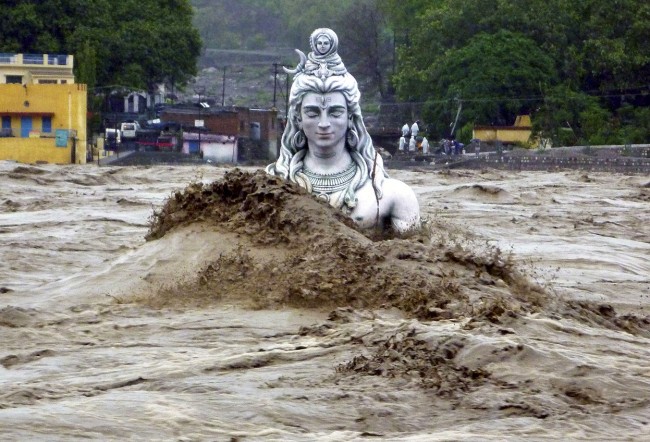
A giant statue of Lord Shiva was submerged up to its head in the tourist hub of Rishikesh.

Roads in many areas have been destroyed, leaving hundreds of pilgrims stranded on their way to visit shrines in remote areas.

Authorities have cancelled pilgrimage trips, fearing further rains and landslides in the state.

"Right now our priority is to save as many lives as possible and the scale of destruction will be assessed later," Mr Rautela said.

Tuesday 18 June 2013

http://www.abc.net.au/news/2013-06-18/at-least-60-killed-in-india-monsoon-floods/4763808

continue reading

More than 1,200 migrants reach Italy by boat, drownings reported


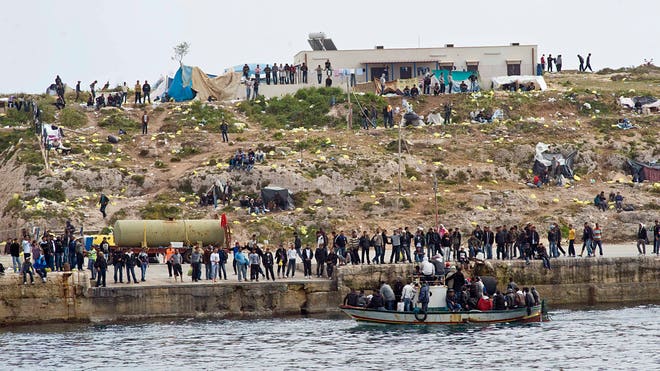
More than 1,200 migrants reached Italy over the weekend after attempting the perilous sea passage from Africa in flimsy vessels, the Italian coast guard said on Monday.

The coast guard said it had rescued most of the migrants at sea after intercepting nearly 20 boats and was still searching for others but it could not confirm reports that up to 10 people had died during the attempted crossing.

This year's first wave of summer heat has brought with it relatively calm waters, prompting impoverished immigrants desperately seeking work in the European Union to set off in rubber rafts and wooden boats. Many do not survive the passage.

Italian media reported that 95 immigrants were saved from a large raft. The survivors told of as many as 10 who had died after a Tunisian fishing boat cut loose the tuna cages it was dragging and that several immigrants were clinging onto.

"We do not have a confirmation of this," a coast guard spokeswoman said. "These are rumors from people we rescued but we found no bodies."

Italy's Foreign Ministry said it had not heard of the incident, which reportedly took place in international waters.

In 2008, a picture of 27 Somali immigrants clinging to the tuna nets of an Italian fishing boat came to symbolize a tragic summer in which many boats sank in choppy waters during the crossover, drowning unknown numbers.

Thousands of immigrants seek the southern shores of Italy every summer, when the waters in the Strait of Sicily become calm enough for small boats to make the crossing, usually from Libya or Tunisia.

They come seeking work in the EU and many do not remain in Italy. Those who do, or who are taken into Italian custody, can be sent home.

Tuesday 18 June 2013

http://www.reuters.com/article/2013/06/17/us-italy-migrants-idUSBRE95G0EZ20130617

continue reading

3 bodies recovered from sea after a Malaysia-bound trawler capsized in the Bay near Teknaf


Police recovered three bodies, including one woman and two children, were recovered around 10am Monday from Kochubunia area under Teknaf Upazila after an illegally Malaysia-bound trawler capsized in the Bay near Teknaf in Cox’s Bazar on Sunday morning.

One of the deceased was identified as Abdur Rahman, 50, the driver of the trawler.

The trawler sank with 30 passengers, including women and children, on board. 22 of them managed to swim ashore while others went missing, locals said.

One more person is still missing since the trawler capsized early on Sunday.

Teknaf BGB 42 Battalion commander Lt Col Jahid Hasan said all of them are Rohingyas, he said.

A human trafficking gang was sending those people to Malaysia, Teknaf police said, adding that police arrested three members of the gang in this connection.

Mohammad Farhad, officer-in-charge of Teknaf Police Station, confirmed the incident.

Tuesday 18 June 2013

http://www.thedailystar.net/beta2/news/six-bodies-found-in-bay/

continue reading

Collecting DNA is next step in Dozier mass grave probe


Sen. Bill Nelson's office announced Thursday that DNA testing is set to begin in the search for identities of remains in graves at Dozier.

Researchers will try to match DNA samples taken from the living relatives of boys buried on the grounds of the now-closed Arthur G. Dozier School for Boys in Marianna. According to a press release from Nelson’s office, this is an important next step in solving the mysteries behind dozens of unmarked graves found at the site.

Forensic experts from the University of South Florida were to begin collecting DNA samples Friday from relatives they’ve identified through historical records or who have come forward during the school's ongoing investigation.

Over the years, the reform school has been the subject of several investigations stemming from allegations of abuse. Florida officials closed the school in 2011 following a state police probe into the latest such allegations that found no evidence of any crimes.

That probe was called into question late last year when a USF forensic team began examining the site and found more unmarked graves than police had said were there.

Nelson is pushing the school’s application for a Department of Justice grant he helped identify that would cover the costs associated with forensic research involving the use of DNA to identify missing or dead persons. Up to $3 million will reportedly be awarded to select applicants.

Last month, Circuit Judge Bill Wright rejected a request by state Attorney General Pam Bondi to grant a local medical examiner permission to exhume the bodies buried on school grounds. In his order, Wright wrote that either the local medical examiner or the state’s chief archaeologist could initiate exhumation without court permission. USF is now seeking permission from the state's chief archaeologist.

Tuesday 18 June 2013

http://www.jcfloridan.com/news/article_5128247a-d79a-11e2-9419-001a4bcf6878.html

continue reading

Five more Monsoon victims recovered from near Kedarnath shrine, toll 13


Authorities in Chamoli district said the toll may climb as about 50 persons from different villages in the area are missing and rescue operations are on.

Five more bodies were recovered on Monday from near the Himalayan shrine of Kedarnath, taking the toll in the torrential rains lashing Uttarakhand to 13 even as the chardham yatra remained suspended for the second day due to landslips.

Authorities in Chamoli district said the toll may climb as about 50 persons from different villages in the area are missing and rescue operations are on.

They said five bodies were recovered from Basukital adjoining Kedarnath.

The Yamunotri, Gangotri, Kedarnath and Badrinath motor way and pedestrian routes are blocked at about a dozen places by rocks and boulders that have come down as part of the debris from collapsed houses and landslides triggered by rains continuing for the last 36 hours.

The rains have triggered flashfloods in the Ganga, Yamuna and their tributaries at most of the places sweeping away a number of bridges, roads and buildings.

The swirling waters of Assiganga, a tributary of the Ganga, has swept away several buildings including a four storeyed house which had been vacated in advance and a temple.

Eight persons were killed yesterday in three separate incidents of house collapse in Dehradun and landslips in Rudraprayag districts.

Heavy rains caused a house at New Mithi Beri in Prem Nagar area of the city to cave in yesterday and five persons were killed and six injured after being hit by landslips in Rudrapayag district.

Four of them were killed near Bhim Gali at Rambara on Kedarnath pedestrian route while one was hit by a landslide near Gaurikund which is on way to Kedarnath, she said.

Five stationary buses, a truck and one JCB have been swept away in the flash floods in Uttarkashi district.

Tuesday 18 June 2013

http://www.dnaindia.com/india/1849279/report-five-more-bodies-recovered-from-near-kedarnath-shrine-toll-13

continue reading

Monday, 17 June 2013

Phillipines abandon search for missing 7


Philippine authorities said yesterday they had abandoned hope of finding alive seven people missing from a ferry, which sank last week with dozens on board, after three days of searching in strong currents.

Rescuers recovered two bodies from the sea and rescued 61 others after the Lady of Mount Carmel went down Friday off the coast of central Masbate island, more than 300 km southeast of Manila.

Regional civil defense chief Raffy Alejandro said divers had not been able to reach the sunken ferry, believed to be lying on the seabed 1,300 feet (396 meters) under water.

“We are shifting from rescue to retrieval. We will search only if someone spots something floating near the coastline,” he told reporters. He said they had also withdrawn some of the search and rescue vessels.

The ferry mysteriously sank in calm weather before dawn on Friday about two km (1.2 miles) from Burias Island.

Alejandro said the sunken ship was in water too deep to be reached by navy divers so it could not be determined if any bodies were trapped inside.

Coast guard officials originally refused to give up hope for the missing, believing they could have swum or drifted to nearby islands.

But Alejandro said the decision to end rescue efforts was made due to lack of progress and signs of impending bad weather.

The sinking of the ferry has raised questions as it came apparently in clear weather and smooth seas. Survivors are also reported to have accused the crew of not attending to them as the ship was sinking.

Sea accidents are common in the Philippines due to poor safety standards and overloading.

The world’s deadliest peacetime maritime disaster occurred near Manila in 1987 when a ferry laden with Christmas holidaymakers collided with a small oil tanker, killing more than 4,300 people.

Monday 17 June 2013

http://www.arabnews.com/news/455306

continue reading

11 dead, 50 missing in Uttarakhand Monsoon


Five more bodies were recovered today from near the Himalayan shrine of Kedarnath even as the chardham yatra remained suspended for the second day due to landslips.

Authorities in Chamoli district said the toll may climb as about 50 persons from different villages in the area are missing and rescue operations are on.

They said five bodies were recovered from Basukital adjoining Kedarnath.

The Yamunotri, Gangotri, Kedarnath and Badrinath motor way and pedestrian routes are blocked at about a dozen places by rocks and boulders that have come down as part of the debris from collapsed houses and landslides triggered by rains continuing for the last 36 hours.

Monday 17 June 2013

http://www.firstpost.com/india/monsoon-tracker-live-11-dead-50-missing-in-uttarakhand-876469.html

continue reading

June 24, 1973: Upstairs Lounge fire

On the evening of June 24, 1973, Duane “Mitch” Mitchell dropped his two sons off at the movies before heading to the Upstairs Lounge on the corner of Chartres and Iberville streets with his partner, Horace Broussard.

The bar was a hub for the Metropolitan Community Church, a recently formed ministry that reached out to gays and lesbians.

“During those days, it was an alternative to a dance or hustler bar. It was more of a fellowship, a place where we would sing a song or add a verse to ‘We Shall Overcome’,” said Stewart Butler, 82, who was at the lounge that night.

Mitchell had divorced his wife a few years earlier and was living with Broussard on Polymnia Street. The two were regulars at the Upstairs, attending Metropolitan Church services in a back room theater and rarely missing the Sunday night beer bust.

That evening, they were among about 75 people there.

According to witness accounts, some patrons were singing around the piano, while others were discussing a fundraiser for disabled children.

At approximately 7:50 p.m., the buzzer rang and a patron headed toward the stairwell to open it. He found the stairway engulfed in flames.

As the fire tore through the bar, many inside tried desperately to climb through barred windows to safety. Some leapt to their deaths, while others were devoured by the flames.

Butler, who left an hour or so before the fire to visit a neighboring bar called Wanda’s, remembers sirens and a ghastly scene.

“It was chaos. It was horror. The one thing I particularly remember is seeing MCC Rev. Bill Larson up against the window bars. He burned to death right up against those bars. It was an absolutely monstrous thing,” Butler said.

Mitchell made it outside but went back in to try to save Broussard. Both perished in the fire, alongside 30 others, many of whom were gay men.

That night Duane Jr. and Steven Mitchell watched “The Incredible Athlete” over and over, wondering when their father would arrive to pick them up.

“There was nobody there except for me and my brother and the people who owned the theater,“ said Duane Mitchell Jr., who was 11 at the time, in a documentary about the event. “We were waiting on Dad to come, but he never did.”

Conflicting statements

Forty years after it killed 32 people, the Upstairs Lounge fire still lingers oddly on the fringes of history, unresolved and unknown to many New Orleanians despite the epic scale of the tragedy.

The 64-page New Orleans Police Department report filed Aug. 30, 1973, reveals that detectives found compelling evidence of arson at the scene: An empty 7-ounce can of Ronsonol lighter fluid on the stairway where the fire had begun.

The report also includes a statement by an employee at the Walgreens in the 100 block of Royal Street who said she sold a can of lighter fluid around the time of the fire to a man she described as “gay” and appearing distraught.

Investigators additionally learned that two men had been kicked out of the bar that night, one of whom had had a violent confrontation with another patron.

Michael Scarborough gave police a statement saying he had been in a fight that night with a man who had been spying on other men in the bathroom.

“I just jumped up and just knocked him down, and he just looked up at me and he said, ‘I’m gonna burn you all out,’” Scarborough said.

David Dubose, 19 at the time, initially confessed to the fire, but recanted. After another man provided an alibi for him and Dubose passed a polygraph test, he was cleared of suspicion.

A few days later, the police located a second suspect, 24-year old Roger Nunez. But before he could be interviewed, Nunez had a seizure and was taken to Charity Hospital.

Nunez was also treated for a broken jaw. He was released from the hospital days later, unbeknownst to police.

Officers were unable to find him for months. When they did, he denied setting the fire and said he couldn’t remember whether he had been at the lounge that night.

A year later, Nunez committed suicide in his home in New Orleans East.

Shortly after Nunez’ death, one of his friends, Ralph Forrest, told police Nunez had admitted to him several times, while drunk, that he had started the fire.

“When I questioned him when he was sober regarding the fire, he wouldn’t admit it and said, ‘You must be kidding; me do that!’” Forrest said.

Keeping the story alive

“Do a mind experiment,” said New Orleans artist Skylar Fein in his Bywater studio on a recent afternoon.

“Imagine that the fire had happened a few blocks away, at Antoine’s, and all of the people who died were relatively wealthy, white heterosexual couples. I can guarantee that things would have turned out differently. Had there been a prime suspect, he would not have been allowed to go free.”

Fein — who in 2008 breathed life into the story of the Upstairs Lounge when he built a replica of the bar that he exhibited at the Contemporary Arts Center of part of Prospect.1 — is one of many artists and researchers who have recently spotlighted the tragedy.

Fein thinks the story is surprisingly little-known in New Orleans, considering the magnitude of the carnage — as well as what it reveals about the mores of the times.

Royd Anderson, a teacher and documentary filmmaker who will premiere his film about the event next week, agrees.

“This is the worst mass murder of gays in U.S. history, and it’s a footnote in most Louisiana textbooks,” Anderson said.

At the time of the fire, Anderson said, there were no public statements or memorials given by either Gov. Edwin Edwards or Mayor Moon Landrieu.

Media coverage was short-lived, and only a few small church ceremonies were held for the victims. Some bodies even went unclaimed.

The Rev. William P. Richardson, of St. George’s Episcopal Church, held a small prayer service, earning him a raft of hate mail and a rebuke from the bishop.

Even today, the only physical memorial marking the tragedy is a plaque laid 25 years later on the sidewalk outside of where the fire had occurred.

“Most people walk right over it like it’s not even there,” Anderson said.

Harassment commonplace

The near-silence by politicians on the tragedy — and the ire directed at Richardson — highlights the homophobia that pervaded New Orleans, and America as a whole, in the early 1970s.

Frank Perez, a columnist for Ambush magazine and author of a book about the history of gay New Orleans, said that gays in the city were still being harassed and arrested because of their sexual orientation.

Raids of gay bars were common, and those who were taken in for violating vice laws would be subjected to police violence, have their names published in the paper and often find themselves evicted from their apartments and fired from their jobs, Perez said.

He added that the public attitude about the fire was “very cruel,” with the victims being the butt of jokes more often then the object of sympathy.

“Radio commentators would say things like, ‘What should they do with the remains? How about burying them in fruit jars?’” he said.

According to Perez, while gays were organizing politically in other U.S. cities, the gay community in New Orleans was more inclined to organize socially, and activism was rare.

Wayne Self, a composer who has written a musical about the Upstairs fire, said the stigma of homosexuality deterred many victims’ families and friends from rallying for more public acknowledgement of the tragedy.

“This was never going to be a Stonewall,” said Self, referring to the Stonewall riots that occurred in 1969 in New York City after a raid on a gay bar, galvanizing the gay community there.

“Family members were embarrassed,” Self said. “There were gay men who were married, who had brought shame to their families.

“The gay community in New Orleans didn’t want it to be a shot heard around the world.”

Turning point

But the event still marked a sort of turning point for gay identity in New Orleans, according to Butler, recalling a memorial service held at St. Mark’s Church on Rampart Street.

When the media arrived, mourners, many of whom were gay, had to decide between slipping out a side door in anonymity or walking out the front door and potentially revealing their sexual orientation.

“To my knowledge, not one person left from that side door, we all left upright and proudly through the front,” he said.

Three months after the tragedy, The Times-Picayune published a series of articles about how many gays were coming out of the closet in the fire’s aftermath.

Four years later, thousands of people would gather at Jackson Square to protest singer and homosexuality critic Anita Bryant, an event widely viewed as a seminal moment in New Orleans gay activism.

Author Johnny Townsend, who 20 years ago wrote one of the first books on the fire, said he still feels touched by the stories he researched long ago.

“It did consume me,” he said. “I worked on it 20 hours a week for probably a year and a half, and I’m still haunted by things that people have told me.”

Memorial events scheduled

A number of events commemorating the fire are planned for June 24, the 40th anniversary of the tragedy.

Fein will give a brief lecture at the Williams Research Center of the Historic New Orleans Collection, after which a jazz funeral will proceed to the site of the fire.

That evening, Self’s musical, “Upstairs,” will premier at Cafe Istanbul, and on Monday, Anderson will show his film for the first time at PJs Coffee on Magazine Street.

Duane Mitchell, who lives in Alabama, said he hopes to make it, but can’t afford the cost of transportation and is relying on donations that Self has been raising.

Mitchell hasn’t been back to New Orleans since his father’s passing, and he said the anniversary is taking an emotional toll on him.

“What really stings me is that nobody was ever charged with any crime,” he said.

“I still think my dad’s a hero. I think about him every day, what he could have been and what we could have been.”

Monday 17 June 2013

http://theadvocate.com/home/6254220-125/1973-lounge-fire-lies-on

continue reading

Search for ferry passengers shifts from rescue to recovery


The search for seven missing passengers of the ill-fated vessel that sank off Masbate last Friday is now a recovery effort, the Office of Civil Defense (OCD) in Bicol Region said Monday.

Raffy Alejandrino, OCD-Bicol Region chief, said they were studying the option of using the sonar equipment of the United States Navy to reach the area where the roll-on and roll-off vessel M/V Lady of Carmel sank.

Rough seas caused by Tropical Depression "Emong" also affect the ongoing search operation of the navy and coast guard, he said.

The ferry was sailing in a calm sea on Friday when it sank around 5 a.m. along Burias Pass between Pio Duran, Albay and Aroroy, Masbate.

Two persons died in the incident while 61 passengers and crew were rescued.

The bodies of Erlinda Julbitado and Carlota Senga were transferred to Metro Manila over the weekend. Julbitado's remains were brought to The Evergreen Chapels and Crematory in Pasig City while Senga's were brought to San Roque in Marikina City.

Julbitado and Senga were part of the group who went to Masbate for the house blessing of Julbitado's daughter.

Monday 17 June 2013

http://www.sunstar.com.ph/breaking-news/2013/06/17/search-ferry-passengers-shifts-rescue-recovery-287830

continue reading

15 unidentified bodies found in Tamil Nadu every day‏


Fifteen unidentified bodies are recovered in Tamil Nadu every day.

As many as 5,319 unidentified bodies were found in Tamil Nadu in 2012, according to recent data from the National Crime Records Bureau. Most of the individuals were murder victims.

The state is second only to Maharashtra, which tops the official crime compiler’s morbid list with 5,906 unidentified bodies. Crime experts and police officers say a rise in the number of unidentified bodies could be a pointer to an increase in the number of unsolved murders.

A total of 37,838 unidentified bodies were recovered across the country in 2012, an average of 103 bodies a day, the NCRB data has revealed.

Most bodies unclaimed are of women and elderly

Police officials say killers dump bodies in lakes or on railway tracks because it is an easy way to get rid of evidence and putrefaction or mutilation makes identification and further investigation difficult for police.

A police officer said few people approach police to identify bodies or claim them. “Investigating officers try to make identification as soon as possible, preferably within 48 hours, before decomposition starts, because determining the identity early is vital to a murder investigation,” he said.

Unidentified bodies are sent to crematoriums or to medical colleges where they are used to study anatomy.

The Tamil Nadu police website (www.tnpolice.gov.in) currently has details of 631 unidentified bodies that were recovered in the state this year. Most of the bodies were of senior citizens and of women with severe injuries to the face.

Social activists say several of the bodies are of homeless people. “There are too few homes where they can find shelter and inadequate healthcare facilities,” said A Narayanan, who works for the welfare of the homeless. “The facilities are poor at government hospitals and mortuaries are often inadequate. This leads to decomposition. Police rarely conduct forensic tests to determine the cause of death,” he said.

Railway police have to deal with a large number of bodies, of people who committed suicide or were accidentally hit by trains. “Railway police usually take unidentified bodies to the nearest government hospital,” said Southern Railway chief public relations officer V J Accamma. If we conclude it is a suspicious death, we immediately alert the nearest police station.”

“We place advertisements in newspapers about unclaimed bodies, after which we wait for a few days,” a police officer said. “If we receive no response and the body is not connected to a medico-legal case, we hand it over to the corporation for burial or send it to a medical college.”

Monday 17 June 2013

http://www.pakistankakhudahafiz.com/region/15-unidentified-bodies-found-in-tamil-nadu-every-day%E2%80%8F/

continue reading

June 17, 1958: The collapse of the Second Narrows Bridge


June 17, 1958, was a perfect summer day, sunny and hot. Workers building the new Second Narrows Bridge were nearing the end of their shift when, suddenly, a span 20 storeys above Burrard Inlet began to shake.

“Some of the men on it ran,” reported The Vancouver Sun. “Some clung to the girders.

“Then, with a crash that could be heard in downtown Vancouver, it swung down like a pendulum and slammed into the bottom of the sea.

“Clinging ironworkers flicked off like flies. The falling mass pulled its inshore supporting pillar out, (which) allowed (a second) span to fall like its partner.”

A survivor estimated that the collapse lasted only 25 seconds, but it sent 18 men hurtling to their deaths, and injured 20 more.

John Olynyk was one of the lucky ones. Olynyk was inside a “big, criss-crossed diagonal beam” when the span collapsed. He miraculously survived the fall and crawled to the top of the beam, but the tide started to come in. Then “the water came up and up and up,” and he thought he only had five minutes to live.

But a crew of six welders spotted him. Clambering onto a work boat, wrote The Sun’s Tom Ardies: “They put their torches to the steel cage that held him. They burned it away piece by piece, and pulled him out at the last minute.

“ ‘We worked like hell to save his life,’ said welder Jim Fullager. ’He just stared at us, without a word.’ ”

The welders pulled eight men out of the wreckage. But only two were alive.

A diver later died searching for bodies in the twisted metal underwater, bringing the final death toll to 19. Among the dead were two engineers that had miscalculated the strength of the “grillage” on a platform. A royal commission into the disaster said the miscalculations “meant the beams of the platform were used without stiffeners and supports which would have been found necessary if the calculation had been made correctly.”

It was a fatal mistake.

Monday 17 june 2013

Read more: http://www.vancouversun.com/THIS+HISTORY+JUNE+1958/8533871/story.html

continue reading

Sunday, 16 June 2013

'I lost my entire family to Sungai Dipang'


Pos Dipang was a tranquil Orang Asli village until tragedy struck 17 years ago, when the raging waters of Sungai Dipang almost wiped out the entire village and its residents, writes Jaspal Singh.

Whenever it rains heavily, Sapie Bahoi shudders. Despite having re-married and becoming a devoted father to three children, the memory of having lost his first family 17 years ago almost always comes back to haunt the 43-year-old rubber tapper whenever the rains come.

"I cannot forget my late wife, my three-year-old son and the unborn child who died when our village was wiped away by a sudden torrent of water and debris.

"In a matter of minutes, I lost them ... my only solace was being able to bury their remains," said the resident of the Orang Asli village of Pos Dipang, about 8km from Sungai Siput Selatan town.

With tearful eyes, Sapie recalled that fateful evening on August 29, 1996, when an unexpected gush of water from Sungai Dipang swept away nearly 60 homes from the village that used to be located along the river bank.

The tragedy killed 44 villagers, including six members of a Chinese family living about 6km downstream from Sungai Dipang. So extensive was the damage caused by the gushing river that only two Orang Asli houses were spared as they were located on higher ground, unlike the others.

According to Sapie, who is also the assistant Tok Batin (village head), most of the villagers were resting in their wooden huts after returning from the jungles nearby.

"It was the fruit season then, and the villagers spent most of their time in the jungles picking durian, plucking petai and harvesting rotan.

"We had returned home in the evening and were spending time with our families when the river overflowed its banks and the water suddenly gushed down and hit the village around 7pm," he said.

Sapie was visiting his father, several houses away from his own, when villagers started shouting and running helter-skelter, during which time he saw his wife and son trying to escape the murky and debris-filled river.

"I shouted at them to run to higher ground, but the force of the river pulled them in.

"That night, when the remains of the villagers were being recovered, I saw the bodies of my wife and son.

"I lost everything ... many families lost everything ... we lost our families, our belongings and homes.

"The sight after the water receded was like 'padang jarak padang tekukur' (total wilderness). Nothing was left."

For Sapie, who follows the traditional beliefs of his ancestors, the incident itself was a mystery because prior to 1996, the Orang Asli settlement was never hit by Sungai Dipang's raging waters, nor has the river risen since.

After the incident, the Pos Dipang village, with its population of about 400 people, was relocated to higher ground downstream, about a kilometre from its original site.

The present site sits on hilly terrain, part of which was once mined for tin.

Village Tok Batin, Bah Semu Bah Udin, said the incident had taught him to be more firm with the villagers as well as outsiders who pass through the village to go to a picnic spot upstream.

"I keep reminding the villagers to check on their children, especially when dark clouds start forming above Gunung Kinjang where Sungai Dipang originates.

"Villagers will sometimes remind outsiders to get out of the area when the skies threaten to unleash heavy rain.

"Although nothing similar to the 1996 tragedy has taken place since then, we are not taking anything for granted," said the 50-year-old security guard, who was appointed as the seventh village head about 10 years ago.

Bah Semu, who took the New Sunday Times to revisit the original site of Pos Dipang village, said the river water struck the village as its natural flow had been diverted by a dam-like trap of boulders and trees.

"It happened so fast. I had just returned from the jungle and was resting at home when I heard shouts and loud cries. When I looked out, I saw that muddy water had already engulfed the village.

"I quickly climbed a langsat tree near my house and stayed on it until the water receded. My wife and all our six children were unharmed. But I lost my brother-in-law."

Asked if it was raining heavily prior to the incident, Bah Semu said it rained lightly for about three hours, adding that it must have poured heavily upstream.

Describing the situation as chaotic, he said more than 500 rescuers from various agencies, including firemen, police, the army and the Orang Asli Affairs and Welfare departments were mobilised to help.

The search operation lasted three weeks, during which time rescuers recovered 39 bodies, mostly found buried under sand and debris at Kampung Sahom, downstream of Pos Dipang.

"The entire village was devastated. There was nothing left to be seen. Maybe it was 'takdir tuhan' (God's will). The survivors have moved on, but the memory of the tragedy remains.

"Of course, we now have better and safer homes. But when it rains, we still shudder. How can we forget such a tragedy? We can't," he said, pointing to the many large boulders which have made the river banks at the former village their home.

Sunday 16 June 2013

http://www.nst.com.my/nation/general/i-lost-my-entire-family-to-sungai-dipang-1.301191

continue reading

Families identify schoolgirl victims of Pakistani bus attack


Weeping relatives gathered yesterday to identify the charred remains of loved ones killed in a double attack in Pakistan's south-west.

At least 25 people were killed on Saturday when militants blew up a bus carrying female students in Quetta, the capital of Baluchistan province, and then stormed a hospital where survivors had been taken for treatment.

A Sunni militant group, Lashkar-e-Jhangvi (LeJ), which is responsible for a string of attacks against Pakistan's Shiite minority, said it was behind both attacks.

A LeJ spokesman said a female suicide bomber struck the bus, a rare tactic in Pakistan, before gunmen attacked the hospital, claiming the strikes were revenge for an operation by security forces this month.

Militants occupied parts of the Bolan Medical Complex in a standoff that lasted several hours and ended when security forces stormed the building, freeing 35 hostages.

Authorities shut down the hospital yesterday, moving patients to another facility, as investigators combed the grisly aftermath of the violence.

The intensity of the blast and subsequent fire reduced the student bus to a blackened skeleton, and outside the mortuary of the Provincial Sandeman Hospital, weeping relatives gathered to identify bodies.

The state of the bodies added confusion to the relatives' grief, as some were given contradictory information about their loved ones.

Mohammad Hamza, 19, said that on Saturday he had been given the body of his sister, only to be told a mistake had been made.

"I came here after someone had given us the information that we had taken the wrong body and my sister's body was still here at hospital, but it is not true," Mr Hamza said. It appeared the body he was given on Saturday was indeed his sister.

An LeJ spokesman called newspaper offices in Quetta late on Saturday to claim the killings.

Sunday 16 June 2013

http://www.thenational.ae/news/world/south-asia/families-identify-schoolgirl-victims-of-pakistani-bus-attack

continue reading

Malda boat capsize toll rises to 10


The disaster management team retrieved eight more bodies from the Ganges on Saturday, a day after an overloaded boat capsized near Manikchak Ghat, taking the death toll to ten. However, five persons are yet to be traced.

Police sources said that rescue operations would continue till all the five bodies are found. But villagers challenged the figures and said that there were more people on board the boat and the exact number can only be confirmed by the boatman. They further alleged that some of the passengers were from Jharkhand and thus the police have no records of them.

Meanwhile, police have arrested the contractor of the bank, Sohardi Sk, but boatman Chintu Sk has gone into hiding. DM G Kiran Kumar said, "We have recovered ten bodies. But according to our records, five persons are still missing." Sources said both the IG of North Bengal as well as the DIG visited the spot to take stock of the rescue work.

Locals said that the arrest of Sohardi Sk, who used to collect money from boats as well as the passengers, has frightened the boatmen and thus there were no services along the ghat on Saturday. If this continues it would not be possible for the villagers to carry on with farming and grazing activities on islands located on the western side of the river.

Sunday 16 June 2013

http://timesofindia.indiatimes.com/city/kolkata/Malda-boat-capsize-toll-rises-to-10/articleshow/20610404.cms

continue reading

No new survivors; divers fail to find sunken Philippino ferry


Navy divers have failed to find the seven missing passengers of the ferry M/V Our Lady of Mt. Carmel that sank off Burias Island in Masbate Friday with 70 people on board.

Sixty-one of those on board have been rescued, 39 of them passengers and 22 crew members, officials said. The bodies of two fatalities have been recovered.

Navy spokesman Lt. Cmdr. Gerald Fabic told reporters the seven missing could have been trapped inside the sunken vessel.

There’s a slim chance that they had drifted to nearby islands, Fabic said.

Of the seven missing, only three are listed in the ship’s manifest: Abegail Barredo, Noan Manocan and Leticia Andaya.

Four are not in the manifest: Fe Rapsing, Jonas Comidor, Arianne Comidor and Jocelyn Danao.

In a phone interview, Coast Guard spokesman Commander Armand Balilo told The STAR they have not yet received news of any new survivors from the Coast Guard and Navy search and rescuers teams at the scene.

“They (survivors) may have been carried by waves to the island (Burias),” he said.

Balilo said the last report from the field showed calm weather was allowing the continued search and rescue operations.

“It is hard to give an assessment at this point,” he said.

Fabic said hopes of finding the remaining missing passengers were fading fast as strong currents thwarted attempts to reach the seabed.

“They still have not (located) the ferry and they were not able to go too deep,” he said.

Fabic said divers from the Naval Special Operations Group and the Coast Guard were continuously scouring the area but without success as of yesterday. “No new survivors were recovered so far,” he said.

Fabic said Navy and Coast Guard ships continue their patrols in case survivors had drifted to nearby coastal areas.

No deadline has been set for the rescue operations since the missing might still be alive, he added.

The Maritime Police in Masbate has deployed a motorized banca to help in the search.

Authorities are looking at the possibility that the ship capsized in Agua Point, some 11 nautical miles from Aroroy port.

The ship might have sunk in depths reaching 518 meters that professional divers may not be able to reach.

Local governments, fishermen and volunteers have joined in the search and rescue for the missing passengers.

As of press time, authorities had not received any report of the missing being found near the coastal areas.

The Navy has no equipment for divers to find the sunken vessel at a depth of about 1,000 feet.

Office of Civil Defense regional director Raffy Alejandro said the BRP Pampanga, which was supposed to join the Indonesian Navy in naval exercises, arrived at 3:17 p.m. Saturday at Burias Pass.

“The search and rescue operation immediately started as early as 9 a.m. Saturday and still continuing,” he said. Alejandro said the Navy has deployed two vessels and a plane; and the Coast Guard a motorized banca for the search and rescue.

Commodore Natalio Abinuman, Naval Forces Southern Luzon commander, has deployed a five-man team from the Naval Special Operation Unit on Saturday off Burias Pass.

Lt. Col. Johannis Leonardi Dimaano, Air Force Tactical Operations commander, has also deployed two helicopters with parachute jumpers for the aerial survey Friday at 3:30 p.m.

Ensign John Duruin, Navy deputy spokesperson in Bicol, said members of the Naval Special Operations Unit were able to go down to some 100 feet.

“The search was cancelled due to poor visibility,” he said. Duruin said the depth of the ocean floor where the vessel sank was about 1,000 feet.

“Our technical divers cannot go down to that depth,” he said. “They can only go as far as 330 feet.”

Duruin told The STAR in a text message the NAVSOU has no equipment for the conduct of that kind of search.

“Tomorrow it will be about 48 hours since they have been missing and we expect them to float toward the surface and will be carried by the current to the shorelines if they had not been trapped inside the vessel’s compartment,” he said.

Sunday 16 June 2013

http://www.philstar.com/headlines/2013/06/17/954854/no-new-survivors-divers-fail-find-sunken-ferry

continue reading

Saturday, 15 June 2013

Wedding ring, IDs, other personal effects brought out of ‘Princess’ ferry wreck


A gold wedding ring was among personal effects found Friday by divers who went down into the wreckage of the Princess of the Stars in the hopes of locating the remains of about 400 passengers believed still trapped inside the ship that sank off Sibuyan Island five years ago.

Engraved on the ring the name Farah and what forensic investigators believed to be a wedding date: 10-6-07. It came from a bag that also contained a passport and other belongings of one Marlon Guinitaran from Balingasag, Misamis Oriental.

Also recovered was a plastic folder that contained the certificates awarded by the Far East Maritime Foundation in Cebu City to a seaman named Domino Omega.

In another bag were passbooks and documents of a Sgt. Rupert Tan of the Philippine Army.

There was also a school ID of a Mary Jane B. Sabuero of the Northern Mindanao School of Fisheries from a bag that contained a woman’s shirts and denim pants, now in tatters.

“These only strengthen our hopes of recovering the hundreds of bodies still down there,” said Persida Acosta, chief of the Public Attorney’s Office who arrived here Friday with a team of forensic experts to inspect the personal effects recovered from the wreckage of the Princess of the Stars.

The divers failed, however, on Friday to cut open the cabins of the ship where hundreds of bodies were believed to be trapped. The Cebu-bound Princess of the Stars, owned by Suplicio Lines, capsized and sank at the height of Typhoon Frank on June 21, 2008.

Of the 860 people on board, only 52 survived, says a memorial marker erected on the shore of Sitio Cabitangahan in Barangay Taclobo here.

It says 312 bodies were found during the initial years of recovery. Acosta said around 400 remained missing.

The ship’s hull, which was visible above the water until 2011, was removed, leaving the remaining half of the ship, composed of the four passenger and crew decks, 100 feet deep down the sea and 500 meters from the shore.

“We are now on the second phase (of the recovery),” said project engineer Vener Balsamo, who is working for the salvaging company, Hi-cap Metal Trading.

Royal Jessan was the original salvor until it sold the project to Hi-cap Metal Trading sometime in 2012.

“It’s not as simple as you think,” said Balsamo of pulling bodies out of the cabins. He cited the danger of being trapped inside the wreck, with the structure already weakened by rust.

The weather is also a factor, which allowed retrieval operations in 2012 to go on for only two months.

Balsamo said they planned to cut open each cabin, a process that might take them three to five years.

“We don’t mind how long. We will not stop looking for them. All we want is to give them a decent burial,” said Estella Jeli, 36. Jeli, who is from Imus City in Cavite, lost her parents and three siblings in the sea tragedy. She came here with the PAO, hoping to find her still missing two siblings, Jonil and Jackie Laurel, who were 17 and 7 years old when the ship sank.

“Our objective in retrieving these personal effects is to identify the passengers who were not on the ship’s manifesto and to check the manifesto itself. These are pieces of evidence to prove these people were on board the ship,” said PAO forensic doctor Erwin Erfe.

Acosta vowed her office would not stop monitoring the retrieval of the bodies until the shipwreck is totally removed from Romblon.

Rodne Galicha, director of the non-governmental group Sibuyan Island Sentinels League for Environment, called on the national government to step in and help speed up the recovery, citing danger from solid wastes like shampoo, bath soaps, and even infant diapers in cargo trucks that are still inside the shipwreck.

Besides that, Galicha said, “no one deserves to be buried in the ocean. As Chief Acosta has always said, the victims deserved a decent burial.”

Saturday 15 June 2013

http://newsinfo.inquirer.net/426951/wedding-ring-ids-other-personal-effects-brought-out-of-princess-wreck

continue reading

Friday, 14 June 2013

Documenting the Undocumented


One hot early morning last July, archaeologist Jason De Leรณn and his team were collecting artifacts in an empty stretch of the Sonoran Desert in southern Arizona. The study area, about 55 miles south of Tucson and 40 miles north of the Mexican border, is traversed by hundreds of thousands of undocumented migrants every year. Since early 2009, De Leรณn has been cataloging the objects — water bottles, diapers, knock-off Nikes, rosaries — that the migrants leave behind on the brutal journey. But on this particular morning, his team stumbled on what he’d been dreading since day one: a dead body.

De Leรณn, 36, is one of National Geographic’s Emerging Explorers, and he described his Undocumented Migration Project yesterday to a packed auditorium at NG headquarters in Washington D.C. Most of what we hear about immigration comes from the perspective of law enforcement — think Border Wars — or pandering politicians. De Leรณn is using the migrants’ discarded possessions to tell their side of the story. “This is American history in the making,” he said, “and we can use the tools of archaeology to systematically record these steps.”

Since 2000, U.S. authorities in Tucson have made 4.5 million captures of undocumented migrants (a number that includes multiple captures of the same person). De Leรณn has interviewed hundreds of these hikers and become good friends with two: Miguel and Victor*.

He met the men in the summer of 2009 when visiting a migrant shelter in the border town of Nogales, Mexico. Miguel and Victor hadn’t known each other long. They met in a detention center in Tucson, caught after living illegally for 20-odd years in the United States. After being sent back to Nogales, they tried to trek back into the U.S. together, failed, and again wound up in Nogales. They were working in the shelter for a few weeks to pay for their stay; then they’d attempt to cross the border yet again.

De Leรณn spent a few weeks at the shelter, getting to know the two men over many hands of poker. Miguel and Victor talked optimistically about the future, promising De Leรณn that after they made it back to their home in Tucson, they’d invite him over to grill and catch up. They’d be drinking beers, but since De Leรณn was so young, they teased, he’d have apple juice.

De Leรณn went shopping with the men to get supplies for their trip. In towns like Nogales and nearby Altar, the local economy depends on migrants. Store shelves are lined with bottles of water and electrolyte juice, camouflage gear, hiking boots, first-aid kits. Altar’s baseball team is called the Coyotes, a nod to the Spanish euphemism for smugglers.

Victor bought a few garlic cloves for his backpack to ward off wild animals. De Leรณn wrote a good-bye message in marker on the inside flap: “Don’t forget you owe me an apple juice.”

De Leรณn walked with Victor and Miguel to the Western edge of town, right up to an ominous, dark tunnel that ran underneath a highway overpass. On the other side of the tunnel was the desert and, if they were lucky, a way back home. De Leรณn cried as he watched the backs of his new friends disappear.

There was a good chance, he knew, that he’d never see them again. But about three weeks later, he got a phone call from Victor. “We’re in Tucson and we’ve got your apple juice,” he said.

For the first few years of his project, De Leรณn focused on cataloging the many objects left by migrants out in the desert. It’s a fascinating collection of things both banal (bottles, paper scraps) and unique (one of his favorites is an “illegal alien card” showing a green-faced alien and an Area 51 logo on it). Sometimes these objects are found alone — a t-shirt here, a backpack there. But De Leรณn has also found “migrant stations” with huge piles of clothes and trash. Unlike traditional archaeology that’s focused on the distant past, he calls his work “the archaeology of 10 minutes ago, literally”.

More recently he’s gotten into forensics. Since 1998, some 5,600 bodies have been found on the U.S.-Mexico border. That’s thought to be a wild underestimate of the migrants who die on the trip, but no one knows much about how a dead body fares in those conditions.

After consulting with forensic experts, De Leรณn learned that pig carcasses are often used as proxies of human flesh. So last summer his team dressed a dead pig in typical migrant clothes, placed it in the middle of the desert, and set up motion cameras to watch. For the first two weeks the animal decomposed naturally. Then the vultures came. Within 24 hours, most of the pig and its clothes had disappeared, including ID cards the researchers had stuffed in the pockets.


De Leรณn felt uncomfortable with the brutality of that experiment, but was reminded of its purpose just two weeks later, when he found the body of a middle-aged woman face down on the desert floor. He covered her in a colorful blanket he had found nearby. Then he waited with his team for seven hours until the Tucson sheriff came to pick her up.

After she was gone, De Leรณn’s students built her a shrine, as is the custom for deceased migrants. They decorated it with a sundry collection of religious objects bought at a local store. Some researchers pray before a shrine to a dead migrant. In the foreground, the blanket that covered her body. Photo by Jason De Leรณn.

Some researchers pray before a shrine to Marisol. In the foreground, the blanket that had covered her body.

De Leรณn, too, was moved by the experience. Over the next few weeks, he got in touch with various authorities and found out that a fingerprint analysis had identified her as Marisol, a 41-year-old mother of three from Ecuador. She had been on her way to meet family in New York.

Then De Leรณn did the hardest thing he’s ever had to do. He called her family.

He struggled, he told us, to find something positive to say.

“I picked up the phone and I said, ‘I’m the person who found Marisol. And I just wanted to let you know that we sat with her for a long time, that we waited. We sat with her before the birds could get to her.’”

Friday 14 June 2013

http://phenomena.nationalgeographic.com/2013/06/13/documenting-the-undocumented/

continue reading

Hunt for suspected Sri Lankan asylum boat called off


Australian authorities have abandoned the search for a boat bound for the Cocos Island carrying about 30 people.

The Australian Maritime Safety Authority announced it had called off a three-day search for the boat, believed to have sailed direct from Sri Lanka.

The boat, first spotted on Wednesday last week, was seen motoring under its own steam 480km northwest of Cocos Islands and 3500km northwest of Perth. When it failed to arrive at Cocos, Customs and Border Protection sent a RAAF plane to look for it. The boat was not found and the operation referred to AMSA, which began a larger sea and air search on Sunday, scouring the waters northwest of Cocos and Keeling Islands.

The perils faced by asylum-seekers were underscored last week when a boat carrying at least 55 asylum-seekers was lost at sea, with all on board drowned. The bodies of some of those killed were later seen floating in the sea.

Sri Lankan community sources said they knew nothing about the boat and navy operations commander N. Attygalle said he did not believe the missing boat had Sri Lankans on board.

"So far there's no evidence to suggest it's Sri Lankan and if it is we believe it must have left from Indonesia," he said. "If they had left from Sri Lanka, then by this time we should have received some calls (about missing people). But as far as the navy and coastguard are concerned we haven't received any information (about the missing boat)."

However, it would be highly unusual for a boat spotted nearly 500km northwest of Cocos to have sailed from Indonesia.

Sri Lanka's navy and coastguard have been recovering bodies from their own marine disaster last weekend after a storm off the coast of Galle and the capital Colombo in which more than 50 fishermen drowned.

Friday 14 June 2013

http://www.theaustralian.com.au/national-affairs/immigration/hunt-for-suspected-sri-lankan-asylum-boat-called-off/story-fn9hm1gu-1226663475666

continue reading

Ferry with more than 50 on board capsizes off Philippines


A major rescue operation is underway off the Philippines coast after a roll-on, roll-off ferry capsized with more than 50 people on board.

At least two people have died and 13 are still missing.

A further 42 people have been rescued.

The Coast Guard, the Philippines Navy and local fishermen are continuing a rescue operation for the remaining passengers and crew.

Philippines coast guard spokesman, Armand Balilo, told Radio Australia the ship sent a distress signal three hours after it sailed from the central province of Albay, en route to nearby Masbate province.

The vessel was reportedly carrying 57 passengers and crew, as well as two trucks and two buses on board.

The Coast Guard says it will look into possible overloading as a reason for the capsizing of the vessel.

Regional civil defence chief, Raffy Alejandro, says one of the bodies found was of a 58-year-old woman.

The ferry, MV Our Lady of Carmel, was travelling between Pio Duran in Albay enroute to Aroroy, Masbate.

Mr Alejandro says the cause of the sinking has not yet been determined.

However, the ship's captain, who was among those rescued, has said the vessel may have been unbalanced by the passenger buses and trucks it was carrying.

"He said it happened so quickly. It just went down in the darkness," Mr Alejandro said.

He said the waters and weather were calm.

The vessel was a roll-on, roll-off ferry commonly used in the Philippines to transport people, vehicles and cargo throughout the archipelago of more than 7,100 islands.

Sea accidents are common in the Philippines due to poor safety standards and overloading.

The world's deadliest peacetime maritime disaster occurred near Manila in 1987 when a ferry laden with Christmas holidaymakers collided with a small oil tanker, killing more than 4,000 people.

In 2008, a huge ferry capsized during a typhoon off the central island of Sibuyan, leaving almost 800 dead.

Mr Alejandro said he was hopeful Friday's death toll would not rise drastically, partly because the captain said most passengers were wearing life jackets.

"We expect many more will be rescued. We were able to respond quickly," he said.

Friday 14 June 2013

http://www.abc.net.au/news/2013-06-14/an-ferry-reportedly-sinks-of-philippines/4753774

continue reading

Four drown, 40 missing in West Bengal boat disaster


At least four persons, including a woman drowned, and more than 40 others were missing after a boat capsized in the Ganga River in West Bengal's Malda district on Friday.

Officials said a country boat carrying about 60 passengers, mostly daily labourers, capsized after it left Dharampur bank towards the char (riverine) island at 7.30 AM.

Four bodies, including that of a woman, have been fished out by the rescuers who are mostly locals, while eight persons were rescued.

Nearly 40 others are still missing

Senior district and police officials are camping on the spot and supervising rescue operations.

Friday 14 June 2013

http://zeenews.india.com/news/nation/four-drown-40-missing-in-wb-boat-disaster_854935.html

continue reading

Bus crash kills 12 pilgrims, injures 34 in Saudi Arabia


A bus carrying Jordanian Umrah pilgrims overturned on Thursday afternoon killing 12 and injuring 34 others on the Madinah-Makkah Road after Al-Jumoom Bridge towards Makkah.

The pilgrims were set to perform the Umra (lesser pilgrimage).

Capt. Humood Al-Bugumi, Traffic Police Duty Officer; Maj. Hilal Al-Qurashi, Director of Eastern Accidents; Lt. Col. Salman Al-Mutairi, Director of the Accidents Section with supervision and follow up by Col. Salman Al-Jumay’i, Director of Makkah Traffic Department, were at the scene of the accident.

Col. Al-Jumay’i issued directives to his staff to mobilize all efforts. The injured were rushed to King Abdul Aziz Hospital in Al-Zaher district, besides Hera, Al-Noor and Al-Shisha hospitals as well as hospitals in Jeddah.

The bodies of the 12 dead pilgrims were taken to the morgues of Makkah hospitals. Investigations are still going on to determine the cause of the accident.

King orders transferring bodies of Jordanian pilgrims died in Saudi Arabia

His Majesty King Abdullah II on Thursday instructed the government to transfer bodies of Jordanian pilgrims who died in a tragic road accident in Saudi Arabia.

The King also instructed the government to transfer the injured to Jordanian hospitals to receives medical treatment.

Friday 14 June 2013

http://www.saudigazette.com.sa/index.cfm?method=home.regcon&contentid=20130614169777

http://www.petra.gov.jo/Public_News/Nws_NewsDetails.aspx?Site_Id=1&lang=2&NewsID=114564&CatID=13&Type=Home>ype=1

continue reading