Friday, 25 January 2013

Zengeza Blast: Mystery Soldier and Cop Identified


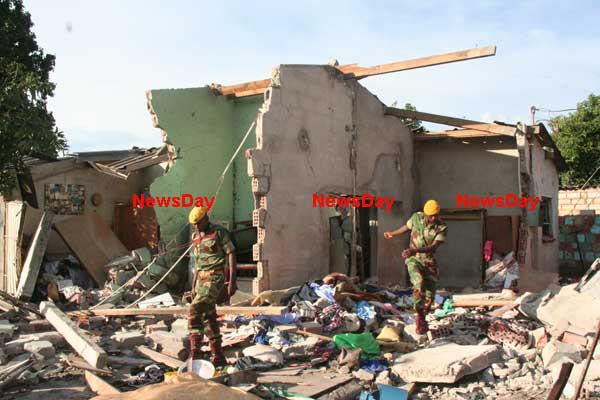
Investigations into the Chitungwiza deadly mystery explosion which killed 5 people on Monday publicly suspected to have been caused by super human powers, have escalated into an advanced stage amid revelations that the two unidentified bodies are of a serving soldier and an ex cop.

A source was quoted on the local ZBC News stating that the other person who is also yet to be identified is someone in the military, raising credence to suspicions that the explosion may have been caused by a bomb. The names of the two deceased persons are still be identified due to the sensitive nature of investigations being carried out by both the army and police. ZRP Harare Provincial Spokesperson, Inspector Tadius Chibanda indicated they are still in the process of identifying the two bodies with the help of pathologists.

Until now numerous superstitious people had suspected that the explosion was caused by ‘supernatural’ causes. Social networks were awash with random rumours claiming that the N’anga had meddled with powers too great for him to handle and is experiment had backfired. The wider Chitungwiza community sounded fears even suggesting that traditional healers should not be allowed to operate within residential areas and should use the bush for public safety reasons.

But the extent of the blast which damaged several other houses and the possible citing of a soldier among the dead nearby have all solidified a suspicion that it could have actually been a bomb.

The elder brother of the kombi driver who died, Robert Kamudzeya, said the family was still not aware of what had caused the blast.

“We are concerned about the media reports. We are sure the incident had nothing to do with lightning,” he said.

His son Tichaona said the family was devastated by the death of a “loving and caring father”.

But what struck controversy was a claim by the n’anga’s wife who claimed that she experienced electric shocks during the incident.

Nyawata said she had just arrived at the house when the incident occurred.

She was with Kamudzeya’s wife and two other women when the explosion occurred.

The women had used Kamudzeya’s vehicle to go and to fetch water for domestic use in the suburb.

“When we got home there were some people intending to see my husband. They wanted to be attended to,” she said.

Nyawata said as she put the last bucket into the house she heard a huge blast and found herself “tucked into a refrigerator”.

“I got some electric shocks. I finally managed to escape. Once I was outside I looked for my husband.

“I saw him lying motionless outside. He was bleeding from the nose and mouth but was still breathing,” she said.

She said as the ambulance took her to the hospital she told the crew that her husband was still breathing, but they ignored her.

Meanwhile a ZBC News crew which attended the scene revealed that the residents who were within the vicinity of the explosion are still traumatised by the horrific scenes they witnessed.

Some of the victims contend that it will be difficult for them to wake up everyday facing reminders of the horrific explosion.

However, owner of the seven roomed house destroyed by the explosion, Mr Dumba said he will continue staying at his property as he was not part of the people who caused the explosion.

Friday 25 January 2013

http://www.zimeye.org/?p=72082

continue reading

Body storage plan for Mazaruni boat collision victims flops


Despite assurances that bodies retrieved from Tuesday’s deadly boat collision on the Mazaruni River would have been properly stored and transported, that was not the case on Thursday when two more bodies were retrieved.

Transport Minister Robeson Benn on Wednesday had declared that unlike the massacres in Bartica where the bodies were just dumped on a boat and not properly prepared before being sent out of the mining area, the same would not have been for the victims of the boat crash.

He explained that already body bags were procured and that the bodies when recovered will be placed in body bags before leaving Bartica.

However, neither of the two bodies recovered from the Mazaruni arrived at Parika in body bags.

Those recovered on Thursday are Christopher Narine 21 of Parika Façade and Zahir Baksh 35 of Kane Ville, East Bank Demerara The bodies of the men arrived at the Parika Police Station just after 11 AM but it was only after 3 PM that they were removed and taken to the Lyken Funeral Parlour in the city.

Narine’s aunt, Debbie, told Demerara Waves Online News (www.demwaves.com) that she last saw her nephew five days before he went into the riverain community. She explained that he went to work with her cousin who operates a cargo boat from Parika to communities beyond Bartica.

Meanwhile the relatives of Baksh expressed much dissatisfaction that the bodies had to lay at the location for such lengthy period. One relative,who did not give his name added that they approached the police and suggested that they would have taken up the responsibility to have the body transported to wherever the police needed it to go. However. that suggestion was rejected by the police, the man said.

“Deez bodies come here since morning and just deh here all de time, we tell de police dat we could take it to parlour and dem tell we is a police matter and we can't move it" a male relative of Singh said.

On Thursday afternoon the police were forced to lock the gates of the Parika police station as the hearse arrived to have the bodies taken away. Persons flocked the gateways and even glued themselves to the chain-link fence to get a glimpse of the bodies which were covered in tarpaulin.

The recovery of Narine and Singh brings to four the number of bodied retrieved from the river near the scene of the accident. The bodies of Jermaine Calistro of West Demerara and Ulric Grimes of Salem, Parika have been already found.

Operation Hawkeye, which includes representatives of the Maritime Administration, Region 7 administration and the police and defence forces, are now looking out for the five remaining bodies of two Brazilians and two brothers- Ricky Bobb and and Keanu Amsterdam-and a Bartician identified only as “Tallman".

The accident occurred Tuesday afternoon when the two high-powered boats collided in the vicinity of Crab Falls, about 25 miles up the Mazaruni River from Bartica.

Friday 25 Janaury 2013

http://www.demerarawaves.com/index.php/201301245374/Latest/body-storage-plan-for-mazaruni-boat-collision-victims-flops.html

continue reading

Five bodies now recovered from Mazaruni tragedy


Three more bodies were found on Thursday after another gruelling day of search and recovery following the boat accident which occurred at Crab Falls, Mazaruni, on Tuesday.

Jewan Seeram, 52, from Tuschen was the most recent body retrieved while earlier on Thursday, Christopher Ramnarine, 22, of Parika, East Bank Essequibo and Zahir Baksh, 34, from Kaneville, East Bank Demerara were positively identified by family members and friends. The total number of bodies now stands at five, with four more persons still missing. There is some concern that all those feared missing may not have been identified, and the number could increase.

Ramnarine was identified by his uncle, his aunt told Guyana Times. She said he was working on a fuel boat for over a year and was accustomed to the back and forth trips that were required. She said that he was not afraid of the water and he left home on Saturday to take fuel into the interior. “I heard the boat was in an accident and Chrissy pitched out.”

Early Thursday morning, the woman noted that Ramnarine’s cousins went to look for him after there was no news of his body being found. However, while his cousins were looking for him, Ramnarine’s body was found and was being transported to Bartica Police Station. Baksh required two persons to positively identify him because of the decomposed state of his body. “He was so beat up, and decomposed, there was a piece of wood through him,” a close friend of Baksh stated.

He noted that “there are so many things we don’t know and you know conflicting reports. But I saw [Baksh] and I knew what his clothes were and recognised his hair and there was a phone in his pocket, but he was looking bad,” the friend noted.

The recovery is ongoing for Rick “Quaco” Bobb, 22, of Kitty; Deon “Tall Man” Moses, of Bartica and Keanu Amsterdam, 17, also of Bartica. Amsterdam’s aunt told Guyana Times that the young man’s father left early Thursday morning to search for his son. She also said “that lots of people are searching with their private boats”, noting that family members were out in droves looking for the missing men.

The Bartica Hospital was crowded with eager family members awaiting news of their presumed dead relatives. A hospital worker told Guyana Times that the wife of one of the missing men was unable to convey her distress because of the language barrier. “She is the wife of a Brazilian man on the boat and he is missing too, but she can’t speak English.” The hospital employee also stated that “with all the confusion around this accident, it is so much to deal with all these people who are here waiting on results”.

The search operation known as “Hawkeye” was shifted form a rescue to a recovery operation on Wednesday. Guyana Maritime Administration Department in collaboration with the Guyana Defence Force will continue to search for the missing persons, while at the same time pursuing an investigation as to the cause of the accident.

One of the boat captains is currently in police custody. He is being questioned with regard to the “blind turns” that may have attributed to the accident and the subsequent suspected death of nine persons.

Friday 25 January 2013

http://www.guyanatimesgy.com/?p=13990

continue reading

Thursday, 24 January 2013

20 dead in Bolivia bus crash


More than 20 people were killed Wednesday and 30 others injured when a bus plunged into a ravine in the Andes, Bolivian police said.

The accident occurred near Challapata in Oruro province, officials said.

The bus was en route from the southern city of Potosi to La Paz with 55 passengers aboard, the officer said. Police took 30 injured survivors to a hospital in Oruro city and as many as 25 bodies remain trapped in the wreckage of the bus.

Preliminary reports indicate the bus driver was drunk.

Wednesday 24 January 2013

http://english.ruvr.ru/2013_01_24/20-dead-in-Bolivia-bus-crash/

continue reading

14 killed in western Burma bus crash


Fourteen people were killed and 33 injured on Wednesday when a passenger bus crashed off cliff in western Burma, according to police reports.

Reuters have reported that the dead numbered 16.

The accident occurred at 3am on Wednesday morning along a bus route from Rangoon to Rakhine State.

Brake failure was the suspected cause of the crash of the ill-fated Aung Thit Sar Express, according to a report by AFP.

Speaking to The Irrawaddy on Wednesday, Min Aung, chairman of the National League for Democracy in Rakhine’s Taungup Township said that, “The injured people were sent to the hospital with other buses. As the bus fell a very long way down, we are still collecting the dead bodies.”

Accidents such as this are common in Burma due to poor infrastructure and hazardous road conditions.

Wednesday 24 January 2013

http://www.bnionline.net/index.php/news/mizzima/14643-14-killed-in-western-burma-bus-crash.html

continue reading

Limpopo flood death toll rises to 12


Two more bodies of flood victims, including a child, have been found, increasing the death toll as a result of the floods in Limpopo to 12 since last week.

The bodies were found on Wednesday by a search and rescue team comprising police divers, the fire brigade, officials from the Army, the South African Air Force, the Red Cross, the provincial disaster management office and emergency medical services.

Limpopo Department of Cooperative Governance, Human Settlements and Traditional Affairs spokesperson, Dieketseng Diale, said an elderly man's body was found in Soekmekaar near Tzaneen while the body of a school child was discovered in Giyani.

"This has raised the number of deaths caused by the floods to 12. Department MEC Clifford Motsepe as political head of the provincial disaster management centre expressed his deep sympathy and condolences to affected families," said Diale on Thursday.

Diale said the provincial disaster management centre was ready to handle any eventuality while residents were still urged not to cross flowing rivers and streams.

Limpopo's Vhembe and Mopani districts were the hardest hit by floods following the heavy rains in the past week.

More than 870 people have been rescued from their homes and rooftops around the province following the floods.

"A team from the provincial disaster management centre is currently doing an assessment of the damage caused, and they will prepare a report for the attention of authorities," added Diale.

She said the report would advise the department in terms of what needs to be done.

"All people reported [to be] trapped have been rescued and clean-up operations have commenced," she said.

On Wednesday, Diale explained that the department was already in the process of identifying flood victims who need RDP houses to be built with immediate effect.

An initial assessment shows that more than 700 houses, 19 schools and 42 bridges were cut-off while 14 roads were eroded in the floods.

The floods have also caused damage on several farms, affecting critical infrastructure like communications and electricity.

Wednesday 24 January 2013

http://7thspace.com/headlines/430834/south_africa_limpopo_flood_death_toll_rises_to_12.html

continue reading

Chitungwiza explosion caused by 'sandawana', traditional healer explains


The mysterious blast which killed five people and seriously injured three others at a traditional healer's house in Chitungwiza could have been a case of sorcery gone wrong, experts said yesterday.

While it has been suggested that a bomb, lightning or gas explosion could have caused the blast, members of the Zimbabwe Traditional Healers Association say there are other explanations for the incident.

Speculation remains rife on the blast, which destroyed the traditional healer's house and damaged 12 others in the high-density suburb of Zengeza 2 in the dormitory town of Chitungwiza.

While traditional healers are known for providing medicines for ailments as well as addressing matters in the spiritual realm, there are some who dare to extend their practice to the dark side.

Registered traditional healer Lovemore Muparadzi said the explosion was most likely the result of a failed attempt to address problems associated with an enrichment medicine (muti) processed using a rare animal called sandawana, which looks just like a mouse.

"That explosion was not caused by lightning or goblins," he said. "It most likely happened because of a sandawana."

Muparadzi explained that sandawana was a rare animal which traditional healers practicing the art on the dark side could use to come up with concoctions to enrich people.

"But this is a dangerous practice and as far as I know, when trying to come up with that prescription, it is not done in a house but in the bush," he said.

He said coming up with the enrichment muti followed strict procedures which when not adhered to had disastrous consequences.

"Those were exactly the effects of Sandawana," he said.

Muparadzi warned against the "get rich fast" mentality which he said led people to seek and get dangerous muti.

He urged people to instead turn to God and work hard to establish themselves in life. Zinatha spokesperson George Kandiyero agreed that the incident was most likely caused by a process which went wrong.

Kandiyero warned members of the public against obtaining harmful traditional medicine most of which was brought from outside the country.

"Buying such muti can be dangerous because people tend not to get the full manual on how it should be used. And if you do not get the full details, it can backfire," he said.

"I agree that it is possibly Sandawana or some other type of muti, which they were dealing with," he said.

Experts were also of the opinion that the young traditional healer, known as Sekuru Shumba and only aged 24, might not have known the impact of what he was doing. Kandiyero warned the public against visiting fly-by-night traditional healers who were not registered with Zinatha.

Zimbabweans await anxiously to know what police investigations will unearth as many people have been left speculating on what exactly transpired inside the doomed house.

Wednesday 24 January 2013

http://bulawayo24.com/index-id-news-sc-africa-byo-25346.html

continue reading

Chitungwiza blast: Healer's wife speaks out


The Zengeza traditional healer’s 17-year-old wife opened up yesterday saying she felt electric shock in the blast that claimed her husband and four other people on Monday afternoon. The cause of the blast has not yet been established.

Ms Liliyosa Nyawata, the traditional healer’s wife, said that her husband could have survived the explosion had he been attended to earlier.

The couple had been together for a couple of weeks.

Speaking at Chitungwiza General Hospital mortuary where she joined the Mandere family to collect Speakmore Mandere’s remains, Ms Nyawata said she had eloped to the traditional healer three weeks ago.

The couple had stayed at 4 Ndororo Street for only 10 days.

The families had not yet collected the bodies late yesterday afternoon. They, however, indicated that they would bury their relatives today.

The traditional healer died together with four other people who include kombi operator Mr Clever Kamudzeya, baby Kelly Chimina and two unidentified men.

Nyawata said she had just arrived at the house when the incident occurred.

She was with Kamudzeya’s wife and two other women when the explosion occurred.

The women had gone to fetch water for domestic use in the suburb. They had used Kamudzeya’s vehicle to fetch water.

“When we got home there were some people intending to see my husband. They wanted to be attended to,” she said.

Nyawata said as she put the last bucket into the house she heard a huge blast and found herself “tucked into a refrigerator”.

“I got some electric shocks. I finally managed to escape. Once I was outside I looked for my husband.

“I saw him lying motionless outside. He was bleeding from the nose and mouth but was still breathing,” she said.

She said as the ambulance took her to the hospital she told the crew that her husband was still breathing, but they ignored her.

Nyawata said when the blast occurred there were eight adults in the house.

Four women were in the dining room while the men were in another bedroom.

“I had stayed with him for three weeks. We were planning to get a traditional marriage,” she said.

She dismissed reports that there was a dispute between her and her ex-husband only identified as Shumba.

She said her ex-husband was from Mberengwa and works for a Harare car dealer.

“I had a child with him when I was 14 years old. He paid part of the lobola but I decided I could not stay with him because of the ill-treatment I got. I left him in October,” she said.

She said she met Mandere when she had returned to her parents’ home in the same suburb.

Nyawata dismissed as fictitious reports that her ex-husband had been deported to Malawi and was seeking revenge.

Across town in St Mary’s at the Kamudzeya family, friends and relatives were gathered and preparing to travel to Watambwa Village in Chihota for the burial.

Robert Kamudzeya, an elder brother to Clever, said the family was still not aware of what had caused the blast.

“We are concerned about the media reports. We are sure the incident had nothing to do with lightning,” he said.

His son Tichaona said the family was devastated by the death of a “loving and caring father”.

At the scene of the blast, neighbours suggested that traditional healers should not be allowed to operate within residential areas.

Mr Blessing Magaya said they should operate in secluded areas away from the public.

“Now we are all suffering,” he said.

Ms Felistas Dumba, daughter to Mandere’s landlord, said the family would not sell the property.

“In future such healers should have their own premises away from the rest of us,” she said.

Mr Kennedy Mangenje said council should allocate traditional healers an area to build their “surgeries”.

Most of Sekuru Shumba’s paraphernalia was taken to the police station yesterday.

Mandere’s father and some of the victims also gave statements to the police yesterday afternoon.

Among Mandere’s belongings was the clay pot that survived the blast, raising eyebrows among residents.

The clay pot had inexplicably survived the blast with residents claiming that it was part of the traditional healer’s apparatus.

Authorities in Chitungwiza had also hired earthmoving equipment to clear rubble from the site.

The equipment had yesterday cleared the rubble from the damaged houses.

Chitungwiza residents continued to throng the area to catch a glimpse of activities at the site.

Police also maintained their presence to control the crowd.

Mr Oliver Dumba, the landlord, said he would rebuild his seven-roomed house as it was his only source of guaranteed revenue.

“I am 66 years old and am a retired bus driver. I worked for Harare Omnibus Company,” he said.

Mr Dumba said he would look for a job to earn a living.

Harare police spokesman Inspector Tedious Chibanda said police were still waiting for results from the specialists who include pathologists and the army bomb disposal unit.

“By tomorrow (today) we will know the direction,” he said.

Inspector Chibanda said the matter had now been referred to the CID Law and Order Unit because of its nature.

He confirmed that post-mortems had been carried out on all the five bodies and remains.

He said results would be made public soon

Wednesday 24 January 2013

http://www.zimdiaspora.com/index.php?option=com_content&view=article&id=10754:chitungwiza-blast-healers-wife-speaks-out&catid=38:travel-tips&Itemid=18

continue reading

Filipino death toll in Algeria rises to 7


The Department of Foreign Affairs (DFA) on Thursday said that the number of Filipinos who died in the hostage crisis in Algeria has risen to seven.

Assistant Secretary and DFA spokesperson Raul Hernandez told reporters in a press briefing that the Filipino was positively identified by Algerian and Philippine authorities as one of those earlier reported to be missing. Hernandez said the authorities were able to positively identify the Filipino from one of the recovered bodies.

Hernandez also clarified that another Filipino who had earlier been reported to be missing had been accounted for, and was not in Algeria when the incident happened.

“Therefore, we still have two Filipinos unaccounted for and missing……and our team in Algeria continues to coordinate with the authorities and employers to find them,” Hernandez said.

The DFA had said that the six male Filipino fatalities earlier reported were mostly employed by the Japanese engineering firm JGC Corporation. He noted, however, that the seventh Filipino identified was employed by a British company.

Hernandez said that they could not yet disclose the names of the Filipino fatalities as they had not been authorized by their respective kin. He added that the authorities were working on the speedy repatriation of the remains of the fatalities but that they could not yet give a specific date.

He added that specific details on the circumstances of how the Filipinos died remained hazy but maintained that “it was the direct result of the hostage taking incident in the area and mostly by gunshot wounds and the effects of the explosion.”

Hernandez also noted that four Filipinos who were injured in incident remained in “stable condition” at the Al Azhar hospital in Algiers.

“They are able to stand up and walk, and the employer is now arranging their repatriation but we could not yet give a specific date,” Hernandez said.

He also said that the four Filipino workers from the Algeria who arrived Wednesday were those who were earlier reported to be staying at the Mercure Hotel. The DFA had said that they were inside the gas facility compound when it was attacked and occupied by militants but they were able to hide and so were not taken hostage.

Earlier reports had noted that the death toll from the siege had risen to more than 80 as Algerian forces searching the area for explosives found more bodies but that it was not clear whether they were hostages or militants.

An earlier Algerian ministry count also noted that 23 foreigners and Algerians were killed after al-Qaida-linked gunmen began their attack on the In Amenas gas plant deep in the Sahara desert on Wednesday. It also said that 32 kidnappers were also killed during the siege, and special forces were able to free 685 Algerian workers and 107 foreigners.

Wednesday 24 January 2013

http://globalnation.inquirer.net/62497/filipino-death-toll-in-algeria-rises-to-7

continue reading

Japan's Algeria toll hits 10 as survivors head home


A shell-shocked country was Friday readying to welcome home the seven Japanese survivors of the Algerian hostage crisis on a plane that was also carrying nine of its ten dead citizens.

Anxious relatives awaited those who made it out of the In Amenas complex alive, amid a renewed national awareness of the perils of doing business in resource-rich, but unstable parts of the world.

Tokyo on Thursday said it had now accounted for all ten men who had been out of contact since Islamist gunmen stormed the desert gas plant over a week ago.

Dozens of foreigners were killed during a four-day standoff that ended in a bloody showdown with Algerian commandos on Saturday, with reports of summary executions.

Japan's body count of 10 is the highest of any nation whose citizens were caught up in the crisis in the Sahara and an unusual taste of Jihadist anger for a country that has remained far from US-led wars in the Muslim world.

The plane left Algeria on Thursday, stopping in Frankfurt before heading to Tokyo's Haneda airport, where it was expected to arrive around 7:00am (2200 GMT Thursday).

As the aircraft left north Africa, mourners had paid their respects to lost colleagues at a makeshift altar at the headquarters of plant-builder JGC, which employed -- directly or indirectly -- all the Japanese who died.

A steady stream of visitors dressed in black solemnly bowed to a Buddhist cenotaph, as they urged departed souls to find peace.

An elegantly handwritten prayer for those who lost their lives was inscribed on a wooden tablet, around which lay bouquets of white flowers.

The loss of so many colleagues is a heavy blow to JGC in a country where corporate communities are close-knit and company loyalties remain strong.

Media reported Thursday that the tenth Japanese victim of the Islamist gunmen's rampage was Tadanori Aratani, 66, a former vice president of JGC and lately its supreme adviser.

The government has so far refused to identify those who died, although newspapers and broadcasters have told the stories of some victims, including heart-wrenching tales of never-to-be-realised plans for family celebrations.

Broadcaster NHK spoke to the sobbing elderly mother of one man struggling to come to terms with the loss of her son less than two years after the March 2011 tsunami swept her husband to his death.

At least 37 foreign hostages were killed in the siege according to a preliminary death toll, as well as one Algerian hostage. Several people are still missing and some bodies have not yet been identified.

Wednesday 24 Janaury 2013

http://au.news.yahoo.com/world/a/-/world/15944784/japan-confirms-tenth-death-in-algeria-siege/

continue reading

Families of Bangladesh garment factory fire struggle as they await compensation


When fire ravaged a Bangladeshi garment factory, killing 112 workers, dozens of their families did not even have a body to bury because their loved ones' remains were burned beyond recognition. Two months later, the same families have yet to receive any of the compensation they were promised — not even their relatives' last paychecks.

An official with the country's powerful garment industry said DNA tests must first be conducted to confirm the losses of more than 50 families. He would not say why the families have not even received the wages their relatives had earned before the Nov. 24 blaze.

Many of the families desperately need money after losing their primary breadwinners in the fire at the Tazreen factory, which made clothes for Wal-Mart, Disney and other Western brands.

The Bangladesh Garment Manufacturers and Exporters Association, a foreign supplier and the government promised to give the families of the dead 600,000 takas ($7,500) each, finance the education of the dead workers' children and pay the November salaries of both dead and surviving factory workers.

"I have got nothing. Nobody is saying anything," said Ansar, who uses one name and who lost his wife and daughter in the fire.

The 55-year-old is too ill to work himself. His 16-year-old son, who also worked at Tazreen, managed to escape but was traumatized by leaving his mother and sister behind "amid the darkness and ash," Ansar said at his home near the gutted factory.

The boy got a job at another factory but was unable to work because of his trauma.

"My son cannot sleep," Ansar said, sobbing. "He wakes up at midnight and then cries for a long time. The same thing happens to him every night."

Ansar has been unable to pay his rent for two months and fears that if he gets evicted and is forced to return to his home village in the impoverished north, he may never be compensated.

The fire drew international attention to the conditions that garment workers toil under in Bangladesh, where the $20 billion-a-year textile industry is incredibly powerful and politically connected.

The factory lacked emergency exits and its owner said only three floors of the eight-story building were legally built. Surviving employees said gates had been locked and managers had told them to go back to work after the fire alarm went off.

A government panel concluded that the fire was sabotage. No one has been charged with setting the blaze, though three officials accused of locking in workers have been arrested.

Siddiqur Rahman, vice president of the garment association, said checks have been cut for families of the 59 victims whose bodies were identified. In addition, 80 workers injured in the fire received 100,000 takas each.

The other 53 people killed were burned beyond recognition and buried in unmarked graves, after samples of their DNA were taken. The garment industry demanded relatives provide their own DNA samples to ensure their claims were valid. Those samples are undergoing testing.

Rahman said the industry did not want to handle the claims haphazardly and said the money should be disbursed by the end of February.

"We will do whatever we have promised," he said.He declined to explain why the victim's families had not yet received their November wages, which they would be entitled to whether the employee had died or not. Those wages are much smaller than the promised 600,000 takas; Ansar said his wife and daughter together earned around 10,500 takas a month as sewing machine operators.

When Ansar heard about the compensation, he gave the industry association photographs of his wife and daughter, their employee IDs and copies of their national identity cards. His son gave a blood sample for a DNA test days after the fire, but he has heard nothing.

"We went there; we met the BGMEA officials. They have asked us to wait. They don't make anything clear. They asked us to stay at home, not to go there," he said.

He has their phone numbers, but they don't answer when he calls, he said.

"I went there three times, but returned without anything," he said. "How long should we wait?"

"These families are very poor," said Mahmudul Sumon, an anthropologist from Jahangir Nagar University who is studying the fate of the victims' families. "They have lost their dear ones. Now they are suffering a lot, as many of the families have lost someone who was the main earner in the family."

Ruhul Hannan, who said his 35-year-old wife was killed in the blaze, sent his 18-year-old son for a DNA test, but so far he has received nothing, despite his pleas to the garment trade group.

"I am just waiting. They told me to wait until end of this month for the test result," he said.

Wednesday 24 January 2013

http://www.commercialappeal.com/news/2013/jan/24/families-of-bangladesh-garment-factory-fire-as/?CID=happeningnow

continue reading

Four bodies recovered from Mazaruni tragedy


The police today said that four bodies have been found following Tuesday’s collision in the Mazaruni River that left nine persons missing.

The police identified the bodies of the persons found as Jermaine Calistro, 27 years of Boodhoo Housing Scheme, EBE; Ulric Grimes, 39 years of Salem, EBE; Christopher Narine, 21 years of Parika, EBE; and Zahir Baksh, 34 years of Kaneville, EBD.

The police said that the search is continuing with the involvement of the Joint Services, the Maritime Administration Department, miners and public-spirited persons of the community among others.

Lennox Andrews who identified himself as Grimes’s son told Stabroek News today that the body was found floating in the water about 200 metres from Crab Falls near where the two boats collided.

Andrews explained that following searches throughout the day yesterday, relatives decided last night to continue and it was then that they found the body.

Andrews said that the death is even more devastating because Grimes leaves behind a two-year-old son. He has five older children.

After being retrieved, the body was transported to Bartica then to the Lyken’s Funeral home in Georgetown where it is awaiting a post-mortem examination scheduled for tomorrow.

According to Andrews, relatives are planning to bury him after the post- mortem due to the decomposing state of the body.

Searches are at the moment being conducted for the other seven who are missing.

Wednesday 24 January 2013

http://www.stabroeknews.com/2013/news/stories/01/24/second-body-found-from-mazaruni-tragedy/

continue reading

Wednesday, 23 January 2013

Wife wants DNA test on bodies of slain OFWs


The wife of an overseas Filipino worker (OFW) asked for more proofs that her husband, identified as Iluminado “Bong” Santiago, was among six overseas Filipino workers killed by during a hostage taking launched by Al Qaida linked “Signatories in Blood” at In Amenas in Algeria last week, a local paper said.

“I really want to be sure it is him (who is dead),” Estrella Santiago told the Inquirer as she requested for the use of DNA tests on bodies that were recovered after the hostage-taking crisis at the oil plant.

“I still hope he is alive,” said Mrs. Santiago, school teacher and a resident of Apalit, Pampanga in central Luzon.

Representative of the foreign affairs department and the Overseas Workers Welfare Administration (Owwa) have given information about the death of her husband, although his body was not yet recovered, said Mrs. Santiago.

She also asked for a complete list of OFWs who survived the incident, some of whom were brought to Italy and Germany, hoping that her husband might be with those groups.

Her scepticism began when her husband’s co-worker and friend, Joseph Balmaceda, who survived the incident, returned to the Philippines on Monday, and visited the Santiago family on Tuesday.

Narrating to the family what happened, Balmaceda said he and Santiago were herded by the hostage- takers into one of the five trucks that were filled up with hostages from the gas plant.

It was Santiago who asked the hostage-takers about their motive and was told, “We are angry at the British and French (nationals),” one of Santiago’s children, Christian, quoted Balmaceda as saying.

“(Balmaceda) told us the terrorists were transferring the hostages out of the gas plant because they were going to bomb it. But as the convoy was heading out of the plant, the Algerian forces rushed to bomb the convoy,” Santiago’s son said.

“As the hostage takers were asked to raise their hands (like human shields for the hostage-takers) when an Algerian military plane hovered, it was Bong (Santiago) who tried to assure us that we were going to be safe. He led us in prayers for a miracle,” the young Santiago told Balmaceda’s story.

“He (Santiago) had no wounds or traces of blood but he looked afraid. I’m sure Bong was in (that state) when I left him (to find safety),” Santiago’s son added.

Earlier, Balmaceda said he was the only survivor among those in the vehicle that was bombed on the first day of the hostage-taking.

“As a husband and father, he was more than 10 (on a scale of 10). He had no vices. When he was in the country, all his time was for our children,” Mrs. Santiago recalled.

In December 2011, Santiago finishing building his family’s two-storey concrete “dream house” on a 200 square metre lot at Royal Family Homes. He also bought them a black Mitsubishi car.

The Santiago couple’s children are aged 13, 10 and 5.

Wednesday 23 January 2013

http://gulfnews.com/news/world/philippines/wife-wants-dna-test-on-bodies-of-slain-ofws-1.1136613

continue reading

Ritual killings that have terrorised Cameroon: 18 young women are abducted, murdered and found with brains, eyes and genitals missing


A series of ritual killings of young women in the West African nation of Cameroon has caused panic in the capital city Yaounde.

Families are now refusing to let their daughters go out after a spate of gruesome killings of young girls who were abducted by the drivers of motorcycle taxis before being murdered and dismembered.

Police have found 18 mutilated bodies on the streets of the capital in the past two weeks, five of them outside a nursery school, and all are believed to be linked to occult rituals.

In some parts of the country traditional healers believe that body parts including eyes, genitals, breasts and tongues have mystical powers, with many believing they bring riches and other good fortune. Others believe that performing a human sacrifice will bring good luck.

Ritual killings were common in Cameroon until the 1970s but as education spread, the number of murders decreased.

Now families fear the practice is coming back, with the latest wave of killings causing near-hysteria in the capital city.

This week, the sister of a 17-year-old girl whose corpse was found on Friday outside a nursery school, minus the genitals, tongue, eyes, hair and breasts, wrote to Cameroon President Paul Biya demanding action to prevent further killings.

Deborah Ngoh Tonye Epouse Mvaebeme said her sister, Michele Mbala Mvogo, a student at the government bilingual High School Yaounde was abducted three days before her body was found outside a nursery school.

She accused the city's commonly-used motorcycle taxi drivers of facilitating the murder, and said the government had failed to do enough to protect the victims, who were from the poverty-stricken neighbourhoods of Mimboman and Biteng.

One local said: 'The moto-taxi drivers are the assassins' accomplices, and their targets are girls aged 16-25 who get the taxis after nightfall. For a large sum of money, these girls are delivered to men in the suburbs who do the rest.'

The head of a Mimboman nursery school told afrik.com how she found one of the bodies outside her school.

She said: 'It was a strong smell of rotting that drew my attention, so I decided to do a tour of the school.

'That's how I found, behind one classroom, a body of a young girl in an advanced state of decomposition, with her underwear placed on her feet, before my very eyes.' Families in the neighbourhood are said to be in a state of hysteria, banning their girls from taking motorbike taxis and keeping them indoors after dark.

Communication minister Tchiroma Bakary said: 'Ritual sacrifices with a demoniac connotation are unacceptable and intolerable, and the government will do all it can to put a stop to it.'

Ngoh Tonye, whose sister was murdered, told CNN: 'There is laxity in the forces in ensuring security in the capital.'

The bodies of the five most recent victims were identified yesterday, according to a State security official who said most of the victims were high school students aged 15-26.

Two men have been arrested in connection with the killings but so far no charges have been brought.

The Cameroon capital, which has a population of just over two million, is in a state of distress with families staying behind locked doors as soon as darkness falls.

Police warn pedestrians to walk in groups at all times and have cracked down on local bars frequented by criminals, shutting them down in the dozens.

Vigilante groups of young men guard the streets at night and hunt for the killers, as the people of Yaounde say the police are not doing enough to keep the city safe.

The new wave of gruesome killings in the capital has also seen dozens of complaints about mutilated corpses in the mortuaries of Yaounde's public hospitals, according to Health Minister Andre Mama Fouda.

Wednesday 23 January 2013

http://www.dailymail.co.uk/news/article-2266688/Families-daughters-18-young-women-mutilated-murdered-Yaounde-Cameroon.html

continue reading

Home Buipe accident: Six bodies identified


Six bodies have so far been identified in Monday’s accident at Buipe in the Northern region.

The gory accident which occurred on the Tamale-Buipe road claimed 24 lives.

The bodies have been deposited at the Tamale Teaching hospital morgue for identification. The two survivors are also responding to treatment.

Buipe Police Commander DSP Owusu Antwi in an interview with XYZ News said the six identified bodies have been handed over to their relatives.

Wednesday 23 January 2013

http://edition.radioxyzonline.com/pages/news/01232013-0823/9514.stm

continue reading

Update: Chitungwiza mysterious explosion deepens


More than 24 hours after the blast that rocked Zengeza 2, Chitungwiza, killing five people, police had still up to yesterday afternoon no idea what caused the explosion.

The mysterious explosion occurred at a house in which a traditional healer was said to be performing unknown rituals.

At least three houses had their walls and roofs ripped off through while the bodies of some victims were mutilated with pieces of flesh flung as far away as 50 metres.

There were others though that were literally incinerated in a manner associated with high-voltage electric power or a powerful lightning bolt.

The explosion was so powerful it damaged up to 12 other houses in the neighbourhood.

Some property, including blankets and furniture, which was in the same room where some people were burnt beyond recognition, mysteriously escaped the fire as were some people who were within the yard.

Harare provincial police spokesperson Inspector Tadius Chibanda yesterday said police, other State security agents and forensic experts had not yet established the cause of the explosion.

Up till yesterday afternoon, bodies of the deceased people still lay where they were the previous day to allow for the investigations.

“We know there are a lot of assumptions as to what happened, but we need to be thorough so as to come up with what really happened. We have our experts on the ground, the army bomb disposal unit, (power utility) Zesa, homicide have all been there and we also had the pathologist attending the scene,” Chibanda said.

Top officials from the Criminal Investigations Department (CID) (homicide and law and order section), a foreign pathologist and members of the army’s bomb disposal unit have been called in to lead investigations into the Chitungwiza “house of death” explosion which has left the country in shock.

Police said they have roped in the army and have alerted cooperating foreign laboratories to be on alert for assistance as they are leaving no stone unturned.

Head of the Harare law and order and homicide sections Crispen Makedenge and Cuban pathologist Gabriella Alvero are leading the investigations in a case that police officers say is complex.

Police said among the dead were four adults, including the traditional healer identified as Speakmore Mandere, a businessman who had come to consult the healer, Clever Kamudzeya, and an unidentified seven-month-old child.

Unconfirmed reports said the businessman was based in South Africa and owned a fleet of buses

Mandere’s aide Tawanda Maruma told NewsDay that he was outside the house stirring some stuff in a clay pot which Mandere used for casting out bad spirits when disaster struck.

“I do not really know what caused the explosion, but this guy used to be a prophet at the same time as being a traditional healer,” said Maruma.

However, the presence of bomb disposal and forensic experts brings in a whole new dimension to the unravelling case and could mean that authorities suspect a bomb detonated at the house.

Tadious Chibanda, Harare police spokesperson, said investigations will include the army who have supplied their bomb disposal unit to examine the presence of a bomb and land mines.

“We have roped in Central Investigation Department (CID) homicide, law and order, special forensic unit, and among other interested parties. We have summoned all our experts to attend to this complex matter,” said Chibanda.

The owner of the house, Oliver Dumba, said in an interview yesterday that the incident happened shortly after he had ordered Mandere to vacate the property after he learnt he was a traditional healer.

Mandere’s father, Swellemu Mandere, said his son’s death had pained him.

“As far as I know, my son was a prophet who helped a lot of people. What happened pains me a lot because he even helped me out of some problems,” said a distraught Mandere

Swelimu Mandere father to the deceased traditional healer said his son doubled in ritual and apostolic activities, a development which makes the superstitious endorse the black magic theory.

Wednesday 23 January 2013

http://www.zimdiaspora.com/index.php?option=com_content&view=article&id=10746:chitungwiza-blast-sorcerer-used-bomb&catid=38:travel-tips&Itemid=18

http://www.zimdiaspora.com/index.php?option=com_content&view=article&id=10743:chitungwiza-mysterious-explosion-deepens&catid=38:travel-tips&Itemid=18

continue reading

New evidence of indentured Indians' mass graves in Suriname


As the Suriname government granted permission in early January to researchers to begin operations to discover the forgotten mass graves of Indian indentured workers killed in police firing in 1902 in the tiny South American nation, where nearly 40 percent of its people are of Indian extraction, new evidence has emerged that could give significant pointers to the location of the graves.

Late last year, Benjamin Mitrasingh, an archaeologist in Suriname, had proposed to use modern technology and aerial surveys to locate the graves of Indian indentured workers killed 110 years ago in Marienburg. The 1902 massacre took place at Marienburg factory and sugarcane plantation when angry agricultural workers protesting against low wages were fired upon by Dutch colonial forces. About 24 workers were killed and their bodies dumped in unmarked mass graves.

As Mitrasingh waited for government permission to commence his investigation, researchers in the Netherlands - Suriname, a country of a little over 500,00 people, gained independence from the Dutch in 1975 - working in the archives located a map that could give indications to the site where the mass graves were located. Sandew Hira and historian Radhinder Bhagwanbali have done considerable research on the subject of Indian immigrants in Suriname.

Bhagwanbhali had been researching on the subject of resistance on the plantations against the indentured labour system. "During his research, Bhagwanbali went into the archives and studied the reports of the Dutch military regarding the uprisings by the workers. He found this map in the military files," Hira said in an email interview with a news agency. A copy of the map was sent to Mitrasingh, he added.

Bhagwanbali is the author of three books on migration and the indenture system in Suriname. Hira has been working on creating a database of all Indian indentured labourers who arrived in Suriname. He has put together a list of all those Indian workers killed in the Mariengburg massacre with their names and details about their home villages in India from immigration sources. Hira is keen to get some recognition in India for those who died in the Marienburg uprising.

"I have written a letter to the Indian government with the names, village addresses of those killed in the uprising so that they get recognition in their homeland. I am still awaiting a response from the Indian government", he added. Hira's list was sent to the ministry for overseas Indian affairs in July 2012.

However, Mitrasingh is not very hopeful of getting any real evidence from Bhagwanbali's map. "It is not an actual military map which gives coordinates and specific locations of the graves," he said. The map discovered by Radhinder Bhagwanbali looks like a rough sketch that depicts the rail tracks, the roads and other topographical features of the area.

After securing the government's go-ahead, Mitrasingh has been assured full support by the district commissioner, the surveyor's office and the Marienburg coordinator for his investigations. The surveyor's office will provide a detailed map of the disused rail system at Marienburg. According to media reports, a local businessman has offered the use of his company helicopter for an aerial survey of the area.

There were about 10 major incidents of workers protests by Indian indentured labour in Suriname between 1873 and 1902 and the Marienburg agitation was among the largest. Indian indentured workers were taken to Suriname as agricultural labour to work on the sugarcane plantations during colonial times. Suriname was first colonized by the British, and captured by the Dutch in 1667. Conditions on the plantations were miserable with overwork, poor living conditions and low wages.

The Mareinburg estate and sugar factory was the biggest business enterprise in Suriname at one time. In 1902, Dutch security forces fired on the protesting workers, killing 24, whose bodies were dumped in unidentified mass graves. According to local belief in the region, the bodies were transported on the train that brought the sugarcane to the sugar mill and buried in large pit near the rail tracks.

The plans to locate the mass graves at Marienburg have evoked a good deal of interest in Suriname. An unsuccessful attempt was made in 1983-84 when drilling was undertaken at one site. In 2006 a monument was unveiled to commemorate the workers uprising.

Wednesday 23 January 2013

http://zeenews.india.com/news/world/new-evidence-of-indentured-indians-mass-graves-in_824634.html

continue reading

Unusual ways of identifying dead bodies at US-Mexico border


Through an investigation from BBC, it revealed the difficult process of identifying the bodies of migrants, who die in the desert of Sonora during their struggle to cross illegally into the United States. Although migration rates have decreased significantly due to the economic situation that the U.S. is currently going through, it is necessary to address the problem that this has been for years and still is today.

In an interview with Robin Reineke, who is part of the team of forensic anthropologists in Pilma County, Arizona, it was said that about 800 bodies remain unclaimed in Tucson.

For the forensic team it's a daunting task to identify bodies, in which even the smallest details of each person are not overlooked. After spending hours and even days in the desert, the bodies become extremely difficult to identify.

Robin Reineke speaks of how they compare the list of missing persons with the bodies that are found, where they look for signs that family members give in the missing persons report. Details such as the type of shirt buttons, shoes and stamps that may be on a portfolio or letter that make it crucial in determining the identity of a person.

The process can take months, but after certain features are matched on a person, they then proceed to track down the family members, who are not allowed to view the body, because it may cause a negative impression that could possibly influence them to deny the identity of the body.

Reineke noticed that most of these people are indigenous, and made call out to government officials to pay attention to the security of the border, not in the physical aspect but rather to question how safe it is and for whom.

The task does not only fall on the United States, but also on all of the countries that these migrants come from.

Wednesday 23 January 2013

http://www.sandiegored.com/noticias/33318/Unusual-ways-of-identifying-dead-bodies-at-US-Mexico-border/

continue reading

Update: Coal mine explosion kills 10, leaves 3 missing in southwestern China


State media say the death toll from a coal mine explosion in southwestern China has risen to 10, with three workers still missing.

State-run China Central Television said rescuers were able to recover more bodies from the mine on Tuesday. The explosion occurred Friday at the state-owned Jinjia coal mine in Guizhou province's Liupanshui city, but high levels of gas hampered rescue efforts.

State media said four company officials have been ordered to resign.

China has the world's deadliest coal mine industry, with 1,973 miners killed in accidents in 2011.

Safety improvements have reduced deaths in recent years, but regulations are often ignored and accidents are still common.

Wednesday 23 January 2013

http://www.windsorstar.com/news/Coal+mine+explosion+kills+leaves+missing+southwestern+China/7854081/story.html

continue reading

Five foreigners still missing at Algeria hostage site


Algerian authorities searched on Tuesday for five foreigners still missing and tried to identify seven charred bodies, days after a bloody hostage crisis, a security source said.

"Still no news about the five missing foreigners," the source said, after Algerian special forces launched a final assault on Saturday against Islamist gunmen at the remote desert gas plant where they seized hundreds of hostages.

Thirty-seven foreigners of eight different nationalities and an Algerian were killed in the siege by the hostage-takers, who were demanding the release of Islamist prisoners and an end to France's intervention in Mali.

Announcing the grim body count on Monday, Prime Minister Abdelmalek Sellal did not specify the nationalities of the slain foreigners, and said seven of them remain unidentified, adding that five foreigners were still missing.

A plane of Norwegian experts arrived in Algiers on Tuesday to help with identifying the victims, with five Norwegians unaccounted for.

"The gas complex is so big that we are still in the process of looking for bodies, especially those of missing foreigners," said an official at the sprawling In Amenas plant, 1,300 kilometres (800 miles) southeast of Algiers.

At the hospital morgue in the nearby town, only the bodies of the militants remained, 29 of whom were killed, along with three others captured during the final assault launched against them.

Another security source said of those found alive, two were Algerian and one Tunisian.

A source close to hardline Islamist groups said the militants, most of whom were thought to have entered Algeria from Libya, and reportedly used Libyan weapons, received logistical aid from Islamists based there.

"Logistical support was provided from Libya," said the source close to hardline Islamist groups in Libya, which has seen a rise in extremism since the fall of Colonel Moamer Kadhafi.

He did not specify the exact nature of such aid but acknowledged Libyan Islamists were responsible for establishing contacts between the captors and the media.

Harrowing accounts of the siege have emerged, with survivors recalling how fellow hostages were brutally executed, among them citizens of Japan, which grieved on Tuesday over its greatest loss of life at militant hands since 9/11.

A government plane was to leave Japan late Tuesday bound for Algeria. It was expected to return on Thursday with survivors and the bodies of those killed, all of whom were employees or contractors for Japanese engineering firm JGC.

There was blanket media coverage of the news that at least seven Japanese nationals had been killed in the Algerian hostage crisis, with the respected business daily Nikkei describing Japan's anger as "overwhelming".

Three other Japanese remained unaccounted for.

Some foreign governments, and Tokyo in particular, initially voiced concern over Algeria's response to the crisis, which many observers found hasty, but criticism then focused on the Islamist militants behind the hostage crisis.

The government has said special forces managed to free 685 Algerian and 107 foreign hostages, most of them on Thursday, during a first rescue operation.

The In Amenas plant, part of a natural-gas industry vital to Algeria's economy and which is jointly run by three firms including Britain's BP, was being brought back on stream on Tuesday, according to the security source.

Security has been heavily beefed up at the plant, which is being guarded by the army, while security has been doubled at other energy installations across the country.

"Work to restart the complex has begun," the source said, after mine-clearing and other clearance operations at the desert complex were completed.

"But we will have to wait for a week before everything returns to normal," he added, as there were complicated technical procedures involved in resuming gas production.

Algeria's Energy Minister Youcef Yousfi had said on Sunday that the wet gas plant would restart "in the next two days," adding the damage caused during the four-day crisis was "not significant".

Employees not being treated for shock have been called back to the plant to help with restarting it and specialists have also been brought in from other sites, the security source said.

Wednesday 23 January 2013

http://timesofindia.indiatimes.com/world/rest-of-world/Five-foreigners-still-missing-at-Algeria-hostage-site/articleshow/18143636.cms

continue reading

Disposal of bodies in Ganga unabated


On the eve of the first ritual bath of Mahakumbh, which started over a week ago, a group of pilgrims from Bangalore spot a body in the Ganga where it meets the Yamuna and the mythical Saraswati.

“It was a grim sight ahead of the Mahakumbh. We looked the other way. What could we do?” said Santosh Lal, on her third Kumbh visit. Another body was fished out of the river at another spot the same day.

The discharge of bodies into the river doesn’t amuse anyone in this part of the country, but environmental engineers admit it is a potential source of bio pollution and much less talked about than it should be.

On an average, 20 bodies are pulled out of the river every month. Most belong to people whose families have no money to pay for the last rites or those marooned in superstition.

The discharge of bodies is often made for religious reasons. Sadhus’ bodies are often discharged into the river and not cremated; around the Ganga, “jal samadhi” is commonplace.

Besides, over 1 lakh kilos of unburned mass from bodies cremated along the ghats also finds its way into the river. “For religious reasons, people do not cremate the entire body. Sometimes out of poverty, they leave most parts unburned. This mass is discharged into the river, thereby polluting it,” says Mohd Sikandar from Kumbh administration’s pollution control unit.

Over 20,000 bodies (sometimes 30,000) are cremated along the banks of the Ganga every month. Environmental experts say at least 5 kg unburned mass is discharged into the river from each body. That brings the discharge to whopping 1 lakh kilos a month.

On the discharge of bodies into the river, the state administration has tried to raise awareness among the local residents and sadhus.

“We have received some requests from sadhus for the allotment of land to carry out traditional cremation. But the demand is quite low,” says Kailash Singh of the Allahabad municipal corporation.

During the Mahakumbh, over 50 personnel of “Water Police”, a special cadre, is manning the river to scout for bodies or animal carcasses.

Around 40 boats have been pressed into service and boating has been banned at Sangam ghat, the most auspicious place for the holy dip.

Even locals feel the practice of discharge of bodies into the Ganga must end. “People have been polluting the river for ages. They throw away bodies of snake-bitten and leprosy-afflicted persons even today. This is unacceptable,” says Satish Chandra Mishra, a local resident.

The state is now promoting electric crematoria to assist poor people with the last rites. There are two crematoria in Allahabad and four furnaces. An NGO has been roped in to aid the task.

But Sanjeev Pradhan, environmental engineer with Allahabad MC, admits: “Our electric crematoria are hugely underutilised. More awareness needs to be raised.”

Until the awareness comes, the Ganga will continue to bear the brunt of bio pollution, the least talked about in the larger debate on river’s violation.

Protecting purity

Around 80 tanneries have been closed to ensure Ganga water remains clean during six ritual baths of Kumbh, the next being on January 27

On Makar Sankranti, the colour of Ganga water was measured at 15 Hazen units, indicating it had its natural colour

As this measurement rises, water turns reddish brown, primarily because of tannery-based pollutants

Wednesday 23 January 2013

http://www.tribuneindia.com/2013/20130122/nation.htm#7

continue reading

Tuesday, 22 January 2013

24 Perish In Ghana Auto Crash


Twenty-four travellers died yesterday dawn on the spot at Dagomba Line near Buipe, the Central Gonja District capital, when a 22-seater sprinter passenger bus with registration number AS 3981-12 collided head-on with a Kia truck registered AS 8833-11.

The dead persons, whose identities could not be immediately ascertained, were seven women, two infants and 15 men. The bodies are currently at the morgue of the Tamale Teaching Hospital.

Two out of 10 survivors, including a military officer of the Air Force Base in Tamale, are currently on admission at the hospital in critical condition.

According to DSP Owusu Antwi, the Central Gonja District Police Commander, the accident occurred at about 1:30am when the Kia truck loaded with cattle from Daboya veered into the lane of the oncoming passenger Sprinter resulting in the crash.

The passenger vehicle, he disclosed, believed to be heading towards Tamale from Ejura in the Ashanti Region, after the crash, somersaulted several times killing almost all passengers on board.

He told DAILY GUIDE that preliminary investigations uncovered that it was as a result of poor visibility that the driver of the Kia veered off his lane and ran into the lane of the other vehicle.

The Northern Regional Director of the National Road Safety Commission (NRSC), Mr. Alexis Ayieta, who conducted journalists round the accident scene, expressed regret over the incident after a similar one barely two months ago.

He advised drivers to exercise restraint to avert the needless deaths on the road.

At the time of going to press yesterday, only three out of the 24 deceased persons had been identified by their families.

Tuesday 22 January 2013

http://www.dailyguideghana.com/?p=73518

continue reading

Limpopo floods death toll rising: 10 dead, 4 missing after heavy rains


At least 10 people have died as a result of the torrential rains that fell in Limpopo over the past few days.

Six of the victims died in the Vhembe region, far north of the province, and four died in the Mopani region.

Two of the deceased in Vhembe died after the houses in which they were sleeping collapsed on them, presumably because of the rain.

Three children and an adult died in Mopani at the weekend as a result of drowning.

The rains started falling last Wednesday and have wreaked havoc in most parts of the province, leaving scores of people homeless and roads damaged.

Rescue teams have been sent to areas along the Limpopo River, where many communities are in danger of being washed away by the raging waters.

Yesterday, police had their hands full searching for the bodies of four people who allegedly drowned in the overflowing Limpopo River near the Beitbridge border post between South Africa and Zimbabwe.

According to police, the four were clinging to a tree on Sunday afternoon when it was uprooted and they were washed away.

At least four helicopters were busy rescuing people from the area. By yesterday afternoon, more than 500 people had been rescued and 334 of them were taken to the All Days Community Hall while the remainder were taken to Musina military base.

Tuesday 22 Janaury 2013

http://www.findingdulcinea.com/news/Africa/2009/feb/Uganda-Witchcraft-Crackdown-Yields-Arrests.html

continue reading

Death toll hits 5 in SW China coal mine accident


The death toll in a Friday coal mine accident in southwest China's Guizhou province rose to five Monday afternoon following the discovery of two more bodies.

Eighteen people were working underground when a gas explosion occurred

Friday afternoon at the Jinjia Coal Mine in Panxian county in the city of Liupanshui, killing five miners and leaving another eight missing.

About 300 rescuers are working around the clock to look for the missing miners.

An investigative team headed by the vice director of the provincial coal mine safety inspection bureau has been formed to look into the cause of the accident.

The team will also carry out a work safety inspection at the mine, as well as at Guizhou Panjiang Clean Coal Co. Ltd., the company that runs the mine, and the Guizhou Panjiang Group, the controlling shareholder of the company.

On November 24, 2012, a similar explosion hit the Xiangshui Coal Mine in Liupanshui, killing 23 people.

Both the Jinjia and Xiangshui coal mines are controlled by the Guizhou Panjiang Group.

Tuesday 22 Janaury 2013

http://www.globaltimes.cn/content/757334.shtml

continue reading

Child body parts sold at sh0.5m, says report


He was a boda boda rider, and not earning much. Because he wanted to make more money, he resorted to kidnapping people, including children.

“I was doing it for tycoons who came from Kampala and other places. I used to charge them sh200,000 for adults and sh350,000 for children.

“One day, I met a man who I did not know was a witchdoctor. He hired me to get him a young boy to take his teeth, ears, genitalia and heart. After I got the boy, he asked me to help him mutilate the child’s body, but I told him that I feared to do it.

“He pulled out a knife and started cutting off the parts he needed, saying it would stop the spirit of the victim from haunting us. With time, I gained courage in the business and he hired me to start doing this work for him. He increased my pay,” recounts a former child sacrifice agent in Buikwe district.

Another child kidnapper narrates how he was hired to get the blood of a virgin girl. He found a girl walking alone and kidnapped her, later mutilated her body and took selected parts.

“I packed them in my black polythene bag and delivered them to a witchdoctor,” reads the chilling confession.

These are some of the disturbing confessions contained in a 2013 report on child sacrifice and mutilation in Uganda, by Humane Africa, a charity organisation.

The report, which Sunday Vision has exclusively obtained, shows that every week, a Ugandan child is mutilated or sacrificed and body parts removed, often, while the child is still alive. The organs can be sold for between sh500,000 and sh1m, depending on the age of the victim and the period taken to hunt down the victim. One agent admitted to killing as many as 23 children in his lifetime, but from different localities.

The report is due to be released this Tuesday by HumaneAfrica in partnership with the United Nations Children’s Fund (UNICEF).

The research, which took place between June and September 2012, is based on about 140 first hand testimonies from 25 communities in nine districts, including Kiryandongo, Masindi, Wakiso, Jinja, Mayuge, Mukono, Masaka, Kalungu and Buikwe. Data was also collected using UNICEF’s U-report, in which young people used a free SMS-based system to speak out on what is happening in their communities.

Most of the children targeted were aged between three and 18 years. However, there are also a number of cases where mothers in their later stages of pregnancies were attacked and the foetus removed and mutilated.

The preferred body parts

Based on the interviews contained in this report, a total of 177 body parts were mentioned as missing from bodies. The tongue, female and male genitalia and blood seem to be the most sought after parts. Others include the head, legs, hair, throat, fingers, hands, eyes, arms, breasts, intestines, brain, ears, liver, teeth and kidneys. Others are nose, jaws, toes, the belly button and buttocks.

One victim’s mother in Masaka district recounts how her child’s limbs were cut off: “I took one glance at my child and could not take another look. He did not have arms and his legs and head had been cut off. I cried uncontrollably.”

Another father says his seven-year-old boy was found dead in November 2009 in Nyenga village, Buikwe district. “My son’s body had a missing finger, genitalia, his two eyes and one tooth were also missing. He was left naked with a traditional cloth in his mouth.”

What for ?

According to the report, these body parts are taken by people who believe that they will assist with a number of issues that include: Overcoming illness, gaining wealth, obtaining blessings from ancestors, protection, initiation, assisting with conception and dictating the gender of the child.

A woman in Buikwe district told researchers that when she had a bedwetting problem, she was given a young boy’s genetalia to help ease her problem.

“It was black and stiff. I tied it around my knickers for two days,” she says. Another traditional healer’s son said his relatives used to treat people’s illnesses using body organs like fingers and to initiate people into traditional healing.

Way Forward

Simon Fellows, the HumaneAfrica Director, says the report should provide an opportunity for stakeholders to forge a way forward.

Copies of the report will be made available during the launch at UNICEF offices on Tuesday, January 22.

In light of this report, the gender, labour and social development ministry needs to implement a deliberate action plan on child sacrifice.

The deputy Police spokesperson, Ibin Senkumbi, declined to comment before reading the report, but states that 2012 had fewer cases of child sacrifice compared to past years.

Tuesday 22 January 2013

http://www.newvision.co.ug/news/639113-child-body-parts-sold-at-sh0-5m-says-report.html

continue reading

Horn migrants use new, more dangerous, routes through Malawi


On 20 June 2012, a group of undocumented Ethiopian migrants boarded a boat on the shores of Lake Malawi and headed southwards. A few minutes after departing, the overloaded boat sank, drowning 49 of its passengers.

“From the lake shore, one could see what looked like a piece of paper floating on the lake. But when fishermen, paddling their canoes, went to check it out it turned out to be several human bodies,” recalled Grecian Mbewe, Centre for Human Rights and Rehabilitation district coordinator for Karonga, in northern Malawi.

According to Joseph Mwandege*, who claims to be part of a syndicate that smuggles migrants, mainly from the Horn of Africa, through the country in a bid to eventually reach South Africa, the use of boats to cross Lake Malawi gained popularity after land routes became too risky.

“We work with a group of police officers. They are the ones who advise us on security locations. Unfortunately, there are times when a group [of police] that is not involved in the syndicate man’s security check [points]," he said. “When such a scenario occurs, the group [of migrants] can be intercepted any time because all the routes they take are pre-arranged based on advice from our police friends.”

Travelling on the lake at night became the preferred alternative.

Mwandege said groups of migrants entered Malawi near the Songwe border post in Karonga District, on the Tanzanian border. With help from people like him and the police, the migrants waited for night to fall before cramming into small boats to continue their journey southwards. They docked their boats after bypassing several security check points along the roads and moved quickly into the surrounding hills where they could not be seen.

Crackdown

But the events of 20 June brought close scrutiny to the issue of illegal migration. Under pressure from President Joyce Banda, the Malawi Police Service launched a crackdown on those suspected of involvement in the drownings.

Some police officers were suspended and others transferred. Three locals suspected of having connections with the group that died were arrested and initially charged with aiding and abetting illegal entry. The charge was later amended to manslaughter.

The result of the crackdown, according to police spokesperson Solemn Chunga, from Chitipa District, which lies on Malawi's northern border with Tanzania, has been a change in the pattern of migration movement. Illegal migrants now resort to perilous routes through the bush.

Chunga said key among the areas that have been targeted for “smoother passage” was Nyika National Park, a vast wildlife reserve covering some 3,200sqkm. Sitting on Nyika Plateau at about 2,600m above sea level, the park is covered in fog for the better part of the year and is home to a number of dangerous wild animals, including leopards, lions and snakes.

Since June, police in Chitipa have intercepted groups of migrants travelling towards Nyika on seven occasions. In September, they intercepted 47 migrants and their Malawian guide as they tried to enter the northern side of the park. Almost a week later, another 74 migrants were found packed in the back of a truck, heading towards the same area. On being intercepted, one of the migrants gave officials a phone number that turned out to belong to a police officer in Karonga.

Following their arrest, migrants are taken to court and charged with entering the country illegally, said Karonga police spokesperson Enock Livasoni. Undocumented migrants usually face fines of up to 25,000 kwacha (US$71) or sentences of three months of imprisonment with hard labour. After paying the fine or serving the sentence, police hand the migrants over to the immigration department for deportation. "The immigration department just ensures that these people are out of Malawian territory, and it is not necessarily that they are sent back to their home countries," said Livasoni.

IRIN witnessed vehicles taking migrants towards the Songwe border area, where they would presumably be deported across the border into Tanzania. Migrants intercepted by police in Tanzania typically spend several months in prison before being repatriated to their places of origin.

Refugees and asylum-seekers in the mix

Groups of migrants travelling from the Horn of Africa towards South Africa often include asylum-seekers and refugees who make use of the same routes and smuggling networks as economic migrants. According to the UN Refugee Agency (UNHCR), this phenomenon of "mixed migration" often makes it difficult to distinguish between those entitled to access the asylum process and those subject to local immigration laws.

"In Malawi... we try to assist the government through technical advice and support so that screening can be conducted at the border and those that have asylum claims can be assisted accordingly. Sometimes this is not always possible due to limited resources," said George Kuchio, UNHCR's country representative in Malawi.

UNHCR is now focusing its efforts on training newly recruited immigration officers and "offering practical tools that border officials can easily use to determine who is an asylum-seeker."

Red Cross Malawi, which helped connect a number of survivors of the 20 June boat accident with their families, told IRIN that they had not handled any further cases involving undocumented migrants.

"We assume this is the case because the police have tightened security in all suspected entry points," said Horace Nyaka, a Red Cross Malawi communications officer. "Because of this tight security, we have the feeling that the illegal entrants are no longer passing through Malawi. They might have found other routes to get to their final destination.”

*Not his real name

Tuesday 22 January 2013

http://reliefweb.int/report/malawi/horn-migrants-use-new-more-dangerous-routes-through-malawi

continue reading

Five die in blast at Zimbabwe healer's house


Five people including a traditional healer died in a mysterious blast in Zengeza 2, Chitungwiza yesterday afternoon. While the bodies seemed to have been burnt, there was no fire from the blast, which some people suspected could have been lightning.

The bodies of the dead were burnt while their limbs were strewn all over the place covering a distance of up to 60 metres.

While the bodies seemed to have been burnt, there was no fire from the blast, which some people suspected could have been lightning.

The bizarre incident, which claimed the lives of four male adults and one minor, has left the people in Zengeza 2 dumbfounded.

Number 4 Ndororo Street in Zeneza is believed to be the epicentre of the mysterious explosion whose source remains unclear though its impact caused severe damage to more than 12 houses surrounding it.

Body parts like arms, fingers, and pieces of flesh were picked from rooftops and from nearby houses.

Among the five is a commuter omnibus operator identified as Clever Kamunzeya, who was consulting the traditional healer — popularly known as Sekuru Shumba — Speakmore Mandere (24) who came from Chiweshe.

A seven-month-old baby Kelly Chimina who was sleeping in one of the rooms at the house also died in the blast.

Her mother was a tenant at the property.

Two other people who died were not immediately identified. Identity particulars were picked from the scene but no one could verify whether they belonged to the dead.

Three other people were seriously injured while others with minor injuries were also taken to Chitungwiza General Hospital.

The traditional healer had been given a notice to vacate the property by month-end after the property owner expressed reservations over his traditional healing.

More than 12 houses were destroyed in the blast that witnesses said shook properties as far away as a kilometre.

Walls, roofs and windows were destroyed while property worth several thousands of American dollars was also lost.

By early evening people with destroyed houses were seeking refuge from relatives and friends while those returning from work were shocked to see the destruction that had occurred.

More than 500 people gathered at the scene with police and the army cordoning off the area to investigate the cause of the blast.

Witnesses said Mr Kamunzeya whose damaged vehicle was parked could have been consulting the healer.

He was in the company of two women who were severely injured in the blast. A neighbour whose house was badly damaged said he heard a huge blast and went out to investigate. But he ran away the moment he noticed the damage.

Mr Edmore Mikitayo said the blast caused huge panic that saw some people running from their homes.

Others linked the blast to a marital problem involving a woman who was staying with the traditional healer.

It is believed she had sought a peace order against her husband and had eloped to the n’anga.

Officer-in-charge of St Mary’s police Inspector Daniel Badza said investigations were in progress to ascertain the cause of the blast. He referred further questions to his superiors at the scene who declined comment.

A nephew of the healer Mr Emmanuel Chinwadzimba said his uncle possessed supernatural powers.

He said their family believed that he had a mermaid spirit, having been trained by one when he was a young boy.

Residents assisted in retrieving some of the body parts.

Job Sikhala, the former MP for St Mary’s, said his house is more than 2km from the street where the explosion took place, but it was so huge it shook his house. He said he believed that the house belonged to a tradional healer, who is known to have kept gas cylinders.

‘From what I hear from people in the area, the owner of the house which was apparently obliterated by the blast, belonged to this n’anga, who is well known in the area,’ Sikhala said.

Tuesday 22 January 2013

http://www.thezimbabwemail.com/zimbabwe/15435-mysterious-blast-kills-5.html

continue reading

Ezu River: 18 bodies evacuated as autopsy begins today


Eighteen decomposed bodies evacuated from Ezu River on the border town of Amansea, between Enugu and Anambra states, will today be subjected to autopsy to be jointly carried out by Anambra and Enugu State governments and their police commands.

Anambra State police commissioner, Mr. Bala Nassarawa, gave the figure yesterday while addressing Divisional Police Officers, DPOs, and other senior police officers in the state. Nassarawa confirmed that all the dead bodies were males, adding that three bodies had been selected for the autopsy because the other 15 had become too bad.

He said: “We have also discovered that there were no gun injuries or matchet cuts on their bodies as being speculated and the dead bodies were not up to 30 or 50 as rumored.”

According to him, the Commissioner of Police in charge of medicals, the state Commissioner for Health and pathologists from the two states would be involved in carrying out the autopsy.

Nasarawa stated further that investigations were still continuing on the matter, assuring that the police would be providing additional information on the matter at the right time.

Monday 21 January 2013

http://www.vanguardngr.com/2013/01/ezu-river-18-bodies-evacuated-as-autopsy-begins-today/

continue reading

Matale mass grave traced to 1987-89; Skeletal remains of 79 persons exhumed


Human skeletal remains excavated from a mass grave near the Matale Hospital have been preliminary dated to 1987-89 period, when over 60,000 insurgents perished in extra judicial killings by the then government sponsored death squads during the second JVP uprising.

The preliminary date has been given on the basis of bone colouration and typological analysis on the personal items, including some rings found in the grave along with 78 human skulls and skeletal remains of 79 persons, a senior analyst who declined to be named told The Island yesterday.

Human skeletal remains were first discovered in the site on Nov. 25, 2012 by a group of building workers digging up the earth near the hospital for constructing a bio gas unit. The police had secured the building site and the Matale Magistrate ordered that site be excavated to exhume all human remains.

Excavations were conducted under the supervision of three judicial medical officers.Samples of the skeletal remains have also been submitted for radio carbon dating procedures abroad.

Prof. Raj Somadeva of the Postgraduate Institute of Archaeological Research, who conducted tests on the human remains and submitted a short report said it was too early to draw conclusions as the tests were still be conducted. But, he said he was sure that the remains recovered from the site had no archaeological significance.

"We hope to submit our final report in last week of February. In our short report we have recommended that samples be sent to the US, where they could be further analyzed with the help of a method called Radio Carbon Bomb–Pulse dating procedure, which is the optimum and widely used to analyze artifacts and human remains dating back to the post World War II period. We have to wait till their conclusion," Prof Somadeva said.

Monday 21 January 2013

http://www.srilankabrief.org/2013/01/matale-mass-grave-traced-to-1987-89.html

continue reading

Death toll from Jakarta flooding rises to 26


Widespread flooding in the Indonesian capital over the last week has killed 26 people, police said Monday, with most of the deaths caused by electrocution and drowning.

People sit on an inflatable raft as they move through a flooded street to try to reach higher ground, in the business district in Jakarta on Jan 18, 2013.

Floods peaked on Thursday following days of heavy rains, bringing Jakarta to a near standstill.

Waters have receded in many parts of the megacity home to more than 10 million people, but some areas remained under water.

More than 40,000 people have sought refuge in temporary shelters, according to the National Disaster Management Agency.

Jakarta - 40 per cent of which lies below sea level - is prone to flooding in the wet season, which is made worse by clogged rivers, sewers and storm drains and poor city planning.

Severe flooding in 2007 killed 57 people and forced more than 420,000 to leave their homes in the capital. Officials put the total damage at nearly 695 million dollars.

Monday 21 January 2013

http://www.bangkokpost.com/lite/news/331895/death-toll-from-jakarta-flooding-rises-to-26

continue reading

Six die in Limpopo floods


Six people have died after the Limpopo river burst its banks, the provincial co-operative governance department said on Monday.

"Rescue operations in the area have been completed. On the record we have six people who died," spokeswoman Dieketseng Diale said.

"We have not consolidated the figures we received today and have not received the figures from the police either."

A total of 44 people were rescued at the Mapungubwe Main Gate next to the Kruger National Park, she said.

"At the moment we do not have a precise figure of the number of people rescued."

Diale could not provide more details and said more details would be available after a meeting with the police and rescue teams on Monday evening.

On Sunday evening, rescue operations had to stop after 45 of the 334 people were rescued and resumed on Monday morning.

Residents were stranded when they sought refuge on rooftops and mountains.

The extent of the damage was still being assessed.

"A lot of houses have been damaged, but there is no way to give a figure because certain areas are still inaccessible."

Provincial health and social development MEC Norman Mabasa was expected to visit the Musina hospital and flood victims on Monday morning.

"Such disasters weigh heavily on the response of our health services, so we are visiting Musina to ensure that everything is running smoothly as it should and [the hospital] is able to accommodate the flood victims," he said.

On Monday morning, the SA Weather Service said more rain was expected in Limpopo and Mpumalanga.

"There is a warning for heavy falls in Mpumalanga and Limpopo for today, but it will improve later in the afternoon," forecaster William Msianga said.

No rain was expected in the rest of country until Thursday.

In Mpumalanga, gravel roads and some camps inside the Kruger National Park remained closed on Monday because of heavy rains.

Three children were killed when their homes collapsed during rain in Limpopo over the weekend, a spokesman said on Sunday.

Vhembe district municipality spokesman Matodzi Mulaudzi said the municipality's disaster management team received reports about the deaths of two boys and a girl on Sunday morning.

Earlier, Mpumalanga police spokesman Colonel Leonard Hlathi said three people were killed when lightning struck their houses in Piet Retief during thunderstorms on Saturday morning.

The SA National Defence Force assisted in conducting search and rescue missions in both provinces.

Brigadier General Xolani Mabanga said 60 people were airlifted in the Makhado and Hoedspruit areas.

Monday 21 January 2013

http://www.timeslive.co.za/local/2013/01/21/six-die-in-limpopo-floods

continue reading

Monday, 21 January 2013

Algeria hostage crisis: wives and girlfriends help identify victims


The wives and girlfriends of six Britons killed at the BP gas plant have sent toothbrushes and other items belonging to their loved ones to Algeria so that DNA samples can be taken and matched to the victims’ remains.

Five days after the first British worker was killed, families are still waiting for formal identification to take place, but David Cameron has confirmed that three Britons are dead and three others are missing, presumed killed.

A BP executive from Colombia, who had been living in London, was also killed.

One of the victims was Garry Barlow, 49, a father of two from Liverpool, who was forced to wear an explosive vest. He had phoned his wife during the attack to say that he would be killed if the Algerian army attempted a rescue.

Paul Morgan, a 46-year-old former soldier with the French Foreign Legion, was the first Briton to die in the hostage crisis. Mr Morgan, who was also from Liverpool, reportedly “went down fighting” when the al-Qaeda kidnappers attacked the bus he was travelling in on Wednesday, last week.

Kenneth Whiteside, a 59-year-old father-of-two from Scotland, and Carlos Estrada, a Colombian vice-president of BP who lived in Chelsea, west London, with his wife and children, were also among the dead.

The discovery of 25 charred bodies inside the In Amenas gas plant suggested that the terrorists murdered their captives before being overrun by Algerian security forces.

William Hague, the Foreign Secretary, said that the British hostages had been “executed”.

One Briton was forced to betray his colleagues’ hiding place before he was shot by the terrorists, and another was shot while he tried to give first aid to the injured.

A total of 22 Britons were freed or escaped to safety. As they returned home over the weekend they began to recount the extraordinary stories of how they evaded capture.

Alan Wright, a 37-year-old health and safety officer from Aberdeenshire, hid in a locked office for 24 hours before disguising himself as an Algerian and crawling through a hole cut in a wire fence, in what he described as his own “Great Escape”.

Monday 21 January 2013

http://www.telegraph.co.uk/news/worldnews/africaandindianocean/algeria/9814697/Algeria-hostage-crisis-wives-and-girlfriends-help-identify-victims.html

continue reading