Friday, 7 August 2015

Afghan army helicopter crashes, killing all 17 aboard


An Afghan military helicopter crashed, killing all 17 people on board on Thursday, officials said, in a blow for a fledgling air force whose resources have been stretched since the withdrawal of most international troops last year.

The Taliban, mounting a growing insurgency, said it shot down the helicopter in the southern province of Zabul, but a government official blamed a technical failure and said there had been no gunfire.

Twelve soldiers and five crew died, said Gul Islam Seyal, a government spokesman in Zabul, on the same day as two suicide attacks blamed on the militant group. Thousands have been killed and wounded since the start of the year.

"There were two helicopters ... One of them had a technical problem and contacted the other one and informed the pilot of an emergency landing. As soon as it landed, it caught fire," Seyal said.

Provincial police chief Mirwais Noorzai said the cause of the helicopter crash was not yet known and was under investigation. The Defense Ministry said the crash appeared to have been caused by a technical problem, without elaborating.

Afzal Aman, the Defense Ministry's chief of operations, described it as "the worst calamity to hit the air force." He confirmed the casualty figure, and said the dead included a unit commander and 11 soldiers, as well as the crew.

Afghanistan's military has about 150 aircraft and 390 pilots, just a fraction of the air power that NATO used to fly support, evacuation and supply sorties before last year's drawdown.

The bulk of the Afghan fleet is made up of aging Mi-17 transport aircraft, but it was not immediately clear what type of helicopter was involved in the crash.

Friday 7 August 2015

http://www.reuters.com/article/2015/08/06/us-afghanistan-helicopter-idUSKCN0QB0QF20150806

continue reading

Cypriot officials say they may have found Greek aircraft shot down in 1974


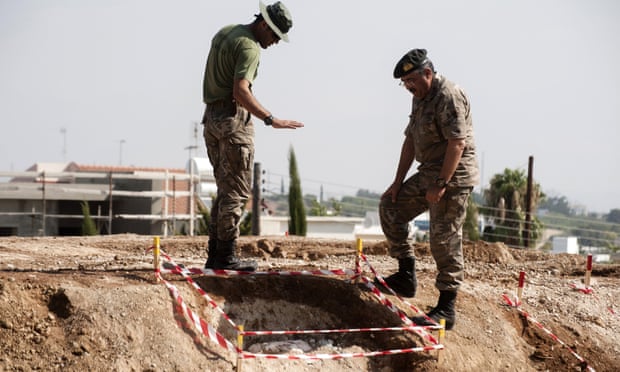
Cypriot officials searching for the remains of a Greek military plane that crashed 41 years ago believe they may have discovered the aircraft buried near a war memorial on the outskirts of Nicosia.

The discovery of shards of metal has raised hopes that the bodies of the 19 soldiers still believed to be inside the plane’s incinerated fuselage could be recovered and returned to their families.

The Nord Noratlas, a Greek military transport aircraft, was brought down by friendly fire in the opening days of Turkey’s invasion of the island in 1974, with just one survivor among the 32 people on board. Twelve bodies were collected and identified from the crash site, but 19 soldiers remain unaccounted for.

Fotis Fotiou, the humanitarian affairs commissioner for Cyprus, said: “Initial findings are positive that the aircraft is here. My message to the relatives is that we will do whatever it takes to find the remains of their loved ones so they can be buried according to our Orthodox Christian customs and traditions, as well as with all appropriate honours.”

Fotiou said the second, more intensive phase of the dig will begin next week, with the assistance of experts from countries including Canada, Australia and the Netherlands, who specialise in military-related excavations.

He said possible explosives and ammunition may still be inside the aircraft’s fuselage, making the recovery work particularly risky.

Xenophon Kallis, an official at the Cyprus foreign ministry, said shards of aluminium and other metal found during the initial phase of the operation has boosted confidence that the aircraft is there.

The Noratlas crashed as it was coming in to land at Nicosia airport in the early hours of 22 July 1974.

The plane went down under withering volleys of friendly fire from the airport’s Greek Cypriot defenders, who were fearful of an imminent landing by invading Turkish forces to take the strategically important area.

It was one of 13 aircraft that arrived from Greece to help defend against the invasion, triggered when supporters of Cyprus uniting with Greece mounted a short-lived coup. The island has since been separated into a breakaway Turkish Cypriot north and an internationally recognised Greek Cypriot south.

Accounts from the time suggest word of the plane’s arrival reached the airport’s defenders too late. Fire from anti-aircraft batteries and other small arms tore through the Noratlas, which burst into flames and crashed several hundred metres from the now defunct airport that straddles a UN-controlled buffer zone.

The remains of 12 soldiers scattered around the crash site, which were collected and buried at a Nicosia cemetery, have been identified through DNA analysis.

But in two separate instances, families mistakenly received remains they should not have. The mistake was rectified after remains found later at the Nicosia cemetery were positively identified and returned.

Friday 8 August 2015

http://www.theguardian.com/world/2015/aug/06/cyprus-greek-military-plane-shot-down-1974-discovery-nicosia

continue reading

Pakistan military helicopter crashes in northwest; 11 killed


A Pakistani military helicopter crashed in a mountainous region in the country's restive northwest on Thursday, killing at least 11 people on board, police said.

The helicopter, which serves as a medical assistance aircraft, was on the way to the northern town of Gilgit when it went down near the district of Mansehra in the Khyber Pakhtunkhwa province, said local police official Fida Khan.

"Rescuers have so far retrieved 11 bodies from the wreckage," he said, adding that the cause of the crash was unclear and that an investigation was underway.

However, a senior army officer told The Associated Press that the helicopter was carrying 12 people- including military doctors, paramedics and crew members - and was flying to Gilgit to evacuate a critically ill soldier when it went down, apparently because of bad weather.

The officer said the helicopter had taken off from Rawalpindi, a garrison city near the capital, Islamabad. It crashed near Mansehra, about 200 kilometers (120 miles) northeast of the city of Peshawar. The officer, who spoke on condition of anonymity because he wasn't authorized to speak to reporters, had no other details and said the army had dispatched troops to the site of the crash.

The crash came months after another army helicopter crashed in the northern town of Naltar, killing four foreigners - ambassadors to Islamabad from the Philippines and Norway, as well as the wives of the ambassadors from Malaysia and Indonesia. Three crew members from the army were also killed at the time.

It took rescue workers at least two hours to reach the crash site due to the difficult mountainous terrain, Mushtaq Ghani, information minister of northwestern Khyber Pakhtunkhwa province, told reporters.

Earlier in the day, another helicopter of the Pakistan Air Force had crashed in the tourist Chitral Valley near the Afghanistan border, which left several people injured. The PAF helicopter was also engaged in rescue operations in flood-hit areas.

On May 8, the ambassadors of Norway and the Philippines were among seven people killed in a helicopter crash in the northern Gilgit district's Niltar valley, a popular skiing destination near the border with China.

Pakistan's army has been fighting local and foreign militants in the country's northwestern tribal regions bordering Afghanistan for nearly a decade. The military launched a major offensive in the North Waziristan tribal region last year and claims it has cleared 90 percent of the region of militants.

North Waziristan was considered to be the headquarters of the Pakistani Taliban until June 2014, when the army launched the long-awaited operation there.

Friday 7 August 2015

http://www.newswest9.com/story/29726028/pakistan-military-helicopter-crashes-in-northwest-11-killed

continue reading

Thursday, 6 August 2015

Madhya Pradesh train accident: Toll may cross 50 as many feared washed away


The death toll in Tuesday’s train derailments in Madhya Pradesh reached 34 but it could cross 50 as rescuers and relatives feared flash floods that caused the fatal accidents washed away many passengers on board the two packed trains.

The Kamayani Express on its way to Varanasi from Mumbai derailed shortly before midnight on Tuesday near Harda town while the Janata Express travelling in the opposite direction to Mumbai from Patna slid off the tracks soon after. The trains derailed after flash floods set off by torrential rains weakened tracks over the swollen Kala Machak river.

Officials said three more bodies — including two women — were fished out from Kala Machak on Thursday but the toll could be much higher as more than a dozen families reached Harda and nearby towns looking for missing relatives who were travelling in the two trains.

These families reported 17 missing passengers but when they were shown photos of a dozen unidentified bodies, the identity of only two could be ascertained.

“This indicates 15 missing people might add to the list of 31 declared dead so far,” an official said.

The administration directed officials to look for bodies that might have washed away 15-20km downstream after the National Disaster Response Force team stopped their rescue efforts on Thursday.

Family members recounted their frustration after repeated rounds of hospitals, police stations and Harda railway station for news about their missing loved ones.

Thursday 6 August 2015

http://www.hindustantimes.com/india-news/mp-train-accident-toll-may-cross-50-as-many-feared-washed-away/article1-1377251.aspx

continue reading

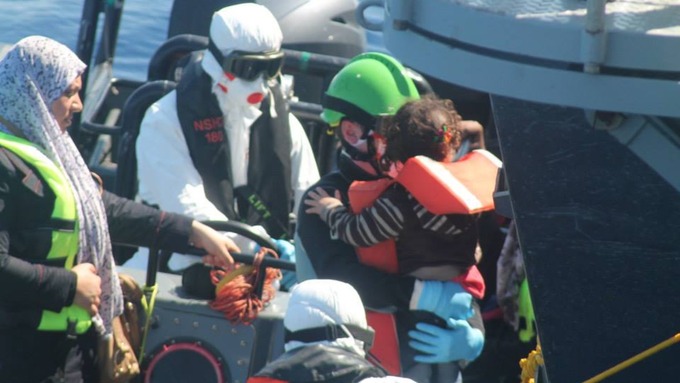
More than 200 feared dead in sinking of migrant boat in Mediterranean


Hopes faded of finding more survivors on Thursday from a shipwreck in which 200 migrants are feared drowned, as rescue ships were called to the aid of more migrant boats in the same area of the Mediterranean.

"We are witnessing a genocide caused by European selfishness," said Palermo mayor Leoluca Orlando as the Irish navy ship LE Niamh docked in the port carrying some 370 survivors of Wednesday's disaster and 25 corpses, including three children.

Orlando, speaking on Italian television as hearses arrived to take the bodies away, called on European leaders to do more to prevent such disasters and to allow more refugees to re-settle in their countries.

A police official told reporters a distraught woman from the boat had been searching for her three children who had gone missing in the crossing. She was taken to view bodies and came out weeping, said the officer, though it was not clear whether she had seen her family.

Police said they had detained five men suspected of having piloted the boat that overturned on Wednesday and of having had a role in trafficking the migrants.

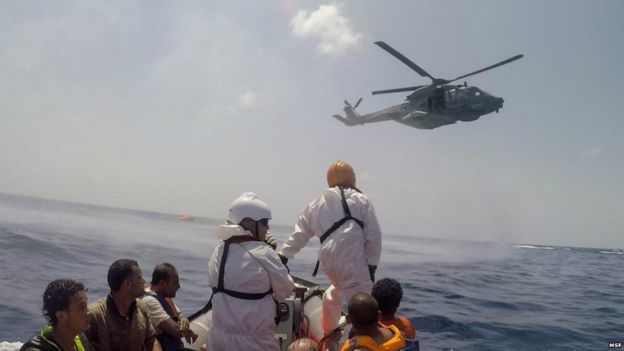
Vessels from the Italian and Irish navies and humanitarian agency Medecins Sans Frontieres (MSF) saved about 400 people from the fishing boat, thought to have been carrying up to 600 people, mostly Syrians fleeing their country's civil war.

Cmdr Filippo Marini of the Italian coast guard said survivors had indicated that between 400 and 600 people were on board the boat when it capsized.

Melissa Fleming, a UN refugee agency (UNHCR) spokeswoman, said about 100 people are thought to have been travelling in the boat's hull at the time, adding: "The boat capsized very fast".

They found no more survivors after scouring the waters overnight. Italian vessels continued to search the area on Thursday, a coastguard spokesman said.

Seas were very calm on Thursday, perfect conditions to attempt the sea crossing, said a Reuters photographer aboard the privately funded Phoenix, a vessel run by MSF and the Migrant Offshore Aid Station.

The Phoenix was responding to a distress call for a boat carrying about 500 people, he said. The coastguard picked up 381 on Thursday morning, while an Italy navy ship took 101 from a large rubber boat, and the MSF vessel Argos rescued 87, according to their Twitter accounts.

Wednesday's tragedy occurred when the boat flipped over as the LE Niamh approached, probably because desperate passengers surged to one side as they spotted the ship.

"What happened here was because the boat was so overloaded, and the conditions were such that the boat started taking on water and it listed to one side, capsized and sank, all in the space of two minutes," Irish Defence Minister Simon Coveney said on Irish state radio RTE on Thursday.

The Irish ship is part of the European Union Triton mission, which was expanded after up to 800 migrants drowned in a shipwreck in April.

DEADLY BORDER AREA

The Mediterranean Sea is the world's most deadly border area for migrants. More than 2,000 migrants and refugees have died so far this year trying to reach Europe by boat, compared with 3,279 during the whole of last year, the International Organization for Migration said on Tuesday.

People-smugglers, mostly based in Libya and charging thousands of dollars for passage, have sent more than 90,000 migrants by sea to Italy so far this year, the UN refugee agency says. Italy took in 170,000 in 2014.

This summer's mass arrivals in both Italy and Greece show the crisis is worsening. Immigrants fleeing violence and poverty at home continue to pour in from Africa and the Middle East.

Many of the newcomers look to move swiftly to wealthier northern Europe, including to Britain from Calais, France.

In April, a 20-metre (66-foot) vessel capsized as it approached a merchant ship that had come to its assistance, and up to 900 people were killed. It was the deadliest shipwreck in the Mediterranean for decades and a symbol of Europe's long-running migrant crisis.

Thursday 6 August 2015

http://uk.reuters.com/article/2015/08/06/uk-europe-migrants-italy-idUKKCN0QB0SN20150806

continue reading

Wednesday, 5 August 2015

20 more bodies recovered from Langtang landslide site


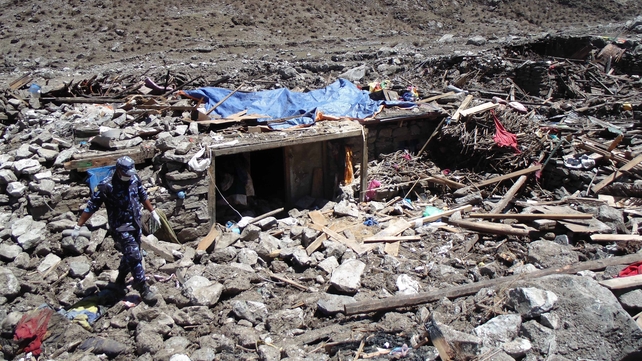
Twenty more bodies have been recovered from Langtang in Rasuwa district three months after the Great Earthquake on April 25. The bodies, retrieved from the landslide debris, have badly decomposed are waiting to be airlifted to Kathmandu for DNA testing, the Home Ministry said on Tuesday.

Chief District Officer (CDO) of Rasuwa Shiva Ram Gelal said the bodies could not be transported to the Forensic Unit of the Tribhuvan University Teaching Hospital on Tuesday due to (TUTH) as the helicopter could not fly in due to adverse weather conditions.

Locals of the Langtang VDC informed the authorities after they discovered the bodies, according to police. Deputy Superintendent of Police (DSP) Prabin Pokhrel of the district said the locals have claimed that the bodies were that of their family and relatives.

More than 100 complaints of missing people had been lodged in the wake of the massive earthquake that devastated Rasuwa district, a major tourist destination. Out of them, 21 are locals, 61 are not native of the district, while 22 are foreigners.

A Home Ministry record shows 660 people were killed by the April 25 quake in Rasuwa district. A total of 8,898 people lost their lives in the earthquake across the country.

The bodies or other human remains of the earthquake victims that could not be identified have been undergoing DNA testing at the Central Police Forensic Science Laboratory (CPFSL) of Nepal Police.

A total of 53 samples have been tested for a DNA match, police said. People can apply for a DNA test to identity the body or mortal remains of their kin by depositing their blood sample at the district police office. The samples will be then forwarded to the CPFSL where they are put through test for a DNA match.

Of the total 12 blood samples of foreigners sent for such tests, the CPFSL has so far identified body parts of five foreigners. No blood samples have been collected from Nepali people, police said.

Samples are collected and processed in bulk for DNA tests because of the cost factor, according to DSP Singh. “We collect at least 50 samples before we put them through the test. The test results will arrive after a month to three months,” he said.

Wednesday 5 August 2015

http://www.ekantipur.com/2015/08/05/top-story/20-more-bodies-of-quake-victims-recovered-in-langtang/408945.html

continue reading

Naupada building collapse kills 12, injures 7


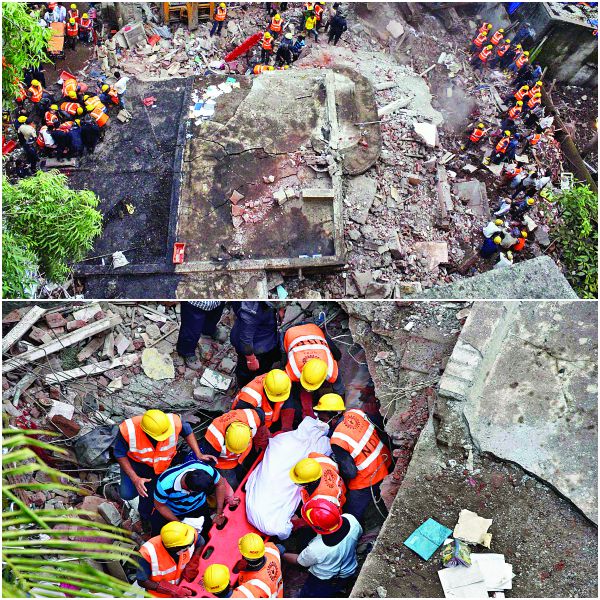
Around 2.30am on Tuesday, while residents of Krishna Niwas were asleep, the 50-year-old building in Naupada collapsed, killing 12 and injuring seven.

An earth-shattering thud awoke everyone in the building as well as vicinity, with locals rushing to the spot and informing local corporator Sanjay Waghole. He alerted the fire brigade and Thane Municipal Corporation's (TMC) disaster management cell. A team of 50 National Disaster Response Force (NDRF) officials from Andheri reached the spot around 4.15am and began rescue operations.

With NDRF's help, fire brigade officials and locals completed the rescue work within eight hours. The injured were taken to Thane civil hospital.

"We used various equipment, including sniffer dogs, who helped us locate victims stuck in the rubble. We also used were air-lifting bags and victim location camera," said Sachidanand Gawde, deputy commander-in-chief, NDRF.

"It was the moral support from locals, some of whom helped us identify where the victims could have been stuck. Our sniffer dogs identified such locations efficiently."

Even before the rescue teams arrived, locals had managed to rescue an 80-year-old, who stayed on the third floor and was recognised by the locals. Nene has suffered head injuries and is recuperating at the hospital.

Interestingly, the three-storey building, located in the heart of the city, was due for redevelopment and, hence, the TMC had not served any evacuation notice to the residents, who were staying here on Pagdi system. This is the second incident of building collapse in a week, the first being the Thakurli collapse in Dombivli on July 28, which killed nine and injured 11.

Sanjay More, mayor (TMC), said, "The building was constructed in 1962. It was due for redevelopment and appropriate steps were taken by owner Hemant Patil. However, due to family disputes of ownership, the matter was sub judice and, hence, no notice was issued to this building. Many residents were saved as the building tilted left and collapsed. Thus, no other building in the vicinity was damaged."

Minister of state for urban development Ranjit Patil, who visited the site, said, "Buildings that have completed more than 30 years should get a structural audit done. All civic bodies need to be alert and take appropriate measures."

Wednesday 5 August 2015

http://www.dnaindia.com/mumbai/report-naupada-building-collapse-kills-12-injures-7-2111163

continue reading

Lake Victoria accident: At least 30 feared dead after boat capsizes near Remba Island, Kenya


At least 30 people are feared dead after a boat carrying 200 passengers capsized in Lake Victoria according to Citizen TV Kenya, a local television network. The accident reportedly occurred early Wednesday.

Three bodies, of which two are children, have been recovered so far, local media reported. However, local fishermen at Nyandiwa Beach said that nine people were killed, Daily Nation newspaper reported. The cause of the accident is not clear, however, some local media reports said two boats collided resulting in the accident.

Lake Victoria is Africa’s largest lake and its waters spread across Uganda, Tanzania and Kenya. About 5,000 fishermen die each year due to storms on Lake Victoria, according to a report last month in New Vision, a Ugandan daily, citing a survey by Makerere University School of Public Health in Kampala, Uganda.

The Kenya Red Cross Society tweeted saying that it has sent a rescue team to Lake Victoria where a boat carrying 200 passengers capsized early Wednesday.

The accident happened near Remba, a tiny island in the middle of Lake Victoria, is known as “Slum Island”.

A few thousand people, mainly fishermen, make their home on this busy outpost on the border between Uganda and Kenya. One-room shacks are the norm here, and the fishermen almost literally live on top of each other: they share shacks, with one group sleeping in the day while the other fishes, and then they swap at night.

Wednesday 5 August 2015

http://news.yahoo.com/least-2-dead-kenya-boat-200-people-capsizes-060850733.html

continue reading

More than 2,000 migrant deaths in Mediterranean in 2015


More than 2,000 people have died so far this year trying to make the perilous journey across the Mediterranean to Europe, the International Organisation for Migration said on Tuesday, making it the world's most dangerous migrant route.

"Unfortunately, we have now reached a milestone whereby over 2,000 migrants and refugees have died as of this past weekend," IOM spokesman Itayi Virri told reporters in Geneva.

The organisation said around 188,000 people had been rescued so far this year trying to cross the Mediterranean, and warned the 200,000-mark could be crossed by the end of the week.

IOM said the latest toll confirms "this route as the deadliest for migrants in search of a better life," and warned the situation was worsening.

During the same period last year, 1,607 migrants had perished trying to make the journey, with 3,279 dying in all of 2014.

Nearly all of the people flooding across the Mediterranean so far this year, often in rickety boats and at the mercy of human traffickers, have landed in Italy (97,000) and Greece (90,500), the IOM said.

Virri said the so-called central Mediterranean route had proved by far the deadliest, with just over 1,930 people dying trying to cross from Libya to Italy so far this year, while only about 60 had died trying to reach Greece.

The IOM said that traffickers taking people to Italy tended to use more unseaworthy vessels, leading to the higher death toll.

While lamenting the tragic milestone of more than 2,000 deaths, Mr Virri pointed out that increased European Union efforts since April to rescue migrants at sea meant "a lot of people have been saved who otherwise would have lost their lives."

Nineteen people had lost their lives in the Channel of Sicily last week alone, with the bodies of 14 migrants brought to the Sicilian port of Messina on July 29. They had been travelling with 456 others who were rescued.

And on Monday, 550 migrants rescued in the Mediterranean over the weekend arrived in Sicily aboard a ship operated by Doctors Without Borders (MSF), which also carried the bodies of five people who died at sea.

The migrants who were brought to safety in Palermo had been travelling on several different boats and were rescued over the weekend, the aid group said.

The victims, four women and one man, were found dead on a boat that was rescued on Saturday with 112 people on board. They died, according to initial tests, as a result of dehydration.

Shocked survivors said their rickety boat had only left Libya's shores for Italy 13 hours before they were rescued. In that short time, five of the children on board lost a parent.

Wednesday 5 August 2015

http://www.telegraph.co.uk/news/worldnews/europe/italy/11782584/More-than-2000-migrant-deaths-in-Mediterranean-in-2015-says-monitoring-group.html

continue reading

Death toll rises to 29 as Kamayani, Janata Express trains derail in Madhya Pradesh


At least 29 people, including 11 women and 5 children, have been killed after the Kamayani Express from Mumbai to Varanasi and the Mumbai-Jabalpur Janata Express derailed near Kudawa railway station, about 30 kilometres from Harda district in south western Madhya Pradesh, late on Tuesday night.

Meanwhile, Railway Minister Suresh Prabhu, according to PTI, has said that 12 people have been killed and 25 others injured in the accident.

Those killed include nine men, eight women and five children. Two of them reportedly died after being electrocuted during the rescue effort in the twin tragedy.

Both Mumbai-Varanasi Kamayani Express and Jabalpur-Mumbai Janata Express, got derailed while crossing a bridge on Machak River, near Khirkiya and Harda station, about 160 kms from Bhopal.

Kamayani Express was the first to get derailed at around 11:30 pm and Janata Express met with the accident just a few minutes later.

Railway authorities said the sudden flow of water on the tracks caused the derailment.

"We think tracks were breached because of the flow of excessive water," said an officer.

Meanwhile a section has been closed for any train movement. The accident relief train has reached the spot and several passengers have been brought to a nearby station, Sinha added.

More than 300 people have been rescued after the two trains derailed while crossing a swollen Machak river, said officials. According to officials, six coaches of Kamayani Express and three coaches plus the engine of Janata Express were derailed late last night as the base material on the tracks got washed away. “The mishap took place around 11.30 PM on Tuesday as base material of the tracks got washed away in heavy rains.”

Harda district collector Rajnish Srivastava said that incident took place near Khirkiya and Harda station on Machak River in which seven coaches of Kamayani Express and three coaches with the engine of Janata Express got derailed.

"It seems that base material on the tracks got washed away following heavy rains when the two trains coming from opposite directions on the Up and Down tracks met with the accident almost simultaneously," he said.

Wednesday 5 August 2015

http://indianexpress.com/article/india/india-others/kamayani-express-janata-express-derail-in-madhya-pradesh-many-feared-killed/

http://timesofindia.indiatimes.com/india/Twin-train-derailment-death-toll-hits-27-in-Madhya-Pradesh/articleshow/48354995.cms

continue reading

Tuesday, 4 August 2015

In Poland, communist-era graves overlay victims of the state


Fearing the power of their patriotism, Poland's communist leaders killed the nation's World War II heroes and anti-communist activists and dumped their bodies secretly in mass graves, hoping they would be forgotten. They were topped with new graves.

But now, a history institute is restoring the memory of the slain heroes and arranging proper burials. In order to get to the hidden remains, it is asking to move 194 communist-era graves — including one of a judge who contributed to the death sentence for a man likely buried just beneath him.

The move is part of efforts taken by democratic Poland after 1989 to recognize war heroes and anti-communist activists who were persecuted, killed and deliberately erased from records under four decades of communism imposed after the war.

A motion to have the graves moved within Warsaw's military Powazki cemetery, at the expense of the state, has been filed with the provincial governor, who will negotiate with families, Institute of National Remembrance spokesman Andrzej Arseniuk told The Associated Press on Monday.

He said that the primary concern is for the relatives of the slain heroes who are waiting to have them identified and properly buried.

"It is the duty of the Polish state toward these national heroes who were murdered, secretly buried and destined by the communists for oblivion, to give them back their names and proper burial sites where they could be honored," Arseniuk said.

The institute is searching for the remains of about 100 independence heroes, from among several hundred killed in a Warsaw prison and then dumped there between 1945 and 1956.

Across Poland, thousands of war-time resistance heroes who later opposed communism were tortured, killed, and secretly buried. A few of their persecutors were handed prison terms under democracy.

Remains of about 120 victims — entangled skeletons and shattered skulls — were discovered in 2012-2013 under a lawn in the Powazki cemetery. About 40 have been identified using relatives' DNA. Officials realized that more remains could be reached only by moving the new graves on top.

Among those missing are Capt. Witold Pilecki, who volunteered to be an Auschwitz inmate and smuggled out reports of atrocities there before fleeing, and Gen. August Fieldorf, deputy commander of Poland's war-time resistance Home Army.

Among the graves of various communist-era military figures, dating to the 1980s, is that of Lt. Col. Roman Kryze, a judge who contributed to Pilecki's 1948 death sentence.

Tuesday 4 August 2015

http://news.yahoo.com/poland-seeks-move-graves-reach-remains-wwii-heroes-104617339.html

continue reading

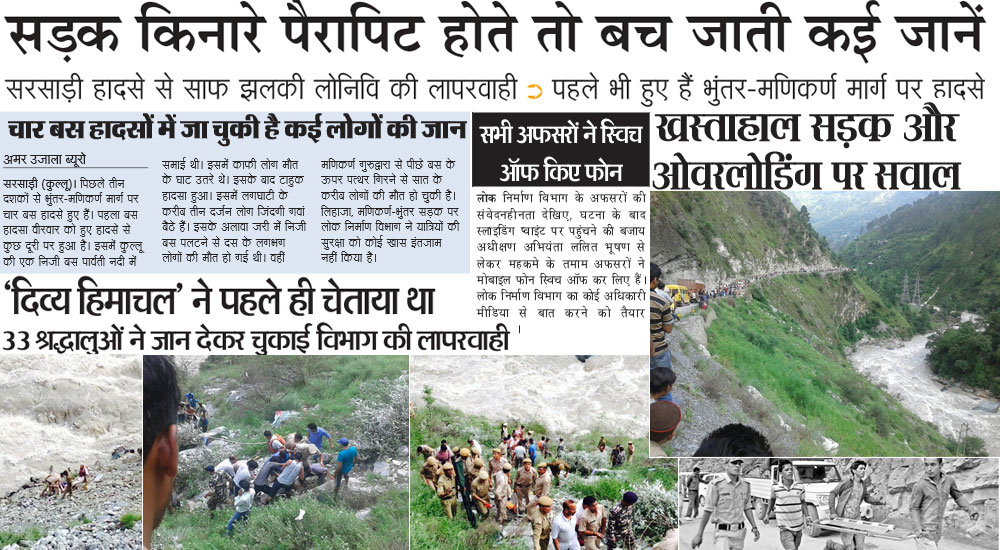
Manikaran mishap: One more body recovered, yet to be identified


A male body was today spotted by villagers near Bajaura in Kullu district. Search teams retrieved the body from the Beas river and sent it to the government hospital.

A 52-seater bus with 69 pilgrims on board from Mansa, Barnala and Bhatinda districts of Punjab plunged into the swollen Parbati river near Sarsari village on the Bhuntar-Manikaran road in Kullu district on July 23. Eight persons died on the spot, while bodies of four pilgrims were later recovered from the river and the Larji Dam. However, 34 pilgrims are still missing. At least 23 persons were injured in the mishap.

Rajinder Singh Gill, member of the Kullu Kar Seva, said the relatives of the missing pilgrims camping here could not identify the body. However, photos bear resemblance to one Balwant Singh, son of Lal Singh of Jagaramtirath village in Talwandi tehsil of Punjab. He said relatives of the missing had been called for identification of the victim.

Meanwhile, Talwinder Singh, tehsildar, Barnala, consoled the relatives of Komalpreet Kaur, whose body was today sent to her native place. He assured them all support from the Punjab government.

Kullu Deputy Commissioner Rakesh Kanwar said the administration would rework the strategy tomorrow as exhaustive search and survey of the entire stretch from Sarsari up to Larji Dam undertaken at the potential spots to find the missing persons by the Navy had not yielded much result.

He said due to strong river water current, the equipment of the Navy could not trace the wreckage. Cold waters prevented divers to stay under the water for longer duration.

He said the search for the missing persons from the accident spot up to the Largi Dam along the Parbati and the Beas rivers would continue till the last week of September.

A 12-member Indian Navy team headed by Commander Tilak Thakur had yesterday started search operation with Sonar imaging system, but the operation was hampered due to muddy and turbulent water of the river.

Nearly 160 personnel of the National Disaster Response Force (NDRF), Shastra Seema Bal (SSB), Indo-Tibetan Border Police (ITBP), Home Guards and state police have been pressed into the search operation.

Tuesday 4 August 2015

http://www.tribuneindia.com/news/himachal/manikaran-mishap-one-more-body-recovered-yet-to-be-identified/115088.html

continue reading

One year of PINAK 6 capsize: No luck for the families of missing victims


One year ago, 21 unnamed dead bodies were buried at a local graveyard in Shibchar of Madaripur.

All of them died in one of the deadliest ever maritime mishaps on August 4 last year, when heavily loaded ferry Pinak 6 capsized in Padma River killing over a hundred passengers.

Rescuers retrieved 49 dead bodies at the time. Official count shows that 61 people are still missing from that accident, although many more families have claimed to have lost members.

The authorities were supposed to find out the identities of the bodies buried at that graveyard through DNA tests. But that has never happened.

They collected DNA samples from some families but most of them have been left out. It has been a year and the DNA test results have still not come.

The caretaker of that graveyard said that neither have anybody come there looking for the dead bodies, nor have anyone come to collect DNA samples since they were buried here one year ago.

As a result, these families – mostly from the low-income group – have not been able to get the cash compensation that the administration had announced after the accident.

Only those families who could identify or show proof that their members were among those deceased, got the money.

Suraton Nesa, a widow from the Sannashichar village in Shibchar, lost four members of her family – son, daughter, son-in-law and grandson – in that accident.

But since none of their bodies have been found, she failed to avail compensation. She does not even know if any of them are lying in that graveyard.

“We were already poor. Moreover, I had to spend most of my savings searching for the dead bodies after the accident. My son was the only bread-earner. I have been living from hand to mouth since. I have not got any compensation from the government because none of their dead bodies have been found,” Suraton said.

When contacted, Kamal Uddin Biswas, deputy commissioner of Madaripur district, said: “Except for one, each of the victim families were given Tk1.05 lakh as compensation. Any other victim families can apply for compensation by producing appropriate proof that they have missing members.”

Siblings Heera and Swarna and their cousin Lucky – all killed in that capsize – belongs to the family that did not accept compensation.

Nurul Haque, father of the siblings, said: “My daughter Heera was still alive when she was rescued and brought to the Mawa terminal. But she died before we took her to the government hospital in Munshiganj. If we could give her primary treatment at the Mawa terminal, we could have saved her life.

“This [Mawa] is such an important ferry terminal. But there are no first aid facilities here,” he said.

After the accident last year, Jahangir Bhuiya, inspector of the Mawa terminal, filed a case against Pinak 6 owner Abu Bakkar Siddique and five workers of the ferry. On August 14, ten days after the capsize, Siddique got arrested but there have not been much progress in that case since.

The ferry itself was never found. The Bangladesh Internal Water Transport Authority (BIWTA) tried with state-of-the-art sonar equipment but in vain.

Locals said that there was strong current in the river when the accident took place and this might have taken the ferry a long way downstream where it might now be resting on the river under a thick cover of sand.

The last time he spoke on the incident, Water Transport Minister Shajahan Khan said their priority after the accident was to hand the dead bodies over to their families; that was why they gave up on the operation to retrieve the ferry.

Tuesday 4 August 2015

http://www.dhakatribune.com/bangladesh/2015/aug/04/no-luck-families-missing-victims

continue reading

Monday, 3 August 2015

20 bodies recovered from Langtang in Northern Nepal


At least 39 foreigners are still missing even as the bodies of 20 people who died in the devastating earthquake that hit Nepal in April were recovered from the northeastern region of Langtang, Nepal’s Interior Ministry said on Monday.

“The bodies are not in condition to be identified; all we can say right now is that we have recovered 20 bodies that were swept away after the earthquake,” ministry spokesperson Laxmi Prasad Dhakal told EFE, adding that the bodies were recovered “a couple of days ago.”

Dhakal said three bodies have already been sent to Kathmandu and the other 17 will reach on Tuesday for DNA testing.

Around 200 people, at least 100 of them foreigners, were buried in an avalanche of rocks, snow and mud that followed the earthquake on April 25.

A total of 159 people, 39 of them foreigners, who were at the Everest base camp and Langtang, are still missing.

Most of the missing foreigners are from the United States, Belgium, Canada, France and China, besides four Spaniards, who went missing in Langtang.

Shiva Ram Gelal, head of Rasua district, where Langtang is located, told EFE residents of the area have claimed the bodies are those of their relatives.

“We have decided to send them to Kathmandu for DNA testing so that we can verify their identity,” Gelal said.

Police spokesperson Kamal Singh Bam told EFE they are taking the help of social networking sites to locate the missing people.

“Some foreigners returned home by themselves and contacted us through social networks, so we are using these platforms to find more information,” Bam said.

According to official figures, the earthquake in April and its aftershocks, two of them measuring over 7.0 on the Richter scale, left 8,898 people dead and 22,309 injured.

Moreover, 602,257 houses and buildings were completely destroyed and another 285,099 suffered damages.

Monday 3 August 2015

http://laht.com/article.asp?ArticleId=2393658&CategoryId=12395

continue reading

Sunday, 2 August 2015

Italy coast guard rescues 1,800 sea migrants, five found dead


Italy's coast guard said about 1,800 migrants were rescued from seven overcrowded vessels on Saturday, while five corpses were found on a large rubber boat carrying 212 others.

The dead bodies were found on board at the time of the rescue, a coast guard spokeswoman said on Sunday. The cause of death was not yet known, she said.

The Mediterranean has become the world's most deadly barrier for migrants and refugees, with 3,500 thought to have died at sea last year and almost 2,000 so far this year. Many are fleeing poverty and violence in the Middle East and Africa.

While there was no breakdown by nationality of those rescued on Saturday, about a quarter of arrivals this year have come from Eritrea, followed by Nigerians, Somalis, Sudanese and Syrians, according to the UN refugee agency.

Italy has had about 90,000 sea migrant arrivals so far this year, after receiving 170,000 in 2014, the agency says. Many of the newcomers look to move swiftly to wealthier northern Europe, including to England from Calais, France.

Nightly attempts by large groups of the estimated 5,000 migrants in Calais to force their way through the rail tunnel linking France and Britain have provoked public anger and severely disrupted the flow of goods between the two countries.

Sunday 2 August 2015

http://www.reuters.com/article/2015/08/02/us-europe-migrants-italy-idUSKCN0Q70H520150802

continue reading

Where are the bodies buried in Colombia?


When members of Colombia’s Crime Scene Investigators (CTI) removed a section of topsoil indicated to them by a demobilized paramilitary member as being the site of a mass grave, they were expecting to unearth skulls, bones and fragments of clothing. Instead what they came face to face with were multiple round holes of medium depths.

“What happened here? Did you bury them standing up?” asked one CTI officer.

Far from it. The bodies of the deceased had been hacked into pieces and placed in tall milk urns and doused in acid. Once the human contents had dissolved and become liquid, the urns were then disinterred and their contents poured into the nearby Magdalena River. No trace no foul and another reminder of how far Colombia has yet to go to reconcile an uncompromising and bloody past. In this particular case, the number of people to have been killed in this fashion near to the colonial town of Guaduas, barely 77 miles northwest from the capital city of Bogota, is based on hazy recollections gathered from former combatants in Colombia’s conflict looking to reduce their sentences through an admission of guilt in participation in such heinous events. Sadly, these tales are the norm rather than unique.

That was in 2010 and as the Colombian government’s negotiating team grapples with members of the Revolutionary Armed Forces (FARC guerrillas) in on-going peace dialogues in Havana, Cuba in an attempt to bring stability to much of the country, there is still the issue of thousands of missing people, many forcibly disappeared, resulting from more than 50 years of conflict. So, exactly how many people have disappeared in Colombia’s long-running conflict and where have they been disposed of? While the answer to this question in unknown, human rights groups estimate there to be 4,649 common graves across the country.

Through tearful eyes Margarita Restrepo shares with reporters that not a day passes when she doesn’t think of her daughter Carol who disappeared in Medellin in October 2002. 13 years is a long time and Margarita is just one of a group of family members here on the location of a former landfill known as La Escombrera at the westernmost edge of the city and above the infamous Comuna 13 barrio. There has been a ceremony of remembrance and on Monday July 27 authorities began an excavation which will reportedly take five months, in the hope of finding and identifying as many as 100 bodies expected to have been buried here between 1999 and 2004 when paramilitary groups took control of this strategically located district.

Unmarked graves, mass graves and common graves abound in Colombia. The puzzle is finding those who know their whereabouts and who they contain. There’s a discrepancy in numbers as victims’ groups such as Asfaddes Medellรญn, Movice, Familiares Colombia and las Madres de la Candelaria which all believe there to be as many as 45,000 forcibly disappeared people across Colombia in contrast to the government’s figures of 15,000. Families seeking the whereabouts of loved ones also consider la Escombrera to be of significance in that it could hold the answers to an estimated 300 missing individuals and therefore garland Medellin with the unwelcome fame of being home to the world’s largest urban mass grave.

“They will find some things, but not the quantities that they are suggesting,” said a criminologist knowledgeable in the city and who preferred to remain anonymous in an exclusive interview. “This search is a sophism to create a distraction as the Comuna 13 has become something of a myth,” he continued.

So what is the myth surrounding Medellin’s Comuna 13, a district once routinely believed to be amongst the worst in Colombia’s second city due to gang warfare and drugs? Perhaps the answer is precisely that it has gained its notoriety for being the principal Comuna—of Medellin’s 16 Comunas—which was targeted by former President Alvaro Uribe as the one which required military intervention to pacify it. Thus, the infamous Operation Orion in 2002 was carried out and it is known that the military sent in right wing paramilitary groups first and then followed them up with an all-out assault to wrest this district from the control of leftwing guerrillas such as the FARC and the smaller National Liberation Army (ELN rebels).

Certainly, this scarred hillside which for so long was a dumping ground for construction materials, household waste and even chemicals, will hold its fair share of secrets, as after Operation Orion, Comuna 13 was run by a ruthlessly savage paramilitary group known as the Bloque Cacique Nutibara under the leadership of alias “Don Berna” or Diego Murillo who was later extradited to the US in 2008 for drug trafficking and money laundering.

The excavations are not without their challenges, requiring digs to 8m in depth and which will focus on three points based on testimonies. To begin with, teams will have to move 24,000m3 of rubble and earth with heavy machinery for a period of two months before even studying the debris.

“No one can really know what they will find and what the state of preservation of the remains will be unless they attempt to excavate and recover the remains. Paleontology and Archaeology teach us that human remains (in particular bones) can survive at great depths, for hundreds of thousands of years, and that sometimes even soft tissue and clothing survive, and DNA can also be extracted. I would like to reiterate that the preservation will depend on the type of soil and whatever was dumped on the remains,” said Dr Karina Gerdau Radonic, Lecturer in Biological Anthropology at the UK’s Bournemouth University.

This situation is hardly unique to Medellin. La Escombrera itself has been visited on no less than four occasions by experts from the Attorney General’s Office since 2004 and as yet nothing of use has been uncovered. Then there are the environmental and geographical elements to consider. Colombia is home to various mountain ranges, is tectonically unstable and at the mercy of landslides, floods and heavy rainfalls across much of the country. There’s the very real fear that many remains will have shifted position from their original burial sites or have been lost altogether.

But, it’s a start down the road which hopefully can lead to closure for families and perhaps reconciliation in Colombia. While members of the leftist FARC guerrillas, involved in the peace dialogues since November 2012, have expressed their solidarity with the victims of the paramilitary killings believed to be in la Escombrera, the rebel group will be forced to recognize those disappearances carried out by members of their own.

It’s a grim reality in today’s Colombia. Killings by illegal groups in the Pacific city of Buenaventura in so-called “casas de pique” or “chop houses”, where the dismemberments of opponents occur, continue as the struggle for control of this strategic port heightens. Body parts are then bagged up weighed down with rocks and tossed out to sea. Where will forensic investigators need to look next? Grave sites attributed to the rise in gangs born from the shells of former paramilitary outfits, have been found in neighboring Venezuela as well. Nowhere, it appears, is exempt from this scourge.

The Attorney General’s website warns that some contents of their pages could be sensitive and may not be apt for minors. Here one can conduct a search through a macabre database showing items of clothing retrieved from common graves and posted online in the hope that a family comes forward to identify the missing person last seen dressed in these items. Another page offers up facial reconstruction renders, there are 64 images from the southern coca-growing department of Putumayo alone.

So, will this excavation at La Escombrera encourage further investigations around Colombia or will it lead up a blind alley and discourage the authorities from pursuing further cases? It’s hard to say. And are demobilized guerrillas or paramilitaries providing the authorities with accurate locations or leading investigators on a ruse? Unsubstantiated rumors abound that a stretch of land near to Medellin known as the Curva de Rodas was another infamous place used by gangs as a disposal area. What is not covered by new-build apartment blocks is a delicately landscaped park. In Bogota, after the military stormed the Palacio de Justicia in November 1985 in response to the siege by M19 guerrillas; those killed in the attack were supposedly unceremoniously dumped in an unused lot near to the Central Cemetery and in a more humble district of the south known as Matatigres.

Unmarked graves, mass graves and common graves abound in Colombia. The puzzle is finding those who know their whereabouts and who they contain. This is clearly easier said than done.

As the Criminologist said: “These groups are organized, the idea is to leave no evidence and no witnesses.”

It is clear that La Escombrera is just a start as thousands of Colombian families yearn for closure in a process which could easily take decades.

Sunday 2 August 2015

http://www.thedailybeast.com/articles/2015/08/02/where-are-the-bodies-buried-in-colombia.html

continue reading

Italian authorities confirm the deaths of 14 people on board a boat carrying hundreds of refugees


Italian authorities have confirmed the deaths of 14 people on board a boat carrying hundreds of refugees and migrants across the Mediterranean on Tuesday, July 28th.

According to officials, 456 people are known to have survived and were rescued during an operation conducted by an Irish naval patrol. Among the survivors are several dozen children. The deceased and most of the survivors have been brought to shore to the Italian port of Messina.

The nationalities of those who died have not yet been confirmed. Autopsies will now be carried out on the island of Sicily to determine the exact cause of death.

However, several of the survivors from the vessel have told UNHCR they believe those who died may have suffocated after being forced to travel inside the hull of the boat.

The sea rescue took place in the Mediterranean on the afternoon of July 28, after the Irish naval vessel L.E. Niamh responded to a distress call. The Irish navy has reported that the survivors were discovered on a boat roughly 80 km north of the Libyan coast.

To date in 2015, more than 2,000 refugees and migrants are estimated to have died or gone missing at sea while attempting the perilous crossing of the Mediterranean. More than 1,300 people died in the month of April alone, prompting a number of European leaders to agree on a plan to triple the amount of money devoted to sea rescues.

Many states also committed significant resources and naval rescue ships. In addition, these efforts have been greatly enhanced by the involvement of private and other non-governmental initiatives, including one launched by Mรฉdecins Sans Frontiรจres (MSF) and the Migrant Offshore Aid Station (MOAS), a private philanthropic enterprise. All these measures have had a positive impact in reducing loss of life.

According to the Irish Navy, L.E. Niamh has now been involved in the rescue of more than 1,200 people as part of Ireland's contribution to the refugee crisis in the Mediterranean.

Sunday 2 August 2015

http://www.unhcr.org/55b940f66.html

continue reading

Landslide kills 20 in Manipur


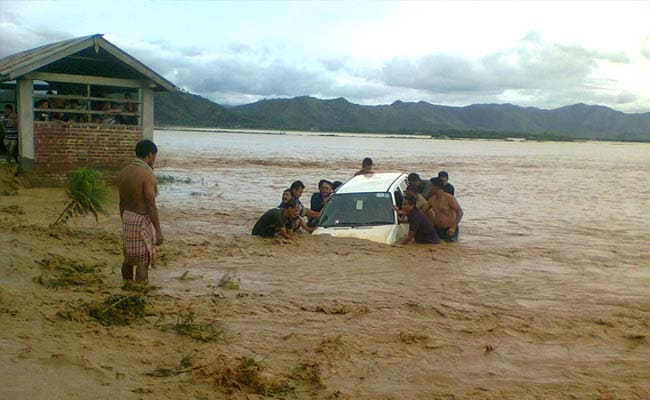
Around 20 villagers were reported killed in a landslide in Manipur’s Chandel district while a 60-year-old man drowned in Thoubal district in the flash flood triggered by incessant rains and subsequent heavy rain since the last three days inundating many villages and agricutlural fields and washing away five bridges in the districts.

As the heavy rains continued non-stop from Wednesday to Friday, landslide occurred burying around 20 villagers besides sweeping away 12 houses at Joumol village, about 168 km south of here under Khengjoi Sub-division around 6.30 in the morning,sources said. Rescue operations have been undertaken by Assam Rifles and nearby villagers.But the state disaster management team could not reach the spot due to landslides at several locations along the stretch of Imphal-Moreh Highway. Thus, the bodies of the dead could not be retrieved till filing of this report.

"Rescue teams are being sent to Juomol at the earliest and will reach by tomorrow morning because of heavy rains and landslides. The government is trying to mount relief operations as effectively as possible," Chandel lawmaker Victor Nunghlung told NDTV.

What is also hampering rescue operations in the area is the damage to crucial bridges in Chandel, including one that connects Chandel town to the Juomol village. The Manipur govt says the only other route to the village is through Myanmar. This morning, choppers were spotted by local residents in the area, suggesting that the government is trying to mount air rescue and relief operations.

The flash flood inundated some portion of Indo-Myanmar route in Thoubal district and several villages under Heirok,Yairipok, Wangjing, Salungpham, Keirenbikhok, Khangabok, Wabagai, Keirak, Kakching, Hiyanglam-Hiranmei, Langmeidong, Lamjao, Pallel areas besides washing away some houses at Pallel area and one bridge built over a canal at Yairipok area in Thoubal district.

Reports from Thoubal and Chandel districts said authorities have surveyed the damage and the affected people to provide government assistance, sources added.

Two more houses of Chakpikarong Khupi village and four suspension bridges have also been washed away by flood water and Chakpi river, sources added. There were about a dozen worst affected houses around the Chandesl district headquarters and Chakpikarong area. The district authority has opened a relief camp at Maha Union higher secondary school by setting up a control room.

Reports from other districts said major rivers including Imphal, Iril,Kongba,Nambul have started to flow at an alarming level on Saturday. Some of the people residing on the riverbanks have started shifting to safer places.

Sunday 2 August 2015

http://www.assamtribune.com/scripts/detailsnew.asp?id=aug0215/oth050

continue reading

Saturday, 1 August 2015

Mount Ontake searchers recover body from September eruption


A body recovered after search operations on Mount Ontake resumed was identified as that of a 45-year-old man from Kai, Yamanashi Prefecture, the Nagano Prefectural Police said Saturday.

The body of Tetsuya Inooka was found Friday on the mountain that straddles the border between Nagano and Gifu prefectures. His remains were identified by relatives as well as DNA analysis.

Police concluded Inooka died after being hit by falling rocks during the sudden eruption last Sept. 27.

Inooka was one of six people still been listed as missing in the wake of the 3,067-meter-high volcano’s eruption.

“I’m relieved (the body) was found early,” said Koichi Inooka, Tetsuya’s 53-year-old brother. “I want to say ‘Welcome home.'”

Inooka was on the mountain with his wife, Hiromi, 42, when the volcano erupted. Hiromi was later found dead.

Inooka’s body, buried under a layer of volcanic ash, was found shortly after midday by a search team dispatched from the Gifu side.

Saturday 1 August 2015

http://www.japantimes.co.jp/news/2015/08/01/national/searchers-on-mount-ontake-find-one-body/

continue reading

Nepal multiple landslides: Death toll reaches 36; 7 bodies recovered today from debris


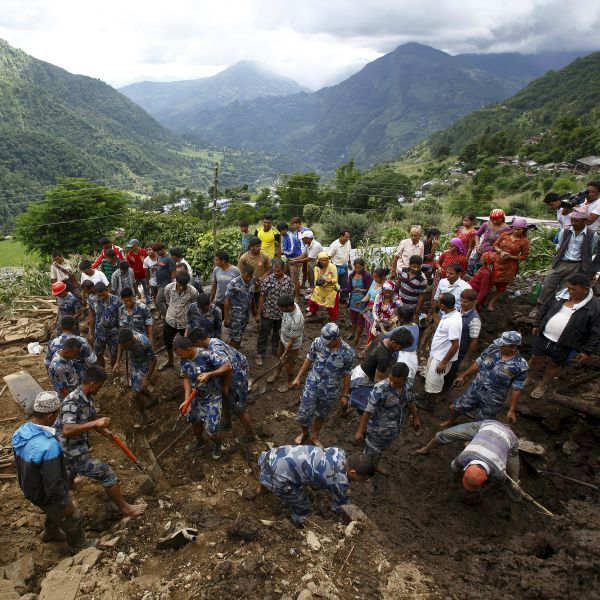
Emergency workers on Friday recovered seven more bodies from the debris of multiple landslides triggered by heavy rains in Nepal, taking the confirmed death toll to 36.

Police said rescuers were still searching for six people believed missing after Thursday's landslides, which crushed villages in the western district of Kaski in the foothills of the Himalayas, around 150 kilometres west of Kathmandu.

"The number of dead has risen to 32 in our district," said Kaski police chief Kedar Rajaure.

Four more people, including an 83-year-old man, were killed in three landslides in the neighbouring districts of Myagdi and Baglung as well as in the popular tourist resort of Chitwan, according to a statement released by authorities. Scores of people die every year from flooding and landslides during the monsoon season in the Himalayan nation. Two weeks ago a student was killed when a landslide buried part of a school in the nearby town of Pokhara, and 35 people died last month when a landslide crushed villages in northeastern Nepal.

The monsoon rains are also hampering delivery of relief supplies to mountainous villages devastated by the massive earthquake that struck the Himalayan nation on April 25. More than 8,800 people were killed by the quake and a large aftershock, and many more were left without shelter.

Saturday 1 August 2015

http://www.dnaindia.com/world/report-nepal-multiple-landslides-death-toll-reaches-36-7-bodies-recovered-today-from-debris-2110008

continue reading

Now, hope on sonar imagery system as 12-member crew of Navy reaches tonight at Kullu to start search operation


The Kullu administration is pinning hope on the sonar imagery system reaching Manikaran tonight with the 12-member crew of the Navy after the massive search operations to locate the remaining 35 bodies of Manikaran bus accident victims made little headway.

The sonar system and crew from Visakhapatnam is on the way and will reach Kullu tonight and start the search operations for remaining bodies from tomorrow, Special Secretary (Disaster Management) DD Sharma said, adding that eight divers of the Navy were also a part of the 12-member team.

As per the final list, there were 69 passengers in the overloaded 52-seater bus that plunged into the Parbati river on July 22 on the Bhuntar-Manikaran road. Eleven bodies had been recovered, 23 persons were injured in the accident while the search for 35 missing persons was still on, said Deputy Commissioner Kullu, Rakesh Kanwar.

More than 600 personnel from the police, SSB, Indo-Tibet Border Police, National Disaster Response Force, civil defence, Home Guards and divers of the BBMB had been pressed into rescue operations. A large number of relatives and friends of the missing persons from Mansa, Barnala and Bathinda are camping near the accident spot, waiting for a miracle to happen.


The chances of survival of the missing persons, feared to have been washed away in strong currents, are almost remote. But they are just praying for the bodies so that last rights of the deceased could be performed. “We are religious people and that was the reason that my brother went to the pilgrimage to Manikaran but he is still missing and we are desperate to get his body to perform the last rights”, said Manjit.

Saturday 1 August 2015

http://www.tribuneindia.com/news/himachal/now-hope-on-sonar-imagery-system/113787.html

continue reading

MH370 wreckage may not provide the closure grieving families seek


For those who lost loved ones on Malaysia Airlines Flight 370, the utter mystery of exactly what happened nearly 17 months ago has only compounded their grief.

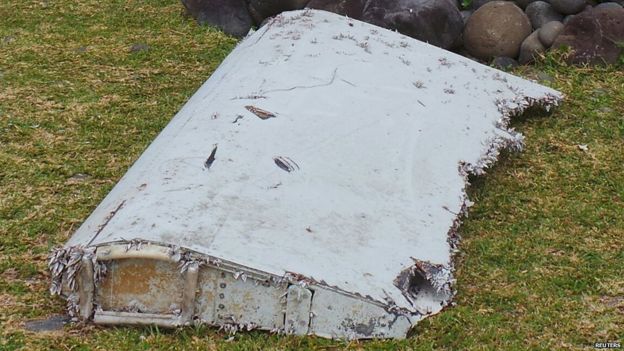
But with the discovery of a barnacle-encrusted wing part on Reunion Island in the western Indian Ocean this week, there is, for the first time, a strong clue about what may have happened to MH370 and its 239 passengers and crew on that fatal flight from Kuala Lumpur to Beijing.

The finding is a possible punctuation point in an open-ended story. But it is unlikely to bring anything like full closure say those who have also lost loved ones in mysterious circumstances and have had to grapple with how to grieve the missing.

Ask Bret McCann, whose parents Lyle and Marie McCann vanished on a road trip to British Columbia five summers ago. "I've read about this," he says, "and it's called ambiguous loss, where, psychologically, you're not really sure what happened. I mean. It still bothers me."

Or ask Crystal Dunahee, for whom not having any closure is her daily reality since March 24, 1991, the day her four-year-old son Michael disappeared from an elementary school playground in Victoria, B.C.

Her situation, Dunahee says, has no real comparison to this latest glimmer of hope the families of flight MH370 victims have received.

"You have a plane incident. You know they were on the plane. Whereas we have nothing to show what happened to Michael or where he may be now. We have nothing.

We have no answers."

Just some facts

Sometimes, says author and New Hampshire-based grief counsellor Ashley Davis Bush, when people are seeking what they call closure, they're hopeful they can put an end to the pain because we are, what she calls, "a pain-averse culture."

"What they don't realize is that even when those events occur, whether it's finding a piece of evidence or prosecuting someone or finding an answer, the pain is still going to be there."

Davis Bush doesn't deny that new information can bring a certain amount of relief to grieving families. She simply cautions that "it is not going to erase the pain. It will just give you some facts that provide an answer."

In the McCann case, the last time the retired couple, both in their 70s, were seen alive was July 3, 2010. Video surveillance footage shows Lyle filling up their motorhome at a gas station in their hometown of St. Albert, Alberta.

Lyle and Marie McCann went missing in July 2010 after leaving St. Albert on their way to B.C. (RCMP)

Two days later their burned out RV was discovered in a remote area near Edson. Their bodies were never found.

At first, family members chose to believe they were lost. "For all that winter of 2010 to 2011 we looked after my parents' house, shovelled the snow and kept it clean. So by the next summer police were telling us they were ... gone," says Bret McCann.

A year after the McCanns disappeared, a court declared them legally deceased. And shortly after, the family held a public memorial service on what would have been the couple's 59th wedding anniversary.

Afterward, some family members told Bret McCann that the memorial helped them feel "better." But for him, it had another purpose: to continue the search for his parents.

"I mean, it was a meaningful memorial, but it was also another way to keep it in the public eye."

A mother's pain

Dunahee says she'd much rather know what happened to Michael, even if the answer would be heartbreaking.

"It's always there. We don't have the closure that we need to move on 100 per cent."

For her part, Davis Bush likes to remind people that "we want to believe that pain will stop, but you don't want the love to stop. Feeling the grief is part of having loved them."

For the families of those lost on MH370, their public grieving has been an eventful roller coaster of emotions in the full glare of the world media.

They've watched desperately as authorities chased several, sometimes erroneous leads and searched a vast expanse of the Indian Ocean, to no avail.

Many of the families have already stated that even if the debris is determined to have come from the missing Boeing 777, it's only one piece of a very large puzzle and not nearly enough to give them any real understanding of what happened.

That's not dissimilar to what Bret McCann is going through. Next March, Travis Vader will go on trial for the first-degree murders of Lyle and Marie McCann in Alberta.

But when asked whether that is where the McCann family hopes to find conclusive answers as to exactly where his parents may be, McCann sighs deeply.

"I think we'll know a lot more after the trial, but we won't know everything. I think we'll just ... accept that."

Saturday 1 August 2015

http://www.cbc.ca/news/world/mh370-wreckage-may-not-provide-the-closure-grieving-families-seek-1.3174553

continue reading

Friday, 31 July 2015

Eight persons remain missing one month after Darjeeling landslides


A month after the devastating landslides hit the Darjeeling hills, eight persons still remain missing, with search operations called off a couple of days ago.

On the night of 30 June, heavy rainfall had led to devastating landslides throughout the Darjeeling hills, with major impact seen in Mirik and some areas of Kalimpong sub division with several persons dead and missing.

Search operations were executed jointly by NDRF, SSB, state police disaster management team, and locals, who recovered some of the bodies of the deceased.

According to district administration sources, a total of eight missing persons are yet to be traced in the hills, of who five are from Kalimpong sub division area (1 from 8th Mile and 4 from Kholakham) and three are from Tingling, Mirik, under Kurseong sub division.

The bodies of one Ramesh Rai resident of 7th Mile Kalimpong, recovered from Melli area on 5 July and nine year old Shreha Sharma Suvedi, recovered from Tingling on 6 July were the last of the missing persons found.

A cousin of the Suvedi family, Balkrishna Suvedi said that that on devastating 30 June night, a total of 19 persons lost their lives in the landslides at Limbu Dhura, Tingling, in Mirik out of which 11 were from their family.

The rest were from the Thapa and the Aaley familes.

He added that out of the 19 persons missing, sixteen bodies have been recovered. The bodies of three persons from the Suvedi family, namely Ramlal Suvedi, Kumari Suvedi and Dipraj Suvedi are yet to be found.

He added that on 13 July, they had also performed the last rites of those who had died in the 30 June night landslide excluding the three missing members.

He said that till recently the SSB personnel were seen working in the landslide hit areas to find the missing persons, but for the past couple of days, they too have not been seen conducting search operations.

"As such, we are really worried and in a Dilemma regarding the missing members," he added.

When asked, Darjeeling district magistrate, Anurag Srivastava, he said that for the past couple of days, they have called off the search operation. According to records, 32 people were killed and eight missing persons are yet to be traced out in the hills, he added.

Friday 31 July 2015

http://www.thestatesman.com/news/bengal/the-case-of-the-missing-8/79105.html

continue reading

34 still missing in Kullu bus accident


Eight days after the tragic accident in which a bus with 69 people on board plunged into the Parvati River near Sarsari village, search and rescue teams have been unable to locate 34 passengers with only 12 bodies fished out till now. Of these one victim remains unidentified.

Relatives of those still missing have become desperate with many of them wandering near the accident site in hopes, which are swiftly evaporating, of finding their loved ones.

Gurmail Singh, a resident of Mansa district in Punjab, whose 22-year-old son Preet Singh was on the ill fated bus, said the tragedy had left him and his family members shattered. "I'm now a completely broken man and my wife continuously asks me about whether our son has been found," he told this reporter.

After the tragedy Gurmail and his family members arrived at the accident site along with his relatives and have been milling around in the scorching heat every day for any sign of Preet but without success, leaving them completely depressed. Like him there are about other 40 relatives of the missing bus passengers camping in Kullu, hoping against hope the search teams will be able to locate them.

The district administration has deployed 160 diving experts and others including personnel of the National Disaster Response Force, Sashastra Seema Bal (armed border force), Indo-Tibetan Border Police and the police in the search operation. The state government has now sought the assistance of the Indian navy for employing sonar, a technique that uses sound propagation, in the search efforts.

Meanwhile, families of the bus passengers whose bodies have been retrieved have urged the Punjab government to give a compensation of `10 lakh to each of them.

Friday 31 July 2015

http://www.hindustantimes.com/himachalpradesh/hopes-fading-for-35-still-missing-in-bus-mishap/article1-1374805.aspx

continue reading

All 23 people aboard crashed Lao helicopter confirmed dead


All 23 people on a Lao military helicopter that crashed earlier this week while traveling to northern Laos have been confirmed dead, military officials and state media said Thursday, though the cause of the accident remains unknown.

Air traffic control in the capital Vientiane lost contact with the MI-17 helicopter—registration number RDPL-34062—at 1:10 p.m. local time on July 27, shortly after it departed Wattay International Airport, heading for Houaphan and Xieng Khuang provinces.

The aircraft was located Wednesday crashed in a remote area of Xaysomboun province’s Longchaeng district, a Lao military official told RFA’s Lao Service, adding that all 19 passengers and four crew members were killed in the accident.

“We have accessed the crash site—all the people on board were killed because the helicopter hit a mountain in eastern Longchaeng district,” the official said, speaking on condition of anonymity.

“The recovery team can now retrieve all the bodies from the crash site.”

An official with Division 703 of the Lao Air Force told RFA that the remains of the dead would be flown to Vientiane for identification and then turned over to relatives for funeral proceedings.

Lao state media cited a Ministry of Defense statement Thursday confirming that all people aboard the helicopter died in the crash.

The ministry said that an investigation is underway into the cause of the crash, but preliminary findings suggest recent heavy rains and extreme weather in the region is likely to blame.

The weather has also hampered recovery efforts by a task force committee assigned to the site, which is reportedly located deep in in the jungle on a slope of Phu Bia Mountain in Longchaeng.

On Wednesday, a senior official from the Ministry of Defense told RFA that at least one of the 19 passengers was a “high-ranking military patient” who had received treatment in Hospital 103 in Vientiane and was returning to Houaphan province.

Hospital 103 is a military hospital operated by the Ministry of Defense which was built to treat soldiers.

A doctor from Hospital 103 told RFA on Wednesday that three other passengers were health professionals from the facility accompanying the patient in the helicopter.

The identities of the other passengers and crew members were not immediately known.

Recent air disasters

Aircraft in impoverished Laos are mostly outdated, and the country has suffered at least two major air disasters within the last two years.

On May 17 last year, a Ukrainian-made Antonov AN-74TK-300 aircraft owned by the Lao military crashed while approaching an airport in Xiengkhuang, killing 17 passengers, including Lao Deputy Prime Minister Douangchay Phichit, Minister of Public Security Thongbanh Sengaphone, and two other high-ranking officials.

The group was en route to attend the 55th anniversary of “strategic gains” made by the Lao military during the Indochina War, according to state media.

The crash, which was attributed to a technical error by the pilot, is the second deadliest air disaster in Lao history, after the crash of Lao Airlines Flight 301 seven months earlier.

On Oct. 16, 2013, Flight 301—an ATR-72 turboprop—plunged into the Mekong River during bad weather as it approached Pakse Airport in southern Laos’s Champasak province, killing all 49 passengers.

Six Australians, seven French, five Thai, three South Koreans, two Vietnamese, as well as passengers from China, Myanmar, Taiwan and the U.S. were killed in the crash, which was also attributed to pilot error.

Friday 31 July 2015

http://www.rfa.org/english/news/laos/dead-07302015181429.html

continue reading

Thursday, 30 July 2015

Nepal landslides kill at least 20, bury 2 villages


Landslides triggered by torrential rain in Nepal swept through two villages on Thursday, killing at least 20 people, the home ministry said.

The landslides struck the villages near the resort town of Pokhara, 125 kilometres west of Kathmandu shortly after midnight. At least 22 houses were destroyed, said ministry spokesman Laxmi Dhakal.

Krishna Bahadur Raut, a government official in the area, told Reuters about a dozen people were missing.

Two powerful earthquakes in Nepal this year that killed almost 9,000 people are believed to made slopes across the mountainous country unstable and raised the risk of landslides during the rainy season, which lasts from June to September.

Soldiers and police officials were working in heavy rain using shovels and their bare hands to search for villagers, most of whom were in their beds when the landslide struck.

The government has asked for mechanical diggers and other heavy equipment to help with the search, but their arrival from Pokhara has been held up by landslides on the roads.

Despite years of preparation for earthquakes, the government had been slow to map landslide-prone areas.

Thursday 30 July 2014

http://www.cbc.ca/news/world/nepal-landslides-kill-at-least-20-bury-2-villages-1.3173486

continue reading

Wednesday, 29 July 2015

14 bodies found in migrant ship in Mediterranean


An Irish military ship has recovered 14 bodies from a small unseaworthy fishing boat carrying more than 500 migrants.

The vessel was found around 80 kilometres north-west of the Libyan capital Tripoli.

The cause of death is as yet unknown but migrants are offen at sea for says and suffer from dehydration and sun exposure.

A ship operated by Medicines Sans Frontieres helped in the rescue and one of its members, Juan Matias Gil, described the challenge facing Europe.

“It is impossible to believe, it is very difficult to believe, that these people are coming in these conditions. We havent had another major tragedy so far because we have been very lucky and there are rescue boats are around. But for sure the operation is not enough for all the needs that we are facing.”

Later today more than 1,000 migrants are due to arrive at the Italian ports of Messina and Reggio Calabria in the latest wave of people willing to risk the perilous journey across the Mediterranean to Europe.

So far this year more than 1,900 migrants have died in the attempt.

The European Union is still struggling to formulate a policy on ho to deal with those trying to get to Europe.

Earlier this month the bloc failed to agree on how to spread 40,000 asylum seekers in Greece among its members over the next two years, postponing the decision until the end of the year.

The LE Niamh naval ship, which has so far rescued more than 1,200 migrants as part of the international humanitarian mission, was sent to the scene.

An Irish Defence Forces spokesman said: "During searches of the barge the crew of the LE Niamh recovered 14 bodies from below the deck of the barge."

Wednesday 15 July 2015

http://www.euronews.com/2015/07/28/fourteen-migrant-bodies-recovered-in-the-continuing-exodus-from-north-africa/

continue reading

The tragedy of the USS Indianapolis


Its sinking in shark-infested waters 70 years ago is still regarded as the worst naval disaster in US history.

On November 6, 1968, a 70-year-old man was found dead on the lawn of his home in Litchfield, Connecticut.

In his hand he clutched a toy sailor. The body was that of Charles Butler McVay III, a retired rear-admiral in the US Navy.

He had shot himself with his Navy issue revolver but, in some ways, tragedy and injustice had broken Charles McVay many years earlier.

From November 1944 until July 1945, he had served as captain of the USS Indiana polis, flagship of the 5th Fleet.

Shortly after midnight on July 30, 1945, the ship was hit by Japanese torpedoes and sank within 12 minutes.

Nearly 900 of the 1,197 aboard survived but they remained adrift in the Pacific for five days before being rescued.

By then only 317 were left. The rest had perished by drowning, dehydration, exposure or shark attacks.

It remains the biggest US naval disaster of the war and Captain McVay, quite wrongly, got the blame.

If they were hungry, they’d eat a little of you. If not, they’d leave you alone. The fear was constant Seventy years later, the tragedy of the USS Indianapolis is to be told in two Hollywood films.

One of them, Men of Courage is in production in Mobile, Alabama, with Oscar-winner Nicolas Cage playing Captain McVay.

Despite its scale, the disaster – and the shameful incompetence of the US Navy high command – remained little known for years.

On July 29, 1945, the Indianapolis was returning from a top-secret mission to deliver enriched uranium and other parts to the island of Tinian in the Pacific.

The materials were destined for use in Little Boy, the atomic bomb that would later be dropped on Hiroshima.

The delivery completed, the Indianapolis called at Guam for a change of crew, then set sail for Leyte, in the Phillippines.

At 12.14am on July 30, two torpedoes from a Japanese submarine struck the ship on her starboard bow.

Three hundred of her sailors never got the chance to obey the order to abandon ship.

No lifeboats or life rafts were launched.

The others jumped into the dark waters of the Pacific, many before they had time to grab a life jacket.

As the Indianopolis sank, her four propellers were still turning.

The ship had no sonar to detect submarines but the crew managed to send three SOS signals.

However, it soon became clear that the 880 drifting survivors faced other perils.

They had no food or water and nothing to cling to except each other.

By day they burned under the fierce sun. By night, they froze.

And then there were the sharks – hundreds of them.

“I saw a shark the first morning after daylight,” recalled Loel Dean Cox, then 19, who had come on duty at midnight.

“I swear some were 15 feet long but then they all looked that big swimming beneath you.”

At first the sharks feasted on the dead bodies but soon they began picking off the living.

“We were losing three or four each night and day,” said Cox.

“Every few minutes you’d see a dozen or two dozen fins coming at you.

"They’d bump you but you never knew when they would attack.

“If they were hungry, they’d eat a little of you. If not, they’d leave you alone. The fear was constant.”

On the third day, Cox saw a shark shoot towards him “like lightning” and take down the man next to him.

“I stayed in half shock after that. All you could do was pray it wouldn’t be you.”

The men huddled together in groups in the hope of deterring the sharks.

At first they talked constantly but as the hours stretched into days, their tongues became swollen with thirst.

Some began to hallucinate. One sailor believed he was in touch by walkie-talkie with a submarine but warned that no one who wet the bed would be rescued.

One of Cox’s friends became convinced the Indianapolis was floating just below the ocean surface and announced he would dive to the second deck where the supply of drinking water was stored.

He resurfaced, raving about how good the water tasted.

Minutes later he choked to death, with brown foam at his mouth from drinking salt water.

On the fourth day, two US Navy aircraft flew over the sailors without seeing them.

Just before sundown, they were finally spotted by a seaplane flying so low that the men in the water could see a man waving.

“That was when the tears came,” said Cox.

“That was the happiest time of my life.”

As he waited for rescue, drifting in and out of consciousness, he became aware of a bright light.

“It came down out of a cloud.

"I thought it was from heaven but it was the rescue ship shining its spotlight up into the sky to give all the sailors hope and let them know someone was looking for them.”

But why had it taken so long to rescue them?

Why was there no response to the three distress signals sent from the Indianapolis?

Before the voyage, Captain McVay had requested a destroyer escort.

Despite the Indianapolis having no sonar and despite evidence of Japanese submarine activity in the area, the request was denied.

Instead, the admirals had simply instructed McVay to adopt a “zig-zag” course. Why?

Captain McVay never got an answer.

Instead he became the scapegoat that the US Navy clearly needed.

In November 1945 McVay was found guilty of “hazarding his ship by failing to zig-zag”.

Even the Japanese commander of the submarine that had fired the fatal missiles testified that zig-zagging would have made no difference.

By then the public were celebrating the Japanese surrender and had little stomach for wartime calamities.

Despite 380 US ships being sunk in the war, McVay was the only captain court-martialled for losing his.

For years the navy denied receiving any distress signal but when they were eventually declassified, papers relating to the disaster revealed that all three had been received and ignored.

One commander was drunk, another didn’t want to be disturbed and the third suspected a Japanese trap.

No one had reported the ship’s failure to arrive in Leyte because no one was tracking it.

McVay retired in 1949 as a rear-admiral but for the rest of his life he was haunted by abusive letters and phone calls from the families of the dead sailors.

Eventually he could take no more. He was finally exonerated in 2000 after an unrelenting campaign by some of the survivors, aided by a 12-year-old Florida schoolboy who interviewed 150 of them for a history project and gave evidence before the US Congress.

Until then, the only mainstream reference to the Indianapolis was in the 1975 blockbuster Jaws, in which shark-hunter Quint, played by Robert Shaw, reveals he survived the sinking.

There are now only 32 survivors of the Indianapolis, among them Richard Stephens who has given his first-hand account to Nicolas Cage.

After five days in the sea, Loel Dean Cox’s hair, fingernails and toenails fell out.

He returned to his home town in Texas and died there in January, aged 89.

The horror had never faded for him. “I dream every night and I have anxiety every day,” he said.

“But I’m living with it and sleeping with it and getting by.”

Wednesday 29 July 2015

http://www.express.co.uk/news/history/594535/Tragedy-of-the-USS-Indianapolis

continue reading

As peace talks advance, Colombia struggles to find its missing


"I know the grave was here," says the ex-combatant, Andres Martinez, wiping his brow as a forensic expert starts in with a shovel near the rural town of Chaguani.

Though it's only mid-morning, the motley team of forensic staff, prison guards and ex-rebels from the Revolutionary Armed Forces of Colombia (FARC) have already dug one trench in heavy rain, hoping to find the bones of a victim of the 50-year conflict.

The missing man, who the FARC says was a member of a rival group shot in battle, is one of at least 52,000 Colombians who have disappeared during a long war between Marxist rebels, government troops and right-wing paramilitaries.

Most were killed and buried in unmarked graves across the country.

As the government wades through complex peace talks with the FARC, rights advocates and families of the disappeared hope the rebels will reveal grave locations as part of a deal for them to avoid long prison terms and be allowed to enter politics.

Victims' groups warn that unless more bodies are exhumed, identified and returned to their families, Colombia risks handicapping its post-conflict development.

"The past is going to haunt them," said Christoph Harnisch, head of the International Committee of the Red Cross's (ICRC) office in Colombia.

An estimated 220,000 people have been killed in the war.

The violence, and the unknown fate of so many missing people, has stalled Colombia's development. The government is hoping for a peace deal this year and says its could add 2 percentage points to annual growth, but that would be at risk if implementation goes badly.

Even with an easing of the conflict over the last decade, work inside Congress is often stalled as lawmakers dissect each others' links to different armed groups.

Experts say the challenge facing Colombia could be even greater than in Argentina, Chile and Guatemala - where the disappeared of late-20th century conflicts were largely victims of the government - because so many armed groups are involved, complicating efforts to collect information.

Handcuffed to a prison officer, the ex-FARC fighter Martinez, who will serve just eight years in prison in exchange for information about bodies, points to where he thinks the grave is.

"Length-wise, this way."

"Is the body dismembered or whole?" excavation official Hugo Villalobos asks.

"Whole."

Apart from locating graves, usually in remote jungle or mountain terrain, the biggest obstacles to identification are investigators' lack of training, funding and equipment.

The workload will balloon if a peace deal is signed.

"Obviously it would mean an increase - an exponential increase," says Alvaro Polo, head of excavations for the attorney general's office in Bogota, where forensic staff pore over skeletons in their morgue. He says his team would need to double in size from roughly 70 now.

The ICRC calculates that nearly 70,000 people remain unaccounted for, more than the government's estimate, though some disappearances may be unrelated to the war.

The numbers are high even by the standards of Latin American conflicts. In Guatemala's brutal civil war, up to 45,000 people went missing. About 30,000 "disappeared" under military rule in Argentina, while 3,000 went missing during Chile's dictatorship.

UNIDENTIFIED BODIES

"Until we have bones, something we can say goodbye to, he's still alive," said Marcela Granados, 28, cradling a photo of her father Jose, who was taken by paramilitaries from their ranch in northeast Colombia in 2003.

Despite testimony from a neighbor, who saw him beaten, and the capture of one perpetrator, his remains were never found.

Polo's unit has excavated 6,000 bodies since 2007, more than 10 percent of the government's missing count.

Nearly half of the remains have been returned to families, but another 3,000 bodies lie unidentified in morgues.

Some have preliminary identifications, based on witness testimony or other evidence, but the majority are "pure unidentifieds" - meaning investigators have zero leads.

Victims mostly come from poor, isolated rural families who lack decent communication, hobbling efforts to get DNA samples to match with bodies that have been found.

Rights groups say investigators rely too much on testimony from ex-fighters and fail to use other techniques: interviews with communities, records of armed groups' movements or satellites and radar.

Stefan Schmitt, a German forensic expert who has met with Colombian officials, said Colombia should compile a definitive database of the disappeared because once "flashy exhumations" finish the unidentified stop being prioritized.

"You end up with warehouses full of remains," he said.

Finding the disappeared is easier said than done.

Staff often carry equipment for hours through inhospitable terrain to reach sites and few are certified to use technologies like ground-penetrating radar, said Polo.

Excavations in dangerous areas require army protection or helicopter transport. Captured insurgents sometimes withdraw testimony following threats, canceling exhumations.

Even when digs do occur, they fail to turn up remains at least half the time.

"Peace will bring something big," said forensic anthropologist Maria Alejandra Marino, packing up her equipment after eight hours work at the Chaguani excavation, where no remains were found.

Wednesday 29 July 2015

http://ca.reuters.com/article/topNews/idCAKCN0Q228820150728?sp=true

continue reading

Tuesday, 28 July 2015

Search on for 28 missing in Kullu


Search operations continued on the sixth day on Tuesday for the 28 passengers from Punjab who got drowned when their bus fell into the swollen Parvati river in Himachal Pradesh.

Eleven bodies have been taken out and 23 people rescued, police said. The passengers were travelling to a Sikh shrine in Manikaran.

Kullu Deputy Commissioner Rakesh Kanwar told IANS over the telephone that search operations were on to locate the bodies.

Though one more body was recovered from the river, it was not that of the missing passengers, he said.

The official said the bus was still untraceable, and the divers could not successfully carry out the operation as the river was still in spate.

"The flow in the river today (Tuesday) came down marginally owing to less rain in the catchment area. We are hopeful that the water level will decrease in one or two days," he added.

Rescuers said there were chances that the remaining bodies, which were in the process of getting bloated, would start surfacing in the water.

In the first two days, nine bodies were recovered.

Over 150 rescue workers are involved in the search operation, focusing on the 44 km downstream stretch of the river from the accident spot to Pandoh dam.

Most bodies, officials said, were either trapped under the rocks or buried in the riverbed silt.

Meanwhile, parents and family members of many of the missing passengers met Chief Minister Virbhadra Singh here on Tuesday and sought cooperation from the government to locate the bodies.

The chief minister assured the families all possible help, including providing ex-gratia to the accident victims.

Tuesday 28 July 2015

http://news.webindia123.com/news/Articles/India/20150728/2650690.html

continue reading

Fire at Egypt furniture factory kills 25


A fire at a furniture factory outside Cairo killed 25 people on Tuesday, the spokesman for Egypt's health ministry said.

Another 22 people were injured by the fire in El Obour, an industrial city about 35 kilometres (22 miles) northeast of Cairo, Hossam Abdel Ghaffar said.

The cause of the fire was not immediately clear, he said.

A separate fire at a food market in Egypt's second city of Alexandria left 11 people injured on Tuesday, a health ministry official in the city said.

At least 35 people died last week in a boat collision on the Nile that prompted criticism of Egypt's transportation and infrastructure safety standards.

Health Ministry spokesman Hossam Abdel-Ghaffar said in a statement that the injured and dead were transported to local hospitals.

Video footage posted on social networks showed thick smoke billowing from the factory as rescuers crowded to help the victims.

Such accidents are relatively common in Egypt, given the dilapidated state of many buildings and failure to adhere to industrial safety norms.

In September 2014, six people died and 22 were injured when a textile dyeing factory collapsed in Cairo in an accident blamed on poor construction.

Tuesday 28 July 2015

http://www.shanghaidaily.com/article/article_xinhua.aspx?id=294631

http://english.alarabiya.net/en/News/middle-east/2015/07/28/Egypt-factory-fire-kills-19-workers.html

continue reading

Colombia searches dozens of bodies at Medellin landfill site


Forensic experts in Colombia have begun a search for dozens of bodies at a landfill site believed to be one of the largest urban mass graves in the world.

Relatives of possible victims held a ceremony at the site on the outskirts of the city of Medellin before the excavation started.

The bodies of 90 to 300 people are thought to be buried there.

The disappearances date from 2002, when the army launched an operation against left-wing rebels in the area.

The operation was ordered by Colombia's president at the time, Alvaro Uribe.

Right-wing paramilitaries filled the void when the rebels left the Comuna 13 shantytown area and they are blamed by many for most of the killings.

Criminal gangs are also accused of involvement in some of the disappearances.

Medellin was once considered one of the world's most violent cities.

It was the home of the Medellin Cartel, the drug-trafficking organisation led by Pablo Escobar, who was killed in 1993.

Some 20,000 tonnes of earth will be removed over the next five months in the search for the bodies, reports the BBC's Natalio Cosoy in Bogota. 'Drop of hope'

A ceremony at the site, including a religious service, marked the beginning of the excavation.

"It took us 13 years to get here. This is a drop of hope," said Luz Elena Galeano, leader of an organisation of women fighting for justice for their missing relatives.

Relatives laid flowers and images of their loved ones on the site.

"The ceremony was moving and a commitment to peace and reconciliation," said Colombia's Interior Minister Juan Fernando Cristo.

More than 200,000 people have been killed since hostilities between the army and Colombia's main rebel group, the Farc, began in 1964.

Both sides have been engaged in nearly three years of peace negotiations, which are being held in Cuba.

Earlier this month, the Colombian government announced a de-escalation of attacks against the rebels, who had announced a unilateral ceasefire.

The talks are aimed at ending hostilities, which would lead to the Farc giving up its armed struggle to join the legal political process.

Tuesday 28 July 2015

http://www.bbc.co.uk/news/world-latin-america-33684670

continue reading