Showing posts with label Train accident. Show all posts

Saturday, 22 October 2016

Cameroon train disaster toll rises to at least 60


At least 60 people were killed and nearly 600 injured when a packed train derailed between Cameroon's two main cities, officials said Saturday, as distraught relatives desperately sought news of missing loved ones.

With the dead and injured scattered between different hospitals, authorities were working flat out to cope with the scale of the disaster.

At Yaounde's main hospital, where the morgue was holding 29 bodies including those of babies, distraught relatives thronged the corridors.

The first person allowed into the morgue, a woman, emerged in tears. "She recognised the body of her sister," explained one of the people with her.

The train, travelling from the capital Yaounde to the economic hub of Douala, came off the rails near the central city of Eseka at around midday on Friday.

"We have received between 60 and 70 bodies at the station this morning," a railway official who asked not to be identified told AFP in Yaounde.

The train was crammed with people because a collapsed bridge had made travelling the same route by road impossible.

"Some of the wounded are arriving unconscious. We think the death toll will rise," said the railway official.

On Friday evening, state-run television reported that many of the injured were in a critical condition.

Health minister Alim Garga Hayatou told AFP after visiting some of the injured that more information would be released "once we are in control of the whole situation".

In the meantime hospital staff were "working hard and efficiently", he added.

At Yaounde's main hospital, the 29 bodies in the morgue included those of white people, many women and babies, a policeman on duty there said.

He had no information on nationalities although the French foreign ministry said one French national was among the dead.

One woman waiting her turn to enter the morgue said: "We have had no news from our sister since yesterday. We don't know whether she is alive.

"Her phone was ringing yesterday but it wasn't since this morning. Her husband is looking for her in Douala," said the woman who gave her name as Fadimatou.

Dan Njoya said he had come to the morgue "to see if the body of my four-month-old baby is here".

At another morgue, in Yaounde's Ekounou neighbourhood, there was a list of 24 names: 11 women, six men including one Ugandan, one child and six babies.

Most of those injured in the accident were taken to hospitals in Douala, medical sources said.

Rail operator Camrail, a subsidiary of French investment group Bollore, said the cause of the crash was under investigation.

"Technical investigations are ongoing to determine the causes of this terrible accident and the findings as they become available will be made known," it said in a statement.

The company was doing everything necessary to "deal with the injured and ensure support for the families affected by this tragedy", it added.

Police had cordoned off the railway stations in both cities.

Meanwhile, the road bridge that collapsed on Thursday night as a result of heavy rain reopened to traffic in both directions on Saturday after emergency work.

The road is one of the busiest in the country and one of the main commercial routes in central Africa, carrying trade towards landlocked Chad and the Central African Republic.

Saturday 22 October 2016

http://www.dailymail.co.uk/wires/afp/article-3860820/53-killed-Cameroon-train-derailment-state-radio.html

continue reading

Tuesday, 18 August 2015

South Africa taxi collides with train near Ballito


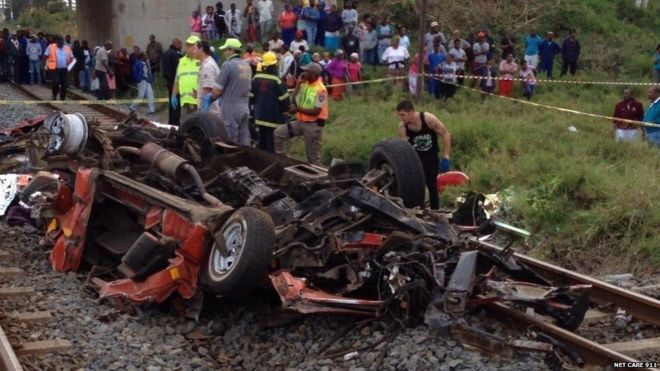
A minibus taxi has collided with a train near Ballito in South Africa, killing at least 14 people, according to KwaZulu-Natal emergency services.

The BBC's Milton Nkosi says it is believed the taxi was carrying 20 passengers when it went over a bridge and hit a train as it plunged onto a railway line below.

South Africa has an exceptionally high accident rate on its roads.

At least 10,000 people die on the roads a year, mostly due to reckless driving.

No-one on the train was injured, according to ENCA news.

Tuesday 18 August 215

http://www.bbc.com/news/world-africa-33967398

continue reading

Saturday, 8 August 2015

Harda train accident: One more body found, toll rises to 30


One more body was recovered on Friday, taking the toll in twin-train tragedy near Harda station to 30. The dead, identified as Shobhnath Pasi, 55, was a native of Badka Dela village in Phoolpur tehsil of Uttar Pradesh's Allahabad district. Pasi, who was working in a powerloom in Mumbai, was travelling from Mumbai to Allahabad in Kamanyani Express's general bogie.

Shobhnath Pasi, 55, was a resident of Badka Dela village under Phoolpur tehsil of Uttar Pradesh's Allahabad district. Pasi was living in Mumbai and working in a powerloom factory. He was travelling from Mumbai to Allahabad in Kamanyani Express's general bogie when the accident took place.

"His son Rakesh Pasi, who came to Harda after hearing about the incident, identified him," Harda SP Prem Babu Sharma told TOI. "13 passengers are still missing and rescue operations are underway," he said.

Sources said the toll may cross 40. If they were alive, they could have been traced by now or would have approached family members.

Kin of 25 people have lodged missing complaints about their near and dear up to Friday. Of these, eight people were identified from the bodies sent to Bhopal and four were found alive in Harda, but the whereabouts of remaining 13 could not be traced so far.

District police have launched a 24x7 helpdesk at Harda railway station to provide information to kin of those missing.

On Friday, rescue operations by state disaster relief force, national disaster relief force and local administration continued. Officials said relief work would continue for next couple of days. Derailed bogies and debris are yet to be removed from the accident site.

Several passengers were trapped in two bogies of Janata Express perilously hanging while three wrecked compartments telescoped into the Kamayani Express. The accident took place near Mandla village under Khirkiya tehsil of Harda district.

Mumbai lad recounts harrowing experience at mortuary

Mumbai resident Ajay Patel's family members were taken out dead from the wreckage of Janata Express by rescue workers at Harda. Four bodies wrapped in sheets, tossed on the slush at the tragedy site for identification and then stuffed into an ambulance van to Bhopal, where it was shoved into a frigid morgue. Sixty hours later, Ajay, who is just out of high school, is struggling to get custody of the bodies for performing last rites. It was a traumatic journey from Kalyan railway station, where he first heard the tragic news to a roller-coaster ride to Harda ground zero and then a harrowing experience at the morgue at Hamidia Hospital, Bhopal.

Ajay only had a fleeting glimpse of his parent's decomposed bodies. He cringed as he pointed out to mortuary officials that they were his own. Now, he's still waiting to get custody of the bodies for funeral. With no coordination between police, doctors and railway officials, many like Ajay are getting trapped in red tape of babudom.

"I was waiting at Kalyan railway station to receive my parents, aunt and cousin. It was then that I heard about the accident. I dialled the helpline number and heard the shocking news. I did not know much about Harda or Bhopal. I and my uncle headed for Harda in a taxi as trains were diverted. We scoured photographs of the dead put up at notice board at Harda railway station and then reached Bhopal. I waited at BMHRC morgue for three hours and still didn't get the bodies. I spent sleepless night in the open at the hospital campus. In the morning, we were told, the bodies were taken to another hospital for autopsy," he said.

Since Friday morning, Ajay is waiting outside mortuary at Gandhi Medical College for the autopsy to end. "There's nobody to lend a helping hand. There's so much red tape even after a national tragedy," he said. His parents, Baliram, 47, Hari Bai, 44, aunt, Shashi, 35 and cousin Satyam, 11, died after the coach in which they were travelling sank into the swollen Machak river after two trains derailed on the bridge.

Ajay is eldest in the family and his two younger siblings, brother Vikas, 16 and sister Manju, 18, are in Kalyan, Mumbai, still unaware of what has happened.

The bodies were taken out of GMC Hospital after autopsy late afternoon and Ajay hired two hearses for railway station.

Ajay's is not the only sordid tale. Families of victims are having a tough time dealing with administration as officials of Railways and district administration are not in sync. Arman Shah, who lost his elder brother, Ramzan Shah, 23, had to also struggle to get the autopsy done and take the body home. Two railway officials, including ticket examiners, were also present at the hospital on Friday. "What we can do? Police and doctors do not listen to us. Railway brass should take note of the situation," they said.

Kamayani Express, headed for Varanasi in Uttar Pradesh from Mumbai, derailed near Harda town, 160 km south of Bhopal, shortly before midnight. The Janata Express, en route to Mumbai from Patna, too derailed at the same spot minutes later. A total of 30 bodies have been recovered so far, besides, at least 13 passengers are still missing.

Saturday 8 August 2015

http://timesofindia.indiatimes.com/city/bhopal/One-more-body-found-toll-30/articleshow/48399401.cms

http://timesofindia.indiatimes.com/city/bhopal/60-hrs-after-tragedy-Mumbai-lad-recounts-harrowing-experience-at-morturary/articleshow/48399415.cms

continue reading

Thursday, 6 August 2015

Madhya Pradesh train accident: Toll may cross 50 as many feared washed away


The death toll in Tuesday’s train derailments in Madhya Pradesh reached 34 but it could cross 50 as rescuers and relatives feared flash floods that caused the fatal accidents washed away many passengers on board the two packed trains.

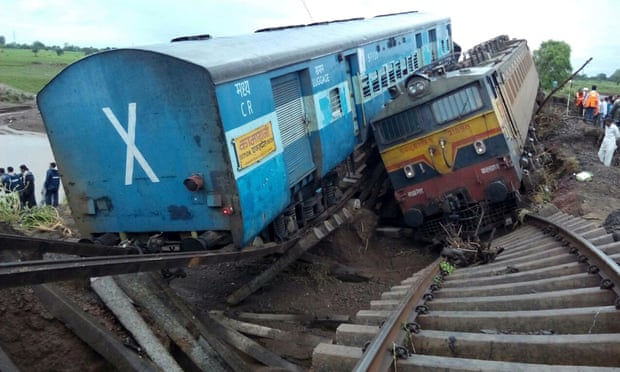
The Kamayani Express on its way to Varanasi from Mumbai derailed shortly before midnight on Tuesday near Harda town while the Janata Express travelling in the opposite direction to Mumbai from Patna slid off the tracks soon after. The trains derailed after flash floods set off by torrential rains weakened tracks over the swollen Kala Machak river.

Officials said three more bodies — including two women — were fished out from Kala Machak on Thursday but the toll could be much higher as more than a dozen families reached Harda and nearby towns looking for missing relatives who were travelling in the two trains.

These families reported 17 missing passengers but when they were shown photos of a dozen unidentified bodies, the identity of only two could be ascertained.

“This indicates 15 missing people might add to the list of 31 declared dead so far,” an official said.

The administration directed officials to look for bodies that might have washed away 15-20km downstream after the National Disaster Response Force team stopped their rescue efforts on Thursday.

Family members recounted their frustration after repeated rounds of hospitals, police stations and Harda railway station for news about their missing loved ones.

Thursday 6 August 2015

http://www.hindustantimes.com/india-news/mp-train-accident-toll-may-cross-50-as-many-feared-washed-away/article1-1377251.aspx

continue reading

Wednesday, 5 August 2015

Death toll rises to 29 as Kamayani, Janata Express trains derail in Madhya Pradesh


At least 29 people, including 11 women and 5 children, have been killed after the Kamayani Express from Mumbai to Varanasi and the Mumbai-Jabalpur Janata Express derailed near Kudawa railway station, about 30 kilometres from Harda district in south western Madhya Pradesh, late on Tuesday night.

Meanwhile, Railway Minister Suresh Prabhu, according to PTI, has said that 12 people have been killed and 25 others injured in the accident.

Those killed include nine men, eight women and five children. Two of them reportedly died after being electrocuted during the rescue effort in the twin tragedy.

Both Mumbai-Varanasi Kamayani Express and Jabalpur-Mumbai Janata Express, got derailed while crossing a bridge on Machak River, near Khirkiya and Harda station, about 160 kms from Bhopal.

Kamayani Express was the first to get derailed at around 11:30 pm and Janata Express met with the accident just a few minutes later.

Railway authorities said the sudden flow of water on the tracks caused the derailment.

"We think tracks were breached because of the flow of excessive water," said an officer.

Meanwhile a section has been closed for any train movement. The accident relief train has reached the spot and several passengers have been brought to a nearby station, Sinha added.

More than 300 people have been rescued after the two trains derailed while crossing a swollen Machak river, said officials. According to officials, six coaches of Kamayani Express and three coaches plus the engine of Janata Express were derailed late last night as the base material on the tracks got washed away. “The mishap took place around 11.30 PM on Tuesday as base material of the tracks got washed away in heavy rains.”

Harda district collector Rajnish Srivastava said that incident took place near Khirkiya and Harda station on Machak River in which seven coaches of Kamayani Express and three coaches with the engine of Janata Express got derailed.

"It seems that base material on the tracks got washed away following heavy rains when the two trains coming from opposite directions on the Up and Down tracks met with the accident almost simultaneously," he said.

Wednesday 5 August 2015

http://indianexpress.com/article/india/india-others/kamayani-express-janata-express-derail-in-madhya-pradesh-many-feared-killed/

http://timesofindia.indiatimes.com/india/Twin-train-derailment-death-toll-hits-27-in-Madhya-Pradesh/articleshow/48354995.cms

continue reading

Friday, 3 July 2015

Gujranwala train accident: Another four bodies recovered, death toll reaches 18


Death toll in Gujranwala train accident has reached 18 after another four bodies were recovered from the canal, Dunya News reported.

Three bodies have been identified while identity of the fourth victim could not be confirmed yet.

On Thursday afternoon, about four bogies of a special train bound for Kharian carrying military troops derailed over Chanawan Bridge near Jamke Chattha and fell down in the canal.

Rescue efforts including army aviation helicopters and SSG divers underway whereas more than eighty persons have been rescued.

Railway sources said the train had 21 cargo wagons and six passenger coaches, of which four fell into the canal. The train was shifting cargo of the Pak Army from Pano Aqil to Kharian.

The pre-partition bridge that collapsed as the train was passing over it was reportedly in a dilapidated condition, however, Railway Minister Khawaja Saad Rafique said that possibility of ‘sabotage’ cannot be ruled out in this incident.

Rafique said apparently some other hand seems to be at play in the incident.

On the directives of Prime Minister Nawaz Sharif, a four-member investigation team was formed to probe the incident. The team comprises army’s engineering corps general, a brigadier and railways’s federal government inspector Mian Arshad and AGM Humayyun Rasheed.

The joint investigation team will present its report within 72 hours.

According to authorities, restoration of railway track will take more than two weeks.

Friday 3 July 2015

http://dunyanews.tv/index.php/en/Pakistan/287355-Gujranwala-train-accident-Another-four-bodies-rec

continue reading

Thursday, 2 July 2015

12 dead as train carrying military troops falls into canal near Gujranwala


At least 12 people, including a senior army officer, were killed on Thursday when a train carrying soldiers and military hardware fell into a canal in Gujranwala following the partial collapse of a bridge, officials said.

The accident occurred near the eastern town of Wazirabad in Punjab as it headed to the garrison town of Kharian.

A statement issued by the military said four carriages derailed as the train crossed Chanawan Bridge.

DG ISPR Asim Bajwa tweeted that eight bodies, including “Lieutenant Colonel Amir”, the commander of a unit, had so far been recovered while a further four people were missing.

“Almost 200 people were travelling on the train,” said SSP Waqas Nazir, adding that the canal has been closed to carryout the rescue operation.

“There were around 300 passengers on board,” Minister for Railways Khawaja Saad Rafique told Reuters.

“It is too early to say about the reason for the mishap. Rescue work is under way.”

More than 50 people were rescued, a military official said.

Television images of the scene showed several carriages partly submerged in the canal.

Rafiq said the cause of the crash was unknown. But a senior military official said the army suspected sabotage.

“We suspect that this was an act of sabotage… The planks on the rail were tampered with,” the official said, requesting anonymity as he was not authorised to speak to the media.

The collapse also raises concerns about the safety of infrastructure. Several TV channels reported that the bridge had been marked as “extremely dangerous”.

Later on, Prime Minister Nawaz Sharif expressed concerns for those injured in the accident.

He directed the authorities concerned to mobilise all resources to rescue the injured and restore the track.

Further, the premier directed medical aid to be given to the injured and assure safe return to their destinations.

Thursday 2 July 2015

http://tribune.com.pk/story/913541/seven-killed-as-train-derails-in-gujranwala/

continue reading

Wednesday, 17 June 2015

18 dead, 98 hurt in Tunisia train collision with lorry


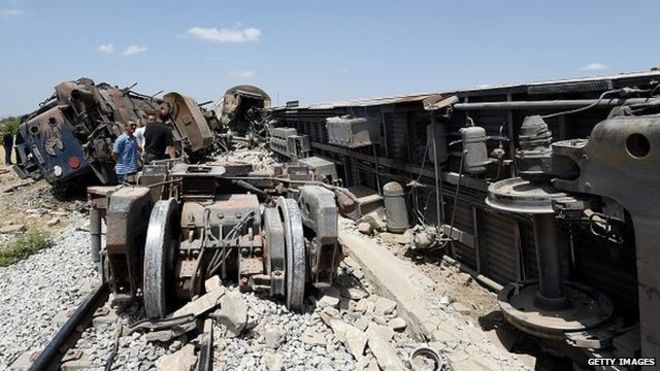
At least 18 people were killed and 98 injured today when a train hit a lorry and derailed at a level crossing in one of Tunisia's worst railway disasters, officials said.

Most of the dead were passengers on the morning rush hour train which hit the lorry in the village of Tabika, around 60 kilometres south of Tunis, the transport ministry said.

"We received the bodies of 17 people," said Riadh Khlifi, director of El Fahes hospital a few kilometres from the accident scene, "and another dead person was sent to Zaghouan hospital".


He added that among the 98 hurt, three were in a critical condition and had been sent to the capital for treatment.

The interior ministry said the train had been en route to Tunis from Gaafour, 120 kilometres to the southwest.

The collision happened at around 6:30 am (0530 GMT).

Transport Minister Mahmoud Ben Romdhane said the accident happened because there was no barrier at the crossing, but this was disputed by the Tunisian National Railway Co (SNCFT).

"The main cause of the accident is the non-existence of a barrier... and protection at the crossing," he told radio station Shems-FM.

"In Tunisia, there are 1,150 rail crossings. Only 250 are equipped with signal posts and barriers and only 150 have lights. This is insufficient."

But SNCFT spokesman Hassen Miaad told Tunisian radio there was "a stop sign and a railway crossing sign at the level crossing".

Train crashes are common in Tunisia, where much of the rail network is dilapidated, but Tuesday's accident was the deadliest in recent memory.

The presidency said it had called for an inquiry "to determine the cause of this catastrophe".

Witnesses spoke of mangled wreckage at the scene and dead bodies strewn across the tracks.

"A very loud noise woke me up. At first I thought it was an earthquake but then I saw this overturned truck and the bodies. Two bodies had their legs ripped off," local resident Habib Fayedh told AFP.

The lorry driver, originally reported to have been killed, survived the collision and was questioned by police before being taken to hospital, Fayedh said.

Wednesday 17 June 2015

http://www.dnaindia.com/world/report-18-dead-98-hurt-in-tunisia-train-collision-with-lorry-2096282

continue reading

Tuesday, 5 May 2015

Britain’s worst rail disaster: Soldiers on way to Gallipoli were caught up in rail crash inferno


Britain’s worst rail disaster - Quintinshill near Gretna - is to be remembered at a centenary parade and commemoration service on Thursday, May 21.

The collision resulted in the death of two Bo’ness servicemen and seriously injured another as they headed south to meet up with a boat heading for Gallipoli.

The majority of those killed were soldiers travelling on a Larbert to Liverpool service, drawn largely from the 1/7th (Leith) Battalion, the Royal Scots.

The regiment had been camped at the Tryst, Stenhousemuir, for several weeks and was travelling to Liverpool docks en route to the front at Gallipoli in Turkey.

The disaster occurred at 6.50am on May 22, 1915, when the troop train travelling from Larbert collided with a local passenger service that had been shunted on to the main line.

An express train, travelling at speed to Glasgow crashed into the wreckage a minute later with horrifying and devastating results. The gas lights fitted in the train carriages, which themselves were wooden built, created an inferno.

The accident was later found to have been caused by poor working practices on the part of two signalmen, George Meakin and James Tinsley, who were subsequently jailed for culpable homicide.

The former worked night shift at a nearby signal box and was supposed to be relieved by the latter at 6am. However, the two men had an informal arrangement allowing Tinsley to arrive later, coming by train, rather than walking the 1.5 miles from Gretna.

In order to hide their malpractice they ignored the correct procedures on recording train movements leading to the disaster.

Of the two Bo’ness deaths recorded, the first was that of Thomas Barnett, a private in the Royal Scots 7th Battalion.

He was the son of George Barnett, a boot repairer, of South Street, Bo’ness.

Having been discharged from the Royal Field Artillery due to an injury, he re-presented himself for active service at Blackness Castle during a recruiting campaign for the 7th Royal Scots.

It was reported in the Linlithgowshire Gazette at the time that Thomas had married shortly before he met his death on May 22, 1915, and that his wife continued to live at Corbiehall after his untimely death.

The second death was of Andrew Williamson, also a private in the 7th Royal Scots.

He lived with his widowed mother at Cowdenhill, Grangepans, and was the youngest sone of the late George Williamson.

Andrew had previously been employed as a miner before enlisting. His age at the time of his death was given as being 19 years old.

The one local survivor was Albert Munro of 14 Mayfield Terrace, Grangepans. The Linlithgowshire Gazette reported that Albert’s survival was solely down to the fact that he was travelling in a carriage located halfway down the train and had managed to jump from a window just before the collision occurred.

Further research seems to suggest that Albert survived the war as no record can be found on either the Bo’ness War Memorial or the list of soldiers who perished during the Great war of 1914-1919.

The commemoration will take place at Larbert Church at 7pm. A parade will leave Larbert Station at 6.40pm.

After the terrible tragedy came the grim funerals...

A number of bodies were never recovered, having been completely consumed by the fire, and when the bodies of the men of the Royal Scots were returned to Leith on May 24, they were buried together in a mass grave in Edinburgh’s Rosebank Cemetery.

The bodies were escorted by the 15th and 16th Battalions Royal Scots,and the Edinburgh Pals battalions recently assembled and still undergoing training. The cortege took four hours to complete its sad task.

The coffins were laid three deep with each on the top row covered in the Union flag with the deceased being afforded a burial with full military honours.

The public was excluded although 50 wounded servicemen who were convalescing at a nearby military hospital were allowed to attend.

The ceremony lasted three hours at the end of which a volley of three shots was fired and the Last Post played.

A memorial was erected in Rosebank Cemetery in 1916.

Of the troops, 83 bodies were identified. Eighty-two were recovered but unrecognisable and 50 were missing altogether giving a total of 215 but which was later revised by the army to 214.

Among the coffins were four bodies which were unidentified. One coffin was simply labelled as ‘little girl, unrecognisable,’ and another as ‘three trunks, probably children’.

As no children were reported missing the railway company moved the bodies to Glasgow for possible identification but no one came forward to claim the bodies. The four were buried in Glasgow’s Western Necropolis on May 26 in what was reported as a ‘‘very touching service’’.

The engine crew of the troop train were both from Carlisle and they were also buried on May 26 at the local Stanwix Cemetery.

The final legal inquiry into the disaster was held on November 4, 1915, in Dumfries and was an inquiry under the Fatal Accidents Inquiry (Scotland) Act.

Tuesday 5 May 2015

http://www.linlithgowgazette.co.uk/news/local-news/soldiers-on-way-to-gallipoli-were-caught-up-in-rail-crash-inferno-1-3760555

continue reading

Wednesday, 29 April 2015

Commemorating the Quintinshill rail disaster


Dumfries and Galloway will commemorate the centenary of the Quintinshill rail disaster on 22 May 2015.

The Quintinshill rail disaster on 22 May 1915 claimed 227 lives, including 216 servicemen of The Royal Scots as they headed for Gallipoli. Another 246 people were injured. The train crash, near Gretna, remains the UK’s worst rail disaster.

A troop train that had departed from Larbert station crashed into a local service at a junction near Gretna. An express train bound for Glasgow ploughed into the wreckage just moments later.

Many of those who died in the tragedy were servicemen with the Leith-based Royal Scots, who were travelling to Liverpool before they sailed to Gallipoli.

The events at Gretna on 22 May will be followed by a commemoration in Leith the next day.

They will be included in the national World War One centenary commemoration programme.

The programme of events includes a march to Quintinshill rail siding; the opening of a Roll of Honour at Gretna Old Church; a commemorative tree planting at Gretna Green war memorial; the premiere reading of Quintinshill poem at Stormont village hall; and a wreath laying at Quintinshill Bridge. HRH The Princess Royal will visit the region to participate in the commemorations.

Council Leader Ronnie Nicholson said, “As we commemorate the events in World War 1, it’s important that we take time to respectfully mark the centenary of this momentous event, which took place in our region. Our Council is working with local communities and a range of appropriate organisations to deliver a fitting tribute.”

Wednesday 29 April 2015

http://www.bbc.co.uk/news/uk-scotland-south-scotland-31364439

http://www.falkirkherald.co.uk/news/local-news/falkirk-men-among-quintinshill-rail-disaster-victims-1-3746492

continue reading

Saturday, 25 April 2015

At least 14 migrants killed in Macedonia after being hit by train while walking through canyon


At least fourteen migrants have died after being hit by an international passenger train in central Macedonia as they walked through a canyon along an increasingly well-trodden Balkan route for migrants trying to reach western Europe.

The accident happened at night near the central city of Veles.

Rescue efforts were hampered by difficult terrain, with the site of the accident accessible only by foot or railway.

Macedonia's state prosecutor said that from interviewing survivors it appeared most of the group were from Somalia and Afghanistan.

Migrants fleeing war, poverty and repression in the Middle East and Africa are increasingly turning to the Balkans as a land route to western Europe.

Although the route is longer, it is deemed safer than trying by boat across the Mediterranean.

Up to 900 migrants drowned when their boat capsized its way from Libya to Italy on Sunday.

The Macedonian prosecutor confirmed the 14 deaths and said rescue services found no injured migrants at the site, an area called Pcinja north of Veles and near the Vardar river.

Local media reported that the group numbered around 50.

They were hit by an international train travelling from the southern Macedonian border town of Gevgelija to the Serbian capital, Belgrade, the same route taken by migrants trying to get from Greece to Hungary.

"The driver saw a large group, dozens of people," the prosecutor said in a statement.

"At that moment, he took action to stop the train and engage the siren, at which point some people left the tracks. The train was unable to stop before hitting and running over some of them."

Emergency service workers described a "scene of horror with body parts scattered some 150 metres along the railroad".

The bodies were taken to a chapel at the local cemetery in Veles, police said.

Eight migrants were detained, while others fled the scene, police spokeswoman Anita Stojkovska said.

Already, more than 1,750 migrants have died crossing the Mediterranean this year — 30 times more than the same period in 2014.

Saturday 25 April 2015

http://www.abc.net.au/news/2015-04-24/fourteen-migrants-killed-by-train-in-macedonian-canyon/6419918

continue reading

Tuesday, 7 April 2015

15 people feared dead after train hits a canter truck in Kafue


Fifteen people are feared dead after a light canter truck was hit by a train in Kafue last evening less than 24 hours after 19 people died in a road clash in Mazabuka on Monday morning.

Zambia Police spokesperson Charity Chanda confirmed in a post on social media that five people died on the spot but witnesses say more bodies were retrieved at the scene.

“Five people have died, 14 seriously injured while three sustained minor injuries in an accident which happened between 1830 hours and 1900 hours at the rail crossing in Kafue.

Among the seriously injured is a thief who tried to steal from the scene of accident,” Ms Chanda said.

According to eye witnesses, the light truck overtook other vehicles on the rail crossing that were waiting for the train to pass. The driver failed to stop after discovering that the train had already reached the road crossing point. The truck was hit in the trailor and dragged leaving many people and their animals likes goats seriously injured and others dead.

Early in the day 19 people died when the Fuso Fighter truck they were travelling in rammed into the Shoprite building in Mazabuka.

Among the dead are 10 men, six women and three children of various ages.

Southern Province police chief Mary Chikwanda confirmed the accident which happened around 01:00 hours yesterday.

Ms Chikwanda said in an interview that the truck, registration number ACT 2439, was being driven by Kabaso Mwenya from Lusaka heading to a fishing camp in Monze area.

Mr Mwenya is among the people that died on the spot, while some bodies of the victims were mangled.

According to witnesses, the vehicle was loaded with fridges, mealie meal and other goods which passengers, mostly fish mongers, use in their fish business.

The witnesses also disclosed that some money was discovered tied in a plastic bag at the scene of the accident.

Ms Chikwanda said the driver, whose wife also perished is believed to have been speeding resulting in him failing to negotiate a corner and hit into the building.

Part of the building has been razed due to the impact.

“The accident happened around 01:00 hours and several people died among them 10 men, six women and three children,” Ms Chikwanda said.

Ms Chikwanda further said that about five people sustained serious injuries, mainly broken bones, and were admitted to Mazabuka General Hospital.

Some of the bodies of the victims have been identified, while others were still waiting to be identified.

She appealed to members of the public to help the police and hospital authorities to identify the bodies.

The 23 passengers on the truck are believed to be residents of John Laing Township in Lusaka and were heading to Lonchinvar fishing camp.

President Lungu expressed sadness over the deaths when he visited the Copperbelt yesterday.

Vice-President Inonge Wina, who was in Livingstone for the official opening of the fourth general assembly of the Association of African Public Services Commissions, yesterday observed a moment of silence for the accident victims.

Tuesday 7 April 2015

http://www.lusakatimes.com/2015/04/07/15-people-feared-dead-after-train-hits-a-canter-truck-in-kafue/

continue reading

Thursday, 26 March 2015

7 killed in train-truck collision during heavy rain in Thailand


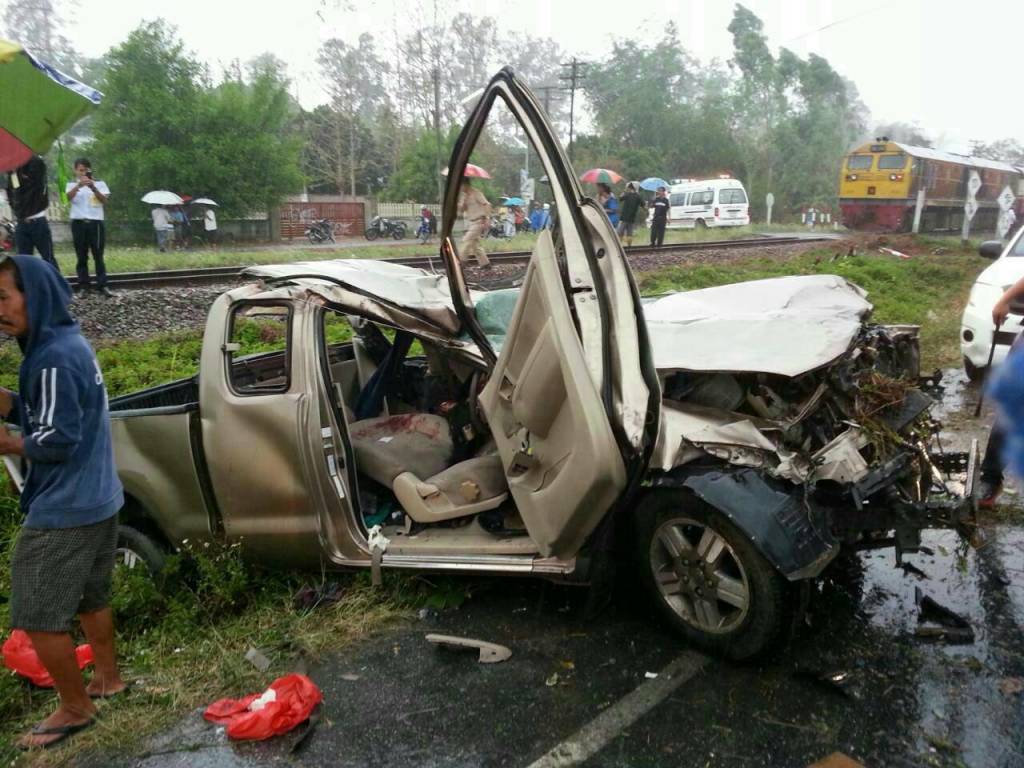
A passenger train collided with a pickup truck in heavy rain in northern Thailand on Tuesday, killing seven construction workers in the truck and seriously injuring another, police said.

The train, bound for Bangkok, crashed into the truck at an unguarded crossing in Saraphi district shortly after departing from Chiang Mai, police Lt. Colonel Kumkaew Suyati said. He said the heavy downpour could have prevented the truck driver from seeing the oncoming train while crossing the tracks.

Kumkaew said five men and two women in the pickup truck were immediately killed and another man was seriously injured. All were members of the ethnic Shan minority, he said.

Construction jobs in Thailand are commonly filled by migrant workers or ethnic minorities.

Kumkaew said the train was not damaged and was able to continue its trip after a brief stop.

Chiang Mai is Thailand’s second largest city and a popular tourist destination.

Thursday 26 March 2015

http://www.khaleejtimes.com/kt-article-display-1.asp?xfile=data/international/2015/March/international_March630.xml§ion=international

continue reading

Friday, 20 March 2015

31 killed as Indian train derails


Rescuers were using cutters to rip apart the mangled wreckage to search for trapped people.

Rescue workers pulled 31 bodies from the wreckage, said Ashwini Srivastava, a spokesman for the railways, and at least 50 more were injured.

The engine and two coaches of the Janata Express jumped off the tracks near Bachhrawan village in Uttar Pradesh state.

Several people were feared trapped in the wreckage, and rescue efforts were focused on bringing them out alive, said Ram Murath Yadav, a police official at the site of the accident.

One of the derailed coaches was crushed by the impact and most of the casualties were in that coach, he said.

The federal rail ministry has ordered an inquiry.

The driver of the train escaped unhurt and was being questioned, Mr Srivastava said.

Friday 20 March 2015

http://www.independent.ie/world-news/31-killed-as-indian-train-derails-31081682.html

continue reading

Saturday, 14 February 2015

Mexico bus-train collision kills 20, injures 31


At least 20 people were killed and 31 injured when a freight train slammed into a packed passenger bus in northeastern Mexico, authorities said Saturday after rescue crews worked through the night to reach victims.

The collision happened on Friday when the bus was attempting to cross rail tracks in the town of Anahuac, Nuevo Leon, state civil protection chief Jorge Camacho told AFP.

The accident occurred just after 5pm at Camarones station, near the US border.

At least two children were reported among the dead, Camacho said.

Images broadcast by local media showed the bus split in half by the force of the train.

Many of the injured were taken to hospitals in the nearby border town of Nuevo Laredo, around 60km away, mayor Desiderio Urteaga told Milenio television.

The bus, which normally transports around 40 people, was traveling with 51 passengers, as it made its way from Nuevo Laredo to the northern city of Nueva Rosita.

Camacho said an investigation was under way to determine whether the bus driver was trying to beat the train when the vehicle was struck.

There was no fog or rain in the area at the time, he said.

Saturday 14 February 2015

http://www.straitstimes.com/news/world/americas/story/mexico-bus-train-collision-kills-20-injures-31-20150215#sthash.V2etazaG.dpuf

continue reading

Friday, 13 February 2015

Bangalore train mishap: 12 dead in Bangalore-Ernakulam Express accident


Up to 12 passengers were killed and 25 injured when nine coaches of the Bengaluru-Eranakulam Inter-City Express derailed in Karnataka early Friday, an official said. The incident occurred at 7.35 am after the train left Anekal station towards Hosur near the border with Tamil Nadu, a railway official told IANS here.

While one railway official in Bengaluru claimed five deaths, others at the disaster site put it at 10. But Kerala Chief Minister Oommen Chandy said after speaking to a Karnataka minister that 12 people had died.

Rescuers frantically retrieved bodies from two of the coaches which telescoped into one another following the crash. The train was chugging at high speed when it went off the rails. The train departed from the main city station here at 6.15 a.m. and covered 45 km when the disaster took place between Anekal road and Hosur town on the Karnataka-Tamil Nadu border.

“A disaster relief force team is at the spot for rescue and relief operations. The injured have been rushed to private and government hospitals at Anekal and Hosur,” one official said. He said 10 of them were reported to be in serious condition.

Chandy, who spoke to Karnataka Home Minister K.J. George, told reporters in Kochi that a team led by Kerala Electricity Minister Aryadan Mohammed had left for the accident site.

Anish, a passenger on the train, told the media in Kochi over telephone that the rescue team had cut open the two coaches to shift the injured to hospitals. Another passenger, Cyriac Mathew, said he had seen three bodies.

“The worst affected was coach D-8. I could see the bodies of two men and a woman in the coach,” said Mathew, a regular traveller on the train. ”Police and the ambulance arrived an hour after the accident,” he said.

Officials have not explained the cause of derailment. “An expert team is at the mishap spot to inspect what caused the derailment,” the official noted.

The South Western Railway has set up help desks at the Bengaluru station and the accident site to assist the injured and the stranded passengers. The railways arranged special buses to shift the stranded passengers to Anekal and Hosur to either return to Bengaluru or to continue their onward journey to Ernakulam in Kerala via Tamil Nadu.

“We are planning to run a special train later in the day after the track is cleared,” the official added.

Friday 13 February 2015

http://www.india.com/news/india/bangalore-train-mishap-12-dead-in-bangalore-ernakulam-express-accident-281004/

continue reading

Wednesday, 4 February 2015

Seven killed as New York train hits vehicle


A commuter train has hit a vehicle at a level crossing north of New York City, killing at least seven people and injuring 12, officials say.

The train, with about 800 passengers on board, hit the Jeep Cherokee near Valhalla - about 20 miles (32km) from New York - on Tuesday evening.

The vehicle's female driver was killed, along with six people on the train, New York Governor Andrew Cuomo said.

The car and front carriage of the train caught fire following the crash.

The packed commuter train had left Grand Central Station in New York City and was heading to Wassaic in south-east New York State.

The crossing gates at the railroad had come down on top of the vehicle, which had stopped on the tracks, Metro-North Railroad spokesman Aaron Donovan said.

The driver got out to look at the damage, and then got back into the car to drive forward before it was hit by the train. It pushed the vehicle more than 120m (400ft).

It is not yet clear why the vehicle stalled on the tracks.

As a result of the collision the electrified third rail of the track came through the front carriage of the train.

Passengers had to escape from the rear of the train.

Mr Cuomo, who visited the site of the crash, said he witnessed "a truly ugly and brutal sight".

He added: "When you look at the damage done, it's actually amazing that not more people were hurt."

Hundreds were taken to a local rock climbing gym following the crash.

Parts of the railroad remain closed on Wednesday.

Metro-North is the second-busiest railroad in the US, serving about 280,000 passengers a day in New York and Connecticut.

Last year, the National Transportation Safety Board issued rulings on five accidents that occurred on the railroad in 2013 and 2014, criticising Metro-North while also finding conditions had improved.

Wednesday 4 February 2015

http://www.bbc.co.uk/news/world-us-canada-31124170

continue reading

Saturday, 24 January 2015

60 years on - eyewitness remembers Birmingham's worst train crash


Birmingham's worst train disaster happened on a wintry afternoon at Sutton Coldfield railway station 60 years ago.

On January 23, 1955, an express train carrying around 300 passengers derailed on a sharp bend shortly after 4pm.

Seventeen people, including the train crew, died and a further 25 were injured.

The train had rocketed towards the station at speeds of up to 60mph – twice the speed limit – with devastating results.

Stan Brown, a council lorry driver, was called in to help set up a temporary morgue to deal with the volume of bodies being taken from the wreckage.

“My wife Jean and I were walking down the Parade when we saw a fire engine come by and all the fireman had black faces,” says Stan, now 82 and from Sutton Coldfield.

“The next thing I knew my boss came and took me to the railway station.

“There I saw the terrible tragedy.”

The sight he beheld must have been horrendous.

The train had collided with platforms and nine out of the 10 carriages had derailed.

The first carriage was crushed between the engine and the second carriage.

Another was knocked into the air, causing it to drag along the station roof.

Seven bodies, including those of the two drivers, were trapped inside the train.


Stan, who was 22 at the time, recalls: “Dr Preston, the medical officer, was there as was the surveyor Mr Porter. There were half a dozen chaps helping.

“We went to Riland Road where there was a council yard depot shed we used to store the lorries, steam rollers and salt for the roads.

“The floor was greasy so we covered it with tarpaulin and put sheets up to the windows so people couldn’t see inside.”

Forty ambulances from across the Midlands were sent to the scene along with a mobile surgical unit from Birmingham Accident Hospital, 25 fire crews and 50 extra police officers.

Extra help was also provided by RAF servicemen who were based at Whitemore Common.

“I remember the ambulances carrying the bodies in,” says Stan, who has two children and four grandchildren.

“Then, once the bodies were cleaned up, we laid them out for their families to come and see them.

“We were there for two days. We couldn’t believe how many bodies there were.”

Stan had served with the Royal Electrical Mechanical Engineers for three years in Germany, having been called up for national service as a driver.

“Even though I’d been in the army, I’d never seen a dead body before,” says Stan.

“But everyone was just doing anything they could to help.

“Arthur Anenborough, the ticket collector, had been travelling in the last coach that derailed. He ran to the signal box and managed to avert a further disaster.

“A lady who lived nearby could see what was happening and ran to stop another train from coming down the track.

“The trouble was the train had been travelling too fast. It had exceeded the speed limit and come off the rails. If it had travelled 10 yards more, it would have reached Park Road where there’s a 300-500ft drop onto the road below.

“It’s hard to come to terms with something like that but you just live every day the best you can.”

A passenger called Mr W Forrest, from South Shields, who had been travelling to Coventry and was in the fifth coach.

“The train had been swaying from side to side,” he told the Birmingham Mail at the time.

“Suddenly, there was a terrific rending noise and we were all thrown in a heap.

“Some of us were thrown up and struck the roof.”

The train was the 12.15 from York to Bristol via Sheffield, Derby, Burton-on-Trent and Birmingham, and it had been diverted from its usual route because of engineering works.

Most of the injured went to Sutton Coldfield Hospital, with Birmingham General and the accident hospital also taking casualties.

Although excessive speed was the major factor in the accident, the exact cause was never fully established.

It seems likely the driver knew he was exceeding the speed limit but did not realise the extent of the danger.

One theory was that he thought the train was running late and was making up time, another that there was a gradient to climb after the station which he thought was best approached at full speed.

The steam locomotive, like most at that time, was not fitted with a speedometer.

Following the tragedy, lineside speed restrictions were universally adopted and the Government announced a multi-million pound modernisation plan for the railways.

This included a £210 million programme to improve track and signalling.

Wolverhampton Wanderers player Bobby Thomson had been due to take the train that derailed in Sutton Coldfield that fateful day.

In his book, The Real Bobby Dazzler, he wrote: “Little did Cullis know that seven of his players were due to take that train.

“One of those was me. The others were Colin Tether, Dick Calvert, Harry Middleton, Stan Round, Cyril Bevan and Geoff Sidebottom.

“Cullis called a meeting for the Sunday and we travelled back on the Saturday instead.”

It was a decision that probably saved their lives.

So, could an accident like this happen today?

“It is much less likely,” says Sim Harris, managing editor of Railnews.

“The railways in Britain are now protected by a system called TPWS (Train Protection and Warning System). If a train is travelling too fast, the driver is warned. If the warning is disregarded for more than a few seconds, the brakes are applied.

“The next generation of signalling and train protection, the European Rail Traffic Management System, is now being tested. This includes various visual warnings if the permitted speed is exceeded at any time and, as with TPWS, the system takes over and stops the train if it is travelling too fast or does not have authority to proceed.”

MAJOR RAIL DISASTERS OVER THE LAST 60 YEARS

November 5, 1967 – 49 dead after commuter train derailed near Hither Green, South-east London

February 28, 1975 – 43 killed in Moorgate Tube crash, the cause of which remains a mystery

November 23, 1984 – London tube fire traps hundreds – thought to be started by a cigarette

September 19, 1986 – 75 injured and driver dead following collision at Colwich Junction near Rugeley, Staffordshire

November 18, 1987 – 31 dead after Kings Cross Station fire, which began in machine room under a wooden escalator

December 12, 1988 – 35 dead in Clapham rail collision following wiring errors made by an overworked rail worker

October 5, 1999 – 38 people died in Paddington rail crash, resulting in a public inquiry into high speed train safety

October 17, 2000 – Four dead in Hatfield rail crash caused by a cracked rail

February 28, 2001 – Ten people died in Selby rail crash after the driver fell asleep at the wheel

May 10, 2002 – Seven killed in Potters Bar rail crash after the train derailed at high speed


Saturday 24 January 2015

http://www.birminghammail.co.uk/news/nostalgia/60-years---eyewitness-remembers-8489949

continue reading

Monday, 29 December 2014

The Tay Bridge rail disaster, 135 years on


It was, said the Glasgow Herald on a Monday morning exactly 135 years ago, a catastrophe of the most appalling description.

The night before - Sunday, December 28, 1879 - the central span of the Tay Bridge, at that time the longest bridge in the world, had collapsed during a violent gale estimated at Beaufort force 10/11.

A northbound ferry train from Burntisland had the misfortune to be on the bridge when the collapse happened. The six-carriage train plunged 130ft into the freezing waters of the Tay killing 75 people.

The wind was blowing hard that night, bringing down chimney pots and roof slates. The iron girders of the Tay Bridge, opened in June 1878, should have been strong enough to withstand any winds. But a half-mile span of the bridge collapsed just as a train was crossing.

A court of inquiry ruled that the collapse was due to an “insufficiency of the cross bracing and its fastenings” to withstand the gale.

However, the inquiry did not hear the testimony of one witness, engineer WB Thomson, who reported seeing “two luminous columns of mist or spray”, perhaps 100 metres tall, travelling across the river. The spray from one column struck a nearby house with hissing sound, leaving the windows caked with salt. A second witness, William Robertson, also described the columns.

Researchers at tornado research organisation Torro believe these columns were waterspouts – tornadoes over water made visible by the water droplets they carry. They believe the impact of one or more tornadoes brought down the bridge after it had been weakened by the wind.

After the disaster rules were introduced requiring new bridges to be built stronger. As McGonagall observed: “For the stronger we our houses do build / The less chance we have of being killed.”

Monday 29 December 2014

http://www.theguardian.com/news/2014/dec/22/weatherwatch-tragedy-new-twist

continue reading

Sunday, 5 October 2014

Paddington rail disaster remembered 15 years on


Those bereaved by the Paddington train crash have marked the 15th anniversary of the disaster with a ceremony.

They have placed flowers at a memorial site high above the railway line at Ladbroke Grove in west London.

Just before 08:10 BST on 5 October 1999, 31 people died when two trains collided almost head-on.

The subsequent inquiry found the Thames Trains service travelling from Paddington to Bedwyn in Wiltshire had gone through a red signal.

It then crashed into the London-bound high-speed First Great Western train which had left Cheltenham Spa in Gloucestershire at 06:03.

The Thames driver, Michael Hodder, 31, and the other train driver, Brian Cooper, 52, were among those killed as the collision led to a fireball in which coach H was burnt out.

As well as the fatalities, more than 220 people were injured.

Paddington Survivors group chairman Jonathan Duckworth, 56, from Stroud in Gloucestershire, was on the First Great Western train.

Father-of-two Mr Duckworth said: "Luckily, I was only in hospital for around 24 hours but then I suffered from post-traumatic stress disorder.

"I had to have about 18 months of treatment and was only able after that to take on small, part-time jobs.

"It was six or seven years before I was able to work full-time again."

The Paddington disaster was followed by fatal rail crashes at Hatfield in Hertfordshire in 2000, at Selby in North Yorkshire in 2001 and at Potters Bar in Hertfordshire in 2002.

But in the 12 years since, there has only been one passenger death in a rail accident in Britain - 84-year-old Margaret Masson was killed when a Virgin Trains Pendolino derailed on a faulty set of points at Grayrigg in Cumbria in February 2007.

Michael Roberts, director-general of the Rail Delivery Group, which speaks on behalf of Network Rail and the train operators, said: "We remember those who lost their lives and all those whose lives were changed as a result of the Paddington crash.

"After serious accidents in the early 2000s, changes such as an overhaul of employee training for those doing safety-critical jobs and a better approach to staff working hours have helped improve safety on Britain's railway."

Sunday 05 October 2014

http://www.bbc.co.uk/news/uk-england-london-29493287

continue reading