Showing posts with label Landslides. Show all posts

Saturday, 1 August 2015

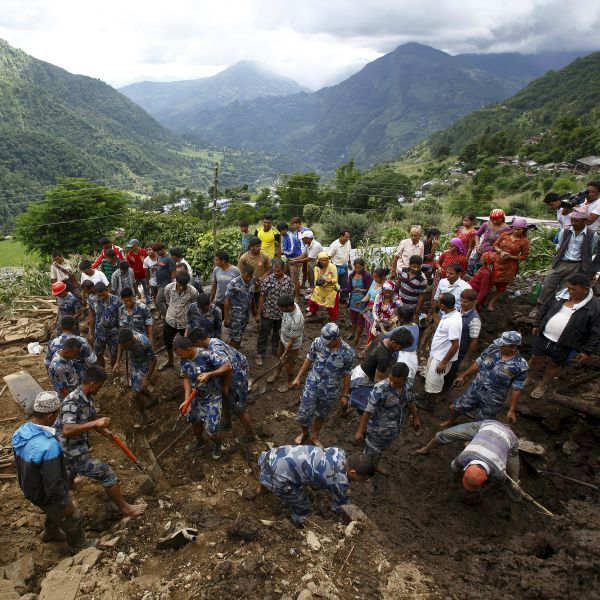
Nepal multiple landslides: Death toll reaches 36; 7 bodies recovered today from debris


Emergency workers on Friday recovered seven more bodies from the debris of multiple landslides triggered by heavy rains in Nepal, taking the confirmed death toll to 36.

Police said rescuers were still searching for six people believed missing after Thursday's landslides, which crushed villages in the western district of Kaski in the foothills of the Himalayas, around 150 kilometres west of Kathmandu.

"The number of dead has risen to 32 in our district," said Kaski police chief Kedar Rajaure.

Four more people, including an 83-year-old man, were killed in three landslides in the neighbouring districts of Myagdi and Baglung as well as in the popular tourist resort of Chitwan, according to a statement released by authorities. Scores of people die every year from flooding and landslides during the monsoon season in the Himalayan nation. Two weeks ago a student was killed when a landslide buried part of a school in the nearby town of Pokhara, and 35 people died last month when a landslide crushed villages in northeastern Nepal.

The monsoon rains are also hampering delivery of relief supplies to mountainous villages devastated by the massive earthquake that struck the Himalayan nation on April 25. More than 8,800 people were killed by the quake and a large aftershock, and many more were left without shelter.

Saturday 1 August 2015

http://www.dnaindia.com/world/report-nepal-multiple-landslides-death-toll-reaches-36-7-bodies-recovered-today-from-debris-2110008

continue reading

Wednesday, 1 July 2015

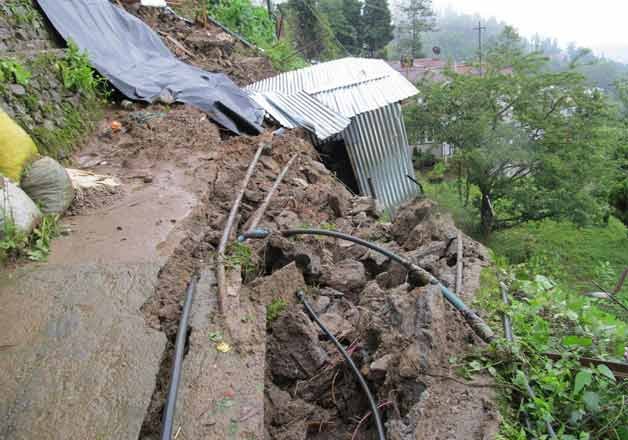
Toll in Darjeeling hills landslides rises to 28


Heavy rainfall since Tuesday triggered landslides across Darjeeling district, leaving scores of people trapped.

"So far we have recovered 28 bodies. Several others are still missing," Darjeeling Superintendent of Police Amit Javalgi said.

According to Javalgi, 20 bodies were recovered from Mirik, six from Kalimpong and one each from Sukhiapokhri and Gorubathan areas of the district.

The landslides have snapped the hills' link with Sikkim as the Rohini-Garidhura Bridge was washed away. National Highways No 31 and 10 also remained blocked due to debris from landslides.

Chief Minister Mamata Banerjee said she was monitoring the situation in the Darjeeling hills and would visit the area during the day.

In Jalpaiguri district, at least 5,000 people were affected by water-logging and their misery was compounded by the release of over 5,000 cusecs of water from the Teesta barrage.

The district administration has issued a red alert over the Teesta and Torsa rivers touching danger levels.

While the Sashastra Seema Bal and Disaster Management personnel are engaged in relief and rescue operations, North Bengal Development Minister Gautam Deb said the army has been called to help in the rescue operations.

Wednesday 1 July 2015

http://zeenews.india.com/news/west-bengal/toll-in-darjeeling-hills-landslides-rises-to-28_1622937.html

continue reading

Sunday, 24 May 2015

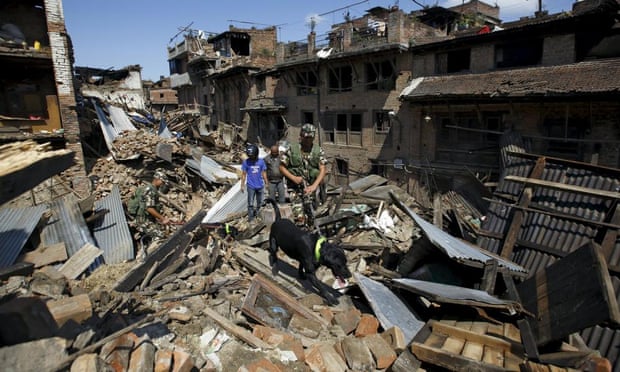
Chinese rescuers return from Rasuwa as deadline expires


The Chinese rescue teams deployed in the district 12 days ago returned to Kerung on Saturday as the Nepal government’s deadline has expired before they could complete their task.

Sources said that the rescuers, who managed to recover four bodies as well as four containers buried in landslides and installed a Bailey bridge at the border, wanted to return home only after completing their task.

A Chinese team that reached Rasuwa via Tatopani border had opened 16 kilometre Syaphrubesi- Rasuwa gadhi road while another team had entered Nepal from Rasuwa gadhi for assistance.

The Chinese rescuers had worked in collaboration with Nepal Army, Armed Police Force and police personnel to open the landslides-hit road and search for the missing people.

The security personnel, however, are yet to make the road fully operational and find 16 people still missing in Rasuwa gadhi landslide.

The landslide has buried the Immigration Office, Customs Office and China Kerung Business Association office and many eateries, among other buildings.

Sunday 24 May 2015

http://www.ekantipur.com/2015/05/24/national/chinese-rescuers-return-from-rasuwa-as-deadline-expires/405587.html

continue reading

Monday, 7 July 2014

Seven killed, nine missing in China landslides


Seven people were killed and nine others have gone missing in two mudslides triggered by flash floods in southwest China's Yunnan Province.

Five people were washed away and several houses were flattened last evening in Dongshan Village, according to the county government of Yongsheng.

Three bodies have been found. More than 200 rescuers are searching for the two missing.

Relief goods such as food and quilts have been sent to the affected areas, state-run Xinhua news agency reported.

In Ludian County, four people were killed and seven others were reported missing after a rainstorm-triggered mudslide.

Continuous downpour has battered the Ludian County, leading to torrential floods and mudslides in many areas, said the Ludian County government.

Longtoushan and Lehong townships are the worst hit townships in the County.


Rescuers have rushed to search for the missing people.

Local governments have initiated an emergency rescue and allocated relief goods to the disaster-hit regions.

Monday 07 July 2014

http://www.outlookindia.com/news/article/Seven-Killed-Nine-Missing-in-China-Landslides/848545

continue reading

Wednesday, 20 March 2013

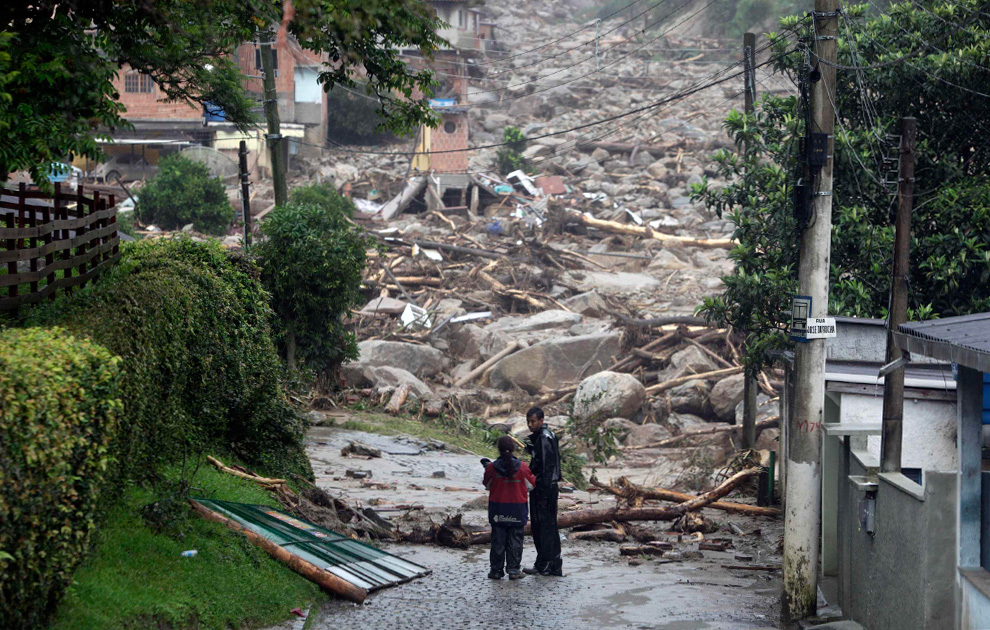
Landslides in Rio mountains kill 24


Landslides triggered by heavy rains killed at least 24 people in the mountains above Rio de Janeiro and prompted Brazilian President Dilma Rousseff to call for tougher action to eradicate precarious dwellings.

Firemen on Friday recovered the bodies of three children who were swept away by floods in the worst hit neighbourhood called Quitandinha, a suburb of Petropolis, where dozens of homes were demolished by the landslides.

Most of the dead, including two civil defence rescuers, were buried under landslides caused by 17 inches (420 mm) of rain that fell on the mountainous region in just 24 hours, almost double the rainfall average for the month of March in the area.

Rousseff, who is in Rome for the investiture of Pope Francis, said Brazilian authorities will have to take "more drastic" measures to stop people building homes in dangerous places.

"We have offered people conditions to move away from areas that are at risk, but they always refuse to move," Rousseff told reporters in Italy. "So we will have to be tougher."

Floods and landslides killed about 1,000 people in the mountain region north of Rio de Janeiro in 2011 in the worst natural disaster on record in Brazil.

Works promised by local authorities to prevent new disasters have not materialized, though sirens installed in the region helped reduce the number of deaths this year, officials say.

Wednesday 20 March 2013

http://uk.reuters.com/article/2013/03/19/uk-brazil-landslides-idUKBRE92I14P20130319

continue reading

Thursday, 4 October 2012

landslide buries primary school

A landslide has buried 18 children and one adult in a mountainous area of south-western China that was hit by earthquakes and flooding a month ago, state media have reported.

Chinese officials said the Youfang primary school collapsed when the landslide struck the village of Zhenhe in Yiliang county, Yunnan province, at around 8am on Thursday morning. Eighteen students are thought to have been inside.

An adult was also trapped when two houses in the village were toppled, according to the statement published on the county website.

State news agency Xinhua said a family of three managed to escape. It added that other residents had been evacuated from the area. An official from the county told Associated Press on Thursday that rescuers had arrived at the village, a three-hour drive from the county seat.

The students at the Youfang Primary School would not normally have been in school this week as China is on a week-long national holiday. But Li Zhong, head of the county education bureau, told the China News Service they were making up for classes suspended after two earthquakes hit the area in early September.

But they were making up for lost time caused by disruptions stemming from two September 7 earthquakes that struck Yiliang county where Zhenhe is located, killing 81 people and leaving hundreds injured.

Web users immediately raised questions about the decision to have the children back in the schools.

The safety of school pupils is a sensitive issue after thousands of students died when an 8.0-magnitude tremor in 2008 rocked Sichuan province in southwestern China and parts of neighbouring Shaanxi and Gansu.

Many schools collapsed in the 2008 quake, which killed more than 80,000 people in total.

This led to accusations that corner-cutting in construction projects and possibly corruption led to shoddy buildings, especially as many buildings nearby such schools held firm.

That disaster, which saw shockwaves of 5.7 and 5.6 magnitude, claimed 81 lives and injured 800 people in Yiliang and neighbouring areas. It was followed by torrential rain that triggered floods and mud and rockslides through the area — damaging roads and relocation sites for emergency services.

The central government said at the time it had allocated 1bn yuan for disaster relief in the county and premier Wen Jiabao visited to inspect rescue work.

Local government officials moved local residents to safer ground after the disaster and dispatched rescue teams to the area, it added.

Yiliang county was one of the areas worst-hit by the two 5.6-magnitude earthquakes last month. Last month's quakes left 820 people injured and 201,000 displaced.

In the wake of that disaster, domestic media said authorities should emphasise safety and sustainability in future developments.

Despite decades of rapidly improving living standards, China remains prone to natural disasters such as floods, quakes, and landslides, with heavy loss of life.

Thursday 4 October 2012

http://www.guardian.co.uk/world/2012/oct/04/china-landslide-buries-primary-school

continue reading

Monday, 24 September 2012

15 persons still missing, believed to be buried under landslide debris

Family members of the 15 ‘missing’ victims of the Ukimath cloudburst are still hopeful that their dear ones may return home someday. The Rudraprayag district administration, has however, apparently given up hope to find any of these persons alive and has also begun the process of distributing compensation money to the genuine claimants.

Of the total of 69 persons, who were missing as per the records of the Rudraprayag District Administration, the rescue workers have so far recovered 54 bodies. A total of 15 persons are still missing and are believed to have been buried under tons of mud and debris of the landslide that hit the area following a cloudburst earlier this month.

According to the Executive Director of the State Disaster Management and Mitigation Department (DMMD), Piyush Rautela, a magisterial probe has already been ordered and the family members of all the 15 missing persons have been asked to get their statements recorded before the officials.

“The claimants of the compensation money have also been asked to fill an indemnity bond, stating that they will return the compensation money, in case their missing family members are found alive,” Rautela added.

Even as the indemnity bond may make the family members of the missing people, hopeful that they may see their loved ones alive someday, the rescue operators say that the possibility of finding anyone of these victims alive is almost negligible. “We have, however, still not called off the rescue operations and searches for the victims are still on. The final death toll in the tragedy is expected to surpass the present figure of 54,” Rudraprayag District Magistrate, Dr Neeraj Kherwal, said.

Meanwhile as life limps back to normal with people coming to terms with their grave losses in Ukhimath, a team of the Geological Survey of India (GSI) has started surveying the area to study the reasons for the unprecedented mudslides that caused more damage in the cloudburst-hit villages in the district.

Ukhimath area in the Rudraprayag district was the worst hit in the calamity that had flattened dozens of homes in eight villages in the area killing at least 54 people in their sleep. A total of 15 persons are still missing and 14 are presently under medical care. It may be noted that the Government had announced `3 lakh compensation for relatives of those killed and `1.5 lakh to those critically injured.

According to records, nearly 450 residents were rendered homeless after the calamity.

Monday 24 September 2012

http://dailypioneer.com/state-editions/dehradun/96579-15-persons-still-missing-believed-to-be-buried-under-landslide-debris.html

continue reading

Monday, 10 September 2012

29 killed in landslides and flooding in Vietnam

Landslides and flooding caused by heavy rains have killed 29 people and left four missing in northern and central Vietnam.

Disaster official Ngo Van Hung of northern Yen Bai province said that 16 villagers from the mostly poor Hmong ethnic minority group died in a landslide while they were illegally collecting tin ore from a mine operated by a private company.

Authorities are searching for two other people missing from the incident, he added.

The government disaster agency said flooding killed another 13 people and left two missing in central Vietnam over the past week.

The agency says on its website that flooding caused by heavy rains has caused an estimated 22 million US dollars in damage to rice crops and infrastructure.

Monday 10 September 2012

http://www.independent.co.uk/news/world/asia/29-killed-in-landslides-and-flooding-in-vietnam-8120967.html

continue reading

Thursday, 16 August 2012

Landslide Fatalities Are Greater Than Previously Thought

ScienceDaily (Aug. 15, 2012) — Landslides kill ten times more people across the world than was previously thought, according to research by Durham University, UK.

A new database of hazards shows that 32,300 people died in landslides between 2004 and 2010. Previous estimates ranged from 3,000 to 7,000 fatalities.

The database, which provides the first detailed analysis of fatal landslides across the world, maps hotspots including China, Central and South America, and India.

The researchers say that the new database, the Durham Fatal Landslide Database (DFLD), can help policymakers to prioritise areas for action to manage hazards and to lessen the risks to human populations living in hotspot regions.

The findings are published in the journal Geology.

Lead researcher, Professor David Petley, a Geographer at the International Landslide Centre, and Co-Director of The Institute of Hazard, Risk and Resilience, Durham University, said: "The environmental effects of landslides are often devastating for nearby human populations.

"We need to recognise the extent of the problem and take steps to manage what is a major environmental risk to people across the world. Our database will enable us to do this by identifying areas most at risk and could help to save thousands of lives."

The DFLD includes only fatal landslides and is compiled using a number of search tools and analysis of government statistics, aid agency reports, and research papers.

It is still likely that the database underestimates the number of landslides and deaths. The database excludes data from landslides caused by earthquakes due to the high level of uncertainty associated with these events. Following an earthquake, where there is a fatal landslide, the deaths are attributed to the earthquake trigger itself, rather than the landslide.

The researchers say that weather patterns, deforestation, melting permafrost in high mountainous areas, and high and increasing human population densities are important factors in the cause, distribution, number, extent and effects of landslides.

More fatal landslide events are recorded in May to October and the dominant global trigger is rain from the monsoon. Tropical cyclones also generate extreme rainfall events that trigger landslides in Asia, and hurricanes have the same effect on regions in the Caribbean and Central America.

In some areas with a history of fatal landslides, such as Hong Kong, programmes to mitigate the risks of landslides have been successful.

Professor David Petley said: "Areas with a combination of high relief, intense rainfall, and a high population density are most likely to experience high numbers of fatal landslides. Landslides are a global hazard requiring a major change in perception and policy.

"There are things that we can do to manage and mitigate landslide risks such as controlling land use, proactive forest management, and guiding development away from vulnerable areas."

Global landslide hotspots: •Southern edge of the Himalayan Arc •South west coast of India •Sri Lanka •Southern and eastern coasts of China •Central China, notably the mountains around the Sichuan Basin •Western edge of the Philippine Sea plate (Japan, Taiwan and the Philippines) •Central Caribbean islands including Haiti •Indonesia, especially in Java •Along the mountainous chain from Mexico, Central America, to Chile, South America, but especially in Colombia

Thursday 16 august 2012

http://www.sciencedaily.com/releases/2012/08/120815202224.htm?utm_source=feedburner&utm_medium=feed&utm_campaign=Feed%3A+sciencedaily%2Fearth_climate%2Fearthquakes+(ScienceDaily%3A+Earth+%26+Climate+News+--+Earthquakes)

continue reading

Landslides, cloudbursts kill 10 in Uttarakhand

Ten people were killed and 38 others went missing as incessant rain battered north Indian state of Uttarakhand on Saturday triggering landslides, cloudbursts and flash floods which flattened homes and stranded hundreds of people.

The Garhwal region bore the brunt of the natural calamity.

The state government has sounded a high alert and has sought the help of the army.

Nineteen labourers of the state-run UJVN Ltd’s Assi Ganga hydel project went missing following a cloud burst in the upper hills of Uttarkashi district. Similarly, 19 people also went missing from Gangori, Dunda, Uttarkashi town and Barkot areas in the district. Elsewhere in the state, 10 people were killed in different incidents following heavy rains during the past 24 hours, said sources in the Disaster Management and Mitigation Centre.

In the disaster-prone Uttarkashi district, flash floods hit several low-lying areas creating havoc there.

At least three men of the fire brigade department and two others were killed at Gangori area even as Chardham yatra to Gangotri and Yamunotri remained suspended.

In Gangori area of Uttarkashi, Bhagirathi is flowing above the danger level with people being evacuated to safer areas.

Nearly 30 homes were washed away in the floods with the Gangori bridge also collapsing.

Two more people were killed in Dunda area of Uttarkashi district.

While two children were killed in a house collapse at Kararnprayag area of Chamoli district early on Saturday, another child was washed away in flash floods at Pokhri area of the district where landslides continue to block highways leading to Badrinath.

Meanwhile, continuing heavy rains in the mountains of Uttarakhand and Nepal have flooded the major rivers of eastern Uttar Pradesh Ghaghra, Rapti and Saryu, threatening to submerge hundreds of villages.

Thursday 16 August 2012

http://www.omantribune.com/index.php?page=news&id=125124&heading=India

continue reading

Wednesday, 8 August 2012

Flooding eases after killing 23 in Philippines

MANILA, Philippines (AP) — Widespread flooding that killed at least 23 people, battered a million others and paralyzed the Philippine capital briefly eased Wednesday, allowing rescuers on rubber boats to reach a large number of distressed residents still marooned in submerged villages.

Government forecasters said the monsoon rains that overflowed major dams and rivers crisscrossing Manila and surrounding provinces would gradually abate and lead to sunny weather later this week after 12 days of relentless downpours.

The deluge that began late Sunday was the worst since 2009, when hundreds died in rampaging flash floods. "We're still on a rescue mode," said Benito Ramos, who heads the government's main disaster-response agency. "Floods are receding in many areas but people are still trapped on their roofs." Ramos said the massive flooding turned half of Manila into "a water world" on Monday evening and into Tuesday.

At least 23 died, including nine in a landslide in a hillside slum in suburban Quezon City and several others who drowned in outlying provinces.

More than 1.2 million people were affected by the deluge, including 783,000 who fled from their inundated homes.

With the receding floodwaters, some of the displaced have started returning to their homes but others stayed put despite the hard conditions in emergency shelters as rain clouds again darkened the sky Wednesday afternoon.

Carmen Empesao said she panicked and left with her three grandchildren when waist-deep floodwaters swamped her home in the hard-hit city of Marikina. "We fled without any food and the clothes we managed to grab were wet and cannot be worn," Empesao, 60, told The Associated Press in an evacuation center teeming with 3,000 displaced.

Rescue efforts shifted into high gear Wednesday, with more than 130 emergency crewmen from two provinces reaching the capital city of 12 million people to help their overwhelmed teams, including police and soldiers.

Rescuers used rubber boats and ropes to navigate flooded streets where many people climbed on rooftops to escape neck-deep waters.

Food and drinking water were in short supply because of impassable roads. President Benigno Aquino III distributed food packs in flood-hit communities south of Manila. Ramos said he was overwhelmed by the extent of the flooding when he flew aboard a helicopter with Defense Secretary Voltaire Gazmin for an inspection Wednesday, although he added that water in many areas was beginning to recede. "In some areas, I could not tell the sea from the flooded villages," he told The AP.

Manila was drenched with more than half of a month's worth of rain in just 24 hours starting Monday. A typhoon in eastern China that has helped intensify the southwest monsoon in the Philippines blew further into the Chinese mainland, prompting Filipino forecasters to predict better weather the rest of the week. "We may see the sun tomorrow," government forecaster Glaiza Escullar said. She added that heavy but brief downpours may still sporadically drench the coastal capital.

Although heavy rains may ease, she warned that up to three storms or typhoons were expected to lash the country this month.

At the height of the flooding, many residents called radio and TV stations desperately asking to be rescued. TV footage showed rescuers dangling on ropes to bring children and other residents to safety from a rooftop.

Vehicles and even heavy trucks struggled to navigate water-clogged roads, where hundreds of thousands of commuters were stranded.

The government suspended work and classes Tuesday but most offices opened Wednesday. Traffic was still light as workers began clearing roads of debris, trash and fallen trees.

In 2009, massive flooding spawned by a typhoon devastated Manila and surrounding areas, killing hundreds.

Wednesday 8 August 2012

http://www.guardian.co.uk/world/feedarticle/10379699

continue reading

Sunday, 5 August 2012

Death toll from Beijing rainstorm climbs to 78


The death toll from rain-triggered disasters and accidents in Beijing on July 21 has climbed to 78 as one more body was recovered, the Beijing flood control and drought relief headquarters said Saturday.

The victim found in the worst-hit suburban Fangshan district in southwestern Beijing, where 43 died, was identified as Li Ruixin, a 65-year-old native of Hebei province, said Liu Hongwei, a spokesman for the headquarters.

Of the 78 victims, 10 remained to be identified, Liu said.

The severe landslides and flash floods complicated the search for missing people as well as the victims' identification, but the work never stopped, the official said.

The Beijing city government substantially raised the death toll to 77 from 37 on the night of July 26, releasing their names, ages and reasons of death, following public outrage over the government's lack of transparency in tackling the disaster and also its insufficient weather alert and disaster rescue.

Beijing was battered by the heaviest rain in six decades on July 21. Average precipitation hit 170 mm, while a township in the suburban district of Fangshan recorded 460 mm of rain.

Sunday 5 August 2012

 http://www.china.org.cn/china/2012-08/05/content_26132213.htm

continue reading

Uttarkashi flash floods : 31 dead, 40 missing

Dehradun - In the worst tragedy to hit Uttarkashi in more than 30 years, 31 people have died and at least 40 are feared missing in the flash floods that occurred late on Friday night.

The MeT department has warned of more heavy rains today. A cloud burst in the middle of Friday night triggered landslides and flash floods, which destroyed hundreds of homes in the Uttarkashi area.

The cloud burst swept away bridges and a large chunk of the Gangotri national highway. Chardham yatra has been suspended to all four shrines with hundreds of pilgrims stranded.

ITBP and state disaster management forces are currently involved in the rescue operations. About 200 families have been evacuated from low lying regions of Uttarkashi to higher ground. "Nearly 2000 people have been affected in the floods.

200 families have been displaced and have been arranged to live in a relief camps like bhavans and schools. Seven people are missing till now in the Gangotri river," Uttarakhand Chief Minister Vijay Bahuguna said.

 In Varanasi, the level of Ganga has risen by more than an inch and the ghats, where daily ceremonies usually take place, have submerged in water.

Several residents have been evacuated from the affected area.

Sunday 5 August 2012

Read more: http://www.indiavision.com/news/article/national/331532/uttarkashi-flash-floods--31-dead-40-missing/#ixzz22gKjlmNu

continue reading

Tuesday, 24 July 2012

Rain storms kill at least 37 in Beijing

BEIJING: Officials have raised the death toll to at least 37 in the heaviest rainstorm to hit Beijing in six decades, and dozens of other storm deaths have been reported elsewhere in China.

The rain Saturday night knocked down trees in Beijing and trapped cars and buses in waist-deep water in some areas.

A statement from the city government late Sunday said 25 people drowned, six were killed when houses collapsed, one was hit by lightning and five were electrocuted by fallen power lines.

The official China Daily newspaper reported Monday that rain and flooding caused damages of at least 10 billion yuan ($1.6 billion), with 60,000 people evacuated from their homes.

The official Globe Times said Monday that it was the heaviest rainstorm in the capital in 61 years. It was the heaviest on record in Fangshan district in the southwest of the city, which received 460 millimeters (18.4 inches) of rain Saturday, according to the weather bureau.

The agency also said suburban Pinggu district got 100.3 millimeters (4 inches) of rain in one hour. A flash flood in Fangshan stranded 104 primary school students and nine teachers at a military training site, Xinhua said.

They were taken to safety. Elsewhere, six people were killed by rain-triggered landslides in Sichuan province in the west, Xinhua News Agency said, citing disaster officials.

Four people died in Shanxi province in the north when their truck was swept away by a rain-swollen river.

In neighboring Shaanxi province, state media said at least eight people died and 17 were missing after heavy rains hit.

China suffers flooding and dozens of storm-related deaths every summer during its rainy season, but such a heavy downpour in relatively dry Beijing is unusual.

The capital's skies were clear Monday, with traffic back to normal. The city's main airport was operating normally after hundreds of flights were canceled or delayed over the weekend.

Tuesday 24 July 2012

http://www.thehimalayantimes.com/fullNews.php?headline=Rain+storms+kill+at+least+37+in+Beijing&NewsID=340614

continue reading

Flooding in central Nigeria's Jos kills at least 35

Heavy rainfall in central Nigeria forced a dam to overflow, causing flooding that left at least 35 people dead and destroyed or damaged some 200 homes, the Red Cross said Monday.

"We have recovered the bodies of 35 people that drowned in the overnight flooding," said Manasie Phampe, head of the Red Cross in Plateau state, where Jos is the capital. "About 200 homes have either been submerged or destroyed."

The confirmed victims so far included a 90-year-old woman and a three-month-old baby, adding that the toll could rise, he said. "Rainwater and water from the Lamingo dam which overflowed swept across several neighbourhoods in the city," he explained. "We are still searching for more bodies as many people have been declared missing."

The downpour in Jos began at roughly 9:00 pm (2000 GMT) Sunday when many of the city's residents were at home for the night. "I have lost seven of my children in this disaster," said Alhaji Abdulhamid Useini, who described heavy rain pounding his neighbourhood for nearly three hours, which also swept away some of his livestock.

The area coordinator for the National Emergency Agency (NEMA), Alhassan Danjuma Aliyu, called the flood "devastating" and said police and other rescue bodies were searching the affected areas in hopes of finding survivors.

NEMA was also trying to quickly bring in added relief materials to care for those who lost their homes, Aliyu explained. "We hope to get these materials to them before the end of today," he said.

The head of search and rescue committee of the Muslim community in Jos, Sani Shuaibu, said the search was still on for 25 bodies still missing. "We are still looking for 25 other bodies that are still missing and the figure of the missing may rise as families come forward to register their missing family members," he said. "Most of the dead were children between three months and 13 years that were swept away by the flooding in their sleep. We picked the drowned along the river bank... We have two camps where around 700 displaced people are sheltering with little food and water supplies."

Much of the country has been affected by heavy seasonal rainfall, including Jos in the centre of the country and the economic capital Lagos in the south, where flooding has caused several road closures and other damage.

The rainy season typically runs from March to September. Last week, at least three people were killed by flood waters some 150 kilometres (90 miles) north of Lagos in Ibadan, an area where 102 people died following torrential rains last year.

At least 20 people died from flooding in Lagos last year, while 24 were killed after rains inundated a neighbourhood in Nigeria's largest northern city of Kano.

Nigerian papers have in recent weeks been filled with commentary criticising officials for failing to put in place measures to mitigate the impact of the annual, often severe floods.

The largest cities in Nigeria, Africa's most populous nation, are overcrowded, with many residents living in haphazardly constructed slums. Drainage systems are also often poorly maintained and contribute to the problem of floods.

In 2010, flooding affected roughly half a million people in two-thirds of Nigeria's 36 states.

Tuesday 24 July 2012

http://www.newvision.co.ug/news/633318-flooding-in-central-nigeria-s-jos-kills-at-least-35.html

continue reading

Monday, 16 July 2012

32 dead or missing as flood victims begin clean-up

TOKYO - Flood victims in Japan began a full-scale clean-up operation Monday after record rainfall forced hundreds of thousands to flee and left at least 32 dead or missing in northern Kyushu.

Residents together with volunteers and local government officials shovelled mud and moved damaged furniture from their homes, while mechanical diggers removed fallen trees and debris from the roads.

Four days of torrential rainfall wrought devastation in the four prefectures of Kumamoto, Oita, Saga and Fukuoka, with rivers bursting their banks, and muddy water destroying or inundating houses.

 Electricity remained cut off to some 2,600 houses in northern Kyushu, according to Kyushu Electric Power Co, while local governments sent emergency response teams to villagers isolated by landslides.

Troops were called in Sunday to airlift supplies to those cut off, while local authorities dispatched rescue helicopters to ferry the elderly to hospital.

The death toll from landslides and floods rose to 27 Monday afternoon as the body of a 57-year-old man was recovered in Aso, Kumamoto Prefecture, officials said.

Rescuers continued searching for five missing people. Television footage showed rescue divers searching a river, while troops looking for bodies scoured flooded rice fields.

“We are stepping up efforts to remove rubble as roads remain covered with mud at many points,” Masatatsu Minoda, an official from Kyushu’s Kumamoto Prefecture, told AFP by phone. “Workers are engaged in clean-up efforts while taking care against possible further landslides. We may have to stop working if it rains heavily again.”

The meteorological agency said rains had eased but warned further downpours on Monday could trigger more landslides.

Light rainfall was recorded in northern Kyushu Monday morning but there were no immediate reports of further damage.

Most of the 400,000 people who were ordered or advised to evacuate their homes on the island were allowed to return home after authorities began lifting evacuation orders Sunday. But 6,000 were still under instructions to stay away.

In Yame, a mountainous area of Kyushu’s Fukuoka Prefecture, 5,000 people had been isolated by landslides, but just 82 remained cut off Monday, officials said.

Rainfall of up to 81.7 centimeters has been recorded in hardest-hit Aso, situated at the foot of a volcano in Kumamoto, where at least 19 people were killed and three others were still missing.

There was also heavy rain on Sunday in Kyoto—500 kilometers east of the affected areas in Kyushu—where about 20 people were temporarily trapped after a stream broke its banks.

Monday 16 July 2012

 http://www.japantoday.com/category/national/view/flood-hit-evacuees-start-returning-home-in-kyushu

continue reading

Saturday, 7 July 2012

Over 100 killed in floods, landslides in Russia

Floods and landslides killed at least 103 people in southern Russia after two months' average rainfall fell in a few hours, forcing some to climb on to roofs and into trees to save themselves, police said on Saturday.

Many victims were elderly people who were asleep in the town of Krymsk when the storm broke in the agricultural region of Krasnodar overnight.

They drowned as the torrential rain turned hilly streets into driving torrents and water rose above head-height in what one official called the worst flooding for 70 years.

Five people were electrocuted when an electric transformer fell into the water in the coastal resort of Gelendzhik and some victims were swept out to sea.

The flooding damaged thousands of homes, blocked railways and roads, and halted oil and grain shipments from the Black Sea port of Novorossiisk. "There are lots of overturned cars, even huge trucks. Brick walls have been washed away," said Vladimir Anosov, a resident of the village of Novoukrainsky near Krymsk, a town surrounded by mountains about 300 km (190 miles) northwest of Sochi where Russia will host the 2014 Winter Olympics. "People are on the street, they are at a loss what to do.

Helicopters are flying overhead, they are evacuating people from the flooded areas. The floods are really, really huge," he said by telephone.

Russian news agencies said President Vladimir Putin was expected to visit the region to inspect the damage and meet residents, some of whom criticized the rescue operations.

It was not immediately clear what the impact might be on the grain harvest, an important part of the regional and national economy. "We found several streets with corpses covered in canvas.

People there are in shock. They keep on mumbling that they had not been warned ... There are lots of Emergencies Ministry staff, but they are struggling to cope with the disaster," a reporter on Krasnodar's 9 TV channel said. Novorossiisk, Russia's largest Black Sea port, halted crude oil shipments, a spokesman for oil pipeline operator Transneft said.

The port also suspended grain exports. Police put the death toll in the Krymsk area alone at 92 and said two had been killed in Novorossiisk and nine in Gelendzhik.

Saturday 7 July 2012

http://news.yahoo.com/least-45-die-floods-russia-krasnodar-region-080241761.html

continue reading

Friday, 6 July 2012

Assam Flood Situation Still Grim, Death Toll Reaches 117

The situation in flood-ravaged Assam remains grim with the toll rising to 117 and the water level of Brahmaputra river and its tributaries flowing above the danger level though showing a receding trend in some affected districts.

Altogether 101 people have died due to the floods and 16 in landslides caused by incessant rainfall while 16 people are still missing, official sources said today.

An estimated 22 lakh people have been affected in the worst floods in recent years, causing large-scale devastation in 2809 villages in 27 of the 28 districts of the state.

 The current wave of floods has devastated the world famous Kaziranga National Park where more than 540 animals, including 13 rhinos, have perished, the sources said.

The situation in the world's largest river island Majuli was also grim. Almost the entire island is submerged and more than 75 families have been rendered homeless due to heavy floods and unabated erosion.

The sources said the water level in Brahmaputra and its tributaries is showing receding trend in some districts but in a majority of areas it is flowing above the danger mark.

Road services, affected at 2847 places, are yet to be restored as also rail tracks damaged by landslides in Lumding- Badarpur Railway Division.

An estimated five lakh people have taken shelter in 630 relief camps and 150 medical teams have been deployed to provide medical aid, the sources added.

Friday 6 July 2012

http://news.outlookindia.com/items.aspx?artid=767918

continue reading

Uganda: Two More Bodies Found in Bududa Landslide Rubble


Rescue workers have recovered two more bodies buried in the mud after a landslide roared down rain-saturated hills and engulfed homes in Bududa two weeks ago, local authorities said.

This brings to four the number of bodies pulled out of the lanslide rubble however many people remain missing.

District chairman John Baptist Nambeshe told New Vision online that the body of Patrick Bwaya's body who has been a lay reader at Bumasata Church of Uganda together with that of his wife Jessica Bwaya were found under the ruins of their destroyed house as excavators intensified a search for landslide victims.

Nambeshe said the deceased couple left behind six orphans who were at school at the time when the landslide struck their home.

 He said there was however, commotion when relatives of Jessica attempted to carry away her body to Buwali sub-county for burial but a timely intervention by the Police allowed the body to be buried in Bumwalukani village near the landslide scene.

Nambeshe said the six orphans who are now homeless are being living at Arlington Academy premises from they are being assisted by Red Cross and other sympathisers.

Friday 6 July 2012

http://allafrica.com/stories/201207051019.html

continue reading

Wednesday, 4 July 2012

Overpopulation on Uganda’s Mount Elgon Kills Hundreds


BUDUDA, Uganda, Jul 4 2012 (IPS) - The Ugandan government says it will forcibly remove people settling on the steep slopes of Mount Elgon in eastern Uganda’s Bududa District, as the growing population has resulted in increased landslides in recent years.

In the latest one on Jun. 25, an estimated 100 people are feared dead and up to 250 have been unaccounted for when three villages were washed away after heavy rainfall in the area.

Over the last three years, landslides have buried alive several hundred people living on the slopes of Mount Elgon. In March 2010, 365 people were killed in Bududa District during a landslide.

However, prior to that there were fewer fatalities in the area. In 1997, 48 people were killed in a landslide.

But the increasing number of fatalities resulting from the landslides has not stopped people from settling here. Mount Elgon, according to the Uganda Bureau of Statistics, has the country’s highest population density of 1,000 people per square kilometre with a population growth rate of 3.4 percent per annum.

 Many locals have been hesitant to move to low-lying areas as some say that the soil is very fertile for farming, while others claim cultural and historical attachments to the mountain.

However, Dr. Steven Malinga, Uganda’s Disaster Preparedness Minister, told IPS that the government is now determined to enact a law to allow it to evict all those living on dangerous parts of the mountain slope in order to resettle them elsewhere. “This place has been one of the most risky areas as far as landslides are concerned. And they are getting more frequent and severe.

So a special committee of cabinet has been formed. The committee will go round the mountain sensitising people on voluntary relocation,” Malinga told IPS. The recent landslide has left a huge hollow in the mountain the size of 10 football pitches.

A mound of soil mixed with eucalyptus trees, banana suckers and wrinkled iron sheets that once were part of people’s houses stands at the bottom of the mountain.

Buried underneath it are human bodies and cattle carcasses. Malinga said if people did not want to move voluntarily for their own safety, the government would use force. “If they do not move we shall have no option but to forcefully evacuate them. We shall use our security forces, if necessary, to have those people moved,” he said.

He added that the country’s current constitution did not allow the government to forcefully evict communities, even if they were in danger. “That is why we need another law to allow for the forceful evacuation of people living in danger. Otherwise they will claim their rights are being violated,” he said.

Over 600 people were relocated to government-owned land in Uganda’s Midwestern district of Kiryandongo after the March 2010 landslides. However, Malinga said many had returned. “That kind of thing should not be happening. We have got to teach our people that these are risky areas,” he said.

He added that the government would aid those who could not afford to buy land elsewhere. The Mount Elgon area conservation manager Adonia Bintora told IPS that although landslides have occurred in Bududa District since the early 1900s, they are likely to become more frequent and deadly as the population increases.

Bintora told IPS that the population growth has exerted more pressure on the land and natural vegetation leaving the soil denuded and therefore vulnerable to landslides. “So if the hills are stripped of vegetation, the soil gets saturated with rain water and therefore it easily caves in,” said Bintora.

Dr. Mary Goretti Kitutu, an environment information systems specialist with Uganda’s National Environment Management Authority, has extensively researched landslide occurrences in Bududa District and their causes.
She explained that overpopulation in the area has exerted pressure on the clay-rich soils as residents clear hillside forests for firewood and farming. “And when there are no trees with complex roots to hold the soil in place after constant rain, then you end up with landslides. The moment trees are cleared, water becomes the only downward driving force, and you will end up with land slides,” she said.

Apart from felling trees and extensively tilling the land, Kitutu told IPS that the practice by cutting into slopes for the construction of houses and roads has triggered slope failure.

When IPS visited the affected areas, it was easy to observe houses constructed on excavated slopes. The backs of the houses are situated next to high walls of mud that could easily cave in. “The cutting of slopes removes the lateral support of the slope leading to slope failure,” said Kitutu.

Scientists have also said that Mount Elgon has developed a 40-kilometre crack with a width of between 30 to 35 centimetres.

Bintora told IPS that the crack could affect up to three million people living on Kenyan and Ugandan sides of Mount Elgon.

Moving may be the only option to save the community here from further devastation.

But some locals are resistant to the idea. Gabriel Buyela, who lives just across the hill from the area where latest landslides occurred, told IPS that he would only move to a low lying area in the district if government provided him with land.

But he added that he could not abandon his ancestral home.

Zaina Namono lost a relative in the landslide but said she and her family were hesitant to move. “The government relocated our people to Kiyrandongo after the March 2010 landslides but we have heard that they are suffering and going without food. We cannot accept to be subjected to the same,” she said.

Though some who have lost everything say they will relocate. A grieving Michael Kusolo and his wife Mary lost all their four children in the recent landslides. Kusolo told IPS that he had no alternative but to move because everything he had was now destroyed. “Even all the land is gone; the graves of my father, my mother and brothers were swept away. So I will move,” he said.

Wednesday 4 July 2012

http://www.ipsnews.net/2012/07/overpopulation-on-ugandas-mount-elgon-kills-hundreds/

continue reading