Thursday, 16 July 2015

S Korea ferry disaster: Temp teachers discriminated, even in death


On April 16, 2014, 26-year-old Kim Cho-won and 31-year-old Lee Ji-hye, teachers from Danwon High School, rushed downstairs from their fifth-floor cabin as the ferry they were on began to list.

They ran across the doomed vessel in a desperate attempt to get as many students to safety as they could. It was the last time they were seen alive, as the two teachers were among 304 killed when the Sewol ferry capsized on that fateful day.

Earlier this week, the Ministry of Personnel Management said the two could not be subject to the screening process to be considered "killed in the line of duty." The reason was that they were temporary teachers. This effectively barred their families from being compensated in the same way as those of the nine other teachers who died in the accident.

"I cannot accept that my daughter is being discriminated in her death. I urge the people to help me so my daughter's honour can be restored," Kim Seok-woo, the father of late Kim Cho-won, said Tuesday at a press conference in front of Seoul Government Complex. He and Lee Jong-rak, father of Lee Ji-hye, visited the government officials and submitted a petition to reconsider their decision, signed by 120,000 teachers across the country.

The incident was a reminder of the discrimination temporary teachers in the country still face, even the ones who had perished in what is widely considered a heroic death.

In Korea, one wishing to acquire a permanent teaching job at elementary, middle and high schools must receive a teacher's credentials from certified colleges or universities. Then they must pass a state-commissioned test and be appointed by the government to receive the status of "education civil servant."

Those who were college-certified but did not pass the state test can only get temporary jobs, which deprives them of many benefits other teachers are entitled to. This includes job security, joining the civil servant pension programme, and providing financial compensation to government officials who are killed on the job.

Temporary teachers say they often fall victim to discrimination at work, both from the school administration and their coworkers.

"My students received an award from a state-sponsored competition, so I filed a report on it. But then I learned that temporary workers cannot claim credit for their contribution, so I had to fill in the forms under the name of another teacher who held a permanent post," said a 31-year-old temporary teacher at a Seoul-based middle school.

Temporary teachers are also the first in line for doing remedial classes, he added. Some faculty members, like the principal, even ask them to run personal errands.

In 2012, the local court ordered schools to pay bonuses to the temporary teachers. The case is currently pending decision by the Supreme Court.

Whether or not the temporary teachers should be considered education civil servants has sparked controversy here. The Personnel Ministry stated that Kim and Lee could not receive benefits for education civil servants, as they had different working conditions and did not contribute to the civil servants pension programme.

But a study by the National Assembly Research Service ― commissioned by Rep. Jeong Jin-hoo of the minor Justice Party ― found that the current law implies that temporary workers should be subject to the education civil servant law.

Clause 32 of the education civil servant law states that those appointed as temporary teachers are considered "education workers," and clause 2 of the same law stipulates that education workers working at an educational institute are considered education civil servants.

Last month, 69 lawmakers including Jeong proposed a joint resolution that urged the government to recognise Kim and Lee as education civil servants killed on the job.

Local teachers' groups have also voiced complaints about the temporary teachers not being entitled to privileges.

"Teachers exist for students. And a teacher trying to protect lives of students should be respected above all, whether one is a temporary teacher or not," said Kim Dong-seok, the spokesperson for the Korea Federation of Teacher's Associations. He said that compensating the deceased teachers as education civil servants can contribute to boosting the morale of all temporary teachers, since it delivers a message that the government respects teachers who are willing to sacrifice themselves for students.

The Korea Teachers and Education Workers' Union on Tuesday submitted a petition ― signed by 90,000 citizens ― urging the government to compensate all teachers equally.

"Both Kim and Lee tried their best even though they were treated unfairly. But now they are being discriminated in their death," said the KTU. "We will continue fighting with the families (Kim and Lee) until our demands are accepted by the government."

While Education Minister Hwang Woo-yea has expressed hopes for the two teachers' recognition, the ministry's efforts have been limited. "In principle, we hope that it will happen. But there isn't much we can do since it is really not up to us," said a high-ranking ministry official Wednesday, denying earlier reports that the education and personnel ministries had agreed to pursue policies to compensate the two teachers as education civil servants.

Kim Seong-wook told local media that he would not give up until his daughter receives what he believes is the proper treatment as a teacher at Danwon. "Her students came up to me and asked why she was discriminated (in the government compensation). To them, she was their teacher. They don't care if she held a temporary job or a permanent one," he said.

Thursday 16 July 2015

http://news.asiaone.com/news/asia/s-korea-ferry-disaster-temp-teachers-discriminated-even-death

continue reading

Natural disaster and extreme weather death toll on the rise


In the first half of 2015, 16,000 people died worldwide in natural tragedies, including earthquakes and heatwaves, up from 2014. There has been a major global spike in deaths resulting from natural catastrophes, including earthquakes and heatwaves, in the first half of 2015, according to data from the largest reinsurance company in the world, Munich Re.

The mid-year natural disaster assessment was marked by catastrophic earthquakes in Nepal and intense heatwaves in India and Pakistan, together amounting to some 12,000 fatalities. "The natural catastrophes in the first half of the year show us once again that vulnerability to natural catastrophes needs to be reduced, particularly in emerging and developing countries,” said Munich Re Board member Torsten Jeworrek in a statement.

In total, in the first six months of the year, 16,000 people worldwide died as victims of severe weather and earthquakes.

The number is a major increase from 2,800 natural disaster deaths in the same period in 2014, the reinsurance company reported. In Nepal's 7.8 magnitude earthquake in April alone, at least 8,850 people were killed and thousands of homes and institutions left in ruins.

But while the death toll is on the rise, the cost of disasters is down by about US$7 billion, falling to US$35 billion from US$42 billion, according to Munich Re. Some of this year's extreme weather is related to the strong El Nino event predicted for 2015, a climatic phenomenon in the Pacific Ocean that can trigger floods, droughts, and other extreme conditions around the world.

"The currently already intense El Nino phase is expected to become even stronger as we head into the autumn," said Munich Re. But El Nino's disruption of regular climatic patterns could also mean fewer Atlantic hurricanes in the U.S., even while it unleashes tornadoes in southern U.S., scorching heat in Asia, drought in the Caribbean, floods in South America, and other extreme weather.

The frequency and intensity of extreme weather events like heatwaves are expected to increase with climate change. Scientists have warned that the world could face climate and public health catastrophe in ten years if decisive action is not taken.

Thursday 16 July 2015

http://www.telesurtv.net/english/news/Natural-Disaster-and-Extreme-Weather-Death-Toll-on-the-Rise--20150716-0004.html.

continue reading

A year later, MH17 relatives grieve, wait


A year on from the grotesque calamity that killed all 298 people aboard MH17, the Dutch Safety Board, which has coordinated the investigation, is yet to present conclusive evidence as to the cause.

The relatives of victims have requested to be sent seeds from the field of sunflowers that encircle the crash site.

On their son Bryce's birthday this year, Silene Fredriksz-Hoogzand and her husband Rob went to a Dutch air base, watched pall bearers solemnly unload seven coffins from a military cargo plane and wondered if they contained parts of the remains of Bryce or his girlfriend Daisy Oehlers.

For many families of the 298 people killed when Malaysia Airlines Flight 17 was brought down July 17 last year over eastern Ukraine, uncertainty and agonising waiting is still woven into the fabric of life a year later.

"Your world stops with a bang," Silene said at her home in Rotterdam, where flowers and mementos to Bryce and Daisy still dominate the living room. The couple's bedroom is still the same disorderly mess it was the day they left for a Bali holiday.

"Everything around you continues. You try to participate, but it's just hard."

As if waiting for remains of loved ones was not bad enough, families also have still not received conclusive answers to many questions about the crash: who brought down the plane? Will the perpetrators ever face justice? Why was the Boeing 777 heading from Amsterdam to Kuala Lumpur even flying over a war zone?

International investigators say it will be October before they publish the official cause of the crash. A Dutch-led criminal investigation into the downing won't be done until the end of the year - adding to family frustrations.

"I understand their impatience. They want to know exactly what happened. They want answers," said Fred Westerbeke, the prosecutor leading the probe.

"Many big criminal investigations do take a lot of time and because of all the circumstances this investigation is not an easy one."

Along with the impatience, there is understanding from some relatives.

James Rizk, a 22-year-old real estate agent from Melbourne, is confident that the slow but methodical investigations will eventually mean that the killers of his parents Albert and Maree Rizk will face justice.

"I've got confidence in our government. They're doing a good job and I believe they're on the right track at the moment," Rizk said.

The investigation is focusing on a Buk surface-to-air missile downing MH17 as the most likely scenario, but is also working to rule out other possible causes.

The Dutch Safety Board said in a preliminary report that the plane was hit by multiple high-energy objects, a conclusion experts said bears the hallmarks of a missile strike.

Ukraine blames Russian-backed separatist rebels, Moscow blames Ukraine. Countries who lost citizens in the disaster are trying to establish a United Nations tribunal to prosecute any suspects eventually identified.

The disaster was a second and tragically familiar blow to the extended Rizk family in only four months. Maree Rizk's stepmother Kaylene Mann lost a brother Rod Burrows and sister-in-law Mary Burrows on Malaysia Airlines Flight 370, thought to have plunged mysteriously into the Indian Ocean on March 8. That plane and all its 238 passengers and crew remain missing.

At least James Rizk didn't have to wait too long for his parents' bodies to return home. They were the first of the 38 Australian permanent residents and citizens killed on Flight 17 to be repatriated, six weeks after the tragedy.

Others have had a hard period of uncertainty. Evert van Zijtveld buried only partial remains of his 18-year-old son Robert-Jan and 19-year-old daughter Frederique in December.

"You can't keep saying 'I'm not going to do anything'," he said.

"We got something back - small as it was - so we gave it a place. The graveyard is close to our home."

But since the funeral, later Dutch missions to recover human remains from the scorched crash site in eastern Ukraine have returned with more fragments of the teenagers, confirmed through DNA analysis by a team that has, since the crash, positively identified remains of all but two of the victims.

Now "we don't know what to do. It's very difficult to take the decision to open the grave to add pieces of bone," Van Zijtveld said.

On Friday, families will again gather and hold commemorations.

James Rizk is going to Canberra, where MPs are interrupting their six-week mid-year break for a memorial that includes the unveiling of a plaque in the House of Representatives garden listing the victims' names.

The family will then fly from to Melbourne for commemorations at their beloved Sunbury Football Club the next day. James Rizk plays at the Aussie rules club, where his father was a committee member and his mother volunteered in the canteen. Albert and Maree will be remembered with a plaque on a grandstand to be built within the next year.

In Rotterdam, Silene and Rob take comfort from friends and family as the anniversary approaches, but the pain of their loss, if anything, is just getting worse.

"We're a year further, but actually we've made no progress," Rob said.

"For us, every day is July 17."

Thursday 16 July 2015

http://news.yahoo.com/later-mh17-relatives-grieve-wait-043404706.html

continue reading

6 illegal migrants die after boat sinks off Çanakkale coast


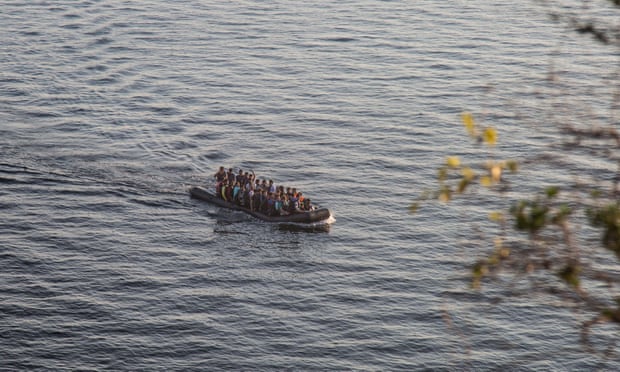
Six illegal migrants were killed while one went missing on Tuesday night when the boat they were in sank off the northwestern province of Çanakkale in the Aegean Sea while trying to reach to the island of Lesbos in Greece through Turkey.

The Cihan news agency said the boat was carrying Syrians. Ten passengers were saved while search and rescue efforts were under way for the missing person. Four of the dead were children, according to the Doğan news agency.

The migrants were taken to the Ayvacık and Ezine state hospitals for treatment while the bodies were sent to the Bursa Council of Forensic Medicine for autopsy.

Thursday 16 July 2015

http://www.todayszaman.com/national_6-illegal-migrants-die-after-boat-sinks-off-canakkale-coast_393844.html

continue reading

The missing: 275000 Britons disappear each year


ODD place, Britain. Every day, 13 million CCTV cameras track our movements. We’re PINnumbered, databased, credit-rated, nannied, Neighbourhood Watched, Facebooked, e-mailed and GPS-ed.

You wouldn’t think any of us could slip away unnoticed.

But we do, in ever-increasing quantities. An Independent on Sunday investigation has established that the numbers of Britons who disappear each year is now at record levels. Missing People, the charity that helps both the disappeared and those left behind, told us that 250 000 missing persons reports each year — more than 30 000 higher than any previous total — is “probably an underestimate”; others put the total nearer 275 000.

This, the equivalent of the entire population of Plymouth being spirited away, means that, across the country, one person goes missing every two minutes.

The vast majority are swiftly found, or return of their own volition, but many don’t. Some disappear for decades, and sources, including some inside the police, say the number of people in Britain who have been missing from family, friends and usual haunts for more than a year is at least 16 000 and could be as many as 20 000.

Among them are people like Melanie Hall, last seen in a Bathclub nightclub in 1996, whose parents had to endure 13 years of waiting and wondering before her remains were found, a week ago, beside the M5.

She had been murdered. Nor does death always bring closure. At any one time, there are an estimated 1 000 unidentified bodies lying in the country’s mortuaries and hospitals. Many have been there for years — unknown, unclaimed citizens. The long-term missing inhabit a looking-over-their-shoulder world of false names, cash-in-hand jobs, hostels and short lets.

For their families, they leave behind not only trauma, grief, guilt, anger and despair, but also, if they are breadwinners, more practical problems. Missing people are deemed neither dead nor properly alive, so salaries are stopped, insurance companies won’t pay out, bills can’t be paid and corporate “helplines” won’t discuss the disappeared’s affairs because of the Data Protection Act. But, most of all, the long-term missing leave behind an aching sense of mystery: what has become of them, and why did they go?

This is the story of Britain’s long-term disappeared — of people such as Joyce Wells, Alan Hobbs and Janet Cowley; of those as young as seven-year-old Daniel Entwhistle, missing from his Great Yarmouth home since May 2003, or as elderly as 88-year-old Mary Ferns, missing from West Lothian for 16 months now. All an agonising riddle.

Why did the Gloucester librarian Angela Bradley leave her spectacles in her car, the keys in the ignition, and walk away one January day in 1995? What happened last November to Quentin Adams, a 40-year-old father of three from Banchory, Aberdeenshire?

He popped out to buy cigarettes and has not been seen since. And where on earth is the 14- year-old Doncaster schoolboy Andrew Gosden? Some 93 percent of the children who go missing do not live in a two-parent household, and single children are more likely to run away than those with brothers and sisters. Andrew fell into neither category, happily living, according to testimony from his caring family, with his mother, father and elder sister, Charlie. He was doing well at school, and no one had noticed him behaving in any way that would set alarm bells ringing.

And yet, one day two Septembers ago, he left for school, waited for his parents to go to their work as speech therapists, returned to the house, changed his clothes, went to a cash machine, withdrew £200 of his savings, and boarded a train to London. We know this because he was seen on CCTV arriving at King’s Cross, a slight figure dressed in black jeans and T-shirt. No one has seen him since.

The despair, the not knowing, hit his father, Kevin, like a truck. He tried to commit suicide, hanging himself from the banisters, and his life was saved only because the vicar — who had a key to the house — arrived at that moment. The efforts to find Andrew could not have been greater. Police were swiftly alerted, as was Missing People and local media.

His face is on the web, on posters, and on 15 000 leaflets that were distributed in London by three coachloads of family, friends, schoolmates and teachers, who travelled to London and searched for him a year after his disappearance.

His 14-year-old face stares from a page on the Missing People website, increasingly a reminder of what he once was, rather than an aid to recognising him now. The Andrew who left the house in his school uniform is no longer the Andrew who might be found.

So an age-progressed face will feature on a new leaflet, to be emailed to snooker halls and, if permission is granted, to be handed out at a Muse gig, one of Andrew’s favoured bands. Back in Doncaster, his family keep his childish things, and the clothes that will no longer fit him, in a room unchanged since that day in September 2007.

They can still look and hope. What they cannot do is grieve. Kevin Gosden told us: “We have all reacted differently in our house. It’s been a battle with depression for me. I haven’t reached the point where I can give up — there’s always another chance to find him. Sometimes it feels like we’re going round and round in circles, like we’re trapped in a work by Escher.”

Children make up the bulk of the missing persons reports in Britain. But, as teenagers who stay out a night or two from their care or foster home, or who sleep on a friend’s sofa to cool down after a row with a parent, they are also likely to be the cases that are resolved within a few days. Teenage runaways are overwhelmingly female: 71 per cent of missing 13- to 17-year-olds are girls. With adults, it is different. Men predominate, with 73 per cent of all disappeared people over the age of 24 being male. Adult missing cases are also far less likely to be resolved quickly, or at all.

A 2003 study found that only 20 per cent of missing adults traced by Missing People decided to return to the place they had left, and 41 per cent of those located were not prepared to make contact with those who were looking for them.

The conclusion is that they’re fleeing something — in their own minds or in reality — far more deep-seated than the cause of a teenager’s tiff with Mum, Dad, a step-parent or friends. There have always been the elderly and confused, the alcoholics, drug addicts and obsessive

There have always been the elderly and confused, the alcoholics, drug addicts and obsessive loners who drift out of contact, until the family, wishing to try again, finds there is no forwarding address. And there will always be the utterly inexplicable disappearances — people such as Anne Simpson, a mother of 60, who went for a walk near her home in Ingoldmells, Lincolnshire, in September 2004 and never returned.

But the most intriguing of the missing are those ordinary folk who have some discernible pressure in their lives, but one which seems on the surface no worse than that experienced by the millions who simply keep battling on.

It might be job stress, money worries (the recession is a major cause of a rise in missings), or relationship breakdown. But what is it that tips them over some invisible edge and compels them to make a sudden bolt for the door? And what is it like to be the family left behind? To find out, we sat down with Anne and Peter Langridge, sister and nephew of Bernard Coomber, who went missing in January this year. His story contains many of the ingredients of other missing cases.

You could call it “A Very Average Disappearance”. Bernard was 55, unmarried, and lived alone in Sevenoaks, Kent. He was an outdoor person, who often went walking and the job he liked best was landscape gardening.

“That was his first love,” says Anne, “but he had back problems, so he went into a factory that made parts for showers. He worked for an agency that made him redundant; he was taken on again when the work picked up, then they made him redundant again.” By early this year, he had not worked for two years and “had totally run out of money”. So she gave him £50.

One day in late January Anne was called by one of Bernard’s neighbours. The woman could get no reply at his house.

Anne went round, let herself in, and found the house empty. On the kitchen table were laid out Bernard’s mobile, and beside it was the £50 Anne had lent him. He was, she explained, a proud man and hated accepting money. “He took nothing with him,” says Anne.

“Not a bank card, small change, not a rucksack or holdall. He just walked out with whatever he’d got on. His coats were still in the house. And it was a bitterly cold day.” It was, in a phrase used by so many families of the missing, “totally out of character”. Peter says: “He was a loner, really. He led a simple life, but he was quite a grounded sort of person.” He was, however, “a bit down, having problems finding a job”, says Peter. And, like many on benefits, things did not run smoothly.

Anne says: “He had flu at Christmas and, because he didn’t sign on by phone, they signed him off and he didn’t get his money. So, within a month, there was no money coming in . . . he didn’t get on with the man at the Jobcentre and wanted to be referred to another one, but they wouldn’t allow that.”

Bernard’s last words to Anne were: “I’ve got myself in a mess, and I’ll get myself out of it.” Like quite a few of the mature missing, Bernard had been a sort of carer, to his father, who died seven years ago. “Bernard did have one girlfriend,” says Anne, “but, sadly, my dad made that one fizzle out. He was frightened of being left on his own.”

Instead, with his money problems, bad back and a troublesome recent hernia operation, it was Bernard who was left on his own. Kent Police have carried out extensive searches, traced all possible contacts, travelled to interview Bernard’s friends up north, talked to his doctor, publicised his details, and checked any bodies that have turned up.

Appeals have appeared in local newspapers, on the net, in The Big Issue, and on posters besides the paths where he used to walk. But nothing. Anne says: “My only feeling is that he may have taken his own life in the old quarry, where he knew he wouldn’t be found, because he wouldn’t want to put me through the cost of a funeral. If he’s taken his own life, he’ll have put himself

want to put me through the cost of a funeral. If he’s taken his own life, he’ll have put himself somewhere we won’t find him for a long time.”

As soon as the leaves are off the trees, police will use a helicopter with thermal-imaging equipment to see if any remains can be found in Bernard’s favourite rural spots. Anne and Peter say that Missing People (who call regularly), and the police, both the Kent force and the National Policing Improvement Agency’s missing persons bureau, “could not have done more”.

The offices of the charity Missing People are the closest this country has to a nerve centre for the disappeared.

Above a supermarket on a busy west London street is an operation that looks like a police incident room. Phones are constantly manned, and, on the wall, there are wipeboards with lists of names, and when and where they were last seen. Missing People, founded 20 years ago in the wake of the disappearance of Suzy Lamplugh, who lived near by, runs three helplines — for young runaways, missing adults, and the families of the disappeared, all manned 24 hours a day.

They receive 120 000 calls a year. The chief executive, Martin Houghton-Brown, says they can barely cope with the volume. In the early hours of last Monday morning, for instance, the two volunteers had 30 calls in an hour.

They included sightings, relatives making initial reports and the missing phoning in. A recent sample: “James” (13) missing from care and sleeping rough on a park bench, angry and upset, who agreed to be put in touch with a social worker; “Paula”, a long-term disappeared who had swallowed a large amount of paracetamol and drink, who eventually allowed Missing People to call an ambulance; “Adrian” (50) who had walked out on his wife, but wanted to let her know he was safe; and “Aina” (24) from Bradford, whose parents had her booked on a flight that night to go to a forced marriage.

She was frantic; Missing People put her in touch with organisations such as the Asian Women’s Domestic Helpline.

Mr Houghton-Brown and his policy and research director, Geoff Newiss, are clear about what needs to be done to help Britain’s missing and their families. First, a government department needs to take responsibility for the issue. Second, comprehensive information on the missing needs collating and analysing centrally (we are better at keeping tabs on missing cars than missing people, according to Helen Southworth, Labour MP for Warrington South and a long-time campaigner for the missing). Third, all agencies must have a duty to co-operate. And, fourth, underpinning all this, these responsibilities need to be statutory.

“It means resources,” says Mr Houghton-Brown, “but we’re talking about people dying every day.”

Adults, unless illegality is involved, have a perfect right to go missing, assume a new identity, and live out of contact with their former friends and family. (One man who disappeared told Missing People when he was traced: “How dare you look for me!” — and threatened to sue.) This has fed the myth that the police regard any missing case which is not that of a child, or where a crime is suspected, as beyond their remit. It may once have been true, but not now. In Bramshill, Hampshire, the NPIA’s missing persons bureau logs and helps investigate cases. And it is thanks, in part, to its work that families such as Bernard Coomber’s testify to the lengths to which most forces go to find their lost loved one.

Down in Surrey, police still keep active Operation Scholar, the search for Ruth Wilson, a sixthformer who went missing 14 years ago. She left Dorking just after 4pm on 27 November 1995, and, instead of going home, took a taxi to an isolated pub on Box Hill. Intriguingly, she had ordered flowers for her parents to be delivered two days later. More significantly, police later learned that Ruth, the bookish-looking daughter of two teachers, was in the habit of going to the remote spot on the way home from school. (As an example of the almost limitless trials facing families of missing persons, the Wilsons were asked if they were willing to appear on a game show where the audience would vote on the best step the family could next take to try to get their daughter back. They declined.)

Although Missing People uses a specialist in age-progressed likenesses to portray people missing over the long term, there is a limit to what it, and the police, can do. So families hand out leaflets, put up posters, tramp the streets, offer rewards (£10,000 is not an uncommon amount), hire private investigators (an extensive search can cost more than £15,000), and even, as Kent Police told us, consult mediums. They also start groups on Facebook, and launch websites such as the one for Nicola Payne, who went off to collect clothes for her baby in December 1991, took a short cut across fields, and has not been seen since. Among the poignant messages on the site is one from her son Owen – now 17, but just seven months old when his mother disappeared: “I envy my older cousins who remember her well, and they tell me what a fun-loving girl she was… My one wish would be to have my mum found and to be able to understand the confusion, mystery and heartbreak of the past 17 years.”

Some do return. About 10 disappeared persons a week are found through the work of Missing People, among them Billy Andrews, who went missing from his family after his marriage broke up. He began sleeping rough, and defied all the efforts of his mother, Kathleen, and his four sisters to find him. Twelve years went by, and then Kathleen saw an advertisement for Missing People and rang. Within four weeks, the charity’s case managers had found him. Kathleen says: “One day I was watching my favourite soap when the phone rang. It was Billy. We both wept.” Billy says: “I was so happy when I got the phone call from Missing People telling me that my mum was trying to find me. To be back in touch with her and my sisters after so long was a dream come true.” So why did he lose touch? He felt he had let them down and was ashamed of the state he was in. He is now settled, and has remarried. “It is,” says Kathleen, “a second chance for all of us.”

Thousands of Billies, Bernards, Ruths and Andrews will join the ranks of the long-term missing this year. Maybe it isn’t so curious that they can elude all the tabs kept on us, all of our petty nannyings and risk assessments. We may have officials logging missing cars, we might microchip our dogs, and indelibly mark our possessions, but we’re awfully casual about lost humans. After all, in 2009 there is no government department responsible for listing and finding them. Odd place, Britain.

The trafficked girls

Among the passport pictures of the disappeared staring out from the Missing People web pages a sizeable number are of teenage girls of Far Eastern origin. Xia Wang, 17, has been missing from Westcliff-on-Sea, Essex, since November 2006; Qin Wang, 16, from Bournemouth since January 2007; Yan He, 17, from Worthing since July 2007; Dung Thi Nguyen, 17, from Catford since April 2007; Lihua Hi, 16, from Birmingham since June 2006. There are many others. Having been brought to this country illegally, such girls – whose only common characteristic, says Missing People, is their region of origin and their vulnerable prettiness – are warned by those who transported them to trust absolutely no one. They are taken into care, but, a short while later, are often seen getting into a car driven by an older male oriental. They have been trafficked.

Britain’s unclaimed bodies

Who was the man known as Mr Seagull, whose body was found on Chesil Beach, Dorset, in 2002? Who was the white man aged between 30 and 40 killed at Canterbury by the Londonbound train in October 2001? Who was the man whose badly burnt remains were found on Parley Common, Dorset, when firefighters tackled a heathland blaze in August 2006? Their bodies, and hundreds more, lie refrigerated in Britain’s mortuaries, awaiting identification. One reason there are so many is because there is no database of the DNA of missing people, which Dr Tim Clayton of the Forensic Science Service has described as “a national disgrace”. And an investigation in Scotland by the Daily Record last January found that police there have the DNA of just 34 of 450 long-term missing cases on their books.

Thursday 16 July 2015

http://www.herald.co.zw/the-missing-each-year-275-000-britons-disappear/

continue reading

Lithuanian chief rabbi protests excavation of WWII mass grave


The chief rabbi of Lithuania appealed to authorities to prevent the excavation of a mass grave of Holocaust victims in the country’s north. Rabbi Chaim Burshtein issued the statement Tuesday about the mass grave discovered this week during road construction work in Siauliai, a city located 120 miles northwest of Vilnius, Lithuania’s capital.

“Please halt all disturbance and moving of these human remains,” Burshtein wrote in reference to the work, which he called “the humiliation of the excavation of the human remains of hundreds of people from the Holocaust-era mass-murder grave uncovered this week.”

Originally written in Russian, the statement was translated to English and reproduced by Dovid Katz, an American scholar of Yiddish who runs the defendinghistory.com website on Jewish issues in Lithuania.

Though some human remains were unearthed during construction, a forensic excavation has not yet begun, though a local government commission gave its approval for one on Monday, the Delfi news agency reported.

“It’s been decided to excavate the remains, do anthropological tests and then rebury them and also mark this place,” archaeologist Audrone Sapaite, who is in charge of the investigation, told the BNS news agency. She said that the remains of 40 people were found at the burial site. In all, approximately 700 people shot dead by the Nazis were buried there. The reports by BNS and Delfi did not mention Jews.

According to halachah, or traditional Jewish law, Jewish burial sites are not to be disturbed unless there is danger to the dignity of the dead or other special reasons. For this reason, archaeologists’ desire to conduct forensic tests on mass graves has prompted fierce opposition by rabbinical groups throughout Eastern Europe.

Before World War II, Siauliai was home to some 6,600 Jews, according to the Yad Vashem Holocaust museum. Many escaped to the Soviet Union, but the Nazis and Lithuanian collaborators murdered hundreds of those who stayed in 1941 and in later mass killings. Some Jews from the city were conscripted to forced labor.

According to Sapaite, the bodies found in the mass grave belonged to “prisoners of various nationalities.”

Thursday 16 July 2015

http://www.jewishjournal.com/lifestyle/article/lithuanian_chief_rabbi_protests_excavation_of_wwii_mass_grave

continue reading

Wednesday, 15 July 2015

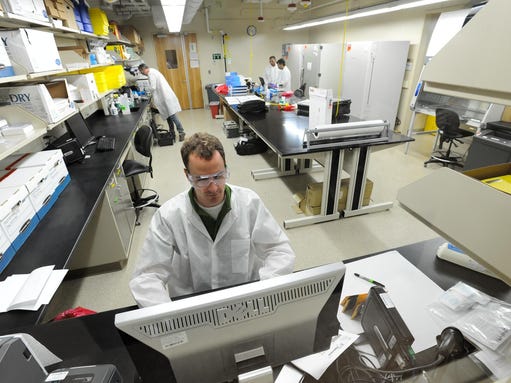
Without war, Dover mortuary, lab roles shift


For the better part of 14 years of war, the transfer cases and bodies never seemed to stop arriving at Dover Air Force Base.

"We used to look at the casualty board and hope for a break," said James Parsons, an embalming technician with Air Force Mortuary Affairs Operations, the only U.S.-based funeral home dedicated to the nation's fallen military. "Now? Now it's good."

In 2007, the worst year of the fighting in Iraq and Afghanistan, some 1,020 military casualties were shipped home, according to Air Force Col. Dan Merry, AFMAO's commander. Last year, the overall total fell to 60. "And it has gone down gradually since," said William Zwicharowski, Port Mortuary branch chief, who was with AFMAO, and the agencies that preceded it, for the entirety of the conflicts.

So trimming, and training, are now the watchwords at AFMAO. Its next-door neighbor at Dover, the Armed Forces Medical Examiner System, has also shifted gears, from performing autopsies on every returned casualty from Iraq and Afghanistan to studying lessons learned, taking on more emerging historical DNA identification work and helping non-defense agencies with medical legal death investigations.

"We're staying busy," said Army Col. Ladd Tremaine, director of AFMES, noting the group's increasingly worldwide responsibilities for the federal government. "Most of our work is not done back in that autopsy suite. Most of my examiners are on the road."

It's been a remarkable shift. A total of 6,852 U.S. military personnel have died overseas since 9/11. All were carried off a cargo jet ramp, one by one, and into the complex that houses the two agencies. Even as stunned family members were welcomed, comforted, even counseled, the remains were being scanned (for explosive material), catalogued, autopsied, embalmed and prepared for burial.

Now, the number of dignified transfers from overseas has slowed to a crawl.

"We are not used to it," said Zwicharowski, a former Marine. "We've almost slammed the brakes on now. Which is great. ... It's probably the best problem I've ever had in my life, [which] is to not have 10, 20, 30 bodies to process a day. So it's a good problem to have."

The slowdown is giving AFMAO time to take stock of itself. Recently borrowed mortuary personnel are being returned to other bases - as well as to Dover's Air Force Reserve unit, the 512th Airlift Wing, which it has relied on heavily during the wars. AFMAO could get even smaller, Merry said.

AFMAO has 50 personnel assigned, but that could be halved "if we stay this way for a year or two," Merry said – adding that this could quickly change if the U.S. keeps increasing its small combat presence in theater.

"If we get 30 or 40 thousand boots on ground, in harm's way, we'd start plussing back up," Merry said.

To prepare for the unexpected – a mass casualty event, e.g. – Merry is implementing a more efficient rapid "recall" system. "We're looking at a system where we can hit a button and get everybody we need back here, fully trained, fully checked out, ready to go," he said.

"It's not a matter of if," Zwicharowski said. "It's a matter of when, unfortunately."

That was the case when 11 Louisiana National Guardsmen were killed in a March helicopter crash during training in Florida. All the troops were brought to Dover; AFMAO reached out to the Navy to borrow licensed embalmers to help out, Merry said.

With fewer permanent personnel on staff, Zwicharowski said, "We're turning to training on mannequins, restorative art training, embalming training, and licensing."

Training is particularly important for specialists who sometimes handle bodies in far worse shape than those that typically arrive at a mortuary. Roadside bombs were the No. 1 killer in these wars.

Tremaine's AFMES is responsible not only for worldwide U.S. military autopsies but medical legal death investigations for the entire federal government across the globe – agencies such as the FBI and NASA – which is why his examiners often find themselves traveling.

"The sheer numbers have decreased," Tremaine said. "The complexity of our cases has increased. Department of Justice has been using us extensively over the past year." He pointed to the police shooting death of Michael Brown in Ferguson, Missouri, which was investigated by the FBI.

"When something like Ferguson occurs, you're going to have the locals investigate it, and … the same thing happened here in Baltimore recently – you're going to have the family request a second autopsy," Tremaine said. "Who's going to be the ultimate arbitrator or make sure that everybody's playing on an even field? Who's the honest broker? Well, we've essentially become that honest broker. We come in as a federal entity; we get to see all the evidence and information; and potentially do a tertiary post-mortem examination, independently. And then we present that to the Department of Justice."

In addition to its autopsy work, AFMES recorded in detail war injuries with an eye toward improving combat trauma care. Tremaine wants to make that database more easily accessible.

"All throughout the war, we've been very active in identifying the glaringly obvious, and getting that information out quick," he said. "Now it's time to sit back and look at all the information in its totality, and discover those non-glaring issues that will only be captured through more in-depth research. Can we discover something else that can potentially change techniques, tactics and procedures in the future?"

AFMES' DNA Lab will also stay busy performing DNA analyses on remains from past conflicts, such as those of the sailors and Marines who died at Pearl Harbor aboard the USS Oklahoma who were buried, unidentified, in mass graves in Hawaii and are now being exhumed.

Wednesday 15 July 2015

http://www.delawareonline.com/story/news/nation/military/2015/07/14/without-war-dover-mortuary-lab-roles-shift/30162767/

continue reading

South Korea selects China consortium for Sewol ferry salvage


A Chinese-led consortium was selected Wednesday as the preferred bidder to take on the massive task of raising the South Korean passenger ferry that sank last year with the loss of more than 300 lives, most of them schoolchildren.

The 6,825-tonne Sewol ferry sank off the southwest coast in April 2014. A total of 295 bodies were recovered, but nine remained unaccounted for when divers finally called off the dangerous search of the sunken vessel last November.

The Sewol lies 40 metres (130 feet) down on the sea bed and bringing it to the surface represents a substantial technical challenge. The salvage operation is scheduled to begin in September and take as long as one and a half years.

The Ministry of Oceans and Fisheries said it would begin negotiations next Monday with the consortium involving China's state-run Shanghai Salvage Co. and a South Korean firm, which beat six other competitors including European and US firms.

Shanghai received good marks for its experience in salvaging sunken vessels, including a cruise ship that sank in China's Yangtze River with the loss of more than 400 lives last month, it said.

The ministry said it would talk with the second candidate -- a consortium led by China's state-run China Yantai Salvage -- if negotiations with Shanghai fail.

Shanghai offered to lift the ferry for 85.1 billion won ($74 million) by using a frame built with metal beams on the sea floor instead of drilling holes into its side.

"We regarded Shanghai Salvage's idea as safe ... because the Sewol's hull remains fragile," Yeon Yeong-Jin, a ministry official in charge of salvage, told reporters.

The overloaded Sewol was carrying 476 people, including 325 students from the high school in Ansan, when it sank. Only 75 students survived. Strong currents and muddy waters at the site of the sunken vessel greatly hampered the search efforts last year, leaving two divers dead and dozens injured.

The families of those still missing had led a campaign for the ferry to be brought to the surface.

The shock accident -- blamed on the ship's illegal redesign and overloading left unchecked by regulators -- prompted calls to overhaul the nation's lax safety standards and tackle deep-rooted corruption.

Wednesday 15 July 2015

https://uk.news.yahoo.com/south-korea-selects-china-consortium-sewol-ferry-salvage-050346113.html#6qTOsSw

continue reading

Japan tsunami: Diving into the world of the dead to find their relatives


Twice a month two Japanese men put on scuba gear and go diving. One is looking for his wife, the other for his daughter, both of whom were swept away by the devastating tsunami that struck Japan four years ago. They know they are no longer alive, but the hope of finding something - anything - gives them a much-needed sense of purpose.

Underneath the glittering waters of Onagawa Bay, in Japan's north-eastern Miyagi Prefecture, fridges, TVs, cars, trucks and fishing gear lie scattered on the sea floor, under a layer of mud.

"Imagine a big city, put it in a grinder and throw it all into the ocean," is how one oceanographer described the effect of the Japanese tsunami.

Under water, things are still mostly where they were left by the violence of the waves.

In the sunlight up above, on the other hand, everything has changed.

Fishing boats are again going about their business - the Japanese diet is built around seafood and it's a key part of the local economy.

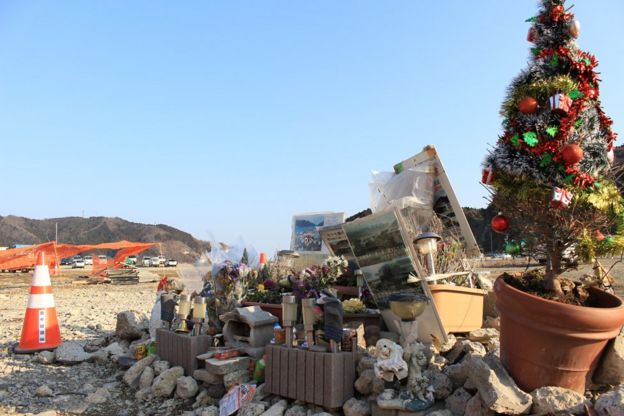
The wreckage of a thriving port has been cleaned away. In its place there is now a vast expanse of concrete - empty except for, in one corner, a modest shrine made up of some laminated pages of A4, a pink plastic chrysanthemum, and, rather incongruously, a Christmas tree.

This is where the Onagawa branch of the Shichijushichi (77) Bank used to stand and the shrine is there to commemorate it.

When the tsunami warning sounded at 14:50 on the afternoon of 11 March 2011, the bank's employees were busy tidying up the damage caused by the earthquake that had shaken the building a few minutes earlier.

Their manager was out seeing clients. Driving back along the coast he could see the sea sharply withdrawing - a sure sign of an imminent tsunami. As soon as he walked in he told everyone to stop and to climb on to the roof of the two-storey building as quickly as possible.

Sure enough, as soon as they got there, they heard the siren and the municipal broadcast warning people to evacuate to high ground - just a few hundred metres away were the steep slopes of Mount Horikiri, where some people were already seeking shelter.

One employee asked if she could go home because she was worried about her children. The manager said he couldn't stop her, so she ran to her car, which was parked 300m away, and drove home.

The manager told those remaining to watch the sea, just 100m away in normal conditions, and to listen out for further news. The radio warned that a 6m-high tsunami would hit at 15:10.

Among the 13 bank employees up on the roof that day was 47-year-old Yoko Takamatsu. Her husband Yasuo had dropped her off by car that morning, though they only lived a few minutes' drive away. During the short short journey they had talked about what to have for dinner. "Don't say: 'Anything is fine!'" she had said.

With Yoko on the roof was her colleague, 26-year-old Emi Narita, from the neighbouring town of Ishinomaki, where her father Masaaki ran a fish-processing plant. She had seen him just the night before, when she went over to pick up her dinner - her grandmother still liked to cook for her.

As the workers stood nervously on the roof they debated whether there was time to flee to the nearby hospital - a much taller and stronger building, but they decided to stay. After all, a 6m-high tsunami would only reach the first floor. Some went down to get their coats - it was cold, there was still snow on the ground.

Yoko sent her husband a text message: "Are you safe? I want to go home."

The tsunami swept into Onagawa moments later. Footage filmed by a survivor shows how the dark water moved swiftly and relentlessly into town, pushing over everything in its path. Buildings gave way and cars and trucks were picked up like toys, and acted like floating battering rams adding to the wave's destructive power. Within minutes the sea had engulfed areas that were once considered safe.

The bank flooded quickly - it took just five minutes for the water to fill half the building. The workers decided to climb up even higher on top of an electrical room standing on the roof of the two-storey building. As they climbed the 3m vertical ladder the strong wind almost blew them off.

Many people witnessed their desperate bid to escape to safety. A Facebook post reads: "We get a lump in a throat every time we think about the female bankers who, wearing skirts, had to climb the ladder with unimaginable fear, and male bankers who threw off their coats at the last minute regardless of the cold weather, their fear, despair and regret."

The tsunami turned out to be far, far bigger than anyone expected.

The town's defences had largely been based on the worst tsunami in living memory - a 6m-high tsunami in Chile in 1960. But this one reached more than three times higher.

As a consequence many designated shelters were inundated - even the hospital was flooded, killing four people in the building itself and an estimated 16 in the car park.

Onagawa was one of the areas hardest hit by the tsunami," says Tsutomu Yamanaka, a relief co-ordinator who arrived a week after the disaster for the aid organisation Japan Platform.

The coastline of the region is a series of submerged river valleys shaped "like the teeth of a saw", he says, and tsunamis reach great heights as the water funnels into the crevices.

A town has little chance in this battle between ocean and mountain. Satellite pictures show how the sea reached in and clawed the town away. More than 5,000 buildings were washed away or damaged beyond repair.

"Buildings had been torn from their foundations," says Yanamaka, describing the scene he witnessed when he arrived in Onagawa. "A train had been swept to the hill far from the station."

The morning after the tsunami Yasuo Takamatsu made his way to the municipal hospital to find Yoko. He soon had to abandon the car and push a path through the wreckage.

He was stunned to find she wasn't there.

"There were lots of people taking refuge there, but I was told she'd been taken away by the tsunami," he says. "After that I just couldn't stand up. I'd lost all my strength like it had been washed away."

It took Emi Narita's father, Masaaki, longer to find out about his daughter's fate in the chaotic days after the disaster.

He himself had only just driven to safety with his mother-in-law, the tsunami "coming over a few cars behind us".

For four days he was unable to contact his wife, who was working as a nurse away from home. It was she who told him Emi was missing. "I couldn't believe it. I can't believe it even now," he says. "Until that moment, I had no doubt that she would be safe."

Local authorities were overwhelmed by the scale of the disaster, the staff reeling from their own personal losses, on top of massive practical and logistical problems.

Almost one in 10 of the town's residents was dead or missing. The majority of survivors were staying in special accommodation for evacuees. They spent their days searching for loved ones, picking through the chaos and walking for miles along the breakwaters on the shoreline.

Takamatsu was there too, looking for his wife, Yoko. "I searched everywhere for her, but she was nowhere to be found," he says.

The only thing that was eventually recovered was Yoko's mobile phone, found in the parking lot behind the 77 Bank building. At first, Takamatsu thought it wouldn't work because it had been soaked with water, but months later, he took the phone out and tried it.

Miraculously, it came to life. Then he saw she'd tried to send another message that never reached him. It said: "The tsunami is disastrous."

The 77 Bank building, just over 10m tall, was knocked over by the force of the tsunami.

Of the 13 people on the roof, one, amazingly, survived - he held on to floating debris and was swept out to sea, almost losing consciousness in the icy water before he was rescued by a fishing boat hours later. The bodies of four bank staff were found, but eight are still missing, Emi and Yoko among them. The worker who left the building by car survived.

"I couldn't understand why they escaped to the rooftop," says Narita. "There's no more escape there. If they had escaped to the mountain, they could have climbed to a higher place. I thought evacuation to the mountain was a matter of course."

The toppled building itself was cleared away along with all the other buildings in the port area, bar one, which was left as a memorial. Although the town began to rebuild, for the bereaved families it was hard to move on.

"We are still stuck in 2011," says Narita.

Takamatsu is haunted by the message Yoko sent. "I have this feeling that she still wants to come home," he says.

"I wish I had gone to pick her up at the bank after the earthquake struck, but I'm still not sure what would have been the right decision. The tsunami warning told us to stay away from the shoreline, and if I'd gone down to pick her up, chances are I would have been taken out by the tsunami as well.

"But at the same time, I wish I'd gone and saved her."

Two years ago, when he saw divers from the Japanese Coast Guard out searching for the remains of the missing, it gave him an idea: he could do the same, and perhaps bring Yoko home.

"So I learned to dive. I felt like I could meet her one day as long as I kept diving," he says.

Takamatsu needed to qualify for a diving licence, and he began taking lessons at a diving school. When he talked to Narita about it, and offered to look for Emi too, Narita decided to join him.

Learning to dive was a challenge for these men, both in their mid-50s. Takamatsu was terrified by the thought of his oxygen failing, and having to come up for air. "At 5m below, I could swim up without much trouble, but at 20m deep it gets dangerous - thinking about those things always scared me," he says.

Narita had other problems. "I didn't get scared, but I couldn't control my body under the sea at all," he says. He found it hard even to regulate his breathing. "I never considered quitting, but I struggled."

After months of training, the two men qualified last summer, and have since completed more than 80 dives. The search has given them purpose and lifted their spirits.

"I couldn't do anything before I started diving, but after I decided to find my daughter by myself, I could become positive about it - a bit. I get encouraged by searching for her," says Narita.

"It was depressing not doing anything," says Takamatsu. "At first I just wanted to find my wife, but now I hope I can find others too."

It's hard work. The bay is very deep and most objects are buried under a thick layer of mud, which, when disturbed, also makes it hard to see. They have good days. On one they found a child's calligraphy box with his name on it, and a wedding album.

Anything with a name goes back to the owners. Wallets, bank books, and stamps are handed to the police. Photographs can often be restored. An estimated five million tonnes of debris was dragged into the sea by the tsunami. Two-thirds sank just off the coast, covering the sea floor and damaging the marine environment. About a third floated away, in giant patches that could be tracked on satellite images.

Boats, buoys, propane tanks and refrigerator doors are still washing up on the shores of North America and Hawaii.

But much of the tsunami debris has joined the "plastic smog" that collects in oceanic gyres. Marcus Eriksen, from the 5 Gyres Institute, led an expedition to the debris field in June 2012 - 5,000 miles east of Tokyo they spotted buckets, laundry detergent bottles, half a boat, and a still-inflated truck tyre. "One day a shoe drifted by," says Eriksen. "What was eerie was that the laces were still laced at the top - it left us thinking."

The bodies of more than 2,000 people, of the 16,000 estimated to have died, have never been recovered.

So what about those missing from Onagawa - how far could they have travelled? Not far, says Hiroshi Kitazato from the Japan Agency for Marine-Earth Science and Technology. "I think they sank immediately in the bay. I talked to fishermen in Onagawa town, they said that in the past couple of years they've found no bodies in their fishing nets. This means that in the first two or three years they dredged up dead bodies."

Kitazato points out that, coming from a small community, those fishermen would probably have known who they had fished up. "They would have felt very bad," he says.

Four years on, this is less likely to happen - organic matter will have mostly "returned to nature", says Kitazato. "Now, we seldom find bodies or their belongings during research activities."

Kitazato's work is aimed at helping ecosystems recover, but after the tsunami many people "felt awful about the sea" he says, and part of his remit is to explain to them how the ocean works. His team goes into schools to show its positive side - "how ocean organisms are beautiful and how the oceanic system is useful for human life."

Many of Onagawa's citizens moved away to escape their memories of the disaster - and to find work. Takamatsu stayed, and, through diving, has a new-found appreciation of the sea. "I found creatures which I had never seen, beautiful fish such as lumpfish," he says. "You cannot see such worlds usually."

Despite the seeming hopelessness of their task, Takamatsu and Narita have no intention of giving up. "I still have a hope we can find something - maybe a human body, regardless of whether it's my daughter's or not," says Narita.

His only memento of Emi is a painting he commissioned after her death, which has pride of place in the living room - all of his own photographs were lost, along with the family home.

"I want to search for my daughter as long as my body allows me to. If I just give up, there's zero chance. If I keep searching, I might have a chance at least."

Takamatsu feels the same way. "I want to continue my search as long as my strength lasts, even though the chances of finding her are slim. I know that she has already passed away, but I don't want her to be left alone under the sea.

"Honestly, I still want to find her and bring her home."

Wednesday 15 July 2015

http://www.bbc.co.uk/news/magazine-33294275

continue reading

As many as 100 bodies believed to be sub-saharan migrants wash up on Libyan shore


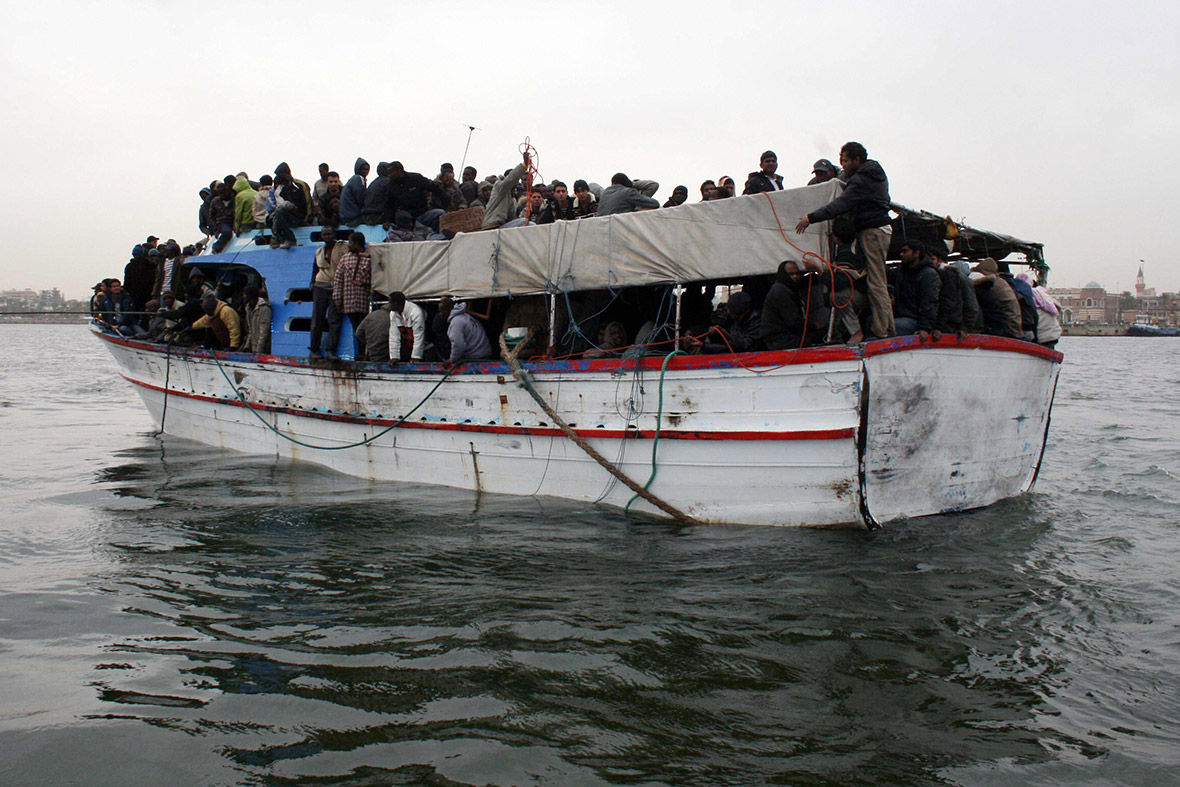
As many as 100 bodies believed to be sub-saharan migrants have been found in the sea and the shores of the Tajoura, a coastal town about 10kms east of Tripoli, according to spokesman for the capital’s anti-immigration department.

Details are still a bit sketchy but a the spokesman said there were women and children among the dead. He could not confirm their numbers or indicate their nationality. They are believed to be the victims of a shipwreck off Tajoura, which is known as a sending spot for migrants heading for Europe on boats.

The bodies recovered in Tajoura are being transferred to a hospital in the capital. More details throughout the day.

If the number of dead is confirmed it would be the biggest tragedy by far since April 18 when 850 migrants are believed to have lost their lives in a single shipwreck off Libya.

A record 1,780 migrants had lost their lives in the Mediterranean up to that point but the deaths slowed down after EU leaders reacted by expanding the search and rescue effort to unprecedented levels. In a statement on Friday, the UN refugee agency (UNHCR) put the number of migrant deaths in the Mediterranean up to that point at 1,900.

On the same day the statement was issued, however, 12 migrants were recovered dead after the boat they were on capsized off Libya. Earlier in the week, Turkish and Greek coastguard mounted a search for 19 people believed to have drowned while crossing between the two countries.

Wednesday 15 July 2015

http://migrantreport.org/breaking-dozens-of-bodies-wash-up-on-libyan-shore/

continue reading

Tuesday, 14 July 2015

Pushkaram Stampede: Death toll rises to 27


Twenty-nine pilgrims, 23 of them women, were crushed to death in a stampede on the first day of Godavari Maha Pushkaralu, considered the 'Mahakumbh of south', on Tuesday.

Around 50 people were hospitalized; the condition of 15 of them is critical.

Sources said 5,000 pilgrims were thronging Pushkara Ghat in Andhra Pradesh's Rajahmundry at 8.30 am with another 1 lakh people queuing outside the main venue when the stampede broke out.

Most of the victims were women and some of them have not been identified yet. The injured were rushed to Government Hospital in the city. The stampede occurred at around 8.30 am, about an hour after chief minister N Chandrababu Naidu left the ghat. Preliminary information indicates that a large number of pilgrims were kept waiting due to the presence of VVIPs including the chief minister and his cabinet colleagues besides a large group of bureaucrats and other VIPs for more than two hours.

Huge crowd, poor crowd-control, closing of the ghat for more than two hours after pushkaram began since VIPs were taking holy dip apparently led to the stampede at Rajahmundry.

Soon after the VVIPs left the premises after the inauguration, pilgrims jostled with one another reach the ghat. As crowds swelled, the pilgrims pushed each other resulting in the stampede near the Fort gate of the Kotagummam. Adding to the chaos, the police personnel used mild force to control the crowds. Minutes later, several women were found unconscious and a dozen others were injured. They were all rushed to the hospital but to of no avail. The condition of 14 others who are under treatment is reported to be critical.

According to eye witness accounts, the stampede took place because the devotees were anxious to have holy dip in the pushkar, which is the main ghat in Rajahmundry though there are quite a number of ghats along the river bank. They said that the barricading of the pushkar ghat has in fact led to the stampede as the pilgrims did not move in the queue but tried to squeeze through the barricades to enter the ghat as there the rush was unimaginable.

Another problem was that the authorities had arranged only one passage into the ghat as a result of which those who were getting in and those who are getting out pushed each other in opposite directions. "When such a huge crowd collects, the movement should be unidirectional only. If the passage is meant for pilgrims moving in both the directions it is the perfect recipe for disaster. At Pushkar ghat this is what has happened," an official on condition of anonymity, said.

As this time, the pushakaram is called Maha Pushkaram, the crowd that descended on this fist sized town was quite huge, beyond the expectations of the officials. This apart, though there is VIP ghat, the VIPS including Chief Minister N Chandrababu Naidu chose to take holy dip at pushkar ghat only. This has forced the officials to close the ghat for more than two hours and the crowd kept swelling outside the ghat. After Naidu et al left at about 8 a.m., the ghat was thrown open to ordinary pilgrims and all of them tried to move at once. This apart, those who had already taken the holy dip began coming out of the ghat and the two streams of the people began pushing the other away.

"The people were packed like sardines at the ghat. There is not even an inch of room left between one person and the another. In this kind of situation, if a small portion of the crowd loses balance, it would lead to a domino effect. This is what has happened," the official said. Though Saraswathi Ghat has been prepared for the VIPs, which is less than one km away from the pushkar ghat, the chief minister and the other ministers took the holy dip at the pushakar only. This apart, the vehicles of the chief minster and the ministers were parked on the road which drastically reduced the space necessary for easy movement of people, eye witnesses said.

Chandrababu Naidu who is reviewing the situation with his deputy Nimmakayala China Rajappa asked the officials to stagger the crowds so the pilgrims would be distributed evenly to other ghats but the officials are not able to make much progress in implementing his direction. Naidu later vistied the victims undergoing treatment.

Tuesday 14 July 2015

continue reading

Nepal closes a National Park to give mating Red Pandas some privacy, implications for body recovery efforts


Langtang National Park, Nepal’s first Himalayan national park and the one nearest to capital Kathmandu, has been declared a restricted zone by local authorities to allow red pandas to mate.

The shy creature, called habre in Nepal, loves to live in quiet places and is easily scared by noises. When frightened by sound, it will even leave its young cub behind and run away. As the red panda’s breeding season starts from mid-June, the national park has been closed to visitors and even firewood gathering by locals has been prohibited for two months.

With only 10,000 individuals remaining in the world, around 1,000 red pandas are found in eight protected areas of Nepal – from Kanchenjunga Conservation Area in the east to Makalu Barun National Park and Buffer Zone, Sagarmatha National Park and Buffer Zone, Langtang National Park and Buffer Zone, Manaslu Conservation Area, Annapurna Conservation Area, Dhorpatan Hunting Reserve and Rara National Park and Buffer Zone in the west. Besides Nepal, the animal is found in the mountainous regions of India, China, Bhutan, Myanmar and Laos.

The red panda, also called fire fox, was discovered decades earlier than the giant panda. It is a carnivore turned herbivore and feeds mainly on young bamboo shoots and leaves.

Though the shy creature dons the Mozilla Firefox logo and millions of Internet browsers use it daily, only a few know that it is a red panda.

Red pandas are listed as endangered species by the International Union for Conservation of Nature (IUCN). Although red pandas are not poached generally, they fall prey to the traps laid for musk deer and other wild animals. The herders and the chauris, the yak-cow hybrids, disturb and destroy the red panda habitats, though not intentionally. Habitat loss is another major concern for conservationists.

The Nepalese government together with the wildlife organisation WWF has involved local communities in the conservation of this species in Langtang. Likewise, the Red Panda Network has been working with communities to monitor and preserve red pandas since 2007.

The restriction period at the Langtang National Park till mid-August will provide a peaceful environment for the red pandas to mate. Soon after, International Red Panda Day will be celebrated on 19 September, further raising awareness about its conservation.

Tuesday 14 July 2015

http://globalvoicesonline.org/2015/07/13/nepal-closes-a-national-park-to-give-mating-red-pandas-some-privacy/

continue reading

Missing and murdered: searching for the lost in Mexico


The woman’s body appeared in the middle of March.

She had been left next to a sewage canal in Mexicali, a Mexican city that borders the dry and dusty Imperial Valley in California. There was a bag over her head, her hands and feet tied with duct tape. She was the eighth woman to have been killed in the city since the beginning of 2015 – as of June, 12 have been murdered. Still more have vanished without a trace.

Mexicali, the capital of Baja California state, is not unique among border cities. All along the United States-Mexico border, women and girls are going missing. They are often of indigenous descent, brought north from impoverished rural areas by the lure of better economic prospects and the possibility of crossing into the U.S. There is also a strong element of structural racism that contributes to the apathy of Mexican authorities when indigenous women disappear, critics say.

Sometimes they aren’t found, but other times their bodies turn up in the desert, desiccated by the heat, or dumped in trash heaps, or left under bushes. The murders of women have reached such epidemic proportions in the past two decades that a new term has entered Mexico’s lexicon: femicidio, or femicide. The Mexican government claims a massive backlog on missing and murdered women cases means many deaths remain unsolved.

“This issue’s been going on for a long time … the mistreatment of women, especially women of colour, the abuse of women, the disappearance of women. And it’s not only happening on the U.S.-Mexico border, it’s also happening on the U.S.-Canadian border,” says Enrique Morones who runs Border Angels, a volunteer group based in San Diego, that fights for immigration reform. “But you don’t hear those stories, and those stories are important that they be told.”

In Ciudad Juarez, a city across the border from El Paso, Tex., Marisela Ortiz Rivera is trying to make sure those stories are heard. She’s the co-founder of a group whose name translates into English as May Our Daughters Return Home, launched after her student, 17-year-old Lilia Alejandra Garcia Andrade, was abducted and murdered in 2001. She began the group with Lila’s mother, Norma Andrade. “There are various aspects of this extreme violence against women here,” Ms. Ortiz Rivera says. “There’s that machista culture, that male chauvinism, which is responsible for domestic violence, street violence, violence against women they don’t know. But there’s also groups – big syndicates – that exist on the border, that exist to kidnap and sell women. And there’s impunity … it’s big business.”

In Canada, the RCMP have identified more than 1,100 cases of missing and murdered indigenous women since 1980. A report issued by the Mounties on June 19 identifies family violence as the foremost cause of the disappearances and murders. The Native Women’s Association of Canada has long urged the government to examine the broader systemic causes of the violence. In a letter to the United Nations Permanent Forum on Indigenous Issues this spring, it stated: “The social and economic marginalization of Indigenous women and girls not only makes them prey for violent men, but is also used by officials as a justification for failing to protect them.”

In Mexico, May Our Daughters Return Home organizes demonstrations to bring attention to the disappearances, and pressures the government and the global community to do more to help victims of gender crime. Their visibility made Ms. Ortiz Rivera and Ms. Andrade targets almost immediately.

“We received so many death threats, that we would be murdered, that our families would be murdered,” Ms. Ortiz Rivera says. That same year, Ms. Andrade was shot several times by a group of men as she left work, and a few months after that, slashed in the face with a knife while supposedly under police protection. Both women continue their work, but Ms. Ortiz Rivera now lives in El Paso, on the U.S. side of the border.

Juarez has been nearly synonymous with femicides for more than a decade, but its notoriety overshadows the same problems along the rest of the border, which spans four U.S. states – California, Arizona, New Mexico and Texas – and six Mexican states, Baja California, Sonora, Chihuahua, Coahuila, Nuevo Leon and Tamaulipas. (The only area in Mexico with a higher incidence of violence against women is the crime- and corruption-ridden southern state of Guerrero.)

According to the UN, more than 2,500 deaths of women in Mexico every year can be attributed to gender-targeted violence. The National Citizen Femicide Observatory, or OCNF, says at least six women are targeted and killed every day in Mexico. Of those, less than a quarter are investigated. Of those investigations, fewer than 2 per cent lead to a sentence.

Mexico’s police have dismissed these deaths and disappearances as a side effect of drug use or sex work. The government also claims that many of the women who disappear are actually in the U.S., living and working under the radar, and that there is no way to find them – an assertion scoffed at by friends and family of the missing.

Mexico’s attorney general’s office says that budget cuts and bureaucratic foul-ups have created a years-long accumulation of cases that need investigating. No one seems to know exactly how many people are missing in the country, although Human Rights Watch says at least 27,000 have gone missing since 2006.

“Even though the government is doing things, it is not enough. The only thing … families want to know is where the missing people are,” says Eliana Garcia Laguna, a politician and human-rights attorney who worked on missing-persons cases for the attorney general’s office until she resigned in May.

The backlog of cases has spurred citizens to begin doing their own investigations. “We work with relatives directly,” says geneticist Ernesto Schwartz, 33, who is from Mexico and works as a research fellow at England’s Durham University. He co-created Citizen-Led Forensics, Mexico’s first independent DNA bank.

“Most of the relatives that are governing our project are in Tamaulipas, a very dangerous area, Monterrey, Coahuila, in the north part of Mexico … even though this isn’t about Juarez and other high-profile parts, I think – I hope – that we have an impact in the whole region.”

There are glimmers of hope. Mexico’s government recently provided Citizen-Led Forensics with DNA kits and some investigative help in Mexico’s southern state of Guerrero, in which at least 20 mass graves have been found since last September, when people began looking for 43 vanished student teachers from Ayotzinapa.


At the same time, an influx of women and families asking for asylum in the United States in the past year has brought international scrutiny to the violence and inequality that plagues parts of Mexico and Central and South America.

In the state of Baja California, prosecutors brought their first femicide case against a man accused of strangling his girlfriend, setting the stage for legal precedents that may reverberate all along the border, and beyond.

Ms. Ortiz Rivera, the schoolteacher turned activist, said that despite the threats and fear she lives with on a daily basis, she intends to keep pressure on the Mexican government and the international community.

“The corruption that exists … in the murders and disappearances, it’s all met with impunity because the corruption among authorities is so entrenched that any real investigation would bring down this entire, profitable network,” she said.

Group helps identify human remains along U.S., Mexico border, notify families

Robin Reineke works out of Arizona to help find and identify remains of migrants who die crossing into the United States.

Ms. Reineke, a doctoral candidate in anthropology, co-founded the Tucson-based Colibri Center for Human Rights, a non-profit organization that does similar work to that of Citizen-Led Forensics, only in the U.S. She says while it’s rare for them to find migrants who have been murdered – usually they die from hunger, thirst or exposure to the elements – the people they find are victims of a deeper, more subtle violence.

“Basically, if you look at the quotas, there isn’t a legal way [into the United States],” said Ms. Reineke. “The service entrance to America is through the desert, and what U.S. federal policymakers did in the nineties was made that crossing deadly.”

In the 1990s, the U.S. Border Patrol began tightening security around checkpoints in Texas and California. Operation Hold The Line and Operation Gatekeeper added more fencing and surveillance to the busiest known regions for undocumented entry. By 1997, Congress had effectively doubled both the Immigration and Naturalization Service’s budget and number of Border Patrol agents.

The result of the additional staffing and fences pushed hopeful migrants deeper into the hot deserts of the borderlands, dramatically increasing the number of deaths due to exposure there.

“It’s mind-boggling to me how acceptable this appears to be to the American public,” said Ms. Reineke.

According to U.S. government statistics, there have been more than 6,330 migrant deaths while crossing into the country since 1998. However, many more people remain unaccounted for. Many families of the missing already living in the United States are reluctant to draw attention to themselves by asking the government for help, as they fear deportation. Reineke’s group not only works to identify human remains in the desert, but to track down and notify their families, as well.

Tuesday 14 July 2015

http://www.theglobeandmail.com/news/world/mexicos-epidemic-of-missing-and-murdered-women/article25137141/

continue reading

Saturday, 11 July 2015

Cyprus marks four years since Mari disaster


CYPRUS marks four years since the deadly explosion at Mari today.

The incident occurred on 11 July 2011, when 98 containers of explosives that had been stored for 2½ years in the sun on the base near Zygi self-detonated.

The resulting explosion killed 13 people, 12 of them immediately, including Captain Andreas Ioannides, the Commander of the Navy and the base commander, Lambros Lambrou.

Also killed were four navy personnel and six firefighters, while a further 62 people were injured.

The explosion severely damaged hundreds of nearby buildings including all of the buildings in Zygi the island's largest power station, responsible for supplying over half of Cyprus' electricity.

As a result, much of Cyprus was without power in the immediate aftermath of the incident and rolling blackouts were initiated in order to conserve supplies.

Saturday 11 July 2015

http://famagusta-gazette.com/cyprus-marks-four-years-since-mari-disaster-p28767-69.htm

continue reading

Tunisia recovers 27 migrant bodies from Mediterranean Sea


The bodies of 27 migrants of sub-Saharan origin have been recovered off the coast of Tunisia in the past week, a spokesman for the country's civil protection agency told AFP on Friday.

"Since July 3, 27 bodies have been recovered, most of them off Ben Guerdane", a port in the south of the country, Mongi El Kadhi said.

Earlier, an official at Ben Guerdane port, Fathi Abab, had said 16 bodies that had washed ashore were thought to be of people who had drowned trying to reach Europe.

On June 10 off the same port, Tunisia's navy rescued 356 migrants, mainly Africans but also including Syrians and Pakistanis who had left Libya on a makeshift vessel on their way to Europe.

On Sunday, 17 Tunisian migrants were picked up from an inflatable boat off the northern town of El Haouria, the defence ministry said.

People smugglers have taken advantage of the chaos gripping Libya since the 2011 uprising toppled dictator Moamer Kadhafi to step up their lucrative smuggling business.

According to UN High Commissioner for Refugees figures, of the more than 219,000 migrants who tried to cross the Mediterranean in 2014, at least 3,500 lives were lost.

Hundreds have also died this year attempting to make the perilous crossing to Europe, including some 750 people when a trawler sank in April.

Tens of thousands of migrants fleeing war and hunger in Africa and the Middle East have crossed the Mediterranean to Italy and Greece this year, with the vast majority departing from the coast of Libya.

The International Organisation for Migration said last night that thousands of migrants had been rescued in the last 24 hours in the channel of Sicily, despite strong winds.

Saturday 11 July 2015

http://www.thesundaily.my/news/1486503

continue reading

Pipeline blast in Nigeria kills 12 people at repair site


An explosion at an Eni pipeline in Nigeria killed at least 12 people and injured three others, the Italian oil major said in a statement on Friday.

The men were part of a maintenance crew, including security and environment officials, carrying out repairs on Thursday afternoon on the Tebidaba-Clough Creek line near the town of Azuzuama in the Niger delta's Bayelsa state.

On Friday morning, environmental activist Morris Alagoa, whose colleague had traveled to the scene, said that authorities were still combing the area for bodies.

"Four bodies were seen floating on the river today as the search continues," Alagoa said.

Iniro Wills, state commissioner for the ministry of the environment, said that the cause was still being investigated and one of his staff was still missing.

"Three victims rescued are now at the hospital. Two were severely burnt," Wills said.

Eni has a joint venture with Nigeria's state oil company.

Saturday 11 July 2015

http://www.reuters.com/article/2015/07/10/us-nigeria-oil-eni-idUSKCN0PK1AI20150710

continue reading

Italian rescue effort gives dignified burial to refugee shipwreck victims


Six victims of a shipwreck in which an estimated 800 fleeing people drowned in the Mediterranean were buried in Italy on Thursday (July 9), nearly three months after their deaths. The bodies were recovered by the Italian navy from the wreck around 380 metres below sea level.

The six wooden coffins were lowered into graves in the community cemetery on the outskirts of Catania, Sicily's second city. Each was marked with a number to identify those buried as victims of the shipwreck on 18 April, when a boat crammed with refugees and migrants sank in the Mediterranean.

A woman's body retrieved immediately after the disaster was buried alongside the remains of five people who were recovered from the sea between 29 June and 1 July by the Italian navy. As of July 10, the total number of bodies recovered from the seabed numbered 13.

The coffins were lowered into the ground by local authority workers, most dressed in sky blue shirts with gold crosses hanging around their necks. As they worked under the baking midday sun, a digger cleared ground for a further seven coffins due to arrive Friday.

A sprig of flowers was thrown onto each coffin as they were laid to rest. There was no formal funeral service.

Italy's prime minister, Matteo Renzi, had previously expressed his wish to have the victims' bodies returned to their relatives, although the depth of the shipwreck and the difficulty in identifying remains makes this almost impossible.

Those who came to be buried in Catania were instead laid to rest between Sicilians' mausoleums and well-kept graves, close to those of a number of people who drowned in 2013. Nearly 600 people died in two separate incidents in October 2013, prompting shocked reactions from EU leaders.

It was however the capsizing in April 2015 -- the worst such incident in decades -- which led the EU to triple funding of its Frontex led Triton and Poseidon sea operations. The increase in search and rescue missions has led to a drastic reduction in the number of deaths. Between January and April 2015, almost 1,800 refugees and migrants drowned or went missing in the Mediterranean. Over May and June, the figure fell to 80.

The number of refugees and migrants taking the dangerous journey across the Mediterranean to Europe is however increasing, with 137,000 people arriving in the first six months of 2015 compared to 75,000 during the same period last year.

The majority of those taking the Mediterranean Sea route to reach Europe are people fleeing war, conflict and persecution. A third of people arriving by boat in Italy or Greece are Syrians, escaping an ongoing conflict which has prompted more than four million people to flee their home country. UNHCR data shows the second and third largest groups are from Afghanistan and Eritrea.

Saturday 11 July 2015

http://www.unhcr.org/559fd26d6.html

continue reading

Friday, 10 July 2015

More than five thousand bodies found in Colombian mass graves


Groups of experts were able to find until today four thousand 332 mass graves in Colombia, in sites where more than five thousand bodies were exhumed during the past six years, the general attorney Eduardo Montealegre confirmed.

These efforts are part of the missing persons search mechanisms, implemented by the research body to clarify crimes that have occurred in the context of the armed conflict.

The research body also seeks to return the victims bodies to their families, the official said. According to estimates, some 45,000 Colombian were target of the phenomenon known as enforced disappearance during the confrontation, which has lasted more than 50 years.

The general victim´s figure is around 6.8 millions, mostly of them were displaced from their places of origin because of the violence.

Friday 10 July 2015

http://www.plenglish.com/index.php?option=com_content&task=view&id=3969341&Itemid=1

continue reading

Forensic artist’s images reunited tsunami dead


It takes more than a keen eye and an agile hand to give a semblance of life to the dead.

But for former police forensic artist Shuichi Abe, 65, it is a profession he aims to pass down through generations of police officers after his groundbreaking work in identifying victims from the March 11, 2011, earthquake and tsunami.

“The eyes and mouths have changed in autopsy photos. You have to think about when they were still living,” said Abe, who is now retired from the Miyagi Prefectural Police.

Abe’s most daunting work began in January 2012.

Using his trusty pencil and the top forensics data available, he began the task of reconstructing the faces of victims from the Tohoku disasters to reunite them with their loved ones.

But being able to flesh out faces that have been charred beyond recognition or bloated from months at sea, with only the vaguest traces of humanity remaining, is a tall order.

“The best thing is when there is no work to be done at all,” said Abe, who is on a mission to teach his unconventional methodology to police officers around the country.

Abe recalls the autopsy chamber where the bodies of victims lay squeezed side by side in coffins when he was an assistant deputy chief of the forensics division at the time of the 3/11 disasters. Only the agonizing screams of family members clutching at their loved ones would break the silence.

Spending most of his time simply staring at the photos of the dead, Abe painstakingly restored many of the faces of the victims who could not be identified through DNA analysis because too much time had gone by.

He is able to return that certain sparkle to lifeless eyes even when faces have been all but obliterated.

“I want to return names to people who are called by numbers,” said Abe, who has completed 97 forensic art portraits.

Inquiries began streaming in from people who thought they might have recognized loved ones after the portraits were publicized in May 2012. Twenty-four bodies were positively identified.

He received a letter from a kindergarten student that said “Thank you for finding my granddad.”

In early June, Abe traveled to Aomori to teach police officers interested in the forensics art field. As material, he used 22 photos of victims from the Tohoku disasters. Some were frustrated they are unable to produce a likeness.

“I wouldn’t call (their portraits) good yet. Also, there’s not enough time (to teach them),” said Abe.

The work of a forensic artist is never done.

Friday 10 July 2015

http://www.japantimes.co.jp/news/2015/07/10/national/forensic-artists-images-reunited-tsunami-dead/

continue reading

12 migrants drown, 500 rescued in Mediterranean off Libya


Twelve migrants died on Thursday when their overcrowded rubber dinghy sank off the coast of Libya, the Italian Coast Guard said, while some 500 were rescued in the latest episodes in the Mediterranean migrant crisis.

The corpses of the victims were found in the sea by the Coast Guard ship Dattilo some 40 miles north of Libya, a Coast Guard spokesman said. The Dattilo saved 106 people from the same dinghy, which was "half submerged" when help arrived.

The Dattilo is still involved in other rescue operations involving boats in difficulty, the spokesman said.

A total of 393 other migrants were saved in four different operations carried out by the Dattilo on Thursday. Another 106 migrants were saved by two Coast Guard frigates operating off the southern Italian island of Lampedusa.

No details were available on the nationalities of the victims or those rescued.

Tens of thousands of migrants fleeing war and hunger in Africa and the Middle East have crossed the Mediterranean to Italy and Greece this year, with the vast majority departing from the coast of Libya. More than 2,000 are estimated to have drowned.

Friday 10 July 2015

http://ca.reuters.com/article/topNews/idCAKCN0PJ2O720150709

continue reading