Monday, 5 October 2015

Death toll after Guatemala landslide tops 130


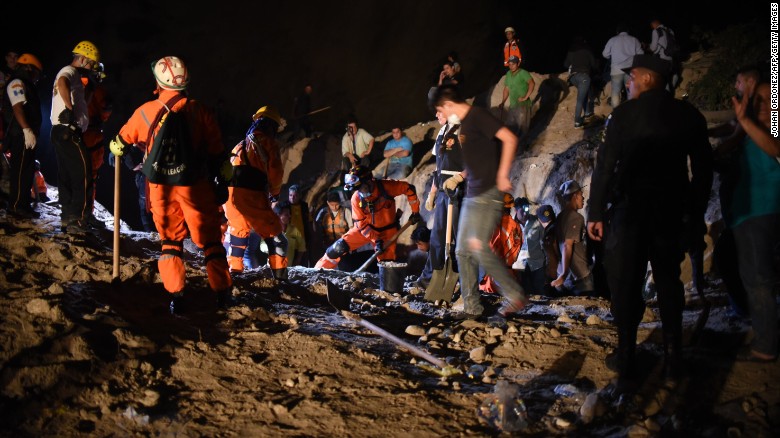
The gangly arms of four backhoes dug through a mound of sandy soil that had buried many of the residents of El Cambray alive in a landslide.

Carefully, the diggers turned up sheet metal roofs, broken walls and the bodies of people trapped in the dirt bulging over much of the Guatemalan village.

By early Sunday, they had recovered nearly 90 bodies of people who died after the side of a towering hill broke loose suddenly and crashed down on the village in the darkness of Thursday night.

Since then, residents and rescuers have shoveled and even burrowed with their hands in search of the hundreds of victims the country's Public Ministry estimates were inside the dozens of homes that were instantly engulfed by the landslide.

By Sunday evening, the ministry was reporting 131 people were dead and more than 300 still missing.

Heavy rains sent earth and rock cascading over homes and trapping residents inside on Thursday night. No survivors have been found this weekend despite the efforts of around 1,800 rescue workers sifting through the rubble.

Rain hampered search and rescue efforts on Sunday.

In the town's crowded cemetery, families sobbed as they placed wreaths on hastily-sealed tombs stacked in walls, where simple inscriptions in cement listed the names of the dead.

Many people in El Cambray did not heed a warning to evacuate, said Alejandro Maldonado, the national coordinator for disaster reduction. El Cambray is about 10 miles (16 kilometers) east of Guatemala City.

Somber finds

Rain had soaked the village and the forested hills that rise steeply up around it. The town is nestled in a deep valley, leaving little space between the hillside and the homes below to buffer the force of the earth and trees that fell down on them.

The rescuers and villagers formed long bucket lines of up to 100 people to pass away dirt and debris. Some carried out the bodies of neighbors and loved ones, including children.

"We found the two month-old twins, and now we are looking for their mother and sister," a villager said.

"We only found one of my nieces, in a state that nobody would want to see a family member," said another.

Many were still waiting for the first body of their loved ones to turn up.

"I have 20 missing family members -- my seven brothers, my dad and my brother-in-law" among them, another villager said.

As they tried to salvage what they could from under the dirt to aid them in grieving, the pale gash in the hill left by the landslide gaped down at those digging.

On Saturday, the workers stopped what they were doing briefly and stood still for a moment of silence.

Monday 5 October 2015

http://uk.reuters.com/article/2015/10/05/uk-guatemala-mudslide-idUKKCN0RW1Q220151005

continue reading

For 2nd day, search in Indonesia fails to locate missing passenger plane with 10 people aboard


For a second day, searchers failed to locate a plane with 10 people on board that went missing in eastern Indonesia, officials said Sunday.

The search for the DHC-5 Twin Otter turboprop plane, owned by the Aviastar Mandiri airline, was again hindered by bad weather and rough terrain, said Henry Bambang Soelistyo, the head of Indonesia's National Search and Rescue Agency.

The plane lost contact with air traffic controllers 11 minutes after taking off in good weather Friday from Masamba in South Sulawesi province. It was on a routine flight to Makassar, the provincial capital, carrying three crew members and seven passengers, including three children. No distress signal was received.

"Today search have not yet produced any result as expected although we have expanded the search area," Soelistyo said. "I myself have checked locations reported by the locals, but we found nothing."

Two aircraft and two helicopters combed areas around the location where the missing plane was believed to have made the last contact and areas where villagers allegedly heard or spotted the plane before it went missing, said Ivan Ahmad Titus, the agency's operation director.

Soelistyo said the plane may not have been equipped with an emergency locator transmitter, a device attached to the so-called black boxes, which emits a signal indicating its position. Director General of Air Transportation Suprasetyo said officials were investigating that possibility.

Monday's aerial search would focus on the sea, while on the ground, soldiers and policemen would search along the 150-mile route of the Masamba-Makassar flight.

The 1981 Canadian-made plane joined Aviastar in January 2014 and underwent its most recent maintenance on Sept. 15.

Indonesia, a sprawling archipelago nation of about 250 million people, has been plagued by transportation accidents in recent years, including plane and train crashes and ferry sinkings. It is one of Asia's most rapidly expanding airline markets, but is struggling to obtain qualified pilots, mechanics, air traffic controllers and modern airport technology.

Monday 05 October 2015

http://www.startribune.com/search-fails-to-locate-missing-indonesian-plane-for-2nd-day/330568291/

continue reading

Friday, 2 October 2015

Migrant crisis: Nameless dead with no one to claim them


Shrouded in white, the little girl lies on the ground in the paupers’ section of Lesbos cemetery.

Strangers attend her burial, and she will forever rest next to an unknown woman who died with her.

“Her mother may be alive in Turkey but we have not been able to find a family contact,” says Effi Latsoudi, a member of a volunteer group helping migrants on Lesbos, the Greek island that is a gateway into Europe for thousands of migrants and refugees.

All that is known of the little girl is that she was seven—according to the coroner—and that she died on September 20 trying to cross the Aegean Sea in search of a better future.

Among the group she was apparently travelling with, the Turkish coastguard rescued 20 people and another 24 are believed to be missing.

A bulldozer digs three new graves for the girl, two women and an unidentified man. For want of space, the girl will be buried with one of the women.

Assuming all four are Muslim, the graves are dug facing Mecca.

An Iraqi refugee is present to say a prayer for the dead, assisted by Mustafa, an Egyptian interpreter working for rights group Pro Asyl.

Two women from the Israel-based humanitarian agency IsraAID—an Israeli and a Palestinian—are also present.

The volunteers all help to lower the bodies into the ground.

At the end of the prayer, olive branches are placed on the graves.

Europe should be ashamed

“Europe should be ashamed of forcing these people to risk their lives,” says one of the volunteers.

The continent is grappling with its biggest migration challenge since World War II, with the main surge coming from civil war-torn Syria.

“Many of these people have relatives looking for them and they have no support to find them,” says Latsoudi.

Another five-year-old girl from Syria died a day earlier. She was identified and her family, who are refugees in Germany, will claim her body for burial.

A Christian family from Syria—a couple with two children and a grandmother—lie beneath headstones adorned with flowers.

They died on March 18, 2014, hoping to reach family in Sweden. Their relatives subsequently travelled to Lesbos for the funeral.

But another man from Syria was only identified a year after his death by his wife.

And older graves belonging to Kurds, Iraqis, Afghans who died in past migrant waves are marked only with numbers.

Other more recent victims are “identified” by their date of death.

“Unknown, August 28, 2015.”

“Unknown, September 4, 2015.”

The cemetery of Agios Panteleimonas on the island capital of Mytilene has been the final resting place of migrants who perish in the storm-hit Aegean for years.

Now it is running out of space.

Since the beginning of the year, 11 graves have been added to more than 60 already dug in this section of the cemetery.

And 10 more people await to be buried.

Many more will drown

“This used to be a mass grave for victims of the Second World War. Only refugees and poor Greeks are buried here now,” Latsoudi says.

The local group she represents, Horio Oloi Mazi (‘the village of all together’) was founded in 2012 after 22 migrants died near the island.

It aims to bring “a little respect and humanity” to the dead and to help their relatives seek them out, she says.

More than half a million people have reached Europe via the Mediterranean this year—including more than 310,000 who have landed in Greece, figures from the UN refugee agency show.

But according to Greek authorities, more than 100 migrants have died or gone missing in the last two weeks alone in at least seven boat accidents.

“Now that the northern winds have picked up there will be even more drownings,” says Christos Mavrakidis, the man responsible for the cemetery.

Earlier in the day, another woman and child died when the bottom of the inflatable dinghy they were sailing in fell apart.

Mavrakidis says the bodies should be exhumed after three years — as is done with Greeks who can’t afford to continue paying for a grave — to create space.

However, Muslim burial rites forbid this.

Friday 2 October 2015

http://www.themalaymailonline.com/world/article/migrant-crisis-nameless-dead-with-no-one-to-claim-them

continue reading

The families of missing migrants and refugees may never know their fates


In 2015, almost 3,000 people died trying to cross the sea and start a new life in Europe. It was the shocking images of three-year-old Aylan Kurdi – who drowned as his family tried to flee the Syrian conflict for the safe haven of the EU – that sparked a global outcry over this tragedy.

International media attention made it possible for Aylan to be identified, his family informed and his body repatriated to Syria for a decent burial. But the vast majority of migrants and refugees who drown in the Aegean and Mediterranean seas are never identified. Their unnamed bodies are deposited without ritual or respect in graveyards on Europe’s periphery.

This is hardly a new phenomenon. The inhabitants of Greek and Italian islands have been dealing with the human tragedy of finding bodies on their beaches for many years now. One result of this epidemic of anonymous death is that migrants simply disappear from the lives of the families they have left behind. For every body that is washed ashore in Italy or Greece, there is a family waiting for news from their missing loved one. Families want to know what has happened to those who left for Europe: they want to know whether their loved ones are dead or alive.

Searching for answers

As it stands, the states of Europe have consistently failed to provide such answers. That’s why we decided to investigate the outcome of shipwrecks, in an effort to understand what’s being done to arrange the collection, identification, burial and repatriation of migrant bodies at the EU frontier.

Our research focused on the Greek island of Lesbos, which is now the leading entry point to the EU for sea-borne refugees and migrants. What we found was a fundamental lack of planning about how to deal with the problem of dead and missing migrants.

Both EU and national authorities seek to avoid responsibility for the identification or proper burial of the dead by using language that deflects blame. By characterising deaths as “accidents”, or dead migrants as “victims” of smuggling networks national and EU authorities deflect any legal or moral responsibility for the identification or proper burial of the dead. They devote more rhetoric and resources to targeting alleged traffickers than to preventing deaths or addressing their consequences. It’s difficult to imagine that this lack of accountability would be acceptable if the bodies found on beaches were those of Europeans.

Rather than dedicate its considerable political and economic power to this humanitarian challenge, we found that the EU relegates responsibility to local municipal authorities. Although there needs to be a local response, these authorities do not have the resources or capacity to deal with the task at hand. This is where national governments and EU authorities have a responsibility to step in and help to collect data from bodies or contact families who are waiting for news. And there is no consular aid available to most migrants.

While living migrants are some of the most heavily-monitored individuals in the EU, dead migrants merit almost no attention from the authorities.

These factors have led to shocking scenes in cemeteries in Lesbos and Lampedusa. The bodies of unidentified migrants are buried in common graves, only lightly covered by earth. The only markers are broken stones – often recycled from older graves – on which is written the purported nationality of the deceased, a number, and a date.

Since most bodies are unidentified, this nationality is typically based on an informed guess or information from survivors, rather than any real investigation. The techniques of forensic anthropology and DNA identification, which have proven so valuable in identifying those who have disappeared in conflict and political violence in the past, are largely absent here. We found that in some contexts, authorities may collect samples from bodies. But there is rarely anything to compare them with, so this useful tool is largely neglected.

The management of the missing in the aftermath of the war in Bosnia is a good example. In 2001, the International Committee on Missing Persons (ICMP) started using DNA-based identification of the victims of the Srebrenica massacre. Since then, it has identified almost 80% of the approximately 7,000 people who went missing in the biggest mass killing in post-World War II Europe. Austrian authorities are using similar techniques to identify the 71 migrants who suffocated to death in an abandoned lorry earlier this year.

To identify the migrant dead, information needs to be collected from bodies: these data include both documents and information taken from the body - such as identifying marks, and tissue samples that can be used for DNA testing, which can be matched with that of family members. Those who made the journey with them, and survived, may also have valuable information about their identity.

Next, there must be a route for families in migrants' countries of origin to report missing people and provide details about them to the European authorities. Finally, data from families – potentially including DNA – must be matched to the information collected from and about bodies found at the EU’s Mediterranean shores.

Affront to human decency

The current, ad-hoc approach means that even when a family can confirm that their relative has died in a shipwreck, they have no way of locating their loved one’s remains among the unnamed graves. The very few families who have been able to claim remains are those with significant political or economic influence.

One local from Lesbos who we interviewed told us that of one shipwreck in which 22 migrants died, only two bodies were repatriated. This was the result of their family relationship to an Afghan minister, who mobilised the Afghan embassy in Athens. The other victims were buried at the local cemetery. As an 18-year-old from Afghanistan aptly put it: “Only the rich get back, the poor stay here.”

Most governments are now agreed: the images of European cemeteries filling with unidentified bodies are an affront to the conscience of humanity. Both the EU and the national authorities of its member states have a moral and legal obligation; not only to stop the deaths, but also to identify and appropriately manage the dead at their borders.

This can and should be decoupled from the broader and more contentious issue of border control. Organisations such as the International Committee of the Red Cross and the International Commission for Missing Persons have the experience, means and capacity to support EU states to address this urgent humanitarian issue. Now, they must be given the mandate and the resources to do so.

Friday 2 October 2015

http://theconversation.com/the-families-of-missing-migrants-and-refugees-may-never-know-their-fates-48396

continue reading

Cape town Fishermen's bodies to be identified


Arrangements are being made for loved ones to identify the remains of the fishermen who died on Sunday when a fishing trawler overturned, the Viking Fishing Company has confirmed.

Group financial director Rory Williams said family members were being contacted and the company would facilitate the "sad task".

"Throughout Monday and Tuesday, bereaved family members and survivors were consoled at the Viking offices with trauma counsellors on stand-by to assist where needed. Company staff have also travelled to Hermanus to identify the deceased," he said.

Nine bodies were recovered and three crewmen were presumed to have drowned after the 42-metre Cape Town fishing trawler reportedly took on water in heavy sea swells 20 nautical miles south of Hangklip (35 nautical miles South East of Cape Point).

The 21-member crew of the MFV Lincoln had to abandon ship after the vessel started keeling over.

Search called off

The search for the last missing men was called off at 18:00 on Tuesday.

"Ongoing counselling will be made available to all families as required, especially to those families where the bodies have not been recovered," Williams said.

Once the bodies have been identified, the company will co-ordinate with families and undertakers to collect the deceased and assist the families with their funeral arrangements, he added.

"All employees are covered by the Compensation for Occupational Injuries and Diseases Act (COIDA), the company’s Group Accident Policy and additional underwriting benefits covered through the company’s pension and provident funds."

Investigations

The trawler would remain under the South African Maritime Safety Authority’s (Samsa) care while it conducted investigations into the circumstances of the accident.

The vessel had arrived at the company’s quayside premises in the Cape Town harbour after being towed back by a sister ship on Tuesday.

It had been examined within port limits by Samsa to ascertain the extent of the damage prior to entering the harbour, Williams confirmed.

Thursday 1 October 2015

http://www.news24.com/SouthAfrica/News/Fishermens-bodies-to-be-identified-20150930

continue reading

Mecca stampede: Indonesian RI haj team continues pilgrim search, body identification


More bodies of Indonesian haj pilgrims are expected to be identified in the coming days as the government steps up its efforts following the arrival of dozens of containers carrying the victims of a recent stampede in Mina, Saudi Arabia, at hospitals on Wednesday.

As of Wednesday, the Indonesian death toll in the accident had reached 57 of the more than 700 who died, with around 78 Indonesian pilgrims “yet to return to their groups” since the deadly crush, the worst of its kind in 25 years, that occurred on Thursday last week.

The government has yet to confirm the whereabouts of the 78 people, whether they “got lost” after the stampede or were among victims’ bodies currently being examined at dozens of hospitals in Saudi Arabia, especially in Mecca and Medina.

Religious Affairs Ministry spokesman Rosyidin told The Jakarta Post on Wednesday night that five Indonesian pilgrims who were injured during the stampede had been receiving medical treatment at different hospitals in Saudi Arabia, adding that all identified Indonesian victims confirmed dead had been buried in the kingdom. “Tonight [Wednesday] there are several containers that have been opened.

There were also four other containers shipped to Jeddah to be identified at one of the hospitals in the city,” Rosyidin said.The ministry said the government of Indonesia would try its best to find the missing pilgrims and would keep family members updated about the search.

Meanwhile, according to data from the Indonesian haj team in Saudi Arabia, the number of missing pilgrims comprised nine people from Batam, 17 from Surabaya, 40 from Jakarta, 10 from Makassar, six from Solo, one from Balikpapan and one from Lombok. The head of the Religious Affairs Ministry’s Mecca office, Arsyad Hidayat, said on Wednesday that the Indonesian haj team had established three separate groups to expedite attempts to identify bodies unloaded from containers in several cities.

The first team was tasked with counting the number of Indonesian pilgrims yet to return to their groups by visiting all groups of Indonesian pilgrims in Mecca, while the second team would visit hospitals in Mecca and Jeddah to find injured victims. “The third team is to identify bodies of victim at [crisis center] Majma’ Ath-Thawari Bil Mu’aishim by identifying pilgrims’ paperwork [and] haj attributes such as bracelets, shawls and bags,” Arsyad said on Wednesday.

As victims’ bodies have begun to decompose, the third team, according to Arsyad, would cooperate with Saudi Arabia’s disaster victim identification (DVI) unit to get data on pilgrims’ fingerprints recorded when they first arrived in the kingdom. “We hope that with the use of fingerprints it will be easier for us to identify the bodies [of Indonesian pilgrims].

In addition, if we don’t find any haj accessories then we will confirm [the identity of] victims’ bodies with their respective group heads,” Arsyad added.Commenting on authorities’ slow progress in identifying the victims, House of Representatives Deputy Speaker Fahri Hamzah urged the government to exercise more political clout in dealing with the Saudi administration’s closed-lid stance on the resolution of the tragedy.

Fahri, who leads the House’s haj monitoring team, said that Saudi authorities should have provided unrestricted access and open communications to assist in the monitoring and handling of the situation, especially since Indonesia is home to the world’s largest Muslim population and sends the biggest number of pilgrims to Mecca every year.

“Indonesia has not shown the communicative prowess to [confront] Saudi Arabia [about disaster mitigation],” Fahri told reporters during a press conference at the House complex on Wednesday. House Speaker Setya Novanto corroborated his colleague’s claims by saying that Saudi officials had initially prevented the haj monitoring group from entering hospitals, despite having flaunted the Saudi Kingdom’s crest to prove that they were guests of Saudi King Salman bin Abdulaziz al-Saud. “Eventually we waited until a car passed by and we snuck in,” Setya said on Wednesday. He claimed not to have seen any Indonesian officials in the hospital that day, despite the presence of several injured Indonesian citizens.

Friday 2 October 2015

http://www.thejakartapost.com/news/2015/10/01/ri-haj-team-continues-pilgrim-search-body-identification.html

continue reading

Thursday, 1 October 2015

Missing body of June 13 Tbilisi flood victim found, identified


A body found in Tbilisi last month has been identified as one of the three missing victims of June 13 Tbilisi flash flood.

DNM tests revealed the remains, found by Georgian police near Tbilisi’s Ponichala area on August 23, were of Elizbar Baghashvili.

The body – found more than two months after the disaster - was spotted in Mtkvari River kilometers from where the taxi he was in was swept away by raging flood waters.

Authorities have continuously been searching for Baghashvili and three others victims who remain missing following the June 13 disaster.

Baghashvili returned to Tbilisi from Moscow only hours before the natural disaster struck. He was in a taxi returning home from a meeting with a friend when the car he was in was swept off the road.

Twenty-two people, including Baghashvili, lost their lives in June 13 flash flood. Of these, three bodies still remain missing.

Furthermore, about 400 people from up to 80 families lost everything they owned as a result of the flood.

On a wider scale, an initial evaluation estimated flood damage on Tbilisi infrastructure exceeded 100 million GEL. Roads linking Tbilisi and several nearby villages and summer settlements still remain blocked.

Thursday 1 October 2015

http://agenda.ge/news/43524/eng

continue reading

More remains of MH17 victims found (article in Dutch)


In het oosten van Oekraïne zijn opnieuw stoffelijke resten gevonden van slachtoffers van vlucht MH17. De stoffelijke resten worden met een lijnvlucht van Charkov overgebracht naar Schiphol, maakte het ministerie van Veiligheid en Justitie vrijdag bekend.

Tot dusver gingen stoffelijke resten met een militair toestel naar Eindhoven waarna ze in een konvooi werden overgebracht naar de Korporaal van Oudheusden Kazerne bij Hilversum voor identificatie. De ceremonie is gewijzigd ,,omdat het identificatieproces grotendeels is afgerond''.

Een achtkoppig Nederlands team is in Oekraïne om de stoffelijke resten, persoonlijke bezittingen en resten van het vliegtuig op te halen. De overblijfselen zijn gevonden nabij de plek waar het toestel neerkwam, in de buurt van Hrabove, en werden sinds 1 mei verzameld door de plaatselijke autoriteiten. Inwoners van de dorpen rond het rampgebied kunnen op vaste punten gevonden spullen blijven inleveren.

Medewerkers van het Landelijk Team Forensische Opsporing brengen de stoffelijke resten naar Schiphol. Wanneer dat gebeurt, is nog niet bekend. Daar vindt - zonder media - een gedenkmoment plaats. De marechaussee zorgt voor de ceremoniële ontvangst. Daarvoor is de familie van de twee nog niet geïdentificeerde Nederlandse slachtoffers uitgenodigd.

Op 2 mei vloog een militair toestel voor het laatst kisten met stoffelijke resten naar Eindhoven. Dat was de tiende keer dat er menselijke resten werden overgevlogen naar Nederland. De officiële bergingsmissie was in die week afgerond.

Thursday 1 October 2015

http://www.telegraaf.nl/binnenland/24538777/__Opnieuw_stoffelijke_resten_MH17_gevonden__.html

continue reading

Anniversary of Austin Dam disaster today


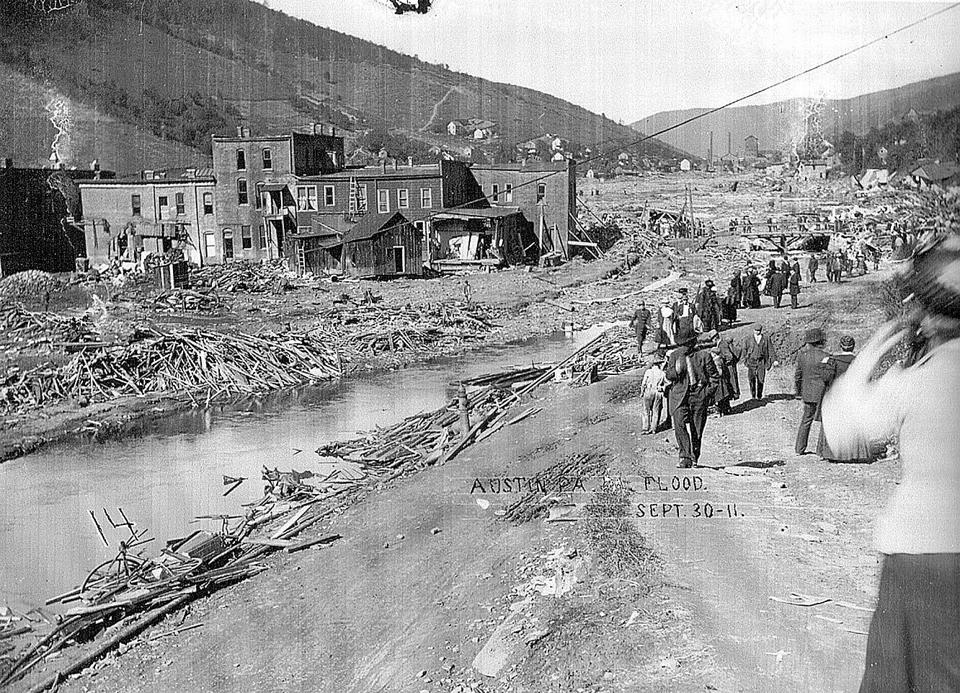
Today marks the 104th anniversary of perhaps the single greatest disaster in the history of this area of the Twin Tiers — the failure of a concrete dam and subsequent destruction of the towns of Austin and Costello on Sept. 30, 1911, in Potter County, Pa.

Pressure from about 250 million gallons of water broke the dam, which was built two years before to supply water for the Bayless Pulp and Paper Co. The dam stood 50 feet high and was more than 500 feet long — it had been dubbed by some as “the dam that could not break.” The water from the dammed-up Freeman Run swept up logs and other debris, creating a grinding wall of devastation. A total of 78 people are officially reported killed in the disaster, although it is believed by historians that more people — possibly traveling businessmen, visitors to the town, lumbermen who had brought in logs to the Bayless Co. — perished in the disaster and their bodies were not found.

Austin was a small city of 3,000 people in 1911.

Indeed, newspaper dispatches even two days after the flood reveal how murky information was in the aftermath, given the communications abilities and the state of emergency management response of that day.

A headline on the front page of the Oct. 2, 1911, edition of the Olean Evening Times (the dam broke on a Saturday; the Evening Times was not printed on Sundays) stated: “Official Count Gives Death List as 250, But Citizens Claim It Will Reach 550.”

Rescuers at the scene expressed certainty that the death toll would be in the hundreds, and it was feared that great piles of debris would have to be burned — along with the bodies it was assumed they covered — because of concerns about disease.

An editorial in the Evening Times read:

“The nation stands appalled at the fearful calamity that has overwhelmed Austin. Not since the fateful Johnstown flood of 1889 has there been such a holocaust of death in a single accident in this country. Coming so close to Olean, this catastrophe brought with a terrible shock to all residents of this city. Many of them had relatives in the stricken city, and many more of them had friends whose safety has not yet been established.

“The suspense here yesterday was poignant, and every additional report but added to the grief of the waiting people. Practically no definite information could be secured and only such news as filtered in from Keating Summit and other nearby places, inadequate in respect to the names of the dead or the survivors, came to relieve their anxiety. But in most cases, this but added to the suspense.

“Everything that can be done to relieve the situation is being done. Nothing that can mitigate the sorrow and horror of the calamity is being left undone. All the necessary medical aid is upon the scene, the homeless people are being placed in the homes of hospitable neighbors, and at present there is food amply sufficient to meet the needs of the sufferers.”

A permanent memorial was dedicated in September 2013 to the people who lost their lives in the flood. The memorial marker, in Austin Dam Memorial Park, is made of light-colored stone with the names of the deceased etched in black upon its face. The monument stands directly in front of the dam as a solemn memorial to those who lost their lives that day.

Thursday 1 October 2015

http://www.oleantimesherald.com/news/article_de892bd6-672e-11e5-9324-13d1c038ece3.html?mode=image&photo=0

continue reading

Wednesday, 30 September 2015

With 1,200 missing persons in Orange County, authorities reach out to families for DNA


For over 20 years, the identity of a human femur that washed ashore in Seal Beach and a jaw bone found elsewhere on the coast remained a mystery.

Meanwhile, the family of Percy Ray Carson wondered in anguish for two decades what had happened to the 26-year-old Long Beach resident and Army veteran, who disappeared while swimming off the coast of Huntington Beach on July 19, 1992.

It wasn’t until June that authorities connected the DNA of the remains with that of Carson’s family, identifying the bones as his.

Although Carson’s case was finally solved, another 1,200 active missing persons cases remain in Orange County, according to the Sheriff’s Department. About 100 human remains have been collected but never identified, sheriff’s Lt. Jeff Hallock said.

For the first time, Orange County coroner and law enforcement officials are reaching out to people with missing family members in a public event Saturday, encouraging them to give DNA in the hopes that improving DNA testing technologies will lead to answers.

At the event, titled “Identify the Missing,” law enforcement and forensic officials will speak with relatives who wish to file or add to missing persons reports, submit DNA cheek swabs, and provide medical and dental information, photographs and fingerprints of their loved ones. Authorities can use the records to search The National Missing and Unidentified Persons System’s federal database, which has information on 10,000 unidentified bodies.

“We’re providing a venue that’s going to encompass all of the law enforcement and community professionals that families would need in this situation,” Allison O’Neal, the Orange County supervising deputy coroner, said after a press conference announcing the program Tuesday.

Representatives from several county police agencies, the National Center for Missing and Exploited Children, the California Department of Justice, National Missing and Unidentified Persons System and the Mexican consulate in Santa Ana are expected to participate.

Similar events have been held in Michigan, New York, Texas and Missouri.

Coroner officials said they regularly send remains to the California Department of Justice for DNA testing to close the books on the thousands missing and unidentified persons cases they see annually.

“We’re resubmitting material all the time on these older cases to try to make a match,” said Tiffany Williams, a senior deputy coroner.

However, many missing people go unreported, officials said. Sometimes family members are afraid of how DNA samples would be used, but assistant chief deputy coroner Bruce Lyle said the DNA will only be used to help identify remains.

The new outreach approach is the result of meetings with Southern California coroner offices, where some agreed to hold similar events in the coming months.

The San Bernardino County coroner’s office held theirs in June, but turnout was reportedly low, Sheriff’s officials said. They said they hope to avoid that in Orange County by spreading the word.

At San Bernardino County’s event, a Redlands mother filed a missing persons report for the daughter she had not seen in 12 years. A detective discovered that the daughter was OK and living in Los Angeles.

Sheila Tubbs, of Newport Beach, hopes to find the same resolution for her brother, Gary Patton, who went missing during a short trip to Mexico.

Patton, of Westminster, was 64 years old when he went missing in September 2013 while on a three-day trip to photograph whales and a fishing tournament in Baja California, Mexico.

They filed a missing persons report with the Westminster Police Department, passed out fliers near where he possibly went missing, hired a private investigator and placed ads in Mexican newspapers, to no avail.

Tubbs said she and several of her siblings will submit to cheek swabs on Saturday.

“The family wants to get closure if something did happen to him,” Tubbs said. “I’m trying to be the eternal optimist.”

30 September 2015

http://www.ocregister.com/articles/missing-685262-persons-county.html

continue reading

Austria migrant truck tragedy: relatives trying to identify their familymembers


Omar Abd-Mugeeth stared at his TV in Dubai. He felt hot, then sick. Police had found an abandoned refrigerator truck on an Austrian roadside with at least 50 dead aboard.

“ Mahmoud…my little brother. I knew he was one of them,” said Mr. Abd-Mugeeth, a 44-year-old Iraqi who last week traveled nearly 3,000 miles to try to confirm the fate of his brother and his brother’s wife.

Austrian authorities eventually extracted 71 decomposing bodies from the truck last month, one in a string of recent tragedies that has put the migration crisis at the top of Europe’s political agenda. Undertaking risky travel over land and sea has drawn global attention to the desperation of families fleeing war-torn and impoverished lands in the largest mass migration since World War II.

Mr. Abd-Mugeeth and other relatives now wait as a lab in the Austrian capital processes DNA samples to find matches with the tissue of victims who would otherwise be nearly impossible to identify. He flew Thursday to Vienna and then drove to meet with police in the Burgenland region, where the truck was found. En route, he stared past cornfields and small medieval-era houses, crying silently. “My mother,” he said, “she is crushed.”

His 29-year-old brother Mahmoud Abd-Mugeeth had married Zina Kaylany, 24, shortly after they had met at a wedding five years ago, Mr. Abd-Mugeeth said. It was love at first sight. “She was a very strong and respected woman,” he said. “Mahmoud adored her.” The couple lived in Baghdad, where his brother’s wife, nicknamed “Light Eyes,” sang for her husband at home.

As Mr. Abd-Mugeeth waited to speak with authorities at the Eisenstadt police station, he asked officers, “How big was the truck? How many meters?” No one could tell him exactly. On a piece of paper, Mr. Abd-Mugeeth drew a square in red ink with small circles inside.

“Seventy one,” he said. “My brother. No space.” Rising suddenly, he stood on one leg, holding his arms up. “This is how he was standing,” he said. Then Mr. Abd-Mugeeth fell back into his chair and rested his head in his hands.

His brother Mahmoud was an Iraqi army officer, a Sunni who had grown fearful that neither he nor his country could protect his wife and family from violent extremists, according to Mr. Abd-Mugeeth and other family members.

Mahmoud Abd-Mugeeth researched flights, spoke with friends who had already left and discussed possible routes with his wife, Zina, who had two brothers already living in Germany.

In mid-August, the couple decided to leave. Mahmoud Abd-Mugeeth didn’t tell his commanding officers, family members said. They flew out of Baghdad, traveling in a group that included Zina’s sister and a brother. They arrived in Izmir, a city on Turkey’s Mediterranean coast.

Mr. Abd-Mugeeth said he asked his brother to stay in Turkey, where other family members lived. But his brother told him his wife and her two siblings wanted to join their brothers in Germany.

“Mahmoud would follow Zina anywhere,” Mr. Abd-Mugeeth said. “I tried to talk him into staying in Turkey, I warned him that the trip might be dangerous, that he didn’t know what to expect, but he wouldn’t listen.” Mahmoud Abd-Mugeeth planned to start a money transfer and exchange business in Germany, his brother said, similar to the one that Mr. Abd-Mugeeth was running in Dubai.

Before leaving Izmir, the group left their passports with relatives. A smuggler recommended by friends who had already made it to central Europe told them they would get new identities. Many Iraqi migrants are told it is easier to gain asylum in European countries by changing their identities and using, for example, Syrian passports.

Mahmoud Abd-Mugeeth also left $10,000 with his older brother, who would transfer the savings when he arrived in Germany.

The group traveled by boat to Greece, where they found another smuggler who drove them by van through Macedonia and Serbia, as far as the border with Hungary. On this leg of the trip, Mr. Abd-Mugeeth said, he and his mother were in constant contact with Mahmoud through calls and text messages.

‘“In the beginning, he was very happy,” Mr. Abd-Mugeeth said, showing a picture of his smiling brother as he posed at a town on the Greek shore.

As they progressed deeper into Europe, Mr. Abd-Mugeeth said, his brother no longer smiled in photos he sent. “I could see it in his eyes,” Mr. Abd-Mugeeth said. “He had a scared look.”

In one of the last pictures sent, he said, his brother’s face was shaded in a tree’s shadow—behind him, other migrants sat on the ground and talked while others slept amid strewed trash and discarded leftovers.

Mr. Abd-Mugeeth last spoke with his brother on Aug. 25—two days before the abandoned truck was discovered by authorities. His brother had told him he was worried about his wife sleeping on the ground in the Serbian forest, Mr. Abd-Mugeeth said. His brother also confided the couple hadn’t eaten for two days, except for some foraged fruit.

Mr. Abd-Mugeeth said he told his brother to return to their family in Turkey, that there was no point to more suffering. But his brother refused, he said, saying he had spoken to a smuggler who had promised to retrieve them that evening at the Serbia-Hungary border and take them to Germany for €1,800 (about $2,022) a person.

“I should have been harder on him,” Mr. Abd-Mugeeth said. “I should never have let him go.”

The group was expected in Germany by the Kaylany brothers—Ahmed, 28, and Sarmad, 25—who were waiting to welcome their sister Zina, her husband, Mahmoud Abd-Mugeeth, another sister and a brother, Ali Amer.

Mr. Amer had texted his brothers on Aug. 24, saying the group was waiting at the Serbia-Hungary border for a transport. Don’t worry, he said.

Sitting in their apartment in Aachen, a small town on the border with the Netherlands, the Kaylany brothers said Sunday that they heard nothing for a week after that message. They had tried calling. At first, the phone rang. But after awhile, even the ring tone went silent.

“The world fell apart,” said Ahmed Kaylany, sitting on a green velvet sofa, elbows resting on his knees. “It is as if God chose to take the best people in the world. They wouldn’t even have hurt an ant.”

The two brothers now spend their time waiting—for a decision by German authorities on their asylum applications, filed in May, and for a call from Austrian authorities about the DNA samples they sent out a week ago. For weeks, they have had trouble sleeping and eating.

“The wait is the worst part,” Sarmad Kaylany said, tears in his eyes. “I only think about my family, my parents back home who still have hope…My little sisters, my brother.”

Austrian investigators said working with frustrated and distraught relatives has heightened the emotional challenge for officers working on the case. “We see people doing all they can to provide us with DNA samples, some traveling across half of the world,” a police spokesman said.

Providing relatives with a clear answer is taking much longer than anyone wants, the spokesman said, and it could drag on for several more months because of the forensic complexity of the case, as well as the logistics of communicating with foreign authorities.

“Our priority has to be to not, not ever, make a mistake,” the spokesman said.

Authorities have arrested six people in the case, including the alleged driver.

. At the Eisenstadt police station, an officer arrived to speak with Mr. Abd-Mugeeth. A second man asked him to open his mouth so he could take a swab of saliva. He looked at Mr. Abd-Mugeeth’s passport and wrote down his name, birth date, and address on a form.

Mr. Abd-Mugeeth asked when he would get an answer about his DNA sample. “In two to three weeks,” the officer said.

The officer started looking through some papers in front of him, then pulled out a photograph of a head scarf from the stack.

“Have you seen this before?” he asked.

“I’m not sure,” Mr. Abd-Mugeeth said.


The officer showed him a picture of a small pouch. Mr. Abd-Mugeeth flicked through the photos his brother had sent on his phone. In one shot, of his brother and his wife in the forest in Serbia, Mr. Abd-Mugeeth saw that she wore the same pouch around her hips.

“And look,” Mr. Abd-Mugeeth said, pointing at his phone. “It’s the head scarf. It’s the same.”

The officer pulled out one last photo that showed a golden necklace with Kurdish letters.

“It’s Zina’s, 100%.” Mr. Abd-Mugeeth said. “The letters say ‘Mahmoud.’ ”

Mr. Abd-Mugeeth asked whether he could see the bodies of his brother and sister-in-law, or at least pictures of them. The officer said he couldn’t until the bodies were identified.

“You would not be able to recognize them,” the officer said. “The bodies are not visually recognizable.”

“But her hair color,” Mr. Abd-Mugeeth said. “You must have been able to see her hair color.”

The police officer looked down at the table.

“I’m so sorry,” he said. “But no, we couldn’t even recognize her hair color.”

Mr. Abd-Mugeeth said he had felt as though his brother’s presence lingered after the truck’s discovery. He could see on Facebook that his brother was online for several days after they last talked, a sign his phone must have been in use. But his brother didn’t reply to messages.

When Mr. Abd-Mugeeth called, no one answered.

Mr. Abd-Mugeeth said he was convinced smugglers took away the phone—which police never found—and forced his brother and the others into the truck.

“Mahmoud was very jealous,” he said. “He would not have wanted his wife to be in a place like that with so many men and so little space. He would never have entered that truck without being very scared.”

After the couple had learned early in their marriage that they couldn’t conceive children, Mr. Abd-Mugeeth said, his brother’s wife offered a divorce so her husband could remarry and have children with someone else.

“He told her he loved her, and that he would always stay with her, with or without children,” Mr. Abd-Mugeeth said. “He said…that he would live with her and die with her. And he did.”

Wednesday 30 September 2015

http://www.wsj.com/articles/a-month-after-migrant-truck-tragedy-a-grim-wait-1443576982

continue reading

North Korea: Rason flood casualties ten times official figures


Nearly 400 people have reportedly died from torrential rain that swept up residents in Rason, North Hamgyong Province. This is ten times the figure officially announced by North Korea, which is believed to have distorted numbers in fear that the international community would criticize the Kim Jong Un leadership for its lack of readiness against natural disasters, Daily NK sources reported.

“Damage from the downpours was contained to Rason in the Sonbong area and not elsewhere,” a source privy to North Korean affairs in China told Daily NK. “It was only in the Sonbong area where it rained a lot. Although the state reported 40 were killed, after looking into the matter those figures are over 400.”

An additional source in China with ties to North Korea confirmed this news.

Images featured in the Party-run Rodong Sinmun showed buildings being reconstructed, but on the larger scale, the damage was immense with entire villages being swept away, leading to a massive loss of lives, according to the source.

“The sudden rise in water levels swept up not only residents in the area but taxi drivers, traders, and even truck drivers from China. Those bodies have not even been recovered yet,” he asserted.

“Saying that 40 lives were lost is sheer nonsense.”

Soldiers mobilized from surrounding areas are currently working on rebuilding the hard hit city, which has been sealed off from the public. Roughly 45,000 soldiers are on site, reflecting the magnitude of devastation in Rason.

“The soldiers that have been mobilized are storm troops that specialize in building roads, bridges, and fixing houses,” the source said. “They have cut off the entrance to Sonbong to block cars coming from Wonjong Customs House, and people cannot enter at all. All vehicles that go through customs have to make a detour toward the Tumen River,” the source explained.

He went on to speculate that Pyongyang downplayed the numbers in an effort to deflect any criticism from the global community. While it is more common to see dozens of lives lost in a natural disaster, much higher numbers would be a sure sign of North Korea’s lack of readiness. The leadership, the source surmised, likely did not want to take any chances in acknowledging this reality.

Wednesday 30 September 2015

http://www.dailynk.com/english/read.php?num=13488&cataId=nk01500

continue reading

Hajj stampede: Saudi officials clarify toll after questions


Saudi officials have denied reports that more than 1,000 people were killed in a stampede near Mecca last week while undertaking the Hajj pilgrimage.

A Nigerian official told the BBC the bodies of 1,075 victims had been taken to mortuaries in the city of Jeddah - higher than the official toll of 769.

Other countries also said they had been sent the photos of some 1,090 bodies.

But the Saudi officials said the photos included unidentified people who died at the Hajj - not just in the stampede.

Spokesman Maj Gen Mansour al-Turki told the Associated Press that some were foreign nationals who lived in Saudi Arabia and carried out the Hajj without the required permits

Others were among the 109 people who were killed when a crane collapsed at the Grand Mosque in Mecca on 11 September, he said.

Confusion about how many people died in last week's stampede mounted after Indian Foreign Minister Sushma Swaraj tweeted on Sunday that the Saudi authorities had released photos of 1,090 pilgrims who died.

Pakistani and Indonesian officials also indicated that they have been sent more than 1,000 such images.

On Tuesday, a Nigerian Hajj official from Kano, Abba Yakubu, told the BBC's Yusuf Ibrahim Yakasai that he had been to Jeddah, where the dead from the stampede were being processed.

Mr Yakubu said that in total, 14 lorries loaded with bodies were brought to the city.

He added that so far 1,075 bodies had been offloaded from 10 lorries and taken into the morgues. Four lorries had yet to be dealt with, Mr Yakubu said.

Several countries have been severely critical of the way the Saudi authorities have handled the accident's aftermath, notably Saudi Arabia's regional rival Iran, which lost at least 228 people in the disaster.

The stampede was the deadliest incident to hit the Hajj in 25 years.

The crush occurred as two large groups of pilgrims converged at right angles as they took part in the Hajj's last major rite - stone-throwing at pillars called Jamarat, where Satan is believed to have tempted the Prophet Abraham.

As well as the fatalities, 934 people were injured.

Saudi Arabia's most senior cleric, Grand Mufti Sheikh Abdul Aziz bin-Abdullah al-Sheikh, has defended the authorities, saying the stampede was "beyond human control".

King Salman has ordered a safety review into the disaster.

Deaths reported so far by nationality

◾Iran: at least 228
◾Morocco: 87 (media reports)
◾Egypt: 74
◾India: 45
◾Pakistan: 44
◾Cameroon: at least 20
◾Niger: at least 19
◾Chad: 11
◾Somalia: 8 (media reports)
◾Senegal: 5
◾Algeria: 4
◾Tanzania: 4
◾Turkey: 4
◾Indonesia: 3
◾Kenya: 3
◾Nigeria: 3
◾Netherlands: 1
◾Burundi: 1
◾Burkina Faso: 1
◾Other nationalities (numbers not yet known): Benin


Wednesday 30 September 2015

http://www.bbc.com/news/world-middle-east-34391055

continue reading

Tuesday, 29 September 2015

62 Guerrero graves yield 131 bodies


The investigation into the disappearance of 43 students from the teacher training college in Ayotzinapa has uncovered more than 100 corpses buried in unmarked graves in Guerrero – but none of them corresponds to the students, missing since September 26 last year.

The Attorney General’s office (PGR) has exhumed 131 bodies from 62 sites, analyzing the remains and genetically cross-referencing them with family members of the missing students.

But none has tested positive. The investigation of the graves began last October after the Union of the Peoples and Organizations of Guerrero (UPOEG) alerted the Criminal Investigation Agency (AIC) to their presence.

Since then bodies have been found in unmarked graves across Iguala every month, some of them mass graves containing more than a single corpse.

Many have been found by UPOEG volunteers who went out searching for possible grave sites based on information gathered from local residents.

The bodies unearthed in Iguala are among 321 found in 158 graves across the country since 2012, most of them in the states of Guerrero, Jalisco, Michoacán and Morelos.

The Iguala finds probably represent the worst case of clandestine graves uncovered in Mexico since the AIC found 75 bodies in La Barca, Jalisco, between November 2013 and February 2014.

The agency was investigating the disappearance of two of its agents, René Rojas Márquez and Gabriel Quijados Santiago, whose remains were discovered in Vista Hermosa, Michoacán.

The two are believed to have been murdered by members of the Jalisco Nueva Generación cartel.

Tuesday 29 September 2015¨

http://mexiconewsdaily.com/news/62-guerrero-graves-yield-131-bodies/

continue reading

New project aims to identify immigrant remains


The Texas Forensic Science Commission hosted a meeting in Edinburg on Monday to discuss efforts to better identify the bodies of undocumented immigrants who die while illegally crossing into the United States.

While many consider illegal immigration to be a federal issue, others claim it’s not that simple.

"It's a federal and it’s a state issue. The federal issue is immigration, but the state issue is the bodies are in our state," said Rep. Terry Canales.

In the last two years, 169 cases of human remains have been recovered in Brooks County, but only 4 have been identified.

"We're failing. We’re failing to identify these people; we're failing to bury them properly. The bottom line is we need to respect them in life and in death," Canales said.

It's why Canales made an amendment to Senate Bill 1287, which created the Rio Grande Identification Project.

“The forensics commission creating the best practice and a database of the collection of DNA from unidentified corpuses from 120 miles of the Rio Grande. So when you ask what does it do? Well, it basically creates what was never there," Canales said.

State Sen. Juan “Chuy” Hinojosa, D-McAllen, said the new system could help not only those from Mexico, but Texas as well.

"We've made a lot of progress through DNA, through coordination and cooperation. We now have a system in place that makes it a lot easier to find out who that person is and locate that person’s family – whether it is in Mexico, Central America or maybe even a missing person here in Texas," Hinojosa said.

While Hinojosa and Canales both said Texas is taking proactive steps to deal with the impact of illegal immigration, they said this is the next step in tackling the issue.

"America is such a beautiful place that people are flocking to be here. They are trying to cross here illegally; they are willing to risk life and death to get here because it’s such a great country. But us burying you in a mass grave or not being able to identify you, is not so great. So we're trying to not only admit our wrongs, but right them," Canales said.

The commission is funded by the state, but there are federal grants available to help with the costs, Canales said.

The Brooks County Sheriff's Office said its county spent $680,000 between 2009 and 2013 in recovering bodies.

Tuesday 29 September 2015

http://www.valleycentral.com/news/story.aspx?id=1247847

continue reading

Migrant crisis: 17 people drown after boat sinks off Turkish coast


Seventeen migrants attempting to reach Greece by boat from Turkey have drowned after their boat sank off Turkey.

The victims, all thought to be Syrians, included five women and five children, local media said.

Another 20 people on the boat's deck, who were wearing life jackets, survived, the news agency said.

Some 300,000 migrants and refugees have arrived in Greece so far this year, most of them moving on to try to reach other EU countries.

Those arriving in Greece have mostly set off from Turkey's Aegean coast, according to the International Organisation for Migration.

Those who drowned on Sunday were trapped in the boat's cabin as it sank, Turkey's Dogan news agency reported.

The boat is thought to have set out from the village of Gumusluk near the Turkish resort town of Bodrum, where three-year-old Syrian refugee Alan Kurdi died earlier this month.

Alan's death made international headlines when an image of his body washed up on the beach in Bodrum was widely shared.

With several Greek islands within a few miles, thousands of people are attempting the dangerous journey every day.

Mediterranean rescue

Separately, 500 migrants have been rescued from the Mediterranean so far this weekend in seven operations involving the Italian coastguard and navy and a ship belonging to the charity Medecins Sans Frontieres.

A spokesman for the coastguard told the AFP news agency on Sunday that three of the seven operations were ongoing.

The rescued migrants are thought to be largely from Nigeria, Ghana, Senegal and Sierra Leone and left Libya three days earlier. They were rescued about 80km (50 miles) off the Libyan coast.

Hungarian police said on Sunday that 9,472 migrants had arrived in the country on Saturday, overwhelmingly crossing from Croatia. Hungarian Prime Minister Viktor Orban has said that his government plans to seal its border with Croatia, in the same way that it has sealed the border with Serbia.

Croatia said on Saturday that about 67,000 people had entered the country over the past 10 days, when Hungary's decision to fence off its border with Serbia redirected migrants towards Croatia.

About 10,000 migrants crossed into Croatia from Serbia on Friday - a record daily high - with the steady stream of people continuing into the weekend.

Migrants and refugees crossing the Serbia-Croatia border have suffered a dip in temperatures this weekend.

Monday 28 September 2015

http://www.bbc.com/news/world-europe-34373161

continue reading

Mina crush: More bodies identified


Many countries on Monday announced that they had identified dozens more bodies from a stampede in Mina four days ago.

The number of Indonesians killed in the stampede rose to 41 Monday with scores more still missing, an official said.

Indonesia, the world’s most populous Muslim-majority country, initially indicated only a handful of its citizens died in the stampede but the death toll crept up over the weekend, and the Religious Affairs Ministry confirmed Monday that it now stood at 41.

In addition, 10 Indonesians were being treated for their injuries in hospital while a further 82 remain missing, although senior ministry official Abdul Djamil said it was not clear if they were caught up in the stampede.

Many pilgrims’ bodies were mutilated in the crush, and Djamil said that officials were identifying Indonesian victims through such methods as checking clothes and Haj ID bracelets against their records.

“Our team has been working hard day and night to look for the pilgrims whose whereabouts are still unknown, and to identify the pilgrims who died,” he added.

Pakistan’s minister for religious affairs said authorities have tracked down 217 Pakistanis who went missing following the stampede.

Sardar Muhammad Yousaf, speaking to Pakistan Television Sunday night from Saudi Arabia, said 85 Pakistanis were still missing and efforts were under way to locate them. He said 36 Pakistanis were killed and 35 injured in the stampede.

Egypt’s Minister of Religious Endowments Mohammed Mokhtar Gomaa told the Middle East News Agency that 55 Egyptian citizens are among the dead. He said another 120 Egyptian pilgrims are still missing and 26 are receiving treatment for injuries sustained during the disaster.

India also updated its list of the dead. Ten more Indian pilgrims were identified in Al-Moaissem mortuary near Mina taking the toll to 45.


Indian Consulate General also released a list of 50 injured pilgrims and the name of hospitals they are under treatment.

There are three pilgrims under treatment at King Faisal Hospital, five at King Abdullah Medical City in Makkah, seven at Al-Noor Hospital in Makkah, six at Mina ER Hospital, one at Hira Hospital in Makkah, one at Nimra Hospital in Arafat, five at Al-Jasr Hospital in Mina, two at Mina Al-Wadi Hospital, two at Al-Jadid Hospital in Mina, five at Shesha Hospital in Makkah, one at Mina dispensary, 10 at Security Force Hospital in Makkah, two at King Abdulaziz National Guard Hospital in Bahra.

The largest number of casualties identified thus far is from Iran. Iran’s state TV raised the death toll for Iranian pilgrims from 155 to 169. More than 300 Iranians are still missing and around 100 were wounded in Thursday’s incident.

Tuesday 29 September 2015

http://www.saudigazette.com.sa/index.cfm?method=home.regcon&contentid=20150929258089

continue reading

Monday, 28 September 2015

Poland reburies 35 victims of Stalin-era terror


The bodies of 35 victims of a Stalin-era campaign of terror in Poland were reburied at a solemn ceremony on Sunday after being exhumed from mass graves and identified.

Digs carried out recently at a military cemetery uncovered a number of mass graves and have led to the exhumation of around 200 bodies of victims of the Stalinist regime in Poland following World War II.

"We are now attempting to discover the fate of each one of these victims, so that, as far as possible, no one remains anonymous, to put a name to the communist reign of terror of 1945-1956, to document it and portray it," Polish Prime Minister Ewa Kopacz said at the ceremony, which was broadcast live on television.

The 35 wooden coffins were placed in a new mausoleum at the Powazki cemetery in Warsaw.

The Institute of National Remembrance (IPN), which oversees a vast programme of excavation work across the country, hopes to find and identify the remains of Witold Pilecki, a Polish partisan who infiltrated the Auschwitz-Birkenau Nazi death camp, in order to share his experience with the world.

Pilecki escaped from the camp after three years, but was arrested after the war by Poland's communist authorities loyal to Soviet dictator Joseph Stalin, accused of espionage and sentenced to death. His body was never found.

The institute believes that around 50,000 people were killed during the post-war campaign of terror, with many still in mass graves.

Digs are under way across the country that have led to the exhumations of more than 600 bodies, 41 of which have so far been identified through DNA.

Monday 28 September 2015

http://news.yahoo.com/poland-reburies-35-victims-stalin-era-terror-175134580.html

continue reading

Texas: Hearing set on identifying immigrant remains


Efforts to improve the identification process of undocumented immigrants who die while crossing from Mexico into Texas will take center stage in the Rio Grande Valley today.

The Texas Forensic Science Commission will host a public meeting at the Edinburg Conference Center at Renaissance, Rep. Terry Canales, D-Edinburg, has announced.

The meeting will be held from 10 a.m. to 1 p.m. at the facility, which is located at 118 Paseo Del Prado, near the intersection of McColl Road and Dove Avenue in southwest Edinburg.

The gathering in Edinburg, which is the result of a last-minute amendment on May 26 by Canales to Senate Bill 1287, will focus on what is known as the Rio Grande Identification Project.

The Edinburg lawmaker’s amendment created the Rio Grande Identification Project and requires the Texas Forensic Science Commission — a state agency — “to develop a method for collecting forensic evidence related to the unidentified bodies located less than 120 miles from the Rio Grande River,” Leigh M. Tomlin, with the Texas Forensic Science Commission, stated in an advisory about the Edinburg meeting.

“In accordance with its legislative mandate, the commission is working with stakeholders to develop a systematic plan for proper forensic evidence collection of biological material that may help identify human remains found along the border. The goal for the session is to establish best practices in Texas for subsequent publication and dissemination,” Tomlin explained.

Canales said an estimated 1,000 immigrants without any identification have died in the Rio Grande Valley during the past 10 years.

In the summer of 2014, international attention was focused in deep South Texas with the discovery that mass graves of hundreds of suspected unidentified immigrants were buried haphazardly in a cemetery in Brooks County.

In addition, hundreds of immigrants’ bodies have been recovered on the ranches in Brooks County in recent years. Smugglers guide immigrants through the brush trying to circumvent a Border Patrol highway checkpoint an hour’s drive north of the border. There is little water and the walk can take two or three days in punishing temperatures.

The House District 4o lawmaker recalled how the Legislature late last spring took action to bring compassion and closure to thousands of families who never know what happened to their love ones who crossed into Texas seeking a better life.

“It was spontaneous. I just noticed the subject of the bill and it got me out of my chair,” Canales said.

“I ran to the front of the House of Representatives and said, ‘I have an amendment to this bill, hold on.’”

The passage of his amendment was even more remarkable given the political climate in the Legislature, he noted.

“I think it was one of my most exciting moments in the Legislature,” Canales said. “I was a little over jubilant that it passed, especially with the anti-immigrant sentiment that exists in the Texas Legislature. I think it’s a great victory.”

“I think that it’s unquestionable what role immigrants play in our daily lives in our economy,” Canales said. “Not only do we need to respect what they do for our country but we need to respect human life in death.”

Monday 28 September 2015

http://www.valleymorningstar.com/news/local_news/article_65aca646-6587-11e5-aaa3-ef6dbf931928.html

continue reading

10 dead in Cape fishing trawler disaster


Ten fishermen have died and three remain missing after they abandoned a fishing trawler which was taking on water in rough seas on Sunday night.

Eight men were plucked from the frigid water by other vessels that had rushed to their aid.

NSRI spokesperson Craig Lambinon said the volunteer rescue service was alerted to the vessel in distress by the Transnet National Ports Authority (TNPA).

“The 42-metre Cape Town fishing trawler [reported] to be taking on water in heavy sea swells 20 nautical miles south of Hangklip with their 21 crew on board abandoning ship.”

Lambinon said that all vessels were alerted to the incident and asked to help, with the NSRI launching rescue craft from their bases in Hermanus and Simonstown.

A cargo vessel and three fishing boats were first to arrive at the floundering trawler's location.

“On arrival on the scene it was confirmed that all 21 crew of the casualty fishing trawler had abandoned their vessel.

“Nine survivors were rescued and nine bodies were recovered from the water. It was later confirmed that one of the survivors who had been rescued had succumbed to injuries and died. Rescues were made by all of the vessels in the search area,” he said.

“Sea conditions were six-metre swells with gusting to 45 knot south easterly winds but sea conditions improved during the search and rescue operation.

“Despite an extensive air and sea search no sign of the three missing crew have been found and a search is continuing. Radio communications are being assisted by Telkom Maritime Radio Services,” Lambinon said.

Monday 28 September 2015

http://www.news24.com/SouthAfrica/News/10-dead-in-Cape-fishing-trawler-disaster-20150928

continue reading