Saturday, 25 July 2015

Germanwings crash victims remembered in French Alps memorial ceremony


Four months to the day since Germanwings Flight 4U9525 crashed in the French Alps, relatives and friends have gathered at a memorial ceremony near the crash site. Compensation for victims' families remains unsettled.

More than 300 people in the quaint French town of Le Vernet remembered the 150 people who died on March 24 when their flight from Barcelona to Düsseldorf crashed in the French Alps outside the town.

Authorities who examined cockpit voice and data recorders from Germanwings Flight 4U9525 concluded that 27-year-old German co-pilot Andreas Lubitz, who had a history of severe depression, appeared to have intentionally crashed the plane.

Around half of the crash victims were German, among whom where 16 high school students and two teachers who had been on a school exchange trip in Spain. Other passengers came from Spain, Britain, Denmark, Australia, the US, Israel, Mexico, Columbia, Argentina, Japan and the Netherlands. 'Sense to life'

Guests attended an interfaith ceremony on Friday at the memorial stone that was erected shortly after the crash, before releasing 149 balloons over the mountain range, each one representing a crash victim, not including Lubitz.

"Now the relatives must find a sense to their lives again," Rabbi Daniel Dahan said at the service.

At a separate ceremony on Thursday evening, the remains of victims who were unable to be identified were laid to rest in a communal grave. Germanwings memorial in Le Vernet, France

The bodies of people were able to be identified by French police were returned to the countries of origin in June.

According to Steffen Rudolph, the ombudsman for relatives of the victims appointed by the German government, all but one of the 150 victims' bodies have been repatriated.

It's difficult for the families - "a grave still exists here, there are over 3,000 remains buried here," aviation attorney Christof Wellens said. Intentional crash

At the end of Friday's ceremony, the mayor of Prads-Haute-Bleone, Bernard Bartolini, said the disaster remains present in the mountainous region. "We owe this place to the relatives," Bartolini said, adding that plans were already in place for a second memorial.

"We want neither a massive press furor, nor a big spectacle," he said. "It shouldn't become some kind of Disneyland." Compensation row

Taking a backseat to the memorial on Friday was the ongoing public row between Lufthansa and lawyers representing the victims' relatives over the amount of compensation each family will receive.

The airline has offered around 100,000 euros ($109,000) per family on average, depending on family size. After a total of 75,000 euros per family unit, Lufthansa also agreed to pay an additional 10,000 euros to each immediate relative, including parents, children and spouses.

Despite demands from lawyers for 200,000 euros per family, the airline has insisted that its offer goes "well beyond" what it is legally bound to pay.

Saturday 25 July 2015

http://www.dw.com/en/germanwings-crash-victims-remembered-in-french-alps-memorial-ceremony/a-18606544

continue reading

Pakistan floods: Death toll rises as more bodies recovered


Twenty-four more people were killed today as floods triggered by heavy monsoon rains inundated northern Pakistan, raising the overall death toll in the flooding to 46.

The rescuers recovered 24 more bodies from the deluged Chitral district in Khyber Pakhtunkhwa province, police said.

The already inundated district has been lashed with heavy rainfall since Sunday, which have swept away roads and bridges, cutting away remote areas from the district headquarters.

It prompted the Pakistani government to dispatch troops there to rescue those trapped by the flooding. The army says it is using helicopters to evacuate people from remote villages.

The district's Mor Kahu area is the worst-hit where around seven villages have been swept away. It has been already cut off from rest of the district and there are reports of shortages of food and medicines.

The overall death toll due to flooding in the country has climbed to 46 nationwide, police said.

Prime Minister Nawaz Sharif, Pakistan Tehreek-e-Insaf chief Imran Khan and Chief Minister Pervez Khattak had yesterday visited Chitral and inspected the damages caused to the infrastructure.

The Prime Minister has announced Rs 500 million aid relief package for those affected in the district besides Rs 5 lakh for each destroyed house as compensation and waiving of the agriculture loans.

National Disaster Management Authority said that in the largest province of Punjab, 366 villages and over 2,00,000 people were affected, while crops on 2,05,366 acres of land were damaged.

The latest spell of rains, which started on Friday, is likely to continue for another two days in Pakistan, according to officials.

Saturday 25 July 2015

http://www.business-standard.com/article/pti-stories/pak-floods-rains-kill-24-more-people-toll-reaches-46-115072500640_1.html

continue reading

Friday, 24 July 2015

At least 40 migrants drown and 90 are rescued when a rickety inflatable boat capsizes off Libyan coast


As many as 40 African migrants have reportedly drowned off the Libyan coast after their overcrowded inflatable boat capsized and sank.

Another 90 migrants managed to survive the perilous journey across the Mediterranean sea and were rescued by a German naval vessel, which took them to the Sicilian harbour of Augusta.

It is believed the sunken boat had as many as 140 migrants on board. One survivor recalled how the boat started taking in water and the weak rubber began to deteriorate as the boat sunk.

The staggering number of illegal migrants who have arrived this year has now reached 60,000, according to the UN.

The rapid increase in the flow of migrants comes after 170,000 migrants arrived into Europe in 2014.

All 40 of the victims, who drowned in the sea, are believed to have come from sub-Saharan countries including Senegal, Mali and Benin. Whilst it is unclear where the migrants were hoping to end up once they were in Europe, it is thought their boat was destined for the Italian coast when it sank on Wednesday.

A team from the Save the Children charity that interviewed some of the survivors said up to seven teenagers, aged about 15 or 16, were also believed to have died in the incident.

One survivor, known as Sami, said the boat they were travelling in started to disintegrate shortly after it put to sea from the Tripoli area. 'Unfortunately the rubber was of a very bad quality,' she said, speaking by telephone from Sicily, where the survivors had come ashore after being rescued by a German navy vessel.

Save the Children said the German ship brought 283 refugees and migrants to Port Augusta. Two other boats brought a further 669 immigrants to Sicily and southern Italy during the day.

Italy has become one of the main entry points in Europe for immigrants seeking a better life, with many - mostly from Africa and the Middle East - reaching the country so far this year via the Mediterranean.

Many of the migrants travel from as far as Darfur and Afghanistan, making long road journeys in the back of lorries to reach the departure points in Turkey and Libya.

The 90 migrant fatalities comes as the United Nations estimates that some 1,900 would-be migrants have died since January trying to make the crossing.

Often the boats used are in poor condition and not fit for a long journey across the tempestuous Mediterranean sea.

Friday 24 July 2015

http://www.dailymail.co.uk/news/article-3173097/At-40-migrants-drown-90-rescued-rickety-inflatable-boat-capsizes-Libyan-coast.html

continue reading

Chicago’s Deadliest Day, 100 Years Ago


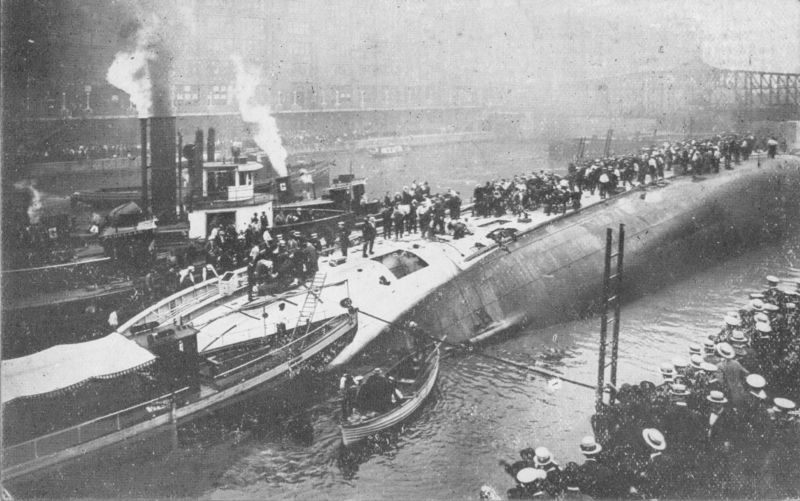
On July 24, 1915, nearly 900 people died when SS Eastland capsized in the Chicago River. It was a particularly astounding loss of life considering that, unlike in most deadly shipwrecks, the calamity occurred only 19 feet from shore in the middle of a metropolis. On the 100th anniversary of the SS Eastland catastrophe, look back at the deadliest disaster in Chicago history.

Even the falling drizzle couldn’t dampen the soaring spirits of the crowd who gathered on the banks of the Chicago River on July 24, 1915. Employees of the Western Electric Company, the country’s only telephone manufacturer, savored a rare Saturday off and looked forward to a day of fun with family and friends at the company’s annual summer excursion to Michigan City, Indiana. Not wanting to miss a single enjoyable moment, passengers with picnic baskets and baby carriages in tow began to board SS Eastland, the first of five vessels chartered by Western Electric, at the early hour of 6:30 a.m.

Women in long summer dresses and men in three-piece suits chuckled and joked as the slender steamship occasionally rocked from side to side during the hour-long boarding in what felt like a preview of the roller coaster and other stomach-dipping amusements that awaited them on the other side of Lake Michigan. Deep below deck, however, Eastland’s crew knew the listing was no laughing matter. “The Speed Queen of the Lakes” may have been one of the Midwest’s fleetest ships, but it was hardly the safest. The ballast system, which was designed to keep the steamer on an even keel, suffered from repeated malfunctions, and at least twice before—in 1904 and 1907—the vessel nearly capsized. “Eastland’s owners were aware of stability problems that needed to be repaired but planned to postpone them until after the sailing season ended in 1915 because of the expense,” says Michael McCarthy, author of “Ashes Under Water: The SS Eastland and the Shipwreck That Shook America.”

The required addition of lifeboats on the top deck in the wake of the 1912 sinking of Titanic and a recent 500-passenger capacity increase authorized by inspectors only compounded the steamship’s stability problems. With its three decks packed to its new 2,500-person limit, Eastland began to creep away from its berth at 7:30 a.m., but as its stern swung into the Chicago River, the ship’s listing from side to side turned violent.

“Look out, she’s tipping!” cried warehouse workers along the river. Dishes and bottles crashed to the floor. Panic along with the Chicago River gushing through gangways and portholes swept across the decks. Frightened passengers and crew jumped to the dock as the last line holding Eastland to the wharf snapped like a whip.

For those on board the steamer, the world suddenly turned sideways.


Eastland rolled onto its port side and rested partially submerged in less than 20 feet of water. “It lay like a toy boat of tin wrecked in a gutter,” reported the Chicago Tribune. The unfortunate passengers who happened to be on the port side were crushed by the hundreds of people, deck chairs and other furniture that suddenly fell on top of them. “The entire crowd of men, women and children came slipping and sliding and sprawling down with a mass of lunch boxes, milk bottles, chairs—rubbish of every sort—on top of them,” said passenger George Goyette. “They came down in a floundering, screaming mass.” As the enclosed decks filled with water and debris, the mob of humanity who tried to scale the staircase to the promenade deck, now turned sideways, turned the lone escape path into a deathtrap.

Screams mixed with gurgles as survivors struggled to stay afloat in the filthy river, a toxic cocktail of raw sewage and detritus from Chicago’s stockyards. Few passengers knew how to swim, and even those who did were weighed down by their water-logged dresses and heavy suits. Rescue boats scrambled to the scene as welders ran with torches in hand to the crippled steamer. Hearing the muffled cries of the desperate passengers pounding on the metal hull, the welders began to cut rectangular escape hatches when Eastland’s horrified captain, Harry Pedersen, incredibly protested that they were “ruining his ship.” “The captain showed more regard for the company property than the people inside,” McCarthy says.

As doctors tried to force water out of victims’ lungs with pulmotors, rescue workers hoisted lifeless bodies found by divers working in the dark holds of the ship. In all, the Eastland tragedy claimed 844 victims, including more than 50 infants. In just mere minutes, the capsizing wiped out 22 entire families.

Pedersen, the ship’s engineer and four of its owners stood trial for the disaster, but a federal judge changed the original charges from criminal negligence and manslaughter to conspiracy to operate an unsafe ship. As McCarthy notes, the owners may have been negligent, but there certainly was no conspiracy. Represented by the legendary Clarence Darrow—who was in the “valley of his career” according to McCarthy after accusations of bribing jurors on an earlier case—the six men were all found not guilty. No one was ever held criminally responsible for the disaster, and a civil trial that dragged on for more than two decades ultimately provided little money to victims’ families. “I don’t believe justice was done,” McCarthy says. “The Eastland story offers an example of how important it is to bring charges against people who have endangered lives and how careful you must be to pin the charges on them.”

Although the Eastland disaster was the deadliest in Windy City history—claiming seven times the lives as the official death toll from the Great Chicago Fire—it quickly faded from public memory. McCarthy attributes this in part to the lower economic status of the victims as well as the timing. “This happened just before the U.S. entered World War I, and the world-changing events eclipsed so much else of what was going on,” he says while adding, “It is remarkable that something so catastrophic wouldn’t be better remembered.”

Friday 24 July 2015

http://www.history.com/news/chicagos-deadliest-day-100-years-ago

continue reading

Egypt boat accident death toll climbs to 31


The number of people who died after a boat collision in Cairo has risen to 31 after 13 more bodies were retrieved, the Health Ministry said on Friday.

A search operation was still ongoing at the site of the accident in Giza, part of the Greater Cairo zone, three days after the boat sank in the River Nile after a cargo ship hit it, the ministry added.

Reports meanwhile conflicted about the number of the people who were aboard the pleasure boat when the accident took place late on Wednesday.

While some witnesses said there were around 60, officials put the figure at around 35.

Egypt's health ministry said on Friday that the death toll from a collision of cargo ship and a boat on the Nile carrying people celebrating the holidays of post-Ramadan feast on Wednesday has risen to 31, after several more bodies were retrieved from the river.

The captain of the cargo ship and his assistant have been detained pending investigations. According to early investigations, the ship was not meant to travel at night.

According to AFP, the family and friends of a young couple had hired the boat to celebrate their recent engagement. However, it is unclear whether the young couple were among those killed.

Some 150m far from the coast, the front of the boat has appeared on the surface, with some of the remained ornaments and broken colored lamps, and silent music speakers that never stopped playing popular songs in very loud voice, while the backward of the boat was still sinking.

Awaiting people in lines near the coast were staring cautiously at the rescue team who appears from time to time around and near the boat sometimes with victims and many times with empty hands.

Families in queues were standing near the Nile river coast on Friday, while others are searching among the recovered bodies in hospitals for their missed relatives.

On Thursday, family members and locals staged a protest following the tragedy. Protesters cut off roads in Warraq and briefly clashed with security forces, according to Al-Ahram.

"Our family cemetery isn't wide enough for burial of our victims in one time, " Moustafa Ali said when he stood outside the morgue room of Tahrir Hospital to receive corpses of his family members.

Ali has lost seven persons of his relatives including his wife and two children in two boats collision late on Wednesday.

Ali told Xinhua that two of his family's beloved are still missing, "I had to experience the grief of burial two times: we will hold a funeral and bury five bodies, then we will attend a second funeral for other two victims when retrieved."

Egypt’s Ministry of Health, meanwhile, stated that rescue operations would continue and that the death toll is expected to rise.

Boat accidents are frequent in Egypt due to overloading and failure to comply with safety standards.

In 2006, Egypt had its worst maritime tragedy when more than 1,000 people drowned in a ferry boat sinking in the Red Sea.

Friday 24 July 2015

http://gulfnews.com/news/mena/egypt/egypt-boat-accident-death-toll-climbs-to-31-1.1555499

http://www.shanghaidaily.com/article/article_xinhua.aspx?id=294088

continue reading

Thursday, 23 July 2015

Migrant crisis: Desperate relatives search for Syrian housewife who disappeared after Greece shipwreck


Syrian Roeda Amir was on a smuggler's boat carrying up to 35 people when it capsized between the small Greek islands of Agathonisi and Farmakonisi just 10 miles from Turkey.

A housewife in war-torn Syria, the 39-year-old ethnic Kurd planned to seek asylum in Europe after reaching Greece by boat with her brother, Rodin.

But those dreams were shattered in the Aegean Sea on 7 July during the deadliest Mediterranean shipwreck since May.

Roeda is one of 16 people declared missing or feared drowned in the incident. Her brother was rescued by the Greek coastguard and is at a hospital on the island of Samos.

And while Greek and Turkish coastguards have rescued respectively eight and 11 people each, only five bodies have been retrieved.

Roeda's cousin, Khaled Ameer, contacted in a desperate plea to find her after IBTimes UK published a report on the shipwreck.

"We haven't had any news about her, we are depressed. Please can you help me?" he said via Facebook.

"My uncle is worried and he's always crying. Same thing for his wife. I always check the news on the web but there is no news, unfortunately."

The family is from Afrin, a town in northern Syria in the Aleppo Governorate that became part of the autonomous Kurdish region of Rojava. In the past few days, Roeda's father has left Rojava to go and search for his daughter in Turkey.

"I can't explain in words the state he's in," said Ameer, who arrived in the UK two years ago and now lives in Nottingham.

"If she's dead, we need to know to hold a funeral for her. But we don't know anything yet."

He agreed to share a photograph which shows Roeda spreading her arms and smiling on the beach on a sunny evening.

IBTimes UK contacted the International Organization for Migration (IOM) in Greece which said it was looking into Roeda's case. The Greek coastguard has yet to reply to a request for a list of missing persons during the shipwreck.

Survivors allegedly said that the 15 people that were missing were locked in a room inside the boat and could not open the door. "The coastguard needs a diving expedition to recover the bodies," Ameer said.

More than 68,000 migrants, mainly Syrian, Afghan and Iraqi refugees, have attempted to cross the Aegean from Turkey to the Greek islands, which is double the total figure of arrivals in 2014.

In islands such as Lesbos, which has a population of about 90,000, the arrivals may cause a humanitarian crisis with debt-ridden authorities unable to cope with the unprecedented influx of asylum seekers.

It has been calculated that about 1,000 refugees arrive on the shores of Lesbos daily and more migrants arrived on the island in June than in the whole of the previous year, according to the United Nations. There were about 15,000 arrivals in June as opposed to the 12,187 in 2014.

Thursday 23 July 2015

http://www.ibtimes.co.uk/migrant-crisis-desperate-relatives-search-syrian-housewife-who-disappeared-after-greece-shipwreck-1512080

continue reading

Nile 'party boat' crash kills at least 18 in Egypt


At least 18 people have been killed in a crash between a cargo vessel and a passenger boat on Egypt's River Nile.

Family and friends of a young couple had hired the boat for an engagement party and were sailing north of Cairo when it was hit, eyewitnesses said.

The interior ministry said the bodies of four babies had been recovered. Several passengers are still missing.

Five people were rescued from the crash scene and the captain of the cargo boat has been arrested.

It is not clear if the couple thought to be celebrating their engagement were among the casualties.

Relatives of the dead and missing gathered on the banks of the river to await news of their loved ones.

Witnesses said fishermen had been first on the scene at night to pull out the corpses and survivors.

The search was initially hampered by darkness but resumed after daybreak, with police and emergency vessels trawling the river looking for survivors.

A rescue diver emerged from the water empty handed as a crowd of onlookers and relatives of the passengers gathered on the river bank, an AFP reporter said.

Rescue workers used a mechanical digger to raise the wreckage of the party boat from the water.

"At around 8, 8:30 pm, a big cargo ship collided with the boat," said Mostafa al-Soweissi, whose brother had captained the chartered vessel.

"After the collision we took fisherman boats and from 8:30 until now we took out around 19 bodies," he said, reflecting confusion over the exact toll.

Children missing

Ahmed Helmy, another relative of passengers, said at least five of his family members were killed in the accident.

"Two children are missing," he said.

Helmy accused emergency services of arriving late, but a health ministry official told an Egyptian newspaper that rescue efforts had initially been hampered by the crowd.

Family and friends of a young couple had hired the boat to celebrate their engagement. It was not clear whether the couple were among the dead.

The captain has been detained for four days along with three of his assistants on suspicion of manslaughter, the official MENA news agency reported.

They are also suspected of having operated the ship without following safety regulations, the agency reported.

The Nile, which runs along the length of Egypt, is dotted with cargo ships, party boats and fishing vessels.

In 2011, at least 22 people drowned in southern Egypt when a bus they were in slipped into the Nile from a ferry which crashed into the river bank.

A year before, five people drowned north of Cairo when their boat capsized.

In the deadliest accident involving a ferry, an Egyptian vessel sank in the Red Sea in 2006 killing more than 1,000 people.

The accident fuelled resentment against the veteran strongman Hosni Mubarak, who was toppled in a 2011 popular uprising.

Traffic had been heavy along the Nile, where many Egyptians had been celebrating the end of the holy month of Ramadan.

Thursday 23 July 2015

http://www.bbc.co.uk/news/world-africa-33632887

http://news.asiaone.com/news/world/least-18-dead-cargo-ship-hits-egypt-party-boat

continue reading

Flood destroys hundreds of villages; 13 more killed


At least 13 more people have died as heavy floods swept away hundreds of villages in parts of the country, destroying almost everything in their path.

According to reports, as many as six bodies were recovered while six others went missing after a flash flood stream swept away two vehicles and an auto rickshaw in Lasbella, Hub, the industrial town of Balochistan.

The flash floods swept away two vehicles of pilgrims going to the tomb of Shah Noorani. The rescue teams reached the site soon after being informed and recovered six bodies.

It may be mentioned here that the recent torrential rains have caused havoc in Zhob district of Balochistan, inflicting huge losses on livestock and disrupting the communication system.

Standing crops and around 370 livestock have been washed away since the torrential rains began. The townships affected by rains and subsequent streams of rainwater include Taki, Wela, Bring, Omza, Naerazai, Mir Alikhel, Khowsti, Marghazai, Maloor, Torkhala, Deragara Babar, Datozai, Bobai and Irabzai.

Zhob District Chairman Qazi Ahmed Khosti told reporters said the current torrential streams have caused losses worth millions of rupees, and appealed to prime minister, chief minister and the provincial disaster management authority to respond to the disaster quickly so that further losses can be averted.

At least 170 more villages of Kot Adu, Ali Pur and Kandhkot areas have been washed away in floods, while victims continue to shift to safer places. Moreover, moderate level flood in Ravi River has been reported. Separately, Mozah Ahmed Bhagyala in Harappa has completely been inundated.

Flood in Sindh River has resulted in inundation of hundreds of adjoining villages.

According to details, dozens of villages in Muzaffargarh, Layyah, Kahror Laal Hussain and Kot Mithan have been inundated. As many as 70 villages of Ghotki have lost land connections to other parts.

Levees have collapsed in Dera Ghazi Khan, while the authorities have opened spillways of Tarbela Dam.

At least 450,000 cusecs of water is passing through Sindh River at Muzaffargarh point.

The authorities have shut down more than 200 canals due to flood in Head Taunsa. These canals include Muzaffargarh Canal, Dera Ghazi Khan Canal and TP Link.

To add to the tragedy, boats owners are charging at least Rs 1,000 per person to shift families to safer places.

According to a report by the National Disaster Management Authority, this season’s floods have so far caused three deaths in Chitral, while three people have lost their lives in Punjab’s Muzaffargarh district. A further three were killed in the Balochistan district of Zhob, the report added.

The flood has also washed away as many as 180 buildings including houses, shops and hotels in Chitral while damaging another 15 bridges and 12 roads, the agency said.

Over in Gilgit-Baltistan, rescue and relief operations continued on Wednesday in Skardu and Ghanche after heavy rain and land sliding.

District Ghanche was the most affected area where about 11 villages were damaged.

Provincial Minister for Education Haji Muhammad Ibrahim is supervising the relief work besides monitoring the rehabilitation work in the affected areas. He said that effective measurers were being taken to restore bridges, power, irrigation channels in all part of the district.

Also, the Rajanpur district administration has set up 32 relief camps while Rescue 1122 shifted 1,300 people to safer places as medium-level flood situation persisted in the mighty Indus River.

Rajanpur DCO Zahoor Hussain visited the flood-affected areas and ordered the rescue teams to continue relief and rescue operations in the district.

The DCO said that the army had not been called in so far to assist the administration, as the Indus River was still experiencing medium-level flood.

He, however, added that help from Pakistan Army would be sought in case the flood level rises above 500,000 cusecs.

Dozens of teams of rescuers were busy in rescuing people from low-lying areas in Rajanpur district at six different points. Water flow from hill torrents was decreasing gradually. No casualty has so far been reported in the wake of the ongoing flood situation and land links among different areas in Rajanpur district were intact.

Thursday 23 July 2015

http://www.dailytimes.com.pk/national/23-Jul-2015/flood-destroys-hundreds-of-villages-13-more-killed

continue reading

Wednesday, 22 July 2015

Two more bodies recovered after flooding in Iran’s Alborz Province


Two more bodies have been recovered in the aftermath of flash floods in the north-central Iranian province of Alborz.

The victims were from the provincial village of Sijan, said Ehsan Nasiri, the managing director of Iran’s Red Crescent Society (IRCS) in Alborz Province, in an interview with IRNA on Tuesday.

There have been conflicting reports about the number of casualties caused by the flooding in Alborz. Reports put the death toll at anything between eight to eleven.

Officials had previously said that the number of fatalities could rise as rescue teams had been dispatched to the areas affected by the flooding and could be expected to recover more bodies.

Flash flooding triggered by torrential rain hit Alborz, located to the northwest of the Iranian capital, Tehran, on Sunday.

The heavy flooding inflicted widespread damage and destroyed infrastructure in provincial villages. Dozens of cars were also washed away by floods, which caught locals off-guard.

Meanwhile, a summertime storm also struck Tehran Province and nearby areas on Sunday, damaging buildings and bringing down power lines and trees.

At least four people were also killed in the storm in Tehran Province.

Wednesday 22 July 2015

http://www.presstv.ir/Detail/2015/07/22/421297/Iran-Alborz-Province-flooding-Chaloos-road-

continue reading

Tuesday, 21 July 2015

Remembering the S.S. Eastland disaster of 1915


What started out as a day of celebration for more than 2,500 workers of the Western Electric Company turned into the deadliest disaster in Chicago history. On the morning of July 24, as workers and their families gathered aboard the SS Eastland for a trip to Michigan City, Ind., problems with the ship's weight and ballast tanks – which had been emptied before the launch – caused the ship to roll over while it was docked in the Chicago River.

Little known today, one of the great disasters in U.S. history occurred 100 years ago this week in Chicago, and caused heartbreak and anxiety throughout Illinois including Champaign-Urbana.

Although no one from here perished in the tragedy that struck the S.S. Eastland as it sat moored to a dock on the main branch of the Chicago River, for days afterward local newspapers carried stories about friends or relatives who were missing, or who had intended to board the boat that Saturday morning for an excursion across Lake Michigan.

Even today there is some dispute about the number of people who died when the sleek boat, called "The Speed Queen of the Great Lakes," capsized in about 20 feet of water between Clark and LaSalle streets on the south side of the river. Most accounts say 844 people died, others say 848. In those days following the accident there were newspaper reports that as many as 1,338 lost their lives.

Even so the death toll was greater than the number (766) who died in the Great Chicago Fire 44 years earlier, and is still considered one of the worst accidents (in terms of lives lost) in U.S. history.

Almost all the dead were employees or family members of employees who worked at the gigantic Western Electric plant just outside of Chicago, where telephone equipment was manufactured. Five boats, including Eastland, had been chartered to carry an estimated 7,000 people to the picnic at Michigan City, Ind.

There was immediate concern that recent University of Illinois graduates who worked at Western Electric would be among the dead.

"Walter J. Blum, who completed a course in electrical engineering at the university in 1914, and F.J. Naprsteck, who finished a course in architectural engineering in the same year, are among the former university students working for the Western Electric Company for whom no word has been received since the disaster this morning," The Champaign Gazette reported hours after the accident.

A few days later, however, local papers reported that they and others were safe. The manager of the student apprentice program at Western Electric, which included 30 UI students, wired: "All Illinois men checked up as safe."

Then came stories of narrow escapes, people who attempted to rescue survivors and local undertakers who were enlisted to care for the dead.

The sister of Champaign Police Chief A.U. Keller initially was reported among the missing "until an inquiry by wire brought the information that Miss Keller was not on the ill-faced boat. She had purchased a ticket but for some reason did not go aboard," the Urbana Daily Courier reported.

Another story said that Frank Holmgren, a young man from Rantoul, had been on the Eastland but was thrown into the river as the boat "turned turtle."

"Holmgren was on the upper deck and when thrown into the water he easily swam to the dock," the Courier said. "He and another young man were with a couple of young lades when they were thrown into the water and became separated from them, both the girls being drowned. Homlgren has been in Chicago only a few months and was employed at the Western Electric plant. He is well known (in Rantoul), having at one time had charge of a local moving picture show."

Mrs. Carrie Hatch, a nurse at the Cook County Psychopathic Hospital, wrote to her daughter in Urbana following the accident, and her letter was reprinted in the Courier.

"You can't imagine the dark pall of death that hung over the city yesterday. No theatre, no park open, nothing but hearses and ambulances flying in every direction," she wrote. "I went in my uniform and was allowed anywhere. I went on both bridges and saw the old ship on its side with 700 bodies underneath. I saw the divers bring up many bodies.

"Then I went to armory No. 2 on through the morgue and looked at the poor unidentified bodies, mangled and bleeding — people looking into every black and mangled face for their loved one. I never beheld such a sight of repulsion in all my life."

Urbana undertaker C.A. Fry left town to care for the dead, the Courier said."When the appalling number of dead was realized, Coroner Peter Hoffman of Cook County sent appeals for help to downstate undertakers, and the Urbana man responded. Mr. Fry individually prepared the bodies of 10 victims for burial," said the Courier.

A book on the Eastland, written 20 years ago by George W. Hilton, concluded that the disaster was caused by post-Titanic modifications — including the addition of lifeboats and life rafts — that made it top-heavy and unstable.

Civil lawsuits following the accident gave little comfort to the victims and their families. Laws at the time limited liability to the value of the ship, $46,000, and claims by the salvage company that towed the Eastland away took precedence. There was little money left for the families of middle- and lower-class victims, many of them immigrants with names like Buszkiewicz, Grochowksi, Cmucha, Stejskal, Cifrik and Zdrojewska.

Tuesday 21 July 2015

http://www.news-gazette.com/news/local/2015-07-19/tragedy-chicago-echoed-c-u-100-years-ago.html

continue reading

Cyprus: plea for information on the missing


President Nicos Anastasiades has appealed to anyone who has information with regard to missing persons in Cyprus to come forward and share it with the Committee on Missing Persons (CMP).

Speaking on Sunday evening at an event organiSed by the Cyprus Committee of Relatives of Missing Persons and Undeclared Prisoners of 1974, at the Panorama of Missing Persons, in the village of Kornos, Anastasiades noted that this appeal was made both by him and the leader of the Turkish Cypriot community Mustafa Akinci.

“We are exerting pressure in all directions for Turkey to finally be persuaded to cooperate and allow search operations in areas which it has turned into closed military zones,” the President said, adding that he raised the issue with European Commission President Jean-Claude Juncker.

Efforts have also been directed towards the five UN Security Council Permanent Members, he noted.

“As long as the Cyprus problem remains unresolved and as long as there are military occupation forces that describe some of our occupied areas as ‘military zones’, finding our missing persons or at least investigating the fate of our missing persons will unfortunately be impossible,” he said.

Anastasiades said he would not stop, together with the rest of the political leadership, to pursue a solution to the Cyprus problem that will abolish armies and military zones, and which will provide every Cypriot citizen with the right to reside freely where he or she wishes, with human rights safeguarded. The missing persons issue, he said, was one of the integral elements of the solution.

The list of missing persons includes 1,508 Greek Cypriots, 43 of whom went missing between 1963-1964 when intercommunal violence broke out in Cyprus. The list also includes 493 Turkish Cypriots, 229 of whom are thought to have been lost during the period 1963-1967.

Two hundred and sixty four Turkish Cypriots went missing during the 1974 Turkish invasion of the island and there have been some reports that 126 of them were lost in the areas of Aloa-Maratha-Sandalari.

So far 444 identifications of Greek Cypriots have been carried out and 138 of Turkish Cypriots. Approximately 200 cases are in the stage of anthropological or genetic analysis, 100 Greek Cypriot missing cannot be identified and the remains of 800 missing persons are still to be located.

Over 30 missing persons remains identified so far this year

Greek Cypriot member of the Committee on Missing Persons in Cyprus (CMP) Nestoras Nestoros has said that the remains of 34 missing persons had been identified so far in 2015.

He told the Cyprus News Agency that the Committee was focusing both on the quality of the tests carried out and the quantity of the remains handed over to the families.

Nestoros said that the number of missing persons identified could be much more “if we gave the relatives a couple of bones of their loved ones.” He said that in the cases of ‘mixed bones’ such as those found in mass graves, they are tested but when skeletal samples fail to come up with a DNA identification or the DNA distinctiveness is low “then we deem that we must continue our efforts.”

Thos remains that fail the DNA test for one profile may match with the profile of another missing persons and the tests start over.

“We have to be able to give the families as many bones as possible,” Nestoros said.

He said that after the conclusion of the genetic tests, the lab experts evaluate whether they must send new samples from other mixed bones that have not been identified. “Our aim is to exhaust all scientific means with a view to return as much of the remains as possible,” Nestoros added. In the case of complete skeletons, when the DNA distinctiveness is low then more genetic material is sent for DNA tests, he said. Nestoros said that when the remains are handed over to each family, relatives are also given a comprehensive report comprising the anthropological findings, genetic tests and a comprehensive archeological report in Greek, English and Turkish.

He noted that according to the recommendations of foreign experts, the CMP was implementing a pilot programme with a view to determining whether it should change the protocols of its anthropological tests in the cases where mixed bones are discovered.

According to Nestoros, excavations are being carried out currently in nine areas, two in the government controlled areas and seven in the breakaway Turkish Cypriot state in the north.

He called on everyone who participated in the burial of people or has any information to give to the Committee to do so. He said that from the 444 Greek Cypriots who have been identified, 281 were found buried in different places from where they had reportedly disappeared. (CNA)

Tuesday 21 July 2015

http://cyprus-mail.com/2015/07/20/anastasiades-issues-plea-for-information-on-the-missing/

http://cyprus-mail.com/2015/07/17/over-30-missing-persons-remains-identified-so-far-this-year/

continue reading

U.S., Japanese veterans, 95, work to find missing comrades


Tuesday, Leon Cooper, who is 95 and lives in Malibu, will leave for Japan to meet with Kokichi Nishimura, who is 95 and lives outside Tokyo.

During World War II, the two were enemies, each sent by his country to New Guinea, where they endured some of the bloodiest fighting of the war.

Cooper was a boat group commander taking U.S. assault troops to the shore at New Guinea and elsewhere. Nishimura was an infantryman at an earlier battle in New Guinea called the Kokoda Track and later in Burma.

Now they share a passion: that a decent reckoning, and appropriate honors, be made for their countrymen killed in combat. Each is livid with allegations that his country is not more aggressive in accounting for the fallen.

They have never met. But each felt drawn to compare experiences. Nishimura is frail, and the meeting may take place in a hospital.

In his devotion to finding Japanese — and Australians — killed in New Guinea, Nishimura left behind his business and his family in the late 1970s and moved to New Guinea — now known as Papua New Guinea. With occasional returns to Japan, he remained in New Guinea until his health declined in 2007, forcing a final return to his homeland.

In New Guinea, he acquired the nickname the "Bone Man of Kokoda," which is the title of a 2008 book about Nishimura written by Australian journalist Charles Happell.

Cooper's efforts to find and honor the dead from the battle on the atoll of Tarawa were chronicled in the documentary by filmmaker Steven Barber, "Return to Tarawa: the Leon Cooper Story." Barber is accompanying Cooper to Japan with plans to co-produce, with Matthew Hausle, an updating of the Cooper story, "Return to New Guinea."

Cooper, in an interview Sunday, said he has heard that Nishimura wants to know if the hatred that Americans once felt for Japanese has subsided.

My feeling is: 'How long can you harbor hatred?' "Cooper said. "I don't hate the Japanese. Most of the people I hated are dead. I outlived them, which is the best revenge."

After the war, Nishimura founded a successful engineering firm. Cooper had various business ventures, including founding an early computer company and serving as chief financial officer for several corporations.

Each traces his concern for the remains of those killed to an unchanging sense of duty.

Nishimura has said that when he married his wife after the war, he told her that someday he would return to New Guinea to retrieve the bodies of his comrades. "It was a promise I made to my friends," he told Hausle last year.

Cooper remembers soldiers in his landing craft, in Tarawa, New Guinea and other battles.

"I know that some of those guys were killed and are still missing," he said. "I took them across the River Styx into the killing field. It haunts me still."

Although the Defense Department has recently reorganized its effort to account for the missing, Cooper said the effort is still ineffectual.

"I want our government to live up to its promise not to leave any man behind," he said. "There are more than 80,000 who remain where they fell. It makes me so mad."

In an interview with the Japan Times, Nishimura offered similar criticism of the Japanese government. Estimates of Japanese dead unaccounted for during World War II reach into the millions.

"They don't care; it has always been the same," he told journalist David McNeill. "Everybody today is against war in Japan, but nobody wants to talk about what happened."

While in Japan, Cooper hopes to meet with the U.S. and Australian ambassadors. He is especially eager to meet with U.S. Ambassador Caroline Kennedy, daughter of John F. Kennedy.

"We share a connection," he said.

Kennedy's father's PT-109 was based at Tulagi, one of the Solomon Islands. Cooper's ship, the attack transport Harry Lee, stopped briefly at Tulagi — which proved long enough for sailors and soldiers facing combat, including Cooper, to go ashore and get drunk.

The trip to Japan is being underwritten by Gordon Cooper, a nephew of the late astronaut Gordon Cooper. Leon Cooper knew the astronaut but, similar name not withstanding, they were not related.

Cooper plans to visit the Yasukuni Shrine, Japan's shrine to its war dead, although Cooper has mixed feelings about the shrine, particularly its inclusion of military personnel convicted of war crimes, including Hideki Tojo, Japan's prime minister during much of the war. Tojo was hanged as a war criminal in 1948.

About Nishimura, Cooper has no mixed feelings.

"Like me, he was sent [to New Guinea] to protect his country," Cooper said. "But I bet neither of us had such lofty ideas in mind. We just wanted to get the hell out alive."

Tuesday 21 July 2015

http://www.latimes.com/local/california/la-me-veterans-meeting-20150721-story.html

continue reading

Monday, 20 July 2015

Colombia to begin large-scale excavation of mass grave


Colombian officials will soon begin exhumation of a mass grave that could prove to be the largest in the country's history, authorities said Friday.

The grisly work of unearthing the mass grave in Medellin, Colombia's second-largest city, will begin on July 27 and will likely take months to complete. The bodies are believed to be the result of years of fighting among right-wing paramilitaries, leftist guerrillas and drug traffickers.

Workers could discover more than 100 bodies, according to national prosecutor's office spokeswoman Caterina Heyck, though it's hard to know in advance what they will find.

She said it could be "the largest" judicial exhumation in Colombia's history. Officials received information on the mass burial site from demobilized paramilitary fighters.

The country's five-decade long civil war has left the landscape pockmarked with unmarked grave. In recent years, officials have exhumed thousands of bodies and attempted to return the remains to family members. Workers use DNA to match bodies with people reported missing.

The government has been negotiating with the guerrilla group the Revolutionary Armed Forces of Colombia in Havana for two and a half years to end the conflict.

Saturday 18 July 2015

http://www.nytimes.com/aponline/2015/07/17/world/americas/ap-lt-colombia-exhumation.html?_r=0

continue reading

Remains of 86 Jewish Holocaust victims used for human experiments by Nazis found hidden in Strasbourg lab


The remains of 86 Jewish people sent to Nazi gas chambers in 1943 have been discovered at a forensic medicine institute in eastern France.

The bodies of the victims were brought from German holocaust camps to the then Nazi occupied city of Strasbourg in eastern France where they were used by Nazi anatomy professor August Hirt for experiments, according to news agency AFP.

Some of the bodies remain intact while others are dismembered and burnt.

It was thought that the bodies had been buried in a common grave in 1946, following the liberation of the city by Allied forces two years earlier. However, historian Raphael Toledano found that some remains were still lying undiscovered in the institute 70 years on.

Toledano, along with the director of the institute Jean-Sebastien Raul, identified many of the body parts including a jar of “skin fragments” from a gas chamber victim.

Test tubes containing intestine and stomach were also found, according to news agency reports.

The remains had been preserved by a forensic professor from Strasbourg’s medicine faculty, Camille Simonin, as part of an investigation into Hirt’s crimes.

A letter written by Simonin in 1952 gave Toledano a clue as to the location of the remains which mentioned jars containing “samples taken in the course of judicial autopsies carried out on the Jewish victims of the Struthof gas chamber“.

A statement announcing the bodies’ discovery said that labels on each piece refer to the register 107969 and “match the number tattooed at the Auschwitz camp on the forearm of Menanchem Taffel, one of the 86 victims".

Local authorities are reportedly planning to return the newly discovered remains to the Jewish community of Strasbourg where they will be buried at the cemetery of Cronenbourg.

Hirt was an SS-captain who served as a chairman at the Reich University in Strasbourg during World War II. During the war he worked together with other Nazi experimenters to collect human corpses from among inmates at Auschwitz in preparation for an anthropological display at the university.

Hirt killed himself in 1945 before he could be tried for war crimes.

Monday 20 July 2015

http://www.independent.co.uk/news/world/europe/remains-of-86-jewish-holocaust-victims-used-for-human-experiments-by-nazis-found-hidden-in-strasbourg-lab-10400263.html

continue reading

Saturday, 18 July 2015

Forensic Imaging Software: A Tool to Break Cold Cases?


One group pioneering this technology is the National Center for Missing and Exploited Children (NCMEC), a nonprofit organization that works with law enforcement agencies and families to aid in cases of missing and exploited children. The NCMEC utilizes a variety of functions to fulfill its mission of helping to find, aid, and protect children. The agency has had great success in the past through its initiatives, as it has assisted in the recovery of more than 208,000 children.

Computer generated imagery is a relatively new technology, although it has been used heavily in recent years in cases of missing or unidentified children and has proven to be vital in investigations. This unit was first instituted by the NCMEC in 1990, and has been used so far in 6,000 age progressions, 1,300 of them leading to children being found or identified through the pictures. CNN reports, “forensic imaging and age progression are often fairly accurate and can help find the missing or unidentified children.” When comparing images created by forensic artists to real life photographs, it is evident that they are very close to the real thing, and are an integral tool in most cases.

For example, a recent case in Massachusetts has renewed focus on the benefits of forensic imaging technology. The remains of an unidentified young girl, who is believed to have only been about four years old and has been dubbed “Baby Doe,” were found in a trash bag on a Boston Harbor beach about three weeks ago. Even though the following computer-generated image of her has been seen by millions of people, authorities have had little to no luck in their efforts to identify her. This tragic case has mystified law enforcement and captivated the hearts of Americans nationwide, as people continue to search for any clues that could lead to the identification of this girl.

Authorities are working furiously to find any possible lead that could help them to identify the girl, perplexed as to how no one has recognized her yet. It is not clear whether her death was accidental or intentional, and investigators are desperate for any information at all that could lead to her identity or the cause of her death. Law enforcement in Massachusetts has teamed up with the NCMEC since this agency is well trained in these types of situations and offers many useful resources, including its expertise in forensic imaging.

The image of Baby Doe was created by Christi Andrews, a forensic artist who works with the NCMEC and who tried to make the face of the girl look as realistic as possible using Adobe Photoshop. In order for Andrews to join the Forensic Imaging Team and become a specialist, a job she has had for twelve years now, she had to first receive extensive training in order to master the software. She constructed the image by studying the precise details and photos from the autopsy. The picture has been shared hundreds of thousands of times on multiple different social media platforms and seen by over fifty million people, but unfortunately, no valuable tips have arisen.

This type of software is instrumental in many cases because it assists investigators in their efforts to identify deceased victims, create realistic, up-to-date photos of missing people that can be used when searching for them, and can garner useful information from the public once released. In the case of Baby Doe, Andrews was limited to pictures and information given from the coroner, although when creating age progression images, artists can often utilize pictures of family members to analyze similarities and use this to generate life-like images. Our culture’s obsession with taking photos has actually proven to be useful when it comes to creating these age progression images because it gives the specialists more to study and compare to.

After these images are produced, they are distributed to the masses via a variety of platforms, such as social media, billboards, flyers, through news stations, or other sources. The goal is to have as many people view it as possible so that the likelihood of someone recognizing the subject and contacting the police increases. This tool is especially helpful in cases of children who have been missing for many years, because the age progression feature gives investigators a glimpse of what the children might look like currently. This is crucial because not only does it increase the chances of other people recognizing this person, but also the missing person themself might see it. There might be children out there who were abducted at too young of an age to remember and are raised in a new family, so if they were to see these images displaying missing children that resemble them, this might cause them to recover old memories or even come forward if they suspect that they could be the child. Forensic imaging software is a critical tool for a multitude of reasons, although most importantly, it can be used to solve cases that seemingly have come to a screeching halt.

Saturday 18 July 2015

http://lawstreetmedia.com/blogs/crime/forensic-imaging-software-tool-break-cold-cases/

continue reading

MH17 dead honoured in Eastern Ukraine


Late in the afternoon of July 17 last year, Marina Volkova was nearly killed by a dead body.

Her husband, Yevgenny, a miner, was watching television and she was on the computer when two powerful blasts reverberated through their home in the village of Rosipnoye, Ukraine.

In the context of war, the explosions did not come as much of a surprise. Knowing that combat aircraft had been operation in the region, she assumed the village had come under attack.

"We'd already spoken about what to do," she told The Daily Telegraph a few days later. "So we dashed across the yard to the cellar."

It was then, as she opened the door of the house, that something crashed into the yard.

It was the body of a woman. They still do not know her identity.

Almost everyone in the villages of Rosipnoye, Grabovo, and Petropavlivka has similarly horrific memories of the moment Malaysian Airlines flight 17 was destroyed 10,000 metres above their homes exactly a year ago.

But for many, July 17 2014 was just one particularly dark day in a nightmarish war.

The war between the Ukrainian government and Russian-backed separatists has now killed more than 6,000 people. The grim reality, as Mrs Volkova put it last week, is that people were already living in fear when MH17 crashed, and they continued to do so for months afterwards.

Shortly after the disaster, the war washed over the crash site like a tide, leaving shell holes and bits of rocket scattered amongst the chunks of fuselage, airline seats, and personal effects that remained here for months before being moved.

Compared to other towns, Grabovo got it "relatively light," said Vladimir Berezhnoi, the local mayor, talking about the war as one would the weather. "We were only in our basements for a couple of nights."

The war has now retreated. Rebel gains over winter pushed the front so far away that you can now visit the crash site without seeing a single soldier, and the locals are making a stab at returning to normal.

But the approach of the anniversary brought back memories that many had repressed.

"I didn't sleep for nights, and it wasn't because I was busy," Mr Berezhnoi said last week as he recalled last summer. "I had never seen anything like that - bodies, bits of bodies, hands, legs, heads - and I never want to again."

"The smell is still there - not so much the bodies, but definitely still the fuel. And we still find bits. Bits of plane, bits of people," he said.

Eight lorries of such "fragments" have been dispatched to the Netherlands in the months since, he said. Many more likely remain in the earth.

For Mr Berezhnoi, who says villages have voluntarily brought in money, laptops, and phones found around the crash site, the reports of looting that circulated at the time were both offensive and confusing.

"It was a surprising thing to read. How could we have done? The soldiers set up checkpoints on both ends of the road straight away. We couldn't even get to the site."

"I think the Dutch didn't believe those stories, because the last time they were here the investigators offered everyone in the village humanitarian assistance," he said.

In fact, says Mr Berezhnoi, the tragedy and the war have in many ways brought out the best in people.

"We have a saying: tragedy brings people together. Before the war, if I tried to organize a subbotnik, or voluntary clean up, I'd get 15 or 20 people at most. When a shell made a big crater in the road I just had to say the word and hundred people showed up to help," he said.

Much as the recovery effort fell to the locals, so too has the business of remembrance.

Each village was holding a memorial service Friday - a modest attempt to honour the foreign dead.

And the villagers have also raised the only monuments to the disaster.

In Grabovo, the road-side cross that greets travellers entering the village has taken on the role of a shrine. Its traditional inscription of "save and protect" assuming a new, more sombre meaning since the centre section of MH17 fell in an inferno of black smoke and flame in the meadow across the road.

One of the few relatives of the dead to make the difficult journey here has left photographs of a victim pinned to it. The locals maintain a wreath there.

It is a fact lost on few that Grabovo itself escaped destruction by a margin of a little over 10 metres - a strange stroke of fate that Mr Berezhnoi thinks the village priest may find worth mentioning in his memorial sermon.

Across the road, on a telegraph pole next to the still charred earth of the centre-section fire, someone has affixed a placard with a poem of remembrance.

A new memorial at Grabovo, funded by donations from across the region, was unvieled at a ceremony attended by representatives of the separatist government on Friday.

At Rosipnoye, an Orthodox cross has been raised on the spot where the cockpit ploughed into a sunflower field.

A modest flower bed is arranged at its foot, and in front of it have been placed two tiny plastic hinges with American serial numbers - the kind of wreckage that can still be found in any garden or field in the area.

Mrs Volkova, who planned to lay flowers from her garden at the site, says she would like to see something more permanent.

At the Volkova's house, 100 yards away, the roof destroyed by the falling corpse has been repaired and the window that it hit bricked up.

Under the same eaves, a family of house martins has built a nest - a sign for good fortune for a house in Russia and Ukraine, and in many ways the very opposite of the tragedy that occurred here a year ago.

"They say that's a good sign," said Mrs Volkova. "So we're hopeful."

Saturday 18 July 2015

http://www.newindianexpress.com/world/MH17-Dead-Honoured-in-Eastern-Ukraine/2015/07/18/article2927167.ece

continue reading

Friday, 17 July 2015

Lahore: consistent procedure needed regarding unidentified bodies


Muhammad Younas, an official at the Edhi Welfare Foundation Lahore, throws a pile of files at a big table. The record, carrying pictures and available details about hundreds of unidentified bodies, have been compiled for years.

“All these bodies, temporarily buried in Miani Sahib, — one of the oldest and biggest graveyards of the town, have a permanent status now because the percentage of the bodies’ identification is quite low,” recalls the officer. Photographs are meant to be shown to those who come looking for their missing loved ones.

In the past six months, Edhi Foundation in Lahore has buried as many as 170 unidentified bodies with the help of police and Municipal Corporation. Most of the unidentified bodies are of men.

The number of unidentified bodies, sadly, is growing day by day in the dense cities of the country where law and order is fast becoming a challenge. The reason of death changes from area to area due to circumstances like heat wave, use of drugs, murder etc.

The procedure of identifying such bodies is delayed or overlooked in some cases.

In February this year, the federal government told the Supreme Court of Pakistan that as many as 4,557 bodies were found in the country over the past four years. The Punjab police submitted a report before the apex court stating that as many as 1,299 unidentified dead bodies were found in the province in the last two years. Out of them 1248 were buried and 51 were sent to the mortuary.

According to the stated procedures, police told the court, “If a body is unidentified, the officer making the investigation shall record a careful description of it — all marks, peculiarities, deformities and distinctive features. He shall take the finger impression in addition to taking all the reasonable steps to secure identification, have the body photographed and in cases where such action appears desirable, a description published in the Criminal Intelligence Gazette.” These unidentified bodies are temporarily buried in a graveyard of the concerned union council.

In the past six months, Edhi Foundation in Lahore has buried as many as 170 unidentified bodies. Most of the unidentified bodies are of men. In case unidentified bodies have been handed over to a charitable organisation for burial, the concerned secretary of the union council will follow through the burial proceedings. Law also binds the police to carry post-mortem of every unidentified body to know the cause of death and, if the person is known to have been murdered, the police are supposed to make all investigations into the matter.

However, an old worker at Edhi Foundation, asking not to be named, says the procedure is not implemented in letter and spirit. “The usual practice is to have postmortem of the body which is then handed over to Edhi for burial. If the police discern the dead person’s status, they store the body in the official mortuary for a certain period.” However, a senior police officer Ejaz Shafi Dogar says that police cannot rule out the defined procedure to handle unidentified dead bodies. “We are supposed to do maximum effort for the identification of the body and maintain the record.”

“There is need to make sure that police take finger prints of the unidentified body soon after its recovery for NADRA identification,” the Edhi official suggests, adding, “with the increasing population in big cities, the number of unidentified bodies is increasing gradually which should be a matter of concern for the government.”

Not many people know that the unidentified bodies, kept in the official mortuary, become the property of the dead house after six months, and are usually sold to medical colleges for dissection purposes.

“In many cases, police neglect can be seen in delaying or overlooking the procedures. Sometimes, the bodies are kept unidentified because their identification can expose some crime, adding to the police work which they don’t like to do,” says Dr Naseeb R Awan, Head of Forensic Department of King Edward Medical College. “There is no system followed so the concerned departments also try to shift their responsibilities to others,” he says. “There is need for serious efforts to review the laws, rules and procedures regarding unidentified bodies so that they are identified. It is also important to make the efforts transparent.”

Friday 17 July 2015

http://tns.thenews.com.pk/nameless-miseries/

continue reading

Philippines coal mine collapses, 3 dead, 6 missing


Three people were killed and six others were still unaccounted for when an open pit coal mine in the central Philippines collapsed on Friday due to heavy monsoon rain.

Antique provincial governor Rhodora Cadiao said three people had died and rescue workers are digging to recover six workers who were buried alive at the Panian coal mine site on Semirara island.

"Three workers were found and brought to a hospital but they were declared dead on arrival," Cadiao said, adding rescue teams are using heavy equipment to recover the six people buried by the collapsed coal mine.

She said it was raining heavily for days on the mine site, on an island off the main island of Panay in the central Philippines. "The accident happened around 3 a.m. while the workers were working on a water system," said Cadiao.

There were only nine workers at the site when the accident happened, said Isidro Consunji, CEO of Semirara Mining & Power Corp, confirming all were buried alive.

"Three bodies have been recovered as of this time and digging continues to look for six others," he said. "That's as far as I know. Some of our mining equipment has also been damaged. We don't have the complete details yet."

The Department of Energy on Friday suspended operations at the mine and a government panel will investigate the landslide, said Zenaida Monsada, the officer-in-charge at the department.

"We have directed Semirara Mining Corporation to focus on search and rescue operations," Monsada said in a statement.

Semirara a unit of Philippine conglomerate DMCI Holdings Inc , is the country's largest coal miner.

In a statement, the company said it complied with the suspension order but is "coordinating with national and local authorities to keep them updated on other necessary measures, including ensuring the adequate supply of coal for power generation".

In 2013, five people died and five others were missing in a landslide in the coal mine on Semirara island.

Friday 17 July 2015

http://uk.reuters.com/article/2015/07/17/philippines-mining-disaster-idUKL4N0ZX24520150717

continue reading

It never happened: How to deny genocide in the face of science


Scientific advances in DNA identification over the past 15 years have helped war-crimes investigators document to an unprecedented extent the massacre of 8,000 Bosnian Muslim men and boys around this town in 1995.

Yet even as these technological advances uncovered more damning evidence, many Bosnian Serbs have grown increasingly more resolute in their denial.

Last Friday night, two Bosnian Serb men standing beside a memorial to Serb war dead were a telling example. They insisted that Serbs are the victims of an international plot. They fervently argued — despite 93 mass-grave exhumations and 6,827 DNA identifications of the dead — that the mass killings have been grossly exaggerated.

Biased historical narratives, of course, have existed throughout history. The identification of the dead in Srebrenica demonstrates the ability of technological advances to produce a flood of factual information. Yet in many cases, the scientific statistics appear to have only given those willing to manipulate the numbers more arrows in their quiver.

The two Bosnian Serbs contended that roughly the same number of victims died on each side during the 1992-1995 war. When I asked how such a vast subterfuge had been carried out, one said the answer was simple. “As far as the Muslim side,” he told me, “there is a bigger lobby in America.”

The following morning, interviews with a dozen other Bosnian Serbs living near Srebrenica produced similar answers. As tens of thousands of Bosnian Muslims drove past their homes to commemorate the 20th anniversary of the mass killings, Serbs dismissed the gathering and the idea of 8,000 dead as a “farce,” a “circus” and “make believe.”

“It’s definitely not correct,” said Budimir Todorovic, a 60-year-old electrician, as he calmly drank coffee with his family in his front yard as busloads of Bosnian Muslims drove by. “It’s not 8,000.”

Milan Rakic, a 48-year-old store owner, accused Muslims of stealing the bodies of Orthodox Christian Serbs and interring them in the town’s sprawling cemetery complex.

“There are a lot of Serb bodies buried in this memorial,” he said.

One elderly widow said that some Bosnian Muslims listed as dead in the Srebrenica memorial were, in fact, living in Germany. “The number is exaggerated,” she said. “There are many living people whose names are engraved on the gravesites.”

The woman, like the other Serbs interviewed, was genial and polite. The Serbs expressed regret about the war — the woman declared it “horrible, horrible.” But they echoed the arguments of Bosnian Serb nationalists who still dominate politics here. The nationalists contend that foreign powers, primarily the United States and Britain, stage-managed everything from the war itself to the burial of bodies in Srebrenica.

They dismissed the annual commemoration as a “provocation” also organized by meddling outsiders. They said the crowds were so large because “Western NGOs” paid people to attend.

“Everything is well coordinated,” one man standing at the memorial for Serb war dead told me. “No one from here is guilty for what happened.”

Denial is evident outside Bosnia as well. Disparate groups, including left-leaning academics, Russian government-controlled media and some right-wing Americans who talk about a Muslim takeover, scoff at the number of 8,000 dead.

In fact, the annual commemoration and cemetery here have become a global symbol of the international community’s failure to stop the killing in Bosnia. U.N. officials arrived in Srebrenica in 1993 and declared it a United Nations protected “safe area.” When Serb forces attacked it two years later, Dutch peacekeepers and U.N. commanders did little to defend the enclave, and it fell to Serb forces on July 11, 1995. Two weeks of mass expulsions and mass executions followed.

Twenty years later, an estimated 50,000 Bosnians and several thousand foreigners attended the anniversary commemoration last weekend. Dozens of foreign dignitaries did as well, with former President Bill Clinton saying the world must prevent more such killings.

In the largest DNA identification project ever, a nonprofit group called the International Commission on Missing Persons has collected 22,268 blood samples from Srebrenica survivors and matched them to 6,827 bodies.

“Huge advances in DNA identification have made it possible,” said Kathryne Bomberger, director of the project. “The science is moving rapidly.”

Along with 93 mass graves that have been exhumed, investigators have found bodies at 314 “surface sites” in the surrounding mountains. Yet the work is not over. With 8,000 men reported missing from Srebrenica and the nearby town of Zepa, another 1,200 bodies are believed to be scattered in the woods or in mass graves not yet located.

Finding the dead has been vastly complicated by a grisly Bosnian Serb effort to conceal evidence. Several months after the executions, Bosnian Serb forces dug up many of the mass graves and reburied the bodies in dozens of locations. In the process, many corpses were dismembered.

Body parts from single victims have been found at multiple sites. In one case, parts of the body of one victim, 23-year-old Kadrija Music, were discovered in five different mass graves 20 miles apart.

While the DNA identification of the bodies has received widespread praise, the uneven sentencing practices of the U.N.-created International Criminal Tribunal for the former Yugoslavia has elicited scorn from both Muslims and Serbs.

Bosnian Muslims hailed decisions from the tribunal, as well as the United Nations International Court of Justice, that ruled genocide had occurred in Srebrenica. But they criticized some of the sentences as far too short.

Meanwhile, Serbs insist they have been the victims of the court. They assailed the tribunal for ultimately acquitting Naser Oric, commander of Bosnian Muslim forces in Srebrenica, though they say he is responsible for many deaths

“How many Serbs need to be killed for people in the world to see that Serbs are people, not animals?” asked Rakic, the store owner, who said his uncle was one of Oric’s victims. “Animals have rights but not the Serb people?”

International war-crimes investigators, however, say there is no proportionality in the deaths in Srebrenica or Bosnia as a whole. The say several hundred Serbs died in the fighting around Srebrenica, but the vast majority of them were Serb military forces.

Across the country, Bosnian Muslims made up 65 percent of the war dead and Serbs 23 percent, according to prosecutors. Yet Bosnian Muslims made up 44 percent of the population, according to a census conducted two years before the war. Serbs made up 31 percent.

Meanwhile, Bosnian Serb news accounts lay out a different narrative. They report that 1,300 Serb civilians died around Srebrenica, and a total of 3,267 Serbs were “murdered” across eastern Bosnia.

Dismissing the Bosnian Serbs’ statements as irrelevant conspiracy theories would be easy. But their assertions had an eerie familiarity. In conversations around the world, extremist Muslims, Jews, Hindus and Buddhists, as well as some on the far right and far left of U.S. politics — have all featured similar arguments.

The stories usually involve a nefarious plot by outsiders to destroy their culture or faith, or future. They say they have had to act in self-defense. As the victims of the plot, they have no choice but to respond.

There is usually some distant, all-powerful covert force — the CIA, the Mossad, oil-rich Arab potentates — deftly stage-managing each event. Local people are helpless victims, with no responsibility for what occurs.

When I asked the Bosnian Serb men about the future of the former Yugoslavia, they said it would be decided in London and Washington. “Basically, how the English and Americans decide,” one told me. “That’s how it will be.”

Though there had been a decade of progress in Bosnia after the 1995 peace accord ended the war, the country has been moving steadily backward over the past 10 years. Bosnian Serb denial of the Srebrenica massacre is growing. Bosnian Muslim resentment of that denial is simmering.

Violence erupted at the 20th anniversary commemoration. Groups of young Bosnian Muslim men hurled stones and slurs at Serbian Prime Minister Alexander Vucic, a wartime ultranationalist now turned pro-Western moderate, forcing him to flee.

The International Commission on Missing Persons, meanwhile, is expanding internationally and applying the DNA identification system it developed to tragedies in other parts of the world. It is identifying the missing in Iraq, Chile and South Africa, as well as victims of typhoon Haiyan in the Philippines and the passengers shot down in a Malaysian airliner over Ukraine.

Yet scientific and technological advances seem to have changed few views. One new conspiracy theory circulated by Serb nationalists is that the remains recently buried in the Srebrenica memorial are Filipinos who died in typhoon Haiyan.

Friday 17 July 2015

http://blogs.reuters.com/great-debate/2015/07/17/it-never-happened-how-to-deny-genocide-in-the-face-of-science/

continue reading

MMDA asks owners of funeral homes to ready body bags, Philippines prepare for disaster


With the “Big One” likely to cause 35,000 deaths, owners of funeral parlors are not only being asked to participate in the “Metro Manila Shake Drill” but also prepare to provide cadaver bags.

The exercise to be conducted by the Metropolitan Manila Development Authority (MMDA) is scheduled on July 30 to prepare residents for what the Philippine Volcanology Commission says is a 7.2-magnitude earthquake that is due to hit the capital anytime.

In a news briefing on Thursday, MMDA Chair Francis Tolentino urged members of the Philippine Mortuary Association (PMA) to participate in the disaster simulation as well as to extend their services should the worse happen.

Public service not business

Urging morticians and funeral parlors to view this as a public service and not as a business, Tolentino requested each member of the 400-strong PMA to provide 500 cadaver bags.

He said operators of mortuaries had an important role to play in times of disasters, such as taking care of the dead and the prevention of the outbreak of epidemics.

“We need to establish definite roles for every sector involved in disaster preparedness and management as each and everyone should be ready to provide necessary services to the public in times of disaster,” Tolentino said.

The MMDA has projected 35,000 deaths in case of a massive earthquake, with Manila and Quezon City expected to have the most number of casualties.

Mass burial site identified

Earlier, the MMDA identified an area in Macapagal Boulevard as the designated mass burial site during the earthquake simulation. The MMDA and National Disaster Risk Reduction and Management Council (NDRRMC) are set to sign a memorandum of agreement with the PMA on Monday on disaster preparedness and response.

The deal includes the training of at least five of the MMDA’s personnel in embalming with the help of the PMA and the Department of Health. In turn, the MMDA and NDRRMC will provide training in rescue operations for funeral parlor personnel and community coordination in their barangays in times of disaster.

For their services, Tolentino said the government would pay them back with the barangays (villages) expected to pay for the cadaver bags used in their respective areas.

Ready to help

According to PMA chair Renato Dychangco, the group was prepared to deploy personnel to assist in preserving and identifying the bodies in the event of a massive earthquake.

The Metro Manila Shake Drill, amid the ringing of alarm bells and audio recording of a rumbling earthquake, has been scheduled on July 30 from 10:30 a.m. to 11:30 a.m. in the capital region, except in Pasig City, where it will be held from 7:30 p.m. to 8:30 p.m.

Friday 17 July 2015

http://newsinfo.inquirer.net/705783/mmda-asks-owners-of-funeral-homes-to-ready-body-bags

continue reading