Wednesday, 12 September 2012

Overcoming the aftermath of flash floods

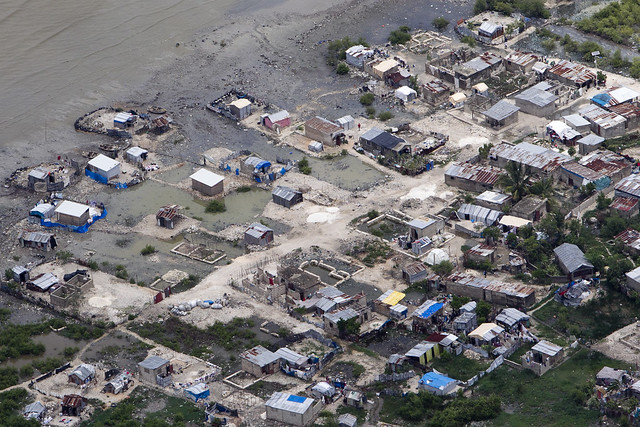
PANO – Flash floods, landslide and torrential rains have claimed several lives and damaged local people’s properties and crops from Lao Cai, Yen Bai to the Central region in recent days.
Local troops and militia have been joining hands with locals to overcome the aftermath of the calamities, attempting to help locals return to normal life soon.
Bodies of victims being sanitized before a burial service
Searching for the missing after the landslide in Trong Pao Sang village, La Pan Tan commune (Yen Bai) PANO’s reporters and collaborators have taken some photos of this assistance as follows.

continue reading

Unrelenting rains kill up to 37 more in Sindh, eight in Punjab

DERA GHAZI KHAN / SUKKUR: As rains and floods continue to lash Sindh, at least 37 people lost their lives across the province on Tuesday while access to hundreds of coastal villages was cut off as several roads were washed away.

Over the past five days, Sindh has been hit by widespread rains with Jacobabad receiving 481mm, Larkana 215mm, Sukkur 206mm, Chhor 137mm, Badin108 mm and Hyderabad and Dadu recording 90mm of rainfall.

Like the past year, monsoon has left many low-lying areas in Shikarpur, Jacobabad, Thull, Kashmore, Kandhkot, Sukkur, Khairpur, and Larkana submerged.

In Kashmore, 17 people, including women and children, were killed as hundreds of katcha houses collapsed when the flash floods hit the area around midnight. According to the Met office, more rains are expected in parts of lower Sindh and southeast Balochistan over the next 24 hours.

Sindh Chief Minister Qaim Ali Shah has announced a grant of Rs5 million to each rain-affected district in the province.

Meanwhile, as floodwaters receded from the badly-hit Dera Ghazi Khan district on Tuesday, four bodies were recovered from Choti Zaireen over the last 48 hours. Small amounts of flooding continued to plague Rajanpur, Rojhan, Jampur and Dera Ghazi Khan.

In addition, another four people died in Rajanpur when a clash broke out between panicked residents trying to divert floodwater from a rural area, Sukhera. Police were unable to reach the spot and intervene in time because ground routes were blocked.

Although D G Khan’s urban area has been drained of water, inundated rural areas are still being cleared out by the district administration in coordination with the flood victims themselves. As many as 50,000 people have returned to the city in the last 24 hours after evacuating earlier. Inter Services Public Relations (ISPR) confirmed that more troops had arrived to rescue people in the flooded regions.

Meanwhile, the D G link canal was in the process of being repaired. Three major breaches have been fixed while the other four are expected to be repaired by today at noon (Wednesday). Agricultural losses are estimated to have affected around 20,000 acres of rice, wheat, cotton, maize and other crops, according to the provincial agricultural minister. Makeshift medical camps have been set up on the National Highway since the major hospitals of the city, including the District Headquarters hospital, remain inundated.

According to district officials, as many as 2,000 houses have been affected in D G Khan, including those which have been completely destroyed – but losses are still building up. Heritage sites, including the mausoleums of Hazrat Bukhari and Jamalallah in Rajanpur, have also been badly damaged.

D G Khan’s tribal area has experienced the biggest devastation, where necessities are being provided via helicopters.

Infuriated residents, however, organised separate protests across the district to demonstrate over not being provided relief items. Demonstrators chanted against political leaders and complained that they needed aid, not statements and visits accompanied by a cohort of security vehicles.

In Balochistan, meanwhile, thousands remain stranded due to the disruption of electricity and communication lines, especially in Naseerabad and Jaffarabad. Blocked routes have led to a massive shortage of food and medicine while crops over thousands of acres have been destroyed and livestock lost. One man drowned in Bolan district’s Machh Nullah.

Moreover, cracks have appeared in the banks of the Pat Feeder canal at five different places which has exacerbated the flooding. The breaches have inundated dozens of low-lying villages, forcing hundreds of families to move to higher ground. The floodwater has also entered the Uch Power Plant due to which half of the plant has been closed, sources told The Express Tribune.

Railway tracks and highways in Jaffarabad and Naseerabad were inundated, cutting off rail links between the province and the rest of Pakistan for the third consecutive day.

While the Provincial Disaster Management Authority (PDMA) has already dispatched some trucks carrying tents and other food items to the affected areas, it is unable to match the needs of the affected people.

“We are stuck in Dera Murad Jamali and there’s water everywhere. We are sitting in the district commissioner’s office in stagnant water that’s two feet deep,” said a PDMA driver talking to The Express Tribune. He added said that some of the PDMA drivers were stranded in Jhal Magsi and contact couldn’t be established with them due to the disruption of phone networks.

According to Inter-Services Public Relation (ISPR) sources, the army has also kicked off relief efforts on a large scale following the orders of the Southern Command.

Wednesday 12 September 2012

http://tribune.com.pk/story/435267/unrelenting-rains-kill-up-to-37-more-in-sindh-eight-in-punjab/

continue reading

Floods in South Sudan suspected to have killed 15 people

Around twelve people in Western Equatoria State and three people from Awerial County in Lakes State are believed to have died due to floods and fast flowing rivers over the last two days, according to officials.

Western Equatoria State’s minister of information and communications, Charles Barnaba Kisanga, said in a statement on Tuesday that a whole vehicle - registration number CE515R - traveling from Yambio to Juba had been washed away at the at the Luri Bridge crossing of the Luri River at 8pm on Monday. All 12 passengers are believed to have died.

"We are deeply saddened by such event which shows the dangers of driving on our roads these days”, Kisanga said.

Heavy rains across South Sudan are making roads impassable and cutting off commercial activities and supplies from reaching towns and rural areas.

Minister Kisanga explained there was nothing much the state government could do to improve the situation since there was a lack of funds due to the austerity measures introduced after South Sudan stopped oil production in January as part of a transit fee dispute with Khartoum.

The cuts have crippled government plans to link the area to Juba and other towns and areas with well maintained roads.

“They have been cut and we can only advise drivers to take extra care. The Western Equatoria Government is currently mobilizing some resources for the part between Madebe and Ibba but it may not provide any immediate solution”, he said.

“We only advise drivers to exercise maximum care especially if deciding to use the Jambo-Juba Road. The advice is to use [the] Yei-Juba Road even though this is also in bad state and takes longer. Luri has become very hazardous”, he explained.

“The driver Joseph Peter survived the accident. We are still waiting on news update from Juba on the recovery of bodies. Our condolences to all relatives and friends of those who might have perished in the accident”, he said.

In Lakes State, the Awerial County commissioner David Mayom Riak, has reported that more than 2,000 people have been displaced and three people, including a nine-year-old child have died due to flooding.

Heavy rain caused the Gel River, which is located at the eastern part of the county, to overflow, Mayom said, adding that the floods had been a surprise.

Commissioner Mayom said that Dor, Bunagok, Alel and Magok payams [districts] were affected, asking humanitarian organizations, the state government as well national government in Juba to quickly intervene.

This is the first time serious floods have hit the county since South Sudan became independent last year.

Wednesday 12 September 2012

http://www.sudantribune.com/spip.php?article43864

continue reading

Pakistan factory fires kill 125

Factory fires have broken out in two major cities in Pakistan, killing 125 people and injuring dozens more, including some who had to break through barred windows and leap to the ground to escape the flames.

Workers recounted how their colleagues were trapped behind blocked exits, and firefighters said that one reason why the blazes were so deadly is that the buildings a shoe factory in the eastern city of Lahore and a garment factory in the southern port of Karachi lacked clear escape routes.

Such safety issues are common throughout Pakistan, where buildings also lack emergency equipment like alarms and sprinklers and municipal rules are rarely enforced.

The most deadly blaze came in Karachi, the country's economic heart, killing at least 100 people.

Firefighters could be seen pounding on the metal grates covering some of the windows and pulling out smoke-covered bodies. Many of the workers were injured when they jumped from the burning building, said a doctor at the Civil Hospital in Karachi, Karar Abbasi.

An injured factory worker, Mohammad Ilyas, speaking from the hospital, said he was working along with roughly 50 other men and women on one of the floors when suddenly a fireball came from the staircase.

"I jumped from my seat as did others and rushed toward the windows, but iron bars on the windows barred us from escaping. Some of us quickly took tools and machines to break the iron bars," he said. "That was how we managed to jump out of the windows down to the ground floor."

Fire fighters were still trying to subdue the deadly blaze that broke out on Tuesday evening, and senior police official Amjad Farooqi.

"There were no safety measures taken in the building design. There was no emergency exit. All the people got trapped," Farooqi said.

In Lahore, the fire swept through a four-story shoe factory and killed 25 people, some from burns and some from suffocation, said senior police officer Multan Khan. The factory was illegally set up in a residential part of the city.

It broke out when people in the building were trying to start their generator after the electricity went out. Sparks from the generator made contact with chemicals used to make the shoes, igniting the blaze. Pakistan faces widespread blackouts, and many people use generators to provide electricity for their houses or to run businesses.

One of the workers, Muhammad Shabbir, said he had been working at the factory for six months along with his cousin. He said all the chemicals and the generator were located in the garage, which was also the only way out of the building. When the fire ignited, there was no way out. Shabbir said he had just gone outside the factory when the fire started, but his cousin was severely burned and died at the hospital.

A firefighter at the scene, Numan Noor, said the reason most of the victims died was because the main escape route was blocked.

"The people went to the back side of the building but there was no access, so we had to make forceful entries and ... rescue the people," said Noor.

Pakistani Prime Minister Raja Pervaiz Ashraf in a statement expressed his shock and grief over the deaths in both cities.

Woensdag 12 September 2012

http://www.guardian.co.uk/world/2012/sep/12/pakistan-factory-fires-karachi?newsfeed=true

continue reading

Monday, 10 September 2012

Rain, flash floods kill 78 in Pakistan

Heavy monsoon rains which began falling last week destroyed more than 1,600 houses while damaging a further 5,000, Irshad Bhatti, a spokesman for the country’s National Disaster Management Authority (NDMA) told AFP.

“A total of 78 people have died and 68 injured in rains and flash floods in the country so far,” he said, adding that the casualties were caused mostly by houses collapsing and people being caught in floods.

The worst-hit region was Khyber Pakhtunkhwa province where 32 people have died and 26 were injured in several districts, he said, adding that 83 houses were totally destroyed and another 4,200 were partially damaged, he said.

In the northwestern district of Swabi eight Afghan refugees were killed when the roof of their mud house collapsed overnight, police official Mohammad Ali said.

The dead, who were members of the same family, included two women and six children aged between one and 12 years he said.

In Pakistan-administered Kashmir, flash flood killed at least 31 people, Bhatti said. Rains killed at least 26 people in that region last month.

Monday 10 September 2012

http://www.thefrontierpost.com/news/8012/

continue reading

29 killed in landslides and flooding in Vietnam

Landslides and flooding caused by heavy rains have killed 29 people and left four missing in northern and central Vietnam.

Disaster official Ngo Van Hung of northern Yen Bai province said that 16 villagers from the mostly poor Hmong ethnic minority group died in a landslide while they were illegally collecting tin ore from a mine operated by a private company.

Authorities are searching for two other people missing from the incident, he added.

The government disaster agency said flooding killed another 13 people and left two missing in central Vietnam over the past week.

The agency says on its website that flooding caused by heavy rains has caused an estimated 22 million US dollars in damage to rice crops and infrastructure.

Monday 10 September 2012

http://www.independent.co.uk/news/world/asia/29-killed-in-landslides-and-flooding-in-vietnam-8120967.html

continue reading

Sunday, 9 September 2012

Tractor full of workers hit by train. Eight people killed

Eight people were killed and one was severely injured on Saturday in an accident neat Chilieni, Covasna County. A tractor with trailer carrying 12 people was hit by a train. Upon impact, the people in the trailer were thrown 30 meters away. The vehicle was hit by a train going between Targu Mures and Brasov.

A spokesperson for the Covasna Police, Iulia Grigoras, told Mediafax Saturday afternoon that there were seven people killed in the accident. The injured woman who had goine into cardiac arrest could not be resuscitated, despite intervention teams’ efforts. Grigoras said the tractor driver, 78, failed to check for incoming trains, although the railway crossing was properly signaled.

Grigoras added that the driver was not injured in the accident. One of the injured people was taken by a SMURD helicopter to Targu Mures and another was to be taken to Sfantu Gheorghe Hospital by ambulance.

A total of eight people, six women and two men, were killed in the accident. Railway traffic was stopped in the area for several hours.

Saturday 9 September 2012

http://www.bucharestherald.ro/dailyevents/41-dailyevents/36733--terrible-accident-tractor-full-of-workers-hit-by-train-eight-people-killed

continue reading

Saturday, 8 September 2012

Argentina torture victim identified as Chilean

BUENOS AIRES, ARGENTINA -- Forensic scientists have finally identified a mutilated corpse that washed up on the shore in 1976 as that of a Chilean leftist who was among the first victims of the Argentine dictatorship.

The Argentine Forensic Anthropology Team used genetic evidence and fingerprints taken by Uruguay's military government at the time to identify the body as Luis Guillermo Vega Ceballos, an activist with Chile's Revolutionary Workers Party.

Vega Ceballos had been detained in Buenos Aires on April 9, 1976, along with his pregnant Argentine wife Laura Gladis Romero, whose body has never been found. The human rights group Grandmothers of the Plaza de Mayo believes she was among hundreds of dissidents killed after giving birth in captivity, and whose babies were raised by military or police families. The child would be turning 36 years old this month.

The discovery was announced Thursday night in Uruguay, where Peace Commission Secretary Graciela Jorge said "it closes a small chapter" in the history of the dirty wars that right-wing militaries fought against leftist revolutionaries in the 1970s.

Vega Ceballos' corpse showed clear signs of torture when it washed up on the coast of neighboring Uruguay, which also was ruled by a dictatorship, from 1973-1985. He had been mutilated and his hands were tied. Still, Uruguayan authorities followed their laws and took fingerprints that eventually enabled forensic scientists to identify the body.

In all, eight bodies that had washed up on the coast and been buried in a cemetery in Colonia, Uruguay were sent this year to the forensics team in Argentina. Of them, three others have been identified: Argentines Horacio Adolfo Abeledo and Roque Montenegro, and Uruguayan Alberto Mechoso Mendez, she said.

Abeledo was a 22-year-old salesman who was detained on July 21, 1976, according to Argentina's official registry of the disappeared. Montenegro disappeared along with his wife, Hilda Torres Montenegro, six weeks before Argentina's March 24 coup.

Their daughter, Victoria Montenegro, learned in May that her birth father had been identified. She recovered her true identity in 2000 with the help of the Grandmothers, and it was her blood that provided the match to her father's remains.

"No word exists to describe my feelings," she wrote in an open letter months ago. She described "the sadness of knowing my father's final destiny," along with "this feeling of peace that only comes with the truth."

She thanked the rights activists and forensics team for enabling her to recover her father's dignity, "so that he would no longer be an unknown body in a grave on the coast of Uruguay," and pleaded with other relatives of the disappeared to donate their blood to Argentina's genetic database.

"It makes us better, as Argentines, each time we can identify them and sing more strongly, 'we have not been beaten'," she wrote.

Rights activists suspect the victims were thrown from Argentine military planes into the wide Rio de la Plata that separates Uruguay and Argentina. Witnesses in Argentina have described torture victims being drugged and flown alive into the sea on the so-called "death flights."

Alberto Breccia, secretary to Uruguayan President Jose Mujica, said the identifications disprove critics who complain of misspent efforts to identify dirty war victims. He said Uruguay's program includes 35 people whose work includes unearthing cadavers, updating archives and adding to a database that now includes genetic information from 85 percent of the families of Uruguay's disappeared.

Saturday 8 September 2012

Read more here: http://www.kansascity.com/2012/09/07/3802021/argentina-torture-victim-identified.html#storylink=cpy

continue reading

10 miners die in latest China coal mine accident Read more here: http://www.kansascity.com/2012/09/08/3803259/10-miners-die-in-latest-china.html#storylink=cpy

BEIJING -- Ten miners have died after a platform overturned in a coal mine in northwest China.

China's official Xinhua News Agency says the accident happened Thursday night in Gansu province in a mine that was under construction.

Xinhua says the last body was pulled from the mine Saturday morning. It says the miners were plunged into water when the platform overturned. No other details were given.

China has the world's deadliest coal mine industry. Safety improvements have reduced deaths in recent years, but safety rules are often ignored and accidents are still common.

Saturday 8 September 2012

Read more here: http://www.kansascity.com/2012/09/08/3803259/10-miners-die-in-latest-china.html#storylink=cpy

continue reading

China earthquake death toll rises in Yunnan and Guizhou

At least 80 people are now known to have died in a series of earthquakes in south-western China, as rescuers struggle to reach remote areas.

More than 730 people were injured after the quakes hit Yunnan and Guizhou provinces on Friday, state media say.

The tremors struck mostly mountainous areas, causing landslides that blocked some roads.

The US Geological Survey registered the two strongest of the quakes at 5.6 magnitude.

Premier Wen Jiabao is expected to arrive in the area shortly.

China's Xinhua news agency quoted officials in Yunnan as saying 6,650 houses had been destroyed in the province and 430,000 others damaged.

More than 100,000 people have already been evacuated, said Xinhua, and the Red Cross has sent 650 tents and 3,000 quilts to the region.

The authorities have deployed the army to assist rescue teams in the rough terrain.

"Roads are blocked and rescuers have to climb the mountains to reach hard-hit villages," Li Fuchun, head of Yunnan's Luozehe town, was quoted as saying.

Mobile and regular phone service in the area was experiencing disruption, according to reports.

Most of the deaths were in Yunnan's Yiliang county, said officials.

Television footage from state-run broadcaster CCTV showed hundreds of local residents gathering on streets littered with bricks and rocks.

Users of the Twitter-like wesbite Weibo reported people rushing out of shaking office buildings, and photos posted online also showed streets strewn with rubble.

Aid agencies said they were concerned about the plight of children in the two provinces following the quakes.

"We are especially worried about those who may have been separated from their parents, as more aftershocks are expected to hit the area," Save the Children in China Country Director Pia MacRae said.

The largest of the quakes was also felt in the neighbouring province of Sichuan, where a 7.8 magnitude quake in 2008 left tens of thousands dead.

Saturday 8 September 2012

http://www.bbc.co.uk/news/world-asia-china-19527695

continue reading

Friday, 7 September 2012

Police use sketches to ID disaster bodies

Facial sketches have helped identify some of the people killed in the March 11, 2011, earthquake and tsunami, with 15 people identified since May from sketches drawn by police based on photos of the bodies.

According to the National Police Agency, 223 of the 15,802 bodies found in Iwate, Miyagi and Fukushima prefectures after the Great East Japan Earthquake remained unidentified as of Sept. 5.

The identities of 2,814 bodies--about 20 percent--were confirmed through DNA examination. Police are utilizing traditional techniques as well as modern scientific methods to identify the bodies about 1-1/2 years after the disaster.

The identities of 15,576 bodies, or 98.6 percent of those found in the three prefectures as of Aug. 8, have been confirmed. Soon after the disaster, bodies were identified mainly through their physical characteristics. About six months after the disaster, it became difficult to identify bodies through examination, so police have had to rely more on DNA tests.

However, it was difficult for the police to secure DNA samples of missing people for verification, such as hair or oil left on combs, as most of the missing people's houses were washed away. Samples from only 120 missing people have been obtained from items left in houses.

Since May 2011, the NPA has beefed up efforts to secure DNA samples through other channels, such as asking the Japanese Red Cross Society to provide blood samples of missing people who had donated blood. The NPA also asked medical institutions to provide cells from missing people collected during biopsies.

For those who left no DNA samples, the NPA has collected cheek swabs from relatives of missing people in hopes of a DNA match. Combining the results with other clues, such as teeth and other bodily characteristics, the agency has succeeded in identifying some of the unidentified bodies.

Since May, the prefectural police headquarters of Miyagi and Iwate have released 96 sketches of dead people, which were drawn from pictures of the dead bodies. Many of the bodies' eyes were closed and their faces were damaged, but police artists recreated the faces as if they were alive. The sketches were decisive in identifying the bodies of 15 people.

In June, a man from Kesennuma, Miyagi Prefecture, was able to identify the body of his father-in-law, who was 79 years old when he was killed, from a facial sketch posted on a Miyagi prefectural police website.

"I visited the morgue where his body was many times, but I couldn't identify it and even seeing a picture didn't help. However, the facial sketch was identical to his face when he was alive," the man said.

A senior NPA official said: "People seem more comfortable looking at the sketches rather than shocking pictures of dead bodies. We can also alter the the sketches if we don't receive many tips."

About 1 million police officers--counting those who made multiple visits--from around the country have visited the three prefectures to search for those missing after the disaster. However, only 16 bodies were discovered in the six months up to Aug. 31. According to police, 2,925 people remain missing.

Friday 8 September 2012

http://www.yomiuri.co.jp/dy/national/T120907003565.htm

continue reading

Flash Flood In Pakistan-Administered Kashmir Kills 13

PESHAWAR, PAKISTAN — Thirteen people were killed on Wednesday when a group of people was washed away by a flash flood in Pakistan-administered Kashmir, emergency officials said on Thursday, raising the death toll as a result of recent monsoon rains in northern Pakistan to 46.

The National Disaster Management Authority (NDMA) said heavy monsoon rains triggered a flash flood in Machiara Nullah, around 40 kilometers (24 miles) from Muzaffarabad, in the Azad Kashmir region which is administered by Pakistan. The floods washed away at least eighteen people.

Five people were injured and taken to medical facilities while rescue teams had recovered four bodies by Thursday, with the remaining nine people still missing and presumed to have drowned. “Efforts (are) on to recover the remaining dead bodies,” an NDMA official said, identifying the nine missing as six men and three women.

In other rain-triggered incidents on Wednesday, sixteen people were injured when a road collapsed as a bus drove over it in the Kotli district of Azad Kashmir. Landslides also killed two people in Pakistan’s Khyber Pakhtunkhwa province, one in Abbottabad district and the other in Mansehra district.

Heavy monsoon rains in northern Pakistan have killed at least 51 people in recent weeks, according to the National Disaster Management Authority (NDMA). The worst-hit area is Pakistan-administered Kashmir, where emergency officials have reported that at least 31 people were killed and 32 others were injured.

Earlier this year, the Pakistani government warned that nearly 30 million people across the country could be affected by flooding this year, advising local government officials and local citizens for adequate preparedness. Millions of people were also affected by the monsoon season last year, killing more than 300 people. Some areas saw the worst rainfall since at least 1936.

In late July 2010, above-average heavy monsoon rains in Pakistan’s Khyber Pakhtunkhwa, Sindh, Punjab and Balochistan regions killed approximately 2,000 people and affected around 20 million others as floods covered about a fifth of the country. Torrential rains overflooded rivers, which went cascading across the country from the mountainous north, inundating successive regions until they reached the sea. It was the country’s worst flooding in modern history.

Friday 7 September 2012

http://earththreats.com/2012/09/flash-flood-in-pakistan-administered-kashmir-kills-13/

continue reading

Toll in bus tragedy rises to nine

The toll in the bus tragedy in West Bengal's Bankura district on Friday rose to nine with recovery of seven more bodies.

Police superintendent of Bankura Mukesh Kumar said five bodies, including that of a young housewife, were found in Bhairabbanki river at Raipur in the district.

Two other bodies were found at Lalagrah in neighbouring West Midnapore during searches this morning, he said.

Search was on for more bodies, especially in the downstream near Lalgrah though no complaints of missing persons had been filed with the police, he said.

The private bus, which had fallen into the swollen river and was washed away while navigating a small bridge at Phulkulsma on way to Durgapur from Jhargram yesterday, has been pulled out of the water and no body was found inside it.

Neither was any body found trapped under the bus, he said.

The body of the 25 year-old housewife from Jhargram in West Midnapore was found at Junbani ghat in Raipur, while those of two men were found at Ekpal Ghat.

Bodies of two other men were found at Ambari ghat, also in Raipur. All the bodies except one found at Ambari have been identified, Kumar said adding all the bodies were taken to Bankura Medical College for post mortem.

Friday 7 September 2012

http://www.hindustantimes.com/India-news/WestBengal/Toll-in-bus-tragedy-rises-to-nine/Article1-926005.aspx

continue reading

Deadly bus crash in south Morocco

At least 42 people died when a bus plunged into a ravine in southern Morocco, officials say.

More than 20 others are reported to have been injured, some seriously.

The bus, travelling between the cities of Marrakesh and Zagora, left the road near the town of Zerkten in Haouz province and fell 150m (490ft), local officials said.

Most of the passengers are believed to be Moroccan. It is not clear if any foreigners are among the casualties.

"We are still in the process of identifying the bodies, as well as the injured," a local official told AFP news agency.

The accident happened in a mountainous area in the early hours of Tuesday, the official news agency Map reported. The cause is not yet known but an official in Haouz said an inquiry had been launched.

At least 24 people were said to be injured, 21 of whom were taken to a hospital in Marrakesh and the rest to a hospital in nearby Ouarzazate.

In a palace statement, King Mohammed VI offered his condolences to families of the victims and said he would pay for their transport, funeral and burial costs.

In July, two separate bus crashes in Morocco killed 26 people.

More than 4,000 people died in road accidents in Morocco last year, according to the transport ministry - an increase of 11.6% on the previous year.

4 September 2012

http://www.bbc.co.uk/news/world-africa-19475412

continue reading

Death toll in southwest China quake rises to 64

BEIJING - The death toll from two earthquakes that struck in southwestern China has risen to 64, the Xinhua state-run news agency said on Friday, citing provincial authorities.

Residents described people running out of buildings as the two quakes hit on the border of Yunnan and Guizhou provinces an hour apart around the middle of the day, followed by a string of aftershocks.

Television footage showed people running from damaged buildings and streets strewn with fallen bricks and rocks in Yunnan province's Yiliang district, which appeared to be worst hit.

The Xinhua news agency said 50 people had been killed and that rescuers have rushed to the quake zone. Authorities are also sending thousands of tents, quilts and coats to the area, it said.

The Yiliang county government said on its website that 556 people had been injured, while an online statement from the public affairs bureau in Zhaotong city, which overseas Yiliang, put the figure at 150.

The Zhaotong statement also said 100,000 people were made homeless by the disaster, and at least 20,000 houses collapsed or were damaged.

Altogether 700,000 people have been affected, it said.

The death toll could still rise as some villages remain blocked by landslides and the worst-hit areas may have lost power and communications, Xinhua said, citing local officials.

"The hardest part of the rescue now is traffic," Li Fuchun, the head Luozehe township, identified as the epicentre, was quoted as saying. "Roads are blocked and rescuers have to climb mountains to reach hard-hit villagers."

Rocks as tall as four meters (13 feet) crashed into mountain roads and landslides were also triggered, the report said.

The death toll may have been higher because of the area's denser population, with 205 people per square kilometer compared to 117 across the province, said Huang Pugang, head of the Yunnan seismological bureau, according to Xinhua.

In addition the epicentres of both major quakes were located just five to 15 kilometres from the county seat, he said, while the homes and buildings in the poor area might not have been built to withstand strong quakes.

Footage broadcast on state television network CCTV showed hundreds of people crowded into a sports field in Yiliang, a sprawling town surrounded by green mountains.

Many people took cover outside after the first quake and did not return indoors, said a man surnamed Xia reached by phone. "Lots of people are outside because they fear aftershocks," he said.

"I was walking on the street when I suddenly felt the ground shaking beneath me," posted one witness on Sina Weibo, a microblog similar to Twitter.

"People started rushing outside screaming, it still scares me to think of it now." So far, no casualties have been reported in Guizhou province, but the quake has damaged 1,540 homes there, Xinhua said, quoting the provincial civil affairs department.

The US Geological Survey said the first quake struck at 11.20 am (0320 GMT) at a depth of around 10 kilometres (six miles), with a second quake around an hour later, putting the magnitude of both at 5.6.

The China Earthquake Networks Centre put its magnitude at 5.7 and said it struck at a depth of 14 kilometres.

Southwest China is prone to earthquakes. In May 2008, an 8.0-magnitude quake rocked Sichuan and parts of neighbouring Shaanxi and Gansu provinces, killing tens of thousands and flattening swathes of the province.

Yiliang county has a population of 550,900, according to the latest official figures, and is listed as a priority district for state aid due to its poor infrastructure and the low average income of residents.

Friday 7 September 2012

http://www.asiaone.com/News/AsiaOne%2BNews/Asia/Story/A1Story20120907-370253.html

continue reading

Fireworks factory blaze in India kills at least 40 people

A massive blaze raged for hours at a fireworks factory in southern India, killing at least 40 workers and injuring 60 others on Wednesday, police said. Some reports put the death toll at more than 50. Flames billowing out of the factory could be seen one mile away before firefighters extinguished the fire more than five hours after it began. Photographs taken afterwards showed the factory had burned to rubble, with fireworks littering the ground. The fire spread to 40 of the 60 rooms at the Om Siva Shakti fireworks factory, one of the biggest in Sivakasi, in Tamil Nadu state, a police officer said. The Press Trust of India news agency said about 300 people were working in the factory and 52 died. The CNN-IBN television news channel said rescue workers had completed a search of the devastated building for trapped workers. Large amounts of firecrackers and raw materials were stored in the factory with major Hindu festivals weeks away. The cause of the fire was not immediately known, the officer said. Sivakasi is about 310 miles south-west of Chennai, the state capital. The region has many factories making fireworks, which are used in religious festivals and weddings across India. They also are exported to other Asian countries. Thursday 6 September 2012 http://www.guardian.co.uk/world/2012/sep/06/india-fireworks-factory-fire

continue reading

At least 61 die in Turkey boat sinking

At least 61 migrants including Palestinians and Syrians have drowned after their overcrowded boat sank just tens of metres off Turkey’s western Aegean coast. More than half of them are children.

The governor of the coastal district in Turkey’s Izmir province, said an initial investigation showed overcrowding caused the accident. The total death toll stands at 61, including 28 children and three babies.

The governor said 46 people had been rescued alive, including the ship’s Turkish captain and assistant, who had been placed under arrest. He added there were no bodies left on the boat, and he did not expect the death toll to rise any further.

Turkish media reported that the high death toll was because the women and children were in a locked compartment in the lower section of the small vessel. Although there have not been any official confirmation of this.

Nine children were among the dead, according to Turkey's Dogan News Agency. Several dozen survivors, mostly from Iraq and Syria, were able to swim through the Aegean waters to shore, only 50 metres away. Survivors had told authorities that some people were trapped below the deck of the submerged vessel, and divers launched an operation to try to find them.

Television footage showed several rescue vessels near the dim outline of the submerged boat, which lay just below the surface of the water. Ambulances waited at the top of a cliff, but there were no indications that anyone else had survived.

The group of migrants had previously made their way to hotels in the city of Izmir, where smugglers agreed to take them to Britain. Authorities arrested two Turkish suspects in the smuggling operation, Turkey's TRT television reported.

TRT earlier quoted Tahsin Kurtbeyoglu, a local administrator, as saying 20 bodies were recovered, but the toll rose through Thursday as more bodies were pulled from within the boat's confines. Those who survived were on the deck, rather than below with other members of their group.

It was not immediately clear when the boat sank, but many such vessels carrying migrants make the journey at night to avoid detection by authorities.

Migrants from Asia and Africa have long sought to reach Europe by passing through Turkey, and their desperate efforts have occasionally ended in disaster. Each year, thousands try to sail to Greek islands from Turkish soil in rickety boats.

Turkey is now hosting 80,000 Syrians who have fled the civil war in their country and are staying in camps just across the border, and some countries are concerned that larger numbers of Syrians could try to reach Europe illegally.

Greece said in July that it was quadrupling the number of guards at its border with Turkey and boosting other defences in part because of worries about a potential influx.

Some non-governmental groups believe migrants, deterred by tighter enforcement on the land border, are now turning back to more dangerous sea routes in their effort to start a life elsewhere.

Friday 7 September 2012

http://news.xinhuanet.com/english/video/2012-09/07/c_131833838.htm
http://www.skynews.com.au/world/article.aspx?id=792335

continue reading

Saturday, 1 September 2012

29 dead, 16 injured in Yobe auto crash

Twenty-nine people were killed and 16 injured in an auto crash that occurred on Friday on the Potiskum-Kano Road, at Daniski Village, Nengere Local Government Area of Yobe State.

Eleven of the victims were burnt beyond recognition, according to a statement by the Deputy Force Public Relations Officer, Mr. Frank Mba, a chief superintendent of police.

Mba said the accident happened when two Toyota Hiace buses travelling in opposite directions had a head-on collision, which resulted in instant fire.

Policemen from Nengere Division, Yobe State Command, assisted by members of the National Union of Road Transport Workers, responded to the incident.

The injured persons were rushed to the General Hospital, Potiskum, while the dead bodies were deposited at the hospital’s mortuary.

Expressing his concern over the incessant accidents on the highways, Mba said the Inspector-General of Police, Mr. Mohammed Abubakar, advised Nigerians to ensure that their vehicles are roadworthy at all times.

He warned against reckless driving, over speeding, over loading and flagrant disobedience of road traffic laws and regulations.

The police boss directed officers and men of the force attached to the newly rejuvenated Police Highway Patrol to take proactive measures at all times.

He ordered his men to work with other security agencies to assist road users in preventing accidents and rendering prompt assistance to victims of road crashes.

Saturday 1 September 2012

http://www.punchng.com/news/29-dead-16-injured-in-yobe-auto-crash/

continue reading

Scores dead in Arepo oil pipeline vandalisation fire

Scores of pipeline vandals and others scooping petroleum products from the vandalised pipeline were burnt to death in Arepo, a village off the Lagos Ibadan expressway, when the highly inflamable product caught fire.

An eyewitness said Officials of the Fire Service and the National Emergency Management Agency (NEMA), Thursday evening, battled to put out the fire from the vandalized pipeline.

Meanwhile, some armed oil pipeline vandals believed to be part of the gangs that have been attacking oil pipeline in the area are hampering recure work at the scene of the fire as they chased emergency workers and security officials away on Friday.

Men of the National Emergency Management Agency, the Federal Fire Service and National Security and Civil Defence Corps had to scamper to safety when they encounter the hoodlums.

The armed men were believed to have vandalized the Nigerian National Petroleum Corporation’s pipeline that ignited the inferno at Arepo.

The security men and rescue workers were at the scene to remove the corpses of the suspected vandals, who had been killed in the inferno earlier on Thursday.

NEMA officials and civil defence personnel, who had gone to the village to monitor the rescue operations, as well as journalists trying to access the village in canoes, were waylaid by hoodlums, who hid themselves in the bush.

NEMA Information Officer, Mr. Ibrahim Farinloye, told journalists that the agency and others were at the scene to recover dead bodies littering scene of the fire incident.

He said, “Our intention was to evacuate bodies and to help the fire fighters to extinguish the fire that has been burning since yesterday (Thursday).

“But as you can see, the vandals have refused to allow us to perform our work. We are even lucky to still be alive but we have contacted the military and they are on their way.

“We don’t want the bodies to decompose and begin to pollute the environment. The remains will spill into the surrounding stream and people drinking the water or using it for domestic purposes will definitely be at risk.”

Farinloye, however, gave the assurance that the rescue work would soon commence as the Director General of NEMA, Alhaji Muhammad Sidi, had requested the deployment of military personnel to flush out the hoodlums.

Saturday 1 September 2012

http://oguntoday.blogspot.co.uk/2012/09/scores-dead-in-arepo-in-oil-pipeline.html

continue reading

52 people dead after torrential rains flood Niger

Emergency officials in Niger say that 52 people have died after heavy rains caused rivers to overflow and buildings to crumble.

Col. Mahamane Laminou Moussa, the director general of the country's fire brigade service, said not a single neighborhood of the capital, Niamey, was spared. He said that on the night of Aug. 20, 4.7 inches of rain (119 millimeters) fell in the capital, pushing water under people's doors and causing rivers to rise to the highest levels since 1929.

In the capital, around 400,000 people are living in emergency shelters in schools and mosques.

In the northern province of Agadez, 81 villages have been flooded, leaving 44,600 people homeless. In Dosso district, 14,588 houses were destroyed. In Tillabery region, nearly 1,500 acres of rice fields were flooded.

Saturday 1 September 2012

http://www.thejakartapost.com/news/2012/08/31/52-people-dead-after-torrential-rains-flood-niger.html

continue reading

8 dead after canoe capsizes outside Guinea capital

Survivors say at least eight people have died and another 30 are missing after a canoe overloaded with merchandise capsized in the Atlantic Ocean off the coast of Conakry, the capital of Guinea.

Ibrahima Bangoura, one of the survivors, said the boat was traveling Friday from the capital to the island of Loos Kassa, about 30 miles (48 kilometers) away. They had just left the port when a violent wind picked up the wooden vessel and smashed it on the rocks. He says there were around 50 people on board, mostly market women. He could hear them crying out.

At the morgue, an AP reporter saw the bodies of six women and two children. A medical official who requested anonymity said they had all drowned. He pointed to the blood coming out of their noses — a sign, he said, that their lungs had burst.

Saturday 1 September 2012

http://www.thejakartapost.com/news/2012/09/01/8-dead-after-canoe-capsizes-outside-guinea-capital.html

continue reading

Friday, 31 August 2012

Chile Admits Irregularities in Identifying Disappeared Persons

Santiago, Chile - Chilean authorities admitted today the persistence of irregularities in the identification of bodies of the disappeared, with the resulting trauma for relatives, victims of the genocide committed by the Pinochet dictatorship (1973-1990).

These irregularities will mean that 14 families will have to return the remains of those they thought were their beloved ones, as already happened in 2006, according to www.biobiochile.cl.

The source refers to a meeting held yesterday by minister of the Appeals Court of Santiago, Alejandro Solis, with families of the detained-disappeared.

During the meeting, these relatives received information about the proceeding followed to identify 124 bodies that had been buried in the Patio 29th of the General Cemetery, in 1991.

Patricio Bustos, head of the Legal Medical Service, attended the meeting, where it was informed that 51 of the victims had been identified.

Not all those results were positive. "We told 24 families that the remains they had in fact belonged to their relatives, but we had to tell the others that unfortunately mistakes were made in their identification," admitted Solis.

He apologized to the families and lamented the drama brought by this denial, while Bustos announced that in order to identify other bodies we will need to discover bodies belonging to relatives of the victims to obtain bone samples and see whether they match.

"The minister summons the families and informs them immediately to try not to increase a nearly 40 year-long anguish," said Bustos.

The Pinochet regime left some 40,000 victims, including more than 3,000 people killed.

The probe into the illegal burials in Patio 29th started on July 16, 1991, in the wake of a denunciation filed by the Vicaria de la Solidaridad.

Friday 31 August 2012

http://www.plenglish.com/index.php?option=com_content&task=view&id=540243&Itemid=1

continue reading

Peru Identifies Civil War Victims

LIMA - Of the 69,000 people killed during the 1980-2000 armed conflict in Peru, at least 16,000 were buried in secret unmarked graves. So far, only 2,064 of these bodies have been recovered, and just 50 percent have been identified, according to a new report.

“The exhumation process is slow and disorderly, and moreover it is not a priority for the authorities, even though no democracy can grow strong without reconciling with its past and without recovering its dead,” historian Carola Falconí, executive director of the non-governmental Human Rights Commission (COMISEDH), told IPS.

For example, the forensic medicine institute (IML), which is in charge of the exhumations and answers to the attorney general’s office, does not have a national plan for forensic anthropological investigations to recover the remains of the victims of the civil war between government forces and the Maoist Sendero Luminoso (Shining Path) guerrillas.

Nor do the authorities have up-to-date records on the areas where bodies were buried, often in mass graves, which would give a complete picture of what still needs to be done, says the book “Los muertos de Ayacucho. Violencia y sitios de entierro clandestinos” (The Dead of Ayacucho: Violence and Clandestine Burial Sites), presented by COMISEDH on Tuesday Aug. 28.

IML officials estimate that there are 15,731 victims – acknowledged to be an underestimate – of the conflict buried at more than 4,000 sites around the country documented by the CVR up to 2003.

But the IML was only able to find 2,064 bodies between 2002 and 2011, which means that at this rate, it would take eight decades to exhume the rest of the bodies, and much more time to identify them and turn the remains over to the victims’ families, says the book, whose journalistic investigation was carried out by this reporter.

The government inaction is especially notorious in the southern department or region of Ayacucho, which suffered the highest number of victims during the armed conflict. Official figures indicate that in the last 10 years, the remains of 1,196 of the 8,660 victims buried there – a conservative estimate – have been exhumed.

COMISEDH reveals in its book that in Ayacucho there are another 1,818 burial sites, besides the 2,234 reported by the CVR in 2003.

The new figure emerges from the updating of the records carried out by COMISEDH from 2004 to 2009, after the CVR stopped operating.

The figure has since been updated, to a total of 6,462 secret unmarked graves.

To locate the sites, a team of COMISEDH researchers headed by Falconí interviewed thousands of family members of victims, survivors and witnesses in some 100 villages and towns of Ayacucho. Several of the experts had been in charge of putting together the original CVR list in that region.

Falconí said that in late September, she would give the updated list to the office of the public prosecutor and the ombudsman’s office, so it could be used as “a tool to draw up a plan for forensic anthropological investigations and an orderly, efficient process of exhumation, in accordance with international standards.”

In its 2003 report, the CVR recommended that the government craft a national plan for forensic anthropological investigations, to make it possible to recover and identify the remains of victims and hand them over to the families, in an efficient and planned manner, especially necessary given the complexity of the events in question and the number of years that have passed.

“It’s not the same thing to exhume the body of someone who died recently as those of people who were murdered over two decades ago,” said Falconí.

Exhuming bodies implies stirring up past crimes. Forensic anthropological investigations make it possible to identify the cause of death, and provide clues as to who may have been responsible, as a result of analysing the bones and scraps of clothing and other belongings and carrying out a reconstruction of events.

The head of the IML, Gino Dávila, told IPS that his team has an annual schedule for exhumations, but that a document with a medium- to long-term scope such as the one called for by the CVR would be difficult to come up with because the government forensic experts work on the basis of requests by the prosecutors who are investigating the civil war-era human rights violations.

“For this year, we have programmed some 400 exhumations, to try to speed things up and gain time. If we assessed what would be needed to complete the work (recover the remains of all of the victims), a great deal of funds would be needed,” Dávila said.

The specialised IML forensic team has a budget of about 600,000 dollars a year – 80 percent less than what Dávila had requested from the attorney general’s office for the purpose of recovering and identifying the remains of victims, including DNA testing.

Only 50 percent of the bodies exhumed have been identified so far. The rest are still pending DNA tests. And in some cases, it is impossible to determine the identity of the victim due to the poor state of the remains, the absence of family members to provide blood samples to match with DNA, or the lack of materials to carry out the required technical process.

This high proportion of unidentified bodies indicates inadequate investigation prior to the exhumation, according to experts at the only two specialised civil society institutions, the Andean Centre for Forensic Anthropology Research (CENIA) and the Peruvian Forensic Anthropology Team (EPAF).

There are family members who have been waiting for results of DNA tests for seven years, when they gave blood samples. The civil society experts say that at the very least, grieving relatives should be informed when a match is made and a body is identified.

In response to the indifference and ignorance of much of society and the lack of political will on the part of the authorities, COMISEDH proposed a plan of forensic anthropological investigations for Ayacucho, in order to recover the victims in a more efficient manner, Falconí said.

The head of the human rights investigation team in the ombudsman’s office, César Cárdenas, said that “Allowing them to stay there (in the ground) is like recognising that Sendero Luminoso, which started the armed struggle, was right. And we know that this is not true.”

Friday 31 August 2012

http://www.ipsnews.net/2012/08/peru-identifies-civil-war-victims-at-snails-pace/

continue reading

Thursday, 30 August 2012

Indian military helicopters collide in mid-air, nine killed

Two military helicopters collided in mid-air during a training sortie over the western Indian state of Gujarat on Tuesday, killing nine air force personnel, the government has said.

Television pictures showed skeletal, charred remains of the Russian-made MI-17 multi-utility helicopters in what seemed like a sparsely populated area. The wreckage was surrounded by police, firefighters and military officials.

Officials quoted by the media said the crash site was a military area near the Jamnagar airbase in Gujarat, a state bordering Pakistan. No casualties or loss of property on the ground was reported.

The country's military has been plagued by often fatal accidents due to obsolete hardware. More than half of the 872 MiG fighters India bought from Moscow since the early 1960s have crashed.

India plans to spend about $100bn over the next 10 years to upgrade largely Soviet-era military equipment.

Thursday 30 august 2012

http://www.guardian.co.uk/world/2012/aug/30/indian-military-helicopters-collide?newsfeed=true

continue reading

Japan estimates monster quake could kill 320,000

Japan's government on Wednesday unveiled a worst case disaster scenario that warned a monster earthquake in the Pacific Ocean could kill over 320,000 people, dwarfing last year's quake-tsunami disaster.

Tokyo's casualty toll estimate was based on a catastrophic scenario in which a powerful undersea quake of about 9.0 magnitude sparked a giant tsunami that swamps Japan's coastline south of Tokyo The Cabinet Office's hypothetical disaster would see the quake strike at nighttime during the winter with strong winds helping unleash waves that reach 34-metre (110 feet), sweeping many victims away as they slept.

Many of the estimated 323,000 victims would be drowned by the tsunami, crushed under falling objects or in fires sparked by the disaster, it said.

On March 11 last year, a 9.0 magnitude quake struck seismically-active Japan in the early afternoon, triggering tsunami waves that reached 20 metres.

About 19,000 were killed or remain missing while the tsunami slammed into the Fukushima Daiichi nuclear plant, sending reactors into meltdown and sparking the worst atomic crisis in a generation. "As long as we live in Japan, we cannot deny the possibility of a huge earthquake and tsunami," Masaharu Nakagawa, state minister for disaster management, told reporters Wednesday.

The report was designed to paint a worst-case scenario and help officials boost their disaster preparedness.

An estimate in 2003 assumed casualties of about 25,000 people, but that scenario envisioned a less powerful 8.4 magnitude quake striking a smaller area.

The deadliest quake in Japanese history struck the central Kanto region in 1923, killing at least 100,000 people.

Thursday 30 August 2012

Read more at: http://phys.org/news/2012-08-japan-monster-quake.html#jCp

continue reading

Navy recovers 10 more bodies off Libyan coast

The Navy recovered 10 more bodies on Wednesday evening, who were victims of a boat that sank while transporting 40 illegal immigrants off the coast of Libya on Sunday evening.

“The bodies were completely decomposed,” said Health Ministry Undersecretary Mahmoud Zahran. “Only three bodies were identified from the ID cards that were found.”

The bodies were sent to the morgue of the Barrany Central Hospital. The morgue at Salloum Hospital.

Seventeen bodies have been recovered from the accident site so far.

Edited translation from Al-Masry Al-Youm

Thursday 30 August 2012

http://www.egyptindependent.com/news/navy-recovers-10-more-bodies-libyan-coast

continue reading

Nine passengers dead in DG Khan road mishap

DERA GHAZI KHAN - Nine passengers died while 70 others received injuries when two coaches collided at Indus Highway near Kala Town on late Tuesday night.

The Local people later joined the Rescue 1122 personnel dragged out the bodies and the injured passengers from both the buses which were bound for Karachi and coming from Swat. The injured said that both the buses stopped at a hotel for dinner and had just moved when met the fatal accident.

Most of the passengers were going back to their work station after celebrating Eid at their native towns. As per police officials, the two coaches (LZ 1475 and LRT 1467) collided at sharp turn while making an attempt to overtake when an oil tanker came from the opposite side at the highway in the town near some 40 km from here towards North. The deceased were identified as Mohammad Iqbal, the driver of a coach, Mohammad Sadiq, Shazia Bibi, Saddam Hussain, Ali Zai, Gull Tahir and Sajid Hussain while the two dead bodies were yet to be identified.

The injured were shifted to the District Headquarters Hospital while the minor injured were rushed to a nearby rural health centre.

Thursday 30 August 2012

http://www.nation.com.pk/pakistan-news-newspaper-daily-english-online/national/30-Aug-2012/nine-passengers-dead-in-dg-khan-road-mishap

continue reading

Amnesty Urges Balkans to Investigate War Missing

Amnesty International is calling on Balkan governments to investigate the fate of some 14,000 people who are still unaccounted for since the region's conflicts in the 1990s.

This is nearly half the total of 34,700 people reported missing between 1991 and 2001 when a series of conflicts tore apart the former Yugoslavia.

The group said Wednesday the missing are a daily source of pain for relatives wanting to learn the fate of their loved ones.

"The lack of investigations and prosecutions of enforced disappearances and abductions remains a serious concern throughout the Balkans," Amnesty official Jezerca Tigani said on the International Day of the Disappeared on Thursday.

"The major obstacle to tackling impunity and bringing the perpetrators to justice is a persistent lack of political will" in Bosnia, Croatia, Macedonia, Montenegro, Serbia and Kosovo, she stressed.

While some of the main war crimes perpetrators have been tried by the UN war crimes court for the former Yugoslavia in The Hague, that tribunal is nearing the end of its mandate, Amnesty warned.

"Domestic courts are slow to abide by their responsibility to seek out, identify, and prosecute the remaining perpetrators," it said.

Amnesty stressed that the families of the victims, who come from all ethnic groups and walks of life, must get access to justice and reparations for their loss.

"Their families have the right to know the truth about the circumstances of the forced disappearance, the process and the result of the investigation and the fate of the disappeared person," Tigani said.

The families of the victims, "do not know if they will ever return, so they cannot mourn and adjust to the loss," according to an Amnesty report issued on Thursday.

It quotes the mother of Albion Kumnova, a Kosovo Albanian who disappeared during the 1998-99 conflict between ethnic Albanian rebels and Serbian security forces. His body is believed to have been transported to Serbia and buried there.

"If I could know where my son Albion is, and if I could bury him and put a flower on his grave I would be in a better place," Nesrete Kumnova told Amnesty.

Besides calling on the Balkan governments to "demonstrate a clear commitment ... to end impunity for enforced disappearances and abductions" Amnesty also urged the European Commission to pressure them on the subject during the accession process of countries that want to join the European Union.

Croatia is set to enter the EU in 2013, Macedonia, Serbia and Montenegro are all candidate members, while Bosnia and Kosovo also want to join the 27-member bloc sometime in the future.

In July 2011 some 500,000 people in the region signed a joint petition of more than 1,500 NGOs from all over the former Yugoslavia asking for an independent regional commission to draw up a list of all the victims of the wars and try to clarify the fate of the people still listed as missing.

It is estimated that at least 130,000 people were killed in the wars in Bosnia, Croatia and the breakaway Serbian province of Kosovo. Most of them -- some 100,000 -- died during Bosnia's 1992-1995 conflict.

Thursday 30 August 2012

http://timesofindia.indiatimes.com/world/europe/Amnesty-warns-14000-are-still-missing-after-Balkans-wars/articleshow/15977830.cms

continue reading

Death toll climbs to 19 in SW China mine explosion

CHENGDU, Aug. 30 (Xinhua) -- The death toll in a gas explosion that occurred Wednesday afternoon in a coal mine in southwest China's Sichuan province has climbed to 19, rescuers said Thursday morning.

A total of 107 miners have been rescued, although 28 remain missing, the local rescue headquarters said.

Chinese state television said rescue teams had retrieved the bodies of 19 miners who died from carbon monoxide poisoning. Another three people died in hospital.

A total of 154 miners were working underground at the Xiaojiawan Coal Mine in the city of Panzhihua when the blast occurred around 6 p.m. Wednesday.

The injured have been taken to local hospitals, the headquarters said.

Professional rescue teams from other coal mines in Sichuan have been sent to the accident site.

The coal mine is owned by Zhengjin Industry and Trade Co., Ltd.

The owner of the mine is being questioned by police.

China's mines are the deadliest in the world because of lax enforcement of safety standards and a rush to feed demand from a robust economy. But the death toll from accidents has been falling, government statistics show.

The government work safety watchdog said that 1,973 miners were killed in coal mine accidents last year, according to state media. In 2010, 2,433 people were killed, down from a toll of 2,631 the previous year.

Thursday 30 August 2012

http://news.xinhuanet.com/english/china/2012-08/30/c_131817265.htm

continue reading

Wednesday, 29 August 2012

Authorities ID 5 victims of Tahoe plane crash

SOUTH LAKE TAHOE, Calif. — Authorities say the five victims of a single-engine plane crash near South Lake Tahoe include a Fresno trucking company owner and a 6-year-old girl.

El Dorado County sheriff's officials said Tuesday that dental records helped identify the two couples and the child killed in the late Saturday crash.

They were 60-year-old Harold Cardwell, 41-year-old Kin Cardwell, 43-year-old Francisco De La Mora, 39-year-old Lorena De La Mora and 6-year-old Esmeralda De La Mora. All were from Fresno.

The plane was registered to trucking firm owner Francisco De La Mora.

A company employee said De La Mora's wife and daughter flew to South Lake Tahoe with him.

Witnesses say the plane made a turn and crashed soon after takeoff.

The National Transportation Safety Board is investigating.

Wednesday 29 August 2012

http://www.ktvu.com/news/news/local/authorities-id-5-victims-tahoe-plane-crash/nRMcs/

continue reading

26 victims identified in fatal bus accident

YAN'AN - The identity of 26 people, who were killed in a bus-tanker collision in Northwest China's Shaanxi province on Sunday, have been confirmed, the local government said Tuesday.

DNA testing has been completed for all of the crash victims and experts are checking the results to ensure their accuracy, the Yan'an municipal government said.

The accident happened in Yan'an at around 2 a.m. Sunday, when a double-decker sleeper bus crashed into a methanol-loaded tanker and caught fire on the Baotou-Maoming expressway.

The 39-seat bus was full at the time of the crash, with three survivors sent to local hospitals for treatment. Two of the survivors, who were seriously injured, are currently in stable condition. Another slightly-injured passenger is receiving further treatment.

A compensation plan for the victims' relatives has been drafted and the compensation will be issued soon, the local government said.

The State Council has sent an investigation team to Yan'an to look into the accident, said officials with the State Administration of Work Safety.

Wednesday 29 August 2012

http://www.chinadaily.com.cn/china/2012-08/28/content_15713758.htm

continue reading

11 die in Haiti mudslides, rains

A storm set off mudslides and flooding that killed at least 11 people in impoverished Haiti, officials said yesterday.

Rains engulfed the capital for several hours Monday night, turning hilly streets into rivers and sweeping debris down denuded hillsides of Haiti's capital.

Motorists abandoned their cars. Women could be heard screaming for help as water pounded the supposedly temporary settlements that arose in Port-au-Prince, after last year's powerful earthquake.

Marie Alta Jean-Baptiste, director of Haiti's Civil Protection Department, told Radio Galaxie that 11 people drowned or died in mudslides. All but one of the deaths happened in the Port-au-Prince area.

Officials say they fear the hurricane season, which officially began last week, could exacerbate a cholera outbreak that already has killed 5,000 people. Haiti's newly elected President Michel Martelly took to national television just before midnight to calm the nation as the storm was still passing over the city. "This message is to tell the population that I'm with you," the President said.

Martelly said the seaside slum of Cite Soleil flooded and walls toppled in the hills above Port-au-Prince. He ordered government construction workers to show up to work early Tuesday. Debris and mud clogged major thoroughfares Tuesday, causing traffic jams throughout the capital.

Wednesday 29 August 2012

http://www.momentng.com/en/news/2852/11-die-in-haiti-mudslides-rai.html

continue reading

18 bodies recovered as Cameroon dam floods 250 Nigerian villages

UPI – A massive release of water from a dam in Cameroon submerged 250 villages in neighboring Nigeria and killed an unknown number of people.

Eighteen bodies were recovered Monday from the Benue River in the Nigerian state of Adamawa, The Guardian reported.

Kobis T. Ari, secretary to the state government, told journalists Adamawa officials received a letter from the Cameroon government on Friday advising that water would be released from the Lado Dam, at the upper reaches of the Benue River.

Ari said the release was done before villagers could be told to leave flood-prone areas.

Cameroon regularly releases water from the dam.

Ari said Cameroon should compensate the victims of the flooding and enter an agreement with its neighbor on how to avoid the “yearly disaster.”

He said the flooding was the worst since 1958.

Schools, hospitals and government offices also were submerged.

Medical workers have been dispatched to the area to help prevent an outbreak of disease, he added.

Wednesday 29 August 2012

http://www.pilotafrica.com/2012/08/28/18-bodies-recovered-as-cameroon-dam-floods-250-nigerian-villages/

continue reading

Flash floods: 18 feared dead as bus swept away in AJK

AJK / MIRPUR: At least 18 people, including eight women, are feared dead, while nine others were injured, after a passenger bus was swept away in a flash flood in Azad Jammu and Kashmir (AJK) on Tuesday.

“Nine bodies have so far been recovered, while nine people have been rescued, from the sharp currents of Nullah Sair in the mountainous Sudhanoti district of AJK”, said the district police chief Sajaad Hussain.

“The bus, with at least 27 passengers on board, was on its way from Palandri town to Anjaal Kot town when it was swept away in the seasonal nullah which had overflowed its banks,” said Shoukat Tabassam, a local resident and an eyewitness.

Flash floods have become more frequent following a spell of heavy late monsoon rains in the northern areas.

“Nine people, including three women and a child, were rescued and rushed to district hospital Palandri,” Tabassam said, adding their condition is stated to be out of danger.

The deceased, whose bodies have been recovered, are all residents of Anjaal Kot town.

Search for the remaining passengers continued till the filing of this report. The wreckage of the private passenger bus could not be recovered from the nullah till late Tuesday night.

Wednesday 29 August 2012

http://tribune.com.pk/story/427650/flash-floods-18-feared-dead-as-bus-swept-away-in-ajk/

continue reading

DNA advances help identify dead buried in NYC potter's field; 54 bodies exhumed

NEW YORK, N.Y. - On a wind-swept island off New York City, the remains of 850,000 people rest in pine boxes in a grid of covered trenches — but many are not resting in peace.

They are the unidentified or unclaimed dead who have been found around the largest U.S. city — often with little hope of a loved one ever knowing their fate. Now, with advances in DNA technology and anthropology and with new federal funding, the city medical examiner's office has exhumed dozens of the bodies in a new push to identify several decades' worth.

It's how Ben Maurer's family finally learned that the 17-year-old had jumped to his death from a Manhattan building on June 25, 2002.

His mother, Germaine, submitted his DNA to the medical examiner in 2009, when the first phase of the project began. The DNA was entered into a public database containing information on thousands of cases of missing and unidentified people — and matched a John Doe buried in the potter's field on 101-acre (41-hectare) Hart Island on Long Island Sound.

He was given a proper funeral near the family's home in Piscataway, New Jersey, shortly after his remains were returned to them in 2009.

"It meant everything," said Jared Maurer, Ben's 28-year-old brother. "It finally gave us closure to what had happened to Ben."

Jared Maurer said he frequently visits his brother's gravesite. "I tell him I miss him, I tell him I love him," he said.

At any given time, there are 40,000 active missing and unidentified person cases in the United States. New York State accounts for 25 per cent of those cases, most of them in New York City.

The identities of some of the bodies in the potter's field are known, but their families are too poor to have them buried elsewhere.

DNA samples weren't regularly taken from all bodies until about 2006, so the only way to identify many bodies is to exhume them, once DNA samples can be matched up with a description of a corpse, like in Maurer's case.

Fifty-four bodies for which the medical examiner's office had no DNA samples have been disinterred from Hart Island. The exhumation, performed by city inmates, is part of a larger effort to gather data on the unknowns. So far, 50 have been identified, including some who were exhumed.

To date, the scientists have gathered data on more than 1,200 unidentified bodies and entered it into Namus, the public database that is run by the National Institute of Justice — the research arm of the Department of Justice — that helped identify Maurer.

DNA technology developed for the need to identify remains from the Sept. 11 attacks and other disasters, including Hurricane Katrina, has contributed to a national push in recent years to identify unclaimed remains, said Benjamin Figura, a forensic anthropologist and director of identification at the medical examiner's office.

Bodies in advanced states of decomposition get an anthropological workup; the scientists determine age, ancestry, sex and height and identify any other unique features that could be helpful in identification such as tattoos, scars and prior surgeries.

"What we're building is a biological profile. ... If we can say this is a 17-to 25-year-old male, we can narrow down the pool of potential matches," said Bradley Adams, who heads the team.

Germaine Maurer called the New York City morgue to search for her son the day after he disappeared, but because he had dark features and looked older, he was labeled as a male Hispanic in his 20s, rather than a 17-year-old white male.

She counts herself lucky.

"There are many families out there missing loved ones who never know what has happened," she said. "We were very fortunate. We found out all the details."

Wednesday 29 august 2012

http://www.canada.com/news/world/advances+help+identify+dead+buried+potters+field+bodies+exhumed/7159914/story.html

continue reading

Crash victims’ identification process continues

The Indonesian disaster victim identification (DVI) team has found it difficult to identify the remains of the victims of last week’s Cessna Piper Navayo Chiftain PA31 crash in East Kalimantan due to their condition.

Budi, of the Indonesia DVI, said that the remains that were severely damaged and too difficult to identify at the AW Syahranie hospital in Samarinda, East Kalimantan, and would be sent to Jakarta for further investigation.

“We have been working very hard round the clock, matching the DNA of the victims and those of their respective family members,” Budi said on the phone on Tuesday.

Matching the DNA, according to Budi, was the most effective way of revealing the identities of all the victims, especially due to the condition of the remains.

He said the family members of each of the victims had arrived in Samarinda for that purpose.

He also expressed gratitude to the Australian Embassy for having brought the son of Australian Peter John Elliott, one of the victims, from Australia to Samarinda.

Elliot’s remains were found among the wreckage of the aircraft on the slope of Mt. Mayang on the border of Bontang East Kutai.

Budi said that although Elliot was the only foreign victim, his body was difficult to identify because of severe burns.

He also said that despite such difficulties, the DVI team was confident it would be able to identify each of the victims’ bodies, but it would take time to ensure accuracy.

“The conditions of the victims were similar to the victims of the Sukhoi crash. The Sukhoi victims were evacuated earlier while those of the Cessna were evacuated in pieces and mixed with the elements thanks to the rain,” he said.

The flaming wreck of the Cessna plane that went missing in East Kalimantan last week was discovered late on Sunday. All the four passengers, including the pilot, were dead.

The plane, chartered by Elliott Geophysics International to survey a coal mining site, was carrying four men — pilot Capt. Marshal Basir, two Indonesians, and the company’s Australian owner, Peter John Elliot — when it vanished from the radar screens of local aircraft control on Friday evening.

The Cessna left the airport in Samarinda on Friday morning for what was to have been a 90-minute survey of a coal mining site near the city of Bontang, about 120-airline kilometers away.

After the aircraft failed to return, four helicopters and a 400-personstrong search-and-rescue team attempted to find the Cessna.

The aircraft was located on the slopes of Mt. Mayang in East Kutai regency.

Wednesday 29 August 2012

http://www.thejakartapost.com/news/2012/08/29/crash-victims-identification-process-continues.html

continue reading

Tuesday, 28 August 2012

Chinese fishermen killed as typhoon hits South Korea

A powerful typhoon has struck South Korea, killing at least eight people including five fishermen. Strong winds and heavy rain churned up rough seas and smashed two fishing ships on to rocks, forcing the coastguard to perform a daring rescue for the survivors.

Rescuers saved 12 fishermen and were still searching for 10 missing from the Chinese ships, which hit rocks off South Korea's southern Jeju island.

At least three other people died as Typhoon Bolaven knocked out power to hundreds of thousands of South Koreans, cancelled flights and temporarily halted joint war games by US and South Korean military forces.

State media in North Korea, which is still struggling to rebuild from recent floods and a devastating drought, reported on Tuesday the country was being lashed by heavy rain and strong winds.

Off Jeju island, dangerous waves kept rescue vessels from approaching the Chinese fishing ships. The coastguard used a special gun to shoot rope to one ship so officers could pull themselves over and bring the fishermen back to shore, coastguard spokesman Ko Chang-keon said.

Eighteen fishermen survived. Twelve were rescued by the coastguard and the others swam or were washed ashore.

South Korea issued a storm warning for the capital, Seoul, as Bolaven battered the country's south and west, knocking over street lights and church spires and ripping down shop signs. A large container box crushed the caretaker of an apartment building to death, a woman fell to her death from a rooftop and a third person died after bricks hit a house, according to disaster and fire officials.

Strong gusts left Seoul streets covered with leaves, rubbish and branches. More than 15,000 schools cancelled classes, and businesses and homes boarded up windows.
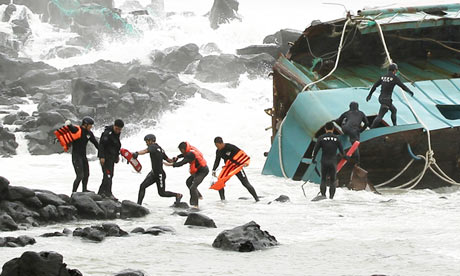
More than 330,000 South Korean households lost power, the government said, and more than 70 people were left homeless because of floods or storm damage. Nearly 200 flights were cancelled.

In North Korea, Pyongyang's official Korean Central News Agency reported gale-force winds and heavy rain in many parts of the country. Rainstorms often mean catastrophe in the north because of poor drainage, deforestation and decrepit infrastructure.

North Korea is still trying to help people with food, shelter, healthcare and clean water after heavy flooding in July, according to a recent United Nations report. More than 170 died nationwide, and tens of thousands of homes were destroyed in the floods, according to official North Korean accounts.

Many flood victims still live in tents with limited access to water and other basic facilities, the UN report said, and there is concern about malnutrition. Seoul's unification ministry approved a trip Wednesday by two South Korean aid groups to visit the North Korean city of Kaesong for talks on flood aid.

Weather officials had warned that Bolaven would be the strongest typhoon to hit the region in several years, but its gusts turned out not to be as powerful as expected.

The typhoon hit the southern Japanese island of Okinawa on Monday, injuring four people but doing less damage than feared before moving off to sea. More than 75,000 households lost power.

Further south, another typhoon, Tembin, doubled back and hit Taiwan three days after drenching the same region before blowing out to sea. Fierce winds and rain toppled coconut trees in the beach resort town of Hengchun.

In Manila, the Philippine weather agency reissued typhoon warnings to residents and fishermen for Tembin, which blew out of the archipelago over the weekend. Fishing boats in the north were urged not to venture out to sea while larger ships were warned of possible big waves and heavy rains.

Tuesday 28 August 2012

http://www.guardian.co.uk/world/2012/aug/28/fishermen-killed-typhoon-south-korea

continue reading

36 Egyptians missing, 3 dead after boat sinks trying to reach Europe illegally

Three bodies washed ashore in Libya Monday after a boat carrying illegal Egyptian migrants trying to reach Europe capsized in the Mediterranean Sea, and officials say 36 people are missing.

The boat’s only known survivor, Mohamed Gomaa Abdel-Kader, 23, told authorities that 40 people were on the boat when it sank. They were traveling overnight Sunday from an Egyptian port near Libya. They were part of a three-boat convoy full of migrants heading to Europe illegally, he said, according to a statement from Egypt’s Foreign Ministry.

The growing crisis from the flood of refugees could prompt Turkey to ask the United Nations to create a haven in Syria.

The boat he was on was supposed to carry no more than 15 people. It started sinking from the weight of the passengers, and people began jumping into the sea in the middle of the night, he said.

The search for survivors was continuing in the Burdi area, the officials in Cairo said.

In Libya, the state news agency Lana reported that the boat was carrying around 40 illegal migrants and capsized off Libya's east coast near the border with Egypt, with only one passenger surviving the tragedy.

"All the migrants who were on board died, except for one person who survived and was able to alert local authorities and inform them of the tragedy," Lana said, quoting a local official.

It was not immediately clear who the passengers of the boat were but they are widely believed to be asylum seekers trying to get to Europe in search of jobs and a better life.

Lana did not give the nationalities of the passengers but said the boat sunk some three kilometres (almost two miles) off the Libya coast.

Libya has been traditionally a launchpad for African refugees and migrants seeking to make an illegal run across the sea to Europe, with many landing in Italy. Migrants and refugees often travel in rickety and overcrowded wooden fishing boats and there have been several accidents at sea.

Thousands of young North African men make the dangerous and illegal sea journey to Europe to flee poverty, high unemployment and low wages at home. Some leave from Egypt’s Mediterranean coast, but most travel overland to neighboring Libya to take the shorter trip from there.

In April last year, scores of people went missing at sea after a tiny boat carrying more than 200 African migrants fleeing unrest-hit Libya capsized in the night in three-metre-high waves.

In March 2010, around 18 Egyptians drowned at sea trying to flee illegally to Europe. In 2007, 22 people died when two smuggler boats carrying around 150 Egyptians capsized off Italy’s southern coast. The next month, another boat sank off Turkey, killing 50, half of them Egyptians.

Tuesday 28 August 2012

http://www.washingtonpost.com/world/europe/officials-36-egyptians-missing-3-dead-after-boat-sinks-trying-to-reach-europe-illegally/2012/08/27/9ec26664-f055-11e1-b74c-84ed55e0300b_story.html

continue reading