Tuesday, 4 February 2014

Police collect DNA samples of kin of dead to identify bodies


Close to a week after an accident on the Mumbai-Ahmedabad Highway left eight people dead and 14 injured, DNA samples of the kin of the deceased have been taken and will be sent to JJ Hospital to identify the dead, the police said.

Three vehicles were gutted after a collision between a diesel tanker and luxury bus on the highway, 12 km from Manor village.

“At this point, it is impossible to identify bodies. The families submitted claims with us last week. Accordingly, we took DNA samples from immediate family members and will send these to JJ Hospital. Once the reports from the forensic department there are received, we will hand over the bodies,” said Assistant Police Inspector Meghana Burande, Manor police station.

At 1.30 am on Wednesday, January 29, a diesel tanker hired by BPCL and travelling from Wadala to Hazira in Gujarat broke down in the middle of the road after ramming into a vehicle moving ahead of it,

The luxury bus, which was travelling to Ahmedabad from Pune rammed straight into the stationary tanker, the police said. A Hyundai Verna car speeding behind also rammed into the bus. The three persons inside the car escaped with minor injuries. In the blaze that followed due to fuel leak, the bus driver, Shaukat Mulani (36), the second driver and six passengers were burnt alive, the police said. Both Siddiqui and Shah fled after the accident and were arrested a few hours later.

While one of the passengers was identified by a silver locket he wore around his neck, the other seven deceased remain unidentified, the police said.

Doctors and local police said bodies had been completely charred, with no features discernible. The bodies were later sent to JJ Hospital in Mumbai for a forensic examination.

Tuesday 04 February 2014

http://indianexpress.com/article/cities/mumbai/police-collect-dna-samples-of-kin-of-dead-to-identify-bodies/

continue reading

Search for victims delayed as Indonesia’s Mt Sinabung spews ash into the sky


A new eruption of ash and steam from Indonesia's Mt. Sinabung has put on hold a search for victims of the Saturday's major eruption that has claimed 16 lives.

The volcano erupted at around 10:30 a.m. local time on Saturday, February 1st, just a day after local residents who were previously evacuated due to the eruptions and pyroclastic flows were told that they could return to their homes. This fast-moving flow of hot ash and gas quickly swept down the mountainside, traveling roughly five kilometres away from the crater. It was followed by two more flows over the next hour.

According to reports, search parties checking villages on the volcano slopes recovered 14 bodies, along with three people who had suffered burns. The death toll had risen to 16 on Sunday when another body was discovered and one of the burn victims died of their injuries. All of the victims were from the village of Suka Meriah, which is roughly three kilometres from the volcano. Evacuation zones had stretched out to well beyond that range over the past few weeks, due to the volcano's increased activity. It's still unclear whether those restrictions were lifted prior to the weekend eruption, or if those on the mountainside had simply violated the restrictions put on travel in the area.

A resident runs to escape the billowing ash cloud engulfing their village.Search efforts for victims resumed on Monday, since three people are apparently still missing from the eruption on Saturday. Those efforts had to be delayed, though, when the volcano spewed out another blast of ash and gas, reaching 2.5 kilometres into the sky. This mixture of burning hot ash and poisonous gas would not only have made searching difficult simply due to obscuring everything in the area, but with temperatures reaching several hundred degrees and combined with a mix of poisonous gases, venturing into the area could have been deadly. Authorities were to decide later on Monday if the search would be called off permanently.

At the other end of the island nation, the disaster mitigation agency raised the alert level on Mount Kelud of East Java to level 2, according to state-run Antara News, and there are now around 20 volcanoes in Indonesia that are currently on alert status. The alert statuses of most of the volcanoes are simply to note a level of activity above normal. Mt. Sinabung is at the highest alert level: level 3.

Today, a magnitude 6.1 earthquake shook the sea floor near Kepulauan Barat Daya, and was followed by several aftershocks. These may be unrelated to the volcanic activity, but eruptions are often associated with tremors and earthquakes, as magma shifts under the ground.

Tuesday 04 February 2014

http://ca.news.yahoo.com/blogs/geekquinox/search-victims-delayed-indonesia-mt-sinabung-spews-ash-012625624.html

continue reading

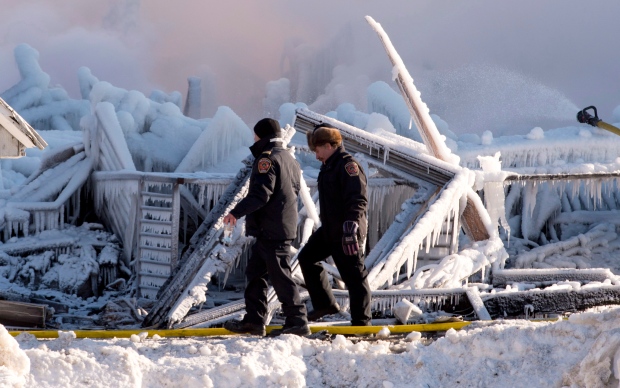
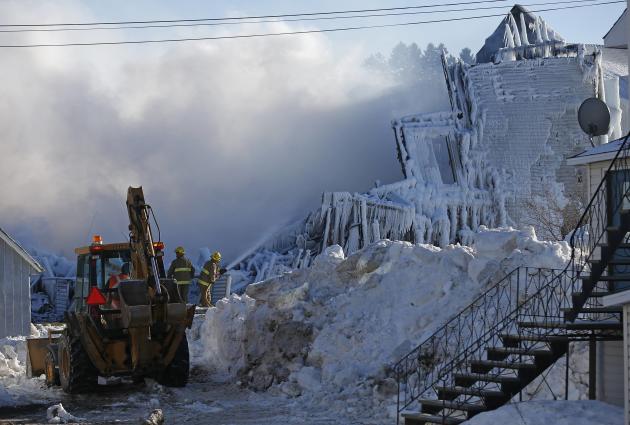
28 bodies recovered from Isle Verte fire


The Surete du Quebec has ended its recovery efforts following a deadly fire in Isle Verte, after finding the bodies of 28 victims.

17 of those recovered have been identified by the coroner, and efforts are being made to identify the remaining nine.

Four of the people missing from the night of the fire are still unaccounted for.

SQ officer Guy Lapointe said the cause of the fire is still unknown, and police have yet to rule out the possibility that the fire was deliberately set.

While police will no longer be at the scene, specialist chemists and electricians will be scouring the wrecked building to see if they can figure out what started the fire.

About 900 attended a church service this past Saturday to mourn the victims of the Jan. 23 fire at the Residence du Havre.

Tuesday 04 January 2014

http://montreal.ctvnews.ca/28-bodies-recovered-from-isle-verte-fire-1.1668611

continue reading

11 drown, 50 missing as ferry sinks in Bangladesh


Eleven persons were drown and 50 others were missing as a small ferry sank into the Surma River in Bangladesh's northeastern Sunamganj district Monday night, officials said on Tuesday.

Kamrul Alam, chief executive of the Doara sub-district of Sunamganj, confirmed the ferry sank after its engine.

Alam said six bodies were recovered Monday night and five bodies were found Tuesday morning.

Fire service rescuers are conducting rescue operations.

Tuesday 04 January 2014

http://www.shanghaidaily.com/article/article_xinhua.aspx?id=198067

continue reading

Monday, 3 February 2014

Bodies of migrants wash up on Moroccan shores


The bodies of five presumed migrants thought to have been trying to reach Spain were found on Sunday on northern Morocco's shoreline, local authorities said.

"The bodies of five probably illegal migrants, four of them from Senegal, were washed up from the Mediterranean" in the Nador area, MAP news agency cited officials as saying.

It said four Senegalese had been identified, and added that an inflatable boat was also found.

Morocco estimates that some 30,000 migrants, mostly sub-Saharan, are on its soil as they try to make their way to Europe in search of a better life.

The Spanish territories of Melilla and Ceuta in Morocco form the European Union's only land borders with Africa, and many try to reach Europe this way.

But others opt for a perilous sea crossing across the Straits of Gibraltar, often losing their lives in the attempt.

Monday 03 February 2014

http://www.abs-cbnnews.com/global-filipino/world/02/02/14/bodies-migrants-wash-moroccan-shores

continue reading

Mysterious blaze kills 186 in 1944 Connecticut circus horror


Children of all ages gawped and gasped as Alfred Court, the famed French lion tamer, cracked a whip to shoo his big circus cats into chutes leading out of the spotlight and into wagons outside the tent.

Merle Evans, the Toscanini of the Big Top, gave a downbeat, and the Ringling Bros. and Barnum & Bailey brass orchestra struck up a transitional tune. As the cats exited, the third act, the Great Wallendas, began ascending to aerial perches.

It was a wartime circus matinee on July 6, 1944, a steamy Thursday afternoon at the Barbour Street Show Grounds in Hartford’s North End.

The gigantic circus tent — 425 feet long — was packed with 7,000 people, most of them children enjoying summer vacation with their mothers.

Bandleader Evans got the first whiff of trouble, a small flame licking at the tent canvas near the main entrance. A single bucket of water might have doused it — if anyone had thought to have water handy.

Evans quickly cued “The Stars and Stripes Forever,” the old circus “disaster march” that alerts carnies to a serious problem.

The Wallendas quickly shinnied down poles and slithered down ropes.

Some in the bleachers hesitated, wondering if the smoke and flames were part of the act. Others surged toward exits, two of which were blocked by the animal chutes.

The emcee urged calm, but in an instant the flames reached the top of the tent and spread laterally. The canvas, waterproofed with paraffin wax that had been dissolved in gasoline and then painted on, rained down in glops of fire.

Bottlenecks of screaming patrons built up at several exits. Some mothers tossed their small children over the masses and outside to safety. Boys with pocketknives slashed the tent sides, saving many lives. A number of adults imperiled themselves while pushing and pulling others out of the inferno.

As support ropes burned through, foot-thick mast poles and support timbers crashed to the ground, crushing anything and anyone in their paths.

Just seven minutes after the fire began, the tent was gone.


Firefighters arrived belatedly to find bodies piled at exits, including one blocked by the cat chute.

Miraculously, 6,000 people made it out safely. But 186 perished — 10 men, and the rest women and children — and about 500 were hurt. A third of those killed were younger than 10.

Rescuers carted the casualties to the Connecticut State Armory, where they were laid out on cots. That night and the next day, a pitiful procession trudged past the cots, peeling back blankets to look for dead loved ones.

Before any real investigation, the conventional wisdom deemed that the worst circus fire in American history was caused by a discarded cigarette.

But there was plenty of blame to go around. The negligence was breathtaking.

Inexplicably, the circus had staged none of its fire apparatus for the matinee show. Fifty fire extinguishers were deep in storage, and four circus fire trucks were parked a quarter-mile from the tent.

Even though the circus was held on city property, no Hartford firemen were assigned. Chief John King said he had not been notified that Ringling Bros. was in town.

A commission found “municipal inadequacies,” but the city focused its fury on the circus.

On the day after the fire, five Ringling Bros. officials were charged with involuntary manslaughter: James Haley, a vice president; general manager George Smith; Leonard Aylesworth, the chief canvas man; David Blanchfield, superintendent of rolling equipment, and chief electrician Edward Versteeg.

Ringling Bros. agreed to pay financial damages to the fire victims, eventually awarding about $4 million to 550 claimants, an average of $7,300 each.

Connecticut lawmakers enacted stringent new fire-safety requirements for public assemblies.

The Ringling Bros. officials pleaded no contest and spent about a year locked up. Haley, the vice president, was later pardoned by the Florida legislature, which declared his conviction “not of such a nature as to brand him a criminal.”

He went into politics and in 1953 was elected to the first of 12 terms he would serve as a U.S. congressman from central Florida.

Seventy years later, mysteries endure from the Great Hartford Circus Fire.

The cause was never proven, though authors and investigators have dueled over the issue. Some insist it was arson, perhaps set in a men’s toilet near where the fire was first spotted.

Six years after the blaze, a young man who was an adolescent circus go-fer in Hartford claimed he set the fire, but he recanted.

Officially, the cause is undetermined.

But the fire’s biggest baffler concerns the identity of a victim known as Little Miss 1565, from her morgue ID number.

A blond girl about 8 years old, her photograph was widely published after the inferno as officials tried in vain to identify her. In the 1980s, sleuths took up new efforts to give Little Miss 1565 a name, and she finally got one: Eleanor Cook, a Massachusetts child whose brother also died in the fire.

But Cook’s mother, who was injured in the fire, said before she died in 1997 that Little Miss 1565 was not her daughter.

Perhaps the girl should remain enigmatic — as incomprehensible as the fire itself.

Monday 03 February 2014

http://www.nydailynews.com/news/justice-story/3-rings-death-1944-conn-circus-horror-article-1.1599269

continue reading

Sunday, 2 February 2014

Recovery efforts in L'Isle-Verte end


Rescue operations have been suspended in the town of L'Isle-Verte where a deadly fire tore through the Residence du Havre seniors home on January 23.

"Our experts have combed the entire area," said Surete de Quebec Lt. Michel Brunet. "The search for victims is over, but we will continue to investigate the cause of the fire."

Thirty two people died in the fire. Twenty seven bodies were recovered, while five bodies are still unaccounted for. Police hope that they will be identified through DNA matching on human remains discovered on-site.

Ten of the bodies that were recovered have been officially identified, and nine of those names have been made public. The most recent name to be released was Madeleine Fraser, 86.

A memorial mass was held on Saturday in L'Isle-Verte to pay tribute to the victims. Attendees included Prime Minister Stephen Harper, Quebec Premier Pauline Marois, and Governor General David Johnston.

Sunday 02 February 2014

http://www.torontosun.com/2014/02/02/lisle-verte-fire-search-for-victims-is-over

continue reading

Families hold memorial service for Diglake miners


Families of the men and boys who died in a Staffordshire mining disaster more than 100 years ago are holding a memorial service.

Many of the bodies of the 80 miners were never recovered, following a flood at Diglake Colliery in January 1895.

Villagers are campaigning against UK Coal's plans to carry out opencast mining in the area because of the sensitivity surrounding the site.

A UK Coal representative said their sympathies were with the families.

Judith Edgeley, from Audley, lost her great-great grandfather William Roberts in the disaster.

She said: "We grew up knowing all about it. I lived on the street where William lived and, when you look at the records from the disaster, nearly every house was affected in that street.

"There are still 77 men and boys down there whose bodies were never recovered."

Ms Edgeley said the names of the missing men would be read out at the service, in the cemetery on Chapel Street in Bignall End.

"There are still families around here who lost loved ones and it's important to show we don't forget them," she said.

"These men and boys weren't afforded a Christian burial. These families had nowhere to go and grieve."

Ms Edgeley added she was part of the campaign to stop mining in the area.

"This sort of thing has been rearing its head for a long time," she said. "Various companies have wanted to come back and mine but, in the past, the fact there are bodies there has frightened people away."

A UK Coal statement said: "Our sympathies are with the families of those lost at the Diglake Disaster of 1895.

"We are, after all, a coal mining company and we regularly hold and attend similar memorials to colleagues and friends lost in the industry.

"We, of course, remain sensitive to this issue. During our conversations with the community last year we discussed this matter at length. These discussions have helped shape the revised plans which are still being worked on.

"The planning application we submit to Staffordshire County Council will be carefully thought through and designed to ensure the disaster area is not disturbed."

Sunday 02 February 2014

http://www.bbc.co.uk/news/uk-england-stoke-staffordshire-26006577

continue reading

Death toll climbs after major volcanic eruption in Indonesia


The death toll from the sudden eruption of an active volcano on Indonesia’s Sumatra Island rose to 15, officials said Sunday, as toxic clouds of hot ash hampered search and rescue teams looking for more victims and survivors.

Among the victims from the volcanic activity Saturday in North Sumatra Province were local residents checking on their homes, a journalist and a group of high school students and their teacher, said Yopie Haryadi, a spokesman for Indonesia’s National Search and Rescue Agency.

The teams resumed searching Sunday but were forced to stop and take cover when sirens activated to warn that the area around the volcano, Mount Sinabung, was not safe. One of three people who were injured during Saturday’s eruptions died in a hospital, Mr. Yopie said. Officials have warned that the volcano could erupt again and that the death toll could rise because of people ignoring warnings and returning to their homes.

The bodies of the first 14 victims were recovered Saturday, Mr. Yopie said. “No one is reported missing, but we don’t know for sure,” he said. “Sometimes people can come and go to check on their homes. We will try to search again, but we have to wait until the situation is clear, given the hot clouds.”

He said the first 14 victims were found in the village of Suka Meriah, which lies within a three-mile exclusion zone around the volcano’s crater. The high school students were in the disaster area distributing aid on behalf of the Indonesian Christian Students Movement, according to a local news reporter at the scene.

Around 30,000 people have been evacuated from the area in the weeks after Mount Sinabung resumed erupting in November.

In January, the volcano was erupting dozens of times a day, but it had quieted in recent days. President Susilo Bambang Yudhoyono made a visit to the disaster zone on Jan. 23 to comfort displaced residents camped out in evacuation centers and to discuss reconstruction efforts.

On Friday, local authorities in North Sumatra allowed nearly 14,000 people living outside the danger zone to return home after volcanic activity decreased, said Parlindungan Harahap, a reporter for Sumut Pos, the newspaper in the provincial capital, Medan. Others living close to the peak have been returning home over the past four months despite the dangers.

On Sunday afternoon, officials from the National Board for Disaster Management appeared on national television to deny reports that the agency had authorized evacuees to return home, saying they had placed warning notices and posted guards at access points to Mount Sinabung’s slopes. Some local residents, however, have ignored the warnings and used small, unguarded roads to return to check on their property in recent days.

On Saturday, a series of huge blasts and eruptions from the 8,530-foot-high volcano sent lava and rock flows up to nearly three miles away, according to news reports. Local television reports during the weekend showed giant gray clouds cloaking Mount Sinabung’s crater, farms and roads around the volcano covered in ash, and panicked local residents running away from plumes of smoke.

Television news footage showed people bringing the bodies of some of the 14 victims down the mountain in makeshift rescue vehicles and on motorbikes.

After Saturday’s eruptions, all those who had been allowed to return home on Friday were ordered back into evacuation centers, The Associated Press reported.

Sunday 02 February 2014

http://www.nytimes.com/2014/02/03/world/asia/death-toll-climbs-after-major-volcanic-eruption-in-indonesia.html?hpw&rref=world&_r=0

continue reading

Friday, 31 January 2014

Passengers' kin seek police help to identify bodies


Four families from Pune looking for their relatives have approached the Manor police following the Wednesday's bus accident. Eight bodies, including that of the bus driver, were charred beyond recognition. These were brought to the JJ Hospital in Byculla for collection of samples that will sent for DNA test. The bodies of bus driver Shaukat Maulani (47) and passenger Suraj Chavan (40) from Chiplun, Ratnagiri, were partially identified by their families later on Wednesday.

Relatives of passengers Sunil Rane, Sangram Talekar and Subhash Jogdenkar have approached the Manor police after they failed to contact their near and dear ones. They were among those who had taken the bus. They are feared to be among those dead. The family of Rahul Gaekwad (25), the cleaner of the bus, has also approached the police for identification of the body.

Doctors at the JJ Hospital, however, are unhappy about bodies from peripheral hospitals being regularly sent for post-mortem to their hospital. The hospital currently has 11 unidentified bodies in its mortuary, seven victims of the Manor bus accident and four of the Dehradun Express fire. "The blood samples required to be drawn from the deceased as well as their relatives for DNA testing can be done in any government facility. The authorities, however, are putting the relatives through great hardship by sending them all the way to JJ Hospital every time," said a senior doctor.

The 35-seater sleeper coach met with an accident at Manor when it collided with a diesel tanker early Wednesday. The police have yet to get a list of bona fide passengers who travelled on the bus. They claim there was political pressure to go slow on the number of bona fide passengers. It is believed that many a passengers have boarded without proper tickets. The tanker driver Shafique Siddiqui has been arrested. He will be produced before the Palghar sessions court on Friday. The police, who had earlier booked Siddiqui for causing death by negligence under section 304 (a) of the IPC, will now seek his arrest under section 304 (culpable homicide not amounting to murder).

The police said that Siddiqui had risked the lives of many by parking the tanker in the middle of the highway. He had failed to inform the police after the tanker was allegedly hit by an unidentified vehicle, causing its malfunction.

Friday 31 January 2014

http://timesofindia.indiatimes.com/city/mumbai/Passengers-kin-seek-police-help-to-identify-bodies/articleshow/29623303.cms

continue reading

Official death toll in Quebec fire rises to 21


Quebec provincial police say 21 people have been confirmed dead in a fire that ripped through a seniors' home last week.

Another 11 people were still listed as officially missing on Thursday following the early morning blaze at the Residence du Havre in L'Isle-Verte on Jan. 23.

Thursday's updated death toll came as Pope Francis reached out from the Vatican to offer spiritual support to the grieving community.

Vatican Secretary of State, Archbishop Pietro Parolin, wrote that Pope Francis was immediately touched by the tragedy upon learning of it.

He said the Pope imparted a special apostolic blessing to those affected by the tragedy.

The Pope's sympathies followed those of the Queen, who offered her condolences in a message released a day after the fire.

The archbishop said the pontiff "united himself in prayer in the grief of the bereaved families and entrusted the victims to the mercy of God, that they might be accepted into his light."

The pontiff also "expressed his spiritual closeness to the injured and their families, as well as the firefighters and rescue workers who have performed a great work of solidarity."

Emergency crews have worked in sub-zero temperatures to recover bodies and evidence from the rubble of the seniors' home.

Special machines to melt thick sheets of ice coating the structure have been used to help them gain access.

The residence had 52 units and many of its occupants had limited mobility, needing wheelchairs or walkers to get around.

Friday 31 January 2014

http://www.baytoday.ca/content/news/national/details.asp?c=57649

continue reading

Thursday, 30 January 2014

Damage control: Coordinated response key to reducing disaster risk


There is a need to train rescue teams and establish a central command system to enable the government and humanitarian agencies to coordinate and minimise destruction during any disaster, said fellows from the Institute for International Emergency Medicine, Harvard School of Public Health, on Tuesday.

“There is a lack of coordination among different stakeholders, including the government and rescue agencies,” said the fellows – Dr Shawn D’Andrea, Dr Usha Periyamayagam and Dr Payal Modi.

“The top leadership and heads of the organisations have to understand that, without coordination, rehabilitation cannot be carried out effectively,” they said.

The Harvard team members were holding training workshops on ‘Preparing emergency department for disaster’ and ‘Training paramedics in pre-hospital mass casualty management.’ The participants from the Khidmat-e-Khalq Foundation (KKF), Pakistan Red Crescent Society and Aman Foundation were trained in modern techniques for disaster-risk management.

“We want to train the rescue teams about the humanitarian element during any disaster,” briefed Dr Modi. “In this manner, the skilled persons will be able to tackle the situations confidently,” she added.

“There is a need for different ambulance services to coordinate amongst themselves,” said Dr Periyanayangam. The plan is to meet the heads of different organisations and government officials, she added.

“The heads of Chhipa and Edhi are interested in having their rescue staff trained. We’ll meet them soon. They are the major stakeholders in the city. Edhi is even working in other parts of the country,” informed Dr Andrea.

The team said that they had held several meetings with officials of Sindh health department, Provincial Disaster Management Authority and others regarding the training of their respective staff members.

“The top leadership should show interest. These trainings would be more beneficial for field officers,” they added.

“We lack proper management. We need to train our staff,” commented Dr Ali Warsi of Red Crescent. He said that though he was already trained but the knowledge he received from the Harvard team was good for him and his staff. “It was designed in accordance with the prevailing situation,” he maintained.

KKF ambulance driver Syed Nazim Hussain seemed satisfied and excited. “It was my first such training,” he said. Hussain complained that without the resources, it is not possible for rescue workers to save lives effectively. “There is also a lack of awareness among people who abruptly show up at a blast location,” he added.

“One well-equipped ambulance will not be enough,” commented Ghulam Raza, a staff member of Aman Foundation. “All rescue workers should be trained and work in complete harmony. The accident site is always a mess. Every rescue worker wants to recover bodies and injured persons without thinking they could harm those who could be saved,” he said.

Concluding the session, Dr Periyanayagam stressed that the participants needed to share knowledge with their colleagues. “You should put disaster training into practice on the field,” she encouraged.

The team informed that not only rescue teams but law enforcement agencies needed to be trained. “I was part of the Boston blast rescue team. There was central command coordination during the rescue. It really made everything easy,” informed Dr Andrea.

The Harvard teams said that it is the need of the hour for all teams involved in disaster management to work together. “Whatever it is – floods, earthquakes, road accidents or blasts – you can’t manage things easily without coordination,” they said.

Thursday 30 January 2014

http://tribune.com.pk/story/665009/damage-control-coordinated-response-key-to-reducing-disaster-risk-argues-harvard-team/

continue reading

Official death toll climbs to 19 after Quebec seniors' home fire; 13 still missing


Firefighters and police officers, some on their hands and knees, braved bitter cold for yet another day to find more bodies in the rubble of a seniors' home that was engulfed in flames last week.

Surete du Quebec confirmed Wednesday that 19 people are now confirmed dead and 13 remain missing after the blaze that ravaged Residence du Havre in L'Isle-Verte in eastern Quebec early last Thursday.

"We will keep going until all 32 people have been found," said Surete du Quebec Lt. Michel Brunet the day before.

A police investigator slips on the ice as they search through the frozen rubble of a seniors residence in L'Isle-Verte, Que. Friday, Jan. 24, 2014. (Ryan Remiorz / THE CANADIAN PRESS)

Four people have been formally identified by the coroner's office so far. They are Angรฉline Guichard, 88, Marie-Laurรฉat Dubรฉ, 82, Louis-Philippe Roy, 89 and Juliette Saindon, 95.

Authorities say they are satisfied with the progress of their work during the last six days.

Weather has been a major hurdle, forcing crews to take regular breaks to warm up from the bone-chilling cold.

Special machines also had to be brought in to melt thick ice that coated the ruins after the fire. Police have had to approach the rubble carefully, not just to avoid harming any bodies within the structure but also to preserve evidence that may allow investigators to determine a cause for the blaze.

About 65 per cent of the site has been examined. Brunet said it is difficult to say how long it will take to complete the effort because large hunks of debris have to be removed carefully.

The delicacy of the effort was reflected in the large construction shovels that have been brought in which carefully scratched at the ground to remove rubble.

Smaller tools such as rakes, brooms and spades were also being used by the workers, who also include pathologists from the Quebec coroner's office.

Surete du Quebec spokesperson Ann Mathieu says the searches are progressing well and about 50 people are combing the rubble of the building in teams.

On Tuesday, media were granted increased access to the remnants of the Residence du Havre to see the efforts in the community about 240 kilometres northeast of Quebec City.

Health and social services officials also said six people remain in hospital. Nine others have found new homes and five people are expected to be relocated on Wednesday.

Surete du Quebec also said the public has responded to their requests for any photos or videos taken of the fire and they will begin sifting through them in the coming days.

Prime Minister Stephen Harper is among those who are expected to attend a commemorative ceremony in L'Isle-Verte this coming Saturday.

Thursday 30 January 2014

http://montreal.ctvnews.ca/official-death-toll-climbs-to-19-after-quebec-seniors-home-fire-13-still-missing-1.1661754

continue reading

Wednesday, 29 January 2014

Boat capsizes in India's Bihar


At least three people have drowned and six others are missing after a boat capsized in the Ganges river in the eastern Indian state of Bihar.

The victims were all women, who were on their way to work on farms in the neighbouring state of Uttar Pradesh.

"Bodies of the three women have been recovered," Buxar District Magistrate Raman Kumar said.

Kumar said 22 women, mostly labourers, were in the boat when the accident took place late Tuesday.

Thirteen women were rescued when the boat, also laden with vegetables, sunk in Buxar district late on Tuesday.

Boats in India are often overloaded, and lax safety standards mean accidents are common on the river.

Three bodies were recovered by divers and 13 passengers were recued, he said and added that six women were still missing.

On Sunday, 21 people were killed when a tourist boat capsized off India's Andaman and Nicobar Islands in the Bay of Bengal.

Last July, 11 people drowned after a boat capsized in the flooded Kosi river in Bihar. Twenty-four others swam to safety.

In 2012, 108 people died after a ferry capsized during a storm in Assam.

In October 2010, at least 36 people died after an overloaded boat sank in the Ganges river in Bihar.

In 2009, a tourist boat carrying 76 people capsized in a lake in Kerala, killing at least 37.

Wednesday 29 January 2014

http://ibnlive.in.com/news/overcrowded-boat-capsizes-3-drown-hunt-on-for-11/448658-3-232.html

continue reading

7 passengers dead and 15 injured in Luxury bus and container collision at Thane


In the wee hours of Wednesday, a luxury bus rammed into a Petroleum container killing at least 7 passengers including the driver of the bus while a four wheeler behind the bus too rammed into it leading to oil spill and severe fire on the Mumbai Ahmedabad Highway near Varai phata.

The Bharat Petroleum container (MH 43 U 9201) was moving towards Gujarat and the driver halted the bus due to breakdown when the luxury double decker bus rammed into it killing the driver of the bus and other 6 persons on the spot. While, a four wheeler behind the bus too caught fire and the mangled remains of the bus and the car were shifted with the help of fire brigade and the Thane Rural police.

"The luxury bus driver did not notice the stationary bus and rammed into it the bus and car has beeb completely charred and the numbers of both the vehicles still haven't been ascertained" said a police official.

The driver of the Petroleum company is missing and we are trying to contact the family members of the deceased and have shifted the injured at Rural Hospital near Charoti, said Meghana Burande, Incharge, Manor police station.

After the accident heavy traffic jam led to major problems as the vehicles were diverted from the Wada-Bhiwandi road after the Thane rural police shut the road towards Gujarat.

Wednesday 29 January 2014

http://www.dnaindia.com/india/report-7-passengers-dead-and-15-injured-in-luxury-bus-and-container-collision-at-thane-1958084

continue reading

Andaman ferry disaster: Search for body of last victim still on


While the families of those who died in the Andamans boat tragedy have found a semblance of closure by receiving the bodies on Monday morning, one family is still at odds with the sea. Authorities in the Andaman and Nicobar Islands are yet to find the body of Suresh Sha of Kancheepuram.

Suresh Sha's brother Chandru is waiting in Port Blair, hoping for the body to wash ashore. "Locals tell me that the tide is high and the area is very windy. This will, hopefully, push the body to the coast," Chandru to TOI over the phone.

Local authorities and the ministry of shipping are searching for the body. "Five small boats and five ships have been patrolling the sea from Monday. Two helicopters have joined the search. Ministry officials have been giving me the hope that the body will be found by Wednesday morning," said Chandru.

On Monday night, Chandru saw what looked like a body floating near the shore. "As soon as I called the Andamans collector, helicopters rushed in," he said. Chandru's biggest fear is the crocodiles he spotted on the island. He is staying in the government quarters in Andamans.

Chandru was the first one in Kancheepuram to hear about the tragedy when his sister-in-law Gangabai called from the Andamans. She and her daughter Vinodhini were the only survivors among the six of his family members who went on a holiday there. Chandru lost his brother Suresh, his parents and niece in the accident.

Meanwhile in Kancheepuram, all the bodies have been cremated. "All the bodies have been handed over to the families. We provided assistance in the cremation," said Kancheepuram collectorate PRO Stanislaus. "We also distributed the compensation announced by the chief minister." He said the collectorate had bought large amounts of dried cow dung and firewood as they expected a number of cremations on the same day.

Survivors were welcomed back to Kancheepuram by hundreds of people on Monday. Of the 32 residents of Kancheepuram who left for the Andamans in a tour group, only 15 returned.

Wednesday 29 January 2014

http://timesofindia.indiatimes.com/city/chennai/Search-for-body-of-last-victim-still-on/articleshow/29514481.cms

continue reading

Sri Lanka mass grave toll reaches 50


Skeletal remains of at least 50 people have been dug out from a mass grave discovered in northeastern Sri Lanka, amid speculation that the remains were of Tamil civilians who had disappeared during the war with the LTTE.

Police spokesman and Senior Superintendent Ajith Rohana said further digging will be continued with the deployment of a team from the crime investigation department to assist in investigations.

Three more skulls were found today, Rohana said. With this, the total skeletal remains discovered stand at 50.

A team of forensic experts led by Judicial Medical Officer Dhananjaya Waidyaratne earlier stated that bodies had been buried in several layers at the site.

The state water entity's workers had stumbled upon the grave as they dug the ground to lay water supply connections late December last year in Thirukatheeswaram area in Mannar district.

The main Tamil party TNA-controlled Northern Provincial Council yesterday adopted a resolution to call for UN assistance at forensic excavations at the site.

The Tamil groups believe that the remains were those of the Tamil civilians who had disappeared during the three-decade conflict.

The resolution was moved by Tamil National Alliance's woman councillor Ananthy Saseetharan, whose husband Elilan was an LTTE political wing leader and is among those believed to have disappeared during the final battle in 2009.

This was the first discovery of a mass grave in the former conflict zone since the war ended. Digging of the site took place in the presence of magisterial and judicial medical officials after the discovery of the first four skeletal remains on December 21.

The police in an initial reaction said the area of the site had been under LTTE control for well over 15 years.

Since the end of the war, Sri Lanka has been facing international accusations of rights abuses.

Sri Lanka denies that its troops committed any war crimes whilst combating the LTTE. It has resisted calls to probe claims that over 40,000 ethnic minority Tamils were killed by the military during the final phase of the civil war that ended in 2009.

The UN Human Rights Council has passed two rights resolutions against Sri Lanka and a third one is expected in March.

Wednesday 29 January 2014

http://zeenews.india.com/news/south-asia/sri-lanka-mass-grave-toll-reaches-50_907489.html

continue reading

Mass grave recovered after El Salvador's gang 'truce'


In a room set apart from the scrubbed surfaces and autopsy tables of this city’s medical examiner’s office, two technicians in white coveralls are sifting through sacks of mud and death.

One technician carefully extracts a human vertebra. He brushes off the bone with what looks like a toothbrush, and then places the bone into a water basin.

The technicians “leave nothing untouched,” says Saul Quijada, the forensic anthropologist in charge. “Even the smallest item can be important.”

The sacks were trucked in from a mass grave discovered last December in the fields of Lourdes, a working-class district on this city’s outskirts. Authorities accuse the Barrio 18 street gang of digging the burial site in the remote and rugged fields to hide the remains of 44 people who’d been killed and dismembered elsewhere.

A March 2012 truce between Barrio 18 and its powerful rival, the Mara Salvatrucha, or MS-13, has been credited with slashing El Salvador’s homicides from more than 4,000 in 2011 to about 2,500 over the past two years.

But the discovery of the mass grave — the largest found since this country's 12-year civil war — has given ammunition to truce skeptics. They’ve noted that while murders were supposedly declining, disappearances were rising, to more than 1,000 last year. Crimes and killings, critics say, continued clandestinely all along.

And with only days to go before El Salvador’s presidential election on Sunday, politicians have seized on the truce as a potent wedge issue in a nation terrorized by violence.

“All these people were murdered during the so-called truce,” says Miguel Fortin Magana, director of the medical examiner’s office in San Salvador.

And these gang issues matter well beyond Salvadoran borders.

Both Barrio 18 and MS-13 formed in Latino migrant communities in Southern California. Mass deportations by the United States pushed them into Central America in the 1990s. The "maras," as the gangs are called, found fertile ground in postwar El Salvador, where displaced and broken families crowded into cities, making for easy recruiting, and where police were ill equipped to handle the spike in crime.

The gangs spread to neighboring Honduras and Guatemala, and their foot soldiers now number in the tens of thousands — helping make this the world's most violent region outside a war zone.

Offshoots of the maras continue to thrive in immigrant enclaves of the US and Canada, but with gang leaders giving the orders from squalid tropical prisons.

El Salvador’s gang truce was an unorthodox response to years of hard-line policies that failed to stem the bloodshed. Gang leaders, a bishop, a human rights activist and — from a careful distance — government officials brokered the cease-fire in secret negotiations. The agreement allowed key gang leaders to be moved to lower security prisons.

The government has never acknowledged an active role, and outgoing President Mauricio Funes continues to deny that it took part, even after a recent leak of audiotapes made it clear that negotiators had the backing of Funes' top security official at that time.

Gang leaders, who met recently for the first time in seven months, claim that the truce remains in place. But murders have risen sharply in recent weeks, with about eight killings daily and a surprising number of massacres. Neighborhood walls that had been symbolically scrubbed of gang graffiti at the truce’s onset are now littered with tags.

In a recent poll conducted by the University Institute of Public Opinion at the Central American University in San Salvador, nearly 70 percent of respondents said they had little or no confidence in the truce.

“What has been consistent over the last year and a half is the rejection of [the truce] by the public,” says Jeannette Aguilar, the institute’s director.

The truce has become the central campaign issue of the conservative opposition, the Nationalist Republican Alliance (ARENA). Its presidential candidate, Norman Quijano, has said the government made a “pact with criminals.”

In solemn television ads, Quijano claims he's the only candidate able to defeat the gangs. “I know what has to be done, and you do too,” he deadpans, without saying what that is.

Salvador Sanchez Ceren, the candidate for the governing left-wing Farabundo Marti National Liberation Front (FMLN), has been vague about whether he supports the truce, though he was vice president when the negotiations took place. In debates he’s been loath to even mention it, and when pressed denies his government’s involvement.

Steven Dudley, co-director of InSight Crime, a website that tracks organized crime in the Americas, says the FMLN’s vacillating and lack of transparency on the truce has hurt the process and made it difficult for other organizations, such as churches and NGOs, to provide the support needed for the truce to succeed.

“Own it or don’t,” he said of the ruling party’s stance. “This game they have played has been very counterproductive.”

Little is known about the gangs themselves, which are estimated to have about 60,000 members in El Salvador and are often portrayed as “a massive and faceless enemy,” Dudley says. The truce, he said, served as a rare opportunity to understand “who these guys are and how much reach they have,” and to engage them in ongoing conversations.

“By mishandling this," he says, the Salvadoran government "could shut the doors for a very long time.”

San Salvador’s medical examiners have so far processed the remains of 25 people from the mass grave in Lourdes. Of the six bodies identified, Dr. Fortin says, not all were gang members. A fruit vendor from the area was among them.

What’s more, authorities know of two other suspected mass graves. One, Fortin says, lies within the district of Soyapango, an area where gang territories are fought over constantly, and the other is in the heart of San Salvador’s downtown.

In the medical examiner’s office, the violence that gangs can unleash appears in stark relief.

In one room, the skeletal remains of three people are laid out on long tables.

Quijada, the forensic anthropologist, fits together three neck vertebrae and points out sharp irregular angles on the uppermost one. The splintering, he explains, most likely occurred as the person was hacked at with a machete.

“They cut here and they cut here until it was completely decapitated,” he says.

Investigators are leaving 19 bodies in the ground at Lourdes until they can start excavating again next month. Completing work on this mass grave “could take us until the middle of the year,” Quijada says.

“That's if there are not others, and it appears there are.”

Wednesday 29 January 2014

http://www.globalpost.com/dispatch/news/regions/americas/140128/el-salvador-mass-grave-maras-gangs-election

continue reading

Regional co-operation necessary to identify missing persons


With thousands of people still missing from the 1990s conflicts in the region, countries in Southeast Europe must be diligent in their co-operation to solve the issue, experts said.

According to the International Commission for Missing Persons, there are still more than 14,000 people unaccounted for from Bosnia and Herzegovina (BiH), Croatia, Kosovo and Macedonia.

Of the approximately 40,000 total missing in the region after the conflicts, an estimated 30,000 were from BiH, 5,500 from Croatia, 4,400 from Kosovo and 23 from Macedonia. Of those still missing, approximately 10,000 are from BiH, 2,000 from Croatia, 1,900 from Kosovo and 13 from Macedonia.

Kathryne Bomberger, the director general of the International Commission for Missing Persons, said that finding and identifying those still missing is complicated because the conflicts took place when there were no borders in the region.

"We have often had cases where the remains of people from Bosnia and Herzegovina were in the territory of Serbia, Croatians disappeared from Bosnia and Herzegovina, Serbians on Croatian territory and the like. One of the ways to solve these issues is a good regional co-operation and that is at a very high level," Bomberger said.

The governments in the region must remain vigilant in their efforts to account for the missing regardless of their ethnic, religious or national origin in a transparent and accountable manner, she added.

Co-operation efforts include following a joint road map on proceedings, information sharing, a mutual DNA database and common methodology and transparency in exhuming mass graves.

Kosovo and Serbia have also been co-operating on the issue.

A gravesite in Raska, Serbia, was opened last month, in which the bodies of 250 Albanians are believed to be buried.

The investigation leading to the discovery was a joint effort by Kosovo, Serbia and EULEX.

Officials from Kosovo and Serbia are expected to meet soon to discuss how to proceed with further excavations.

"We have had cases of direct co-operation in order to accelerate the procedures, but due to the political circumstances, this co-operation remains within a non-formal format," Kushtrim Gara, who leads the administrative unit of the Kosovo Commission for Missing Persons, told SETimes.

Serbia Prime Minister Ivica Dacic said his government is committed to solving the issue.
<

"The search for the missing will continue until light is shed on each and every crime," he said.

However, some say more action needs to be taken.

"Great progress has been made, but it still not enough to bring peace to the families of the missing," Lejla Cengic, a spokesperson for the Institute for Missing Persons in BiH, told SETimes.

She said that a central register of missing persons would help accelerate the process.

"A regional list of missing persons is one of the most important issues for the future. This year has been declared the year of missing persons in all countries of the region in order to speed up the process of finding those who are still missing," Cengic said.

The co-operation agreement that was presented at a December 2011 meeting between the Missing Persons Institute of BiH, the Directorate for Detained and Missing in Croatia and the Commission for Missing Persons in Serbia, has yet to be signed.

"We are missing co-operation on a political level. Signing the co-operation agreement between Bosnia and Herzegovina, Croatia and Serbia would mean supporting the engagement of police and military records of all countries. This will enhance the joint exhumation process and lead to the resolution of an even greater number of missing persons in the region," Amor Masovic, a member of the Institute for Missing Persons in BiH board of directors, told SETimes.

"Globally, this is an unprecedented achievement. Nowhere in the world after a conflict have so many missing persons been located and identified. This is a joint success for the families of missing, local authorities and the international community," said Peter Sorensen, EU special representative in BiH.

Wednesday 29 January 2014

http://www.setimes.com/cocoon/setimes/xhtml/en_GB/features/setimes/features/2014/01/28/feature-01

continue reading

Landslides kill 19 villagers, 10 missing on Indonesia’s Java island


Two landslides triggered by torrential rain killed at least 19 people and left 10 others missing on Indonesia’s main island of Java, a government official said Tuesday.

Five houses were buried when mud rolled down from surrounding hills just after midnight in Mekarsari village of East Java’s Jombang district, said National Disaster Mitigation Agency spokesman Sutopo Purwo Nugroho.

He said rescuers pulled seven bodies from mounds of mud and were still searching for 10 others reportedly missing under tons of debris.

“Lack of equipment hampered our rescue efforts for those who are still missing and feared dead,” said Nugroho.

Authorities struggled to get tractors and bulldozers over washed-out roads. Television footage showed hundreds of police, soldiers and residents digging through debris with their hands, shovels and hoes.

Tuesday’s fatal landslides were the second in several days on densely populated Java island.

Mud and rocks cascaded down hills in Central Java’s Kudos district late Friday, leaving at least 12 villagers dead.

Seasonal rains and high tides in recent days have caused dozens of landslides and widespread flooding across much of Indonesia, a chain of 17,000 islands where millions of people live in mountainous areas or near fertile flood plains near rivers.

Wednesday 29 January 2014

http://globalnews.ca/news/1112160/landslides-kill-19-villagers-10-missing-on-indonesias-java-island/

continue reading