Friday, 20 December 2013

22 killed in Kano road accident as seven die in tanker fire


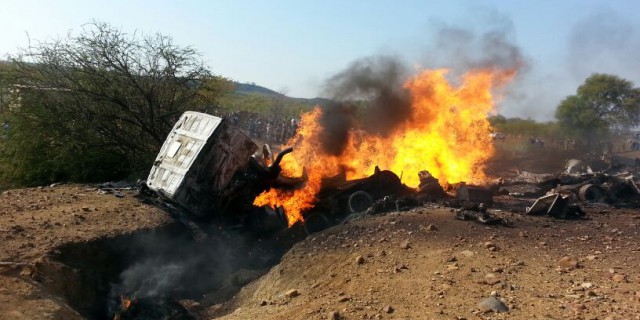
A road accident along Marke village in Takai Local Government Area of Kano State yesterday killed 22 passengers of a Ford, marked XA671 NNG. Several people were injured even as another tragedy hit Rivers State yesterday when a loaded fuel tanker crashed at about 1am in Elele, Ikwere council area, barely 24 hours after fire razed the popular Mile One market in Port Harcourt.

A resident, who spoke on condition of anonymity, said the loaded tanker upturned at an area known as ‘roundabout’ and exploded. Seven died in the inferno, which also burnt about 30 houses, both residential and business buildings, six cars, three trailers and a police van parked around the area.

The state police command’s spokesman, Ahmad Muhammed, a Deputy Superintendent, confirmed the incident. on Tuesday, at about 2am, fire razed the Port Harcourt market and destroyed inestimable goods and property. Governor Chibuike Rotimi Amaechi has urged the police command to investigate the cause of the fuel tanker fire, according to a Government House statement. He visited the scene yesterday.

He said: “The police should investigate the cause of this fire. We hear a life was lost and properties have been damaged. We need to hear from the police and know what happened before the government can decide on what to do.”

Meanwhile, a more devastating tragedy occurred in Kano yesterday along Marke village in Takai Local Government Area, killing 22 passengers. The victims of the auto crash, include 10 women. Nine injured victims, who survived the crash, were rushed to Takia General Hospital.

Some of the deceased were burnt to death in the crash which happened at about midday.

According to the Sector Commander of the Federal Road Safety Corps (FRSC), Alhaji Garba Mohammed Ibrahim, the bodies were given mass burial at the scene of the crash by the community. They were buried at about 3.00 pm. Eyewitness said that the heavily-loaded Ford vehicle was also carrying bags of foodstuffs when it somersaulted and burst into flames following a suspected mechanical fault.

The sector commander appealed to motorists to drive more carefully even as he prayed for the repose of the souls of the victims. The Information Officer in the area, Malam Muntari Usman Romi, journalists that funeral prayer was conducted at the graveyard side by Malam Ibrahim Usman, adding that the burial was attended by the local government officials and traditonal rulers in the area.

He said the passengers were coming from Magami village in Takai local government and were travelling to the state capital.

Friday 20 December 2013

http://www.osundefender.org/?p=138722

continue reading

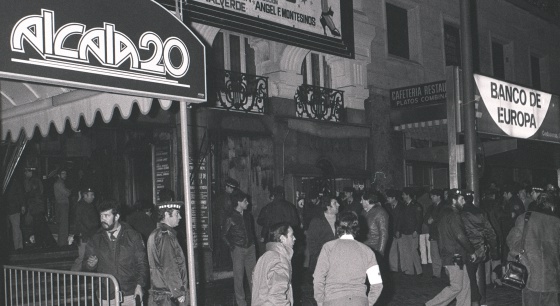
December 17, 1983: Alcalá 20 nightclub fire


On the morning of December 17, 1983 Madrid awoke to terrible news. A fire at the Alcalá 20 nightclub in the heart of the capital had left 78 people dead. The lack of safety measures at the establishment and the padlocking of emergency exits led to a complete overhaul of safety and security protocols in Spain. Now, 30 years later, the victims and some of the people responsible for the tragedy prefer to forget. The images of that night still haunt them today.

The Alcalá 20 disaster completed a black month for the region of Madrid, where two fatal air crashes had also recently taken place at Barajas airport and Mejorada del Campo: in total, 355 people were killed in the space of a few days. The initial death toll at Alcalá 20 rose to 81 after a person died in intensive care and the bodies of two youngsters were discovered in an elevator shaft inside the building.

It is thought that the fire might have been caused by a short circuit in the electrical system. At around 4.30am that Saturday morning, the stage curtains went up in flames. Cries of "fire, fire" were initially taken as a joke by many clubbers, who remained on the basement dance floor. According to the owners of the club there were 150 people inside at the time, although customers said the figure was closer to 1,000.

The flames created a thick blanket of smoke, causing people to run up the stairs to street level. But the hallway and coat check area were too narrow to cope with the dozens of people rushing madly to escape death. The desperation to get out led to a human stampede in which many people were trampled. The locked emergency doors converted the night spot into a death trap from which dozens of people were unable to escape in time through the one available exit.

It has been a long time, and many people have tried to move on. Purificación A. P. lost a sister in the tragedy. Her father was the janitor of the building located right above the nightclub. She had been sleeping when her parents pulled her out of bed. The house was filling up with smoke.

"It's been very tough. It's been 30 horrible years," she says, tears welling up. "Every single day I remember what happened and it is never out of my mind."

She prefers not to go on. Many other victims and family members did not even let the reporter finish his question: the conversation was over as soon as Alcalá 20 was mentioned.

One of the first people to go inside the nightclub after the fire had broken out was firefighter Francisco Gallego Clavero, who says the place was absolute chaos. One of the first things he remembers about that night is that as soon as he walked in, he saw three bodies lying on a staircase. Later he went downstairs and found "a bunch of people piled up" next to the coat check.

"I was using a vest pocket flashlight of the kind we used to carry back then to light up the place while my colleagues took out the bodies. Outside there were friends and relatives waiting," recalls Gallego, who was 35 at the time. "It was a huge blow, because nearly everybody died of asphyxiation."

Technical reports showed that the staircase leading up to the entrance door turned into a chimney draft that sucked out all the smoke even as customers attempted to escape through it.

Meanwhile, news about the fire spread quickly through the emergency services' radios. Sitting inside one of the patrol cars that reported to Alcalá 20 was Mateo Rivas, a 24-year-old officer who had also recently been to the site of the air crash in Mejorada del Campo. He and his colleague, who were driving a Seat 131 station wagon, picked up a young woman who was injured and drove her to the Provincial Hospital [now the Gregorio Marañón].

"When we were driving by Puerta de Alcalá, they warned us that this center was over capacity, so we ended up driving to La Paz [hospital in the north of the city]," recalls Rivas, who now works in the traffic accident department.

"What struck me the most was all the smoke coming out and the fact that you couldn't even stand at the front door of the nightclub. The firefighters had to go down with breathing equipment."

The investigation was overseen by a very young judge, the 28-year-old Jacobo López Barja de Quiroga, whose work was later described by other jurists as "masterful" and "textbook perfect."

The four club owners were arrested and the trial, which took place 10 years later, found them guilty, as well as the electrician in charge of the installation and the Interior Ministry inspector who should have checked the club's safety measures.

The state took four years to pay damages to the victims.

Friday 20 December 2013

http://elpais.com/elpais/2013/12/19/inenglish/1387459694_048856.html

continue reading

28 bodies discovered at hidden burial ground in El Salvador


Four more bodies have been found in the hidden burial ground that was discovered in El Salvador last month, bringing the total number to 28, the country’s justice minister said Wednesday.

“There are already 28 (bodies) found” at the site on the El Limon ranch in Colon, a city 19 kilometers (about 12 miles) west of San Salvador, Ricardo Perdomo told a press conference.

The burial site includes more than 14 graves in an area of some 200 square meters (about 2,100 square feet), according to the Attorney General’s Office, and investigators estimate that there could be as many as 44 bodies in all interred there.

Investigators began digging on the El Limon property on Nov. 19 and made the “first discoveries” three days later, the head of the organized crime unit in the AG’s office, Rodolfo Delgado, said last week.

Militant members of the Pandilla 18 gang were behind the killings, the AG’s office says.

Perdomo announced that “probably investigations will be begun in other places” around the country to determine if there are more clandestine burial sites.

Between January and Dec. 15, at least 2,391 people have been murdered in El Salvador, according to official figures.

But national police director Rigoberto Pleites said Wednesday that the force is “analyzing” the number of disappearances, which have almost doubled this year, since “possibly many of them may have been murdered.”

Between January and Dec. 1, 1,070 people were reported missing, compared with 545 during the same period last year.

The increase has called into question the ostensible 52 percent reduction in murders due to a cease fire declared among gangs in March 2012.

Friday 20 December 2013

http://www.hispanicallyspeakingnews.com/latino-daily-news/details/28-bodies-discovered-at-hidden-burial-ground-in-el-salvador/28454/

continue reading

Himalayan 'Village of Widows' struggles after flash floods kill 57


The Indian government still doesn't have a final toll for the thousands of people killed in massive flash floods earlier this year, but in the Himalayan hamlet known as the Village of Widows, the loss is all too specific: 57 people killed, about a quarter of its population.

Six months after walls of melted glacier, mud and debris came crashing down the mountainside, the village officially named Deoli-Benigram has 37 widows from the floods, making up about a third of its remaining inhabitants and giving the town its grim new name.

Along with their loved ones, the grieving women's livelihoods were also lost, and they say the state's help is not enough.

"Just six months ago, we were the richest family in this village, and now we do not know where our next meal will come from,'' says Bijaya Devi, tears rolling down her face as her orphaned one-year-old grandson reaches up to touch her cheek.

Mrs Devi lost her husband, three of her sons and a nephew in the June 17 floods, which devastated the temple town of Kedarnath where most of the men in the village made their livings.

At age 64, Mrs Devi is the village's oldest widow. The youngest is her 22-year-old daughter-in-law. Both their husbands worked in the family's small lodge and grocery store in Kedarnath which catered to pilgrims to the shrine.

The Indian government has been criticised for its slow response to the floods in the northern state of Uttarakhand, near Tibet. In all, about 1000 bodies were found and some 5700 people are missing.

The early monsoon floods struck near the end of the summer Hindu pilgrimage to the Kedarnath shrine - one of four major temple towns in the area 3500 metres high in the Garhwal Himalayan mountain range.

Many of the surrounding people depend on temple tourism to make their livings, either as priests, innkeepers or guides with mules to take pilgrims up the steep trails.

The Kedarnath temple - dedicated to the Hindu god Shiva - was not badly damaged itself but the area around it is still strewn with piles of debris up to 4 metres high.

The government has distributed 500,000 rupees (about $8000) to families in the area who lost a breadwinner, but the villagers say what they need are jobs, and for roads and electricity to be restored.

They worry that next summer's pilgrims won't come to the devastated area, even if they did have a way to rebuild their businesses.

But with the harsh Himalayan winter setting in, many are concerned just with surviving.

"Earlier, the life in the hills was dangerous, but now it is hell. There are no roads, no water, no electricity and no jobs,'' said Vinod Kumar in the village of Bhatwadi, also near Kedarnath.

"People in many villages are still living in make-shift tents. How can they survive in tents? How will they keep themselves warm?''

Friday 20 December 2013

http://www.dailytelegraph.com.au/news/world/himalayan-village-of-widows-struggles-afer-flash-floods-kill-57-critics-say-not-enough-govt-help/story-fni0xs63-1226787074245

continue reading

Namibia: Nine plane crash bodies identified


Police this week identified nine bodies, after examining 609 human remains recovered from the site of the Mozambique plane crash.

The examination of the remains, which included comparison of dental DNA and fingerprints, is part of the Disaster Victim Identification (DVI) process that was completed on Thursday last week.

The bodies are still with the Namibian police awaiting repatriation to their respective countries.

"These nine individuals are some of the passengers who were in the aircraft and thus their families will be notified individually through their governments," police deputy Inspector General James Tjivikua said.

Tjivikua also said families of the deceased requested to wait until the process is completed before the remains are repatriated.

The police are in process of obtaining more data and samples from five counties where the victims originated and once these samples have been received, further analyses will be done.

The Director of the Institute of National Forensic Science, Paul Ludik, said the institute received additional support from 10 countries in addition to those where the victims came from.

Ludik said the investigators had to overcome a number of challenges in the examination of the bodies including the state of the remains.

"Chemicals in the plane also affected the bodies and thus making it hard to identify the bodies at a faster pace," said Ludik.

Friday 20 December 2013

http://allafrica.com/misc/forms/sendpage.html

continue reading

11 Killed in Peru bus crash


Eleven people were killed and 35 others injured Thursday when a bus ran off the road and tumbled 30 meters (98 feet) to the bottom of a ravine in northern Peru's Ancash region, police said.

The accident occurred shortly before 11:00 a.m. in Cajacay district on the road linking the cities of Huaraz and Pativilca, a police spokesman told Efe.

Authorities are still working to recover the bodies of the dead, he said.

The 35 injured survivors were taken to several different hospitals in Barranca, Huaraz and Cajacay.

Bus accidents are all too common in Peru, especially in mountainous areas. Most crashes are attributed to excessive speed, driver fatigue or the poor condition of the vehicle.

Friday 20 December 2013

http://www.laprensasa.com/309_america-in-english/2345235_11-killed-in-peru-bus-crash.html

continue reading

Wednesday, 18 December 2013

Ethanol tanker explosion victims identified


The 13 victims of the Chisumbanje ethanol tanker explosion of October 30, 2013 have been identified through DNA profiling conducted by a team of medical experts in Harare.

Health and Child Care Minister Dr David Parirenyatwa yesterday confirmed the development.

"The DNA profiling was successful and all the bodies were positively identified. I received the report yesterday (Monday)," he said.

"Although it was a sad case, it is a relief to the families as they will now be able to bury their relatives since all the bodies have been identified."

He said the Ministry of Home Affairs was helping relatives collect the remains from Mutare Provincial Hospital for burial. Early last month, samples were transferred to Harare from Mutare for tests.

The team, led by Africa Institute of Biomedical Science Technology (AiBST) founder Professor Collen Masimirembwa, took tissue and blood samples from 19 relatives of the victims. The team required six weeks to conduct the tests.

Wednesday 18 December 2013

http://www.bulawayo24.com/index-id-news-sc-national-byo-40417.html

continue reading

45,000 missing people in Colombia may be buried in mass graves


The Colombian General Prosecutor's Office said it is investigating the disappearance of 45,154 people who may be buried in mass graves.

Officials said Monday that 4,189 graves with 5,390 bodies have been found since May 2006.

The discoveries came after the demobilization of the paramilitary group AUC, which is allegedly responsible for most of the disappearances, Colombia Reports said.

Authorities have identified 2,483 of the remains, and 2,338 bodies have been delivered to the victims' families.

Former AUC members have informed authorities of 1,025 graves.

Wednesday 18 December 2013

http://www.upi.com/Top_News/World-News/2013/12/17/45000-missing-people-in-Colombia-may-be-buried-in-mass-graves/UPI-83581387289653/

continue reading

'Yolanda' death toll stops rising


The official death toll from super typhoon "Yolanda" is stuck at 6,069, even as retrieval operations continue in areas ravaged by by the deluge.

The death toll has been stuck at 6,069 since December 17, Tuesday, based on the latest update from the National Disaster Risk Reduction and Management Council (NDRRMC).

Majority of the fatalities were from Eastern Visayas at 5,715 (5,220 in Leyte; 265 in Eastern Samar; 224 in Samar; and 6 in Biliran).

In Tacloban, 2,454 bodies have yet to be identified.

The number of missing remains at 1,779: 1,671 in Leyte; 38 in Samar; 24 in Palawan; 20 in Eastern Samar; 15 in Antique; 5 in Cebu; 4 in Iloilo and 1 each in Guimaras and Capiz.

Wednesday 18 December 2013

http://www.abs-cbnnews.com/nation/regions/12/18/13/yolanda-death-toll-stops-rising

continue reading

Geslacht onbekende watersnooddoden staat vast


Article in Dutch. Please use the Google translate function on the right to tranlate into English.

Onderzoekers van de politie en het Nederlands Forensisch Instituut (NFI) hebben een belangrijke stap gezet in het achterhalen van de identiteit van 25 onbekende doden van de watersnoodramp in 1953. Van hen zijn DNA-profielen opgesteld waaruit blijkt dat het om 11 mannen (waarvan twee jongens) en 14 vrouwen (waarvan een meisje) gaat. Dat heeft de politie woensdag gemeld.

De doden werden in september opgegraven in de gemeente Schouwen-Duiveland in een ultieme poging 60 jaar na de ramp alsnog de identiteit van hen te achterhalen. Inmiddels heeft de politie van 50 nabestaanden van rampslachtoffers wangslijmvlies afgenomen. De onderzoekers hopen dat een vergelijking van hun DNA met het DNA van de slachtoffers een ‘match’ oplevert. De politie verwacht de eerste resultaten daarvan in januari te hebben.

Profiel In totaal werden 28 mensen in september opgegraven. Van 3 bleek het vooralsnog niet mogelijk om een DNA-profiel te maken. Het gaat om een volwassene en twee kinderen. De onderzoekers voeren op dit moment aanvullende onderzoeken uit om te kijken of alsnog een profiel kan worden gemaakt.

Een woordvoerder van de politie vertelde dat dinsdag nog een watersnoodrampdode is opgegraven. Na de opgravingen in september kwamen er sterke aanwijzingen dat onder het watersnoodrampmonument op de begraafplaats in Ouwerkerk nog een slachtoffer moest liggen. ,,We hebben in alle rust onderzoek gedaan en in de archieven inderdaad aanwijzingen gevonden. Vorige week zijn we met een grondradar gaan zoeken en zagen dat er een graf was, vlak naast het monument’’, vertelde hij. Het NFI onderzoekt nu of van dit slachtoffer nog een DNA-profiel kan worden opgesteld.

De politie graaft niet alleen onbekende doden van de watersnoodramp op. Deze opgravingen zijn onderdeel van een breder programma waarin deskundigen de identiteit van onbekende doden in het hele land willen achterhalen. Zo werden op Schouwen-Duiveland in september ook 11 onbekende doden opgegraven, waarvan vaststaat dat zij niet door de watersnoodramp omkwamen.

Wednesday 18 December 2013

http://www.telegraaf.nl/binnenland/22148145/__Geslacht_watersnooddoden_bekend__.html

continue reading

Tuesday, 17 December 2013

December, 16: 1960 NYC air disaster


December 16, 2013, marked the 53rd anniversary of the 1960 New York mid-air collision, which was considered the worst disaster in aviation history at the time.

At 10:21 am, United Airlines flight 826 left Chicago's O'Hare airport and headed for Idlewild airport (later renamed to JFK) in New York.

At around the same time, TWA flight 266 was heading to La Guardia airport from Dayton, Ohio.

On that snowy day, flight 826 flew 11 miles off course over Staten Island. And at 10:30 am, it collided with flight 266.

All 128 passengers on board were killed except for one.

Six people on the ground were also killed.


A young boy, Stephen Baltz, 11, was discovered in a snow bank in Park Slope. He was taken to the hospital where he died 27 hours later.

This event is not only historic for being one of the worst air disasters in history. It also marks the first time black box recorders were used to investigate an aviation disaster.

Tuesday 17 December 2013

http://digitaljournal.com/news/world/today-in-history-1960-nyc-air-disaster/article/364095

continue reading

Flash floods kill at least 12 in southeast Kenya


At least 12 people have been killed by flash floods in Kenya's southeastern region, local police reported on Monday.

Divisional police commander Mohammed Farah said the heavy rains have also caused widespread destruction of property and infrastructure in Kajiado County, where the 12 victims died in the past two days.

The county was flooded after seasonal rivers burst their banks in heavy rains.

"Two women travelling from Isinya along the Pipeline road in a Toyota Corolla saloon car were swept by raging floods near Dawamu School on Saturday at Oltepes area near Kiserian," Farah said.

The two were flashed into a raging seasonal river and their bodies were recovered on Sunday evening trapped in their car.

The 10 others lost their lives while travelling on Sunday night in the same region. The police said the victims include seven girls and two boys.

"We retrieved their bodies and took them to Shalom Hospital in Athi River to await postmortem," he said. The local police boss said they were unable to retrieve the vehicle because of the speed of the water flow.

Several parts of the country have been affected by flooding following an increased heavy downpour.

He appealed to residents and motorists in the area to avoid crossing streams at night because it is not easy to determine the speed of the flowing water.

Authorities have put areas near major rivers on high alert and advised local residents to move to higher ground.

Tuesday 17 December 2013

http://www.chinadaily.com.cn/xinhua/2013-12-16/content_10829370.html

continue reading

Manila bus crash leaves at least 17 dead


A passenger bus plunged off a wet, elevated highway in suburban Manila and fell onto a van passing below Monday morning, killing at least 17 people and injuring some 16 others, police, hospital and mortuary staff said, revising higher tolls.

TV footage showed a number of bodies strewn around the bus wreckage with police officers nearby. The van was an unrecognizable pile of smashed white metal.

The bus veered off the Skyway, as the elevated road is called, and crashed onto the van 9.6 metres below in suburban Paranaque city at dawn, said police superintendent Elizabeth Velasquez.

It wasn't immediately clear what caused the accident but the highway was wet from rain, said Ivy Vidal, a spokeswoman from Skyway Operations and Maintenance Corp.

Irene Sisperes, a motorist who witnessed the accident, said she was driving with her daughter at 80 kilometres per hour when the bus overtook her car. She estimated that the bus was travelling at between 100 and 110 km/hour.

She said it was still dark and it was raining when the accident happened.

"After a few metres, I saw the bus fall and I shouted, `The bus fell, the bus fell,'" she told DZMM radio, adding there were no other cars nearby.

Sisperes said she saw the damaged railing of the highway and some debris and reported the incident at the toll gate.

Velasquez earlier reported 21 died and 20 others were injured but later said there appeared to have been double counting amid the confusion. She said she was verifying reports 17 perished and a several others were injured.

Angelo Dequina, an employee of a funeral parlour, said 17 bodies from the accident were brought to their mortuary from hospitals and from the crash site.

Calls to five hospitals where the victims were rushed showed at least 16 people injured from the accident have been admitted.

Velasquez earlier said the van's driver was killed and the bus driver was in serious condition in a hospital. But Dr. Carmencita Solidum, medical director of the Paranaque Doctors' Hospital, said the two drivers were among the 10 injured who were at her hospital.

The bus driver was critically injured and the van driver had minor injuries, she added

Ryan Bresa, a passenger who survived, said the bus may have been travelling too fast and the driver to tried control the vehicle's swerving before it fell from the highway.

Winston Ginez, chairman of the government's Land Transportation, Franchising and Regulatory Board, said all the 78 buses of Don Mariano Transit Corp. have been ordered suspended for 30 days.

Two years ago a bus from another company also fell from the Skyway near the same area, leaving three people dead and four others injured.

Tuesday 17 December 2013

http://www.cbc.ca/news/world/manila-bus-crash-leaves-at-least-17-dead-1.2465393

continue reading

Saturday, 14 December 2013

Xinjiang coal mine explosion kills 21


A gas explosion killed twenty-one miners early Friday morning at a coal mine in northwestern China, the government said, but the exact cause was not immediately known. More than a dozen other miners were able to escape.

The blast occurred at around 1:40 a.m. local time at the Baiyanggou coal mine in Hutubi County of Xinjiang Uygur Autonomous Region, according to Zhou Xiuling, a spokesman for the State Administration of Work Safety. A total of 34 miners were working underground when it happened.

Thirteen miners managed to escape the mine, including one who was freed by rescue workers, but his or her condition was not immediately known. The bodies of the 21 other miners were recovered later in the day, officials said, giving no details about what may have caused the accident.

During rescue efforts, temperatures dropped to -5 C, China News Service reported.

Immediately after the explosion, a team entered the mineshaft on Friday morning to ascertain conditions before launching a rescue operation, the report said. Later that afternoon, China Central Television reported that a rescue team was about 300 meters away from where the miners were trapped. The one miner was then rescued.

The rescued worker was in a coma when he was found underground, and he has been sent to the hospital for further medical treatment.

The State Administration of Work Safety said on Friday that the coal mine was once shut down in June because of safety problems.

The coal mine illegally restarted production before the problems were rectified, and that led to the accident, the administration said in a statement.

The administration required coal mines nationwide to enhance safety rules and prohibit illegal production.

The Baiyanggou mine has an annual output of 90,000 tons, and it has been in production since August 2007, China News Service reported.

While safety conditions at mines in China have improved according to statistic from the Chinese government, they are still ranked the most dangerous with 1,384 deaths reported in 2012, a significant decrease from the 1,973 fatalities in 2011. The Chinese government reported 2,433 fatalities in 2010 and 2,631 in 2009.

China shut down scores of small mines in recent years to improve safety and efficiency in the mining industry. The country has also ordered all mines to build emergency shelter systems which are to be equipped with machines to produce oxygen and air conditioning, protective walls and airtight doors to protect workers against toxic gases and other hazardous factors.

One of the worst mining accidents in China in recent years happened in November 2009 when 104 workers were killed after several explosions at a coal mine in Heilongjiang province.

On Dec 6, Premier Li Keqiang ordered intensified efforts to improve work safety standards following a deadly explosion last month in Shandong province that left 62 dead.

He urged a careful review of a nationwide work-safety overhaul this year to learn from deadly accidents.

"Production safety is a life-and-death matter and a red line that must not be crossed," Li said in a written statement as a work safety committee of the State Council, China's Cabinet, held a plenary session in Beijing.

The country should emphasize the prevention of accidents, regularly conduct safety inspections and move to establish a permanent mechanism for ensuring work safety, Li said.

Saturday 14 December 2013

http://www.china.org.cn/china/2013-12/14/content_30893449.htm

http://wireupdate.com/gas-explosion-kills-21-miners-in-northwest-china.html

continue reading

Dec. 16, 1943: Worst US train collision frozen in memory of witnesses


Seventy years ago this weekend, as North Carolina marked the 40th anniversary of the Wright Brothers’ first flight, disaster struck on snow-covered railroad tracks in Robeson County. It had been an uncommonly cold winter with no relief in sight. A broken rail had caused the derailment of the Florida-bound Tamiami West Coast Champion, killing one person.

Then, “some 40 minutes later the northbound Tamiami East Coast Champion ploughed into the derailed coaches of the first train wreck which lay sprawled across the double track.”

It happened a long time ago, but Lucille Bullock can remember sitting in her father’s green 1940 Ford on the side of the road and seeing the trains down the railroad tracks in the snow. She would have been about 7 or 8 at the time.

Her family had driven to the site where one Atlantic Coast Line passenger train had hit another a couple of days earlier on the main line near the community of Buie about 1:30 a.m. Dec. 16, 1943.

It was bitter cold on the night of the accident.

Injured passengers trapped in the twisted steel cars screamed for help. As rescue workers cut through the wreckage with acetylene torches, doctors crawled through to administer morphine shots to the trapped survivors. The water in some of the syringes froze in the 10-degree temperatures.

Bullock’s father, George Tolar, visited the scene the day after it happened. “I remember going up there after he had went and come back,” said Bullock. “My mother and grandmother, which was his mother, we went up there and looked at it. But he wouldn’t let me get out and see where it was at. I had to stay in the car.”

Seventy-two people, including 52 servicemen bound for home for the holidays, lost their lives in the train wreck that occurred near the N.C. 211 overhead bridge on the rail line between Buie and Rennert in Robeson County. Almost as many people, 70, were hurt.


“Rescuers battled through the winter’s coldest night over snow and ice-coated highways to bring survivors of the double smashup to hospitals at Lumberton and Fayetteville,” The Associated Press reported. ...

The accident happened about 35 minutes after three cars of the southbound Tamiami West Coast Champion derailed after running across a split rail. This was shortly after the train had passed through Rennert. A dining car and two Pullman sleepers were left tilting, with the first of the derailed cars leaning over the tracks at an angle of about 45 degrees.

The train had left New York at 11:45 a.m. Dec. 15, and was due in St. Petersburg, Fla., the next day.

Once repair efforts began, the conductor sent the fireman down the track to flag oncoming trains. As he walked along the track, he slipped in the snow and fell, damaging his fusee, or colored flare, so that it wouldn’t work.

A couple of southbound freight trains were stopped, but attempts to halt the northbound Tamiami East Coast Champion failed. As that diesel-hauled train passed the railwayman, the crew was unaware of the danger that lay ahead.

The East Coast Champion plowed into its southbound cousin at a speed in excess of 85 mph, hurling hundreds of men, women and children into the wreckage. Both trains carried from 16 to 18 cars apiece and a heavy load of passengers in both sleeping cars and coaches.

Railway offices in Wilmington said nine cars on the northbound train were derailed.

“Scattered about the wreck scene were packages in Christmas wrappings, Army blouses, Marine coats and broken Christmas toys,” an Associated Press report said. “One spectator reported seeing a white satin dress and white veil, evidently the wedding dress of some passenger.”

Horace Tyner of Red Springs recalled seeing a passenger car that had shoved into another from the impact. He went to the site a day or two after the accident.

“It was cold. It was cold. I remember everything all white,” he said. “I remember my first impression – all the rails twisted like pretzels. But that railroad, it was messed up. [For] 150 yards or more. All the bodies were gone. Only thing left of the wreck was the carnage of track, wreckage, wheels, axles and twisted railroad. It was just twisted all to pieces.”

The wreck remains one of the deadliest railroad accidents in the U.S. Reports from the scene relayed stories of heroic efforts by some of the military and civilian passengers in tending to the wounded.

Saturday 14 December 2013

http://www.newsobserver.com/2013/12/13/3457324/worst-train-collision-frozen-in.html

continue reading

Suspected mass grave found in Serbia


Human remains believed to be the bodies of hundreds of Albanians killed during the 1998-99 war in Kosovo have found been just inside the Serbian border, a Kosovo official said this afternoon.

More than 14 years after the war ended, Kosovo officials have been pressing Serbia to continue to look for bodies on its territory that may have been moved by Serbian forces trying to cover up killings of majority ethnic Albanians in Kosovo.

"For many years, we have cooperated with informers and they told us that there may be more than 250 bodies, they even mention there may be 400 bodies," Prenk Gjetaj, the head of Kosovo's state commission for missing persons, said.

10,000 people are believed to have died in the crackdown by Serbian police and army on ethnic Albanian rebellion in its former province.

The conflict was halted when NATO launched air strikes against Serbia in 1999.

Most victims were Albanians. More than 1,700 people are still missing.

The investigation leading to the discovery was a joint effort by Kosovo, Serbia and the EULEX, the EU's justice and police mission in Kosovo.

Officials from Kosovo and Serbia are expected to meet soon to discuss how to proceed with further excavations.

The war crimes prosecutor's office in Belgrade declined to comment.

The bodies were found after excavators removed the concrete pavement in the yard of a road maintenance company in Rudnica, just inside southern Serbia, near its border with Kosovo.

Mr Gjetaj did not say how many bodies were found but said a big office building on the site had to be destroyed during the dig.

If confirmed, it would be the sixth mass grave found since 2000.

The largest, containing the bodies of more than 800 Kosovo Albanians, was found in 2001 in pits at a police training ground outside Belgrade.

Kosovo declared independence in 2008, but relations with Serbia have only started to normalise in the past year, after the EU brokered a deal to integrate the mainly Serb north with the rest of Kosovo.

In exchange, Serbia was offered talks on EU membership, expected to start in January.

Saturday 14 December 2013

http://www.rte.ie/news/2013/1213/492771-kosovo/

continue reading

Friday, 13 December 2013

How nuclear bombs tell us the age of human cells, used to identify Tsunami victims


When mushroom clouds exploded in the sky during Cold War-era nuclear bombs testing, they also created an unexpected boon for science. The nuclear explosions caused a massive uptick in Carbon-14 that eventually settled in all living tissue — everything from tree rings to elephant tusks to human brain cells.

As such, this spike in Carbon-14 has helped scientists date trees, find ivory poachers, and upend a decades-old dogma that new brain cells cannot be regenerated in the human brain.

In fact, Kirsty Spalding and Jonas Frisén, the pioneering brain cell researchers profiled by PBS’s NOVA, believe Carbon-14 dating has great potential for shedding light on how quickly cells are replenished in the body.

The catch is that the Carbon-14 released before the aboveground nuclear testing ban in 1963 is slowly fading to background levels. There’s plenty of research yet to be done — but they only have until 2050.

As Carrie Arnold explains for NOVA, this is why Carbon-14 or so-called bomb pulse dating works:

Most aboveground nuclear bomb testing happened between 1955 and 1963, and those detonations released untold numbers of neutrons into the atmosphere. These slammed into nitrogen atoms, causing their nuclei to eject a proton. What was once a seven-proton nitrogen became a six-proton carbon. But unlike most carbon atoms, which have six protons six and neutrons, this radioactive carbon, known as 14C, retained nitrogen’s two extra neutrons, a difference in atomic mass that is small, but measurable. Normally, only a tiny fraction of the world’s carbon is 14C, so little that scientists measure it in parts per trillion. The bomb pulse doubled this amount. While 14C concentrations are still low even after the bomb pulse, the difference is obvious to scientists who know what they’re looking for.

The use of Carbon-14 dating in biology was originally forensic. Because skin and hair are continually replenished in a live person, their age — as determined by Carbon-14 dating — is also a proxy for when a person died. Spalding and Frisén used Carbon-14 to help identify victims of the Indian Ocean tsunami, for example, but they were eventually convinced the technique could be used to date populations of cells as well as whole bodies. By looking at the age of cells, they could also figure out how quickly those cells replenished.


When they started looking at certain tissues, Spalding and Frisén first found that fat cells were replaced more quickly in the obese than the healthy. When they turned their attention to the brain, they found that some neurons were younger than the individuals they came from, thus showing that the brain can, in fact, regenerate, a discovery indirectly made possible due to the atmospheric effects of nuclear bombs.

Friday 13 December 2013

http://www.gizmodo.com.au/2013/12/how-nuclear-bombs-tell-us-the-age-of-human-cells/

continue reading

Police probe plane crash pictures release


Police are investigating how pictures of the Mozambican plane, which crashed in northern Namibia about two weeks ago, were released in the media without authorisation.

Both Police Deputy Commissioner Edwin Kanguatjivi and Director of National Institute of Forensic Science Paul Ludik concurred during a press conference in Windhoek on Wednesday that publishing the images was unethical since it interfers with the course of justice.

“We realise these photographs and videos are very graphic,” said Kanguatjivi, adding that they are investigating how such ‘unauthorised release’ of pictures occurred in the first place.

“The unauthorised usage of photographic images emanating from crime scenes could be construed as interfering with the course of justice,” said Ludik.

According to Police Deputy Inspector General James Tjivikua, the crash is still under investigation to ensure accurate identification of all deceased.

“The investigation should take approximately 14 days as the Institute of National Forensic Science is attempting to make identification through comparison of dental and fingerprint records available prior to the crash,” said Tjivikua.

Initial information had suggested that there were 33 people on board the LAM flight from Maputo to Luanda, Angola on 29 November and that only 31 bodies were found.

LAM spokesperson Norberto Mucopa, also expressed concern, in a press statement issued on Tuesday, about worldwide media speculation, in reference to some claims that some passengers had evacuated before the crash and that two bodies were also not accounted for.

“LAM is concerned about these speculation as they are causing anxiety, upset and uncertainty locally,” said Mucopa, adding that family members have been of assistance during the investigation process.

Friday 13 December 2013

See more at: http://www.namibian.com.na/indexx.php?id=7205&page_type=story_detail&category_id=1

continue reading

Thursday, 12 December 2013

Over 8000 people still missing in Bosnia


Over 8,400 people are still missing after the Bosnian war between 1992 and 1995, Marko Jurisic of the Institute for Missing People in Bosnia and Herzegovina told the media in Sarajevo on Thursday.

Speaking after December 10 International Day of Human Rights, he expressed dissatisfaction with the attitude of local governments toward the issue of missing persons.

“One of the key issues in the process of the search for missing people is the lack of relevant information about mass graves,” Jurisic said, adding that the institute exhumed 506 body remains and identified 480 people during 2013.

Currently, exhumation is ongoing at one of the biggest mass graves in the country, Tomasica in northern Bosnia where 430 body remains were found since September.

According to existing data, more than 100,000 people were killed during the war.

Thursday 12 December 2013

http://www.worldbulletin.net/?aType=haber&ArticleID=124854

continue reading

Clapham rail disaster: Ex-firefighter remembers train crash


Twenty-five years ago 35 people were killed and 500 people injured when three trains collided in Clapham, south London. BBC producer Clifford Thompson, who at that time worked as a firefighter and was on duty that day, says he will never forget what he saw.

The teleprinter furiously spat out messages printed on to a roll of paper.

It was Monday, 12 December 1988 - a bright but fiercely cold day - just after 08:00.

The London Fire Brigade's Green Watch firefighters were coming to the end of their 48-hour shift.

I stood in the watch room at Stratford fire station in east London - I'd been a firefighter for three years and was one of the Red Watch crews preparing to relieve our colleagues.

We crowded around the teleprinter as messages were relayed from Spencer Park in Clapham.

"This is a major incident - initiate major incident procedure," followed by: "two commuter trains in collision, five carriages involved, approximately 150 casualties, unknown number of people trapped, efforts being made to release".

A train travelling from Poole, Dorset, had passed a "clear" signal just outside Clapham Junction Station and hit the back of a train from Basingstoke, ripping open carriages. Some de-railed carriages were pushed into the path of a third train travelling away from London.

Fifteen fire engines from closer stations headed straight to the crash site, along with a number of specialist rescue firefighters and police, ambulance and hospital surgical teams.

At that point - being 12 miles away and a 45-minute drive from Clapham - I thought there was little chance of our crew getting called there.

Then at 10:25 the officer in charge of the incident sent the radio message: "request 18 pump relief... as soon as possible... rendezvous at junction of Windmill Road and Spencer Park."

A few minutes later the teleprinter bell sounded at Stratford and our engine was despatched to the crash.

I was struck by the scale of what met us - there were dozens of emergency service vehicles and also TV crews.

It was a surreal sight, like a massive film set.

We were told to go down to the crash site and assist with the remaining victims.

In the eerie quiet, it was clear that of those remaining, none was alive.

I walked down the steep embankment - at the bottom was a ledge with a vertical drop about 15ft (4.5m) into the cutting - and saw the jumbled mess of iron and steel.

Ladders and ropes were used to help us get down there.

A man's body was pulled from the wreckage, followed by a woman who had suffered multiple injuries.

We removed another body, leaving only one in place: a man thrown from one of the first two carriages on the Poole train.

At 15:52 another radio message was sent: "All bodies now removed from remaining coaches - British Rail heavy cutting and lifting units in operation. Brigade crews now standing by."

I played a very small part in the rescue operation: one of about 250 firefighters who attended the incident.

I could not imagine what the scene was like for the very first crews to arrive confronted by hundreds of injured people. But we worked with quiet determination to make sure that the final bodies were recovered with as much dignity as possible.

It took more than a year for the 250-page report by Anthony Hidden QC to be published.

It found that faulty wiring had caused an incorrect signal to be displayed to the driver of the Poole train, who was driving into a blind bend and had no chance of stopping.

This crash was by far the largest incident I had attended at that point in my firefighting career.

Of course, I had attended other incidents where people had died. But none of them were on this scale - even 25 years ago, it remains difficult to take in.

Thursday 12 December 2013

http://www.bbc.co.uk/news/uk-england-london-25331840

continue reading