Friday, 19 April 2013

Update: 9 victims identified in West explosion, official death toll climbs to 14


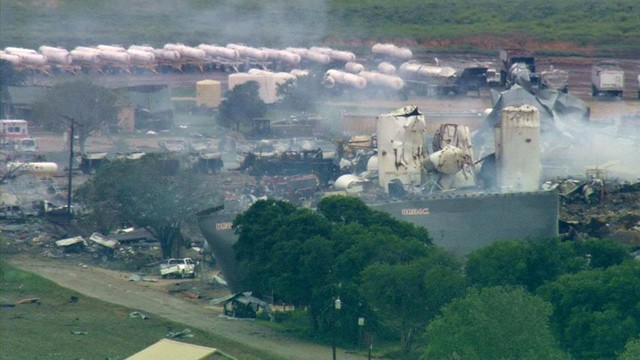
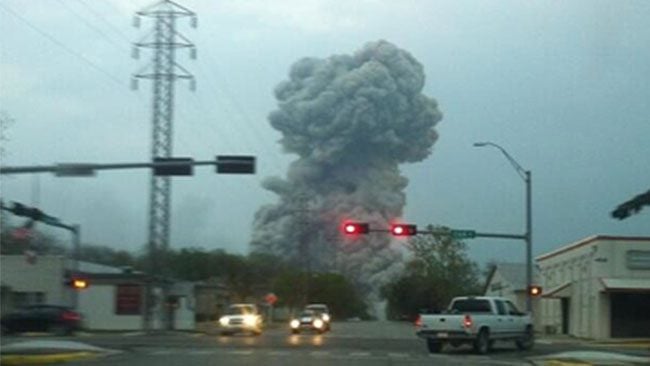
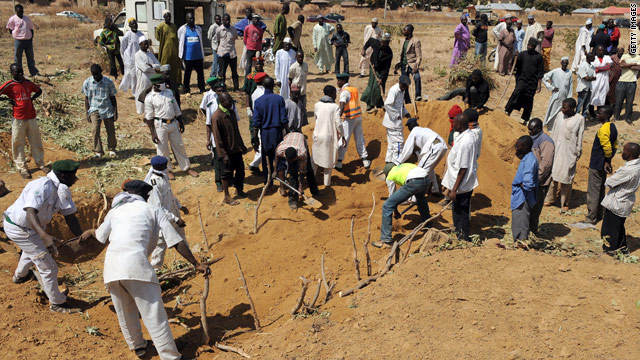
Two days after the fertilizer facility exploded in a blinding fireball, authorities announced that they had recovered 14 bodies, confirming for the first time an exact number of people killed. Grieving families quickly started planning burials.

At least three of those who perished in Wednesday's blast were firefighters, according to family members. The dead included Uptmor and Joey Pustejovsky, the city secretary who doubled as a member of the West Volunteer Fire Department, as well as a captain of the Dallas Fire Department who was off-duty at the time but responded to the fire to help.

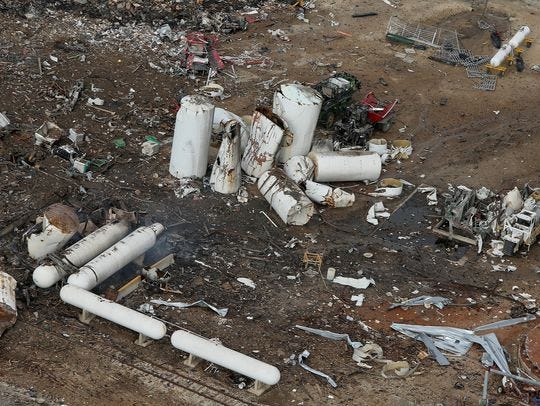
The explosion was strong enough to register as a small earthquake and could be heard for many miles across the Texas prairie. It demolished nearly everything for several blocks around the plant. More than 200 people were hurt.

Texas Department of Public Safety Sgt. Jason Reyes said he could not confirm how many first-responders had been killed. Efforts to search devastated buildings in a four-block radius around the blast site continued Friday.

Texas Sen. John Cornyn told television station WFAA that search-and-rescue workers had a list of several dozen people who are unaccounted for and were checking that list against those people who are still hospitalized, staying with relatives or evacuated because their homes were destroyed.

"So, hopefully that number will come way down, hopefully to zero," Cornyn said.

Friday 19 April 2013

http://abcnews.go.com/US/wireStory/crews-seek-survivors-bodies-texas-blast-18994785#.UXG_wadzA34

continue reading

Waco Siege 20th Anniversary And 18 Years Since Oklahoma City Bombing


The Boston marathon bombing and the massive explosion at a fertiliser plant in Waco, Texas, have made this week a particularly grim one for America.

Unfortunately, US domestic terrorism and the town of Waco are no strangers to the news.

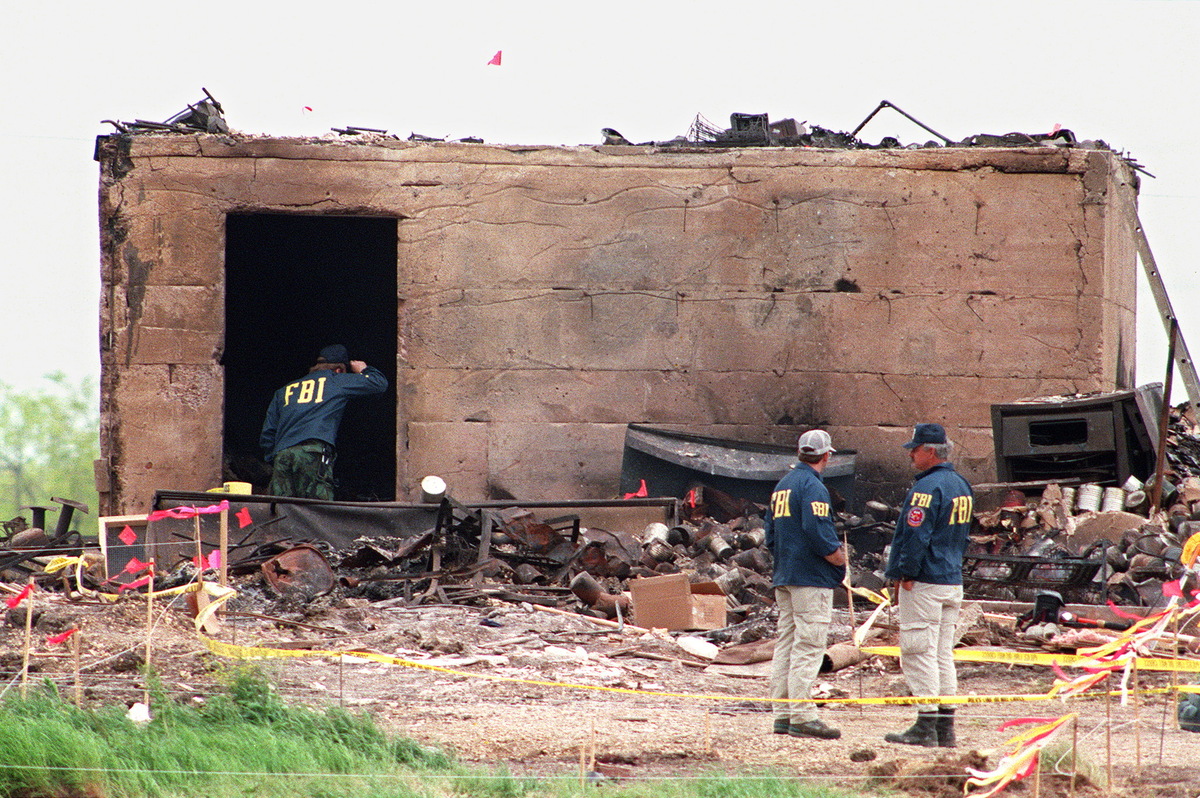
In the early hours of a Texan Monday morning 20 years ago today a 51-day stand off between the FBI and a heavily armed Messianic cult came to an end.

Federal agents (ATF) raided the compound Feb. 28, 1993, trying to arrest sect leader David Koresh for stockpiling illegal weapons. But the group had been tipped off about the raid and a shootout ensued. Four agents and six Davidians were killed.

David Koresh, formerly known as Vernon Wayne Howell, was the leader of the cult, an offshoot of a Protestant sect known as the Branch Davidians.

Koresh had changed his name in honour of two biblical kings and convinced his followers he was to lead the second coming in the forthcoming Apocalypse he had prophesied.

He also convinced the male members to observe a life of celibacy while he had sexual relations with their wives in order to establish a "House of David".

The Branch Davidians lived in a compound in the Texan town of Waco. They came to the attention of the Alcohol, Firearms and Tabacco (AFT) department who believed they were stockpiling weapons and making methamphetamine.

A siege now ensued led by the FBI. Despite using sleep deprivation techniques, cutting power to the compound and shooting holes in their water tower, the occupants refused to leave.

During this period a 24-year-old Gulf War veteran called Timothy McVeigh visited the compound. He would come to the attention of the world in devastating style two years later.

The decision to force entry was made, ostensibly for the welfare of the children who were inside, on 19 April.

Tear gas was pumped into the compound followed by heavily armed FBI agents and armoured vehicles.

Around noon three fires had broken out which quickly spread through the compound's buildings suffocating and burning all those inside, including Koresh.

The actual sequence of events is still disputed. Doubt remains over who fired the first shots and whether the fires were deliberate or could have been prevented.

The ensuing gunfight and blazes that resulted, 76 people died including 28 children.

Twenty-three of the dead were British.

After the siege had ended McVeigh returned to the scene in Waco. Incensed by what he saw as federal suppression of US citizens he decided to take revenge.

Along with another conspirator, Terry Nichols, McVeigh constructed a massive 3.2-tonne truck bomb.

On the second anniversary of the Waco siege, 19 April 1995, the bomb was detonated outside the Alfred P Murrah Federal Building which housed a number of government agencies.

It also had a creche and among the 168 people killed in the blast including were 19 children under the age of 6.

McVeigh was executed in 2001 for what was the worst incident of terrorism on US soil until 9/11. Nichols was sentenced to life in prison.

Friday 19 April 2013

http://www.mysanantonio.com/news/us/article/Davidian-survivors-mark-20th-anniversary-of-siege-4447019.php

http://www.huffingtonpost.co.uk/2013/04/19/waco-siege-oklahoma-bomb_n_3114649.html?utm_hp_ref=uk?ncid=GEP#slide=2352998

continue reading

10 killed, over 40 injured in Pakistan accident


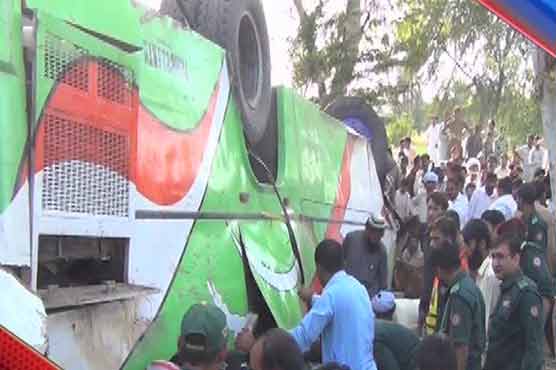
At least 10 people were killed and 46 others injured Friday when their bus overturned in Pakistan's eastern province of Punjab, a media report said.

The over-speeding bus overturned when one of its tyres burst in Hasilpur area of Bahawalpur city, Xinhua reported citing Urdu TV channel ARY.

The bus with over 70 people on board was on its way to Multan.

The injured were taken to a hospital where several of them were said to be in critical condition.

Friday 19 April 2013

http://in.news.yahoo.com/10-killed-over-40-injured-pakistan-accident-142434608.html

continue reading

Death toll in Indonesia boat sinking climbs to 18


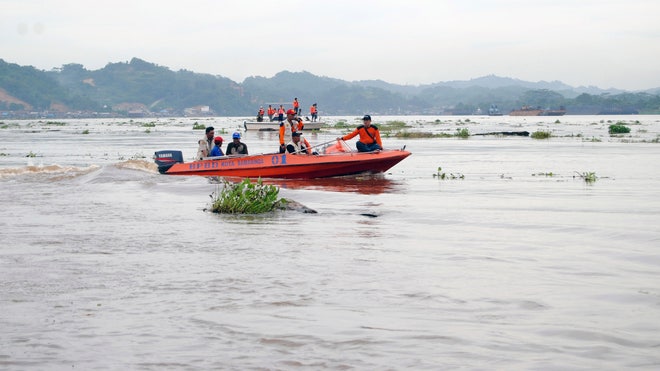
The death toll from a boat accident in the Indonesian part of Borneo island rose to 18 on Friday with five people still missing, a provincial governor said.

The boat carrying workers from a plywood company sank on Wednesday after being hit by a huge wave as it travelled across the Mahakam River in East Kalimantan province.

Provincial governor Awang Faroek Ishak said a total of 18 bodies had now been pulled from the water, up from a death toll of three on Thursday.

"Twenty-one people have been rescued, and we will continue to search for the five passengers still missing," Ishak said in a statement.

There had been conflicting reports about the numbers on the boat, but the governor said it was now confirmed it had been carrying 44.

Disaster agency official Wahyu Didit said none of the bodies recovered were wearing life jackets.

Boat accidents are common in Indonesia, where vessels have a poor safety record and the population of 240 million is scattered over a vast archipelago of more than 17,000 islands.

Friday 19 April 2013

http://www.globalpost.com/dispatch/news/afp/130419/death-toll-indonesia-boat-sinking-climbs-18

continue reading

Official: 12 Bodies Recovered After Texas Blast


The bodies of 12 people have been recovered after an enormous Texas fertilizer plant explosion that demolished surrounding neighborhoods for blocks and left more about 200 other people injured, authorities said Friday.

Texas Department of Public Safety Sgt. Jason Reyes said it was "with a heavy heart" that he confirmed 12 bodies had been pulled from the area of the plant explosion.

Even before investigators released a confirmed number of fatalities, the names of the dead were becoming known in the town of 2,800 and a small group of firefighters and other first responders who may have rushed toward the plant to battle a pre-explosion blaze was believed to be among them.

Reyes said he could not confirm Friday how many of those killed were first responders.

The mourning already had begun at a church service at St. Mary of the Assumption Catholic Church the previous night.

"We know everyone that was there first, in the beginning," said Christina Rodarte, 46, who has lived in West for 27 years. "There's no words for it. It is a small community, and everyone knows the first responders, because anytime there's anything going on, the fire department is right there, all volunteer."

One victim Rodarte knew and whose name was released was Kenny Harris, a 52-year-old captain in the Dallas Fire Department who lived south of West. He was off duty at the time but responded to the fire to help, according to a statement from the city of Dallas.

Authorities spent much of the day after Wednesday night's blast searching the town for survivors. Reyes said those search and rescue efforts continued early Friday.

Friday 19 April 2013

http://abcnews.go.com/US/wireStory/crews-seek-survivors-bodies-texas-blast-18994785

continue reading

Libya: Progress on Missing Persons investigations assessed


The President of the General National Congress Muhammad Maqrif met with the Director-General of the International Commission on Missing Persons (ICMP) Kathryne Bomberger in Tripoli this afternoon to discuss the progress of the Commission’s operations in Libya.

Four months ago, Bomberger and the then Minister for Martyrs and the Missing, Naser Jibril Hamed, signed a cooperation agreement to help process the cases of those who went missing during the 42-year Qaddafi regime and the revolution as well as those who have gone missing since.

As part of that agreement, the ICMP is helping set up a Libyan Identification Center (LIC) to work on cases of missing persons. According to an ICMP statement at the time: “The LIC will allow for the development of a DNA laboratory system, starting with a facility to collect and store biological samples for DNA identity testing and possibly culminating in the creation of a high throughput DNA laboratory. The LIC would also enable Libyan authorities to coordinate the domestic process, as well as international assistance.”

Part of Bomberger’s current visit is to try and deal with some of the problems facing the Commission in its work in Libya. To that end, she will meet in the next couple of days with the present Minister of Martyrs and the Missing, Ali Gadour, and the chairman of Congress’ Medical Committee, Omar Al-Obeidi.

Friday 19 April 2013

http://www.libyaherald.com/2013/04/18/progress-on-missing-persons-investigations-assessed/

continue reading

Search continues in rubble of Texas fertilizer blast


Emergency teams went house to house through mounds of debris Thursday searching for bodies and possible survivors of the earthquake-like blast at a fertilizer company Wednesday night, which sent a ball of fire and burning embers into nearby homes.

State investigators would not confirm the number of deaths from the explosion at the West Fertilizer Co., in this small town 20 miles north of Waco. As many as 160 others were injured. Initial reports put the count as high as 15, and later estimates provided to the mayor's office put the toll at more than 30.

But in an interview with USA TODAY late Thursday, West Mayor Tommy Muska said revised estimates put the death toll closer to about 15 people, including 10 first responders.

Muska said the dead include five members of the West Volunteer Fire Department who were trying to put out a still-unexplained blaze, four EMS workers and an off-duty Dallas firefighter who pitched in. Not all the bodies have been recovered but all are assumed dead.

Two volunteers who showed up to help fight the blaze are also missing and presumed dead, he said.

The remaining fatalities include fertilizer company workers and residents in several devastated blocks of this north-central Texas agricultural town about 80 miles south of Dallas.

"It's just a tragic, tragic incident," Muska said.

Between 50 and and 75 homes and buildings — including an apartment complex, the junior high school and a nursing home — were destroyed or seriously damaged.

"The apartment complex looks like it was the site of a bombing, the kind you see in Baghdad," Texas Attorney General Greg Abbott said at an afternoon news briefing. "It's utterly destroyed."

He also said railroad tracks to the west of the blast site were fused together and a playground was obliterated.

The blast, which rocked the ground with the force of a magnitude-2.1 earthquake, could be felt as far as 45 miles away.

"We risk our lives everyday. Those firefighters knew what they were going into," Waco police Sgt. William Patrick Swanton said. "They went in there to save lives, and that's what they did. A few of them lost their lives in doing so."

Officials said there was no initial indication that the blast was anything but an industrial accident, although agents from the federal Bureau of Alcohol, Tobacco, Firearms and Explosives were on the scene investigating, along with the U.S. Chemical Safety Board.

The facility, which receives fertilizer by rail and distributes it to local farmers, declared in a risk-management plan filed with the U.S. Environmental Protection Agency in 2011 that it did not have sprinklers or other fire-safety measures in place because it was not handling flammable materials, the Associated Press reported.

Last summer, records show, the company paid a $5,250 fine and took "corrective actions" after the U.S. Pipeline and Hazardous Materials Safety Administration found safety violations, including not having a security plan to transport flammable anhydrous ammonia and not properly labeling the tanks.

The state requires that all facilities handling anhydrous ammonia to have sprinklers and other safety measures, a top official with the Texas Commission on Environmental Quality told AP.

The commission last inspected the West Fertilizer facility in 2006, another agency official said. Records also show that the last time the federal Occupational Health and Safety Administration visited the business was in 1985, when an inspector fined it $30 fine for a serious violation in storing anhydrous ammonia.

As a storm front moved through the area Thursday morning, teams were carefully sifting through the charred remains of the explosion for survivors, looking under beds, inside collapsed closets, and rummaging through debris for any sign of life.

Swanton said that it was a good sign that emergency teams were still in a "search and rescue" mode because it indicated that they still hoped to find more survivors.

"A lot of tedious, meticulous searching," he said. "They want to make sure they don't miss anyone."

Texas Gov. Rick Perry called the devastating explosion "truly a nightmare scenario" for the small farming community. He declared a state of emergency for McLennan County and dispatched National Guard troops.

The governor also said that President Obama called him from Air Force One en route to Boston to offer federal aid.

Earlier, Mayor Muska told reporters that his town of 2,800 people needs "your prayers."

Officials said it did not appear that the town was threatened by chemical fumes from the plant, which was still smoldering hours after the explosion.

Emergency teams had responded to a fire call at the plant at 7:29 p.m. CT. The explosion erupted 24 minutes later, as the firefighters, police and paramedics were battling the blaze and attempting to evacuate nearby residents.

"They were responding to the scene and were actively fighting the fire at the time the explosion occurred," Swanton said.

First responders to the West Rest Haven Nursing home removed 133 residents, many in wheelchairs, from the rubble.

Jimmy Girad, 27, a builder, was in his home about 7 miles from the blast site when the explosion rattled windows and scared his two young sons. His initial thought: a training jet from a nearby military base must have crashed nearby. Then he saw smoke coming from the fertilizer depot and began getting calls from family members. He hopped in his truck and sped off toward the smoke to help.

He arrived at the West Rest Haven Nursing Home and began wheeling elderly residents there away from the blast site, he said. Nearby, relatives' homes had collapsed roofs and there were piles of charred rubble where friends' homes once stood. The destruction and chaos reminded him of the devastation he witnessed while volunteering on the Gulf Coast in the wake of Hurricane Katrina in 2005.

"It's hard to take it all in, that this happened here," Girad said.

He said the depot had been there so long that no one thought it could inflict so much damage.

"It never crossed my mind something like that could happen," Girad said.

Bill and Polly Killough had just sat down to watch TV when the explosion roared into their living room. The front door blew in and the windows exploded at the same time, followed by the roof collapsing and a thunderous boom, Polly Killough, 64, said.

Her first thought was: tornado. But after clawing out from under the debris and stepping outside, she saw no thunderclouds or storm.

"What the hell just happened?" she asked.

Around her, neighbors homes were stripped of siding, their roofs caved in and doors and windows blown in. The scene reminded her of TV images she'd seen from Iraq.

"Now I know what soldiers go through when they go through an [improvised explosive device]," she said. "In an instant, just total destruction."

In one video, posted on YouTube, a young girl, Khloey Hurtt, is taping the fire from about 300 yards away while sitting in a truck with her father, Derrick. The force of the blast knocks them both backward.

In the video, Khloey can be heard pleading with her father, "Please get out of here, please get out of here, Dad, please get out of here. I can't hear anything."

Derrick Hurtt later told NBC's Today show, "I'm pretty sure it lifted the truck off the ground. It just blew me over on top of her. It all happened so quick that things just kind of went black for a moment."

"The injuries that we are seeing are very serious,'' said Glenn Robinson, CEO of Hillcrest Baptist Medical Center. "There are a number of patients that will be going to surgery. ... It's a very, very unfortunate situation.''

Robinson said that 10 or 12 of the injured were in critical condition. Two people were in surgery as he spoke and two more were awaiting surgery, he said.

Robinson said an unknown number of people with minor injuries were being treated at a triage center set up by emergency medical personnel at a high school football field.

Swanton, who was one of the first officers on the scene, said the chaos and devastation was staggering.

"I've been policing for 32 years and seen some pretty rough stuff in that time," he said. "I've never seen anything of this magnitude."

The blast and ball of fire reduced a middle school to rubble and seriously damaged least 50 houses. A 50-unit apartment building looked like a "skeleton," according to one state trooper. Some structures as far away as a half-mile were destroyed.

Julie Zahirniako said she and her son, Anthony, had been playing at a school playground near the fertilizer plant when the explosion occurred. She was walking the track, he was kicking a football.

The blast threw her son 4 feet in the air, breaking his ribs. She said she saw people running from the nursing home and the roof of the school lifted into the sky.

"Hit the ground, hit the ground," Zahirniako heard a neighbor yell.

"The fire was so high," she said. "It was just as loud as it could be. The ground and everything was shaking."

The West Independent School District announced that it will be closed until Monday, when students will resume classes on the high school and middle school campus in Connally, about 10 miles from the blast zone. Other nearby districts are providing supplies, furniture, personnel and other needs for the displaced students.

Texas Trooper D.L. Wilson said the damage was comparable to the destruction caused by the April 19, 1995, bomb blast that destroyed the Murrah Federal Building in Oklahoma City.

Muska, who is a firefighter as well as mayor, urged residents to stay indoors as protection from the possibility of chemical fumes in the area.

Wilson said half the town had been evacuated due to damage or the threat posed by the fumes.

"When that north wind changes, we might have to evacuate the other side of town,'' Wilson said.

There were no immediate details on the number of people who work at the facility, which was cited by the Texas Commission on Environmental Quality in 2006 for failing to obtain or to qualify for a permit, the Associated Press reported. The agency acted after receiving a complaint in June of that year of a strong ammonia smell.

In 2001, an explosion at a chemical plant killed 31 people and injured more than 2,000 in Toulouse, France. The blast occurred in a hangar containing 300 tons of ammonium nitrate, which can be used for both fertilizer and explosives. The explosion came 10 days after the Sept. 11, 2001, terrorist attacks in the U.S., and raised fears at the time it was linked. A 2006 report blamed the blast on negligence.

Friday 19 April 2013

http://www.usatoday.com/story/news/nation/2013/04/18/waco-texas-plant-explosion/2092769/

continue reading

Thursday, 18 April 2013

Search operation for remaining 19 avalanche victims resumed in Gayari sector


he search operation for the remaining bodies of the victims of April 2012 avalanche in Gayari area near the Siachen glacier has resumed after opening of weather and melting of snow, according to a statement issued by the Inter Services Public Relations (ISPR) on Thursday, DawnNews reported.

At least 140 people including personnel of Pakistan Army and civilians were martyred on April 7 last year when an avalanche struck an Army camp high in the mountains of Kashmir after which a search operation had commenced to recover the bodies of the buried soldiers.

The search operation was suspended on November 27 2012 due to winters season. 121 bodies have been recovered so far whereas 19 bodies are yet to be found.

The statement once again reiterated that the sustained efforts would continue till recovery of last man.

Heavy engineering equipment pieces including excavators, dozers and drill machine along with 228 personnel have been employed for the task.

Thursday 18 April 2013

http://dawn.com/2013/04/18/search-operation-resumed-in-gayari-sector-ispr/

continue reading

3 killed, 30 still missing in Indonesia's capsized boat


Rescuers managed to retrieve 3 dead bodies on Thursday from the capsized boat in East Kalimantan river of Mahakam as the search for 30 missing passengers continues, a senior official at Indonesia's National Disaster Mitigation Agency (BNPB) said.

Sutopo Purwo Nugroho, the BNPB spokesperson said that 30 people managed to survive from the mishap that occurred on Wednesday afternoon. Citing to several sources passengers onboard the ill- fated Arinda boat were 63 people.

"According to data provided by the rapid response post command, total number of passengers was 63 people. Other sources said that they were 64 people onboard. Further verification on the exact number of passengers is conducted by the authority at the moment," Sutopo told Xinhua by phone.

Due to lack of passengers manifest document, the BNPB estimated earlier that passengers onboard the ill-fated boat that capsized at 18:00 middle Indonesian time (WITA) were 50 people.

Thursday 18 April 2013

http://english.peopledaily.com.cn/90777/8213416.html

continue reading

Chemical blast brings echoes from ship explosion disaster 66 years earlier


The deadly explosion at a fertilizer plant that ripped through the town of West, Texas, on Wednesday, stirred echoes of one of the worst industrial accidents in United States history, which struck the state 66 years ago earlier this week.

On April 16, 1947, the French cargo ship SS Grandcamp, anchored in Texas City, was being loaded with a cargo of ammonium nitrate fertilizer when a fire broke out on board.

At 9:12 a.m., the ship exploded and took much of the town with it, according to the archives of Moore Memorial Public Library in Texas City. A second blast rattled the area 16 hours later.

It remains one of the worst industrial disasters ever to hit the United States.

To this day, there is no definitive death toll. The Texas State Historical Association notes that 576 people are listed on the site's memorial wall but that many more may have died.

Because so many victims were so horribly mangled, and because of the number of foreign sailors and itinerant dockworkers, it is impossible say how many people actually perished, both the library and the historical association say.

About 1,000 homes and businesses were either heavily damaged or destroyed in the explosion, which caused a 15-foot-high tidal wave, killed 28 firemen and destroyed all the town's firefighting equipment. Contemporary accounts say the blast shattered windows 40 miles away in Houston and was felt 250 miles away in Louisiana.

About 150 embalmers worked at a temporary morgue, and identification of bodies continued through mid-June. Even students from regional dental schools were called in to try to identify remains.

The deaths in Texas City were not necessarily in vain.

Experts examined industrial safety and in particular the handling and storage of chemicals.

There was a new awareness of the danger of ammonium nitrate, which had been abundant as wartime munitions were converted to fertilizer.

And governments around the country saw the need for coordinated emergency response and disaster relief.

In many ways, people are probably safer today because of the explosions in Texas City, and the town recovered financially in the years after the disaster, remaining home to a thriving petrochemical industry. The Census Bureau shows that the population is bigger than ever, with more than 45,000 people calling Texas City home.

But the effect left by the disaster is difficult to overstate.

After a June 22 public funeral, an editorial in the Texas City Sun said those touched by the event had been "bound together by a great and common tragedy for which there is no ready word of solace."

Thursday 18 April 2013

http://usnews.nbcnews.com/_news/2013/04/18/17805986-chemical-blast-brings-echoes-from-ship-explosion-disaster-66-years-earlier

continue reading

20 dead in car accident on Benin-Asaba highway


No fewer than 20 persons reportedly lost their lives along Benin-Asaba expressway yesterday in an auto-crash which occurred at about 5.30pm.

Eyewitness said that apart from the 18-seater bus with registration number AA 246 XX which crashed into the bush around Onicha-Ugbo leaving the 18 passengers dead, another lorry driver lost his brakes and veered off the road almost at the same scene, killing himself and his conductor instantly.

LEADERSHIP gathered that the 18-seater bus lost two of its tyres while on top speed before crashing into the bush.

Road safety officials who were on hand to evacuate the dead bodies, but craved anonymity, blamed the driver of the bus for reckless driving.

The trailer was said to have leapt out of the lorry after he lost the brakes of the vehicle while the lorry was still in motion in an attempt to save his life, but jumped into broken bottles, while his colleague died under the trailer after it crashed into the bush.

LEADERSHIP checks reveal that frequent accidents on the expressway in the last six months has left no fewer than 75 persons dead, a situation road safety officials blamed on reckless driving.

At the time of filing the report, relations of the victims were seen at the scene of the accident wailing.

Only last Sunday, two tankers were involved in a head-on collision in which four people reportedly died.

Thursday 18 April 2013

http://www.osundefender.org/?p=98244

continue reading

Team seeks to return Vietnam artifacts


During the Vietnam conflict, Australian soldiers souvenired personal items from the bodies of slain Viet Cong and North Vietnamese soldiers.

There's nothing especially unusual about this - soldiers have done the same in every war.

The veterans - plus various museums, military history rooms and even RSL clubs - hold letters, certificates, diaries, photos and more that belonged to the dead.

Now a team of University of NSW researchers at the Australian Defence Force Academy (ADFA) wants to find these items and return them.

The group wants federal government help to repatriate the materials to families and present unclaimed documents to appropriate institutions in Vietnam.

But appeals to the Department of Defence were rejected, as was a request to the Department of Foreign Affairs, while the Department of Veterans Affairs said it wasn't its area of responsibility.

"We are a couple of retired folks who are doing this on the smell of an oily rag," team leader Dr Bob Hall, a Vietnam war veteran said.

"We reckon the government has an obligation, moral and legal, under the Geneva Convention to do this and it ought to bloody well chip in some support."

The Geneva Convention specifies that at the end of hostilities, opposing sides must notify locations of war dead and return artifacts.

But Australia has officially done neither, even though Vietnam helped in the search for the six Australians missing in action in Vietnam - all of whom were found and their remains returned to family.

Hall and his team's mission grew out of a long-running project analysing operations of the Australian task force in Vietnam in 1966-71.

"The intellectual gold to be found out of Vietnam is much greater than you can currently find out of Afghanistan because all the records are available," Hall said.

"All the records of the Australian embassy in Saigon are now publicly available.

"You can go into the archives and look through all the discussions inside the embassy."

The records include more than 4500 combat after-action reports filed by Australian soldiers.

Using the raw information, a detailed database has been created that's still useful today.

For example, it shows when, where and in what circumstances firefights started and even how many shots were needed to inflict a casualty.

It also includes details of enemy dead, who - under the practice of the time - were buried at the battle site.

"We realised we had the location of where the Australians buried all the Vietnamese we killed," said fellow researcher Derril De Heer, also a Vietnam veteran.

It appears some 3796 bodies were hastily interred in unmarked graves.

The discovery coincided with the finding of the remains of Australia's last two servicemen missing in action from the Vietnam war - Flying Officer Michael Herbert and Pilot Officer Robert Carver - who died when their Canberra bomber crashed in November 1970.

"There's a belief in Vietnam that if you die violently or die where you are not known, your spirit will wander," De Heer said.

And so Operation Wandering Souls was conceived as a private humanitarian venture to help find some of Vietnam's estimated 300,000-600,000 missing dead of the Vietnam conflict.

Hall's team transposed all the burial site grid references onto Vietnam-era topographical maps, converting them to latitude and longitude locations on Google earth images.

Then in 2010, then-defence minister John Faulkner presented the database to Vietnam's deputy defence minister.

But there was more.

Some Australian intelligence reports, based on documents found on the bodies, gave actual names.

So the team realised they could put names to some of the Vietnamese dead by matching People's Army of Vietnam (PAVN) casualty records against dates and locations in the Australian records.

From this discovery came another significant development.

Victorian Vietnam veteran Laurens Wildeboer contacted the team to reveal he had a scarf, notebook and book of poetry from his time in Vietnam and asked if they could help give back the artifacts.

In a widely reported ceremony in Vietnam last year, the scarf and notebook were handed over to the dead soldier's mother.

"As a result, people have been giving us artifacts that have been taken from bodies - letters, photographs and other stuff," De Heer said.

"We now have about 120 letters. We have certificates, photographs. We know there is more around Australia either in private museums or people have held onto it. Some is in defence museums or history rooms."

Among the cache is a collection of 40 pencil and charcoal sketches taken from the body of a soldier killed at the 1966 Battle of Long Tan. Other material is likely being held at the Australian War Memorial and RSL clubs. One military museum is believed to hold a gold ring taken from a dead soldier.

So Operation Wandering Souls is now appealing to anyone with such material to pass it over.

"We will try and find the families. If not, we will hand it to the Vietnamese government," De Heer said.

But without federal help, the mission will have to be funded out of the team's own pockets.

Last year's visit required De Heer to hire a 30-seater bus to transport a Vietnamese media contingent and feed them, all out of his own funds.

The team reckons about $130,000 would be enough, considering the goodwill their efforts have produced in Vietnam, and would cover travel within Australia to collect items and travel to Vietnam to present them.

"We believe the costs should be met by the Australian government, since we are fulfilling the government's legal responsibilities under the Geneva Convention," De Heer said.

Thursday 18 April 2013

http://www.theaustralian.com.au/news/breaking-news/team-seeks-to-return-vietnam-artifacts/story-fn3dxiwe-1226623455153

continue reading

Many casualties in Texas Waco fertiliser plant blast


Scores of people are injured and an unknown number are dead after a huge explosion at a fertiliser plant near Waco in the US state of Texas.

Dozens of homes and buildings have been destroyed, and several are still on fire, after the West Fertilizer plant exploded at about 19:50 (00:50 GMT).

Some people are thought still to be trapped in buildings and a number of firefighters are reported missing.

Emergency services officials said ammonia may have caused the explosion.

It has been reported the company had 54,000lbs (20 tonnes) of anhydrous ammonia on site.

Firefighters had been tackling a blaze at the plant when the explosion in West, a town of about 2,700 people some 20 miles (32km) north of Waco, occurred.

Police said the half the town had been evacuated, amid fears of possible further explosions or a leak of toxic gas.

The plant is right on the edge of town, only a few hundred metres from houses, a school and nursing home.

Sgt William Swanton of the Waco police department said power to the town had been shut off to prevent further accidents.

He confirmed there were deaths, but could not give a figure.

Police have been conducting house-to-house searches to check for casualties.

'Like a war zone'

TV images showed streams of emergency vehicles descending on the site and ambulance crews using a nearby sports field as an emergency treatment area. The injured were being carried to hospital not just in ambulances but in police squad cars and helicopters.

Glenn A Robinson, chief executive of Hillcrest Baptist Medical Center in Waco, told CNN that his hospital had received 66 injured people including 38 who were seriously hurt.

He said the hospital was seeing "everything from orthopaedic injuries to patients that are experiencing serious blood loss".

McLennan County Sheriff Parnell McNamara said: "It's a lot of devastation. I've never seen anything like this. It looks like a war zone with all the debris."

A nursing home was caught in the explosion and some people were believed trapped inside.

Witness Debby Marak told the Associated Press news agency that she had seen smoke coming from the area near the plant and had driven over to see what was happening.

She said that when she arrived, two boys ran towards her screaming that the authorities had told them to leave because the fertiliser plant was going to explode.

She said she drove a short distance before the blast happened.

"It was like being in a tornado," she said. "Stuff was flying everywhere. It blew out my windshield. It was like the whole earth shook."

Another resident told KWTX-TV that she heard several explosions from 13 miles (20km) away.

"It sounded like three bombs going off very close to us,'' said Lydia Zimmerman.

Texas Governor Rick Perry said in a statement: "We are monitoring developments and gathering information as details continue to emerge about this incident.

"We have also mobilised state resources to help local authorities. Our thoughts and prayers are with the people of West, and the first responders on the scene."

The Dallas Morning News reported that West Fertilizer had told the Environmental Protection Agency that it presented no risk of fire or explosion.

The newspaper said it had seen documents in which the plant said it stored large amounts of anhydrous ammonia, but the worst scenario envisaged was a release of ammonia gas that would harm no-one.

Thursday 18 April 2013

http://www.bbc.co.uk/news/world-us-canada-22195495

continue reading

Planned mass burial for slain 12 policemen in Bayelsa rejected


The Inspector-General of Police, Mohammed Abubakar, has turned down the proposed plan by the Bayelsa State Police Command to conduct a mass burial for the burnt and decomposed corpses of the 12 Policemen killed a fortnight ago by armed men suspected to be ex-militants.

LEADERSHIP gathered that the Bayelsa Police Command led by Commissioner, Mr. Kingsley Omire, had been under pressure from families of the slain policemen to release to them the corpses of their loved ones.But such request was turned down by Kingsley Omire with the claim that the identity of the deceased officers cannot be determined.

Indications however emerged yesterday that the Inspector-General of Police, Mohammed Abubakar, has kicked against request by the Bayelsa State command to conduct a mass burial for the 12 policemen killed by gunmen in Bayelsa State.

According to Police sources, the IG and other top police officers at the Headquarters argued that the idea of mass burial for the slain policemen is derogatory and insisted that a medical examination must be conducted on the mutilated bodies to ascertain their identities.

A senior police officer told our correspondent that the IG had already sent a team of qualified pathologists to conduct the examination. The Medical Team, according to the security source, is headed by an Assistant Commissioner of Police, "they have commenced investigations"

"The IG has ordered medical investigations to know e identities of persons killed by the gunmen. The IG is against burying them in a mass grave despite the fact that their bodies were burnt beyond recognition. The inquiry is ongoing and the team which is led by an assistant Commissioner, a pathologist, has commenced the investigation", he said.

Attempts to speak with the Police Public Relations Officer, Mr.Alex Akhigbe, failed as he did not answer his calls and neither reply text messages to him.

Thursday 18 April 2013

http://leadership.ng/nga/articles/52249/2013/04/17/ig_rejects_planned_mass_burial_slain_12_policemen_bayelsa.html

continue reading

Boat capsizes on river in central Indonesia; 2 confirmed dead and dozens missing


Officials say a boat carrying about 50 people has capsized while crossing a river in central Indonesia, leaving at least two people dead and dozens believed missing.

Rescue official Mujiono, who uses one name, says 11 people were rescued after the boat sank Wednesday in the Mahakam River in East Kalimantan. He says the bodies of two women were recovered.

The boat was believed to be carrying about 50 workers. National Disaster Mitigation Agency spokesman Sutopo Purwo Nugroho said the exact number of missing was unclear because no passenger manifest exists.

Rescue efforts were hampered by strong winds and currents.

Ships are a key mode of transportation in Indonesia, the world's largest archipelago. Boats are often overcrowded and in poor condition.

Wednesday 18 April 2013

http://www.foxnews.com/world/2013/04/17/boat-capsizes-on-river-in-central-indonesia-2-confirmed-dead-and-dozens-missing/

continue reading

2 children die in Kenya landslide; 41 flood deaths


Kenya's Red Cross says two children buried in a landslide overnight have died, as the country's death toll from heavy flooding rose to 41.

The Red Cross said Wednesday that the landslide in Narok County happened after a heavy downpour that destroyed houses and farms. The two children were buried alive while sleeping.

A search and rescue mission to find the children was hampered by impassable roads. The bodies were recovered in the afternoon.

Kenya's annual long rains have brought heavy flooding around the country, displacing thousands of people. The Red Cross says 41 people have died from floods in recent days.

Wednesday 18 April 2013

http://www.huffingtonpost.com/huff-wires/20130417/af-kenya-floods/?utm_hp_ref=media&ir=media

continue reading

Wednesday, 17 April 2013

Relatives seek news of Hazaras missing at sea


Hazara communities across the world are desperately seeking news about relatives who may have been aboard an asylum boat that sank in the Sunda Strait last week following the failure of Indonesian authorities to carry out a search.

More than a week after the sinking, Basarnas, the Indonesian search and rescue agency, has still not carried out a sea or air search for about 60 people still missing.

The accident is now believed to have happened in the southeast reaches of the Sunda Strait in the early hours of Wednesday last week; a report of a suspected sinking in the same area on Friday morning is now thought to have arisen out of confusion surrounding the first incident.

There were about 72 passengers on the Wednesday boat, all believed to be ethnic Hazaras from Afghanistan and Pakistan.

Fourteen are now known to have survived the sinking and to have been picked up by local fishermen off the West Java coast.

Immigration officials at Pelabuhan Ratu have confirmed that late on Thursday police handed them the 14 survivors but the men escaped before they could be questioned.

Hazaras from at least five countries are searching for news about missing relatives. Refugee advocates say that in the absence of any help from officials, a Facebook page is serving as a sort of "clearing house" for families.

Yesterday, the page displayed 14 names, purportedly of those rescued after the small fishing boat they were in rapidly took on water. Some clung to pieces of wreckage for 24 hours before being picked up by the local fisherman. There are also photographs identifying those who have not been found yet.

Among them is Rahmatullah Mohammad Jan, a 17-year-old boy who is believed to have boarded the boat hoping his family would follow to escape the Taliban.

According to family friend Mehdi Sabir, who lives in Padua, Italy, the teenager had left Pakistan, where his parents, two sisters and brother now live, only two weeks ago.

The family were refugees who originally came from the Afghan city of Ghazni.

"They said on Wednesday Rahmatullah called them that they are on the way to Australia in an hour. That was the last time Rahmatullah contacted his family. After that his family did not get nothing, no good news. He is missing like this," Mr Sabir told The Australian.

Another photo shows Mohammad Dawood, aged in his 40s, and Mohammad Asif, 15.

Habib Akbari, from Brisbane, said he knew them from Pakistan and their families had asked him to help find them.

"Their family says they were on that boat," Mr Akbari said.

Perth man Daniel Rezaie said he was receiving lots of calls from fellow Hazaras worried that people they knew may have been on the boat.

"They are really distressed about those people," Mr Rezaie said. "Some are calling, saying, 'I'm not sure if my friend was on that boat or not'."

The Australian understands the national police have contacted at least one of the survivors since, but he was unable to give any information useful to searchers.

Basarnas officials say they have located no other survivors or bodies.

Basarnas did not respond to telephone calls from The Australian yesterday.

Wednesday 17 April 2013

http://www.theaustralian.com.au/national-affairs/immigration/relatives-seek-news-of-hazaras-missing-at-sea/story-fn9hm1gu-1226622978642

continue reading

Mistaken identity adds to family's grief over Boston victim


Patty Campbell worried her daughter Krystle might face amputation after a bomb blast at the Boston Marathon wounded her.

The family said doctors at Massachusetts General Hospital told them Campbell had survived -- but that they had to work hard to save her leg.

But when her parents were allowed to see her, they made a heart-wrenching discovery.

The wounded woman wasn't their daughter at all, but her close friend, Karen Rand, who had gone to see the race with her.

Rand had been carrying something with Campbell's name on it. Doctors saw it and assumed it belonged to the patient they were working on.

Rand survived, but Campbell, 29, did not.

She is one of three people who perished when the two bombs blew shrapnel through crowds of thousands at the iconic road race.

Wednesday 17 April 2013

http://edition.cnn.com/2013/04/17/us/boston-marathon-second-victim/index.html?hpt=hp_t1

continue reading

Rescuers head to site of earthquake near Iran-Pakistan border


Rescue teams were on their way to remote border regions between Iran and Pakistan on Tuesday night, after a powerful earthquake struck.

Though tremors were felt across the Gulf region, Pakistan and well into north-west India after the quake happened at 3.14pm (11.44am UK time), local authorities said there were only limited casualties. However, it was the biggest earthquake in Iran for 40 years and there were fears of massive casualties yet to be reported.

A Pakistani military official said his initial information was that 34 people had been killed and 80 injured in the country, saying all of the dead and injured so far were in the town of Mashkal.

The US Geological Survey said it had measured the earthquake at magnitude 7.8 and gave its location at 50 miles east-south-east of the town of Khash, in Iran. Though the area is largely desert and mountains, there are several major cities, including Zahedan, 125 miles away, which has more than half a million inhabitants.

One Iranian told the Guardian that the small town of Hiduj, which had a population of around 1,000 according to a 2006 census, had been badly damaged.

The Iranian semi-official news agency Fars quoted Tehran University's geophysics centre as saying the quake had hit the south-eastern city of Saravan in Sistan and Baluchistan province at 3.14pm and initially reported that it had killed at least 40 people. However, TV stations later downgraded their estimate to "several feared dead".

Speaking to the Iranian Students News Agency (Isna), Hatam Naroee, the governor of Sistan and Baluchistan province, reported no fatalities.

"Except for a limited number of villages, telecommunication services and electricity wires and water pipelines of other villages close to the epicentre are safe," he said, explaining that the region was sparsely populated.

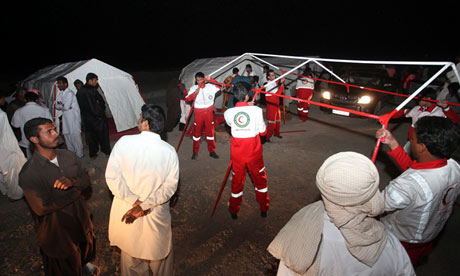
An official from Iran's Red Crescent Society told Isna that 22 search and rescue teams, including 17 rescue dogs, had been dispatched to the region.

On the Pakistan side, the situation also seemed confused.

"We have reports of three deaths near the Pakistan-Iran border in Mash Khel area of Panjgore district," said a local government official, requesting anonymity.

The official said about 40 people had been injured when wooden roofs and mud walls collapsed. The thinly populated district is one of Pakistan's most underdeveloped, with minimal telecommunication and infrastructure.

Close to magnitude 8 means a powerful quake on a level with the one that killed an estimated 68,000 people in Sichuan province, China, in 2008.

Experts said the depth of the earthquake may have saved many lives.

"The earthquake in Iran was strong but fortunately its source was quite deep, about 80km [50 miles] ... the intensity of the shaking was less than it would have been for a shallower earthquake of the same magnitude," said Dr David Rothery, chair of the Open University's volcanoes, earthquakes and tsunamis course.

Saleh Mangi, from the NGO Plan International, said he was in a meeting with staff in an office in Thatta, around 65 miles from the Pakistani port city of Karachi, when the ground shook.

"People are afraid to go back to their homes and the government is telling fishing communities not to go into the sea as that would be very dangerous," he said.

There was concern that facilities associated with Iran's nuclear programme might have been affected. But the Bushehr nuclear power plant was not damaged, said an official at Atomstroyexport, the Russian firm that built the plant.

Wednesday 17 April 2013

http://www.guardian.co.uk/world/2013/apr/17/rescuers-earthquake-iran-pakistan-border

continue reading

45 districts of Pakistan at high risk of being hit by disasters


Forty-five districts in Pakistan are at high risk of being hit by disasters, said Naunehal Shah, the head of Pakistan Poverty Alleviation Fund’s (PPAF) team on disaster management.

“An integrated approach, which includes measures to prevent disaster and to mitigate its impact, needs to be developed,” he added. He was speaking at the concluding session of a seven-day-long workshop on disaster management organised by PPAF in Hyderabad.

The National Rural Support Programme and three other Sindh-based NGOs, Thardeep Rural Development Programme (TRDP), Badin Rural Development Society (BDRS) and Sindh Agriculture and Forestry Workers Coordinating Organisation (SAFWCO), also assisted in the workshop. Twenty-eight representatives from 24 NGOs attended the closing session on developing systematic rescue, relief and rehabilitation operations to be able to deal with natural disasters.

Rescuing disaster victims

The six-member team of TRDP, whose research centred on rescue measures, felt that designating responsibilities to smaller teams made the rescue process more efficient. They had conducted a simulation project in which they had rescued two people from an imaginary flood in a village of Sanghar.

“The operation begins with obtaining the profile of a particular disaster-hit area,” said Nisar Khaskheli, the team’s leader. “This includes finding out details about its location, the number of households situated in the area and the primary means of income of its residents.” He advised that disaster management teams should establish a camp in the affected area and should mark out its territory. “They should then gather all the facts about the magnitude of the disaster and the people trapped in the area.”

He also stressed that rescue teams must be equipped with a variety of tools and machines so that they could help victims “trapped under debris or surrounded by water”.

Providing relief

Dr Veeram Kumar from BRDS’s team spoke about the process of setting temporary camps for people rescued from disasters and providing them basic goods and services. “Tents, food, water, first aid kits, lavatories and schools are indispensable features of any relief camp,” he said.

He felt that it would take at least 36 hours after any disaster had struck to provide these services to about 1,000 victims.

He also felt that assigning tasks to separate committees of stakeholders increased efficiency.

Wednesday 17 April 2013

http://tribune.com.pk/story/536475/45-districts-of-pakistan-at-high-risk-of-being-hit-by-disasters/

continue reading